SEQUENCE CONTROL
SEQUENCE CONTROL
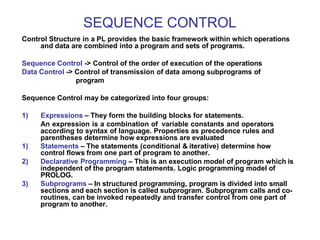
Control Structure in a PL provides the basic framework within which operations
and data are combined into a program and sets of programs.
Sequence Control -> Control of the order of execution of the operations
Data Control -> Control of transmission of data among subprograms of
program
Sequence Control may be categorized into four groups:
1) Expressions – They form the building blocks for statements.
An expression is a combination of variable constants and operators
according to syntax of language. Properties as precedence rules and
parentheses determine how expressions are evaluated
1) Statements – The statements (conditional & iterative) determine how
control flows from one part of program to another.
2) Declarative Programming – This is an execution model of program which is
independent of the program statements. Logic programming model of
PROLOG.
3) Subprograms – In structured programming, program is divided into small
sections and each section is called subprogram. Subprogram calls and co-
routines, can be invoked repeatedly and transfer control from one part of
program to another.
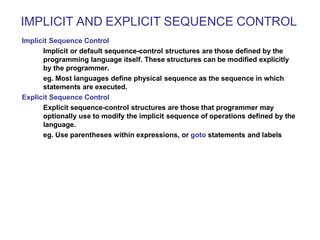
IMPLICIT AND EXPLICIT SEQUENCE CONTROL
Implicit Sequence Control
Implicit or default sequence-control structures are those defined by the
programming language itself. These structures can be modified explicitly
by the programmer.
eg. Most languages define physical sequence as the sequence in which
statements are executed.
Explicit Sequence Control
Explicit sequence-control structures are those that programmer may
optionally use to modify the implicit sequence of operations defined by the
language.
eg. Use parentheses within expressions, or goto statements and labels
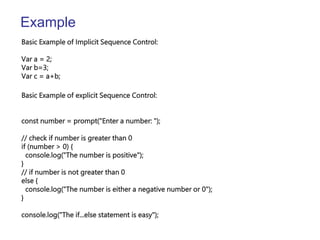
Example
Basic Example of Implicit Sequence Control:
Var a = 2;
Var b=3;
Var c = a+b;
Basic Example of explicit Sequence Control:
const number = prompt("Enter a number: ");
// check if number is greater than 0
if (number > 0) {
console.log("The number is positive");
}
// if number is not greater than 0
else {
console.log("The number is either a negative number or 0");
}
console.log("The if...else statement is easy");
Sequence Control Within Expressions
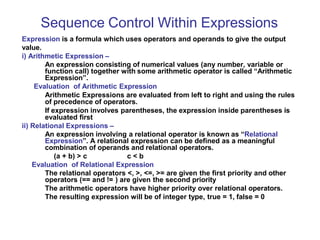
Expression is a formula which uses operators and operands to give the output
value.
i) Arithmetic Expression –
An expression consisting of numerical values (any number, variable or
function call) together with some arithmetic operator is called “Arithmetic
Expression”.
Evaluation of Arithmetic Expression
Arithmetic Expressions are evaluated from left to right and using the rules
of precedence of operators.
If expression involves parentheses, the expression inside parentheses is
evaluated first
ii) Relational Expressions –
An expression involving a relational operator is known as “Relational
Expression”. A relational expression can be defined as a meaningful
combination of operands and relational operators.
(a + b) > c c < b
Evaluation of Relational Expression
The relational operators <, >, <=, >= are given the first priority and other
operators (== and != ) are given the second priority
The arithmetic operators have higher priority over relational operators.
The resulting expression will be of integer type, true = 1, false = 0
Sequence Control Within Expressions
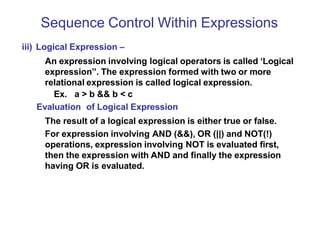
iii) Logical Expression –
An expression involving logical operators is called ‘Logical
expression”. The expression formed with two or more
relational expression is called logical expression.
Ex. a > b && b < c
Evaluation of Logical Expression
The result of a logical expression is either true or false.
For expression involving AND (&&), OR (||) and NOT(!)
operations, expression involving NOT is evaluated first,
then the expression with AND and finally the expression
having OR is evaluated.
Sequence Control Within Expressions
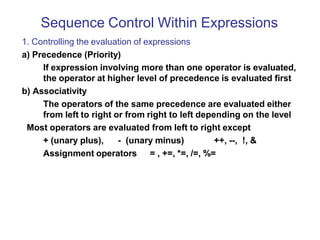
1. Controlling the evaluation of expressions
a) Precedence (Priority)
If expression involving more than one operator is evaluated,
the operator at higher level of precedence is evaluated first
b) Associativity
The operators of the same precedence are evaluated either
from left to right or from right to left depending on the level
Most operators are evaluated from left to right except
+ (unary plus), - (unary minus) ++, --, !, &
Assignment operators = , +=, *=, /=, %=
Sequence Control Within Expressions
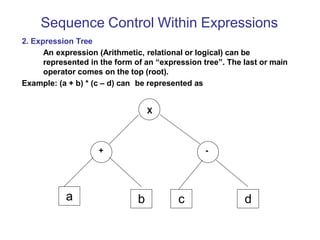
2. Expression Tree
An expression (Arithmetic, relational or logical) can be
represented in the form of an “expression tree”. The last or main
operator comes on the top (root).
Example: (a + b) * (c – d) can be represented as
X
+ -
a b d
c
Sequence Control Within Expressions
3. Syntax for Expressions
a) Prefix or Polish notation
Named after polish mathematician Jan Lukasiewicz, refers to
notation in which operator symbol is placed before its operands.
*XY, -AB, /*ab-cd
b) Postfix or reverse polish
Postfix refers to notation in which the operator symbol is placed
after its two operands.
AB*, XY-
c) Infix notation
It is most suitable for binary operation. The operator symbol
is placed between the two operands.
Sequence Control Within Expressions
4. Semantics for Expressions
Semantics determine the order of expression in which they are evaluated.
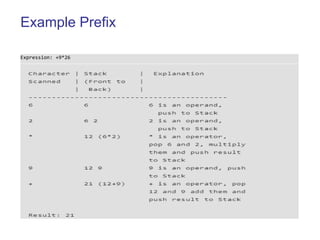
a) Evaluation of Prefix Expression
If P is an expression evaluate using stack
i) If the next item in P is an operator, push it on the stack. set the arguments
count to be number of operands needed by operator.
(if number is n, operator is n-ary operator).
ii) If the next item in P is an operand, push it on the stack
iii) If the top n entries in the stack are operand entries needed for the last n-ary
operator on the stack, apply the operator on those operands. Replace the
operator and its n operands by the result of applying that operation on the
n operands.
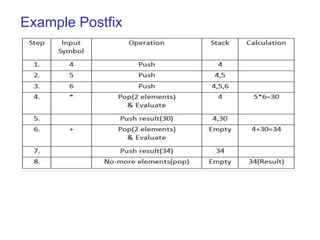
b) Evaluation of Postfix Expression
If P is an expression evaluate using stack
i) If the next item in P is an operand, push it on the stack.
ii) If the next item in P is an n-ary operator, its n arguments must be top n
items on the stack. Replace these n items by the result of applying this
operation using the n items as arguments.
Sequence Control Within Expressions
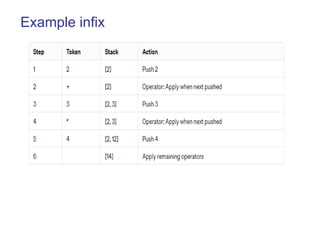
c) Evaluation of Infix Expression
Infix notation is common but its use in expression cause the problems:
i) Infix notation is suitable only for binary operations. A language cannot use
only infix notation but must combine infix and postfix (or prefix) notations.
The mixture makes translation complex.
ii) If more than one infix operator is in an expression, the notation is ambiguous
unless parentheses are used.
Example Prefix
Expression: +9*26
Example Postfix
Example infix
Sequence Control Within Expressions
5. Execution-Time Representation:
Translators evaluate the expression using a method so as to get efficient result
(optimum value at optimum time with optimum use of memory and processor).
Translation is done in two phases –
In first phase the basic tree control structure for expression is established. In next
stage whole evaluation process takes place.
The following methods are used for translation of expression –
a) Machine code sequences
Expression can be translated into machine code directly performing the two
stages (control structure establishment and evaluation) in one step.
The ordering of m/c code instructions reflect the control sequence of original
expression.
b) Tree Structure
The expressions may be executed directly in tree structure representation using a
software interpreter.
c) Prefix or postfix form
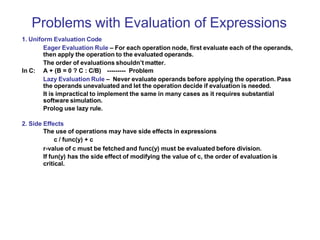
Problems with Evaluation of Expressions
1. Uniform Evaluation Code
Eager Evaluation Rule – For each operation node, first evaluate each of the operands,
then apply the operation to the evaluated operands.
The order of evaluations shouldn’t matter.
In C: A + (B = 0 ? C : C/B) --------- Problem
Lazy Evaluation Rule – Never evaluate operands before applying the operation. Pass
the operands unevaluated and let the operation decide if evaluation is needed.
It is impractical to implement the same in many cases as it requires substantial
software simulation.
Prolog use lazy rule.
2. Side Effects
The use of operations may have side effects in expressions
c / func(y) + c
r-value of c must be fetched and func(y) must be evaluated before division.
If fun(y) has the side effect of modifying the value of c, the order of evaluation is
critical.
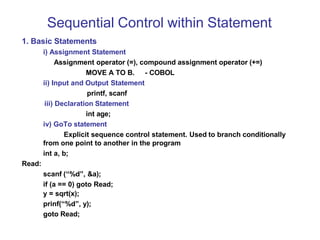
Sequential Control within Statement
1. Basic Statements
i) Assignment Statement
Assignment operator (=), compound assignment operator (+=)
MOVE A TO B. - COBOL
ii) Input and Output Statement
printf, scanf
iii) Declaration Statement
int age;
iv) GoTo statement
Explicit sequence control statement. Used to branch conditionally
from one point to another in the program
int a, b;
Read:
scanf (“%d”, &a);
if (a == 0) goto Read;
y = sqrt(x);
prinf(“%d”, y);
goto Read;
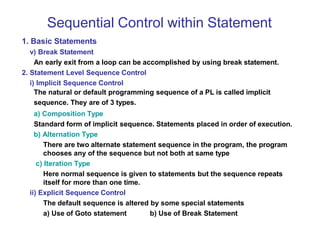
Sequential Control within Statement
1. Basic Statements
v) Break Statement
An early exit from a loop can be accomplished by using break statement.
2. Statement Level Sequence Control
i) Implicit Sequence Control
The natural or default programming sequence of a PL is called implicit
sequence. They are of 3 types.
a) Composition Type
Standard form of implicit sequence. Statements placed in order of execution.
b) Alternation Type
There are two alternate statement sequence in the program, the program
chooses any of the sequence but not both at same type
c) Iteration Type
Here normal sequence is given to statements but the sequence repeats
itself for more than one time.
ii) Explicit Sequence Control
The default sequence is altered by some special statements
a) Use of Goto statement b) Use of Break Statement
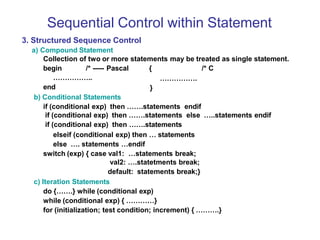
Sequential Control within Statement
3. Structured Sequence Control
a) Compound Statement
Collection of two or more statements may be treated as single statement.
begin /* ----- Pascal { /* C
…………….
……………..
end
b) Conditional Statements
}
if (conditional exp) then …….statements endif
if (conditional exp) then …….statements else …..statements endif
if (conditional exp) then …….statements
elseif (conditional exp) then … statements
else …. statements …endif
switch (exp) { case val1: …statements break;
val2: ….statetments break;
default: statements break;}
c) Iteration Statements
do {…….} while (conditional exp)
while (conditional exp) { …………}
for (initialization; test condition; increment) { ……….}
Subprogram Sequence Control
Subprogram sequence control is related to concept:
How one subprogram invokes another and called subprogram
returns to the first.
Simple Call-Return Subprograms
•
•
•
• Program is composed of single main program.
• During execution It calls various subprograms which may call
other subprograms and so on to any depth
Each subprogram returns the control to the program/subprogram
after execution
The execution of calling program is temporarily stopped during
execution of the subprogram
After the subprogram is completed, execution of the calling
program resumes at the point immediately following the call
Copy Rule
The effect of the call statement is the same as would be if the call
statement is replaced by body of subprogram (with suitable
substitution of parameters)
We use subprograms to avoid writing the same structure in program
again and again.
Subprogram Sequence Control
Simple Call-Return Subprograms
The following assumptions are made for simple call return structure
i) Subprogram can not be recursive
ii) Explicit call statements are required
iii) Subprograms must execute completely at call
iv) Immediate transfer of control at point of call or return
v) Single execution sequence for each subprogram
Subprogram Sequence Control
Two system-defined pointer variables keep track of the point at which program is
being executed.
Current Instruction Pointer (CIP)
The pointer which points to the instruction in the code segment that is
currently being executed (or just about to be) by the hardware or software
interpreter.
Current Environment Pointer (CEP)
Each activation record contains its set of local variables. The activation
record represents the “referencing environment” of the subprogram.
The pointer to current activation record is Current Execution Pointer.
Exception and Exception Handlers
Type of Bugs -
Logic Errors – Errors in program logic due to poor understanding of the
problem and solution procedure.
Syntax Errors – Errors arise due to poor understanding of the language.
Exceptions are runtime anomalies or unusual conditions that a program
may encounter while executing.
eg. Divide by zero, access to an array out of bounds, running out of
memory or disk space
When a program encounters an exceptional condition, it should be
Identified and dealt with effectively.
Exception and Exception Handlers
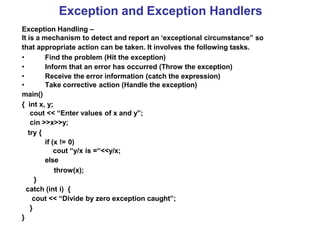
Exception Handling –
It is a mechanism to detect and report an ‘exceptional circumstance” so
that appropriate action can be taken. It involves the following tasks.
• Find the problem (Hit the exception)
• Inform that an error has occurred (Throw the exception)
• Receive the error information (catch the expression)
• Take corrective action (Handle the exception)
main()
{ int x, y;
cout << “Enter values of x and y”;
cin >>x>>y;
try {
if (x != 0)
cout “y/x is =“<<y/x;
else
throw(x);
}
catch (int i) {
cout << “Divide by zero exception caught”;
}
}
Exception and Exception Handlers
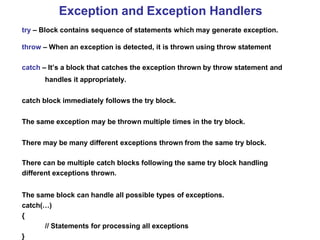
try – Block contains sequence of statements which may generate exception.
throw – When an exception is detected, it is thrown using throw statement
catch – It’s a block that catches the exception thrown by throw statement and
handles it appropriately.
catch block immediately follows the try block.
The same exception may be thrown multiple times in the try block.
There may be many different exceptions thrown from the same try block.
There can be multiple catch blocks following the same try block handling
different exceptions thrown.
The same block can handle all possible types of exceptions.
catch(…)
{
// Statements for processing all exceptions
}
Exception and Exception Handlers
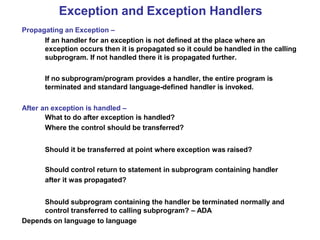
Propagating an Exception –
If an handler for an exception is not defined at the place where an
exception occurs then it is propagated so it could be handled in the calling
subprogram. If not handled there it is propagated further.
If no subprogram/program provides a handler, the entire program is
terminated and standard language-defined handler is invoked.
After an exception is handled –
What to do after exception is handled?
Where the control should be transferred?
Should it be transferred at point where exception was raised?
Should control return to statement in subprogram containing handler
after it was propagated?
Should subprogram containing the handler be terminated normally and
control transferred to calling subprogram? – ADA
Depends on language to language
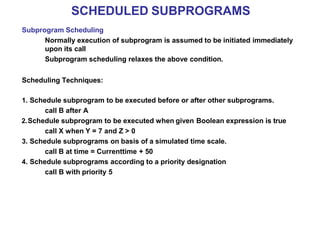
SCHEDULED SUBPROGRAMS
Subprogram Scheduling
Normally execution of subprogram is assumed to be initiated immediately
upon its call
Subprogram scheduling relaxes the above condition.
Scheduling Techniques:
1. Schedule subprogram to be executed before or after other subprograms.
call B after A
2.Schedule subprogram to be executed when given Boolean expression is true
call X when Y = 7 and Z > 0
3. Schedule subprograms on basis of a simulated time scale.
call B at time = Currenttime + 50
4. Schedule subprograms according to a priority designation
call B with priority 5
Assignment
Explain sequence control and scheduling
algorithm.
Solving prefix infix and postfix
expression.

theory of programming languages by shikra

  • 1.
  • 2.
    SEQUENCE CONTROL Control Structurein a PL provides the basic framework within which operations and data are combined into a program and sets of programs. Sequence Control -> Control of the order of execution of the operations Data Control -> Control of transmission of data among subprograms of program Sequence Control may be categorized into four groups: 1) Expressions – They form the building blocks for statements. An expression is a combination of variable constants and operators according to syntax of language. Properties as precedence rules and parentheses determine how expressions are evaluated 1) Statements – The statements (conditional & iterative) determine how control flows from one part of program to another. 2) Declarative Programming – This is an execution model of program which is independent of the program statements. Logic programming model of PROLOG. 3) Subprograms – In structured programming, program is divided into small sections and each section is called subprogram. Subprogram calls and co- routines, can be invoked repeatedly and transfer control from one part of program to another.
  • 3.
    IMPLICIT AND EXPLICITSEQUENCE CONTROL Implicit Sequence Control Implicit or default sequence-control structures are those defined by the programming language itself. These structures can be modified explicitly by the programmer. eg. Most languages define physical sequence as the sequence in which statements are executed. Explicit Sequence Control Explicit sequence-control structures are those that programmer may optionally use to modify the implicit sequence of operations defined by the language. eg. Use parentheses within expressions, or goto statements and labels
  • 4.
    Example Basic Example ofImplicit Sequence Control: Var a = 2; Var b=3; Var c = a+b; Basic Example of explicit Sequence Control: const number = prompt("Enter a number: "); // check if number is greater than 0 if (number > 0) { console.log("The number is positive"); } // if number is not greater than 0 else { console.log("The number is either a negative number or 0"); } console.log("The if...else statement is easy");
  • 5.
    Sequence Control WithinExpressions Expression is a formula which uses operators and operands to give the output value. i) Arithmetic Expression – An expression consisting of numerical values (any number, variable or function call) together with some arithmetic operator is called “Arithmetic Expression”. Evaluation of Arithmetic Expression Arithmetic Expressions are evaluated from left to right and using the rules of precedence of operators. If expression involves parentheses, the expression inside parentheses is evaluated first ii) Relational Expressions – An expression involving a relational operator is known as “Relational Expression”. A relational expression can be defined as a meaningful combination of operands and relational operators. (a + b) > c c < b Evaluation of Relational Expression The relational operators <, >, <=, >= are given the first priority and other operators (== and != ) are given the second priority The arithmetic operators have higher priority over relational operators. The resulting expression will be of integer type, true = 1, false = 0
  • 6.
    Sequence Control WithinExpressions iii) Logical Expression – An expression involving logical operators is called ‘Logical expression”. The expression formed with two or more relational expression is called logical expression. Ex. a > b && b < c Evaluation of Logical Expression The result of a logical expression is either true or false. For expression involving AND (&&), OR (||) and NOT(!) operations, expression involving NOT is evaluated first, then the expression with AND and finally the expression having OR is evaluated.
  • 7.
    Sequence Control WithinExpressions 1. Controlling the evaluation of expressions a) Precedence (Priority) If expression involving more than one operator is evaluated, the operator at higher level of precedence is evaluated first b) Associativity The operators of the same precedence are evaluated either from left to right or from right to left depending on the level Most operators are evaluated from left to right except + (unary plus), - (unary minus) ++, --, !, & Assignment operators = , +=, *=, /=, %=
  • 8.
    Sequence Control WithinExpressions 2. Expression Tree An expression (Arithmetic, relational or logical) can be represented in the form of an “expression tree”. The last or main operator comes on the top (root). Example: (a + b) * (c – d) can be represented as X + - a b d c
  • 9.
    Sequence Control WithinExpressions 3. Syntax for Expressions a) Prefix or Polish notation Named after polish mathematician Jan Lukasiewicz, refers to notation in which operator symbol is placed before its operands. *XY, -AB, /*ab-cd b) Postfix or reverse polish Postfix refers to notation in which the operator symbol is placed after its two operands. AB*, XY- c) Infix notation It is most suitable for binary operation. The operator symbol is placed between the two operands.
  • 10.
    Sequence Control WithinExpressions 4. Semantics for Expressions Semantics determine the order of expression in which they are evaluated. a) Evaluation of Prefix Expression If P is an expression evaluate using stack i) If the next item in P is an operator, push it on the stack. set the arguments count to be number of operands needed by operator. (if number is n, operator is n-ary operator). ii) If the next item in P is an operand, push it on the stack iii) If the top n entries in the stack are operand entries needed for the last n-ary operator on the stack, apply the operator on those operands. Replace the operator and its n operands by the result of applying that operation on the n operands. b) Evaluation of Postfix Expression If P is an expression evaluate using stack i) If the next item in P is an operand, push it on the stack. ii) If the next item in P is an n-ary operator, its n arguments must be top n items on the stack. Replace these n items by the result of applying this operation using the n items as arguments.
  • 11.
    Sequence Control WithinExpressions c) Evaluation of Infix Expression Infix notation is common but its use in expression cause the problems: i) Infix notation is suitable only for binary operations. A language cannot use only infix notation but must combine infix and postfix (or prefix) notations. The mixture makes translation complex. ii) If more than one infix operator is in an expression, the notation is ambiguous unless parentheses are used.
  • 12.
  • 13.
  • 14.
  • 15.
    Sequence Control WithinExpressions 5. Execution-Time Representation: Translators evaluate the expression using a method so as to get efficient result (optimum value at optimum time with optimum use of memory and processor). Translation is done in two phases – In first phase the basic tree control structure for expression is established. In next stage whole evaluation process takes place. The following methods are used for translation of expression – a) Machine code sequences Expression can be translated into machine code directly performing the two stages (control structure establishment and evaluation) in one step. The ordering of m/c code instructions reflect the control sequence of original expression. b) Tree Structure The expressions may be executed directly in tree structure representation using a software interpreter. c) Prefix or postfix form
  • 16.
    Problems with Evaluationof Expressions 1. Uniform Evaluation Code Eager Evaluation Rule – For each operation node, first evaluate each of the operands, then apply the operation to the evaluated operands. The order of evaluations shouldn’t matter. In C: A + (B = 0 ? C : C/B) --------- Problem Lazy Evaluation Rule – Never evaluate operands before applying the operation. Pass the operands unevaluated and let the operation decide if evaluation is needed. It is impractical to implement the same in many cases as it requires substantial software simulation. Prolog use lazy rule. 2. Side Effects The use of operations may have side effects in expressions c / func(y) + c r-value of c must be fetched and func(y) must be evaluated before division. If fun(y) has the side effect of modifying the value of c, the order of evaluation is critical.
  • 17.
    Sequential Control withinStatement 1. Basic Statements i) Assignment Statement Assignment operator (=), compound assignment operator (+=) MOVE A TO B. - COBOL ii) Input and Output Statement printf, scanf iii) Declaration Statement int age; iv) GoTo statement Explicit sequence control statement. Used to branch conditionally from one point to another in the program int a, b; Read: scanf (“%d”, &a); if (a == 0) goto Read; y = sqrt(x); prinf(“%d”, y); goto Read;
  • 18.
    Sequential Control withinStatement 1. Basic Statements v) Break Statement An early exit from a loop can be accomplished by using break statement. 2. Statement Level Sequence Control i) Implicit Sequence Control The natural or default programming sequence of a PL is called implicit sequence. They are of 3 types. a) Composition Type Standard form of implicit sequence. Statements placed in order of execution. b) Alternation Type There are two alternate statement sequence in the program, the program chooses any of the sequence but not both at same type c) Iteration Type Here normal sequence is given to statements but the sequence repeats itself for more than one time. ii) Explicit Sequence Control The default sequence is altered by some special statements a) Use of Goto statement b) Use of Break Statement
  • 19.
    Sequential Control withinStatement 3. Structured Sequence Control a) Compound Statement Collection of two or more statements may be treated as single statement. begin /* ----- Pascal { /* C ……………. …………….. end b) Conditional Statements } if (conditional exp) then …….statements endif if (conditional exp) then …….statements else …..statements endif if (conditional exp) then …….statements elseif (conditional exp) then … statements else …. statements …endif switch (exp) { case val1: …statements break; val2: ….statetments break; default: statements break;} c) Iteration Statements do {…….} while (conditional exp) while (conditional exp) { …………} for (initialization; test condition; increment) { ……….}
  • 20.
    Subprogram Sequence Control Subprogramsequence control is related to concept: How one subprogram invokes another and called subprogram returns to the first. Simple Call-Return Subprograms • • • • Program is composed of single main program. • During execution It calls various subprograms which may call other subprograms and so on to any depth Each subprogram returns the control to the program/subprogram after execution The execution of calling program is temporarily stopped during execution of the subprogram After the subprogram is completed, execution of the calling program resumes at the point immediately following the call Copy Rule The effect of the call statement is the same as would be if the call statement is replaced by body of subprogram (with suitable substitution of parameters) We use subprograms to avoid writing the same structure in program again and again.
  • 21.
    Subprogram Sequence Control SimpleCall-Return Subprograms The following assumptions are made for simple call return structure i) Subprogram can not be recursive ii) Explicit call statements are required iii) Subprograms must execute completely at call iv) Immediate transfer of control at point of call or return v) Single execution sequence for each subprogram
  • 22.
    Subprogram Sequence Control Twosystem-defined pointer variables keep track of the point at which program is being executed. Current Instruction Pointer (CIP) The pointer which points to the instruction in the code segment that is currently being executed (or just about to be) by the hardware or software interpreter. Current Environment Pointer (CEP) Each activation record contains its set of local variables. The activation record represents the “referencing environment” of the subprogram. The pointer to current activation record is Current Execution Pointer.
  • 23.
    Exception and ExceptionHandlers Type of Bugs - Logic Errors – Errors in program logic due to poor understanding of the problem and solution procedure. Syntax Errors – Errors arise due to poor understanding of the language. Exceptions are runtime anomalies or unusual conditions that a program may encounter while executing. eg. Divide by zero, access to an array out of bounds, running out of memory or disk space When a program encounters an exceptional condition, it should be Identified and dealt with effectively.
  • 24.
    Exception and ExceptionHandlers Exception Handling – It is a mechanism to detect and report an ‘exceptional circumstance” so that appropriate action can be taken. It involves the following tasks. • Find the problem (Hit the exception) • Inform that an error has occurred (Throw the exception) • Receive the error information (catch the expression) • Take corrective action (Handle the exception) main() { int x, y; cout << “Enter values of x and y”; cin >>x>>y; try { if (x != 0) cout “y/x is =“<<y/x; else throw(x); } catch (int i) { cout << “Divide by zero exception caught”; } }
  • 25.
    Exception and ExceptionHandlers try – Block contains sequence of statements which may generate exception. throw – When an exception is detected, it is thrown using throw statement catch – It’s a block that catches the exception thrown by throw statement and handles it appropriately. catch block immediately follows the try block. The same exception may be thrown multiple times in the try block. There may be many different exceptions thrown from the same try block. There can be multiple catch blocks following the same try block handling different exceptions thrown. The same block can handle all possible types of exceptions. catch(…) { // Statements for processing all exceptions }
  • 26.
    Exception and ExceptionHandlers Propagating an Exception – If an handler for an exception is not defined at the place where an exception occurs then it is propagated so it could be handled in the calling subprogram. If not handled there it is propagated further. If no subprogram/program provides a handler, the entire program is terminated and standard language-defined handler is invoked. After an exception is handled – What to do after exception is handled? Where the control should be transferred? Should it be transferred at point where exception was raised? Should control return to statement in subprogram containing handler after it was propagated? Should subprogram containing the handler be terminated normally and control transferred to calling subprogram? – ADA Depends on language to language
  • 27.
    SCHEDULED SUBPROGRAMS Subprogram Scheduling Normallyexecution of subprogram is assumed to be initiated immediately upon its call Subprogram scheduling relaxes the above condition. Scheduling Techniques: 1. Schedule subprogram to be executed before or after other subprograms. call B after A 2.Schedule subprogram to be executed when given Boolean expression is true call X when Y = 7 and Z > 0 3. Schedule subprograms on basis of a simulated time scale. call B at time = Currenttime + 50 4. Schedule subprograms according to a priority designation call B with priority 5
  • 28.
    Assignment Explain sequence controland scheduling algorithm. Solving prefix infix and postfix expression.