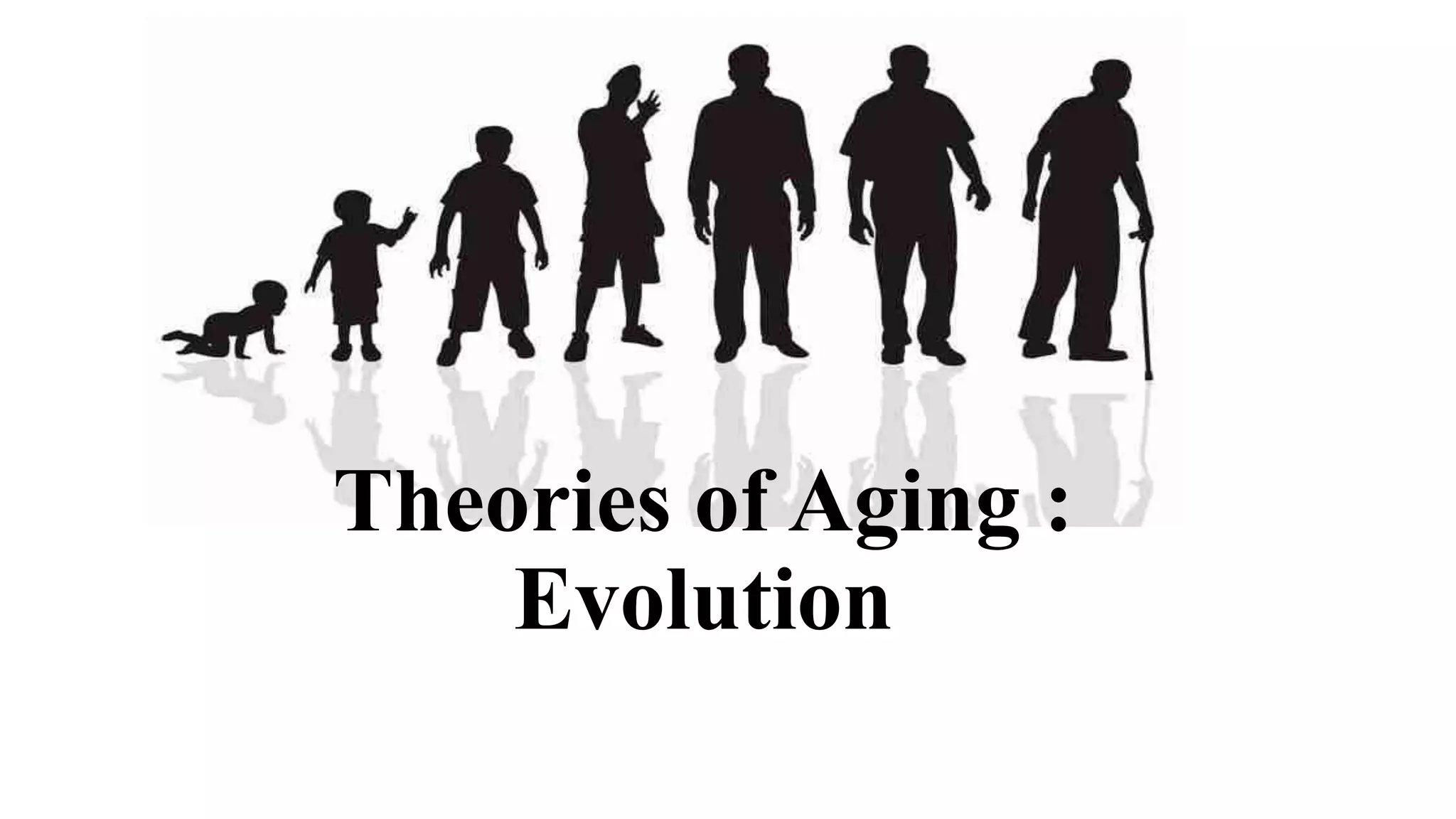
Theories of Aging :
Evolution
Introduction
Hillary Meshack
3/27/2023 Akal L. Morris 2
Introduction
 The encyclopedia Britannica (2022) describes aging as the progressive
physiological changes in an organism that lead to senescence or a decline
of biological functions and of the organism’s ability to adapt to metabolic
stress.
 Senescence is the progressive deterioration of body systems that can
increase the risk of mortality as the individual gets older (Patricia, 2019).
 The core aim of the theories of aging is to explain why we age. We will
use the ” Evolutionary theory of aging” to explain some of the aspects of
aging, since no one theory can explain each factor concerning aging.
Presenter – Joseph Maina
3/27/2023 Akal L. Morris 4
i. Evolutionary theories of aging
• Darwin (1876) describes Natural selection/ survival for the fittest as the
preservation of favorable individual differences and variations, and the
destruction of those which are more injurious.
• It ensures that the selected traits are not injurious, for if they were it would
lead to the extinction of the species.
• One of the greatest controversies that arose from his theories was on
longetivity.
• Longetivity is a great advantage to all species yet it is not always that
progenitors leave longer than their parents. People usually age and die.
• Bengston & Settersten (2016), therefore concludes that the fundamental
goal of aging theory (evolutionary) is to explain why, if natural selection
favors optimal organismal function, does aging not evolve away?
The numerous models proposed to explain the evolution of
aging are classified into:
I. Aging as an adaptation
II. Aging is a maladaptation
III. Aging is the result of constraint
3/27/2023 Akal L. Morris 6
Presenter
– Camillus
Tsuma
3/27/2023 Akal L. Morris 7
I. Adaptation
• This theory was first articulated by August Weismann. He
considers the duration of life to be dependent upon adaptation to
external conditions.
• It is governed by the needs of the species which forms the basis
of Darwin’s theory of evolution on adaptation of structures and
functions to the environmental needs of the organism.
To illustrate his theory, Weismann classified the needs into two:
A. Growth; Large animals such as Elephants take longer time as compared to
humans to reach maturity. The elephant therefore lives a longer time, around
200 years as compared to the human who lives approximately 100 years. This
is in order to ensure the preservation of species.
B. Rate at which an animal lives ; Weismann describes this as the rapidity at
which assimilation and other vital processes take place or the period needed to
achieve the aim and purpose of life. He describes the life cycle of swift-footed
animals such as antelopes which are hunted by man to satisfy his needs as
opposed to the consideration of the length of life.
3/27/2023 Akal L. Morris 9
 The theory’s weakness can be the fact that the longetivity of life in some
animals is not based on their size and rate of life. i.e., birds can live for long
in spite of having a high activity of life.
 Weismann theory on longetivity and aging concludes by suggesting that
natural selection will favor the death of the old since they consume
resources that might be put to better use by the young. Natural selection is
thus viewed as maximizing the survival of the group rather than the
individual.
• Weismann finally argues that “in regulating duration of life, the
advantage of the species, and not the individual, is alone of any
importance. This must be obvious to anyone who has once thoroughly
thought out the process of natural selection” (Weismann, 1889, p.
10).
• The problem with the theory is that it requires preexistence of aging
and does not explain the origin of senescence. Aging emerges as a
by-product of selection.
3/27/2023 Akal L. Morris 11
Presenter – Salama
Swaleh
3/27/2023 Akal L. Morris 12
II. Maladaptation
• Maladaptation focuses on the failure of natural selection to affect late
life traits and aging. Peter Medawar ( 1948,1952) suggested the
strength of selection for traits expressed at specific ages must decrease
with increasing age.
• Since natural selection operates through reproduction mutations that
have harmful effects but appear only after reproduction are passed to
future generations.
• Weak selection at a late age results in mutation buildup leading to
mutation accumulation model which suggests that selection is unable to
remove aging rather than directly select it.
3/27/2023 Akal L. Morris 13
 He argued that, “in regulating duration of life, the advantage of the
species, and not the individual, is alone of any importance. This must
be obvious to anyone who has once thoroughly thought out the process
of natural selection” (Weismann, 1889, p. 10).
 The problem with the theory is that it relies on the preexistence of
aging and does not explain the origin of senescence. Aging emerges as
a by-product of selection.
3/27/2023 Akal L. Morris 14
• Mutation accumulation model differs from the adaptive model in the
following ways:
a. Mutation accumulation does not involve any form of group
selection.
b. Mutation accumulation is able to explain aging from non aging
making it sufficient to account for evolutionary origins of aging.
3/27/2023 Akal L. Morris 15
 George Williams formulated the theory of antagonistic pleiotropy which
suggests that genes that contribute to successful reproduction early in life
might lead to harmful effects later in life.
 The harmful effects appear after reproduction and therefore cannot be
eliminated by natural selection. Example is the p53 gene that directs
damaged cells to stop reproducing.
 It prevents cancer in young people and might be partially responsible for
aging by impairing the body’s ability to renew degenerating tissues.
 Experiment with fruit flies in which only older flies were allowed to
reproduce resulted in delayed aging in the fruit fly population. The older
flies were however less fertile supporting antagonistic pleiotropy.
3/27/2023 Akal L. Morris 16
 Thomas Kirkwood formulated the disposable soma theory which suggests
organisms have to balance reproduction and the demands of maintaining
their soma.
 This explains the disparity in life spans of different organisms. Organisms
such as mice invest more energy in reproduction that health maintenance
because they are more likely to die from predation.
 The theory also explains why some organisms such as salmon reproduce
only once and die. In such cases natural selection allocates all resources to
reproduction rather than somatic maintenance.
3/27/2023 Akal L. Morris 17
Constraints
Presenter – Susan Mwangi
3/27/2023 Akal L. Morris 18
III. Constraints
 According to the theory of evolution, there are several constraints that
can limit or shape the evolutionary process. They include :
i. Natural selection:
• Natural selection is the process by which certain traits become more
common in a population over time due to their beneficial effects on
survival and reproduction. However, natural selection can only work
with the variation that is already present in a population.
• If a beneficial trait doesn't exist in a population, it can't evolve through
natural selection. Additionally, natural selection can be limited by trade-
offs between different traits. For example, a trait that provides a fitness
advantage in one environment may be a disadvantage in another.
3/27/2023 Akal L. Morris 19
ii. Genetic constraints:
• Genetic drift refers to the random fluctuations in the
frequency of alleles in a population over time. This can lead
to the loss of beneficial or neutral alleles, which can limit the
potential for new traits to evolve.
• Gene flow, or the movement of individuals or gametes
between populations, can also limit evolutionary change by
introducing new genetic material or homogenizing genetic
differences between populations.
• Mutations can provide new genetic variation, but most
mutations are either neutral or harmful, so beneficial
mutations are relatively rare.
3/27/2023 Akal L. Morris 20
iii. Developmental constraints:
• The structure and organization of an organism's body plan can limit the range of
possible phenotypes that can evolve. For example, the basic body plan of
vertebrates includes a head, trunk, and tail, which can limit the possible shapes
and sizes of these body regions.
• Additionally, the timing and duration of developmental processes can constrain
evolution. For example, the number of teeth in mammals is tightly controlled by
developmental processes, so it's difficult for new tooth types to evolve.
iii. Environmental constraints:
• Environmental factors can limit the range of traits that can be adaptive in a given
environment. For example, low light levels in deep ocean environments can limit
the range of colors that are useful for camouflage.
• Additionally, competition for resources can influence the direction and speed of
evolution. When resources are limited, organisms that are better able to compete
for those resources may be more successful, leading to the evolution of traits that
improve competition.
3/27/2023 Akal L. Morris 21
v. Historical constraints:
• The history of life on Earth can constrain evolution by setting the stage
for future evolutionary processes. For example, the extinction of certain
lineages can limit the diversity of life that can evolve in the future.
• Additionally, historical contingencies can shape the course of evolution
in unpredictable ways. For example, the evolution of humans was
influenced by a number of chance events, such as the extinction of the
dinosaurs, which allowed mammals to diversify and occupy new
ecological niches.
3/27/2023 Akal L. Morris 22
3/27/2023 Akal L. Morris 23
References
1. Simic, Petra , Guarente, Leonard P. & Rogers, 2022. "aging". Encyclopedia
Britannica. https://www.britannica.com/science/aging-life-process. Accessed
26 February 2023.
2. Patricia A. Tabloski, 2019. Gerontological Nursing: The essential guide to
clinical practice. Pearson
3. Bengtson V. & Settersten R., 2016. Handbook of theories of Aging. Springer
Publishing Company, LLC.
4. Dr. August Weismann, 1889. Essays upon heredity and kindred biological
problems. Oxford
5. American Federation for aging Research AFAR 2016 Theories of Aging
6. Natural selection: Darwin, C. (1859). On the Origin of Species by Means of
Natural Selection, or the Preservation of Favoured Races in the Struggle for
Life. John Murray.
Cont..
7. Genetic constraints: Mayr, E. (1963). Animal Species and Evolution. Belknap Press.
8. Developmental constraints: Alberch, P. (1982). Developmental constraints in
evolutionary processes. In Gould, S. J. (Ed.), The Structure of Evolutionary Theory.
Harvard University Press.
9. Environmental constraints: Endler, J. A. (1986). Natural selection in the wild.
Princeton University Press.
10. Historical constraints: Gould, S. J. (1989). Wonderful Life: The Burgess Shale and
the Nature of History. W. W. Norton & Company.
THE END

Theories of Aging.pptx

  • 1.
    Theories of Aging: Evolution
  • 2.
  • 3.
    Introduction  The encyclopediaBritannica (2022) describes aging as the progressive physiological changes in an organism that lead to senescence or a decline of biological functions and of the organism’s ability to adapt to metabolic stress.  Senescence is the progressive deterioration of body systems that can increase the risk of mortality as the individual gets older (Patricia, 2019).  The core aim of the theories of aging is to explain why we age. We will use the ” Evolutionary theory of aging” to explain some of the aspects of aging, since no one theory can explain each factor concerning aging.
  • 4.
    Presenter – JosephMaina 3/27/2023 Akal L. Morris 4
  • 5.
    i. Evolutionary theoriesof aging • Darwin (1876) describes Natural selection/ survival for the fittest as the preservation of favorable individual differences and variations, and the destruction of those which are more injurious. • It ensures that the selected traits are not injurious, for if they were it would lead to the extinction of the species. • One of the greatest controversies that arose from his theories was on longetivity. • Longetivity is a great advantage to all species yet it is not always that progenitors leave longer than their parents. People usually age and die. • Bengston & Settersten (2016), therefore concludes that the fundamental goal of aging theory (evolutionary) is to explain why, if natural selection favors optimal organismal function, does aging not evolve away?
  • 6.
    The numerous modelsproposed to explain the evolution of aging are classified into: I. Aging as an adaptation II. Aging is a maladaptation III. Aging is the result of constraint 3/27/2023 Akal L. Morris 6
  • 7.
  • 8.
    I. Adaptation • Thistheory was first articulated by August Weismann. He considers the duration of life to be dependent upon adaptation to external conditions. • It is governed by the needs of the species which forms the basis of Darwin’s theory of evolution on adaptation of structures and functions to the environmental needs of the organism.
  • 9.
    To illustrate histheory, Weismann classified the needs into two: A. Growth; Large animals such as Elephants take longer time as compared to humans to reach maturity. The elephant therefore lives a longer time, around 200 years as compared to the human who lives approximately 100 years. This is in order to ensure the preservation of species. B. Rate at which an animal lives ; Weismann describes this as the rapidity at which assimilation and other vital processes take place or the period needed to achieve the aim and purpose of life. He describes the life cycle of swift-footed animals such as antelopes which are hunted by man to satisfy his needs as opposed to the consideration of the length of life. 3/27/2023 Akal L. Morris 9
  • 10.
     The theory’sweakness can be the fact that the longetivity of life in some animals is not based on their size and rate of life. i.e., birds can live for long in spite of having a high activity of life.  Weismann theory on longetivity and aging concludes by suggesting that natural selection will favor the death of the old since they consume resources that might be put to better use by the young. Natural selection is thus viewed as maximizing the survival of the group rather than the individual.
  • 11.
    • Weismann finallyargues that “in regulating duration of life, the advantage of the species, and not the individual, is alone of any importance. This must be obvious to anyone who has once thoroughly thought out the process of natural selection” (Weismann, 1889, p. 10). • The problem with the theory is that it requires preexistence of aging and does not explain the origin of senescence. Aging emerges as a by-product of selection. 3/27/2023 Akal L. Morris 11
  • 12.
  • 13.
    II. Maladaptation • Maladaptationfocuses on the failure of natural selection to affect late life traits and aging. Peter Medawar ( 1948,1952) suggested the strength of selection for traits expressed at specific ages must decrease with increasing age. • Since natural selection operates through reproduction mutations that have harmful effects but appear only after reproduction are passed to future generations. • Weak selection at a late age results in mutation buildup leading to mutation accumulation model which suggests that selection is unable to remove aging rather than directly select it. 3/27/2023 Akal L. Morris 13
  • 14.
     He arguedthat, “in regulating duration of life, the advantage of the species, and not the individual, is alone of any importance. This must be obvious to anyone who has once thoroughly thought out the process of natural selection” (Weismann, 1889, p. 10).  The problem with the theory is that it relies on the preexistence of aging and does not explain the origin of senescence. Aging emerges as a by-product of selection. 3/27/2023 Akal L. Morris 14
  • 15.
    • Mutation accumulationmodel differs from the adaptive model in the following ways: a. Mutation accumulation does not involve any form of group selection. b. Mutation accumulation is able to explain aging from non aging making it sufficient to account for evolutionary origins of aging. 3/27/2023 Akal L. Morris 15
  • 16.
     George Williamsformulated the theory of antagonistic pleiotropy which suggests that genes that contribute to successful reproduction early in life might lead to harmful effects later in life.  The harmful effects appear after reproduction and therefore cannot be eliminated by natural selection. Example is the p53 gene that directs damaged cells to stop reproducing.  It prevents cancer in young people and might be partially responsible for aging by impairing the body’s ability to renew degenerating tissues.  Experiment with fruit flies in which only older flies were allowed to reproduce resulted in delayed aging in the fruit fly population. The older flies were however less fertile supporting antagonistic pleiotropy. 3/27/2023 Akal L. Morris 16
  • 17.
     Thomas Kirkwoodformulated the disposable soma theory which suggests organisms have to balance reproduction and the demands of maintaining their soma.  This explains the disparity in life spans of different organisms. Organisms such as mice invest more energy in reproduction that health maintenance because they are more likely to die from predation.  The theory also explains why some organisms such as salmon reproduce only once and die. In such cases natural selection allocates all resources to reproduction rather than somatic maintenance. 3/27/2023 Akal L. Morris 17
  • 18.
    Constraints Presenter – SusanMwangi 3/27/2023 Akal L. Morris 18
  • 19.
    III. Constraints  Accordingto the theory of evolution, there are several constraints that can limit or shape the evolutionary process. They include : i. Natural selection: • Natural selection is the process by which certain traits become more common in a population over time due to their beneficial effects on survival and reproduction. However, natural selection can only work with the variation that is already present in a population. • If a beneficial trait doesn't exist in a population, it can't evolve through natural selection. Additionally, natural selection can be limited by trade- offs between different traits. For example, a trait that provides a fitness advantage in one environment may be a disadvantage in another. 3/27/2023 Akal L. Morris 19
  • 20.
    ii. Genetic constraints: •Genetic drift refers to the random fluctuations in the frequency of alleles in a population over time. This can lead to the loss of beneficial or neutral alleles, which can limit the potential for new traits to evolve. • Gene flow, or the movement of individuals or gametes between populations, can also limit evolutionary change by introducing new genetic material or homogenizing genetic differences between populations. • Mutations can provide new genetic variation, but most mutations are either neutral or harmful, so beneficial mutations are relatively rare. 3/27/2023 Akal L. Morris 20
  • 21.
    iii. Developmental constraints: •The structure and organization of an organism's body plan can limit the range of possible phenotypes that can evolve. For example, the basic body plan of vertebrates includes a head, trunk, and tail, which can limit the possible shapes and sizes of these body regions. • Additionally, the timing and duration of developmental processes can constrain evolution. For example, the number of teeth in mammals is tightly controlled by developmental processes, so it's difficult for new tooth types to evolve. iii. Environmental constraints: • Environmental factors can limit the range of traits that can be adaptive in a given environment. For example, low light levels in deep ocean environments can limit the range of colors that are useful for camouflage. • Additionally, competition for resources can influence the direction and speed of evolution. When resources are limited, organisms that are better able to compete for those resources may be more successful, leading to the evolution of traits that improve competition. 3/27/2023 Akal L. Morris 21
  • 22.
    v. Historical constraints: •The history of life on Earth can constrain evolution by setting the stage for future evolutionary processes. For example, the extinction of certain lineages can limit the diversity of life that can evolve in the future. • Additionally, historical contingencies can shape the course of evolution in unpredictable ways. For example, the evolution of humans was influenced by a number of chance events, such as the extinction of the dinosaurs, which allowed mammals to diversify and occupy new ecological niches. 3/27/2023 Akal L. Morris 22
  • 23.
  • 24.
    References 1. Simic, Petra, Guarente, Leonard P. & Rogers, 2022. "aging". Encyclopedia Britannica. https://www.britannica.com/science/aging-life-process. Accessed 26 February 2023. 2. Patricia A. Tabloski, 2019. Gerontological Nursing: The essential guide to clinical practice. Pearson 3. Bengtson V. & Settersten R., 2016. Handbook of theories of Aging. Springer Publishing Company, LLC. 4. Dr. August Weismann, 1889. Essays upon heredity and kindred biological problems. Oxford 5. American Federation for aging Research AFAR 2016 Theories of Aging 6. Natural selection: Darwin, C. (1859). On the Origin of Species by Means of Natural Selection, or the Preservation of Favoured Races in the Struggle for Life. John Murray.
  • 25.
    Cont.. 7. Genetic constraints:Mayr, E. (1963). Animal Species and Evolution. Belknap Press. 8. Developmental constraints: Alberch, P. (1982). Developmental constraints in evolutionary processes. In Gould, S. J. (Ed.), The Structure of Evolutionary Theory. Harvard University Press. 9. Environmental constraints: Endler, J. A. (1986). Natural selection in the wild. Princeton University Press. 10. Historical constraints: Gould, S. J. (1989). Wonderful Life: The Burgess Shale and the Nature of History. W. W. Norton & Company.
  • 26.