Sampling
Theorem
• 1. Sampling
• - Sampling Theorem
• - Impulse Sampling
• - Natural and Flat-Top Sampling
• - Reconstruction of Signal from Samples
• - Aliasing and Effect of Under-Sampling
• - Introduction to Band-Pass Sampling
Table of Contents
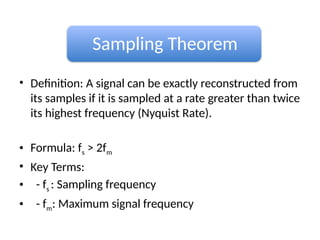
• Definition: A signal can be exactly reconstructed from
its samples if it is sampled at a rate greater than twice
its highest frequency (Nyquist Rate).
• Formula: fs > 2fm
• Key Terms:
• - fs : Sampling frequency
• - fm: Maximum signal frequency
Sampling Theorem
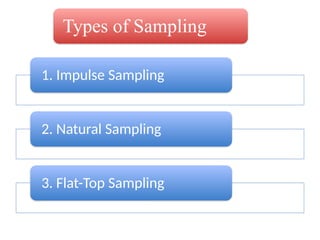
1. Impulse Sampling
2. Natural Sampling
3. Flat-Top Sampling
Types of Sampling
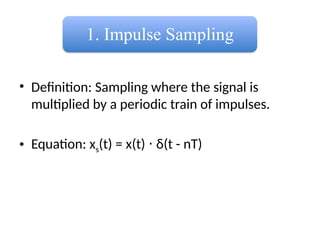
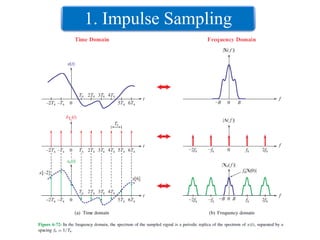
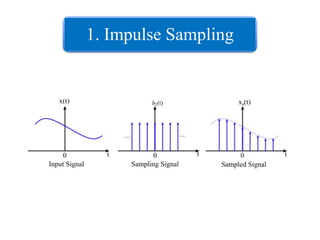
• Definition: Sampling where the signal is
multiplied by a periodic train of impulses.
• Equation: xs(t) = x(t) δ(t - nT)
⋅
1. Impulse Sampling
1. Impulse Sampling
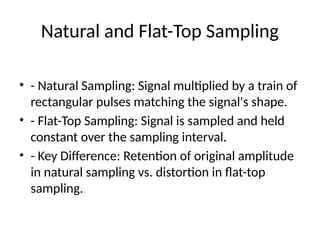
Natural and Flat-Top Sampling
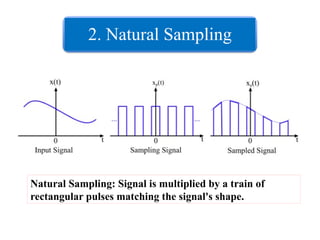
• - Natural Sampling: Signal multiplied by a train of
rectangular pulses matching the signal's shape.
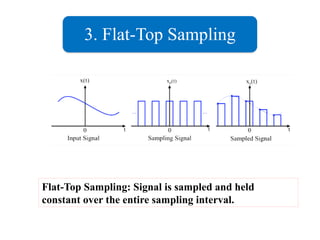
• - Flat-Top Sampling: Signal is sampled and held
constant over the sampling interval.
• - Key Difference: Retention of original amplitude
in natural sampling vs. distortion in flat-top
sampling.
1. Impulse Sampling
2. Natural Sampling
Natural Sampling: Signal is multiplied by a train of
rectangular pulses matching the signal's shape.
3. Flat-Top Sampling
Flat-Top Sampling: Signal is sampled and held
constant over the entire sampling interval.
Comparison of 3 Types of
Sampling
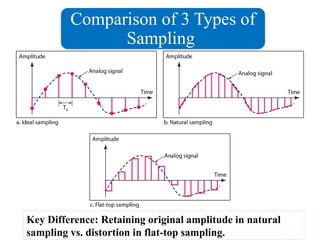
Key Difference: Retaining original amplitude in natural
sampling vs. distortion in flat-top sampling.
• Method: Low-pass filtering to reconstruct the
continuous signal.
• Conditions: Sampling frequency must meet
the Nyquist Criterion.
Reconstruction of CT Signal from Samples
• Definition: Overlapping of spectral components
caused by under-sampling.
• Effect: Distortion in reconstructed signal.
Effect of Under Sampling:
Aliasing
Introduction to Band-Pass Sampling
• Extends the Nyquist theorem for band-pass signals.
• Condition: Sampling frequency depends on the signal
bandwidth, not its maximum frequency.
• Formula: fs > 2(B), where B is the bandwidth.
• Application: Communication systems.

Theorem Signal zxCacxc Signals Sampling Theorem

  • 1.
  • 2.
    • 1. Sampling •- Sampling Theorem • - Impulse Sampling • - Natural and Flat-Top Sampling • - Reconstruction of Signal from Samples • - Aliasing and Effect of Under-Sampling • - Introduction to Band-Pass Sampling Table of Contents
  • 3.
    • Definition: Asignal can be exactly reconstructed from its samples if it is sampled at a rate greater than twice its highest frequency (Nyquist Rate). • Formula: fs > 2fm • Key Terms: • - fs : Sampling frequency • - fm: Maximum signal frequency Sampling Theorem
  • 4.
    1. Impulse Sampling 2.Natural Sampling 3. Flat-Top Sampling Types of Sampling
  • 5.
    • Definition: Samplingwhere the signal is multiplied by a periodic train of impulses. • Equation: xs(t) = x(t) δ(t - nT) ⋅ 1. Impulse Sampling
  • 6.
  • 7.
    Natural and Flat-TopSampling • - Natural Sampling: Signal multiplied by a train of rectangular pulses matching the signal's shape. • - Flat-Top Sampling: Signal is sampled and held constant over the sampling interval. • - Key Difference: Retention of original amplitude in natural sampling vs. distortion in flat-top sampling.
  • 8.
  • 9.
    2. Natural Sampling NaturalSampling: Signal is multiplied by a train of rectangular pulses matching the signal's shape.
  • 10.
    3. Flat-Top Sampling Flat-TopSampling: Signal is sampled and held constant over the entire sampling interval.
  • 11.
    Comparison of 3Types of Sampling Key Difference: Retaining original amplitude in natural sampling vs. distortion in flat-top sampling.
  • 12.
    • Method: Low-passfiltering to reconstruct the continuous signal. • Conditions: Sampling frequency must meet the Nyquist Criterion. Reconstruction of CT Signal from Samples
  • 13.
    • Definition: Overlappingof spectral components caused by under-sampling. • Effect: Distortion in reconstructed signal. Effect of Under Sampling: Aliasing
  • 14.
    Introduction to Band-PassSampling • Extends the Nyquist theorem for band-pass signals. • Condition: Sampling frequency depends on the signal bandwidth, not its maximum frequency. • Formula: fs > 2(B), where B is the bandwidth. • Application: Communication systems.