Workshop on
World Programme for the Census of Agriculture 2020
Amman, Jordan
16-19 May 2016
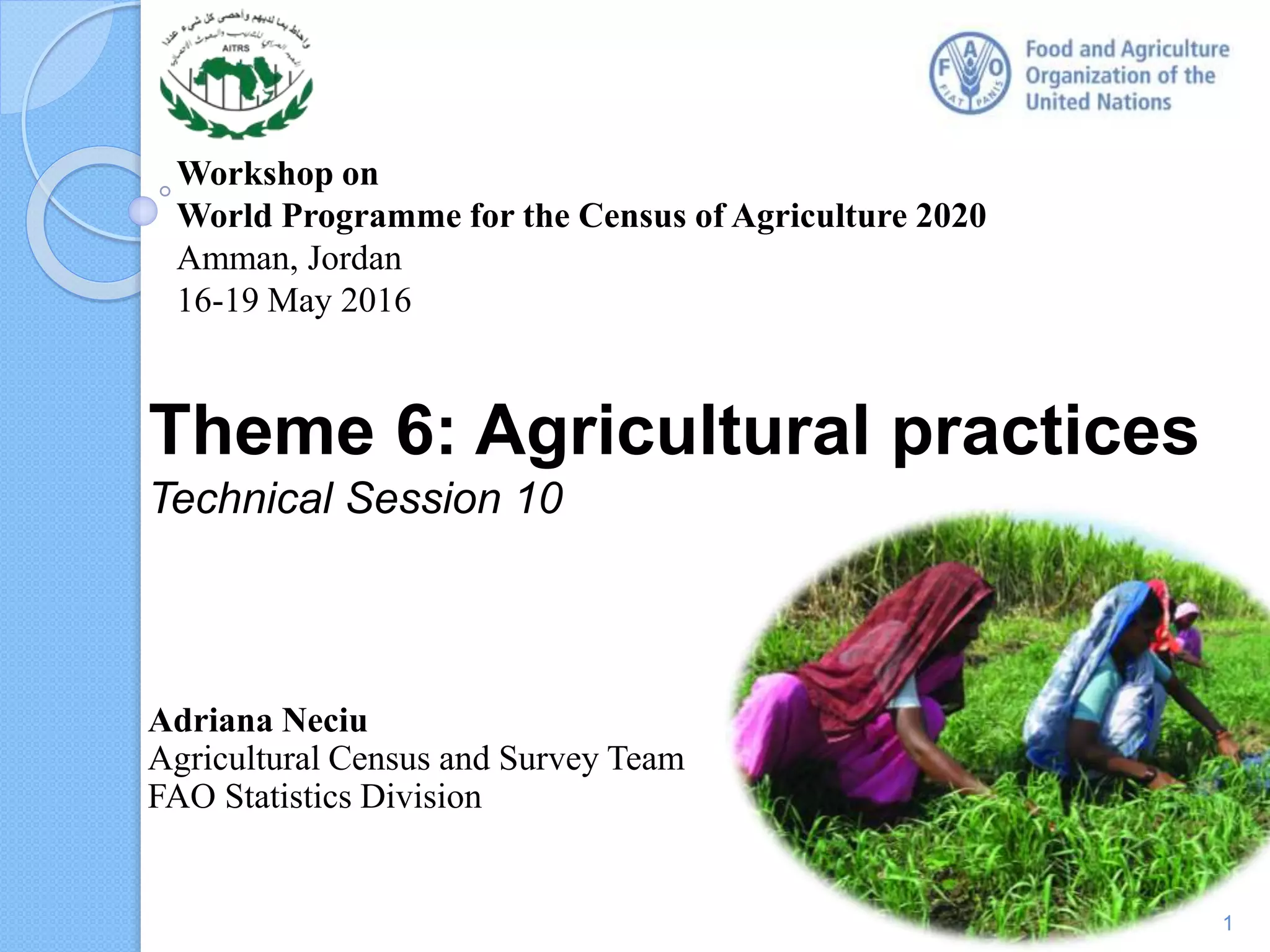
Theme 6: Agricultural practices
Technical Session 10
Adriana Neciu
Agricultural Census and Survey Team
FAO Statistics Division
1
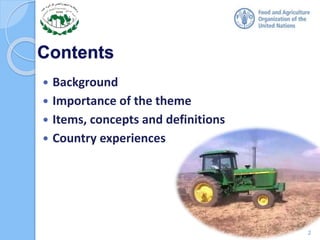
Contents
 Background
 Importance of the theme
 Items, concepts and definitions
 Country experiences
2
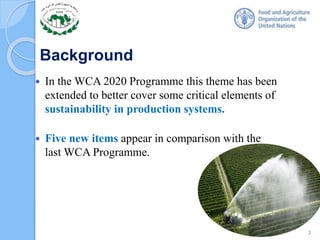
Background
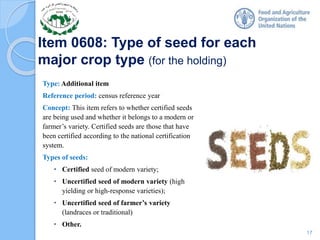
 In the WCA 2020 Programme this theme has been
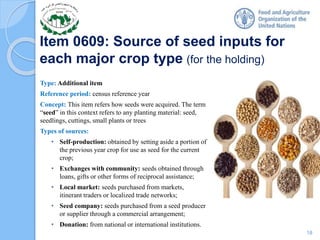
extended to better cover some critical elements of
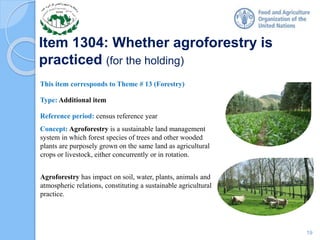
sustainability in production systems.
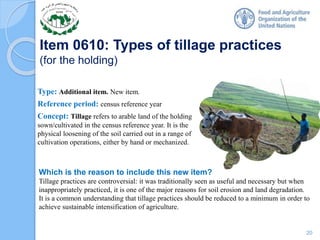
 Five new items appear in comparison with the
last WCA Programme.
3
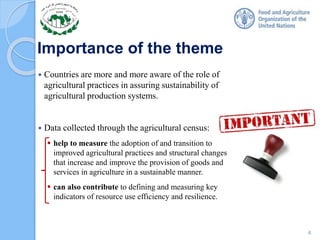
Importance of the theme
 Countries are more and more aware of the role of
agricultural practices in assuring sustainability of
agricultural production systems.
 Data collected through the agricultural census:
 help to measure the adoption of and transition to
improved agricultural practices and structural changes
that increase and improve the provision of goods and
services in agriculture in a sustainable manner.
 can also contribute to defining and measuring key
indicators of resource use efficiency and resilience.
4
Items
Theme 6 comprises 17 items:
 12 are included specifically in the theme.
 5 although related to agricultural practices, correspond to other
themes:
− Whether agroforestry is practised (Theme 13)
− Type of grazing practices (Theme 15);
− Use of each type of fertilizer (Theme 4);
− Area fertilized (Theme 4)
− Irrigation (Theme 3)
5
Items (contd.)
The 12 items specific to Theme 6 are:
0601 Use of agricultural pesticides 0607 Use of organic agricultural practices
0602 Use of genetically modified seeds 0608 Type of seed for each major crop type
0603 Use of genetically modified seeds
according to crop type
0609 Source of seed inputs for each major
crop type
0604 Selected machinery and
equipment using on the holding by
source
0610 Types of tillage practices
0605 Non-residential buildings 0611 Presence of conservation agriculture
0606 Percentage of each major
agricultural product sold
0612 Presence of soil conservation practices
6
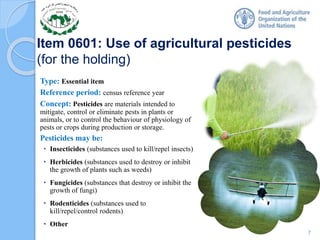
Item 0601: Use of agricultural pesticides
(for the holding)
Type: Essential item
Reference period: census reference year
Concept: Pesticides are materials intended to
mitigate, control or eliminate pests in plants or
animals, or to control the behaviour of physiology of
pests or crops during production or storage.
Pesticides may be:
• Insecticides (substances used to kill/repel insects)
• Herbicides (substances used to destroy or inhibit
the growth of plants such as weeds)
• Fungicides (substances that destroy or inhibit the
growth of fungi)
• Rodenticides (substances used to
kill/repel/control rodents)
• Other
7
Item 0602: Use of genetically modified (GM)
seeds (for the holding)
Type: Frame item and new item.
Reference period: census reference
year
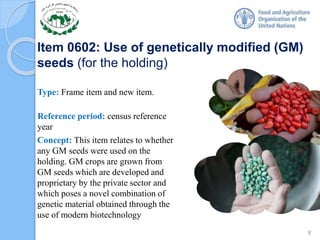
Concept: This item relates to whether
any GM seeds were used on the
holding. GM crops are grown from
GM seeds which are developed and
proprietary by the private sector and
which poses a novel combination of
genetic material obtained through the
use of modern biotechnology
8
Item 0603: Use of genetically modified (GM)
seeds according to crop type (for the holding)
Type: Additional item
Reference period: census reference year
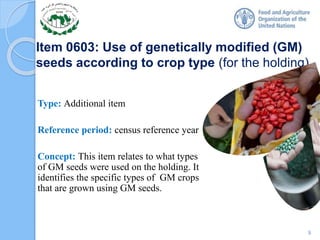
Concept: This item relates to what types
of GM seeds were used on the holding. It
identifies the specific types of GM crops
that are grown using GM seeds.
9
Item 0604: Selected machinery and
equipment used on the holding by source
(for the holding)
Type: Additional item
Reference period: census reference year
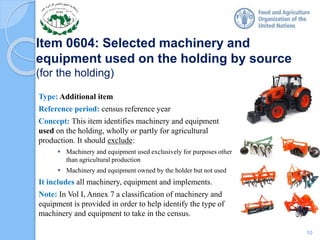
Concept: This item identifies machinery and equipment
used on the holding, wholly or partly for agricultural
production. It should exclude:
 Machinery and equipment used exclusively for purposes other
than agricultural production
 Machinery and equipment owned by the holder but not used
It includes all machinery, equipment and implements.
Note: In Vol I, Annex 7 a classification of machinery and
equipment is provided in order to help identify the type of
machinery and equipment to take in the census.
10
Item 0604: Selected machinery and
equipment used on the holding by source
(for the holding) contd.
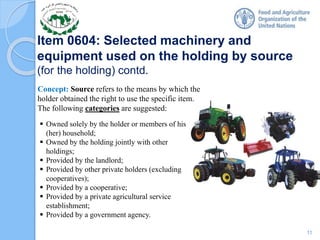
Concept: Source refers to the means by which the
holder obtained the right to use the specific item.
The following categories are suggested:
 Owned solely by the holder or members of his
(her) household;
 Owned by the holding jointly with other
holdings;
 Provided by the landlord;
 Provided by other private holders (excluding
cooperatives);
 Provided by a cooperative;
 Provided by a private agricultural service
establishment;
 Provided by a government agency.
11
Item 0605: Non-residential buildings
(for the holding)
Type: Additional item
Reference period: census reference year
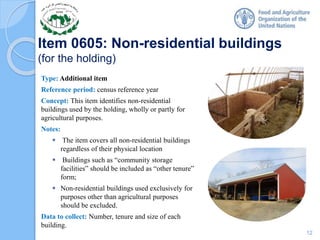
Concept: This item identifies non-residential
buildings used by the holding, wholly or partly for
agricultural purposes.
Notes:
 The item covers all non-residential buildings
regardless of their physical location
 Buildings such as “community storage
facilities” should be included as “other tenure”
form;
 Non-residential buildings used exclusively for
purposes other than agricultural purposes
should be excluded.
Data to collect: Number, tenure and size of each
building.
12
Item 0605: Non-residential buildings
(for the holding) (contd.)
Type of non-residential building:
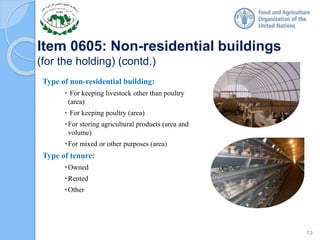
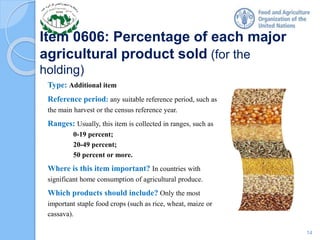
• For keeping livestock other than poultry
(area)
• For keeping poultry (area)
•For storing agricultural products (area and
volume)
•For mixed or other purposes (area)
Type of tenure:
•Owned
•Rented
•Other
13
Item 0606: Percentage of each major
agricultural product sold (for the
holding)
Type: Additional item
Reference period: any suitable reference period, such as
the main harvest or the census reference year.
Ranges: Usually, this item is collected in ranges, such as
0-19 percent;
20-49 percent;
50 percent or more.
Where is this item important? In countries with
significant home consumption of agricultural produce.
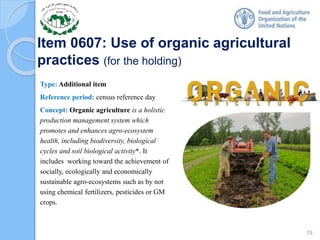
Which products should include? Only the most
important staple food crops (such as rice, wheat, maize or
cassava).
14
Item 0607: Use of organic agricultural
practices (for the holding)
Type: Additional item
Reference period: census reference day
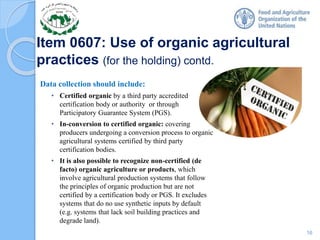
Concept: Organic agriculture is a holistic
production management system which
promotes and enhances agro-ecosystem
health, including biodiversity, biological
cycles and soil biological activity*. It
includes working toward the achievement of
socially, ecologically and economically
sustainable agro-ecosystems such as by not
using chemical fertilizers, pesticides or GM
crops.
15
Item 0607: Use of organic agricultural
practices (for the holding) contd.
Data collection should include:
• Certified organic by a third party accredited
certification body or authority or through
Participatory Guarantee System (PGS).
• In-conversion to certified organic: covering
producers undergoing a conversion process to organic
agricultural systems certified by third party
certification bodies.
• It is also possible to recognize non-certified (de
facto) organic agriculture or products, which
involve agricultural production systems that follow
the principles of organic production but are not
certified by a certification body or PGS. It excludes
systems that do no use synthetic inputs by default
(e.g. systems that lack soil building practices and
degrade land).
16
Item 0608: Type of seed for each
major crop type (for the holding)
Type: Additional item
Reference period: census reference year
Concept: This item refers to whether certified seeds
are being used and whether it belongs to a modern or
farmer’s variety. Certified seeds are those that have
been certified according to the national certification
system.
Types of seeds:
• Certified seed of modern variety;
• Uncertified seed of modern variety (high
yielding or high-response varieties);
• Uncertified seed of farmer’s variety
(landraces or traditional)
• Other.
17
Item 0609: Source of seed inputs for
each major crop type (for the holding)
Type: Additional item
Reference period: census reference year
Concept: This item refers how seeds were acquired. The term
“seed” in this context refers to any planting material: seed,
seedlings, cuttings, small plants or trees
Types of sources:
• Self-production: obtained by setting aside a portion of
the previous year crop for use as seed for the current
crop;
• Exchanges with community: seeds obtained through
loans, gifts or other forms of reciprocal assistance;
• Local market: seeds purchased from markets,
itinerant traders or localized trade networks;
• Seed company: seeds purchased from a seed producer
or supplier through a commercial arrangement;
• Donation: from national or international institutions.
18
Item 1304: Whether agroforestry is
practiced (for the holding)
This item corresponds to Theme # 13 (Forestry)
Type: Additional item
Reference period: census reference year
Concept: Agroforestry is a sustainable land management
system in which forest species of trees and other wooded
plants are purposely grown on the same land as agricultural
crops or livestock, either concurrently or in rotation.
Agroforestry has impact on soil, water, plants, animals and
atmospheric relations, constituting a sustainable agricultural
practice.
19
Item 0610: Types of tillage practices
(for the holding)
Type: Additional item. New item.
Reference period: census reference year
Concept: Tillage refers to arable land of the holding
sown/cultivated in the census reference year. It is the
physical loosening of the soil carried out in a range of
cultivation operations, either by hand or mechanized.
Which is the reason to include this new item?
Tillage practices are controversial: it was traditionally seen as useful and necessary but when
inappropriately practiced, it is one of the major reasons for soil erosion and land degradation.
It is a common understanding that tillage practices should be reduced to a minimum in order to
achieve sustainable intensification of agriculture.
20
Item 0610: Types of tillage practices
(for the holding) contd.
Types of tillage practices:
• Conventional tillage (turning over of the soil over the whole area using tillage tools or
equipment such as: mouldboard, disc plough, rotovator, etc. or traditional ploughs of
either wood or iron, drawn by animal power;
• Conservation (low) tillage which is a tillage practice or practices that leave plant
residues (at least 30-35 %) of the soil surface for erosion control and moisture
conservation. It can include:
Reduced/minimum tillage: there is no soil inversion and causes little compaction but it
leaves some ripping lines (the soil normally remains with a good cover of residues on the
surface). A ripper is usually used;
Strip tillage: strips are tilled to receive the seed and the soil along the bands is not
disturbed;
Ridge tillage: system of ridges and furrows. The ridges can be permanent or be constructed
each year.
• Zero tillage or no tillage: does not involve any tillage operations on arable land. After
the seeding operation, not more than 25% of the soil surface is allowed to be disturbed.
21
Item 0611: Presence of conservation
agriculture (for the holding)
Type: Additional item. New item
Reference period: census reference year
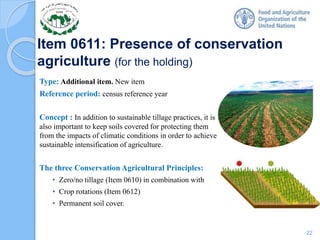
Concept : In addition to sustainable tillage practices, it is
also important to keep soils covered for protecting them
from the impacts of climatic conditions in order to achieve
sustainable intensification of agriculture.
The three Conservation Agricultural Principles:
• Zero/no tillage (Item 0610) in combination with
• Crop rotations (Item 0612)
• Permanent soil cover.
22
Item 0612: Presence of soil
conservation practices (for the holding)
Type: Additional item. New item
Reference period: census reference year
Concept : Soil conservation is a sustainable practice to
prevent and reverse soil degradation through
appropriate land use and management practices. It
includes prevention and reduction of soil erosion,
compaction and salinity, conservation or drainage of
soil water.
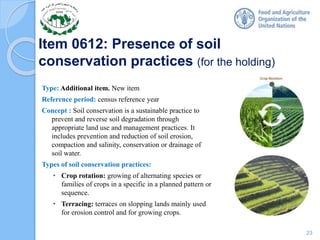
Types of soil conservation practices:
• Crop rotation: growing of alternating species or
families of crops in a specific in a planned pattern or
sequence.
• Terracing: terraces on slopping lands mainly used
for erosion control and for growing crops.
23
Item 1501: Type of animal grazing practices
(for the holding)
This item correspond to Theme # 15 (Environment, GHG
emissions).
Type: Additional item. New item
Reference period: census reference year
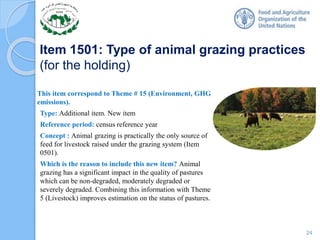
Concept : Animal grazing is practically the only source of
feed for livestock raised under the grazing system (Item
0501).
Which is the reason to include this new item? Animal
grazing has a significant impact in the quality of pastures
which can be non-degraded, moderately degraded or
severely degraded. Combining this information with Theme
5 (Livestock) improves estimation on the status of pastures.
24
Items 0411 & 0412: Use of each type of
fertilizer and area fertilized for each type of
fertilizer and major crop type (for the holding)
These items correspond to Theme # 4 (Crops).
Type:
• Use of fertilizers: Essential item.
• Area fertilized: Additional item.
Reference period: census reference year
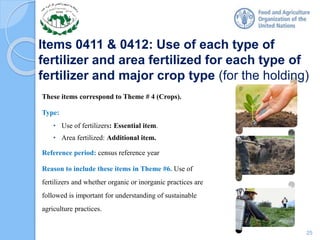
Reason to include these items in Theme #6. Use of
fertilizers and whether organic or inorganic practices are
followed is important for understanding of sustainable
agriculture practices.
25
Irrigation
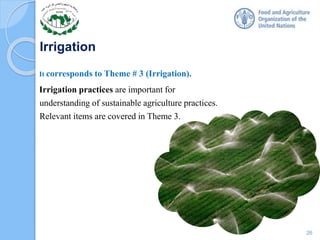
It corresponds to Theme # 3 (Irrigation).
Irrigation practices are important for
understanding of sustainable agriculture practices.
Relevant items are covered in Theme 3.
26
Country experiences
Mexico, Census of agriculture and forestry 2007.
In each section of the questionnaire, information on agricultural practices is collected
according with the following detail:
Agriculture
• Area with organic cultivation for each
reported crop;
• Irrigation;
• Machinery and equipment;
• Use of each type of fertilizers;
• Seeds: use of improved seeds and/or
GM seeds;
• Use and type of agricultural pesticides;
• Whether biological pest control was
practiced;
• Whether crop rotation is practiced;
• Type of agricultural facilities used.
Forestry
• Whether agro-forestry is practiced;
• Use and type of agricultural pesticides;
• Whether biological pest control was
practiced;
27
Country experiences
Source and variety of seeds/plants;
• Use of fertilizers by type and quantity used;
• Use of pesticides by type and quantity used;
• Irrigation
Bangladesh, Census of agriculture 2008
The questionnaire of the supplementary module used with the modular approach
included the following questions referred to agricultural practices:
28
MANY THANKS
29

Theme 6 – Agricultural Practices : Technical Session 10

  • 1.
    Workshop on World Programmefor the Census of Agriculture 2020 Amman, Jordan 16-19 May 2016 Theme 6: Agricultural practices Technical Session 10 Adriana Neciu Agricultural Census and Survey Team FAO Statistics Division 1
  • 2.
    Contents  Background  Importanceof the theme  Items, concepts and definitions  Country experiences 2
  • 3.
    Background  In theWCA 2020 Programme this theme has been extended to better cover some critical elements of sustainability in production systems.  Five new items appear in comparison with the last WCA Programme. 3
  • 4.
    Importance of thetheme  Countries are more and more aware of the role of agricultural practices in assuring sustainability of agricultural production systems.  Data collected through the agricultural census:  help to measure the adoption of and transition to improved agricultural practices and structural changes that increase and improve the provision of goods and services in agriculture in a sustainable manner.  can also contribute to defining and measuring key indicators of resource use efficiency and resilience. 4
  • 5.
    Items Theme 6 comprises17 items:  12 are included specifically in the theme.  5 although related to agricultural practices, correspond to other themes: − Whether agroforestry is practised (Theme 13) − Type of grazing practices (Theme 15); − Use of each type of fertilizer (Theme 4); − Area fertilized (Theme 4) − Irrigation (Theme 3) 5
  • 6.
    Items (contd.) The 12items specific to Theme 6 are: 0601 Use of agricultural pesticides 0607 Use of organic agricultural practices 0602 Use of genetically modified seeds 0608 Type of seed for each major crop type 0603 Use of genetically modified seeds according to crop type 0609 Source of seed inputs for each major crop type 0604 Selected machinery and equipment using on the holding by source 0610 Types of tillage practices 0605 Non-residential buildings 0611 Presence of conservation agriculture 0606 Percentage of each major agricultural product sold 0612 Presence of soil conservation practices 6
  • 7.
    Item 0601: Useof agricultural pesticides (for the holding) Type: Essential item Reference period: census reference year Concept: Pesticides are materials intended to mitigate, control or eliminate pests in plants or animals, or to control the behaviour of physiology of pests or crops during production or storage. Pesticides may be: • Insecticides (substances used to kill/repel insects) • Herbicides (substances used to destroy or inhibit the growth of plants such as weeds) • Fungicides (substances that destroy or inhibit the growth of fungi) • Rodenticides (substances used to kill/repel/control rodents) • Other 7
  • 8.
    Item 0602: Useof genetically modified (GM) seeds (for the holding) Type: Frame item and new item. Reference period: census reference year Concept: This item relates to whether any GM seeds were used on the holding. GM crops are grown from GM seeds which are developed and proprietary by the private sector and which poses a novel combination of genetic material obtained through the use of modern biotechnology 8
  • 9.
    Item 0603: Useof genetically modified (GM) seeds according to crop type (for the holding) Type: Additional item Reference period: census reference year Concept: This item relates to what types of GM seeds were used on the holding. It identifies the specific types of GM crops that are grown using GM seeds. 9
  • 10.
    Item 0604: Selectedmachinery and equipment used on the holding by source (for the holding) Type: Additional item Reference period: census reference year Concept: This item identifies machinery and equipment used on the holding, wholly or partly for agricultural production. It should exclude:  Machinery and equipment used exclusively for purposes other than agricultural production  Machinery and equipment owned by the holder but not used It includes all machinery, equipment and implements. Note: In Vol I, Annex 7 a classification of machinery and equipment is provided in order to help identify the type of machinery and equipment to take in the census. 10
  • 11.
    Item 0604: Selectedmachinery and equipment used on the holding by source (for the holding) contd. Concept: Source refers to the means by which the holder obtained the right to use the specific item. The following categories are suggested:  Owned solely by the holder or members of his (her) household;  Owned by the holding jointly with other holdings;  Provided by the landlord;  Provided by other private holders (excluding cooperatives);  Provided by a cooperative;  Provided by a private agricultural service establishment;  Provided by a government agency. 11
  • 12.
    Item 0605: Non-residentialbuildings (for the holding) Type: Additional item Reference period: census reference year Concept: This item identifies non-residential buildings used by the holding, wholly or partly for agricultural purposes. Notes:  The item covers all non-residential buildings regardless of their physical location  Buildings such as “community storage facilities” should be included as “other tenure” form;  Non-residential buildings used exclusively for purposes other than agricultural purposes should be excluded. Data to collect: Number, tenure and size of each building. 12
  • 13.
    Item 0605: Non-residentialbuildings (for the holding) (contd.) Type of non-residential building: • For keeping livestock other than poultry (area) • For keeping poultry (area) •For storing agricultural products (area and volume) •For mixed or other purposes (area) Type of tenure: •Owned •Rented •Other 13
  • 14.
    Item 0606: Percentageof each major agricultural product sold (for the holding) Type: Additional item Reference period: any suitable reference period, such as the main harvest or the census reference year. Ranges: Usually, this item is collected in ranges, such as 0-19 percent; 20-49 percent; 50 percent or more. Where is this item important? In countries with significant home consumption of agricultural produce. Which products should include? Only the most important staple food crops (such as rice, wheat, maize or cassava). 14
  • 15.
    Item 0607: Useof organic agricultural practices (for the holding) Type: Additional item Reference period: census reference day Concept: Organic agriculture is a holistic production management system which promotes and enhances agro-ecosystem health, including biodiversity, biological cycles and soil biological activity*. It includes working toward the achievement of socially, ecologically and economically sustainable agro-ecosystems such as by not using chemical fertilizers, pesticides or GM crops. 15
  • 16.
    Item 0607: Useof organic agricultural practices (for the holding) contd. Data collection should include: • Certified organic by a third party accredited certification body or authority or through Participatory Guarantee System (PGS). • In-conversion to certified organic: covering producers undergoing a conversion process to organic agricultural systems certified by third party certification bodies. • It is also possible to recognize non-certified (de facto) organic agriculture or products, which involve agricultural production systems that follow the principles of organic production but are not certified by a certification body or PGS. It excludes systems that do no use synthetic inputs by default (e.g. systems that lack soil building practices and degrade land). 16
  • 17.
    Item 0608: Typeof seed for each major crop type (for the holding) Type: Additional item Reference period: census reference year Concept: This item refers to whether certified seeds are being used and whether it belongs to a modern or farmer’s variety. Certified seeds are those that have been certified according to the national certification system. Types of seeds: • Certified seed of modern variety; • Uncertified seed of modern variety (high yielding or high-response varieties); • Uncertified seed of farmer’s variety (landraces or traditional) • Other. 17
  • 18.
    Item 0609: Sourceof seed inputs for each major crop type (for the holding) Type: Additional item Reference period: census reference year Concept: This item refers how seeds were acquired. The term “seed” in this context refers to any planting material: seed, seedlings, cuttings, small plants or trees Types of sources: • Self-production: obtained by setting aside a portion of the previous year crop for use as seed for the current crop; • Exchanges with community: seeds obtained through loans, gifts or other forms of reciprocal assistance; • Local market: seeds purchased from markets, itinerant traders or localized trade networks; • Seed company: seeds purchased from a seed producer or supplier through a commercial arrangement; • Donation: from national or international institutions. 18
  • 19.
    Item 1304: Whetheragroforestry is practiced (for the holding) This item corresponds to Theme # 13 (Forestry) Type: Additional item Reference period: census reference year Concept: Agroforestry is a sustainable land management system in which forest species of trees and other wooded plants are purposely grown on the same land as agricultural crops or livestock, either concurrently or in rotation. Agroforestry has impact on soil, water, plants, animals and atmospheric relations, constituting a sustainable agricultural practice. 19
  • 20.
    Item 0610: Typesof tillage practices (for the holding) Type: Additional item. New item. Reference period: census reference year Concept: Tillage refers to arable land of the holding sown/cultivated in the census reference year. It is the physical loosening of the soil carried out in a range of cultivation operations, either by hand or mechanized. Which is the reason to include this new item? Tillage practices are controversial: it was traditionally seen as useful and necessary but when inappropriately practiced, it is one of the major reasons for soil erosion and land degradation. It is a common understanding that tillage practices should be reduced to a minimum in order to achieve sustainable intensification of agriculture. 20
  • 21.
    Item 0610: Typesof tillage practices (for the holding) contd. Types of tillage practices: • Conventional tillage (turning over of the soil over the whole area using tillage tools or equipment such as: mouldboard, disc plough, rotovator, etc. or traditional ploughs of either wood or iron, drawn by animal power; • Conservation (low) tillage which is a tillage practice or practices that leave plant residues (at least 30-35 %) of the soil surface for erosion control and moisture conservation. It can include: Reduced/minimum tillage: there is no soil inversion and causes little compaction but it leaves some ripping lines (the soil normally remains with a good cover of residues on the surface). A ripper is usually used; Strip tillage: strips are tilled to receive the seed and the soil along the bands is not disturbed; Ridge tillage: system of ridges and furrows. The ridges can be permanent or be constructed each year. • Zero tillage or no tillage: does not involve any tillage operations on arable land. After the seeding operation, not more than 25% of the soil surface is allowed to be disturbed. 21
  • 22.
    Item 0611: Presenceof conservation agriculture (for the holding) Type: Additional item. New item Reference period: census reference year Concept : In addition to sustainable tillage practices, it is also important to keep soils covered for protecting them from the impacts of climatic conditions in order to achieve sustainable intensification of agriculture. The three Conservation Agricultural Principles: • Zero/no tillage (Item 0610) in combination with • Crop rotations (Item 0612) • Permanent soil cover. 22
  • 23.
    Item 0612: Presenceof soil conservation practices (for the holding) Type: Additional item. New item Reference period: census reference year Concept : Soil conservation is a sustainable practice to prevent and reverse soil degradation through appropriate land use and management practices. It includes prevention and reduction of soil erosion, compaction and salinity, conservation or drainage of soil water. Types of soil conservation practices: • Crop rotation: growing of alternating species or families of crops in a specific in a planned pattern or sequence. • Terracing: terraces on slopping lands mainly used for erosion control and for growing crops. 23
  • 24.
    Item 1501: Typeof animal grazing practices (for the holding) This item correspond to Theme # 15 (Environment, GHG emissions). Type: Additional item. New item Reference period: census reference year Concept : Animal grazing is practically the only source of feed for livestock raised under the grazing system (Item 0501). Which is the reason to include this new item? Animal grazing has a significant impact in the quality of pastures which can be non-degraded, moderately degraded or severely degraded. Combining this information with Theme 5 (Livestock) improves estimation on the status of pastures. 24
  • 25.
    Items 0411 &0412: Use of each type of fertilizer and area fertilized for each type of fertilizer and major crop type (for the holding) These items correspond to Theme # 4 (Crops). Type: • Use of fertilizers: Essential item. • Area fertilized: Additional item. Reference period: census reference year Reason to include these items in Theme #6. Use of fertilizers and whether organic or inorganic practices are followed is important for understanding of sustainable agriculture practices. 25
  • 26.
    Irrigation It corresponds toTheme # 3 (Irrigation). Irrigation practices are important for understanding of sustainable agriculture practices. Relevant items are covered in Theme 3. 26
  • 27.
    Country experiences Mexico, Censusof agriculture and forestry 2007. In each section of the questionnaire, information on agricultural practices is collected according with the following detail: Agriculture • Area with organic cultivation for each reported crop; • Irrigation; • Machinery and equipment; • Use of each type of fertilizers; • Seeds: use of improved seeds and/or GM seeds; • Use and type of agricultural pesticides; • Whether biological pest control was practiced; • Whether crop rotation is practiced; • Type of agricultural facilities used. Forestry • Whether agro-forestry is practiced; • Use and type of agricultural pesticides; • Whether biological pest control was practiced; 27
  • 28.
    Country experiences Source andvariety of seeds/plants; • Use of fertilizers by type and quantity used; • Use of pesticides by type and quantity used; • Irrigation Bangladesh, Census of agriculture 2008 The questionnaire of the supplementary module used with the modular approach included the following questions referred to agricultural practices: 28
  • 29.

Editor's Notes

  • #11 Examples are: harvesters, tractors, complex machinery, animal powered equipment, hand tools. It includes all type but the main interest centres on farm mechanizatio
  • #12 Examples are: harvesters, tractors, complex machinery, animal powered equipment, hand tools. It includes all type but the main interest centres on farm mechanizatio
  • #14 Identification in the category “For storing agricultural products (area or volume)” together with the detailed categories of Item 0107 “Main purpose of production of the holding” can be used to develop a frame of holdings for a more detailed survey of farm food stocks for sale. For instance, it would allow development of a frame of grain producers entering into the market – that is, holdings with storage facilities producing mainly for sale or mainly for own consumption with some sales, while identifying the capacity of the storage facility. When intended for the purpose of creating a frame for a detailed stocks survey, the following more detailed categories are recommended for the category “For storing agricultural products (area or volume)” in order to identify the relevant types of storage facilities used by the holding :   ‹ For grain crops (area or volume) ‹ For root crops (area or volume) ‹ For fruit and vegetable crops (area or volume) ‹ For livestock products (area or volume) ‹ For other agricultural products (area or volume)
  • #16 What is organic agriculture? According to the Codex definition adopted by the Codex Alimentarius Commission FAO/WHO – Codex Alimantarius Commission 1999 http://www.fao.org/organicag/oa-faq/oa-faq1/en/ http://www.fao.org/docrep/meeting/X0075e.htm Most recently, the Codex Committee on Food Labelling has debated "Draft Guidelines for the Production, Processing, Labelling and Marketing of Organically Produced Foods"; adoption of a single definition for organic agriculture by the Codex Alimentarius Commission is expected at its next meeting in June, 1999. According to the proposed Codex definition, "organic agriculture is a holistic production management system which promotes and enhances agro-ecosystem health, including biodiversity, biological cycles, and soil biological activity. It emphasises the use of management practices in preference to the use of off-farm inputs, taking into account that regional conditions require locally adapted systems. This is accomplished by using, where possible, agronomic, biological, and mechanical methods, as opposed to using synthetic materials, to fulfil any specific function within the system." 7. Organic agriculture is one of several approaches to sustainable agriculture and many of the techniques used (e.g. inter-cropping, rotation of crops, double-digging, mulching, integration of crops and livestock) are practised under various agricultural systems. What makes organic agriculture unique, as regulated under various laws and certification programmes, is that: (1) almost all synthetic inputs are prohibited,3 and (2) `soil building' crop rotations are mandated.4
  • #23 When covered, soils are better protected from the physical impact of water, wind and direct insolation (exposure to the sun). Soils can be covered with previous-crop residues or cover crops, which also increase biomass. This farming practice is one of the best ways to turn agricultural land into a carbon sink.
  • #24 Where feasible, information on the percentage of land area under each type of soil conservation should be taken. Other activies related to crop cover apply to soil conservation but are no recommended for collection during the census.