Donna Milgram’s desire to foster
female success in traditionally male-
dominated fields led her to found
a national institute. In an exclusive
interview, she talks openly about
the Institute’s belief in the potential
of women to enhance STEM and
its important work to ensure they
occupy a prominent place within the
science and technology landscape.
FORMING THE
COMPLETE
PICTURE
International
Innovation
showcases the
most exciting research
highlights and interviews
published in recent
editions, available
open-access online
BEAUTIFUL
SCIENCE
IMAGE
ANALYSIS
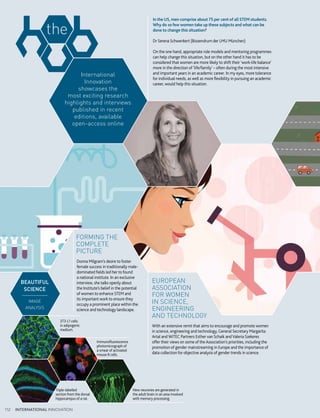
Immunofluorescence
photomicrograph of
a smear of activated
mouse B cells.
Triple-labelled 	
section from the dorsal
hippocampus of a rat.
3T3-L1 cells
in adipogenic
medium.
New neurones are generated in
the adult brain in an area involved
with memory processing.
With an extensive remit that aims to encourage and promote women
in science, engineering and technology, General Secretary Margarita
Artal and WiTEC Partners Esther van Schaik andValeria Szekeres
offer their views on some of the Association’s priorities, including the
promotion of gender mainstreaming in Europe and the importance of
data collection for objective analysis of gender trends in science.
EUROPEAN
ASSOCIATION
FOR WOMEN
IN SCIENCE,
ENGINEERING
AND TECHNOLOGY
In the US, men comprise about 75 per cent of all STEM students.
Why do so few women take up these subjects and what can be
done to change this situation?
Dr Serena Schwenkert (Biozendrum der LMU München)
On the one hand, appropriate role models and mentoring programmes
can help change this situation, but on the other hand it has to be
considered that women are more likely to shift their ‘work-life balance’
more in the direction of ‘life/family’ – often during the most intensive
and important years in an academic career. In my eyes, more tolerance
for individual needs, as well as more flexibility in pursuing an academic
career, would help this situation.
	 112	 INTERNATIONAL INNOVATION
A TOXIC CASCADE THE GENE REGULATORS
MECHANISMS OF SPATIAL
REPRESENTATION
DECIPHERING 	
THE EPIGENOME
Muscle plasticity and
mitochondrial adaptation to
exercise is the topic of interest
for a group of researchers at
the Muscle Research Centre
in York University, Canada.
Mitochondrial biogenesis is
adaptable, meaning numbers
of these cellular powerhouses
can increase by 50-100 per cent,
depending on exercise.The team
has discovered that older people
are less able to adapt their levels
of mitochondria as a result of
several molecular pathways that
slow molecular development in
ageing individuals.
RNA programmable CRISPR-
Cas9 is a new genome editing
tool developed to allow faster
and more flexible genetic
engineering of bacteria, plant
and animal DNA. By utilising
RNA molecules to drive the
DNA-splitting enzyme Cas9, a
multinational team has enabled
programmable splitting of
DNA. The tool, developed by
researchers in Sweden, Germany
and the US, is offering exciting
new biotechnological and
biomedical applications.
How the brain encodes and
retrieves memories has puzzled
philosophers and neuroscientists
alike for centuries. Scientists
from McMaster University,
Canada, at the cutting-edge of
computational psychological
research, have developed a
new model of allocentric and
egocentric reference frames
used by the brain to determine
object location, dependent and
independent of human location,
which are encoded into memory
by the hippocampus.
Professor Giuseppe Macino
is Director of EPIGEN, an
ambitious project that forms
an innovative network of
Italian laboratories. Together
with Professor Giuseppe
Testa, coordinator of the
dissemination and healthcare
policy programme, and the
project’s manager, Dr Cecilia
Poli, he aims to further
understand epigenetic
mechanisms and their
contribution to various
human diseases.
Calcium plays an important role in
intracellular signalling, and when
homeostatic balance is disrupted,
neuronal function is inhibited. Scientists
at the University of Manitoba, Canada,
have been studying the effect of calcium-
transporting gateways on neurons and
neurodegenerative diseases. Novel
experiments have elucidated some key
findings; pannexin channels (which
transport calcium) are linked toTRPM2
receptors, and suppression ofTRPM7
proteins creates resistance to neuronal
death after brain ischaemia, thereby
preserving neuronal function.
CELLULAR POWERHOUSEA PEPTIDE TO TREAT
HUNTINGTON’S DISEASE
Huntington’s disease (HD) is a
genetic disorder which causes neural
stress leading to neurodegeneration.
Research at the Institut de Genomique
Fonctionnelle, France, has offered
new hope for treating HD with the
discovery of a new peptide – P42 –
which effectively blocks PolyQ-Htt
driven aggregation which leads to
neural dysfunction.
	 WWW.RESEARCHMEDIA.EU	113

TheHub_EX18_00

  • 1.
    Donna Milgram’s desireto foster female success in traditionally male- dominated fields led her to found a national institute. In an exclusive interview, she talks openly about the Institute’s belief in the potential of women to enhance STEM and its important work to ensure they occupy a prominent place within the science and technology landscape. FORMING THE COMPLETE PICTURE International Innovation showcases the most exciting research highlights and interviews published in recent editions, available open-access online BEAUTIFUL SCIENCE IMAGE ANALYSIS Immunofluorescence photomicrograph of a smear of activated mouse B cells. Triple-labelled section from the dorsal hippocampus of a rat. 3T3-L1 cells in adipogenic medium. New neurones are generated in the adult brain in an area involved with memory processing. With an extensive remit that aims to encourage and promote women in science, engineering and technology, General Secretary Margarita Artal and WiTEC Partners Esther van Schaik andValeria Szekeres offer their views on some of the Association’s priorities, including the promotion of gender mainstreaming in Europe and the importance of data collection for objective analysis of gender trends in science. EUROPEAN ASSOCIATION FOR WOMEN IN SCIENCE, ENGINEERING AND TECHNOLOGY In the US, men comprise about 75 per cent of all STEM students. Why do so few women take up these subjects and what can be done to change this situation? Dr Serena Schwenkert (Biozendrum der LMU München) On the one hand, appropriate role models and mentoring programmes can help change this situation, but on the other hand it has to be considered that women are more likely to shift their ‘work-life balance’ more in the direction of ‘life/family’ – often during the most intensive and important years in an academic career. In my eyes, more tolerance for individual needs, as well as more flexibility in pursuing an academic career, would help this situation. 112 INTERNATIONAL INNOVATION
  • 2.
    A TOXIC CASCADETHE GENE REGULATORS MECHANISMS OF SPATIAL REPRESENTATION DECIPHERING THE EPIGENOME Muscle plasticity and mitochondrial adaptation to exercise is the topic of interest for a group of researchers at the Muscle Research Centre in York University, Canada. Mitochondrial biogenesis is adaptable, meaning numbers of these cellular powerhouses can increase by 50-100 per cent, depending on exercise.The team has discovered that older people are less able to adapt their levels of mitochondria as a result of several molecular pathways that slow molecular development in ageing individuals. RNA programmable CRISPR- Cas9 is a new genome editing tool developed to allow faster and more flexible genetic engineering of bacteria, plant and animal DNA. By utilising RNA molecules to drive the DNA-splitting enzyme Cas9, a multinational team has enabled programmable splitting of DNA. The tool, developed by researchers in Sweden, Germany and the US, is offering exciting new biotechnological and biomedical applications. How the brain encodes and retrieves memories has puzzled philosophers and neuroscientists alike for centuries. Scientists from McMaster University, Canada, at the cutting-edge of computational psychological research, have developed a new model of allocentric and egocentric reference frames used by the brain to determine object location, dependent and independent of human location, which are encoded into memory by the hippocampus. Professor Giuseppe Macino is Director of EPIGEN, an ambitious project that forms an innovative network of Italian laboratories. Together with Professor Giuseppe Testa, coordinator of the dissemination and healthcare policy programme, and the project’s manager, Dr Cecilia Poli, he aims to further understand epigenetic mechanisms and their contribution to various human diseases. Calcium plays an important role in intracellular signalling, and when homeostatic balance is disrupted, neuronal function is inhibited. Scientists at the University of Manitoba, Canada, have been studying the effect of calcium- transporting gateways on neurons and neurodegenerative diseases. Novel experiments have elucidated some key findings; pannexin channels (which transport calcium) are linked toTRPM2 receptors, and suppression ofTRPM7 proteins creates resistance to neuronal death after brain ischaemia, thereby preserving neuronal function. CELLULAR POWERHOUSEA PEPTIDE TO TREAT HUNTINGTON’S DISEASE Huntington’s disease (HD) is a genetic disorder which causes neural stress leading to neurodegeneration. Research at the Institut de Genomique Fonctionnelle, France, has offered new hope for treating HD with the discovery of a new peptide – P42 – which effectively blocks PolyQ-Htt driven aggregation which leads to neural dysfunction. WWW.RESEARCHMEDIA.EU 113