© 2021 Fox Rothschild
Retention and Recruitment in the
Great Resignation
Lori Armstrong Halber, Partner
&
Alison DiFlorio, Managing Partner, Exude
and special guest
Catherine Wadhwani, Partner
Today’s Discussion
• What’s going on in the labor market?
• What is the Great Resignation and why is it happening?
• How do we retain our talent?
• How do we recruit talent?
• Special considerations
WHAT IS THE GREAT RESIGNATION?
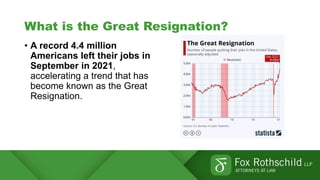
What is the Great Resignation?
• A record 4.4 million
Americans left their jobs in
September in 2021,
accelerating a trend that has
become known as the Great
Resignation.
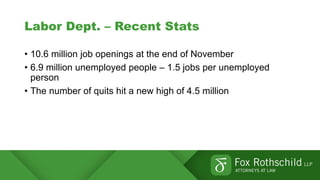
Labor Dept. – Recent Stats
• 10.6 million job openings at the end of November
• 6.9 million unemployed people – 1.5 jobs per unemployed
person
• The number of quits hit a new high of 4.5 million
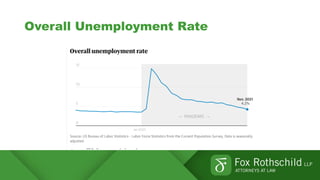
Overall Unemployment Rate
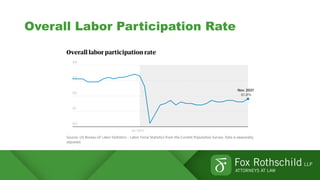
Overall Labor Participation Rate
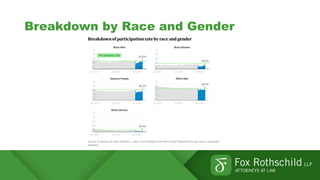
Breakdown by Race and Gender
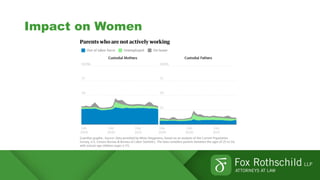
Impact on Women
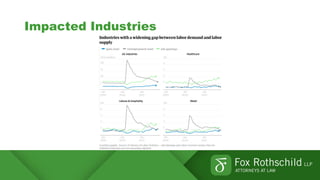
Impacted Industries
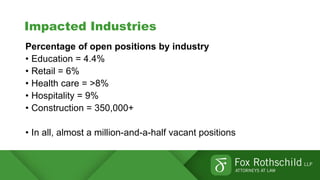
Impacted Industries
Percentage of open positions by industry
• Education = 4.4%
• Retail = 6%
• Health care = >8%
• Hospitality = 9%
• Construction = 350,000+
• In all, almost a million-and-a-half vacant positions
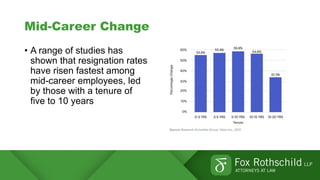
Mid-Career Change
• A range of studies has
shown that resignation rates
have risen fastest among
mid-career employees, led
by those with a tenure of
five to 10 years
WHY ARE PEOPLE QUITTING?
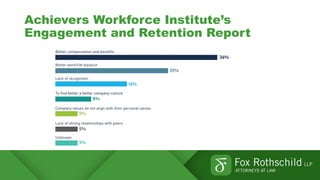
Achievers Workforce Institute’s
Engagement and Retention Report
Factors
• “Backlog” in quits
• Stress and burnout
• Rebalancing of priorities (family, hobbies, etc.)
• Reevaluation of how career aligns with values/interests
• Flexibility
– Pre-pandemic: 1 in 67 jobs was a remote job
– Now: 1 in 7 (people are 2.5 times more likely to apply for a remote job)
• Migration for housing, cost of living
• Unemployment/assistance is NOT the reason
Some Telling Statistics
• DOL data: 500,000 more unincorporated, self-employed workers than
there were at the start of the pandemic = 9.44 million
• New applications for federal tax ID numbers jumped 56 percent between
2019 and 2021; two-thirds of those were for businesses expected to
employ nobody other than the founder
• Percentage of workers in the U.S. who consider themselves self-employed
rose from 5.4 percent in February 2020, just before the pandemic, to 5.9
percent now
• In September 2019, the online marketplace, Etsy had 2.6 million active
sellers; as of the same time this year, the number was 7.5 million
• Similar data found on LinkedIn and Upwork
“It's as if that social contract of work is being rewritten, and right
now the worker's holding the pen.”
HOW DO WE RETAIN OUR EMPLOYEES?
Myths
• You can retain employees by simply offering more money or a
promotion
• The goal is to retain employees for as long as possible
• When employees leave, it is because they are no longer happy
Quantify the Problem
Number of Separations per Year ÷ Average Total Number of
Employees = Turnover Rate
• Use similar formulas for voluntary resignations, versus from
layoffs or firings
• Identify patterns – when are people leaving (6m, 2 years, 5
years)
• Determine the impact of resignations on key business metrics
Identify the Root Causes
Conduct detailed data analysis – which factors could be driving
higher resignation rates?
• Compensation
• Time between promotions
• Size of pay increases
• Tenure
• Performance
• Training opportunities
Stay Interviews
• What keeps you working here?
• What do you enjoy about your job?
• What motivates you at work?
• Do you feel appreciated in your role?
• Where do you see yourself in five
years?
• What would you like to change about
your job, team or department?
• If you could change one thing about
the company, what would it be?
• Have you ever thought about leaving
the organization?
• What would cause you to leave the
company?
Develop Tailored Retention Programs
Create highly customized programs aimed at correcting the
specific issues that your workplace struggles with most.
• If people of color are leaving your organization at a higher rate
than their white peers, you may need a DEI-focused approach
• If time between promotions correlates strongly with high
resignation rates, you may want to reevaluate your
advancement policies
Some Things to Consider
• Onboarding and orientation
• Mentorship programs
• Employee compensation (salary and
benefits)
• Perks
• Wellness offerings
• Communication
• Continuous feedback on performance
• Training and development
• Recognition and rewards systems
• Work-life balance
• Flexible work arrangements
• Effective change management
• An emphasis on teamwork
• Acknowledgement of milestones, big
and small
HOW DO WE RECRUIT TALENT?
Employer Brand Matters
Why would I want to work for you?
• 86% of job seekers look at company reviews/ratings before applying to job
• 76% job seekers consider diversity, inclusion and belonging as important
factor when evaluating companies (higher for women and minority groups)
• 92% of people would consider changing jobs if offered a role with a
company with an excellent reputation (strong employer brand can reduce
cost per hire by 50%; 10% in cost per hire for companies with negative
reputation)
Reenergize Your Employer Brand
• Actively manage brand – respond to comments, address issues
• Update benefits, think about inclusive benefits
• Pay matters – be transparent and competitive
• Growth and development - show that you invest in your team’s growth
• Identify candidate goals – does your brand support?
• Emphasize your company's values – more than words on paper (be sure these are
incorporated into your recruitment process)
• Make use of inclusive success profiles to increase hiring precision
• Work-life balance matters - even to remote employees
• Promote employee well-being (80% of respondents to Deloitte study ranked most
important to an organization’s success)
Reimagine the Recruitment Process
Review through the lens of inclusion, belongingness and the candidate experience:
Consider the following:
• Employer brand
• Business hiring needs
• Website - Company Careers Page
• Posting sites - expand sourcing for talent, think beyond traditional job boards
• Job postings/job descriptions – look at titles, language
• Review the application process
• Rethink the interview process – process, length of time, questions,
• Focus on a frictionless application process
Train Hiring Managers
First impressions: 7-17 seconds!
• Awareness of the potential of unconscious bias in interviewing, hiring
• Managing the candidate experience (respect, courtesy, responsiveness)
• How well do you reflect the employer brand? Promote working at the
company?
• Behavioral based interviewing skills
RECRUITMENT OF FOREIGN WORKERS
H-1B Cap Season for Employers
Overview
• What is H-1B status?
• Why is there an H-1B Cap season?
• H-1B Cap Lottery
• Preparing for H-1B Cap Registration
• H-1B Cap Registration and filing timings
• Examples of other temporary immigration statuses
What is H-1B Status?
• U.S. Company = Petitioner
– Offering Employment at Required Wage in Specialty Occupation –
• Job requires theoretical and practical application of a body of highly
specialized knowledge and
• Bachelor’s or higher degree in the specific specialty or equivalent
• Foreign National = Beneficiary
– Must possess at least U.S. Bachelor’s or higher degree or equivalent in a
related field for a professional level occupation that normally requires the
degree
• Temporary status (3 years / 6 years +)
– Greencard sponsorship is separate
– Application for US Citizenship is separate
Why is there an H-1B Cap Season?
• Annual numerical limit on number of employer petitions that may be approved:
– 65,000 new H-1B statuses / visas per fiscal year under Regular Cap
– 20,000 Advanced Degree Exemption for beneficiaries w/ U.S. master’s
degree or higher per fiscal year
• Cap Lottery - Used When Employer Demand Exceeds the Cap / Exemption:
– FY2022: 308,613 Valid Employer Registrations for 87,500 spots (1x per
person/ER)
• Timings:
– October 1st = Start of Federal Government fiscal year and start date on Cap-
Subject H-1B petitions
– April 1st = Earliest day when a Cap-Subject H-1B petition may be filed
(Regulatory)
• FY2023
H-1B Cap Lottery
• Recent H-1B Cap Seasons:
– USCIS implemented Employer Electronic Registration to precede
actual filing of H-1B petitions
• Streamlined process
• Historically, petitions were filed and selection was based on petition
– Consistent with historical practice, random electronic selection lottery to
determine which US employers would be able to sponsor workers
• Essentially same chance to all employers under cap or under
advanced degree exemption
– Order of cap selection to benefit employer’s sponsoring those w/U.S.
advanced degrees
• Selected registrations first from Regular Cap, then registrations
under Advanced Degree Exemption
Preparing for H-1B Cap Registration
What should Employers Do Now?
Arrange for analysis to confirm basic eligibility criteria are met:
• Requires the review of resumes for the individuals who will be sponsored,
their degree documents and transcripts, passport biographic page to
confirm proper name, and the Employer’s job description with
requirements
• Current status must also be confirmed (e.g., whether individual has
OPT/STEM OPT, etc.)
H-1B Cap Registration and Filing Timings
• When is the FY2023 registration period?
- By late February create new accounts if no account already
- USCIS hasn’t yet announced the registration dates
• Litigation
• When announced, watch exact timings (last year noon to noon
Eastern Time)
• After registration, status is “submitted”
• March 27, 2021 – USCIS received enough registrations
• March 31, 2021 – USCIS issued selection notices
H-1B Cap Registration and Filing Timings
• When can FY2023 Cap-Subject H-1B Petitions be Filed?
– Selected petitioners should be able to file on April 1, 2022
(anticipated)
– File within specified 90-day filing window
• Not Selected?
– Unselected registrations may still have a chance
– Kept in reserve for the fiscal year in case more petitions are needed to
use all 65,000 spots in the regular cap and meet the 20,000 Advanced
Degree Exemption
– So far in 2021, USCIS has conducted 3 lottery selections
Examples of Some Other Temporary
Immigration Statuses
• L-1 Intracompany Transferee - L-1A is for Managers and Executives. 7
years total. L-1B is Specialized Knowledge. 5 years total. Must have worked
for at least 1 continuous year within the preceding 3 years outside the U.S
• E-1 Treaty Trader / E-2 Treaty Investor - Person who is a national of the
treaty country. Usually Executive of Manager. Involved in trade and services
or investor. Develop and direct a bona fide enterprise in which a substantial
amount of capital is invested. 2 years validity and renewable
• F-1 OPT/STEM OPT. Limited work authorization for students/graduates
• O-1 Extraordinary Ability. Individuals must have extraordinary ability or
achievement. Can use for Executives and key personnel. Up to 3 years and
renewable
• And many more
• Temporary, Specific Purpose, Specific Requirements, Specific Time Limits
TAKEAWAYS
Takeaways
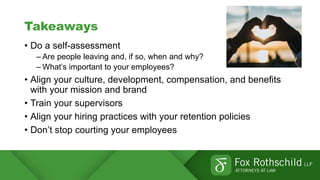
• Do a self-assessment
– Are people leaving and, if so, when and why?
– What’s important to your employees?
• Align your culture, development, compensation, and benefits
with your mission and brand
• Train your supervisors
• Align your hiring practices with your retention policies
• Don’t stop courting your employees
Lori Armstrong Halber
larmstronghalber@foxrothschild.com
215.918.3543
Alison DiFlorio
adiflorio@exudeinc.com
215.900.0379
Catherine Wadhwani
cwadhwani@foxrothschild.com
412.394.5540

The-Great-Resignation-PPT.pdf

  • 1.
    © 2021 FoxRothschild Retention and Recruitment in the Great Resignation Lori Armstrong Halber, Partner & Alison DiFlorio, Managing Partner, Exude and special guest Catherine Wadhwani, Partner
  • 2.
    Today’s Discussion • What’sgoing on in the labor market? • What is the Great Resignation and why is it happening? • How do we retain our talent? • How do we recruit talent? • Special considerations
  • 3.
    WHAT IS THEGREAT RESIGNATION?
  • 4.
    What is theGreat Resignation? • A record 4.4 million Americans left their jobs in September in 2021, accelerating a trend that has become known as the Great Resignation.
  • 5.
    Labor Dept. –Recent Stats • 10.6 million job openings at the end of November • 6.9 million unemployed people – 1.5 jobs per unemployed person • The number of quits hit a new high of 4.5 million
  • 6.
  • 7.
  • 8.
  • 9.
  • 10.
  • 11.
    Impacted Industries Percentage ofopen positions by industry • Education = 4.4% • Retail = 6% • Health care = >8% • Hospitality = 9% • Construction = 350,000+ • In all, almost a million-and-a-half vacant positions
  • 12.
    Mid-Career Change • Arange of studies has shown that resignation rates have risen fastest among mid-career employees, led by those with a tenure of five to 10 years
  • 13.
    WHY ARE PEOPLEQUITTING?
  • 14.
  • 15.
    Factors • “Backlog” inquits • Stress and burnout • Rebalancing of priorities (family, hobbies, etc.) • Reevaluation of how career aligns with values/interests • Flexibility – Pre-pandemic: 1 in 67 jobs was a remote job – Now: 1 in 7 (people are 2.5 times more likely to apply for a remote job) • Migration for housing, cost of living • Unemployment/assistance is NOT the reason
  • 16.
    Some Telling Statistics •DOL data: 500,000 more unincorporated, self-employed workers than there were at the start of the pandemic = 9.44 million • New applications for federal tax ID numbers jumped 56 percent between 2019 and 2021; two-thirds of those were for businesses expected to employ nobody other than the founder • Percentage of workers in the U.S. who consider themselves self-employed rose from 5.4 percent in February 2020, just before the pandemic, to 5.9 percent now • In September 2019, the online marketplace, Etsy had 2.6 million active sellers; as of the same time this year, the number was 7.5 million • Similar data found on LinkedIn and Upwork
  • 17.
    “It's as ifthat social contract of work is being rewritten, and right now the worker's holding the pen.”
  • 18.
    HOW DO WERETAIN OUR EMPLOYEES?
  • 20.
    Myths • You canretain employees by simply offering more money or a promotion • The goal is to retain employees for as long as possible • When employees leave, it is because they are no longer happy
  • 21.
    Quantify the Problem Numberof Separations per Year ÷ Average Total Number of Employees = Turnover Rate • Use similar formulas for voluntary resignations, versus from layoffs or firings • Identify patterns – when are people leaving (6m, 2 years, 5 years) • Determine the impact of resignations on key business metrics
  • 22.
    Identify the RootCauses Conduct detailed data analysis – which factors could be driving higher resignation rates? • Compensation • Time between promotions • Size of pay increases • Tenure • Performance • Training opportunities
  • 23.
    Stay Interviews • Whatkeeps you working here? • What do you enjoy about your job? • What motivates you at work? • Do you feel appreciated in your role? • Where do you see yourself in five years? • What would you like to change about your job, team or department? • If you could change one thing about the company, what would it be? • Have you ever thought about leaving the organization? • What would cause you to leave the company?
  • 24.
    Develop Tailored RetentionPrograms Create highly customized programs aimed at correcting the specific issues that your workplace struggles with most. • If people of color are leaving your organization at a higher rate than their white peers, you may need a DEI-focused approach • If time between promotions correlates strongly with high resignation rates, you may want to reevaluate your advancement policies
  • 25.
    Some Things toConsider • Onboarding and orientation • Mentorship programs • Employee compensation (salary and benefits) • Perks • Wellness offerings • Communication • Continuous feedback on performance • Training and development • Recognition and rewards systems • Work-life balance • Flexible work arrangements • Effective change management • An emphasis on teamwork • Acknowledgement of milestones, big and small
  • 26.
    HOW DO WERECRUIT TALENT?
  • 27.
    Employer Brand Matters Whywould I want to work for you? • 86% of job seekers look at company reviews/ratings before applying to job • 76% job seekers consider diversity, inclusion and belonging as important factor when evaluating companies (higher for women and minority groups) • 92% of people would consider changing jobs if offered a role with a company with an excellent reputation (strong employer brand can reduce cost per hire by 50%; 10% in cost per hire for companies with negative reputation)
  • 28.
    Reenergize Your EmployerBrand • Actively manage brand – respond to comments, address issues • Update benefits, think about inclusive benefits • Pay matters – be transparent and competitive • Growth and development - show that you invest in your team’s growth • Identify candidate goals – does your brand support? • Emphasize your company's values – more than words on paper (be sure these are incorporated into your recruitment process) • Make use of inclusive success profiles to increase hiring precision • Work-life balance matters - even to remote employees • Promote employee well-being (80% of respondents to Deloitte study ranked most important to an organization’s success)
  • 29.
    Reimagine the RecruitmentProcess Review through the lens of inclusion, belongingness and the candidate experience: Consider the following: • Employer brand • Business hiring needs • Website - Company Careers Page • Posting sites - expand sourcing for talent, think beyond traditional job boards • Job postings/job descriptions – look at titles, language • Review the application process • Rethink the interview process – process, length of time, questions, • Focus on a frictionless application process

  • 30.
    Train Hiring Managers Firstimpressions: 7-17 seconds! • Awareness of the potential of unconscious bias in interviewing, hiring • Managing the candidate experience (respect, courtesy, responsiveness) • How well do you reflect the employer brand? Promote working at the company? • Behavioral based interviewing skills
  • 31.
  • 32.
    H-1B Cap Seasonfor Employers Overview • What is H-1B status? • Why is there an H-1B Cap season? • H-1B Cap Lottery • Preparing for H-1B Cap Registration • H-1B Cap Registration and filing timings • Examples of other temporary immigration statuses
  • 33.
    What is H-1BStatus? • U.S. Company = Petitioner – Offering Employment at Required Wage in Specialty Occupation – • Job requires theoretical and practical application of a body of highly specialized knowledge and • Bachelor’s or higher degree in the specific specialty or equivalent • Foreign National = Beneficiary – Must possess at least U.S. Bachelor’s or higher degree or equivalent in a related field for a professional level occupation that normally requires the degree • Temporary status (3 years / 6 years +) – Greencard sponsorship is separate – Application for US Citizenship is separate
  • 34.
    Why is therean H-1B Cap Season? • Annual numerical limit on number of employer petitions that may be approved: – 65,000 new H-1B statuses / visas per fiscal year under Regular Cap – 20,000 Advanced Degree Exemption for beneficiaries w/ U.S. master’s degree or higher per fiscal year • Cap Lottery - Used When Employer Demand Exceeds the Cap / Exemption: – FY2022: 308,613 Valid Employer Registrations for 87,500 spots (1x per person/ER) • Timings: – October 1st = Start of Federal Government fiscal year and start date on Cap- Subject H-1B petitions – April 1st = Earliest day when a Cap-Subject H-1B petition may be filed (Regulatory) • FY2023
  • 35.
    H-1B Cap Lottery •Recent H-1B Cap Seasons: – USCIS implemented Employer Electronic Registration to precede actual filing of H-1B petitions • Streamlined process • Historically, petitions were filed and selection was based on petition – Consistent with historical practice, random electronic selection lottery to determine which US employers would be able to sponsor workers • Essentially same chance to all employers under cap or under advanced degree exemption – Order of cap selection to benefit employer’s sponsoring those w/U.S. advanced degrees • Selected registrations first from Regular Cap, then registrations under Advanced Degree Exemption
  • 36.
    Preparing for H-1BCap Registration What should Employers Do Now? Arrange for analysis to confirm basic eligibility criteria are met: • Requires the review of resumes for the individuals who will be sponsored, their degree documents and transcripts, passport biographic page to confirm proper name, and the Employer’s job description with requirements • Current status must also be confirmed (e.g., whether individual has OPT/STEM OPT, etc.)
  • 37.
    H-1B Cap Registrationand Filing Timings • When is the FY2023 registration period? - By late February create new accounts if no account already - USCIS hasn’t yet announced the registration dates • Litigation • When announced, watch exact timings (last year noon to noon Eastern Time) • After registration, status is “submitted” • March 27, 2021 – USCIS received enough registrations • March 31, 2021 – USCIS issued selection notices
  • 38.
    H-1B Cap Registrationand Filing Timings • When can FY2023 Cap-Subject H-1B Petitions be Filed? – Selected petitioners should be able to file on April 1, 2022 (anticipated) – File within specified 90-day filing window • Not Selected? – Unselected registrations may still have a chance – Kept in reserve for the fiscal year in case more petitions are needed to use all 65,000 spots in the regular cap and meet the 20,000 Advanced Degree Exemption – So far in 2021, USCIS has conducted 3 lottery selections
  • 39.
    Examples of SomeOther Temporary Immigration Statuses • L-1 Intracompany Transferee - L-1A is for Managers and Executives. 7 years total. L-1B is Specialized Knowledge. 5 years total. Must have worked for at least 1 continuous year within the preceding 3 years outside the U.S • E-1 Treaty Trader / E-2 Treaty Investor - Person who is a national of the treaty country. Usually Executive of Manager. Involved in trade and services or investor. Develop and direct a bona fide enterprise in which a substantial amount of capital is invested. 2 years validity and renewable • F-1 OPT/STEM OPT. Limited work authorization for students/graduates • O-1 Extraordinary Ability. Individuals must have extraordinary ability or achievement. Can use for Executives and key personnel. Up to 3 years and renewable • And many more • Temporary, Specific Purpose, Specific Requirements, Specific Time Limits
  • 40.
  • 41.
    Takeaways • Do aself-assessment – Are people leaving and, if so, when and why? – What’s important to your employees? • Align your culture, development, compensation, and benefits with your mission and brand • Train your supervisors • Align your hiring practices with your retention policies • Don’t stop courting your employees
  • 42.
    Lori Armstrong Halber larmstronghalber@foxrothschild.com 215.918.3543 AlisonDiFlorio adiflorio@exudeinc.com 215.900.0379 Catherine Wadhwani cwadhwani@foxrothschild.com 412.394.5540