The Access and Inclusion Model (AIM)
Matthew Day, AIM Team, DCEDIY
05/02/21 AIM TEAM- DCEDIY
The Access and Inclusion Model (AIM)
•AIM is a suite of supports for both children and staff in Early Learning
and Care settings. AIM was founded in 2016 by the Department of
Children, Equality, Disability, Integration and Youth (DCEDIY).
•The goal of AIM is to create a more inclusive environment in Early
Learning and Care settings, so that all children, regardless of ability, can
benefit from quality early years care and education.
2
Introduction
05/02/21 AIM TEAM- DCEDIY
The Access and Inclusion Model (AIM)
•Free pre-school was introduced under the ECCE programme was introduced
in 2010.
The AIM programme was proposed by an Interdepartmental Group to allow
children with disabilities to participate in the ECCE Programme.
The model was founded by DCEDIY, DES and DoH and is administered by
Pobal and Better Start.
The model was launched by the Government in June 2016 and rolled-out
from September 2016.
3
Background
05/02/21 AIM TEAM- DCEDIY
The Access and Inclusion Model (AIM)
4
What Supports are Offered as part of AIM?
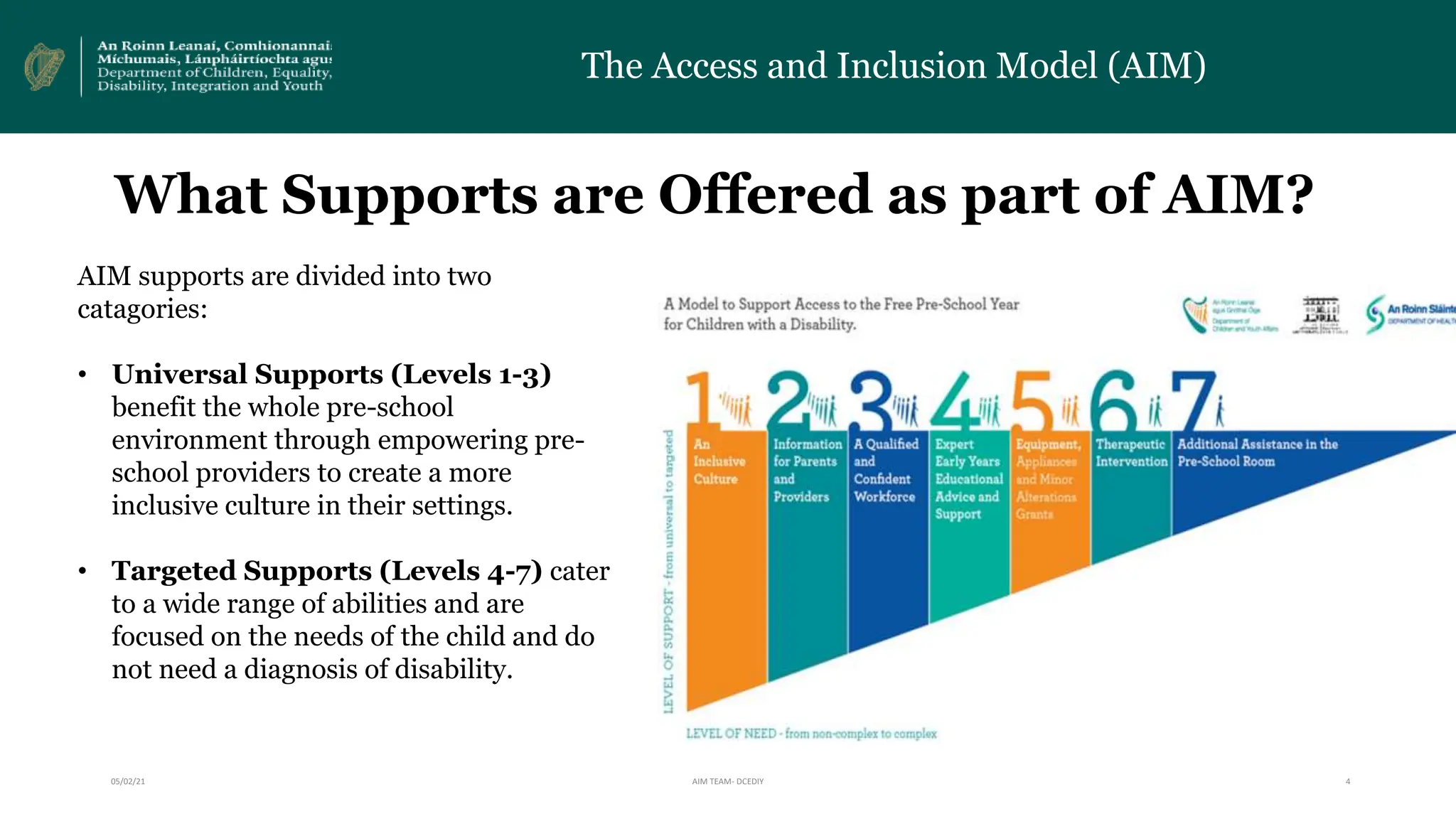
AIM supports are divided into two
catagories:
• Universal Supports (Levels 1-3)
benefit the whole pre-school
environment through empowering pre-
school providers to create a more
inclusive culture in their settings.
• Targeted Supports (Levels 4-7) cater
to a wide range of abilities and are
focused on the needs of the child and do
not need a diagnosis of disability.
05/02/21 AIM TEAM- DCEDIY
The Access and Inclusion Model (AIM)
5
Level 1: Supporting Inclusion
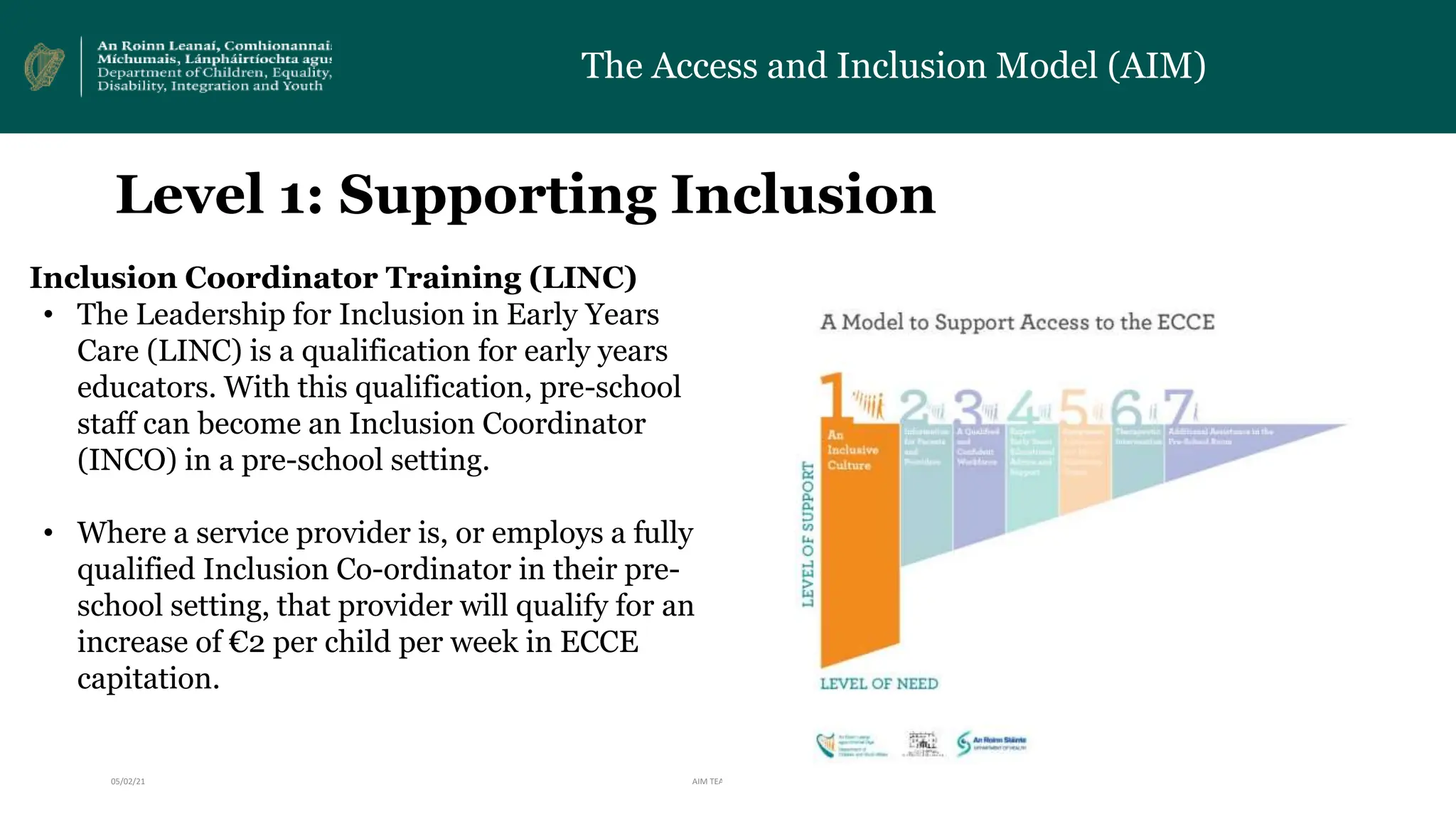
Inclusion Coordinator Training (LINC)
• The Leadership for Inclusion in Early Years
Care (LINC) is a qualification for early years
educators. With this qualification, pre-school
staff can become an Inclusion Coordinator
(INCO) in a pre-school setting.
• Where a service provider is, or employs a fully
qualified Inclusion Co-ordinator in their pre-
school setting, that provider will qualify for an
increase of €2 per child per week in ECCE
capitation.
05/02/21 AIM TEAM- DCEDIY
The Access and Inclusion Model (AIM)
6
Level 1: Supporting Inclusion
Equality Diversity and Inclusion (EDI)
• The Equality, Diversity and Inclusion Charter
was developed by DCEDIY to empower pre-
school staff to develop inclusive practices in
their settings.
• EDI training helps providers; understand the
EDI charter and guidelines and create their
own inclusion charter for their setting. These
courses are free of charge and available
nationwide.
05/02/21 AIM TEAM- DCEDIY
The Access and Inclusion Model (AIM)
7
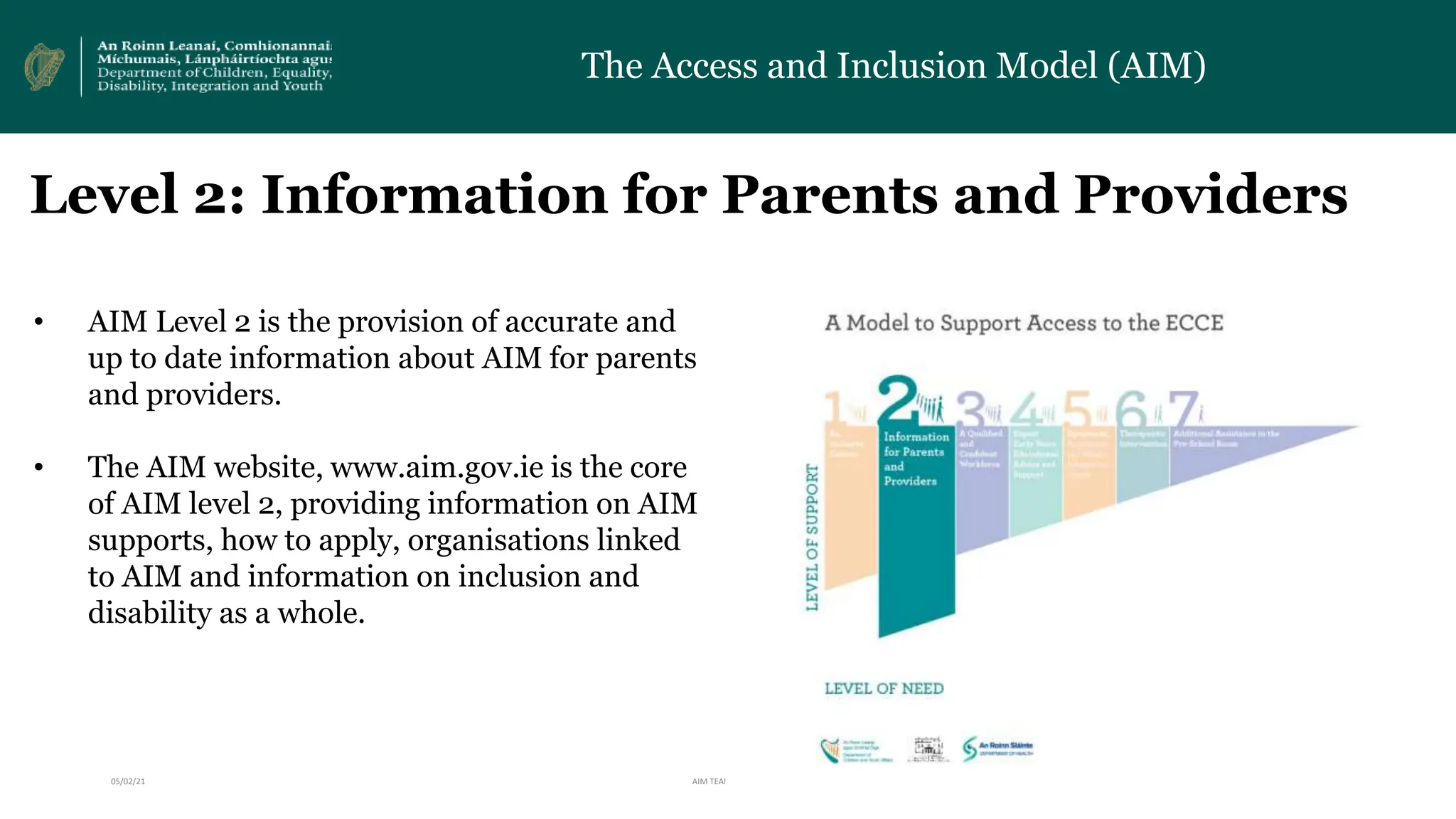
Level 2: Information for Parents and Providers
• AIM Level 2 is the provision of accurate and
up to date information about AIM for parents
and providers.
• The AIM website, www.aim.gov.ie is the core
of AIM level 2, providing information on AIM
supports, how to apply, organisations linked
to AIM and information on inclusion and
disability as a whole.
05/02/21 AIM TEAM- DCEDIY
The Access and Inclusion Model (AIM)
8
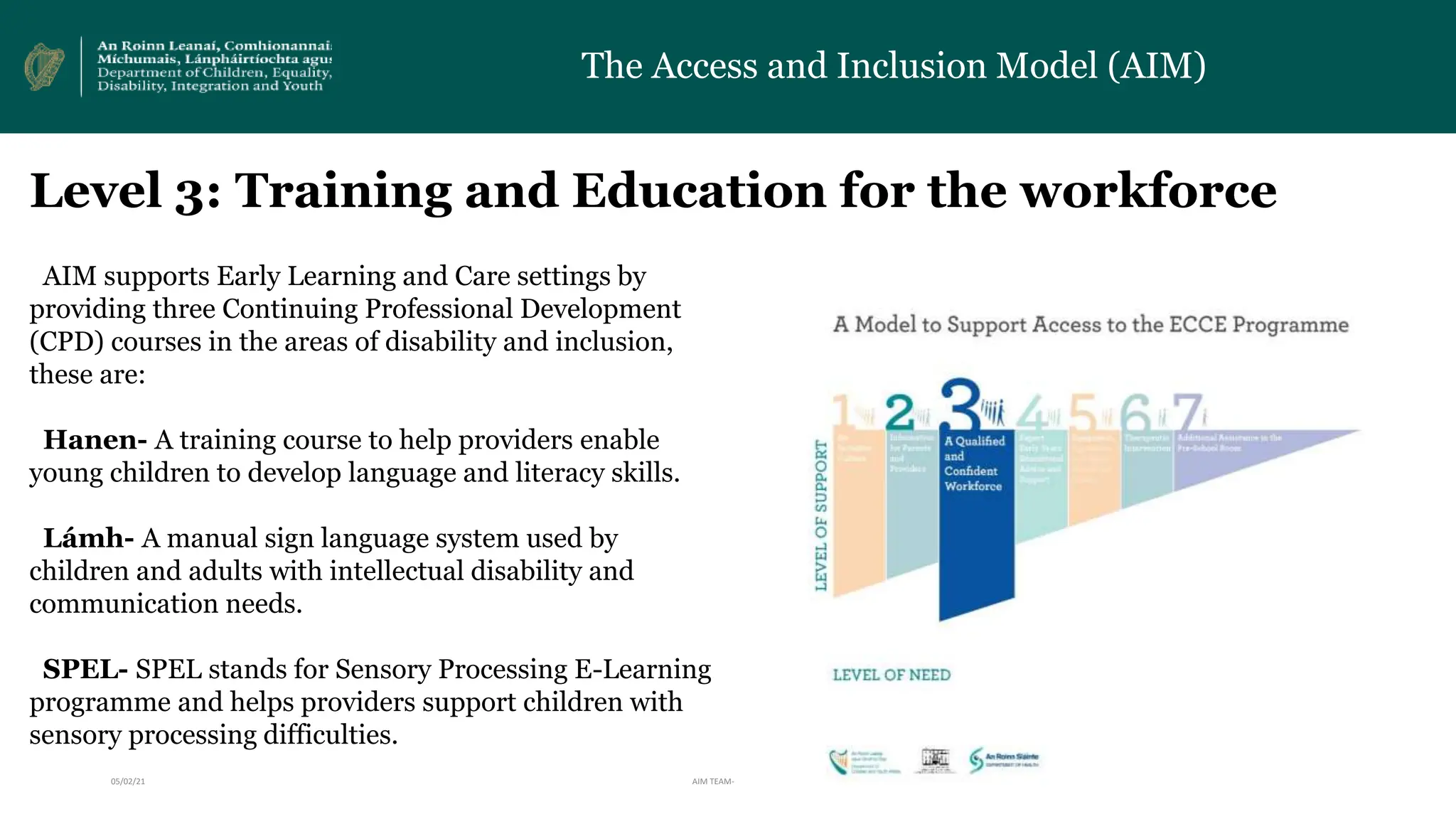
Level 3: Training and Education for the workforce
AIM supports Early Learning and Care settings by
providing three Continuing Professional Development
(CPD) courses in the areas of disability and inclusion,
these are:
Hanen- A training course to help providers enable
young children to develop language and literacy skills.
Lámh- A manual sign language system used by
children and adults with intellectual disability and
communication needs.
SPEL- SPEL stands for Sensory Processing E-Learning
programme and helps providers support children with
sensory processing difficulties.
05/02/21 AIM TEAM- DCEDIY
The Access and Inclusion Model (AIM)
9
Level 4: Access to Early Years Specialists
• AIM level 4 is delivered by the Better Start
Early Years Specialist Service (EYSS). The
EYSS work collaboratively with parents, pre-
school providers, and with other professionals
to develop inclusive learning environments in
pre-schools.
• The EYSS also provides coaching and
mentoring to the pre-school staff on supporting
children in the ECCE programme. The EYSS
can also act as a liaison with the National
Council for Special Education to support
transitions to primary school.
05/02/21 AIM TEAM- DCEDIY
The Access and Inclusion Model (AIM)
10
Level 5: Specialised Equipment, Appliances and Minor Alterations
• Under level 5, AIM can provide specialised
equipment, appliances or capital grants
towards minor building alterations to
ensure a child’s meaningful participation
in pre-school.
• Level 5 support can include a hoist,
hearing aid or wheelchair ramp to name a
few examples. Training in the use of
equipment will be given to providers free
of charge.
05/02/21 AIM TEAM- DCEDIY
The Access and Inclusion Model (AIM)
11
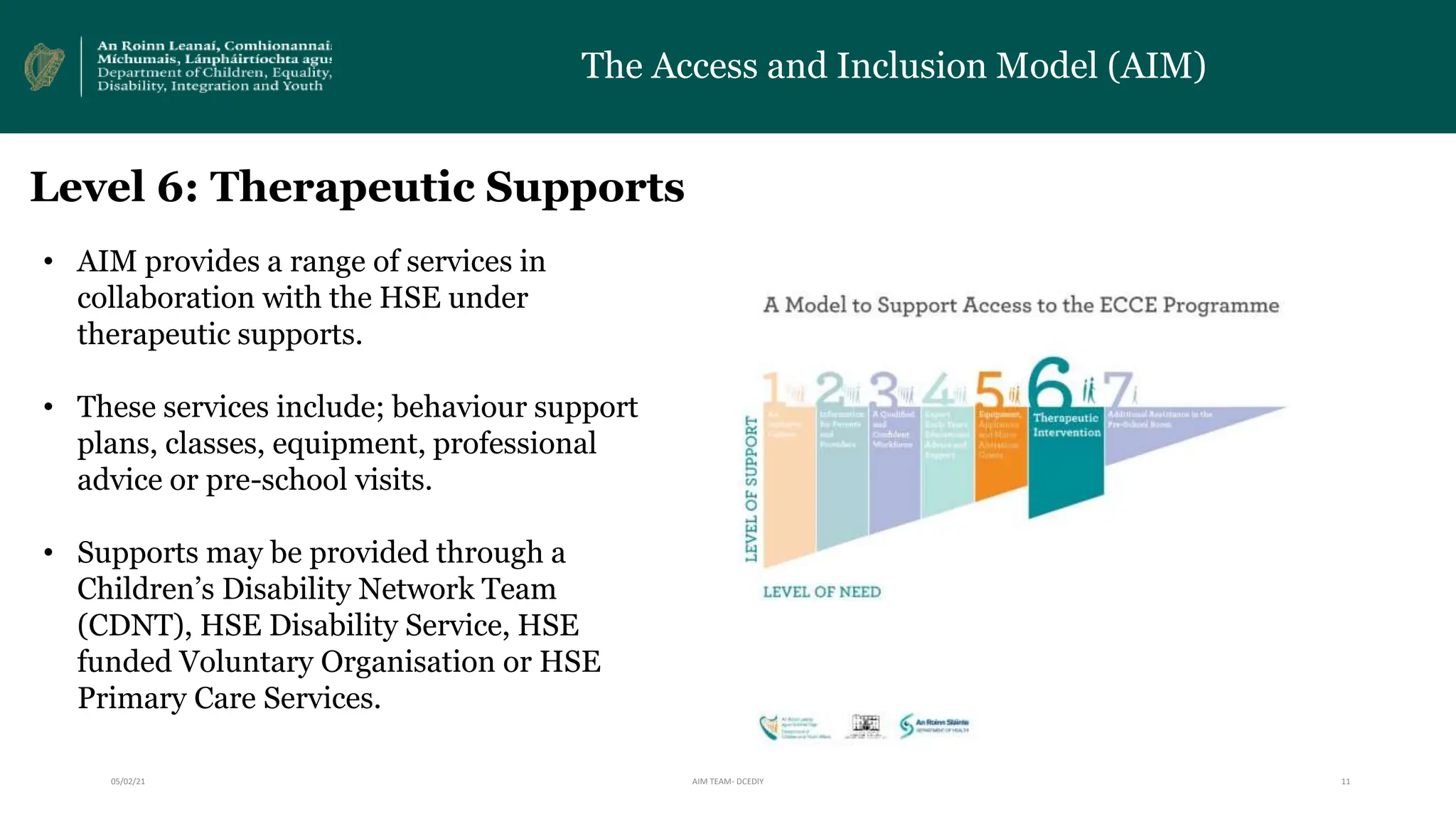
Level 6: Therapeutic Supports
• AIM provides a range of services in
collaboration with the HSE under
therapeutic supports.
• These services include; behaviour support
plans, classes, equipment, professional
advice or pre-school visits.
• Supports may be provided through a
Children’s Disability Network Team
(CDNT), HSE Disability Service, HSE
funded Voluntary Organisation or HSE
Primary Care Services.
05/02/21 AIM TEAM- DCEDIY
The Access and Inclusion Model (AIM)
12
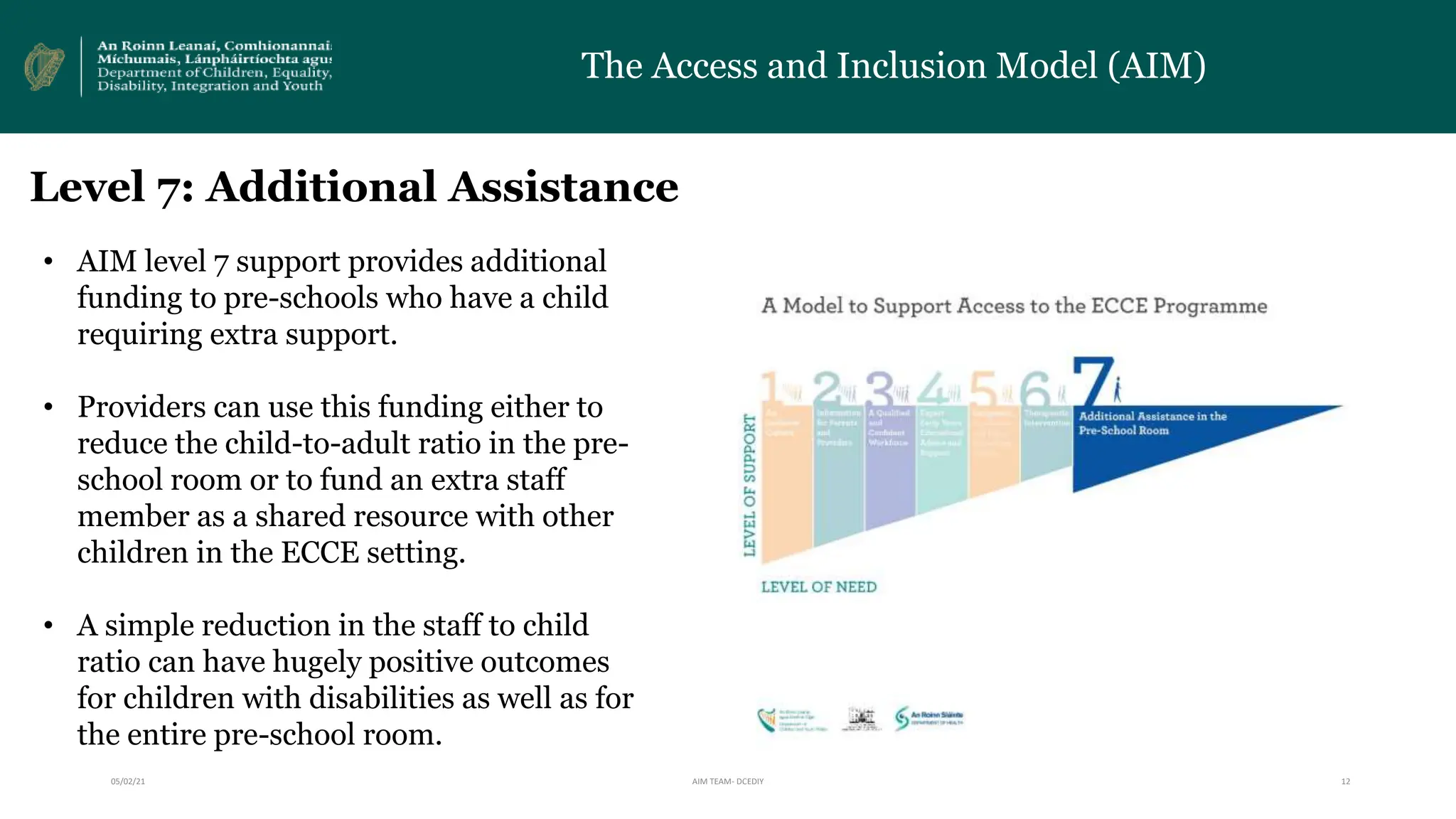
Level 7: Additional Assistance
• AIM level 7 support provides additional
funding to pre-schools who have a child
requiring extra support.
• Providers can use this funding either to
reduce the child-to-adult ratio in the pre-
school room or to fund an extra staff
member as a shared resource with other
children in the ECCE setting.
• A simple reduction in the staff to child
ratio can have hugely positive outcomes
for children with disabilities as well as for
the entire pre-school room.

The-Access-and-Inclusion-Model-AIM.pptx

  • 1.
    The Access andInclusion Model (AIM) Matthew Day, AIM Team, DCEDIY
  • 2.
    05/02/21 AIM TEAM-DCEDIY The Access and Inclusion Model (AIM) •AIM is a suite of supports for both children and staff in Early Learning and Care settings. AIM was founded in 2016 by the Department of Children, Equality, Disability, Integration and Youth (DCEDIY). •The goal of AIM is to create a more inclusive environment in Early Learning and Care settings, so that all children, regardless of ability, can benefit from quality early years care and education. 2 Introduction
  • 3.
    05/02/21 AIM TEAM-DCEDIY The Access and Inclusion Model (AIM) •Free pre-school was introduced under the ECCE programme was introduced in 2010. The AIM programme was proposed by an Interdepartmental Group to allow children with disabilities to participate in the ECCE Programme. The model was founded by DCEDIY, DES and DoH and is administered by Pobal and Better Start. The model was launched by the Government in June 2016 and rolled-out from September 2016. 3 Background
  • 4.
    05/02/21 AIM TEAM-DCEDIY The Access and Inclusion Model (AIM) 4 What Supports are Offered as part of AIM? AIM supports are divided into two catagories: • Universal Supports (Levels 1-3) benefit the whole pre-school environment through empowering pre- school providers to create a more inclusive culture in their settings. • Targeted Supports (Levels 4-7) cater to a wide range of abilities and are focused on the needs of the child and do not need a diagnosis of disability.
  • 5.
    05/02/21 AIM TEAM-DCEDIY The Access and Inclusion Model (AIM) 5 Level 1: Supporting Inclusion Inclusion Coordinator Training (LINC) • The Leadership for Inclusion in Early Years Care (LINC) is a qualification for early years educators. With this qualification, pre-school staff can become an Inclusion Coordinator (INCO) in a pre-school setting. • Where a service provider is, or employs a fully qualified Inclusion Co-ordinator in their pre- school setting, that provider will qualify for an increase of €2 per child per week in ECCE capitation.
  • 6.
    05/02/21 AIM TEAM-DCEDIY The Access and Inclusion Model (AIM) 6 Level 1: Supporting Inclusion Equality Diversity and Inclusion (EDI) • The Equality, Diversity and Inclusion Charter was developed by DCEDIY to empower pre- school staff to develop inclusive practices in their settings. • EDI training helps providers; understand the EDI charter and guidelines and create their own inclusion charter for their setting. These courses are free of charge and available nationwide.
  • 7.
    05/02/21 AIM TEAM-DCEDIY The Access and Inclusion Model (AIM) 7 Level 2: Information for Parents and Providers • AIM Level 2 is the provision of accurate and up to date information about AIM for parents and providers. • The AIM website, www.aim.gov.ie is the core of AIM level 2, providing information on AIM supports, how to apply, organisations linked to AIM and information on inclusion and disability as a whole.
  • 8.
    05/02/21 AIM TEAM-DCEDIY The Access and Inclusion Model (AIM) 8 Level 3: Training and Education for the workforce AIM supports Early Learning and Care settings by providing three Continuing Professional Development (CPD) courses in the areas of disability and inclusion, these are: Hanen- A training course to help providers enable young children to develop language and literacy skills. Lámh- A manual sign language system used by children and adults with intellectual disability and communication needs. SPEL- SPEL stands for Sensory Processing E-Learning programme and helps providers support children with sensory processing difficulties.
  • 9.
    05/02/21 AIM TEAM-DCEDIY The Access and Inclusion Model (AIM) 9 Level 4: Access to Early Years Specialists • AIM level 4 is delivered by the Better Start Early Years Specialist Service (EYSS). The EYSS work collaboratively with parents, pre- school providers, and with other professionals to develop inclusive learning environments in pre-schools. • The EYSS also provides coaching and mentoring to the pre-school staff on supporting children in the ECCE programme. The EYSS can also act as a liaison with the National Council for Special Education to support transitions to primary school.
  • 10.
    05/02/21 AIM TEAM-DCEDIY The Access and Inclusion Model (AIM) 10 Level 5: Specialised Equipment, Appliances and Minor Alterations • Under level 5, AIM can provide specialised equipment, appliances or capital grants towards minor building alterations to ensure a child’s meaningful participation in pre-school. • Level 5 support can include a hoist, hearing aid or wheelchair ramp to name a few examples. Training in the use of equipment will be given to providers free of charge.
  • 11.
    05/02/21 AIM TEAM-DCEDIY The Access and Inclusion Model (AIM) 11 Level 6: Therapeutic Supports • AIM provides a range of services in collaboration with the HSE under therapeutic supports. • These services include; behaviour support plans, classes, equipment, professional advice or pre-school visits. • Supports may be provided through a Children’s Disability Network Team (CDNT), HSE Disability Service, HSE funded Voluntary Organisation or HSE Primary Care Services.
  • 12.
    05/02/21 AIM TEAM-DCEDIY The Access and Inclusion Model (AIM) 12 Level 7: Additional Assistance • AIM level 7 support provides additional funding to pre-schools who have a child requiring extra support. • Providers can use this funding either to reduce the child-to-adult ratio in the pre- school room or to fund an extra staff member as a shared resource with other children in the ECCE setting. • A simple reduction in the staff to child ratio can have hugely positive outcomes for children with disabilities as well as for the entire pre-school room.