of Special Education
Prepared by: Mariche C. Llanto, Faculty-CEd
Definition
Learning
Objective
EDUC112
EDUC 112
Define special education
What are the definitions?
Who defined?
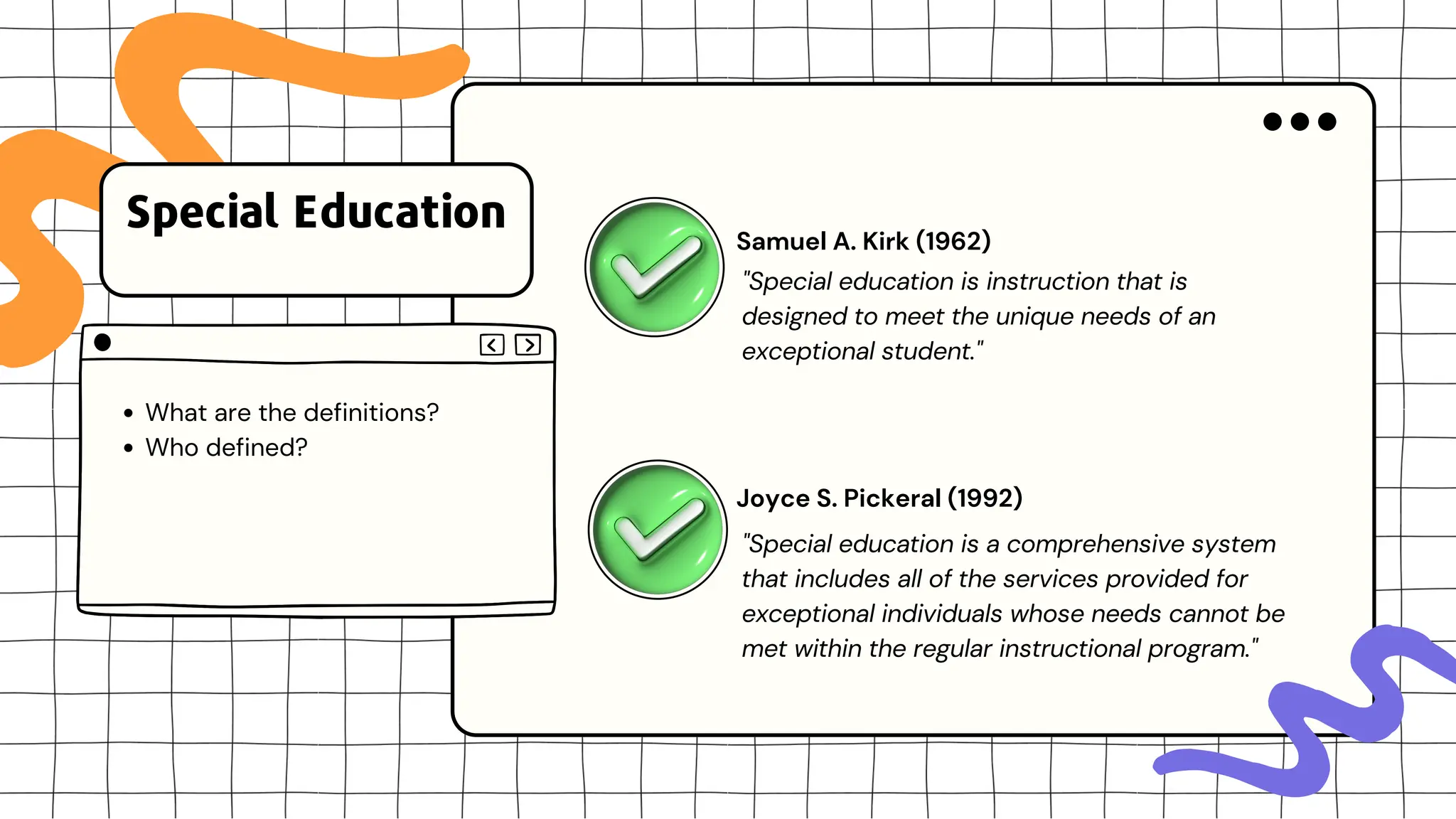
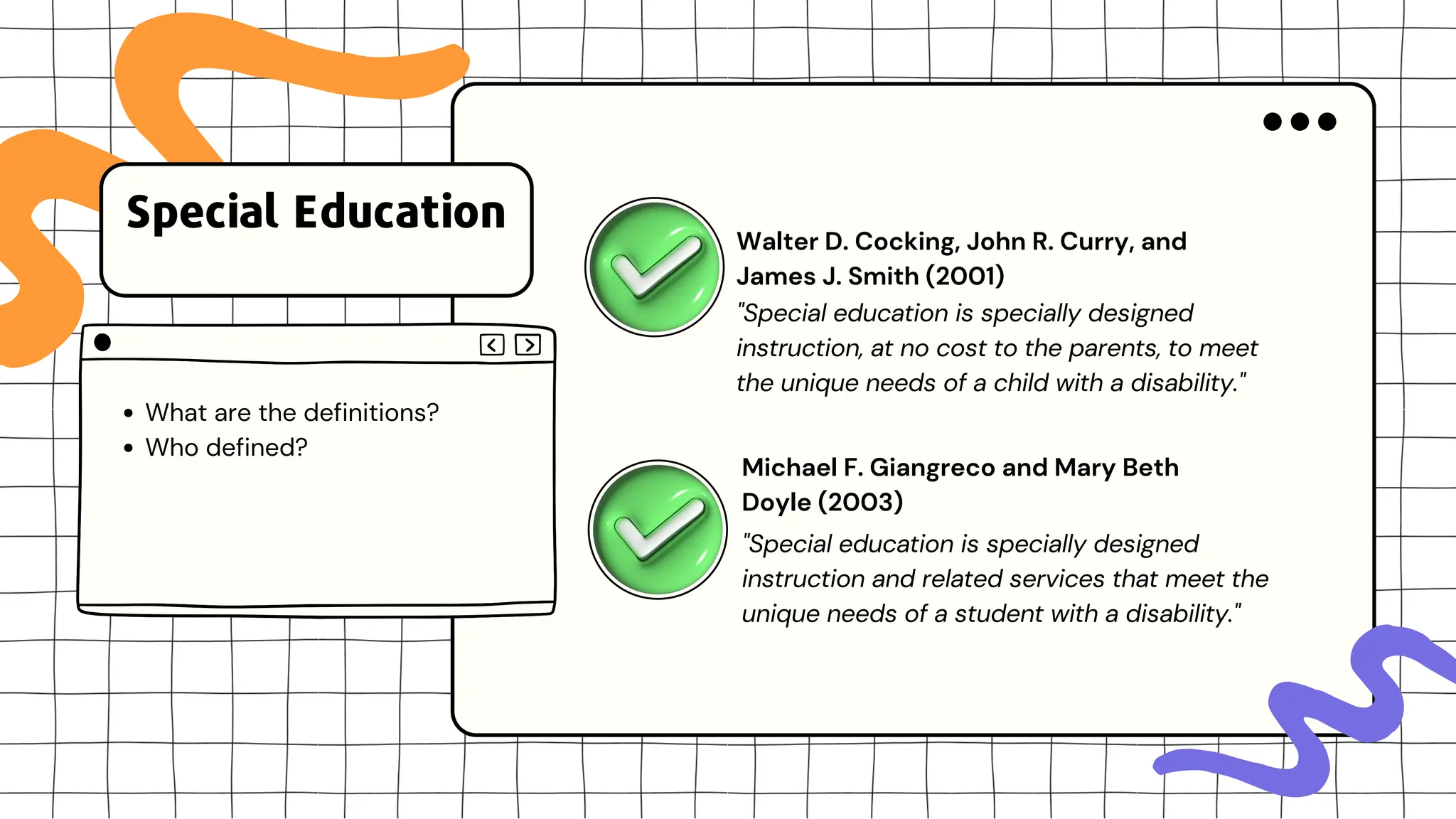
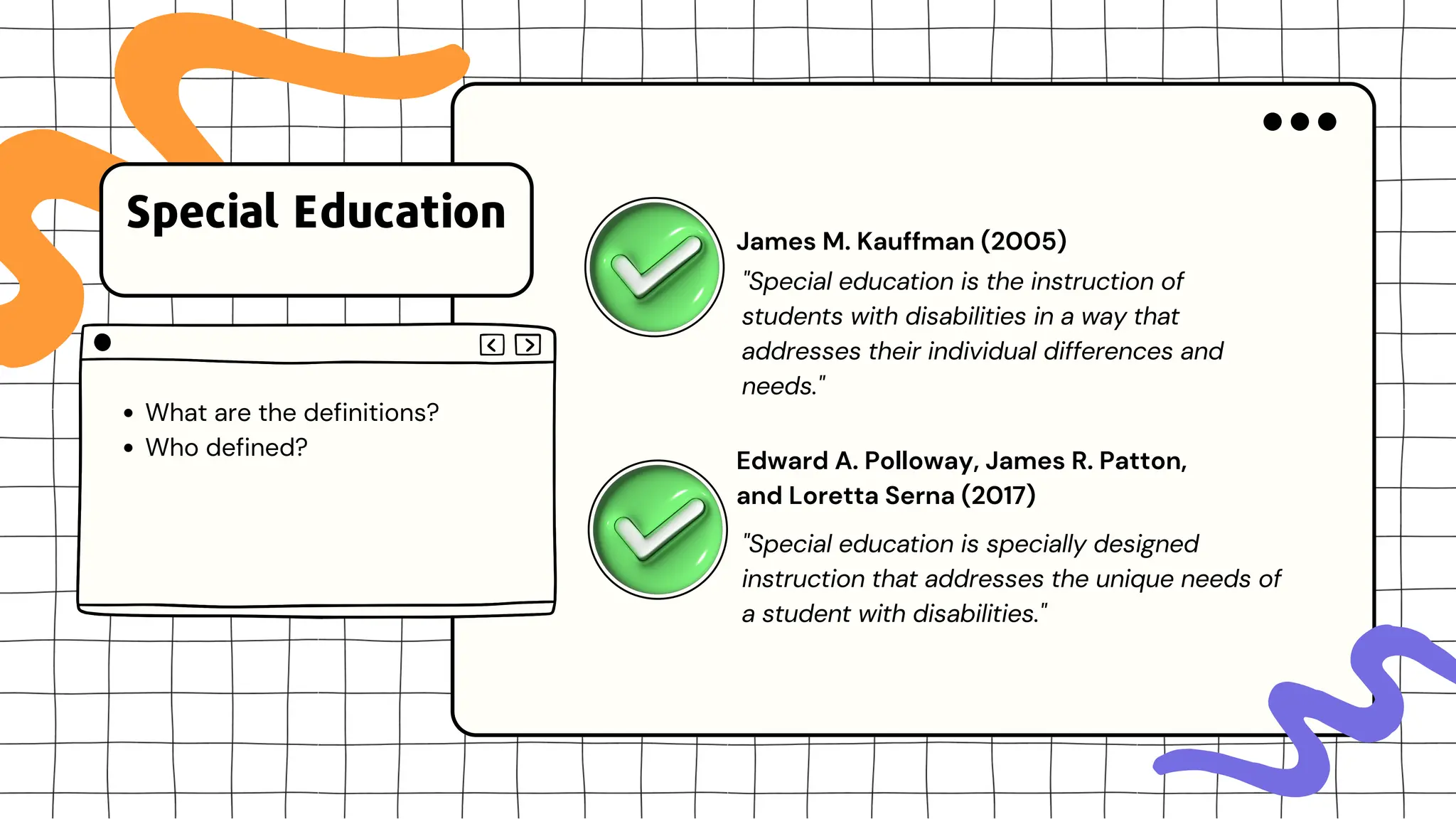
Special Education
"Special education is instruction that is
designed to meet the unique needs of an
exceptional student."
Samuel A. Kirk (1962)
"Special education is a comprehensive system
that includes all of the services provided for
exceptional individuals whose needs cannot be
met within the regular instructional program."
Joyce S. Pickeral (1992)
What are the definitions?
Who defined?
Special Education
"Special education is specially designed
instruction, at no cost to the parents, to meet
the unique needs of a child with a disability."
Walter D. Cocking, John R. Curry, and
James J. Smith (2001)
"Special education is specially designed
instruction and related services that meet the
unique needs of a student with a disability."
Michael F. Giangreco and Mary Beth
Doyle (2003)
What are the definitions?
Who defined?
Special Education
"Special education is the instruction of
students with disabilities in a way that
addresses their individual differences and
needs."
James M. Kauffman (2005)
"Special education is specially designed
instruction that addresses the unique needs of
a student with disabilities."
Edward A. Polloway, James R. Patton,
and Loretta Serna (2017)
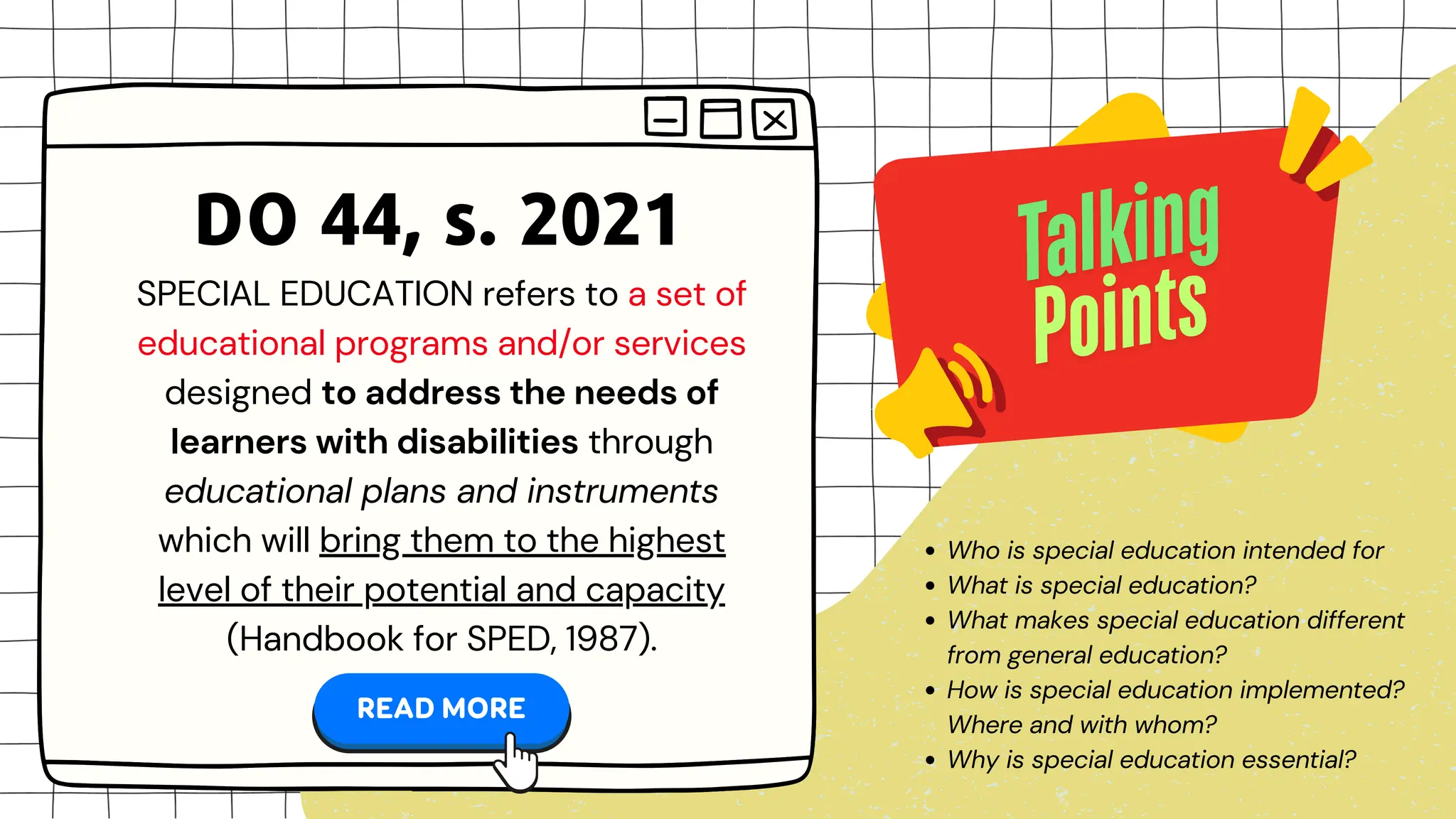
SPECIAL EDUCATION refers to a set of
educational programs and/or services
designed to address the needs of
learners with disabilities through
educational plans and instruments
which will bring them to the highest
level of their potential and capacity
(Handbook for SPED, 1987).
DO 44, s. 2021
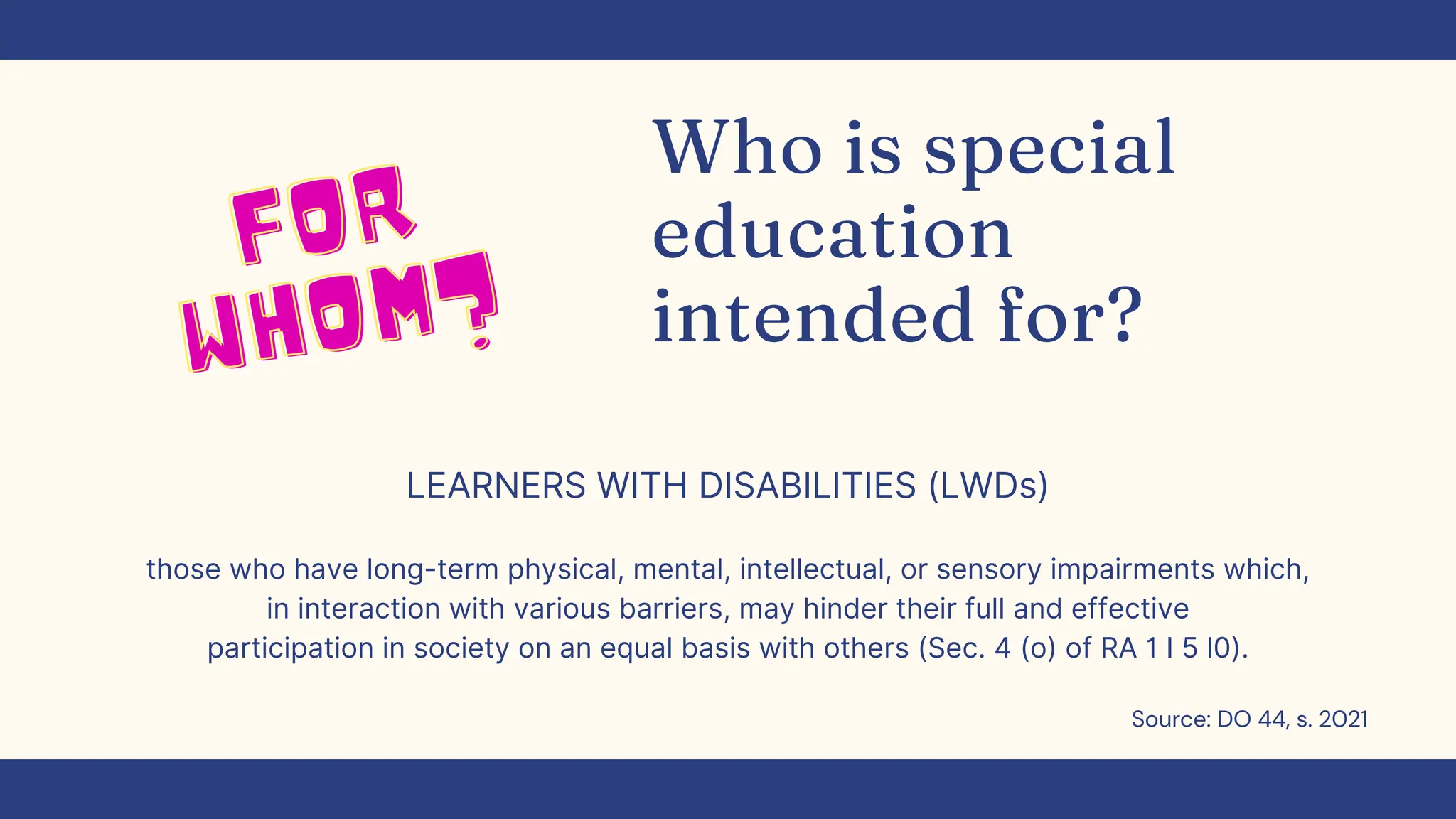
Who is special education intended for
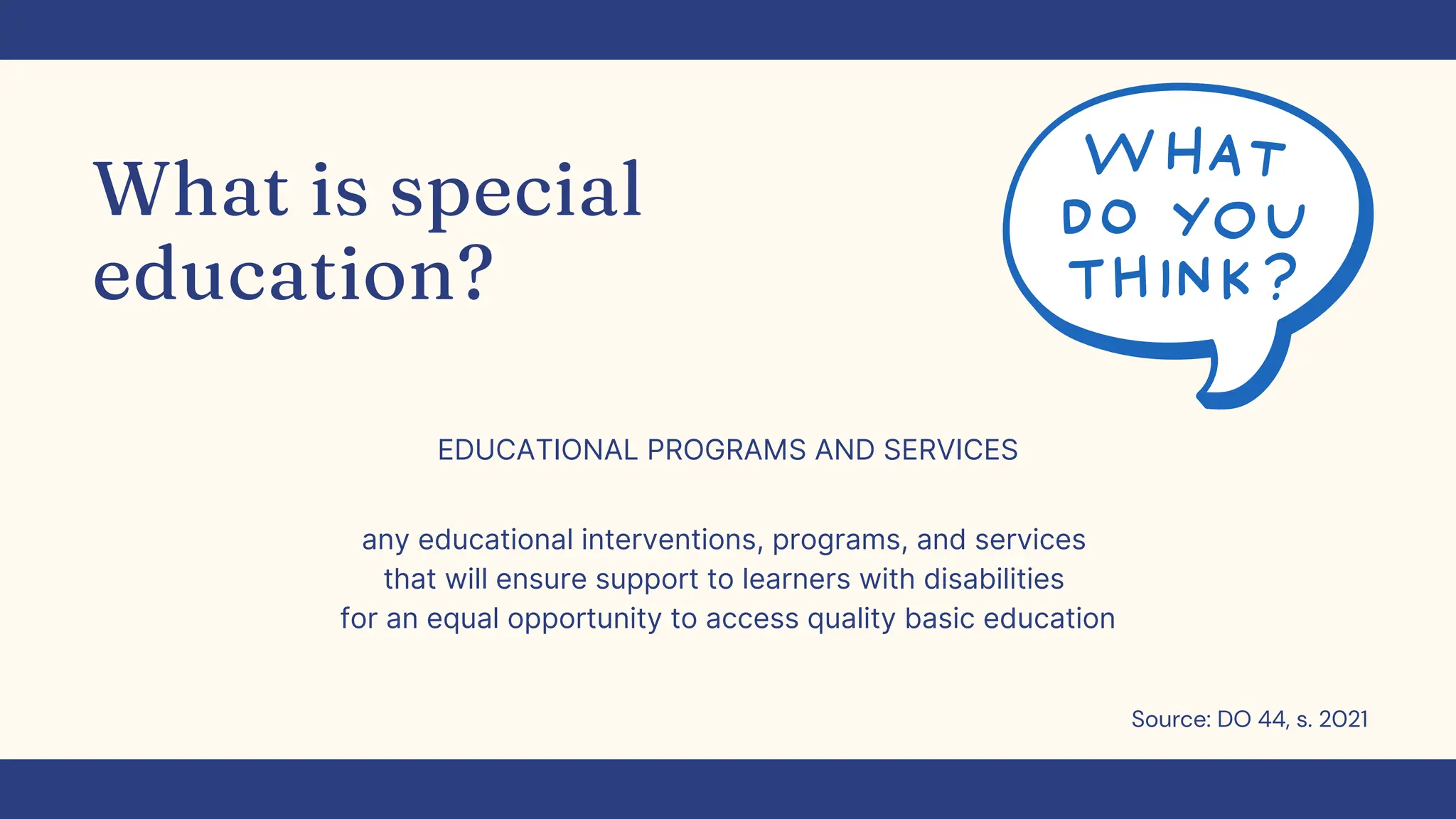
What is special education?
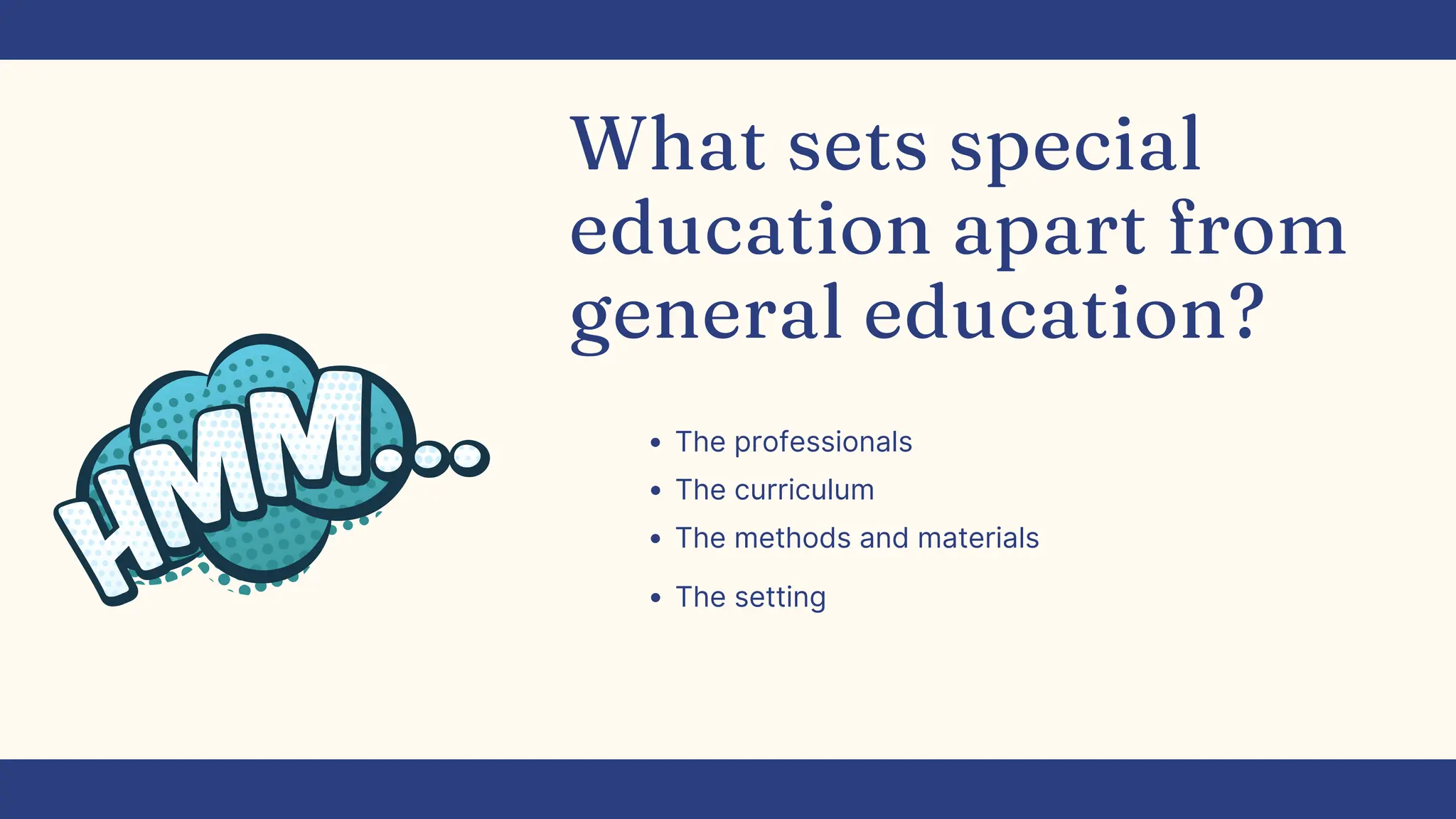
What makes special education different
from general education?
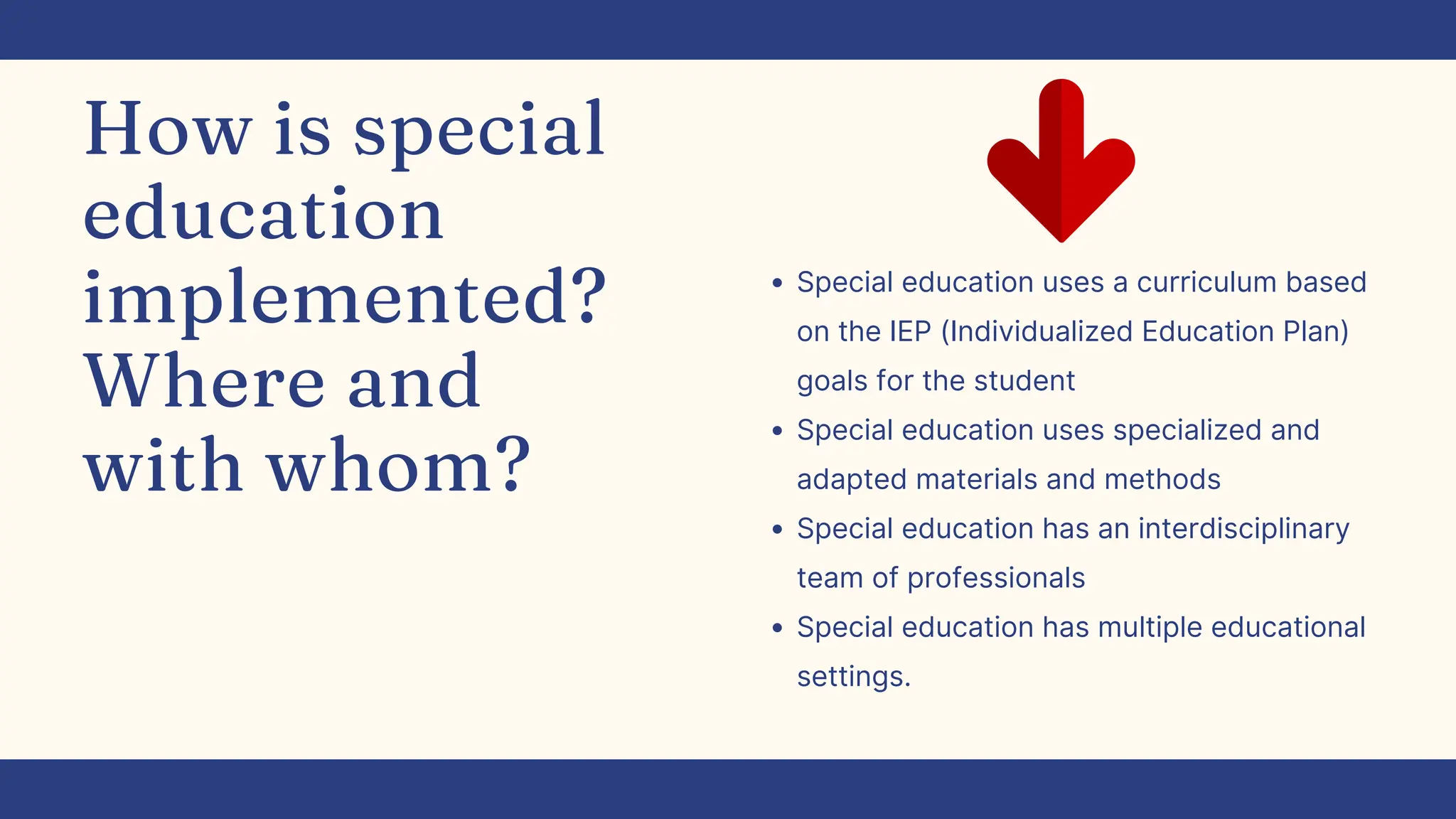
How is special education implemented?
Where and with whom?
Why is special education essential?
Who is special
education
intended for?
LEARNERS WITH DISABILITIES (LWDs)
those who have long-term physical, mental, intellectual, or sensory impairments which,
in interaction with various barriers, may hinder their full and effective
participation in society on an equal basis with others (Sec. 4 (o) of RA 1 I 5 l0).
FOR
FOR
WHOM?
WHOM?‌
‌
Source: DO 44, s. 2021
What is special
education?
EDUCATIONAL PROGRAMS AND SERVICES
any educational interventions, programs, and services
that will ensure support to learners with disabilities
for an equal opportunity to access quality basic education
Source: DO 44, s. 2021
The professionals
The curriculum
The methods and materials
What sets special
education apart from
general education?
The setting
How is special
education
implemented?
Where and
with whom?
Special education uses a curriculum based
on the IEP (Individualized Education Plan)
goals for the student
Special education uses specialized and
adapted materials and methods
Special education has an interdisciplinary
team of professionals
Special education has multiple educational
settings.
Elaborate on the bulleted
points from the previous slide,
providing specific examples
for each.
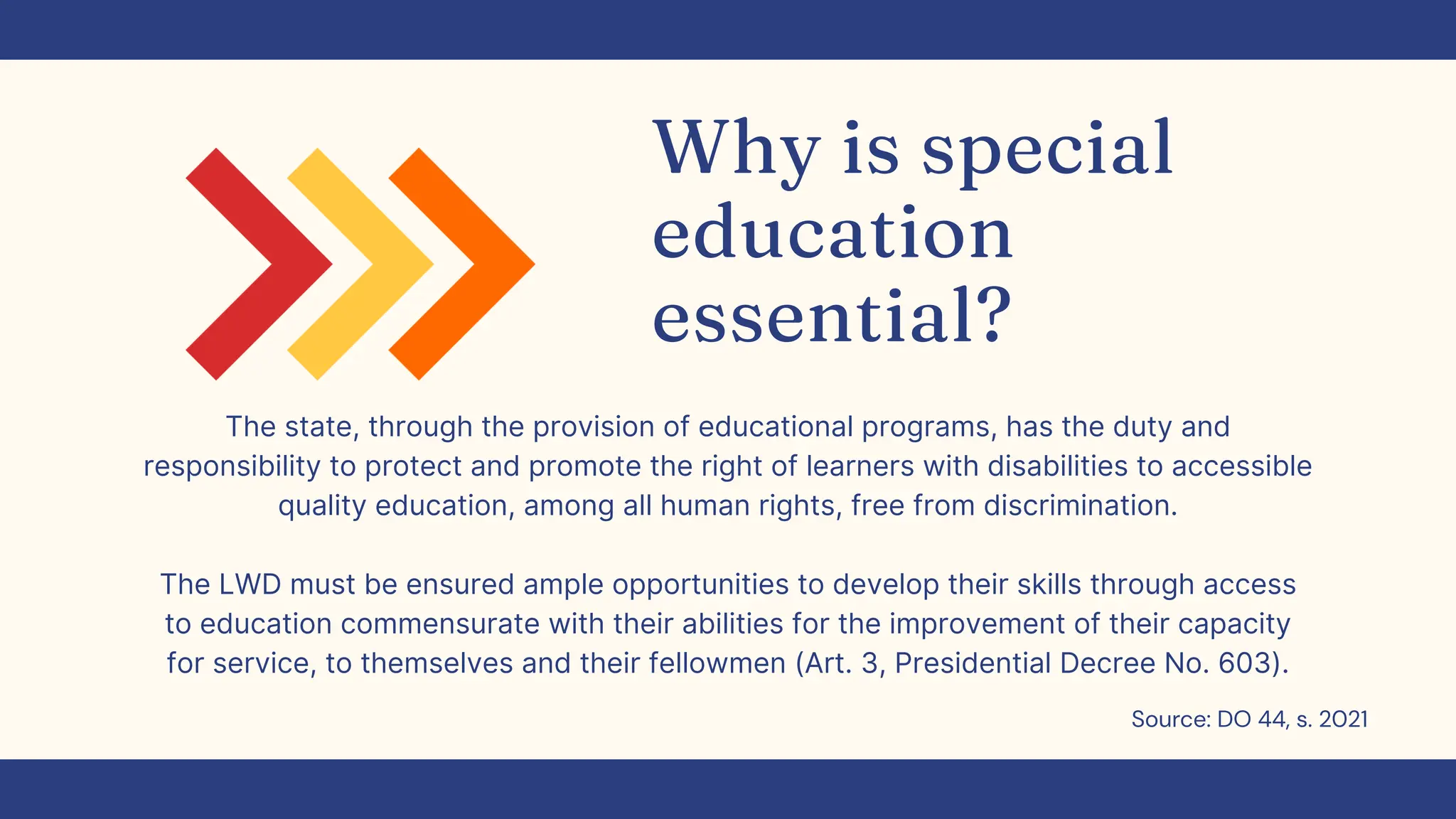
Why is special
education
essential?
The state, through the provision of educational programs, has the duty and
responsibility to protect and promote the right of learners with disabilities to accessible
quality education, among all human rights, free from discrimination.
The LWD must be ensured ample opportunities to develop their skills through access
to education commensurate with their abilities for the improvement of their capacity
for service, to themselves and their fellowmen (Art. 3, Presidential Decree No. 603).
Source: DO 44, s. 2021
of Inclusive Education
Prepared by: Mariche C. Llanto, Faculty- CEd
Definition & Scope
Learning
Objective
EDUC112
EDUC 112
Define inclusive education
Identify the scope and primary goals
of inclusive education
What are the definitions?
Who defined?
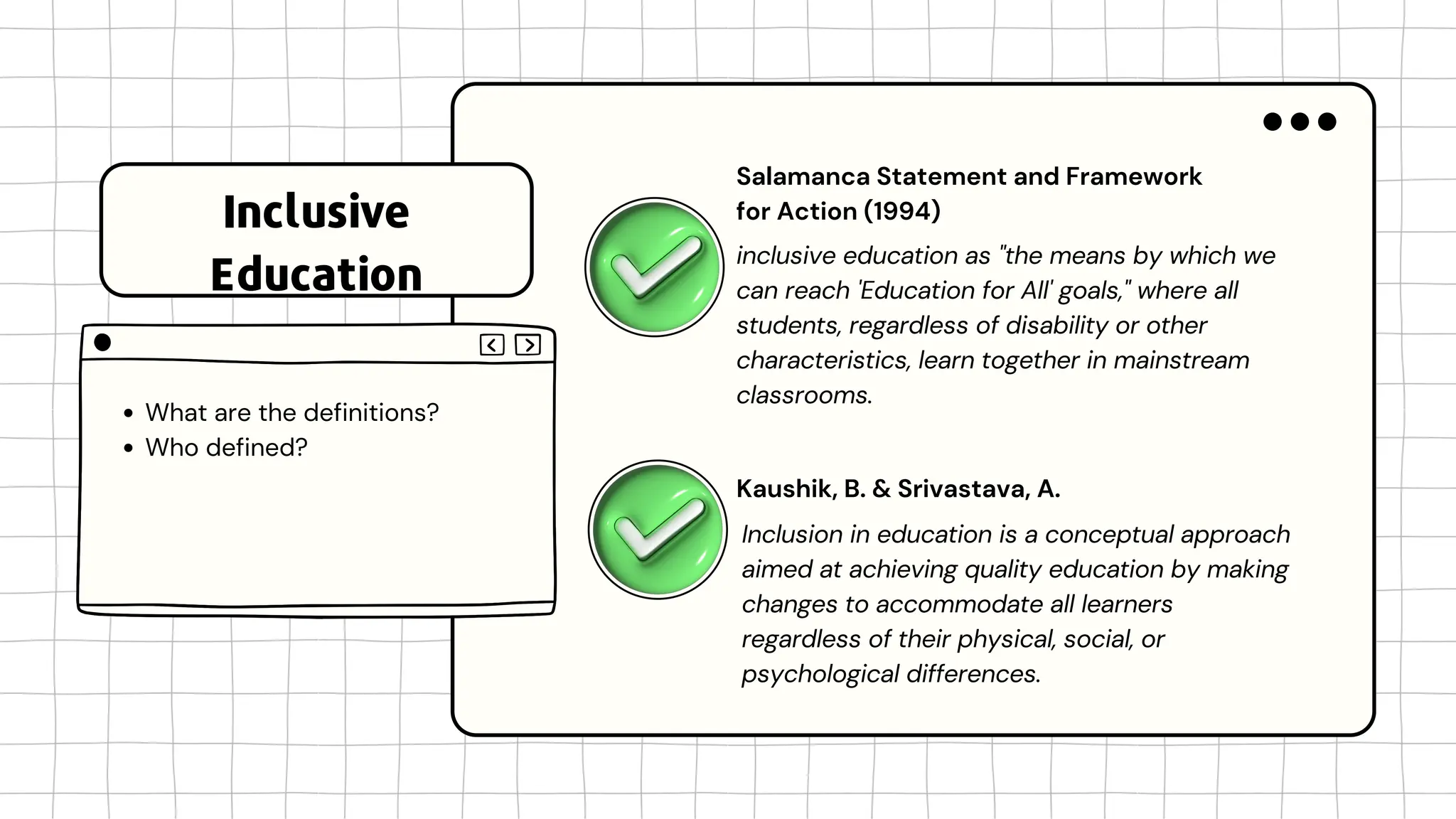
Inclusive
Education
inclusive education as "the means by which we
can reach 'Education for All' goals," where all
students, regardless of disability or other
characteristics, learn together in mainstream
classrooms.
Salamanca Statement and Framework
for Action (1994)
Inclusion in education is a conceptual approach
aimed at achieving quality education by making
changes to accommodate all learners
regardless of their physical, social, or
psychological differences.
Kaushik, B. & Srivastava, A.
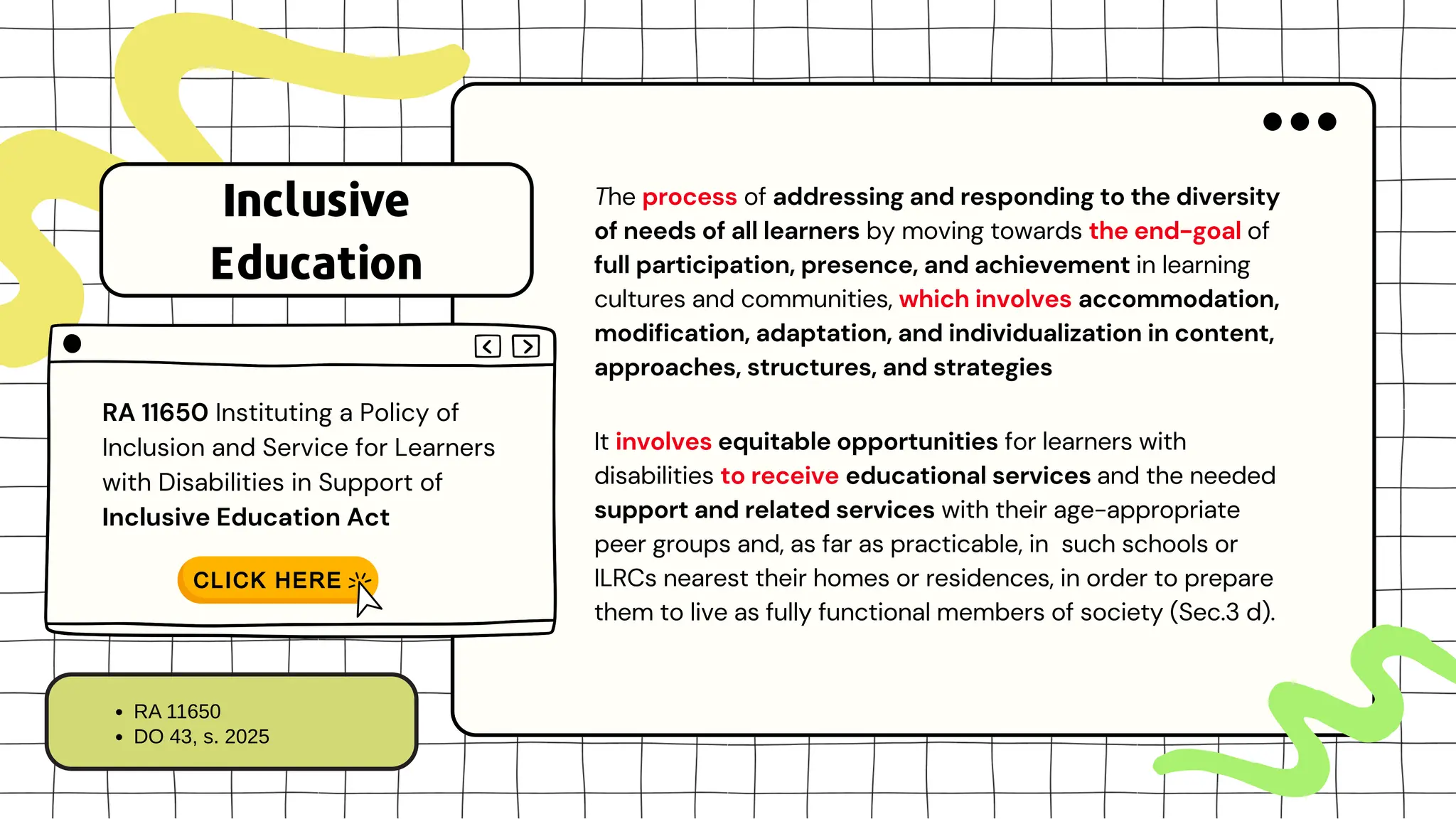
The process of addressing and responding to the diversity
of needs of all learners by moving towards the end-goal of
full participation, presence, and achievement in learning
cultures and communities, which involves accommodation,
modification, adaptation, and individualization in content,
approaches, structures, and strategies
It involves equitable opportunities for learners with
disabilities to receive educational services and the needed
support and related services with their age-appropriate
peer groups and, as far as practicable, in such schools or
ILRCs nearest their homes or residences, in order to prepare
them to live as fully functional members of society (Sec.3 d).
RA 11650 Instituting a Policy of
Inclusion and Service for Learners
with Disabilities in Support of
Inclusive Education Act
Inclusive
Education
RA 11650
DO 43, s. 2025
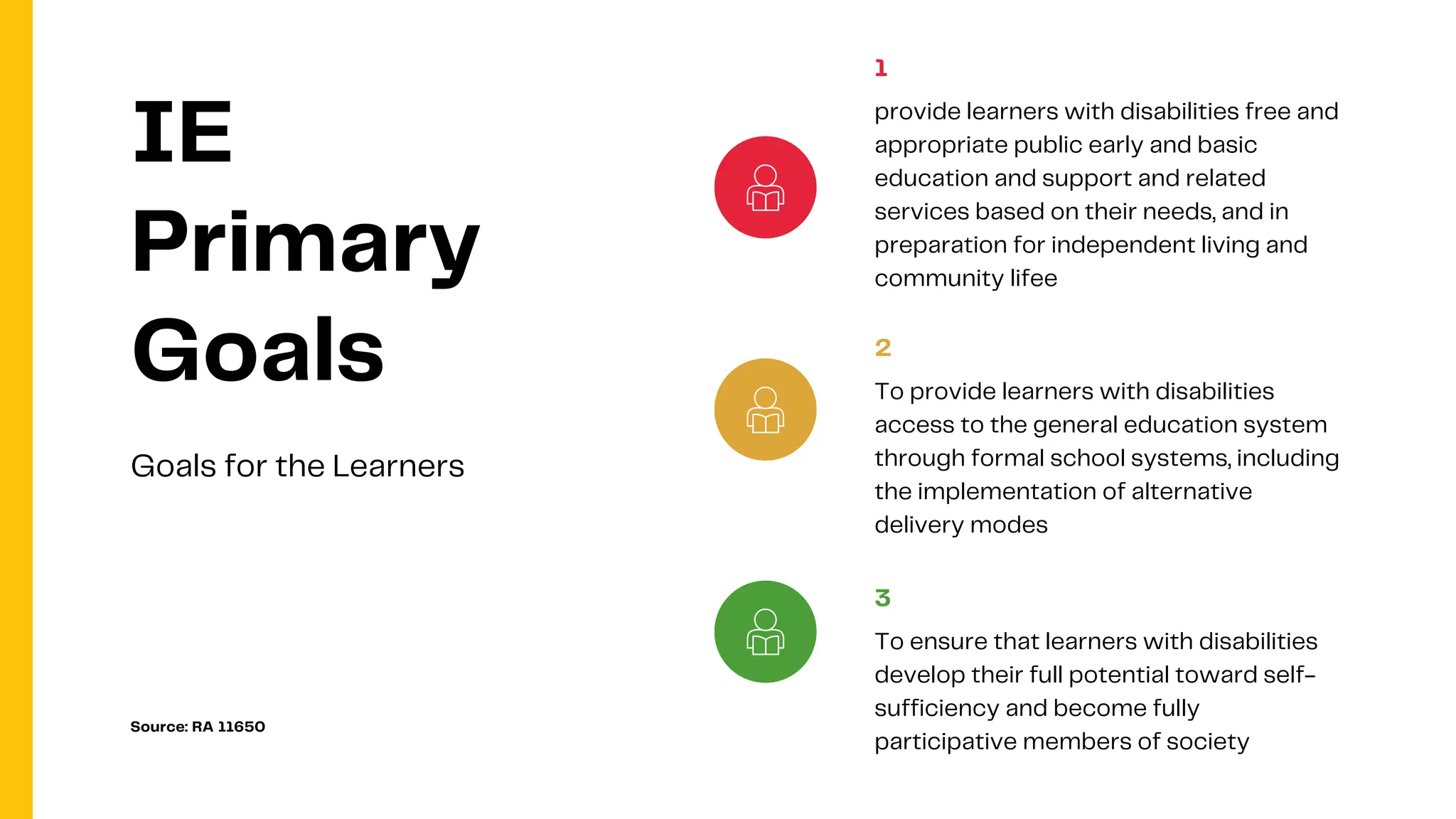
IE
Primary
Goals
Goals for the Learners
1
provide learners with disabilities free and
appropriate public early and basic
education and support and related
services based on their needs, and in
preparation for independent living and
community lifee
2
To provide learners with disabilities
access to the general education system
through formal school systems, including
the implementation of alternative
delivery modes
3
To ensure that learners with disabilities
develop their full potential toward self-
sufficiency and become fully
participative members of society
Source: RA 11650
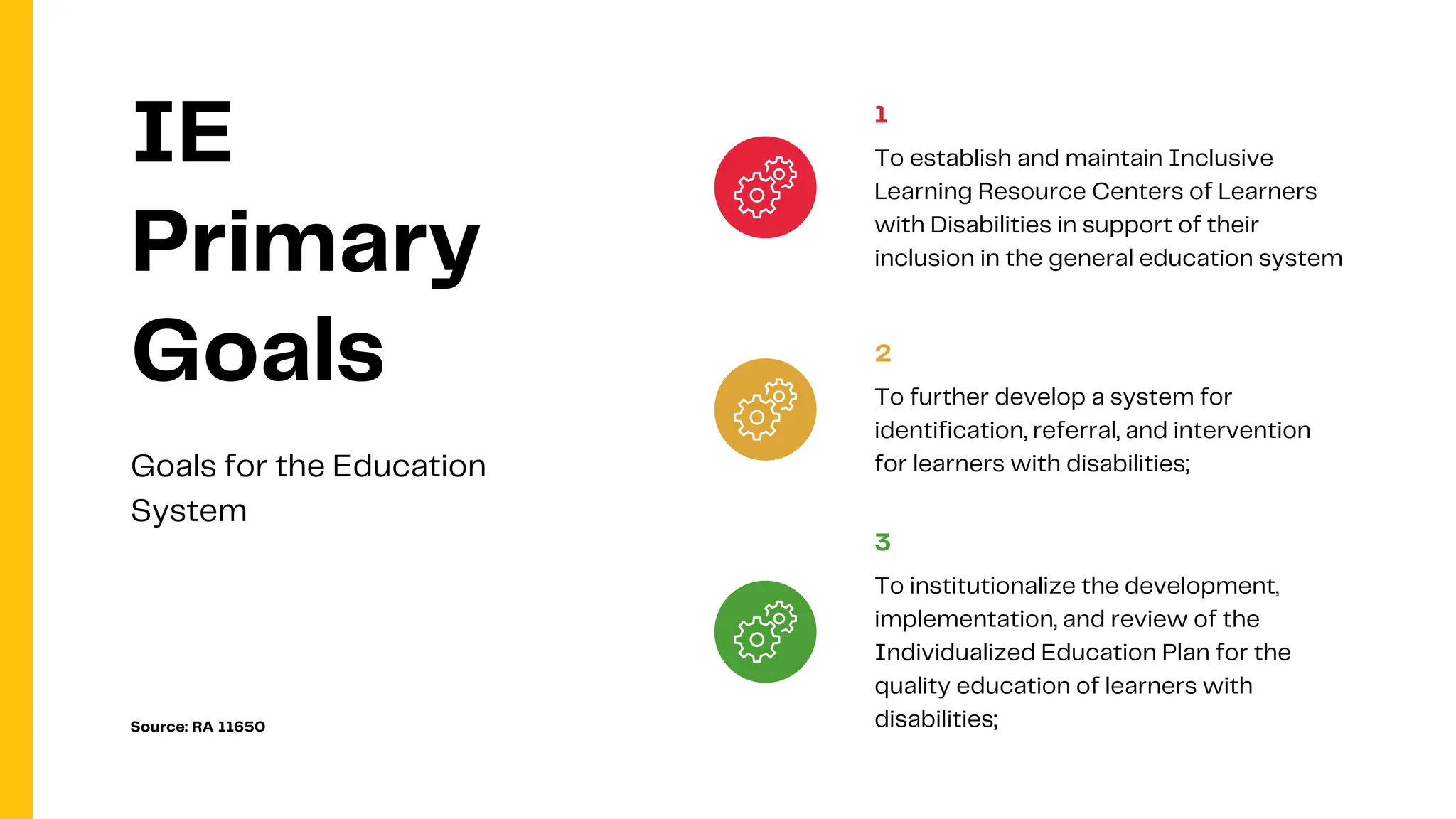
IE
Primary
Goals
Goals for the Education
System
1
To establish and maintain Inclusive
Learning Resource Centers of Learners
with Disabilities in support of their
inclusion in the general education system
2
To further develop a system for
identification, referral, and intervention
for learners with disabilities;
3
To institutionalize the development,
implementation, and review of the
Individualized Education Plan for the
quality education of learners with
disabilities;
Source: RA 11650
IE
Primary
Goals
Goals for the Stakeholders
1
To create significant and positive changes in
community orientation towards disability to ensure
that learners with disabilities are understood,
appreciated, and
respected for their differences by the members of their
communities and by society in general
2
To enable and empower all teachers, including those
with disabilities, parents, guardians, and family
members by training and equipping them with
capabilities for the detection, referral, or introduction of
interventions with regard to disorders, disabilities, and
abilities of the learners;
3
To train and equip all teachers, including child
development teachers and workers, principals,
administrators, non-teaching staff of the school, sign
language interpreters, parents, guardians, and care
providers as partners in the care, development,
education, and advancement of learners with
disabilities
Source: RA 11650
SCOPEOFINCLUSIVE
EDUCATION
Who is inclusive education for?
What educational approaches are required by
inclusive education?
What principles are significant to inclusive
education?
ALL LEARNERS including those-
with disabilities
from ethnic, religious, or linguistic minorities or
indigenous people
from difficult circumstances (e.g. geographical
isolation, chronic illness, displacement, child abuse,
or child labor practices)
Who is inclusive education for?
Education is a fundamental human right
What principles are significant to inclusive education?
Diversity-valuing a range of differences
Equity- fairness; providing different levels of required
support
Accessibility- removing barriers (e.g., physical,
informational, and attitudinal)
Participation- active involvement in the learning process
Collaboration- network of professionals and stakeholders
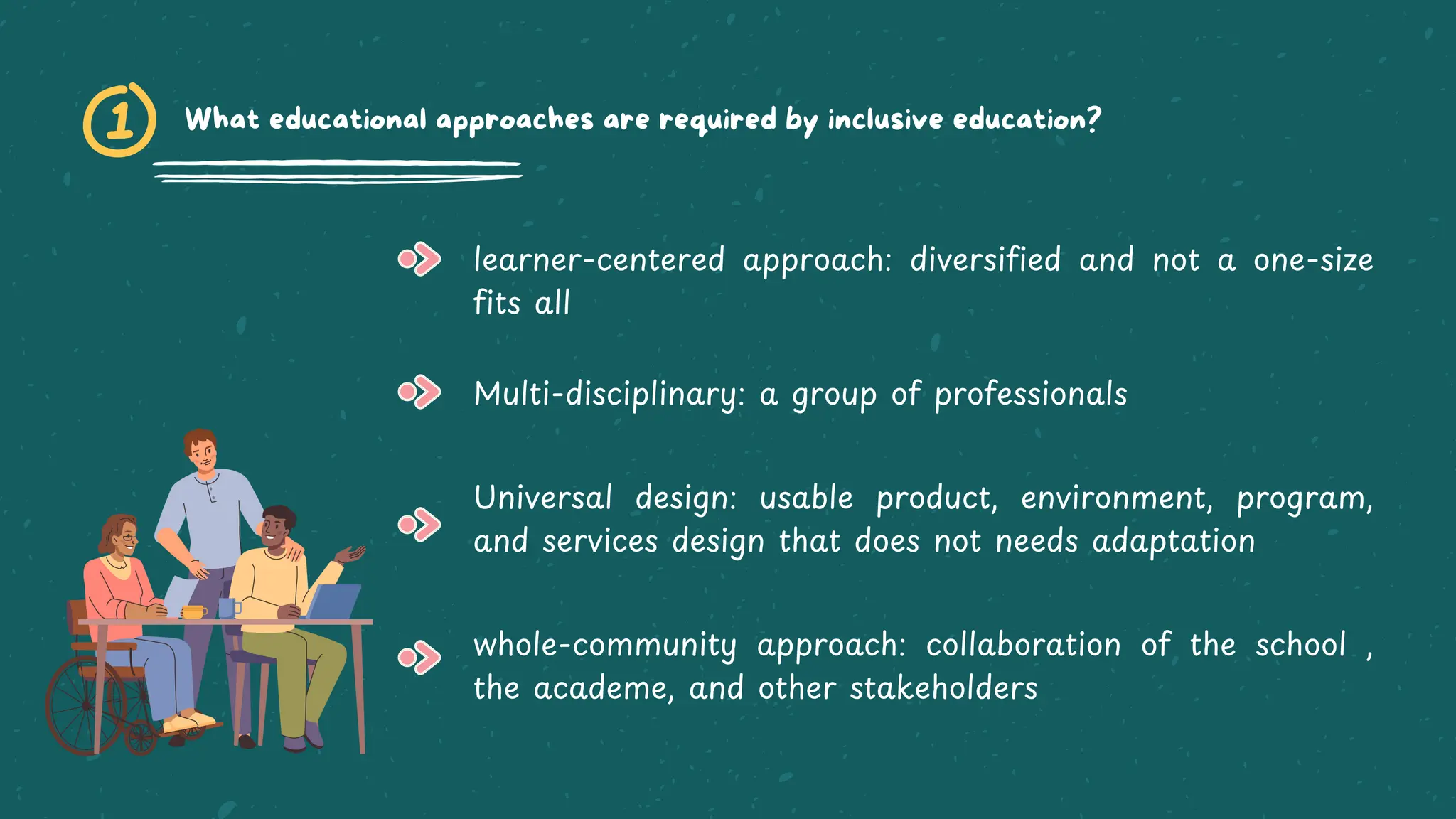
What educational approaches are required by inclusive education?
whole-community approach: collaboration of the school ,
the academe, and other stakeholders
Universal design: usable product, environment, program,
and services design that does not needs adaptation
Multi-disciplinary: a group of professionals
learner-centered approach: diversified and not a one-size
fits all
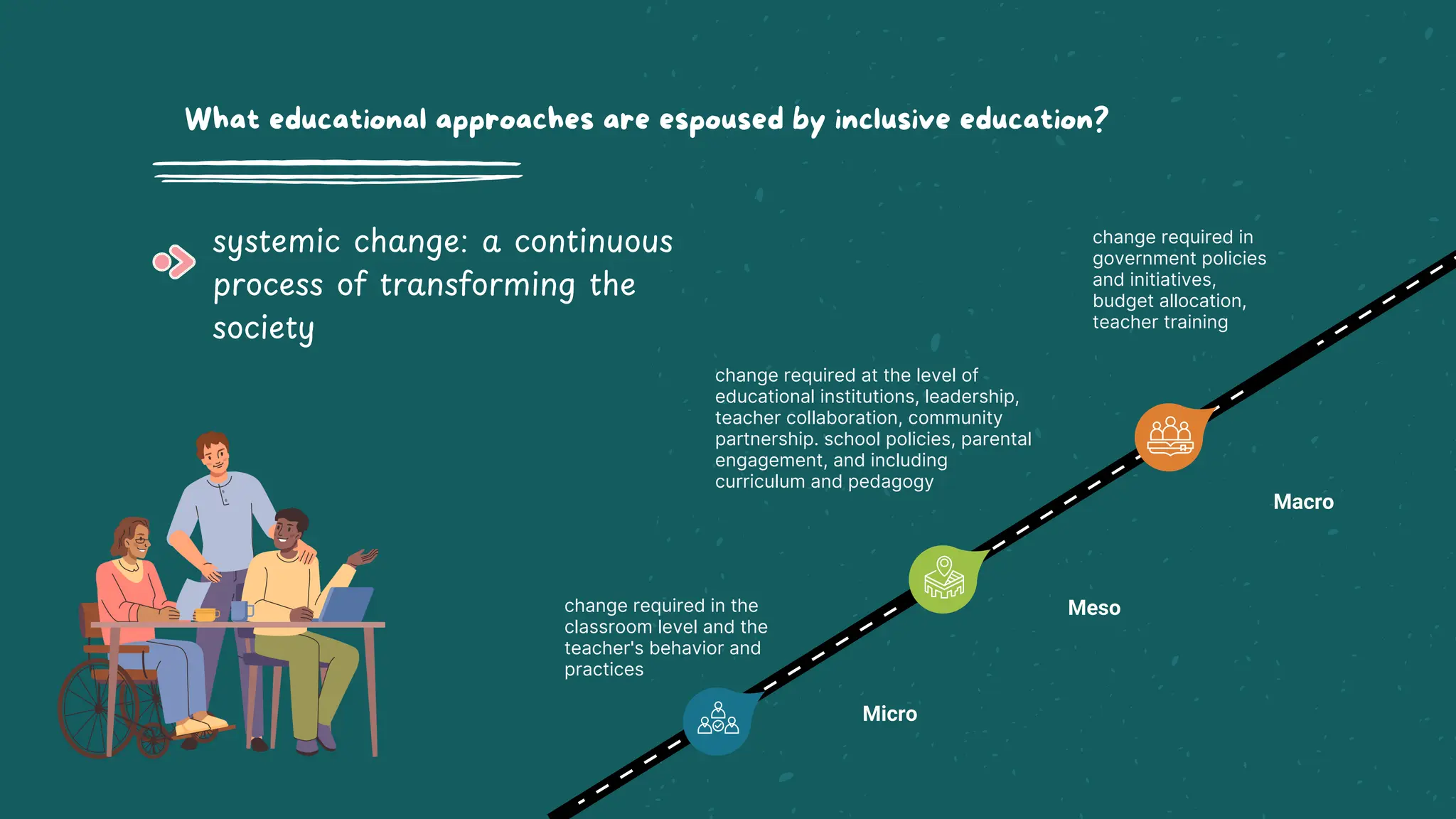
What educational approaches are espoused by inclusive education?
systemic change: a continuous
process of transforming the
society
Micro
Meso
Macro
change required in the
classroom level and the
teacher's behavior and
practices
change required at the level of
educational institutions, leadership,
teacher collaboration, community
partnership. school policies, parental
engagement, and including
curriculum and pedagogy
change required in
government policies
and initiatives,
budget allocation,
teacher training
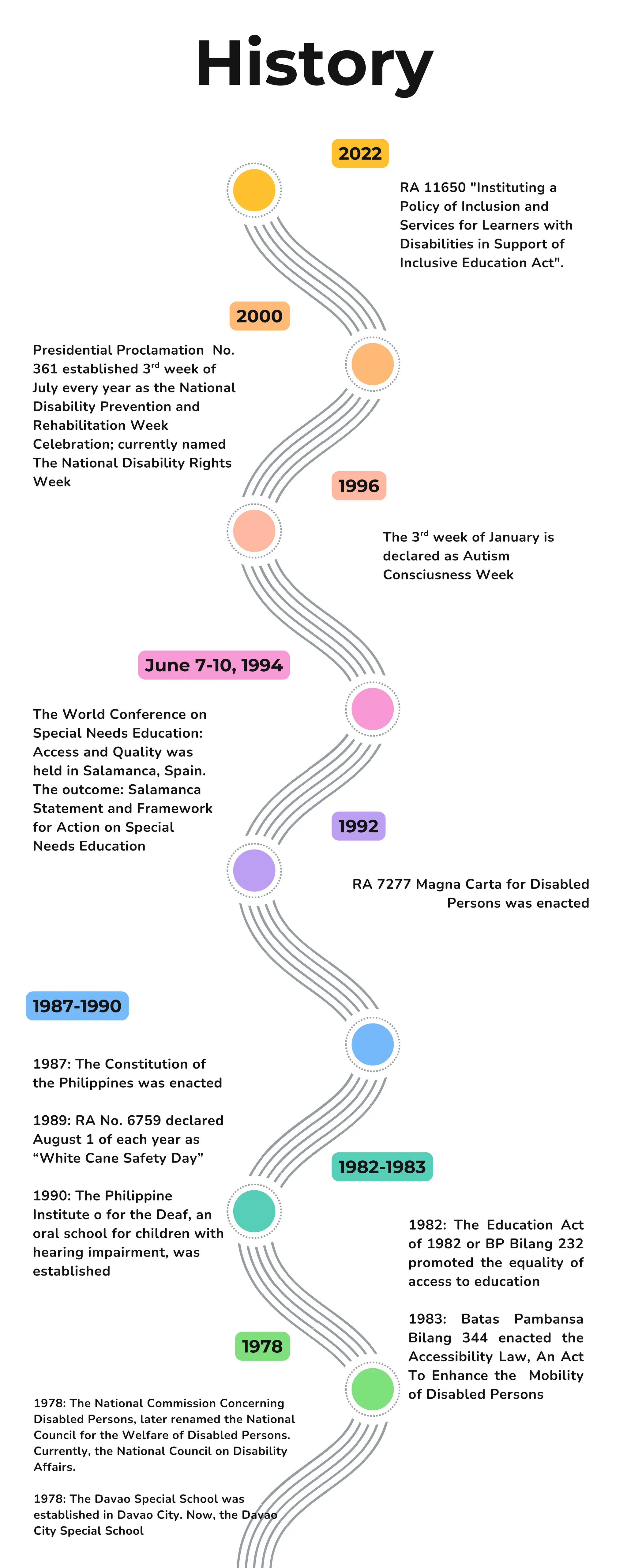
2022
1996
1992
1982-1983
2000
June 7-10, 1994
1987-1990
1978
History
RA 11650 "Instituting a
Policy of Inclusion and
Services for Learners with
Disabilities in Support of
Inclusive Education Act".
The 3 week of January is
declared as Autism
Consciusness Week
rd
RA 7277 Magna Carta for Disabled
Persons was enacted
1982: The Education Act
of 1982 or BP Bilang 232
promoted the equality of
access to education
1983: Batas Pambansa
Bilang 344 enacted the
Accessibility Law, An Act
To Enhance the Mobility
of Disabled Persons
Presidential Proclamation No.
361 established 3 week of
July every year as the National
Disability Prevention and
Rehabilitation Week
Celebration; currently named
The National Disability Rights
Week
rd
The World Conference on
Special Needs Education:
Access and Quality was
held in Salamanca, Spain.
The outcome: Salamanca
Statement and Framework
for Action on Special
Needs Education
1987: The Constitution of
the Philippines was enacted
1989: RA No. 6759 declared
August 1 of each year as
“White Cane Safety Day”
1990: The Philippine
Institute o for the Deaf, an
oral school for children with
hearing impairment, was
established
1978: The National Commission Concerning
Disabled Persons, later renamed the National
Council for the Welfare of Disabled Persons.
Currently, the National Council on Disability
Affairs.
1978: The Davao Special School was
established in Davao City. Now, the Davao
City Special School
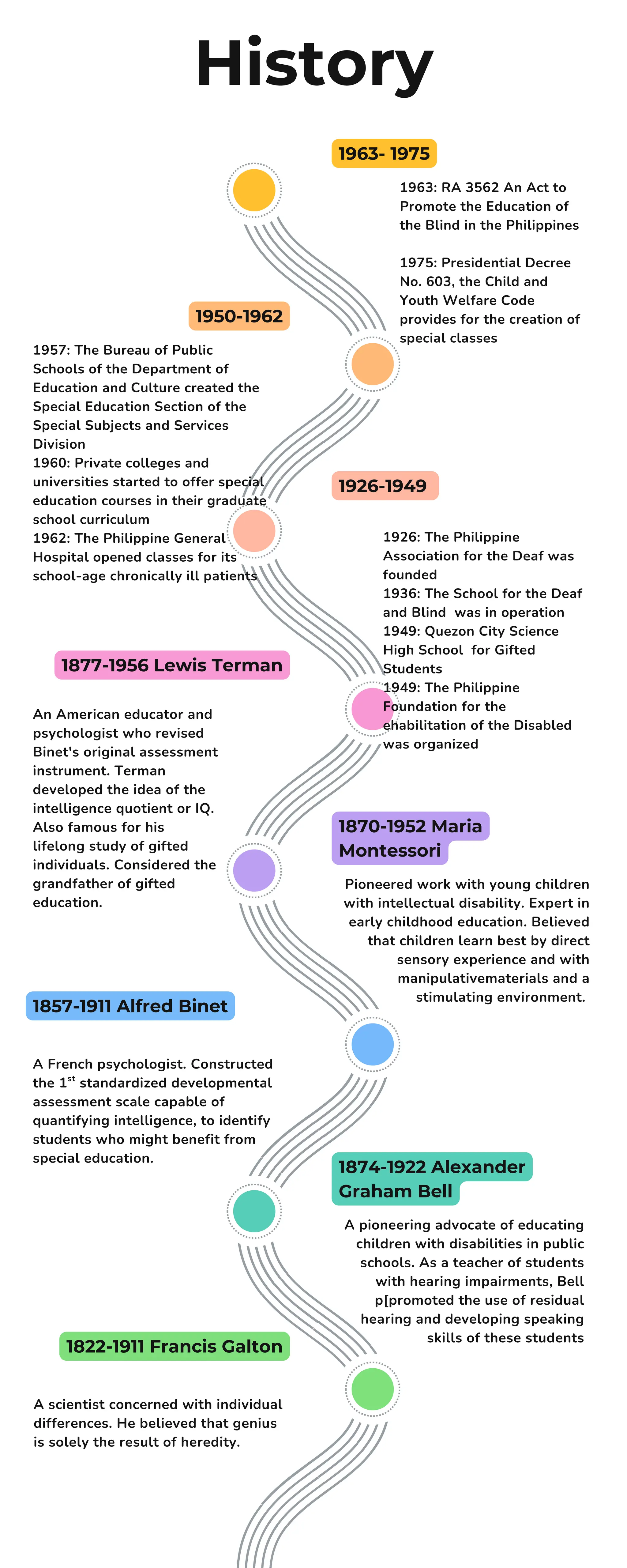
1963- 1975
1926-1949
1870-1952 Maria
Montessori
1874-1922 Alexander
Graham Bell
1950-1962
1877-1956 Lewis Terman
1857-1911 Alfred Binet
1822-1911 Francis Galton
History
1963: RA 3562 An Act to
Promote the Education of
the Blind in the Philippines
1975: Presidential Decree
No. 603, the Child and
Youth Welfare Code
provides for the creation of
special classes
1926: The Philippine
Association for the Deaf was
founded
1936: The School for the Deaf
and Blind was in operation
1949: Quezon City Science
High School for Gifted
Students
1949: The Philippine
Foundation for the
ehabilitation of the Disabled
was organized
Pioneered work with young children
with intellectual disability. Expert in
early childhood education. Believed
that children learn best by direct
sensory experience and with
manipulativematerials and a
stimulating environment.
A pioneering advocate of educating
children with disabilities in public
schools. As a teacher of students
with hearing impairments, Bell
p[promoted the use of residual
hearing and developing speaking
skills of these students
1957: The Bureau of Public
Schools of the Department of
Education and Culture created the
Special Education Section of the
Special Subjects and Services
Division
1960: Private colleges and
universities started to offer special
education courses in their graduate
school curriculum
1962: The Philippine General
Hospital opened classes for its
school-age chronically ill patients
An American educator and
psychologist who revised
Binet's original assessment
instrument. Terman
developed the idea of the
intelligence quotient or IQ.
Also famous for his
lifelong study of gifted
individuals. Considered the
grandfather of gifted
education.
A French psychologist. Constructed
the 1 standardized developmental
assessment scale capable of
quantifying intelligence, to identify
students who might benefit from
special education.
st
A scientist concerned with individual
differences. He believed that genius
is solely the result of heredity.
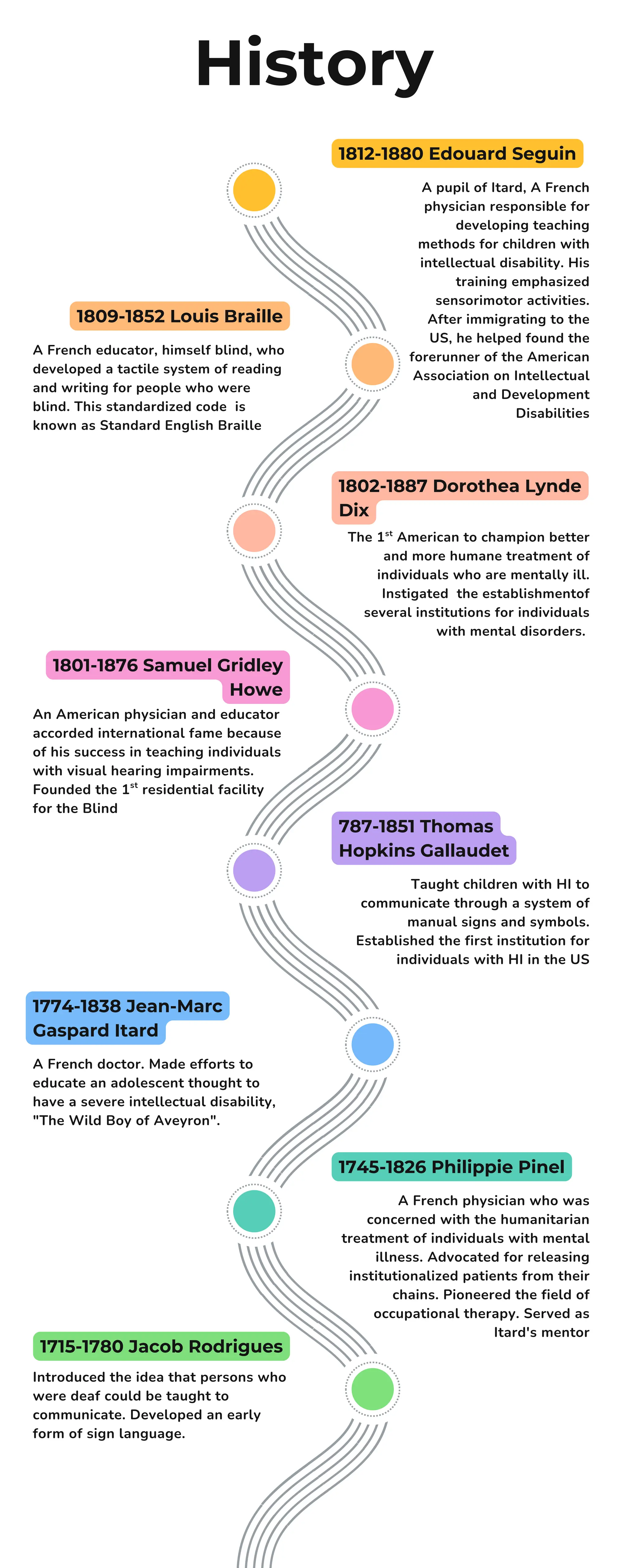
1812-1880 Edouard Seguin
1802-1887 Dorothea Lynde
Dix
787-1851 Thomas
Hopkins Gallaudet
1745-1826 Philippie Pinel
1809-1852 Louis Braille
1801-1876 Samuel Gridley
Howe
1774-1838 Jean-Marc
Gaspard Itard
1715-1780 Jacob Rodrigues
History
A pupil of Itard, A French
physician responsible for
developing teaching
methods for children with
intellectual disability. His
training emphasized
sensorimotor activities.
After immigrating to the
US, he helped found the
forerunner of the American
Association on Intellectual
and Development
Disabilities
The 1 American to champion better
and more humane treatment of
individuals who are mentally ill.
Instigated the establishmentof
several institutions for individuals
with mental disorders.
st
Taught children with HI to
communicate through a system of
manual signs and symbols.
Established the first institution for
individuals with HI in the US
A French physician who was
concerned with the humanitarian
treatment of individuals with mental
illness. Advocated for releasing
institutionalized patients from their
chains. Pioneered the field of
occupational therapy. Served as
Itard's mentor
A French educator, himself blind, who
developed a tactile system of reading
and writing for people who were
blind. This standardized code is
known as Standard English Braille
An American physician and educator
accorded international fame because
of his success in teaching individuals
with visual hearing impairments.
Founded the 1 residential facility
for the Blind
st
A French doctor. Made efforts to
educate an adolescent thought to
have a severe intellectual disability,
"The Wild Boy of Aveyron".
Introduced the idea that persons who
were deaf could be taught to
communicate. Developed an early
form of sign language.
UNIT-1_Introduction-to-SpEd-and-Inclusive-Education.pdf

  • 1.
    of Special Education Preparedby: Mariche C. Llanto, Faculty-CEd Definition
  • 2.
  • 3.
    What are thedefinitions? Who defined? Special Education "Special education is instruction that is designed to meet the unique needs of an exceptional student." Samuel A. Kirk (1962) "Special education is a comprehensive system that includes all of the services provided for exceptional individuals whose needs cannot be met within the regular instructional program." Joyce S. Pickeral (1992)
  • 4.
    What are thedefinitions? Who defined? Special Education "Special education is specially designed instruction, at no cost to the parents, to meet the unique needs of a child with a disability." Walter D. Cocking, John R. Curry, and James J. Smith (2001) "Special education is specially designed instruction and related services that meet the unique needs of a student with a disability." Michael F. Giangreco and Mary Beth Doyle (2003)
  • 5.
    What are thedefinitions? Who defined? Special Education "Special education is the instruction of students with disabilities in a way that addresses their individual differences and needs." James M. Kauffman (2005) "Special education is specially designed instruction that addresses the unique needs of a student with disabilities." Edward A. Polloway, James R. Patton, and Loretta Serna (2017)
  • 6.
    SPECIAL EDUCATION refersto a set of educational programs and/or services designed to address the needs of learners with disabilities through educational plans and instruments which will bring them to the highest level of their potential and capacity (Handbook for SPED, 1987). DO 44, s. 2021 Who is special education intended for What is special education? What makes special education different from general education? How is special education implemented? Where and with whom? Why is special education essential?
  • 7.
    Who is special education intendedfor? LEARNERS WITH DISABILITIES (LWDs) those who have long-term physical, mental, intellectual, or sensory impairments which, in interaction with various barriers, may hinder their full and effective participation in society on an equal basis with others (Sec. 4 (o) of RA 1 I 5 l0). FOR FOR WHOM? WHOM?‌ ‌ Source: DO 44, s. 2021
  • 8.
    What is special education? EDUCATIONALPROGRAMS AND SERVICES any educational interventions, programs, and services that will ensure support to learners with disabilities for an equal opportunity to access quality basic education Source: DO 44, s. 2021
  • 9.
    The professionals The curriculum Themethods and materials What sets special education apart from general education? The setting
  • 10.
    How is special education implemented? Whereand with whom? Special education uses a curriculum based on the IEP (Individualized Education Plan) goals for the student Special education uses specialized and adapted materials and methods Special education has an interdisciplinary team of professionals Special education has multiple educational settings.
  • 11.
    Elaborate on thebulleted points from the previous slide, providing specific examples for each.
  • 12.
    Why is special education essential? Thestate, through the provision of educational programs, has the duty and responsibility to protect and promote the right of learners with disabilities to accessible quality education, among all human rights, free from discrimination. The LWD must be ensured ample opportunities to develop their skills through access to education commensurate with their abilities for the improvement of their capacity for service, to themselves and their fellowmen (Art. 3, Presidential Decree No. 603). Source: DO 44, s. 2021
  • 13.
    of Inclusive Education Preparedby: Mariche C. Llanto, Faculty- CEd Definition & Scope
  • 14.
    Learning Objective EDUC112 EDUC 112 Define inclusiveeducation Identify the scope and primary goals of inclusive education
  • 15.
    What are thedefinitions? Who defined? Inclusive Education inclusive education as "the means by which we can reach 'Education for All' goals," where all students, regardless of disability or other characteristics, learn together in mainstream classrooms. Salamanca Statement and Framework for Action (1994) Inclusion in education is a conceptual approach aimed at achieving quality education by making changes to accommodate all learners regardless of their physical, social, or psychological differences. Kaushik, B. & Srivastava, A.
  • 16.
    The process ofaddressing and responding to the diversity of needs of all learners by moving towards the end-goal of full participation, presence, and achievement in learning cultures and communities, which involves accommodation, modification, adaptation, and individualization in content, approaches, structures, and strategies It involves equitable opportunities for learners with disabilities to receive educational services and the needed support and related services with their age-appropriate peer groups and, as far as practicable, in such schools or ILRCs nearest their homes or residences, in order to prepare them to live as fully functional members of society (Sec.3 d). RA 11650 Instituting a Policy of Inclusion and Service for Learners with Disabilities in Support of Inclusive Education Act Inclusive Education RA 11650 DO 43, s. 2025
  • 17.
    IE Primary Goals Goals for theLearners 1 provide learners with disabilities free and appropriate public early and basic education and support and related services based on their needs, and in preparation for independent living and community lifee 2 To provide learners with disabilities access to the general education system through formal school systems, including the implementation of alternative delivery modes 3 To ensure that learners with disabilities develop their full potential toward self- sufficiency and become fully participative members of society Source: RA 11650
  • 18.
    IE Primary Goals Goals for theEducation System 1 To establish and maintain Inclusive Learning Resource Centers of Learners with Disabilities in support of their inclusion in the general education system 2 To further develop a system for identification, referral, and intervention for learners with disabilities; 3 To institutionalize the development, implementation, and review of the Individualized Education Plan for the quality education of learners with disabilities; Source: RA 11650
  • 19.
    IE Primary Goals Goals for theStakeholders 1 To create significant and positive changes in community orientation towards disability to ensure that learners with disabilities are understood, appreciated, and respected for their differences by the members of their communities and by society in general 2 To enable and empower all teachers, including those with disabilities, parents, guardians, and family members by training and equipping them with capabilities for the detection, referral, or introduction of interventions with regard to disorders, disabilities, and abilities of the learners; 3 To train and equip all teachers, including child development teachers and workers, principals, administrators, non-teaching staff of the school, sign language interpreters, parents, guardians, and care providers as partners in the care, development, education, and advancement of learners with disabilities Source: RA 11650
  • 20.
    SCOPEOFINCLUSIVE EDUCATION Who is inclusiveeducation for? What educational approaches are required by inclusive education? What principles are significant to inclusive education?
  • 21.
    ALL LEARNERS includingthose- with disabilities from ethnic, religious, or linguistic minorities or indigenous people from difficult circumstances (e.g. geographical isolation, chronic illness, displacement, child abuse, or child labor practices) Who is inclusive education for?
  • 22.
    Education is afundamental human right What principles are significant to inclusive education? Diversity-valuing a range of differences Equity- fairness; providing different levels of required support Accessibility- removing barriers (e.g., physical, informational, and attitudinal) Participation- active involvement in the learning process Collaboration- network of professionals and stakeholders
  • 23.
    What educational approachesare required by inclusive education? whole-community approach: collaboration of the school , the academe, and other stakeholders Universal design: usable product, environment, program, and services design that does not needs adaptation Multi-disciplinary: a group of professionals learner-centered approach: diversified and not a one-size fits all
  • 24.
    What educational approachesare espoused by inclusive education? systemic change: a continuous process of transforming the society Micro Meso Macro change required in the classroom level and the teacher's behavior and practices change required at the level of educational institutions, leadership, teacher collaboration, community partnership. school policies, parental engagement, and including curriculum and pedagogy change required in government policies and initiatives, budget allocation, teacher training
  • 25.
    2022 1996 1992 1982-1983 2000 June 7-10, 1994 1987-1990 1978 History RA11650 "Instituting a Policy of Inclusion and Services for Learners with Disabilities in Support of Inclusive Education Act". The 3 week of January is declared as Autism Consciusness Week rd RA 7277 Magna Carta for Disabled Persons was enacted 1982: The Education Act of 1982 or BP Bilang 232 promoted the equality of access to education 1983: Batas Pambansa Bilang 344 enacted the Accessibility Law, An Act To Enhance the Mobility of Disabled Persons Presidential Proclamation No. 361 established 3 week of July every year as the National Disability Prevention and Rehabilitation Week Celebration; currently named The National Disability Rights Week rd The World Conference on Special Needs Education: Access and Quality was held in Salamanca, Spain. The outcome: Salamanca Statement and Framework for Action on Special Needs Education 1987: The Constitution of the Philippines was enacted 1989: RA No. 6759 declared August 1 of each year as “White Cane Safety Day” 1990: The Philippine Institute o for the Deaf, an oral school for children with hearing impairment, was established 1978: The National Commission Concerning Disabled Persons, later renamed the National Council for the Welfare of Disabled Persons. Currently, the National Council on Disability Affairs. 1978: The Davao Special School was established in Davao City. Now, the Davao City Special School
  • 26.
    1963- 1975 1926-1949 1870-1952 Maria Montessori 1874-1922Alexander Graham Bell 1950-1962 1877-1956 Lewis Terman 1857-1911 Alfred Binet 1822-1911 Francis Galton History 1963: RA 3562 An Act to Promote the Education of the Blind in the Philippines 1975: Presidential Decree No. 603, the Child and Youth Welfare Code provides for the creation of special classes 1926: The Philippine Association for the Deaf was founded 1936: The School for the Deaf and Blind was in operation 1949: Quezon City Science High School for Gifted Students 1949: The Philippine Foundation for the ehabilitation of the Disabled was organized Pioneered work with young children with intellectual disability. Expert in early childhood education. Believed that children learn best by direct sensory experience and with manipulativematerials and a stimulating environment. A pioneering advocate of educating children with disabilities in public schools. As a teacher of students with hearing impairments, Bell p[promoted the use of residual hearing and developing speaking skills of these students 1957: The Bureau of Public Schools of the Department of Education and Culture created the Special Education Section of the Special Subjects and Services Division 1960: Private colleges and universities started to offer special education courses in their graduate school curriculum 1962: The Philippine General Hospital opened classes for its school-age chronically ill patients An American educator and psychologist who revised Binet's original assessment instrument. Terman developed the idea of the intelligence quotient or IQ. Also famous for his lifelong study of gifted individuals. Considered the grandfather of gifted education. A French psychologist. Constructed the 1 standardized developmental assessment scale capable of quantifying intelligence, to identify students who might benefit from special education. st A scientist concerned with individual differences. He believed that genius is solely the result of heredity.
  • 27.
    1812-1880 Edouard Seguin 1802-1887Dorothea Lynde Dix 787-1851 Thomas Hopkins Gallaudet 1745-1826 Philippie Pinel 1809-1852 Louis Braille 1801-1876 Samuel Gridley Howe 1774-1838 Jean-Marc Gaspard Itard 1715-1780 Jacob Rodrigues History A pupil of Itard, A French physician responsible for developing teaching methods for children with intellectual disability. His training emphasized sensorimotor activities. After immigrating to the US, he helped found the forerunner of the American Association on Intellectual and Development Disabilities The 1 American to champion better and more humane treatment of individuals who are mentally ill. Instigated the establishmentof several institutions for individuals with mental disorders. st Taught children with HI to communicate through a system of manual signs and symbols. Established the first institution for individuals with HI in the US A French physician who was concerned with the humanitarian treatment of individuals with mental illness. Advocated for releasing institutionalized patients from their chains. Pioneered the field of occupational therapy. Served as Itard's mentor A French educator, himself blind, who developed a tactile system of reading and writing for people who were blind. This standardized code is known as Standard English Braille An American physician and educator accorded international fame because of his success in teaching individuals with visual hearing impairments. Founded the 1 residential facility for the Blind st A French doctor. Made efforts to educate an adolescent thought to have a severe intellectual disability, "The Wild Boy of Aveyron". Introduced the idea that persons who were deaf could be taught to communicate. Developed an early form of sign language.