Dr. Cegielski
Lecture 3
The World is Flat
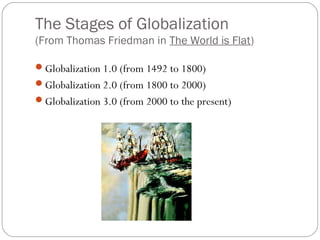
The Stages of Globalization
(From Thomas Friedman in The World is Flat)
Globalization 1.0 (from 1492 to 1800)
Globalization 2.0 (from 1800 to 2000)
Globalization 3.0 (from 2000 to the present)
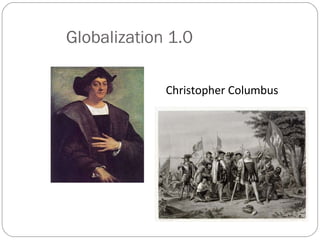
Globalization 1.0
Christopher Columbus
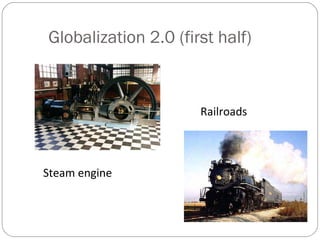
Globalization 2.0 (first half)
Steam engine
Railroads
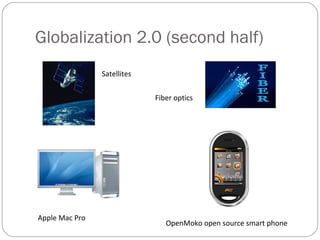
Globalization 2.0 (second half)
OpenMoko open source smart phone
Satellites
Apple Mac Pro
Fiber optics
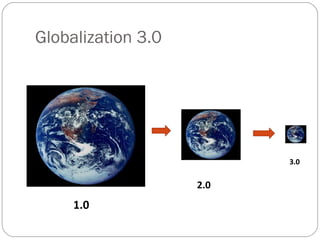
Globalization 3.0
1.0
2.0
3.0
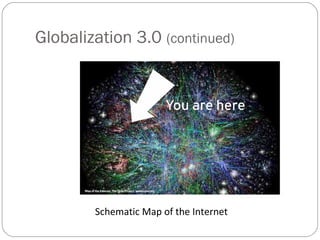
Globalization 3.0 (continued)
Schematic Map of the Internet
Thomas Freidman’s Ten Flatteners
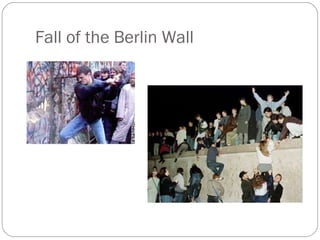
 Fall of the Berlin Wall
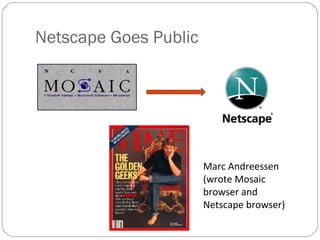
 Netscape goes public
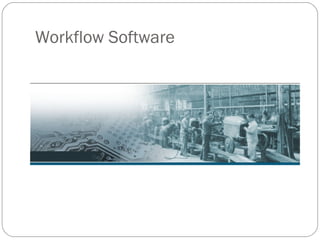
 Development of work-flow software
 Uploading
 Outsourcing
 Offshoring
 Supply Chaining
 Insourcing
 Informing
 The Steriods
Fall of the Berlin Wall
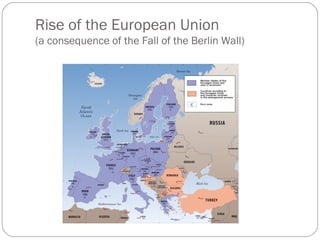
Rise of the European Union
(a consequence of the Fall of the Berlin Wall)
Netscape Goes Public
Marc Andreessen
(wrote Mosaic
browser and
Netscape browser)
Workflow Software
Uploading
The Open Source Movement
(essential ingredient of uploading)
Linux
Apache Web server
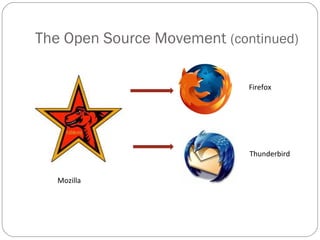
The Open Source Movement (continued)
Mozilla
Firefox
Thunderbird
The SeaMonkey Project
Formerly the Mozilla
Application Suite
Outsourcing
Outsourcing gained
momentum and “took
off” with Year 2000 (Y2K)
problem
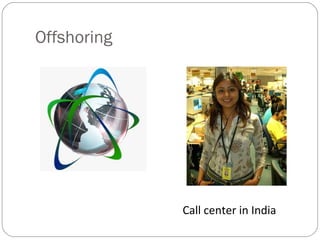
Offshoring
Call center in India
Supply Chaining
Insourcing
Informing
It’s not just
There are MANY other interesting search engines as we see in
Chapter 5
The Steroids
Digital
Mobile
Virtual
Personal
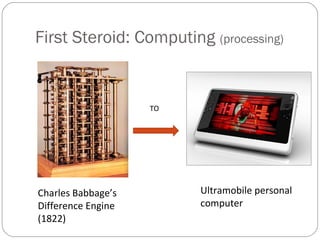
First Steroid: Computing (processing)
TO
Charles Babbage’s
Difference Engine
(1822)
Ultramobile personal
computer
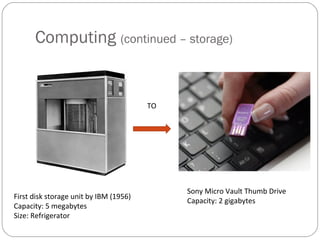
Computing (continued – storage)
TO
First disk storage unit by IBM (1956)
Capacity: 5 megabytes
Size: Refrigerator
Sony Micro Vault Thumb Drive
Capacity: 2 gigabytes
Second Steroid:
Instant Messaging and File Sharing
Instant messaging
(example)
File sharing (example)
Third Steroid:
Voice over Internet Protocol
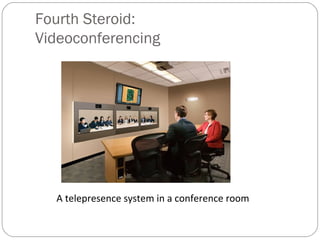
Fourth Steroid:
Videoconferencing
A telepresence system in a conference room
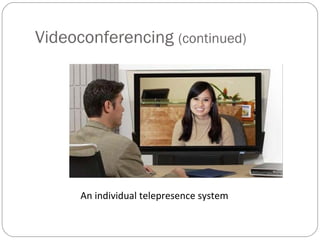
Videoconferencing (continued)
An individual telepresence system
Videoconferencing and Medicine
New Zealand used Polycom, a leading vendor of telepresence
systems, to provide a telemedicine application for children.
Fifth Steroid:
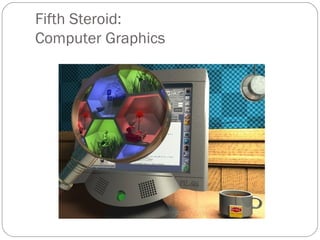
Computer Graphics
Sixth Steroid:
Wireless Technologies
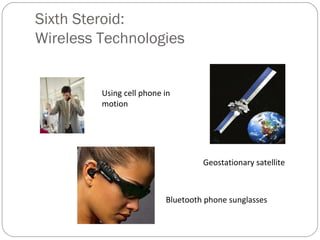
Using cell phone in
motion
Geostationary satellite
Bluetooth phone sunglasses
The Great Convergence
We are in a convergence of three powerful, technological
forces:
(1) Cheap and ubiquitous computing devices (2) Low-cost,
high bandwidth
(3) Open standards
The Great Convergence (continued)
In essence, we have computing everywhere and anywhere,
anytime and all the time, with access to limitless amounts of
information, services, and entertainment.
The Great Convergence (continued)
We have the creation of a global, Web-enabled playing field
that allows for multiple forms of collaboration – the sharing
of knowledge and work – in real time, without regard to
geography, distance, or, in the near future, even language. 
The field now includes some 3 billion new people, formerly
digitally disenfranchised.
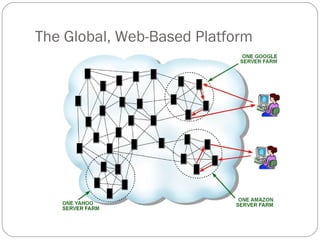
The Global, Web-Based Platform

The world is flat thomas friedman

Editor's Notes

  • #3 Globalization 1.0 * 1492 to 1800 * World went from large to medium-size * All about countries and muscles * Key agents of change: brawn and horsepower Globalization 2.0 * 1800 to 2000 * World has shrunk from medium to small-size * Key agent of change: multinational companies * First half: global integration powered by falling transportation costs (steam engine and railroad) * Second half: global integration powered by falling telecommunications costs (telephone, PC, satellites, fiber-optic cable) Globalization 3.0 * 2000 – now * World is now tiny (everyone is everyone else’s close neighbor) * Competitive playing field is being leveled * Key agent of change: software, in conjunction with the global fiber-optic network * Enabling people to collaborate and compete globally
  • #4 Christopher Columbus “discovering” the New World in 1492.
  • #5 Global integration during the first half of Globalization 2.0 was driven by falling transportation costs (for example, steam engine and the railroads).
  • #6 Global integration during the second half of Globalization 2.0 was driven by falling communications costs (e.g., satellites, fiber optics, the personal computer, and wireless smart phones).
  • #7 Key agent of change: software, in conjunction with the global fiber-optic network enabling people to collaborate and compete globally
  • #9 We look at each flattener in the following slides.
  • #13 This image is an interesting juxtaposition of the old assembly line (on the right) and the integrated circuits of work-flow software (on the left).
  • #14 Clicking on the Blogger, Wikipedia, or YouTube logos on this slide will take you to their respective home pages.
  • #15 Clicking on the Linux logo takes you to the “Linux Headquarters” home page.
  • #16 The Mozilla Foundation has shifted its focus to its Firefox Web browser and Thunderbird e-mail package.
  • #17 The SeaMonkey Project is a community effort to deliver production-quality releases of code derived from the application formerly known as "Mozilla Application Suite". The SeaMonkey Project has released its “all-in-one” Internet application suite, which contains a Web browser, e-mail and newsgroup client, IRC chat client, and HTML editing.
  • #23 Digital: all analog content and processes are being digitized Mobile: thanks to wireless technologies, computing, connecting, collaborating can be done anywhere Virtual: the process of shaping, manipulating, and transmitting digitized content can be done at very high speeds, so that users do not have to think about these processes Personal: Individuals can perform all these processes on their own computing devices
  • #28 This slide shows a telepresence system. A telepresence system is a sophisticated, high-bandwidth videoconferencing system with very large, high-definition screens and directional microphones. The objective is to make participants feel that they are in the same room.
  • #30 The telemedicine link will show a video of the New Zealand application. Clicking on the Polycom logo will take you to its homepage.
  • #36 The cloud in this figure represents the Internet. Various companies’ data centers are connected to the Internet. When you make a query to Google, Yahoo, or Amazon (for example), your request travels over the Internet to one of their data centers. As many servers as are needed are brought to bear answering your query. The response is then sent back to you.