CIDOC 2024, November 12, 2024
The Work of Digital Collections
David Newbury
Senior Director, Public Technologies, Getty
Thank you, CIDOC & Rijksmuseum.
I lead public technologies at Getty.
I’ve been working on museum data standards
for the past decade.
You are my people.
2
Introduction: The Work of Digital Collections
I’d like to show you
three things.
3
Introduction: The Work of Digital Collections
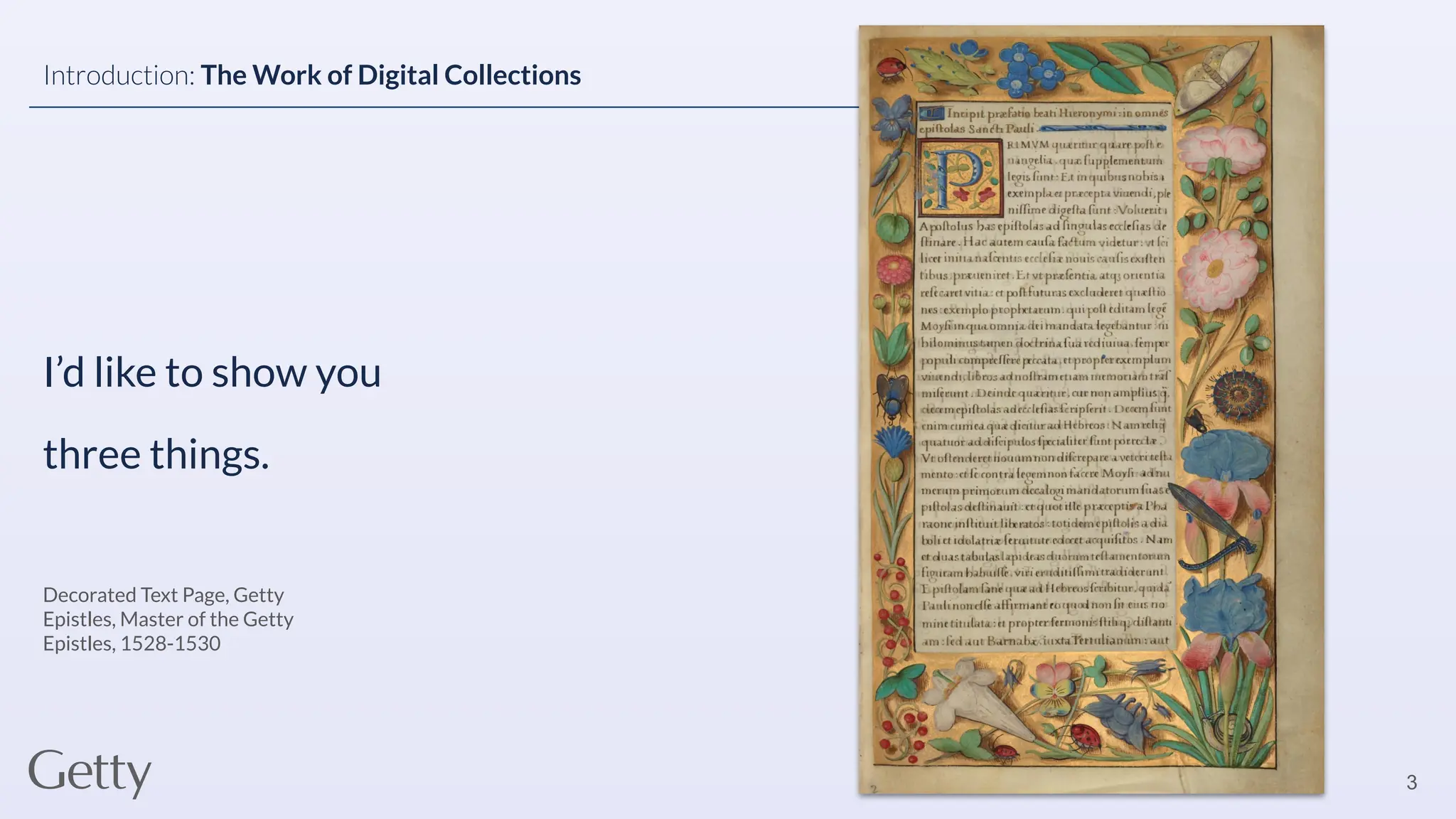
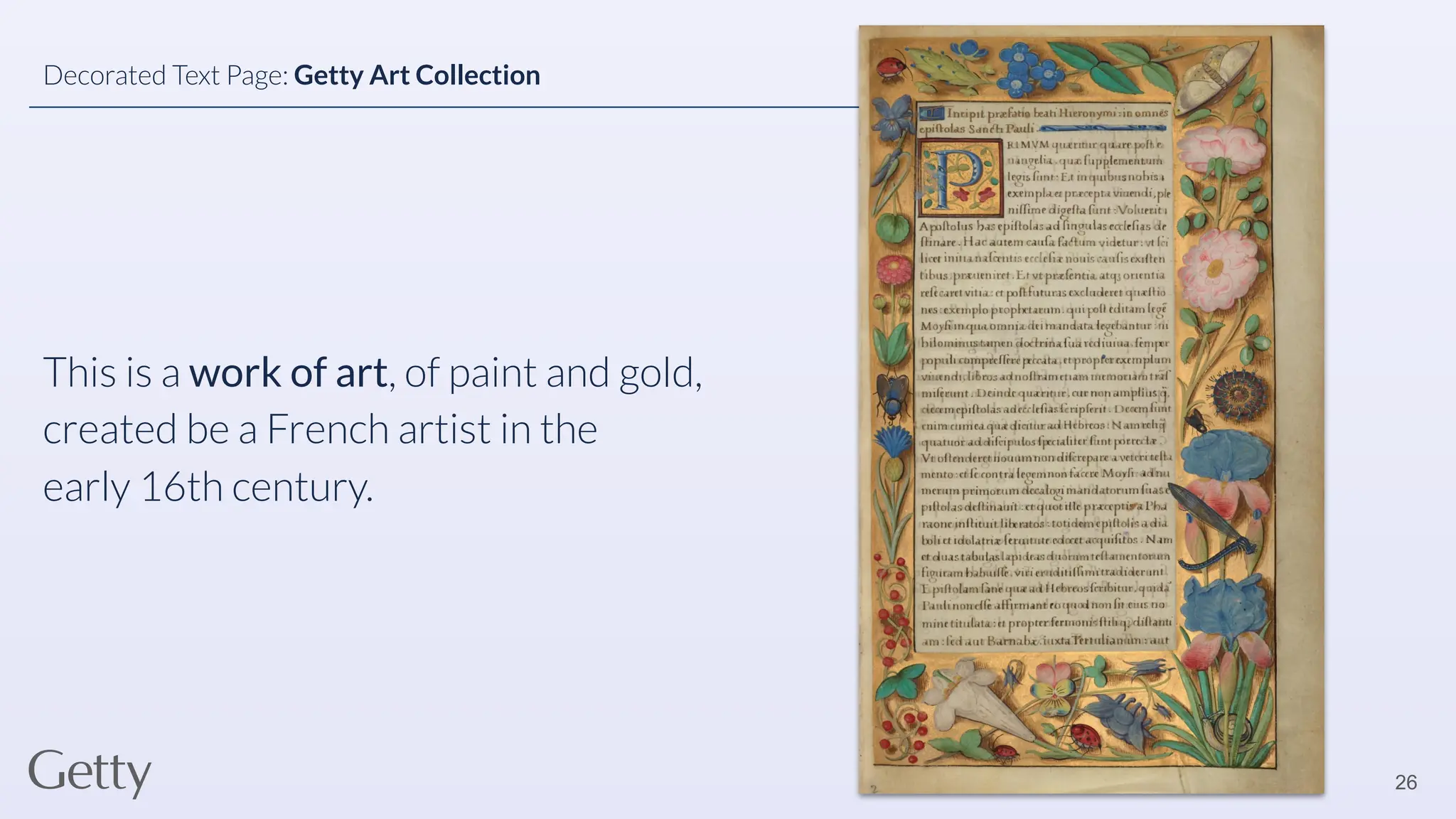
Decorated Text Page, Getty
Epistles, Master of the Getty
Epistles, 1528-1530
I’d like to show you
three things.
4
Introduction: The Work of Digital Collections
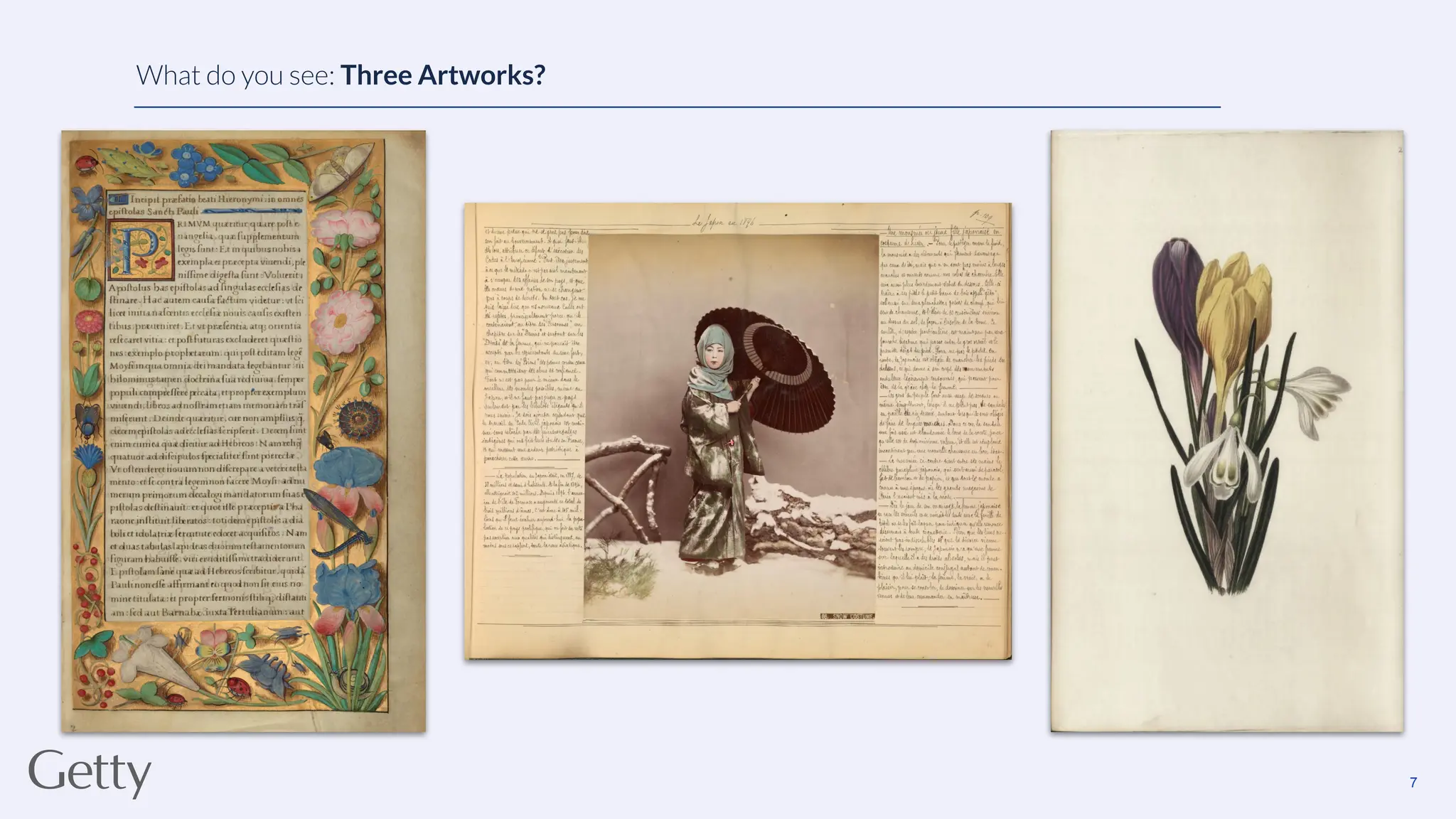
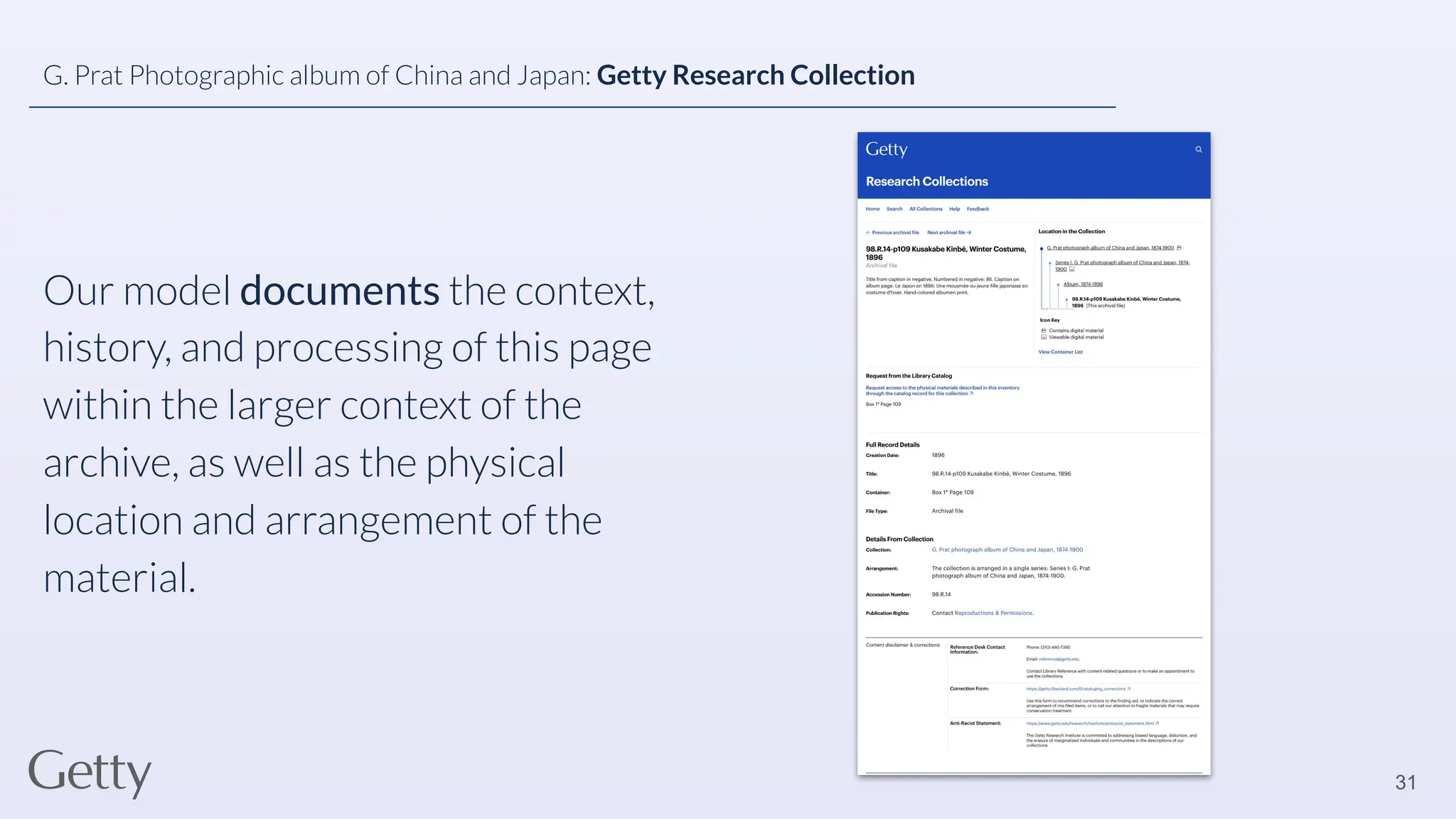
G. Prat photograph album of
China and Japan, 1874-1900,
Page 109.
I’d like to show you
three things.
Introduction: The Work of Digital Collections
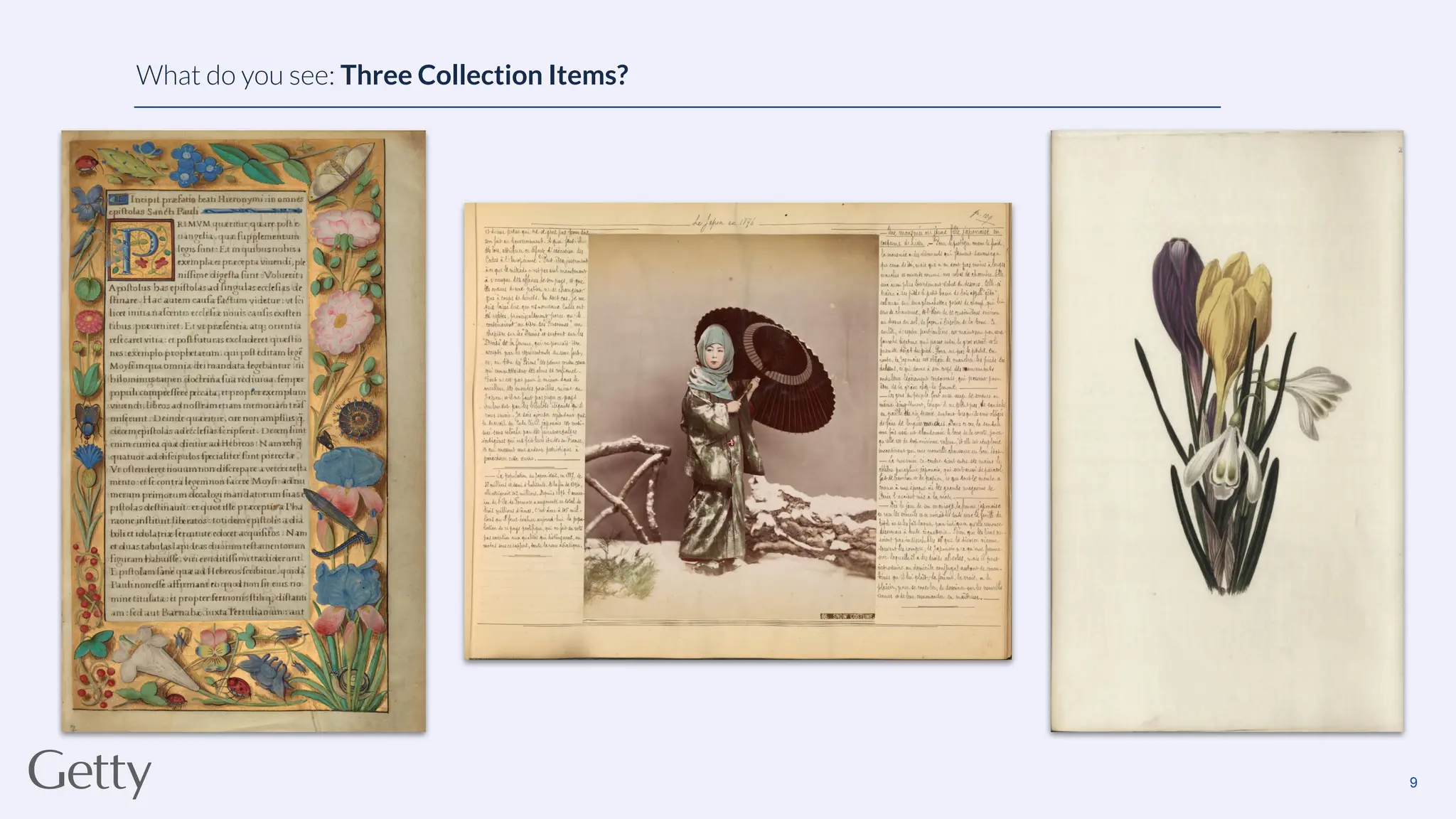
The moral of flowers
Rebecca Hey, 1833
6
What do you see: Three Manuscript Pages?
7
What do you see: Three Artworks?
8
What do you see: Three Authored documents?
9
What do you see: Three Collection Items?
10
What do you see: Three Human-Made Objects?
11
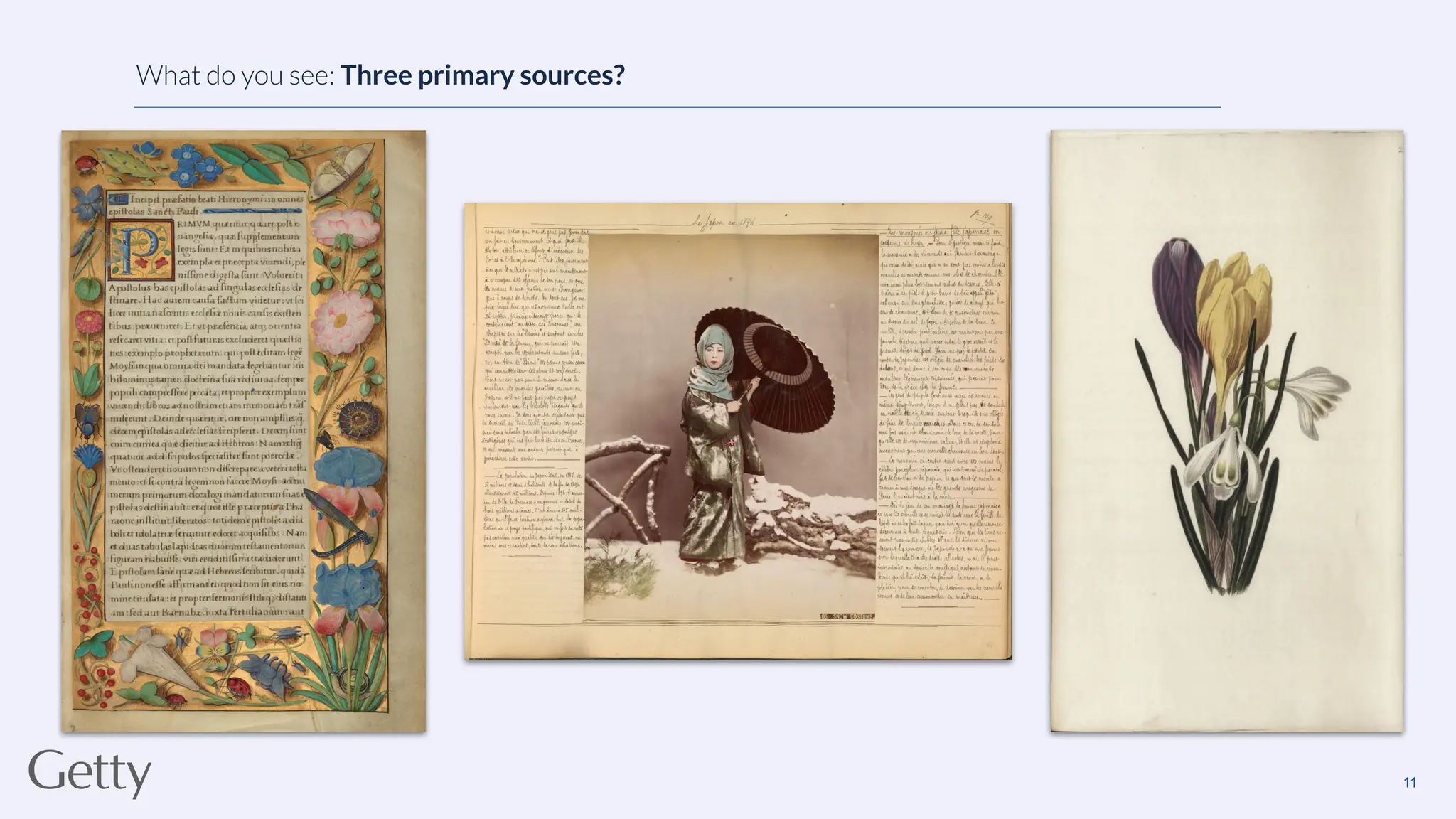
What do you see: Three primary sources?
12
What do you see: Three stories about nature?
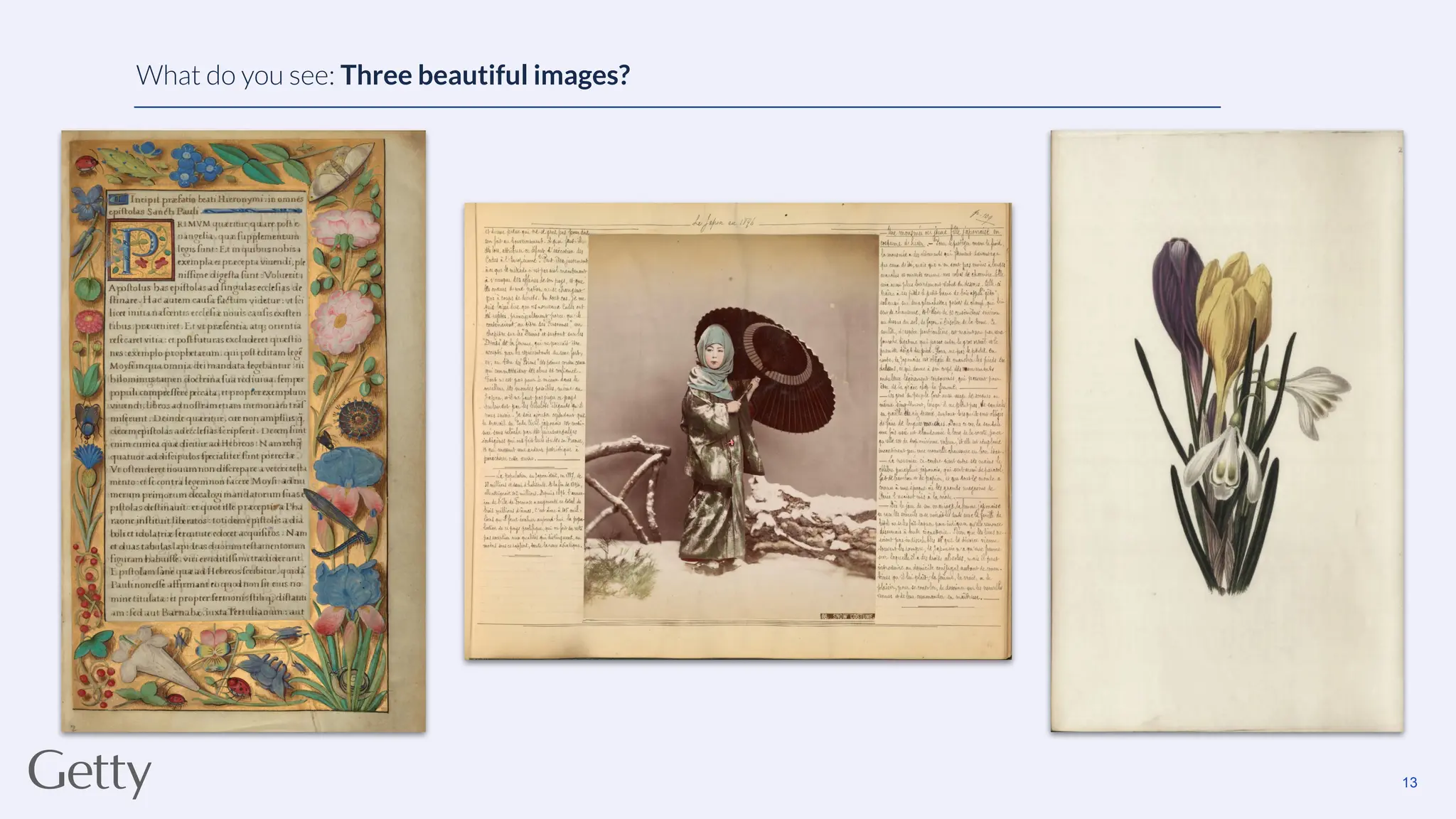
13
What do you see: Three beautiful images?
14
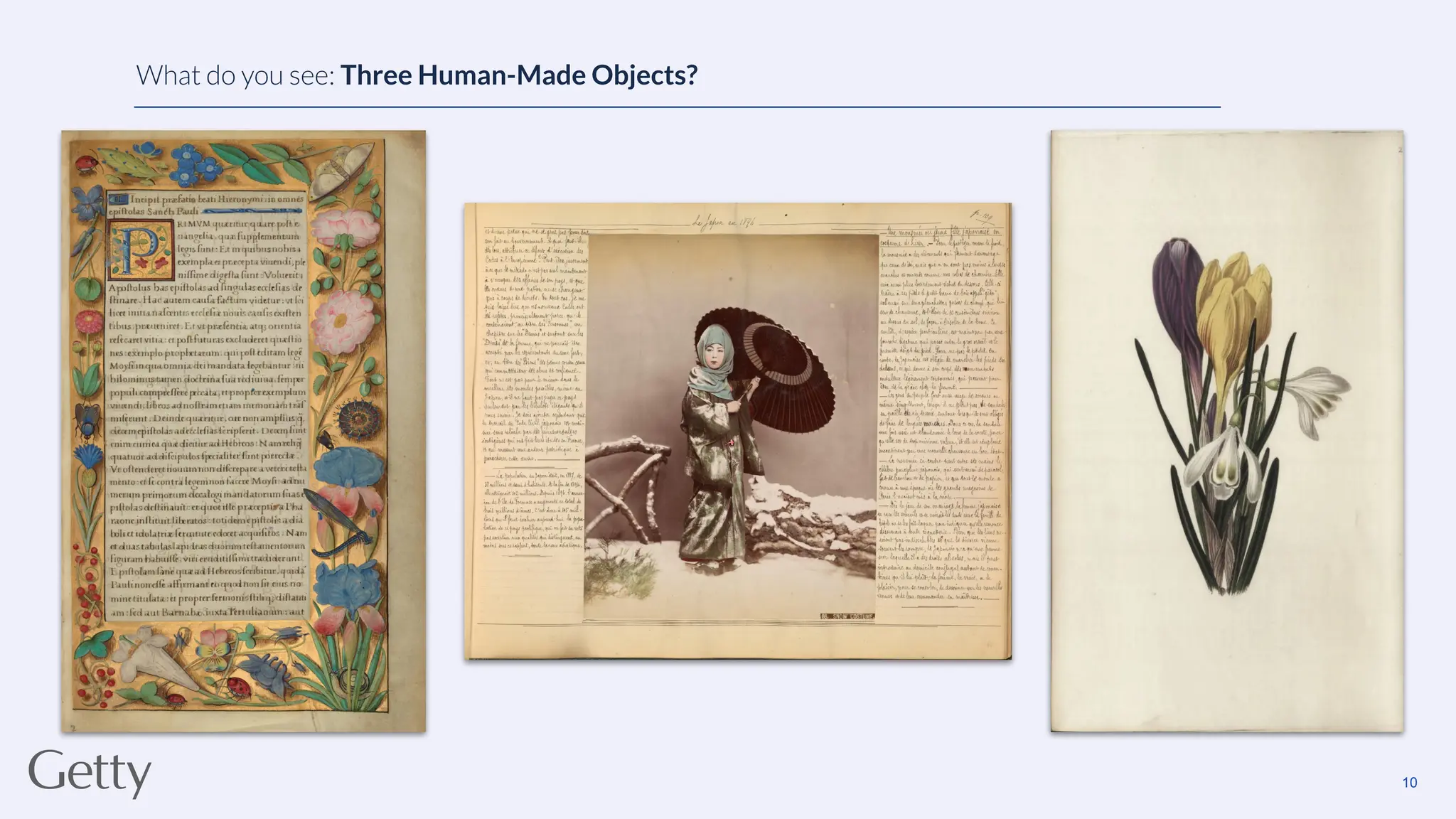
What do you see: Three JPEGS?
I’d like to show you three other things…
15
And now for something completely different
16
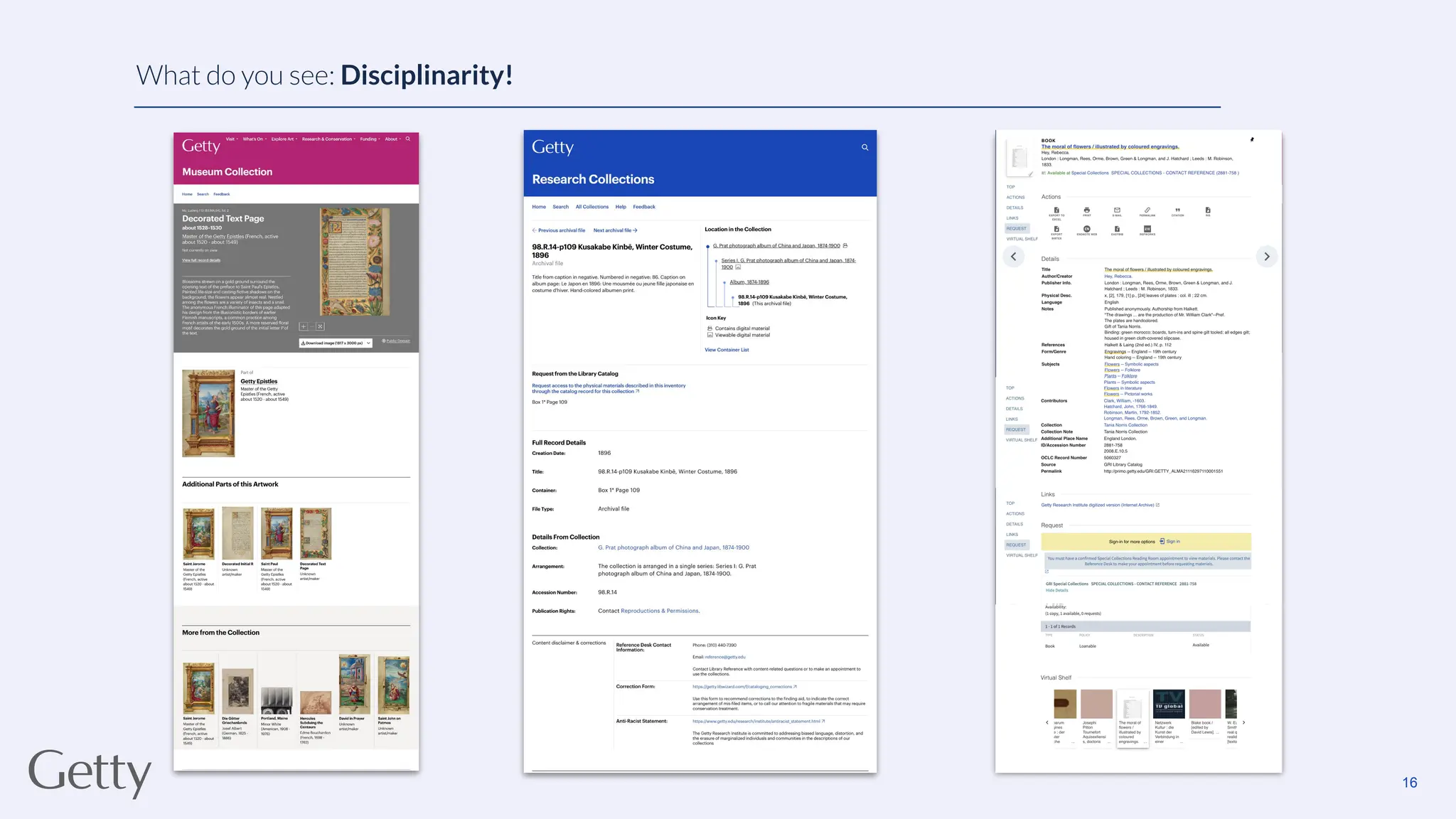
What do you see: Disciplinarity!
DACS/EAD. MARC21. Linked.Art.
Each of these is a cataloging standard.
Each of these is a model of the world.
17
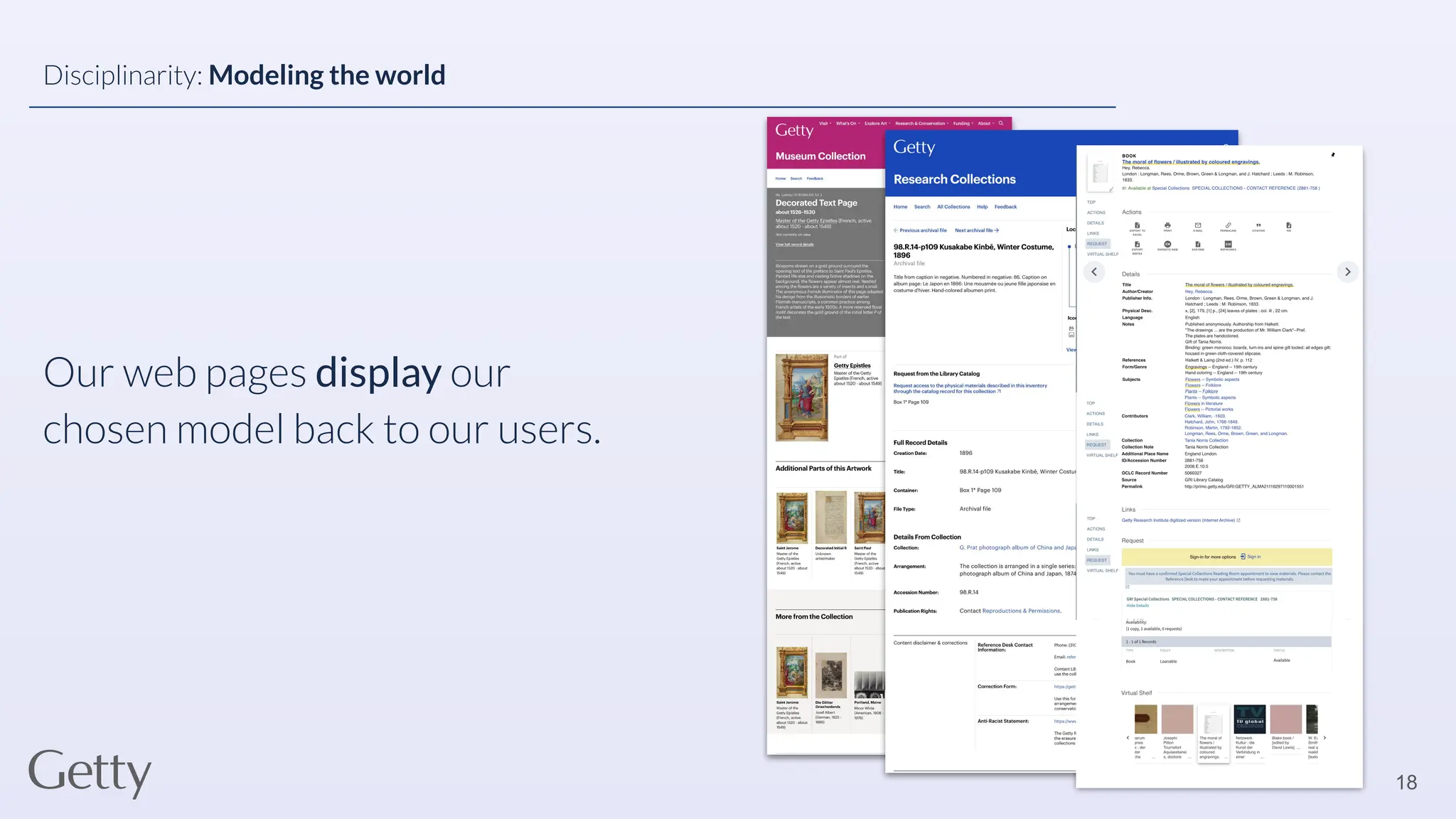
Disciplinarity: Modeling the world
Our web pages display our
chosen model back to our users.
18
Disciplinarity: Modeling the world
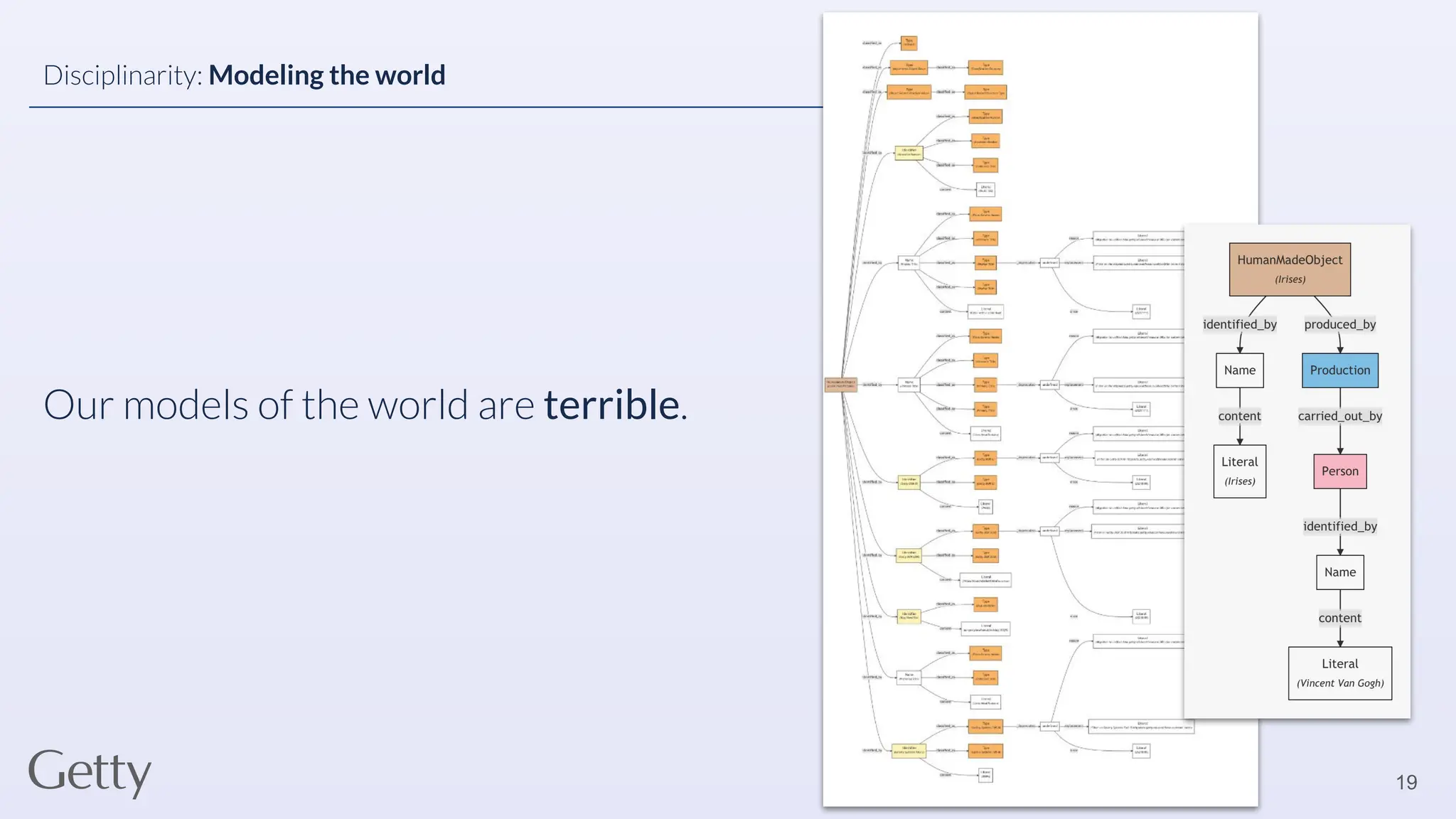
Our models of the world are terrible.
19
Disciplinarity: Modeling the world
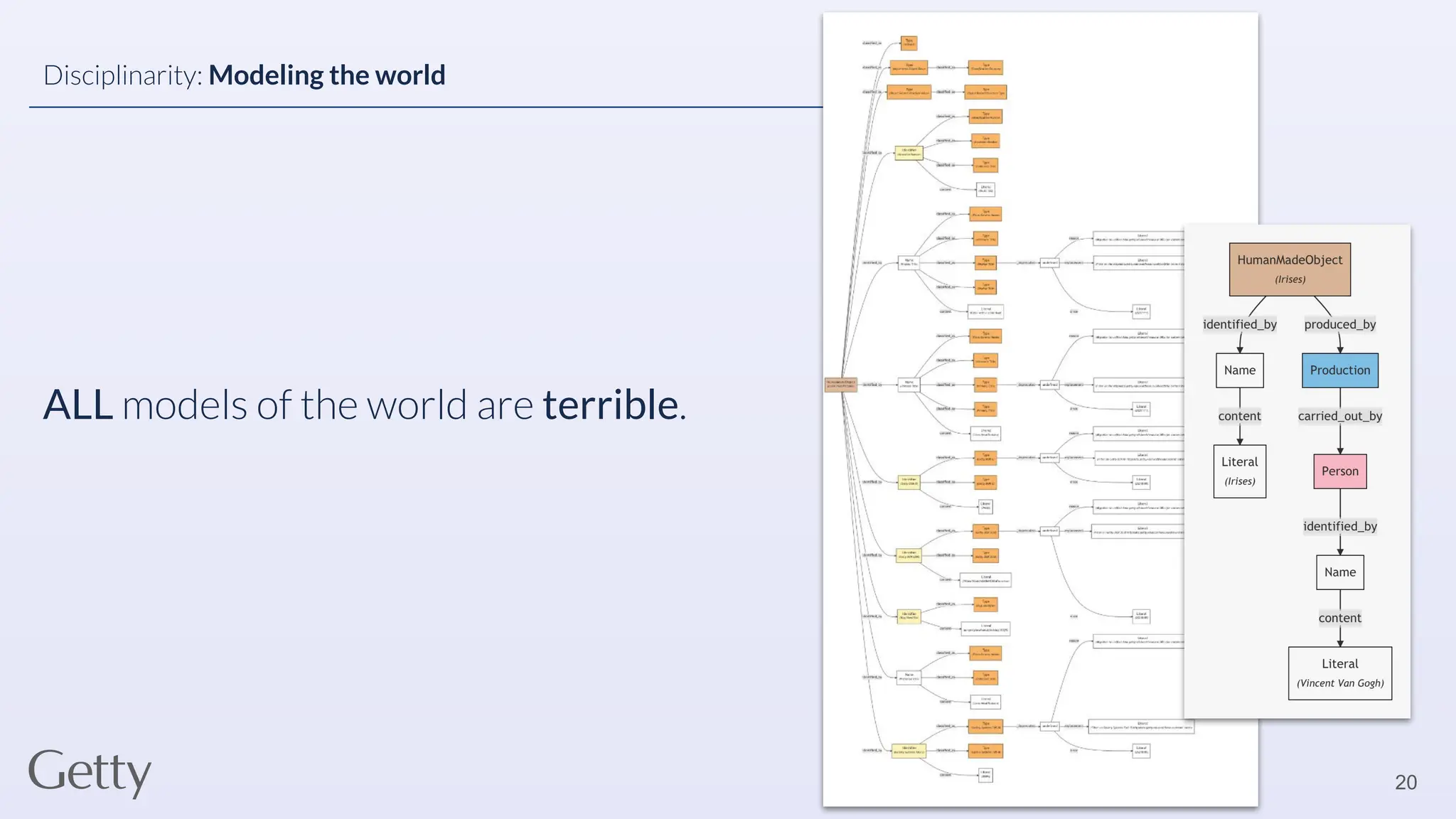
ALL models of the world are terrible.
20
Disciplinarity: Modeling the world
Every model of the world does inconceivable violence
to the underlying reality and humanistic truth of our
lived experience.
21
Disciplinarity: Modeling the world
22
How dare we model these?
Those models reflect our
understanding of our users
back at our users.
23
Disciplinarity: Modeling the world
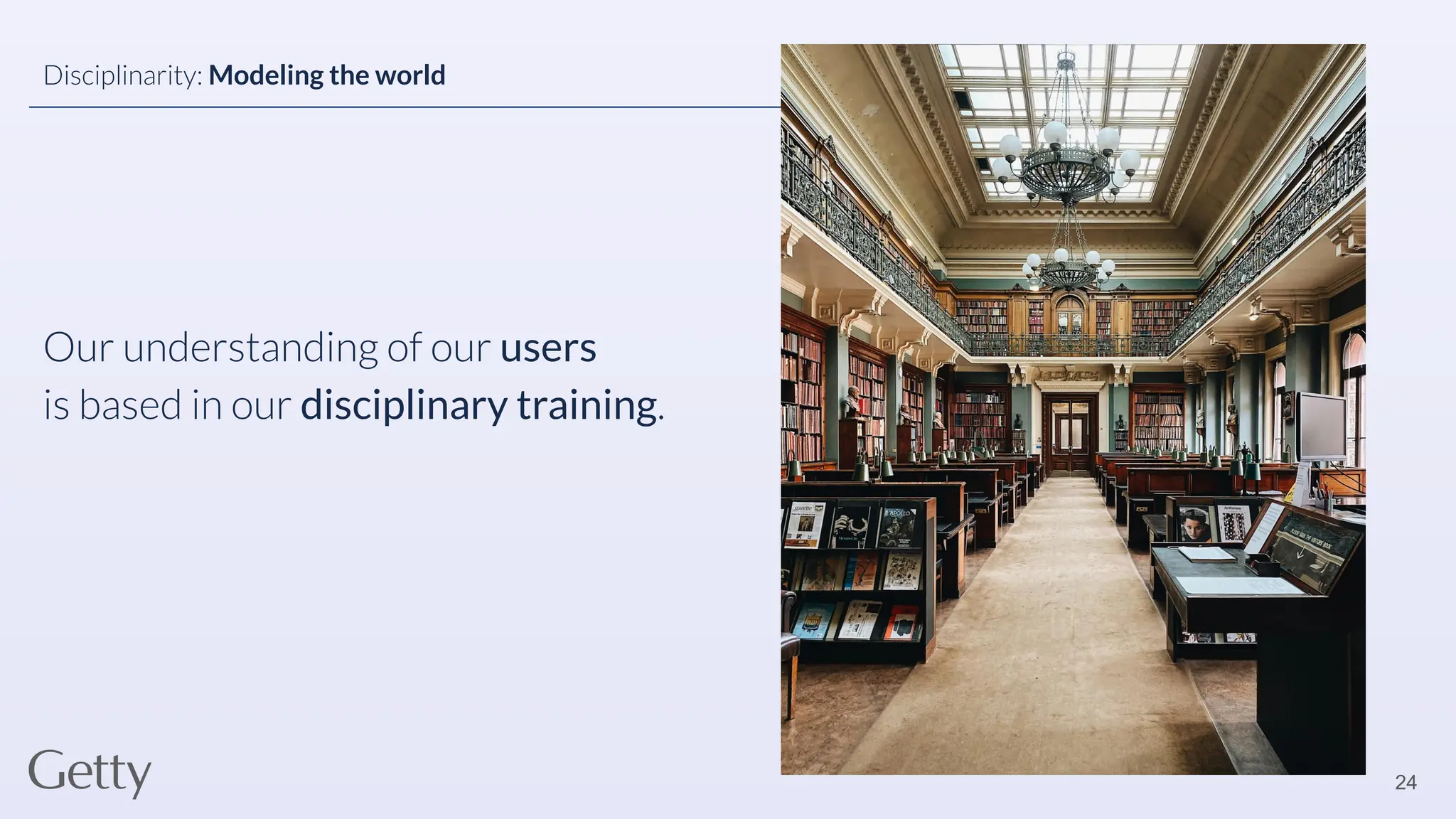
Our understanding of our users
is based in our disciplinary training.
24
Disciplinarity: Modeling the world
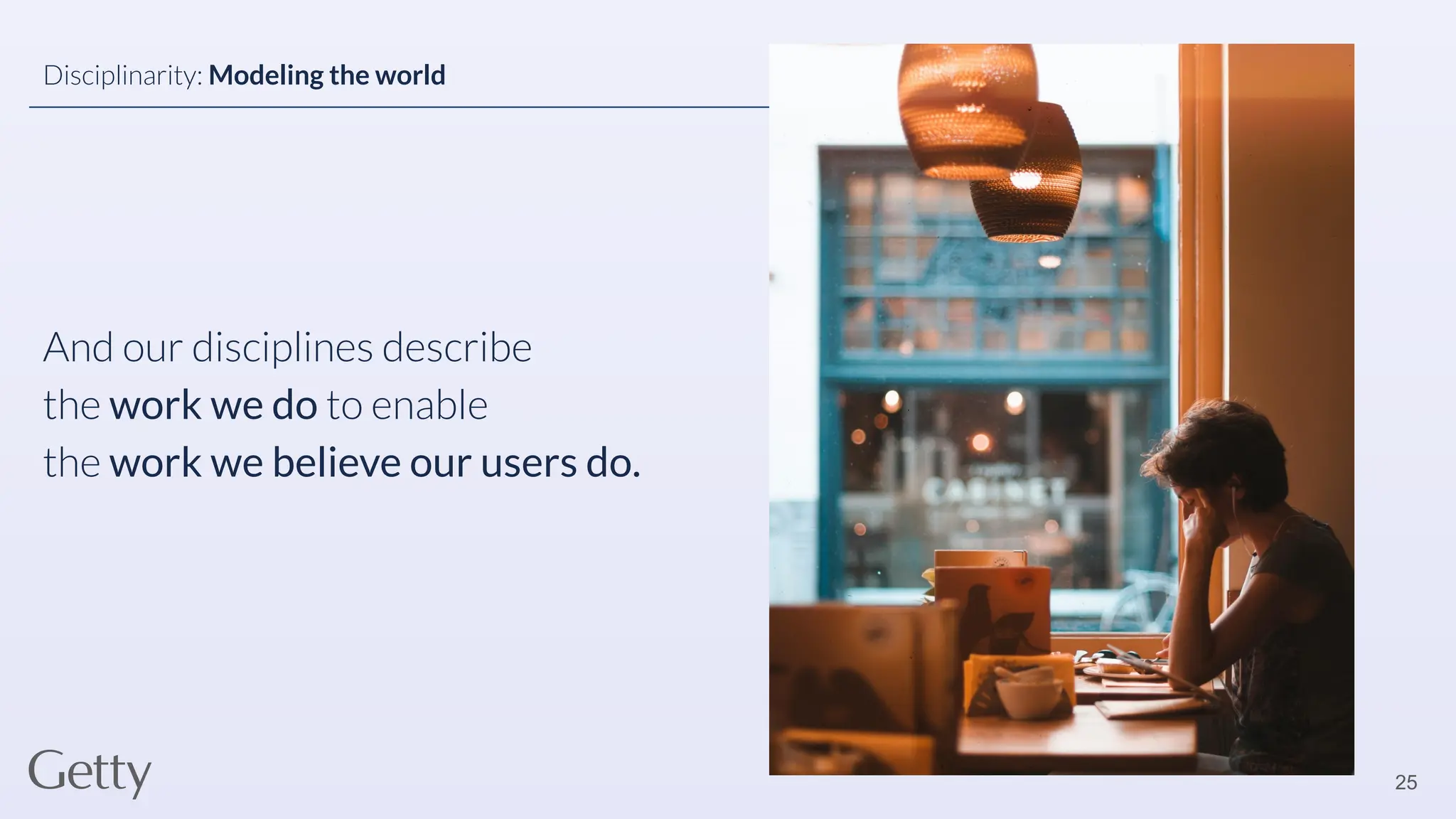
And our disciplines describe
the work we do to enable
the work we believe our users do.
25
Disciplinarity: Modeling the world
This is a work of art, of paint and gold,
created be a French artist in the
early 16th century.
26
Decorated Text Page: Getty Art Collection
Our model documents its materiality,
how it has been exhibited, what we
know about its history and influence.
27
Decorated Text Page: Getty Art Collection
Our model emerges from inventory
management, tracking the location,
movement, and insurance value of
expensive, unique objects.
28
Decorated Text Page: Getty Art Collection
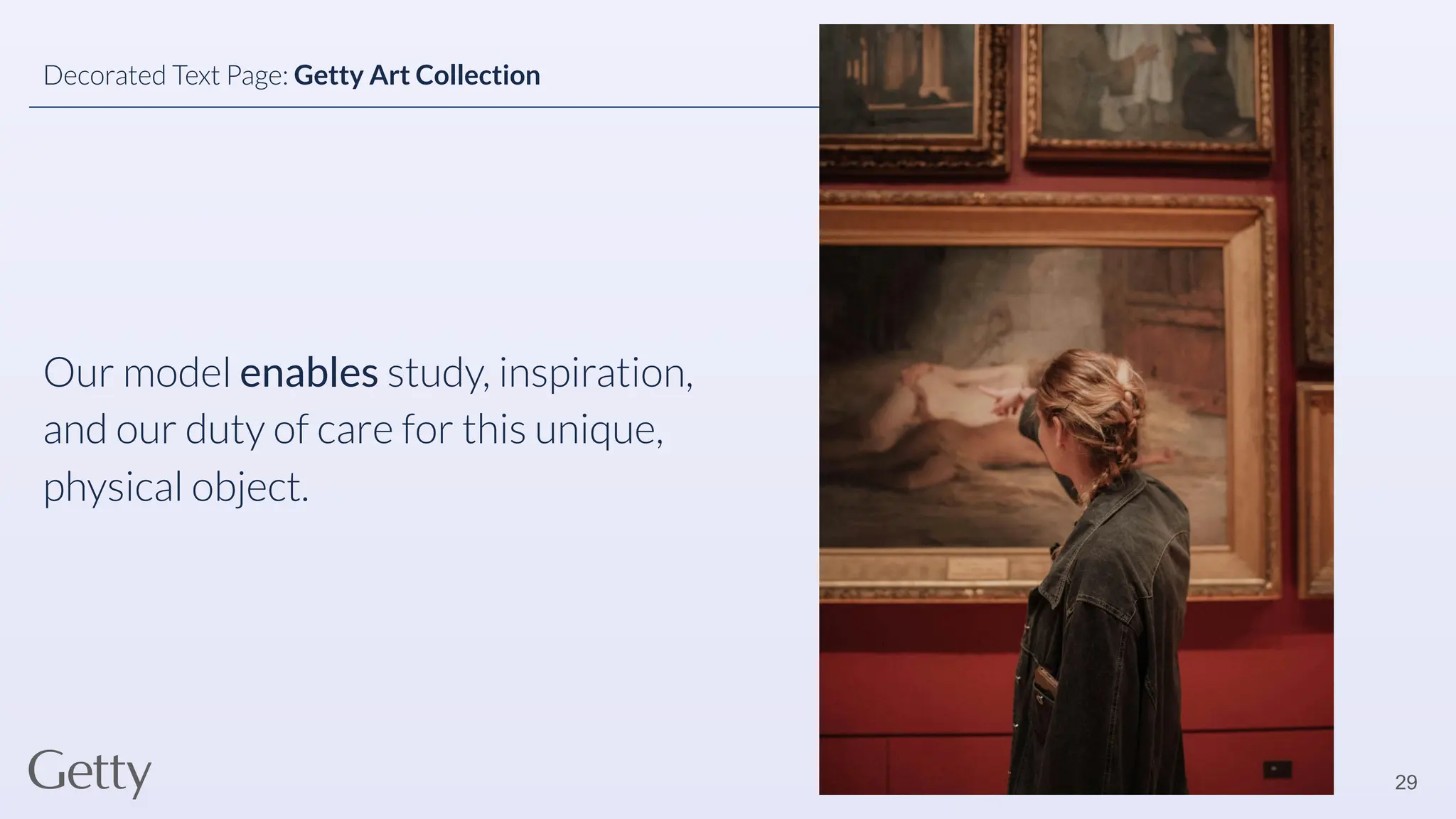
Our model enables study, inspiration,
and our duty of care for this unique,
physical object.
29
Decorated Text Page: Getty Art Collection
This is a primary source,
documenting the travels
and opinions of a French
silk inspector working in
China in the late 19th
century.
30
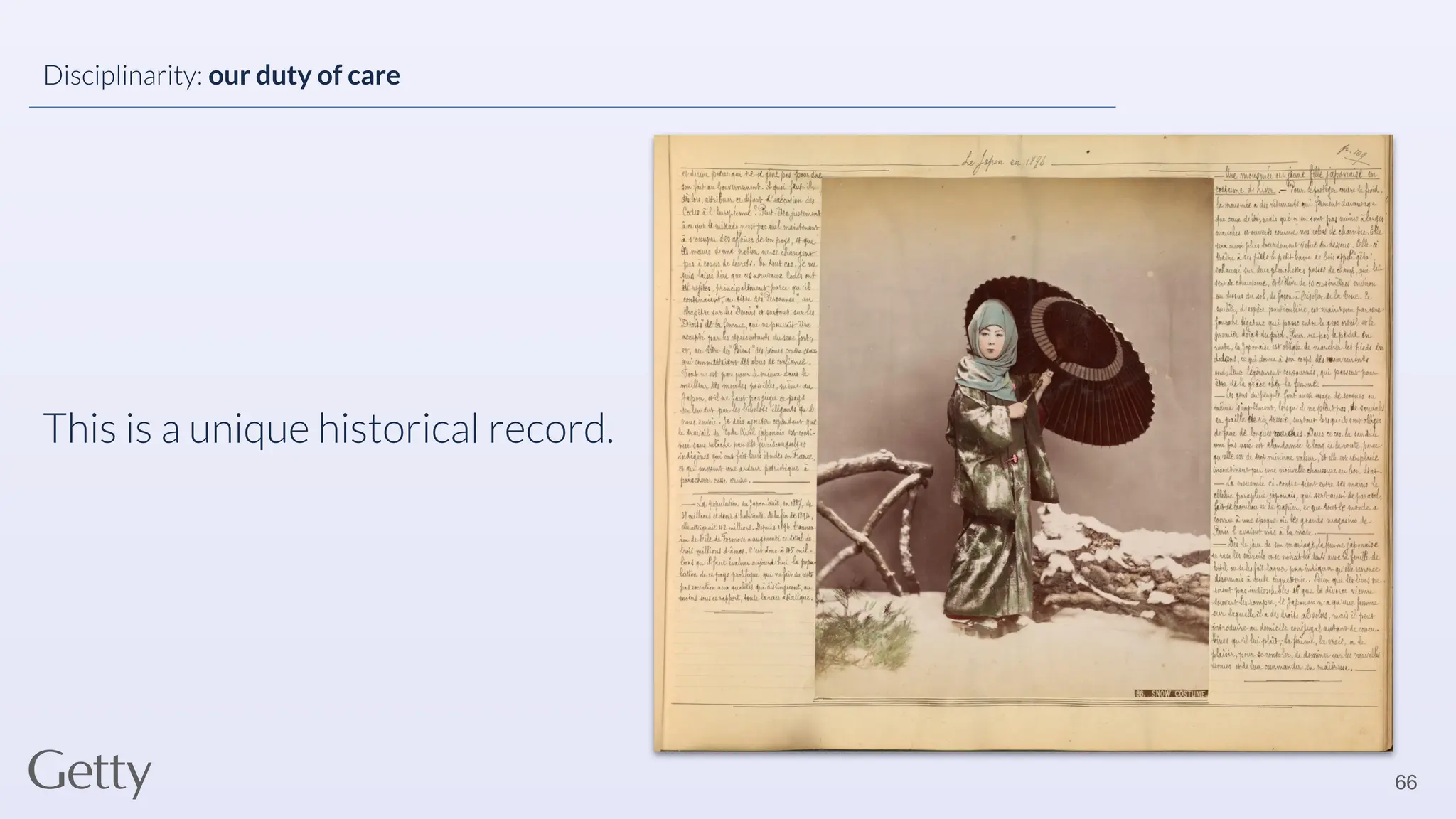
G. Prat Photographic album of China and Japan: Getty Research Collection
Our model documents the context,
history, and processing of this page
within the larger context of the
archive, as well as the physical
location and arrangement of the
material.
31
G. Prat Photographic album of China and Japan: Getty Research Collection
Our model emerges from finding aids,
letting scholars request objects—
and decide if it’s worth the trip.
32
G. Prat Photographic album of China and Japan: Getty Research Collection
Our model enables understanding of
the original context of the archive’s
creator and the retrieval of the
physical materials for further study.
33
G. Prat Photographic album of China and Japan: Getty Research Collection
Source: The National Archives (UK). (Link)
This is a page from a book of poetry,
written by Rebecca Hey and
published by Longman, Rees, Orme,
Brown, Green & Longman in 1833.
It is available in the GRI Special
Collections.
34
The Moral of Flowers: Getty Library
Our model documents the authorship,
publication, subject matter, location, and
access criteria for the book.
35
The Moral of Flowers: Getty Library
Our model emerges from card
catalogs, allowing for self-service
access to vast materials in consistent
ways.
36
The Moral of Flowers: Getty Library
Our model enables discovery of a book,
facilitating identification, confirming
relevance, and enabling access to the
book for research or pleasure.
37
The Moral of Flowers: Getty Library
These are all useful models.
38
Disciplinarity: Modeling the world
38
They’re all also wrong.
39
Disciplinarity: Modeling the world
…with all due respect to my museum, library, and archival colleagues.
40
Disciplinarity: Modeling the world
They’re all books…
41
Disciplinarity: Modeling the world
…but not really.
They’re all digitized proxies of books,
available on the internet as images.
42
Disciplinarity: Modeling the world
They’re all web pages describing items,
providing access and enabling research.
43
Disciplinarity: Modeling the world
And they’re all embedded in a discovery ecosystem.
44
Disciplinarity: Modeling the world
And they’re all embedded in a discovery ecosystem.
45
Disciplinarity: Searching the Internet
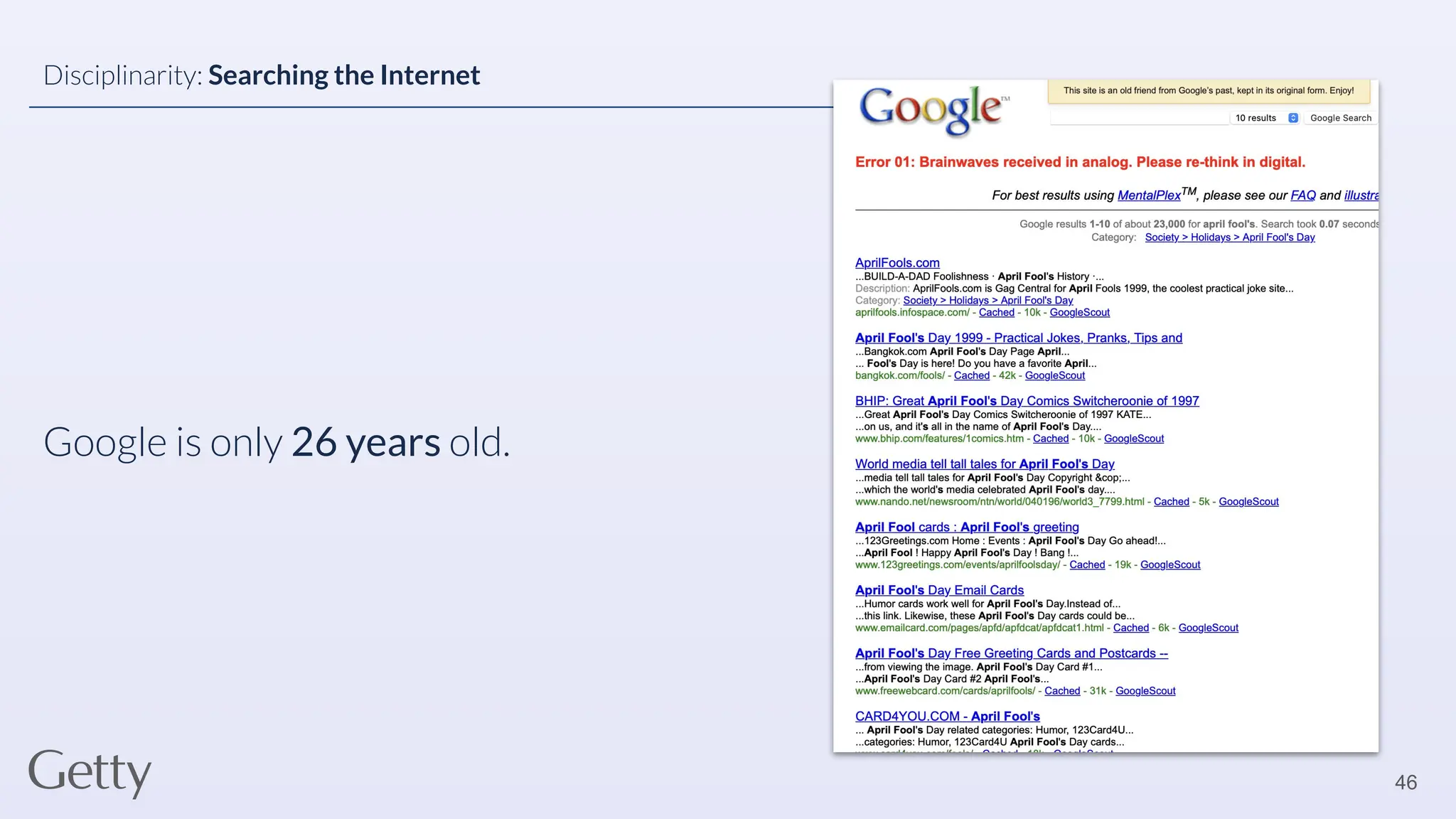
Google is only 26 years old.
46
Disciplinarity: Searching the Internet
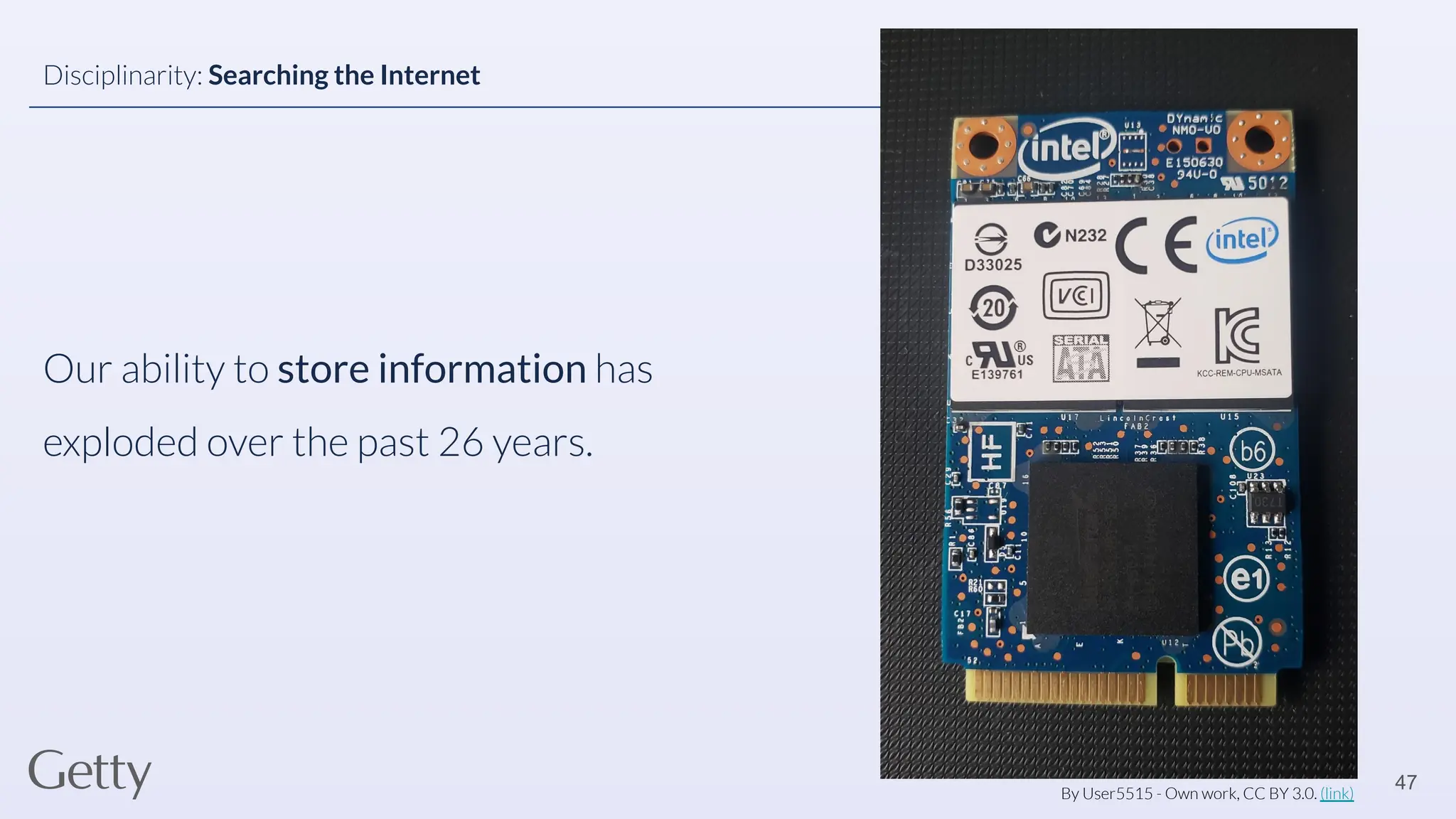
Our ability to store information has
exploded over the past 26 years.
47
Disciplinarity: Searching the Internet
By User5515 - Own work, CC BY 3.0. (link)
And our ability to capture and process
information has expanded alongside that.
48
Disciplinarity: Searching the Internet
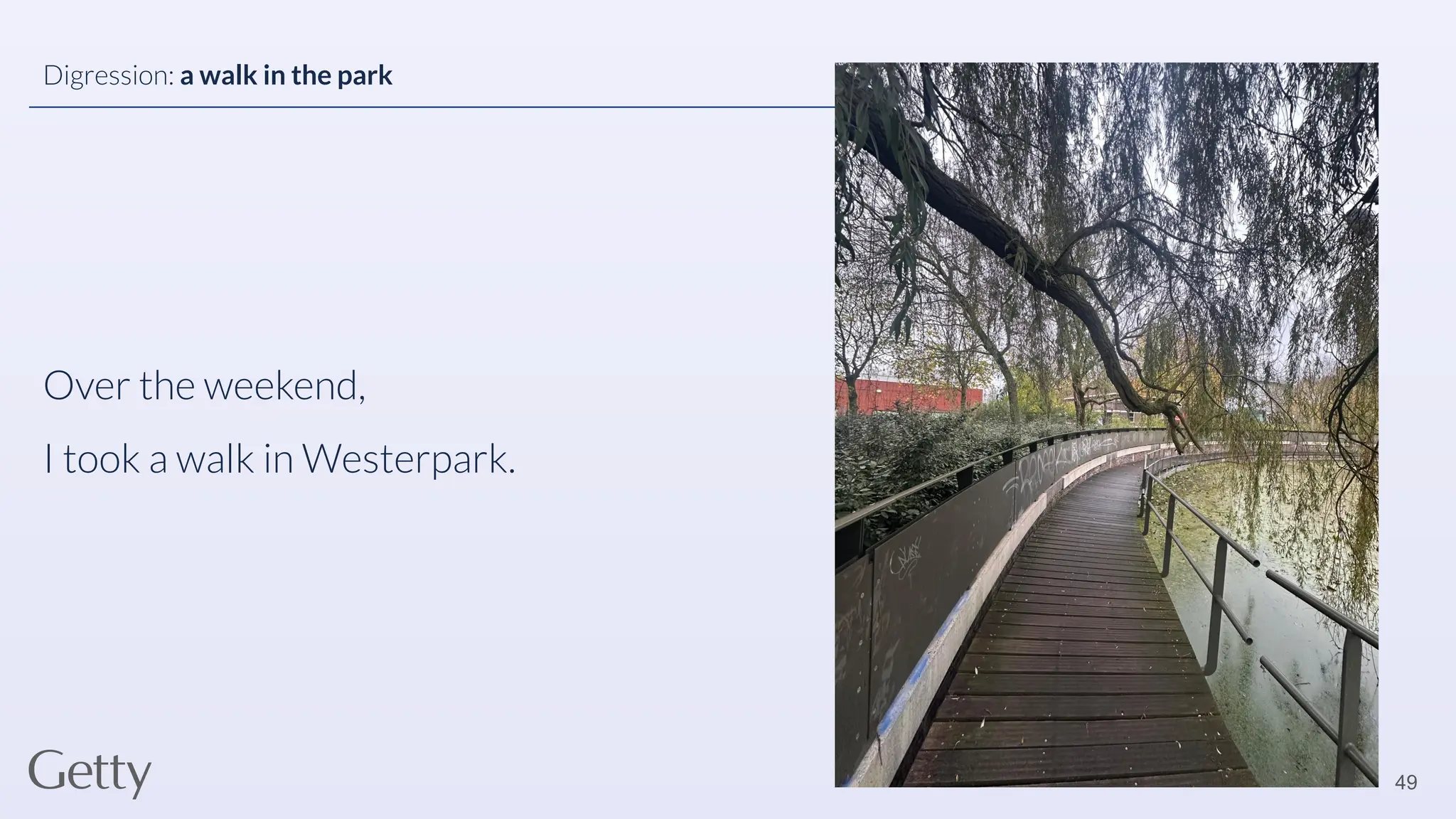
Over the weekend,
I took a walk in Westerpark.
49
Digression: a walk in the park
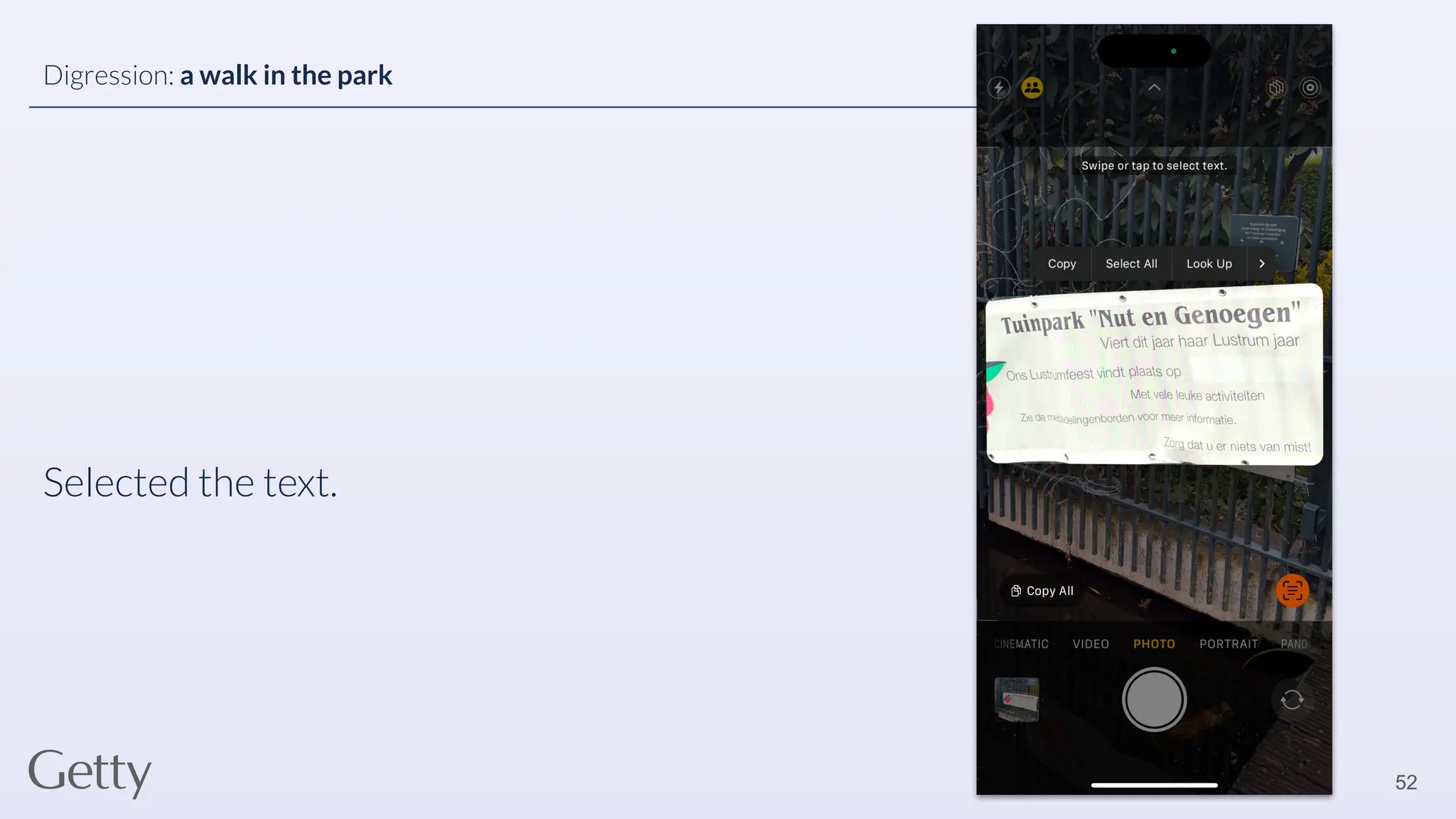
This sign was hanging on a gate.
I was curious.
50
Digression: a walk in the park
I took a photo.
51
Digression: a walk in the park
Selected the text.
52
Digression: a walk in the park
…and translated the content.
53
Digression: a walk in the park
Turns out there’s a garden party coming up.
54
Digression: a walk in the park
Turns out there’s a garden party coming up.
55
Digression: a walk in the park
…this is the future of access to information.
Turns out there’s a garden party coming up.
56
Digression: a walk in the park
…this is the future present of access to information.
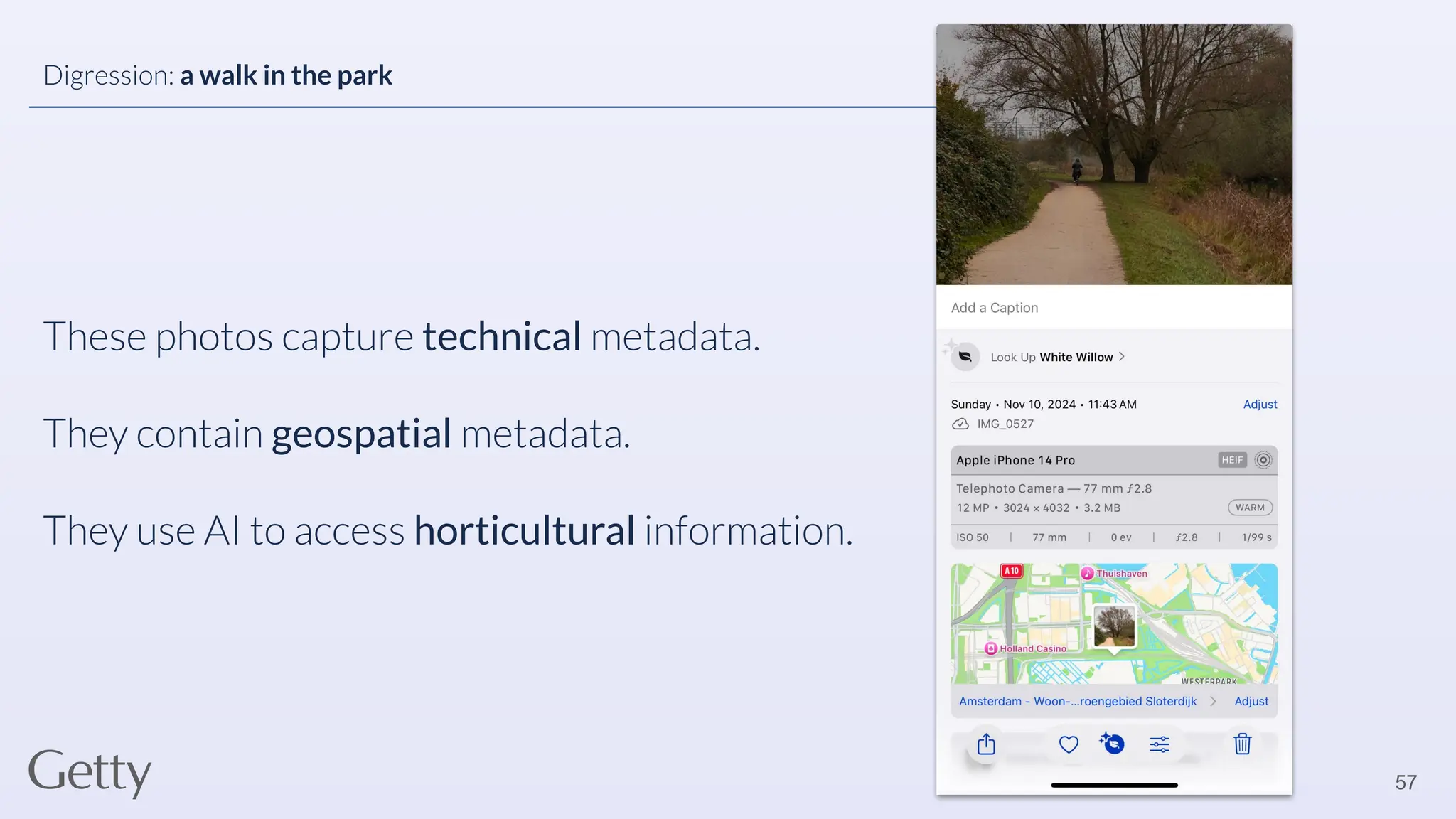
These photos capture technical metadata.
They contain geospatial metadata.
They use AI to access horticultural information.
57
Digression: a walk in the park
They provide on-device OCR and translation,
provide face detection and entity recognition,
can be keyword-tagged, date-filtered, synced,
and can be instantly shared across the world.
58
Digression: a walk in the park
How do we respond to the
expectations of a public trained on
this level of information access?
59
Digression: a walk in the park
How shall we respond,
disciplinarily, to
information overload?
60
Digression: a walk in the park
This is a beautifully-captured photo.
61
Disciplinarity: our duty of care
…a digital composite, with separate
passes for gold leaf and pigment.
62
Disciplinarity: our duty of care
We only have five pages
available online.
63
Disciplinarity: our duty of care
We do have microfilm…
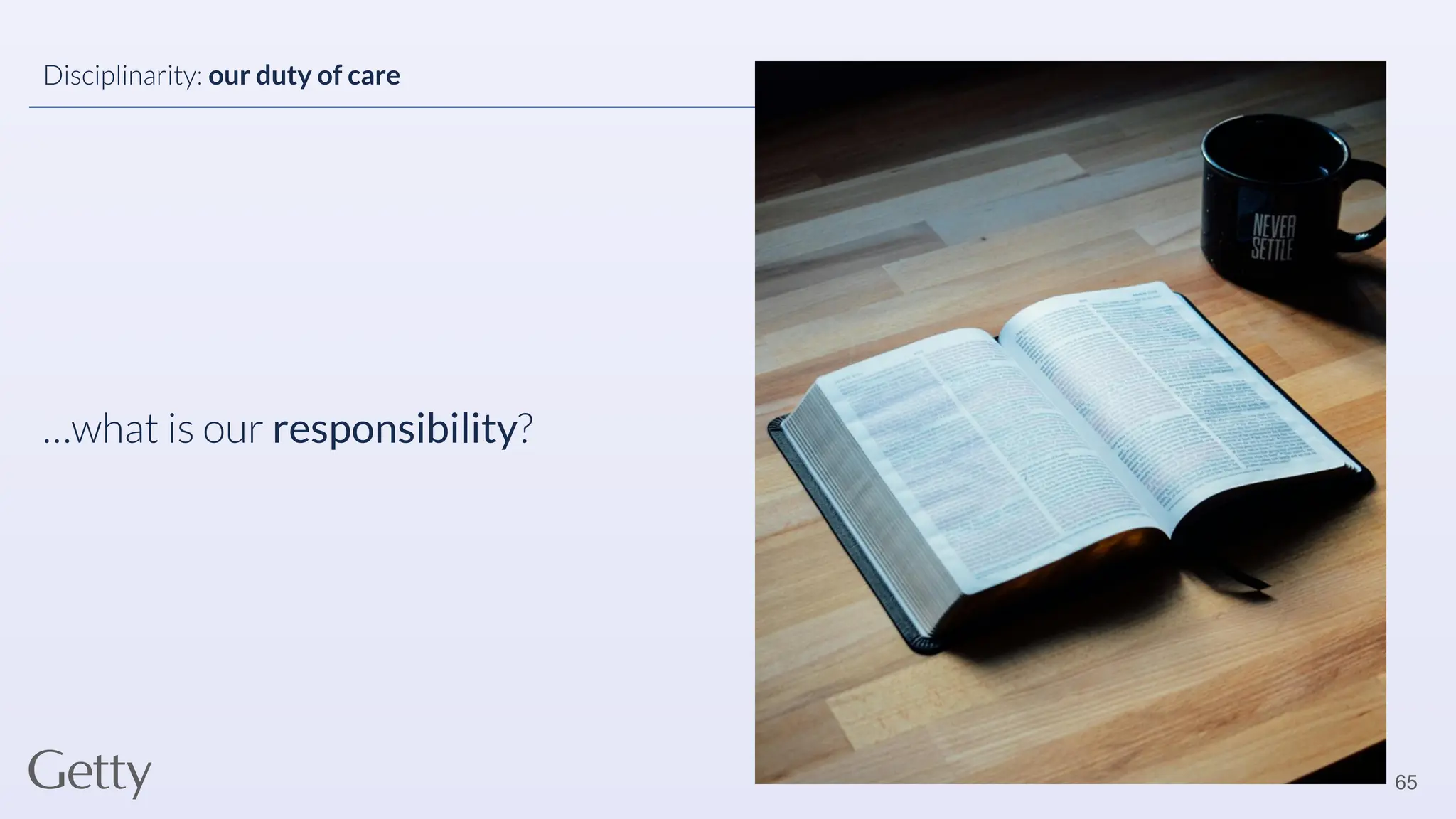
64
Disciplinarity: our duty of care
…what is our responsibility?
65
Disciplinarity: our duty of care
This is a unique historical record.
66
Disciplinarity: our duty of care
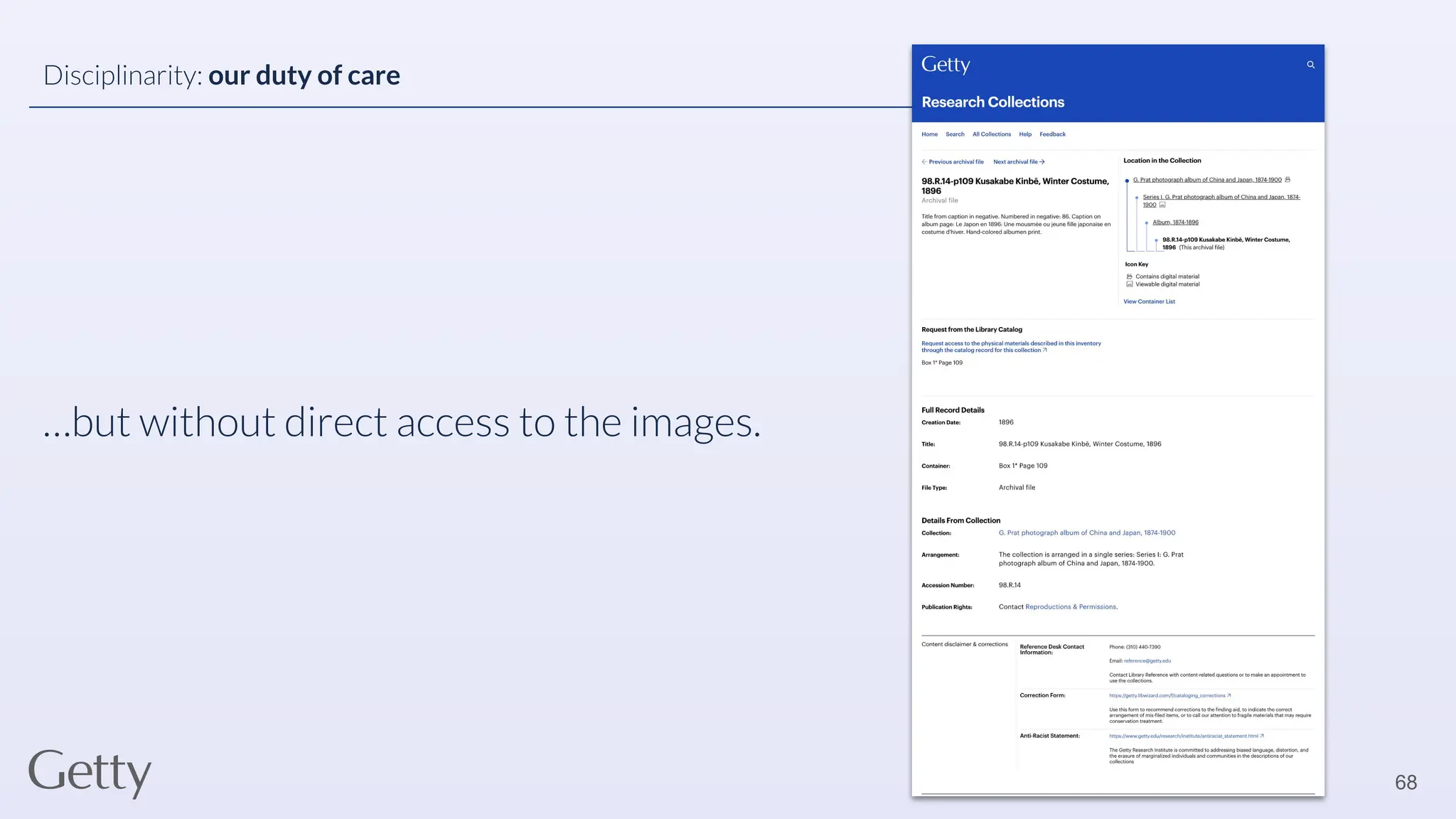
Documented within a finding aid…
67
Disciplinarity: our duty of care
…but without direct access to the images.
68
Disciplinarity: our duty of care
69
Disciplinarity: our duty of care
70
Disciplinarity: our duty of care
…how shall we prioritize?
71
Disciplinarity: our duty of care
This is from a book of poetry, art, and botany.
72
Disciplinarity: our duty of care
Fully digitized and available worldwide…
73
Disciplinarity: our duty of care
…but not on our own website.
74
Disciplinarity: our duty of care
…what should we preserve?
75
Crisis: how should we respond?
I tell these tales not to shame, but to
highlight our collective opportunity.
76
Crisis: how should we respond?
Do we retreat into disciplinarity?
77
Crisis: how should we respond?
Do we despair over the scale
and impossibility of our task?
78
Crisis: how should we respond?
Do we focus on standards and processes?
79
Crisis: how should we respond?
Do we try and do it all?
80
Crisis: how should we respond?
Our constraint is not our expertise…
81
Crisis: how should we respond?
Our constraint is not our expertise…
…it is is the value of our time.
82
Crisis: how should we respond?
Our constraint is not our expertise…
…it is is the value of our time.
Our disciplines prioritize our labor...
83
Crisis: how should we respond?
Our constraint is not our expertise…
…it is is the value of our time.
Our disciplines prioritize our labor...
…but misalign our efforts to collaborate.
84
Values: how should we respond?
As we work together on the standards and
practices needed to document cultural
heritage…
85
Values: how should we respond?
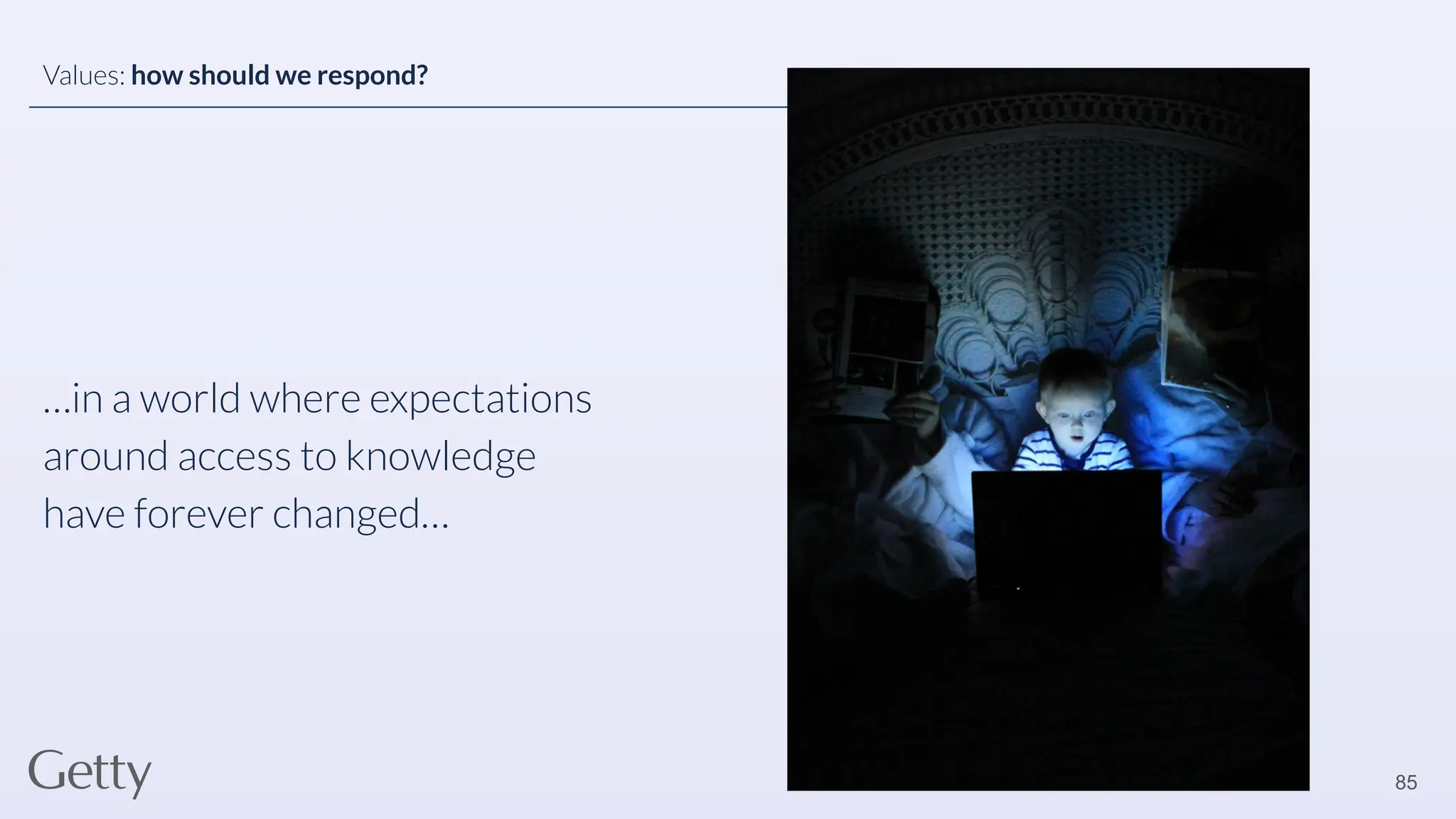
…in a world where expectations
around access to knowledge
have forever changed…
86
Values: how should we respond?
…we must consider how our labor must
shift to support the values that we share
and the global communities we serve.
87
Values: how should we respond?
We value the stories and art we use to explain
our world and ourselves to each other.
88
Values: how should we respond?
We value the connections
between diverse cultures
and histories.
89
Values: how should we respond?
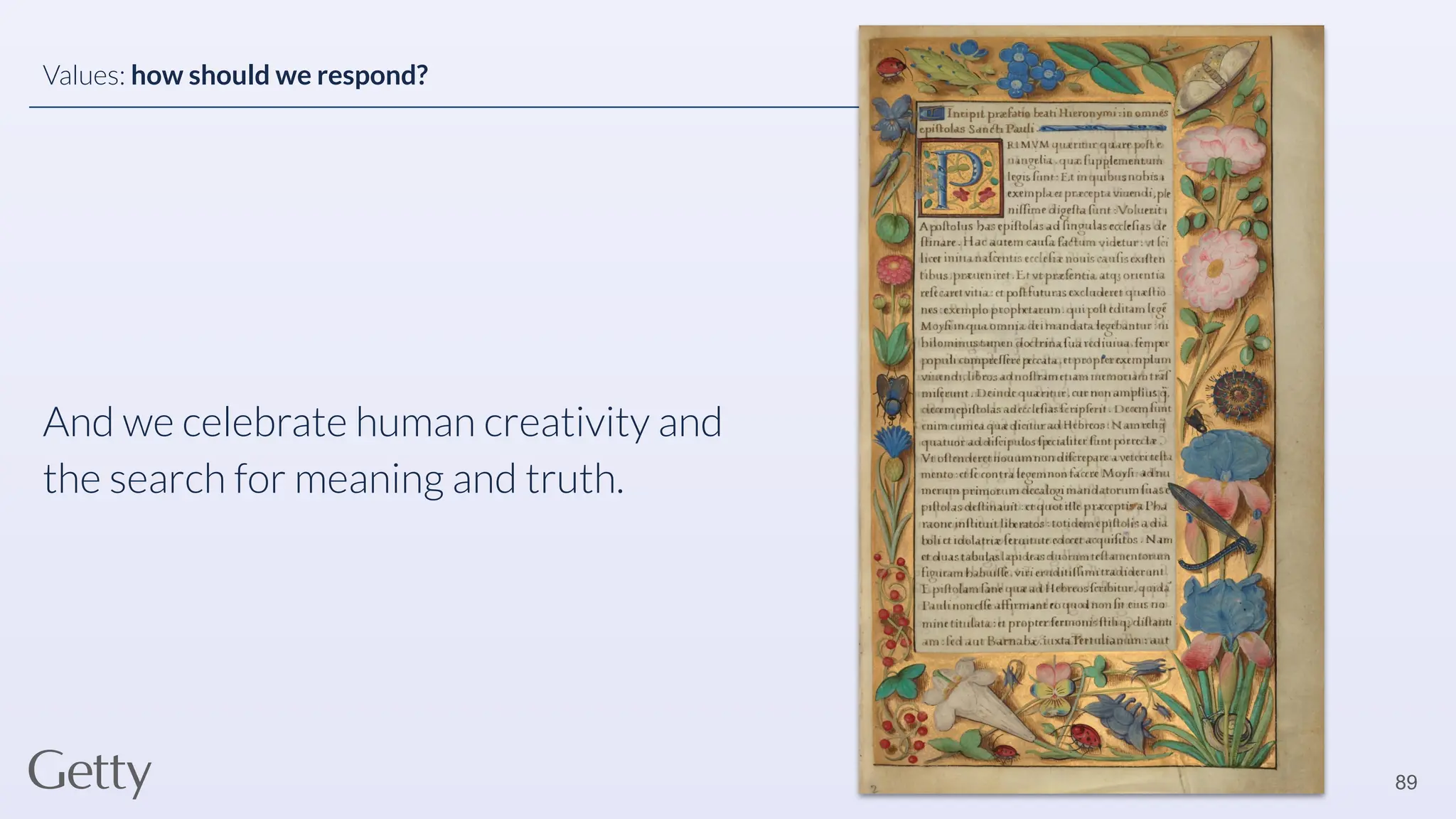
And we celebrate human creativity and
the search for meaning and truth.
Thank you, my colleagues.
90

The Work of Digital Collections — 2024 CIDOC Keynote, Rijksmuseum

  • 1.
    CIDOC 2024, November12, 2024 The Work of Digital Collections David Newbury Senior Director, Public Technologies, Getty
  • 2.
    Thank you, CIDOC& Rijksmuseum. I lead public technologies at Getty. I’ve been working on museum data standards for the past decade. You are my people. 2 Introduction: The Work of Digital Collections
  • 3.
    I’d like toshow you three things. 3 Introduction: The Work of Digital Collections Decorated Text Page, Getty Epistles, Master of the Getty Epistles, 1528-1530
  • 4.
    I’d like toshow you three things. 4 Introduction: The Work of Digital Collections G. Prat photograph album of China and Japan, 1874-1900, Page 109.
  • 5.
    I’d like toshow you three things. Introduction: The Work of Digital Collections The moral of flowers Rebecca Hey, 1833
  • 6.
    6 What do yousee: Three Manuscript Pages?
  • 7.
    7 What do yousee: Three Artworks?
  • 8.
    8 What do yousee: Three Authored documents?
  • 9.
    9 What do yousee: Three Collection Items?
  • 10.
    10 What do yousee: Three Human-Made Objects?
  • 11.
    11 What do yousee: Three primary sources?
  • 12.
    12 What do yousee: Three stories about nature?
  • 13.
    13 What do yousee: Three beautiful images?
  • 14.
    14 What do yousee: Three JPEGS?
  • 15.
    I’d like toshow you three other things… 15 And now for something completely different
  • 16.
    16 What do yousee: Disciplinarity!
  • 17.
    DACS/EAD. MARC21. Linked.Art. Eachof these is a cataloging standard. Each of these is a model of the world. 17 Disciplinarity: Modeling the world
  • 18.
    Our web pagesdisplay our chosen model back to our users. 18 Disciplinarity: Modeling the world
  • 19.
    Our models ofthe world are terrible. 19 Disciplinarity: Modeling the world
  • 20.
    ALL models ofthe world are terrible. 20 Disciplinarity: Modeling the world
  • 21.
    Every model ofthe world does inconceivable violence to the underlying reality and humanistic truth of our lived experience. 21 Disciplinarity: Modeling the world
  • 22.
    22 How dare wemodel these?
  • 23.
    Those models reflectour understanding of our users back at our users. 23 Disciplinarity: Modeling the world
  • 24.
    Our understanding ofour users is based in our disciplinary training. 24 Disciplinarity: Modeling the world
  • 25.
    And our disciplinesdescribe the work we do to enable the work we believe our users do. 25 Disciplinarity: Modeling the world
  • 26.
    This is awork of art, of paint and gold, created be a French artist in the early 16th century. 26 Decorated Text Page: Getty Art Collection
  • 27.
    Our model documentsits materiality, how it has been exhibited, what we know about its history and influence. 27 Decorated Text Page: Getty Art Collection
  • 28.
    Our model emergesfrom inventory management, tracking the location, movement, and insurance value of expensive, unique objects. 28 Decorated Text Page: Getty Art Collection
  • 29.
    Our model enablesstudy, inspiration, and our duty of care for this unique, physical object. 29 Decorated Text Page: Getty Art Collection
  • 30.
    This is aprimary source, documenting the travels and opinions of a French silk inspector working in China in the late 19th century. 30 G. Prat Photographic album of China and Japan: Getty Research Collection
  • 31.
    Our model documentsthe context, history, and processing of this page within the larger context of the archive, as well as the physical location and arrangement of the material. 31 G. Prat Photographic album of China and Japan: Getty Research Collection
  • 32.
    Our model emergesfrom finding aids, letting scholars request objects— and decide if it’s worth the trip. 32 G. Prat Photographic album of China and Japan: Getty Research Collection
  • 33.
    Our model enablesunderstanding of the original context of the archive’s creator and the retrieval of the physical materials for further study. 33 G. Prat Photographic album of China and Japan: Getty Research Collection Source: The National Archives (UK). (Link)
  • 34.
    This is apage from a book of poetry, written by Rebecca Hey and published by Longman, Rees, Orme, Brown, Green & Longman in 1833. It is available in the GRI Special Collections. 34 The Moral of Flowers: Getty Library
  • 35.
    Our model documentsthe authorship, publication, subject matter, location, and access criteria for the book. 35 The Moral of Flowers: Getty Library
  • 36.
    Our model emergesfrom card catalogs, allowing for self-service access to vast materials in consistent ways. 36 The Moral of Flowers: Getty Library
  • 37.
    Our model enablesdiscovery of a book, facilitating identification, confirming relevance, and enabling access to the book for research or pleasure. 37 The Moral of Flowers: Getty Library
  • 38.
    These are alluseful models. 38 Disciplinarity: Modeling the world 38
  • 39.
    They’re all alsowrong. 39 Disciplinarity: Modeling the world
  • 40.
    …with all duerespect to my museum, library, and archival colleagues. 40 Disciplinarity: Modeling the world
  • 41.
  • 42.
    …but not really. They’reall digitized proxies of books, available on the internet as images. 42 Disciplinarity: Modeling the world
  • 43.
    They’re all webpages describing items, providing access and enabling research. 43 Disciplinarity: Modeling the world
  • 44.
    And they’re allembedded in a discovery ecosystem. 44 Disciplinarity: Modeling the world
  • 45.
    And they’re allembedded in a discovery ecosystem. 45 Disciplinarity: Searching the Internet
  • 46.
    Google is only26 years old. 46 Disciplinarity: Searching the Internet
  • 47.
    Our ability tostore information has exploded over the past 26 years. 47 Disciplinarity: Searching the Internet By User5515 - Own work, CC BY 3.0. (link)
  • 48.
    And our abilityto capture and process information has expanded alongside that. 48 Disciplinarity: Searching the Internet
  • 49.
    Over the weekend, Itook a walk in Westerpark. 49 Digression: a walk in the park
  • 50.
    This sign washanging on a gate. I was curious. 50 Digression: a walk in the park
  • 51.
    I took aphoto. 51 Digression: a walk in the park
  • 52.
  • 53.
    …and translated thecontent. 53 Digression: a walk in the park
  • 54.
    Turns out there’sa garden party coming up. 54 Digression: a walk in the park
  • 55.
    Turns out there’sa garden party coming up. 55 Digression: a walk in the park …this is the future of access to information.
  • 56.
    Turns out there’sa garden party coming up. 56 Digression: a walk in the park …this is the future present of access to information.
  • 57.
    These photos capturetechnical metadata. They contain geospatial metadata. They use AI to access horticultural information. 57 Digression: a walk in the park
  • 58.
    They provide on-deviceOCR and translation, provide face detection and entity recognition, can be keyword-tagged, date-filtered, synced, and can be instantly shared across the world. 58 Digression: a walk in the park
  • 59.
    How do werespond to the expectations of a public trained on this level of information access? 59 Digression: a walk in the park
  • 60.
    How shall werespond, disciplinarily, to information overload? 60 Digression: a walk in the park
  • 61.
    This is abeautifully-captured photo. 61 Disciplinarity: our duty of care
  • 62.
    …a digital composite,with separate passes for gold leaf and pigment. 62 Disciplinarity: our duty of care
  • 63.
    We only havefive pages available online. 63 Disciplinarity: our duty of care
  • 64.
    We do havemicrofilm… 64 Disciplinarity: our duty of care
  • 65.
    …what is ourresponsibility? 65 Disciplinarity: our duty of care
  • 66.
    This is aunique historical record. 66 Disciplinarity: our duty of care
  • 67.
    Documented within afinding aid… 67 Disciplinarity: our duty of care
  • 68.
    …but without directaccess to the images. 68 Disciplinarity: our duty of care
  • 69.
  • 70.
    70 Disciplinarity: our dutyof care …how shall we prioritize?
  • 71.
    71 Disciplinarity: our dutyof care This is from a book of poetry, art, and botany.
  • 72.
    72 Disciplinarity: our dutyof care Fully digitized and available worldwide…
  • 73.
    73 Disciplinarity: our dutyof care …but not on our own website.
  • 74.
    74 Disciplinarity: our dutyof care …what should we preserve?
  • 75.
    75 Crisis: how shouldwe respond? I tell these tales not to shame, but to highlight our collective opportunity.
  • 76.
    76 Crisis: how shouldwe respond? Do we retreat into disciplinarity?
  • 77.
    77 Crisis: how shouldwe respond? Do we despair over the scale and impossibility of our task?
  • 78.
    78 Crisis: how shouldwe respond? Do we focus on standards and processes?
  • 79.
    79 Crisis: how shouldwe respond? Do we try and do it all?
  • 80.
    80 Crisis: how shouldwe respond? Our constraint is not our expertise…
  • 81.
    81 Crisis: how shouldwe respond? Our constraint is not our expertise… …it is is the value of our time.
  • 82.
    82 Crisis: how shouldwe respond? Our constraint is not our expertise… …it is is the value of our time. Our disciplines prioritize our labor...
  • 83.
    83 Crisis: how shouldwe respond? Our constraint is not our expertise… …it is is the value of our time. Our disciplines prioritize our labor... …but misalign our efforts to collaborate.
  • 84.
    84 Values: how shouldwe respond? As we work together on the standards and practices needed to document cultural heritage…
  • 85.
    85 Values: how shouldwe respond? …in a world where expectations around access to knowledge have forever changed…
  • 86.
    86 Values: how shouldwe respond? …we must consider how our labor must shift to support the values that we share and the global communities we serve.
  • 87.
    87 Values: how shouldwe respond? We value the stories and art we use to explain our world and ourselves to each other.
  • 88.
    88 Values: how shouldwe respond? We value the connections between diverse cultures and histories.
  • 89.
    89 Values: how shouldwe respond? And we celebrate human creativity and the search for meaning and truth.
  • 90.
    Thank you, mycolleagues. 90