‘Open Education as a Service‘


Session Two: With lessons from the openSE & openED projects


      By: Dr. Andreas Meiszner, United Nations University UNU-MERIT – The Netherlands
         Workshop on “The Why and How of Open Education: Concepts and Practices”
                          OKCon 2011, June 31st – Berlin, Germany
... Not that new…

„As the World Trade Organization (WTO) proudly proclaims, the General
Agreement on Trade in Services (GATS) is 'the first ever set of multilateral, legally
enforceable rules covering international trade in services', including education
services. It dates from 1994, and is the services counterpart of the General
Agreement on Tariffs and Trade (GATT), which has regulated the trade in goods
since 1947. Both these agreements are administered by the WTO. Although it has
been in existence for nearly a decade, the GATS went largely unnoticed by the
education sector in Australia and around the world until quite recently. Since
the highly publicized anti-WTO protests in Seattle in 1999, however, the
Agreement's treatment of education has become one of its most controversial
aspects, along with health care and media content. Education, like health care, is
in most countries a core activity of the nation state and encouraging trade in
these sectors seems to many people to be a fundamental challenge to these
public services.“

Source: http://www.questia.com/googleScholar.qst?docId=5002439997
... but highly controversial…

„With the globalization of communication systems, governments see the
preferential treatment of local media content and other forms of cultural production,
including education, as crucial for continued nation building and cultural diversity. In
this vein, Altbach (2001) has described using the GATS to promote trade in
education as 'globalization run amok'. 'Subjecting academe to the rigors of a
WTO-enforced marketplace', he warns, 'would destroy one of the most
valuable institutions in any society'. In the same year, a consortium of European
and North American organizations representing more than 500 universities issued a
widely publicized declaration on higher education and GATS which warned that
'little is known about the consequences of including trade in education
services in the GATS' and suggested that countries should make no further
commitments (Association of Universities and Colleges of Canada, American
Council on Education, European University Association, Council for Higher
Education Accreditation, 2001)“)

Source: http://www.questia.com/googleScholar.qst?docId=5002439997
... and quite evil…

„Over the past several years, the opposition to the GATS from the education
sector has grown ever louder, particularly from student groups and unions in North
America and Europe, and governments in developing countries who fear being
unable to control the activities of commercially motivated foreign providers if they
are bound by the rules of the WTO. Many of the criticisms of the WTO and GATS
are, in fact, criticisms of trade in education or criticisms of the growth of
private provision and funding rather than criticisms of the trade agreement
per se. The codification of the global trade system in the form of the WTO and the
GATS provides a visible and tangible target for groups opposed to the direction of
commercial development and the underlying dominant ideology of neoliberal
globalism. In response to criticisms of secrecy and back-room dealings, the WTO
has quite rightly adopted a relatively transparent process in recent years, but
nevertheless this greater visibility may in fact heighten opposition in some quarters
while further legitimating the process in others.“press).

Source: http://www.questia.com/googleScholar.qst?docId=5002439997
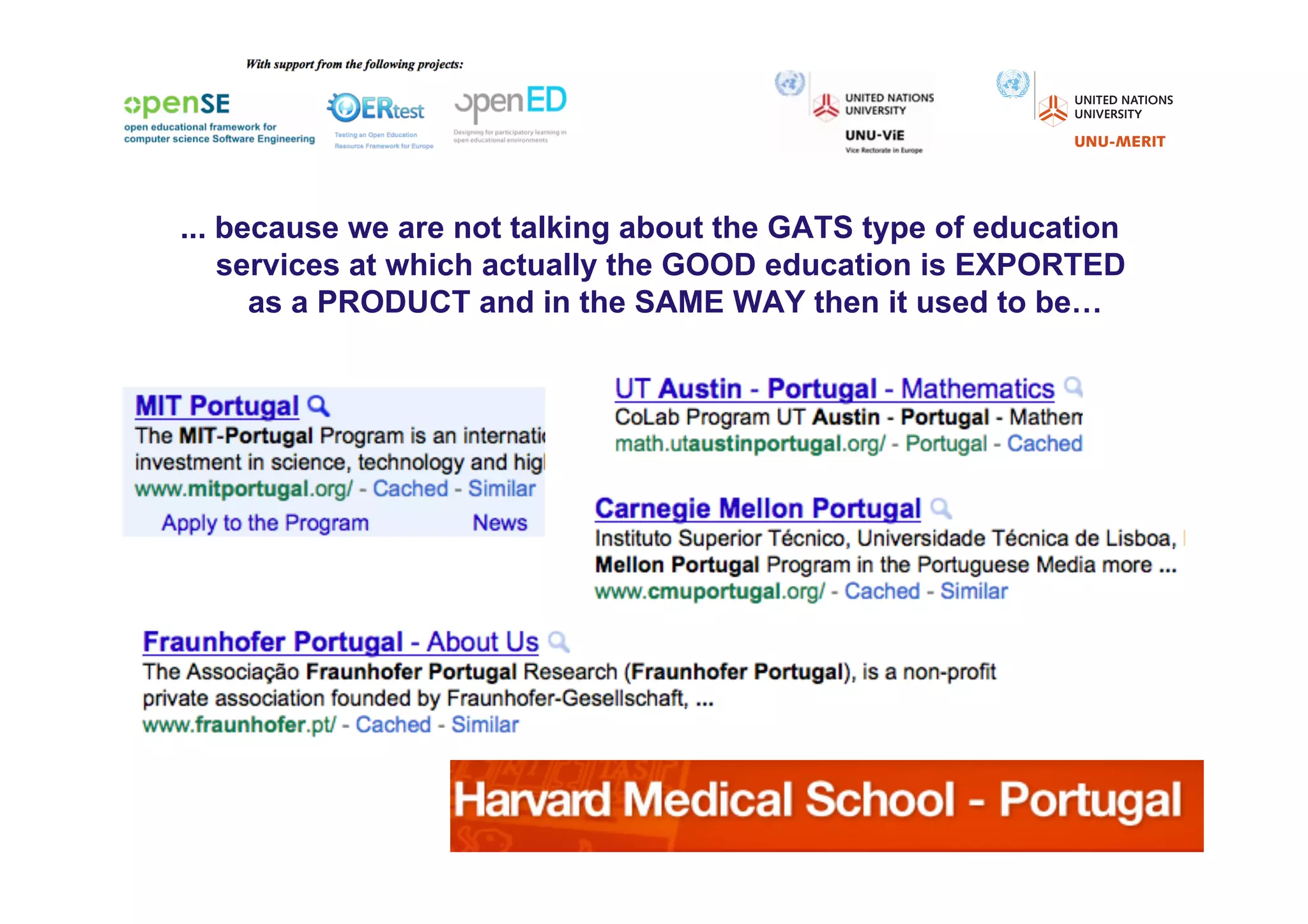
... because we are not talking about the GATS type of education
    services at which actually the GOOD education is EXPORTED
      as a PRODUCT and in the SAME WAY then it used to be…
…and because…

… any type of education, be it traditional formal closed one or be it open one, cost
money

… there will be always “someone” that needs to cover for such cost of education

… those ones covering the cost would want to know what they are paying for

… and thus we talk about new types or new means of services that could be build
around an open form of education and allow to modernize current education in a
sustainable manner!

Open Education allows for unbundling the costs associated to education as it
provides the required level of transparency to put a price tag on the different
education components…
       -> Traditional formal closed education is pretty much a BLACKBOX and
          no one clearly understands the real cost of it…
… such as the following services provided to the learner:


•  Formal assessment
•  Certification & Degrees
•  Local in-class support
•  Monitored study groups
•  Online tutoring
•  …
… or those ones provided to educational provider:


• Training, course & programme development,
•  Hosting & maintenance
•  Online assessment and certification systems
•  Online spaces to provide tutoring
•  Billing systems
•  Physical ID verification & assessment control
•  …
… like for example Freemium Business Models


"Give your service away for free, possibly ad supported but
maybe not, acquire a lot of customers very efficiently through
word of mouth, referral networks, organic search marketing, etc.,
then offer premium priced value added services or an enhanced
version of your service to your customer base.“

                                             Fred Wilson in 2006
…let’s put it that way:

If we define ‘Open Education as a Service’ (OEaaS) as an ‘on-demand’ concept at
which services are provided around freely available educational offers, such as
courses and programmes with basic support provision, then we would be able to
offer additional services against a fee.

OEaaS is thus close to a ‘Freemium business model’ at which basic products or
services are available free of charge, while charging a premium for advanced
features, functionality, or related products and services.
…let’s read it again…

If we define ‘Open Education as a Service’ (OEaaS) as an ‘on-demand’ concept at
which services are provided around freely available educational offers, such as
courses and programmes with basic support provision, then we would be able to
offer additional services against a fee.

    -> Did anyone say who would be paying the service fee?

    -> That someone will pay seems to be a given – even if it is the state
    (through either tax money or debts)
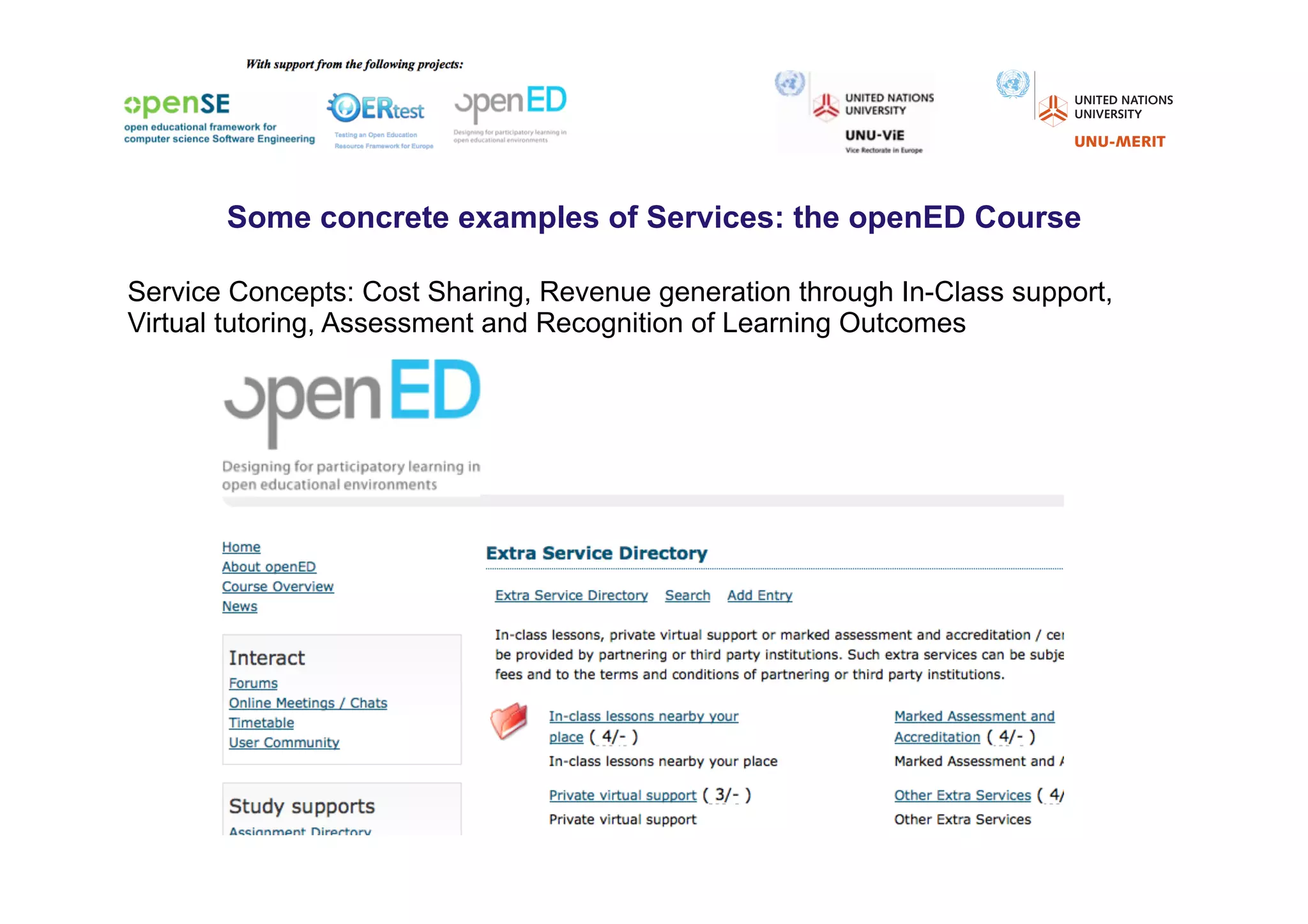
Some concrete examples of Services: the openED Course

Service Concepts: Cost Sharing, Revenue generation through In-Class support,
Virtual tutoring, Assessment and Recognition of Learning Outcomes
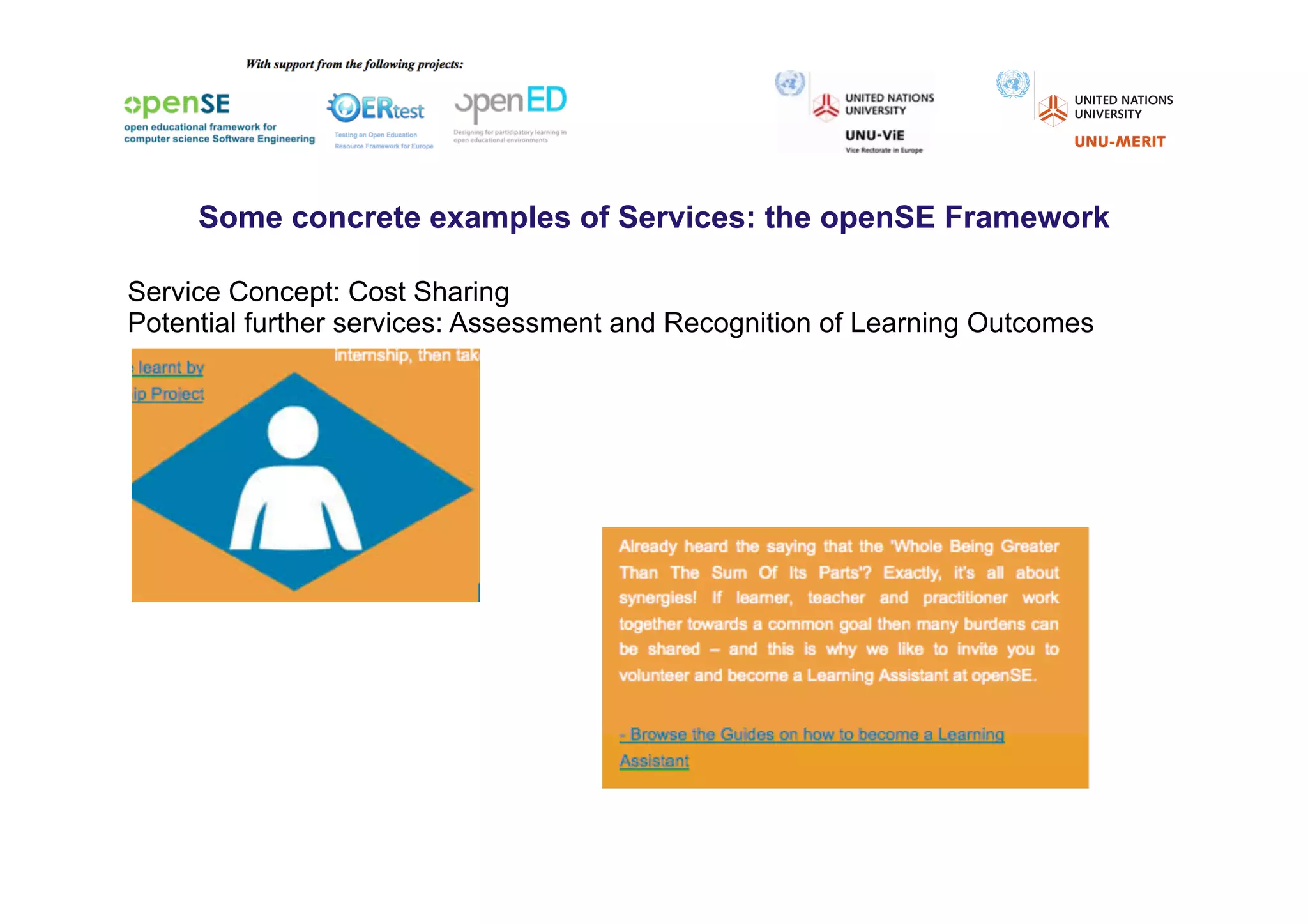
Some concrete examples of Services: the openSE Framework

Service Concept: Cost Sharing
Potential further services: Assessment and Recognition of Learning Outcomes
Thank you for your attention!


   Dr. Andreas Meiszner,
  United Nations University
        UNU-MERIT
  meiszner@merit.unu.edu

The Why and How of Open Education: The Service Perspective.

  • 1.
    ‘Open Education asa Service‘ Session Two: With lessons from the openSE & openED projects By: Dr. Andreas Meiszner, United Nations University UNU-MERIT – The Netherlands Workshop on “The Why and How of Open Education: Concepts and Practices” OKCon 2011, June 31st – Berlin, Germany
  • 3.
    ... Not thatnew… „As the World Trade Organization (WTO) proudly proclaims, the General Agreement on Trade in Services (GATS) is 'the first ever set of multilateral, legally enforceable rules covering international trade in services', including education services. It dates from 1994, and is the services counterpart of the General Agreement on Tariffs and Trade (GATT), which has regulated the trade in goods since 1947. Both these agreements are administered by the WTO. Although it has been in existence for nearly a decade, the GATS went largely unnoticed by the education sector in Australia and around the world until quite recently. Since the highly publicized anti-WTO protests in Seattle in 1999, however, the Agreement's treatment of education has become one of its most controversial aspects, along with health care and media content. Education, like health care, is in most countries a core activity of the nation state and encouraging trade in these sectors seems to many people to be a fundamental challenge to these public services.“ Source: http://www.questia.com/googleScholar.qst?docId=5002439997
  • 4.
    ... but highlycontroversial… „With the globalization of communication systems, governments see the preferential treatment of local media content and other forms of cultural production, including education, as crucial for continued nation building and cultural diversity. In this vein, Altbach (2001) has described using the GATS to promote trade in education as 'globalization run amok'. 'Subjecting academe to the rigors of a WTO-enforced marketplace', he warns, 'would destroy one of the most valuable institutions in any society'. In the same year, a consortium of European and North American organizations representing more than 500 universities issued a widely publicized declaration on higher education and GATS which warned that 'little is known about the consequences of including trade in education services in the GATS' and suggested that countries should make no further commitments (Association of Universities and Colleges of Canada, American Council on Education, European University Association, Council for Higher Education Accreditation, 2001)“) Source: http://www.questia.com/googleScholar.qst?docId=5002439997
  • 5.
    ... and quiteevil… „Over the past several years, the opposition to the GATS from the education sector has grown ever louder, particularly from student groups and unions in North America and Europe, and governments in developing countries who fear being unable to control the activities of commercially motivated foreign providers if they are bound by the rules of the WTO. Many of the criticisms of the WTO and GATS are, in fact, criticisms of trade in education or criticisms of the growth of private provision and funding rather than criticisms of the trade agreement per se. The codification of the global trade system in the form of the WTO and the GATS provides a visible and tangible target for groups opposed to the direction of commercial development and the underlying dominant ideology of neoliberal globalism. In response to criticisms of secrecy and back-room dealings, the WTO has quite rightly adopted a relatively transparent process in recent years, but nevertheless this greater visibility may in fact heighten opposition in some quarters while further legitimating the process in others.“press). Source: http://www.questia.com/googleScholar.qst?docId=5002439997
  • 7.
    ... because weare not talking about the GATS type of education services at which actually the GOOD education is EXPORTED as a PRODUCT and in the SAME WAY then it used to be…
  • 8.
    …and because… … anytype of education, be it traditional formal closed one or be it open one, cost money … there will be always “someone” that needs to cover for such cost of education … those ones covering the cost would want to know what they are paying for … and thus we talk about new types or new means of services that could be build around an open form of education and allow to modernize current education in a sustainable manner! Open Education allows for unbundling the costs associated to education as it provides the required level of transparency to put a price tag on the different education components… -> Traditional formal closed education is pretty much a BLACKBOX and no one clearly understands the real cost of it…
  • 11.
    … such asthe following services provided to the learner: •  Formal assessment •  Certification & Degrees •  Local in-class support •  Monitored study groups •  Online tutoring •  …
  • 12.
    … or thoseones provided to educational provider: • Training, course & programme development, •  Hosting & maintenance •  Online assessment and certification systems •  Online spaces to provide tutoring •  Billing systems •  Physical ID verification & assessment control •  …
  • 15.
    … like forexample Freemium Business Models "Give your service away for free, possibly ad supported but maybe not, acquire a lot of customers very efficiently through word of mouth, referral networks, organic search marketing, etc., then offer premium priced value added services or an enhanced version of your service to your customer base.“ Fred Wilson in 2006
  • 17.
    …let’s put itthat way: If we define ‘Open Education as a Service’ (OEaaS) as an ‘on-demand’ concept at which services are provided around freely available educational offers, such as courses and programmes with basic support provision, then we would be able to offer additional services against a fee. OEaaS is thus close to a ‘Freemium business model’ at which basic products or services are available free of charge, while charging a premium for advanced features, functionality, or related products and services.
  • 19.
    …let’s read itagain… If we define ‘Open Education as a Service’ (OEaaS) as an ‘on-demand’ concept at which services are provided around freely available educational offers, such as courses and programmes with basic support provision, then we would be able to offer additional services against a fee. -> Did anyone say who would be paying the service fee? -> That someone will pay seems to be a given – even if it is the state (through either tax money or debts)
  • 20.
    Some concrete examplesof Services: the openED Course Service Concepts: Cost Sharing, Revenue generation through In-Class support, Virtual tutoring, Assessment and Recognition of Learning Outcomes
  • 21.
    Some concrete examplesof Services: the openSE Framework Service Concept: Cost Sharing Potential further services: Assessment and Recognition of Learning Outcomes
  • 22.
    Thank you foryour attention! Dr. Andreas Meiszner, United Nations University UNU-MERIT meiszner@merit.unu.edu