

The (very) basics of AI for
the Radiology resident
May 25, 2021
Pedro V. Staziaki MD1, Felipe Kitamura, MD2
1. PGY-5 Radiology, Department of Radiology, Boston Medical Center, Boston University School of Medicine
2. Head of Innovation in Diagnostic Operations, Dasa
Resources
Basic resources on Coursera
• DeepLearning.AI (Andrew Ng)
• AI For Everyone à Very short and basic course
• AI For Medicine Specialization
• AI For Medical Diagnosis à Intermediate, some coding
• Stanford University (Matthew Lungren)
• Fundamentals of Machine Learning for Healthcare
Basic resources
• NIIC-RAD from SIIM and RSNA
Basic resources
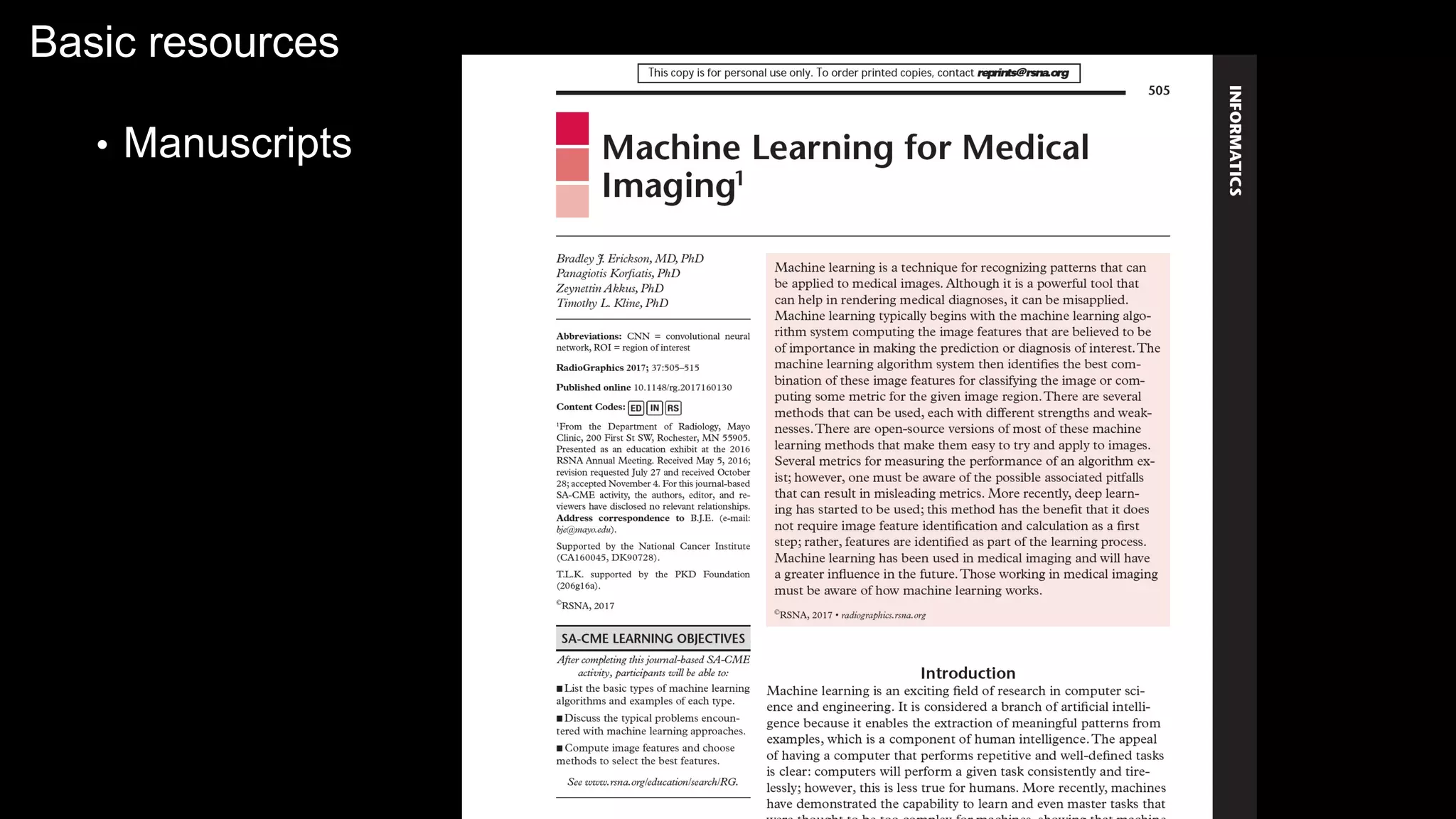
• Manuscripts
Why know a little bit about AI?
Why radiologists need to adapt to a future with AI
Allen B et al. JACR. 2019.
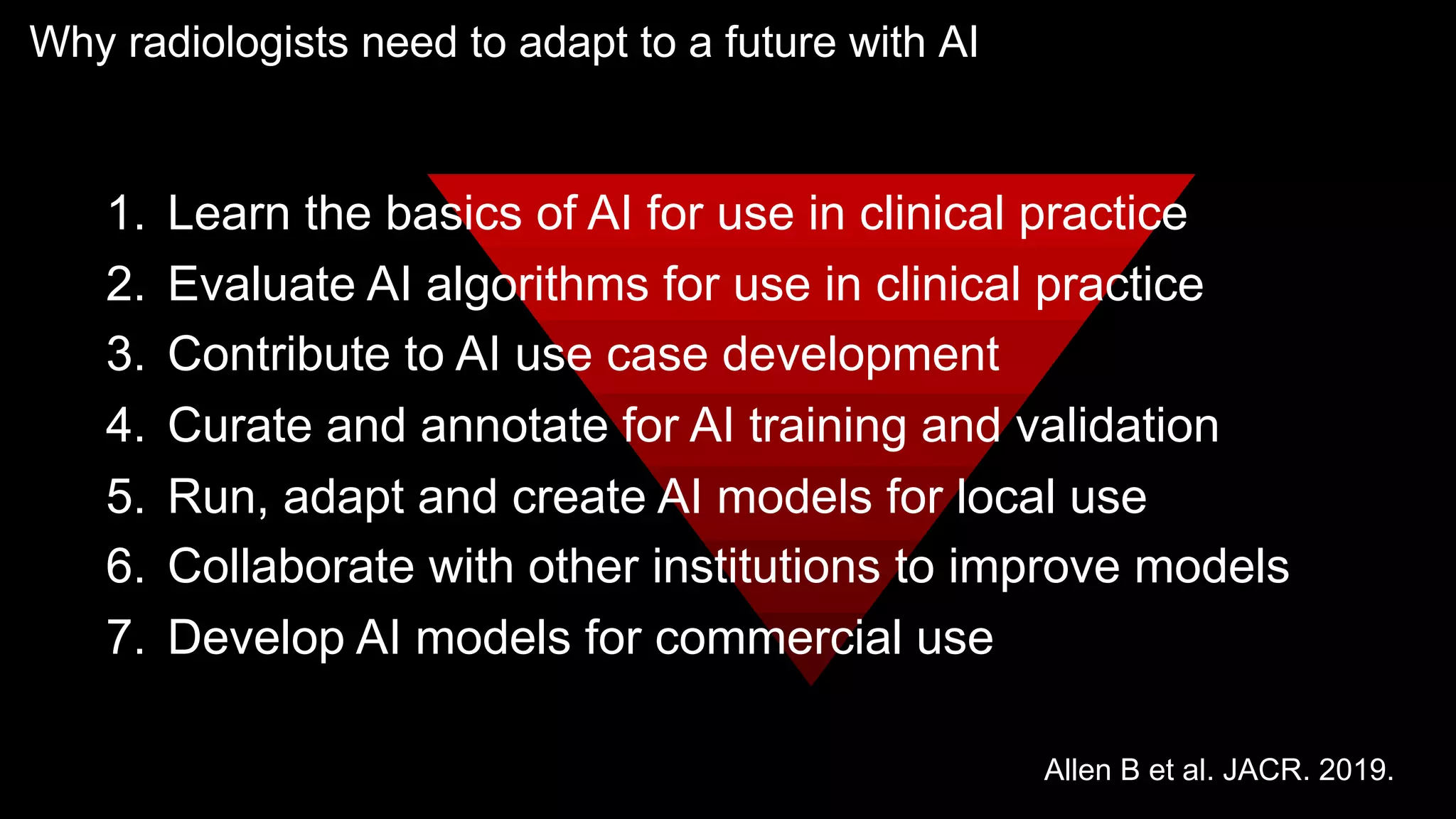
Why radiologists need to adapt to a future with AI
1. Learn the basics of AI for use in clinical practice
2. Evaluate AI algorithms for use in clinical practice
3. Contribute to AI use case development
4. Curate and annotate for AI training and validation
5. Run, adapt and create AI models for local use
6. Collaborate with other institutions to improve models
7. Develop AI models for commercial use
Allen B et al. JACR. 2019.
Why radiologists need to adapt to a future with AI
•There is a hunger for
• Radiologists who want to get involved with AI
• Domain-experts in Radiology
• Someone who can say what is clinically relevant
• Peer-reviewers for AI research
Why radiologists need to adapt to a future with AI
•Radiologists can
• Understand limitations and errors
• Collaborate with multidisciplinary team
• Critical appraisal of the literature
• Evaluate AI products
• Move Radiology forward
What is AI?
What is AI?
•Confusing terms
•Artificial Intelligence ?
•Machine Learning ?
•Deep Learning ?
•Neural Networks ?
•Big Data ?
•Data Science ?
What is AI?
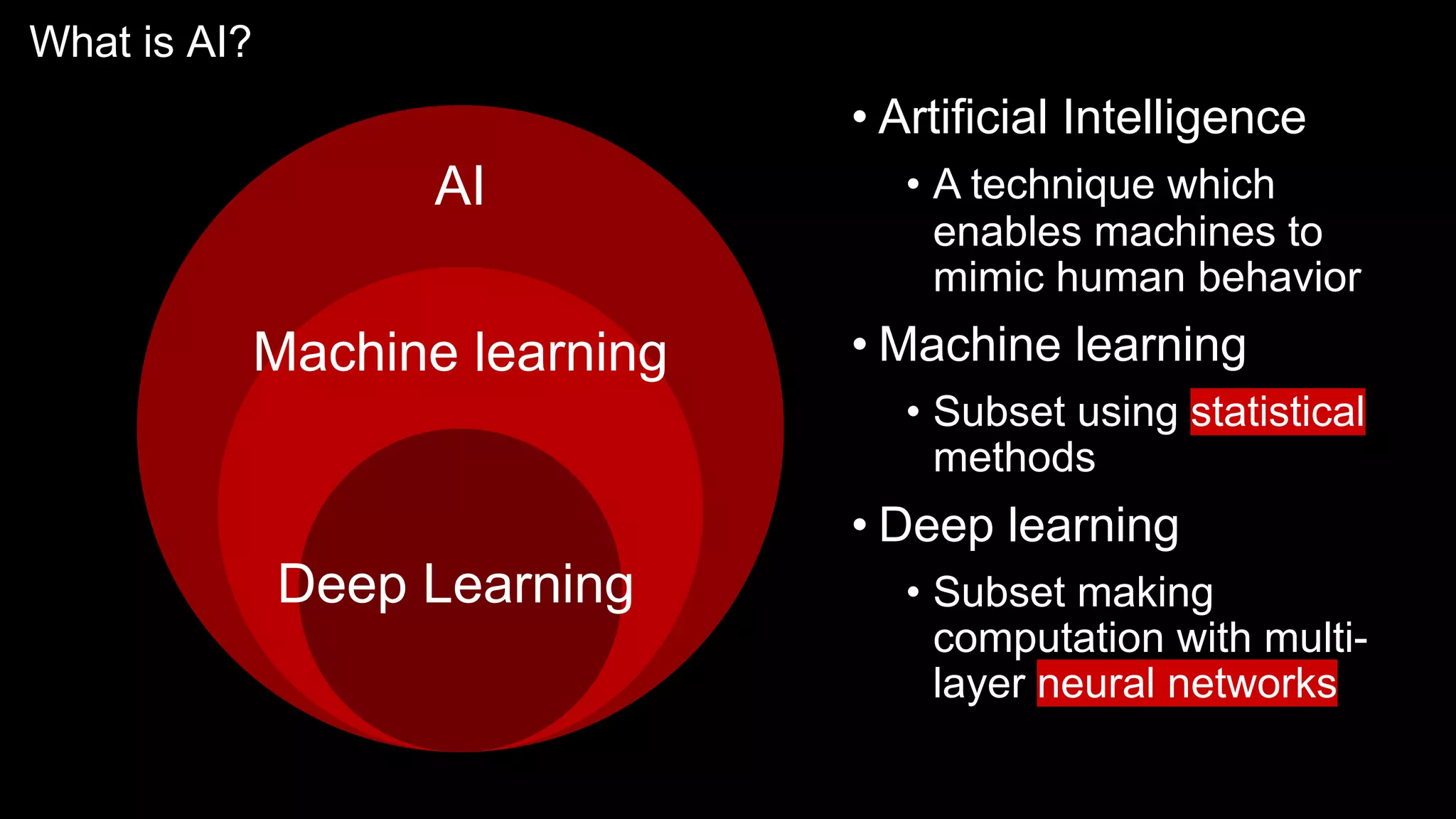
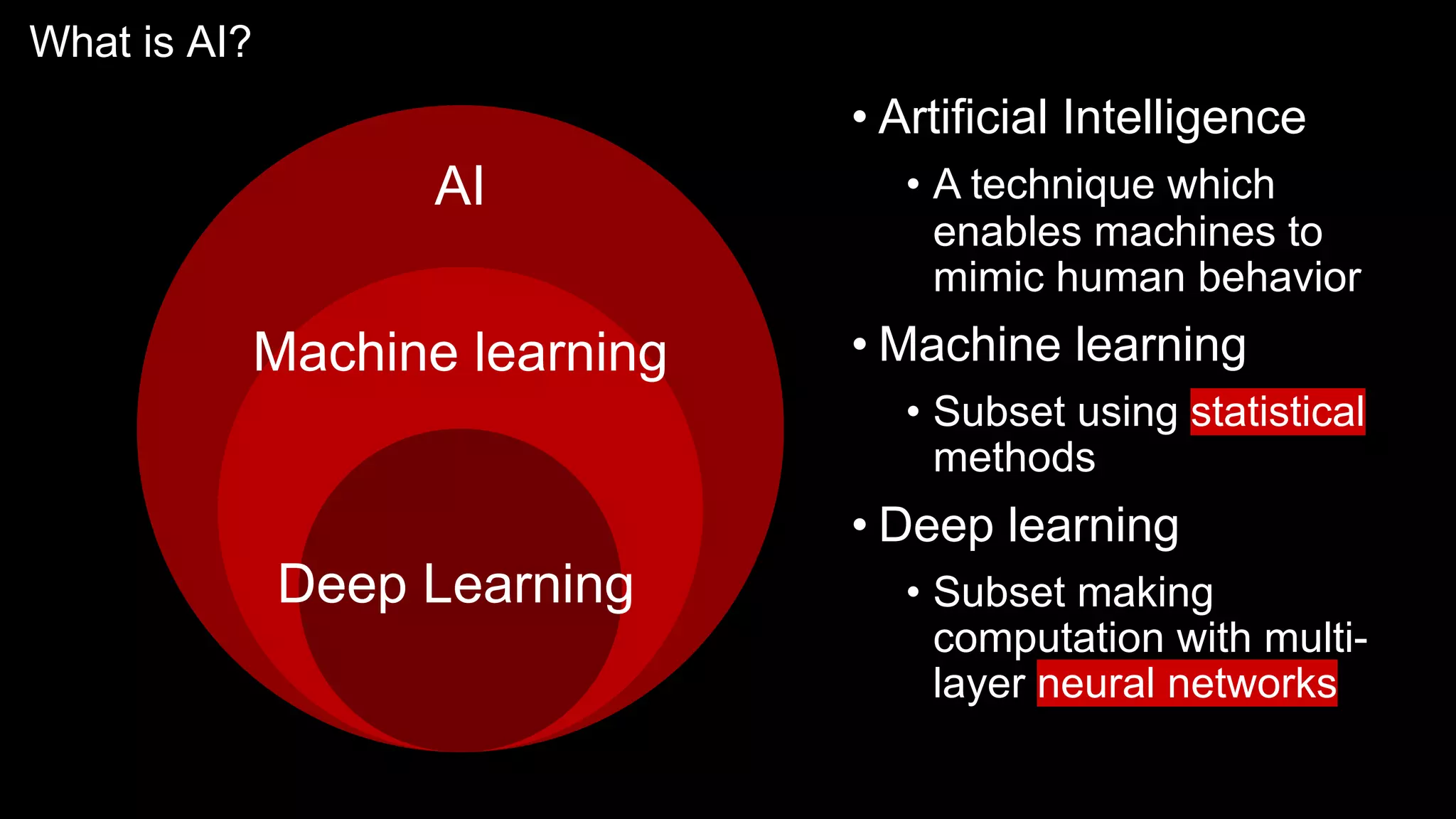
AI
Machine learning
Deep Learning
• Artificial Intelligence
• A technique which
enables machines to
mimic human behavior
• Machine learning
• Subset using statistical
methods
• Deep learning
• Subset making
computation with multi-
layer neural networks
What is AI?
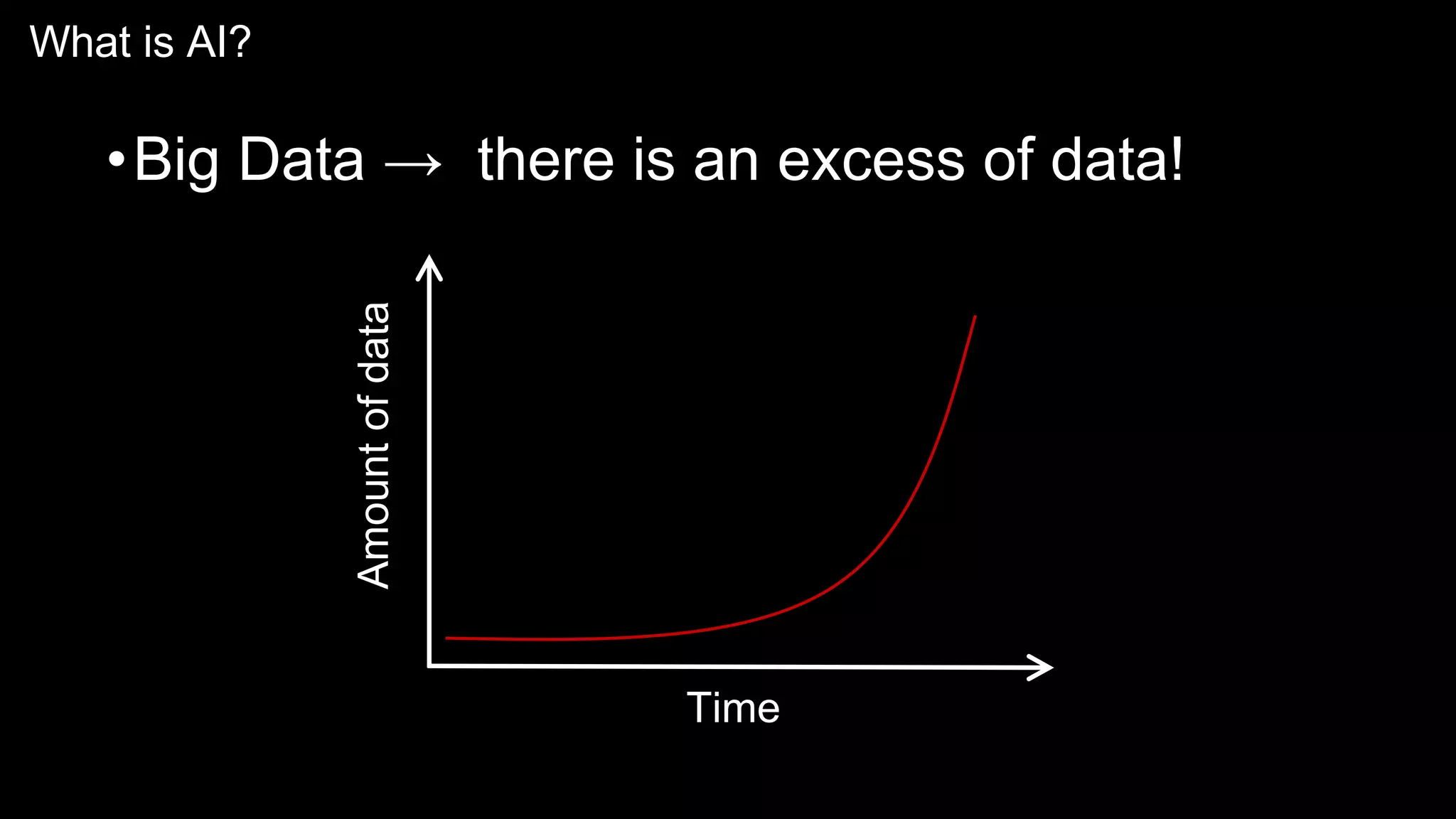
•Big Data → there is an excess of data!
Amount
of
data
Time
What is AI?
•Big Data → ↑ in data, 6 Vs
•↑ volume
•↑ variety
•↑ velocity
•↑ veracity
•↑ value
•↑ variability
What is AI?
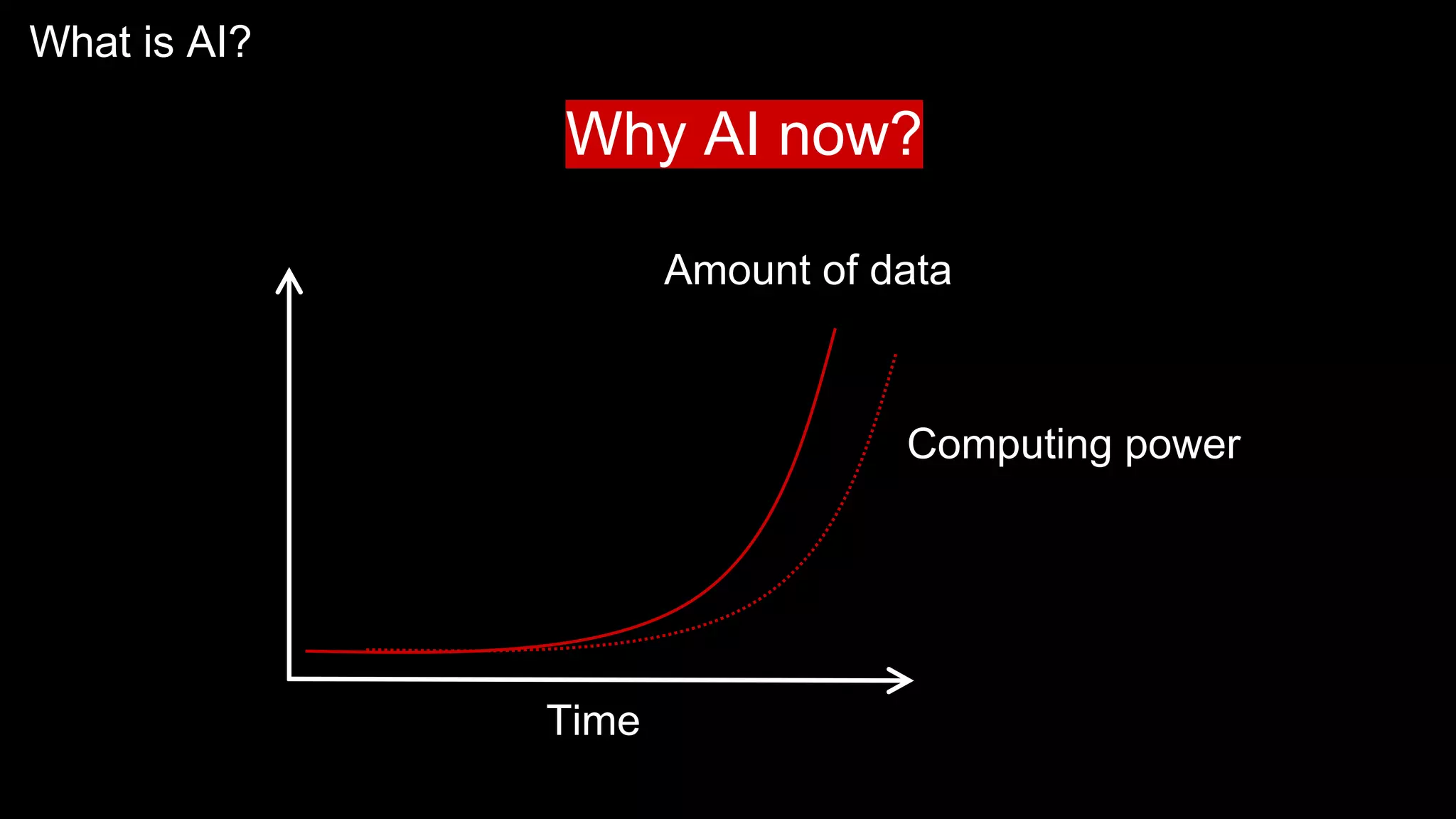
Why AI now?
Amount of data
Time
Computing power
What is AI?
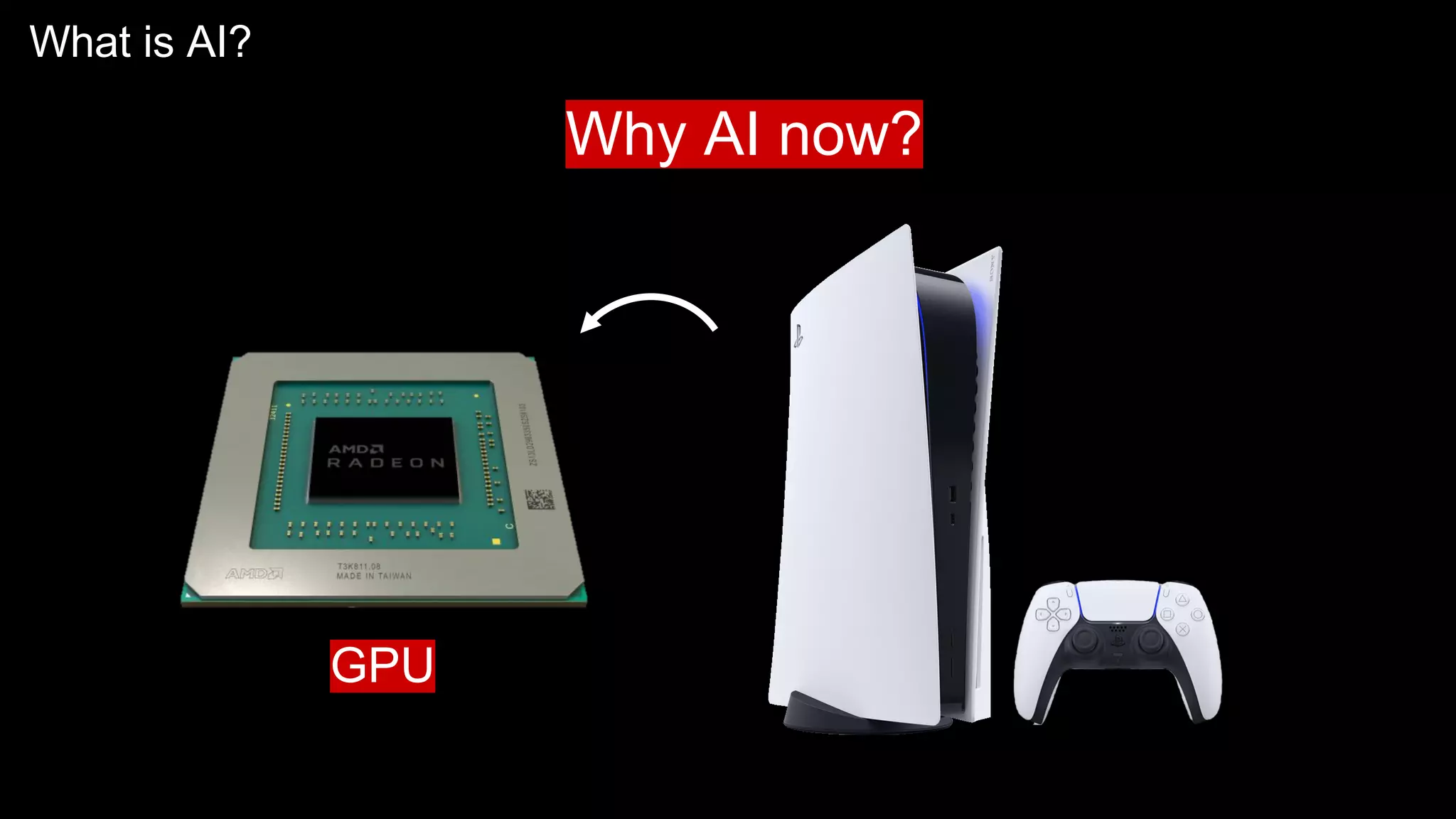
Why AI now?
GPU
What is AI?
Why AI now?
GPU
What is AI?
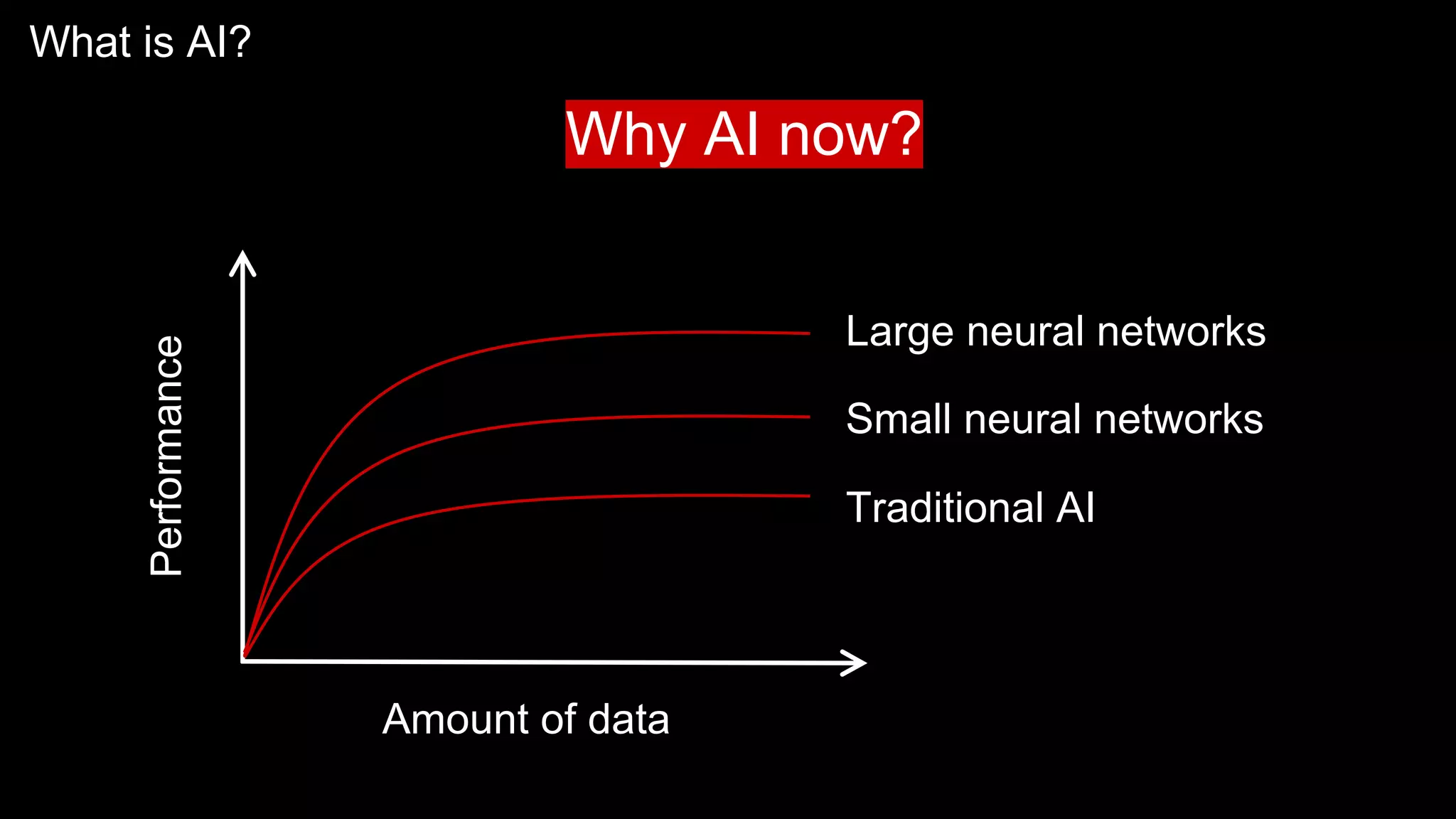
Performance
Amount of data
Traditional AI
Small neural networks
Large neural networks
Why AI now?
What is AI?
•Data Science
• Data analytics
• Data mining
• Data security
• Data management
• Data visualization
• Statistical analysis
What is AI?
•Data Science
• Examine the data and provide insights
• Optimize sales
• Find correlations
•Machine learning
• Make predictions
• Classify things automatically
What is AI?
AI
Machine learning
Deep Learning
• Artificial Intelligence
• A technique which
enables machines to
mimic human behavior
• Machine learning
• Subset using statistical
methods
• Deep learning
• Subset making
computation with multi-
layer neural networks
What is AI?
What is AI?
•Applications of AI
•Improve work-flow and work life
•Improve quality and safety
•Decrease health care errors
•Accelerate medical discoveries
What is machine learning?
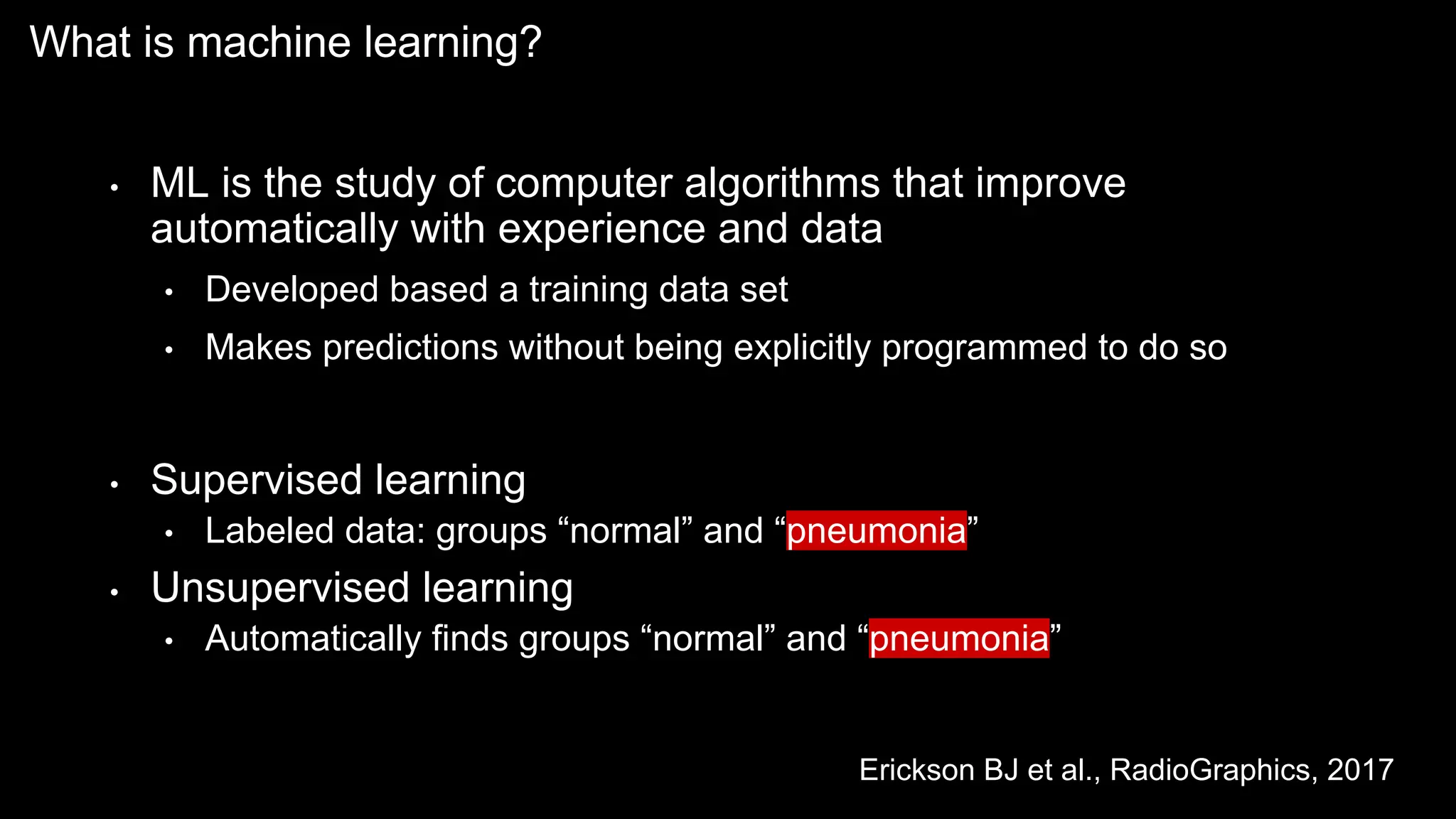
• ML is the study of computer algorithms that improve
automatically with experience and data
• Developed based a training data set
• Makes predictions without being explicitly programmed to do so
• Supervised learning
• Labeled data: groups “normal” and “pneumonia”
• Unsupervised learning
• Automatically finds groups “normal” and “pneumonia”
What is machine learning?
Erickson BJ et al., RadioGraphics, 2017
What is machine learning?
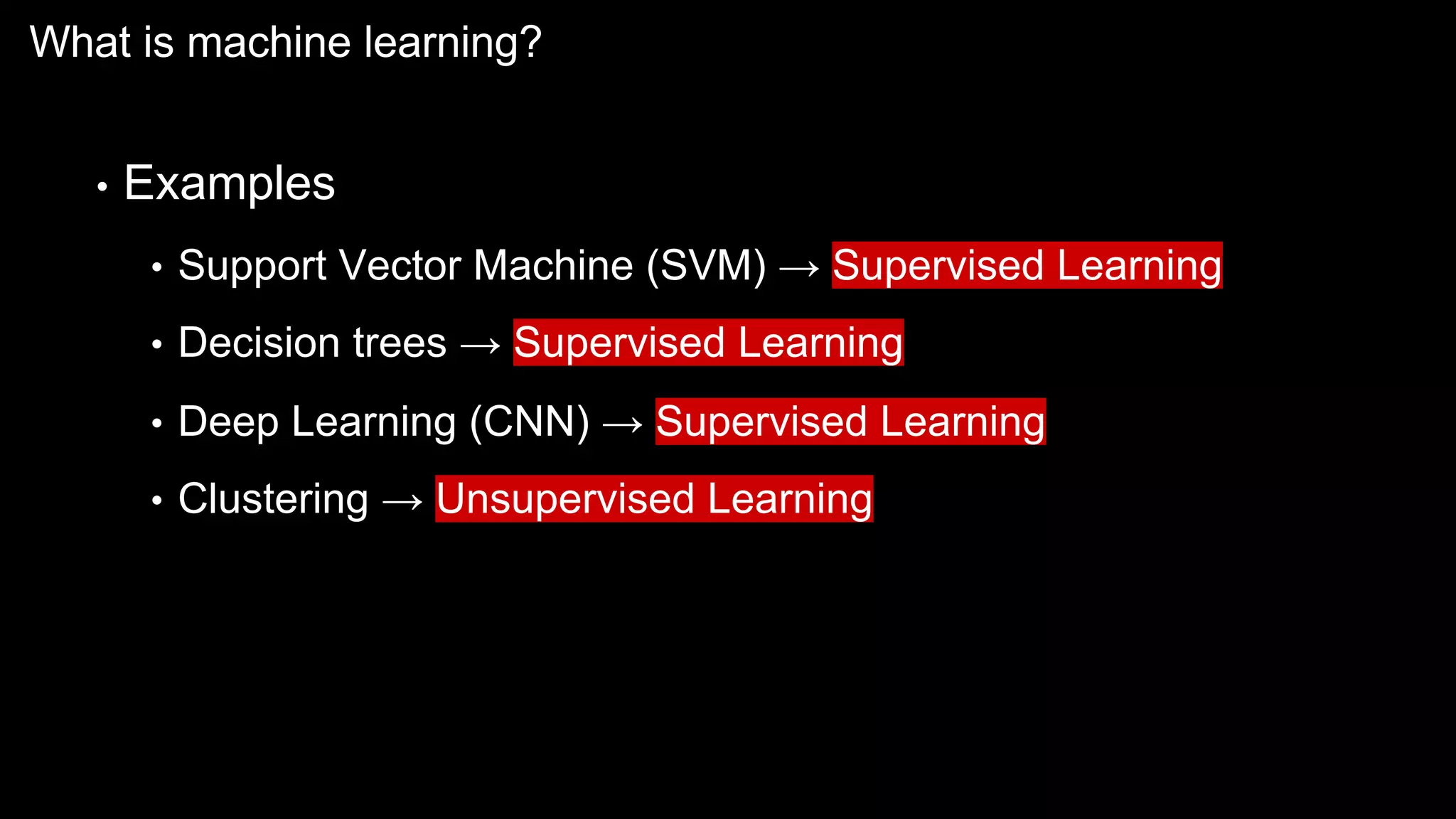
• Examples
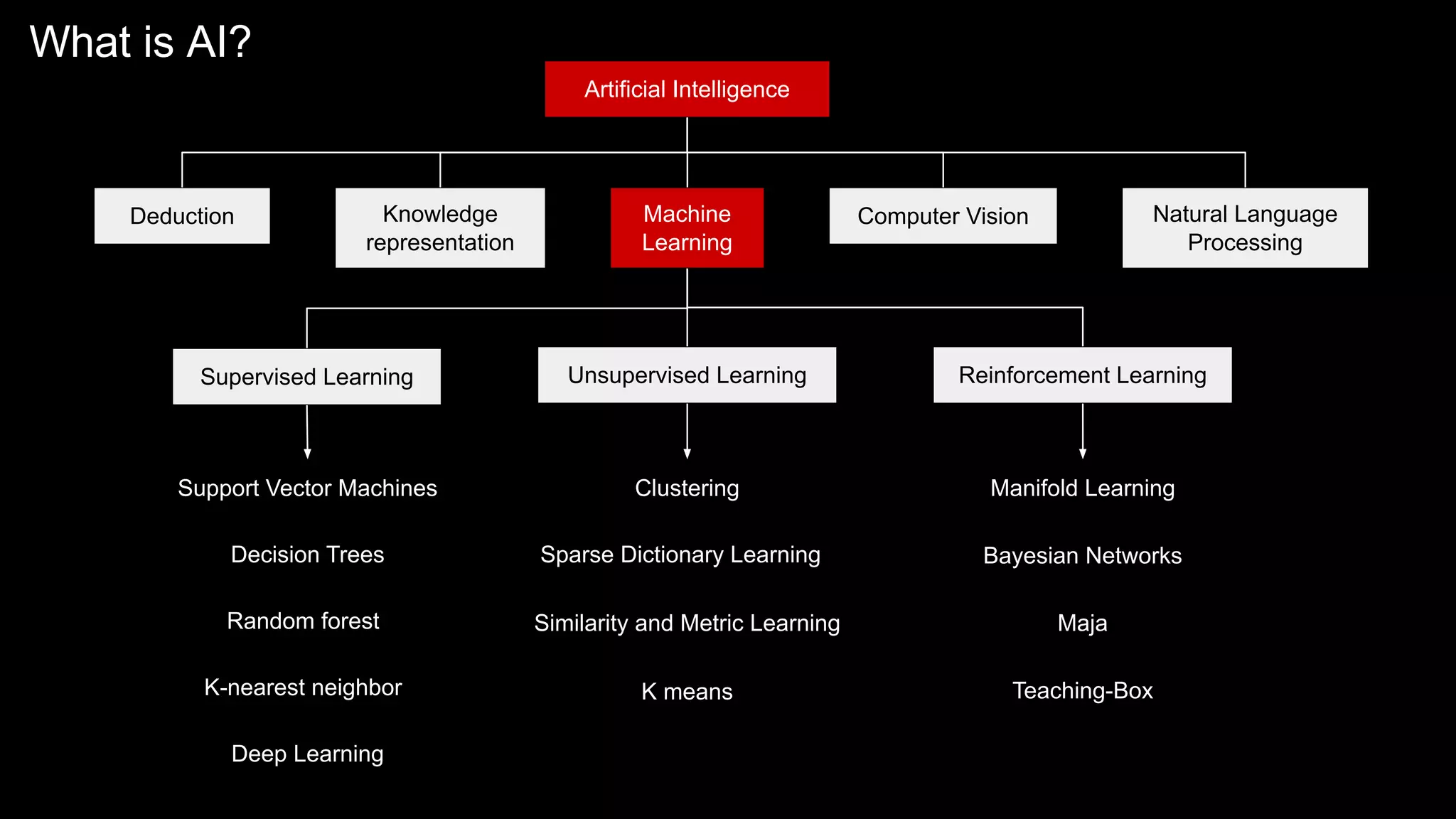
• Support Vector Machine (SVM) → Supervised Learning
• Decision trees → Supervised Learning
• Deep Learning (CNN) → Supervised Learning
• Clustering → Unsupervised Learning
What is SVM?
What is Support Vector Machine (SVM)
✕
✕
✕
✕
✕
✕
✕
✕
✕
✕
✕
✕
✕
✕
✕
✕
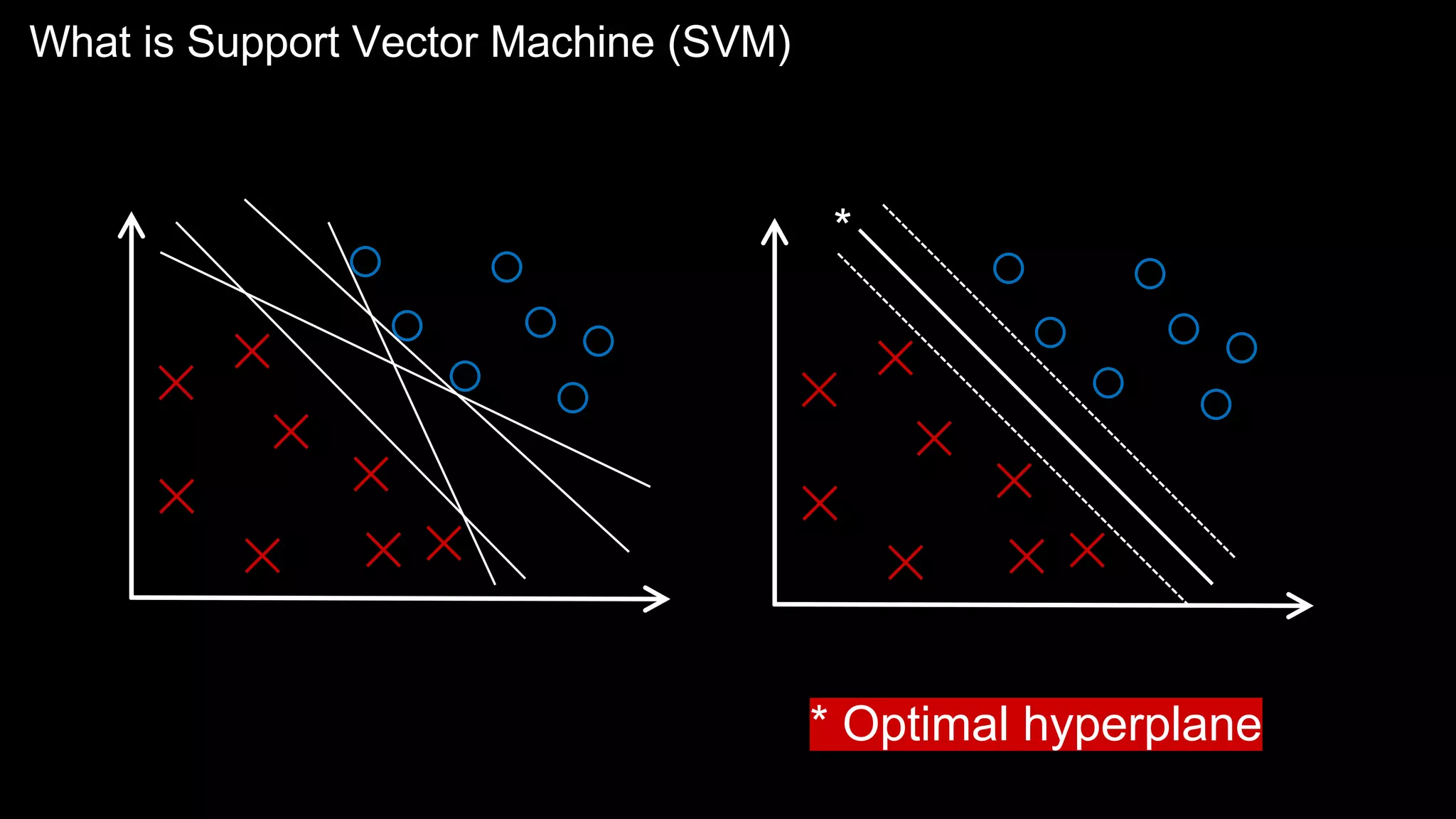
* Optimal hyperplane
*
What is Support Vector Machine (SVM)
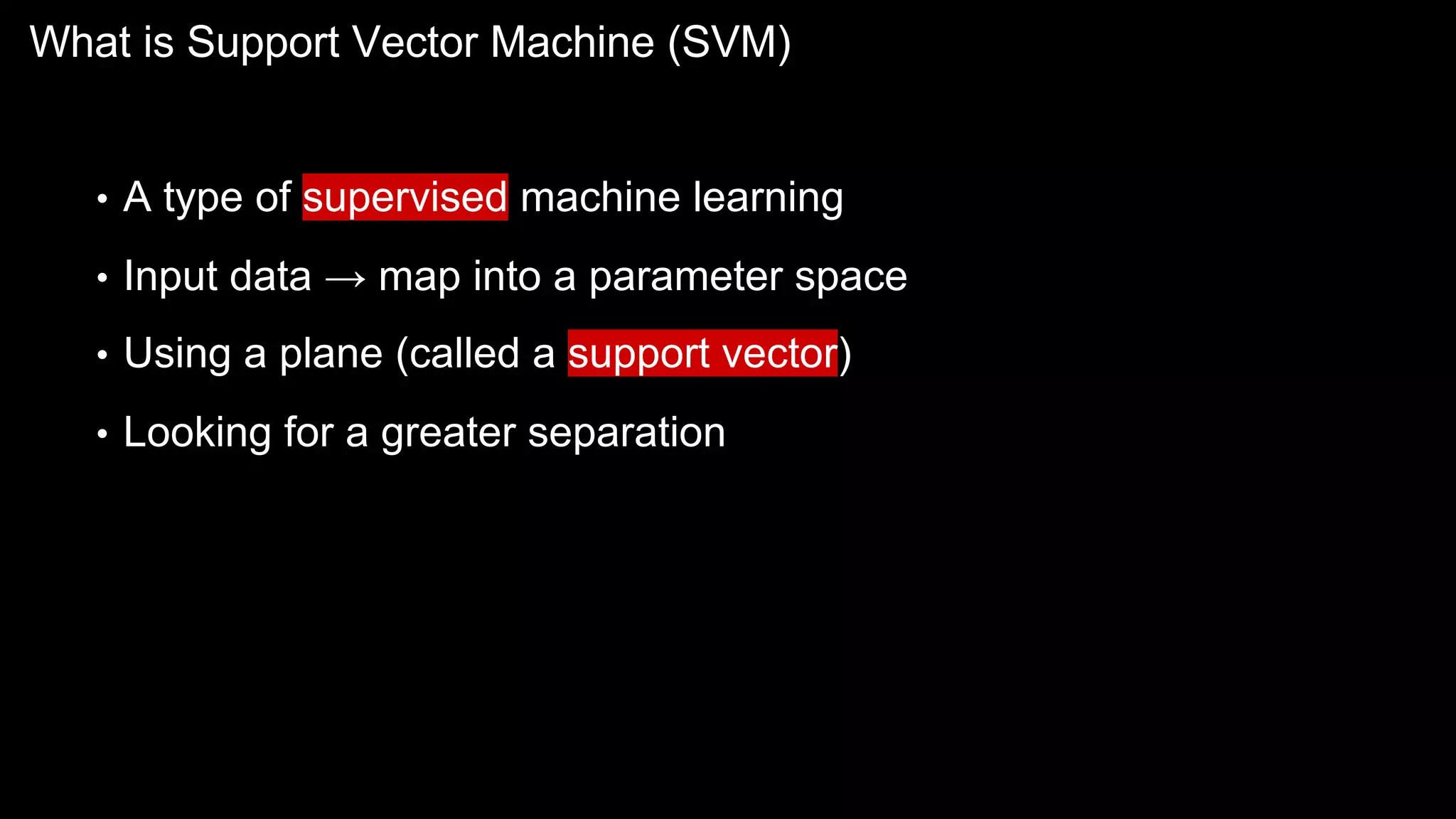
• A type of supervised machine learning
• Input data → map into a parameter space
• Using a plane (called a support vector)
• Looking for a greater separation
What is Support Vector Machine (SVM)
✕
✕
✕
✕
✕
✕
✕
✕
✕
✕
✕
✕
✕
✕
✕
✕
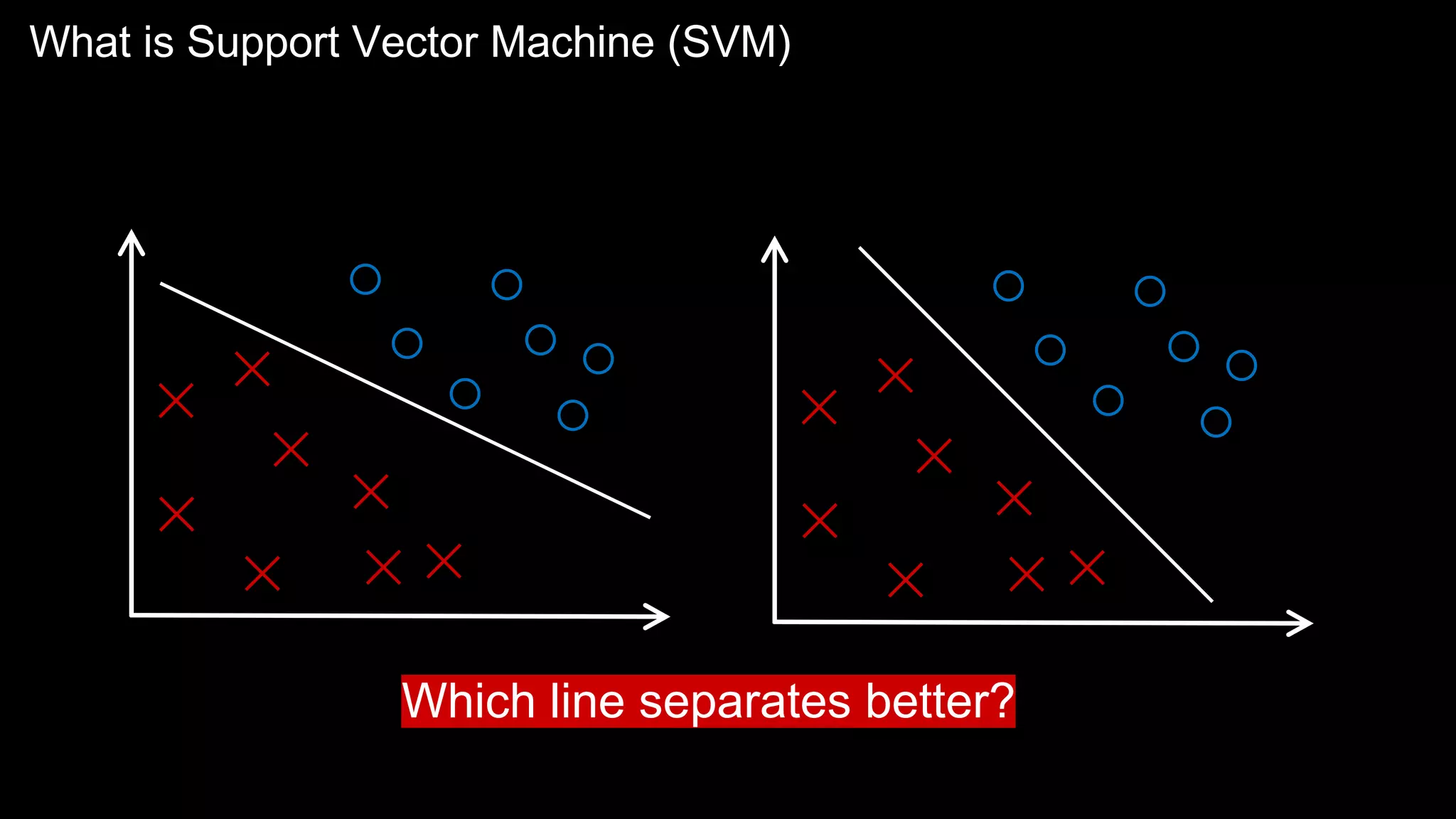
Which line separates better?
What is Support Vector Machine (SVM)
✕
✕
✕
✕
✕
✕
✕
✕
✕
✕
✕
✕
✕
✕
✕
✕
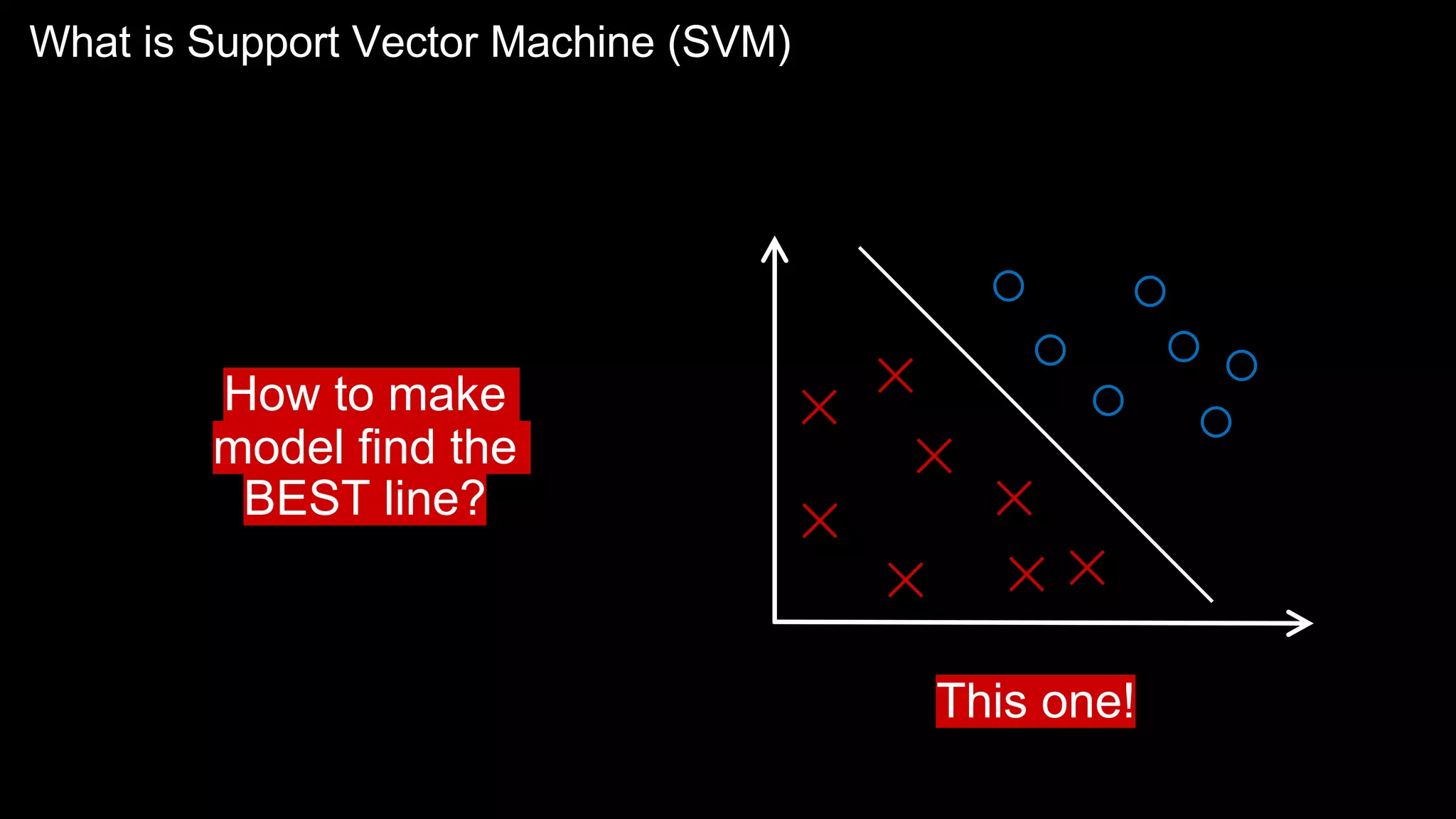
This one!
What is Support Vector Machine (SVM)
✕
✕
✕
✕
✕
✕
✕
✕
This one!
How to make
model find the
BEST line?
What is Support Vector Machine (SVM)
✕
✕
✕
✕
✕
✕
✕
✕
✕
✕
✕
✕
✕
✕
✕
✕
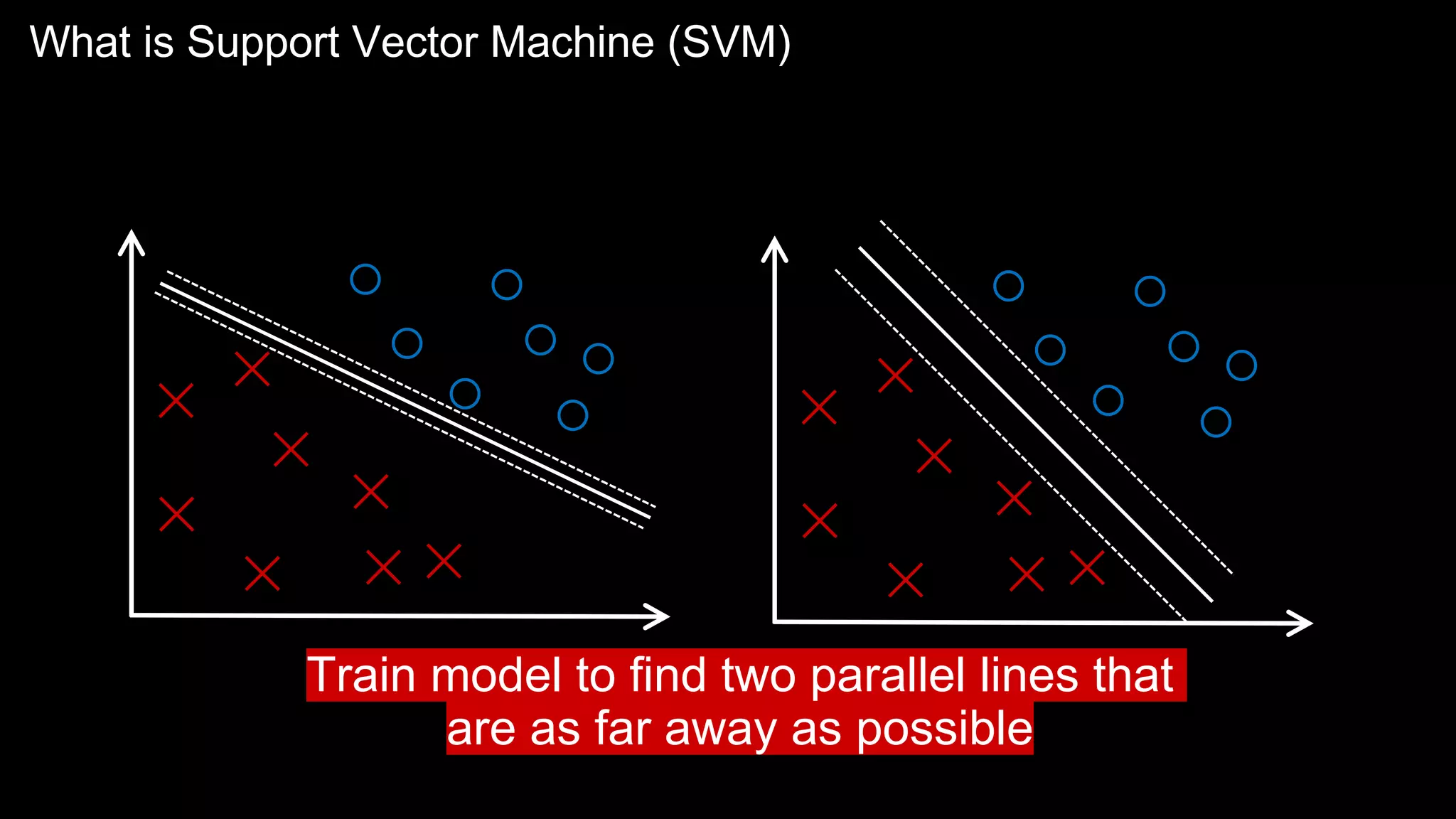
Train model to find two parallel lines that
are as far away as possible
What is Support Vector Machine (SVM)
• Step 1: Start with a random line, and two equidistant parallel to it
• Step 2: Pick a large number of repetitions, the epochs (1000)
• Step 3: Pick a number close to 1, the expanding factor (0.99)
• Step 4: Repeat 1000 times
• Pick random point
• If correct → do nothing; If incorrect → move line towards the point
• Separate the lines using the expanding factor
• Step 5: Boom! You have the line that best separates the data
What is Support Vector Machine (SVM)
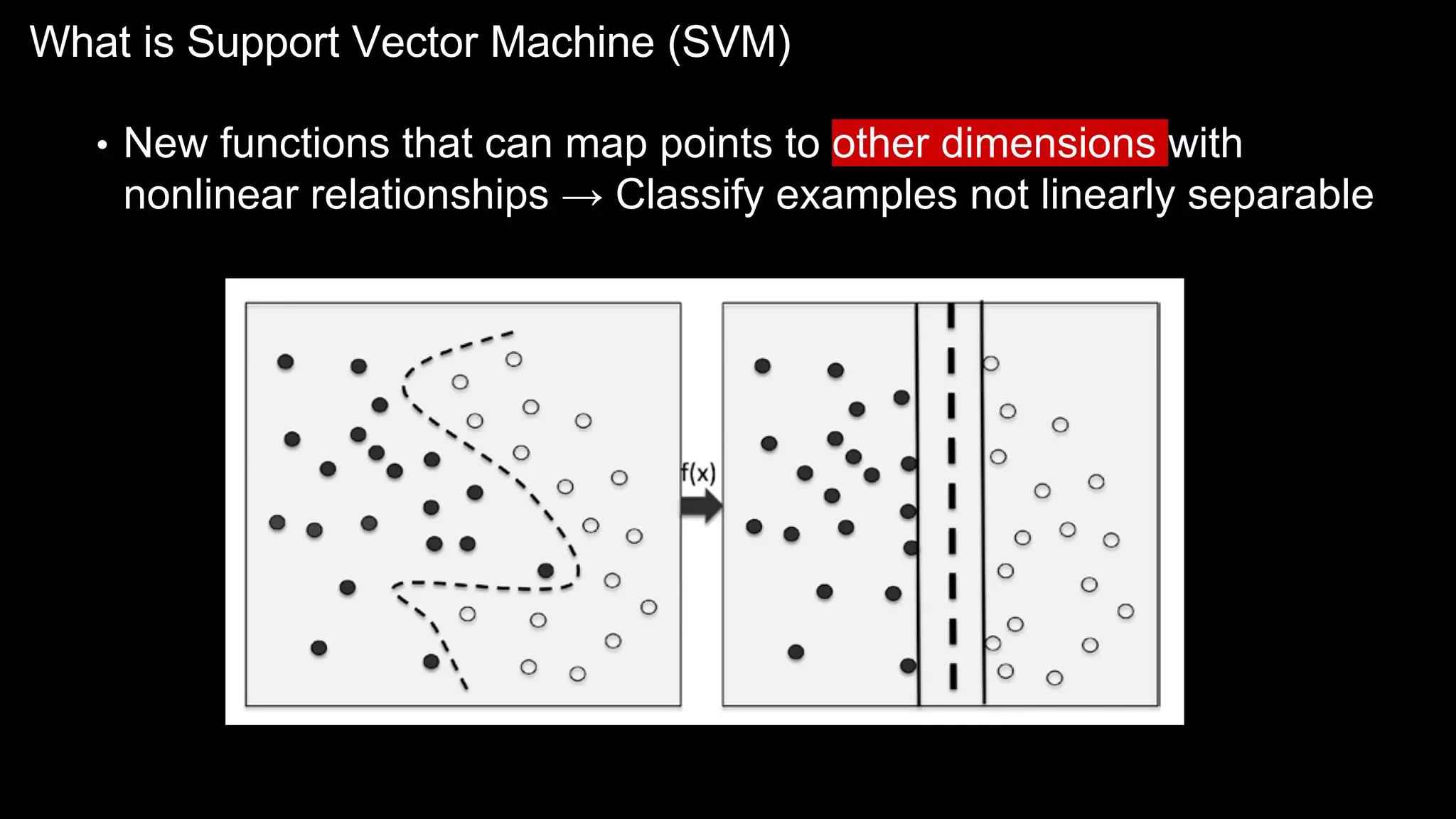
• New functions that can map points to other dimensions with
nonlinear relationships → Classify examples not linearly separable
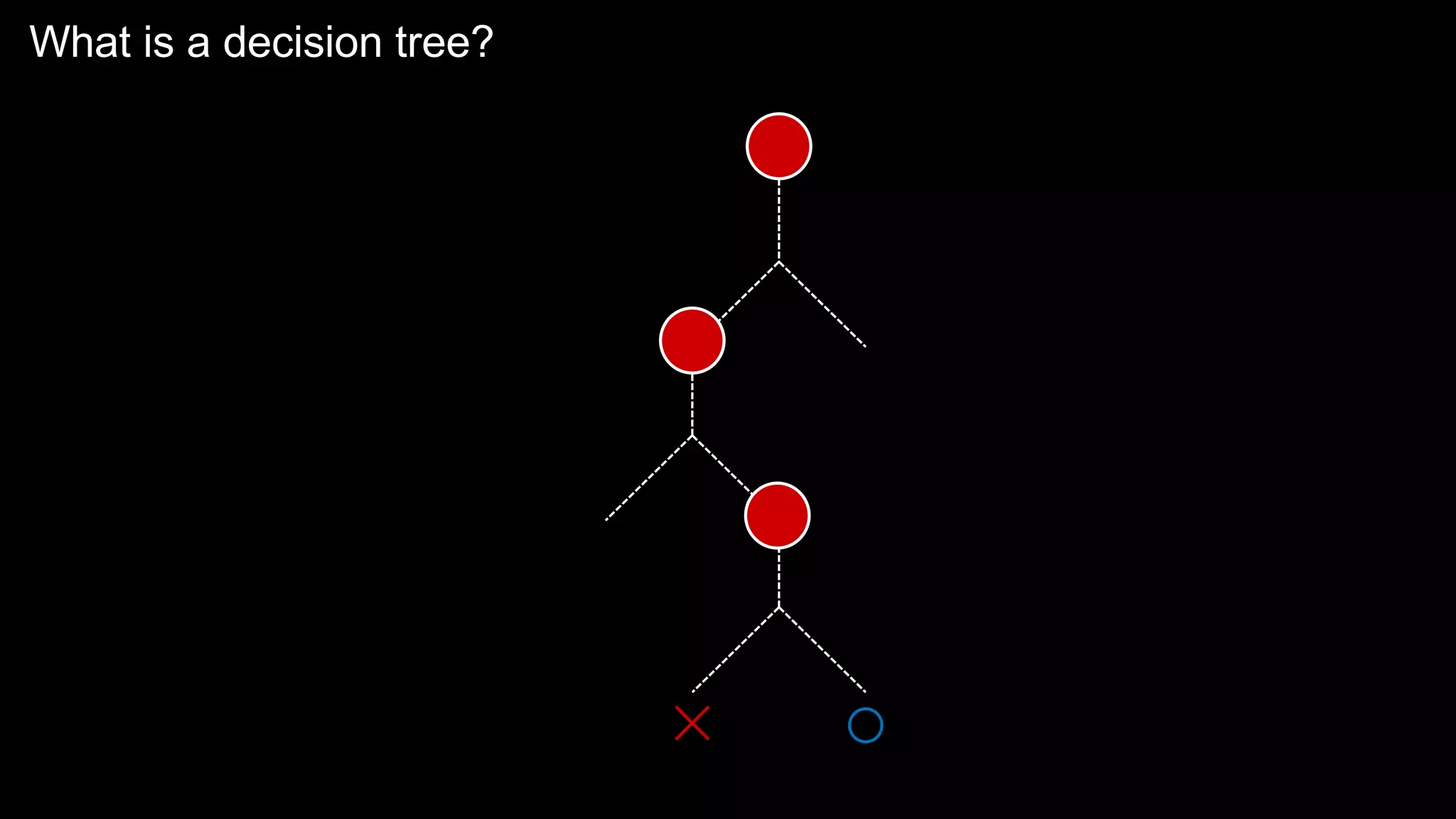
What is a decision tree?
✕
What is a decision tree?
• A type of supervised machine learning
• Produce human-readable rules for classification
• Intuitive, explainable
• Searches the many possible combinations of decision points to
find the points that will result in the simplest tree with the most
accurate results
• But does not generalize well in the real world
What is a decision tree?
• Give an input
• Looks for which feature has the most right and wrong answers
• Stops splitting when, e.g., < 10 samples
What is a decision tree?
• Ensemble methods
• Boosting and random forest
• Improve accuracy
• More than one decision tree is constructed
What is a decision tree?
• Boosted forest
• Multiple decision trees by repeatedly resampling the training data by
means of replacement, and voting on the trees to reach a consensus
prediction
• All features are considered
• Random forest → No data resampling
• Only a subset of the total number of features is randomly selected
• Only uses the best split feature from the subset
• More generalizable
What is Deep Learning?
Input layer
What is Deep Learning?
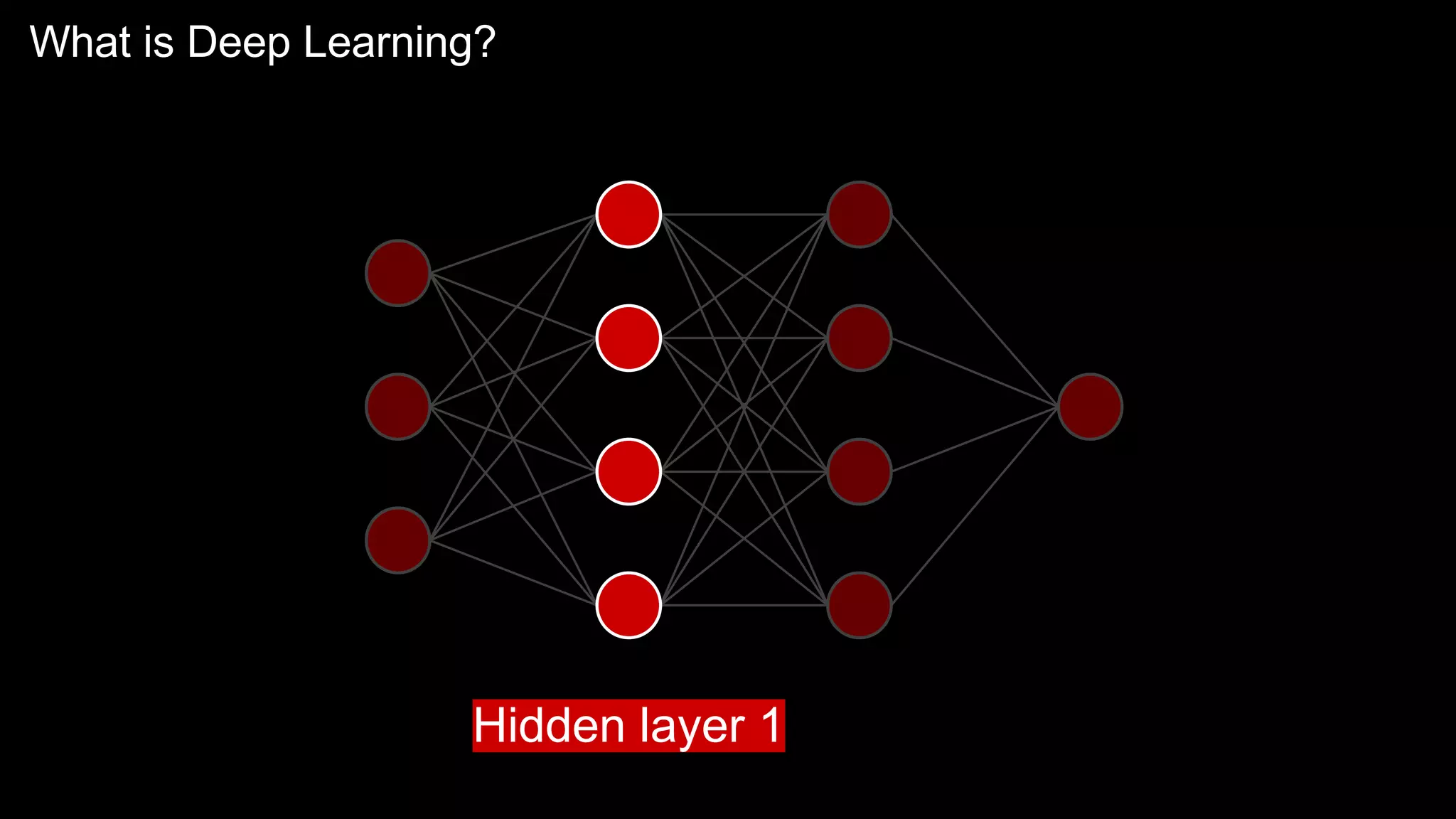
Hidden layer 1
What is Deep Learning?
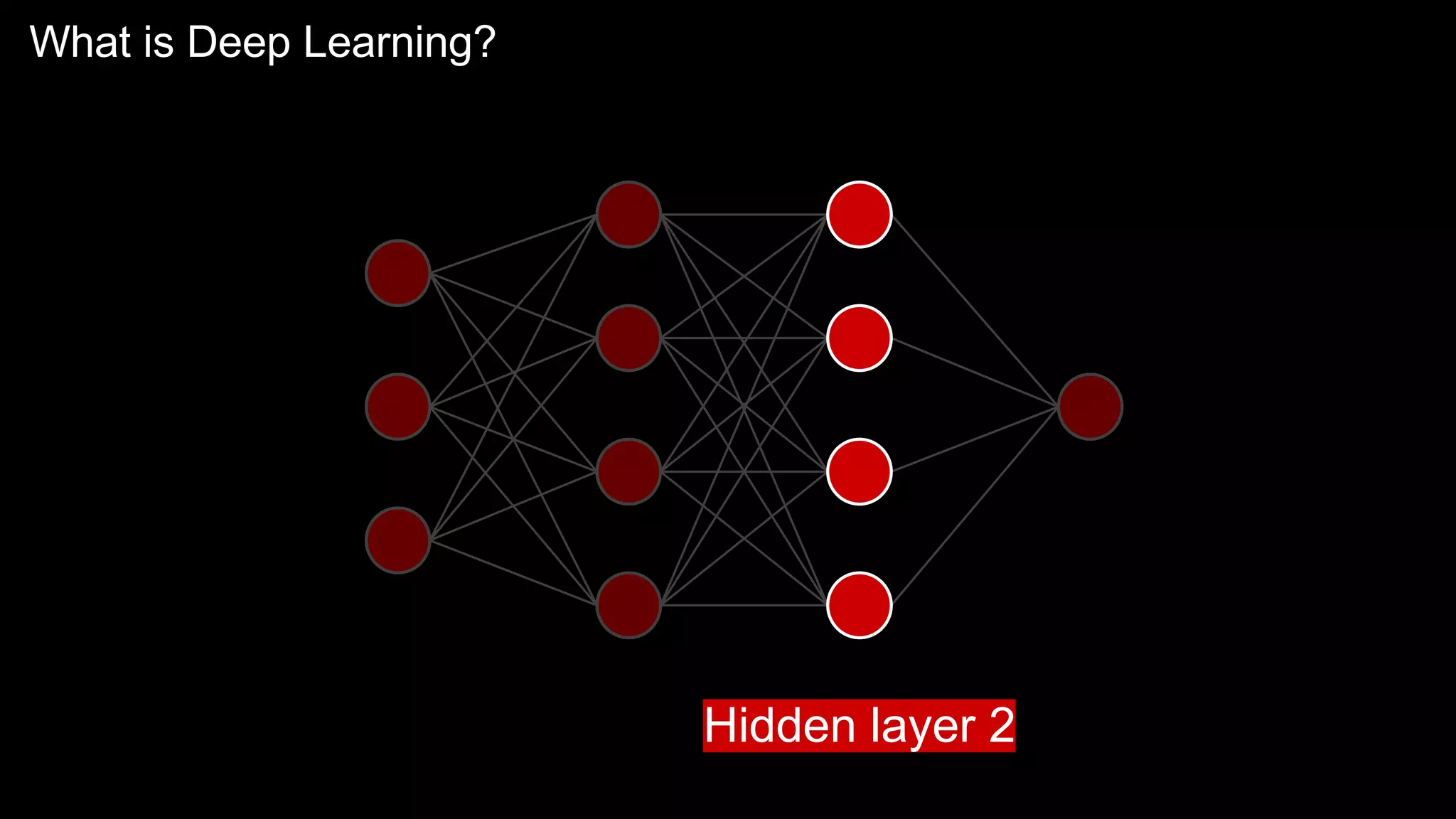
Hidden layer 2
What is Deep Learning?
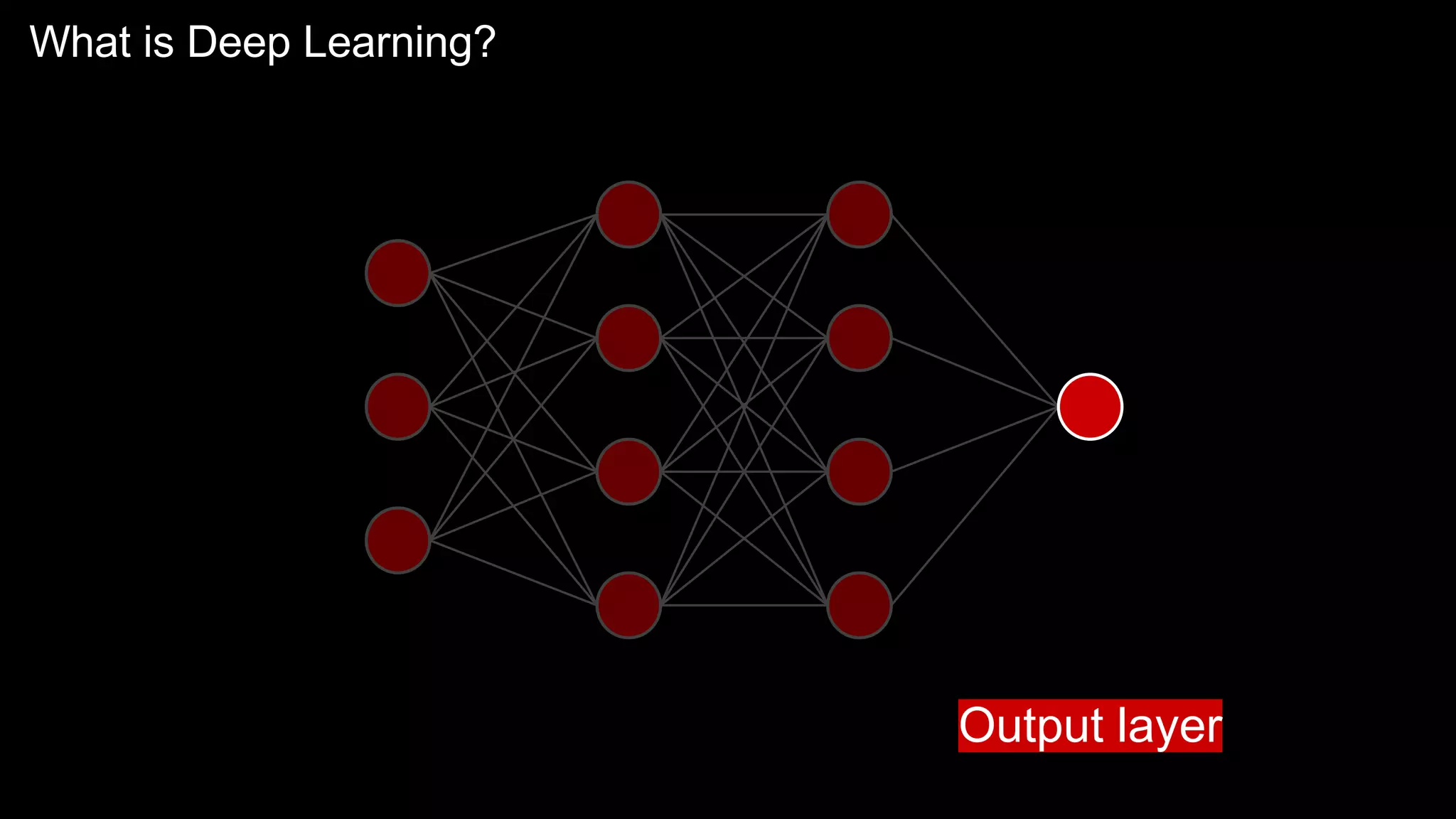
Output layer
What is Deep Learning?
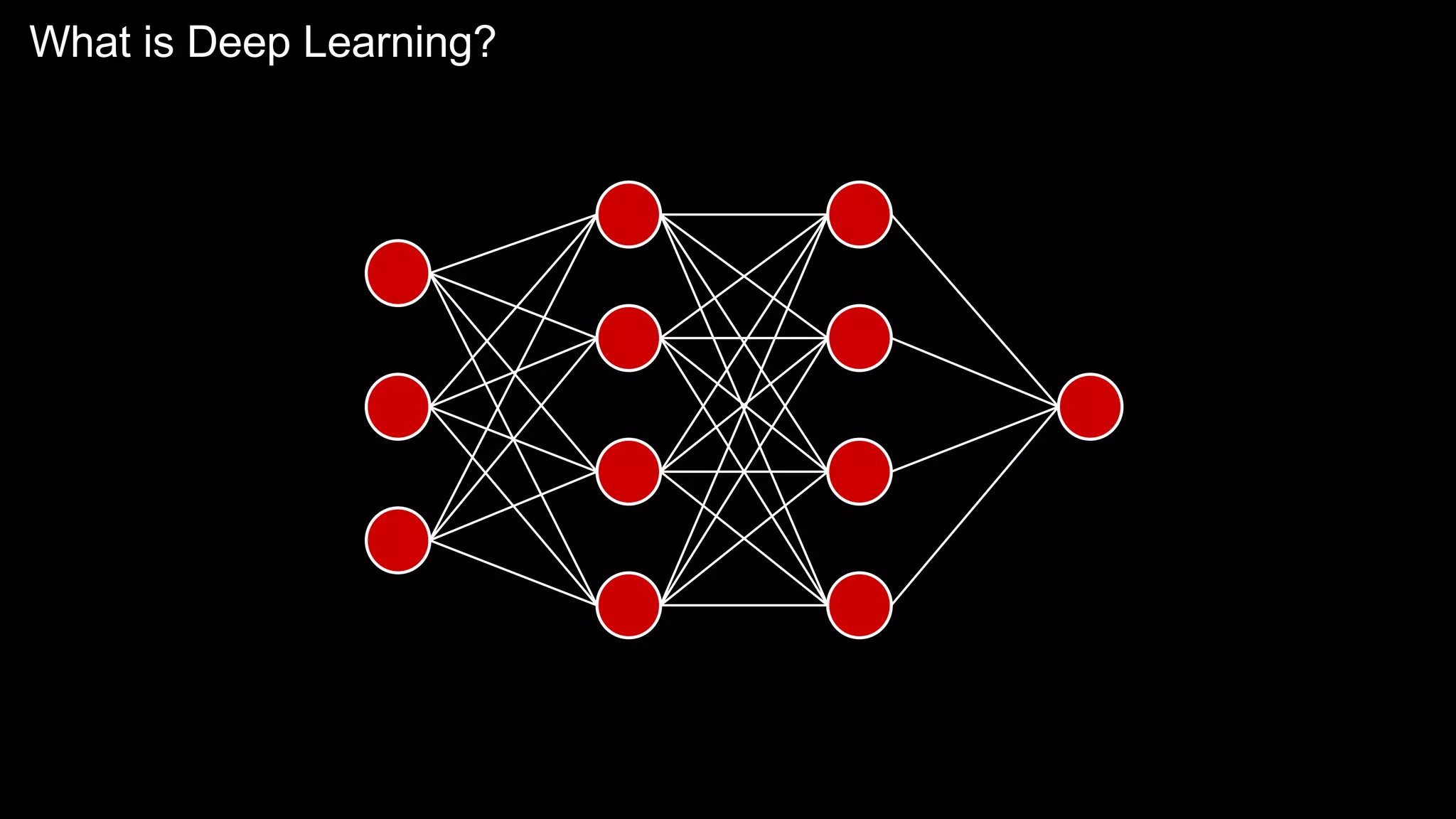
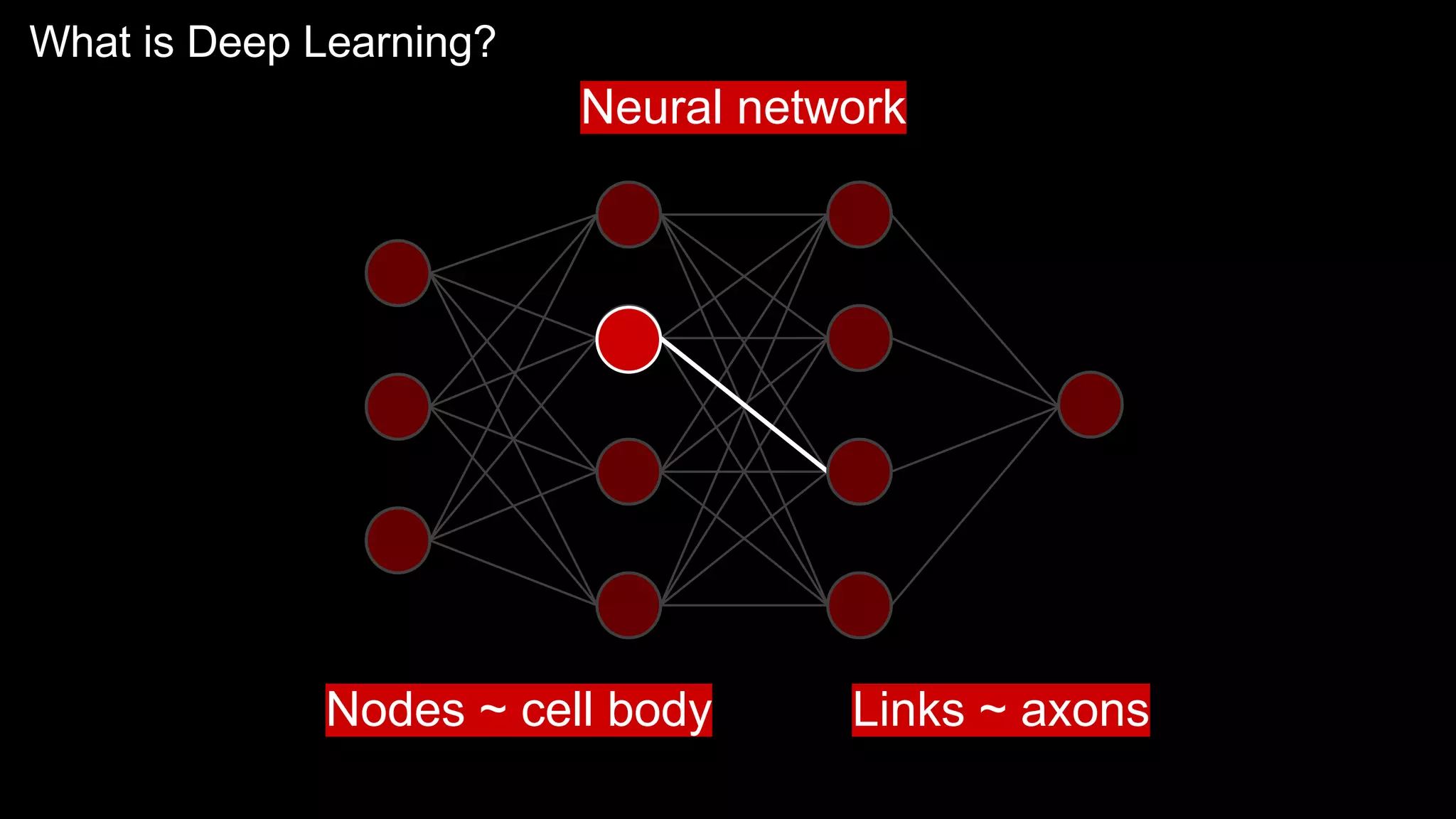
Nodes ~ cell body Links ~ axons
Neural network
What is Deep Learning?
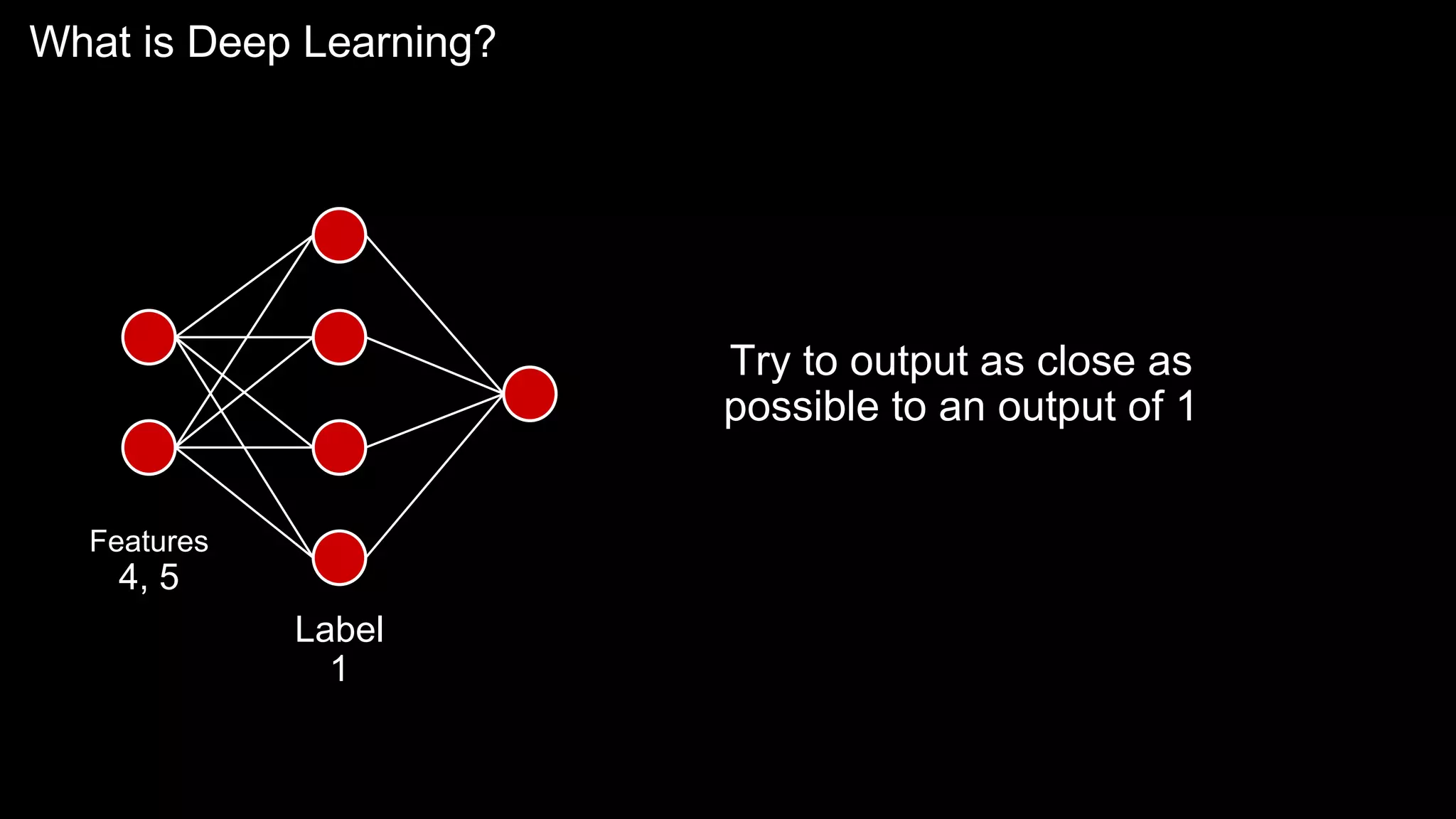
Features
4, 5
Label
1
Try to output as close as
possible to an output of 1
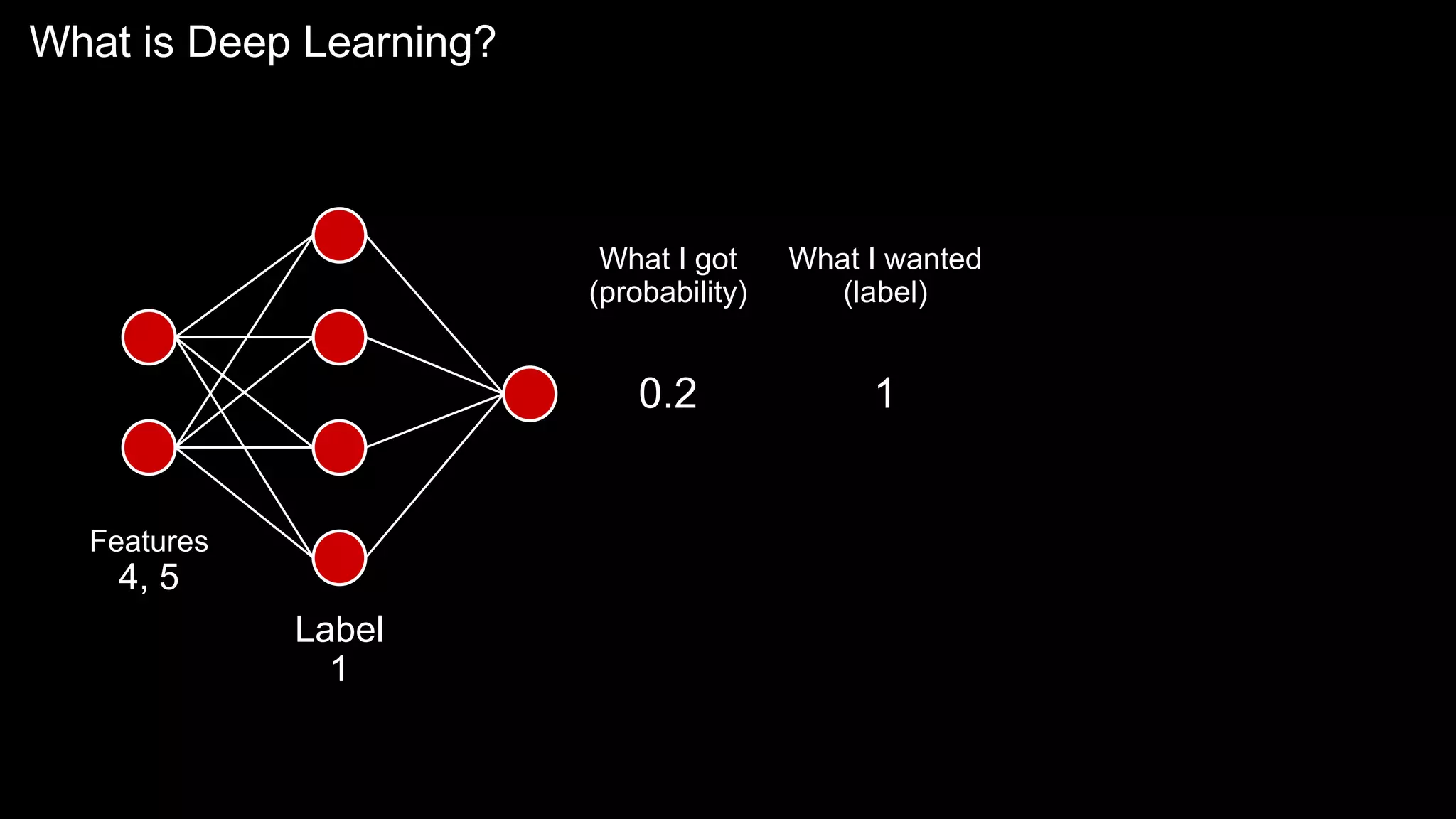
What is Deep Learning?
Features
4, 5
Label
1
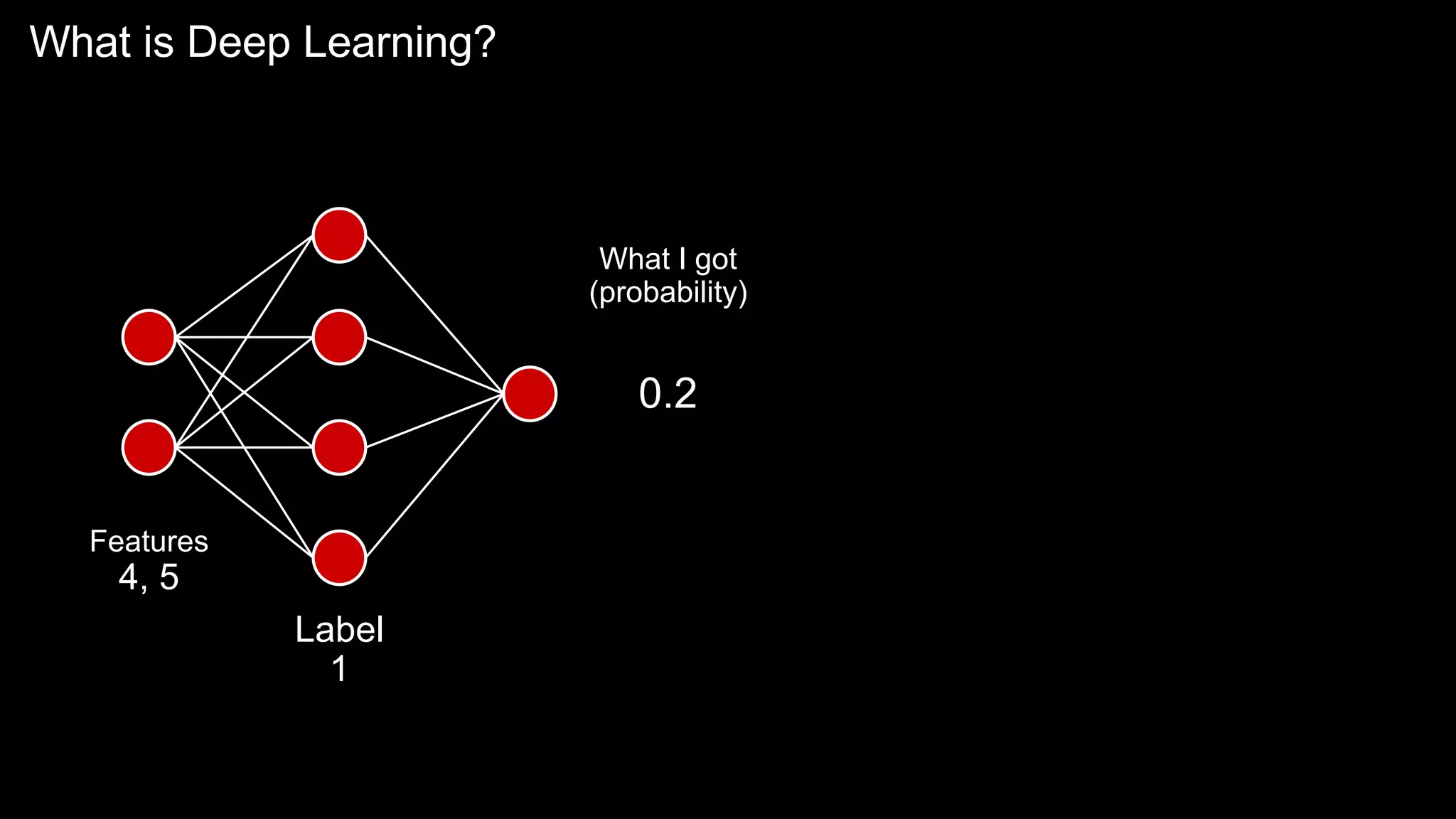
0.2
What I got
(probability)
What is Deep Learning?
Features
4, 5
Label
1
0.2
What I got
(probability)
What I wanted
(label)
1
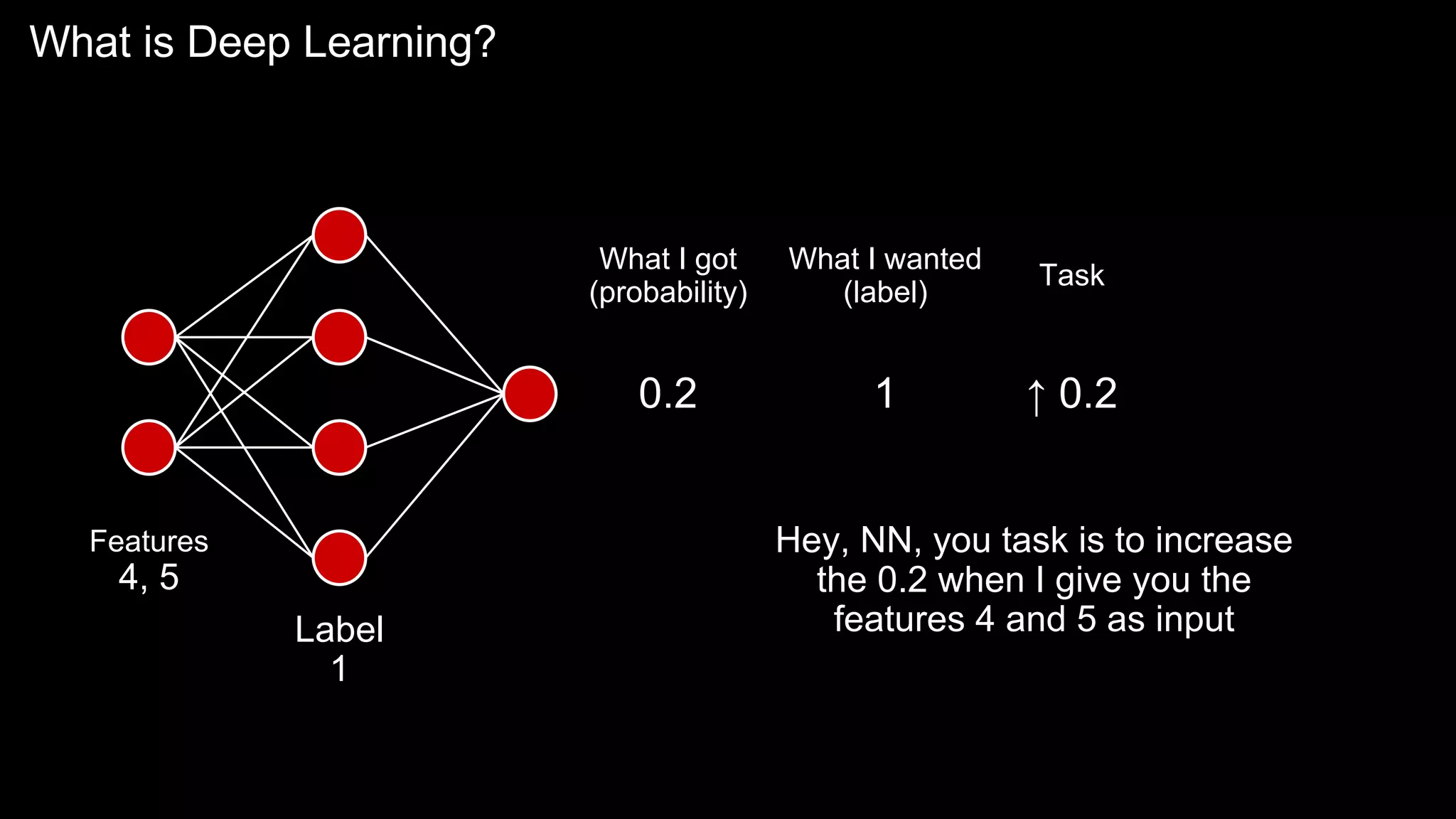
What is Deep Learning?
Features
4, 5
Label
1
0.2
What I got
(probability)
What I wanted
(label)
1
Task
↑ 0.2
Hey, NN, you task is to increase
the 0.2 when I give you the
features 4 and 5 as input
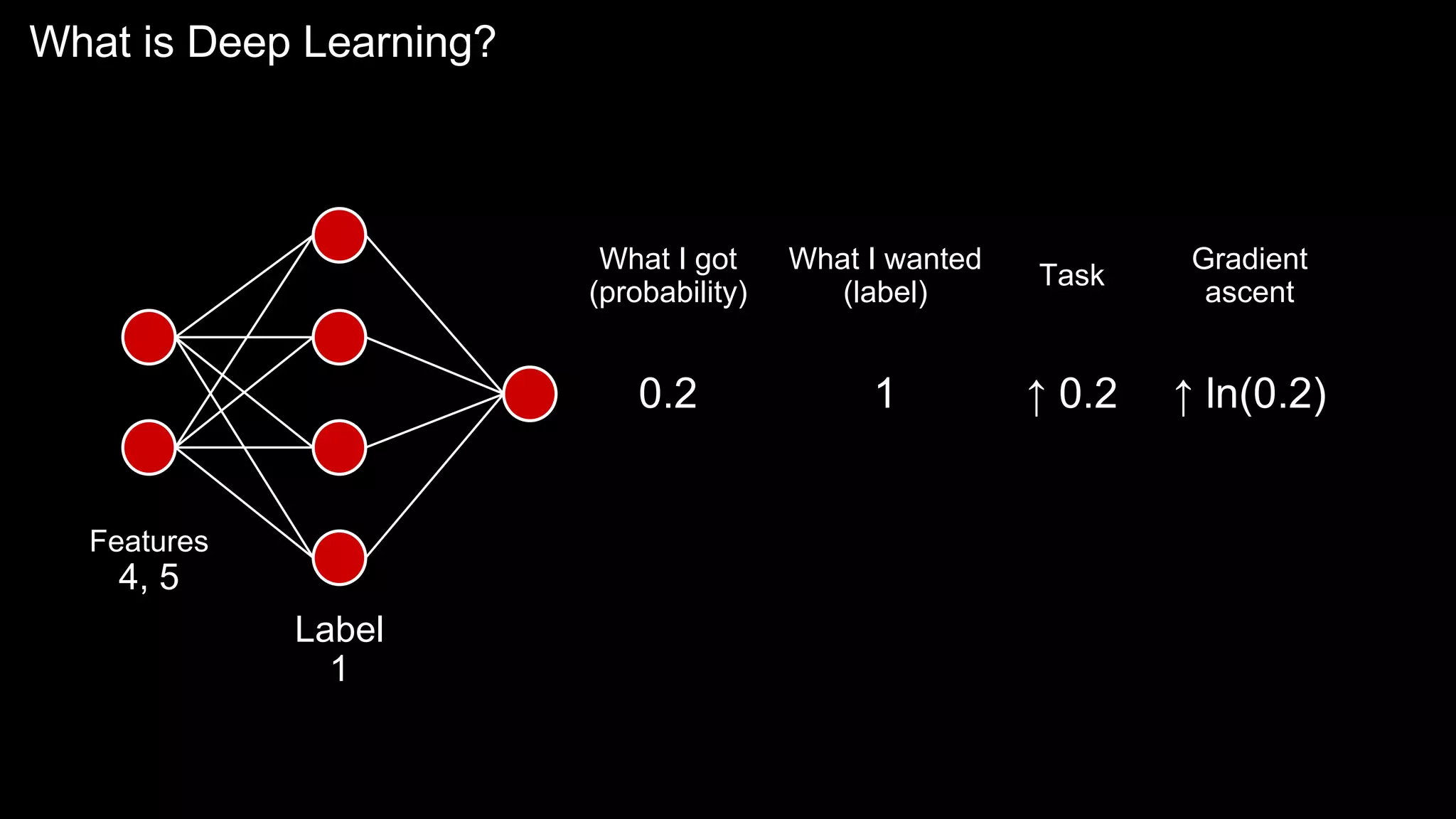
What is Deep Learning?
Features
4, 5
Label
1
0.2
What I got
(probability)
What I wanted
(label)
1
Task
↑ 0.2
Gradient
ascent
↑ ln(0.2)
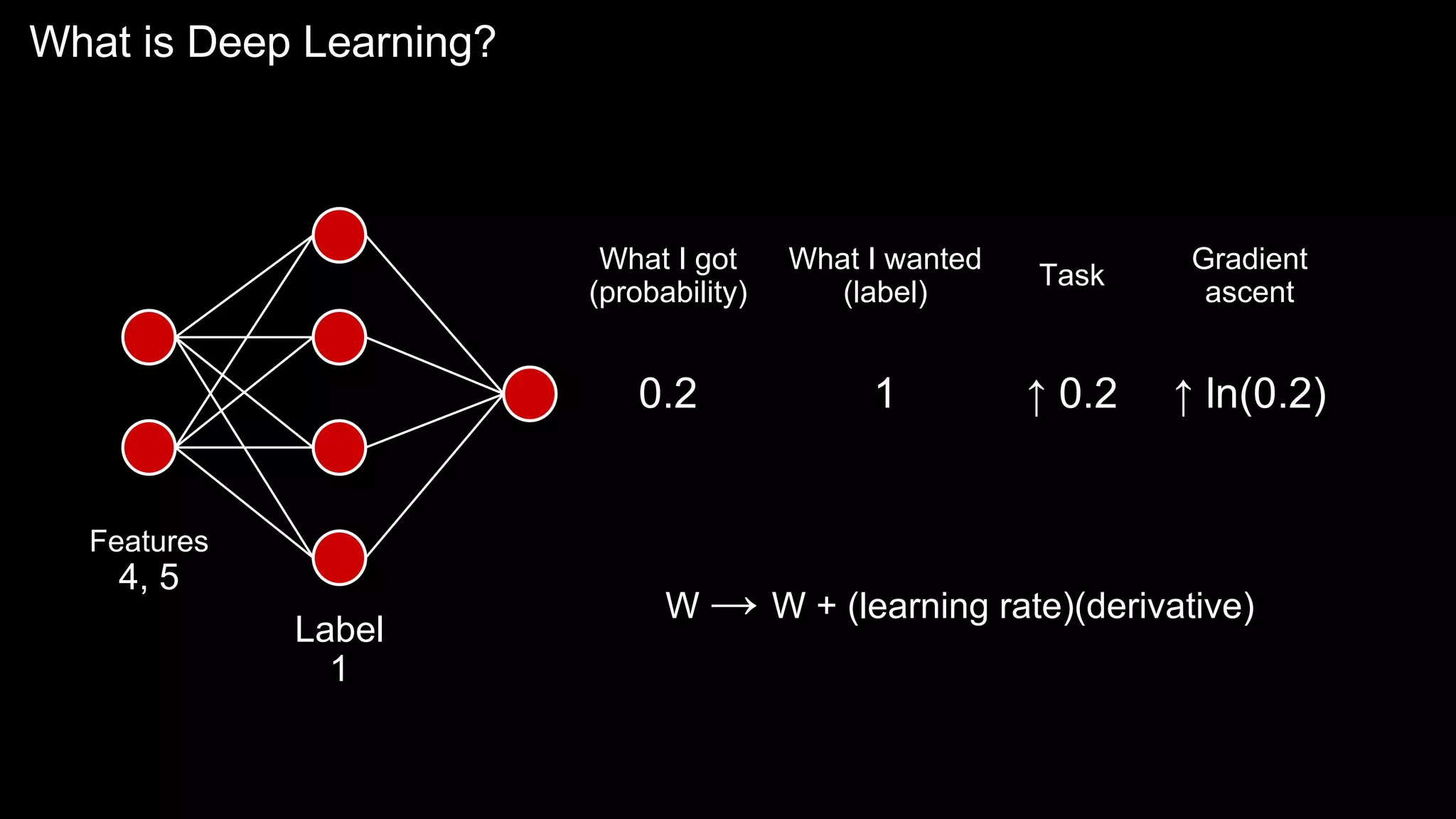
What is Deep Learning?
Features
4, 5
Label
1
0.2
What I got
(probability)
What I wanted
(label)
1
Task
↑ 0.2 ↑ ln(0.2)
W → W + (learning rate)(derivative)
Gradient
ascent
What is Deep Learning?
• A type of supervised machine learning
• Multi-layered neural networks (aka deep neural networks)
• Deep → many layers (> 20), often > 100
• Does not require image feature identification as a first step
• Features are identified as part of the learning process
• Needs all the computing power from video game GPUs
• NVidia Corporation
Erickson BJ et al., RadioGraphics, 2017
What is Deep Learning?
• Uses
Soffer S et al., Radiology, 2019
Classification
Detection
Segmentation
What is Deep Learning?
• Convolutional neural networks (CNN)
• Main subtype of NN
• Assumes that inputs have a geometric relationship
• Like the rows and columns of pixels
• Input layer → convolution of a small image
• Convolutions → filters extract edges or boundaries in matrices
Erickson BJ et al., RadioGraphics, 2017
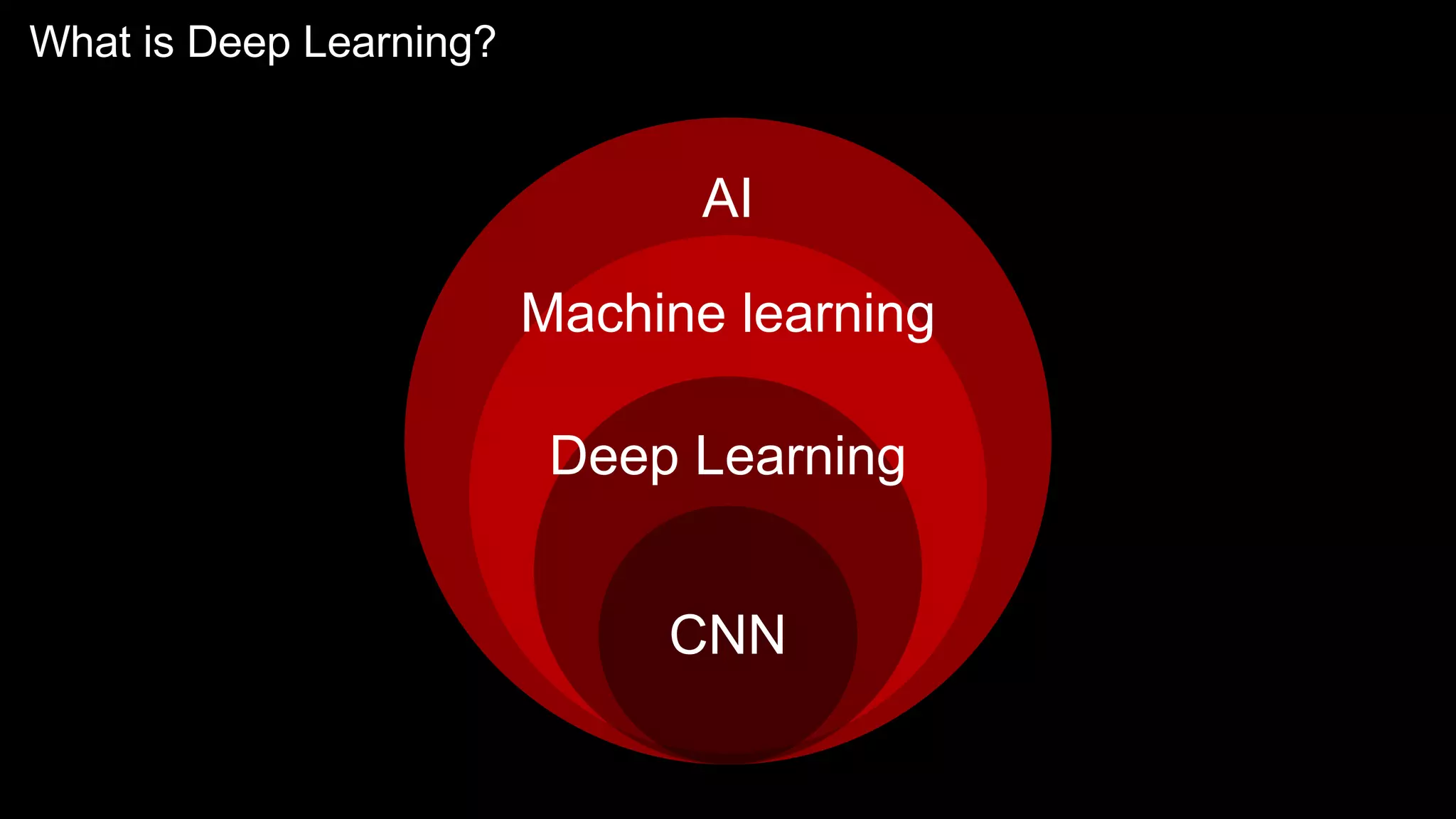
AI
Machine learning
Deep Learning
CNN
What is Deep Learning?
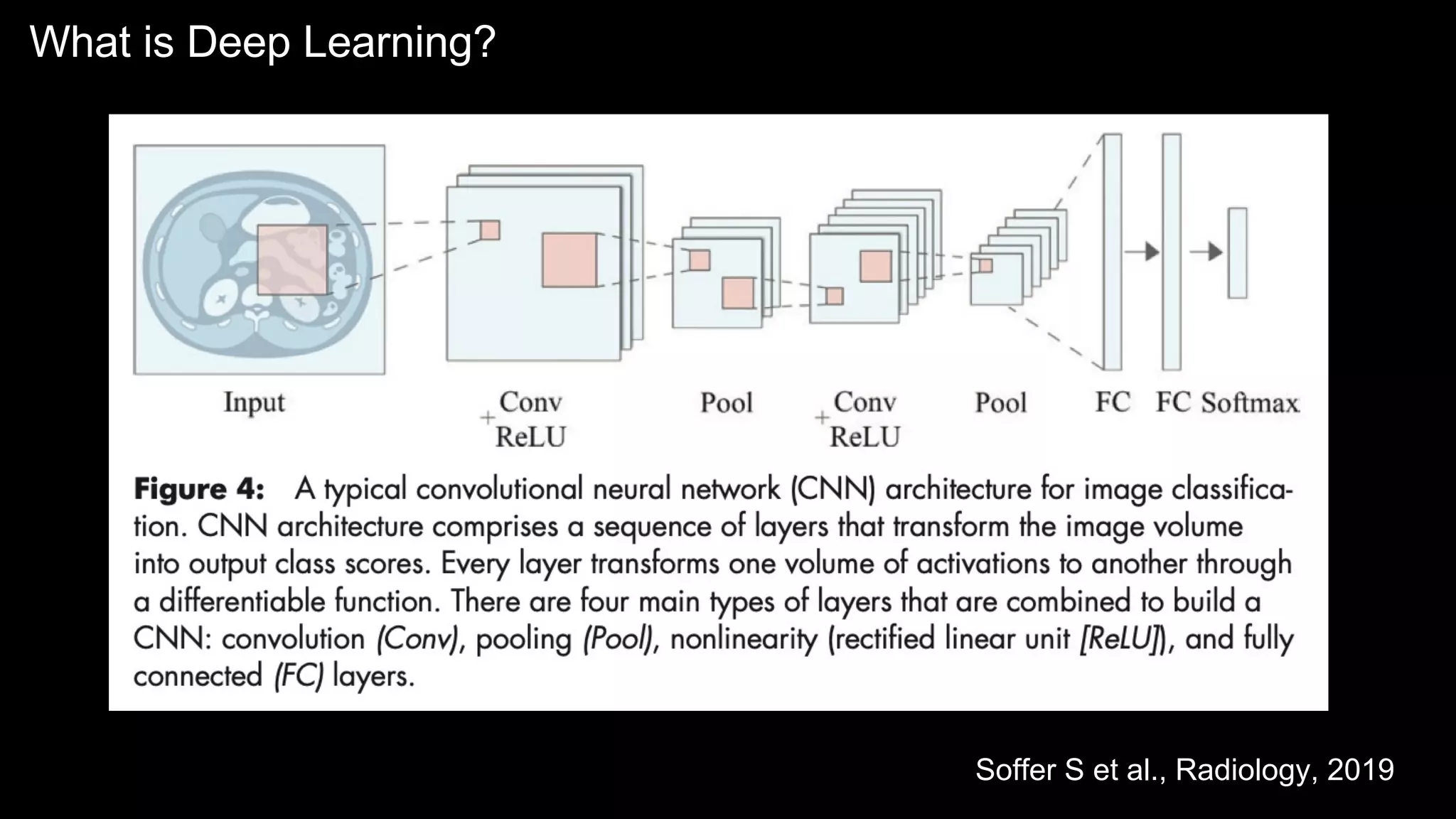
Soffer S et al., Radiology, 2019
What is Deep Learning?
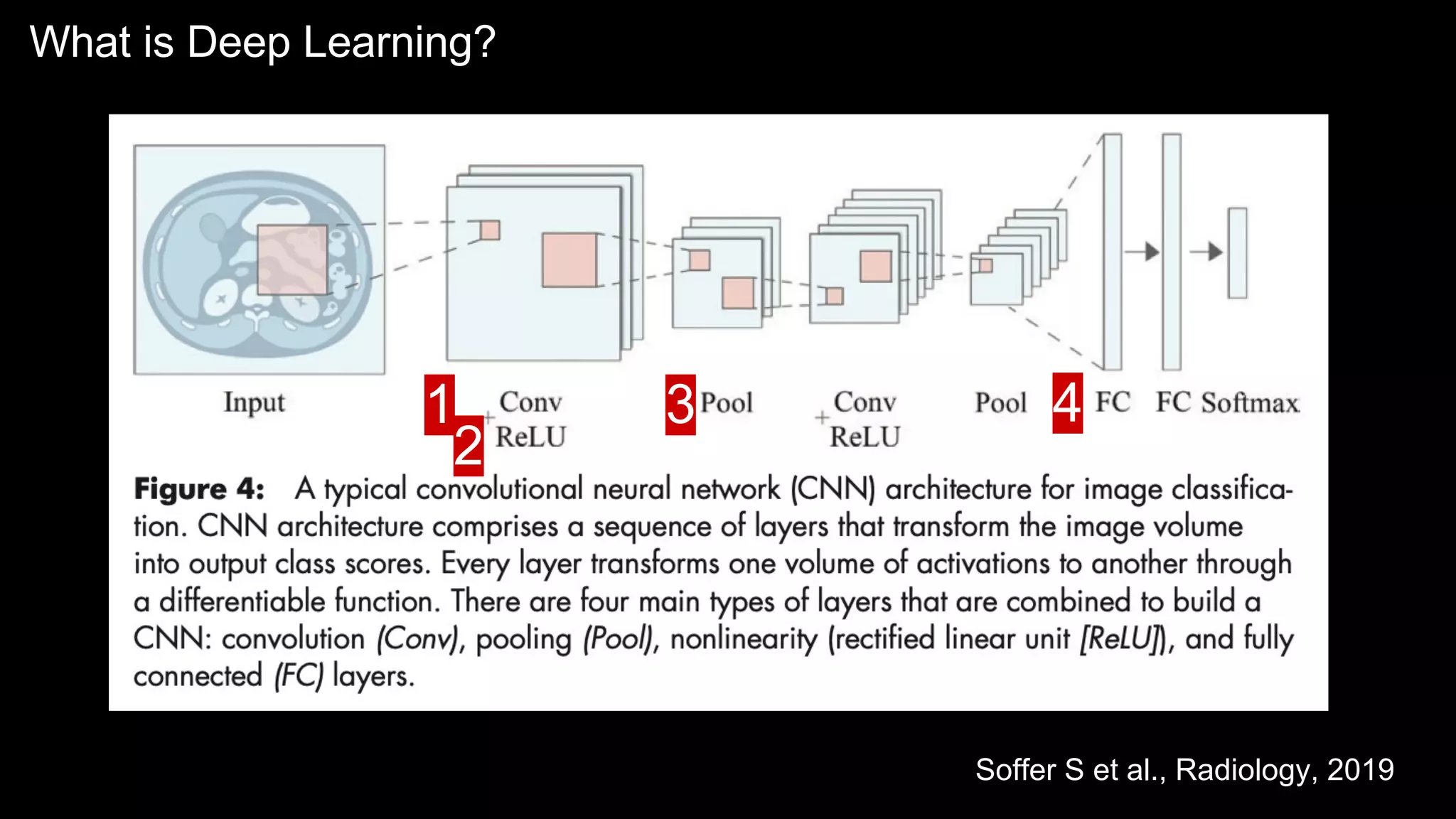
• Layers of a CNN
1. Convolution layer
• Boundaries, edges
• Shape
• Size
2. Activation layer → ReLU (rectified linear unit)
3. Pooling layer
4. Fully connected layer
Erickson BJ et al., RadioGraphics, 2017
Soffer S et al., Radiology, 2019
What is Deep Learning?
1
2
3 4
What is Deep Learning?
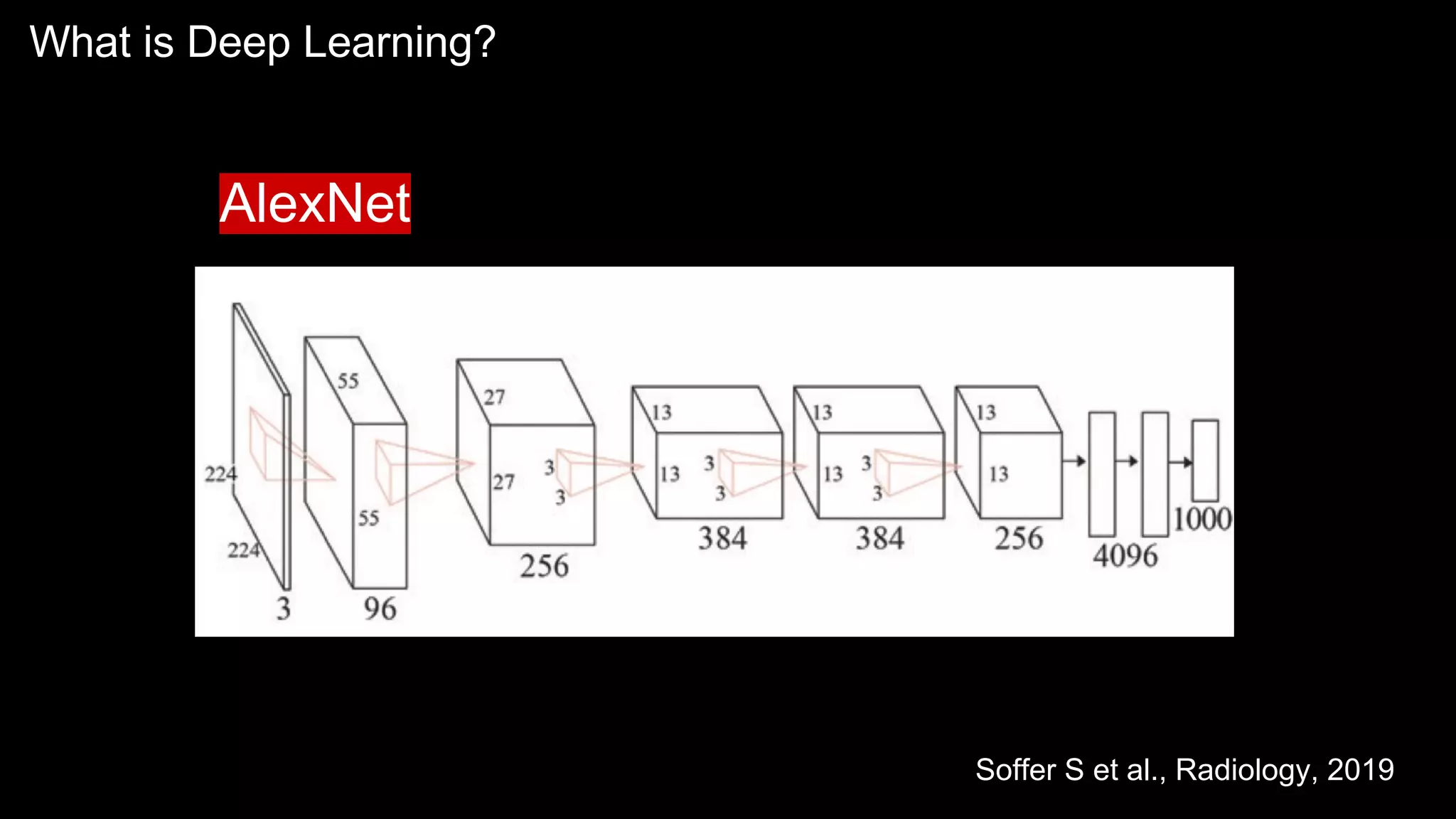
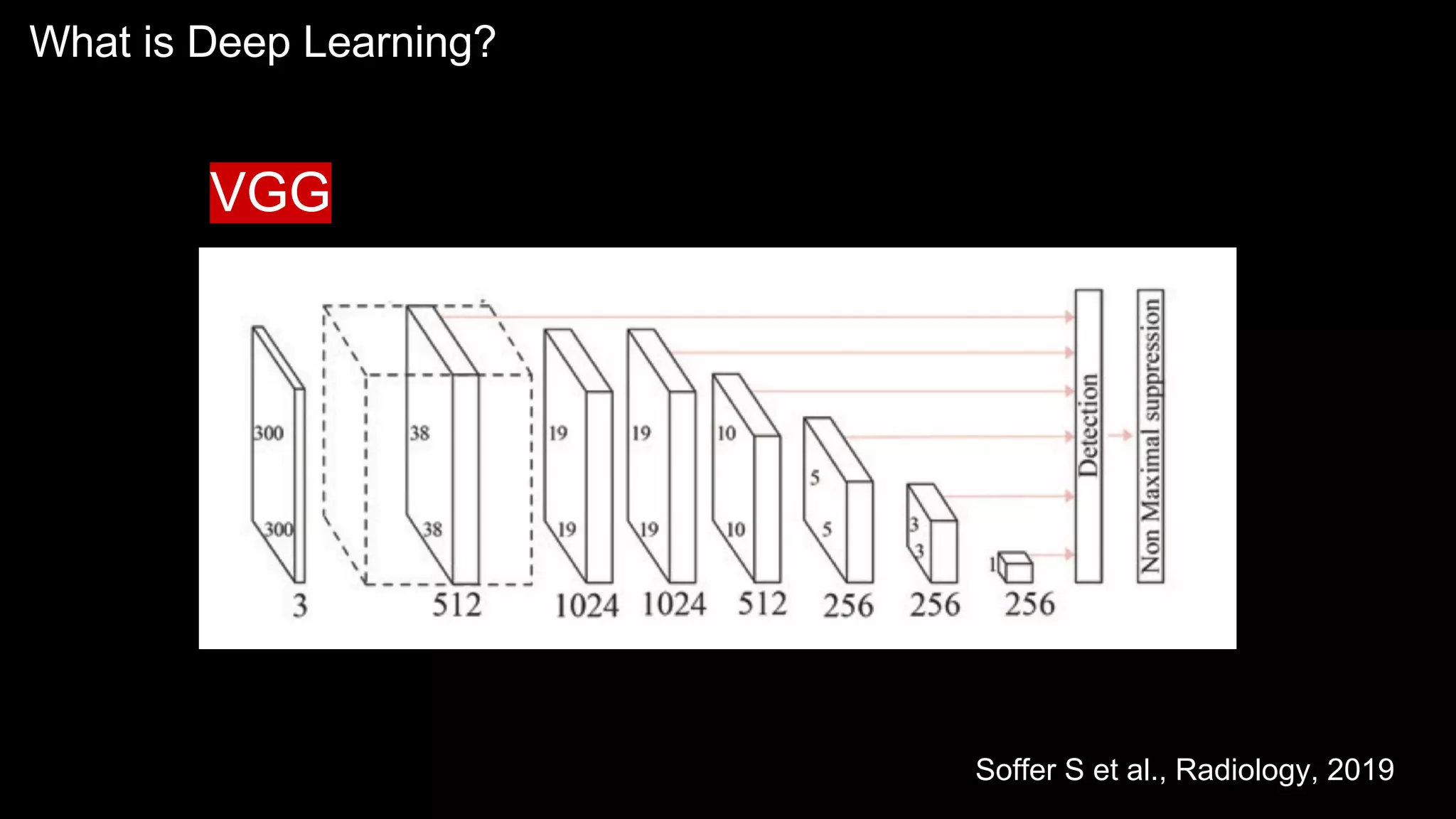
• Architectures → combinations of layers and layer sizes
• LeNet
• ResNet34
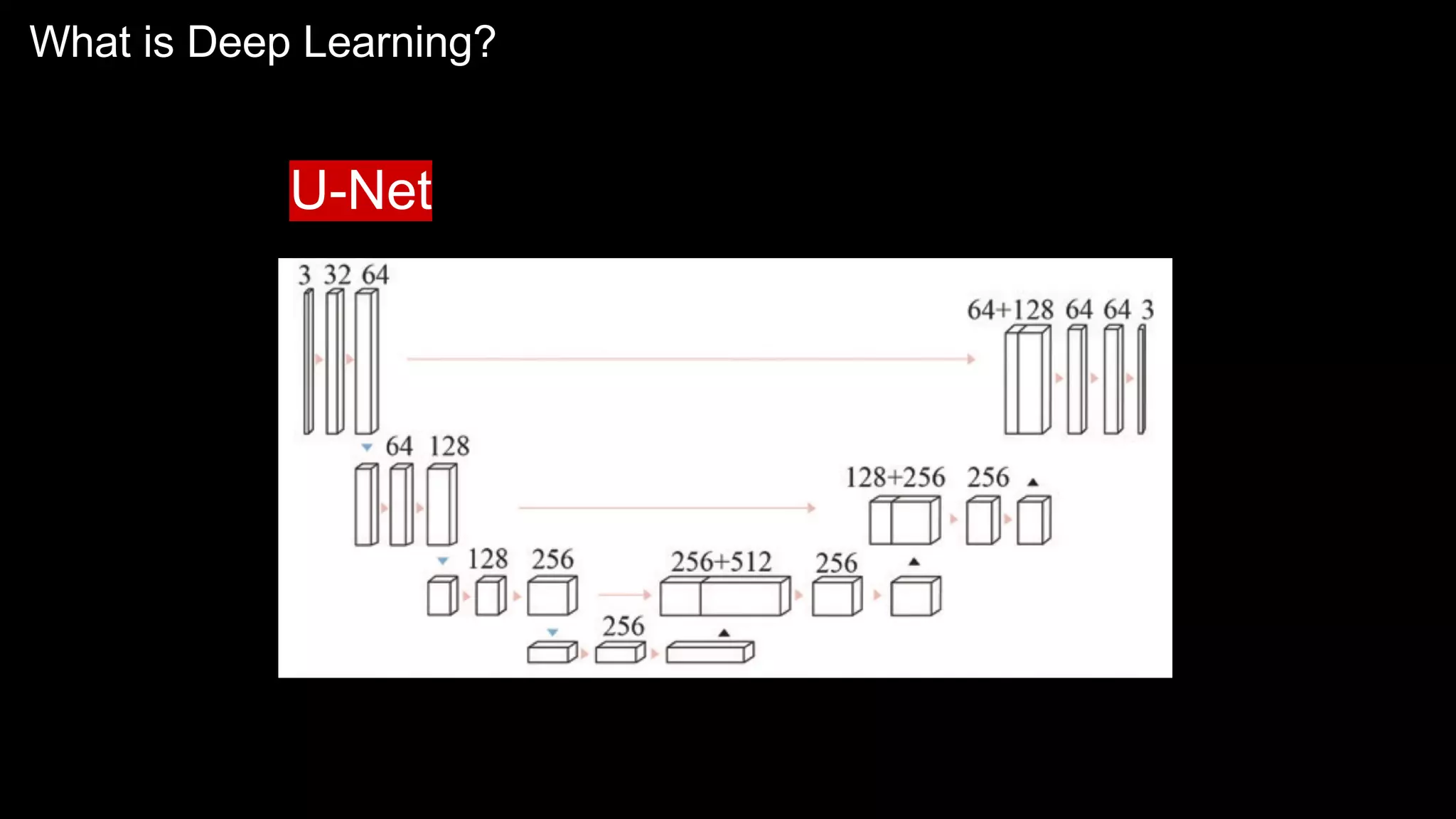
• U-Net
• VGG
• LSTM
• Inception
Soffer S et al., Radiology, 2019
What is Deep Learning?
Soffer S et al., Radiology, 2019
AlexNet
What is Deep Learning?
Soffer S et al., Radiology, 2019
VGG
What is Deep Learning?
U-Net
Clustering
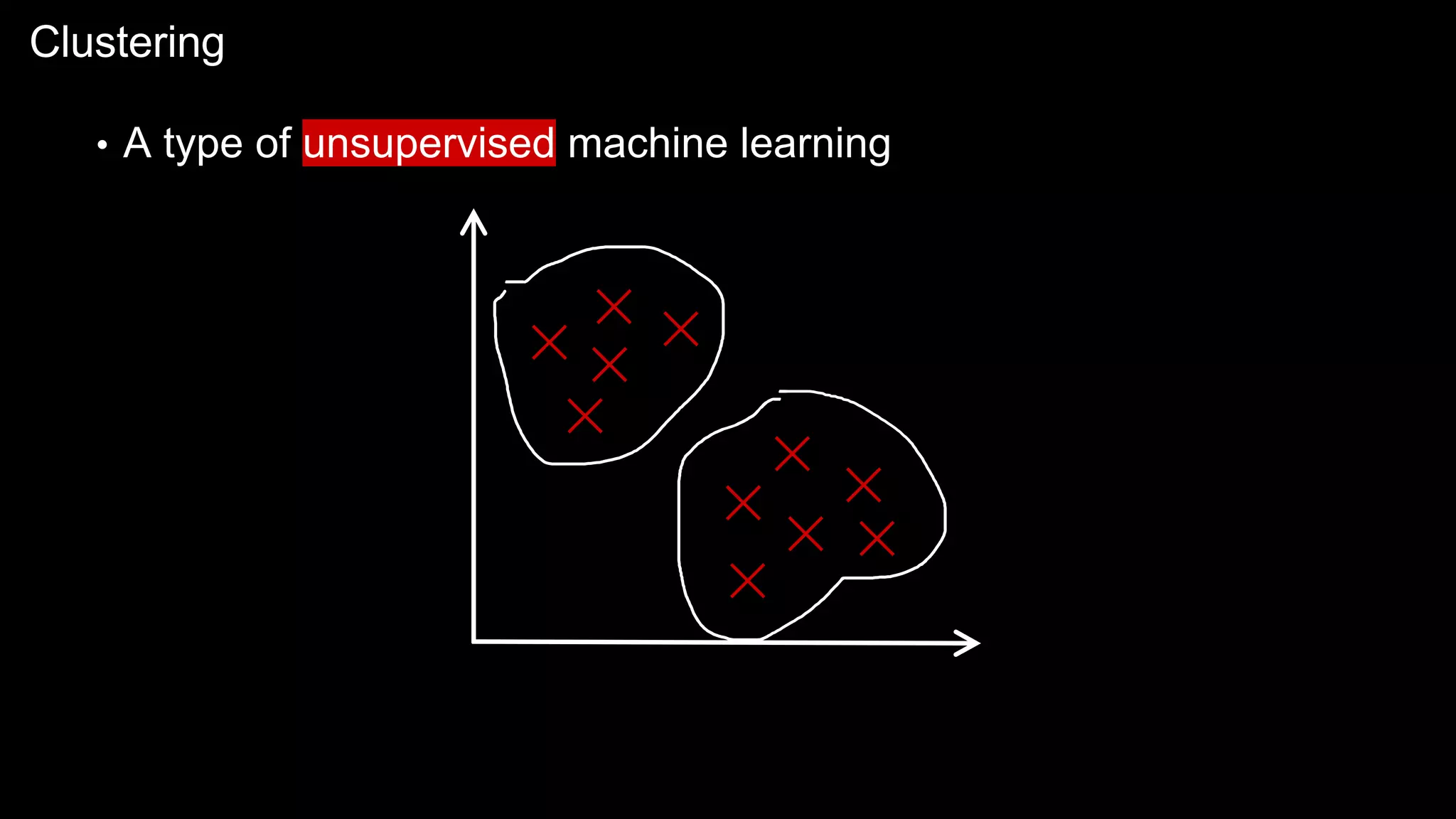
Clustering
• A type of unsupervised machine learning
✕
✕
✕
✕
✕
✕
✕
✕
✕
✕
✕
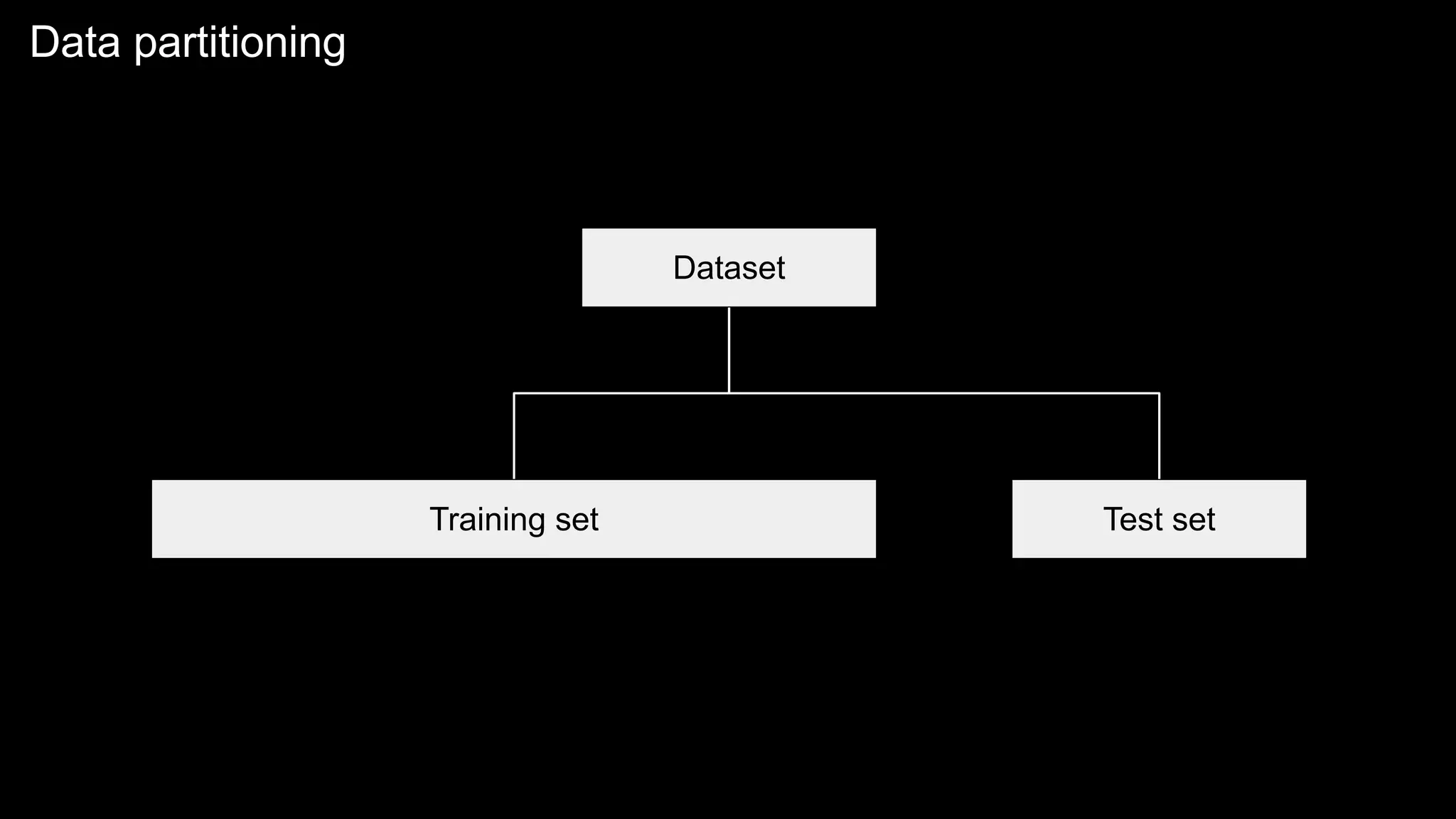
Data partitioning
Data partitioning
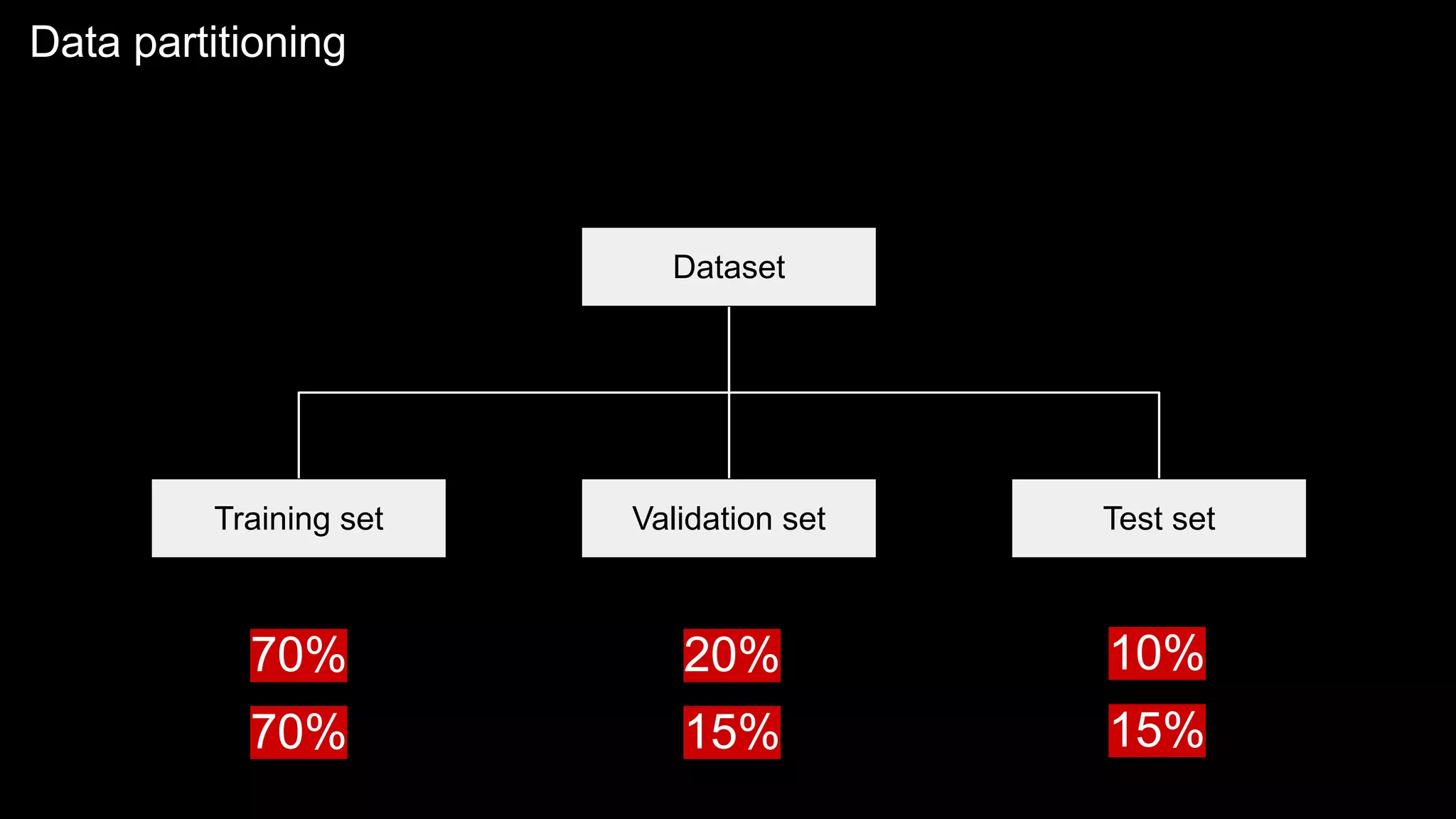
Data partitioning
“tuning set” “hold-out set”
Data partitioning
20%
70% 10%
15%
70% 15%
Small sample size
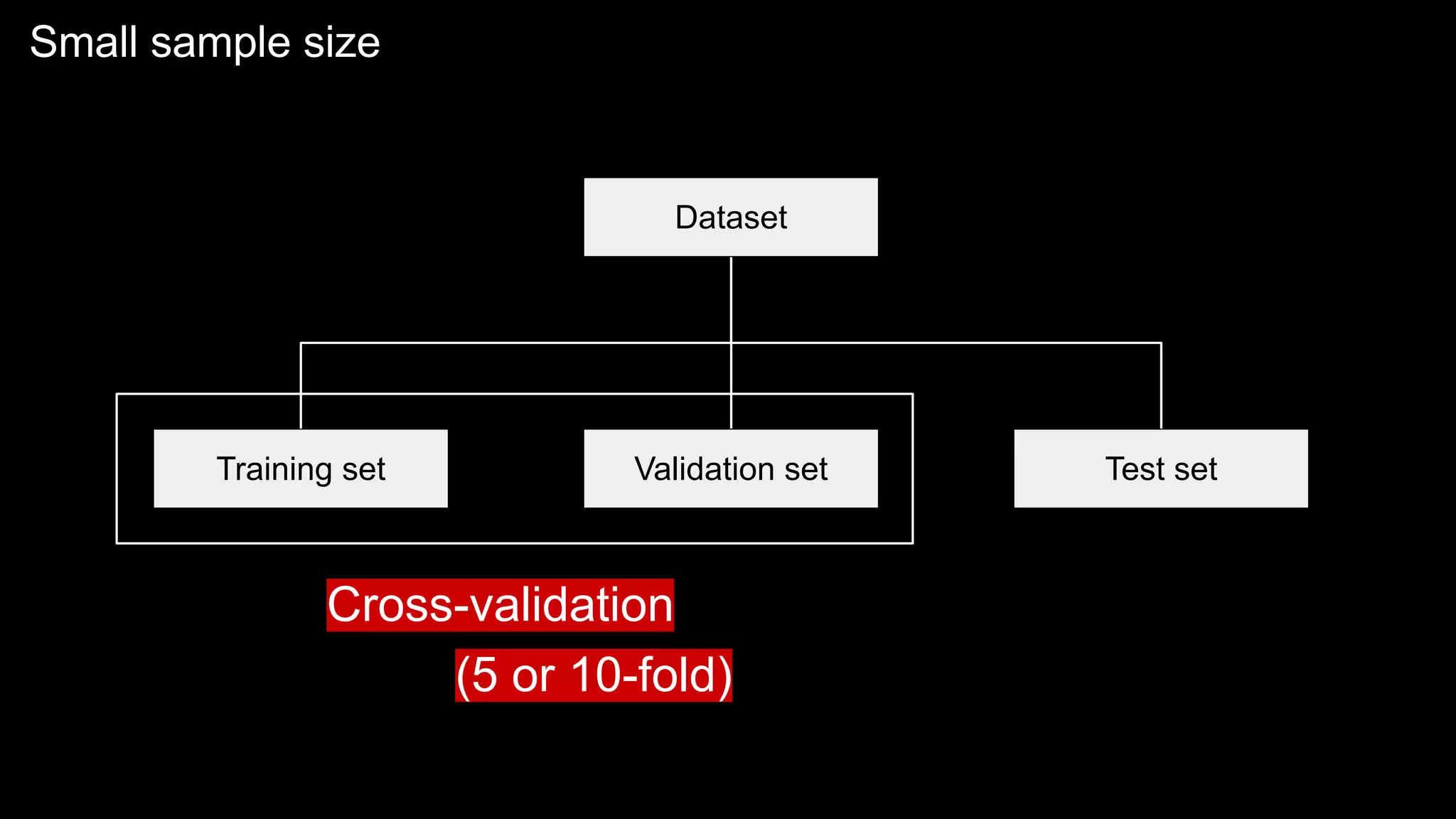
Small sample size
Cross-validation
(5 or 10-fold)
Small sample sizes
• Leave-one-out (LOO) cross validation
• Extreme case
• Remove just one example for testing
• Use all the others for each round of training
• Then classify that example
• Repeat until each sample has been left out
Workflow of a
machine learning project
Workflow of a machine learning project
• Before anything
• Clinically relevant question
• Just like any research
• Define cohort well
• Collect data
• Clean data (90% of time spent)
• Garbage in, garbage out
Workflow of a machine learning project
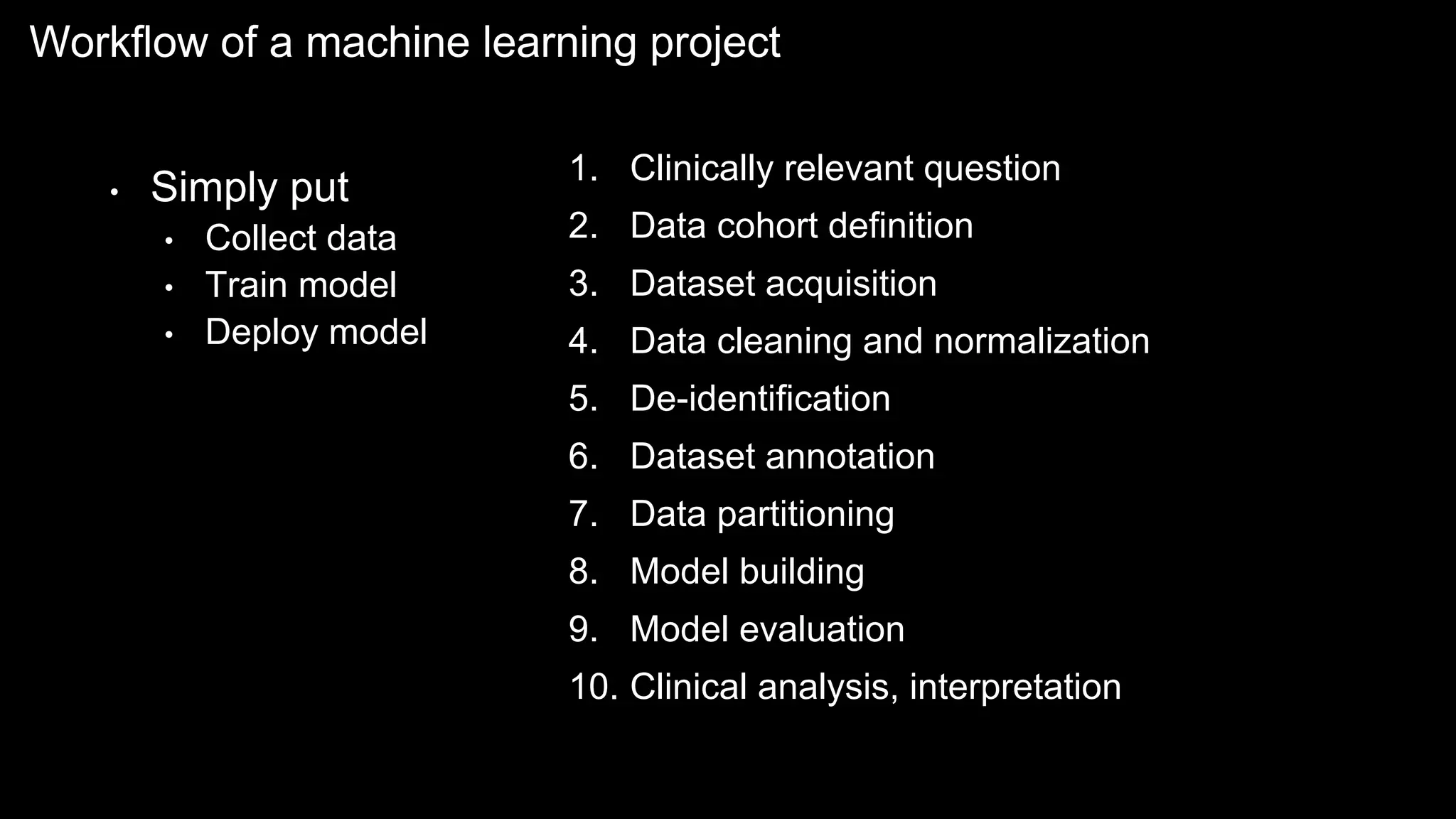
• Simply put
• Collect data
• Train model
• Deploy model
Workflow of a machine learning project
• Simply put
• Collect data
• Train model
• Deploy model
1. Clinically relevant question
2. Data cohort definition
3. Dataset acquisition
4. Data cleaning and normalization
5. De-identification
6. Dataset annotation
7. Data partitioning
8. Model building
9. Model evaluation
10. Clinical analysis, interpretation
Workflow of a machine learning project
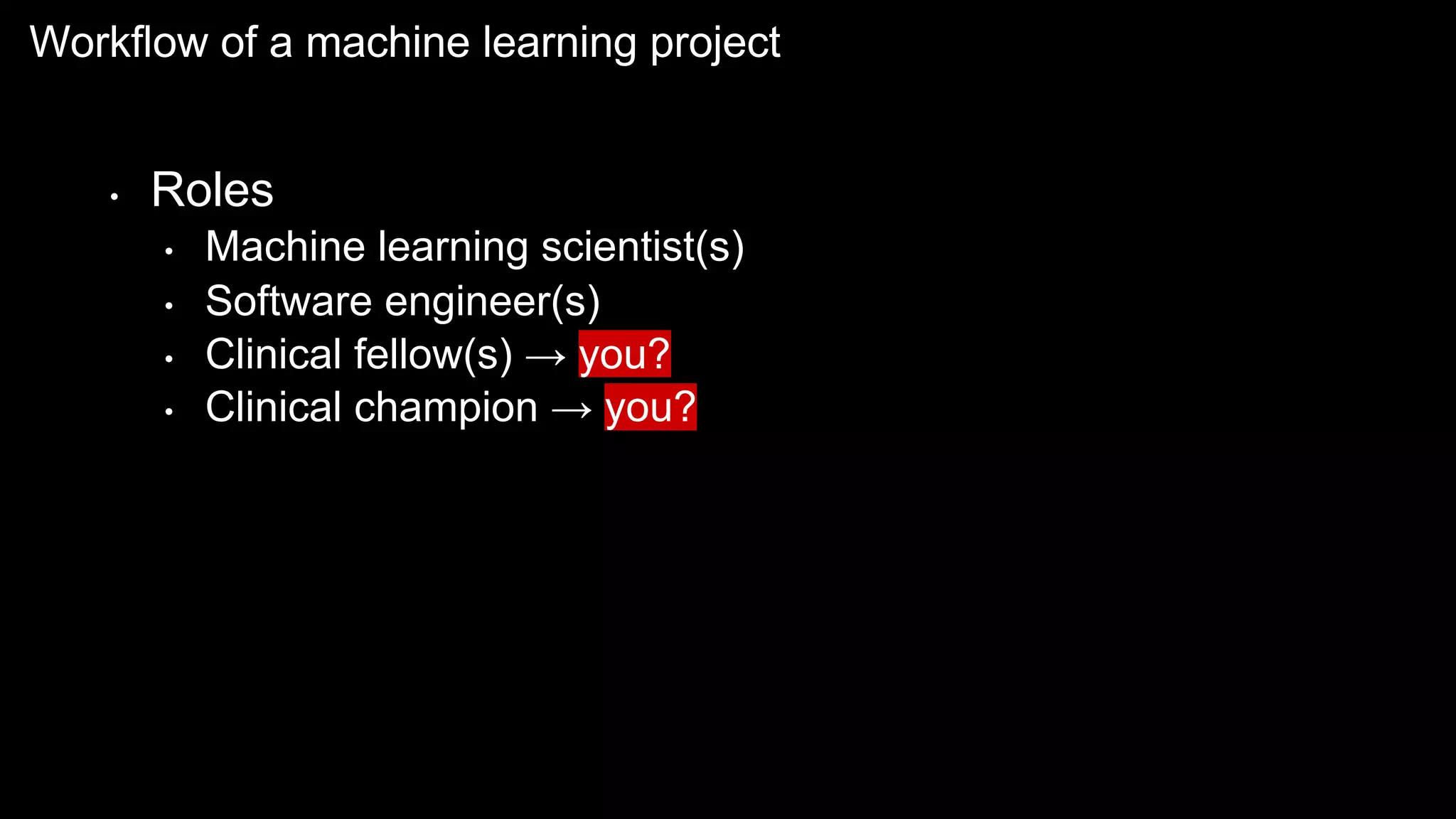
• Roles
• Machine learning scientist(s)
• Software engineer(s)
• Clinical fellow(s) → you?
• Clinical champion → you?
Limitations and challenges of AI
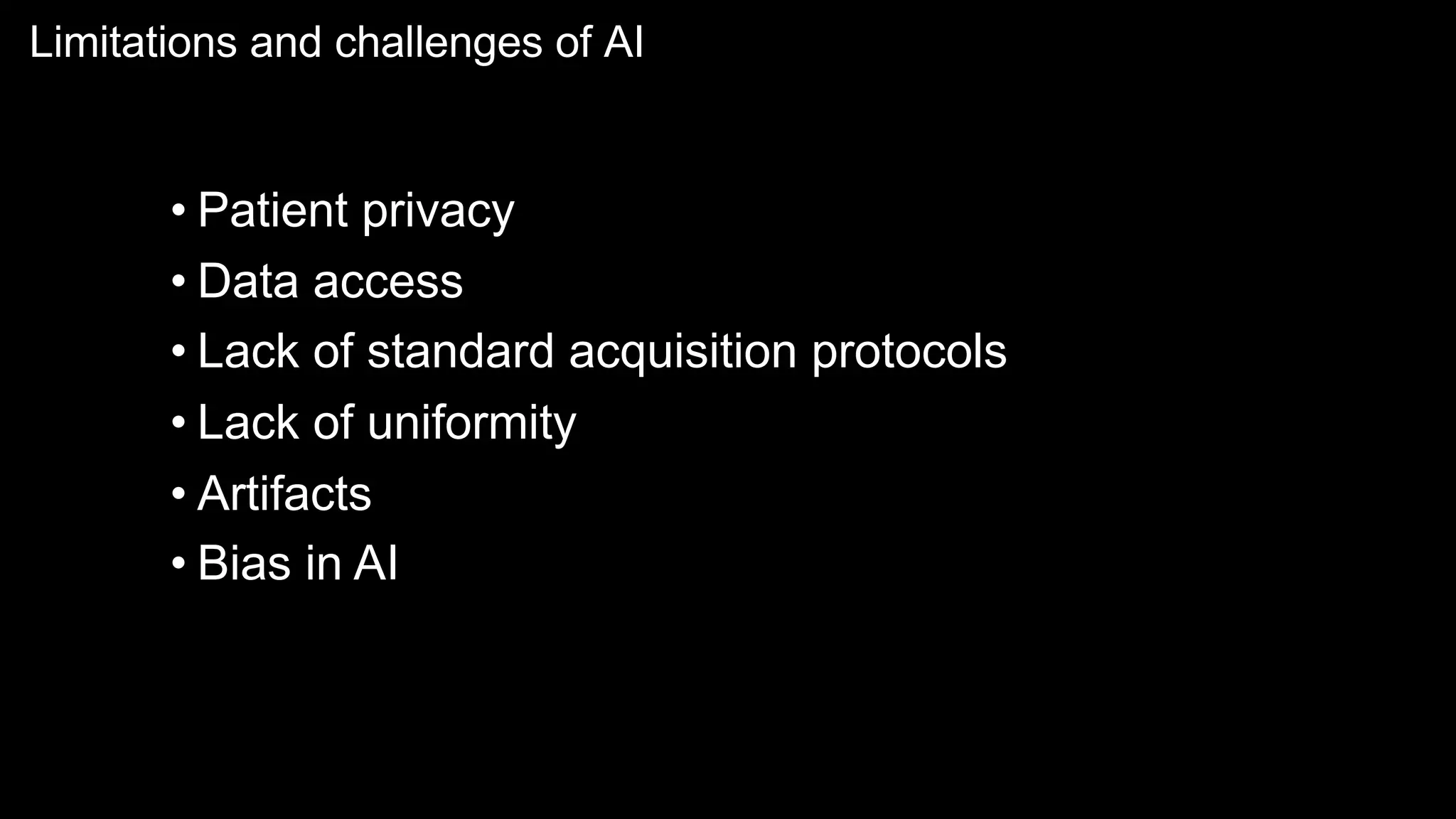
• Patient privacy
• Data access
• Lack of standard acquisition protocols
• Lack of uniformity
• Artifacts
• Bias in AI
Thank you
Relevant references
Relevant references
1. DeepLearning.AI courses: AI For Everyone and AI For Medical
Imaging, by Andrew Ng
2. Artificial Intelligence: Nuts & Bolts of Machine Learning for
Medical Imaging, by Katherine P. Andriole, at the NERRS 2021
3. Allen, Bibb et al. Democratizing AI. Journal of the American
College of Radiology, 2019
4. Erickson, Bradley J et al. Machine Learning for Medical Imaging.
RadioGraphics, 2017
5. Soffer, Shelly et al. Convolutional Neural Networks for
Radiologic Images: A Radiologist’s Guide. Radiology, 2019

The (very) basics of AI for the Radiology resident

  • 1.
    The (very) basicsof AI for the Radiology resident May 25, 2021 Pedro V. Staziaki MD1, Felipe Kitamura, MD2 1. PGY-5 Radiology, Department of Radiology, Boston Medical Center, Boston University School of Medicine 2. Head of Innovation in Diagnostic Operations, Dasa
  • 2.
  • 3.
    Basic resources onCoursera • DeepLearning.AI (Andrew Ng) • AI For Everyone à Very short and basic course • AI For Medicine Specialization • AI For Medical Diagnosis à Intermediate, some coding • Stanford University (Matthew Lungren) • Fundamentals of Machine Learning for Healthcare
  • 4.
    Basic resources • NIIC-RADfrom SIIM and RSNA
  • 5.
  • 6.
    Why know alittle bit about AI?
  • 7.
    Why radiologists needto adapt to a future with AI Allen B et al. JACR. 2019.
  • 8.
    Why radiologists needto adapt to a future with AI 1. Learn the basics of AI for use in clinical practice 2. Evaluate AI algorithms for use in clinical practice 3. Contribute to AI use case development 4. Curate and annotate for AI training and validation 5. Run, adapt and create AI models for local use 6. Collaborate with other institutions to improve models 7. Develop AI models for commercial use Allen B et al. JACR. 2019.
  • 9.
    Why radiologists needto adapt to a future with AI •There is a hunger for • Radiologists who want to get involved with AI • Domain-experts in Radiology • Someone who can say what is clinically relevant • Peer-reviewers for AI research
  • 10.
    Why radiologists needto adapt to a future with AI •Radiologists can • Understand limitations and errors • Collaborate with multidisciplinary team • Critical appraisal of the literature • Evaluate AI products • Move Radiology forward
  • 11.
  • 12.
    What is AI? •Confusingterms •Artificial Intelligence ? •Machine Learning ? •Deep Learning ? •Neural Networks ? •Big Data ? •Data Science ?
  • 13.
    What is AI? AI Machinelearning Deep Learning • Artificial Intelligence • A technique which enables machines to mimic human behavior • Machine learning • Subset using statistical methods • Deep learning • Subset making computation with multi- layer neural networks
  • 14.
    What is AI? •BigData → there is an excess of data! Amount of data Time
  • 15.
    What is AI? •BigData → ↑ in data, 6 Vs •↑ volume •↑ variety •↑ velocity •↑ veracity •↑ value •↑ variability
  • 16.
    What is AI? WhyAI now? Amount of data Time Computing power
  • 17.
    What is AI? WhyAI now? GPU
  • 18.
    What is AI? WhyAI now? GPU
  • 20.
    What is AI? Performance Amountof data Traditional AI Small neural networks Large neural networks Why AI now?
  • 21.
    What is AI? •DataScience • Data analytics • Data mining • Data security • Data management • Data visualization • Statistical analysis
  • 22.
    What is AI? •DataScience • Examine the data and provide insights • Optimize sales • Find correlations •Machine learning • Make predictions • Classify things automatically
  • 23.
    What is AI? AI Machinelearning Deep Learning • Artificial Intelligence • A technique which enables machines to mimic human behavior • Machine learning • Subset using statistical methods • Deep learning • Subset making computation with multi- layer neural networks
  • 24.
  • 25.
    What is AI? •Applicationsof AI •Improve work-flow and work life •Improve quality and safety •Decrease health care errors •Accelerate medical discoveries
  • 26.
    What is machinelearning?
  • 27.
    • ML isthe study of computer algorithms that improve automatically with experience and data • Developed based a training data set • Makes predictions without being explicitly programmed to do so • Supervised learning • Labeled data: groups “normal” and “pneumonia” • Unsupervised learning • Automatically finds groups “normal” and “pneumonia” What is machine learning? Erickson BJ et al., RadioGraphics, 2017
  • 28.
    What is machinelearning? • Examples • Support Vector Machine (SVM) → Supervised Learning • Decision trees → Supervised Learning • Deep Learning (CNN) → Supervised Learning • Clustering → Unsupervised Learning
  • 29.
  • 30.
    What is SupportVector Machine (SVM) ✕ ✕ ✕ ✕ ✕ ✕ ✕ ✕ ✕ ✕ ✕ ✕ ✕ ✕ ✕ ✕ * Optimal hyperplane *
  • 31.
    What is SupportVector Machine (SVM) • A type of supervised machine learning • Input data → map into a parameter space • Using a plane (called a support vector) • Looking for a greater separation
  • 32.
    What is SupportVector Machine (SVM) ✕ ✕ ✕ ✕ ✕ ✕ ✕ ✕ ✕ ✕ ✕ ✕ ✕ ✕ ✕ ✕ Which line separates better?
  • 33.
    What is SupportVector Machine (SVM) ✕ ✕ ✕ ✕ ✕ ✕ ✕ ✕ ✕ ✕ ✕ ✕ ✕ ✕ ✕ ✕ This one!
  • 34.
    What is SupportVector Machine (SVM) ✕ ✕ ✕ ✕ ✕ ✕ ✕ ✕ This one! How to make model find the BEST line?
  • 35.
    What is SupportVector Machine (SVM) ✕ ✕ ✕ ✕ ✕ ✕ ✕ ✕ ✕ ✕ ✕ ✕ ✕ ✕ ✕ ✕ Train model to find two parallel lines that are as far away as possible
  • 36.
    What is SupportVector Machine (SVM) • Step 1: Start with a random line, and two equidistant parallel to it • Step 2: Pick a large number of repetitions, the epochs (1000) • Step 3: Pick a number close to 1, the expanding factor (0.99) • Step 4: Repeat 1000 times • Pick random point • If correct → do nothing; If incorrect → move line towards the point • Separate the lines using the expanding factor • Step 5: Boom! You have the line that best separates the data
  • 37.
    What is SupportVector Machine (SVM) • New functions that can map points to other dimensions with nonlinear relationships → Classify examples not linearly separable
  • 38.
    What is adecision tree?
  • 39.
    What is adecision tree? ✕
  • 40.
    What is adecision tree? • A type of supervised machine learning • Produce human-readable rules for classification • Intuitive, explainable • Searches the many possible combinations of decision points to find the points that will result in the simplest tree with the most accurate results • But does not generalize well in the real world
  • 41.
    What is adecision tree? • Give an input • Looks for which feature has the most right and wrong answers • Stops splitting when, e.g., < 10 samples
  • 42.
    What is adecision tree? • Ensemble methods • Boosting and random forest • Improve accuracy • More than one decision tree is constructed
  • 43.
    What is adecision tree? • Boosted forest • Multiple decision trees by repeatedly resampling the training data by means of replacement, and voting on the trees to reach a consensus prediction • All features are considered • Random forest → No data resampling • Only a subset of the total number of features is randomly selected • Only uses the best split feature from the subset • More generalizable
  • 44.
    What is DeepLearning?
  • 45.
    What is DeepLearning?
  • 46.
    What is DeepLearning? Input layer
  • 47.
    What is DeepLearning? Hidden layer 1
  • 48.
    What is DeepLearning? Hidden layer 2
  • 49.
    What is DeepLearning? Output layer
  • 50.
    What is DeepLearning? Nodes ~ cell body Links ~ axons Neural network
  • 51.
    What is DeepLearning? Features 4, 5 Label 1 Try to output as close as possible to an output of 1
  • 52.
    What is DeepLearning? Features 4, 5 Label 1 0.2 What I got (probability)
  • 53.
    What is DeepLearning? Features 4, 5 Label 1 0.2 What I got (probability) What I wanted (label) 1
  • 54.
    What is DeepLearning? Features 4, 5 Label 1 0.2 What I got (probability) What I wanted (label) 1 Task ↑ 0.2 Hey, NN, you task is to increase the 0.2 when I give you the features 4 and 5 as input
  • 55.
    What is DeepLearning? Features 4, 5 Label 1 0.2 What I got (probability) What I wanted (label) 1 Task ↑ 0.2 Gradient ascent ↑ ln(0.2)
  • 56.
    What is DeepLearning? Features 4, 5 Label 1 0.2 What I got (probability) What I wanted (label) 1 Task ↑ 0.2 ↑ ln(0.2) W → W + (learning rate)(derivative) Gradient ascent
  • 57.
    What is DeepLearning? • A type of supervised machine learning • Multi-layered neural networks (aka deep neural networks) • Deep → many layers (> 20), often > 100 • Does not require image feature identification as a first step • Features are identified as part of the learning process • Needs all the computing power from video game GPUs • NVidia Corporation Erickson BJ et al., RadioGraphics, 2017
  • 58.
    What is DeepLearning? • Uses Soffer S et al., Radiology, 2019 Classification Detection Segmentation
  • 59.
    What is DeepLearning? • Convolutional neural networks (CNN) • Main subtype of NN • Assumes that inputs have a geometric relationship • Like the rows and columns of pixels • Input layer → convolution of a small image • Convolutions → filters extract edges or boundaries in matrices Erickson BJ et al., RadioGraphics, 2017
  • 60.
  • 61.
    Soffer S etal., Radiology, 2019 What is Deep Learning?
  • 63.
    What is DeepLearning? • Layers of a CNN 1. Convolution layer • Boundaries, edges • Shape • Size 2. Activation layer → ReLU (rectified linear unit) 3. Pooling layer 4. Fully connected layer Erickson BJ et al., RadioGraphics, 2017
  • 64.
    Soffer S etal., Radiology, 2019 What is Deep Learning? 1 2 3 4
  • 65.
    What is DeepLearning? • Architectures → combinations of layers and layer sizes • LeNet • ResNet34 • U-Net • VGG • LSTM • Inception Soffer S et al., Radiology, 2019
  • 66.
    What is DeepLearning? Soffer S et al., Radiology, 2019 AlexNet
  • 67.
    What is DeepLearning? Soffer S et al., Radiology, 2019 VGG
  • 68.
    What is DeepLearning? U-Net
  • 69.
  • 70.
    Clustering • A typeof unsupervised machine learning ✕ ✕ ✕ ✕ ✕ ✕ ✕ ✕ ✕ ✕ ✕
  • 71.
  • 72.
  • 73.
  • 74.
  • 75.
  • 76.
  • 77.
    Small sample sizes •Leave-one-out (LOO) cross validation • Extreme case • Remove just one example for testing • Use all the others for each round of training • Then classify that example • Repeat until each sample has been left out
  • 78.
    Workflow of a machinelearning project
  • 79.
    Workflow of amachine learning project • Before anything • Clinically relevant question • Just like any research • Define cohort well • Collect data • Clean data (90% of time spent) • Garbage in, garbage out
  • 80.
    Workflow of amachine learning project • Simply put • Collect data • Train model • Deploy model
  • 81.
    Workflow of amachine learning project • Simply put • Collect data • Train model • Deploy model 1. Clinically relevant question 2. Data cohort definition 3. Dataset acquisition 4. Data cleaning and normalization 5. De-identification 6. Dataset annotation 7. Data partitioning 8. Model building 9. Model evaluation 10. Clinical analysis, interpretation
  • 82.
    Workflow of amachine learning project • Roles • Machine learning scientist(s) • Software engineer(s) • Clinical fellow(s) → you? • Clinical champion → you?
  • 83.
  • 84.
    Limitations and challengesof AI • Patient privacy • Data access • Lack of standard acquisition protocols • Lack of uniformity • Artifacts • Bias in AI
  • 85.
  • 86.
  • 87.
    Relevant references 1. DeepLearning.AIcourses: AI For Everyone and AI For Medical Imaging, by Andrew Ng 2. Artificial Intelligence: Nuts & Bolts of Machine Learning for Medical Imaging, by Katherine P. Andriole, at the NERRS 2021 3. Allen, Bibb et al. Democratizing AI. Journal of the American College of Radiology, 2019 4. Erickson, Bradley J et al. Machine Learning for Medical Imaging. RadioGraphics, 2017 5. Soffer, Shelly et al. Convolutional Neural Networks for Radiologic Images: A Radiologist’s Guide. Radiology, 2019