Published on Agriculture Finance Support Facility (https://agrifinfacility.org/)
Source URL: https://agrifinfacility.org/us-federal-crop-insurance-program
The U.S. Federal Crop Insurance Program © 2014 Agriculture
Finance Support Facility (AgriFin)
AgriFin (March 2013) | This article was contributed by James Callan, Founder
& CEO of James Callan Associates, LLC and a Partner in NorthStar Policy
Navigation, LLC. Mr. Callan also gives talks on U.S. federal crop insurance
and farm policy. For additional information, please contact the author at:
jamescallan@msn.com [2].
The United States federal crop insurance program has become the number one
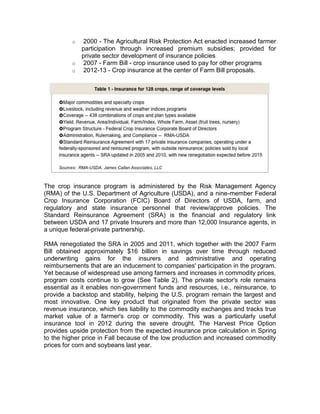
risk management tool for American farmers. The amount of coverage and crops is
significant—some 128 crops in a range of coverage levels, with more than 80
percent coverage of planted acreage for the top ten crops (See Table 1). The
program's beginnings were more humble. During the Great Depression and Dust
Bowl era, President Franklin Roosevelt signed into law the Agricultural Adjustment
Act of 1938:
The purpose of the Agricultural Adjustment Act was to promote the national
welfare by improving the economic stability of agriculture through a sound
system of crop insurance and providing the means for research and
experience helpful in devising and establishing such insurance.
Subsequently renewed key legislation in the history of U.S. federal crop
insurance:
o 1980 - Public-private partnership established
o 2000 - The Agricultural Risk Protection Act enacted increased farmer
participation through increased premium subsidies; provided for
private sector development of insurance policies
o 2007 - Farm Bill - crop insurance used to pay for other programs
o 2012-13 - Crop insurance at the center of Farm Bill proposals.
The crop insurance program is administered by the Risk Management Agency
(RMA) of the U.S. Department of Agriculture (USDA), and a nine-member Federal
Crop Insurance Corporation (FCIC) Board of Directors of USDA, farm, and
regulatory and state insurance personnel that review/approve policies. The
Standard Reinsurance Agreement (SRA) is the financial and regulatory link
between USDA and 17 private Insurers and more than 12,000 Insurance agents, in
a unique federal-private partnership.
RMA renegotiated the SRA in 2005 and 2011, which together with the 2007 Farm
Bill obtained approximately $16 billion in savings over time through reduced
underwriting gains for the insurers and administrative and operating
reimbursements that are an inducement to companies' participation in the program.
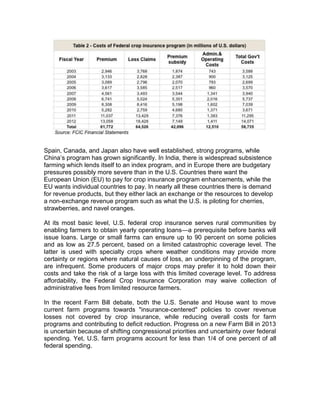
Yet because of widespread use among farmers and increases in commodity prices,
program costs continue to grow (See Table 2). The private sector's role remains
essential as it enables non-government funds and resources, i.e., reinsurance, to
provide a backstop and stability, helping the U.S. program remain the largest and
most innovative. One key product that originated from the private sector was
revenue insurance, which ties liability to the commodity exchanges and tracks true
market value of a farmer's crop or commodity. This was a particularly useful
insurance tool in 2012 during the severe drought. The Harvest Price Option
provides upside protection from the expected insurance price calculation in Spring
to the higher price in Fall because of the low production and increased commodity
prices for corn and soybeans last year.
Spain, Canada, and Japan also have well established, strong programs, while
China’s program has grown significantly. In India, there is widespread subsistence
farming which lends itself to an index program, and in Europe there are budgetary
pressures possibly more severe than in the U.S. Countries there want the
European Union (EU) to pay for crop insurance program enhancements, while the
EU wants individual countries to pay. In nearly all these countries there is demand
for revenue products, but they either lack an exchange or the resources to develop
a non-exchange revenue program such as what the U.S. is piloting for cherries,
strawberries, and navel oranges.
At its most basic level, U.S. federal crop insurance serves rural communities by
enabling farmers to obtain yearly operating loans—a prerequisite before banks will
issue loans. Large or small farms can ensure up to 90 percent on some policies
and as low as 27.5 percent, based on a limited catastrophic coverage level. The
latter is used with specialty crops where weather conditions may provide more
certainty or regions where natural causes of loss, an underpinning of the program,
are infrequent. Some producers of major crops may prefer it to hold down their
costs and take the risk of a large loss with this limited coverage level. To address
affordability, the Federal Crop Insurance Corporation may waive collection of
administrative fees from limited resource farmers.
In the recent Farm Bill debate, both the U.S. Senate and House want to move
current farm programs towards "insurance-centered" policies to cover revenue
losses not covered by crop insurance, while reducing overall costs for farm
programs and contributing to deficit reduction. Progress on a new Farm Bill in 2013
is uncertain because of shifting congressional priorities and uncertainty over federal
spending. Yet, U.S. farm programs account for less than 1/4 of one percent of all
federal spending.

The U_S_ Federal Crop Insurance Program

  • 1.
    Published on AgricultureFinance Support Facility (https://agrifinfacility.org/) Source URL: https://agrifinfacility.org/us-federal-crop-insurance-program The U.S. Federal Crop Insurance Program © 2014 Agriculture Finance Support Facility (AgriFin) AgriFin (March 2013) | This article was contributed by James Callan, Founder & CEO of James Callan Associates, LLC and a Partner in NorthStar Policy Navigation, LLC. Mr. Callan also gives talks on U.S. federal crop insurance and farm policy. For additional information, please contact the author at: jamescallan@msn.com [2]. The United States federal crop insurance program has become the number one risk management tool for American farmers. The amount of coverage and crops is significant—some 128 crops in a range of coverage levels, with more than 80 percent coverage of planted acreage for the top ten crops (See Table 1). The program's beginnings were more humble. During the Great Depression and Dust Bowl era, President Franklin Roosevelt signed into law the Agricultural Adjustment Act of 1938: The purpose of the Agricultural Adjustment Act was to promote the national welfare by improving the economic stability of agriculture through a sound system of crop insurance and providing the means for research and experience helpful in devising and establishing such insurance. Subsequently renewed key legislation in the history of U.S. federal crop insurance: o 1980 - Public-private partnership established
  • 2.
    o 2000 -The Agricultural Risk Protection Act enacted increased farmer participation through increased premium subsidies; provided for private sector development of insurance policies o 2007 - Farm Bill - crop insurance used to pay for other programs o 2012-13 - Crop insurance at the center of Farm Bill proposals. The crop insurance program is administered by the Risk Management Agency (RMA) of the U.S. Department of Agriculture (USDA), and a nine-member Federal Crop Insurance Corporation (FCIC) Board of Directors of USDA, farm, and regulatory and state insurance personnel that review/approve policies. The Standard Reinsurance Agreement (SRA) is the financial and regulatory link between USDA and 17 private Insurers and more than 12,000 Insurance agents, in a unique federal-private partnership. RMA renegotiated the SRA in 2005 and 2011, which together with the 2007 Farm Bill obtained approximately $16 billion in savings over time through reduced underwriting gains for the insurers and administrative and operating reimbursements that are an inducement to companies' participation in the program. Yet because of widespread use among farmers and increases in commodity prices, program costs continue to grow (See Table 2). The private sector's role remains essential as it enables non-government funds and resources, i.e., reinsurance, to provide a backstop and stability, helping the U.S. program remain the largest and most innovative. One key product that originated from the private sector was revenue insurance, which ties liability to the commodity exchanges and tracks true market value of a farmer's crop or commodity. This was a particularly useful insurance tool in 2012 during the severe drought. The Harvest Price Option provides upside protection from the expected insurance price calculation in Spring to the higher price in Fall because of the low production and increased commodity prices for corn and soybeans last year.
  • 3.
    Spain, Canada, andJapan also have well established, strong programs, while China’s program has grown significantly. In India, there is widespread subsistence farming which lends itself to an index program, and in Europe there are budgetary pressures possibly more severe than in the U.S. Countries there want the European Union (EU) to pay for crop insurance program enhancements, while the EU wants individual countries to pay. In nearly all these countries there is demand for revenue products, but they either lack an exchange or the resources to develop a non-exchange revenue program such as what the U.S. is piloting for cherries, strawberries, and navel oranges. At its most basic level, U.S. federal crop insurance serves rural communities by enabling farmers to obtain yearly operating loans—a prerequisite before banks will issue loans. Large or small farms can ensure up to 90 percent on some policies and as low as 27.5 percent, based on a limited catastrophic coverage level. The latter is used with specialty crops where weather conditions may provide more certainty or regions where natural causes of loss, an underpinning of the program, are infrequent. Some producers of major crops may prefer it to hold down their costs and take the risk of a large loss with this limited coverage level. To address affordability, the Federal Crop Insurance Corporation may waive collection of administrative fees from limited resource farmers. In the recent Farm Bill debate, both the U.S. Senate and House want to move current farm programs towards "insurance-centered" policies to cover revenue losses not covered by crop insurance, while reducing overall costs for farm programs and contributing to deficit reduction. Progress on a new Farm Bill in 2013 is uncertain because of shifting congressional priorities and uncertainty over federal spending. Yet, U.S. farm programs account for less than 1/4 of one percent of all federal spending.