Briefing on Alabama Medicaid R. Bob Mullins, Jr. MD  Commissioner  Alabama Medicaid Agency November 2011
Today’s Top Issues The number of AL citizens on Medicaid is growing. Average monthly enrollment increased 33 percent between 2001 and 2010.  Medicaid will consume about 35 percent of the FY 2012 General Fund budget. If current trends continue, Medicaid would require 92 percent of the General Fund in FY 2020 . Medicaid plays an essential role in the state’s economy by funding jobs, generating income and state tax revenues and by providing health care services for  all  citizens.
Economic Impact of Alabama Medicaid Direct Impact 96,235 Jobs Directly Supported $203,975,720 State Sales Tax $214,174,506 State Income Tax Secondary Impact 47,155 Jobs $3,161,623,660 in Additional Supported Income $83,630,046 State Sales Tax $87,811,548 State Income Tax (Due to employee and business spending)
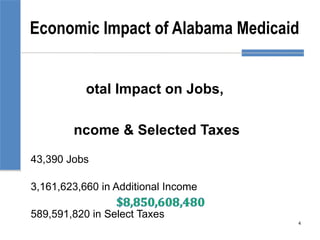
Economic Impact of Alabama Medicaid Total Impact on Jobs,  Income & Selected Taxes 143,390 Jobs $3,161,623,660 in Additional Income $589,591,820 in Select Taxes Total Monetary Impact in Alabama:
Today’s Top Issues Updated technology is essential: To manage expanded enrollment if health care reform is implemented To develop the infrastructure for the exchange electronic health record information To build the infrastructure to support the state health insurance exchange More primary health care providers are needed 1,000 more needed if health care reform is implemented
Health Benefits / Information Exchanges Alabama is one of 10 states chosen by Robert Wood Johnson Foundation for expert technical assistance to develop Benefits Exchange and related projects, including Level 1 Funding application for federal funds Medicaid developing Customer Service Centers throughout state that will ultimately serve as enrollment centers for the Benefits Exchange
Medicaid  Recipients FY 2010
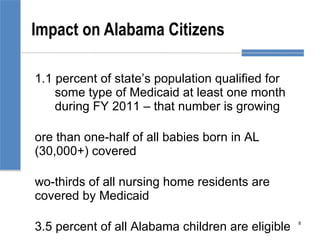
Impact on Alabama Citizens 21.1 percent of state’s population qualified for  some type of Medicaid at least one month  during FY 2011 – that number is growing More than one-half of all babies born in AL  (30,000+) covered Two-thirds of all nursing home residents are  covered by Medicaid 43.5 percent of all Alabama children are eligible 43 percent of children on Medicaid have at  least one working parent
Average Monthly Enrollment FY 2001  – 639,615 FY 2008  – 756,564 FY 2009  – 759,990 FY 2010  – 851,199 FY 2001 to FY 2010  – Up 211,584 (33.1%) *Medicaid Report ELIGPROJ Diff 6-16-11
Average Monthly Enrollment FY 2011  (Projected) – 909,821  FY 2012  – (Projected) – 953,961 FY 2013  – (Projected) – 997,752 FY 2014  – (Projected) – 1,124,347*  Based on Medicaid Report ELIGPROJ Diff 7-15-11 *Projected impact of Health Care Reform / Medicaid Expansion
Who Qualifies for Medicaid: Alabama’s income limits among the most restrictive in the country Low-income families  ( Family of 4 must have < $194/mo. income) Children ages 6-19 (100% FPL)  Pregnant women / children ages 0-5  (133% FPL) SSI for Aged, Blind and Disabled (certified by SSA)  Medicare-related programs (QMB, SLMB, QI-1)  Nursing Home Medicaid Home and Community-Based Waivers Same limits as nursing home
Who Qualifies for Medicaid:
Medicaid Payment Rates 1997-2016
Medicaid’s Funding Shelby Total population 191,474 Medicaid eligible population  14,761 (7.7%) Total child population 52,681 Medicaid eligible children 8,841 (16.8%) Total payments by county of eligible  $67.8 (million) Total payments by county of provider $77.5 (million) Total non-federal health care jobs 4,886 Medicaid will consume about one third of the FY12  General Fund Budget If current trends continue, Medicaid would require  about 92 percent of the General Fund Budget by FY  2020 Medicaid is looking for ways to reduce costs while  improving the cost of care. Key projects to this effort include: Patient Care Networks (3 pilots underway now) PACE programs  / Long Term Care in the Community Pharmacy Initiatives

Mullins medicaid

  • 1.
    Briefing on AlabamaMedicaid R. Bob Mullins, Jr. MD Commissioner Alabama Medicaid Agency November 2011
  • 2.
    Today’s Top IssuesThe number of AL citizens on Medicaid is growing. Average monthly enrollment increased 33 percent between 2001 and 2010. Medicaid will consume about 35 percent of the FY 2012 General Fund budget. If current trends continue, Medicaid would require 92 percent of the General Fund in FY 2020 . Medicaid plays an essential role in the state’s economy by funding jobs, generating income and state tax revenues and by providing health care services for all citizens.
  • 3.
    Economic Impact ofAlabama Medicaid Direct Impact 96,235 Jobs Directly Supported $203,975,720 State Sales Tax $214,174,506 State Income Tax Secondary Impact 47,155 Jobs $3,161,623,660 in Additional Supported Income $83,630,046 State Sales Tax $87,811,548 State Income Tax (Due to employee and business spending)
  • 4.
    Economic Impact ofAlabama Medicaid Total Impact on Jobs, Income & Selected Taxes 143,390 Jobs $3,161,623,660 in Additional Income $589,591,820 in Select Taxes Total Monetary Impact in Alabama:
  • 5.
    Today’s Top IssuesUpdated technology is essential: To manage expanded enrollment if health care reform is implemented To develop the infrastructure for the exchange electronic health record information To build the infrastructure to support the state health insurance exchange More primary health care providers are needed 1,000 more needed if health care reform is implemented
  • 6.
    Health Benefits /Information Exchanges Alabama is one of 10 states chosen by Robert Wood Johnson Foundation for expert technical assistance to develop Benefits Exchange and related projects, including Level 1 Funding application for federal funds Medicaid developing Customer Service Centers throughout state that will ultimately serve as enrollment centers for the Benefits Exchange
  • 7.
  • 8.
    Impact on AlabamaCitizens 21.1 percent of state’s population qualified for some type of Medicaid at least one month during FY 2011 – that number is growing More than one-half of all babies born in AL (30,000+) covered Two-thirds of all nursing home residents are covered by Medicaid 43.5 percent of all Alabama children are eligible 43 percent of children on Medicaid have at least one working parent
  • 9.
    Average Monthly EnrollmentFY 2001 – 639,615 FY 2008 – 756,564 FY 2009 – 759,990 FY 2010 – 851,199 FY 2001 to FY 2010 – Up 211,584 (33.1%) *Medicaid Report ELIGPROJ Diff 6-16-11
  • 10.
    Average Monthly EnrollmentFY 2011 (Projected) – 909,821 FY 2012 – (Projected) – 953,961 FY 2013 – (Projected) – 997,752 FY 2014 – (Projected) – 1,124,347* Based on Medicaid Report ELIGPROJ Diff 7-15-11 *Projected impact of Health Care Reform / Medicaid Expansion
  • 11.
    Who Qualifies forMedicaid: Alabama’s income limits among the most restrictive in the country Low-income families ( Family of 4 must have < $194/mo. income) Children ages 6-19 (100% FPL) Pregnant women / children ages 0-5 (133% FPL) SSI for Aged, Blind and Disabled (certified by SSA) Medicare-related programs (QMB, SLMB, QI-1) Nursing Home Medicaid Home and Community-Based Waivers Same limits as nursing home
  • 12.
  • 13.
  • 14.
    Medicaid’s Funding ShelbyTotal population 191,474 Medicaid eligible population 14,761 (7.7%) Total child population 52,681 Medicaid eligible children 8,841 (16.8%) Total payments by county of eligible $67.8 (million) Total payments by county of provider $77.5 (million) Total non-federal health care jobs 4,886 Medicaid will consume about one third of the FY12 General Fund Budget If current trends continue, Medicaid would require about 92 percent of the General Fund Budget by FY 2020 Medicaid is looking for ways to reduce costs while improving the cost of care. Key projects to this effort include: Patient Care Networks (3 pilots underway now) PACE programs / Long Term Care in the Community Pharmacy Initiatives