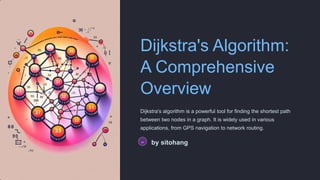
Dijkstra's Algorithm:
A Comprehensive
Overview
Dijkstra's algorithm is a powerful tool for finding the shortest path
between two nodes in a graph. It is widely used in various
applications, from GPS navigation to network routing.
ss
by sitohang
Strengths of Dijkstra's Algorithm
1 Efficiency
Dijkstra's algorithm has a time
complexity of O(E log V),
where E is the number of
edges and V is the number of
vertices. This makes it efficient
for finding shortest paths in
large graphs.
2 Guaranteed Optimality
It guarantees finding the
shortest path between two
nodes, assuming all edge
weights are non-negative.
3 Simplicity
The algorithm is relatively easy
to understand and implement.
4 Wide Applicability
It can be applied to a wide
range of problems, including
network routing, transportation,
and resource allocation.
Weaknesses of Dijkstra's Algorithm
Negative Edge Weights
Dijkstra's algorithm does not work
correctly when there are negative
edge weights. In such cases,
alternative algorithms like Bellman-
Ford are used.
Memory Consumption
It can consume significant memory,
especially for large graphs, as it
needs to store distances for all
nodes.
Limited to Single Source
It finds shortest paths from a single
source node. If you need to find
shortest paths between all pairs of
nodes, other algorithms are more
suitable.
Opportunities for Dijkstra's Algorithm
Dynamic Routing
Dijkstra's algorithm can be used to
dynamically update routes in real-
time based on changing traffic
conditions, road closures, or other
factors.
Internet of Things (IoT)
Its potential in smart cities and other
IoT applications where optimal
resource allocation and path planning
are crucial.
Robotics and Automation
It can be used to optimize robot
paths in complex environments,
minimizing travel time and
maximizing efficiency.
Healthcare and Logistics
Applications include optimizing
patient transport within hospitals,
streamlining logistics operations, and
optimizing resource allocation in
emergency response scenarios.
Challenges in Implementing
Dijkstra's Algorithm
Handling Large Graphs
Implementing Dijkstra's algorithm efficiently for very large graphs
can be challenging due to memory and computational limitations.
Handling Dynamic Updates
Maintaining shortest path information in dynamic graphs where
edges or weights can change over time poses a significant
challenge.
Dealing with Real-World Constraints
In real-world applications, there may be additional constraints like
limited resources, time windows, or capacity restrictions, which
can complicate the algorithm.
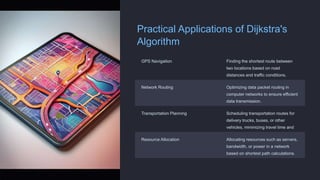
Practical Applications of Dijkstra's
Algorithm
GPS Navigation Finding the shortest route between
two locations based on road
distances and traffic conditions.
Network Routing Optimizing data packet routing in
computer networks to ensure efficient
data transmission.
Transportation Planning Scheduling transportation routes for
delivery trucks, buses, or other
vehicles, minimizing travel time and
cost.
Resource Allocation Allocating resources such as servers,
bandwidth, or power in a network
based on shortest path calculations.
Comparison to Alternative Shortest Path
Algorithms
Bellman-Ford Algorithm
Can handle negative edge
weights, but has a higher time
complexity of O(VE).
A* Search Algorithm
Uses heuristics to prioritize nodes,
potentially leading to faster
solutions but not guaranteeing
optimality.
Floyd-Warshall Algorithm
Finds shortest paths between all
pairs of nodes, but has a higher
time complexity of O(V^3).
Conclusion and Future
Considerations
Dijkstra's algorithm remains a fundamental algorithm for solving
shortest path problems, finding its application in various fields.
Future research may focus on addressing challenges like handling
dynamic updates, incorporating real-world constraints, and
improving algorithm efficiency for large-scale applications.

the unexpected potential of Dijkstra's Algorithm

  • 1.
    Dijkstra's Algorithm: A Comprehensive Overview Dijkstra'salgorithm is a powerful tool for finding the shortest path between two nodes in a graph. It is widely used in various applications, from GPS navigation to network routing. ss by sitohang
  • 2.
    Strengths of Dijkstra'sAlgorithm 1 Efficiency Dijkstra's algorithm has a time complexity of O(E log V), where E is the number of edges and V is the number of vertices. This makes it efficient for finding shortest paths in large graphs. 2 Guaranteed Optimality It guarantees finding the shortest path between two nodes, assuming all edge weights are non-negative. 3 Simplicity The algorithm is relatively easy to understand and implement. 4 Wide Applicability It can be applied to a wide range of problems, including network routing, transportation, and resource allocation.
  • 3.
    Weaknesses of Dijkstra'sAlgorithm Negative Edge Weights Dijkstra's algorithm does not work correctly when there are negative edge weights. In such cases, alternative algorithms like Bellman- Ford are used. Memory Consumption It can consume significant memory, especially for large graphs, as it needs to store distances for all nodes. Limited to Single Source It finds shortest paths from a single source node. If you need to find shortest paths between all pairs of nodes, other algorithms are more suitable.
  • 4.
    Opportunities for Dijkstra'sAlgorithm Dynamic Routing Dijkstra's algorithm can be used to dynamically update routes in real- time based on changing traffic conditions, road closures, or other factors. Internet of Things (IoT) Its potential in smart cities and other IoT applications where optimal resource allocation and path planning are crucial. Robotics and Automation It can be used to optimize robot paths in complex environments, minimizing travel time and maximizing efficiency. Healthcare and Logistics Applications include optimizing patient transport within hospitals, streamlining logistics operations, and optimizing resource allocation in emergency response scenarios.
  • 5.
    Challenges in Implementing Dijkstra'sAlgorithm Handling Large Graphs Implementing Dijkstra's algorithm efficiently for very large graphs can be challenging due to memory and computational limitations. Handling Dynamic Updates Maintaining shortest path information in dynamic graphs where edges or weights can change over time poses a significant challenge. Dealing with Real-World Constraints In real-world applications, there may be additional constraints like limited resources, time windows, or capacity restrictions, which can complicate the algorithm.
  • 6.
    Practical Applications ofDijkstra's Algorithm GPS Navigation Finding the shortest route between two locations based on road distances and traffic conditions. Network Routing Optimizing data packet routing in computer networks to ensure efficient data transmission. Transportation Planning Scheduling transportation routes for delivery trucks, buses, or other vehicles, minimizing travel time and cost. Resource Allocation Allocating resources such as servers, bandwidth, or power in a network based on shortest path calculations.
  • 7.
    Comparison to AlternativeShortest Path Algorithms Bellman-Ford Algorithm Can handle negative edge weights, but has a higher time complexity of O(VE). A* Search Algorithm Uses heuristics to prioritize nodes, potentially leading to faster solutions but not guaranteeing optimality. Floyd-Warshall Algorithm Finds shortest paths between all pairs of nodes, but has a higher time complexity of O(V^3).
  • 8.
    Conclusion and Future Considerations Dijkstra'salgorithm remains a fundamental algorithm for solving shortest path problems, finding its application in various fields. Future research may focus on addressing challenges like handling dynamic updates, incorporating real-world constraints, and improving algorithm efficiency for large-scale applications.