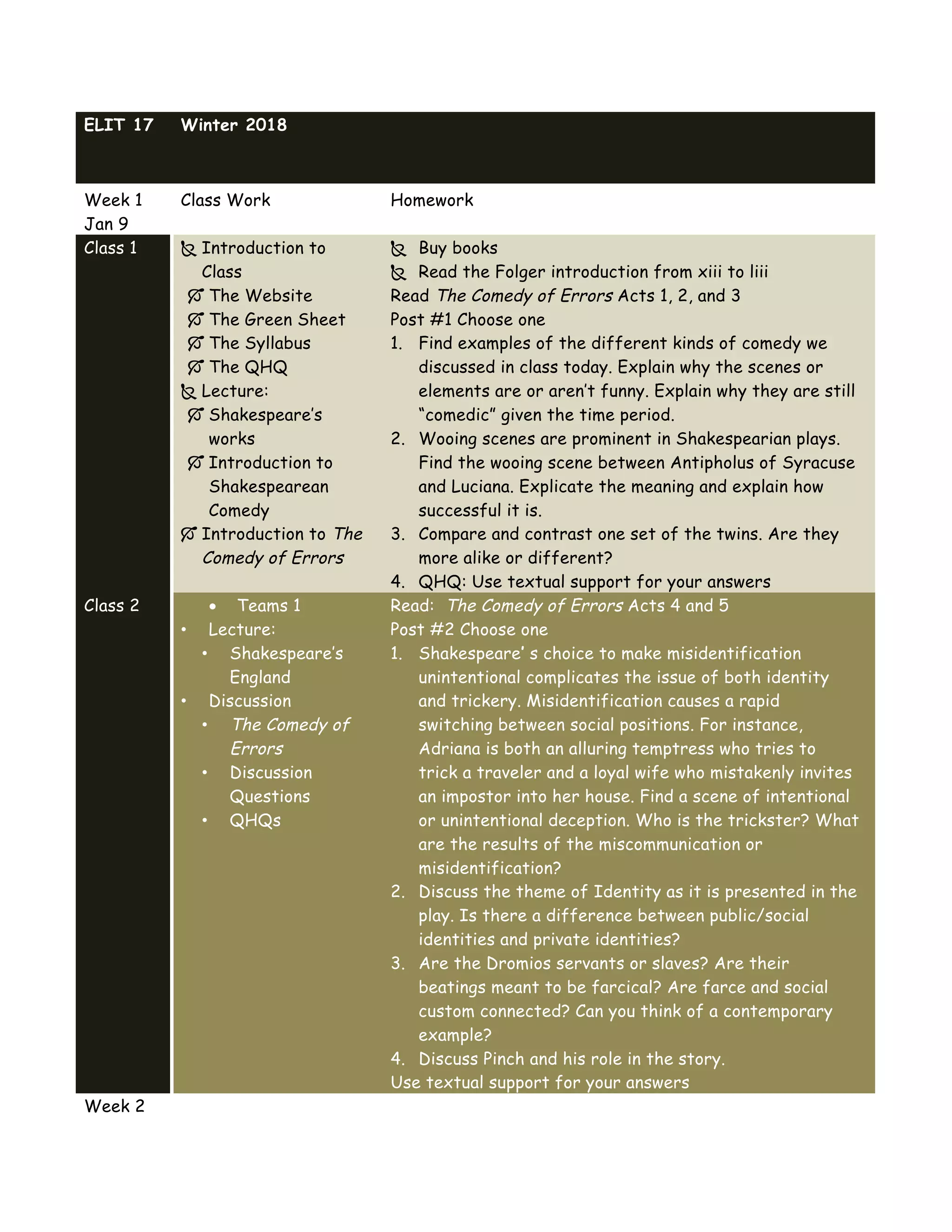
ELIT 17 Winter 2018
Week 1
Jan 9
Class Work Homework
Class 1 Ñ Introduction to
Class
Ó The Website
Ó The Green Sheet
Ó The Syllabus
Ó The QHQ
Ñ Lecture:
Ó Shakespeare’s
works
Ó Introduction to
Shakespearean
Comedy
Ó Introduction to The
Comedy of Errors
Ñ Buy books
Ñ Read the Folger introduction from xiii to liii
Read The Comedy of Errors Acts 1, 2, and 3
Post #1 Choose one
1. Find examples of the different kinds of comedy we
discussed in class today. Explain why the scenes or
elements are or aren’t funny. Explain why they are still
“comedic” given the time period.
2. Wooing scenes are prominent in Shakespearian plays.
Find the wooing scene between Antipholus of Syracuse
and Luciana. Explicate the meaning and explain how
successful it is.
3. Compare and contrast one set of the twins. Are they
more alike or different?
4. QHQ: Use textual support for your answers
Class 2 • Teams 1
• Lecture:
• Shakespeare’s
England
• Discussion
• The Comedy of
Errors
• Discussion
Questions
• QHQs
Read: The Comedy of Errors Acts 4 and 5
Post #2 Choose one
1. Shakespeare’ s choice to make misidentification
unintentional complicates the issue of both identity
and trickery. Misidentification causes a rapid
switching between social positions. For instance,
Adriana is both an alluring temptress who tries to
trick a traveler and a loyal wife who mistakenly invites
an impostor into her house. Find a scene of intentional
or unintentional deception. Who is the trickster? What
are the results of the miscommunication or
misidentification?
2. Discuss the theme of Identity as it is presented in the
play. Is there a difference between public/social
identities and private identities?
3. Are the Dromios servants or slaves? Are their
beatings meant to be farcical? Are farce and social
custom connected? Can you think of a contemporary
example?
4. Discuss Pinch and his role in the story.
Use textual support for your answers
Week 2
Jan 16
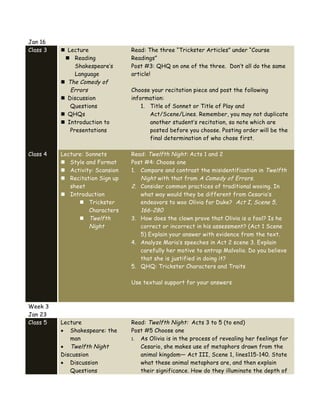
Class 3 n Lecture
n Reading
Shakespeare’s
Language
n The Comedy of
Errors
n Discussion
Questions
n QHQs
n Introduction to
Presentations
Read: The three “Trickster Articles” under “Course
Readings”
Post #3: QHQ on one of the three. Don’t all do the same
article!
Choose your recitation piece and post the following
information:
1. Title of Sonnet or Title of Play and
Act/Scene/Lines. Remember, you may not duplicate
another student’s recitation, so note which are
posted before you choose. Posting order will be the
final determination of who chose first.
Class 4 Lecture: Sonnets
n Style and Format
n Activity: Scansion
n Recitation Sign up
sheet
n Introduction
n Trickster
Characters
n Twelfth
Night
Read: Twelfth Night: Acts 1 and 2
Post #4: Choose one
1. Compare and contrast the misidentification in Twelfth
Night with that from A Comedy of Errors.
2. Consider common practices of traditional wooing. In
what way would they be different from Cesario’s
endeavors to woo Olivia for Duke? Act I, Scene 5,
166-280
3. How does the clown prove that Olivia is a fool? Is he
correct or incorrect in his assessment? (Act 1 Scene
5) Explain your answer with evidence from the text.
4. Analyze Maria’s speeches in Act 2 scene 3. Explain
carefully her motive to entrap Malvolio. Do you believe
that she is justified in doing it?
5. QHQ: Trickster Characters and Traits
Use textual support for your answers
Week 3
Jan 23
Class 5 Lecture
• Shakespeare: the
man
• Twelfth Night
Discussion
• Discussion
Questions
Read: Twelfth Night: Acts 3 to 5 (to end)
Post #5 Choose one
1. As Olivia is in the process of revealing her feelings for
Cesario, she makes use of metaphors drawn from the
animal kingdom— Act III, Scene 1, lines115-140. State
what these animal metaphors are, and then explain
their significance. How do they illuminate the depth of
• QHQs
Recitation: Late sign-
ups
Olivia’s feelings at the moment?
2. Many characters in Twelfth Night adopt a role or
otherwise disguise their identities. Viola is the most
obvious example of this ruse in the play, but what
others can you name? Consider Fester, Orsino, and
Olivia among others.
3. Discuss the outcome of the plot against Malvolio. Is
the yellow garter scene funny or cruel? Is his fate
deserved? How does his reappearance affect the end
of the play?
4. QHQ
Use textual support for your answers
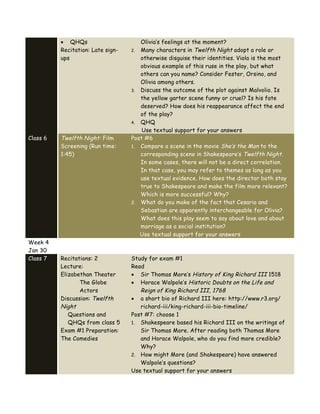
Class 6 Twelfth Night: Film
Screening (Run time:
1:45)
Post #6
1. Compare a scene in the movie She’s the Man to the
corresponding scene in Shakespeare’s Twelfth Night.
In some cases, there will not be a direct correlation.
In that case, you may refer to themes as long as you
use textual evidence. How does the director both stay
true to Shakespeare and make the film more relevant?
Which is more successful? Why?
2. What do you make of the fact that Cesario and
Sebastian are apparently interchangeable for Olivia?
What does this play seem to say about love and about
marriage as a social institution?
Use textual support for your answers
Week 4
Jan 30
Class 7 Recitations: 2
Lecture:
Elizabethan Theater
The Globe
Actors
Discussion: Twelfth
Night
Questions and
QHQs from class 5
Exam #1 Preparation:
The Comedies
Study for exam #1
Read
• Sir Thomas More’s History of King Richard III 1518
• Horace Walpole’s Historic Doubts on the Life and
Reign of King Richard III, 1768
• a short bio of Richard III here: http://www.r3.org/
richard-iii/king-richard-iii-bio-timeline/
Post #7: choose 1
1. Shakespeare based his Richard III on the writings of
Sir Thomas More. After reading both Thomas More
and Horace Walpole, who do you find more credible?
Why?
2. How might More (and Shakespeare) have answered
Walpole’s questions?
Use textual support for your answers
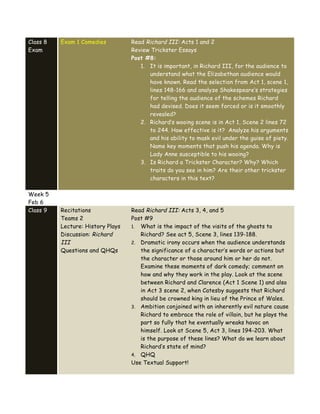
Class 8
Exam
Exam 1 Comedies Read Richard III: Acts 1 and 2
Review Trickster Essays
Post #8:
1. It is important, in Richard III, for the audience to
understand what the Elizabethan audience would
have known. Read the selection from Act 1, scene 1,
lines 148-166 and analyze Shakespeare’s strategies
for telling the audience of the schemes Richard
had devised. Does it seem forced or is it smoothly
revealed?
2. Richard’s wooing scene is in Act 1, Scene 2 lines 72
to 244. How effective is it? Analyze his arguments
and his ability to mask evil under the guise of piety.
Name key moments that push his agenda. Why is
Lady Anne susceptible to his wooing?
3. Is Richard a Trickster Character? Why? Which
traits do you see in him? Are their other trickster
characters in this text?
Week 5
Feb 6
Class 9 Recitations
Teams 2
Lecture: History Plays
Discussion: Richard
III
Questions and QHQs
Read Richard III: Acts 3, 4, and 5
Post #9
1. What is the impact of the visits of the ghosts to
Richard? See act 5, Scene 3, lines 139-188.
2. Dramatic irony occurs when the audience understands
the significance of a character’s words or actions but
the character or those around him or her do not.
Examine these moments of dark comedy; comment on
how and why they work in the play. Look at the scene
between Richard and Clarence (Act 1 Scene 1) and also
in Act 3 scene 2, when Catesby suggests that Richard
should be crowned king in lieu of the Prince of Wales.
3. Ambition conjoined with an inherently evil nature cause
Richard to embrace the role of villain, but he plays the
part so fully that he eventually wreaks havoc on
himself. Look at Scene 5, Act 3, lines 194-203. What
is the purpose of these lines? What do we learn about
Richard’s state of mind?
4. QHQ
Use Textual Support!
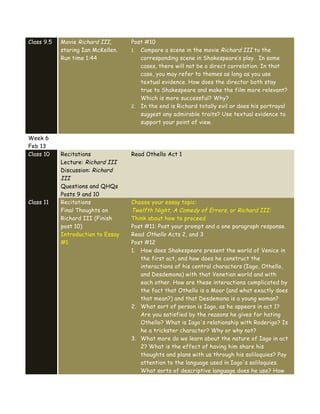
Class 9.5 Movie Richard III,
staring Ian McKellen.
Run time 1:44
Post #10
1. Compare a scene in the movie Richard III to the
corresponding scene in Shakespeare’s play. In some
cases, there will not be a direct correlation. In that
case, you may refer to themes as long as you use
textual evidence. How does the director both stay
true to Shakespeare and make the film more relevant?
Which is more successful? Why?
2. In the end is Richard totally evil or does his portrayal
suggest any admirable traits? Use textual evidence to
support your point of view.
Week 6
Feb 13
Class 10 Recitations
Lecture: Richard III
Discussion: Richard
III
Questions and QHQs
Posts 9 and 10
Read Othello Act 1
Class 11 Recitations
Final Thoughts on
Richard III (Finish
post 10)
Introduction to Essay
#1
Choose your essay topic:
Twelfth Night, A Comedy of Errors, or Richard III:
Think about how to proceed
Post #11: Post your prompt and a one paragraph response.
Read Othello Acts 2, and 3
Post #12
1. How does Shakespeare present the world of Venice in
the first act, and how does he construct the
interactions of his central characters (Iago, Othello,
and Desdemona) with that Venetian world and with
each other. How are these interactions complicated by
the fact that Othello is a Moor (and what exactly does
that mean?) and that Desdemona is a young woman?
2. What sort of person is Iago, as he appears in act 1?
Are you satisfied by the reasons he gives for hating
Othello? What is Iago's relationship with Roderigo? Is
he a trickster character? Why or why not?
3. What more do we learn about the nature of Iago in act
2? What is the effect of having him share his
thoughts and plans with us through his soliloquies? Pay
attention to the language used in Iago's soliloquies.
What sorts of descriptive language does he use? How
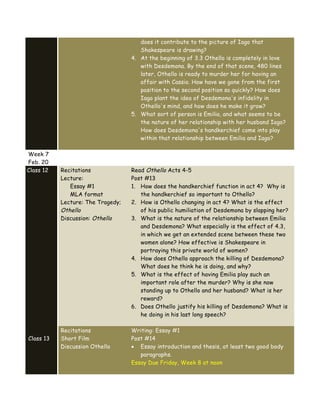
does it contribute to the picture of Iago that
Shakespeare is drawing?
4. At the beginning of 3.3 Othello is completely in love
with Desdemona. By the end of that scene, 480 lines
later, Othello is ready to murder her for having an
affair with Cassio. How have we gone from the first
position to the second position so quickly? How does
Iago plant the idea of Desdemona's infidelity in
Othello's mind, and how does he make it grow?
5. What sort of person is Emilia, and what seems to be
the nature of her relationship with her husband Iago?
How does Desdemona's handkerchief come into play
within that relationship between Emilia and Iago?
Week 7
Feb. 20
Class 12 Recitations
Lecture:
Essay #1
MLA format
Lecture: The Tragedy;
Othello
Discussion: Othello
Read Othello Acts 4-5
Post #13
1. How does the handkerchief function in act 4? Why is
the handkerchief so important to Othello?
2. How is Othello changing in act 4? What is the effect
of his public humiliation of Desdemona by slapping her?
3. What is the nature of the relationship between Emilia
and Desdemona? What especially is the effect of 4.3,
in which we get an extended scene between these two
women alone? How effective is Shakespeare in
portraying this private world of women?
4. How does Othello approach the killing of Desdemona?
What does he think he is doing, and why?
5. What is the effect of having Emilia play such an
important role after the murder? Why is she now
standing up to Othello and her husband? What is her
reward?
6. Does Othello justify his killing of Desdemona? What is
he doing in his last long speech?
Class 13
Recitations
Short Film
Discussion Othello
Writing: Essay #1
Post #14
• Essay introduction and thesis, at least two good body
paragraphs.
Essay Due Friday, Week 8 at noon
Week 8
Feb. 28
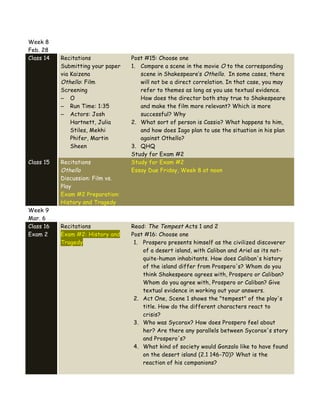
Class 14 Recitations
Submitting your paper
via Kaizena
Othello: Film
Screening
– O
– Run Time: 1:35
– Actors: Josh
Hartnett, Julia
Stiles, Mekhi
Phifer, Martin
Sheen
Post #15: Choose one
1. Compare a scene in the movie O to the corresponding
scene in Shakespeare’s Othello. In some cases, there
will not be a direct correlation. In that case, you may
refer to themes as long as you use textual evidence.
How does the director both stay true to Shakespeare
and make the film more relevant? Which is more
successful? Why
2. What sort of person is Cassio? What happens to him,
and how does Iago plan to use the situation in his plan
against Othello?
3. QHQ
Study for Exam #2
Class 15 Recitations
Othello
Discussion: Film vs.
Play
Exam #2 Preparation:
History and Tragedy
Study for Exam #2
Essay Due Friday, Week 8 at noon
Week 9
Mar. 6
Class 16
Exam 2
Recitations
Exam #2: History and
Tragedy
Read: The Tempest Acts 1 and 2
Post #16: Choose one
1. Prospero presents himself as the civilized discoverer
of a desert island, with Caliban and Ariel as its not-
quite-human inhabitants. How does Caliban's history
of the island differ from Prospero's? Whom do you
think Shakespeare agrees with, Prospero or Caliban?
Whom do you agree with, Prospero or Caliban? Give
textual evidence in working out your answers.
2. Act One, Scene 1 shows the "tempest" of the play's
title. How do the different characters react to
crisis?
3. Who was Sycorax? How does Prospero feel about
her? Are there any parallels between Sycorax's story
and Prospero's?
4. What kind of society would Gonzalo like to have found
on the desert island (2.1 146-70)? What is the
reaction of his companions?
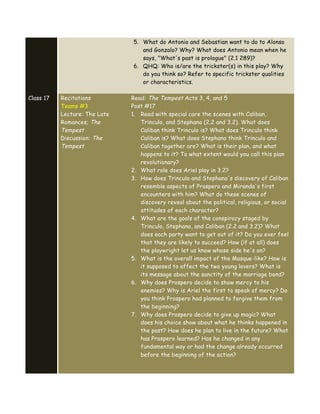
5. What do Antonio and Sebastian want to do to Alonso
and Gonzalo? Why? What does Antonio mean when he
says, "What's past is prologue" (2.1 289)?
6. QHQ: Who is/are the trickster(s) in this play? Why
do you think so? Refer to specific trickster qualities
or characteristics.
Class 17 Recitations
Teams #3
Lecture: The Late
Romances; The
Tempest
Discussion: The
Tempest
Read: The Tempest Acts 3, 4, and 5
Post #17
1. Read with special care the scenes with Caliban,
Trinculo, and Stephano (2.2 and 3.2). What does
Caliban think Trinculo is? What does Trinculo think
Caliban is? What does Stephano think Trinculo and
Caliban together are? What is their plan, and what
happens to it? To what extent would you call this plan
revolutionary?
2. What role does Ariel play in 3.2?
3. How does Trinculo and Stephano's discovery of Caliban
resemble aspects of Prospero and Miranda's first
encounters with him? What do these scenes of
discovery reveal about the political, religious, or social
attitudes of each character?
4. What are the goals of the conspiracy staged by
Trinculo, Stephano, and Caliban (2.2 and 3.2)? What
does each party want to get out of it? Do you ever feel
that they are likely to succeed? How (if at all) does
the playwright let us know whose side he's on?
5. What is the overall impact of the Masque-like? How is
it supposed to affect the two young lovers? What is
its message about the sanctity of the marriage bond?
6. Why does Prospero decide to show mercy to his
enemies? Why is Ariel the first to speak of mercy? Do
you think Prospero had planned to forgive them from
the beginning?
7. Why does Prospero decide to give up magic? What
does his choice show about what he thinks happened in
the past? How does he plan to live in the future? What
has Prospero learned? Has he changed in any
fundamental way or had the change already occurred
before the beginning of the action?
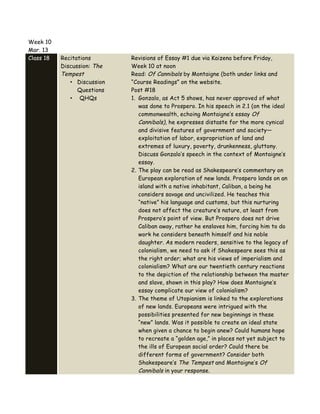
Week 10
Mar. 13
Class 18 Recitations
Discussion: The
Tempest
• Discussion
Questions
• QHQs
Revisions of Essay #1 due via Kaizena before Friday,
Week 10 at noon
Read: Of Cannibals by Montaigne (both under links and
“Course Readings” on the website.
Post #18
1. Gonzalo, as Act 5 shows, has never approved of what
was done to Prospero. In his speech in 2.1 (on the ideal
commonwealth, echoing Montaigne’s essay Of
Cannibals), he expresses distaste for the more cynical
and divisive features of government and society—
exploitation of labor, expropriation of land and
extremes of luxury, poverty, drunkenness, gluttony.
Discuss Gonzalo’s speech in the context of Montaigne’s
essay.
2. The play can be read as Shakespeare’s commentary on
European exploration of new lands. Prospero lands on an
island with a native inhabitant, Caliban, a being he
considers savage and uncivilized. He teaches this
“native” his language and customs, but this nurturing
does not affect the creature’s nature, at least from
Prospero’s point of view. But Prospero does not drive
Caliban away, rather he enslaves him, forcing him to do
work he considers beneath himself and his noble
daughter. As modern readers, sensitive to the legacy of
colonialism, we need to ask if Shakespeare sees this as
the right order; what are his views of imperialism and
colonialism? What are our twentieth century reactions
to the depiction of the relationship between the master
and slave, shown in this play? How does Montaigne’s
essay complicate our view of colonialism?
3. The theme of Utopianism is linked to the explorations
of new lands. Europeans were intrigued with the
possibilities presented for new beginnings in these
“new” lands. Was it possible to create an ideal state
when given a chance to begin anew? Could humans hope
to recreate a “golden age,” in places not yet subject to
the ills of European social order? Could there be
different forms of government? Consider both
Shakespeare’s The Tempest and Montaigne’s Of
Cannibals in your response.
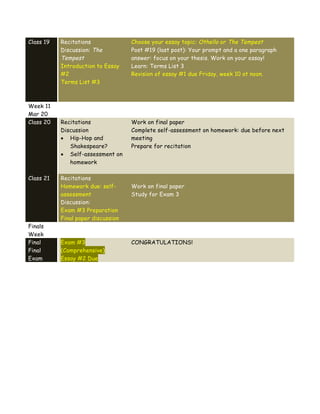
Class 19 Recitations
Discussion: The
Tempest
Introduction to Essay
#2
Terms List #3
Choose your essay topic: Othello or The Tempest
Post #19 (last post): Your prompt and a one paragraph
answer: focus on your thesis. Work on your essay!
Learn: Terms List 3
Revision of essay #1 due Friday, week 10 at noon.
Week 11
Mar 20
Class 20 Recitations
Discussion
• Hip-Hop and
Shakespeare?
• Self-assessment on
homework
Work on final paper
Complete self-assessment on homework: due before next
meeting
Prepare for recitation
Class 21 Recitations
Homework due: self-
assessment
Discussion:
Exam #3 Preparation
Final paper discussion
Work on final paper
Study for Exam 3
Finals
Week
Final
Final
Exam
Exam #3
(Comprehensive)
Essay #2 Due
CONGRATULATIONS!

Elit 17 syllabus winter 2018

  • 1.
    ELIT 17 Winter2018 Week 1 Jan 9 Class Work Homework Class 1 Ñ Introduction to Class Ó The Website Ó The Green Sheet Ó The Syllabus Ó The QHQ Ñ Lecture: Ó Shakespeare’s works Ó Introduction to Shakespearean Comedy Ó Introduction to The Comedy of Errors Ñ Buy books Ñ Read the Folger introduction from xiii to liii Read The Comedy of Errors Acts 1, 2, and 3 Post #1 Choose one 1. Find examples of the different kinds of comedy we discussed in class today. Explain why the scenes or elements are or aren’t funny. Explain why they are still “comedic” given the time period. 2. Wooing scenes are prominent in Shakespearian plays. Find the wooing scene between Antipholus of Syracuse and Luciana. Explicate the meaning and explain how successful it is. 3. Compare and contrast one set of the twins. Are they more alike or different? 4. QHQ: Use textual support for your answers Class 2 • Teams 1 • Lecture: • Shakespeare’s England • Discussion • The Comedy of Errors • Discussion Questions • QHQs Read: The Comedy of Errors Acts 4 and 5 Post #2 Choose one 1. Shakespeare’ s choice to make misidentification unintentional complicates the issue of both identity and trickery. Misidentification causes a rapid switching between social positions. For instance, Adriana is both an alluring temptress who tries to trick a traveler and a loyal wife who mistakenly invites an impostor into her house. Find a scene of intentional or unintentional deception. Who is the trickster? What are the results of the miscommunication or misidentification? 2. Discuss the theme of Identity as it is presented in the play. Is there a difference between public/social identities and private identities? 3. Are the Dromios servants or slaves? Are their beatings meant to be farcical? Are farce and social custom connected? Can you think of a contemporary example? 4. Discuss Pinch and his role in the story. Use textual support for your answers Week 2
  • 2.
    Jan 16 Class 3n Lecture n Reading Shakespeare’s Language n The Comedy of Errors n Discussion Questions n QHQs n Introduction to Presentations Read: The three “Trickster Articles” under “Course Readings” Post #3: QHQ on one of the three. Don’t all do the same article! Choose your recitation piece and post the following information: 1. Title of Sonnet or Title of Play and Act/Scene/Lines. Remember, you may not duplicate another student’s recitation, so note which are posted before you choose. Posting order will be the final determination of who chose first. Class 4 Lecture: Sonnets n Style and Format n Activity: Scansion n Recitation Sign up sheet n Introduction n Trickster Characters n Twelfth Night Read: Twelfth Night: Acts 1 and 2 Post #4: Choose one 1. Compare and contrast the misidentification in Twelfth Night with that from A Comedy of Errors. 2. Consider common practices of traditional wooing. In what way would they be different from Cesario’s endeavors to woo Olivia for Duke? Act I, Scene 5, 166-280 3. How does the clown prove that Olivia is a fool? Is he correct or incorrect in his assessment? (Act 1 Scene 5) Explain your answer with evidence from the text. 4. Analyze Maria’s speeches in Act 2 scene 3. Explain carefully her motive to entrap Malvolio. Do you believe that she is justified in doing it? 5. QHQ: Trickster Characters and Traits Use textual support for your answers Week 3 Jan 23 Class 5 Lecture • Shakespeare: the man • Twelfth Night Discussion • Discussion Questions Read: Twelfth Night: Acts 3 to 5 (to end) Post #5 Choose one 1. As Olivia is in the process of revealing her feelings for Cesario, she makes use of metaphors drawn from the animal kingdom— Act III, Scene 1, lines115-140. State what these animal metaphors are, and then explain their significance. How do they illuminate the depth of
  • 3.
    • QHQs Recitation: Latesign- ups Olivia’s feelings at the moment? 2. Many characters in Twelfth Night adopt a role or otherwise disguise their identities. Viola is the most obvious example of this ruse in the play, but what others can you name? Consider Fester, Orsino, and Olivia among others. 3. Discuss the outcome of the plot against Malvolio. Is the yellow garter scene funny or cruel? Is his fate deserved? How does his reappearance affect the end of the play? 4. QHQ Use textual support for your answers Class 6 Twelfth Night: Film Screening (Run time: 1:45) Post #6 1. Compare a scene in the movie She’s the Man to the corresponding scene in Shakespeare’s Twelfth Night. In some cases, there will not be a direct correlation. In that case, you may refer to themes as long as you use textual evidence. How does the director both stay true to Shakespeare and make the film more relevant? Which is more successful? Why? 2. What do you make of the fact that Cesario and Sebastian are apparently interchangeable for Olivia? What does this play seem to say about love and about marriage as a social institution? Use textual support for your answers Week 4 Jan 30 Class 7 Recitations: 2 Lecture: Elizabethan Theater The Globe Actors Discussion: Twelfth Night Questions and QHQs from class 5 Exam #1 Preparation: The Comedies Study for exam #1 Read • Sir Thomas More’s History of King Richard III 1518 • Horace Walpole’s Historic Doubts on the Life and Reign of King Richard III, 1768 • a short bio of Richard III here: http://www.r3.org/ richard-iii/king-richard-iii-bio-timeline/ Post #7: choose 1 1. Shakespeare based his Richard III on the writings of Sir Thomas More. After reading both Thomas More and Horace Walpole, who do you find more credible? Why? 2. How might More (and Shakespeare) have answered Walpole’s questions? Use textual support for your answers
  • 4.
    Class 8 Exam Exam 1Comedies Read Richard III: Acts 1 and 2 Review Trickster Essays Post #8: 1. It is important, in Richard III, for the audience to understand what the Elizabethan audience would have known. Read the selection from Act 1, scene 1, lines 148-166 and analyze Shakespeare’s strategies for telling the audience of the schemes Richard had devised. Does it seem forced or is it smoothly revealed? 2. Richard’s wooing scene is in Act 1, Scene 2 lines 72 to 244. How effective is it? Analyze his arguments and his ability to mask evil under the guise of piety. Name key moments that push his agenda. Why is Lady Anne susceptible to his wooing? 3. Is Richard a Trickster Character? Why? Which traits do you see in him? Are their other trickster characters in this text? Week 5 Feb 6 Class 9 Recitations Teams 2 Lecture: History Plays Discussion: Richard III Questions and QHQs Read Richard III: Acts 3, 4, and 5 Post #9 1. What is the impact of the visits of the ghosts to Richard? See act 5, Scene 3, lines 139-188. 2. Dramatic irony occurs when the audience understands the significance of a character’s words or actions but the character or those around him or her do not. Examine these moments of dark comedy; comment on how and why they work in the play. Look at the scene between Richard and Clarence (Act 1 Scene 1) and also in Act 3 scene 2, when Catesby suggests that Richard should be crowned king in lieu of the Prince of Wales. 3. Ambition conjoined with an inherently evil nature cause Richard to embrace the role of villain, but he plays the part so fully that he eventually wreaks havoc on himself. Look at Scene 5, Act 3, lines 194-203. What is the purpose of these lines? What do we learn about Richard’s state of mind? 4. QHQ Use Textual Support!
  • 5.
    Class 9.5 MovieRichard III, staring Ian McKellen. Run time 1:44 Post #10 1. Compare a scene in the movie Richard III to the corresponding scene in Shakespeare’s play. In some cases, there will not be a direct correlation. In that case, you may refer to themes as long as you use textual evidence. How does the director both stay true to Shakespeare and make the film more relevant? Which is more successful? Why? 2. In the end is Richard totally evil or does his portrayal suggest any admirable traits? Use textual evidence to support your point of view. Week 6 Feb 13 Class 10 Recitations Lecture: Richard III Discussion: Richard III Questions and QHQs Posts 9 and 10 Read Othello Act 1 Class 11 Recitations Final Thoughts on Richard III (Finish post 10) Introduction to Essay #1 Choose your essay topic: Twelfth Night, A Comedy of Errors, or Richard III: Think about how to proceed Post #11: Post your prompt and a one paragraph response. Read Othello Acts 2, and 3 Post #12 1. How does Shakespeare present the world of Venice in the first act, and how does he construct the interactions of his central characters (Iago, Othello, and Desdemona) with that Venetian world and with each other. How are these interactions complicated by the fact that Othello is a Moor (and what exactly does that mean?) and that Desdemona is a young woman? 2. What sort of person is Iago, as he appears in act 1? Are you satisfied by the reasons he gives for hating Othello? What is Iago's relationship with Roderigo? Is he a trickster character? Why or why not? 3. What more do we learn about the nature of Iago in act 2? What is the effect of having him share his thoughts and plans with us through his soliloquies? Pay attention to the language used in Iago's soliloquies. What sorts of descriptive language does he use? How
  • 6.
    does it contributeto the picture of Iago that Shakespeare is drawing? 4. At the beginning of 3.3 Othello is completely in love with Desdemona. By the end of that scene, 480 lines later, Othello is ready to murder her for having an affair with Cassio. How have we gone from the first position to the second position so quickly? How does Iago plant the idea of Desdemona's infidelity in Othello's mind, and how does he make it grow? 5. What sort of person is Emilia, and what seems to be the nature of her relationship with her husband Iago? How does Desdemona's handkerchief come into play within that relationship between Emilia and Iago? Week 7 Feb. 20 Class 12 Recitations Lecture: Essay #1 MLA format Lecture: The Tragedy; Othello Discussion: Othello Read Othello Acts 4-5 Post #13 1. How does the handkerchief function in act 4? Why is the handkerchief so important to Othello? 2. How is Othello changing in act 4? What is the effect of his public humiliation of Desdemona by slapping her? 3. What is the nature of the relationship between Emilia and Desdemona? What especially is the effect of 4.3, in which we get an extended scene between these two women alone? How effective is Shakespeare in portraying this private world of women? 4. How does Othello approach the killing of Desdemona? What does he think he is doing, and why? 5. What is the effect of having Emilia play such an important role after the murder? Why is she now standing up to Othello and her husband? What is her reward? 6. Does Othello justify his killing of Desdemona? What is he doing in his last long speech? Class 13 Recitations Short Film Discussion Othello Writing: Essay #1 Post #14 • Essay introduction and thesis, at least two good body paragraphs. Essay Due Friday, Week 8 at noon
  • 7.
    Week 8 Feb. 28 Class14 Recitations Submitting your paper via Kaizena Othello: Film Screening – O – Run Time: 1:35 – Actors: Josh Hartnett, Julia Stiles, Mekhi Phifer, Martin Sheen Post #15: Choose one 1. Compare a scene in the movie O to the corresponding scene in Shakespeare’s Othello. In some cases, there will not be a direct correlation. In that case, you may refer to themes as long as you use textual evidence. How does the director both stay true to Shakespeare and make the film more relevant? Which is more successful? Why 2. What sort of person is Cassio? What happens to him, and how does Iago plan to use the situation in his plan against Othello? 3. QHQ Study for Exam #2 Class 15 Recitations Othello Discussion: Film vs. Play Exam #2 Preparation: History and Tragedy Study for Exam #2 Essay Due Friday, Week 8 at noon Week 9 Mar. 6 Class 16 Exam 2 Recitations Exam #2: History and Tragedy Read: The Tempest Acts 1 and 2 Post #16: Choose one 1. Prospero presents himself as the civilized discoverer of a desert island, with Caliban and Ariel as its not- quite-human inhabitants. How does Caliban's history of the island differ from Prospero's? Whom do you think Shakespeare agrees with, Prospero or Caliban? Whom do you agree with, Prospero or Caliban? Give textual evidence in working out your answers. 2. Act One, Scene 1 shows the "tempest" of the play's title. How do the different characters react to crisis? 3. Who was Sycorax? How does Prospero feel about her? Are there any parallels between Sycorax's story and Prospero's? 4. What kind of society would Gonzalo like to have found on the desert island (2.1 146-70)? What is the reaction of his companions?
  • 8.
    5. What doAntonio and Sebastian want to do to Alonso and Gonzalo? Why? What does Antonio mean when he says, "What's past is prologue" (2.1 289)? 6. QHQ: Who is/are the trickster(s) in this play? Why do you think so? Refer to specific trickster qualities or characteristics. Class 17 Recitations Teams #3 Lecture: The Late Romances; The Tempest Discussion: The Tempest Read: The Tempest Acts 3, 4, and 5 Post #17 1. Read with special care the scenes with Caliban, Trinculo, and Stephano (2.2 and 3.2). What does Caliban think Trinculo is? What does Trinculo think Caliban is? What does Stephano think Trinculo and Caliban together are? What is their plan, and what happens to it? To what extent would you call this plan revolutionary? 2. What role does Ariel play in 3.2? 3. How does Trinculo and Stephano's discovery of Caliban resemble aspects of Prospero and Miranda's first encounters with him? What do these scenes of discovery reveal about the political, religious, or social attitudes of each character? 4. What are the goals of the conspiracy staged by Trinculo, Stephano, and Caliban (2.2 and 3.2)? What does each party want to get out of it? Do you ever feel that they are likely to succeed? How (if at all) does the playwright let us know whose side he's on? 5. What is the overall impact of the Masque-like? How is it supposed to affect the two young lovers? What is its message about the sanctity of the marriage bond? 6. Why does Prospero decide to show mercy to his enemies? Why is Ariel the first to speak of mercy? Do you think Prospero had planned to forgive them from the beginning? 7. Why does Prospero decide to give up magic? What does his choice show about what he thinks happened in the past? How does he plan to live in the future? What has Prospero learned? Has he changed in any fundamental way or had the change already occurred before the beginning of the action?
  • 9.
    Week 10 Mar. 13 Class18 Recitations Discussion: The Tempest • Discussion Questions • QHQs Revisions of Essay #1 due via Kaizena before Friday, Week 10 at noon Read: Of Cannibals by Montaigne (both under links and “Course Readings” on the website. Post #18 1. Gonzalo, as Act 5 shows, has never approved of what was done to Prospero. In his speech in 2.1 (on the ideal commonwealth, echoing Montaigne’s essay Of Cannibals), he expresses distaste for the more cynical and divisive features of government and society— exploitation of labor, expropriation of land and extremes of luxury, poverty, drunkenness, gluttony. Discuss Gonzalo’s speech in the context of Montaigne’s essay. 2. The play can be read as Shakespeare’s commentary on European exploration of new lands. Prospero lands on an island with a native inhabitant, Caliban, a being he considers savage and uncivilized. He teaches this “native” his language and customs, but this nurturing does not affect the creature’s nature, at least from Prospero’s point of view. But Prospero does not drive Caliban away, rather he enslaves him, forcing him to do work he considers beneath himself and his noble daughter. As modern readers, sensitive to the legacy of colonialism, we need to ask if Shakespeare sees this as the right order; what are his views of imperialism and colonialism? What are our twentieth century reactions to the depiction of the relationship between the master and slave, shown in this play? How does Montaigne’s essay complicate our view of colonialism? 3. The theme of Utopianism is linked to the explorations of new lands. Europeans were intrigued with the possibilities presented for new beginnings in these “new” lands. Was it possible to create an ideal state when given a chance to begin anew? Could humans hope to recreate a “golden age,” in places not yet subject to the ills of European social order? Could there be different forms of government? Consider both Shakespeare’s The Tempest and Montaigne’s Of Cannibals in your response.
  • 10.
    Class 19 Recitations Discussion:The Tempest Introduction to Essay #2 Terms List #3 Choose your essay topic: Othello or The Tempest Post #19 (last post): Your prompt and a one paragraph answer: focus on your thesis. Work on your essay! Learn: Terms List 3 Revision of essay #1 due Friday, week 10 at noon. Week 11 Mar 20 Class 20 Recitations Discussion • Hip-Hop and Shakespeare? • Self-assessment on homework Work on final paper Complete self-assessment on homework: due before next meeting Prepare for recitation Class 21 Recitations Homework due: self- assessment Discussion: Exam #3 Preparation Final paper discussion Work on final paper Study for Exam 3 Finals Week Final Final Exam Exam #3 (Comprehensive) Essay #2 Due CONGRATULATIONS!