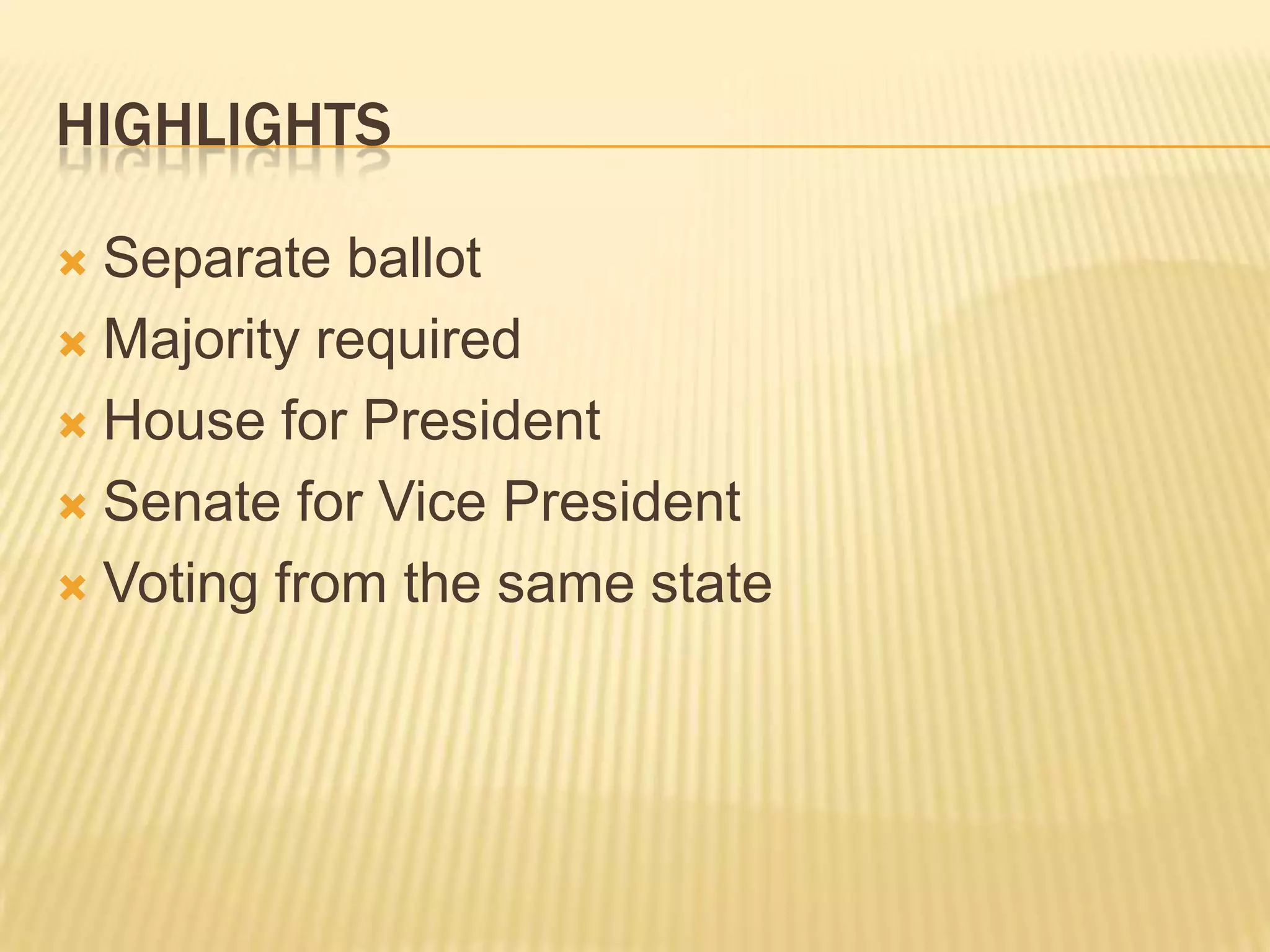
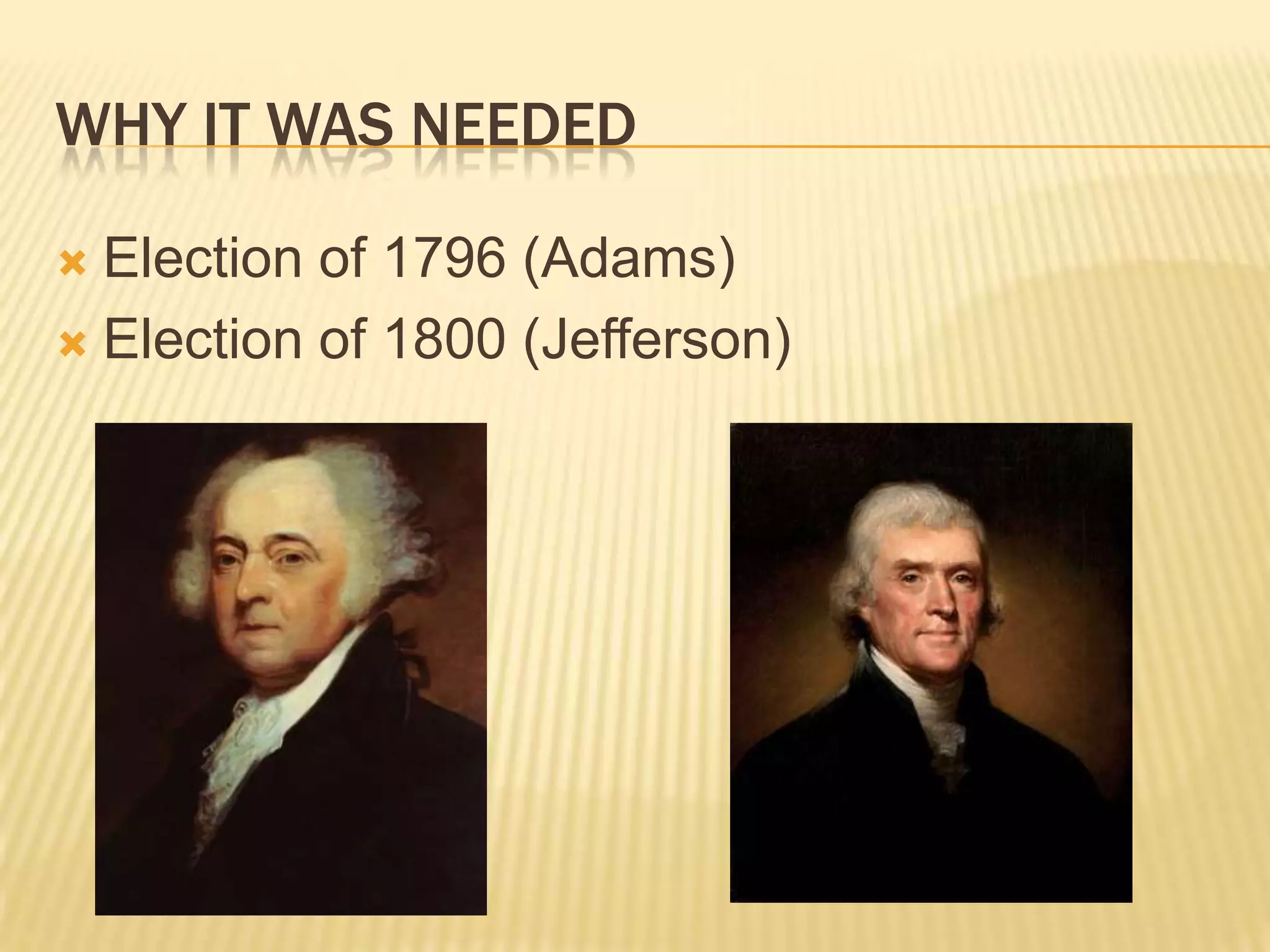
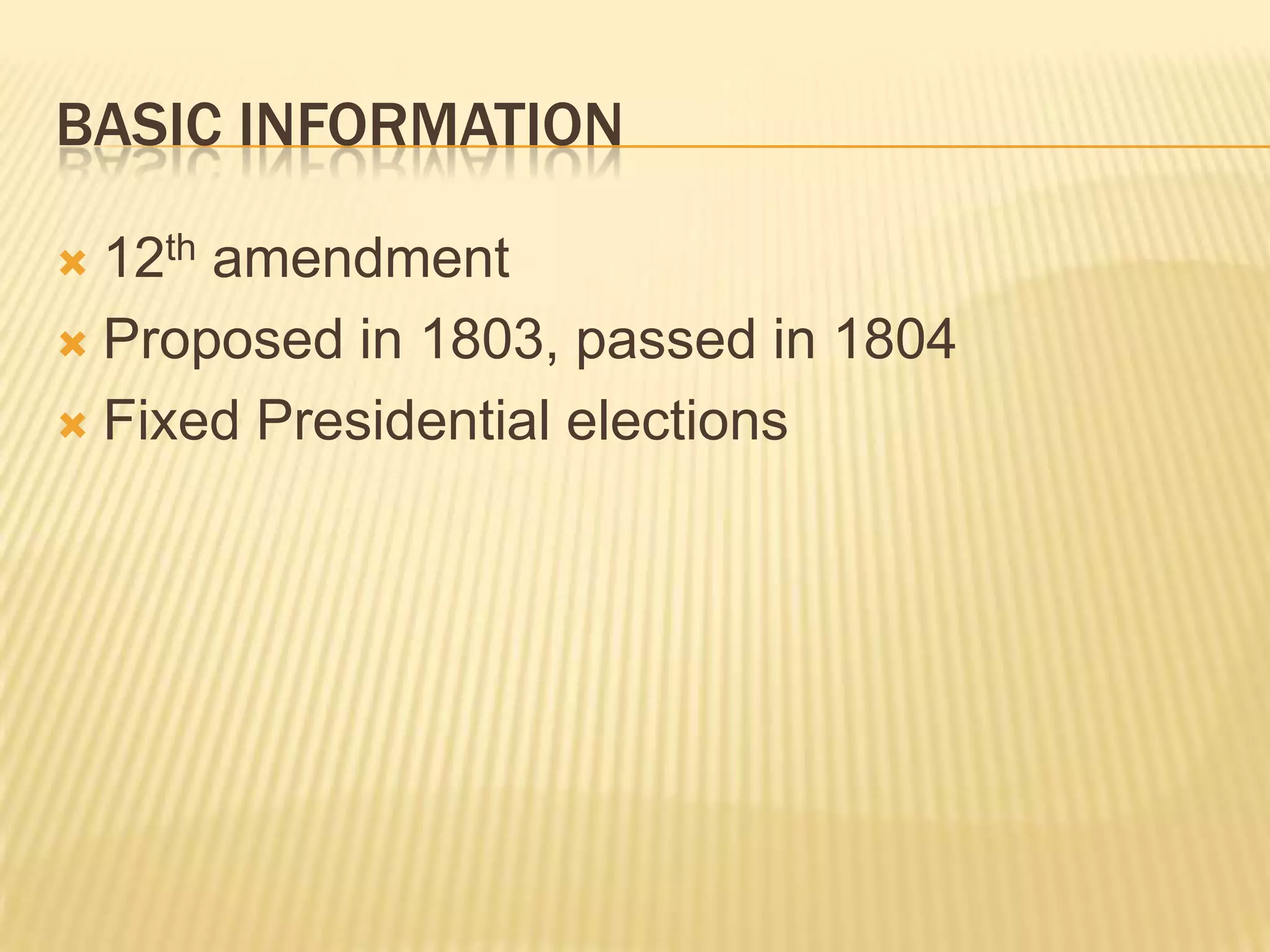
The 12th Amendment to the US Constitution, passed in 1804, made three key changes to Presidential elections:
1) Electors vote separately for President and Vice President on distinct ballots instead of two votes for President.
2) It requires a candidate to receive a majority of electoral votes to avoid having the House of Representatives decide the election.
3) If no candidate gets a majority, the House chooses the President and the Senate chooses the Vice President.
![TEXT
The Electors shall meet in their respective States and vote by ballot for President and Vice-
President, one of whom, at least, shall not be an inhabitant of the same State with themselves;
they shall name in their ballots the person voted for as President, and in distinct ballots the
person voted for as Vice-President, and of the number of votes for each, which lists they shall
sign and certify, and transmit sealed to the seat of the Government of the United States, directed
to the President of the Senate; the President of the Senate shall, in the presence of the Senate
and House of Representatives, open all the certificates and the votes shall then be counted; -
The person having the greatest number of votes for President, shall be the President, if such
number be a majority of the whole number of Electors appointed; and if no person have such
majority, then from the persons having the highest numbers not exceeding three on the list of
those voted for as President, the House of Representatives shall choose immediately, by ballot,
the President. But in choosing the President, the votes shall be taken by States, the
representation from each State having one vote; a quorum for this purpose shall consist of a
member or members from two-thirds of the States, and a majority of all the States shall be
necessary to a choice. And if the House of Representatives shall not choose a President
whenever the right of choice shall devolve upon them, [before the fourth day of March next
following,] then the Vice-President shall act as President, as in case of the death or other
constitutional disability of the President. The person having the greatest number of votes as
Vice-President, shall be the Vice-President, if such numbers be a majority of the whole number
of electors appointed, and if no person have a majority, then from the two highest numbers on
the list, the Senate shall choose the Vice-President; a quorum for the purpose shall consist of
two- thirds of the whole number of Senators, and a majority of the whole number shall be
necessary to a choice. But no person constitutionally ineligible to the office of President shall be](https://image.slidesharecdn.com/thetwelfthamendmenttotheunitedstatesconstitution-111103122137-phpapp01/75/The-twelfth-amendment-to-the-united-states-constitution-3-2048.jpg)