e Tru Files 
MOBILITY 
5 3.5 
TRU HEAT 
INDEX 
@BillBoorman and Natalia Shuman
10 /02 
EVENTS 
8,000field of recruiting. 48 
We scoured 
presentations and 
conversations from 
the last twelve 
months of TRU 
events to bring you 
the best forward-looking 
ideas in the 
ATTENDEES BIG IDEAS
MOBILITY /03 
HOW DOES 24-HOUR ACCESS CHANGE 
THE WAY WE ENGAGE JOB CANDIDATES? 
WILL YOU CHANGE YOUR MESSAGE WHEN 
YOU’RE REACHING JOB CANDIDATES AT HOME? 
TIME TO RETHINK HOW 
YOU REACH CANDIDATES.
In developed markets in the US, Europe and Asia, it’s become 
commonplace to talk about mobile as a segregated (or lesser) 
recruiting strategy. And in the years when smart phone adoption 
was less than 30 percent, such an approach made (some) sense. 
But visit markets like Poland or Russia—where the recruiting market is evolving and becoming 
formalized—and you’ll find no one talking about their mobile strategy as a segregated strategy. 
And that’s because web access and content consumption in those countries skipped the personal 
computer and went straight to mobile tablets and phones. Counterintuitively, recruiters in those 
markets are savvier about exploiting mobile channels than those in more established markets. 
Here’s why thinking about mobile matters so much regardless of geography: 40 percent of all 
emails are opened on mobile devices (i.e. phone and tablet). And 50 percent of average global 
mobile web users use their mobile either as their primary or exclusive online portal.1 
When a recruiter shares digital content, by email or through social channels, they must think 
clearly about whether the message works well on both mobile and desktop devices. What’s 
more, recruiters must consider the moment in which they’re interrupting prospects. Eighty 
percent of smartphone users and 81 percent of tablet users are using their devices while 
watching television. And 44 percent report sleeping with their devices by their side.2 
/04 
50% of mobile phone 
users say mobile 
is their primary 
internet source.3 
MOBILITY 
1, 2, 3 http://www.digitalbuzzblog.com/infographic-2013-mobile-growth-statistics/
MOBILITY /05 
Increasingly there are few boundaries between work and personal lives, which means your 
message may be opened during the work day, but it also may be opened while your candidate 
is watching television or cooking dinner. In fact, we’ve found the best time to reach job 
candidates is between 4:45 to 9:45 p.m.—those hours when they’re transitioning between work 
and home life, and when they’re most likely to be watching a screen for entertainment. 
This means two important things: (a) you’re battling for attention not against your competitors, 
but against every other source of information and entertainment; (b) you need 
to package your message in a way that’s as relevant and frictionless as possible for 
mobile users. 
Too often conversations about mobile are focused on the technology, but recruiters would be 
wise to think more about the moment. To offer a real-life example: When you reach out to your 
audience via email, the content within should more closely resemble an instant message than 
a letter. And yet, we bet 98 percent of companies send email newsletters and updates that 
resemble letters. Long, linear and just a tad too dry. Wrong.
MOBILITY /06 
Your content (and by content we’re talking about all the ways in which you keep in touch with 
both prospective candidates and active candidates) should be easy to read, easy to share 
and highly relevant. Headlines should be optimized and smart, content should be informative 
or entertaining, and, above all, your content should be highly targeted (even personalized). 
Remember, you’re competing against Buzzfeed, not the recruiter down the street. By opting-in 
to email newsletters or following your social feed, people are inviting you into their personal 
space. Be relevant and respectful. 
Job candidates really 
don’t want to apply by 
mobile. Think about 
how difficult it would 
be to fill in dozens 
of fields through a 
mobile device. What 
they really want is to 
connect via mobile.
/07 
MOBILITY 
MOBILE-OPTIMIZED 
OR APP? 
One decision companies face is whether to build an app to 
improve candidate experience or to simply ensure web 
content is mobile-optimized. 
Many companies believe mobile strategy is synonymous with app design—after all, 80 percent 
of time spent on mobile is spent inside apps according to DigitalBuzz. But the challenge of 
apps for recruiting is to design a solution that’s not a one-shot, short-term utility.4 If you design 
an app to help candidates navigate the application process, for example, then by default it’s 
likely to be useful for a matter of months. A great tool to be sure, but it shouldn’t be the only 
tactic in your mobile strategy. 
Beyond apps, employer brands must ensure their websites are mobile optimized—or easily 
navigable via a mobile device. There should be no pinching-to-zoom or anything else that 
forces your audience to overcome design limitations on their mobile devices. What’s more, 
both apps and mobile-optimized sites should leverage your visitors’ GPS data. If a potential 
candidate is viewing your content from Seattle, then immediately serve up openings in that 
metro area. 
4 http://www.digitalbuzzblog.com/infographic-2013-mobile-growth-statistics/
/08 
MOBILITY 
And one more thing: Job candidates really don’t want to apply via mobile. Think about how 
difficult it would be to fill in dozens of fields using a mobile device. What they really want is to 
connect via mobile. No need to make the application process mobile-optimized. 
CANDIDATE 
EXPERIENCE APPS 
The most interesting recruiting apps build in rich functionality and are part of an overall talent 
attraction effort. Yes, it should offer the basics, including a graphic that shows the status of an 
application … but apps can do so much more. 
You can ask candidates to pre-record an introductory interview on their smartphone to warm 
up the relationship. Help candidates prepare for the second-round interview with a custom 
interview guide, as well as a profile of each person they’ll meet. Offer directions to the company 
and check-in instructions. And finally, use the app as an integral part of onboarding to ensure a 
continuous, positive candidate experience. By thinking beyond the basics in app development, 
recruiters thrill (rather than just satisfy) their recruits, whether they become employees or not.
/09 
MOBILITY 
INVEST IN SOCIAL 
LISTENING 
The potential upside for companies that understand their audience, 
and how they use mobile, is truly profound. 
Consider this example: What if recruiters kept active lists of high-value candidates, and 
adopted a “listening” strategy to uncover job-searching signals (i.e. predictive online behavior). 
Updating a LinkedIn profile, for example, or aggressively increasing activity on professional 
social groups could signal to a recruiter that it’s time to reach out. 
And what if that communication was hyper-personalized? Just as ad networks serve up ads from 
retail sites you’ve recently visited online, so too recruiters could target potential candidates with 
positions related to the candidates’ recent searches online. 
Rather than thinking about mobile, it’s time to think about mobility—and all the implications 
of interconnectivity. How does 24-hour access change the way we message job candidates? 
And how will we design content to educate, entertain and enchant potential candidates in the 
moment we reach them through mobile devices?
/10 
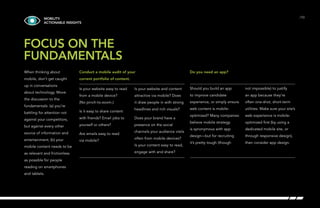
When thinking about 
mobile, don’t get caught 
up in conversations 
about technology. Move 
the discussion to the 
fundamentals: (a) you’re 
battling for attention not 
against your competitors, 
but against every other 
source of information and 
entertainment; (b) your 
mobile content needs to be 
as relevant and frictionless 
as possible for people 
reading on smartphones 
and tablets. 
Conduct a mobile audit of your 
current portfolio of content. 
Is your website easy to read 
from a mobile device? 
(No pinch-to-zoom.) 
Is it easy to share content 
with friends? Email jobs to 
yourself or others? 
Are emails easy to read 
via mobile? 
Is your website and content 
attractive via mobile? Does 
it draw people in with strong 
headlines and rich visuals? 
Does your brand have a 
presence on the social 
channels your audience visits 
often from mobile devices? 
Is your content easy to read, 
engage with and share? 
MOBILITY: 
ACTIONABLE INSIGHTS 
Do you need an app? 
Should you build an app 
to improve candidate 
experience, or simply ensure 
web content is mobile-optimized? 
Many companies 
believe mobile strategy 
is synonymous with app 
design—but for recruiting 
it’s pretty tough (though 
not impossible) to justify 
an app because they’re 
often one-shot, short-term 
utilities. Make sure your site’s 
web experience is mobile-optimized 
first (by using a 
dedicated mobile site, or 
through responsive design), 
then consider app design. 
FOCUS ON THE 
FUNDAMENTALS
MOBILITY /11 
THE #TRU STORY 
I first discovered the Unconference concept when I led a track at #RecruitFest in Toronto in 
1999. I was taken aback by the way discussion flowed and how different the format was to a 
traditional conference. I led a track all day under a tree and learnt far more than I gave. 
Two months later and back in the UK, we ran the first #truLondon at Canary Wharf in November 
2009. Today, we’re running dozens of #tru events a year across Europe, North America, Africa 
and the Asia-Pacific. Thousands of recruiters, HR leaders and providers come together in an 
informal spirit of information sharing and networking. 
#tru is based on the BarCamp principle, which means that everybody can be an active 
participant instead of listening to speakers and watching presentations all day. The emphasis is 
on communication and the free exchange of ideas and experiences where the participants fuel 
the conversations. 
BILL BOORMAN
MOBILITY /12 
THINK ABOUT HOW OFTEN YOUR REACH FOR SMART PHONE 
OR TABLET BEFORE YOU EVEN LEFT THE HOUSE THIS MORNING. 
Technological change means people are connected 24-hours a day, and this has already created 
a revolution in the way we reach job candidates and created a new sense of urgency in the way 
we communicate – with everyone. 
Mobile should be top-of-mind when thinking of strategies to attract top-talent and here’s why: 
40 per cent of all emails are opened on mobile devices like a smart phone or tablet, while 
50 per cent of average global mobile web users use their mobile as their primary or exclusive 
online portal. This also means that having a mobile-optimized career site or ATS is vital, as 
it allows for the most efficient exchange of information. Candidates can receive immediate 
information from a company, while recruiters are more able to keep information up-to-date and 
keep in touch with talent, which could result in a faster hiring cycles. 
When a recruiter shares digital content, by email or through social media channels, they must 
think clearly whether the message works well on both mobile and desktop devices, and if the 
message is compelling enough to make someone read it – now. 
You’re battling not only for attention not against your competitors but against every other 
source of information and entertainment. So it’s important to make sure your message and 
methods of recruiting are always mobile-ready. 
To learn more about the future of recruiting download the TRU File e-book 
MOBILITY @BillBoorman 
NATALIA SHUMAN 
NATALIA SHUMAN 
Senior Vice President and 
General Manager, EMEA and 
Asia Pacific Regions 
Board Director, 
TS Kelly Workforce Solutions, 
North Asia Joint-Venture 
Natalia is a global executive with 
broad general management and 
operational experience and 20 
years in the staffing industry. 
Her career with Kelly spans all 
three regions of the globe and a 
variety of leadership positions. 
Natalia thoroughly understands 
and appreciates cultural 
differences, talent trends, 
business practices and 
traditions in both emerging 
and developed markets. She is 
well positioned to consult with 
senior management of large and 
small companies on their talent 
acquisition and management 
issues and to positively impact 
their outlook, helping them to 
grow and stay competitive.
For more thought leadership go to talentproject.com 
EXIT 
2 
1 
TO LEARN MORE ABOUT THE FUTURE OF RECRUITING, 
DOWNLOAD THE FOLLOWING TRU FILES EBOOKS. 
e Tru Files 
CANDIDATE EXPERIENCE 
2 
3.5 
TRU HEAT 
INDEX 
e Tru Files 
CULTURE BRANDING 
5.0 
TRU HEAT 
INDEX 
e Tru Files 
MOBILITY 
5 
3.5 
5.0 
5.0 
ABOUT KELLY SERVICES® 
Kelly Services, Inc. (NASDAQ: KELYA, KELYB) is a leader in providing workforce solutions. Kelly® offers a 
comprehensive array of outsourcing and consulting services as well as world-class staffing on a temporary, 
temporary-to-hire, and direct-hire basis. Serving clients around the globe, Kelly provided employment to 
approximately 540,000 employees in 2013. Revenue in 2013 was $5.4 billion. Visit kellyservices.com and connect 
with us on Facebook, LinkedIn, and Twitter. Download The Talent Project, a free iPad® app by Kelly Services. 
This information may not be published, broadcast, sold, or otherwise distributed without prior written permission from the authorized party. 
All trademarks are property of their respective owners. An Equal Opportunity Employer. © 2014 Kelly Services, Inc. 
TRU HEAT 
INDEX e Tru Files 
HIRE WORK, NOT WORKERS 
8 
TRU HEAT 
INDEX 
e Tru Files 
ASSESSMENTS 
3 
4.0 
TRU HEAT 
INDEX 
e Tru Files 
SOURCING TECHNOLOGY 
6 4.0 
TRU HEAT 
INDEX 
e Tru Files 
GAMIFICATION 
9 3.5 
TRU HEAT 
INDEX 
e Tru Files 
VIDEO INTERVIEWING 
4 
3.5 
TRU HEAT 
INDEX e Tru Files 
NEW ROLE OF THE RECRUITER 
7 TRU HEAT 
INDEX 
e Tru Files 
SOCIAL RECRUITING  PERSONALIZATION 
4.0 
TRU HEAT 
INDEX

The Tru Files - Mobility

  • 1.
    e Tru Files MOBILITY 5 3.5 TRU HEAT INDEX @BillBoorman and Natalia Shuman
  • 2.
    10 /02 EVENTS 8,000field of recruiting. 48 We scoured presentations and conversations from the last twelve months of TRU events to bring you the best forward-looking ideas in the ATTENDEES BIG IDEAS
  • 3.
    MOBILITY /03 HOWDOES 24-HOUR ACCESS CHANGE THE WAY WE ENGAGE JOB CANDIDATES? WILL YOU CHANGE YOUR MESSAGE WHEN YOU’RE REACHING JOB CANDIDATES AT HOME? TIME TO RETHINK HOW YOU REACH CANDIDATES.
  • 4.
    In developed marketsin the US, Europe and Asia, it’s become commonplace to talk about mobile as a segregated (or lesser) recruiting strategy. And in the years when smart phone adoption was less than 30 percent, such an approach made (some) sense. But visit markets like Poland or Russia—where the recruiting market is evolving and becoming formalized—and you’ll find no one talking about their mobile strategy as a segregated strategy. And that’s because web access and content consumption in those countries skipped the personal computer and went straight to mobile tablets and phones. Counterintuitively, recruiters in those markets are savvier about exploiting mobile channels than those in more established markets. Here’s why thinking about mobile matters so much regardless of geography: 40 percent of all emails are opened on mobile devices (i.e. phone and tablet). And 50 percent of average global mobile web users use their mobile either as their primary or exclusive online portal.1 When a recruiter shares digital content, by email or through social channels, they must think clearly about whether the message works well on both mobile and desktop devices. What’s more, recruiters must consider the moment in which they’re interrupting prospects. Eighty percent of smartphone users and 81 percent of tablet users are using their devices while watching television. And 44 percent report sleeping with their devices by their side.2 /04 50% of mobile phone users say mobile is their primary internet source.3 MOBILITY 1, 2, 3 http://www.digitalbuzzblog.com/infographic-2013-mobile-growth-statistics/
  • 5.
    MOBILITY /05 Increasinglythere are few boundaries between work and personal lives, which means your message may be opened during the work day, but it also may be opened while your candidate is watching television or cooking dinner. In fact, we’ve found the best time to reach job candidates is between 4:45 to 9:45 p.m.—those hours when they’re transitioning between work and home life, and when they’re most likely to be watching a screen for entertainment. This means two important things: (a) you’re battling for attention not against your competitors, but against every other source of information and entertainment; (b) you need to package your message in a way that’s as relevant and frictionless as possible for mobile users. Too often conversations about mobile are focused on the technology, but recruiters would be wise to think more about the moment. To offer a real-life example: When you reach out to your audience via email, the content within should more closely resemble an instant message than a letter. And yet, we bet 98 percent of companies send email newsletters and updates that resemble letters. Long, linear and just a tad too dry. Wrong.
  • 6.
    MOBILITY /06 Yourcontent (and by content we’re talking about all the ways in which you keep in touch with both prospective candidates and active candidates) should be easy to read, easy to share and highly relevant. Headlines should be optimized and smart, content should be informative or entertaining, and, above all, your content should be highly targeted (even personalized). Remember, you’re competing against Buzzfeed, not the recruiter down the street. By opting-in to email newsletters or following your social feed, people are inviting you into their personal space. Be relevant and respectful. Job candidates really don’t want to apply by mobile. Think about how difficult it would be to fill in dozens of fields through a mobile device. What they really want is to connect via mobile.
  • 7.
    /07 MOBILITY MOBILE-OPTIMIZED OR APP? One decision companies face is whether to build an app to improve candidate experience or to simply ensure web content is mobile-optimized. Many companies believe mobile strategy is synonymous with app design—after all, 80 percent of time spent on mobile is spent inside apps according to DigitalBuzz. But the challenge of apps for recruiting is to design a solution that’s not a one-shot, short-term utility.4 If you design an app to help candidates navigate the application process, for example, then by default it’s likely to be useful for a matter of months. A great tool to be sure, but it shouldn’t be the only tactic in your mobile strategy. Beyond apps, employer brands must ensure their websites are mobile optimized—or easily navigable via a mobile device. There should be no pinching-to-zoom or anything else that forces your audience to overcome design limitations on their mobile devices. What’s more, both apps and mobile-optimized sites should leverage your visitors’ GPS data. If a potential candidate is viewing your content from Seattle, then immediately serve up openings in that metro area. 4 http://www.digitalbuzzblog.com/infographic-2013-mobile-growth-statistics/
  • 8.
    /08 MOBILITY Andone more thing: Job candidates really don’t want to apply via mobile. Think about how difficult it would be to fill in dozens of fields using a mobile device. What they really want is to connect via mobile. No need to make the application process mobile-optimized. CANDIDATE EXPERIENCE APPS The most interesting recruiting apps build in rich functionality and are part of an overall talent attraction effort. Yes, it should offer the basics, including a graphic that shows the status of an application … but apps can do so much more. You can ask candidates to pre-record an introductory interview on their smartphone to warm up the relationship. Help candidates prepare for the second-round interview with a custom interview guide, as well as a profile of each person they’ll meet. Offer directions to the company and check-in instructions. And finally, use the app as an integral part of onboarding to ensure a continuous, positive candidate experience. By thinking beyond the basics in app development, recruiters thrill (rather than just satisfy) their recruits, whether they become employees or not.
  • 9.
    /09 MOBILITY INVESTIN SOCIAL LISTENING The potential upside for companies that understand their audience, and how they use mobile, is truly profound. Consider this example: What if recruiters kept active lists of high-value candidates, and adopted a “listening” strategy to uncover job-searching signals (i.e. predictive online behavior). Updating a LinkedIn profile, for example, or aggressively increasing activity on professional social groups could signal to a recruiter that it’s time to reach out. And what if that communication was hyper-personalized? Just as ad networks serve up ads from retail sites you’ve recently visited online, so too recruiters could target potential candidates with positions related to the candidates’ recent searches online. Rather than thinking about mobile, it’s time to think about mobility—and all the implications of interconnectivity. How does 24-hour access change the way we message job candidates? And how will we design content to educate, entertain and enchant potential candidates in the moment we reach them through mobile devices?
  • 10.
    /10 When thinkingabout mobile, don’t get caught up in conversations about technology. Move the discussion to the fundamentals: (a) you’re battling for attention not against your competitors, but against every other source of information and entertainment; (b) your mobile content needs to be as relevant and frictionless as possible for people reading on smartphones and tablets. Conduct a mobile audit of your current portfolio of content. Is your website easy to read from a mobile device? (No pinch-to-zoom.) Is it easy to share content with friends? Email jobs to yourself or others? Are emails easy to read via mobile? Is your website and content attractive via mobile? Does it draw people in with strong headlines and rich visuals? Does your brand have a presence on the social channels your audience visits often from mobile devices? Is your content easy to read, engage with and share? MOBILITY: ACTIONABLE INSIGHTS Do you need an app? Should you build an app to improve candidate experience, or simply ensure web content is mobile-optimized? Many companies believe mobile strategy is synonymous with app design—but for recruiting it’s pretty tough (though not impossible) to justify an app because they’re often one-shot, short-term utilities. Make sure your site’s web experience is mobile-optimized first (by using a dedicated mobile site, or through responsive design), then consider app design. FOCUS ON THE FUNDAMENTALS
  • 11.
    MOBILITY /11 THE#TRU STORY I first discovered the Unconference concept when I led a track at #RecruitFest in Toronto in 1999. I was taken aback by the way discussion flowed and how different the format was to a traditional conference. I led a track all day under a tree and learnt far more than I gave. Two months later and back in the UK, we ran the first #truLondon at Canary Wharf in November 2009. Today, we’re running dozens of #tru events a year across Europe, North America, Africa and the Asia-Pacific. Thousands of recruiters, HR leaders and providers come together in an informal spirit of information sharing and networking. #tru is based on the BarCamp principle, which means that everybody can be an active participant instead of listening to speakers and watching presentations all day. The emphasis is on communication and the free exchange of ideas and experiences where the participants fuel the conversations. BILL BOORMAN
  • 12.
    MOBILITY /12 THINKABOUT HOW OFTEN YOUR REACH FOR SMART PHONE OR TABLET BEFORE YOU EVEN LEFT THE HOUSE THIS MORNING. Technological change means people are connected 24-hours a day, and this has already created a revolution in the way we reach job candidates and created a new sense of urgency in the way we communicate – with everyone. Mobile should be top-of-mind when thinking of strategies to attract top-talent and here’s why: 40 per cent of all emails are opened on mobile devices like a smart phone or tablet, while 50 per cent of average global mobile web users use their mobile as their primary or exclusive online portal. This also means that having a mobile-optimized career site or ATS is vital, as it allows for the most efficient exchange of information. Candidates can receive immediate information from a company, while recruiters are more able to keep information up-to-date and keep in touch with talent, which could result in a faster hiring cycles. When a recruiter shares digital content, by email or through social media channels, they must think clearly whether the message works well on both mobile and desktop devices, and if the message is compelling enough to make someone read it – now. You’re battling not only for attention not against your competitors but against every other source of information and entertainment. So it’s important to make sure your message and methods of recruiting are always mobile-ready. To learn more about the future of recruiting download the TRU File e-book MOBILITY @BillBoorman NATALIA SHUMAN NATALIA SHUMAN Senior Vice President and General Manager, EMEA and Asia Pacific Regions Board Director, TS Kelly Workforce Solutions, North Asia Joint-Venture Natalia is a global executive with broad general management and operational experience and 20 years in the staffing industry. Her career with Kelly spans all three regions of the globe and a variety of leadership positions. Natalia thoroughly understands and appreciates cultural differences, talent trends, business practices and traditions in both emerging and developed markets. She is well positioned to consult with senior management of large and small companies on their talent acquisition and management issues and to positively impact their outlook, helping them to grow and stay competitive.
  • 13.
    For more thoughtleadership go to talentproject.com EXIT 2 1 TO LEARN MORE ABOUT THE FUTURE OF RECRUITING, DOWNLOAD THE FOLLOWING TRU FILES EBOOKS. e Tru Files CANDIDATE EXPERIENCE 2 3.5 TRU HEAT INDEX e Tru Files CULTURE BRANDING 5.0 TRU HEAT INDEX e Tru Files MOBILITY 5 3.5 5.0 5.0 ABOUT KELLY SERVICES® Kelly Services, Inc. (NASDAQ: KELYA, KELYB) is a leader in providing workforce solutions. Kelly® offers a comprehensive array of outsourcing and consulting services as well as world-class staffing on a temporary, temporary-to-hire, and direct-hire basis. Serving clients around the globe, Kelly provided employment to approximately 540,000 employees in 2013. Revenue in 2013 was $5.4 billion. Visit kellyservices.com and connect with us on Facebook, LinkedIn, and Twitter. Download The Talent Project, a free iPad® app by Kelly Services. This information may not be published, broadcast, sold, or otherwise distributed without prior written permission from the authorized party. All trademarks are property of their respective owners. An Equal Opportunity Employer. © 2014 Kelly Services, Inc. TRU HEAT INDEX e Tru Files HIRE WORK, NOT WORKERS 8 TRU HEAT INDEX e Tru Files ASSESSMENTS 3 4.0 TRU HEAT INDEX e Tru Files SOURCING TECHNOLOGY 6 4.0 TRU HEAT INDEX e Tru Files GAMIFICATION 9 3.5 TRU HEAT INDEX e Tru Files VIDEO INTERVIEWING 4 3.5 TRU HEAT INDEX e Tru Files NEW ROLE OF THE RECRUITER 7 TRU HEAT INDEX e Tru Files SOCIAL RECRUITING PERSONALIZATION 4.0 TRU HEAT INDEX