The Subprime Student Loan Scheme The Gateway Drug to Debt Slavery
Last year, a new debt surpassed our consumer credit addiction . . .
The Student Loan
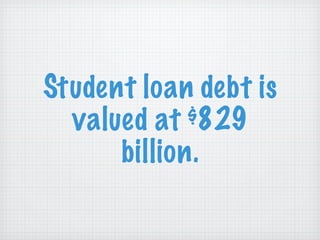
Student loan debt is valued at $829 billion.
But how did it get this way?
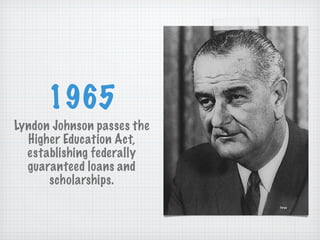
1965 Lyndon Johnson passes the Higher Education Act, establishing federally guaranteed loans and scholarships.
1978 After stories of doctors and lawyers declaring bankruptcy immediately following graduation from medical and law school, and thus discharging their student loan debt, the  Bankruptcy Reform Act  prevented discharge of loan debt for five years after first payment.
1978 The actual discharge rate was less than 1% . . .
1990 Non-discharge period extended to seven years.
1998 Congress completely eliminates ability to discharge student loan debt through bankruptcy. This also applies for debt from criminal acts (such as when someone sues you for murder) and debt from fraud. Student loans are the only federal loan with this  “ no-escape ”  clause.
2005 Amendments to the Bankruptcy code extend the  “ no-escape ”  clause to private student loans. Now all student loans, federal and private, are almost impossible to discharge.
Additionally, the following protections were removed from student loans . . .
Statute of Limitations: This means that debt collectors can keep collecting on your student debt until you repay it, whereas other debts are forgiven after a set number of years.
Fair Debt Collection Practices Act: Eliminated the regulation of debt collection from student loans.
Adherence to state usury laws: Student loans can now charge more interest than legally allowed by individual states.
The right to refinance
The harshest collection methods are reserved for student loans, including: Wage garnishment without a court order Suspension of state professional licenses Garnishment of social security/disability income Withholding of IRS tax refunds
Why?
Because it ’ s INSANELY profitable.
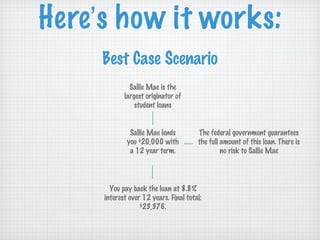
Here ’ s how it works: Sallie Mae is the largest originator of student loans Sallie Mae lends you $20,000 with a 12 year term. The federal government guarantees the full amount of this loan. There is no risk to Sallie Mae You pay back the loan at 8.8% interest over 12 years. Final total: $23,376. Best Case Scenario
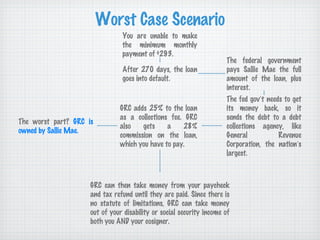
Worst Case Scenario You are unable to make the minimum monthly payment of $293. After 270 days, the loan goes into default. The federal government pays Sallie Mae the full amount of the loan, plus interest. The fed gov ’ t needs to get its money back, so it sends the debt to a debt collections agency, like General Revenue Corporation, the nation ’ s largest. GRC adds 25% to the loan as a collections fee. GRC also gets a 28% commission on the loan, which you have to pay. The worst part?  GRC is owned by Sallie Mae. GRC can then take money from your paycheck and tax refund until they are paid. Since there is no statute of limitations, GRC can take money out of your disability or social security income of both you AND your cosigner.
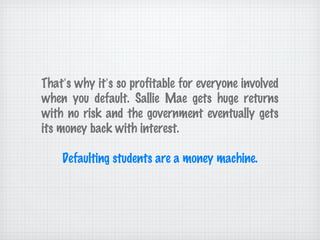
That ’ s why it ’ s so profitable for everyone involved when you default. Sallie Mae gets huge returns with no risk and the government eventually gets its money back with interest. Defaulting students are a money machine.
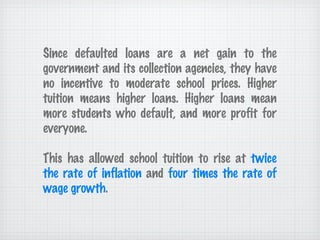
Since defaulted loans are a net gain to the government and its collection agencies, they have no incentive to moderate school prices. Higher tuition means higher loans. Higher loans mean more students who default, and more profit for everyone. This has allowed school tuition to rise at  twice the rate of inflation  and  four times the rate of wage growth .
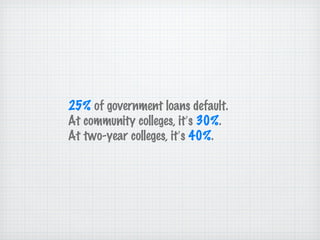
25%  of government loans default. At community colleges, it ’ s  30% . At two-year colleges, it ’ s  40% .
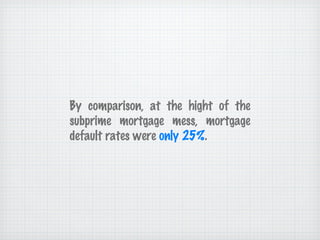
By comparison, at the hight of the subprime mortgage mess, mortgage default rates were  only 25% .
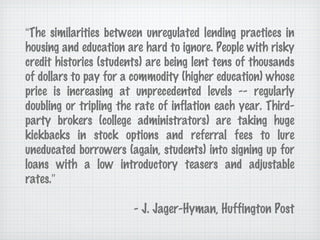
“ The similarities between unregulated lending practices in housing and education are hard to ignore. People with risky credit histories (students) are being lent tens of thousands of dollars to pay for a commodity (higher education) whose price is increasing at unprecedented levels -- regularly doubling or tripling the rate of inflation each year. Third-party brokers (college administrators) are taking huge kickbacks in stock options and referral fees to lure uneducated borrowers (again, students) into signing up for loans with a low introductory teasers and adjustable rates. ” - J. Jager-Hyman, Huffington Post
However, there is  hope .
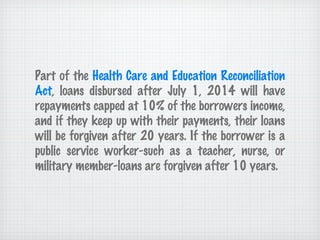
Part of the  Health Care and Education Reconciliation Act , loans disbursed after July 1, 2014 will have repayments capped at 10% of the borrowers income, and if they keep up with their payments, their loans will be forgiven after 20 years. If the borrower is a public service worker-such as a teacher, nurse, or military member-loans are forgiven after 10 years.
Sources: Based largely on  “ The Student Loan Scheme, ”  an infographic from collegescholarships.org. All references to federal actions and documents were augmented with an examination of the original text, with comprehension assistance from ed.gov ( “ Common Disputes Involving Defaulted Student Loans ” ). “ The $555,000 Student-Loan Burden ”  by Mary Pilon,  Wall Street Journal , online.wsj.com “ Subprime Mortgage and Student Loan Parallels ”  by Joie Jager-Hyman,  Huffington Post , huffingtonpost.com

The Subprime Student Loan Scheme

  • 1.
    The Subprime StudentLoan Scheme The Gateway Drug to Debt Slavery
  • 2.
    Last year, anew debt surpassed our consumer credit addiction . . .
  • 3.
  • 4.
    Student loan debtis valued at $829 billion.
  • 5.
    But how didit get this way?
  • 6.
    1965 Lyndon Johnsonpasses the Higher Education Act, establishing federally guaranteed loans and scholarships.
  • 7.
    1978 After storiesof doctors and lawyers declaring bankruptcy immediately following graduation from medical and law school, and thus discharging their student loan debt, the Bankruptcy Reform Act prevented discharge of loan debt for five years after first payment.
  • 8.
    1978 The actualdischarge rate was less than 1% . . .
  • 9.
    1990 Non-discharge periodextended to seven years.
  • 10.
    1998 Congress completelyeliminates ability to discharge student loan debt through bankruptcy. This also applies for debt from criminal acts (such as when someone sues you for murder) and debt from fraud. Student loans are the only federal loan with this “ no-escape ” clause.
  • 11.
    2005 Amendments tothe Bankruptcy code extend the “ no-escape ” clause to private student loans. Now all student loans, federal and private, are almost impossible to discharge.
  • 12.
    Additionally, the followingprotections were removed from student loans . . .
  • 13.
    Statute of Limitations:This means that debt collectors can keep collecting on your student debt until you repay it, whereas other debts are forgiven after a set number of years.
  • 14.
    Fair Debt CollectionPractices Act: Eliminated the regulation of debt collection from student loans.
  • 15.
    Adherence to stateusury laws: Student loans can now charge more interest than legally allowed by individual states.
  • 16.
    The right torefinance
  • 17.
    The harshest collectionmethods are reserved for student loans, including: Wage garnishment without a court order Suspension of state professional licenses Garnishment of social security/disability income Withholding of IRS tax refunds
  • 18.
  • 19.
    Because it ’s INSANELY profitable.
  • 20.
    Here ’ show it works: Sallie Mae is the largest originator of student loans Sallie Mae lends you $20,000 with a 12 year term. The federal government guarantees the full amount of this loan. There is no risk to Sallie Mae You pay back the loan at 8.8% interest over 12 years. Final total: $23,376. Best Case Scenario
  • 21.
    Worst Case ScenarioYou are unable to make the minimum monthly payment of $293. After 270 days, the loan goes into default. The federal government pays Sallie Mae the full amount of the loan, plus interest. The fed gov ’ t needs to get its money back, so it sends the debt to a debt collections agency, like General Revenue Corporation, the nation ’ s largest. GRC adds 25% to the loan as a collections fee. GRC also gets a 28% commission on the loan, which you have to pay. The worst part? GRC is owned by Sallie Mae. GRC can then take money from your paycheck and tax refund until they are paid. Since there is no statute of limitations, GRC can take money out of your disability or social security income of both you AND your cosigner.
  • 22.
    That ’ swhy it ’ s so profitable for everyone involved when you default. Sallie Mae gets huge returns with no risk and the government eventually gets its money back with interest. Defaulting students are a money machine.
  • 23.
    Since defaulted loansare a net gain to the government and its collection agencies, they have no incentive to moderate school prices. Higher tuition means higher loans. Higher loans mean more students who default, and more profit for everyone. This has allowed school tuition to rise at twice the rate of inflation and four times the rate of wage growth .
  • 24.
    25% ofgovernment loans default. At community colleges, it ’ s 30% . At two-year colleges, it ’ s 40% .
  • 25.
    By comparison, atthe hight of the subprime mortgage mess, mortgage default rates were only 25% .
  • 26.
    “ The similaritiesbetween unregulated lending practices in housing and education are hard to ignore. People with risky credit histories (students) are being lent tens of thousands of dollars to pay for a commodity (higher education) whose price is increasing at unprecedented levels -- regularly doubling or tripling the rate of inflation each year. Third-party brokers (college administrators) are taking huge kickbacks in stock options and referral fees to lure uneducated borrowers (again, students) into signing up for loans with a low introductory teasers and adjustable rates. ” - J. Jager-Hyman, Huffington Post
  • 27.
  • 28.
    Part of the Health Care and Education Reconciliation Act , loans disbursed after July 1, 2014 will have repayments capped at 10% of the borrowers income, and if they keep up with their payments, their loans will be forgiven after 20 years. If the borrower is a public service worker-such as a teacher, nurse, or military member-loans are forgiven after 10 years.
  • 29.
    Sources: Based largelyon “ The Student Loan Scheme, ” an infographic from collegescholarships.org. All references to federal actions and documents were augmented with an examination of the original text, with comprehension assistance from ed.gov ( “ Common Disputes Involving Defaulted Student Loans ” ). “ The $555,000 Student-Loan Burden ” by Mary Pilon, Wall Street Journal , online.wsj.com “ Subprime Mortgage and Student Loan Parallels ” by Joie Jager-Hyman, Huffington Post , huffingtonpost.com