Download to read offline
![International Research Journal of Engineering and Technology (IRJET) e-ISSN: 2395-0056
Volume: 04 Issue: 10 | Oct -2017 www.irjet.net p-ISSN: 2395-0072
© 2017, IRJET | Impact Factor value: 5.181 | ISO 9001:2008 Certified Journal | Page 247
The Study of the Large Scale Twitter on Machine Learning
ABHISH IJARI
Dept of Information Science and Engineering, KLEIT, Hubballi, Karnataka, India
--------------------------------------------------------------------------------***-------------------------------------------------------------------------
Abstract – The major rate of data-driven in success of
finding solutions to different problems, The amount of data
with dropping costs and processing that has led in large
scale machine. The work on this project on a study of
Twitter’s integration tools with that on a tool into an
existing Hadoop based Pig-centric platform. The main role
on this platform handles business intelligence task and data
warehousing. The core of this work exist in mainly recent
extensions of Pig in provide predictive analytics capabilities
that incorporate machine learning, specifically focused on
super-vised classification. Thus on a scale it has identified
technique of a stochastic gradient for learning online and
highly amenable for scaling out large amount of data. The
machine learning enables success in an sample of a data on
an training and testing which achieves directly in Pig,
because an crafted loaders and storage function can Pig
script it integration. With an existing infrastructure,
screening out of a production environment will become
libraries for script in material output.
Key Words: stochastic gradient descent, online
learning, ensembles, logistic regression
1. INTRODUCTION
Hadoop, the open-source implementation of Map Reduce
[15], has emerged as a popular framework for large-scale
data processing. Among its advantages are the ability to
horizontally scale to petabytes of data on thousands of
commodity servers, easy-to-understand programming.
With high degree of fault tolerance. Although originally
designed for applications such as text analysis, web
indexing, and graph processing, Hadoop can be applied to
manage structured data as well as dirty" semi structured
datasets with inconsistent schema, missing ends, and
invalid values. More schematically the termed predictive
analysis on fundamental contribution in a case study can
experience a generalized organisation that exploit a new
breed of engineers known as data scientists.
Today, Hadoop enjoys widespread adoption in
organizations ranging from two-person start-ups to
Fortune 500 companies. It lies at the core of a software
stack for large-scale analytics, and owes a large part of its
success to a vibrant ecosystem. For example, Pig [37] and
Hive [47] provide higher-level languages for data analysis:
a data ow language called Pig Latin and a dialect of SQL,
respectively. H-Base the open source implements of
Google’s Big-Table [13], provides a convenient data model.
1.1 Descriptive Statistics
The value of a Hadoop-based stack for traditional"
data warehousing and business intelligence tasks has
already been demonstrated by organizations such as
Facebook, LinkedIn, and Twitter (e.g., [22, 41]). This value
proposition also lies at the centre of a growing list of start-
ups and large companies that have entered the big data"
game. Common tasks include ETL, joining multiple
disparate data sources, followed by altering, aggregation,
or cube materialization. Statisticians might use the phrase
descriptive statistics to describe this type of analysis.
These outputs might feed report generators, frontend
dashboards, and other visualization tools to support
common roll up" and drill down" operations on multi-
dimensional data. Hadoop-based plat-forms have also been
successful in supporting ad hoc queries by a new breed of
engineers known as data scientists”. The success of the
Hadoop platform drives infrastructure developers to build
increasingly powerful tools, which data scientists and
other engineers can exploit to extract insights from
massive amounts of data. In particular, we focus on
machine learning techniques that enable what might be
best termed predictive analytics. We readily acknowledge
that this paper does not present any fundamental
contributions to machine learning. Rather, we focus on
end-to-end machine learning workflows and integration
issues in a production environment. Although specifically a
case study, we believe that these experiences can be
generalized to other organizations and contexts, and
therefore are valuable to the community.
2. BACKGROUND AND RELATED WORK
We begin with a brief overview of machine learning. Let
X be the input space and Y be the output space. Given set of
training samples D = f(x1; y1); (x2; y2):::(xn; yn)g from the
space X Y (called labelled examples or instances), the
supervised machine learning task is to induce a function f :
X ! Y that best explains the training data. The notion of
best" is usually captured in terms of minimizing loss",
via a function L which quantities the discrepancy between
the functional prediction f(xi) and the actual output yi, for
details, we refer the reader to standard textbooks. There](https://image.slidesharecdn.com/irjet-v4i1044-171124100037/85/The-Study-of-the-Large-Scale-Twitter-on-Machine-Learning-1-320.jpg)
![International Research Journal of Engineering and Technology (IRJET) e-ISSN: 2395-0056
Volume: 04 Issue: 10 | Oct -2017 www.irjet.net p-ISSN: 2395-0072
© 2017, IRJET | Impact Factor value: 5.181 | ISO 9001:2008 Certified Journal | Page 247
The Study of the Large Scale Twitter on Machine Learning
ABHISH IJARI
Dept of Information Science and Engineering, KLEIT, Hubballi, Karnataka, India
--------------------------------------------------------------------------------***-------------------------------------------------------------------------
Abstract – The major rate of data-driven in success of
finding solutions to different problems, The amount of data
with dropping costs and processing that has led in large
scale machine. The work on this project on a study of
Twitter’s integration tools with that on a tool into an
existing Hadoop based Pig-centric platform. The main role
on this platform handles business intelligence task and data
warehousing. The core of this work exist in mainly recent
extensions of Pig in provide predictive analytics capabilities
that incorporate machine learning, specifically focused on
super-vised classification. Thus on a scale it has identified
technique of a stochastic gradient for learning online and
highly amenable for scaling out large amount of data. The
machine learning enables success in an sample of a data on
an training and testing which achieves directly in Pig,
because an crafted loaders and storage function can Pig
script it integration. With an existing infrastructure,
screening out of a production environment will become
libraries for script in material output.
Key Words: stochastic gradient descent, online
learning, ensembles, logistic regression
1. INTRODUCTION
Hadoop, the open-source implementation of Map Reduce
[15], has emerged as a popular framework for large-scale
data processing. Among its advantages are the ability to
horizontally scale to petabytes of data on thousands of
commodity servers, easy-to-understand programming.
With high degree of fault tolerance. Although originally
designed for applications such as text analysis, web
indexing, and graph processing, Hadoop can be applied to
manage structured data as well as dirty" semi structured
datasets with inconsistent schema, missing ends, and
invalid values. More schematically the termed predictive
analysis on fundamental contribution in a case study can
experience a generalized organisation that exploit a new
breed of engineers known as data scientists.
Today, Hadoop enjoys widespread adoption in
organizations ranging from two-person start-ups to
Fortune 500 companies. It lies at the core of a software
stack for large-scale analytics, and owes a large part of its
success to a vibrant ecosystem. For example, Pig [37] and
Hive [47] provide higher-level languages for data analysis:
a data ow language called Pig Latin and a dialect of SQL,
respectively. H-Base the open source implements of
Google’s Big-Table [13], provides a convenient data model.
1.1 Descriptive Statistics
The value of a Hadoop-based stack for traditional"
data warehousing and business intelligence tasks has
already been demonstrated by organizations such as
Facebook, LinkedIn, and Twitter (e.g., [22, 41]). This value
proposition also lies at the centre of a growing list of start-
ups and large companies that have entered the big data"
game. Common tasks include ETL, joining multiple
disparate data sources, followed by altering, aggregation,
or cube materialization. Statisticians might use the phrase
descriptive statistics to describe this type of analysis.
These outputs might feed report generators, frontend
dashboards, and other visualization tools to support
common roll up" and drill down" operations on multi-
dimensional data. Hadoop-based plat-forms have also been
successful in supporting ad hoc queries by a new breed of
engineers known as data scientists”. The success of the
Hadoop platform drives infrastructure developers to build
increasingly powerful tools, which data scientists and
other engineers can exploit to extract insights from
massive amounts of data. In particular, we focus on
machine learning techniques that enable what might be
best termed predictive analytics. We readily acknowledge
that this paper does not present any fundamental
contributions to machine learning. Rather, we focus on
end-to-end machine learning workflows and integration
issues in a production environment. Although specifically a
case study, we believe that these experiences can be
generalized to other organizations and contexts, and
therefore are valuable to the community.
2. BACKGROUND AND RELATED WORK
We begin with a brief overview of machine learning. Let
X be the input space and Y be the output space. Given set of
training samples D = f(x1; y1); (x2; y2):::(xn; yn)g from the
space X Y (called labelled examples or instances), the
supervised machine learning task is to induce a function f :
X ! Y that best explains the training data. The notion of
best" is usually captured in terms of minimizing loss",
via a function L which quantities the discrepancy between
the functional prediction f(xi) and the actual output yi, for
details, we refer the reader to standard textbooks. There](https://image.slidesharecdn.com/irjet-v4i1044-171124100037/75/The-Study-of-the-Large-Scale-Twitter-on-Machine-Learning-1-2048.jpg)
![International Research Journal of Engineering and Technology (IRJET) e-ISSN: 2395-0056
Volume: 04 Issue: 10 | Oct -2017 www.irjet.net p-ISSN: 2395-0072
© 2017, IRJET | Impact Factor value: 5.181 | ISO 9001:2008 Certified Journal | Page 248
are three main components of a machine learning solution:
the data, features extracted from the data, and the model.
Accumulated experience over the last decade has shown
that in real-world settings, the size of the dataset is the
most important factor. Studies have repeatedly shown that
simple models trained over enormous quantities of data
outperform more sophisticated models trained on less
data. Labelled training examples derive from many
sources. Human annotators can be paid to manually label
examples, and with the advent of crowdsourcing the cost
can be quite reasonable [45]. However, the amount of
training data that can be manually generated pales in
comparison to the amount of data that can be extracted
automatically from logs and other sources in an
organization's data warehouse. As a simple example, query
and interaction logs from commercial search engines can
be distilled into relevance judgments [24]. These data tend
to be noisy, but modern learning to rank" [27] algorithms
are resilient (by design) to noisy data. By mining log data,
an organization can generate practically limitless amounts
of training data for certain tasks.
Despite growing interest in large-scale learning, there
are relatively few published studies on machine learning
works and how such tools integrate with data
management platforms: Scullery et al. [42] describe
Google's e orts for detecting adversarial advertisements.
Cohen et al. [14] advocate the integration of predictive
analytics into traditional RDBMSes. Labelled training
examples derive from many sources. Human annotators
can be paid to manually label examples, and with the
advent of crowdsourcing the cost can be quite reasonable
[45]. However, the amount of training data that can be
manually generated pales in comparison to the amount of
data that can be extracted automatically from logs and
other sources in an organization's data warehouse.
Despite growing interest in large-scale learning, there are
relatively few published studies on machine learning
work- flows and how such tools integrate with data
management.
3. TWITTER’S ANALYTICS STACK
A large Hadoop cluster lies at the core of our analytics
infrastructure, which serves the entire company. Data is
written to the Hadoop Distributed File System (HDFS) via
a number of real-time and batch processes, in a variety of
formats. These data can be bulk exports from databases,
application logs, and many other sources. When the
contents of a record are well they are serialized using
either Protocol Bu ers3 or Thrift.4 Ingested data are LZO-
compressed, which provides a good trade between
compression ratio and speed.
In a Hadoop job, different record types produce different
types of input key-value pairs for the mappers, each of
which requires custom code for deserializing and parsing.
Since this code is both regular and repetitive, it is
straightforward to use the serialization framework to
specify the data schema, from which the serialization
compiler generates code to read, write, and manipulate the
data. This is handled by our sys-tem called Elephant Bird,5
which automatically generates Hadoop record readers and
writers for arbitrary Protocol Buffer and Thrift messages.
4. EXTENDING PIG
The previous section describes a mature, production
system that has been running successfully for several
years and is critical to many aspects of business
operations. In this section, we detail Pig extensions that
augment this data analytics platform with machine
learning capabilities.
4.1 DEVELOPMENT HISTORY
To better appreciate the solution that we have developed,
it is perhaps helpful to describe the development history.
Twitter has been using machine learning since its earliest
days. Surmise, a two year old startup that Twitter acquired
primarily for its search product in 2008, had as part of its
technology portfolio sentiment analysis capabilities based
in part on machine learning. After the acquisition, machine
learning contributed to spam detection and other
applications within Twitter. These activities predated the
existence of Hadoop and what one might recognize as a
modern data analytics platform. Typically, data
manipulation in Pig is followed by invocation of the
machine learning tool (via the command line or an API
call), followed perhaps by more data manipulation in Pig.
During development, these context switches were
tolerable (but undoubtedly added friction to the
development process). In production, however, these same
issues translated into brittle pipelines. It is common to
periodically update models and apply classifiers to new
data, while respecting data dependencies.
There are many issues with this work ow, the foremost
of which is that down sampling largely defeats the point of
working with large data in the rest place. Beyond the issue
of scalability, using existing machine learning tools
created. Typically, data manipulation in Pig is followed by
invocation of the machine learning tool (via the command
line or an API call), followed perhaps by more data
manipulation in Pig. During development, these con-text
switches were tolerable (but undoubtedly added friction to
the development process). In production, however, these
same issues translated into brittle pipelines.](https://image.slidesharecdn.com/irjet-v4i1044-171124100037/85/The-Study-of-the-Large-Scale-Twitter-on-Machine-Learning-2-320.jpg)
![International Research Journal of Engineering and Technology (IRJET) e-ISSN: 2395-0056
Volume: 04 Issue: 10 | Oct -2017 www.irjet.net p-ISSN: 2395-0072
© 2017, IRJET | Impact Factor value: 5.181 | ISO 9001:2008 Certified Journal | Page 250
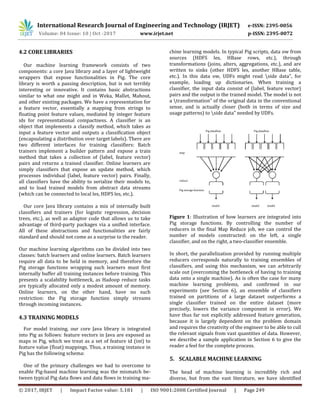
two classes of techniques that are particularly amenable to
large-scale machine learning. The rest is stochastic
gradient descent, representative of online learners that can
easily scale to large datasets. The second is ensemble
methods, which allow us to parallelize training in an nearly
embarrassingly parallel manner, yet retain high levels of
effectiveness. Both are well known in the machine learning
literature, and together they form a powerful combination.
These techniques occupy the focus of our implementation
efforts.
6. SENTIMENT ANALYSIS APPLICATION
In this section, we present an application of our machine
learning tools to the problem of sentiment analysis.
Although the problem is intrinsically interesting, our
discussion primarily exists to illustrate the various
features of our machine learning framework and show
how all the pieces come together".
6.1 METHODOLOGY
Sentiment analysis, and more broadly, opinion mining, is
an area of natural language processing that has received
significant interest in recent years; Pang and Lee provide a
nice overview [40]. These technologies have also seen
widespread commercial interest, particularly as applied to
social media: sentiment analysis and related technologies
promise solutions to brand and customer relations
management, as well as insights into consumer behaviour
in the marketplace. Sentiment analysis applied to tweets
has naturally received attention [38, 36, 25]. In contrast to
previous approaches, which use some form of linguistic
processing, we adopt a knowledge-poor, data-driven
approach. It provides a base-line for classification
accuracy from content, given only large amounts of data.
More specifically, we tackle the binary polarity
classification task. That is, given a tweet known in advance
to express some sentiment, the classifier's task is to
predict yi 2f Negative; Positive g. To generate labelled
training data for polarity classification, we use the well-
known emoticon trick". That is, we simply assume that
tweets with positive emoticons, e.g., :-) and variants, are
positive training instances, and tweets with negative
emoticons, e.g., :-( and variants, are negative training
instances. Obviously, these assumptions are not
completely valid and do not capture phenomena such as
sarcasm, irony, humour, etc., but, overall, data gathered in
this manner are quite reasonable.
The illustrative purposes, the emoticon trick" is typical
of a mechanism for generating a large number of labelled,
albeit noisy, training examples. We have a representation
for a feature vector, essentially a mapping from strings to
floating point feature values, mediated by integer feature
ids for representational compactness. A classifier is an
object that implements a classify method, which takes as
input a feature vector and outputs a classification object
(encapsulating a distribution over target labels). There are
two different interfaces for training classifiers: Batch
trainers implement a builder pattern and expose a train
method that takes a collection of (label, feature vector)
pairs and returns a trained classifier. Online learners are
simply classifiers that expose an update method, which
processes individual (label, feature vector) pairs.
7. CONCLUSIONS
As the cost of storage and processing continues to drop,
organizations will accumulate increasing amounts of data
from which to derive insights. Inevitably, the
sophistication of analyses will increase over time. Business
intelligence tasks such as cubing to support roll up" and
drill down" of multi-dimension data are already
commonplace, with mature best practices both in the
context of traditional data warehouses and Hadoop-based
stacks. We are, however, witnessing the transition from
simple descriptive analytics to more powerful predictive
analytics, which promises to unlock greater troves of
insights. There has not yet emerged a consensus on
architectures and best practices for these types of
activities. Nevertheless, we hope that through the
accumulation of experiences, the community will converge
on a body of shared knowledge. We hope that our
experiences in integrating ma-chine learning tools in a Pig-
centric analytics environment contribute to this end goal.
In addition to training models, many other types of data.
The manipulations common in machine learning can be
straight- forwardly accomplished in Pig. For example, it is
often desirable to randomly shuffle the labelled instances
prior to training, especially in the case of online learners,
where the learned model is dependent on the ordering of
the examples. This can be accomplished by generating
random numbers for each training instance. Using our
machine learning framework is mostly a matter of learning
a few Pig idioms; the rest feels just like typical analysis
tasks. Put it another way: machine learning becomes a
natural extension of data science, where insights gleaned
from data are operationalized in computational models.
ACKNOWLEDGEMENT
I would like to express thankful to Mr. Anand Mannikeri,
Assistant Professor KLEIT Hubballi for technical
suggestions and continuous support to complete this work.](https://image.slidesharecdn.com/irjet-v4i1044-171124100037/85/The-Study-of-the-Large-Scale-Twitter-on-Machine-Learning-4-320.jpg)
![International Research Journal of Engineering and Technology (IRJET) e-ISSN: 2395-0056
Volume: 04 Issue: 10 | Oct -2017 www.irjet.net p-ISSN: 2395-0072
© 2017, IRJET | Impact Factor value: 5.181 | ISO 9001:2008 Certified Journal | Page 251
REFERENCES
[1] K. Bajda-Pawlikowski, D. Abadi, A. Silberschatz, and
E.Paulson. E cient processing of data warehousing quiries
in a split execution environment. SIGMOD, 2011.
[2] M. Banko and E. Brill. Scaling to very very large corpora
for natural language disambiguation. ACL, 2001.
[3] R. Bekkerman and M. Gavish. High-precision phrase-
based document classi cation on a modern scale. KDD,
2011.](https://image.slidesharecdn.com/irjet-v4i1044-171124100037/85/The-Study-of-the-Large-Scale-Twitter-on-Machine-Learning-5-320.jpg)

This document discusses a study on integrating machine learning tools into a Hadoop-based analytics platform at Twitter. Specifically, it focuses on extending the Pig dataflow language to provide predictive analytics capabilities using machine learning algorithms like logistic regression and decision trees. Key points discussed include developing storage functions in Pig for both batch and online learning algorithms, training models by streaming training data through the functions, and scaling out training via model ensembles. An example application of sentiment analysis on tweets using these new Pig extensions is also described to illustrate the end-to-end workflow.


