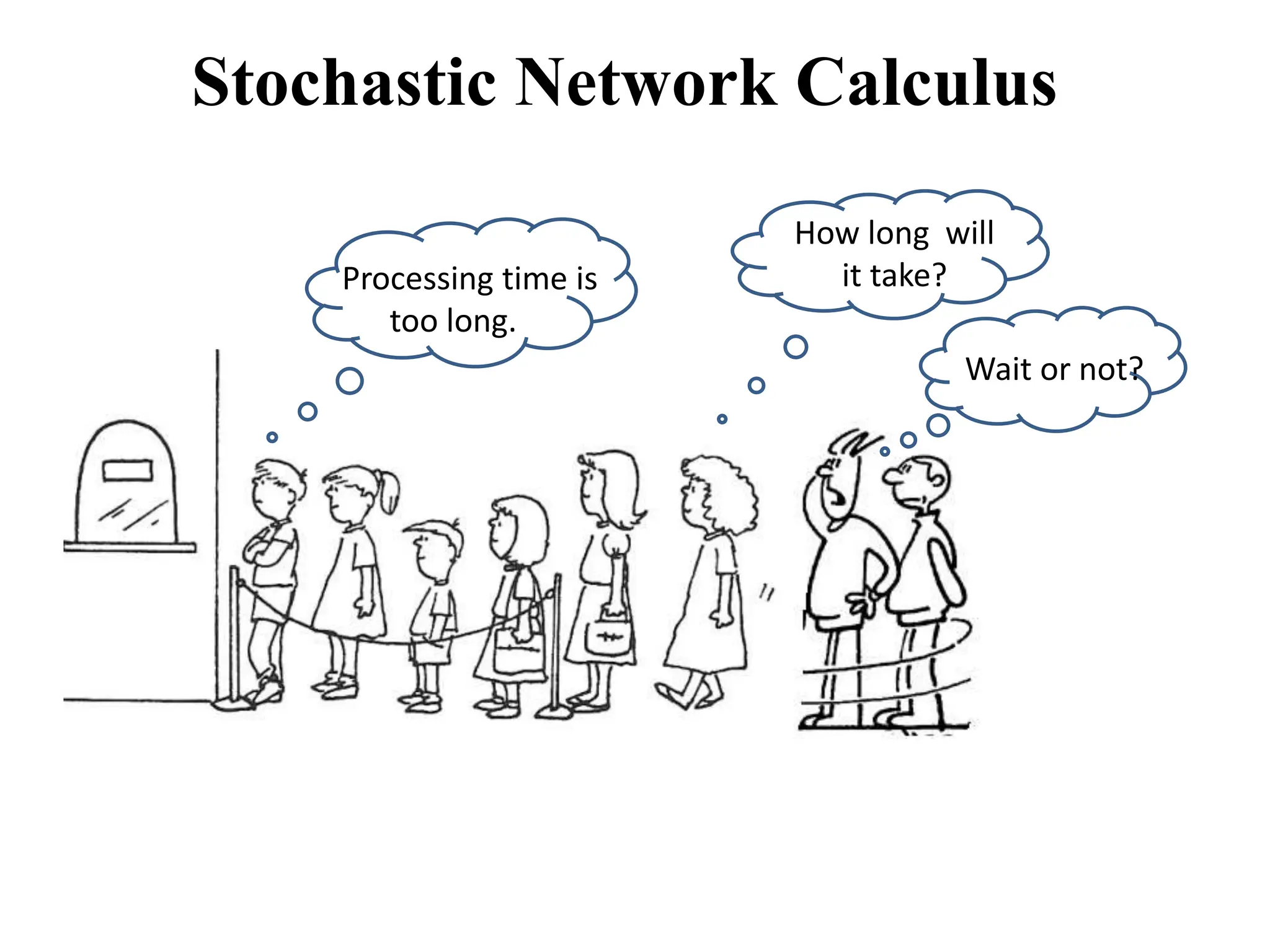
Stochastic Network Calculus
Processing time is
too long.
How long will
it take?
Wait or not?
Network Calculus
• Network calculus is a theory dealing with queuing systems found in computer
networks.
• Specifically, network calculus is a theory for delay and other service guarantee
analysis of computer networks. Its essential idea is to use alternate algebras,
particularly the min-plus algebra and max-plus algebra.
• Transform complex non-linear network systems into analytically tractable
linear systems.
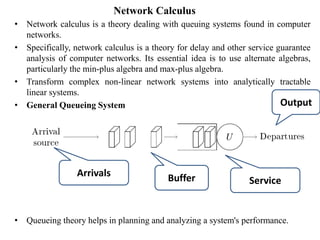
• General Queueing System
• Queueing theory helps in planning and analyzing a system's performance.
Arrivals Buffer Service
Output
Five Basic Properties
• P1.Superposition Property: The superposition of flows can be
represented using the same traffic model.
• P2.Concatenation Property: The concatenation of servers can be
represented using the same server model.
• P3.Output Characterization: The output of a flow from a server
can be represented using the same traffic model as for the input
flow.
• P4.Leftover Service: The service available to a flow at a server
with competing flows can be represented using the same server
model.
• P5.Service Guarantees : Under a chosen traffic model and a
chosen server model, single-node stochastic service guarantees
such as backlog and delay guarantees can be derived.
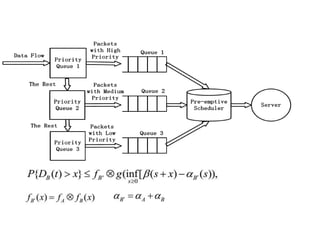
Deterministic Network Calculus (DNC)
• Deterministic network calculus is a theory based on the (min,plus)
algebra. Its aim is to compute worst-case performance bounds in
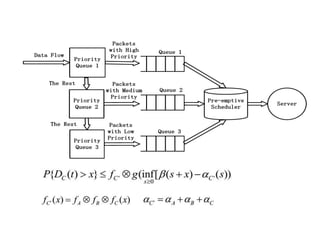
communication networks.
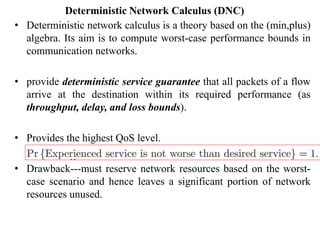
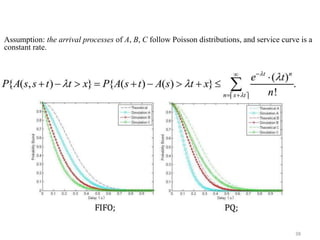
• provide deterministic service guarantee that all packets of a flow
arrive at the destination within its required performance (as
throughput, delay, and loss bounds).
• Provides the highest QoS level.
• Drawback---must reserve network resources based on the worst-
case scenario and hence leaves a significant portion of network
resources unused.
Stochastic Network Calculus (SNC)
• The aim of the stochastic network calculus is to comprehend
statistical multiplexing and scheduling of non-trivial traffic
sources in a framework for end-to-end analysis of multinode
networks
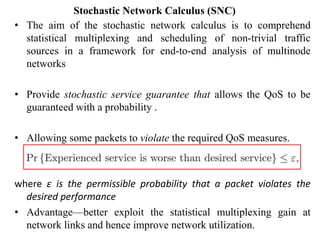
• Provide stochastic service guarantee that allows the QoS to be
guaranteed with a probability .
• Allowing some packets to violate the required QoS measures.
where ε is the permissible probability that a packet violates the
desired performance
• Advantage—better exploit the statistical multiplexing gain at
network links and hence improve network utilization.
QoS
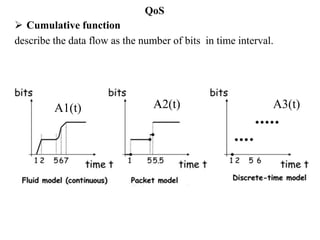
 Cumulative function
describe the data flow as the number of bits in time interval.
A1(t) A2(t) A3(t)
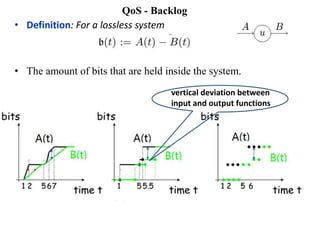
QoS - Backlog
• Definition: For a lossless system
• The amount of bits that are held inside the system.
vertical deviation between
input and output functions
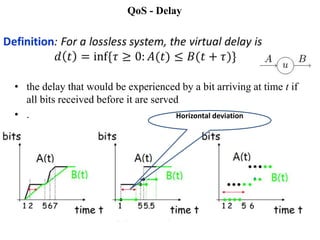
QoS - Delay
• the delay that would be experienced by a bit arriving at time t if
all bits received before it are served
• . Horizontal deviation
Mathematical basis for NC
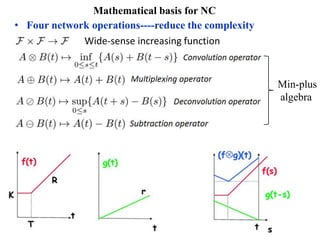
• Four network operations----reduce the complexity
Wide-sense increasing function
Min-plus
algebra
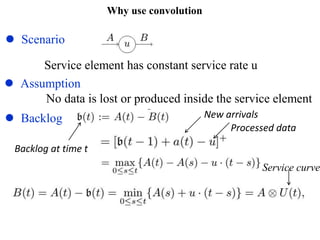
Why use convolution
 Backlog
 Scenario
Service element has constant service rate u
 Assumption
No data is lost or produced inside the service element
Backlog at time t
New arrivals
Processed data
Service curve
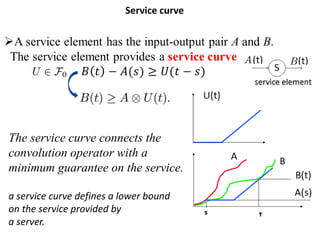
Service curve
The service curve connects the
convolution operator with a
minimum guarantee on the service.
a service curve defines a lower bound
on the service provided by
a server.
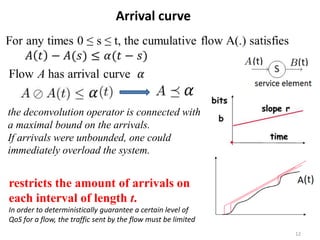
Arrival curve
12
the deconvolution operator is connected with
a maximal bound on the arrivals.
If arrivals were unbounded, one could
immediately overload the system.
restricts the amount of arrivals on
each interval of length t.
In order to deterministically guarantee a certain level of
QoS for a flow, the traffic sent by the flow must be limited
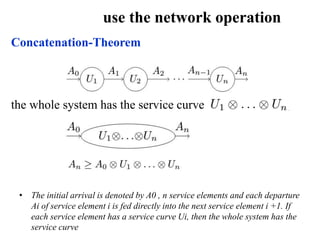
• The initial arrival is denoted by A0 , n service elements and each departure
Ai of service element i is fed directly into the next service element i +1. If
each service element has a service curve Ui, then the whole system has the
service curve
use the network operation
Concatenation-Theorem
the whole system has the service curve
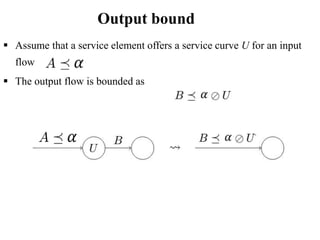
 Assume that a service element offers a service curve U for an input
flow .
 The output flow is bounded as
Output bound
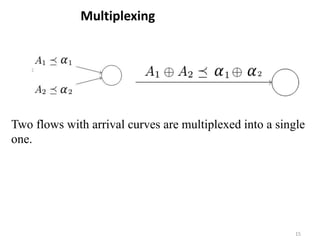
Multiplexing
15
Two flows with arrival curves are multiplexed into a single
one.
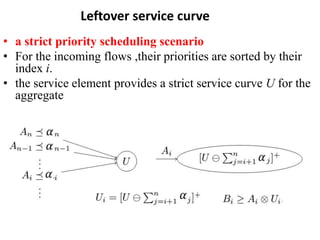
Leftover service curve
• a strict priority scheduling scenario
• For the incoming flows ,their priorities are sorted by their
index i.
• the service element provides a strict service curve U for the
aggregate
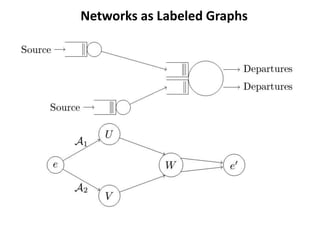
Networks as Labeled Graphs
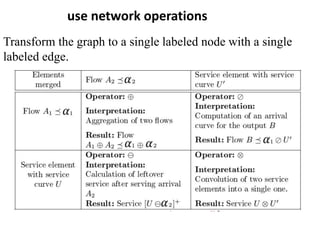
use network operations
Transform the graph to a single labeled node with a single
labeled edge.
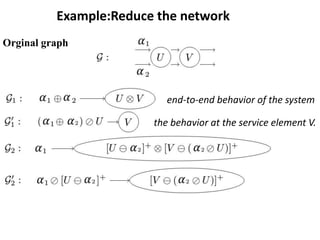
Example:Reduce the network
Orginal graph
end-to-end behavior of the system
the behavior at the service element V.
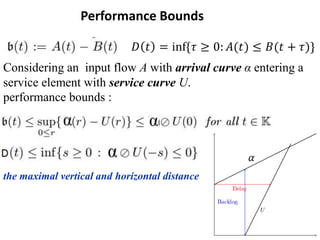
Performance Bounds
Considering an input flow A with arrival curve α entering a
service element with service curve U.
performance bounds :
the maximal vertical and horizontal distance
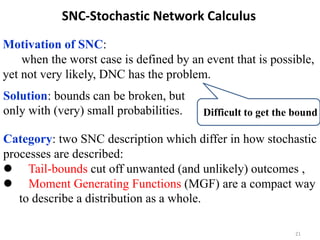
SNC-Stochastic Network Calculus
21
Motivation of SNC:
when the worst case is defined by an event that is possible,
yet not very likely, DNC has the problem.
Category: two SNC description which differ in how stochastic
processes are described:
 Tail-bounds cut off unwanted (and unlikely) outcomes ,
 Moment Generating Functions (MGF) are a compact way
to describe a distribution as a whole.
Difficult to get the bound
Solution: bounds can be broken, but
only with (very) small probabilities.
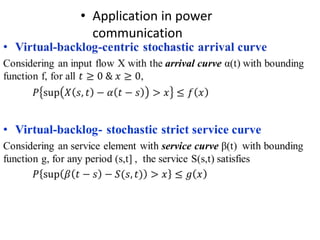
22
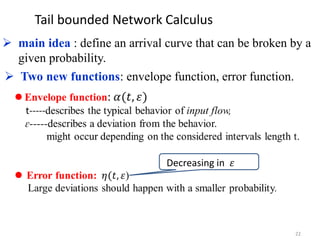
Tail bounded Network Calculus
 main idea : define an arrival curve that can be broken by a
given probability.
 Two new functions: envelope function, error function.
Decreasing in 𝜀
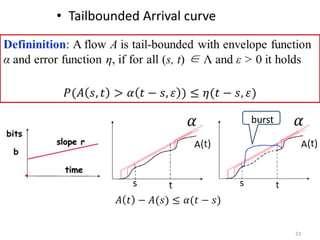
• Tailbounded Arrival curve
23
burst
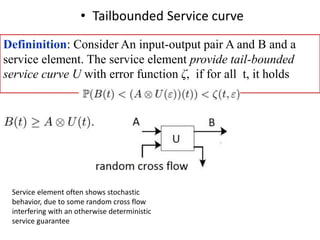
• Tailbounded Service curve
Defininition: Consider An input-output pair A and B and a
service element. The service element provide tail-bounded
service curve U with error function ζ, if for all t, it holds
Service element often shows stochastic
behavior, due to some random cross flow
interfering with an otherwise deterministic
service guarantee
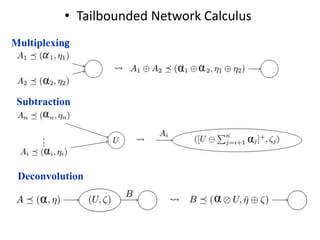
• Tailbounded Network Calculus
Multiplexing
Subtraction
Deconvolution
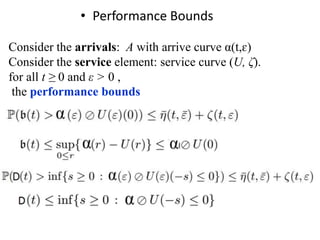
• Performance Bounds
Consider the arrivals: A with arrive curve α(t,ɛ)
Consider the service element: service curve (U, ζ).
for all t ≥ 0 and ε > 0 ,
the performance bounds
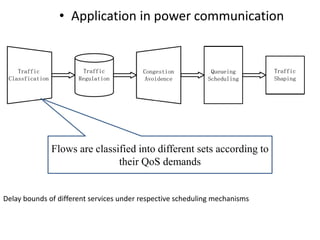
• Application in power communication
Flows are classified into different sets according to
their QoS demands
Delay bounds of different services under respective scheduling mechanisms
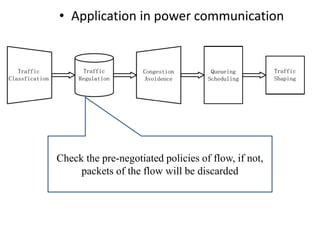
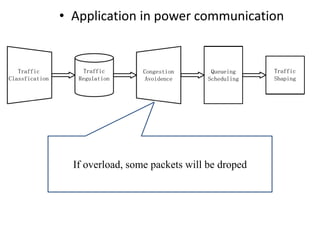
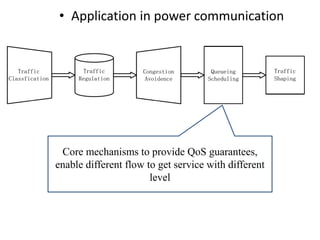
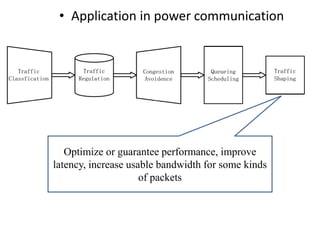
• Application in power communication
Check the pre-negotiated policies of flow, if not,
packets of the flow will be discarded
• Application in power communication
If overload, some packets will be droped
• Application in power communication
Core mechanisms to provide QoS guarantees,
enable different flow to get service with different
level
• Application in power communication
Optimize or guarantee performance, improve
latency, increase usable bandwidth for some kinds
of packets
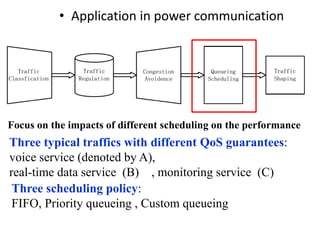
• Application in power communication
Focus on the impacts of different scheduling on the performance
Three typical traffics with different QoS guarantees:
voice service (denoted by A),
real-time data service (B) , monitoring service (C)
Three scheduling policy:
FIFO, Priority queueing , Custom queueing
• Application in power
communication
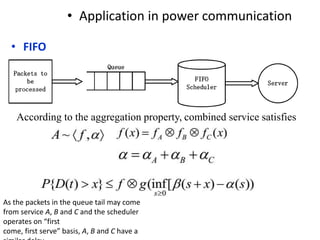
• FIFO
• Application in power communication
According to the aggregation property, combined service satisfies
As the packets in the queue tail may come
from service A, B and C and the scheduler
operates on “first
come, first serve” basis, A, B and C have a
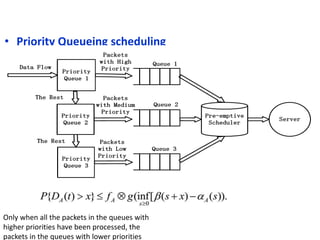
• Priority Queueing scheduling
Only when all the packets in the queues with
higher priorities have been processed, the
packets in the queues with lower priorities
• Priority Queueing scheduling
Assumption: the arrival processes of A, B, C follow Poisson distributions, and service curve is a
constant rate.
38
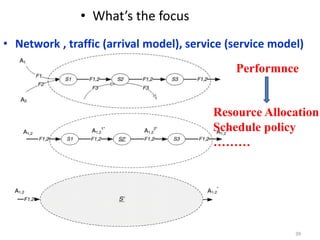
• Network , traffic (arrival model), service (service model)
• What’s the focus
39
Performnce
Resource Allocation
Schedule policy
………
The Stochastic Network Calculus: A Modern Approach.pptx

The Stochastic Network Calculus: A Modern Approach.pptx

  • 1.
    Stochastic Network Calculus Processingtime is too long. How long will it take? Wait or not?
  • 2.
    Network Calculus • Networkcalculus is a theory dealing with queuing systems found in computer networks. • Specifically, network calculus is a theory for delay and other service guarantee analysis of computer networks. Its essential idea is to use alternate algebras, particularly the min-plus algebra and max-plus algebra. • Transform complex non-linear network systems into analytically tractable linear systems. • General Queueing System • Queueing theory helps in planning and analyzing a system's performance. Arrivals Buffer Service Output
  • 3.
    Five Basic Properties •P1.Superposition Property: The superposition of flows can be represented using the same traffic model. • P2.Concatenation Property: The concatenation of servers can be represented using the same server model. • P3.Output Characterization: The output of a flow from a server can be represented using the same traffic model as for the input flow. • P4.Leftover Service: The service available to a flow at a server with competing flows can be represented using the same server model. • P5.Service Guarantees : Under a chosen traffic model and a chosen server model, single-node stochastic service guarantees such as backlog and delay guarantees can be derived.
  • 4.
    Deterministic Network Calculus(DNC) • Deterministic network calculus is a theory based on the (min,plus) algebra. Its aim is to compute worst-case performance bounds in communication networks. • provide deterministic service guarantee that all packets of a flow arrive at the destination within its required performance (as throughput, delay, and loss bounds). • Provides the highest QoS level. • Drawback---must reserve network resources based on the worst- case scenario and hence leaves a significant portion of network resources unused.
  • 5.
    Stochastic Network Calculus(SNC) • The aim of the stochastic network calculus is to comprehend statistical multiplexing and scheduling of non-trivial traffic sources in a framework for end-to-end analysis of multinode networks • Provide stochastic service guarantee that allows the QoS to be guaranteed with a probability . • Allowing some packets to violate the required QoS measures. where ε is the permissible probability that a packet violates the desired performance • Advantage—better exploit the statistical multiplexing gain at network links and hence improve network utilization.
  • 6.
    QoS  Cumulative function describethe data flow as the number of bits in time interval. A1(t) A2(t) A3(t)
  • 7.
    QoS - Backlog •Definition: For a lossless system • The amount of bits that are held inside the system. vertical deviation between input and output functions
  • 8.
    QoS - Delay •the delay that would be experienced by a bit arriving at time t if all bits received before it are served • . Horizontal deviation
  • 9.
    Mathematical basis forNC • Four network operations----reduce the complexity Wide-sense increasing function Min-plus algebra
  • 10.
    Why use convolution Backlog  Scenario Service element has constant service rate u  Assumption No data is lost or produced inside the service element Backlog at time t New arrivals Processed data Service curve
  • 11.
    Service curve The servicecurve connects the convolution operator with a minimum guarantee on the service. a service curve defines a lower bound on the service provided by a server.
  • 12.
    Arrival curve 12 the deconvolutionoperator is connected with a maximal bound on the arrivals. If arrivals were unbounded, one could immediately overload the system. restricts the amount of arrivals on each interval of length t. In order to deterministically guarantee a certain level of QoS for a flow, the traffic sent by the flow must be limited
  • 13.
    • The initialarrival is denoted by A0 , n service elements and each departure Ai of service element i is fed directly into the next service element i +1. If each service element has a service curve Ui, then the whole system has the service curve use the network operation Concatenation-Theorem the whole system has the service curve
  • 14.
     Assume thata service element offers a service curve U for an input flow .  The output flow is bounded as Output bound
  • 15.
    Multiplexing 15 Two flows witharrival curves are multiplexed into a single one.
  • 16.
    Leftover service curve •a strict priority scheduling scenario • For the incoming flows ,their priorities are sorted by their index i. • the service element provides a strict service curve U for the aggregate
  • 17.
  • 18.
    use network operations Transformthe graph to a single labeled node with a single labeled edge.
  • 19.
    Example:Reduce the network Orginalgraph end-to-end behavior of the system the behavior at the service element V.
  • 20.
    Performance Bounds Considering aninput flow A with arrival curve α entering a service element with service curve U. performance bounds : the maximal vertical and horizontal distance
  • 21.
    SNC-Stochastic Network Calculus 21 Motivationof SNC: when the worst case is defined by an event that is possible, yet not very likely, DNC has the problem. Category: two SNC description which differ in how stochastic processes are described:  Tail-bounds cut off unwanted (and unlikely) outcomes ,  Moment Generating Functions (MGF) are a compact way to describe a distribution as a whole. Difficult to get the bound Solution: bounds can be broken, but only with (very) small probabilities.
  • 22.
    22 Tail bounded NetworkCalculus  main idea : define an arrival curve that can be broken by a given probability.  Two new functions: envelope function, error function. Decreasing in 𝜀
  • 23.
  • 24.
    • Tailbounded Servicecurve Defininition: Consider An input-output pair A and B and a service element. The service element provide tail-bounded service curve U with error function ζ, if for all t, it holds Service element often shows stochastic behavior, due to some random cross flow interfering with an otherwise deterministic service guarantee
  • 25.
    • Tailbounded NetworkCalculus Multiplexing Subtraction Deconvolution
  • 26.
    • Performance Bounds Considerthe arrivals: A with arrive curve α(t,ɛ) Consider the service element: service curve (U, ζ). for all t ≥ 0 and ε > 0 , the performance bounds
  • 27.
    • Application inpower communication Flows are classified into different sets according to their QoS demands Delay bounds of different services under respective scheduling mechanisms
  • 28.
    • Application inpower communication Check the pre-negotiated policies of flow, if not, packets of the flow will be discarded
  • 29.
    • Application inpower communication If overload, some packets will be droped
  • 30.
    • Application inpower communication Core mechanisms to provide QoS guarantees, enable different flow to get service with different level
  • 31.
    • Application inpower communication Optimize or guarantee performance, improve latency, increase usable bandwidth for some kinds of packets
  • 32.
    • Application inpower communication Focus on the impacts of different scheduling on the performance Three typical traffics with different QoS guarantees: voice service (denoted by A), real-time data service (B) , monitoring service (C) Three scheduling policy: FIFO, Priority queueing , Custom queueing
  • 33.
    • Application inpower communication
  • 34.
    • FIFO • Applicationin power communication According to the aggregation property, combined service satisfies As the packets in the queue tail may come from service A, B and C and the scheduler operates on “first come, first serve” basis, A, B and C have a
  • 35.
    • Priority Queueingscheduling Only when all the packets in the queues with higher priorities have been processed, the packets in the queues with lower priorities
  • 36.
  • 38.
    Assumption: the arrivalprocesses of A, B, C follow Poisson distributions, and service curve is a constant rate. 38
  • 39.
    • Network ,traffic (arrival model), service (service model) • What’s the focus 39 Performnce Resource Allocation Schedule policy ………

Editor's Notes

  • #14 The initial arrival is denoted by A0 , n service elements and each departure Ai of service element i is fed directly into the next service element i +1. If each service element has a service curve Ui, then the whole system has the service curve
  • #20 (1)merging both arrivals and then either convolute the two service elements----Convolution after multiplexing (2) calculate an output bound for the departures of the first node----Deconvolution after multiplexing (3) describes an end-to-end behavior, subtract one of the flows (4) is more suitable for the local analysis at the second node.
  • #21 After a labeled graph is successfully reduced, the goal of network calculus is to derive performance bounds of the system.