THE NETWORK LAYER
1
REVIEW
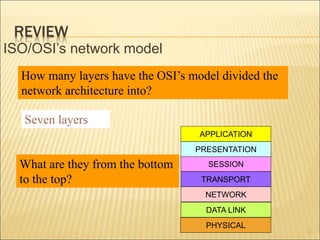
ISO/OSI’s network model
2
How many layers have the OSI’s model divided the
network architecture into?
What are they from the bottom
to the top?
PHYSICAL
DATA LINK
NETWORK
TRANSPORT
SESSION
PRESENTATION
APPLICATION
Seven layers
DESCRIPTION OF THE NETWORK LAYER
• The network layer is concerned with getting
packets from the source all the way to the
destination.
3
To achieve its goals, the network layer must know
about the topology of the communication subnet
and choose appropriate paths through it.
It must also take care to choose routes to avoid
overloading some of the communication lines and
routers while leaving others idle.
CHAPTER 5 THE NETWORK
LAYER
4
5.1 Network Layer Design Issues
5.2 Routing Algorithms
5.6 The Network Layer in the Internet
5.1 NETWORK LAYER DESIGN ISSUES
• Store-and-Forward Packet Switching
• Services Provided to the Transport Layer
• Implementation of Connectionless Service
• Implementation of Connection-Oriented Service
• Comparison of Virtual-Circuit and Datagram
Subnets
5
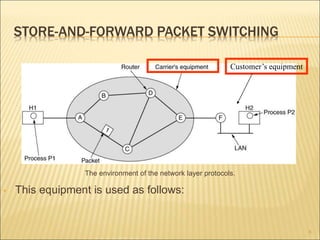
STORE-AND-FORWARD PACKET SWITCHING
The environment of the network layer protocols.
• This equipment is used as follows:
6
fig 5-1
Customer’s equipment
• A host with a packet to send transmits it to the
nearest router, either on its own LAN or over a
point-to-point link to the carrier.
• The packet is stored there until it has fully arrived so
the checksum can be verified. Then it is forwarded
to the next router along the path until it reaches the
destination host, where it is delivered.
• This mechanism is store-and-forward packet
switching, as we have seen in previous chapters.
7
5.1 NETWORK LAYER DESIGN ISSUES
• Store-and-Forward Packet Switching
• Services Provided to the Transport Layer
• Implementation of Connectionless Service
• Implementation of Connection-Oriented Service
• Comparison of Virtual-Circuit and Datagram
Subnets
8
SERVICES PROVIDED TO THE TRANSPORT LAYER
What kind of services the network layer provides to the
transport layer ?
9
1. The services should be independent of the router technology.
2. The transport layer should be shielded from the number, type,
and topology of the routers present.
3. The network addresses made available to the transport layer
should use a uniform numbering plan, even across LANs and WANs.
• The network layer services have been designed with the
following goals:
ONE CAMP’S VIEW
The routers' job is moving packets around and nothing
else. In their view , the subnet is inherently un-reliable,
no matter how it is designed.
Therefore, the hosts should accept the fact that the
network is unreliable and do error control (i.e., error
detection and correction) and flow control themselves.
So the network service should be connectionless.
10
The Internet offers connectionless
network-layer service
THE OTHER CAMP’S VIEW
The subnet should provide a reliable, connection-
oriented service.
In this view, quality of service is the dominant factor,
and without connections in the sub-net, quality of
service is very difficult to achieve, especially for real-
time traffic such as voice and video.
11
ATM networks offer connection-oriented
network-layer service.
5.1 NETWORK LAYER DESIGN ISSUES
• Store-and-Forward Packet Switching
• Services Provided to the Transport Layer
• Implementation of Connectionless Service
• Implementation of Connection-Oriented Service
• Comparison of Virtual-Circuit and Datagram
Subnets
12
• Two different organizations are possible, depending on
the type of service offered.
• If connectionless service is offered, packets are injected
into the subnet individually and routed independently of
each other.
• No advance setup is needed. In this context, the packets
are frequently called datagrams and the subnet is called
a datagram subnet.
• If connection-oriented service is used, a path from the
source router to the destination router must be
established before any data packets can be sent. This
connection is called a VC (virtual circuit) and the
subnet is called a virtual-circuit subnet.
13
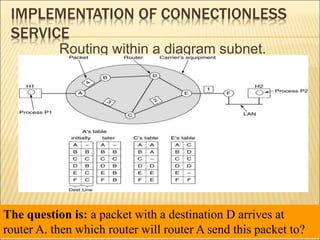
IMPLEMENTATION OF CONNECTIONLESS
SERVICE
Routing within a diagram subnet.
14
The question is: a packet with a destination D arrives at
router A. then which router will router A send this packet to?
5.1 NETWORK LAYER DESIGN ISSUES
• Store-and-Forward Packet Switching
• Services Provided to the Transport Layer
• Implementation of Connectionless Service
• Implementation of Connection-Oriented
Service
• Comparison of Virtual-Circuit and Datagram
Subnets
15
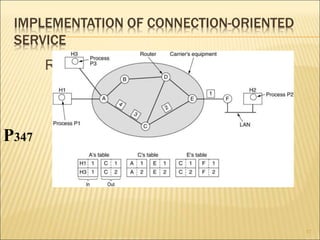
• For connection-oriented service, we need a virtual-
circuit subnet.
• The idea behind virtual circuits is to avoid having to
choose a new route for every packet sent.
• Instead, when a connection is established, a route from
the source machine to the destination machine is chosen
as part of the connection setup and stored in tables
inside the routers. That route is used for all traffic
flowing over the connection, exactly the same way that
the telephone system works. When the connection is
released, the virtual circuit is also terminated.
• With connection-oriented service, each packet carries an
identifier telling which virtual circuit it belongs to.
16
IMPLEMENTATION OF CONNECTION-ORIENTED
SERVICE
Routing within a virtual-circuit subnet.
17
P347
5.1 NETWORK LAYER DESIGN ISSUES
• Store-and-Forward Packet Switching
• Services Provided to the Transport Layer
• Implementation of Connectionless Service
• Implementation of Connection-Oriented Service
• Comparison of Virtual-Circuit and Datagram
Subnets
18
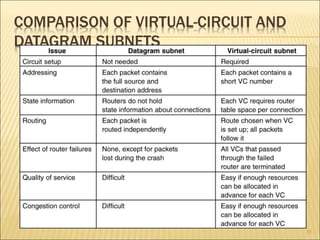
COMPARISON OF VIRTUAL-CIRCUIT AND
DATAGRAM SUBNETS
19
5-4
• Inside the subnet, several trade-offs exist
betw-een virtual circuits and datagrams.
• One trade-off is between router memory
space and bandwidth.
Virtual circuits allow packets to contain
circuit numbers instead of full destination
addresses. If the packets tend to be fairly
short, a full destination address in every
packet may represent a significant amount of
overhead and hence, wasted bandwidth. The
price paid for using virtual circuits internally
is the table space within the routers.
Depending upon the relative cost of
communication circuits versus router
memory, one or the other may be cheaper.
20
• Another trade-off is setup time versus
address parsing time.
Using virtual circuits requires a setup phase,
which takes time and consumes resources.
However, figuring out what to do with a data
packet in a virtual-circuit subnet is easy: the
router just uses the circuit number to index
into a table to find out where the packet goes.
In a datagram subnet, a more complicated
lookup procedure is required to locate the
entry for the destination.
21
• Virtual circuits have some advantages in
guaranteeing quality of service and
avoiding congestion within the subnet.
• The loss of a communication line is fatal
to virtual circuits using it but can be
easily compensated for if datagrams are
used. Datagrams also allow the routers to
balance the traffic throughout the subnet,
since routes can be changed partway
through a long sequence of packet
transmissions.
22
SUMMARY
23
•Store-and-Forward Packet Switching
•Services Provided to the Transport Layer
•Implementation of Connectionless Service
•Implementation of Connection-Oriented Service
•Comparison of Virtual-Circuit and Datagram Subnets
CHAPTER 5 THE NETWORK
LAYER
24
5.1 Network Layer Design Issues
5.2 Routing Algorithms
5.6 The Network Layer in the Internet
DESCRIPTION OF ROUTING ALGORITHMS
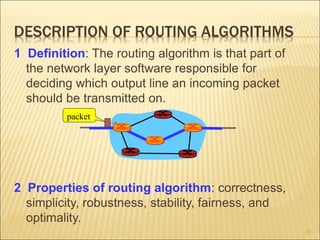
1 Definition: The routing algorithm is that part of
the network layer software responsible for
deciding which output line an incoming packet
should be transmitted on.
2 Properties of routing algorithm: correctness,
simplicity, robustness, stability, fairness, and
optimality.
25
packet
DESCRIPTION OF ROUTING ALGORITHMS
1) Robustness:Once a major network comes on the air,
it may be expected to run continuously for years
without system-wide failures. During that period there
will be hardware and software failures of all kinds.
Hosts, routers, and lines will fail repeatedly, and the
topology will change many times. The routing
algorithm should be able to cope with changes in the
topology and traffic without requiring all jobs in all
hosts to be aborted and the network to be rebooted
every time some router crashes.
26
DESCRIPTION OF ROUTING ALGORITHMS
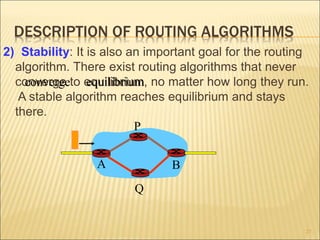
2) Stability: It is also an important goal for the routing
algorithm. There exist routing algorithms that never
converge to equilibrium, no matter how long they run.
A stable algorithm reaches equilibrium and stays
there.
27
converge equilibrium
A
P
Q
B
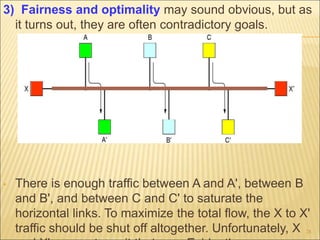
3) Fairness and optimality may sound obvious, but as
it turns out, they are often contradictory goals.
• There is enough traffic between A and A', between B
and B', and between C and C' to saturate the
horizontal links. To maximize the total flow, the X to X'
traffic should be shut off altogether. Unfortunately, X 28
DESCRIPTION OF ROUTING ALGORITHMS
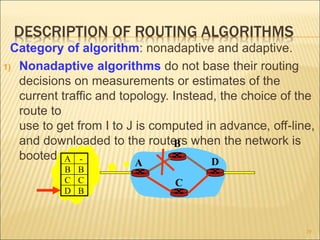
Category of algorithm: nonadaptive and adaptive.
1) Nonadaptive algorithms do not base their routing
decisions on measurements or estimates of the
current traffic and topology. Instead, the choice of the
route to
use to get from I to J is computed in advance, off-line,
and downloaded to the routers when the network is
booted.
29
A
B
C
D
A -
B B
C C
D B
DESCRIPTION OF ROUTING ALGORITHMS
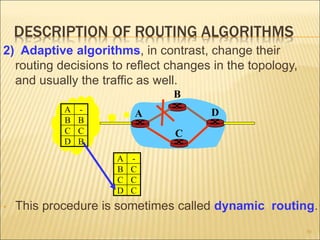
2) Adaptive algorithms, in contrast, change their
routing decisions to reflect changes in the topology,
and usually the traffic as well.
• This procedure is sometimes called dynamic routing.
30
A
B
C
D
A -
B B
C C
D B
A -
B C
C C
D C
5.2 ROUTING ALGORITHMS
• The Optimality Principle
• Shortest Path Routing
• Flooding
• Distance Vector Routing
• Link State Routing
• Hierarchical Routing
• Broadcast Routing
31
5.2.1 THE OPTIMALITY
PRINCIPLE
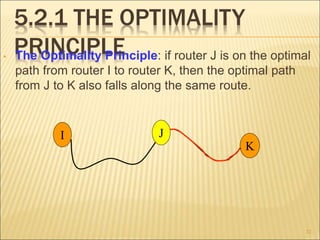
• The Optimality Principle: if router J is on the optimal
path from router I to router K, then the optimal path
from J to K also falls along the same route.
32
I
K
J
5.2.1 THE OPTIMALITY
PRINCIPLE
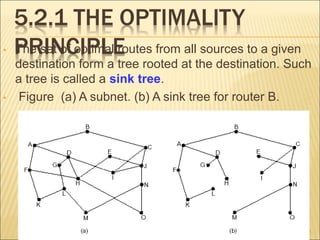
• The set of optimal routes from all sources to a given
destination form a tree rooted at the destination. Such
a tree is called a sink tree.
• Figure (a) A subnet. (b) A sink tree for router B.
33
5.2.1 THE OPTIMALITY
PRINCIPLE
• Note: A sink tree is not necessarily unique; other trees
with the same path lengths may exist.
• The goal of all routing algorithms is to discover and
use the sink trees for all routers.
34
5.2.2 SHORTEST PATH
ROUTING
• A technique to study routing algorithms: The idea is to build a
graph of the subnet, with each node of the graph representing a
router and each arc of the graph representing a communication
line (often called a link).
• To choose a route between a given pair of routers, the algorithm
just finds the shortest path between them on the graph.
• One way of measuring path length is the number of hops.
Another metric is the geographic distance in kilometers . Many
other metrics are also possible. For example, each arc could be
labeled with the mean queuing and transmission delay for some
standard test packet as determined by hourly test runs.
• In the general case, the labels on the arcs could be computed as
a function of the distance, bandwidth, average traffic,
communication cost, mean queue length, measured delay, and
other factors. By changing the weighting function, the algorithm
would then compute the ''shortest'' path measured according to
any one of a number of criteria or to a combination of criteria.
35
5.2.2 SHORTEST PATH
ROUTING
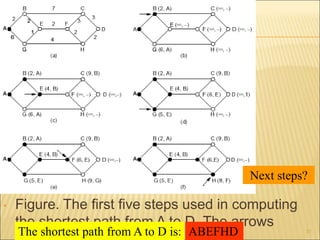
• Dijkstra algorithm:Each node is
labeled (in parentheses) with its
distance from the source node along
the best known path. Initially, no
paths are known, so all nodes are
labeled with infinity. As the algorithm
proceeds and paths are found, the
labels may change, reflecting better
paths. A label may be either tentative
or permanent. Initially, all labels are
tentative. When it is discovered that a
label represents the shortest possible
path from the source to that node, it
is made permanent and never 36
• Figure. The first five steps used in computing
the shortest path from A to D. The arrows
37
Next steps?
The shortest path from A to D is: ABEFHD
5.2.3 FLOODING
• Flooding algorithm:every incoming packet is
sent out on every outgoing line except the one it
arrived on.
• Flooding obviously generates vast numbers of
duplicate packets, in fact, an infinite number
unless some measures are taken to damp the
process.
• One such measure is to have a hop counter
contained in the header of each packet, which
is decremented at each hop, with the packet
being discarded when the counter reaches zero.
38
5.2.3 FLOODING
• A variation of flooding that is slightly more practical is
selective flooding.In this algorithm the routers do not
send every incoming packet out on every line, only on
those lines that are going approximately in the right
direction.
• Applications of flooding algorithm:
1.military applications
2.distributed database applications
3.wireless networks
4. as a metric against which other routing
algorithms can be compared
39
5.2.4 DISTANCE VECTOR
ROUTING
• A dynamic routing algorithm
• Distance vector routing algorithms operate
by having each router maintain a table (i.e, a
vector) giving the best known distance to each
destination and which line to use to get there.
These tables are updated by exchanging
information with the neighbors. (also named the
distributed Bellman-Ford routing algorithm and
the Ford-Fulkerson algorithm )
40
5.2.4 DISTANCE VECTOR
ROUTING
• Table content: In distance vector routing, each
router maintains a routing table indexed by, and
containing one entry for, each router in the
subnet. This entry contains two parts: the
preferred outgoing line to use for that
destination and an estimate of the time or
distance to that destination.
• Table updating method:Assume that the
router knows the delay to each of its neighbors.
Once every T msec each router sends to each
neighbor a list of its estimated delays to each
destination. It also receives a similar list from
41
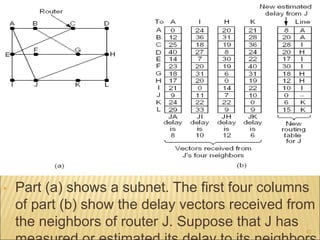
• Part (a) shows a subnet. The first four columns
of part (b) show the delay vectors received from
the neighbors of router J. Suppose that J has
42
5.2.5 LINK STATE ROUTING
• A dynamic routing algorithm
• The idea behind link state routing can be
stated as five parts. Each router must do
the following:
1.Discover its neighbors and learn their
network addresses.
2.Measure the delay or cost to each of
its neighbors.
3.Construct a packet telling all it has
just learned. 43
5.2.5 LINK STATE ROUTING
1. Learning about the Neighbors
• It accomplishes this goal by sending a special
HELLO packet on each point-to-point line. The
router on the other end is expected to send
back a reply telling who it is. These names must
be globally unique because when a distant
router later hears that three routers are all
connected to F, it is essential that it can
determine whether all three mean the same F.
2. Measuring Line Cost
• The most direct way to determine this delay is
to send over the line a special ECHO packet 44
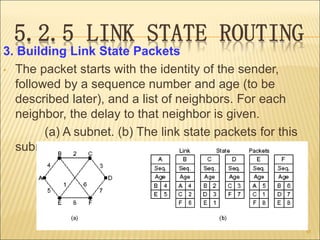
5.2.5 LINK STATE ROUTING
3. Building Link State Packets
• The packet starts with the identity of the sender,
followed by a sequence number and age (to be
described later), and a list of neighbors. For each
neighbor, the delay to that neighbor is given.
(a) A subnet. (b) The link state packets for this
subnet
45
LINK STATE ROUTING
• Building the link state packets is easy. The hard part is determining when to
build them. One possibility is to build them periodically, that is, at regular
intervals. Another possibility is to build them when some significant event
occurs, such as a line or neighbor going down or coming back up again or
changing its properties appreciably.
4. Distributing the Link State Packets
• The basic distribution algorithm:The fundamental idea is to use flooding to
distribute the link state packets. To keep the flood in check, each packet
contains a sequence number that is incremented for each new packet sent.
Routers keep track of all the (source router, sequence) pairs they see. When
a new link state packet comes in, it is checked against the list of packets
already seen. If it is new, it is forwarded on all lines except the one it arrived
on. If it is a duplicate, it is discarded. If a packet with a sequence number
lower than the highest one seen so far ever arrives, it is rejected as being
obsolete since the router has more recent data.
46
LINK STATE ROUTING
• First problem with this algorithm:if the sequence
numbers wrap around, confusion will reign. The
solution here is to use a 32-bit sequence number. With
one link state packet per second, it would take 137
years to wrap around, so this possibility can be
ignored.
• Second problem :if a router ever crashes, it will lose
track of its sequence number. If it starts again at 0, the
next packet will be rejected as a duplicate.
• Third problem :if a sequence number is ever corrupted
and 65,540 is received instead of 4 (a 1-bit error),
packets 5 through 65,540 will be rejected as obsolete,
since the current sequence number is thought to be 47
5.2.5 LINK STATE ROUTING
• The solution to all these problems is to include the age
of each packet after the sequence number and
decrement it once per second. When the age hits zero,
the information from that router is discarded.
5. Computing the New Routes
• Once a router has accumulated a full set of link state
packets, it can construct the entire subnet graph
because every link is represented.
• Now Dijkstra's algorithm can be run locally to
construct the shortest path to all possible destinations.
48
5.2.6 HIERARCHICAL ROUTING
• The routers are divided into what we will call regions,
with each router knowing all the details about how to
route packets to destinations within its own region, but
knowing nothing about the internal structure of other
regions.
• For huge networks, a two-level hierarchy may be
insufficient; it may be necessary to group the regions
into clusters, the clusters into zones, the zones into
groups, and so on, until we run out of names for
aggregations.
49
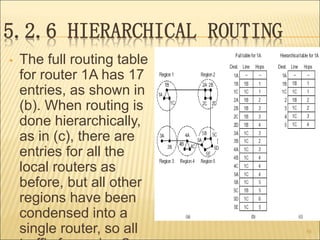
5.2.6 HIERARCHICAL ROUTING
• The full routing table
for router 1A has 17
entries, as shown in
(b). When routing is
done hierarchically,
as in (c), there are
entries for all the
local routers as
before, but all other
regions have been
condensed into a
single router, so all 50
5.2.6 HIERARCHICAL ROUTING
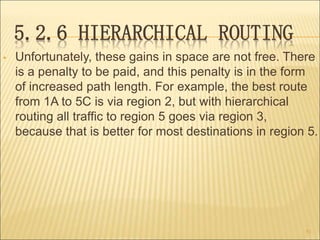
• Unfortunately, these gains in space are not free. There
is a penalty to be paid, and this penalty is in the form
of increased path length. For example, the best route
from 1A to 5C is via region 2, but with hierarchical
routing all traffic to region 5 goes via region 3,
because that is better for most destinations in region 5.
51
5.2.7 BROADCAST ROUTING
• Sending a packet to all destinations simultaneously is
called broadcasting.
1)The source simply sends a distinct packet to each
destination. Not only is the method wasteful of
bandwidth, but it also requires the source to have a
complete list of all destinations.
2)Flooding.
• The problem with flooding as a broadcast technique is
that it generates too many packets and consumes too
much bandwidth.
52
5.2.7 BROADCAST ROUTING
3)Multi-destination routing.
•If this method is used, each packet contains either a list
of destinations or a bit map indicating the desired
destinations. When a packet arrives at a router, the
router checks all the destinations to determine the set of
output lines that will be needed. (An output line is
needed if it is the best route to at least one of the
destinations.) The router generates a new copy of the
packet for each output line to be used and includes in
each packet only those destinations that are to use the
line. In effect, the destination set is partitioned among
the output lines. After a sufficient number of hops, each
packet will carry only one destination and can be 53
5.2.7 BROADCAST ROUTING
4)A fourth broadcast algorithm makes explicit use of the
sink tree for the router initiating the broadcast—or any
other convenient spanning tree for that matter.
• A spanning tree is a subset of the subnet that includes
all the routers but contains no loops.
• If each router knows which of its lines belong to the
spanning tree, it can copy an incoming broadcast
packet onto all the spanning tree lines except the one it
arrived on.
54
5.2.7 BROADCAST ROUTING
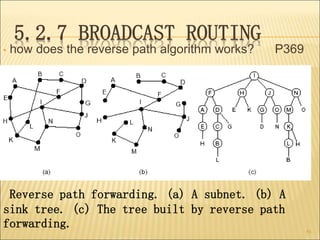
5) Reverse path forwarding.
• When a broadcast packet arrives at a router, the
router checks to see if the packet arrived on the line
that is normally used for sending packets to the
source of the broadcast. If so, there is an excellent
chance that the broadcast packet itself followed the
best route from the router and is therefore the first
copy to arrive at the router. This being the case, the
router forwards copies of it onto all lines except the
one it arrived on. If, however, the broadcast packet
arrived on a line other than the preferred one for
reaching the source, the packet is discarded as a
likely duplicate. 55
5.2.7 BROADCAST ROUTING
• how does the reverse path algorithm works? P369
56
Reverse path forwarding. (a) A subnet. (b) A
sink tree. (c) The tree built by reverse path
forwarding.
57
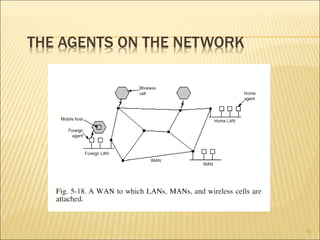
Routing Mobile Hosts
a) Networking portable computers
b) Tanenbaum’s proposed solution
– All mobile agents are assumed to have a
permanent home location
– When a portable computer is attached to
a remote network it contacts a process
that acts as the local foreign agent.
– Each home location has a process that
acts as the home agent
THE AGENTS ON THE NETWORK
58
REGISTERING A MOBILE AGENT
59
a) Periodically the foreign agent broadcasts its
address
b) The mobile agent registers with the foreign agent
and supplies its home address
c) The foreign agent contacts the mobile agent’s
home agent reporting the mobile agent’s location.
– Security must be used to verify the
identity of the mobile agent.
d) The foreign agent registers the mobile agent
60
Routing Packets to a Mobile Agent
a) Packets sent to the mobile agent are routed to the
users home network
b) The home agent routes the packets to the foreign
agent
c) The home agent provides the source of incoming
packets with the remote address of the mobile
agent
61
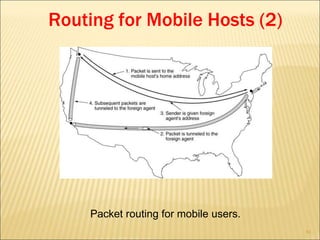
Routing for Mobile Hosts (2)
Packet routing for mobile users.
62
Routing in Ad Hoc Networks
Ad Hoc Networks: Networks of nodes that just
happen to be near each other
Possibilities when the routers are mobile:
1. Military vehicles on battlefield.
– No infrastructure.
2. A fleet of ships at sea.
– All moving all the time
3. Emergency works at earthquake .
– The infrastructure destroyed.
4. A gathering of people with notebook computers.
– In an area lacking 802.11.
63
Route Discovery
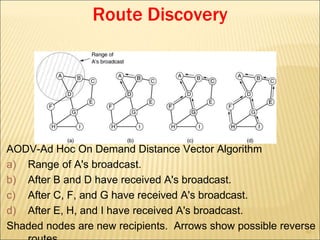
AODV-Ad Hoc On Demand Distance Vector Algorithm
a) Range of A's broadcast.
b) After B and D have received A's broadcast.
c) After C, F, and G have received A's broadcast.
d) After E, H, and I have received A's broadcast.
Shaded nodes are new recipients. Arrows show possible reverse
64
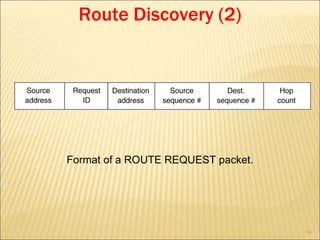
Route Discovery (2)
Format of a ROUTE REQUEST packet.
65
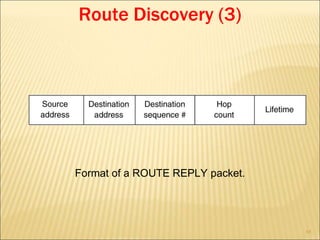
Route Discovery (3)
Format of a ROUTE REPLY packet.
CHAPTER 5 THE NETWORK
LAYER
66
5.1 Network Layer Design Issues
5.2 Routing Algorithms
5.6 The Network Layer in the Internet
5.6 THE NETWORK LAYER IN THE
INTERNET
• The IP Protocol
• IP Addresses
• Internet Control Protocols
67
5.6.1 THE IP PROTOCOL
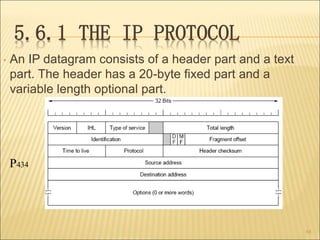
• An IP datagram consists of a header part and a text
part. The header has a 20-byte fixed part and a
variable length optional part.
68
P434
5.6.2 IP ADDRESSES
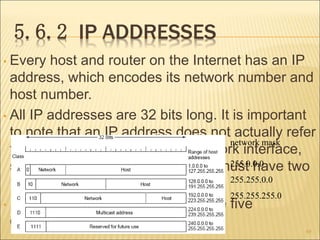
• Every host and router on the Internet has an IP
address, which encodes its network number and
host number.
• All IP addresses are 32 bits long. It is important
to note that an IP address does not actually refer
to a host. It really refers to a network interface,
so if a host is on two networks, it must have two
IP addresses.
• IP addresses were divided into the five
categories
69
network mask
255.0.0.0
255.255.0.0
255.255.255.0
5.6.2 IP ADDRESSES
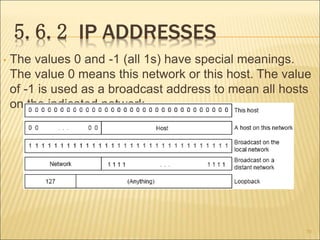
• The values 0 and -1 (all 1s) have special meanings.
The value 0 means this network or this host. The value
of -1 is used as a broadcast address to mean all hosts
on the indicated network.
70
5.6.2 IP ADDRESSES
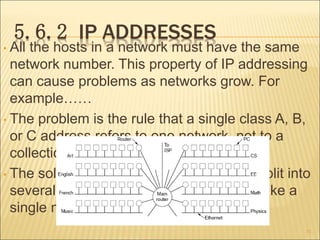
• All the hosts in a network must have the same
network number. This property of IP addressing
can cause problems as networks grow. For
example……
• The problem is the rule that a single class A, B,
or C address refers to one network, not to a
collection of LANs.
• The solution is to allow a network to be split into
several parts for internal use but still act like a
single network to the outside world.
71
5.6.2 IP ADDRESSES
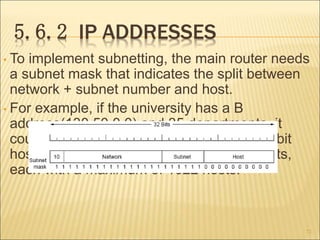
• To implement subnetting, the main router needs
a subnet mask that indicates the split between
network + subnet number and host.
• For example, if the university has a B
address(130.50.0.0) and 35 departments, it
could use a 6-bit subnet number and a 10-bit
host number, allowing for up to 64 Ethernets,
each with a maximum of 1022 hosts.
72
5.6.3 INTERNET CONTROL
PROTOCOLS
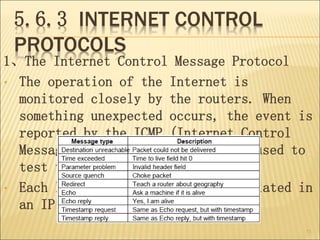
1、The Internet Control Message Protocol
• The operation of the Internet is
monitored closely by the routers. When
something unexpected occurs, the event is
reported by the ICMP (Internet Control
Message Protocol), which is also used to
test the Internet.
• Each ICMP message type is encapsulated in
an IP packet.
73
5.6.3 INTERNET CONTROL
PROTOCOLS
2、ARP—The Address Resolution Protocol
• Most hosts at companies and universities
are attached to a LAN by an interface
board that only understands LAN addresses.
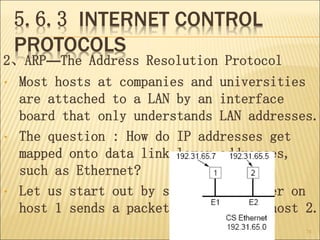
• The question : How do IP addresses get
mapped onto data link layer addresses,
such as Ethernet?
• Let us start out by seeing how a user on
host 1 sends a packet to a user on host 2.
74
5.6.3 INTERNET CONTROL
PROTOCOLS
1)The upper layer software on host 1 now
builds a packet with 192.31.65.5 in the
Destination address field and gives it to
the IP software to transmit.
2)The IP software can look at the address
and see that the destination is on its
own network, but it needs some way to
find the destination's Ethernet address.
• Host 1 outputs a broadcast packet onto the Ethernet asking: Who
owns IP address 192.31.65.5? The broadcast will arrive at every
machine on Ethernet 192.31.65.0, and each one will check its IP
address.
• Host 2 alone will respond with its Ethernet address (E2). In this
way host 1 learns that IP address 192.31.65.5 is on the host with
75
5.6.3 INTERNET CONTROL
PROTOCOLS
3)The IP software on host 1 builds an
Ethernet frame addressed to E2, puts the
IP packet (addressed to 192.31.65.5) in
the payload field, and dumps it onto the
Ethernet.
4)The Ethernet board of host 2 detects
this frame, recognizes it as a frame for
itself, scoops it up, and causes an
interrupt. The Ethernet driver extracts
the IP packet from the payload and passes
it to the IP software, which sees that it
76
5.6.3 INTERNET CONTROL
PROTOCOLS
3、RARP, BOOTP, and DHCP
• Given an Ethernet address, what is the
corresponding IP address? In particular,
this problem occurs when a diskless
workstation is booted.
• The first solution devised was to use
RARP (Reverse Address Resolution
Protocol). This protocol allows a newly-
booted workstation to broadcast its
Ethernet address and say: My 48-bit
77
5.6.3 INTERNET CONTROL
PROTOCOLS
• A disadvantage of RARP is that it uses a
destination address of all 1s (limited
broadcasting) to reach the RARP server.
However, such broadcasts are not
forwarded by routers, so a RARP server is
needed on each network.
• Unlike RARP, BOOTP uses UDP messages,
which are forwarded over routers. It also
provides a diskless workstation with
additional information, including the IP
address of the file server holding the
memory image, the IP address of the 78
5.6.3 INTERNET CONTROL
PROTOCOLS
• DHCP allows both manual IP address
assignment and automatic assignment.
• Like RARP and BOOTP, DHCP is based on the
idea of a special server that assigns IP
addresses to hosts asking for one. This
server need not be on the same LAN as the
requesting host.
79
5.6.3 INTERNET CONTROL
PROTOCOLS
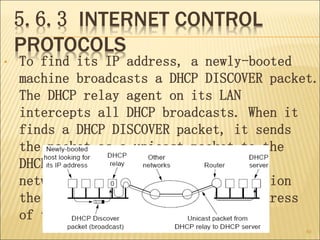
• To find its IP address, a newly-booted
machine broadcasts a DHCP DISCOVER packet.
The DHCP relay agent on its LAN
intercepts all DHCP broadcasts. When it
finds a DHCP DISCOVER packet, it sends
the packet as a unicast packet to the
DHCP server, possibly on a distant
network. The only piece of information
the relay agent needs is the IP address
of the DHCP server.
80
Over!
Thank you very
much!
81
82
robustness
健壮性
83
optimality
最优性
84
topology
拓扑结构
85
converge
汇聚
86
equilibrium
平衡
87
nonadaptive adaptive
非自适应 自适应
88
metric
参数,度量
89
hop
跳数

network layer full chapter_ready.ppt

  • 1.
  • 2.
    REVIEW ISO/OSI’s network model 2 Howmany layers have the OSI’s model divided the network architecture into? What are they from the bottom to the top? PHYSICAL DATA LINK NETWORK TRANSPORT SESSION PRESENTATION APPLICATION Seven layers
  • 3.
    DESCRIPTION OF THENETWORK LAYER • The network layer is concerned with getting packets from the source all the way to the destination. 3 To achieve its goals, the network layer must know about the topology of the communication subnet and choose appropriate paths through it. It must also take care to choose routes to avoid overloading some of the communication lines and routers while leaving others idle.
  • 4.
    CHAPTER 5 THENETWORK LAYER 4 5.1 Network Layer Design Issues 5.2 Routing Algorithms 5.6 The Network Layer in the Internet
  • 5.
    5.1 NETWORK LAYERDESIGN ISSUES • Store-and-Forward Packet Switching • Services Provided to the Transport Layer • Implementation of Connectionless Service • Implementation of Connection-Oriented Service • Comparison of Virtual-Circuit and Datagram Subnets 5
  • 6.
    STORE-AND-FORWARD PACKET SWITCHING Theenvironment of the network layer protocols. • This equipment is used as follows: 6 fig 5-1 Customer’s equipment
  • 7.
    • A hostwith a packet to send transmits it to the nearest router, either on its own LAN or over a point-to-point link to the carrier. • The packet is stored there until it has fully arrived so the checksum can be verified. Then it is forwarded to the next router along the path until it reaches the destination host, where it is delivered. • This mechanism is store-and-forward packet switching, as we have seen in previous chapters. 7
  • 8.
    5.1 NETWORK LAYERDESIGN ISSUES • Store-and-Forward Packet Switching • Services Provided to the Transport Layer • Implementation of Connectionless Service • Implementation of Connection-Oriented Service • Comparison of Virtual-Circuit and Datagram Subnets 8
  • 9.
    SERVICES PROVIDED TOTHE TRANSPORT LAYER What kind of services the network layer provides to the transport layer ? 9 1. The services should be independent of the router technology. 2. The transport layer should be shielded from the number, type, and topology of the routers present. 3. The network addresses made available to the transport layer should use a uniform numbering plan, even across LANs and WANs. • The network layer services have been designed with the following goals:
  • 10.
    ONE CAMP’S VIEW Therouters' job is moving packets around and nothing else. In their view , the subnet is inherently un-reliable, no matter how it is designed. Therefore, the hosts should accept the fact that the network is unreliable and do error control (i.e., error detection and correction) and flow control themselves. So the network service should be connectionless. 10 The Internet offers connectionless network-layer service
  • 11.
    THE OTHER CAMP’SVIEW The subnet should provide a reliable, connection- oriented service. In this view, quality of service is the dominant factor, and without connections in the sub-net, quality of service is very difficult to achieve, especially for real- time traffic such as voice and video. 11 ATM networks offer connection-oriented network-layer service.
  • 12.
    5.1 NETWORK LAYERDESIGN ISSUES • Store-and-Forward Packet Switching • Services Provided to the Transport Layer • Implementation of Connectionless Service • Implementation of Connection-Oriented Service • Comparison of Virtual-Circuit and Datagram Subnets 12
  • 13.
    • Two differentorganizations are possible, depending on the type of service offered. • If connectionless service is offered, packets are injected into the subnet individually and routed independently of each other. • No advance setup is needed. In this context, the packets are frequently called datagrams and the subnet is called a datagram subnet. • If connection-oriented service is used, a path from the source router to the destination router must be established before any data packets can be sent. This connection is called a VC (virtual circuit) and the subnet is called a virtual-circuit subnet. 13
  • 14.
    IMPLEMENTATION OF CONNECTIONLESS SERVICE Routingwithin a diagram subnet. 14 The question is: a packet with a destination D arrives at router A. then which router will router A send this packet to?
  • 15.
    5.1 NETWORK LAYERDESIGN ISSUES • Store-and-Forward Packet Switching • Services Provided to the Transport Layer • Implementation of Connectionless Service • Implementation of Connection-Oriented Service • Comparison of Virtual-Circuit and Datagram Subnets 15
  • 16.
    • For connection-orientedservice, we need a virtual- circuit subnet. • The idea behind virtual circuits is to avoid having to choose a new route for every packet sent. • Instead, when a connection is established, a route from the source machine to the destination machine is chosen as part of the connection setup and stored in tables inside the routers. That route is used for all traffic flowing over the connection, exactly the same way that the telephone system works. When the connection is released, the virtual circuit is also terminated. • With connection-oriented service, each packet carries an identifier telling which virtual circuit it belongs to. 16
  • 17.
    IMPLEMENTATION OF CONNECTION-ORIENTED SERVICE Routingwithin a virtual-circuit subnet. 17 P347
  • 18.
    5.1 NETWORK LAYERDESIGN ISSUES • Store-and-Forward Packet Switching • Services Provided to the Transport Layer • Implementation of Connectionless Service • Implementation of Connection-Oriented Service • Comparison of Virtual-Circuit and Datagram Subnets 18
  • 19.
    COMPARISON OF VIRTUAL-CIRCUITAND DATAGRAM SUBNETS 19 5-4
  • 20.
    • Inside thesubnet, several trade-offs exist betw-een virtual circuits and datagrams. • One trade-off is between router memory space and bandwidth. Virtual circuits allow packets to contain circuit numbers instead of full destination addresses. If the packets tend to be fairly short, a full destination address in every packet may represent a significant amount of overhead and hence, wasted bandwidth. The price paid for using virtual circuits internally is the table space within the routers. Depending upon the relative cost of communication circuits versus router memory, one or the other may be cheaper. 20
  • 21.
    • Another trade-offis setup time versus address parsing time. Using virtual circuits requires a setup phase, which takes time and consumes resources. However, figuring out what to do with a data packet in a virtual-circuit subnet is easy: the router just uses the circuit number to index into a table to find out where the packet goes. In a datagram subnet, a more complicated lookup procedure is required to locate the entry for the destination. 21
  • 22.
    • Virtual circuitshave some advantages in guaranteeing quality of service and avoiding congestion within the subnet. • The loss of a communication line is fatal to virtual circuits using it but can be easily compensated for if datagrams are used. Datagrams also allow the routers to balance the traffic throughout the subnet, since routes can be changed partway through a long sequence of packet transmissions. 22
  • 23.
    SUMMARY 23 •Store-and-Forward Packet Switching •ServicesProvided to the Transport Layer •Implementation of Connectionless Service •Implementation of Connection-Oriented Service •Comparison of Virtual-Circuit and Datagram Subnets
  • 24.
    CHAPTER 5 THENETWORK LAYER 24 5.1 Network Layer Design Issues 5.2 Routing Algorithms 5.6 The Network Layer in the Internet
  • 25.
    DESCRIPTION OF ROUTINGALGORITHMS 1 Definition: The routing algorithm is that part of the network layer software responsible for deciding which output line an incoming packet should be transmitted on. 2 Properties of routing algorithm: correctness, simplicity, robustness, stability, fairness, and optimality. 25 packet
  • 26.
    DESCRIPTION OF ROUTINGALGORITHMS 1) Robustness:Once a major network comes on the air, it may be expected to run continuously for years without system-wide failures. During that period there will be hardware and software failures of all kinds. Hosts, routers, and lines will fail repeatedly, and the topology will change many times. The routing algorithm should be able to cope with changes in the topology and traffic without requiring all jobs in all hosts to be aborted and the network to be rebooted every time some router crashes. 26
  • 27.
    DESCRIPTION OF ROUTINGALGORITHMS 2) Stability: It is also an important goal for the routing algorithm. There exist routing algorithms that never converge to equilibrium, no matter how long they run. A stable algorithm reaches equilibrium and stays there. 27 converge equilibrium A P Q B
  • 28.
    3) Fairness andoptimality may sound obvious, but as it turns out, they are often contradictory goals. • There is enough traffic between A and A', between B and B', and between C and C' to saturate the horizontal links. To maximize the total flow, the X to X' traffic should be shut off altogether. Unfortunately, X 28
  • 29.
    DESCRIPTION OF ROUTINGALGORITHMS Category of algorithm: nonadaptive and adaptive. 1) Nonadaptive algorithms do not base their routing decisions on measurements or estimates of the current traffic and topology. Instead, the choice of the route to use to get from I to J is computed in advance, off-line, and downloaded to the routers when the network is booted. 29 A B C D A - B B C C D B
  • 30.
    DESCRIPTION OF ROUTINGALGORITHMS 2) Adaptive algorithms, in contrast, change their routing decisions to reflect changes in the topology, and usually the traffic as well. • This procedure is sometimes called dynamic routing. 30 A B C D A - B B C C D B A - B C C C D C
  • 31.
    5.2 ROUTING ALGORITHMS •The Optimality Principle • Shortest Path Routing • Flooding • Distance Vector Routing • Link State Routing • Hierarchical Routing • Broadcast Routing 31
  • 32.
    5.2.1 THE OPTIMALITY PRINCIPLE •The Optimality Principle: if router J is on the optimal path from router I to router K, then the optimal path from J to K also falls along the same route. 32 I K J
  • 33.
    5.2.1 THE OPTIMALITY PRINCIPLE •The set of optimal routes from all sources to a given destination form a tree rooted at the destination. Such a tree is called a sink tree. • Figure (a) A subnet. (b) A sink tree for router B. 33
  • 34.
    5.2.1 THE OPTIMALITY PRINCIPLE •Note: A sink tree is not necessarily unique; other trees with the same path lengths may exist. • The goal of all routing algorithms is to discover and use the sink trees for all routers. 34
  • 35.
    5.2.2 SHORTEST PATH ROUTING •A technique to study routing algorithms: The idea is to build a graph of the subnet, with each node of the graph representing a router and each arc of the graph representing a communication line (often called a link). • To choose a route between a given pair of routers, the algorithm just finds the shortest path between them on the graph. • One way of measuring path length is the number of hops. Another metric is the geographic distance in kilometers . Many other metrics are also possible. For example, each arc could be labeled with the mean queuing and transmission delay for some standard test packet as determined by hourly test runs. • In the general case, the labels on the arcs could be computed as a function of the distance, bandwidth, average traffic, communication cost, mean queue length, measured delay, and other factors. By changing the weighting function, the algorithm would then compute the ''shortest'' path measured according to any one of a number of criteria or to a combination of criteria. 35
  • 36.
    5.2.2 SHORTEST PATH ROUTING •Dijkstra algorithm:Each node is labeled (in parentheses) with its distance from the source node along the best known path. Initially, no paths are known, so all nodes are labeled with infinity. As the algorithm proceeds and paths are found, the labels may change, reflecting better paths. A label may be either tentative or permanent. Initially, all labels are tentative. When it is discovered that a label represents the shortest possible path from the source to that node, it is made permanent and never 36
  • 37.
    • Figure. Thefirst five steps used in computing the shortest path from A to D. The arrows 37 Next steps? The shortest path from A to D is: ABEFHD
  • 38.
    5.2.3 FLOODING • Floodingalgorithm:every incoming packet is sent out on every outgoing line except the one it arrived on. • Flooding obviously generates vast numbers of duplicate packets, in fact, an infinite number unless some measures are taken to damp the process. • One such measure is to have a hop counter contained in the header of each packet, which is decremented at each hop, with the packet being discarded when the counter reaches zero. 38
  • 39.
    5.2.3 FLOODING • Avariation of flooding that is slightly more practical is selective flooding.In this algorithm the routers do not send every incoming packet out on every line, only on those lines that are going approximately in the right direction. • Applications of flooding algorithm: 1.military applications 2.distributed database applications 3.wireless networks 4. as a metric against which other routing algorithms can be compared 39
  • 40.
    5.2.4 DISTANCE VECTOR ROUTING •A dynamic routing algorithm • Distance vector routing algorithms operate by having each router maintain a table (i.e, a vector) giving the best known distance to each destination and which line to use to get there. These tables are updated by exchanging information with the neighbors. (also named the distributed Bellman-Ford routing algorithm and the Ford-Fulkerson algorithm ) 40
  • 41.
    5.2.4 DISTANCE VECTOR ROUTING •Table content: In distance vector routing, each router maintains a routing table indexed by, and containing one entry for, each router in the subnet. This entry contains two parts: the preferred outgoing line to use for that destination and an estimate of the time or distance to that destination. • Table updating method:Assume that the router knows the delay to each of its neighbors. Once every T msec each router sends to each neighbor a list of its estimated delays to each destination. It also receives a similar list from 41
  • 42.
    • Part (a)shows a subnet. The first four columns of part (b) show the delay vectors received from the neighbors of router J. Suppose that J has 42
  • 43.
    5.2.5 LINK STATEROUTING • A dynamic routing algorithm • The idea behind link state routing can be stated as five parts. Each router must do the following: 1.Discover its neighbors and learn their network addresses. 2.Measure the delay or cost to each of its neighbors. 3.Construct a packet telling all it has just learned. 43
  • 44.
    5.2.5 LINK STATEROUTING 1. Learning about the Neighbors • It accomplishes this goal by sending a special HELLO packet on each point-to-point line. The router on the other end is expected to send back a reply telling who it is. These names must be globally unique because when a distant router later hears that three routers are all connected to F, it is essential that it can determine whether all three mean the same F. 2. Measuring Line Cost • The most direct way to determine this delay is to send over the line a special ECHO packet 44
  • 45.
    5.2.5 LINK STATEROUTING 3. Building Link State Packets • The packet starts with the identity of the sender, followed by a sequence number and age (to be described later), and a list of neighbors. For each neighbor, the delay to that neighbor is given. (a) A subnet. (b) The link state packets for this subnet 45
  • 46.
    LINK STATE ROUTING •Building the link state packets is easy. The hard part is determining when to build them. One possibility is to build them periodically, that is, at regular intervals. Another possibility is to build them when some significant event occurs, such as a line or neighbor going down or coming back up again or changing its properties appreciably. 4. Distributing the Link State Packets • The basic distribution algorithm:The fundamental idea is to use flooding to distribute the link state packets. To keep the flood in check, each packet contains a sequence number that is incremented for each new packet sent. Routers keep track of all the (source router, sequence) pairs they see. When a new link state packet comes in, it is checked against the list of packets already seen. If it is new, it is forwarded on all lines except the one it arrived on. If it is a duplicate, it is discarded. If a packet with a sequence number lower than the highest one seen so far ever arrives, it is rejected as being obsolete since the router has more recent data. 46
  • 47.
    LINK STATE ROUTING •First problem with this algorithm:if the sequence numbers wrap around, confusion will reign. The solution here is to use a 32-bit sequence number. With one link state packet per second, it would take 137 years to wrap around, so this possibility can be ignored. • Second problem :if a router ever crashes, it will lose track of its sequence number. If it starts again at 0, the next packet will be rejected as a duplicate. • Third problem :if a sequence number is ever corrupted and 65,540 is received instead of 4 (a 1-bit error), packets 5 through 65,540 will be rejected as obsolete, since the current sequence number is thought to be 47
  • 48.
    5.2.5 LINK STATEROUTING • The solution to all these problems is to include the age of each packet after the sequence number and decrement it once per second. When the age hits zero, the information from that router is discarded. 5. Computing the New Routes • Once a router has accumulated a full set of link state packets, it can construct the entire subnet graph because every link is represented. • Now Dijkstra's algorithm can be run locally to construct the shortest path to all possible destinations. 48
  • 49.
    5.2.6 HIERARCHICAL ROUTING •The routers are divided into what we will call regions, with each router knowing all the details about how to route packets to destinations within its own region, but knowing nothing about the internal structure of other regions. • For huge networks, a two-level hierarchy may be insufficient; it may be necessary to group the regions into clusters, the clusters into zones, the zones into groups, and so on, until we run out of names for aggregations. 49
  • 50.
    5.2.6 HIERARCHICAL ROUTING •The full routing table for router 1A has 17 entries, as shown in (b). When routing is done hierarchically, as in (c), there are entries for all the local routers as before, but all other regions have been condensed into a single router, so all 50
  • 51.
    5.2.6 HIERARCHICAL ROUTING •Unfortunately, these gains in space are not free. There is a penalty to be paid, and this penalty is in the form of increased path length. For example, the best route from 1A to 5C is via region 2, but with hierarchical routing all traffic to region 5 goes via region 3, because that is better for most destinations in region 5. 51
  • 52.
    5.2.7 BROADCAST ROUTING •Sending a packet to all destinations simultaneously is called broadcasting. 1)The source simply sends a distinct packet to each destination. Not only is the method wasteful of bandwidth, but it also requires the source to have a complete list of all destinations. 2)Flooding. • The problem with flooding as a broadcast technique is that it generates too many packets and consumes too much bandwidth. 52
  • 53.
    5.2.7 BROADCAST ROUTING 3)Multi-destinationrouting. •If this method is used, each packet contains either a list of destinations or a bit map indicating the desired destinations. When a packet arrives at a router, the router checks all the destinations to determine the set of output lines that will be needed. (An output line is needed if it is the best route to at least one of the destinations.) The router generates a new copy of the packet for each output line to be used and includes in each packet only those destinations that are to use the line. In effect, the destination set is partitioned among the output lines. After a sufficient number of hops, each packet will carry only one destination and can be 53
  • 54.
    5.2.7 BROADCAST ROUTING 4)Afourth broadcast algorithm makes explicit use of the sink tree for the router initiating the broadcast—or any other convenient spanning tree for that matter. • A spanning tree is a subset of the subnet that includes all the routers but contains no loops. • If each router knows which of its lines belong to the spanning tree, it can copy an incoming broadcast packet onto all the spanning tree lines except the one it arrived on. 54
  • 55.
    5.2.7 BROADCAST ROUTING 5)Reverse path forwarding. • When a broadcast packet arrives at a router, the router checks to see if the packet arrived on the line that is normally used for sending packets to the source of the broadcast. If so, there is an excellent chance that the broadcast packet itself followed the best route from the router and is therefore the first copy to arrive at the router. This being the case, the router forwards copies of it onto all lines except the one it arrived on. If, however, the broadcast packet arrived on a line other than the preferred one for reaching the source, the packet is discarded as a likely duplicate. 55
  • 56.
    5.2.7 BROADCAST ROUTING •how does the reverse path algorithm works? P369 56 Reverse path forwarding. (a) A subnet. (b) A sink tree. (c) The tree built by reverse path forwarding.
  • 57.
    57 Routing Mobile Hosts a)Networking portable computers b) Tanenbaum’s proposed solution – All mobile agents are assumed to have a permanent home location – When a portable computer is attached to a remote network it contacts a process that acts as the local foreign agent. – Each home location has a process that acts as the home agent
  • 58.
    THE AGENTS ONTHE NETWORK 58
  • 59.
    REGISTERING A MOBILEAGENT 59 a) Periodically the foreign agent broadcasts its address b) The mobile agent registers with the foreign agent and supplies its home address c) The foreign agent contacts the mobile agent’s home agent reporting the mobile agent’s location. – Security must be used to verify the identity of the mobile agent. d) The foreign agent registers the mobile agent
  • 60.
    60 Routing Packets toa Mobile Agent a) Packets sent to the mobile agent are routed to the users home network b) The home agent routes the packets to the foreign agent c) The home agent provides the source of incoming packets with the remote address of the mobile agent
  • 61.
    61 Routing for MobileHosts (2) Packet routing for mobile users.
  • 62.
    62 Routing in AdHoc Networks Ad Hoc Networks: Networks of nodes that just happen to be near each other Possibilities when the routers are mobile: 1. Military vehicles on battlefield. – No infrastructure. 2. A fleet of ships at sea. – All moving all the time 3. Emergency works at earthquake . – The infrastructure destroyed. 4. A gathering of people with notebook computers. – In an area lacking 802.11.
  • 63.
    63 Route Discovery AODV-Ad HocOn Demand Distance Vector Algorithm a) Range of A's broadcast. b) After B and D have received A's broadcast. c) After C, F, and G have received A's broadcast. d) After E, H, and I have received A's broadcast. Shaded nodes are new recipients. Arrows show possible reverse
  • 64.
    64 Route Discovery (2) Formatof a ROUTE REQUEST packet.
  • 65.
    65 Route Discovery (3) Formatof a ROUTE REPLY packet.
  • 66.
    CHAPTER 5 THENETWORK LAYER 66 5.1 Network Layer Design Issues 5.2 Routing Algorithms 5.6 The Network Layer in the Internet
  • 67.
    5.6 THE NETWORKLAYER IN THE INTERNET • The IP Protocol • IP Addresses • Internet Control Protocols 67
  • 68.
    5.6.1 THE IPPROTOCOL • An IP datagram consists of a header part and a text part. The header has a 20-byte fixed part and a variable length optional part. 68 P434
  • 69.
    5.6.2 IP ADDRESSES •Every host and router on the Internet has an IP address, which encodes its network number and host number. • All IP addresses are 32 bits long. It is important to note that an IP address does not actually refer to a host. It really refers to a network interface, so if a host is on two networks, it must have two IP addresses. • IP addresses were divided into the five categories 69 network mask 255.0.0.0 255.255.0.0 255.255.255.0
  • 70.
    5.6.2 IP ADDRESSES •The values 0 and -1 (all 1s) have special meanings. The value 0 means this network or this host. The value of -1 is used as a broadcast address to mean all hosts on the indicated network. 70
  • 71.
    5.6.2 IP ADDRESSES •All the hosts in a network must have the same network number. This property of IP addressing can cause problems as networks grow. For example…… • The problem is the rule that a single class A, B, or C address refers to one network, not to a collection of LANs. • The solution is to allow a network to be split into several parts for internal use but still act like a single network to the outside world. 71
  • 72.
    5.6.2 IP ADDRESSES •To implement subnetting, the main router needs a subnet mask that indicates the split between network + subnet number and host. • For example, if the university has a B address(130.50.0.0) and 35 departments, it could use a 6-bit subnet number and a 10-bit host number, allowing for up to 64 Ethernets, each with a maximum of 1022 hosts. 72
  • 73.
    5.6.3 INTERNET CONTROL PROTOCOLS 1、TheInternet Control Message Protocol • The operation of the Internet is monitored closely by the routers. When something unexpected occurs, the event is reported by the ICMP (Internet Control Message Protocol), which is also used to test the Internet. • Each ICMP message type is encapsulated in an IP packet. 73
  • 74.
    5.6.3 INTERNET CONTROL PROTOCOLS 2、ARP—TheAddress Resolution Protocol • Most hosts at companies and universities are attached to a LAN by an interface board that only understands LAN addresses. • The question : How do IP addresses get mapped onto data link layer addresses, such as Ethernet? • Let us start out by seeing how a user on host 1 sends a packet to a user on host 2. 74
  • 75.
    5.6.3 INTERNET CONTROL PROTOCOLS 1)Theupper layer software on host 1 now builds a packet with 192.31.65.5 in the Destination address field and gives it to the IP software to transmit. 2)The IP software can look at the address and see that the destination is on its own network, but it needs some way to find the destination's Ethernet address. • Host 1 outputs a broadcast packet onto the Ethernet asking: Who owns IP address 192.31.65.5? The broadcast will arrive at every machine on Ethernet 192.31.65.0, and each one will check its IP address. • Host 2 alone will respond with its Ethernet address (E2). In this way host 1 learns that IP address 192.31.65.5 is on the host with 75
  • 76.
    5.6.3 INTERNET CONTROL PROTOCOLS 3)TheIP software on host 1 builds an Ethernet frame addressed to E2, puts the IP packet (addressed to 192.31.65.5) in the payload field, and dumps it onto the Ethernet. 4)The Ethernet board of host 2 detects this frame, recognizes it as a frame for itself, scoops it up, and causes an interrupt. The Ethernet driver extracts the IP packet from the payload and passes it to the IP software, which sees that it 76
  • 77.
    5.6.3 INTERNET CONTROL PROTOCOLS 3、RARP,BOOTP, and DHCP • Given an Ethernet address, what is the corresponding IP address? In particular, this problem occurs when a diskless workstation is booted. • The first solution devised was to use RARP (Reverse Address Resolution Protocol). This protocol allows a newly- booted workstation to broadcast its Ethernet address and say: My 48-bit 77
  • 78.
    5.6.3 INTERNET CONTROL PROTOCOLS •A disadvantage of RARP is that it uses a destination address of all 1s (limited broadcasting) to reach the RARP server. However, such broadcasts are not forwarded by routers, so a RARP server is needed on each network. • Unlike RARP, BOOTP uses UDP messages, which are forwarded over routers. It also provides a diskless workstation with additional information, including the IP address of the file server holding the memory image, the IP address of the 78
  • 79.
    5.6.3 INTERNET CONTROL PROTOCOLS •DHCP allows both manual IP address assignment and automatic assignment. • Like RARP and BOOTP, DHCP is based on the idea of a special server that assigns IP addresses to hosts asking for one. This server need not be on the same LAN as the requesting host. 79
  • 80.
    5.6.3 INTERNET CONTROL PROTOCOLS •To find its IP address, a newly-booted machine broadcasts a DHCP DISCOVER packet. The DHCP relay agent on its LAN intercepts all DHCP broadcasts. When it finds a DHCP DISCOVER packet, it sends the packet as a unicast packet to the DHCP server, possibly on a distant network. The only piece of information the relay agent needs is the IP address of the DHCP server. 80
  • 81.
  • 82.
  • 83.
  • 84.
  • 85.
  • 86.
  • 87.
  • 88.
  • 89.