The Snake Problem
Math With David Seff
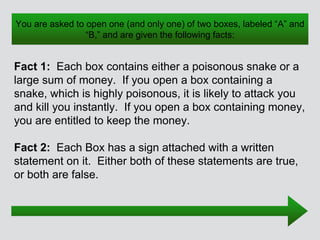
You are asked to open one (and only one) of two boxes, labeled “A” and
“B,” and are given the following facts:
Fact 1: Each box contains either a poisonous snake or a
large sum of money. If you open a box containing a
snake, which is highly poisonous, it is likely to attack you
and kill you instantly. If you open a box containing money,
you are entitled to keep the money.
Fact 2: Each Box has a sign attached with a written
statement on it. Either both of these statements are true,
or both are false.
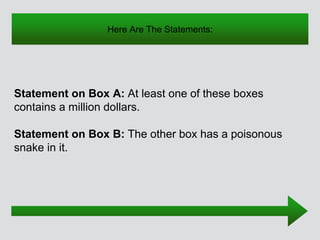
Here Are The Statements:
Statement on Box A: At least one of these boxes
contains a million dollars.
Statement on Box B: The other box has a poisonous
snake in it.
Question: Which Box Should You Open?
To answer that question we need to do an analysis of the
given information. The first thing is to list all possibilities.
Notes To Help Answer Question
1) This is a logic problem, and a logic problem
may present difficulties of “self-reference.”
Notes To Help Answer Question
2) Do not jump into a problem right away. Be
sure you first understand the problem, even if it
takes a few moments.
Notes To Help Answer Question
3) If a problem clearly give a small number of
possibilities, one way that is sometimes good
to solve the problem is to “step” through it, and
see how each possibility works out.
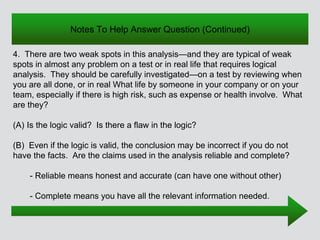
Notes To Help Answer Question (Continued)
4. There are two weak spots in this analysis—and they are typical of weak
spots in almost any problem on a test or in real life that requires logical
analysis. They should be carefully investigated—on a test by reviewing when
you are all done, or in real What life by someone in your company or on your
team, especially if there is high risk, such as expense or health involve. What
are they?
(A) Is the logic valid? Is there a flaw in the logic?
(B) Even if the logic is valid, the conclusion may be incorrect if you do not
have the facts. Are the claims used in the analysis reliable and complete?
- Reliable means honest and accurate (can have one without other)
- Complete means you have all the relevant information needed.
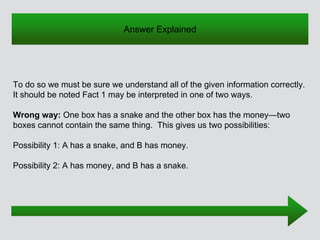
Answer Explained
To do so we must be sure we understand all of the given information correctly.
It should be noted Fact 1 may be interpreted in one of two ways.
Wrong way: One box has a snake and the other box has the money—two
boxes cannot contain the same thing. This gives us two possibilities:
Possibility 1: A has a snake, and B has money.
Possibility 2: A has money, and B has a snake.
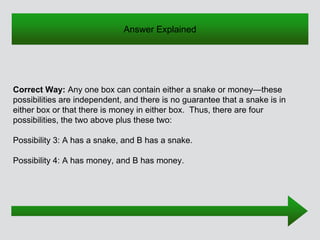
Correct Way: Any one box can contain either a snake or money—these
possibilities are independent, and there is no guarantee that a snake is in
either box or that there is money in either box. Thus, there are four
possibilities, the two above plus these two:
Possibility 3: A has a snake, and B has a snake.
Possibility 4: A has money, and B has money.
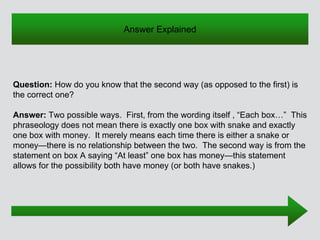
Answer Explained
Question: How do you know that the second way (as opposed to the first) is
the correct one?
Answer: Two possible ways. First, from the wording itself , “Each box…” This
phraseology does not mean there is exactly one box with snake and exactly
one box with money. It merely means each time there is either a snake or
money—there is no relationship between the two. The second way is from the
statement on box A saying “At least” one box has money—this statement
allows for the possibility both have money (or both have snakes.)
Answer Explained
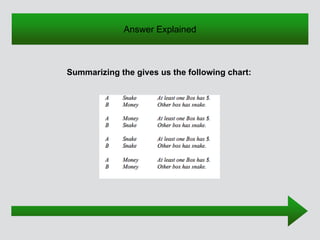
Summarizing the gives us the following chart:
Answer Explained
Our second step involves an analysis of the information once we have listed all
cases. Let us ask which statements, A or B, will be true in each case. We put
a Blue T or F (for True or False) next to each possibility if, in that case,
Statement A is true or false, and we put a Red T or F next to each possibility if,
in that case, Statement B is true or false. NOTE: Our goal is to co-ordinate the
two statements (Fact 1 & 2) with the two statements (A & B).
Answer Explained
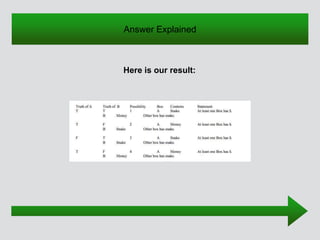
Here is our result:
Answer Explained
Thus, we see in the first case, and only in the first case, both Statements A &
B are true. There is no other case where both are true or both are false, as
required by Fact 1. Therefore, it must be that Possibility 1 is the only viable
possibility, so open Box B.
In real life, however, we should not open any box, because, as humans, we
can never be sure that (1) we did not make any mistake in our analysis, and
(2) the information given to us (namely Fact 1 and Fact 2) are really correct.
We should consider these to be claims that other humans (who are fallible)
have made, and not accept them as absolute fact.
Answer Explained

The Snake Problem (Logic Question)

  • 1.
    The Snake Problem MathWith David Seff
  • 2.
    You are askedto open one (and only one) of two boxes, labeled “A” and “B,” and are given the following facts: Fact 1: Each box contains either a poisonous snake or a large sum of money. If you open a box containing a snake, which is highly poisonous, it is likely to attack you and kill you instantly. If you open a box containing money, you are entitled to keep the money. Fact 2: Each Box has a sign attached with a written statement on it. Either both of these statements are true, or both are false.
  • 3.
    Here Are TheStatements: Statement on Box A: At least one of these boxes contains a million dollars. Statement on Box B: The other box has a poisonous snake in it.
  • 4.
    Question: Which BoxShould You Open? To answer that question we need to do an analysis of the given information. The first thing is to list all possibilities.
  • 5.
    Notes To HelpAnswer Question 1) This is a logic problem, and a logic problem may present difficulties of “self-reference.”
  • 6.
    Notes To HelpAnswer Question 2) Do not jump into a problem right away. Be sure you first understand the problem, even if it takes a few moments.
  • 7.
    Notes To HelpAnswer Question 3) If a problem clearly give a small number of possibilities, one way that is sometimes good to solve the problem is to “step” through it, and see how each possibility works out.
  • 8.
    Notes To HelpAnswer Question (Continued) 4. There are two weak spots in this analysis—and they are typical of weak spots in almost any problem on a test or in real life that requires logical analysis. They should be carefully investigated—on a test by reviewing when you are all done, or in real What life by someone in your company or on your team, especially if there is high risk, such as expense or health involve. What are they? (A) Is the logic valid? Is there a flaw in the logic? (B) Even if the logic is valid, the conclusion may be incorrect if you do not have the facts. Are the claims used in the analysis reliable and complete? - Reliable means honest and accurate (can have one without other) - Complete means you have all the relevant information needed.
  • 9.
    Answer Explained To doso we must be sure we understand all of the given information correctly. It should be noted Fact 1 may be interpreted in one of two ways. Wrong way: One box has a snake and the other box has the money—two boxes cannot contain the same thing. This gives us two possibilities: Possibility 1: A has a snake, and B has money. Possibility 2: A has money, and B has a snake.
  • 10.
    Correct Way: Anyone box can contain either a snake or money—these possibilities are independent, and there is no guarantee that a snake is in either box or that there is money in either box. Thus, there are four possibilities, the two above plus these two: Possibility 3: A has a snake, and B has a snake. Possibility 4: A has money, and B has money. Answer Explained
  • 11.
    Question: How doyou know that the second way (as opposed to the first) is the correct one? Answer: Two possible ways. First, from the wording itself , “Each box…” This phraseology does not mean there is exactly one box with snake and exactly one box with money. It merely means each time there is either a snake or money—there is no relationship between the two. The second way is from the statement on box A saying “At least” one box has money—this statement allows for the possibility both have money (or both have snakes.) Answer Explained
  • 12.
    Summarizing the givesus the following chart: Answer Explained
  • 13.
    Our second stepinvolves an analysis of the information once we have listed all cases. Let us ask which statements, A or B, will be true in each case. We put a Blue T or F (for True or False) next to each possibility if, in that case, Statement A is true or false, and we put a Red T or F next to each possibility if, in that case, Statement B is true or false. NOTE: Our goal is to co-ordinate the two statements (Fact 1 & 2) with the two statements (A & B). Answer Explained
  • 14.
    Here is ourresult: Answer Explained
  • 15.
    Thus, we seein the first case, and only in the first case, both Statements A & B are true. There is no other case where both are true or both are false, as required by Fact 1. Therefore, it must be that Possibility 1 is the only viable possibility, so open Box B. In real life, however, we should not open any box, because, as humans, we can never be sure that (1) we did not make any mistake in our analysis, and (2) the information given to us (namely Fact 1 and Fact 2) are really correct. We should consider these to be claims that other humans (who are fallible) have made, and not accept them as absolute fact. Answer Explained