FINAL DRAFT
05.07.18
SOUTH END VISION PLAN	 iiiii	 SOUTH END VISION PLAN
South End is a people-
first walkable, urban
district of vibrant
neighborhoods, built
along light rail transit,
and fueled with energy
and innovation from
some of Charlotte's
most diverse and
creative people.
SOUTH END VISION PLAN	 viv	 SOUTH END VISION PLANiv	 SOUTH END VISION PLAN SOUTH END VISION PLAN	 v
South End is 25 years old this year—the same as the architectural firm my partner, Kevin
Kelley, and I founded in the Atherton Mill.
Back then, the blocks that were to become South End constituted a borderland, a
largely forgotten post- industrial zone that mitigated life between the Dilworth and
Wilmore neighborhoods.
It was also a frontier, and a place where Charlotte piloted change. This part of Charlotte—
where the first railroads came to town, and where cotton became textiles—transformed
warehouses into space for creatives, and where the trolley followed by light rail sparked
a renaissance of residential investment, and founded a new neighborhood.
The evolution from an industrial area into a creative design district and then vibrant
urban neighborhood has been fueled by both the creativity and dedication of
individuals and small businesses, and by targeted investment and support from public
agencies. Spinning together history and new energy, the neighborhood has become
one of Charlotte’s great assets. As newcomers and new investors arrive, we needed a
new playbook or plan to ensure that the next phase of development improves South
End’s urban design, broadens its mix of uses, fosters vibrant public streets and amplifies
and creates parks and open spaces for those who choose an urban life.
Therefore, as chair of the South End Advisory Committee, the Vision Plan Steering
Committee, a South End real estate and business owner, and long-time advocate for
this neighborhood, I am pleased to present this vision and plan for the future.
South End is already Charlotte’s first transit-oriented neighborhood in our post-street car
era. This plan will guide its next stage of development, maturing it into one of our city’s
first and best examples of a livable city, with a state-of-the-art transportation system, a
walkable and bikeable oasis with expanded housing offerings, and featuring inviting,
activity-filled streets and public spaces.
We plan for thoughtful growth by design, expecting density around transit stations, and
intentional diversity of residents, businesses, commerce and retail. We want a culture of
supporting local artists, entrepreneurs and retailers, with pilot programs that can extend
opportunity in South End and by extension, Charlotte. And we will build on our greatest
assets, celebrating and strengthening the natural neighborhood centers around each
transit station and nurturing the Rail Trail into an outstanding example of a vibrant linear
park, a recreational public space, and a connector of neighborhoods.
The South End Vision Plan and design guidelines will also serve as a springboard and
testing ground for the city’s efforts to overhaul our comprehensive zoning policy, allowing
the Charlotte-Mecklenburg Planning Commission and planning staff to pilot new ideas
and design policies in a fast-growing area.
The founding of South End was arguably the greatest grass roots effort in the history of
Charlotte. All of us who have worked on this vision and plan are grateful to the many
community members whose ideas, feedback and questions guided its development.
The core values from the community reaffirm our city’s commitment to becoming the
best example of a livable city that supports well-being for everyone through excellent
neighborhood design, public infrastructure, open space, employment and housing
options.
The future of our city and South End is bright. Let’s build the best place we can for the
next 25 years, and beyond.
Sincerely,
Terry Shook
"The founding of
South End was
arguably the
greatest grass roots
effort in the history of
Charlotte."
SOUTH END VISION PLAN	 viivi	 SOUTH END VISION PLANvi	 SOUTH END VISION PLAN SOUTH END VISION PLAN	
The Charlotte-Mecklenburg Planning Commission has adopted
this Livable City Policy Statement and Guiding Principles
to articulate the Commission’s priorities for the growth and
development of Charlotte and guide the Commission’s work in
advising the governing bodies it serves.
This policy statement is founded in the City’s adopted Centers,
Corridors and Wedges Growth Framework, General Development
Policies and area plans, and serves to focus and prioritize the
Commission’s work and recommendations. By incorporation as
part of the South End Vision Plan, this Policy Statement and its
Guiding Principles serve as the adopted policy foundation for the
South End Vision Plan.
Charlotte-Mecklenburg
Planning Commission
Livable City Policy Statement
Develop a livable city where Charlotteans of all incomes can
achieve, “a complete state of physical, mental and social well-
being”1
throughthedesignofneighborhoods,publicinfrastructure
and open spaces, and through easy access to employment and
housing choices.
Guiding Principles
»» Create a state-of-the-art transportation system that equally
provides for the health and safety of pedestrians, bicyclists,
transit riders, and motorists and is accessible to people of all
ages and abilities;
»» Promote a mix of land uses within a close proximity so that
Charlotteans can live, work, play, shop and worship in a
neighborhood without the need for an automobile;
»» Ensure access to affordable housing by supporting the
dispersal of a range of housing types throughout the city, so
that the availability of transportation does not limit access to
economic opportunity;
»» Build vibrant and activity-filled public streets and open spaces
that promote community engagement so that Charlotteans
of all ages and abilities can participate in a public life;
»» Promote access to affordable and healthy/local foods so that
income and location don’t limit dietary choices; and
»» Protect the air we breathe, and the trees that filter it, while
also shading us from the hot, southern sun.
»» Build safe communities, by using planning tools to prevent
crime and violence through environmental design.
1
Excerpt of World Health Organization definition of public health
Winning City Principles
The City of Charlotte seeks to model 10 traits of winning cities
of tomorrow. The traits help Charlotte address the major
demographic and cultural trends shaping our future. The South
End Vision Plan incorporates these throughout the document in
the core values, goals, and initiatives.
»» POSITIVE BUZZ – Inspiring and scaling positive word of mouth.
The South End Vision Plan envisions a 2030 South End to work
towards.
»» SHARED STORY – Advancing a seamless narrative; Why we're
unique. South End is the first transit oriented neighborhood
on the blue line to experience explosive growth. The
neighborhood sets Charlotte apart and will continue to do so
over the next 15 years.
»» 15-MINUTE LIVABLE COMMUNITIES – Investing in diverse
neighborhoods. Access to jobs, housing, and daily needs are
all a part of the South End Vision. Well on it's way the Vision
Plan provides a road map to strengthen the neighborhoods
livability.
»» AFFORDABLE SPACES – Meeting the rising demand for
affordable housing. As a goal of the plan affordability is critical
not only for housing, but for office and workspace as well.
»» WORKFORCE DYNAMICS – Advancing large-scale training and
re-skilling
»» MILLENNIAL MAGNET – Being a hot spot for young professionals.
The South End Vision Plan embraces the young professionals
that call the neighborhood home. Keeping this culture and
building on the current momentum through infrastructure and
design is a critical component of the plan.
»» BEYOND BORDERS – Advancing collaboration across and
outside the region
»» OPEN MINDS – Being creative, innovative and accepting of
new ideas. A core value of creative and dynamic is at the
heart of the South End. Always a place of experimentation the
South End Vision Plan aims to keep it that way.
»» OPEN BOOK – Being hyper-transparent and a proactive
communicator. Through the South End Vision Plan the
road map for the future is clear. Future investments and
improvements should align with the Vision Plan, fostering
transparency with both the City of Charlotte and Charlotte
Center City Partners.
»» BIG TENT – Being a welcoming and inclusive community.
As a core value inclusivity in South End means building a
neighborhood for all - old time residents, newcomers, all ages,
and lifestyles.
SOUTH END VISION PLAN	 ixviii	 SOUTH END VISION PLAN
1Why This Plan,
Why Now?
South End is a rapidly changing,
growing urban neighborhood. Filled
with entrepreneurs and teaming with
excitement there is no time like to
present to plan for the future.
In Chapter 1, find the basics of the why
along with history and facts to back it
up. This includes the results from the
2015 South End resident survey. Key
findings from the survey include:
»» Critical: Preserving and increasing
the number of local establishments
»» Critical: Increasing the number of
festivals and events
On page 10 you will also find snapshot
facts about the growth of South End
and the people who live there.
Chapter 1 finishes with a highlight of
the focus areas and the community
engagement process to create the
plan.
2Where We Want
to Go
Chapter 2 is the story of 2030. Beginning
with the core values of South End
the chapter begins to tell the story
of future South Enders. Adaptable,
authentic, beautiful, connective,
inclusive, creative, mobile, dynamic,
and safe begin to paint the picture
of the future South End. Realizing the
core values is achieved through the
goals that follow in Chapter 2. Each
goal includes recommended actions
to implement as well as case studies
from peer cities.
»» Grow By Design
»» Expand Our Mix
»» Pursue Affordability
»» Celebrate Public Space
»» Move, Connect, Network
»» Never Stop Experimenting
»» Manage Our Common Resources
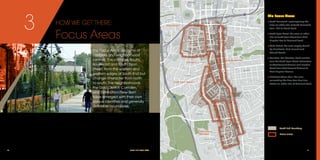
3How We Get
There: Focus
Areas
Five focus areas of South End are
highlighted in Chapter 3 with further
details on the vision and site specific
recommendations. Highlights includes:
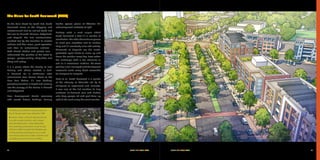
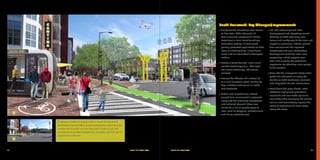
»» Streetscape improvements on South
Boulevard and South Tryon Street
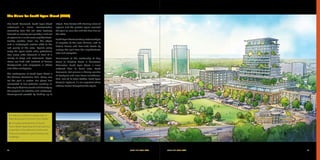
»» Completing Wilmore Centennial
Park adjacent to South Tryon Street
and developing it as an office
corridor
»» Leveraging the history of the Gold
District to develop a new museum
and square
»» Completing Camden Road is a
festival street with high density
development
»» Proserving the industrial character
of Lower South End for existing and
future industry.
4Key Initiatives
The Top 10 initiatives in the
Implementation Chapter create a
road map of priorities to implement the
goals in the South End Vision Plan. Each
of the top ten include stakeholders,
methods, and the resources needed
to complete the tasks. While in
different stages of development these
10 initiatives will be the first actions
from the plan.
1.	 Develop the Rail Trail
2.	 Convert South Boulevard into a
Main Street
3.	 New design regulations
4.	 Attract cultural venues
5.	 Preserve affordable workplaces
6.	 Construct the Wilmore Centennial
Park
7.	 Build a crossing at Hawkins/
Rampart
8.	 Increase density
9.	 Manage parking as a district
10.	Embed art into everything
5Community
Design
Guidelines
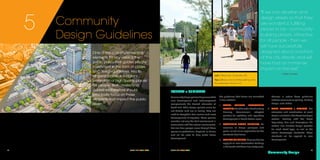
Chapter 4 focuses on the design
guidelines and street standards
necessary to build the public realm
outlined in the South End Vision Plan.
Organized by principles first, then
followed by general guidelines and
street specific standards, this chapter
is where the dimensions are listed.
Priorities for design include:
»» Managing building length and
proportion to break down the large
monolithic buildings
»» Providing clear guidance for
facades and materials to improve
the design quality
»» Prioritizing the ground floor design
and uses
»» Focusing on entrances and their
importance to street life
»» Limiting parking and driveways
»» Getting the streetscape right
Executive Summary
SOUTH END VISION PLAN	 1x	 SOUTH END VISION PLANx	 SOUTH END VISION PLAN SOUTH END VISION PLAN	 1
Contents
1: Why This Plan, Why Now?. . . . . . . . . . . . . 2
The Purpose of This Plan .  .  .  .  .  .  .  .  .  .  .  .  . 3
South End’s Story .  .  .  .  .  .  .  .  .  .  .  .  .  .  .  .  .  .  . 4
South End Fast Facts. .  .  .  .  .  .  .  .  .  .  .  .  .  .  .  . 8
Study Area and Focus Areas. .  .  .  .  .  .  .  . 12
Planning Process.  .  .  .  .  .  .  .  .  .  .  .  .  .  .  .  .  . 14
2: Where We Want To Go. . . . . . . . . . . . . . 18
Vision. .  .  .  .  .  .  .  .  .  .  .  .  .  .  .  .  .  .  .  .  .  .  .  .  .  .  . 18
Realizing this Vision .  .  .  .  .  .  .  .  .  .  .  .  .  .  .  . 21
Core Values .  .  .  .  .  .  .  .  .  .  .  .  .  .  .  .  .  .  .  .  .  . 21
Goals .  .  .  .  .  .  .  .  .  .  .  .  .  .  .  .  .  .  .  .  .  .  .  .  .  .  . 23
3: How We Get There: Focus Areas. . . . . . 40
South Boulevard.  .  .  .  .  .  .  .  .  .  .  .  .  .  .  .  .  .  . 42
South Tryon Street. .  .  .  .  .  .  .  .  .  .  .  .  .  .  .  .  . 46
The Gold District.  .  .  .  .  .  .  .  .  .  .  .  .  .  .  .  .  .  . 50
Camden.  .  .  .  .  .  .  .  .  .  .  .  .  .  .  .  .  .  .  .  .  .  .  .  . 54
Distribution/New Bern .  .  .  .  .  .  .  .  .  .  .  .  .  . 58
4: Implementation: Key Initiatives. . . . . . . 62
5: Implementation: Design Guidelines. . . 74
Appendix A: Acknowledgments. . . . . . . . 94
SOUTH END VISION PLAN	 32	 SOUTH END VISION PLAN
Introduction
Over the past ten years, South
End has grown into one of
Charlotte’s most dynamic
locations. From its history as
a neglected industrial and
commercial part of town in the
1980s, it reinvented itself as a
low-cost haven for artists and
other creative people in the
1990s and early 2000s.
Why This Plan,
Why Now?
1
With the Blue line of the light rail line
opening 2007, a new wave of apartment
construction progressively filled vacant
sites and replaced much of the original
built fabric.
By the end of the first decade of the
21st century, South End had developed
a reputation as a creative hub with the
clustered presence of working design
professionals. Since then, the area has
emerged as a vibrant urban mixed-use
district, with more active street level retail
uses – especially restaurants, bars and
breweries.
Spurred by a strong rebound from the
recession, the neighborhood’s population
has grown to an estimated 9,000 residents
with over 3,500 housing units actively under
construction or recently delivered (at the
time of writing in 2017). While much of this
growth has been driven by new upmarket
rental housing, a welcome variety is being
added by new office buildings, more
retail-oriented projects, and at least one
hotel.
In early 2012, a Center City Partners Three-
Year Strategic Plan articulated a set of
actionable goals for South End's growth
and development. That plan’s six goals,
developed through a series of community
surveys and extensive stakeholder
interviews, were as follows:
»» Develop Camden Road as the natural
neighborhood center
»» Nurture authentic neighborhood retail
»» Plan and develop a public realm of
parks, open space, and recreation
activities
»» Improve neighborhood connectivity
»» Raise the development bar
»» Keep South End accessible to those
who make it great.
Along with each goal, a series of
recommendations and actions were
proposed that have guided Charlotte
Center City Partner’s (CCCP) program of
work in the neighborhood. While many
of the strategies have been acted upon,
work on others is either ongoing or has yet
to be accomplished. For example, the
continued development and build out of
the Rail Trail has begun, while the promise
of a much needed neighborhood park
remains unfulfilled.
In 2016, the Charlotte-Mecklenburg
Planning Commission identified a series
of Transit Oriented Development (TOD)
Priorities based in part on a review and
assessment of recent development in
South End. This review identified areas of
the current TOD regulations that need to
be strengthened to fulfill the purpose set
out in the TOD ordinance. These priorities
emphasize the need to strengthen the
public realm with renewed attention
to street level pedestrian activation,
parking standards and design, the Rail
Trail, and overall architectural design and
density. This work represents important
lessons learned over the past decade of
investment and development in South
End and highlights the need to renew our
vision and redefine our expectations.
With a growing population, proximity
to Uptown and the Blue Line light rail,
and many available, well-located but
underutilized parcels and sites, developers
continue to be interested in South End.
For the neighborhood to become a
more vibrant place, capitalize on its real
estate value, and maximize its potential
as Charlotte’s most walkable, transit-
oriented neighborhood, the community
must articulate an updated vision for how
South End should grow and develop in
ways that are sustainable over the longer
term. At the same time, neighborhood
“focus areas” have emerged with special
characteristics and issues that deserve
special attention.
The Purpose of This Plan
Accordingly, this plan provides a refreshed
and compelling vision with urban design
guidelines, strategies, and tools to help
achieve the high-quality development
that the community demands while
"It always seems
impossible until it is
done.”
—Nelson
Mandela
4	 SOUTH END VISION PLAN
preserving the distinct character of each
focus area.
The purpose of this Plan is to:
1.	 Establish a community-driven vision for
the ongoing development of South
End while defining more specific
visions for the focus areas listed and
2.	 Inform the City’s existing South End
and New Bern Station Area Plans and
comprehensive zoning ordinance
revision with a toolbox of design
standards to guide development and
redevelopment activity in South End.
South End’s Story
Pre-Industrial to “Little Manchester”
to “Creative” District
The area known today as South End is a
fairly recent branding invention, but it has
a fascinating history. This new planning
vision and implementation strategy
has the potential to write an exciting
new chapter in this district’s compelling
historical narrative, a story that begins over
two hundred years ago. To understand
where South End is going visionaries and
plan makers want to go, one needs to
understand where South End has been,
and this is best understood as a sequence
of five historical periods.
Gold! (1799-1860)
Gold was first discovered near Charlotte in
1799andbetweenthatyearand1860gold
workings in the Charlotte area extracted
60 million dollars’ worth of that precious
metal. The brief and hectic “boomtown”
period began in 1831 and lasted until
larger gold deposits were discovered in
California in 1848 (Morrill, 2011). But during
those years important mines operated
within an area of approximately 70-acres
of what is now South End -- bounded
today by West Morehead Street to the
north, South Graham Street to the west,
South Church Street to the east, and West
Summit Avenue to the south. Although
fleeting, this gold rush generated the
building of a U.S. Mint in the city and
Recent Timeline
South End is Established
Dilworth’s old industrial district officially
becomes known as South End with
the incorporation of the South End
Development Corporation (now Historic
South End) to promote and revitalize the
area.
A Transit Rebirth
South End stakeholders
revive an historic
Charlotte streetcar and
begin running it from
South End to Uptown
along an old freight rail
line.
Historic Mill Revitalized
In a $2-million rehab project,
the historic Parks-Cramer
Building is converted to a
48,961-square-foot office
and retail complex called
Atherton Mills.
Factory to Design Center
The historic Nebel Knitting
Annex is rehabbed and
renovated into the Design
Center of the Carolinas,
paving the way for the
inventive rehab of other old
buildings in South End.
1990
1996
1993
1998
SOUTH END VISION PLAN	 5
established the beginnings of Charlotte’s
eminence as a financial center.
Railroads and Connections (1852
to present)
The next major phase in the evolution
of what is nowl South End began shortly
after the gold rush faded. The first train
from Columbia, S.C puffed and clattered
slowly along the tracks parallel to what
is now Camden Road in October 1852.
This began an era of railroad expansion
that connected Charlotte to points north,
south, east and west, and established the
youngtownastherailheadanddistribution
center of the region. The original tracks
through South End parallel to Camden
Road fell into disuse several decades ago.
The right of way was acquired by the City
of Charlotte, enabling the subsequent
construction of the light rail line along that
same corridor. Light rail service started in
2007.
Mills and Manufacturing (1890s -
1980s)
During the last decade of the 19th
century, the area along the rail tracks
became a site for industrial expansion.
Most notably, the large Atherton Cotton
Mill was constructed in 1892. This steam-
powered mill, which drew its water from
the old Summit Hill Gold Mine to the north,
was one of a host of new textile factories
in the vicinity, so much so that in October,
1895, the Charlotte Daily Observer
described the industrial parts of Dilworth
as “the Manchester (U.K.) of Charlotte.”
In the ensuing decades this new “Dilworth
industrial corridor” flourished, and fostered
the development of adjacent residential
suburbs - Dilworth to the east and Wilmore
to the west of the rail line. The block of East
Park Avenue between Camden Road
and South Boulevard functioned as a mini
“Main Street” for both neighborhoods.
However, this period of prosperity was
curtailed during the 1930s when many
factories closed, casualties of the Great
Depression of 1929-42. However, the
buildings that survive from these early
decades of the 20th century now form the
basis for the revived “Historic South End”.
The Creation of “Historic South
End” (1990 – 2000s)
Rise as Design Hub
South End is home to 200
design businesses, including
showrooms and offices for
architects, builders, interior
and landscape designers,
and graphic and web
designers.
Explosive Growth
As Charlotte recovered from
the Great Recession, South
End’s population of 20 to 34
year olds grew over 500%
from 2000 with the addition of
4,200 housing units.
From Trolley to Light Rail
The Lynx Blue Line light rail opened,
running 9.6 miles from Uptown through
South End to south Charlotte, and
catalyzed more than $1 billion in
development along the corridor, much
of it in South End.
2004
2014
2007
E Morehead St
E Morehead St
W Morehead St
W
M
orehead Ext
W
ilkinson
Blvd
FreedomDr
Kenilw
orth
Ave
Charlottetowne Ave
W Stonewall St E Stonewall St
SCaldwellSt
SDavidsonSt
W
Fourth
Ext St
STryonSt
STryonSt
SouthBlvd
East Blvd
East Blvd
West Blvd
SChurchSt
SGrahamSt
SCollegest
W Carson Blvd
W Dunbar St
W Palmer St
W Palmer St
Penman St
Winona St
Winona St
W Summit Ave
CamdenRd
W
Trem
ont Ave
WTremontAve
ToomeyAve
W
oodcrestAve
Doggett St
AbbottSt
ClevelandAve
EuclidAve
EuclidAve
MyrtleAve
OrioleSt
SouthendDrAthertonHeightsLn
LyndhurstAve
LyndhurstAveLyndhurstAve
WinthropAve
LennoxAve
SpringdaleAve
HawkinsSt
HawkinsSt
Ram
part St
W Worthington Ave
W Kingston Ave
W Kingston Ave
W Kingston Ave
W Park Ave
W Park Ave
Larch St
E Kingston Ave
E Park Ave
Rensselaer Ave
Berkeley Ave
Mt Vernon Ave
M
tVernon Ave
Baxter St
BerkeleyAve
Belgrave Pl
Linganore Pl
ArosaDr
Dilw
orth
Rd
EDilworth
Rd
LafaetteAve
CarltonAve
Berkeley Ave
E Tremont Ave
E Tremont Ave
Brookside Ave
Dilworth Mews Ct
McDonald Ave
Magnolia Ave
MagnoliaAve
Iverson Way
Diana Dr
Dorothy Dr
Olm
stead Park Pl
SumnerGreenAve
Mather Green Ave
Meacham St
Brookhill Rd
IdealWay
Sarah Mar
Atherton St
E Worthington Ave
W Summit Ave
Commerce St
Lincoln St
Quincey St
Penn St
SChurchSt
SChurchSt
WinnifredSt
WinnifredSt
MoreheadSquareDr
SCaldwellSt
SCollegeSt
KeeCt
E Carson Blvd Lexington Ave
Lexington
Ave
E Bland St
W Bland St
Levine Avenue of the Arts
W First St
Greenleaf Ave
Westbrook Dr
Harding Pl
EwingAve
WDilworthRd
Isleworth Ave
Park Rd
Kirkwood Ave
Springdale Ave
Winthrop Ave
ParkRd
Romany Rd
Greenwood Cliff
MetropolitanAve
W Martin Luther King Jr Blvd
E Martin Luther King Jr Blvd
SMcDowellStSMcDowellSt
SBrevardSt
SClarksonSt
SClarksonSt
SCedarSt
EldridgeSt
McNinchSt
Post St
W Palmer St
W Hill St
W Hill St
Morris St
SClarksonSt
VictoriaAve
ElliotSt
SCedarSt
SIrwinAve
SSummitAve
CalvertSt
SSum
m
itAve
Bryant Pl
SMintSt
SGrahamSt
SMintSt
WilmoreDr
WilmoreDr
W
ilm
ore
Dr
MerrimanAve
MerrimanAve
BarringerDr
Fordham
RdBethelRd
Skyview
Rd
CartierWay
MerrimanAve
DunkirkDr
SpruceSt
Spruce St
WickfordPl
Westwood Ave
Spruce St
SouthwoodAve
PEARLE STREET
PARK
BAXTER
STREET
PARK
LATTA PARK
THIRD
WARD
PARKFRAZIER
PARK
ROMARE BEARDEN
PARK
FUTURE
SOUTH END
PARK
SEDGEFIELD
PARKREVOLUTION
WILMORE
PARK
THE GREEN
Little
SugarCre
ekGre
enway
IrwinGreekGreenway
RailTrail
RailTrail
R
RailTrail
RailTrail
DILWORTH
SECOND WARD
THIRD WARD
WESTOVER HILLS
WILMORE
BRYANT
PARK
BLAND
STATION
STONEWALL
STATION
THIRD ST/
CONVENTION CENTER
STATION
CARSON
STATION
EAST/WEST
STATION
The first seeds of an urban revival were
planted in 1983, when the designer Gaines
Brown purchased property in the triangle
of land formed by Camden Road, South
Tryon Street and West Park Avenue. Brown
operated his design and fabrication
business there for more than three
decades and leased out space in the old
buildings at cheap rents that artists and
other creative professionals could afford.
The gradual emergence of that block as
a local creative hub was bolstered by the
arrival in 1996 of the Charlotte Art League
and a coffee shop and art gallery in 2000.
In1995,SouthEndwouldunitetoproposea
new trolley system, now the Lynx Light Rail,
toconnecttheareatothecenterofthecity.
Directed by Terry Shook and Kevin Kelley,
the neighborhood would commence
the planning and development of
a principle element of the
neighborhood for
b o t h
transportation and economic
development.
The initiatives of Tony Pressley, former
CEO of MECA Real Estate Services, also
significantly revitalized South End. He
helped establish the first rehabilitation
code in North Carolina to make adaptive-
reuse projects a viable option for
developers. Pressley was also influential
in obtaining investments for real estate
development. His admirable legacy of
projects he led include Atherton Mill, the
Design Center of the Carolinas, Camden
Row, and much more.
The last decade of the 20th century
development saw new activity at the
southern end of Camden Road. The Parks-
Cramer building (now part of the Atherton
Mill complex) was rehabbed into a retail
complex in 1993. In 1996 the beautifully
restored historic Charlotte trolley began
running along a short length of track from
its workshop in Atherton Mill, eventually
extending this trip in 2004 along
the refurbished rail
l i n e
parallel to Camden Road. These separate
initiatives became unified under a new
umbrella organization, the South End
Development Corporation, created in
1994 to promote and revitalize the area.
The name “South End” was an inspired
branding invention derived from the
success of the “West End” area in Dallas,
TX. There, several blocks of old industrial
brick buildings directly west of downtown
Dallas had been rehabilitated into trendy
restaurants, apartments and workplaces.
The old “Dilworth industrial corridor” south
of downtown Charlotte was thus reborn
as “South End,” and in 2004 the South
End Development Corporation merged
with its larger uptown neighbor, Charlotte
Center City Partners, creating the current
entity “Historic South End.”
Light Rail and Rapid Growth
The City of Charlotte’s investment in the
first phase of the CATS Blue Line led to
an astonishing growth spurt of private
sector development along the rail line
in South End. From 2005, before the rail
line opened, to the present day in 2017
private development totaling
over $2.2 billion has
6	 SOUTH END VISION PLAN
The
historic Car
85 streetcar sits behind the
Fowler Building near what would become
the Bland Street light rail station.
SOUTH END VISION PLAN	 7
transformed the area. Additionally, a
further $1.46 billion of development is
under construction or in the planning
stages.
With numbers like these, the Charlotte
sub-market encompassing uptown
and South End was rated as the top
development market in the USA in 2015, a
testament to the area’s original visionaries
and planners. But there is always room
for improvement: in particular the quality
of urban and architectural design has
been inconsistent; the lack of variation
in housing products has not matched
the neighborhood’s ambitions; and the
network of public spaces has not yet
matured into a fully-fledged system.
This focused need for improvement
creates a major springboard for this plan.
This opportunity allows for more attention
to be paid to sustainability and adaptive
reuse of existing buildings. It also allows
for more attention to be paid to critical
issues of public open space, housing
affordability and diversity, and the
retention and recruitment of productive
businesses as well as uses based primarily
on consumption and retail.
REFERENCES
"Charlotte Trolley Vision Plan" Shook Kelley, Inc.
2017. Web
Fahey, Ahsley "Pillar Award: Tony Pressley Made
South End and so Much More." Charlotte
Business Journal. November, 2016. Web
Morrill, Dan L. Historic Charlotte: An Illustrated
History of Charlotte and Mecklenburg County.
San Antonio: Historical Network, a Division of
Lammert Publications, 2011. Print.
Morrill, Dan L., and Richard Matson. “The
Atherton Cotton Mills.” The Atherton Cotton
Mills. Charlotte-Mecklenburg Historic
Preservation Foundation, n.d. Web. 04 May
2017.
Wilkinson, Henrietta H. The Mint Museum of Art
at Charlotte; a Brief History. Charlotte: Heritage
Printers, 1973. Print.
The
Ashton is
one of the first
high density projects to
come out of the ground after
the implementation of light rail in
South End. It remains one of the
densest projects at 122 units per
acre/12 stories though others under
construction will improve the area's
overall density.
Approximate areas of the St.
Catherine mines and the Brush Hill -
Rudisill mines in the Gold District
Charlotte Pipe
& Foundry
St. Catherine's Mines
Rudisill - Brush Hill Mines
Existing Mine Shaft
Bank of America
Stadium
Gold
District
SOUTH END VISION PLAN	 98	 SOUTH END VISION PLAN
South End Fast Facts
Demographics
20 - 34 20 - 340 -19
17%
25%
25 25%
29%
21%
40%
25%
18%
0 - 19
35 - 54 35 - 5455 + 55 +
Educational Attainment Marriage and Children
Compared to Charlotte, South End has more than
twice the single person households and fewer 2+
person households.
South End’s population is more heavily distributed
between the ages of 20 to 34 than is Charlotte’s.
60% of South End residents have an Associate degree
or above whereas 47% of Charlotte’s residents have the
same educational attainment.
The majority of South End residents are unmarried
and without children. About 13% have been
widowed or divorced.
Household Size
Population Distribution by Age
20% 40% 12% 18% 10%
13% 34% 21% 20% 12%
South End
Charlotte
Masters +
Bachelor or
Associate
Some college
High School/GED
No Diploma
1
0%
10%
20%
30%
40%
50%
60%
70%
2 3 4 5 6 7
South End
Charlotte
Married
Unmarried No Children
Unmarried with
Children
South End Charlotte
Married
with
Children
What Matters to Residents
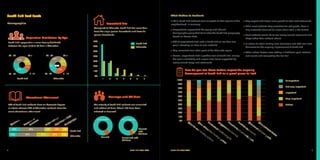
In 2015, South End residents were surveyed on their opinion of the
neighborhood. In summary:
»» Respondents represented the young and affluent
demographic group that dominates the South End geography
based on Census data
»» 60% of respondents had lived in South End for less than two
years, reflecting an influx of new residents
»» They relocated from other parts of the Charlotte region
»» Overall, respondents had a positive view of South End, valuing
the area’s walkability and unique local flavor supported by
locally owned shops and restaurants
»» They expect and desire more growth of retail and restaurants
»» While most residents shop elsewhere for soft goods, there is
only moderate demand for major chain retail in the district
»» Most residents would like to see locally owned restaurants and
shops rather than national chains
»» Its critical to retain existing local businesses and add new local
businesses for the ongoing improvement of South End
»» Other critical factors were adding a traditional park, festivals
and events and completing the Rail Trail
How do you feel these factors impact the ongoing
development of South End as a great place to live?
Unimportant
Not very important
Important
Very Important
Critical
0%
M
ore
for sale
housing
options
M
ore
affordable
housing
options
Dedicated
traditional park
Com
plete
the
Rail Trail
Preserve
local establishm
ents
Festivals and
events
M
ore
local establishm
ents
M
ore
national chains
10%
20%
30%
40%
50%
60%
70%
80%
90%
100%
10	 SOUTH END VISION PLAN SOUTH END VISION PLAN	 11
E Morehead St
E Morehead St
W Morehead St
STryonSt
SouthBlvd
East Blvd
East Blvd
West Blvd
SouthBlvd
STryonSt
Remount Rd
W Carson Blvd
W Dunbar St
W Palmer St
W Palmer St
Penman St
Winona St
Winona St
W Summit Ave
CamdenRd
W
Trem
ont Ave
WTremontAve
ToomeyAve
ToomeyAve
Chicago Ave
Miller St
VillageCt
W
oodcrestAve
Doggett St
AbbottSt
ClevelandAve
EuclidAve
EuclidAve
MyrtleAve
OrioleSt
EuclidAve
GriffithSt
Griffith St
oster Ave
BankSt
MarshallPl
SouthendDr
AthertonHeightsLn
LyndhurstAve
LyndhurstAve
LyndhurstAve
WinthropAve
LennoxAve
SpringdaleAve
HawkinsSt
HawkinsSt
DistributionSt
DunavantSt
BaltimoreAve
NorfolkAve
YoungbloodSt
Ram
part St
W Worthington Ave
W Kingston Ave
W Kingston Ave
W Kingston Ave
W Park Ave
W Park Ave
Larch St
E Kingston Ave
E Park Ave
Rensselaer Ave
Berkeley Ave
Mt Vernon Ave
M
tVernon Ave
Baxter St
BerkeleyAve
ArosaDr
Dilw
orth
Rd
EDilworth
Rd
LafaetteAve
CarltonAve
Berkeley Ave
E Tremont Ave
E Tremont Ave
Brookside AveDilworth Mews Ct
McDonald Ave
Magnolia Ave
MagnoliaAve
Iverson Way
Diana Dr
Dorothy Dr
Olmstead Park Pl
SumnerGreenAve
Mather Green Ave
Meacham St
Brookhill Rd
BrookhillRd
Basin St
Benjamin St
Fairwood Ave
Fairwood Ave
Foster Ave
RemusRd
Ideal Way
IdealWay
Poindexter Dr
Elmhurst Rd
ElmhurstRd
Berkshire Rd
Ardmore Rd
LawndaleRd
HaverfordPl
OakcrestPl
Atherton St
Marsh Rd
Mayfield
Be
Greystone Rd
Belton St
MarionPl
Melbourne Ct
E Worthington Ave
W Summit Ave
Commerce St
Lincoln St
Quincey St
Penn St
SChurchSt
SChurchSt
WinnifredSt
WinnifredSt
MoreheadSquareDr
SCaldwellSt
SCollegeSt
KeeCt
E Carson Blvd Lexington Ave
Lexin
gton
Ave
E Bland St
W Bland St
WDilworthRd
Isleworth Ave
Poindexter Dr
Park Rd
Kirkwood Ave
Springdale AveWinthrop Ave
ParkRd
Romany Rd
Greenwood Cliff
SMcDowellSt
SClarksonSt
SClarksonSt
EldridgeSt
Post St
W Palmer St
Morris St
SMintSt
SGrahamSt
SMintSt
WilmoreDr
WilmoreDr
W
ilm
ore
Dr
MerrimanAve
MerrimanAve
BarringerDr
NutRd
DunkirkDr
SpruceSt
Spruce St
WickfordPl
Westwood Ave
Spruce St
SouthwoodAve
BAXTER
STREET
PARK
LATTA PARK
FUTURE
SOUTH END
PARK
SEDGEFIELD
PARK
SOUTHSIDE
PARK
REVOLUTION
GOLF COURSE
REVOLUTION
PARK
WILMORE
PARK
RailTrail
RailTrail
RailTrail
RailTrail
RailTrail
RailTrail
DILWORTH
SOUTHSIDE PARK
SEDGEFIELD
WILMORE
BROOKHILL
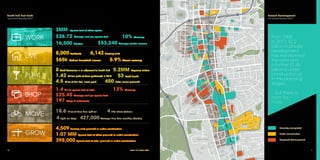
South End Fast Facts
*as of 2nd Quarter 2017 *as of 2nd Quarter 2017
WORK
16,500 Workers
4.5 Miles of Rail Trail linear park
$25.45 Average rent per square foot
450 hotel rooms planned
53 Food trucks
5.2MM Regional visitors
197 Shops & restaurants
$53,240 Average worker income
LIVE
PLAY
SHOP
MOVE
GROW
3MM Square feet of office space
8 Craft breweries in or adjacent to South End
1.4 Million square feet of retail
1.42 Million pints of beer produced in 2014
13% Vacancy
8,000 Residents
4,509 Housing units planned or under construction
4 Light rail stops
4 Bike share stations
6,142 Housing units
5.9% Overall vacancy
398,000 Square feet of retail planned or under construction
427,000 Average Blue LIne monthly ridership
$26.72
$65k Median household income
1.07 MM Square feet of office planned or under construction
18.6 Miles of Blue Line light rail
10% VacancyAverage rent per square foot
SOUTH END VISION PLAN	 11
E Morehead St
E Morehead St
W Morehead St
W
M
orehead Ext
W
ilkinson
Blvd
FreedomDr
Kenilw
orth
Ave
Charlottetowne
W Stonewall St E Stonewall St
tSllewdlaCS
tSnosdivaDS
W
Fourth
StSnoyrT
STryonSt
SouthBlvd
East Blvd
East Blvd
West Blvd
W
estBlvd
SouthBlvd
STryonSt
Remount Rd
Remount Rd
SChcruh
SGmahar
SCegello
W Carson Blvd
W Dunbar St
W Palmer St
W Palmer St
Penman St
Winona St
Winona St
W Summit Ave
CamdenRd
W
Trem
ont Ave
WTremontAve
ToomeyAve
ToomeyAve
Chicago Ave
Miller St
Village Ct
W
oodcrestAve
Doggett St
AbbottSt
ClevelandAve
EuclidAve
EuclidAve
evAeltryM
tSeloirO
EuclidAve
Foster Ave
BankSt
MaySt
Herman Ave
MarshallPl
SouthendDrAthertonHeightsLn
LyndhurstAve
LyndhurstAveLyndhurstAve
WinthropAve
LennoxAve
SpringdaleAve
HawkinsSt
HawkinsSt
DistributionSt
DunavantSt
BaltimoreAve
NorfolkAve
tSdoolbgnuoY
Ram
part St
W Worthington Ave
W Kingston Ave
W Kingston Ave
W Kingston Ave
W Park Ave
W Park Ave
Larch St
E Kingston Ave
E Park Ave
Rensselaer Ave
Berkeley Ave
Mt Vernon Ave
M
tVernon Ave
Baxter St
BerkeleyAve
Belgrave Pl
Linganore Pl
rDasorA
Dilw
orth
Rd
EDilworth
Rd
LafaetteAve
CarltonAve
Berkeley Ave
E Tremont Ave
E Tremont Ave
Brookside Ave
Dilworth Mews Ct
McDonald Ave
Magnolia Ave
MagnoliaAve
Iverson Way
Diana Dr
Dorothy Dr
Olmstead Park Pl
SumnerGreenAve
Mather Green Ave
Meacham St
Brookhill Rd
BrookhillRd
Basin St
Benjamin St
Fairwood Ave
Fairwood Ave
Foster Ave
RemusRd
Ideal Way
IdealWay
Sarah Marks Ave
Poindexter Dr
Elmhurst Rd
ElmhurstRd
Berkshire Rd
Ardmore Rd
LawndaleRd
HaverfordPl
OakcrestPl
Atherton St
Marsh Rd
evAnrubuA
BeltonSt
AnsonSt
Dover St
Greystone Rd
Belton St
WestonSt
DexterSt
MarionPl
Melbourne Ct
Hartford Ave
E Worthington Ave
W Summit Ave
Commerce St
Lincoln St
Quincey St
Penn St
SChurchSt
tShcruhCS
WinnifredSt
WinnifredSt
rDerauqSdaeheroM
tSllewdlaCS
SCollegeSt
KeeCt
E Carson Blvd Lexington Ave
Lexington
Ave
E Bland St
W Bland St
Levine Avenue of the Arts
W First St
Greenleaf Ave
Westbrook Dr
Harding Pl
EwingAve
WDilworthRd
Isleworth Ave
Poindexter Dr
Park Rd
Kirkwood Ave
Springdale Ave
Winthrop Ave
ParkRd
Romany Rd
MetropolitanAve
W Martin Luther King Jr Blvd
E Martin Luther King Jr Blvd
tSllewoDcMS
SMcDowellSt
tSdraverBS
SClarksonSt
SClarksonSt
SCedarSt
tSegdirdlE
McNinchSt
Post St
W Palmer St
W Hill St
W Hill St
Morris St
SClarksonSt
aAve
ElliotSt
SSummitAve
CalvertSt
SSum
m
itAve
Bryant Pl
tniMSSt
maharGSSt
SMintSt
WilmoreDr
WilmoreDr
W
ilm
ore
Dr
evAnamirreM
MerrimanAve
BarringerDr
Fordham
Rd
Brentwood
Pl
CowlesRd
Norma St
Brentwood
Pl
Beech
NutRd
PhillipsAve
BarringerDr
BethelRd
Skyview
Rd
CartierWay
MerrimanAve
Kimberly Rd
DunkirkDr
SpruceSt
Spruce St
WickfordPl
Westwood Ave
Spruce St
SouthwoodAve
PEARLE STREET
PARK
BAXTER
STREET
PARK
LATTA PARK
THIRD
WARD
PARK
FUTURE
SOUTH END
PARK
SEDGEFIELD
PARK
SOUTHSIDE
PARK
REVOLUTION
GOLF COURSE
CLANTON
PARK
REVOLUTION
PARK
WILMORE
PARK
THE GREEN
yawneerGkeerCraguSelttiL
IrwinGreekGreenway
IrwinGreekGreenway
liarTliaR
RailTrail
RailTrail
RailTrail
RailTrail
RailTrail
RailTrail
DILWORTH
THIRD WARD
SOUTHSIDE PARK
SEDGEFIELD
COLONIAL VILLAGE
REVOLUTION PARK
WESTOVER HILLS
WILMORE
BROOKHILL
BRYANT
PARK
NEW BERN
STATION
BLAND
STATION
STONEWALL
STATION
CARSON
STATION
EAST/WEST
STATION
Recent Development
Recently completed
Under construction
Proposed development
From 2005
to 2017, $2.2
billion in private
development
has transformed
the area and
a further $1.46
billion is under
construction or
in the planning
stages...
...but there is
room for
more.
12	 SOUTH END VISION PLAN
Study Area and Focus
Areas
The South End Vision Plan study area is
delineated by CCCP’s Municipal Service
District boundary as shown in the map on
the following page. This area is defined
approximately as follows: On the east by
South Boulevard; to the south by Marsh
Road at its junction with South Boulevard
and by Foster Avenue at its junction with
South Tryon Street; to the west by South
Tryon Street (with the inclusion of a few
properties west of South Tryon Street on
either side of West Tremont Avenue) and,
north of Summit Avenue, by South Mint
and South Graham Streets and to the
north by the southern loop of I-277 at the
border of Uptown Charlotte.
For the purposes of this Plan, this study
follows best practices in urban design
and urban planning and includes the
plan’s context, specifically extending
two blocks beyond the “official” South
End boundaries. It does this because the
city streets defining the boundaries are
not experienced on the ground as hard
boundaries, but shared corridors of public
space – urban rooms within the city.
Within this plan area are key focus areas
whose characteristics have emerged
over the past few years and continue to
do so today. These include but are not
limited to:
»» Gold District: the area roughly bound
by Morehead, Mint, Summit and
Church Streets
»» Camden: the Camden Road corridor
from the South Tryon Street intersection
to West Tremont Avenue and Hawkins
Street from West Tremont Avenue to
West Kingston Avenue
»» Distribution/New Bern: the area north of
the New Bern Blue Line station on either
side of Remount Road
SOUTH END VISION PLAN	 13
E Morehead St
E Morehead St
W Morehead St
W
M
orehead Ext
W
ilkinson
Blvd
FreedomDr
Kenilw
orth
Ave
Charlottetowne
W Stonewall St E Stonewall St
tSllewdlaCS
tSnosdivaDS
W
Fourth
StSnoyrT
STryonSt
SouthBlvd
East Blvd
East Blvd
West Blvd
W
estBlvd
SouthBlvd
STryonSt
Remount Rd
Remount Rd
SChcruh
SGmahar
SCegello
W Carson Blvd
W Dunbar St
W Palmer St
W Palmer St
Penman St
Winona St
Winona St
W Summit Ave
CamdenRd
W
Trem
ont Ave
WTremontAve
ToomeyAve
ToomeyAve
Chicago Ave
Miller St
Village Ct
W
oodcrestAve
Doggett St
AbbottSt
ClevelandAve
EuclidAve
EuclidAve
evAeltryM
tSeloirO
EuclidAve
Foster Ave
BankSt
MaySt
Herman Ave
MarshallPl
SouthendDrAthertonHeightsLn
LyndhurstAve
LyndhurstAveLyndhurstAve
WinthropAve
LennoxAve
SpringdaleAve
HawkinsSt
HawkinsSt
DistributionSt
DunavantSt
BaltimoreAve
NorfolkAve
tSdoolbgnuoY
Ram
part St
W Worthington Ave
W Kingston Ave
W Kingston Ave
W Kingston Ave
W Park Ave
W Park Ave
Larch St
E Kingston Ave
E Park Ave
Rensselaer Ave
Berkeley Ave
Mt Vernon Ave
M
tVernon Ave
Baxter St
BerkeleyAve
Belgrave Pl
Linganore Pl
rDasorA
Dilw
orth
Rd
EDilworth
Rd
LafaetteAve
CarltonAve
Berkeley Ave
E Tremont Ave
E Tremont Ave
Brookside Ave
Dilworth Mews Ct
McDonald Ave
Magnolia Ave
MagnoliaAve
Iverson Way
Diana Dr
Dorothy Dr
Olmstead Park Pl
SumnerGreenAve
Mather Green Ave
Meacham St
Brookhill Rd
BrookhillRd
Basin St
Benjamin St
Fairwood Ave
Fairwood Ave
Foster Ave
RemusRd
Ideal Way
IdealWay
Sarah Marks Ave
Poindexter Dr
Elmhurst Rd
ElmhurstRd
Berkshire Rd
Ardmore Rd
LawndaleRd
HaverfordPl
OakcrestPl
Atherton St
Marsh Rd
evAnrubuA
BeltonSt
AnsonSt
Dover St
Greystone Rd
Belton St
WestonSt
DexterSt
MarionPl
Melbourne Ct
Hartford Ave
E Worthington Ave
W Summit Ave
Commerce St
Lincoln St
Quincey St
Penn St
SChurchSt
tShcruhCS
WinnifredSt
WinnifredSt
rDerauqSdaeheroM
tSllewdlaCS
SCollegeSt
KeeCt
E Carson Blvd Lexington Ave
Lexington
Ave
E Bland St
W Bland St
Levine Avenue of the Arts
W First St
Greenleaf Ave
Westbrook Dr
Harding Pl
EwingAve
WDilworthRd
Isleworth Ave
Poindexter Dr
Park Rd
Kirkwood Ave
Springdale Ave
Winthrop Ave
ParkRd
Romany Rd
MetropolitanAve
W Martin Luther King Jr Blvd
E Martin Luther King Jr Blvd
tSllewoDcMS
SMcDowellSt
tSdraverBS
SClarksonSt
SClarksonSt
SCedarSt
tSegdirdlE
McNinchSt
Post St
W Palmer St
W Hill St
W Hill St
Morris St
SClarksonSt
aAve
ElliotSt
SSummitAve
CalvertSt
SSum
m
itAve
Bryant Pl
tniMSSt
maharGSSt
SMintSt
WilmoreDr
WilmoreDr
W
ilm
ore
Dr
evAnamirreM
MerrimanAve
BarringerDr
Fordham
Rd
Brentwood
Pl
CowlesRd
Norma St
Brentwood
Pl
Beech
NutRd
PhillipsAve
BarringerDr
BethelRd
Skyview
Rd
CartierWay
MerrimanAve
Kimberly Rd
DunkirkDr
SpruceSt
Spruce St
WickfordPl
Westwood Ave
Spruce St
SouthwoodAve
PEARLE STREET
PARK
BAXTER
STREET
PARK
LATTA PARK
THIRD
WARD
PARK
FUTURE
SOUTH END
PARK
SEDGEFIELD
PARK
SOUTHSIDE
PARK
REVOLUTION
GOLF COURSE
CLANTON
PARK
REVOLUTION
PARK
WILMORE
PARK
THE GREEN
yawneerGkeerCraguSelttiL
IrwinGreekGreenway
IrwinGreekGreenway
liarTliaR
RailTrail
RailTrail
RailTrail
RailTrail
RailTrail
RailTrail
DILWORTH
THIRD WARD
SOUTHSIDE PARK
SEDGEFIELD
COLONIAL VILLAGE
REVOLUTION PARK
WESTOVER HILLS
WILMORE
BROOKHILL
BRYANT
PARK
NEW BERN
STATION
BLAND
STATION
STONEWALL
STATION
CARSON
STATION
EAST/WEST
STATION
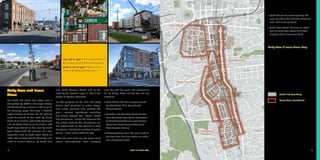
»» South Boulevard: encompassing the
area on either side of South Boulevard
from I-277 to Marsh Road
»» South Tryon Street: the area on either
side of South Tryon Street from West
Kingston Ave to Remount Road
Study Area & Focus Areas Map
South End Boundary
Focus Area Boundaries
Gold District
Camden
South Tryon Street
South Boulevard
Distribution/
New Bern
Top, left to right / 1 The Gold District /
2 Camden Road / 3 South Boulevard
Bottom, left to right / 4 South Tryon
Street / 5 Distribution/New Bern
1 2 3
4 5
SOUTH END VISION PLAN	 1514	 SOUTH END VISION PLAN
Planning Process
The planning work was completed by a
core team which consisted of consultants
from Stantec, and staff from Charlotte
Center City Partners, the City of Charlotte
Urban Design, and Mecklenburg County
Parks and Recreation. A Steering
Committee vetted and guided the
planning process. That committee
included South End residents, business
owners and community leaders. Full lists of
team and Steering Committee members
can be found in the Appendix of this
document.
Reconnaissance
The analysis of previous planning work
revealed a considerable body of work
from past years, replete with many
accomplishments. However, some
items remained incomplete, and fast
changing physical and demographic
circumstances had raised expectations for
the area. Extensive on the ground”surveys
heightened the team’s close-grained
physical and historical knowledge of and
familiarity with the vision plan area.
Community Outreach
The team vetted the vision, goals, and
recommendations from the previous
plan with the community (at large and
in stakeholder interviews) and with the
Steering Committee to determine if these
goals were still valid. This process revealed
new goals and values which were used to
craft a new vision statement.
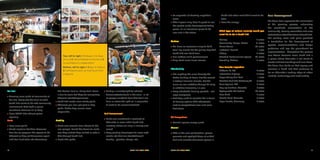
An interactive Community Open House
was held in October 2016 during which
community members discussed what they
value in South End, and which amenities
and character elements are missing or
can be increased. Summary feedback
from major questions asked is as follows:
Where would you like to shop in South
End?
»» Specialty foods & beverage - 23%
»» Apparel - 14%
»» Sports & recreation - 10%
What prevents you from walking, biking or
taking transit more?
»» Efficient public transit doesn't go to
where I live/work/recreate
»» Busy streets, few safe crossings
»» Afraid of cars (for biking)
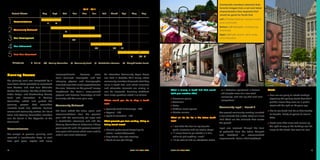
Project Phases Aug. Sept. Oct. Nov. Dec. Jan. Feb. March April May Aug
Reconnaissance
Community Outreach
Plan Development
Plan Refinement
Final Plan Document
1
2
3
4
5
Milestones Kick offK Steering CommitteeSC Community EventC Stakeholder InterviewsSI Thought Leader EventsTL
K
SC
SC SC
SC
C
C C
SI
TL
2016 2017
What is missing in South End that would
feed your creative side?
»» Classroom space
»» Street fairs
»» Cafes
»» Outdoor music spaces
»» Theater venues
What will life be like in the future South
End?
»» "I can take the train to my favorite
parks, museums and ice cream shops."
»» "I'll never have to go outside a 3 mile
radius to get anything I need."
»» "I'd be able to find an affordable studio
or 1-bedroom apartment, a decent
job (maybe even at a new tech
company), and ride my bike and walk
everywhere."
Community Input | Round 2
The second community meeting included
a tour of South End in 2030. What will it look
like? What are the elements that create
the place?
Input was received through the form
of postcards from the future thoughts
and feedback on recommended
improvements. Below is that feedback:
Streets
»» How are we going to retrofit existing?
Especially the parking decks that didn't
get the memo they were on a public
street with the light rail 20 years ago.
»» Like to see South End be as bike friendly
as feasible. Plenty of spaces to secure
bikes.
»» Need more bike lanes and narrow up
the right-of-way so the buildings can be
closer to the street! Less room for cars.
Community members selected their
favorite images from a set and listed
characteristics they depicted that
would be good for South End.
Left / 1 Street festivals, outdoor events
and community
Bottom / 2 Walkability, architecture
and shops
Right / 3 Public space, art & water,
and interaction
SOUTH END VISION PLAN	 1716	 SOUTH END VISION PLAN
Top, left to right / 1 Queen City Quiz
Show / 2 Visual Preference Survey / 3
Crowd listens to presentation
Bottom, left to right / 4 Sign In Table /
5 Participants pick up their South End
passports
Like Central Park vs. Palley Park. Some
is due to scale but they are completely
different intents/experiences.
»» South End needs more shady parks
»» Wherever you can put park or dog
parks. Makes dog owners more
responsible.
Mobility
»» Make cars second class citizens to the
real people! Banish the drivers to make
sure they wished they walked or rode a
bike through South End.
»» Need bike paths.
2
Rail Trail
»» Amazing cross roads at community of
the arts. Really sets the tone of what
South End wants to be with community
involvement. Gets tight in place
sometimes because it's so busy
»» Have CMPD bike officers patrol
regularly
Parks
»» Love more parks!
»» Good locations but then becomes
how do we program the spaces to be
different so they set themselves apart
and don’t just fade into themselves.
»» Parking is already tight for offices/
breweries/restaurants in the area—a lot
of people work/visit here that don't live
here or where the light rail is accessible
& need to be accommodated
Built Environment
»» Make sure investment is localized to
Charlotte or even within South End,
investing where we living in money and
sweat!
»» Keep pushing developers for more apt/
condo etc that are street/sidewalk
friendly—porches, stoops, etc.
»» Be respectful of blocking neighbor's
views
»» After 4 years living here it's good to see
the control of the development taking
place. It's an awesome place to be
now and in the future.
Culture
»» We have an awesome array to build
from! Big events like the gallery hop that
South End can build from.
»» Live outdoor art & performances
»» Bring back more music venues
Affordability
»» Like anything the more diversity the
better building of ideas! Not the easiest
in today's financial climate, but the
more we can subsidize through SF sizing
or subsidize financially is a plus.
»» Keep affordable housing pockets—not
large complexes
»» Definitely need to consider this in terms
of housing options AND office/retail
rents to keep/attract local and small
businesses
Art Everywhere
»» Colorful spaces always great
Overall
»» With all the new construction, please
promote and spotlight those of us that
built and created businesses spaces in
South End when most didn't want to be
here.
»» Love the energy!
What type of cultural amenity would you
most like to be in South End
Gallery 4 votes
Community Design Studio 4 votes
Music Venue 34 votes
Institution Branch 1 vote
Library 6 votes
Theatre/ Performance Space 20 votes
Teaching Kitchen 5 votes
Your favorite inspiration
Ribbons, SF, CA 2 votes
Interactive Displays 3 votes
Hayes Valley Mini Golf 1 vote
Overton Park Bike Gateway TN 8 votes
Town Square, WA 2 votes
Pop-up furniture, Canada 8 votes
Agitagueda Art Festival 25 votes
Hive Mind 2 votes
Karoke Kiosk, Canada 6 votes
Lego-Brucke, Germany 6 votes
Plan Development
This Vision Plan represents the culmination
of this planning process, articulating
the combined conversation of the
community, steering committee and area
stakeholders about the future of South End.
The resulting vision and goals provided
a foundation for the development of
specific recommendations and design
guidelines and lays the groundwork for
implementation. Throughout the process
one theme became clear; South End is
a place where Charlotte is not afraid to
create and test new things and new ideas.
This Vision Plan builds on that legacy and
envisions a South End that continues to
be on Charlotte’s leading edge of urban
livability, technology and sustainability.
18	 SOUTH END VISION PLAN
VISION
South End is a people-first,
walkable urban district of
vibrant neighborhoods, built on
transit, and fueled with energy
and innovation from some of
Charlotte’s most diverse and
creative people.
Where We Want
To Go
2
SOUTH END VISION PLAN	 19
“...people
make[cities]and
it is to them, not
buildings, that we
must fit our
plans."
—Jane
Jacobs
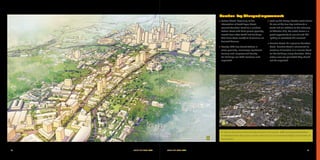
In 2030, South End will be the vibrant center
of many surrounding neighborhoods.
Residents of Dilworth, Wilmore and
Sedgefield will be able to safely and
enjoyably walk to and cross South
Boulevard and South Tryon Street - their
main streets - to shop, to meet friends,
and to experience all that Charlotte has
to offer.
Tens of thousands will live in this place
where stepping onto a train or catching
a ride on an automated vehicle will be as
comfortable and convenient as walking
and biking. Wide sidewalks will be alive
with activity, shaded by street trees, and
anchored by the beautiful South End
skyline. It is a skyline that has embraced its
industrial roots through preservation and
re-use alongside new towers overlooking
grand urban parks and transit stations and
mid-rise buildings for modern workplaces
and housing for people of many lifestyles
and economic means.
Public space will define each of South
End's neighborhoods. The ever-increasing
popularity of the Rail Trail, South End's
linear park will continue to grow as new
connections are made, narrow spots are
20	 SOUTH END VISION PLAN
widened, public art is added, and areas
of respite and entertainment are layered
along its length. Some blocks will be
anchored by large neighborhood parks
full of formal activities, places to relax,
and places to let dogs run free. Others
will have gathering places that are more
intimate in nature as part of a restaurant's
courtyard or a pedestrian alley with string
lights and seating.
This shared space ethic is also
manifested along South
End's streets with its
w e l l - p l a c e d
landscaping, decorative lighting, plentiful
seating, and eclectic artwork. South
Boulevard is a grand boulevard built in
the tradition of great streets across the
world and it is so well-detailed that it is
considered one of the great civic art
contributions to Charlotte. Once, South
Boulevard and South Tryon Street were
considered dividing lines separating
people but these corridors have long
since been transformed into seams that
bring people together - to shop, to eat,
and to celebrate.
Density and mixed-use bring more people
and wonderful new amenities including
restaurants, shops, hotels, theaters,
parks, and activity. The lunch time
crowd, bolstered by large
corporate offices and
smaller-scale
entrepreneurial business, give way to
evening night life and weekend activity.
From start-up to corporate, young and
growing to older and established, South
End is at the intersection of Charlotte's
creatives and creators.
It's a place that welcomes apartment and
condo dwellers along the rail corridor,
and people from the many surrounding
neighborhoods. Housing prices vary from
those that house teachers and firefighters,
young professionals and families with
children, to those that can afford the
penthouse lofts that soar above the transit
stations. South End is a place where many
cultures and lifestyles come to express
themselves and to find success.
And, it's a place that never forgot about its
heritage of experimentation, it's willingness
to try new things, and it's place as a living
laboratory for Charlotte's investments in
creating great places.
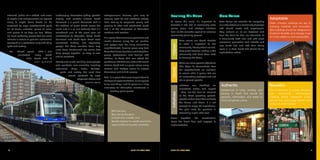
With the Lynx
Blue Line as the spine
of South End, mobility and
density intersect to create economic
opportunities and public amenities.
Realizing this Vision
To realize this vision, it’s important to
translate it into sets of community–wide
values, goals, and strategic initiatives
built on the valuable input of an inclusive
community planning process.
Core values are broad buckets
of what is important to the
community, literally what is valued.
They guide decision making in the
community and have been used
to develop the Goals.
Goals are more specific objectives
that begin to demonstrate how
the neighborhood will maintain
its values while it grows, but are
still overarching strategies and not
site or project specific.
Initiatives are identified for
immediate action and impact
– they are the "how to" element
of the three providing project-
specific action items that embody
the Values and Goals. It is not
enough to simply be aspirational.
This plan must be practical in
advancing it year after year.
Taken together, this combination
drives the Vision Plan and supports its
implementation.
SOUTH END VISION PLAN	 21
Authentic
Experiences of living, working, and
playing in South End should be
genuine, memorable, and linked to
local and global culture.
Core Values
Core Values are essential for navigating
our urban future as a community of people
with shared needs and experiences.
They underlie all of our decisions and
form the basis for how we interrelate as
a community both now and with each
successive generation that inhabits and
uses South End and add their stamp
upon it. In short, South End should be (in
alphabetical order):
ValuesGoalsInitiatives
Adaptable
Older, cheaper buildings are key to
nurturing creativity and innovation.
New buildings should be designed for
maximum flexibility and change of use
for future resilience and sustainability.
Beautiful
The environment is visually attractive
and welcoming. Well-designed
buildings define handsome public
spaces that encourage activity and
make one want to linger.
SOUTH END VISION PLAN	 2322	 SOUTH END VISION PLAN
Inclusive
South End should be open and
accessible to a wide range of
individuals, groups, and lifestyles.
Dynamic
Residents, workers and visitors enjoy
walkable neighborhoods in South End,
with dense and lively 18-hour activity
focused especially along the rail
corridor.
Safe
Residents and visitors alike will feel safe
at all times with well-lit spaces and
plenty of neighbors keeping an eye
out for each other and visitors.
Mobile
A highly-integrated transportation
system encourages mobility without
the need for car ownership and
promotes healthy living.
Creative
A sense of activism, innovation and
experimentation in the arts, business,
entertainment, and infrastructure
should permeate the whole
neighborhood.
Connective
South Boulevard and South Tryon
Street become seams that unite the
neighborhoods to the east and west
so South End can become their Main
Street (e.g., Davidson Street in NoDa.)
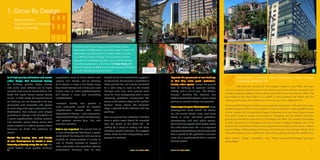
1: 	 Grow By Design
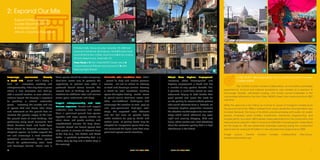
2: 	 Expand Our Mix
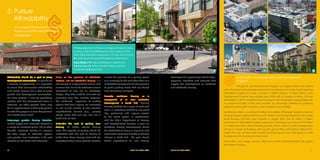
3: 	 Pursue Affordability
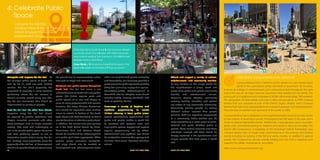
4: 	 Celebrate Public
Space
5: 	 Move.Connect.
Network.
6: 	 Never Stop
Experimenting
7: 	 Manage Our
Common
Resources
Goals
Throughout the year-long planning
process, our steering committee, major
stakeholders, and the general public
helped to craft seven key goals that are
critical to the long-term success of South
End.
24	 SOUTH END VISION PLAN
Build high quality architecture and create
urban design that humanizes density.
Tall buildings provide higher density
and make more efficient use of highly
valuable land close to transit stations. But,
South End needs human scaled density
as well. In other words, the ground floor of
tall buildings can be designed to be very
permeable and accessible with spaces
for small shops and larger restaurants alike.
Architecture that endures and adapts
gracefully to change is the foundation of
a great neighborhood; building eclectic
and beautiful places today means that
future residents will fight to preserve them
tomorrow as South End continues to
evolve.
Control the massing, form, and density
of new development to create a clear
hierarchy of density along the rail line. This
would feature much greater minimum
expectations close to transit stations and
uptown (15+ stories), mid-rise buildings
(6-10 stories) in areas a few blocks away
from transit stations and a finer grain and
smaller scale of urban (re)development
(3-5 stories) in areas near surrounding
neighborhoods.
Increased density can provide a
more sustainable market for essential
neighborhood services that aren’t
dependent on driving -- such as groceries,
soft goods (clothing), food and beverage,
and personal services (e.g., hair and
cosmetic services.)
Details are important. The ground floor of
all new development that faces a public
street should be designed with maximum
flexibility to accommodate a variety of
uses as density increases to support a
more sustainable and consistent retailing
environment. Minimum floor to floor
heights should be established to support a
variety of uses. For example, a residential or
office ground floor unit may be converted
to a retail shop or cafe as the market
changes over time. Taller ground floors
allow for more transparency and a more
interesting pedestrian environment. This
serves as the vertical edge for the "golden
triangle" shown above. The horizontal
edge is defined by the sidewalk and tree
plantings.
Any new ground floor residential units that
face a public street should be elevated
from the grade of the street (24 - 30
inches) by a stoop or landing and have
individual private entrances. This supports
active street life while safeguarding visual
privacy for residents.
1 Architecture that endures and humanizes density,
Alexandria, VA / 2 Density near transit stops, Phoenix, AZ
/ 3 Density-supported retail on Regent Street, London,
U.K. / 4 "The Golden Triangle," incorporates a vibrant
sidewalk, an interesting façade, and on street parking
to protect pedestrians , Ann Arbor, MI Case Study / 5
Distinct architecture / 6 Human scaled density / 7 Mixed
use with upscale ground floor retail
1
1: Grow By Design
	 Expect Density
	 Pay Attention to the Details
	 Bake in Amenities
3
SOUTH END VISION PLAN	 25
Regulate the placement of new buildings
so that they make good, pedestrian-
friendly urban spaces. Design the ground
floor of buildings to promote activity,
visibility, and a mix of uses. “The Golden
Triangle” identifies the sidewalk, two
bottom stories of the façade, and on-street
parking as essential design components.
Encourage finer grain development.Large
development tracts should be broken
up into smaller blocks, using small-scale
streets or alleys, mid-block pedestrian
passageways, and small public spaces.
Avoid building façades that stretch across
the entire block face. This is an important
componentofcreatingabuiltenvironment
that is scaled to the pedestrian and feels
more like a neighborhood than a central
business district.
CASE STUDY: Portland’s Pearl District/River District Design
Guidelines, Portland, OR
Following the removal of the Lovejoy Viaduct in the 1990s, the area
once occupied by warehouses and rail yards is now vibrant with new development
including upscale galleries and boutique apartments and townhouses. Within the
boundaries of the Pearl District is a wealth of new buildings that blend with the
existing warehouses, all contributing to the success of the neighborhood.
The River District Design Guidelines were originally adopted in 1996 and have been
updated several of times. The foundation for new construction, these guidelines layer
on the Central City Fundamental Design Guidelines and can have Special Areas
that add to them in certain circumstances. Guidelines are first outlined and then
specifically identified implementation strategies are listed. This enables developers
to both see photos of successes and have metrics to design buildings with. In the
Special Area Guidelines, there are even requirements for ground floor retail, multiple
story buildings, limited garage entrances, and driveways, and signage details. All of
these standards add up to distinctive, attractive buildings with quality architecture.
River District Design Guidelines Link: https://www.portlandoregon.gov/bps/
article/58869
764
52
26	 SOUTH END VISION PLAN
Encourage commercial diversity
in South End. South End’s history is
built on innovation, creativity and
entrepreneurship. It has long been a place
where a new businesses can start-up,
add a second location, or even attract a
national tenant. This diversity is important
to providing a vibrant, sustainable
place. Increasing the number and size
of spaces that can house retail shops
and restaurants on the ground floor will
increase the general supply. To this end,
the ground floors of most buildings, but
particularly along South Boulevard, Mint
Street, Camden Road, and South Tryon
Street should be designed principally as
shopfront spaces. To further expand this
mix and encourage a most consistent
pedestrian environment, these spaces
should be predominately retail, food
and beverage tenants. Interim uses in
these spaces should be under temporary,
short-term leases only to preserve the
opportunity to convert over when a
preferred tenant comes forward. The
second floor of buildings are potential
locations for additional retail and services
salons, gyms, restaurants, and shops.
Support entrepreneurship and local
business expansion. Curate and support
authentic local businesses and locate
them in prominent ground floor spaces
together with larger spaces suitable for
chain stores, soft goods vendors, and
neighborhood services like drug stores.
Promote shared use tenant spaces that
offer goods or services at different times
of the day (e.g., Hex Coffee and Good
Bottle - a symbiotic partnership that is a
coffee shop by day and a bottle shop in
the evening).
Formulate retail incubation tools. Retail
- places to shop and receive personal
services - are just as critical to vibrancy
as food and beverage services. Develop
a toolkit for retail incubation including
space-sharing/co-hosting, master leases
to permit smaller short-term leases, and
other non-traditional techniques and
encourage the creation of small, pop-up
and semi-permanent kiosk-style retail
shops. The expected wide sidewalks
and Rail Trail area will provide highly
visible locations for pop-up stands and
certain areas of parking decks may be
adapted for inexpensive space that may
not command the higher rents that more
prominent spaces would elsewhere.
1 Market stalls, Grove Arcade, Asheville, NC / 2 Small
increment storefronts, Birmingham, MI / 3 Shared retail,
Good Bottle & Hex Coffee, South End / 4 Small, shallow
(20 feet deep) shops, Greenville, SC
Case Study / 5 Twin Cities METRO Green Line / 6
Cultural festival / 7 Break-dancing event / 8 Little
Mekong Night Market
3
1
2: Expand Our Mix
	 Support Entrepreneurship
	 Curate Vibrant Shopping
	 & Entertainment
	 Attract a Daytime Population
SOUTH END VISION PLAN	 27
CASE STUDY: Minneapolis/St. Paul’s Central Corridor Funders
Collaborative
The Central Corridor Funders Collaborative, an innovative partnership
supported by 14 local and national foundations, was created as a resource to
encourage diversity, affordable housing, and locally owned businesses in the
communities affected by the Twin Cities’ METRO Green Line construction from 2007
until 2016.
While the area has a rich history as a home to waves of immigrant workers since
the second half of the 1800s, it suffered from urban divestment and demolition due
to Urban Renewal. The focus of its efforts was placemaking with public art, public
spaces, increased urban livability investments, intentional programming, and
façade grants. As a result, 450 business made preparations for the construction and
improvements using $3+ million in loans and $260,000 in façade grants. These efforts
set the stage for 128 new street-level businesses opening during the construction
period and an eventual $4.2 billion in new development projects since 2009.
Image source: Central Corridor Funders Collaborative http://www.
funderscollaborative.org/
874
652
Attract More Daytime Employment.
Increasing office development and
daytime employment in South End has
a number of very positive benefits. First,
it provides a lunch-time crowd for area
restaurants helping to both double their
peak periods and lessen the need for
on-site parking to accommodate patrons
who would otherwise drive in. Second, an
increased daytime population increases
the effective market capture for new retail
shops which would otherwise rely upon
night and evening shopping. Third and
finally, office workers can most effectively
share the residential parking that is in high
abundance in the district.
28	 SOUTH END VISION PLAN
Affordability should be a part of every
development conversation. To provide for
a diversity of opportunity it is imperative
to ensure that commercial affordability
and mixed income are a part of every
growth and development conversation.
For some projects, it may be proactively
working with the development team in
advance. For other projects, there may
be an opportunity for a third party partner
to enter the program or even the provision
of a subsidy from a fund.
Encourage greater housing densities.
Limited supply and increased demand is
a recipe for increased prices. Like its other
benefits, increased density will increase
the total supply of residential options
and provide more fluctuation in the rent
structure for the South End submarket.
Focus on the provision of affordable
lifestyles, not just affordable housing. It is
not enough to simply provide smaller units
or lower rents. For low to moderate income
households to truly live an affordable
lifestyle, they often need to eliminate car
ownership from their monthly expenses.
The continued expansion of mobility
options that don't require car ownership
as well as the number of new essential
neighborhood services (e.g., grocery
stores), mean that one can now live in
South End car-free.
Unbundle the cost of parking from
housing. To further reduce housing
costs, the expense of parking should be
unbundled from the cost of housing to
further drive down housing costs and car
usage/ownership. Some possible solutions
include the provision of a parking space
as a surcharge to the rent rather than as a
embedded component and the provision
of public parking decks that are shared
and collectively managed.
Promote workforce housing as a
component of all new residential
development in South End. Housing
diversity stratified by a range of costs and
sizes is a necessary element to any great
city, particularly with superior access
to the transit system. In coordination
with the City’s Department of Housing
and Neighborhood Services, a goal for
workforce housing development should
be established to ensure a long-term and
sustainable economic diversity of housing
choices in South End. This goal should
define expectations for new housing
1 Redevelopment of Strawn Cottage as mixed-income
housing, South End / 2 Mixed-income housing in First
Ward / 3 Adaptable workspaces, C3 Labs, South End /
4 Current South Boulevard Pedestrian Environment
Case Study / 5 Hollywood/Western Apartments
/ 6 Westlake/McArthur Park / 7 Hollywood/Vine
Apartments / 8 Taylor Yard
3
1
Image by: Odell for Horizon Development Co. and Fallon Co.
3: Pursue
Affordability
	 Encourage Mixed-Income Housing
	 Preserve and Provide Affordable 		
	Workspaces
CASE STUDY: Los Angeles Metro Joint Development
Program
Through its Joint Development Program, Los Angeles Metro has worked
with affordable housing developers and local jurisdictions to create transit–oriented
affordable housing at or near a number of Metro Stations. To date, Metro’s Joint
Development Program has created over 2,000 units of housing, of which, 31% are
affordable. In 2015, the Metro Board increased their affordable housing objectives
to provide that 35% of their total portfolio be affordable (defined as qualifying
residents earning 60% or less than area median income (AMI)).
Additionally, Metro committed $9 million to the Metro Affordable Transit Connected
Housing Program (Metro MATCH) and $1 million to the Transit Oriented Communities
Small Business (TOC-SB) Loan Program in August 2016. The $9 million in Metro
investment for affordable housing is expected to leverage up to around $75 million
in contributions from other financing partners. The $1 million in small business loans
will go to owners of buildings with vacant ground floor retail space adjacent to
transit who can use the loans to build out tenant space and offer space to small
business tenants and below market rents.
Information and image source: https://www.metro.net/projects/joint_dev_pgm/
affordable-housing/
874
652
development in partnership with the City’s
programs, incentives and resources that
support the development of workforce
and affordable housing.
SOUTH END VISION PLAN	 29
30	 SOUTH END VISION PLAN
Complete and improve the Rail Trail. As
the principal public space of South End
and by far it's most well-used mobility
corridor, the Rail Trail's popularity has
exceeded its capacity in many locations
particularly where the trail narrows or
doesn't currently extend along one side.
The Rail Trail Framework Plan should be
implemented as quickly as possible.
Treat the Rail Trail like other Main Streets.
Properties along the Rail Trail should
be required to provide pedestrian and
bicycle amenities consistent with other
street frontages such as simple movable
seating, bike racks and landscaping as
well as to provide public space like plazas
and small gathering spaces as well as
decorative facade details facing the Rail
Trail. Perhaps, most importantly, given the
popularity of the Rail Trail, all development
should also provide shopfront space along
the ground floor to accommodate active
uses such as shops and restaurants.
Construct new public spaces throughout
South End. The Rail Trail alone is not
sufficient to serve as South End's only public
space. The district requires parks and
public spaces of all sizes and shapes to
serve its many programmatic and passive
functions. The future Wilmore Centennial
Park should be expanded when funding
allows to extend its borders all the South
Tryon Street and West Boulevard so that it
canbeboundonallsidesbyapublicstreet.
In addition, the current one acre parking
lot in the Gold District bound by Bland,
Commerce, Mint, and Graham Streets
should be considered for redevelopment
as a public park when appropriate. Other
squares, plazas, commons, courtyards,
and alleys should also be curated as
development and redevelopment occur
with a mix of public and private ownership
and stewardship. San Francisco provides a
goodmanualforpublicspacestewardship
(http://sf-planning.org/public-space-
stewardship-guide). Redevelopment of
brownfield sites for adaptive reuse should
consider liability, cleanup standards, and
costs as potential barriers.
Encourage a variety of daytime and
nighttime programming to create
18-hour vibrancy in focal public areas.
Explore collaborative opportunities with
public and private entities in South End
to construct and program small and
large public spaces. Support and expand
organic programming led by others.
Entertainment and nighttime uses should
be clustered to maximize their synergy and
minimize “dark zones” between individual
venues.
1 The Rail-Trail in South End / 2 Old Common Market
courtyard, South End / 3 Alley with retail entryways
and outdoor seating, San Francisco, CA / 4 Romare
Bearden Park in Third Ward
Case Study / 5 Temporary basketball league in the
street / 6 Variety of activities / 7 Pop up beach
4: Celebrate Public
Space
	 Complete the Rail Trail
	 Construct Many & Varied Public Spaces
	 Attract & Support Cultural and 			
	 Entertainment Venues
3
1
SOUTH END VISION PLAN	 31
Attract and support a variety of cultural,
entertainment, and community facilities.
To truly function as the village center for
the neighborhood it serves, South End
needs more public and private community
facilities and entertainment venues.
Museums, libraries, theaters, community
meeting facilities, churches, and schools
are critical to any sustainable community.
Community facilities provide an entirely
different cultural element than private
galleries; both are important components
to a community. Public facilities can be
more accessible to a wider range of artists,
students and youth. Whether public or
private, these cultural elements and those
individuals involved with them should be
deeply ingrained in the spontaneous and
unique projects that take place in South
End.
CASE STUDY: Campus Martius Park, Detroit, MI
Campus Martius Park in Detroit is at the center of a two square block
district in the commercial center and heart of downtown. At 2.5 acres,
it serves as a stage of entertainment and community events throughout the year
and is the hub for all major avenues downtown that radiate from its center. The
park is part of a neighborhood comprised of 20,000 office employees, 750 residents,
35+ restaurants, 50 retail outlets, and over 2 million annual visitors. In 1999, Campus
Martius Park was adopted as part of the Detroit Legacy Project and a Campus
Martius Park Task Force was established to oversee its redesign and redevelopment.
The park was completed and opened in to the public in 2004.
Campus Martius Park is designed to be programmed year round and is the center
of the majority of downtown activity. It is programmed 250 days of the year and is
home to several high-profile events. Additionally, it has gardens, lawns, fountains,
kiosks, café, and flexible seating for residents and visitors to relax and socialize. The
Detroit 300 Conservancy, a subsidiary of the Downtown Detroit Partnership, uses
Campus Martius Park to house music performances in the summer and holiday
events including ice skating in the fall and winter months. In addition to special
events, the Conservancy secures private funding from the Park’s neighbors and
supports the utilities, maintenance, and safety.
http://www.campusmartiuspark.org/
764
52
32	 SOUTH END VISION PLAN
Put people first. A sea change is necessary
in South End in how infrastructure is
oriented and prioritized. Vehicle speeds,
block lengths, lane widths, signal timing,
crosswalks, curb radii, and capacity
should be tilted in favor of pedestrians
and cyclists over the automobiles.
Automobiles are still very welcome to
travel the streets but moving much more
slowly and disciplined as detailed in the
Charlotte Walks Pedestrian Plan. This is
also consistent with Charlotte's adoption
of Vision Zero, a set of goals intended to
eliminate all traffic fatalities and severe
injuries, while increasing safe, healthy,
and equitable mobility for all.
Complete the conversion of South
Boulevard and South Tryon into
"Main Streets" that favor cyclists and
pedestrians. Since the adoption of the
South End Station Area Plans the goal
has been to slowly retrofit these corridors
with enhanced amenities for pedestrians
(wide sidewalks and streetscape), cyclists
(bike lanes), and on-street parking (which
improves pedestrian safety). Rather than
continuing to wait for development
to complete the public realm of these
corridors, a coordinated capital project(s)
should be undertaken to bring these
corridors up to their final, preferred state
as soon as possible.
Enhance bicycle and pedestrian
infrastructure. Install bike boulevards
(signed bike routes on low-speed, low
volume streets), consider conversion
of existing bike lanes on Carson Street
and Remount Road to protected
facilities, prioritize bicycle and
pedestrian connections to surrounding
neighborhoods, establish more crossing
points for pedestrians and cyclists on the
Rail Trail, illuminate crosswalks, and provide
mid-block pedestrian connections via
unique and attractive alleys, woonerfs
and paseos. In addition, at a minimum,
all sidewalk areas (comprised of both
the walkway and the tree planting
area) should be no less than 16 feet in
width. In general, this consists of trees in
wells for most areas,though along more
residential frontages a planting strip can
be acceptable.
1 High visibility pedestrian crossing on the Rail Trail,
South End / 2 EasyMile Shared Autonomous Vehicle
(SAV), Concord, CA / 3 Pedestrian and bicycle
counter, South End / 4 Michigan Avenue, Chicago, IL
Case Study / 5 Unique and attractive pavement
patterns / 6 Public art and lighting / 7 Landscaping
and signage /8 Distinct wayfinding and branding
5: Move.Connect.
Network
	 Put People First
	 Connect all Modes
	 Embrace the Mobility Revolution
3
1
SOUTH END VISION PLAN	 33
Construct a new light rail station between
East/West and New Bern stations. An ideal
location for this important new element
of connectivity is the Rampart Street and
Hawkins Street intersection behind Publix.
This location serves a critical gap in the rail
system and provides needed pedestrian
connectivity east to west near the grocery
stores (to eliminate an unsafe condition
where people hop over a fence).
Accommodate and support innovative
mobility solutions. South End owes its history
to the mobility revolution of the early
railroads and then to light rail. Continue this
spirit of innovation by testing new modes
and technologies for personal and shared
mobility including expansion of the bike
share program, car-share services, electric
car charging, and shared autonomous
vehicles.
CASE STUDY: Cultural Trail, Indianapolis, IN
In 2013 the Indianapolis Cultural Trail opened crossing 8 miles of
Indianapolis’ downtown. This bike and pedestrian path connects
neighborhoods, cultural districts and entertainment amenities by forming a loop
around downtown with separated pedestrian and cycling facilities. The trail was
built in seven phases and each segment had a separate design concept tailored to
eachofthedistrictsuniquehistoriccharacteristicsandenvironmentalconsiderations.
In more urban areas the path is 12 feet wide located directly adjacent to the
pedestrian area outside of mixed-uses. In many cases benches, bike racks, and
additional street furniture separate this space from the trail. Because of the large
width of streets in Indianapolis, one lane was taken to provide the trail facilities.
Over $300 million of new development has been constructed along the route since
the beginning of construction in 2008. Two of the areas along the trail that have
numerous retail and entertainment uses are Massachusetts Avenue and Fountain
Square. The design of the trail in these areas with an existing active public realm
adjacent to active ground floor uses is very sensitive to its surrounding context.
http://indyculturaltrail.org/
874
652
SOUTH END VISION PLAN	 35
The
Vision
for South
Boulevard
The South Boulevard of the future will be
a beautiful street lined with canopy trees,
and wide sidewalks with frequent crosswalks,
parking-protected bicycle tracks, on-street
parking and autonomous shuttles running
its length. South Tryon Street will be similarly
detailed with high quality pedestrian and
bicycle amenities.
16 ft sidewalk
with trees in
wells
16’ sidewalk
with trees in
wells
10 ft
travel
lane
10 ft
travel
lane
10 ft
travel
lane
10 ft
travel
lane
10 ft
parking
7.5 ft
raised
bike
lane
7.5 ft
raised
bike
lane
10 ft
parking
11 ft
median/
refuge/
turn lane
BAXTER
STREET
PARK
LATTA PARK
SOUTHSIDE
PARK
REVOLUTION
GOLF COURSE
REVOLUTION
PARK
WILMORE
PARK
ay
RailTrail
RailTrail
RailTrail
RailTrail
RailTrail
RailTrail
DILWORTH
SOUTHSIDE PARK
SEDGEFIELD
REVOLUTION PARK
WILMORE
BROOKHILL
STADIUM
NEW BERN
STATION
BLAND
STATION
CARSON
STATION
EAST/WEST
STATION
E Morehead St
W Morehead St
STryonSt
SouthBlvd
East Blvd
West Blvd
W
estBlvd
SouthBlvd
STryonSt
Remount Rd
Remount Rd
W Carson Blvd
W Dunbar St
W Palmer St W Palmer St
Penman St
Winona St
Winona St
W Summit Ave
CamdenRd
W
Trem
ont Ave
WTremontAve
ToomeyAve
ToomeyAve
Chicago Ave
Miller St
VillageCt
W
oodcrestAve
Doggett St
AbbottSt
ClevelandAve
EuclidAve
EuclidAve
MyrtleAve
OrioleSt
EuclidAve
GriffithSt
Griffith St
Foster Ave
BankSt
M
MarshallPl
SouthendDrAthertonHeightsLn
LyndhurstAve
LyndhurstAveLyndhurstAve
WinthropAve
LennoxAve
SpringdaleAve
HawkinsSt
HawkinsSt
DistributionSt
DunavantSt
BaltimoreAve
NorfolkAve
YoungbloodSt
Ram
part St
W Worthington Ave
W Kingston Ave
W Kingston Ave
W Kingston Ave
W Park Ave
W Park Ave
Larch St
E Kingston Ave
E Park Ave
Rensselaer Ave
Berkeley Ave
Mt Vernon Ave
M
tVernon Ave
Baxter St
Dilw
orth
Rd
LafaetteAve
CarltonAve
Berkeley Ave
E Tremont Ave
Brookside Ave
Dilworth Mews Ct
McDonald Ave
Magnolia Ave
Iverson Way
Diana Dr
Dorothy Dr
Olmstead Park Pl
SumnerGreenAve
Mather Green Ave
Meacham St
Brookhill Rd
BrookhillRd
Basin St
Benjamin St
Fairwood Ave
Fairwood Ave
Foster Ave
RemusRd
Ideal Way
Poindexter Dr
Elmhurst Rd
Berkshire Rd
Ardmore Rd
LawndaleRd
HaverfordPl
OakcrestPl
Atherton St
Marsh Rd
Dover St
Greystone Rd
Belton St
MarionPl
Melbourne Ct
E Worthington Ave
W Summit Ave
Commerce St
Lincoln St
Quincey St
Penn St
SChurchSt
SChurchSt
WinnifredSt
WinnifredSt
MoreheadSquareDr
SCaldwellSt
SCollegeSt
KeeCt
E Carson Blvd Lexington Ave
Lexington
Ave
E Bland St
W Bland St
Winthrop Ave
Romany Rd
SMcDowellSt
SClarksonSt
SClarksonSt
EldridgeSt
McNinchSt
Post St
W Palmer St
W Hill St
W Hill St
Morris St
SMintSt
SGrahamSt
SMintSt
WilmoreDr
WilmoreDr
W
ilm
ore
Dr
MerrimanAve
MerrimanAve
BarringerDr
Brentwood
Pl
Norma St
Brentwood
Pl
Beech
NutRd
MayflowerRd
PhillipsAve
BarringerDr
BethelRd
CartierWay
MerrimanAve
DunkirkDr
SpruceSt
Spruce St
WickfordPl
Westwood Ave
Spruce St
SouthwoodAve
Street Types
The street regulating plan presented on
this page ties required street sections
to specific blocks and corridors in
accordance with the Charlotte Urban
Street Design Guidelines (USDG). For
more specific information, please
refer to Chapter 5 Community Design
Principles.
Signature Street
Main Street
Mixed-Use Street
Transition Street
Neighborhood Street
Rail Trail
36	 SOUTH END VISION PLAN
Support South End as a center for
creativity. South End has a history as
a place for innovation and creativity.
Increasing rent and diminishing space
will make this creative proliferation more
difficult. Therefore, it will be important
to be intentional about continuing to
support planned and spontaneous
artistic, technical, and social innovation,
experimentation, and production. Attract
start-ups with supportive programs to assist
with finding space and funding (investors).
Protect and maintain buildings and
spaces that are affordable to artists and
other creative professionals. Explore ways
to keep creative maker spaces from
being priced out of the area; this includes
subsidies, artist-in-residence programs,
and partnerships with academic, private,
and non-profit institutions.
Create flexible, innovation-friendly
employment spaces. Ideally located
both near transit stations as well as in
older, utilitarian buildings elsewhere,
these buildings should meet the highest
standards for design, and employ new
technologies and innovations that
advance South End’s desire for creativity
and uniqueness in architecture, urbanism,
and sustainability.
Support a spirit of innovation that
generates activity on the street. Ground
floor workshops and innovation labs that
have transparent windows facing the
street add life at different times of the day.
Curate exhibitions and performances,
and encourage spontaneous creativity
through “tactical urbanism” and similar
events by expanding existing micro-grants
program and other similar programs.
Supportvenuesformakingandperforming
experimental art. Establish and support
a “Civic Arts Lab” as a space to explore
community issues through art and design
and seek to provide black box and other
small format theaters. Promote locally
organized maker events and expand
to attracting a nationally recognized
innovation event like Maker Faire (http://
makerfaire.com/).
Embed art into public infrastructure and
buildings throughout the district. From
sidewalk treatments to wall facades
to aerial sculpture (e.g., http://www.
echelman.com/), public art should be
everywhere.
1 Janet Eschelman aerial sculpture, Phoenix, AZ / 2
Illuminated radio tower and substation along the Rail
Trail, South End/ 3 Ciencia Publica Mobile Learning
Lab, San Francisco / 4 Art embedded into public
infrastructure, South End
Case Study / 5 Experiential placemaking installation /
6 Interactive rotating bench / 7 Temporary prototype
educational art installation
6: Never Stop
Experimenting
	 Encourage Spontaneity
	 Embed Art into Everything
	 Be Creative
3
1
SOUTH END VISION PLAN	 37
Light up the smokestack at Atherton
Mill and other recognizable landmark
features. The smokestack at Atherton Mill is
one of the most iconic structures in South
End. It rises above the old mill buildings
as a visual terminus on South Boulevard
and is a reminder of the district’s industrial
heritage. It is even more visible from long
distances along the Rail Trail. Along with
the water tank at the Design Center,
they have become recognizable figures
in the neighborhood and the focus of
art competitions. Using LED lighting,
light up these features and others of
similar importance to provide additional
nighttime character and landmarks.
CASE STUDY: Market Street Prototyping Festival, San
Francisco, CA
The Market Street Prototyping Festival held its first festival in April 2015.
Over the course of three days, Market Street came alive with more than fifty
models, or “prototypes,” ranging from performance spaces, relaxation zones,
educational spaces, green spaces and interactive art installations. Each prototype
was conceived and built by members of the community—everyday citizens, artists,
designers, urbanists, architects, etc.—with mentorship from professional design
expert partners and feedback from residents of San Francisco. The festival engaged
590,000 people over three days and thousands more engaged online.
The Market Street Prototyping Festival is a natural progression of the innovation
displayed by the Urban Prototyping Festival (UP), a pioneering program of citizen
engagement in urban design developed in 2012 by San Francisco nonprofits Gray
Area Foundation for the Arts and Intersection for the Arts. Included on the selection
jury for UP was the San Francisco Planning Department, who then went on to
commission a prototype from the UP festival to be placed in a community market.
Images 6 & 7 source: http://marketstreetprototyping.org/
764
52
38	 SOUTH END VISION PLAN
Create a parking district to manage
public and private parking. There is an
opportunity to better manage parking
through shared-use agreements,
coordinated management, and
enhanced wayfinding. The creation of
a parking management district with a
dedicated revenue stream can not only
manage public and private spaces,
including real-time availability, but
also construct new public parking in
centralized areas to minimize the need for
on-site private parking.
Plan for adaptable reuse of parking.
Consider adaptive reuse opportunities
for parking decks as options for personal
mobility as we increasingly transition
to greater use of shared, autonomous,
on-demand vehicles.
Parking should be screened by buildings
and access should be from side streets.
Only occupiable building space should
be visible from public streets - not parking.
Additionally, to enhance the pedestrian
realm along South Boulevard, South Tryon
Street, Camden Avenue, and Mint Street,
all parking structures should take their
access from side streets or alleys only.
Adapt infrastructure for increased ride
hailing, car-sharing, bike sharing, and
vehicle charging. Adapt public and
private infrastructure to accommodate
spaces for car sharing, vehicle drop-off
locations, expanded bike share locations,
and electric charging stations. In addition
to physical improvements, there should
be coordination with CDOT and CATS
to maximize all of the mobility options in
South End.
South End’s existing, older buildings are
a vital community resource worthy of
protection. An important element of South
End’s character comes from the adaptive
reuse of old buildings and its history as a
walkable neighborhood. Preservation and
adaptive reuse should be emphasized
as the essential counterpoint to well-
designed new development. The stock
of older, simple buildings offers affordable
“startup” spaces for innovative and
entrepreneurial activities that create the
district’s unique flavor. Codes and policies
(e.g., stormwater, tree protection) will
need to be adjusted to make adaptive
reuse projects and change of use more
feasible. Additionally, consider zoning
mechanisms such as maximum height and
maximum floor-to-area ratio (FAR) that
would encourage reuse in older industrial
1 Opportunity to enhance public space, South End
/ 2 Successful adaptive reuse of an older building
with distinct architecture, South End / 3 Parking deck
screened with a green wall, San Francisco, CA / 4 Start
up businesses in older building, South End
Case Study / 6 Parking sensor diagram / 7 Streetline
Parker App / 7 Streetline Parker sensor installed
7: Manage Our
Common
Resources
	 Organize Parking as a Public Resource
	 Preserve Valuable Building Stock
	 Prepare for the Future
3
1
SOUTH END VISION PLAN	 39
areas such as Distribution and New Bern,
where there are many highly adaptable
workspace buildings, to prevent over-
valuation and preserve affordability for
tenants.
Bury/relocate overhead utilities. All
overhead utilities (main transmission lines
and service lines) should be buried or
relocated.
Convert to LED lighting and local energy
systems. All existing and future lighting
should be converted to LED or more
advanced, low-energy lighting. All
buildings, new and old should convert to
renewable, district or building-level energy
over time as the technology becomes
cost-effective.
CASE STUDY: Boston Innovation District Parking
Management
The City of Boston has long struggled with congestion and air pollution
tied to drivers circling neighborhoods to find parking. At the same time, more drivers
are relying on real-time navigation from on-board systems or their smartphones.
In the winter of 2013, the City partnered with Streetline to install 330 sensors hockey
puck-sized sensors flush to the surface of the road to detect open parking spaces
in the Innovation District and then made that information available via the Parker
App, Streetline’s custom websites, and its API. The project gave the City a wealth of
real-time data on parking. Using this collected information, can ensure that parking
is more closely aligned with true utilization, will spur higher turnover at on-street
parking spaces, and help to promote parking availability for patrons of area
businesses. Boston drivers can view real-time, on-street parking availability in the
area by downloading the Parker™ app, available for Apple and Android, to their
smartphone. Parker’s voice guidance feature gives drivers a hands-free option for
safe operation while driving.
https://www.cityofboston.gov/
874
62
40	 SOUTH END VISION PLAN
The Focus Areas are a mix of
corridors and neighborhood
centers. The corridors, South
Boulevard and South Tryon
Street, form the eastern and
western edges of South End but
change character from north
to south. The neighborhoods,
the Gold District, Camden,
and Distribution/New Bern
have emerged with their own
unique identities and generally
definable boundaries.
HOW WE GET THERE:
Focus Areas
3
SOUTH END VISION PLAN	 41SOUTH END VISION PLAN	 41
E Morehead St
E Morehead St
W Morehead St
W
M
orehead Ext
W
ilkinson
Blvd
FreedomDr
Kenilw
orth
Ave
Charlottetowne
W Stonewall St E Stonewall St
tSllewdlaCS
tSnosdivaDS
W
Fourth
StSnoyrT
STryonSt
SouthBlvd
East Blvd
East Blvd
West Blvd
W
estBlvd
SouthBlvd
STryonSt
Remount Rd
Remount Rd
SChcruh
SGmahar
SCegello
W Carson Blvd
W Dunbar St
W Palmer St
W Palmer St
Penman St
Winona St
Winona St
W Summit Ave
CamdenRd
W
Trem
ont Ave
WTremontAve
ToomeyAve
ToomeyAve
Chicago Ave
Miller St
Village Ct
W
oodcrestAve
Doggett St
AbbottSt
ClevelandAve
EuclidAve
EuclidAve
evAeltryM
tSeloirO
EuclidAve
Foster Ave
BankSt
MaySt
Herman Ave
MarshallPl
SouthendDrAthertonHeightsLn
LyndhurstAve
LyndhurstAveLyndhurstAve
WinthropAve
LennoxAve
SpringdaleAve
HawkinsSt
HawkinsSt
DistributionSt
DunavantSt
BaltimoreAve
NorfolkAve
tSdoolbgnuoY
Ram
part St
W Worthington Ave
W Kingston Ave
W Kingston Ave
W Kingston Ave
W Park Ave
W Park Ave
Larch St
E Kingston Ave
E Park Ave
Rensselaer Ave
Berkeley Ave
Mt Vernon Ave
M
tVernon Ave
Baxter St
BerkeleyAve
Belgrave Pl
Linganore Pl
rDasorA
Dilw
orth
Rd
EDilworth
Rd
LafaetteAve
CarltonAve
Berkeley Ave
E Tremont Ave
E Tremont Ave
Brookside Ave
Dilworth Mews Ct
McDonald Ave
Magnolia Ave
MagnoliaAve
Iverson Way
Diana Dr
Dorothy Dr
Olmstead Park Pl
SumnerGreenAve
Mather Green Ave
Meacham St
Brookhill Rd
BrookhillRd
Basin St
Benjamin St
Fairwood Ave
Fairwood Ave
Foster Ave
RemusRd
Ideal Way
IdealWay
Sarah Marks Ave
Poindexter Dr
Elmhurst Rd
ElmhurstRd
Berkshire Rd
Ardmore Rd
LawndaleRd
HaverfordPl
OakcrestPl
Atherton St
Marsh Rd
evAnrubuA
BeltonSt
AnsonSt
Dover St
Greystone Rd
Belton St
WestonSt
DexterSt
MarionPl
Melbourne Ct
Hartford Ave
E Worthington Ave
W Summit Ave
Commerce St
Lincoln St
Quincey St
Penn St
SChurchSt
tShcruhCS
WinnifredSt
WinnifredSt
rDerauqSdaeheroM
tSllewdlaCS
SCollegeSt
KeeCt
E Carson Blvd Lexington Ave
Lexington
Ave
E Bland St
W Bland St
Levine Avenue of the Arts
W First St
Greenleaf Ave
Westbrook Dr
Harding Pl
EwingAve
WDilworthRd
Isleworth Ave
Poindexter Dr
Park Rd
Kirkwood Ave
Springdale Ave
Winthrop Ave
ParkRd
Romany Rd
MetropolitanAve
W Martin Luther King Jr Blvd
E Martin Luther King Jr Blvd
tSllewoDcMS
SMcDowellSt
tSdraverBS
SClarksonSt
SClarksonSt
SCedarSt
tSegdirdlE
McNinchSt
Post St
W Palmer St
W Hill St
W Hill St
Morris St
SClarksonSt
aAve
ElliotSt
SSummitAve
CalvertSt
SSum
m
itAve
Bryant Pl
tniMSSt
maharGSSt
SMintSt
WilmoreDr
WilmoreDr
W
ilm
ore
Dr
evAnamirreM
MerrimanAve
BarringerDr
Fordham
Rd
Brentwood
Pl
CowlesRd
Norma St
Brentwood
Pl
Beech
NutRd
PhillipsAve
BarringerDr
BethelRd
Skyview
Rd
CartierWay
MerrimanAve
Kimberly Rd
DunkirkDr
SpruceSt
Spruce St
WickfordPl
Westwood Ave
Spruce St
SouthwoodAve
PEARLE STREET
PARK
BAXTER
STREET
PARK
LATTA PARK
THIRD
WARD
PARK
FUTURE
SOUTH END
PARK
SEDGEFIELD
PARK
SOUTHSIDE
PARK
REVOLUTION
GOLF COURSE
CLANTON
PARK
REVOLUTION
PARK
WILMORE
PARK
THE GREEN
yawneerGkeerCraguSelttiL
IrwinGreekGreenway
IrwinGreekGreenway
liarTliaR
RailTrail
RailTrail
RailTrail
RailTrail
RailTrail
RailTrail
DILWORTH
THIRD WARD
SOUTHSIDE PARK
SEDGEFIELD
COLONIAL VILLAGE
REVOLUTION PARK
WESTOVER HILLS
WILMORE
BROOKHILL
BRYANT
PARK
NEW BERN
STATION
BLAND
STATION
STONEWALL
STATION
CARSON
STATION
EAST/WEST
STATION
South End Boundary
Focus areas
Gold District
Camden
South Tryon Street
Distribution/
New Bern
South Boulevard
The Focus Areas
»» South Boulevard: encompassing the
area on either side of South Boulevard
from I-277 to Marsh Road
»» South Tryon Street: the area on either
side of South Tryon Street from West
Kingston Ave to Remount Road
»» Gold District: the area roughly bound
by Morehead, Mint, Summit and
Church Streets
»» Camden: the Camden Road corridor
from the South Tryon Street intersection
to West Tremont Avenue and Hawkins
Street from West Tremont Avenue to
West Kingston Avenue
»» Distribution/New Bern: the area
surrounding the New Bern Blue Line
station on either side of Remount Road
SOUTH END VISION PLAN	 4342	 SOUTH END VISION PLAN
The Vision for South Boulevard (2030)
As the Main Street for South End, South
Boulevard serves as the shopping and
entertainment hub for not just South End
but also for Dilworth, Wilmore, Sedgefield,
and beyond. The final transformation,
enabled first by the transition to electric
vehicles and their clean, quiet operation,
and then to autonomous vehicles –
both shared shuttles and private cars –
rebalanced the priorities of the street to
people – people walking, riding bikes, and
sitting and eating.
It is a place where the density of new
housing and offices created a built-
in demand for a continuous retail
environment from Carson Street to the
New Bern Station. It’s new buildings
gracefully transition in height and massing
into the canopy of the homes in Dilworth
and Sedgefield.
New development blends seemlessly
with reused historic buildings, forming
flexible spaces plazas at Atherton Mill
redevelopment illustrated at right.
Perhaps what is most unique about
South Boulevard is that it’s a corridor of
celebration. The wide sidewalks are places
to meet your neighbors and to window
shop and it’s constantly alive with activity.
Thousands of bicyclists use the raised,
protected cycle tracks to move up and
down the corridor every day. Trees soften
the landscape both in the sidewalks as
well as in occasional medians. On-street
parking is well-managed and the frequent
crosswalks make every block accessible
for everyone to navigate.
Most of all, South Boulevard is a symbol
of the vibrancy of Charlotte led by its
willingness to experiment and innovate.
It was one of the first corridors to truly
embrace on-demand cars and shuttles
who drop people off and pick them up
right at the curb along this smart corridor.
21
1 Existing conditions looking north on
South Boulevard near Atherton Mill
2 Future vision of South Boulevard as
a multi-modal corridor with mixed
use development, wide sidewalks,
and parking protected cycle tracks.
Atherton Mill includes the flexible use
of this surface parking lot as a multi-
functional plaza for public events such
as festivals and food truck rallies.
SOUTH END VISION PLAN	 4544	 SOUTH END VISION PLAN
»» Complete the streetscape from Carson
to New Bern: Wide sidewalks (14
foot minimum); underground utilities;
street trees in wells, street furnishings;
decorative lighting; 7.5 foot raised,
parking-protected cycle tracks on both
sides; on street parking; 10 foot travel
lanes; and an intermittent landscaped
median.
»» Create a Smart Corridor: Install smart
corridor technology (e.g., fiber optic-
fed sensor technology, 5G wireless
services)
»» Convert the Atherton Mill surface lot
to a multi-functional plaza: Parking by
day, entertainment venue on nights
and weekends
»» Active uses: A continuous, vibrant,
ground-floor environment is expected
along with the enhanced streetscape
and widened sidewalk. These uses
should be a mix of specific types of
retail, such as shopping, entertainment,
and dining establishments.
»» Infill and redevelopment: New
development and adaptively reused
buildings on both sides bring new
homes and workplaces to the area and
support a continuous, vibrant, ground-
floor environment. The improved
streetscape and new infrastructure
development make the area more
captivating, which supports local
retail and amplifies the pedestrian
experience by attracting more people
to this location.
»» Alive with Art: Incorporate highly visible
public art installations all along the
corridor as both standalone elements
and integrated into the infrastructure.
»» Break down the super-blocks: Install
additional high quality pedestrian
crosswalks and new traffic signals to
slow traffic while managing the current
volume and dramatically improve the
ability of pedestrians to move safely
across the street.
South Boulevard: Key Changes/Improvements
1 Existing conditions looking north on South Boulevard at
Rensselaer Avenue / 2 Conceptual illustration depicting the
corridor full of public art and trees with infrastructure and
activities that prioritize pedestrians, bicyclists, and the use of
autonomous vehicles
1
2
46	 SOUTH END VISION PLAN SOUTH END VISION PLAN	 47
The Vision for South Tryon Street (2030)
Like South Boulevard, South Tryon Street
underwent a similar transformation
converting from the old state highway
focused on moving cars quickly in and out
of uptown to a much more neighborhood-
friendly corridor. Trees line the edges
and a landscaped median adds to the
lush quality of the area. Cyclists safely
enjoy the cycle tracks while pedestrians
stroll along wide sidewalks in front of a
variety of shops and restaurants. Upper
stories are filled with residents of diverse
backgrounds and employees in offices
and other workspaces.
The centerpiece of South Tryon Street is
the Wilmore Centennial Park. Phase one
set the park in motion but phase two
completed its true potential reaching all
the way to West Boulevard and diversifying
the program of activities and landscape.
Development reacted by building up its
edges. New towers with stunning views of
uptown and the greater region overlook
the park on one side and the Blue Line on
the other.
South Tryon Street carefully acknowledges
its neighbor to the west, Wilmore, with its
historic homes and tree-lined streets by
making the walk from the neighborhood
safe and enjoyable.
Reminiscent of the relationship of King
Street to Meeting Street in downtown
Charleston, South Tryon Street, is more
subdued than its busier sister, South
Boulevard, but remains a thriving corridor
of boutiques and local flavor nonetheless.
And, akin to its older brother, North Tryon
Street (in Uptown), it is an important office
address known throughout the region.
1 Existing conditions looking east at
West Boulevard at South Tryon Street
2 Conceptual illustration of South
Tryon Street depicting the full build-out
potential of the Wilmore Centennial
Park surrounded by grand mixed-use
buildings
21
SOUTH END VISION PLAN	 4948	 SOUTH END VISION PLAN
»» Complete the streetscape from Carson
to Remount: Wide sidewalks (16 foot
minimum); underground utilities;
street trees in wells, street furnishings;
decorative lighting; 7.5 foot raised,
parking-protected cycle track on both
sides; on street parking; 10 foot travel
lanes; and an intermittent landscaped
median. Beyond West Boulevard, the
median is a regular element.
»» Infill and redevelopment: New
development and adaptively reused
buildings on both sides bring new
homes and workplaces to the area.
»» Active uses: A continuous, vibrant,
ground-floor environment is
expected. These uses should be a
mix of specific types of retail, such as
shopping, entertainment, and dining
establishments. These uses assure that
many people come to the area to
enjoy these pleasurable amenities.
»» Affordable shopfronts and workplaces:
Encourage a variety of shop spaces
and office tenant configurations
in redevelopment projects along
South Tryon Street for incubating new
businesses.
»» Promote the Office Corridor: South
Tryon Street will extend the regionally
significant office corridor from the
uptown into South End.
»» Complete and expand Wilmore
Centennial Park: This 1.5 acre
neighborhood park should grow to
a 3.5 acre park with key acquisitions
towards West Boulevard to be fully
bound by streets along all of its edges.
It will be the premier urban park in the
area with a diversity of programming
and landscape.
South Tryon Street: Key Changes/Improvements
1 Existing conditions looking south on South Tryon Street near
Morehead Street / 2 Conceptual illustration of South Tryon
Street extending the prominent office address out of uptown
along with a vibrant sidewalk and protected bike lanes
1
2
SOUTH END VISION PLAN	 51
The Vision for the Gold District (2030)
From the early to mid 1800s, gold was
mined in the area just west of Bank
of America Stadium into the heart of
Wilmore around Park Avenue. Today,
it is real estate in the Gold District that is
the new land of opportunity. One mine
shaft, part of what once was the Rudisill
Gold Mine has been incorporated into a
regional museum located at Mint Street
and Summit Avenue, welcoming tens
of thousands of visitors every year to the
Gold District.
As the Gold District developed over time,
this history and heritage manifested itself
in the public realm, with gold-colored
street furnishings and lighting, interpretive
elements in the streetscape, and a gold
nugget sculpture by world renown fabric
artist, Janet Echelman, hanging over
Mint Street and visible from the offices in
uptown. Other elements of public art can
be found throughout the Gold District
including along its many interesting alleys.
New mixed-use buildings sit alongside the
20th century industrial buildings, providing
one of the most eclectic neighborhoods
in South End. An urban square at Mint and
Bland Streets provides a welcome respite
to the vibrant urban environment around
it teeming with breweries, restaurants,
creative workspaces, boutique shops,
and artist studios lining Mint Street, the
main street of the Gold District.
Beyond Mint Street, the neighborhood
has filled in with new buildings providing
housing and workspaces in urban
townhomes, smaller shops, mid-rise and
high-rise offerings. (In the Gold DIstict,
residents and workers find a place that
is equally convenient by foot and bike to
uptown as it is connected to the larger
region by rail.)
1 Existing conditions looking east
toward Mint Street / 2 Conceptual
illustration of an urban park
surrounded by new mixed-use
buildings bound by Graham, Bland,
Mint, and Commerce Streets
21
50	 SOUTH END VISION PLAN
SOUTH END VISION PLAN	 53
Public space opportunities Streets prioritized for ground floor retail
E Morehead St
E Morehead St
W Morehead St
W
M
orehead Ext
W
ilkinson
Blvd
FreedomDr
Kenilw
orth
Ave
Charlottetowne Ave
W Stonewall St E Stonewall St
SCaldwellSt
SDavidsonSt
W
Fourth
Ext St
STryonSt
STryonSt
SouthBlvd
East Blvd
East Blvd
West Blvd
SChurchSt
SGrahamSt
SCollegest
W Carson Blvd
W Dunbar St
W Palmer St
W Palmer St
Penman St
Winona St
Winona St
W Summit Ave
CamdenRd
rem
ont Ave
W
oodcrestAve
Doggett St
AbbottSt
ClevelandAve
EuclidAve
EuclidAve
MyrtleAve
OrioleSt
DrAthertonHeightsLn
LyndhurstAve
LyndhurstAve
WinthropAve
LennoxAve
SpringdaleAve
HawkinsSt
W Worthington Ave
W Kingston Ave
W Kingston Ave
W Kingston Ave
W Park Ave
W Park Ave
Larch St
E Kingston Ave
E Park Ave
Rensselaer Ave
Berkeley Ave
Mt Vernon Ave
M
tVernon Ave
Baxter St
BerkeleyAve
Belgrave Pl
Linganore Pl
ArosaDr
Dilw
orth
Rd
EDilworth
Rd
LafaetteAve
CarltonAve
Berkeley Ave
E Tremont Ave
E Tremont Ave
Brookside Ave
Dilworth Mews Ct
McDonald Ave
MagnoliaAve
Sarah Marks Ave
E Worthington Ave
W Summit Ave
Commerce St
Lincoln St
Quincey St
Penn St
SChurchSt
SChurchSt
WinnifredSt
WinnifredSt
MoreheadSquareDr
SCaldwellSt
SCollegeSt
KeeCt
E Carson Blvd Lexington Ave
Lexington
Ave
E Bland St
W Bland St
Levine Avenue of the Arts
W First St
Greenleaf Ave
Westbrook Dr
Harding Pl
EwingAve
WDilworthRd
Isleworth Ave
Park Rd
Kirkwood
ParkRd
Romany Rd
Greenwood Cliff
MetropolitanAve
W Martin Luther King Jr Blvd
E Martin Luther King Jr Blvd
SMcDowellStSMcDowellSt
SBrevardSt
SClarksonSt
SClarksonSt
SCedarSt
EldridgeSt
McNinchSt
Post St
W Palmer St
W Hill St
W Hill St
Morris St
SClarksonSt
VictoriaAve
ElliotSt
SCedarSt
SIrwinAve
SSummitAve
CalvertSt
SSum
m
itAve
Bryant Pl
SMintSt
SGrahamSt
SMintSt
WilmoreDr
MerrimanAve
ierWay
MerrimanAve
DunkirkDr
SpruceSt
WickfordPl
Westwood Ave
Spruce St
SouthwoodAve
PEARLE STREET
PARK
BAXTER
STREET
PARK
LATTA PARK
THIRD
WARD
PARKFRAZIER
PARK
ROMARE BEARDEN
PARK
FUTURE
SOUTH END
PARK
WILMORE
PARK
THE GREEN
LittleSugarCreekGreenway
IrwinGreekGreenway
RailTrail
RailTrail
RailTrail
DILWORTH
SECOND WARD
THIRD WARD
WILMORE
BRYANT
PARK
BLAND
STATION
STONEWALL
STATION
THIRD ST/
CONVENTION CENTER
STATION
CARSON
STATION
EAST/WEST
STATION
E Morehead St
W Morehead St
W
M
orehead Ext
W
ilkinson
Blvd
FreedomDr
W Stonewall St E Stonewall St
SCaldwellSt
SDavidsonSt
W
Fourth
Ext St
STryonSt
STryonSt
SouthBlvd
East Blvd
West Blvd
SChurchSt
SGrahamSt
SCollegest
W Carson Blvd
W Dunbar St
W Palmer St
W Palmer St
Penman St
Winona St
Winona St
W Summit Ave
CamdenRd
rem
ont Ave
W
oodcrestAve
Doggett St
AbbottSt
ClevelandAve
EuclidAve
EuclidAve
DrAthertonHeightsLn
HawkinsSt
W Worthington Ave
W Kingston Ave
W Kingston Ave
W Kingston Ave
W Park Ave
W Park Ave
Larch St
E Kingston Ave
E Park Ave
Rensselaer Ave
Berkel
Mt Vernon
E Tremont Ave
M
E Worthington Ave
W Summit Ave
Commerce St
Lincoln St
Quincey St
Penn St
SChurchSt
SChurchSt
WinnifredSt
WinnifredSt
MoreheadSquareDr
SCaldwellSt
SCollegeSt
KeeCt
E Carson Blvd Lexington Ave
E Bland St
W Bland St
Levine Avenue of the Arts
W First St
Greenleaf Ave
Westbrook Dr
W Martin Luther King Jr Blvd
E Martin Lu
SBrevardSt
SClarksonSt
SClarksonSt
SCedarSt
EldridgeSt
McNinchSt
Post St
W Palmer St
W Hill St
W Hill St
Morris St
SClarksonSt
VictoriaAve
ElliotSt
SCedarSt
SIrwinAve
SSummitAve
CalvertSt
SSum
m
itAve
Bryant Pl
SMintSt
SGrahamSt
SMintSt
WilmoreDr
MerrimanAve
ierWay
MerrimanAve
DunkirkDr
SpruceSt
WickfordPl
Westwood Ave
Spruce St
SouthwoodAve
THIRD
WARD
PARKFRAZIER
PARK
ROMARE BEARDEN
PARK
FUTURE
SOUTH END
PARK
WILMORE
PARK
THE GREEN
IrwinGreekGreenway
RailTrail
RailTrail
RailTrail
SECOND W
THIRD WARD
WILMORE
BRYANT
PARK
BLAND
STATION
STONEWALL
STATION
THIRD ST/
CONVENTION CENTER
STATION
CARSON
STATION
EAST/WEST
STATION
Retail priority streetsOpen/green Plazas
Green opportunity Rail Trail
Patios (quasi-public) Gateways
»» Streetscape Improvements: Several
streets in the Gold District are without
sidewalks and street trees, but new
investment should begin on Mint Street
with some enhancements being made
with minimal funds. Consider restriping
the west side of Mint to flip the parking
lane and parking to provide a parking-
protected bicycle facility. Prioritize new
streetscape installations on Graham,
Summit, Mint, and Church Streets.
»» Infill and redevelopment: New
development and adaptively reused
buildings bring new homes and
workplaces to the area. Massing is
varied but height is encouraged to
maximize its location.
»» Gold Square: A new public square
bound by Graham, Bland, Mint, and
Commerce Streets could be installed
as redevelopment occurs in the
area along with other public spaces
throughout.
»» Active uses: A continuous, vibrant,
ground-floor environment is
encouraged along Mint Street, Summit
Street, Morehead Street, and South
Tryon Streets.
»» Gold District Museum: Honoring the
history and heritage of the area, this
new museum would be ideally located
adjacent to the Rudisill Gold Mill and
incorporate the mine shaft that is said
to exist in that area. The location is
proximate to 317 W. Summit Avenue.
Gold District: Key Changes/Improvements
Morehead Street
MintStreet
Summit Avenue
SouthTryonStreet
52	 SOUTH END VISION PLAN
1 Existing conditions looking north on Mint Street near Lincoln Street
2 Conceptual illustration of potential streetscape enhancements along Mint
Street,Development includes higher intensity tower buildings with active street-level
podiums and adaptive re-use of existing buildings. Streetscape includes expanded
sidewalks, painted bicycle lanes, and public art integrated above the intersection
as a gateway element for the Gold District.
2
1
Gold Square
Gold Museum
SOUTH END VISION PLAN	 5554	 SOUTH END VISION PLAN SOUTH END VISION PLAN	 5554	 SOUTH END VISION PLAN
The Vision for Camden (2030)
Stretching from the flatiron corner of South
Tryon Street to Tremont Avenue, the heart
ofSouthEndhaslongbeenalongCamden
Road. Since it's earliest manifestation as a
compact artist's row, Camden has grown
into a major employment center that
thrives on its connectivity to the region
with both the Bland Station and the East/
West Station within easy walking distance.
Even though towers have sprung up in
this corridor to take advantage of the
regional transit system and the other
amenities in walking distance, the older
industrial buildings have been preserved
and re-used. Their historic character,
combined with their taller contemporary
neighbors embraced a new generation
of art galleries and museums.
Converted to a curbless festival street
complete with brick pavers reminiscent
of the original mills in the area, Camden
is a place where events and celebrations
occur on a weekly basis. By day, the street
is open to traffic, but at night and on the
weekends it becomes the property of the
thousands who stroll by vendor carts and
among its many bars, restaurants, and
event venues.
And perhaps most importantly, as the
hearth of South End, it's a place where
the community gathers for festival like
the Fourth of July, Christmas, or other
neighborhood-specific celebrations as
well as for nightly entertainment - both
programmed and improvised.
21
1 View of Camden Road near East
Boulevard looking towards South
Boulevard / 2 Conceptual illustration
of new mixed-use towers within a
short walk of the East/West Station
SOUTH END VISION PLAN	 57
»» Festival Street: Beginning at the
intersection of South Tryon Street,
convert Camden Road to a curbless
festival street with brick pavers (possibly
reused from older South End buildings
that have been razed) to its terminus at
Tremont Avenue.
»» Density: With two transit stations in
close proximity, encourage significant
housing and employment density.
Tall buildings are both welcome and
expected.
»» Light up the Design Center water tower:
As one of the two key landmarks in
South End (in addition to the chimney
at Atherton Mill), the water tower is a
great opportunity to use art and LED
lighting to celebrate this element.
»» Hawkins Street: As it parallels Camden
Road, Hawkins Street is envisioned to
continue its function as a service street
for the buildings along Camden. While
active uses are permitted they should
not be expected.
Camden: Key Changes/Improvements
1
2
1 View of South End with Camden Road in the center / 2 Conceptual illustration
of development along the corridor with a focus on increased height and density at
the stations
56	 SOUTH END VISION PLAN
	
SO
UTH
BLVD
	
CLEVELAND
AVE
	
W. TREMONT AVE
S TRYON ST. AVE
SOUTH END VISION PLAN	 5958	 SOUTH END VISION PLAN
The Vision for Distribution/New Bern (2030)
The Distribution and New Bern area has
taken on an important role as the region's
hub for small scale innovation. Including
Distribution and Dunavant Streets to the
north, Youngblood and Griffith Streets
to the south, and the New Bern Station,
mid-century modern industrial structures
have been preserved and affordably
adapted by entrepreneurs and non-profits
for their creative and service endeavors.
Surrounded by mid-rise housing along its
edges and scattered through its blocks,
the neighborhood is lively both day and
night. Workplaces operate adjacent
to evening entertainment venues and
breweries. Mixed-income housing is a
short walk away in the redeveloped
Brookhill neighborhood and the light rail
stations at New Bern and Southline (near
Dunavant and Iverson) provide access to
the greater region in less than ten minutes
from anywhere in the area. And, perhaps
most importantly, Remount Road has
transformed to a mixed-use "main street"
that provides a seam to both sides.
When not walking, people use the
extensive bike boulevards to connect
them to the Rail Trail, and, the New Bern
Shuttle, an autonomous shuttle that
circulates throughout the day and night,
connects people to the LYNX Blue Line
and into the surrounding neighborhoods.
What was once an area needing
substantial powerlines and transformers to
feed its industry, it has since become one
of the first in Charlotte to convert to local
power generation and storage, installing
solar collector arrays onto the flat roofs
and providing building-level battery
storage.
Perhaps most importantly art has found
a home here. Artists adopted the simple
building forms as their individual canvasses
and have made the neighborhood into a
walkable gallery where paint and color
share space with sculpture and light
on the buildings and embedded in the
infrastructure.
1 Existing conditions looking north on
Distribution Street / 2 Conceptual
illustration of the range of conditions
with building reuse that occurs over
time. Also shown is advanced mobility
and next generation energy to
accommodate small business start-
ups and creative working space. 21
SOUTH END VISION PLAN	 61
»» While somewhat different in character,
the following recommendation apply
the areas on both sides of Remount
Road.
»» Preserve the buildings: Working
with groups such as philanthropies,
investors, and perhaps a community
development corporation, establish a
preservation fund and other strategies
to preserve the utilitarian structures for
economic development opportunities.
»» Zoning: As a means to preserve the
existing building stock and discourage
over-development, consider tools
that protect the over-development
and over-development of this
neighborhood such as reducing height,
density, and FAR.
»» Bike Boulevards: Install bike boulevards
to expand safe biking alternatives and
add connections to the Rail-Trail.
»» Complete the Rail Trail and build a
park: Complete the critical link that is
missing through the CATS light rail facility
and convert the front lawn into a public
park.
»» Convert Remount Road to a walkable,
bike-friendly, mixed-use corridor from
I-77 to South Boulevard.
»» Alternative energy strategies:
Investigate and encourage the use of
local energy collection and storage
(solar panels and building batteries).
»» Keep it funky: Encourage art throughout
Distribution and New Bern, particularly
in wayfinding and in helping to add
interest to buildings.
Distribution/New Bern: Key Changes/Improvements
Image depicting opportunities to expand the Rail Trail and install a public park at
the CATS Light Rail facility in Lo-So.
Adaptive reuse opportunities
W
M
oreh
W
ilkinson
Blvd
FreedomDr
STryonSt
SouthBlvd
East Blvd
West Blvd
W
estBlvd
SouthBlvd
STryonSt
Remount Rd
Clanton Rd
Remount Rd
W
Penman St
Winona St
Winona St
W Summit Ave
CamdenRd
W
Trem
ont Ave
WTremontAve
ToomeyAve
ToomeyAve
Chicago Ave
Miller St
Village Ct
W
oodcrestAve
Doggett St
AbbottSt
ClevelandAve
EuclidAve
EuclidAve
GriffithSt
Griffith St
Foster Ave
BankSt
MaySt
Herman Ave
Trade Park Ct
MarshallPl
SouthendDrAthertonHeightsLn
LyndhurstAve
LyndhurstAveLyndhurstAve
WinthropAve
HawkinsSt
HawkinsSt
DistributionSt
DunavantSt
BaltimoreAve
NorfolkAve
YoungbloodSt
Ram
part St
W Worthington Ave
W Kingston Ave
W Kingston Ave
W Kingston Ave
W Park Ave
W Park Ave
Larch St
E Kingston Ave
E Park Ave
Rensselaer Ave
Berkeley Ave
Mt Vernon Ave
LafaetteAve
Berkeley Ave
E Tremont Ave
McDonald Ave
Magnolia Ave
Iverson Way
Olmstead Park Pl
Mather Green A
Meacham St
Brookhill Rd
BrookhillRd
Basin St
Benjamin St
Fairwood Ave
Fairwood Ave
Foster Ave
RemusRd
Ideal Way
Poindexter Dr
Elmhurst Rd
HaverfordPl
O
Atherton St
M
Hartford
E Worthington Ave
W Summit Ave
Commerce St
Lincoln St
Quincey St
Penn St
SChurchSt
WinnifredSt
SCol
KeeCt
E Bland St
W Bland St
Romany Rd
SClarksonSt
W Palmer St
SSum
m
itAve
Bryant Pl
SGraham
SMintSt
WilmoreDr
WilmoreDr
W
ilm
ore
Dr
MerrimanAve
MerrimanAve
BarringerDr
Fordham
Rd
Brentwood
Pl
CowlesRd
Norma St
Brentwood
Pl
Beech
NutRd
MayflowerRd
PhillipsAve
BarringerDr
BethelRd
Skyview
Rd
CartierWay
MerrimanAve
Kimberly Rd
DunkirkDr
SpruceSt
Spruce St
WickfordPl
Westwood Ave
Spruce St
SouthwoodAve
FUTURE
SOUTH END
PARK
SOUTHSIDE
PARK
REVOLUTION
GOLF COURSE
CLANTON
PARK
REVOLUTION
PARK
WILMORE
PARK
IrwinGreekGreenway
RailTrail
RailTrail
RailTrail
RailTrail
RailTrail
RailTrail
DILWOR
SOUTHSIDE PARK
REVOLUTION PARK
WESTOVER HILLS
WILMORE
BROOKHILL
BRYANT
PARK
NEW BERN
STATION
BLAND
STATION
EAST/WEST
STATION
Opportunities
Successful preservation
60	 SOUTH END VISION PLAN
1 Existing conditions looking north
on Griffith Street towards Fairwood
Avenue / 2 Conceptual illustration of
potential streetscape enhancements
and new infill with bike boulevards.
SOUTH END VISION PLAN	 63
E Morehead St
E Morehead St
W Morehead St
STryonSt
SouthBlvd
East Blvd
East Blvd
West Blvd
SouthBlvd
STryonSt
Remount Rd
W Carson Blvd
W Dunbar St
W Palmer St
W Palmer St
Penman St
Winona St
Winona St
W Summit Ave
CamdenRd
W
Trem
ont Ave
WTremontAve
ToomeyAve
ToomeyAve
Chicago Ave
Miller St
VillageCt
W
oodcrestAve
Doggett St
AbbottSt
ClevelandAve
EuclidAve
EuclidAve
MyrtleAve
OrioleSt
EuclidAve
GriffithSt
Griffith St
oster Ave
BankSt
MarshallPl
SouthendDr
AthertonHeightsLn
LyndhurstAve
LyndhurstAve
LyndhurstAve
WinthropAve
LennoxAve
SpringdaleAve
HawkinsSt
HawkinsSt
DistributionSt
DunavantSt
BaltimoreAve
NorfolkAve
YoungbloodSt
Ram
part St
W Worthington Ave
W Kingston Ave
W Kingston Ave
W Kingston Ave
W Park Ave
W Park Ave
Larch St
E Kingston Ave
E Park Ave
Rensselaer Ave
Berkeley Ave
Mt Vernon Ave
M
tVernon Ave
Baxter St
BerkeleyAve
ArosaDr
Dilw
orth
Rd
EDilworth
Rd
LafaetteAve
CarltonAve
Berkeley Ave
E Tremont Ave
E Tremont Ave
Brookside AveDilworth Mews Ct
McDonald Ave
Magnolia Ave
MagnoliaAve
Iverson Way
Diana Dr
Dorothy Dr
Olmstead Park Pl
SumnerGreenAve
Mather Green Ave
Meacham St
Brookhill Rd
BrookhillRd
Basin St
Benjamin St
Fairwood Ave
Fairwood Ave
Foster Ave
RemusRd
Ideal Way
IdealWay
Poindexter Dr
Elmhurst Rd
ElmhurstRd
Berkshire Rd
Ardmore Rd
LawndaleRd
HaverfordPl
OakcrestPl
Atherton St
Marsh Rd
Mayfield
Be
Greystone Rd
Belton St
MarionPl
Melbourne Ct
E Worthington Ave
W Summit Ave
Commerce St
Lincoln St
Quincey St
Penn St
SChurchSt
SChurchSt
WinnifredSt
WinnifredSt
MoreheadSquareDr
SCaldwellSt
SCollegeSt
KeeCt
E Carson Blvd Lexington Ave
Lexin
gton
Ave
E Bland St
W Bland St
WDilworthRd
Isleworth Ave
Poindexter Dr
Park Rd
Kirkwood Ave
Springdale AveWinthrop Ave
ParkRd
Romany Rd
Greenwood Cliff
SMcDowellSt
SClarksonSt
SClarksonSt
EldridgeSt
Post St
W Palmer St
Morris St
SMintSt
SGrahamSt
SMintSt
WilmoreDr
WilmoreDr
W
ilm
ore
Dr
MerrimanAve
MerrimanAve
BarringerDr
NutRd
DunkirkDr
SpruceSt
Spruce St
WickfordPl
Westwood Ave
Spruce St
SouthwoodAve
BAXTER
STREET
PARK
LATTA PARK
FUTURE
SOUTH END
PARK
SEDGEFIELD
PARK
SOUTHSIDE
PARK
REVOLUTION
GOLF COURSE
REVOLUTION
PARK
WILMORE
PARK
RailTrail
RailTrail
RailTrail
RailTrail
RailTrail
RailTrail
DILWORTH
SOUTHSIDE PARK
SEDGEFIELD
WILMORE
BROOKHILL
dolectae eum ut expernatqui dollam,
ut debis exerecabor amenihit, cum que
velia nos sum audante periam que nis
moluptum harchil in rat re, volore nim ella
comnissectes et ressimus.
Dolore laut abo. Nam, cones aspeliquo
te nam re con plamusae plam venduci
con es quis doluptas ullitas netus, voluptas
nobita doluptae voluptiis quiam, is nim
landipsam, cus que velecto taectur, ut
aute volore nobit vernatiuntur magnam, ut
qui si omnihitae ventiat fugia et inihil eum
fuga. Ris essi doluptaestis invenimusam,
arum nullis est, sinciur, sunt et incientur,
quam quos essi temperc hicatentiis ipicturi
omnis etureiciet alit aut re la pores et et
periasp erionsed et ad quat quis quiatiam
as et entium eost quunt, cullese pe sam is
aceritis ent.
Umet, con nobit voluptae. Rae nihit
voluptatem eserum aceatur, ommod
quiat excepedi blab inctotate opta des
vid eum, quideli gnimendebist venihictur
aut re qui omnis solorunt aci is estio
omnim aliqui tet volut mincimolo min re
volupta sandae pernam quae. Cestisque
magnienda verat as et del et, utem qui
quatur, soleces dipsani dolorrum nost,Bit
am, quatur audipid et autata sit as magnis
am nonem qui utas rerrum, omniend
itatquunt faceati consequi nis eos quam
restrum ipsandi acearchil moluptamus
doluptatur? Quis as es as essincta
coreiumUs pulicib ullat, Ti. Millem ta tum
dintintelin tum poerem movehen ducita,
quem, in publisulus hoctamq uamque.
62	 SOUTH END VISION PLAN
This Vision Plan sets out a
realizable future for South End in
2035, 2040 . . . and beyond. The
following ten Initiatives provide
the initial stepping stones to
reach that goal, and directions
for all parties involved in making
this future happen – e.g., the
public agencies, non-profit
organizations, private property
owners, developers, residents
and business owners and
tenants.
IMPLEMENTATION:
Key Initiatives
4
1: 	 Continue development
of the Rail Trail
2: 	 Finish the conversion of
South Boulevard to South
End's Main Street
3: 	 Implement new
regulations to ensure a
high quality public realm
4: 	 Attract cultural facilities/
venues
5: 	 Preserve and provide
affordable workplaces
6: 	 Construct the Wilmore
Centennial Park and
other green spaces
7: 	 Construct a new crossing
and transit station near
Hawkins/Rampart
8: 	 Increase density
expectations at station
areas
9: 	 Manage parking as a
district
10: Embed art into
everything
The Top 10
Each initiative is a direct outcome of one or more
of the Goals that drive the vision.
SOUTH END VISION PLAN	 6564	 SOUTH END VISION PLAN
Why?
The Rail Trail is one of Charlotte’s most
unique public spaces seamlessly
combining the Blue Line with active
pathways for walking, running, and biking.
It has become the primary shared public
space in South End and is a key element in
realizing the ambition to “put pedestrians
first” in the neighborhood.
While the Rail Trail is highly successful and
is a defining component of South End’s
sense of place, the Trail remains a work in
progress. Opportunities exist throughout
the Rail Trail for trail expansion, new
connections, and additional amenities.
In 2015, the Rail Trail Framework Plan
envisioned the evolution of the corridor
into a network of unique commons and
activity areas. The Rail Trail Framework
Plan identifies programming ideas, design
guidelines, a management structure and
funding strategies to guide the long-
term development, governance and
maintenance of the Trail.
How?
»» Implement the recommendations
of the Rail Trail Framework Plan, key
actions include:
»» Extend the Trail to include building
missing links, widening “pinch
points”, and extending connections
to adjacent public spaces and
neighborhoods as identified in the Rail
Trail Framework Plan. (Who: City of
Charlotte, Center City Partners, Private
Development)
»» Improve street crossings of the Trail
to provide prominent pedestrian
crossings and ensure the management
of vehicles, bicycles and pedestrians
to prioritize the Trail. (Who: City of
Charlotte - CDOT)
»» Construct an iconic bridge across I-277
to connect the Trail from South End
to Uptown. (Who: City of Charlotte,
Center City Partners)
»» Implement the Rail Trail Framework Plan
Design Guidelines into the updates
of the Transit Oriented Development
zoning district and future Unified
Development Ordinance. (Who: City of
Charlotte - Planning)
»» Define a comprehensive funding
strategy for the Trail to identify and
target a range of public, private, and
non-profit investment sources and tools.
(Who: City of Charlotte, Center City
Partners, Private Development)
»» (Who: City of Charlotte, Center City
Partners, Private Development)
Resources
»» Indianapolis Cultural Trail: http://
indyculturaltrail.org
»» Atlanta BeltLine: http://beltline.org
Continue development of
the Rail Trail
1 Move.Connect.Network.
Celebrate Public Space
Why?
“Create a state-of-the-art transportation
system that equally provides for the health
and safety of pedestrians, bicyclists, transit
riders, and motorists and is accessible to
people of all ages and abilities.” (Livable
City Principle, Charlotte-Mecklenburg
Planning Commission)
South Boulevard is currently designed
with a focus on the automobile. The
resulting lack of bicycle facilities and
pedestrian amenities makes South
Boulevard unpleasant for pedestrians and
cyclists and creates an undesirable barrier
between South End’s neighborhoods to
the east and west.
While South End has continued to develop,
traffic volumes on South Boulevard have
remained largely the same for more than
a decade. During that time the city has
implemented changes to the corridor
on a project by project basis adding
wider sidewalks, landscaping, on-street
parking, and bike lanes. The goal of
these improvements is to convert South
Boulevard into a mixed-use, pedestrian-
focused, multi-modal street that connects
adjacent neighborhoods and becomes
South End’s “Main Street”.
How?
Implement the recommendations of the
Charlotte Department of Transportation’s
Arterial Study on South Boulevard, key
actions include:
»» Incorporate the recommended future
cross section of South Boulevard
through the adoption of the South End
Vision Plan and update of the Transit
Oriented Development zoning district.
(Who: City of Charlotte – Planning)
»» Implement intersection enhancements
to support pedestrian and bicycle
activity including; enhanced street
paving treatments, crosswalk lighting,
and pedestrian-actuated signalization.
(Who: City of Charlotte – CDOT)
»» Incorporate development standards
in the update of the Transit Oriented
Development zoning district that
ensure street-level activity and uses
that serve the needs of the surrounding
neighborhoods along South Boulevard.
(Who: City of Charlotte – Planning)
»» Identify the scope, cost, and
funding sources for a corridor-wide
infrastructure investment that would
implement the recommended future
cross section as soon as possible rather
than as development occurs. (Who:
City of Charlotte – CDOT)
Resources
»» NACTO Urban Street Design Guide:
https://nacto.org/publication/urban-
street-design-guide/
»» USDOT TIGER Program: https://www.
transportation.gov/tiger
Finish the conversion of
South Boulevard into South
End's “Main Street"
2 Move.Connect.Network.
SOUTH END VISION PLAN	 6766	 SOUTH END VISION PLAN
Why?
The City’s Transit Oriented Development
(TOD) zoning district is one of the primary
zoning tools used in South End to regulate
and guide private investment and
development. In 2016, the Charlotte-
Mecklenburg Planning Commission
identified a series of Transit Oriented
Development Priorities based in part
on a review and assessment of recent
development in South End. This review
identified areas of the current TOD
regulations that need to be strengthened
to fulfill the purpose set out in the TOD
ordinance.
These TOD priorities emphasize the
need to strengthen the public realm
with renewed attention to street level
pedestrian activation, parking standards
and design, the Rail Trail, and overall
architectural design and density. The
future development and redevelopment
of South End requires zoning and urban
design regulations that reflect best
practices and produce high quality
architectural and urban design - designs
worthy of a great place.
How?
Implement new regulations to ensure a
high quality public realm into the update
of the Transit Oriented Development
zoning ordinance and the future Unified
Development Ordinance, key actions
include:
»» Standards that ensure street level
activity and pedestrian oriented design
of building frontages. (Who: City of
Charlotte – Planning)
»» Standards for streetscapes that include
pedestrian scaled lighting, furnishing
and planting street trees in grates along
key streets in commercial and mixed
use areas. (Who: City of Charlotte –
Planning)
»» Standards that minimize the physical
and visual impact of the car including
lining parking structures with buildings
and locating vehicle access on minor
side streets and alleys. (Who: City of
Charlotte – Planning)
»» Consider a design guideline and review
process for new development that
defines and supports the urban design
principles and goals of the South End
Vision Plan. (Who: City of Charlotte –
Planning)
Resources
»» Form-Based Codes Institute: http://
formbasedcodes.org/
»» Toronto Design Guidelines: https://web.
toronto.ca/
»» NYC Active Design Guideines: https://
www1.nyc.gov/site/planning/plans/
active-design-guidelines/active-design-
guidelines.page
Implement new regulations
to ensure a high quality
public realm
3 Move.Connect.Network.
Celebrate Public Space
Why?
South End’s historical past as an industrial
district provided a stock of former
warehouses and industrial buildings
that over time adapted to new uses. A
number of these buildings became home
to beloved music venues such as Amos’
South End and the Tremont Music Hall and
defined a vibrant music and arts culture in
South End. The ongoing redevelopment
of South End has resulted in the continued
loss of these venues as lower intensity
properties are redeveloped into higher
intensity mixed use development and
housing.
The community and culture of music
and cultural arts is core quality and
characteristic of South End and should
be promoted and protected. Proactive
efforts to support cultural programming
and venues will be necessary to ensure
the protection and enhancement of this
important aspect of South End’s identity.
How?
»» Develop a cultural programming
strategy with arts groups and city wide
non-profits to organize music and
cultural events in South End. (Who:
Center City Partners)
»» Coordinate with partners involved in
cultural arts to identify programming
and facility opportunities in South
End. Potential partners could include
Mecklenburg County Library, religious
and community organizations, and
local museum and gallery operators.
(Who: Center City Partners)
»» dentify partners, opportunities, and
funding sources available to protect
industrial and warehouse buildings
in South End for a variety of uses
including; cultural art venues, creative
co-working spaces, artist studios,
street level galleries, craft workshops,
teaching kitchens, community design
studios, and performing arts spaces.
(Who: Center City Partners)
»» Identify needs, tools and incentives
to create adaptable spaces for
cultural facilities and venues in new
development projects. (Who: Center
City Partners, City of Charlotte -
Planning)
Resources
»» Charlotte Arts & Sciences Council:
https://www.artsandscience.org/
»» Knight Foundation: https://
knightfoundation.org/
Attract cultural facilities/
venues
4 Never Stop Experimenting
Celebrate Public Space
SOUTH END VISION PLAN	 6968	 SOUTH END VISION PLAN
Why?
"Cities need old buildings so badly it is
probably impossible for vigorous streets
and districts to grow without them. By old
buildings I mean not museum-piece old
buildings, not old buildings in an excellent
and expensive state of rehabilitation–
although these make fine ingredients–
but also a good lot of plain, ordinary,
low-value old buildings.” (Jacobs, 1961)
The unique character of South End comes
in large part from the entrepreneurship,
creativity and diversity housed in South
End’s ordinary and older buildings that
are affordable to small businesses and
creative enterprises. What has made
South End the funky, eclectic place for
start-ups and creatives is the prevalence of
older, inexpensive, and easily adaptable
buildings that can accommodate art
studios, repair shops, tech offices, and
breweries.
In South End it is these simple, older
buildings that are most prone towards
redevelopment because of the rising
land values that come with being a place
where people increasing want to live and
work. Proactive efforts will be necessary
to preserve and protect affordable
workspaces in South End.
How?
»» Identify partners, programs, and
incentives available to preserve South
End’s stock of older existing buildings.
An example could be the creation of
community development corporation
for land banking. (Who: Center City
Partners, City of Charlotte - Planning)
»» Evaluate the impact and effectiveness
of establishing maximum development
intensity, building size, and specific
use restrictions for areas in South End
where adaptive reuse and affordability
could be protected. (Who: Center City
Partners, City of Charlotte - Planning)
»» Identify needs, tools and incentives to
provide affordable commercial and
live/work space in new development,
potentially as smaller tenant space
in secondary commercial locations
such as side streets. (Who: Center City
Partners, City of Charlotte - Planning)
Resources
»» The Death and Life of Great American
Cities by Jane Jacobs
»» “Authentically Allentown” Artist-
in-Residency Program: http://
upsideallentown.com/arts-business-
community-leaders-announce-new-
cultural-coalition-allentown-launch-
authentically-allentown-artist-residency-
program/
»» City of Phoenix Adaptive Reuse
Program: https://www.phoenix.gov/
pdd/services/permitservices/arp
Preserve and provide
affordable workplaces
5 Expand Our Mix
6
Why?
“Build vibrant and activity-filled public
streets and open spaces that promote
community engagement so that
Charlotteans of all ages and abilities
can participate in a public life.” (Livable
City Principle, Charlotte-Mecklenburg
Planning Commission)
Parks and urban open spaces are a
critical component of fulfilling the goals
and aspirations of the South End Vision
Plan. Existing parks adjacent to South End
include Abbot Park and Wilmore Park in
the Wilmore Neighborhood and Latta
Park in the Dilworth Neighborhood. Yet
beyond the Rail Trail, there are no public
parks or open spaces in within South End.
A system of parks and urban open
spaces in South End will provide needed
recreational amenities and places for
civic gatherings in this growing urban
neighborhood. South End’s parks and
urban open spaces should include a
range of formal and informal spaces
located within a short walk of residents.
How?
»» Fund, expand and complete the
Wilmore Centennial Park in South
End. Mecklenburg County currently
owns 1.3 acres between West Kingston
Avenue, Hawkins Street, and South
Tryon Street designated for Wilmore
Centennial Park. This site should be
expanded to West Boulevard to create
a park covering a full block with public
streets and development on all sides.
(Who: Mecklenburg County – Park and
Recreation, Center City Partners)
»» Develop a Parks and Urban Open
Space Master Plan for South End.
The planning process should involve
property owners, businesses, and
residents. The plan should identify
needs and sites for future public space
along with an implementation strategy.
(Who: Center City Partners, City of
Charlotte - Planning)
»» Consider the development of a
neighborhood park in the Gold District.
A potential location could be included
in the redevelopment of the area
bound by Graham, Bland, Mint, and
Commerce Streets. (Who: Mecklenburg
County – Park and Recreation, Center
City Partners, City of Charlotte -
Planning)
Resources
»» Project for Public Spaces: https://www.
pps.org/
»» City Parks Alliance: http://www.
cityparksalliance.org/index.php
Construct the Wilmore
Centennial Park and other
green spaces
Celebrate Public Space
SOUTH END VISION PLAN	 7170	 SOUTH END VISION PLAN
Why?
New street and pedestrian connectivity is
an important part of South End’s growth
and development. The former industrial
land use pattern of South End leaves
many areas with a limited street and block
network inadequate to support an urban
pedestrian environment.
In particular, the area between the East/
West and New Bern Stations has limited
east/west connectivity and includes a half
mile distance between Tremont Avenue
and Remount Road without a street or
pedestrian crossing of the light rail line.
The growth of residential and mixed-use
development in this area has highlighted
this lack of connectivity. In certain areas
the distance between housing and
commercial services is less than a few
hundred feet, yet the trip between them
is a half mile on existing streets. As a result
pedestrians “hop the fence” to cross the
rail line creating a growing safety and
accessibility concern.
How?
»» Construct a new pedestrian crossing
of the light rail line between Tremont
Avenue and Remount Road. This
connection will provide a needed
east/west pedestrian access between
Hawkins Street and South Boulevard,
linking the Rail Trail and growing
development in the area. Charlotte
Area Transit (CATS) is currently
conducting preliminary design of this
crossing and has construction funding.
(Who: City of Charlotte – CATS)
»» Evaluate the feasibility of a new transit
station between Tremont Avenue and
Remount Road. Evaluation will need
to consider engineering feasibility, cost,
funding sources, operational impacts,
and economic development potential.
(Who: City of Charlotte – CATS &
Planning, Center City Partners)
Resources
»» Charlotte Department of
Transportation: http://charlottenc.gov/
Transportation/Pages/default.aspx
»» Charlotte Area Transit System: http://
charlottenc.gov/cats/Pages/default.
aspx
Construct a new crossing
and transit station near
Hawkins/Rampart
7 Move.Connect.Network.
Study area for
new pedestrian
connection and
Blue Line Station
Above / View looking north near the
Southline development Bottom /
Location map for study area
8
Why?
“Promote a mix of land uses within a
close proximity so that Charlotteans
can live, work, play, shop and worship
in a neighborhood without the need for
an automobile.” (Livable City Principle,
Charlotte-Mecklenburg Planning
Commission)
Charlotte’s adopted Transit Station Area
Principlesestablisheslanduseexpectations
in transit station areas, concentrating
density around stations to maximize transit
ridership and place urban growth where
high capacity transit is available.
The past decade of transit oriented
development in South End suggests
that higher density expectations can
and should be required. Multifamily
development in South End is consistently
above 20 units per acre and similar to
mid-rise development found in more
suburban areas of Charlotte. The resulting
density under-leverages the significant
transit investment, constrains ridership
potential, and falls short of fully supporting
the vibrant street-level activity and uses
envisioned for South End.
Increased density expectations in station
areas are necessary to achieve the vision
for South End. These higher densities will
help create a vibrant “15-minute livable
community” (Winning City Principle) with
additionalneighborhoodandcommercial
services, cultural and entertainment
venues, and street-level activity.
How?
»» Implement new regulations to ensure
increased density at transit stations
into the update of the Transit Oriented
Development (TOD) zoning ordinance
and the future Unified Development
Ordinance, key actions include:
»» Create a new range of Transit Oriented
Development zoning districts based on
intensity with higher intensity districts
close to stations and lower intensity
districts adjacent to existing lower
intensity neighborhoods. (Who: City of
Charlotte – Planning)
»» Residential density - Calibrate the
new TOD zoning districts to achieve
an overall minimum residential density
of 100 units per acre within a ½ mile
of stations. (Who: City of Charlotte –
Planning)
»» Non-residential and mixed use intensity
- Calibrate the new TOD zoning districts
to achieve an overall minimum floor
area ratio (FAR) of 5.0 within a ½ mile
of stations. (Who: City of Charlotte –
Planning)
Resources
»» Connect Our Future: http://www.
connectourfuture.org
»» Center for Transit Oriented
Development: http://ctod.org/
Increase greater densities at
the station areas
Grow By Design
SOUTH END VISION PLAN	 7372	 SOUTH END VISION PLAN
Why?
In South End, form follows parking. At
present, parking is provided in South
End at ratios largely independent of the
presence of transit and other mobility
options. These parking spaces are
isolated within individual projects which
limits shared parking opportunities and
constrains development potential. In
addition, few public parking spaces are
available aside from on-street spaces.
The expansion of Charlotte’s transit system
and emerging mobility choices such
as car sharing services will continue to
decrease the need to provide parking at
the same ratios that have been common
for the last several decades. This reduction
will change the parking need for future
development and support the sharing
and pooling of parking resources as a
district for maximum efficiency.
Parkingshouldbemanagedandregulated
as a shared district resource in South End
to minimize the need to construct new
spaces, maximize sharing, and increase
the area’s overall development potential.
How?
»» Create a parking management
district for South End to manage the
overall parking supply on behalf of
public and private owners. The district
strategy could include facilitating
shared parking agreements and
pooling/managing parking needs into
existing or new shared parking decks
unbundled from specific buildings or
development sites. (Who: Center City
Partners, City of Charlotte)
»» Develop a travel demand
management program for South
End by working with residential
management companies, employers,
and business owners to promote
alternative transportation options.
Actions could include subsidizing the
use of car sharing and ride services
for residents in lieu of proving parking,
developing an educational campaign
to promote transit use and existing
park and ride lots, and providing transit
passes for employees and residents.
(Who: Center City Partners)
»» Consider establishing maximum parking
requirements and lower or remove
minimum parking standards for new
development in the update of the
Transit Oriented Development (TOD)
zoning ordinance and the future Unified
Development Ordinance. (Who: City of
Charlotte – Planning)
Resources
»» National Parking Association: http://
weareparking.org/
»» LA Metro Parking Management Districts
Toolkit: https://www.metro.net/projects/
tod-toolkit/parking-management-
districts/
»» Shared Use Mobility Center: http://
sharedusemobilitycenter.org/
Manage parking as a
district
9 Move.Connect.Network.
10
Why?
South End’s identity is shaped by its culture
and community of public art and artists.
Public art engenders a sense of pride and
community identity and demonstrates
the cultural value of a place. Public
art projects offer a means by which
a community can personalize its built
environment through infrastructure, public
spaces, and buildings.
A vibrant public art culture in South End
supports a number of Charlotte’s Winning
City Principles including; Positive Buzz,
Shared Story, Open Minds, Millennial
Magnet, and Big Tent. Today in South End,
public art is supported through a variety
of sponsors including; Charlotte Center
City Partners, the Knight Foundation,
local studios, private benefactors, and
individual artists.
Continued and proactive support for
public art in South End is critical to keeping
South End's character.
How?
»» Implement the Public Art Master Plan
for the Rail Trail. Enhance and reinforce
the concepts and content of the plan
to be extended and amplified along
the length of the Rail Trail. (Who: Center
City Partners)
»» Consider incentivizing developers to
incorporate public art into the design
of their buildings and spaces as part
of the update to the Transit Oriented
Development zoning district. When
developers add this amenity to the
public realm it demonstrates their
care for and commitment to the
neighborhood and its public spaces.
(Who: City of Charlotte – Planning)
»» Facilitate regular art and cultural events
in South End. Street festivals and other
public events play an important role in
building the identity of South End. The
original Art & Soul arts festival in South
End was a grass roots effort by local
artists and business owners. (Who:
Center City Partners)
»» Facilitate and program a wide variety
of public art in South End including
public and private installations and
programs. Encourage local, temporary,
pop-up, and grass roots efforts to
provide programming using a wide
network of sponsors and volunteers.
(Who: Center City Partners)
»» Maintain a South End public art blog as
an open forum where individual artists
and organizations can post their latest
projects, ideas, and new initiatives.
(Who: Center City Partners)
Resources
»» Charlotte Public Art Commission: http://
charlottenc.gov/charlottefuture/
PublicArt/Pages/Public-art-commission.
aspx
»» Americans for the Arts: http://www.
americansforthearts.org/
Embed art into everything Never Stop Experimenting
SOUTH END VISION PLAN	 7574	 SOUTH END VISION PLAN
One of the core implementing
elements for any vision is the
public policy that guides private
investment in the form of codes
and design guidelines. Key to
all great places is a vigilant
protection of high quality places
for people. Both codes and
guidelines therefore should
principally focus on those
elements that impact the public
realm.
Community
Design Guidelines
5
FORMAT + SUMMARY
Communitydesignpolicieshelpensurethat
new development and redevelopment
complements the desired character of
South End. While design policies alone do
not dictate land use or zoning, they are
used to strengthen how various land uses/
developments fit together. These policies
consider not only the built environment in
conjunction with the natural environment,
but also how people move through these
spaces as pedestrians, bicyclists, or drivers
and will be used to help guide future
development.
"If we can develop and
design streets so that they
are wonderful, fulfilling
places to be - community-
building places, attractive
for all people - then we
will have successfully
designed about one-third
of the city directly and will
have had an immense
impact on the rest.”
—Allan Jacobs
The guidelines that follow are formatted
in four sections:
1.	 TRANSIT ORIENTED DEVELOPMENT
PRIORITIES:TheCharlotte-Mecklenburg
Planning Commission's adopted
priorities for updating and regulating
development in transit station areas.
2.	 COMMUNITY DESIGN PRINCIPLES: An
overview of design principles and
goals, as well as an explanation for the
standards that follow.
3.	 GENERAL GUIDELINES: These guidelines
apply to all new construction buildings
in the South End Vision Plan study area.
General in nature these guidelines
address issues such as parking, building
design, and utilities.
4.	 STREET FRONTAGES + SECTIONS: The
character and classification of each
street is included in the Street Frontages
section. Leading with the Street
Regulating Plan and descriptions this
section also includes design specifics
for each street type, as well as the
future streetscape standards. These
standards will be applied to new
development.
Community Design
Left / 1Rail Trail, Charlotte, NC
Top / 2Uses and activities spilling onto
the sidewalk, Denver, CO
SOUTH END VISION PLAN	 77
STREET LEVEL + PEDESTRIAN
ACTIVATION
Livable City Guiding Principle: Build
vibrant and activity-filled public streets
and open spaces that promote
community engagement so that
Charlotteans of all ages and abilities can
participate in a public life.
Priority: Strengthening requirements to
activate pedestrian oriented streets.
Commission Discussion:
»» Require more in Code Section 9.1209
to activate streets in contact with
pedestrians.
»» Require designs that allow for future
activity when demand occurs (need
minimum dimensions) and also require
some percent of space to be active
immediately.
»» Require the first floor of residential
units facing the street to physically
connect to it.
»» Require development to have true,
honest, walkable, pedestrian scaled
connections(s) to the street, leading
to where we want activity and
pedestrians.
The Charlotte-Mecklenburg Planning
Commission identified and adopted
these Transit Oriented Development
(TOD) areas as priorities in the current
TOD regulations that needed to be
strengthened to fulfill the purpose
set out in the ordinance: “to require
compact urban growth, opportunities
for increased choice of transportation
modes, and a safe and pleasant
pedestrian environment by ensuring
an attractive streetscape, a functional
mix of complementary uses, and the
provision of facilities that support transit
use, bicycling, and walking.”
Transit Oriented Development
Priorities
PARKING DESIGN & STREET
TREATMENT
Livable City Guiding Principle: Build
vibrant and activity-filled public streets
and open spaces that promote
community engagement so that
Charlotteans of all ages and abilities can
participate in a public life.
Priority: Requiring parking to be designed
and located to support walkability.
Commission Discussion:
»» Prohibit parking, blank walls, “cars
behind bars”, wide roll up doors, fake
windows or only wall recesses along
streets.
»» Hide parking lots from view along a
public street, rather than screening
them.
»» Locate all parking behind a use with
access and entrances directly to street.
»» Provide pedestrian access through the
parking lot to all entrances.
»» Prohibit no front door, exiting through
the parking deck, and totally walled off
compounds.
RAIL TRAIL
Livable City Guiding Principle: Create a
state-of-the-art transportation system that
equally provides for the health and safety
of pedestrians, bicyclists, transit riders,
and motorists and is accessible to people
of all ages and abilities.
Priority: Requiring development to
consider rail trail a front that it must
respect and enhance.
Commission Discussion:
»» Treat trail as though it were a street –
orient towards it, connect to it.
»» Make requirements for streets
applicable to this pedestrian/bicycle
oriented street.
»» Develop prototype designs and/or
guidelines to demonstrate appropriate
design of open space, especially rail
trail.
ARCHITECTURAL DESIGN & DENSITY
Livable City Guiding Principle: Promote a
mix of land uses within a close proximity
so that Charlotteans can live, work, play,
shop and worship in a neighborhood
without the need for an automobile;
Priority: Requiring development to be
more diverse, enhancing the pedestrian
environment and contributing to a unique
sense of place.
Commission Discussion:
»» Break up large buildings with
architectural elements.
»» Raise minimum density to existing
conditions and require a mix of density
across the site.
»» Require architectural diversification
in a development so the buildings do
not all look alike, especially relative to
adjacent property.
PARKING STANDARDS
Livable City Guiding Principle: Create a
state-of-the-art transportation system that
equally provides for the health and safety
of pedestrians, bicyclists, transit riders,
and motorists and is accessible to people
of all ages and abilities.
Priority: Revisiting the amount of allowed
parking to ensure an appropriate
balance between supporting walkability/
transit use and negatively impacting
surrounding neighborhoods.
Commission Discussion:
»» Require freely accessible “minimum
visitor parking” for residential
developments adjacent to single family
and count it towards the maximum
parking allowed in the Ordinance.
»» Ensure parking standards minimize
conflicts between residents (amount,
size of spaces and location).
»» Provide ride sharing locations, bays,
pickup areas.
Left / The Gold District, Charlotte, NC
Right/ Ponce City Market, Atlanta, GA
76	 SOUTH END VISION PLAN
Ground Floor Activity and Uses
Streets that are comprised predominantly
of active uses such as retail shops and
restaurants on the ground floor are
perceived as being safer and more
interesting, thus encouraging more
pedestrian activity throughout the
neighborhood. The presence of such
activeusesareanimportantneighborhood
amenity. Depending on the type of street
and frontage, there are a varying level of
preferred uses and designs.
Ground Floor Design
Large, transparent storefront windows
provide a sense of connection between
the public realm and the merchandise
or activity inside. They also provide a
source of lighting of the sidewalk at night.
This connection encourages pedestrian
activity along the frontage sidewalk.
Ground floor transparency should include
visibility into interior spaces. This improves
the connection between the sidewalk and
the shop. High quality materials should also
be used on the ground floor to withstand
the wear and tear of a high pedestrian
traffic environment. Finally, above ground
utilities should not be located between
the building and the primary frontage, as
they intrude into the pedestrian space.
Principles
Principles relating to the public realm
and the buildings that frame it form the
foundation for community design in South
End. The principles are statements and
goals that are achieved through specific
dimensions, materials, and standards
described in details in later sections.
Building Length and Proportions
Long, uninterrupted facades have a
negative impact on the public realm
and should be avoided. They offer less
visual interest and variety for pedestrians,
diminish available natural light and
sky views, discourage through-block
pedestrian connectivity, and limit valuable
retail space.
Façade/Material Detailing
To encourage the good design quality of
new buildings, facades should be detailed
to avoid a monolithic appearance.
Strategies to accomplish this include a
clear delineation between the first floor
base and the upper stories with changes in
building materials and architectural style.
Both horizontal and vertical articulation
enhance blank walls to raise the quality of
building design.
Top to bottom / 1 Ground floor
transparency exceeding 75%,
Birmingham, MI / 2 Ground floor
minimum tenant space height,
Birmingham, MI / 3 Quality ground floor
building materials (masonry and stone),
Birmingham, MI
Trees and Landscaping
Trees and landscaping are all critical
elements of the streetscape and should
be selected based on the appropriate
context. When on-street parking is
provided and commercial/high density
residential uses are adjacent, trees in
tree pits with grates are typically more
appropriate than planting strips or curbed
planters, as they provide an amenity
area for outdoor dining and streetscape
furniture.
Entrances
Prominent and easily discernible
entrances provide pedestrians with a
clear sense of direction and connection
with the tenant spaces. The more
prominent the street, the more frequent
the entrances into the building should be,
located to encourage pedestrian activity
and smaller shops and offices. Multi-family
residential development should provide
direct connections to the sidewalk for
ground floor units on most street types.
Raised stoops and entries provide a sense
of privacy for residential occupants and
differentiate them from commercial
entries. Stoops should also be designed
as primary entrances and not as back
porches.
Parking and Driveways
Vehicular movement and parking should
be minimized so as to not negatively
impact the pedestrian environment,
improve aesthetics, and encourage
the use of transit and other alternative
transportation, including autonomous
and shared vehicles. Minimizing parking
includes wrapping the ground floor of
structured parking with active uses and
on specific streets wrapping all floors of
parking structures with active uses.
Top to bottom / 1 Raised stoop entries
for housing at Glenwood Park, Atlanta,
GA / 2 'Bookend" apartment concealing
parking deck beyond, Greenville, SC
SOUTH END VISION PLAN	 7978	 SOUTH END VISION PLAN
SOUTH END VISION PLAN	 81
BUILDING LENGTH AND
PROPORTION
1.	 Maximum Building Face Length: No
building shall exceed 250 feet in block
face without a break in the facade.
Covered driveway accesses to garages
are not considered acceptable breaks.
2.	 Vertical Proportions: Urban buildings
should be vertically proportioned so that
the height of each bay should be taller
than it is wide.
3.	 Long Facades: When larger buildings
are longer than 150 feet, the building
should be architecturally divided into
smaller increments. The use of window
arrangement and size variation, vertical
pilasters or other architectural elements
should help create this effect. An over
emphasis of this articulation, either in
trying to make a larger building look like
a series of significantly different small
buildings or by extreme variation in
surface plane should be avoided.
FACADE & MATERIAL DETAILING
1.	 Delineation Between First / Base Floor
and Upper Floors: The area where the first
floor commercial base meets the second
floor should be clearly defined with visual
delineation.
2.	 Wall Depth / Material Detailing: The
overall quality of façade is typically
impacted by the perceived “depth”
of the facade. Walls that have
different materials and elements
that occur in the same plane will
appear flat and lifeless and should be
avoided.
a.	 Larger facades: Facades over
50 feet in length shall be divided
into shorter segments by means
of facade modulation, repeating
window patterns, changes in
materials, canopies or awnings,
varying roof lines and/or other
architectural treatments.
b.	 Facade Articulation: Building
elevations shall be designed
with vertical bays or articulated
architectural features which shall
include a combination of at least
three of the following:
»» exterior wall offsets
»» columns
»» pilasters
»» change in materials or colors
»» awnings
»» arcades
»» other architectural elements
c.	 Blank Wall Detailing: Building
elevations and site walls greater
than 5 feet in height shall not
have blank wall expanses greater
than 20 feet in any horizontal or
vertical direction. For blank walls
Top to bottom / 1 Apartments with
mid-block break at Lindbergh Station,
Atlanta, GA / 2 Facade detailing with
vertical proportions, Ann Arbor, MI / 3
Delineation between ground level and
upper level floors at National Harbor,
Alexandria, VA
General Guidelines for all Sites +
Buildings
greater than 10 feet, architectural
features such as, but not limited to
banding, medallions or similar design
features, or materials will be provided
to avoid a sterile, unarticulated blank
treatment of such walls.
3.	 First Floor Building Façade Materials: High
quality, durable finish materials should
be used on the first floor street façade
of buildings. This may include materials
such as face brick and stone. Utility,
decorative scored or split-faced block
are not appropriate. [Split face block
may be considered at the base up to no
more than 2 ½ feet above the sidewalk)
Simulated stucco/EIFS is not durable
enough for use on the first floor.
4.	 Storefront Window Proportions: Windows
should be large glazed panels, if possible,
with smaller transom units above.
Windows should fill most of the height
of the first or base floor, to at least 10
feet above sidewalk grade. A series of
narrow, vertical windows are typically
not appropriate. Long groupings of
storefront windows should typically have
intermediate piers that help incorporate
the commercial base with the massing
above, ensuring the building does not
appear “top-heavy or unsupported.”
ACCESS
1.	 Parking Access: Access to off-street
parking including both surface lots and
structured parking facilities should be
from the least prominent, least pedestrian
street. Parking access should not be
located in the middle of a building and
should instead be located to the side
or rear if possible. The creation of new
sidewalk curb cuts shall be avoided
whenever an alternative point of
access is available or can be created.
Shared access agreements are strongly
encouraged.
2.	 Residential Parking Access: Access to
off-street parking areas for individual lots
from the fronting street is prohibited. Such
access should be from a low volume side
street, rear alley or lane only. Garage
doors for off-street parking areas facing
public streets are prohibited.
3.	 Drive-Thrus: Drive-thrus shall not be
allowed from any frontage.
RIGHT OF WAY ENCROACHMENTS &
UTILITIES
4.	 Extensions Into the Public Right of Way:
Canopies, awnings and other projecting
elements towards the top of the base
floor elevation are encouraged to help
engage the street, define the building in
a three dimensional manner, and provide
shelter from adverse weather. Awnings
should not be a vinyl material nor be
back lit.
a.	 Minimum Projection (if provided): 3
feet
b.	 Minimum Clearance above sidewalk:
8 feet
5.	 Building Utilities: Building utilities (e.g.,
exhaust vents, air intakes, grease trap
connections, meter banks, utility meters)
shall not be placed on any principal
pedestrian frontage (public street or
rail-trail).
6.	 Site Utilities: Site utilities (e.g., transformers,
mechanical and electrical equipment,
dumpsters, backflow preventers, meter
banks) shall not be located along any
pedestrian frontage unless placed in an
underground vault.
80	 SOUTH END VISION PLAN
SOUTH END VISION PLAN	 8382	 SOUTH END VISION PLAN
Neighborhood Streets
Along neighborhood streets
residential development is built closer
to the street and is typically higher
density than adjacent single family
neighborhoods. Neighborhood
streets include townhouses, duplexes,
and small apartment buildings that
help to transition from higher density
transit areas to predominately
single family neighborhoods. Given
the lower intensity and density of
neighborhood streets, planting
strips are appropriate between the
sidewalk and curb. On-street parking
is encouraged given the close
proximity to the transit station.
Transition Streets
These streets are in areas where
land uses are transitioning from
lower/moderate density residential
uses to more intense transit-
oriented development. In these
areas the sidewalks are still wide to
accommodate increased pedestrian
volumes, however there is also
additional buildings setbacks so that
new development fits in with the
surroundings. Also encouraged are
planters adjacent to on-street parking
to provide street trees and additional
landscaping.
Signature Streets
Signature Streets are unique street
sections that represent thoroughfares
carrying higher traffic volumes.
Signature streets include updated
bike infrastructure on South Boulevard
and South Tryon Street, a widened
Rail Trail, and flexibility for the future
on West/East Boulevard and Remount
Road.
New development on Signature
Streets should be pedestrian friendly
with active ground floor flexibility
that includes residential lobbies,
restaurants, shops, and offices.
Main Streets
Main Streets are retail priority streets
with 18 foot wide sidewalks adequate
for outdoor dining, on-street parking,
and amenity space for trees in tree
grates and street furnishings.
Main Streets are expected to have high
quality ground floor design standards
with a mix of uses on upper floors.
Bike facilities on Main Streets are
integrated into slow moving traffic in
accordance with the Urban Street
Design Guidelines.
Mixed Use Streets
Mixed use streets are in the areas
closest to the future transit stations
and/or in areas that are likely to
develop with office and higher
density residential uses. Tree grates
and wide sidewalks are designed for
large maturing trees on Mixed Use
Streets. Sidewalk widths are designed
for more pedestrian activity and
volumes than would be found in lower
density residential areas.
Ground floor uses on Mixed Use
Streets vary from residential buildings
to retail and office. Ground floor
design should accommodate the
variety.
BAXTER
STREET
PARK
LATTA PARK
SOUTHSIDE
PARK
REVOLUTION
GOLF COURSE
REVOLUTION
PARK
WILMORE
PARK
way
RailTrail
RailTrail
RailTrail
RailTrail
RailTrail
R
RailTrail
DILWORTH
SOUTHSIDE PARK
SEDGEFIELD
REVOLUTION PARK
WILMORE
BROOKHILL
BANK OF
AMERICA
STADIUM
NEW BERN
STATION
BLAND
STATION
STONEWALL
STATION
CARSON
STATION
EAST/WEST
STATION
E Morehead St
W Morehead St
STryonSt
SouthBlvd
East Blvd
West Blvd
W
estBlvd
SouthBlvd
STryonSt
Remount Rd
Remount Rd
W Carson Blvd
W Dunbar St
W Palmer St W Palmer St
Penman St
Winona St
Winona St
W Summit Ave
CamdenRd
W
Trem
ont Ave
WTremontAve
ToomeyAve
ToomeyAve
Chicago Ave
Miller St
VillageCt
W
oodcrestAve
Doggett St
AbbottSt
ClevelandAve
EuclidAve
EuclidAve
MyrtleAve
OrioleSt
EuclidAve
GriffithSt
Griffith St
Foster Ave
BankSt
MarshallPl
SouthendDrAthertonHeightsLn
LyndhurstAve
LyndhurstAveLyndhurstAve
WinthropAve
LennoxAve
SpringdaleAve
HawkinsSt
HawkinsSt
DistributionSt
DunavantSt
BaltimoreAve
NorfolkAve
YoungbloodSt
Ram
part St
W Worthington Ave
W Kingston Ave
W Kingston Ave
W Kingston Ave
W Park Ave
W Park Ave
Larch St
E Kingston Ave
E Park Ave
Rensselaer Ave
Berkeley Ave
Mt Vernon Ave
M
tVernon Ave
Baxter St
Dilw
orth
Rd
LafaetteAve
CarltonAve
Berkeley Ave
E Tremont Ave
Brookside Ave
Dilworth Mews Ct
McDonald Ave
Magnolia Ave
Iverson Way
Diana Dr
Dorothy Dr
Olmstead Park Pl
SumnerGreenAve
Mather Green Ave
Meacham St
Brookhill Rd
BrookhillRd
Basin St
Benjamin St
Fairwood Ave
Fairwood Ave
Foster Ave
RemusRd
Ideal Way
Poindexter Dr
Elmhurst Rd
Berkshire Rd
Ardmore Rd
LawndaleRd
HaverfordPl
OakcrestPl
Atherton St
Marsh Rd
Dover St
Greystone Rd
Belton St
MarionPl
Melbourne Ct
E Worthington Ave
W Summit Ave
Commerce St
Lincoln St
Quincey St
Penn St
SChurchSt
SChurchSt
WinnifredSt
WinnifredSt
MoreheadSquareDr
SCaldwellSt
SCollegeSt
KeeCt
E Carson Blvd Lexington Ave
Lexington
Ave
E Bland St
W Bland St
Winthrop Ave
Romany Rd
SMcDowellSt
SClarksonSt
SClarksonSt
SCedarSt
EldridgeSt
McNinchSt
Post St
W Palmer St
W Hill St
W Hill St
Morris St
ElliotS
SMintSt
SGrahamSt
SMintSt
WilmoreDr
WilmoreDr
W
ilm
ore
Dr
MerrimanAve
MerrimanAve
BarringerDr
Brentwood
Pl
Norma St
Brentwood
Pl
Beech
NutRd
MayflowerRd
PhillipsAve
BarringerDr
BethelRd
CartierWay
MerrimanAve
DunkirkDr
SpruceSt
Spruce St
WickfordPl
Westwood Ave
Spruce St
SouthwoodAve
Street Types
The street regulating plan presented on
this page ties required street sections
to specific blocks and corridors in
accordance with the Charlotte Urban
Street Design Guidelines (USDG).
The Street maps ties to both the
public realm standards listed and
the streetscape. Streets shown and
classified update the South End
Station Area Plan and the New Bern
Station Area Plan to meet the following
standards.
Signature Street
Main Street
Mixed-Use Street
Transition Street
Neighborhood Street
Rail Trail
Street Standards
SOUTH END VISION PLAN	 8584	 SOUTH END VISION PLAN
SIGNATURE STREETS MAIN STREETS
MIXED USE
STREETS
TRANSITION
STREETS
NEIGHBORHOOD
STREETS
GROUND FLOOR DESIGN
MIXED USE/COMMERCIAL FRONTAGES
Minimum Ground Floor Transparency: The first
floor of all buildings must include transparent
windows and doors (not screened by any
opaque material) arranged so that the uses are
visible to a depth of 20 feet along the street
frontage between 2 feet and 10 feet measured
from the sidewalk grade.
75% of width 75% of width 60% of width 60% of width N/A
Minimum Ground Floor Height for Commercial/
Mixed Use Ground Floor Buildings. Floor Height
shall be measured from finished floor to finished
floor.
17 ft 17 ft 17 ft 17 ft N/A
Ground Floor Uses & Activity
Active, occupiable
space including
residential,
commercial, and
office uses
Active, occupiable
limited space to
commercial uses
(retail, restaurants,
galleries and
entertainment venues)
Active, occupiable
space including
residential,
commercial, and
office uses
Active, occupiable
space including
residential,
commercial, and
office uses
Active, occupiable
space including
residential,
commercial, and office
uses
Minimum Tenant Space Depth. All built space
must be built with utility connections.
20 ft 20 ft 20 ft N/A N/A
Maximum Entrance Height from sidewalk grade 3 ft 0 ft 5 ft 5 ft N/A
Maximum Ground Floor Unit Entrances/Operable
Door Spacing: All ground floor commercial
units shall provide entrances facing the street
and include direct pedestrian connections to
sidewalks. The main entrance shall not be set
back more than five feet from the required
setback, unless a public seating area or plaza is
provided in front of the building.
50 ft 50 ft 100 ft 100 ft N/A
RESIDENTIAL FRONTAGES
Porches and Stoops : Usable porches and stoops
shall form a predominant feature of the building
design and be located on the front and/or side
of the building. Usable front porches should be
covered and be at least 6 feet deep. Stoops and
entry-level porches may be covered but should
not be enclosed.
N/A N/A
Raised entries: Resi-
dential entries within
15 ft of the sidewalk
must be raised from
the average sidewalk
grade a minimum of
2 ft. Small gardens,
patios, and other
horizontal separation
may be used as an
alternative.
Required Required
SIGNATURE STREETS MAIN STREETS
MIXED USE
STREETS
TRANSITION
STREETS
NEIGHBORHOOD
STREETS
STRUCTURED PARKING FACILITY DESIGN
Street Frontage: All parking on all streets in South
End must be screened and wrapped with active
uses on the ground floor.
All above ground
parking facilities should
be set back 30 feet
from the sidewalk line
and have occupiable
building space
between the parking
deck and the street on
all floors for 100% of the
frontage.
All above ground
parking facilities
should be set back
30 feet from the
sidewalk line and have
occupiable building
space between the
parking deck and the
street on all floors for
100% of the frontage.
Parking is allowed
above the ground
floor, however on all
ground floor parking
structure shall have
ground floor active
uses that meet
the Ground Floor
Design for mixed use
buildings for 100% of
the frontage.
Parking is allowed
above the ground
floor, however on all
ground floor parking
structure shall have
ground floor active
uses that meet the
Ground Floor Design
for mixed use buildings
for 100% of the
frontage.
All above ground
parking facilities should
be set back 30 feet
from the sidewalk line
and have occupia-
ble building space
between the parking
deck and the street on
all floors for 100% of the
frontage.
Screening: All openings and parking that is not
wrapped with active uses must be designed so
that vehicles are not visible from the sidewalk.
Required Required
Required; Parking
located above the
ground floor shall
be screened with
lourvers and grillwork.
Required; Parking
located above the
ground floor shall be
screened with lourvers
and grillwork.
Required
STREETSCAPES AND SETBACKS
Streetscape
10 ft sidewalk
6 ft tree grate
12 ft sidewalk
6 ft tree grate
10 ft sidewalk
6 ft tree grate
10 ft sidewalk
6 ft raised planter
8 ft sidewalk
8 ft planting strip
Building Setback from Back of Curb
East/West Boulevard:
24 ft
All others: Back of
Sidewalk per Street
Section
Back of Sidewalk per
Street Section
Back of Sidewalk per
Street Section
20 ft 24 ft minimum
Street Frontages
86	 SOUTH END VISION PLAN
(Caption]
Los, que virmand
essimanum, nosula re, ut virmil
hos, quodiu virmaccis cor que. Ibus
vendebis as volorit audis es aspit duntori
busaest, se vitis rehendia nimperumquatMo
ernatiusamus ant aut ute
SOUTH END VISION PLAN	 86
6’ 6’5’min 5’min16’ 16’
6’ 6’15’ 15’10’ 10’~16’~16’
RAIL TRAIL
Rail Trail / 1 Standard Cross Section
A wide walkable, bikeable trail that
connects South End to Uptown. 16
feet wide gives the trail the width
necessary to accommodate current
foot and bike traffic, while also
including additional space for growth.
The tree grates shown can also be
interspersed with low landscaping
when appropriate and at the discretion
of the review team.
Rail Trail / 2 Light Rail Station
Platform Cross Section Width for the
trail and platform increase needed
space as one approaches the light
rail platform. Widening the trail to 10
feet allows for passing for different user
types, while also accommodating the
typical platform traffic.
REMOUNT ROAD: SOUTH BOULEVARD TO SOUTH TRYON STREET
SOUTH END VISION PLAN	 87
W I D T H V A R I E S10’ 6’ 10’6’
EAST/WEST BOULEVARD
Remount Road/ 1 Standard Cross
Section A wide walkable, bikeable
trail that connects South End to
Uptown. 16 feet wide gives the trail
the width necessary to accommodate
current foot and bike traffic, while also
including additional space for growth.
The tree grates shown can also be
interspersed with low landscaping
when appropriate and at the discretion
of the review team.
Rail Trail / 2 Light Rail Station
Platform Cross Section Width for the
trail and platform increase needed
space as one approaches the light
rail platform. Widening the trail to 10
feet allows for passing for different user
types, while also accommodating the
typical platform traffic.10' 10'
Building between the sidewalk/
trail edge a minimum of 8 feet in
depth that includes landscaping,
paving, porches, stoops,
canopies, street trees, benches,
pedestrian kiosks, bicycle rack or
services, and pedestrian lighting
as appropriate.
Street Sections
88	 SOUTH END VISION PLANSOUTH END VISION PLAN	 88
SOUTH BOULEVARD: CARSON BOULEVARD TO IVERSON WAY
SOUTH BOULEVARD: IVERSON WAY TO CLANTON ROAD
South Boulevard
INTERIMFUTUREINTERIMFUTURE
113 ft
117 ft
SOUTH END VISION PLAN	 89
SOUTH TRYON STREET: CARSON BOULEVARD TO TREMONT AVENUE
SOUTH TRYON STREET: TREMONT AVENUE TO CLANTON DRIVE
INTERIMFUTURE
INTERIMFUTURE
118 ft
92 ft
South Boulevard/ 1 Segment 1 + 2 In
Segment 1 a wide streetscape of 21.5
ft buries a future raised bike lane for
future infrastructure. In the constrained
right of way the future streetscape will
only be 14.5 ft. In Segment 2 a wider
23.5 streetscape buries the future
raised bike lane with on-street parking
provided and a future streetscape of
16 ft.
South Tryon Street/ 2 Segment 1 +
2 In Segment 1 a wide streetscape of
21 ft buries a future raised bike lane for
future infrastructure. In the constrained
right of way on-street parking is not
preferred. In Segment 2 a wider 21.5
streetscape buries the future raised
bike lane with on-street parking
provided.
21.5 ft 21.5 ft
21ft21ft
23.5 ft 23.5 ft 21.5 ft21.5 ft
12'
CAMDEN ROAD
Camden Road / The Main Street of
South End with the light rail line on one
side and a festival street to the face of
buildings on the other side.
MAIN STREET
Main Street / 1 Shared traffic with
bikes and cars, on-street parking and
an 18 foot sidewalk comprises the Main
Street section. Tree grates that are
designed to be flush with the sidewalk
and are prescribed in the Charlotte
Land Development Standards are
typical.
MIXED USE STREET
Mixed Use Street / 1 A mix of uses,
wide sidewalks and slower automobile
traffic are characteristics of a mixed
use street. The streetscape is 16' wide
and on-street parking is expected with
two travel lanes. Bicycle facilities are
appropriate on select mixed use streets
guided by the Charlotte Bikes Bicycle
Plan.
Vancouver, CA / 1 A mixed use street
example in Vancouver, CA.
90	 SOUTH END VISION PLAN SOUTH END VISION PLAN	 91
Transition Street / Transition Streets
accommodate both residential and
mixed use buildings. A 16 ft wide
streetscape with tree planters, on-street
parking, and a wide sidewalk allow
a range of uses. At the back of the
sidewalk an additional 4 ft setback
provides a transition to lower intensity
development. Bicycle facilities are
appropriate on select transition streets
guided by the Charlotte Bikes Bicycle
Plan.
Atlanta, GA / Townhouses
Charlotte, NC / Raised Tree Planter
92	 SOUTH END VISION PLAN
TRANSITION STREETS
W I D T H V A R I E S8’ 8’ 8’8’
NEIGHBORHOOD STREETS
Neighborhood Streets / An 8 ft
planting strip with an 8 ft sidewalk
and an additional 8 ft setback
accommodates the residential
neighborhood. Bicycle facilities are
appropriate on select neighborhood
streets guided by the Charlotte Bikes
Bicycle Plan.
Neighborhood Streets / Charlotte, NC
SOUTH END VISION PLAN	 93
8'8'
94	 SOUTH END VISION PLAN94	 SOUTH END VISION PLAN
Acknowledgements
A
STEERING COMMITTEE
Terry Shook, Chair				
Shook Kelley
April Marten					
South End-based Artist
Brooks Whiteside			
Whiteside Industrial Properties
Chris Helsabeck				
Lennar Multifamily Communities
Courtenay Buchan				
Dilworth Community Association
David Furman					
Centro CityWorks
Dr. Bradford Picot				
South End Dentistry
Glen Nocik					
C3 Labs
Gray Little					
Little Hardware
Jeri Thompson				
Charlotte Post
Justin Lane					
Wilmore Neighborhood Association
Rev. Kristen Tucker			
Pritchard Memorial Baptist Church
Larry Elder					
Elder Gallery
Lucy Bush Carter			
Friendship Trays
Matt Browder					
Browder Real Estate Group
Matt Pera					
The Liberty
Maureen Krueger 				
Charlotte Community Tool Bank
Mike Harrell					
Beacon Partners
Rick Shanley					
South End Neighborhood Association
Sarah Brigham				
Sycamore Brewing
Sherri Thompson				
South End Resident
Steve Allen					
South End Resident
Steven Overcash			
Overcash Demmitt Architects
CHARLOTTE CITY COUNCIL
Vi Lyles, Mayor
Julie Eiselt, Mayor Pro-Tem
Dimple Ajmera, At-large
James Mitchell, At-large
Braxton Winston, At-large
Larken Egleston, District 1
Justin Harlow, District 2
LaWanna Mayfield, District 3
Greg Phipps, District 4
Matt Newton, District 5
Tariq Bokari, District 6
Ed Driggs, District 7
CHARLOTTE-MECKLENBURG PLANNING
COMMISSION
Deborah Ryan, Chair
John Fryday, Vice Chair
Bolyn McClung
Cozzie Watkins
Dionne Nelson
Elizabeth McMillan
John Ham
Keba Samuel
Michael Sullivan
Nancy Wiggins
Nasif Majeed
Sam Spencer
Phillip Gussman
Victoria Nwasike
PROJECT TEAM
Ed McKinney				
Charlotte-Mecklenburg Planning Department
Michael Smith				
Charlotte Center City Partners
Cheryl Myers				
Charlotte Center City Partners
Grant Meacci				
Charlotte-Mecklenburg Planning Department
Klint Mullis				
Charlotte Center City Partners
Monica Holmes				
Charlotte-Mecklenburg Planning Department
Rick Thurmond 			
Charlotte Center City Partners
Megan Gude				
Charlotte Center City Partners
Maria Floren 				
Charlotte Center City Partners
Alan Goodwin 				
Charlotte-Mecklenburg Planning Department
Kent Main				
Charlotte-Mecklenburg Planning Department
Scott Curry				
Charlotte Department of Transportation
Kevin Brickman			
Mecklenburg County Park & Recreation
Robert Krumbine			
Charlotte Center City Partners
Lynn Henderson			
Charlotte Center City Partners
Damon Phillips				
Charlotte Center City Partners
CONSULTANT TEAM
Craig Lewis, Project Manager				
Stantec's Urban Places
Dylan McKnight			
Stantec's Urban Places
Ashley Bonawitz			
Stantec's Urban Places
David Dixon				
Stantec's Urban Places
Bria Prioleau				
Stantec's Urban Places
David Walters				
Stantec's Urban Places
Carrieanne Knight				
Stantec
JJ Zanetta					
Zanetta Illustration
SOUTH END VISION PLAN	 95
The Southend Vision Plan Final 2018

The Southend Vision Plan Final 2018

  • 1.
  • 2.
    SOUTH END VISIONPLAN iiiii SOUTH END VISION PLAN South End is a people- first walkable, urban district of vibrant neighborhoods, built along light rail transit, and fueled with energy and innovation from some of Charlotte's most diverse and creative people.
  • 3.
    SOUTH END VISIONPLAN viv SOUTH END VISION PLANiv SOUTH END VISION PLAN SOUTH END VISION PLAN v South End is 25 years old this year—the same as the architectural firm my partner, Kevin Kelley, and I founded in the Atherton Mill. Back then, the blocks that were to become South End constituted a borderland, a largely forgotten post- industrial zone that mitigated life between the Dilworth and Wilmore neighborhoods. It was also a frontier, and a place where Charlotte piloted change. This part of Charlotte— where the first railroads came to town, and where cotton became textiles—transformed warehouses into space for creatives, and where the trolley followed by light rail sparked a renaissance of residential investment, and founded a new neighborhood. The evolution from an industrial area into a creative design district and then vibrant urban neighborhood has been fueled by both the creativity and dedication of individuals and small businesses, and by targeted investment and support from public agencies. Spinning together history and new energy, the neighborhood has become one of Charlotte’s great assets. As newcomers and new investors arrive, we needed a new playbook or plan to ensure that the next phase of development improves South End’s urban design, broadens its mix of uses, fosters vibrant public streets and amplifies and creates parks and open spaces for those who choose an urban life. Therefore, as chair of the South End Advisory Committee, the Vision Plan Steering Committee, a South End real estate and business owner, and long-time advocate for this neighborhood, I am pleased to present this vision and plan for the future. South End is already Charlotte’s first transit-oriented neighborhood in our post-street car era. This plan will guide its next stage of development, maturing it into one of our city’s first and best examples of a livable city, with a state-of-the-art transportation system, a walkable and bikeable oasis with expanded housing offerings, and featuring inviting, activity-filled streets and public spaces. We plan for thoughtful growth by design, expecting density around transit stations, and intentional diversity of residents, businesses, commerce and retail. We want a culture of supporting local artists, entrepreneurs and retailers, with pilot programs that can extend opportunity in South End and by extension, Charlotte. And we will build on our greatest assets, celebrating and strengthening the natural neighborhood centers around each transit station and nurturing the Rail Trail into an outstanding example of a vibrant linear park, a recreational public space, and a connector of neighborhoods. The South End Vision Plan and design guidelines will also serve as a springboard and testing ground for the city’s efforts to overhaul our comprehensive zoning policy, allowing the Charlotte-Mecklenburg Planning Commission and planning staff to pilot new ideas and design policies in a fast-growing area. The founding of South End was arguably the greatest grass roots effort in the history of Charlotte. All of us who have worked on this vision and plan are grateful to the many community members whose ideas, feedback and questions guided its development. The core values from the community reaffirm our city’s commitment to becoming the best example of a livable city that supports well-being for everyone through excellent neighborhood design, public infrastructure, open space, employment and housing options. The future of our city and South End is bright. Let’s build the best place we can for the next 25 years, and beyond. Sincerely, Terry Shook "The founding of South End was arguably the greatest grass roots effort in the history of Charlotte."
  • 4.
    SOUTH END VISIONPLAN viivi SOUTH END VISION PLANvi SOUTH END VISION PLAN SOUTH END VISION PLAN The Charlotte-Mecklenburg Planning Commission has adopted this Livable City Policy Statement and Guiding Principles to articulate the Commission’s priorities for the growth and development of Charlotte and guide the Commission’s work in advising the governing bodies it serves. This policy statement is founded in the City’s adopted Centers, Corridors and Wedges Growth Framework, General Development Policies and area plans, and serves to focus and prioritize the Commission’s work and recommendations. By incorporation as part of the South End Vision Plan, this Policy Statement and its Guiding Principles serve as the adopted policy foundation for the South End Vision Plan. Charlotte-Mecklenburg Planning Commission Livable City Policy Statement Develop a livable city where Charlotteans of all incomes can achieve, “a complete state of physical, mental and social well- being”1 throughthedesignofneighborhoods,publicinfrastructure and open spaces, and through easy access to employment and housing choices. Guiding Principles »» Create a state-of-the-art transportation system that equally provides for the health and safety of pedestrians, bicyclists, transit riders, and motorists and is accessible to people of all ages and abilities; »» Promote a mix of land uses within a close proximity so that Charlotteans can live, work, play, shop and worship in a neighborhood without the need for an automobile; »» Ensure access to affordable housing by supporting the dispersal of a range of housing types throughout the city, so that the availability of transportation does not limit access to economic opportunity; »» Build vibrant and activity-filled public streets and open spaces that promote community engagement so that Charlotteans of all ages and abilities can participate in a public life; »» Promote access to affordable and healthy/local foods so that income and location don’t limit dietary choices; and »» Protect the air we breathe, and the trees that filter it, while also shading us from the hot, southern sun. »» Build safe communities, by using planning tools to prevent crime and violence through environmental design. 1 Excerpt of World Health Organization definition of public health Winning City Principles The City of Charlotte seeks to model 10 traits of winning cities of tomorrow. The traits help Charlotte address the major demographic and cultural trends shaping our future. The South End Vision Plan incorporates these throughout the document in the core values, goals, and initiatives. »» POSITIVE BUZZ – Inspiring and scaling positive word of mouth. The South End Vision Plan envisions a 2030 South End to work towards. »» SHARED STORY – Advancing a seamless narrative; Why we're unique. South End is the first transit oriented neighborhood on the blue line to experience explosive growth. The neighborhood sets Charlotte apart and will continue to do so over the next 15 years. »» 15-MINUTE LIVABLE COMMUNITIES – Investing in diverse neighborhoods. Access to jobs, housing, and daily needs are all a part of the South End Vision. Well on it's way the Vision Plan provides a road map to strengthen the neighborhoods livability. »» AFFORDABLE SPACES – Meeting the rising demand for affordable housing. As a goal of the plan affordability is critical not only for housing, but for office and workspace as well. »» WORKFORCE DYNAMICS – Advancing large-scale training and re-skilling »» MILLENNIAL MAGNET – Being a hot spot for young professionals. The South End Vision Plan embraces the young professionals that call the neighborhood home. Keeping this culture and building on the current momentum through infrastructure and design is a critical component of the plan. »» BEYOND BORDERS – Advancing collaboration across and outside the region »» OPEN MINDS – Being creative, innovative and accepting of new ideas. A core value of creative and dynamic is at the heart of the South End. Always a place of experimentation the South End Vision Plan aims to keep it that way. »» OPEN BOOK – Being hyper-transparent and a proactive communicator. Through the South End Vision Plan the road map for the future is clear. Future investments and improvements should align with the Vision Plan, fostering transparency with both the City of Charlotte and Charlotte Center City Partners. »» BIG TENT – Being a welcoming and inclusive community. As a core value inclusivity in South End means building a neighborhood for all - old time residents, newcomers, all ages, and lifestyles.
  • 5.
    SOUTH END VISIONPLAN ixviii SOUTH END VISION PLAN 1Why This Plan, Why Now? South End is a rapidly changing, growing urban neighborhood. Filled with entrepreneurs and teaming with excitement there is no time like to present to plan for the future. In Chapter 1, find the basics of the why along with history and facts to back it up. This includes the results from the 2015 South End resident survey. Key findings from the survey include: »» Critical: Preserving and increasing the number of local establishments »» Critical: Increasing the number of festivals and events On page 10 you will also find snapshot facts about the growth of South End and the people who live there. Chapter 1 finishes with a highlight of the focus areas and the community engagement process to create the plan. 2Where We Want to Go Chapter 2 is the story of 2030. Beginning with the core values of South End the chapter begins to tell the story of future South Enders. Adaptable, authentic, beautiful, connective, inclusive, creative, mobile, dynamic, and safe begin to paint the picture of the future South End. Realizing the core values is achieved through the goals that follow in Chapter 2. Each goal includes recommended actions to implement as well as case studies from peer cities. »» Grow By Design »» Expand Our Mix »» Pursue Affordability »» Celebrate Public Space »» Move, Connect, Network »» Never Stop Experimenting »» Manage Our Common Resources 3How We Get There: Focus Areas Five focus areas of South End are highlighted in Chapter 3 with further details on the vision and site specific recommendations. Highlights includes: »» Streetscape improvements on South Boulevard and South Tryon Street »» Completing Wilmore Centennial Park adjacent to South Tryon Street and developing it as an office corridor »» Leveraging the history of the Gold District to develop a new museum and square »» Completing Camden Road is a festival street with high density development »» Proserving the industrial character of Lower South End for existing and future industry. 4Key Initiatives The Top 10 initiatives in the Implementation Chapter create a road map of priorities to implement the goals in the South End Vision Plan. Each of the top ten include stakeholders, methods, and the resources needed to complete the tasks. While in different stages of development these 10 initiatives will be the first actions from the plan. 1. Develop the Rail Trail 2. Convert South Boulevard into a Main Street 3. New design regulations 4. Attract cultural venues 5. Preserve affordable workplaces 6. Construct the Wilmore Centennial Park 7. Build a crossing at Hawkins/ Rampart 8. Increase density 9. Manage parking as a district 10. Embed art into everything 5Community Design Guidelines Chapter 4 focuses on the design guidelines and street standards necessary to build the public realm outlined in the South End Vision Plan. Organized by principles first, then followed by general guidelines and street specific standards, this chapter is where the dimensions are listed. Priorities for design include: »» Managing building length and proportion to break down the large monolithic buildings »» Providing clear guidance for facades and materials to improve the design quality »» Prioritizing the ground floor design and uses »» Focusing on entrances and their importance to street life »» Limiting parking and driveways »» Getting the streetscape right Executive Summary
  • 6.
    SOUTH END VISIONPLAN 1x SOUTH END VISION PLANx SOUTH END VISION PLAN SOUTH END VISION PLAN 1 Contents 1: Why This Plan, Why Now?. . . . . . . . . . . . . 2 The Purpose of This Plan . . . . . . . . . . . . . 3 South End’s Story . . . . . . . . . . . . . . . . . . . 4 South End Fast Facts. . . . . . . . . . . . . . . . . 8 Study Area and Focus Areas. . . . . . . . . 12 Planning Process. . . . . . . . . . . . . . . . . . 14 2: Where We Want To Go. . . . . . . . . . . . . . 18 Vision. . . . . . . . . . . . . . . . . . . . . . . . . . . . 18 Realizing this Vision . . . . . . . . . . . . . . . . 21 Core Values . . . . . . . . . . . . . . . . . . . . . . 21 Goals . . . . . . . . . . . . . . . . . . . . . . . . . . . 23 3: How We Get There: Focus Areas. . . . . . 40 South Boulevard. . . . . . . . . . . . . . . . . . . 42 South Tryon Street. . . . . . . . . . . . . . . . . . 46 The Gold District. . . . . . . . . . . . . . . . . . . 50 Camden. . . . . . . . . . . . . . . . . . . . . . . . . 54 Distribution/New Bern . . . . . . . . . . . . . . 58 4: Implementation: Key Initiatives. . . . . . . 62 5: Implementation: Design Guidelines. . . 74 Appendix A: Acknowledgments. . . . . . . . 94
  • 7.
    SOUTH END VISIONPLAN 32 SOUTH END VISION PLAN Introduction Over the past ten years, South End has grown into one of Charlotte’s most dynamic locations. From its history as a neglected industrial and commercial part of town in the 1980s, it reinvented itself as a low-cost haven for artists and other creative people in the 1990s and early 2000s. Why This Plan, Why Now? 1 With the Blue line of the light rail line opening 2007, a new wave of apartment construction progressively filled vacant sites and replaced much of the original built fabric. By the end of the first decade of the 21st century, South End had developed a reputation as a creative hub with the clustered presence of working design professionals. Since then, the area has emerged as a vibrant urban mixed-use district, with more active street level retail uses – especially restaurants, bars and breweries. Spurred by a strong rebound from the recession, the neighborhood’s population has grown to an estimated 9,000 residents with over 3,500 housing units actively under construction or recently delivered (at the time of writing in 2017). While much of this growth has been driven by new upmarket rental housing, a welcome variety is being added by new office buildings, more retail-oriented projects, and at least one hotel. In early 2012, a Center City Partners Three- Year Strategic Plan articulated a set of actionable goals for South End's growth and development. That plan’s six goals, developed through a series of community surveys and extensive stakeholder interviews, were as follows: »» Develop Camden Road as the natural neighborhood center »» Nurture authentic neighborhood retail »» Plan and develop a public realm of parks, open space, and recreation activities »» Improve neighborhood connectivity »» Raise the development bar »» Keep South End accessible to those who make it great. Along with each goal, a series of recommendations and actions were proposed that have guided Charlotte Center City Partner’s (CCCP) program of work in the neighborhood. While many of the strategies have been acted upon, work on others is either ongoing or has yet to be accomplished. For example, the continued development and build out of the Rail Trail has begun, while the promise of a much needed neighborhood park remains unfulfilled. In 2016, the Charlotte-Mecklenburg Planning Commission identified a series of Transit Oriented Development (TOD) Priorities based in part on a review and assessment of recent development in South End. This review identified areas of the current TOD regulations that need to be strengthened to fulfill the purpose set out in the TOD ordinance. These priorities emphasize the need to strengthen the public realm with renewed attention to street level pedestrian activation, parking standards and design, the Rail Trail, and overall architectural design and density. This work represents important lessons learned over the past decade of investment and development in South End and highlights the need to renew our vision and redefine our expectations. With a growing population, proximity to Uptown and the Blue Line light rail, and many available, well-located but underutilized parcels and sites, developers continue to be interested in South End. For the neighborhood to become a more vibrant place, capitalize on its real estate value, and maximize its potential as Charlotte’s most walkable, transit- oriented neighborhood, the community must articulate an updated vision for how South End should grow and develop in ways that are sustainable over the longer term. At the same time, neighborhood “focus areas” have emerged with special characteristics and issues that deserve special attention. The Purpose of This Plan Accordingly, this plan provides a refreshed and compelling vision with urban design guidelines, strategies, and tools to help achieve the high-quality development that the community demands while "It always seems impossible until it is done.” —Nelson Mandela
  • 8.
    4 SOUTH ENDVISION PLAN preserving the distinct character of each focus area. The purpose of this Plan is to: 1. Establish a community-driven vision for the ongoing development of South End while defining more specific visions for the focus areas listed and 2. Inform the City’s existing South End and New Bern Station Area Plans and comprehensive zoning ordinance revision with a toolbox of design standards to guide development and redevelopment activity in South End. South End’s Story Pre-Industrial to “Little Manchester” to “Creative” District The area known today as South End is a fairly recent branding invention, but it has a fascinating history. This new planning vision and implementation strategy has the potential to write an exciting new chapter in this district’s compelling historical narrative, a story that begins over two hundred years ago. To understand where South End is going visionaries and plan makers want to go, one needs to understand where South End has been, and this is best understood as a sequence of five historical periods. Gold! (1799-1860) Gold was first discovered near Charlotte in 1799andbetweenthatyearand1860gold workings in the Charlotte area extracted 60 million dollars’ worth of that precious metal. The brief and hectic “boomtown” period began in 1831 and lasted until larger gold deposits were discovered in California in 1848 (Morrill, 2011). But during those years important mines operated within an area of approximately 70-acres of what is now South End -- bounded today by West Morehead Street to the north, South Graham Street to the west, South Church Street to the east, and West Summit Avenue to the south. Although fleeting, this gold rush generated the building of a U.S. Mint in the city and Recent Timeline South End is Established Dilworth’s old industrial district officially becomes known as South End with the incorporation of the South End Development Corporation (now Historic South End) to promote and revitalize the area. A Transit Rebirth South End stakeholders revive an historic Charlotte streetcar and begin running it from South End to Uptown along an old freight rail line. Historic Mill Revitalized In a $2-million rehab project, the historic Parks-Cramer Building is converted to a 48,961-square-foot office and retail complex called Atherton Mills. Factory to Design Center The historic Nebel Knitting Annex is rehabbed and renovated into the Design Center of the Carolinas, paving the way for the inventive rehab of other old buildings in South End. 1990 1996 1993 1998 SOUTH END VISION PLAN 5 established the beginnings of Charlotte’s eminence as a financial center. Railroads and Connections (1852 to present) The next major phase in the evolution of what is nowl South End began shortly after the gold rush faded. The first train from Columbia, S.C puffed and clattered slowly along the tracks parallel to what is now Camden Road in October 1852. This began an era of railroad expansion that connected Charlotte to points north, south, east and west, and established the youngtownastherailheadanddistribution center of the region. The original tracks through South End parallel to Camden Road fell into disuse several decades ago. The right of way was acquired by the City of Charlotte, enabling the subsequent construction of the light rail line along that same corridor. Light rail service started in 2007. Mills and Manufacturing (1890s - 1980s) During the last decade of the 19th century, the area along the rail tracks became a site for industrial expansion. Most notably, the large Atherton Cotton Mill was constructed in 1892. This steam- powered mill, which drew its water from the old Summit Hill Gold Mine to the north, was one of a host of new textile factories in the vicinity, so much so that in October, 1895, the Charlotte Daily Observer described the industrial parts of Dilworth as “the Manchester (U.K.) of Charlotte.” In the ensuing decades this new “Dilworth industrial corridor” flourished, and fostered the development of adjacent residential suburbs - Dilworth to the east and Wilmore to the west of the rail line. The block of East Park Avenue between Camden Road and South Boulevard functioned as a mini “Main Street” for both neighborhoods. However, this period of prosperity was curtailed during the 1930s when many factories closed, casualties of the Great Depression of 1929-42. However, the buildings that survive from these early decades of the 20th century now form the basis for the revived “Historic South End”. The Creation of “Historic South End” (1990 – 2000s) Rise as Design Hub South End is home to 200 design businesses, including showrooms and offices for architects, builders, interior and landscape designers, and graphic and web designers. Explosive Growth As Charlotte recovered from the Great Recession, South End’s population of 20 to 34 year olds grew over 500% from 2000 with the addition of 4,200 housing units. From Trolley to Light Rail The Lynx Blue Line light rail opened, running 9.6 miles from Uptown through South End to south Charlotte, and catalyzed more than $1 billion in development along the corridor, much of it in South End. 2004 2014 2007
  • 9.
    E Morehead St EMorehead St W Morehead St W M orehead Ext W ilkinson Blvd FreedomDr Kenilw orth Ave Charlottetowne Ave W Stonewall St E Stonewall St SCaldwellSt SDavidsonSt W Fourth Ext St STryonSt STryonSt SouthBlvd East Blvd East Blvd West Blvd SChurchSt SGrahamSt SCollegest W Carson Blvd W Dunbar St W Palmer St W Palmer St Penman St Winona St Winona St W Summit Ave CamdenRd W Trem ont Ave WTremontAve ToomeyAve W oodcrestAve Doggett St AbbottSt ClevelandAve EuclidAve EuclidAve MyrtleAve OrioleSt SouthendDrAthertonHeightsLn LyndhurstAve LyndhurstAveLyndhurstAve WinthropAve LennoxAve SpringdaleAve HawkinsSt HawkinsSt Ram part St W Worthington Ave W Kingston Ave W Kingston Ave W Kingston Ave W Park Ave W Park Ave Larch St E Kingston Ave E Park Ave Rensselaer Ave Berkeley Ave Mt Vernon Ave M tVernon Ave Baxter St BerkeleyAve Belgrave Pl Linganore Pl ArosaDr Dilw orth Rd EDilworth Rd LafaetteAve CarltonAve Berkeley Ave E Tremont Ave E Tremont Ave Brookside Ave Dilworth Mews Ct McDonald Ave Magnolia Ave MagnoliaAve Iverson Way Diana Dr Dorothy Dr Olm stead Park Pl SumnerGreenAve Mather Green Ave Meacham St Brookhill Rd IdealWay Sarah Mar Atherton St E Worthington Ave W Summit Ave Commerce St Lincoln St Quincey St Penn St SChurchSt SChurchSt WinnifredSt WinnifredSt MoreheadSquareDr SCaldwellSt SCollegeSt KeeCt E Carson Blvd Lexington Ave Lexington Ave E Bland St W Bland St Levine Avenue of the Arts W First St Greenleaf Ave Westbrook Dr Harding Pl EwingAve WDilworthRd Isleworth Ave Park Rd Kirkwood Ave Springdale Ave Winthrop Ave ParkRd Romany Rd Greenwood Cliff MetropolitanAve W Martin Luther King Jr Blvd E Martin Luther King Jr Blvd SMcDowellStSMcDowellSt SBrevardSt SClarksonSt SClarksonSt SCedarSt EldridgeSt McNinchSt Post St W Palmer St W Hill St W Hill St Morris St SClarksonSt VictoriaAve ElliotSt SCedarSt SIrwinAve SSummitAve CalvertSt SSum m itAve Bryant Pl SMintSt SGrahamSt SMintSt WilmoreDr WilmoreDr W ilm ore Dr MerrimanAve MerrimanAve BarringerDr Fordham RdBethelRd Skyview Rd CartierWay MerrimanAve DunkirkDr SpruceSt Spruce St WickfordPl Westwood Ave Spruce St SouthwoodAve PEARLE STREET PARK BAXTER STREET PARK LATTA PARK THIRD WARD PARKFRAZIER PARK ROMARE BEARDEN PARK FUTURE SOUTH END PARK SEDGEFIELD PARKREVOLUTION WILMORE PARK THE GREEN Little SugarCre ekGre enway IrwinGreekGreenway RailTrail RailTrail R RailTrail RailTrail DILWORTH SECOND WARD THIRD WARD WESTOVER HILLS WILMORE BRYANT PARK BLAND STATION STONEWALL STATION THIRD ST/ CONVENTION CENTER STATION CARSON STATION EAST/WEST STATION The first seeds of an urban revival were planted in 1983, when the designer Gaines Brown purchased property in the triangle of land formed by Camden Road, South Tryon Street and West Park Avenue. Brown operated his design and fabrication business there for more than three decades and leased out space in the old buildings at cheap rents that artists and other creative professionals could afford. The gradual emergence of that block as a local creative hub was bolstered by the arrival in 1996 of the Charlotte Art League and a coffee shop and art gallery in 2000. In1995,SouthEndwouldunitetoproposea new trolley system, now the Lynx Light Rail, toconnecttheareatothecenterofthecity. Directed by Terry Shook and Kevin Kelley, the neighborhood would commence the planning and development of a principle element of the neighborhood for b o t h transportation and economic development. The initiatives of Tony Pressley, former CEO of MECA Real Estate Services, also significantly revitalized South End. He helped establish the first rehabilitation code in North Carolina to make adaptive- reuse projects a viable option for developers. Pressley was also influential in obtaining investments for real estate development. His admirable legacy of projects he led include Atherton Mill, the Design Center of the Carolinas, Camden Row, and much more. The last decade of the 20th century development saw new activity at the southern end of Camden Road. The Parks- Cramer building (now part of the Atherton Mill complex) was rehabbed into a retail complex in 1993. In 1996 the beautifully restored historic Charlotte trolley began running along a short length of track from its workshop in Atherton Mill, eventually extending this trip in 2004 along the refurbished rail l i n e parallel to Camden Road. These separate initiatives became unified under a new umbrella organization, the South End Development Corporation, created in 1994 to promote and revitalize the area. The name “South End” was an inspired branding invention derived from the success of the “West End” area in Dallas, TX. There, several blocks of old industrial brick buildings directly west of downtown Dallas had been rehabilitated into trendy restaurants, apartments and workplaces. The old “Dilworth industrial corridor” south of downtown Charlotte was thus reborn as “South End,” and in 2004 the South End Development Corporation merged with its larger uptown neighbor, Charlotte Center City Partners, creating the current entity “Historic South End.” Light Rail and Rapid Growth The City of Charlotte’s investment in the first phase of the CATS Blue Line led to an astonishing growth spurt of private sector development along the rail line in South End. From 2005, before the rail line opened, to the present day in 2017 private development totaling over $2.2 billion has 6 SOUTH END VISION PLAN The historic Car 85 streetcar sits behind the Fowler Building near what would become the Bland Street light rail station. SOUTH END VISION PLAN 7 transformed the area. Additionally, a further $1.46 billion of development is under construction or in the planning stages. With numbers like these, the Charlotte sub-market encompassing uptown and South End was rated as the top development market in the USA in 2015, a testament to the area’s original visionaries and planners. But there is always room for improvement: in particular the quality of urban and architectural design has been inconsistent; the lack of variation in housing products has not matched the neighborhood’s ambitions; and the network of public spaces has not yet matured into a fully-fledged system. This focused need for improvement creates a major springboard for this plan. This opportunity allows for more attention to be paid to sustainability and adaptive reuse of existing buildings. It also allows for more attention to be paid to critical issues of public open space, housing affordability and diversity, and the retention and recruitment of productive businesses as well as uses based primarily on consumption and retail. REFERENCES "Charlotte Trolley Vision Plan" Shook Kelley, Inc. 2017. Web Fahey, Ahsley "Pillar Award: Tony Pressley Made South End and so Much More." Charlotte Business Journal. November, 2016. Web Morrill, Dan L. Historic Charlotte: An Illustrated History of Charlotte and Mecklenburg County. San Antonio: Historical Network, a Division of Lammert Publications, 2011. Print. Morrill, Dan L., and Richard Matson. “The Atherton Cotton Mills.” The Atherton Cotton Mills. Charlotte-Mecklenburg Historic Preservation Foundation, n.d. Web. 04 May 2017. Wilkinson, Henrietta H. The Mint Museum of Art at Charlotte; a Brief History. Charlotte: Heritage Printers, 1973. Print. The Ashton is one of the first high density projects to come out of the ground after the implementation of light rail in South End. It remains one of the densest projects at 122 units per acre/12 stories though others under construction will improve the area's overall density. Approximate areas of the St. Catherine mines and the Brush Hill - Rudisill mines in the Gold District Charlotte Pipe & Foundry St. Catherine's Mines Rudisill - Brush Hill Mines Existing Mine Shaft Bank of America Stadium Gold District
  • 10.
    SOUTH END VISIONPLAN 98 SOUTH END VISION PLAN South End Fast Facts Demographics 20 - 34 20 - 340 -19 17% 25% 25 25% 29% 21% 40% 25% 18% 0 - 19 35 - 54 35 - 5455 + 55 + Educational Attainment Marriage and Children Compared to Charlotte, South End has more than twice the single person households and fewer 2+ person households. South End’s population is more heavily distributed between the ages of 20 to 34 than is Charlotte’s. 60% of South End residents have an Associate degree or above whereas 47% of Charlotte’s residents have the same educational attainment. The majority of South End residents are unmarried and without children. About 13% have been widowed or divorced. Household Size Population Distribution by Age 20% 40% 12% 18% 10% 13% 34% 21% 20% 12% South End Charlotte Masters + Bachelor or Associate Some college High School/GED No Diploma 1 0% 10% 20% 30% 40% 50% 60% 70% 2 3 4 5 6 7 South End Charlotte Married Unmarried No Children Unmarried with Children South End Charlotte Married with Children What Matters to Residents In 2015, South End residents were surveyed on their opinion of the neighborhood. In summary: »» Respondents represented the young and affluent demographic group that dominates the South End geography based on Census data »» 60% of respondents had lived in South End for less than two years, reflecting an influx of new residents »» They relocated from other parts of the Charlotte region »» Overall, respondents had a positive view of South End, valuing the area’s walkability and unique local flavor supported by locally owned shops and restaurants »» They expect and desire more growth of retail and restaurants »» While most residents shop elsewhere for soft goods, there is only moderate demand for major chain retail in the district »» Most residents would like to see locally owned restaurants and shops rather than national chains »» Its critical to retain existing local businesses and add new local businesses for the ongoing improvement of South End »» Other critical factors were adding a traditional park, festivals and events and completing the Rail Trail How do you feel these factors impact the ongoing development of South End as a great place to live? Unimportant Not very important Important Very Important Critical 0% M ore for sale housing options M ore affordable housing options Dedicated traditional park Com plete the Rail Trail Preserve local establishm ents Festivals and events M ore local establishm ents M ore national chains 10% 20% 30% 40% 50% 60% 70% 80% 90% 100%
  • 11.
    10 SOUTH ENDVISION PLAN SOUTH END VISION PLAN 11 E Morehead St E Morehead St W Morehead St STryonSt SouthBlvd East Blvd East Blvd West Blvd SouthBlvd STryonSt Remount Rd W Carson Blvd W Dunbar St W Palmer St W Palmer St Penman St Winona St Winona St W Summit Ave CamdenRd W Trem ont Ave WTremontAve ToomeyAve ToomeyAve Chicago Ave Miller St VillageCt W oodcrestAve Doggett St AbbottSt ClevelandAve EuclidAve EuclidAve MyrtleAve OrioleSt EuclidAve GriffithSt Griffith St oster Ave BankSt MarshallPl SouthendDr AthertonHeightsLn LyndhurstAve LyndhurstAve LyndhurstAve WinthropAve LennoxAve SpringdaleAve HawkinsSt HawkinsSt DistributionSt DunavantSt BaltimoreAve NorfolkAve YoungbloodSt Ram part St W Worthington Ave W Kingston Ave W Kingston Ave W Kingston Ave W Park Ave W Park Ave Larch St E Kingston Ave E Park Ave Rensselaer Ave Berkeley Ave Mt Vernon Ave M tVernon Ave Baxter St BerkeleyAve ArosaDr Dilw orth Rd EDilworth Rd LafaetteAve CarltonAve Berkeley Ave E Tremont Ave E Tremont Ave Brookside AveDilworth Mews Ct McDonald Ave Magnolia Ave MagnoliaAve Iverson Way Diana Dr Dorothy Dr Olmstead Park Pl SumnerGreenAve Mather Green Ave Meacham St Brookhill Rd BrookhillRd Basin St Benjamin St Fairwood Ave Fairwood Ave Foster Ave RemusRd Ideal Way IdealWay Poindexter Dr Elmhurst Rd ElmhurstRd Berkshire Rd Ardmore Rd LawndaleRd HaverfordPl OakcrestPl Atherton St Marsh Rd Mayfield Be Greystone Rd Belton St MarionPl Melbourne Ct E Worthington Ave W Summit Ave Commerce St Lincoln St Quincey St Penn St SChurchSt SChurchSt WinnifredSt WinnifredSt MoreheadSquareDr SCaldwellSt SCollegeSt KeeCt E Carson Blvd Lexington Ave Lexin gton Ave E Bland St W Bland St WDilworthRd Isleworth Ave Poindexter Dr Park Rd Kirkwood Ave Springdale AveWinthrop Ave ParkRd Romany Rd Greenwood Cliff SMcDowellSt SClarksonSt SClarksonSt EldridgeSt Post St W Palmer St Morris St SMintSt SGrahamSt SMintSt WilmoreDr WilmoreDr W ilm ore Dr MerrimanAve MerrimanAve BarringerDr NutRd DunkirkDr SpruceSt Spruce St WickfordPl Westwood Ave Spruce St SouthwoodAve BAXTER STREET PARK LATTA PARK FUTURE SOUTH END PARK SEDGEFIELD PARK SOUTHSIDE PARK REVOLUTION GOLF COURSE REVOLUTION PARK WILMORE PARK RailTrail RailTrail RailTrail RailTrail RailTrail RailTrail DILWORTH SOUTHSIDE PARK SEDGEFIELD WILMORE BROOKHILL South End Fast Facts *as of 2nd Quarter 2017 *as of 2nd Quarter 2017 WORK 16,500 Workers 4.5 Miles of Rail Trail linear park $25.45 Average rent per square foot 450 hotel rooms planned 53 Food trucks 5.2MM Regional visitors 197 Shops & restaurants $53,240 Average worker income LIVE PLAY SHOP MOVE GROW 3MM Square feet of office space 8 Craft breweries in or adjacent to South End 1.4 Million square feet of retail 1.42 Million pints of beer produced in 2014 13% Vacancy 8,000 Residents 4,509 Housing units planned or under construction 4 Light rail stops 4 Bike share stations 6,142 Housing units 5.9% Overall vacancy 398,000 Square feet of retail planned or under construction 427,000 Average Blue LIne monthly ridership $26.72 $65k Median household income 1.07 MM Square feet of office planned or under construction 18.6 Miles of Blue Line light rail 10% VacancyAverage rent per square foot SOUTH END VISION PLAN 11 E Morehead St E Morehead St W Morehead St W M orehead Ext W ilkinson Blvd FreedomDr Kenilw orth Ave Charlottetowne W Stonewall St E Stonewall St tSllewdlaCS tSnosdivaDS W Fourth StSnoyrT STryonSt SouthBlvd East Blvd East Blvd West Blvd W estBlvd SouthBlvd STryonSt Remount Rd Remount Rd SChcruh SGmahar SCegello W Carson Blvd W Dunbar St W Palmer St W Palmer St Penman St Winona St Winona St W Summit Ave CamdenRd W Trem ont Ave WTremontAve ToomeyAve ToomeyAve Chicago Ave Miller St Village Ct W oodcrestAve Doggett St AbbottSt ClevelandAve EuclidAve EuclidAve evAeltryM tSeloirO EuclidAve Foster Ave BankSt MaySt Herman Ave MarshallPl SouthendDrAthertonHeightsLn LyndhurstAve LyndhurstAveLyndhurstAve WinthropAve LennoxAve SpringdaleAve HawkinsSt HawkinsSt DistributionSt DunavantSt BaltimoreAve NorfolkAve tSdoolbgnuoY Ram part St W Worthington Ave W Kingston Ave W Kingston Ave W Kingston Ave W Park Ave W Park Ave Larch St E Kingston Ave E Park Ave Rensselaer Ave Berkeley Ave Mt Vernon Ave M tVernon Ave Baxter St BerkeleyAve Belgrave Pl Linganore Pl rDasorA Dilw orth Rd EDilworth Rd LafaetteAve CarltonAve Berkeley Ave E Tremont Ave E Tremont Ave Brookside Ave Dilworth Mews Ct McDonald Ave Magnolia Ave MagnoliaAve Iverson Way Diana Dr Dorothy Dr Olmstead Park Pl SumnerGreenAve Mather Green Ave Meacham St Brookhill Rd BrookhillRd Basin St Benjamin St Fairwood Ave Fairwood Ave Foster Ave RemusRd Ideal Way IdealWay Sarah Marks Ave Poindexter Dr Elmhurst Rd ElmhurstRd Berkshire Rd Ardmore Rd LawndaleRd HaverfordPl OakcrestPl Atherton St Marsh Rd evAnrubuA BeltonSt AnsonSt Dover St Greystone Rd Belton St WestonSt DexterSt MarionPl Melbourne Ct Hartford Ave E Worthington Ave W Summit Ave Commerce St Lincoln St Quincey St Penn St SChurchSt tShcruhCS WinnifredSt WinnifredSt rDerauqSdaeheroM tSllewdlaCS SCollegeSt KeeCt E Carson Blvd Lexington Ave Lexington Ave E Bland St W Bland St Levine Avenue of the Arts W First St Greenleaf Ave Westbrook Dr Harding Pl EwingAve WDilworthRd Isleworth Ave Poindexter Dr Park Rd Kirkwood Ave Springdale Ave Winthrop Ave ParkRd Romany Rd MetropolitanAve W Martin Luther King Jr Blvd E Martin Luther King Jr Blvd tSllewoDcMS SMcDowellSt tSdraverBS SClarksonSt SClarksonSt SCedarSt tSegdirdlE McNinchSt Post St W Palmer St W Hill St W Hill St Morris St SClarksonSt aAve ElliotSt SSummitAve CalvertSt SSum m itAve Bryant Pl tniMSSt maharGSSt SMintSt WilmoreDr WilmoreDr W ilm ore Dr evAnamirreM MerrimanAve BarringerDr Fordham Rd Brentwood Pl CowlesRd Norma St Brentwood Pl Beech NutRd PhillipsAve BarringerDr BethelRd Skyview Rd CartierWay MerrimanAve Kimberly Rd DunkirkDr SpruceSt Spruce St WickfordPl Westwood Ave Spruce St SouthwoodAve PEARLE STREET PARK BAXTER STREET PARK LATTA PARK THIRD WARD PARK FUTURE SOUTH END PARK SEDGEFIELD PARK SOUTHSIDE PARK REVOLUTION GOLF COURSE CLANTON PARK REVOLUTION PARK WILMORE PARK THE GREEN yawneerGkeerCraguSelttiL IrwinGreekGreenway IrwinGreekGreenway liarTliaR RailTrail RailTrail RailTrail RailTrail RailTrail RailTrail DILWORTH THIRD WARD SOUTHSIDE PARK SEDGEFIELD COLONIAL VILLAGE REVOLUTION PARK WESTOVER HILLS WILMORE BROOKHILL BRYANT PARK NEW BERN STATION BLAND STATION STONEWALL STATION CARSON STATION EAST/WEST STATION Recent Development Recently completed Under construction Proposed development From 2005 to 2017, $2.2 billion in private development has transformed the area and a further $1.46 billion is under construction or in the planning stages... ...but there is room for more.
  • 12.
    12 SOUTH ENDVISION PLAN Study Area and Focus Areas The South End Vision Plan study area is delineated by CCCP’s Municipal Service District boundary as shown in the map on the following page. This area is defined approximately as follows: On the east by South Boulevard; to the south by Marsh Road at its junction with South Boulevard and by Foster Avenue at its junction with South Tryon Street; to the west by South Tryon Street (with the inclusion of a few properties west of South Tryon Street on either side of West Tremont Avenue) and, north of Summit Avenue, by South Mint and South Graham Streets and to the north by the southern loop of I-277 at the border of Uptown Charlotte. For the purposes of this Plan, this study follows best practices in urban design and urban planning and includes the plan’s context, specifically extending two blocks beyond the “official” South End boundaries. It does this because the city streets defining the boundaries are not experienced on the ground as hard boundaries, but shared corridors of public space – urban rooms within the city. Within this plan area are key focus areas whose characteristics have emerged over the past few years and continue to do so today. These include but are not limited to: »» Gold District: the area roughly bound by Morehead, Mint, Summit and Church Streets »» Camden: the Camden Road corridor from the South Tryon Street intersection to West Tremont Avenue and Hawkins Street from West Tremont Avenue to West Kingston Avenue »» Distribution/New Bern: the area north of the New Bern Blue Line station on either side of Remount Road SOUTH END VISION PLAN 13 E Morehead St E Morehead St W Morehead St W M orehead Ext W ilkinson Blvd FreedomDr Kenilw orth Ave Charlottetowne W Stonewall St E Stonewall St tSllewdlaCS tSnosdivaDS W Fourth StSnoyrT STryonSt SouthBlvd East Blvd East Blvd West Blvd W estBlvd SouthBlvd STryonSt Remount Rd Remount Rd SChcruh SGmahar SCegello W Carson Blvd W Dunbar St W Palmer St W Palmer St Penman St Winona St Winona St W Summit Ave CamdenRd W Trem ont Ave WTremontAve ToomeyAve ToomeyAve Chicago Ave Miller St Village Ct W oodcrestAve Doggett St AbbottSt ClevelandAve EuclidAve EuclidAve evAeltryM tSeloirO EuclidAve Foster Ave BankSt MaySt Herman Ave MarshallPl SouthendDrAthertonHeightsLn LyndhurstAve LyndhurstAveLyndhurstAve WinthropAve LennoxAve SpringdaleAve HawkinsSt HawkinsSt DistributionSt DunavantSt BaltimoreAve NorfolkAve tSdoolbgnuoY Ram part St W Worthington Ave W Kingston Ave W Kingston Ave W Kingston Ave W Park Ave W Park Ave Larch St E Kingston Ave E Park Ave Rensselaer Ave Berkeley Ave Mt Vernon Ave M tVernon Ave Baxter St BerkeleyAve Belgrave Pl Linganore Pl rDasorA Dilw orth Rd EDilworth Rd LafaetteAve CarltonAve Berkeley Ave E Tremont Ave E Tremont Ave Brookside Ave Dilworth Mews Ct McDonald Ave Magnolia Ave MagnoliaAve Iverson Way Diana Dr Dorothy Dr Olmstead Park Pl SumnerGreenAve Mather Green Ave Meacham St Brookhill Rd BrookhillRd Basin St Benjamin St Fairwood Ave Fairwood Ave Foster Ave RemusRd Ideal Way IdealWay Sarah Marks Ave Poindexter Dr Elmhurst Rd ElmhurstRd Berkshire Rd Ardmore Rd LawndaleRd HaverfordPl OakcrestPl Atherton St Marsh Rd evAnrubuA BeltonSt AnsonSt Dover St Greystone Rd Belton St WestonSt DexterSt MarionPl Melbourne Ct Hartford Ave E Worthington Ave W Summit Ave Commerce St Lincoln St Quincey St Penn St SChurchSt tShcruhCS WinnifredSt WinnifredSt rDerauqSdaeheroM tSllewdlaCS SCollegeSt KeeCt E Carson Blvd Lexington Ave Lexington Ave E Bland St W Bland St Levine Avenue of the Arts W First St Greenleaf Ave Westbrook Dr Harding Pl EwingAve WDilworthRd Isleworth Ave Poindexter Dr Park Rd Kirkwood Ave Springdale Ave Winthrop Ave ParkRd Romany Rd MetropolitanAve W Martin Luther King Jr Blvd E Martin Luther King Jr Blvd tSllewoDcMS SMcDowellSt tSdraverBS SClarksonSt SClarksonSt SCedarSt tSegdirdlE McNinchSt Post St W Palmer St W Hill St W Hill St Morris St SClarksonSt aAve ElliotSt SSummitAve CalvertSt SSum m itAve Bryant Pl tniMSSt maharGSSt SMintSt WilmoreDr WilmoreDr W ilm ore Dr evAnamirreM MerrimanAve BarringerDr Fordham Rd Brentwood Pl CowlesRd Norma St Brentwood Pl Beech NutRd PhillipsAve BarringerDr BethelRd Skyview Rd CartierWay MerrimanAve Kimberly Rd DunkirkDr SpruceSt Spruce St WickfordPl Westwood Ave Spruce St SouthwoodAve PEARLE STREET PARK BAXTER STREET PARK LATTA PARK THIRD WARD PARK FUTURE SOUTH END PARK SEDGEFIELD PARK SOUTHSIDE PARK REVOLUTION GOLF COURSE CLANTON PARK REVOLUTION PARK WILMORE PARK THE GREEN yawneerGkeerCraguSelttiL IrwinGreekGreenway IrwinGreekGreenway liarTliaR RailTrail RailTrail RailTrail RailTrail RailTrail RailTrail DILWORTH THIRD WARD SOUTHSIDE PARK SEDGEFIELD COLONIAL VILLAGE REVOLUTION PARK WESTOVER HILLS WILMORE BROOKHILL BRYANT PARK NEW BERN STATION BLAND STATION STONEWALL STATION CARSON STATION EAST/WEST STATION »» South Boulevard: encompassing the area on either side of South Boulevard from I-277 to Marsh Road »» South Tryon Street: the area on either side of South Tryon Street from West Kingston Ave to Remount Road Study Area & Focus Areas Map South End Boundary Focus Area Boundaries Gold District Camden South Tryon Street South Boulevard Distribution/ New Bern Top, left to right / 1 The Gold District / 2 Camden Road / 3 South Boulevard Bottom, left to right / 4 South Tryon Street / 5 Distribution/New Bern 1 2 3 4 5
  • 13.
    SOUTH END VISIONPLAN 1514 SOUTH END VISION PLAN Planning Process The planning work was completed by a core team which consisted of consultants from Stantec, and staff from Charlotte Center City Partners, the City of Charlotte Urban Design, and Mecklenburg County Parks and Recreation. A Steering Committee vetted and guided the planning process. That committee included South End residents, business owners and community leaders. Full lists of team and Steering Committee members can be found in the Appendix of this document. Reconnaissance The analysis of previous planning work revealed a considerable body of work from past years, replete with many accomplishments. However, some items remained incomplete, and fast changing physical and demographic circumstances had raised expectations for the area. Extensive on the ground”surveys heightened the team’s close-grained physical and historical knowledge of and familiarity with the vision plan area. Community Outreach The team vetted the vision, goals, and recommendations from the previous plan with the community (at large and in stakeholder interviews) and with the Steering Committee to determine if these goals were still valid. This process revealed new goals and values which were used to craft a new vision statement. An interactive Community Open House was held in October 2016 during which community members discussed what they value in South End, and which amenities and character elements are missing or can be increased. Summary feedback from major questions asked is as follows: Where would you like to shop in South End? »» Specialty foods & beverage - 23% »» Apparel - 14% »» Sports & recreation - 10% What prevents you from walking, biking or taking transit more? »» Efficient public transit doesn't go to where I live/work/recreate »» Busy streets, few safe crossings »» Afraid of cars (for biking) Project Phases Aug. Sept. Oct. Nov. Dec. Jan. Feb. March April May Aug Reconnaissance Community Outreach Plan Development Plan Refinement Final Plan Document 1 2 3 4 5 Milestones Kick offK Steering CommitteeSC Community EventC Stakeholder InterviewsSI Thought Leader EventsTL K SC SC SC SC C C C SI TL 2016 2017 What is missing in South End that would feed your creative side? »» Classroom space »» Street fairs »» Cafes »» Outdoor music spaces »» Theater venues What will life be like in the future South End? »» "I can take the train to my favorite parks, museums and ice cream shops." »» "I'll never have to go outside a 3 mile radius to get anything I need." »» "I'd be able to find an affordable studio or 1-bedroom apartment, a decent job (maybe even at a new tech company), and ride my bike and walk everywhere." Community Input | Round 2 The second community meeting included a tour of South End in 2030. What will it look like? What are the elements that create the place? Input was received through the form of postcards from the future thoughts and feedback on recommended improvements. Below is that feedback: Streets »» How are we going to retrofit existing? Especially the parking decks that didn't get the memo they were on a public street with the light rail 20 years ago. »» Like to see South End be as bike friendly as feasible. Plenty of spaces to secure bikes. »» Need more bike lanes and narrow up the right-of-way so the buildings can be closer to the street! Less room for cars. Community members selected their favorite images from a set and listed characteristics they depicted that would be good for South End. Left / 1 Street festivals, outdoor events and community Bottom / 2 Walkability, architecture and shops Right / 3 Public space, art & water, and interaction
  • 14.
    SOUTH END VISIONPLAN 1716 SOUTH END VISION PLAN Top, left to right / 1 Queen City Quiz Show / 2 Visual Preference Survey / 3 Crowd listens to presentation Bottom, left to right / 4 Sign In Table / 5 Participants pick up their South End passports Like Central Park vs. Palley Park. Some is due to scale but they are completely different intents/experiences. »» South End needs more shady parks »» Wherever you can put park or dog parks. Makes dog owners more responsible. Mobility »» Make cars second class citizens to the real people! Banish the drivers to make sure they wished they walked or rode a bike through South End. »» Need bike paths. 2 Rail Trail »» Amazing cross roads at community of the arts. Really sets the tone of what South End wants to be with community involvement. Gets tight in place sometimes because it's so busy »» Have CMPD bike officers patrol regularly Parks »» Love more parks! »» Good locations but then becomes how do we program the spaces to be different so they set themselves apart and don’t just fade into themselves. »» Parking is already tight for offices/ breweries/restaurants in the area—a lot of people work/visit here that don't live here or where the light rail is accessible & need to be accommodated Built Environment »» Make sure investment is localized to Charlotte or even within South End, investing where we living in money and sweat! »» Keep pushing developers for more apt/ condo etc that are street/sidewalk friendly—porches, stoops, etc. »» Be respectful of blocking neighbor's views »» After 4 years living here it's good to see the control of the development taking place. It's an awesome place to be now and in the future. Culture »» We have an awesome array to build from! Big events like the gallery hop that South End can build from. »» Live outdoor art & performances »» Bring back more music venues Affordability »» Like anything the more diversity the better building of ideas! Not the easiest in today's financial climate, but the more we can subsidize through SF sizing or subsidize financially is a plus. »» Keep affordable housing pockets—not large complexes »» Definitely need to consider this in terms of housing options AND office/retail rents to keep/attract local and small businesses Art Everywhere »» Colorful spaces always great Overall »» With all the new construction, please promote and spotlight those of us that built and created businesses spaces in South End when most didn't want to be here. »» Love the energy! What type of cultural amenity would you most like to be in South End Gallery 4 votes Community Design Studio 4 votes Music Venue 34 votes Institution Branch 1 vote Library 6 votes Theatre/ Performance Space 20 votes Teaching Kitchen 5 votes Your favorite inspiration Ribbons, SF, CA 2 votes Interactive Displays 3 votes Hayes Valley Mini Golf 1 vote Overton Park Bike Gateway TN 8 votes Town Square, WA 2 votes Pop-up furniture, Canada 8 votes Agitagueda Art Festival 25 votes Hive Mind 2 votes Karoke Kiosk, Canada 6 votes Lego-Brucke, Germany 6 votes Plan Development This Vision Plan represents the culmination of this planning process, articulating the combined conversation of the community, steering committee and area stakeholders about the future of South End. The resulting vision and goals provided a foundation for the development of specific recommendations and design guidelines and lays the groundwork for implementation. Throughout the process one theme became clear; South End is a place where Charlotte is not afraid to create and test new things and new ideas. This Vision Plan builds on that legacy and envisions a South End that continues to be on Charlotte’s leading edge of urban livability, technology and sustainability.
  • 15.
    18 SOUTH ENDVISION PLAN VISION South End is a people-first, walkable urban district of vibrant neighborhoods, built on transit, and fueled with energy and innovation from some of Charlotte’s most diverse and creative people. Where We Want To Go 2 SOUTH END VISION PLAN 19 “...people make[cities]and it is to them, not buildings, that we must fit our plans." —Jane Jacobs In 2030, South End will be the vibrant center of many surrounding neighborhoods. Residents of Dilworth, Wilmore and Sedgefield will be able to safely and enjoyably walk to and cross South Boulevard and South Tryon Street - their main streets - to shop, to meet friends, and to experience all that Charlotte has to offer. Tens of thousands will live in this place where stepping onto a train or catching a ride on an automated vehicle will be as comfortable and convenient as walking and biking. Wide sidewalks will be alive with activity, shaded by street trees, and anchored by the beautiful South End skyline. It is a skyline that has embraced its industrial roots through preservation and re-use alongside new towers overlooking grand urban parks and transit stations and mid-rise buildings for modern workplaces and housing for people of many lifestyles and economic means. Public space will define each of South End's neighborhoods. The ever-increasing popularity of the Rail Trail, South End's linear park will continue to grow as new connections are made, narrow spots are
  • 16.
    20 SOUTH ENDVISION PLAN widened, public art is added, and areas of respite and entertainment are layered along its length. Some blocks will be anchored by large neighborhood parks full of formal activities, places to relax, and places to let dogs run free. Others will have gathering places that are more intimate in nature as part of a restaurant's courtyard or a pedestrian alley with string lights and seating. This shared space ethic is also manifested along South End's streets with its w e l l - p l a c e d landscaping, decorative lighting, plentiful seating, and eclectic artwork. South Boulevard is a grand boulevard built in the tradition of great streets across the world and it is so well-detailed that it is considered one of the great civic art contributions to Charlotte. Once, South Boulevard and South Tryon Street were considered dividing lines separating people but these corridors have long since been transformed into seams that bring people together - to shop, to eat, and to celebrate. Density and mixed-use bring more people and wonderful new amenities including restaurants, shops, hotels, theaters, parks, and activity. The lunch time crowd, bolstered by large corporate offices and smaller-scale entrepreneurial business, give way to evening night life and weekend activity. From start-up to corporate, young and growing to older and established, South End is at the intersection of Charlotte's creatives and creators. It's a place that welcomes apartment and condo dwellers along the rail corridor, and people from the many surrounding neighborhoods. Housing prices vary from those that house teachers and firefighters, young professionals and families with children, to those that can afford the penthouse lofts that soar above the transit stations. South End is a place where many cultures and lifestyles come to express themselves and to find success. And, it's a place that never forgot about its heritage of experimentation, it's willingness to try new things, and it's place as a living laboratory for Charlotte's investments in creating great places. With the Lynx Blue Line as the spine of South End, mobility and density intersect to create economic opportunities and public amenities. Realizing this Vision To realize this vision, it’s important to translate it into sets of community–wide values, goals, and strategic initiatives built on the valuable input of an inclusive community planning process. Core values are broad buckets of what is important to the community, literally what is valued. They guide decision making in the community and have been used to develop the Goals. Goals are more specific objectives that begin to demonstrate how the neighborhood will maintain its values while it grows, but are still overarching strategies and not site or project specific. Initiatives are identified for immediate action and impact – they are the "how to" element of the three providing project- specific action items that embody the Values and Goals. It is not enough to simply be aspirational. This plan must be practical in advancing it year after year. Taken together, this combination drives the Vision Plan and supports its implementation. SOUTH END VISION PLAN 21 Authentic Experiences of living, working, and playing in South End should be genuine, memorable, and linked to local and global culture. Core Values Core Values are essential for navigating our urban future as a community of people with shared needs and experiences. They underlie all of our decisions and form the basis for how we interrelate as a community both now and with each successive generation that inhabits and uses South End and add their stamp upon it. In short, South End should be (in alphabetical order): ValuesGoalsInitiatives Adaptable Older, cheaper buildings are key to nurturing creativity and innovation. New buildings should be designed for maximum flexibility and change of use for future resilience and sustainability. Beautiful The environment is visually attractive and welcoming. Well-designed buildings define handsome public spaces that encourage activity and make one want to linger.
  • 17.
    SOUTH END VISIONPLAN 2322 SOUTH END VISION PLAN Inclusive South End should be open and accessible to a wide range of individuals, groups, and lifestyles. Dynamic Residents, workers and visitors enjoy walkable neighborhoods in South End, with dense and lively 18-hour activity focused especially along the rail corridor. Safe Residents and visitors alike will feel safe at all times with well-lit spaces and plenty of neighbors keeping an eye out for each other and visitors. Mobile A highly-integrated transportation system encourages mobility without the need for car ownership and promotes healthy living. Creative A sense of activism, innovation and experimentation in the arts, business, entertainment, and infrastructure should permeate the whole neighborhood. Connective South Boulevard and South Tryon Street become seams that unite the neighborhoods to the east and west so South End can become their Main Street (e.g., Davidson Street in NoDa.) 1: Grow By Design 2: Expand Our Mix 3: Pursue Affordability 4: Celebrate Public Space 5: Move.Connect. Network. 6: Never Stop Experimenting 7: Manage Our Common Resources Goals Throughout the year-long planning process, our steering committee, major stakeholders, and the general public helped to craft seven key goals that are critical to the long-term success of South End.
  • 18.
    24 SOUTH ENDVISION PLAN Build high quality architecture and create urban design that humanizes density. Tall buildings provide higher density and make more efficient use of highly valuable land close to transit stations. But, South End needs human scaled density as well. In other words, the ground floor of tall buildings can be designed to be very permeable and accessible with spaces for small shops and larger restaurants alike. Architecture that endures and adapts gracefully to change is the foundation of a great neighborhood; building eclectic and beautiful places today means that future residents will fight to preserve them tomorrow as South End continues to evolve. Control the massing, form, and density of new development to create a clear hierarchy of density along the rail line. This would feature much greater minimum expectations close to transit stations and uptown (15+ stories), mid-rise buildings (6-10 stories) in areas a few blocks away from transit stations and a finer grain and smaller scale of urban (re)development (3-5 stories) in areas near surrounding neighborhoods. Increased density can provide a more sustainable market for essential neighborhood services that aren’t dependent on driving -- such as groceries, soft goods (clothing), food and beverage, and personal services (e.g., hair and cosmetic services.) Details are important. The ground floor of all new development that faces a public street should be designed with maximum flexibility to accommodate a variety of uses as density increases to support a more sustainable and consistent retailing environment. Minimum floor to floor heights should be established to support a variety of uses. For example, a residential or office ground floor unit may be converted to a retail shop or cafe as the market changes over time. Taller ground floors allow for more transparency and a more interesting pedestrian environment. This serves as the vertical edge for the "golden triangle" shown above. The horizontal edge is defined by the sidewalk and tree plantings. Any new ground floor residential units that face a public street should be elevated from the grade of the street (24 - 30 inches) by a stoop or landing and have individual private entrances. This supports active street life while safeguarding visual privacy for residents. 1 Architecture that endures and humanizes density, Alexandria, VA / 2 Density near transit stops, Phoenix, AZ / 3 Density-supported retail on Regent Street, London, U.K. / 4 "The Golden Triangle," incorporates a vibrant sidewalk, an interesting façade, and on street parking to protect pedestrians , Ann Arbor, MI Case Study / 5 Distinct architecture / 6 Human scaled density / 7 Mixed use with upscale ground floor retail 1 1: Grow By Design Expect Density Pay Attention to the Details Bake in Amenities 3 SOUTH END VISION PLAN 25 Regulate the placement of new buildings so that they make good, pedestrian- friendly urban spaces. Design the ground floor of buildings to promote activity, visibility, and a mix of uses. “The Golden Triangle” identifies the sidewalk, two bottom stories of the façade, and on-street parking as essential design components. Encourage finer grain development.Large development tracts should be broken up into smaller blocks, using small-scale streets or alleys, mid-block pedestrian passageways, and small public spaces. Avoid building façades that stretch across the entire block face. This is an important componentofcreatingabuiltenvironment that is scaled to the pedestrian and feels more like a neighborhood than a central business district. CASE STUDY: Portland’s Pearl District/River District Design Guidelines, Portland, OR Following the removal of the Lovejoy Viaduct in the 1990s, the area once occupied by warehouses and rail yards is now vibrant with new development including upscale galleries and boutique apartments and townhouses. Within the boundaries of the Pearl District is a wealth of new buildings that blend with the existing warehouses, all contributing to the success of the neighborhood. The River District Design Guidelines were originally adopted in 1996 and have been updated several of times. The foundation for new construction, these guidelines layer on the Central City Fundamental Design Guidelines and can have Special Areas that add to them in certain circumstances. Guidelines are first outlined and then specifically identified implementation strategies are listed. This enables developers to both see photos of successes and have metrics to design buildings with. In the Special Area Guidelines, there are even requirements for ground floor retail, multiple story buildings, limited garage entrances, and driveways, and signage details. All of these standards add up to distinctive, attractive buildings with quality architecture. River District Design Guidelines Link: https://www.portlandoregon.gov/bps/ article/58869 764 52
  • 19.
    26 SOUTH ENDVISION PLAN Encourage commercial diversity in South End. South End’s history is built on innovation, creativity and entrepreneurship. It has long been a place where a new businesses can start-up, add a second location, or even attract a national tenant. This diversity is important to providing a vibrant, sustainable place. Increasing the number and size of spaces that can house retail shops and restaurants on the ground floor will increase the general supply. To this end, the ground floors of most buildings, but particularly along South Boulevard, Mint Street, Camden Road, and South Tryon Street should be designed principally as shopfront spaces. To further expand this mix and encourage a most consistent pedestrian environment, these spaces should be predominately retail, food and beverage tenants. Interim uses in these spaces should be under temporary, short-term leases only to preserve the opportunity to convert over when a preferred tenant comes forward. The second floor of buildings are potential locations for additional retail and services salons, gyms, restaurants, and shops. Support entrepreneurship and local business expansion. Curate and support authentic local businesses and locate them in prominent ground floor spaces together with larger spaces suitable for chain stores, soft goods vendors, and neighborhood services like drug stores. Promote shared use tenant spaces that offer goods or services at different times of the day (e.g., Hex Coffee and Good Bottle - a symbiotic partnership that is a coffee shop by day and a bottle shop in the evening). Formulate retail incubation tools. Retail - places to shop and receive personal services - are just as critical to vibrancy as food and beverage services. Develop a toolkit for retail incubation including space-sharing/co-hosting, master leases to permit smaller short-term leases, and other non-traditional techniques and encourage the creation of small, pop-up and semi-permanent kiosk-style retail shops. The expected wide sidewalks and Rail Trail area will provide highly visible locations for pop-up stands and certain areas of parking decks may be adapted for inexpensive space that may not command the higher rents that more prominent spaces would elsewhere. 1 Market stalls, Grove Arcade, Asheville, NC / 2 Small increment storefronts, Birmingham, MI / 3 Shared retail, Good Bottle & Hex Coffee, South End / 4 Small, shallow (20 feet deep) shops, Greenville, SC Case Study / 5 Twin Cities METRO Green Line / 6 Cultural festival / 7 Break-dancing event / 8 Little Mekong Night Market 3 1 2: Expand Our Mix Support Entrepreneurship Curate Vibrant Shopping & Entertainment Attract a Daytime Population SOUTH END VISION PLAN 27 CASE STUDY: Minneapolis/St. Paul’s Central Corridor Funders Collaborative The Central Corridor Funders Collaborative, an innovative partnership supported by 14 local and national foundations, was created as a resource to encourage diversity, affordable housing, and locally owned businesses in the communities affected by the Twin Cities’ METRO Green Line construction from 2007 until 2016. While the area has a rich history as a home to waves of immigrant workers since the second half of the 1800s, it suffered from urban divestment and demolition due to Urban Renewal. The focus of its efforts was placemaking with public art, public spaces, increased urban livability investments, intentional programming, and façade grants. As a result, 450 business made preparations for the construction and improvements using $3+ million in loans and $260,000 in façade grants. These efforts set the stage for 128 new street-level businesses opening during the construction period and an eventual $4.2 billion in new development projects since 2009. Image source: Central Corridor Funders Collaborative http://www. funderscollaborative.org/ 874 652 Attract More Daytime Employment. Increasing office development and daytime employment in South End has a number of very positive benefits. First, it provides a lunch-time crowd for area restaurants helping to both double their peak periods and lessen the need for on-site parking to accommodate patrons who would otherwise drive in. Second, an increased daytime population increases the effective market capture for new retail shops which would otherwise rely upon night and evening shopping. Third and finally, office workers can most effectively share the residential parking that is in high abundance in the district.
  • 20.
    28 SOUTH ENDVISION PLAN Affordability should be a part of every development conversation. To provide for a diversity of opportunity it is imperative to ensure that commercial affordability and mixed income are a part of every growth and development conversation. For some projects, it may be proactively working with the development team in advance. For other projects, there may be an opportunity for a third party partner to enter the program or even the provision of a subsidy from a fund. Encourage greater housing densities. Limited supply and increased demand is a recipe for increased prices. Like its other benefits, increased density will increase the total supply of residential options and provide more fluctuation in the rent structure for the South End submarket. Focus on the provision of affordable lifestyles, not just affordable housing. It is not enough to simply provide smaller units or lower rents. For low to moderate income households to truly live an affordable lifestyle, they often need to eliminate car ownership from their monthly expenses. The continued expansion of mobility options that don't require car ownership as well as the number of new essential neighborhood services (e.g., grocery stores), mean that one can now live in South End car-free. Unbundle the cost of parking from housing. To further reduce housing costs, the expense of parking should be unbundled from the cost of housing to further drive down housing costs and car usage/ownership. Some possible solutions include the provision of a parking space as a surcharge to the rent rather than as a embedded component and the provision of public parking decks that are shared and collectively managed. Promote workforce housing as a component of all new residential development in South End. Housing diversity stratified by a range of costs and sizes is a necessary element to any great city, particularly with superior access to the transit system. In coordination with the City’s Department of Housing and Neighborhood Services, a goal for workforce housing development should be established to ensure a long-term and sustainable economic diversity of housing choices in South End. This goal should define expectations for new housing 1 Redevelopment of Strawn Cottage as mixed-income housing, South End / 2 Mixed-income housing in First Ward / 3 Adaptable workspaces, C3 Labs, South End / 4 Current South Boulevard Pedestrian Environment Case Study / 5 Hollywood/Western Apartments / 6 Westlake/McArthur Park / 7 Hollywood/Vine Apartments / 8 Taylor Yard 3 1 Image by: Odell for Horizon Development Co. and Fallon Co. 3: Pursue Affordability Encourage Mixed-Income Housing Preserve and Provide Affordable Workspaces CASE STUDY: Los Angeles Metro Joint Development Program Through its Joint Development Program, Los Angeles Metro has worked with affordable housing developers and local jurisdictions to create transit–oriented affordable housing at or near a number of Metro Stations. To date, Metro’s Joint Development Program has created over 2,000 units of housing, of which, 31% are affordable. In 2015, the Metro Board increased their affordable housing objectives to provide that 35% of their total portfolio be affordable (defined as qualifying residents earning 60% or less than area median income (AMI)). Additionally, Metro committed $9 million to the Metro Affordable Transit Connected Housing Program (Metro MATCH) and $1 million to the Transit Oriented Communities Small Business (TOC-SB) Loan Program in August 2016. The $9 million in Metro investment for affordable housing is expected to leverage up to around $75 million in contributions from other financing partners. The $1 million in small business loans will go to owners of buildings with vacant ground floor retail space adjacent to transit who can use the loans to build out tenant space and offer space to small business tenants and below market rents. Information and image source: https://www.metro.net/projects/joint_dev_pgm/ affordable-housing/ 874 652 development in partnership with the City’s programs, incentives and resources that support the development of workforce and affordable housing. SOUTH END VISION PLAN 29
  • 21.
    30 SOUTH ENDVISION PLAN Complete and improve the Rail Trail. As the principal public space of South End and by far it's most well-used mobility corridor, the Rail Trail's popularity has exceeded its capacity in many locations particularly where the trail narrows or doesn't currently extend along one side. The Rail Trail Framework Plan should be implemented as quickly as possible. Treat the Rail Trail like other Main Streets. Properties along the Rail Trail should be required to provide pedestrian and bicycle amenities consistent with other street frontages such as simple movable seating, bike racks and landscaping as well as to provide public space like plazas and small gathering spaces as well as decorative facade details facing the Rail Trail. Perhaps, most importantly, given the popularity of the Rail Trail, all development should also provide shopfront space along the ground floor to accommodate active uses such as shops and restaurants. Construct new public spaces throughout South End. The Rail Trail alone is not sufficient to serve as South End's only public space. The district requires parks and public spaces of all sizes and shapes to serve its many programmatic and passive functions. The future Wilmore Centennial Park should be expanded when funding allows to extend its borders all the South Tryon Street and West Boulevard so that it canbeboundonallsidesbyapublicstreet. In addition, the current one acre parking lot in the Gold District bound by Bland, Commerce, Mint, and Graham Streets should be considered for redevelopment as a public park when appropriate. Other squares, plazas, commons, courtyards, and alleys should also be curated as development and redevelopment occur with a mix of public and private ownership and stewardship. San Francisco provides a goodmanualforpublicspacestewardship (http://sf-planning.org/public-space- stewardship-guide). Redevelopment of brownfield sites for adaptive reuse should consider liability, cleanup standards, and costs as potential barriers. Encourage a variety of daytime and nighttime programming to create 18-hour vibrancy in focal public areas. Explore collaborative opportunities with public and private entities in South End to construct and program small and large public spaces. Support and expand organic programming led by others. Entertainment and nighttime uses should be clustered to maximize their synergy and minimize “dark zones” between individual venues. 1 The Rail-Trail in South End / 2 Old Common Market courtyard, South End / 3 Alley with retail entryways and outdoor seating, San Francisco, CA / 4 Romare Bearden Park in Third Ward Case Study / 5 Temporary basketball league in the street / 6 Variety of activities / 7 Pop up beach 4: Celebrate Public Space Complete the Rail Trail Construct Many & Varied Public Spaces Attract & Support Cultural and Entertainment Venues 3 1 SOUTH END VISION PLAN 31 Attract and support a variety of cultural, entertainment, and community facilities. To truly function as the village center for the neighborhood it serves, South End needs more public and private community facilities and entertainment venues. Museums, libraries, theaters, community meeting facilities, churches, and schools are critical to any sustainable community. Community facilities provide an entirely different cultural element than private galleries; both are important components to a community. Public facilities can be more accessible to a wider range of artists, students and youth. Whether public or private, these cultural elements and those individuals involved with them should be deeply ingrained in the spontaneous and unique projects that take place in South End. CASE STUDY: Campus Martius Park, Detroit, MI Campus Martius Park in Detroit is at the center of a two square block district in the commercial center and heart of downtown. At 2.5 acres, it serves as a stage of entertainment and community events throughout the year and is the hub for all major avenues downtown that radiate from its center. The park is part of a neighborhood comprised of 20,000 office employees, 750 residents, 35+ restaurants, 50 retail outlets, and over 2 million annual visitors. In 1999, Campus Martius Park was adopted as part of the Detroit Legacy Project and a Campus Martius Park Task Force was established to oversee its redesign and redevelopment. The park was completed and opened in to the public in 2004. Campus Martius Park is designed to be programmed year round and is the center of the majority of downtown activity. It is programmed 250 days of the year and is home to several high-profile events. Additionally, it has gardens, lawns, fountains, kiosks, café, and flexible seating for residents and visitors to relax and socialize. The Detroit 300 Conservancy, a subsidiary of the Downtown Detroit Partnership, uses Campus Martius Park to house music performances in the summer and holiday events including ice skating in the fall and winter months. In addition to special events, the Conservancy secures private funding from the Park’s neighbors and supports the utilities, maintenance, and safety. http://www.campusmartiuspark.org/ 764 52
  • 22.
    32 SOUTH ENDVISION PLAN Put people first. A sea change is necessary in South End in how infrastructure is oriented and prioritized. Vehicle speeds, block lengths, lane widths, signal timing, crosswalks, curb radii, and capacity should be tilted in favor of pedestrians and cyclists over the automobiles. Automobiles are still very welcome to travel the streets but moving much more slowly and disciplined as detailed in the Charlotte Walks Pedestrian Plan. This is also consistent with Charlotte's adoption of Vision Zero, a set of goals intended to eliminate all traffic fatalities and severe injuries, while increasing safe, healthy, and equitable mobility for all. Complete the conversion of South Boulevard and South Tryon into "Main Streets" that favor cyclists and pedestrians. Since the adoption of the South End Station Area Plans the goal has been to slowly retrofit these corridors with enhanced amenities for pedestrians (wide sidewalks and streetscape), cyclists (bike lanes), and on-street parking (which improves pedestrian safety). Rather than continuing to wait for development to complete the public realm of these corridors, a coordinated capital project(s) should be undertaken to bring these corridors up to their final, preferred state as soon as possible. Enhance bicycle and pedestrian infrastructure. Install bike boulevards (signed bike routes on low-speed, low volume streets), consider conversion of existing bike lanes on Carson Street and Remount Road to protected facilities, prioritize bicycle and pedestrian connections to surrounding neighborhoods, establish more crossing points for pedestrians and cyclists on the Rail Trail, illuminate crosswalks, and provide mid-block pedestrian connections via unique and attractive alleys, woonerfs and paseos. In addition, at a minimum, all sidewalk areas (comprised of both the walkway and the tree planting area) should be no less than 16 feet in width. In general, this consists of trees in wells for most areas,though along more residential frontages a planting strip can be acceptable. 1 High visibility pedestrian crossing on the Rail Trail, South End / 2 EasyMile Shared Autonomous Vehicle (SAV), Concord, CA / 3 Pedestrian and bicycle counter, South End / 4 Michigan Avenue, Chicago, IL Case Study / 5 Unique and attractive pavement patterns / 6 Public art and lighting / 7 Landscaping and signage /8 Distinct wayfinding and branding 5: Move.Connect. Network Put People First Connect all Modes Embrace the Mobility Revolution 3 1 SOUTH END VISION PLAN 33 Construct a new light rail station between East/West and New Bern stations. An ideal location for this important new element of connectivity is the Rampart Street and Hawkins Street intersection behind Publix. This location serves a critical gap in the rail system and provides needed pedestrian connectivity east to west near the grocery stores (to eliminate an unsafe condition where people hop over a fence). Accommodate and support innovative mobility solutions. South End owes its history to the mobility revolution of the early railroads and then to light rail. Continue this spirit of innovation by testing new modes and technologies for personal and shared mobility including expansion of the bike share program, car-share services, electric car charging, and shared autonomous vehicles. CASE STUDY: Cultural Trail, Indianapolis, IN In 2013 the Indianapolis Cultural Trail opened crossing 8 miles of Indianapolis’ downtown. This bike and pedestrian path connects neighborhoods, cultural districts and entertainment amenities by forming a loop around downtown with separated pedestrian and cycling facilities. The trail was built in seven phases and each segment had a separate design concept tailored to eachofthedistrictsuniquehistoriccharacteristicsandenvironmentalconsiderations. In more urban areas the path is 12 feet wide located directly adjacent to the pedestrian area outside of mixed-uses. In many cases benches, bike racks, and additional street furniture separate this space from the trail. Because of the large width of streets in Indianapolis, one lane was taken to provide the trail facilities. Over $300 million of new development has been constructed along the route since the beginning of construction in 2008. Two of the areas along the trail that have numerous retail and entertainment uses are Massachusetts Avenue and Fountain Square. The design of the trail in these areas with an existing active public realm adjacent to active ground floor uses is very sensitive to its surrounding context. http://indyculturaltrail.org/ 874 652
  • 23.
    SOUTH END VISIONPLAN 35 The Vision for South Boulevard The South Boulevard of the future will be a beautiful street lined with canopy trees, and wide sidewalks with frequent crosswalks, parking-protected bicycle tracks, on-street parking and autonomous shuttles running its length. South Tryon Street will be similarly detailed with high quality pedestrian and bicycle amenities. 16 ft sidewalk with trees in wells 16’ sidewalk with trees in wells 10 ft travel lane 10 ft travel lane 10 ft travel lane 10 ft travel lane 10 ft parking 7.5 ft raised bike lane 7.5 ft raised bike lane 10 ft parking 11 ft median/ refuge/ turn lane BAXTER STREET PARK LATTA PARK SOUTHSIDE PARK REVOLUTION GOLF COURSE REVOLUTION PARK WILMORE PARK ay RailTrail RailTrail RailTrail RailTrail RailTrail RailTrail DILWORTH SOUTHSIDE PARK SEDGEFIELD REVOLUTION PARK WILMORE BROOKHILL STADIUM NEW BERN STATION BLAND STATION CARSON STATION EAST/WEST STATION E Morehead St W Morehead St STryonSt SouthBlvd East Blvd West Blvd W estBlvd SouthBlvd STryonSt Remount Rd Remount Rd W Carson Blvd W Dunbar St W Palmer St W Palmer St Penman St Winona St Winona St W Summit Ave CamdenRd W Trem ont Ave WTremontAve ToomeyAve ToomeyAve Chicago Ave Miller St VillageCt W oodcrestAve Doggett St AbbottSt ClevelandAve EuclidAve EuclidAve MyrtleAve OrioleSt EuclidAve GriffithSt Griffith St Foster Ave BankSt M MarshallPl SouthendDrAthertonHeightsLn LyndhurstAve LyndhurstAveLyndhurstAve WinthropAve LennoxAve SpringdaleAve HawkinsSt HawkinsSt DistributionSt DunavantSt BaltimoreAve NorfolkAve YoungbloodSt Ram part St W Worthington Ave W Kingston Ave W Kingston Ave W Kingston Ave W Park Ave W Park Ave Larch St E Kingston Ave E Park Ave Rensselaer Ave Berkeley Ave Mt Vernon Ave M tVernon Ave Baxter St Dilw orth Rd LafaetteAve CarltonAve Berkeley Ave E Tremont Ave Brookside Ave Dilworth Mews Ct McDonald Ave Magnolia Ave Iverson Way Diana Dr Dorothy Dr Olmstead Park Pl SumnerGreenAve Mather Green Ave Meacham St Brookhill Rd BrookhillRd Basin St Benjamin St Fairwood Ave Fairwood Ave Foster Ave RemusRd Ideal Way Poindexter Dr Elmhurst Rd Berkshire Rd Ardmore Rd LawndaleRd HaverfordPl OakcrestPl Atherton St Marsh Rd Dover St Greystone Rd Belton St MarionPl Melbourne Ct E Worthington Ave W Summit Ave Commerce St Lincoln St Quincey St Penn St SChurchSt SChurchSt WinnifredSt WinnifredSt MoreheadSquareDr SCaldwellSt SCollegeSt KeeCt E Carson Blvd Lexington Ave Lexington Ave E Bland St W Bland St Winthrop Ave Romany Rd SMcDowellSt SClarksonSt SClarksonSt EldridgeSt McNinchSt Post St W Palmer St W Hill St W Hill St Morris St SMintSt SGrahamSt SMintSt WilmoreDr WilmoreDr W ilm ore Dr MerrimanAve MerrimanAve BarringerDr Brentwood Pl Norma St Brentwood Pl Beech NutRd MayflowerRd PhillipsAve BarringerDr BethelRd CartierWay MerrimanAve DunkirkDr SpruceSt Spruce St WickfordPl Westwood Ave Spruce St SouthwoodAve Street Types The street regulating plan presented on this page ties required street sections to specific blocks and corridors in accordance with the Charlotte Urban Street Design Guidelines (USDG). For more specific information, please refer to Chapter 5 Community Design Principles. Signature Street Main Street Mixed-Use Street Transition Street Neighborhood Street Rail Trail
  • 24.
    36 SOUTH ENDVISION PLAN Support South End as a center for creativity. South End has a history as a place for innovation and creativity. Increasing rent and diminishing space will make this creative proliferation more difficult. Therefore, it will be important to be intentional about continuing to support planned and spontaneous artistic, technical, and social innovation, experimentation, and production. Attract start-ups with supportive programs to assist with finding space and funding (investors). Protect and maintain buildings and spaces that are affordable to artists and other creative professionals. Explore ways to keep creative maker spaces from being priced out of the area; this includes subsidies, artist-in-residence programs, and partnerships with academic, private, and non-profit institutions. Create flexible, innovation-friendly employment spaces. Ideally located both near transit stations as well as in older, utilitarian buildings elsewhere, these buildings should meet the highest standards for design, and employ new technologies and innovations that advance South End’s desire for creativity and uniqueness in architecture, urbanism, and sustainability. Support a spirit of innovation that generates activity on the street. Ground floor workshops and innovation labs that have transparent windows facing the street add life at different times of the day. Curate exhibitions and performances, and encourage spontaneous creativity through “tactical urbanism” and similar events by expanding existing micro-grants program and other similar programs. Supportvenuesformakingandperforming experimental art. Establish and support a “Civic Arts Lab” as a space to explore community issues through art and design and seek to provide black box and other small format theaters. Promote locally organized maker events and expand to attracting a nationally recognized innovation event like Maker Faire (http:// makerfaire.com/). Embed art into public infrastructure and buildings throughout the district. From sidewalk treatments to wall facades to aerial sculpture (e.g., http://www. echelman.com/), public art should be everywhere. 1 Janet Eschelman aerial sculpture, Phoenix, AZ / 2 Illuminated radio tower and substation along the Rail Trail, South End/ 3 Ciencia Publica Mobile Learning Lab, San Francisco / 4 Art embedded into public infrastructure, South End Case Study / 5 Experiential placemaking installation / 6 Interactive rotating bench / 7 Temporary prototype educational art installation 6: Never Stop Experimenting Encourage Spontaneity Embed Art into Everything Be Creative 3 1 SOUTH END VISION PLAN 37 Light up the smokestack at Atherton Mill and other recognizable landmark features. The smokestack at Atherton Mill is one of the most iconic structures in South End. It rises above the old mill buildings as a visual terminus on South Boulevard and is a reminder of the district’s industrial heritage. It is even more visible from long distances along the Rail Trail. Along with the water tank at the Design Center, they have become recognizable figures in the neighborhood and the focus of art competitions. Using LED lighting, light up these features and others of similar importance to provide additional nighttime character and landmarks. CASE STUDY: Market Street Prototyping Festival, San Francisco, CA The Market Street Prototyping Festival held its first festival in April 2015. Over the course of three days, Market Street came alive with more than fifty models, or “prototypes,” ranging from performance spaces, relaxation zones, educational spaces, green spaces and interactive art installations. Each prototype was conceived and built by members of the community—everyday citizens, artists, designers, urbanists, architects, etc.—with mentorship from professional design expert partners and feedback from residents of San Francisco. The festival engaged 590,000 people over three days and thousands more engaged online. The Market Street Prototyping Festival is a natural progression of the innovation displayed by the Urban Prototyping Festival (UP), a pioneering program of citizen engagement in urban design developed in 2012 by San Francisco nonprofits Gray Area Foundation for the Arts and Intersection for the Arts. Included on the selection jury for UP was the San Francisco Planning Department, who then went on to commission a prototype from the UP festival to be placed in a community market. Images 6 & 7 source: http://marketstreetprototyping.org/ 764 52
  • 25.
    38 SOUTH ENDVISION PLAN Create a parking district to manage public and private parking. There is an opportunity to better manage parking through shared-use agreements, coordinated management, and enhanced wayfinding. The creation of a parking management district with a dedicated revenue stream can not only manage public and private spaces, including real-time availability, but also construct new public parking in centralized areas to minimize the need for on-site private parking. Plan for adaptable reuse of parking. Consider adaptive reuse opportunities for parking decks as options for personal mobility as we increasingly transition to greater use of shared, autonomous, on-demand vehicles. Parking should be screened by buildings and access should be from side streets. Only occupiable building space should be visible from public streets - not parking. Additionally, to enhance the pedestrian realm along South Boulevard, South Tryon Street, Camden Avenue, and Mint Street, all parking structures should take their access from side streets or alleys only. Adapt infrastructure for increased ride hailing, car-sharing, bike sharing, and vehicle charging. Adapt public and private infrastructure to accommodate spaces for car sharing, vehicle drop-off locations, expanded bike share locations, and electric charging stations. In addition to physical improvements, there should be coordination with CDOT and CATS to maximize all of the mobility options in South End. South End’s existing, older buildings are a vital community resource worthy of protection. An important element of South End’s character comes from the adaptive reuse of old buildings and its history as a walkable neighborhood. Preservation and adaptive reuse should be emphasized as the essential counterpoint to well- designed new development. The stock of older, simple buildings offers affordable “startup” spaces for innovative and entrepreneurial activities that create the district’s unique flavor. Codes and policies (e.g., stormwater, tree protection) will need to be adjusted to make adaptive reuse projects and change of use more feasible. Additionally, consider zoning mechanisms such as maximum height and maximum floor-to-area ratio (FAR) that would encourage reuse in older industrial 1 Opportunity to enhance public space, South End / 2 Successful adaptive reuse of an older building with distinct architecture, South End / 3 Parking deck screened with a green wall, San Francisco, CA / 4 Start up businesses in older building, South End Case Study / 6 Parking sensor diagram / 7 Streetline Parker App / 7 Streetline Parker sensor installed 7: Manage Our Common Resources Organize Parking as a Public Resource Preserve Valuable Building Stock Prepare for the Future 3 1 SOUTH END VISION PLAN 39 areas such as Distribution and New Bern, where there are many highly adaptable workspace buildings, to prevent over- valuation and preserve affordability for tenants. Bury/relocate overhead utilities. All overhead utilities (main transmission lines and service lines) should be buried or relocated. Convert to LED lighting and local energy systems. All existing and future lighting should be converted to LED or more advanced, low-energy lighting. All buildings, new and old should convert to renewable, district or building-level energy over time as the technology becomes cost-effective. CASE STUDY: Boston Innovation District Parking Management The City of Boston has long struggled with congestion and air pollution tied to drivers circling neighborhoods to find parking. At the same time, more drivers are relying on real-time navigation from on-board systems or their smartphones. In the winter of 2013, the City partnered with Streetline to install 330 sensors hockey puck-sized sensors flush to the surface of the road to detect open parking spaces in the Innovation District and then made that information available via the Parker App, Streetline’s custom websites, and its API. The project gave the City a wealth of real-time data on parking. Using this collected information, can ensure that parking is more closely aligned with true utilization, will spur higher turnover at on-street parking spaces, and help to promote parking availability for patrons of area businesses. Boston drivers can view real-time, on-street parking availability in the area by downloading the Parker™ app, available for Apple and Android, to their smartphone. Parker’s voice guidance feature gives drivers a hands-free option for safe operation while driving. https://www.cityofboston.gov/ 874 62
  • 26.
    40 SOUTH ENDVISION PLAN The Focus Areas are a mix of corridors and neighborhood centers. The corridors, South Boulevard and South Tryon Street, form the eastern and western edges of South End but change character from north to south. The neighborhoods, the Gold District, Camden, and Distribution/New Bern have emerged with their own unique identities and generally definable boundaries. HOW WE GET THERE: Focus Areas 3 SOUTH END VISION PLAN 41SOUTH END VISION PLAN 41 E Morehead St E Morehead St W Morehead St W M orehead Ext W ilkinson Blvd FreedomDr Kenilw orth Ave Charlottetowne W Stonewall St E Stonewall St tSllewdlaCS tSnosdivaDS W Fourth StSnoyrT STryonSt SouthBlvd East Blvd East Blvd West Blvd W estBlvd SouthBlvd STryonSt Remount Rd Remount Rd SChcruh SGmahar SCegello W Carson Blvd W Dunbar St W Palmer St W Palmer St Penman St Winona St Winona St W Summit Ave CamdenRd W Trem ont Ave WTremontAve ToomeyAve ToomeyAve Chicago Ave Miller St Village Ct W oodcrestAve Doggett St AbbottSt ClevelandAve EuclidAve EuclidAve evAeltryM tSeloirO EuclidAve Foster Ave BankSt MaySt Herman Ave MarshallPl SouthendDrAthertonHeightsLn LyndhurstAve LyndhurstAveLyndhurstAve WinthropAve LennoxAve SpringdaleAve HawkinsSt HawkinsSt DistributionSt DunavantSt BaltimoreAve NorfolkAve tSdoolbgnuoY Ram part St W Worthington Ave W Kingston Ave W Kingston Ave W Kingston Ave W Park Ave W Park Ave Larch St E Kingston Ave E Park Ave Rensselaer Ave Berkeley Ave Mt Vernon Ave M tVernon Ave Baxter St BerkeleyAve Belgrave Pl Linganore Pl rDasorA Dilw orth Rd EDilworth Rd LafaetteAve CarltonAve Berkeley Ave E Tremont Ave E Tremont Ave Brookside Ave Dilworth Mews Ct McDonald Ave Magnolia Ave MagnoliaAve Iverson Way Diana Dr Dorothy Dr Olmstead Park Pl SumnerGreenAve Mather Green Ave Meacham St Brookhill Rd BrookhillRd Basin St Benjamin St Fairwood Ave Fairwood Ave Foster Ave RemusRd Ideal Way IdealWay Sarah Marks Ave Poindexter Dr Elmhurst Rd ElmhurstRd Berkshire Rd Ardmore Rd LawndaleRd HaverfordPl OakcrestPl Atherton St Marsh Rd evAnrubuA BeltonSt AnsonSt Dover St Greystone Rd Belton St WestonSt DexterSt MarionPl Melbourne Ct Hartford Ave E Worthington Ave W Summit Ave Commerce St Lincoln St Quincey St Penn St SChurchSt tShcruhCS WinnifredSt WinnifredSt rDerauqSdaeheroM tSllewdlaCS SCollegeSt KeeCt E Carson Blvd Lexington Ave Lexington Ave E Bland St W Bland St Levine Avenue of the Arts W First St Greenleaf Ave Westbrook Dr Harding Pl EwingAve WDilworthRd Isleworth Ave Poindexter Dr Park Rd Kirkwood Ave Springdale Ave Winthrop Ave ParkRd Romany Rd MetropolitanAve W Martin Luther King Jr Blvd E Martin Luther King Jr Blvd tSllewoDcMS SMcDowellSt tSdraverBS SClarksonSt SClarksonSt SCedarSt tSegdirdlE McNinchSt Post St W Palmer St W Hill St W Hill St Morris St SClarksonSt aAve ElliotSt SSummitAve CalvertSt SSum m itAve Bryant Pl tniMSSt maharGSSt SMintSt WilmoreDr WilmoreDr W ilm ore Dr evAnamirreM MerrimanAve BarringerDr Fordham Rd Brentwood Pl CowlesRd Norma St Brentwood Pl Beech NutRd PhillipsAve BarringerDr BethelRd Skyview Rd CartierWay MerrimanAve Kimberly Rd DunkirkDr SpruceSt Spruce St WickfordPl Westwood Ave Spruce St SouthwoodAve PEARLE STREET PARK BAXTER STREET PARK LATTA PARK THIRD WARD PARK FUTURE SOUTH END PARK SEDGEFIELD PARK SOUTHSIDE PARK REVOLUTION GOLF COURSE CLANTON PARK REVOLUTION PARK WILMORE PARK THE GREEN yawneerGkeerCraguSelttiL IrwinGreekGreenway IrwinGreekGreenway liarTliaR RailTrail RailTrail RailTrail RailTrail RailTrail RailTrail DILWORTH THIRD WARD SOUTHSIDE PARK SEDGEFIELD COLONIAL VILLAGE REVOLUTION PARK WESTOVER HILLS WILMORE BROOKHILL BRYANT PARK NEW BERN STATION BLAND STATION STONEWALL STATION CARSON STATION EAST/WEST STATION South End Boundary Focus areas Gold District Camden South Tryon Street Distribution/ New Bern South Boulevard The Focus Areas »» South Boulevard: encompassing the area on either side of South Boulevard from I-277 to Marsh Road »» South Tryon Street: the area on either side of South Tryon Street from West Kingston Ave to Remount Road »» Gold District: the area roughly bound by Morehead, Mint, Summit and Church Streets »» Camden: the Camden Road corridor from the South Tryon Street intersection to West Tremont Avenue and Hawkins Street from West Tremont Avenue to West Kingston Avenue »» Distribution/New Bern: the area surrounding the New Bern Blue Line station on either side of Remount Road
  • 27.
    SOUTH END VISIONPLAN 4342 SOUTH END VISION PLAN The Vision for South Boulevard (2030) As the Main Street for South End, South Boulevard serves as the shopping and entertainment hub for not just South End but also for Dilworth, Wilmore, Sedgefield, and beyond. The final transformation, enabled first by the transition to electric vehicles and their clean, quiet operation, and then to autonomous vehicles – both shared shuttles and private cars – rebalanced the priorities of the street to people – people walking, riding bikes, and sitting and eating. It is a place where the density of new housing and offices created a built- in demand for a continuous retail environment from Carson Street to the New Bern Station. It’s new buildings gracefully transition in height and massing into the canopy of the homes in Dilworth and Sedgefield. New development blends seemlessly with reused historic buildings, forming flexible spaces plazas at Atherton Mill redevelopment illustrated at right. Perhaps what is most unique about South Boulevard is that it’s a corridor of celebration. The wide sidewalks are places to meet your neighbors and to window shop and it’s constantly alive with activity. Thousands of bicyclists use the raised, protected cycle tracks to move up and down the corridor every day. Trees soften the landscape both in the sidewalks as well as in occasional medians. On-street parking is well-managed and the frequent crosswalks make every block accessible for everyone to navigate. Most of all, South Boulevard is a symbol of the vibrancy of Charlotte led by its willingness to experiment and innovate. It was one of the first corridors to truly embrace on-demand cars and shuttles who drop people off and pick them up right at the curb along this smart corridor. 21 1 Existing conditions looking north on South Boulevard near Atherton Mill 2 Future vision of South Boulevard as a multi-modal corridor with mixed use development, wide sidewalks, and parking protected cycle tracks. Atherton Mill includes the flexible use of this surface parking lot as a multi- functional plaza for public events such as festivals and food truck rallies.
  • 28.
    SOUTH END VISIONPLAN 4544 SOUTH END VISION PLAN »» Complete the streetscape from Carson to New Bern: Wide sidewalks (14 foot minimum); underground utilities; street trees in wells, street furnishings; decorative lighting; 7.5 foot raised, parking-protected cycle tracks on both sides; on street parking; 10 foot travel lanes; and an intermittent landscaped median. »» Create a Smart Corridor: Install smart corridor technology (e.g., fiber optic- fed sensor technology, 5G wireless services) »» Convert the Atherton Mill surface lot to a multi-functional plaza: Parking by day, entertainment venue on nights and weekends »» Active uses: A continuous, vibrant, ground-floor environment is expected along with the enhanced streetscape and widened sidewalk. These uses should be a mix of specific types of retail, such as shopping, entertainment, and dining establishments. »» Infill and redevelopment: New development and adaptively reused buildings on both sides bring new homes and workplaces to the area and support a continuous, vibrant, ground- floor environment. The improved streetscape and new infrastructure development make the area more captivating, which supports local retail and amplifies the pedestrian experience by attracting more people to this location. »» Alive with Art: Incorporate highly visible public art installations all along the corridor as both standalone elements and integrated into the infrastructure. »» Break down the super-blocks: Install additional high quality pedestrian crosswalks and new traffic signals to slow traffic while managing the current volume and dramatically improve the ability of pedestrians to move safely across the street. South Boulevard: Key Changes/Improvements 1 Existing conditions looking north on South Boulevard at Rensselaer Avenue / 2 Conceptual illustration depicting the corridor full of public art and trees with infrastructure and activities that prioritize pedestrians, bicyclists, and the use of autonomous vehicles 1 2
  • 29.
    46 SOUTH ENDVISION PLAN SOUTH END VISION PLAN 47 The Vision for South Tryon Street (2030) Like South Boulevard, South Tryon Street underwent a similar transformation converting from the old state highway focused on moving cars quickly in and out of uptown to a much more neighborhood- friendly corridor. Trees line the edges and a landscaped median adds to the lush quality of the area. Cyclists safely enjoy the cycle tracks while pedestrians stroll along wide sidewalks in front of a variety of shops and restaurants. Upper stories are filled with residents of diverse backgrounds and employees in offices and other workspaces. The centerpiece of South Tryon Street is the Wilmore Centennial Park. Phase one set the park in motion but phase two completed its true potential reaching all the way to West Boulevard and diversifying the program of activities and landscape. Development reacted by building up its edges. New towers with stunning views of uptown and the greater region overlook the park on one side and the Blue Line on the other. South Tryon Street carefully acknowledges its neighbor to the west, Wilmore, with its historic homes and tree-lined streets by making the walk from the neighborhood safe and enjoyable. Reminiscent of the relationship of King Street to Meeting Street in downtown Charleston, South Tryon Street, is more subdued than its busier sister, South Boulevard, but remains a thriving corridor of boutiques and local flavor nonetheless. And, akin to its older brother, North Tryon Street (in Uptown), it is an important office address known throughout the region. 1 Existing conditions looking east at West Boulevard at South Tryon Street 2 Conceptual illustration of South Tryon Street depicting the full build-out potential of the Wilmore Centennial Park surrounded by grand mixed-use buildings 21
  • 30.
    SOUTH END VISIONPLAN 4948 SOUTH END VISION PLAN »» Complete the streetscape from Carson to Remount: Wide sidewalks (16 foot minimum); underground utilities; street trees in wells, street furnishings; decorative lighting; 7.5 foot raised, parking-protected cycle track on both sides; on street parking; 10 foot travel lanes; and an intermittent landscaped median. Beyond West Boulevard, the median is a regular element. »» Infill and redevelopment: New development and adaptively reused buildings on both sides bring new homes and workplaces to the area. »» Active uses: A continuous, vibrant, ground-floor environment is expected. These uses should be a mix of specific types of retail, such as shopping, entertainment, and dining establishments. These uses assure that many people come to the area to enjoy these pleasurable amenities. »» Affordable shopfronts and workplaces: Encourage a variety of shop spaces and office tenant configurations in redevelopment projects along South Tryon Street for incubating new businesses. »» Promote the Office Corridor: South Tryon Street will extend the regionally significant office corridor from the uptown into South End. »» Complete and expand Wilmore Centennial Park: This 1.5 acre neighborhood park should grow to a 3.5 acre park with key acquisitions towards West Boulevard to be fully bound by streets along all of its edges. It will be the premier urban park in the area with a diversity of programming and landscape. South Tryon Street: Key Changes/Improvements 1 Existing conditions looking south on South Tryon Street near Morehead Street / 2 Conceptual illustration of South Tryon Street extending the prominent office address out of uptown along with a vibrant sidewalk and protected bike lanes 1 2
  • 31.
    SOUTH END VISIONPLAN 51 The Vision for the Gold District (2030) From the early to mid 1800s, gold was mined in the area just west of Bank of America Stadium into the heart of Wilmore around Park Avenue. Today, it is real estate in the Gold District that is the new land of opportunity. One mine shaft, part of what once was the Rudisill Gold Mine has been incorporated into a regional museum located at Mint Street and Summit Avenue, welcoming tens of thousands of visitors every year to the Gold District. As the Gold District developed over time, this history and heritage manifested itself in the public realm, with gold-colored street furnishings and lighting, interpretive elements in the streetscape, and a gold nugget sculpture by world renown fabric artist, Janet Echelman, hanging over Mint Street and visible from the offices in uptown. Other elements of public art can be found throughout the Gold District including along its many interesting alleys. New mixed-use buildings sit alongside the 20th century industrial buildings, providing one of the most eclectic neighborhoods in South End. An urban square at Mint and Bland Streets provides a welcome respite to the vibrant urban environment around it teeming with breweries, restaurants, creative workspaces, boutique shops, and artist studios lining Mint Street, the main street of the Gold District. Beyond Mint Street, the neighborhood has filled in with new buildings providing housing and workspaces in urban townhomes, smaller shops, mid-rise and high-rise offerings. (In the Gold DIstict, residents and workers find a place that is equally convenient by foot and bike to uptown as it is connected to the larger region by rail.) 1 Existing conditions looking east toward Mint Street / 2 Conceptual illustration of an urban park surrounded by new mixed-use buildings bound by Graham, Bland, Mint, and Commerce Streets 21 50 SOUTH END VISION PLAN
  • 32.
    SOUTH END VISIONPLAN 53 Public space opportunities Streets prioritized for ground floor retail E Morehead St E Morehead St W Morehead St W M orehead Ext W ilkinson Blvd FreedomDr Kenilw orth Ave Charlottetowne Ave W Stonewall St E Stonewall St SCaldwellSt SDavidsonSt W Fourth Ext St STryonSt STryonSt SouthBlvd East Blvd East Blvd West Blvd SChurchSt SGrahamSt SCollegest W Carson Blvd W Dunbar St W Palmer St W Palmer St Penman St Winona St Winona St W Summit Ave CamdenRd rem ont Ave W oodcrestAve Doggett St AbbottSt ClevelandAve EuclidAve EuclidAve MyrtleAve OrioleSt DrAthertonHeightsLn LyndhurstAve LyndhurstAve WinthropAve LennoxAve SpringdaleAve HawkinsSt W Worthington Ave W Kingston Ave W Kingston Ave W Kingston Ave W Park Ave W Park Ave Larch St E Kingston Ave E Park Ave Rensselaer Ave Berkeley Ave Mt Vernon Ave M tVernon Ave Baxter St BerkeleyAve Belgrave Pl Linganore Pl ArosaDr Dilw orth Rd EDilworth Rd LafaetteAve CarltonAve Berkeley Ave E Tremont Ave E Tremont Ave Brookside Ave Dilworth Mews Ct McDonald Ave MagnoliaAve Sarah Marks Ave E Worthington Ave W Summit Ave Commerce St Lincoln St Quincey St Penn St SChurchSt SChurchSt WinnifredSt WinnifredSt MoreheadSquareDr SCaldwellSt SCollegeSt KeeCt E Carson Blvd Lexington Ave Lexington Ave E Bland St W Bland St Levine Avenue of the Arts W First St Greenleaf Ave Westbrook Dr Harding Pl EwingAve WDilworthRd Isleworth Ave Park Rd Kirkwood ParkRd Romany Rd Greenwood Cliff MetropolitanAve W Martin Luther King Jr Blvd E Martin Luther King Jr Blvd SMcDowellStSMcDowellSt SBrevardSt SClarksonSt SClarksonSt SCedarSt EldridgeSt McNinchSt Post St W Palmer St W Hill St W Hill St Morris St SClarksonSt VictoriaAve ElliotSt SCedarSt SIrwinAve SSummitAve CalvertSt SSum m itAve Bryant Pl SMintSt SGrahamSt SMintSt WilmoreDr MerrimanAve ierWay MerrimanAve DunkirkDr SpruceSt WickfordPl Westwood Ave Spruce St SouthwoodAve PEARLE STREET PARK BAXTER STREET PARK LATTA PARK THIRD WARD PARKFRAZIER PARK ROMARE BEARDEN PARK FUTURE SOUTH END PARK WILMORE PARK THE GREEN LittleSugarCreekGreenway IrwinGreekGreenway RailTrail RailTrail RailTrail DILWORTH SECOND WARD THIRD WARD WILMORE BRYANT PARK BLAND STATION STONEWALL STATION THIRD ST/ CONVENTION CENTER STATION CARSON STATION EAST/WEST STATION E Morehead St W Morehead St W M orehead Ext W ilkinson Blvd FreedomDr W Stonewall St E Stonewall St SCaldwellSt SDavidsonSt W Fourth Ext St STryonSt STryonSt SouthBlvd East Blvd West Blvd SChurchSt SGrahamSt SCollegest W Carson Blvd W Dunbar St W Palmer St W Palmer St Penman St Winona St Winona St W Summit Ave CamdenRd rem ont Ave W oodcrestAve Doggett St AbbottSt ClevelandAve EuclidAve EuclidAve DrAthertonHeightsLn HawkinsSt W Worthington Ave W Kingston Ave W Kingston Ave W Kingston Ave W Park Ave W Park Ave Larch St E Kingston Ave E Park Ave Rensselaer Ave Berkel Mt Vernon E Tremont Ave M E Worthington Ave W Summit Ave Commerce St Lincoln St Quincey St Penn St SChurchSt SChurchSt WinnifredSt WinnifredSt MoreheadSquareDr SCaldwellSt SCollegeSt KeeCt E Carson Blvd Lexington Ave E Bland St W Bland St Levine Avenue of the Arts W First St Greenleaf Ave Westbrook Dr W Martin Luther King Jr Blvd E Martin Lu SBrevardSt SClarksonSt SClarksonSt SCedarSt EldridgeSt McNinchSt Post St W Palmer St W Hill St W Hill St Morris St SClarksonSt VictoriaAve ElliotSt SCedarSt SIrwinAve SSummitAve CalvertSt SSum m itAve Bryant Pl SMintSt SGrahamSt SMintSt WilmoreDr MerrimanAve ierWay MerrimanAve DunkirkDr SpruceSt WickfordPl Westwood Ave Spruce St SouthwoodAve THIRD WARD PARKFRAZIER PARK ROMARE BEARDEN PARK FUTURE SOUTH END PARK WILMORE PARK THE GREEN IrwinGreekGreenway RailTrail RailTrail RailTrail SECOND W THIRD WARD WILMORE BRYANT PARK BLAND STATION STONEWALL STATION THIRD ST/ CONVENTION CENTER STATION CARSON STATION EAST/WEST STATION Retail priority streetsOpen/green Plazas Green opportunity Rail Trail Patios (quasi-public) Gateways »» Streetscape Improvements: Several streets in the Gold District are without sidewalks and street trees, but new investment should begin on Mint Street with some enhancements being made with minimal funds. Consider restriping the west side of Mint to flip the parking lane and parking to provide a parking- protected bicycle facility. Prioritize new streetscape installations on Graham, Summit, Mint, and Church Streets. »» Infill and redevelopment: New development and adaptively reused buildings bring new homes and workplaces to the area. Massing is varied but height is encouraged to maximize its location. »» Gold Square: A new public square bound by Graham, Bland, Mint, and Commerce Streets could be installed as redevelopment occurs in the area along with other public spaces throughout. »» Active uses: A continuous, vibrant, ground-floor environment is encouraged along Mint Street, Summit Street, Morehead Street, and South Tryon Streets. »» Gold District Museum: Honoring the history and heritage of the area, this new museum would be ideally located adjacent to the Rudisill Gold Mill and incorporate the mine shaft that is said to exist in that area. The location is proximate to 317 W. Summit Avenue. Gold District: Key Changes/Improvements Morehead Street MintStreet Summit Avenue SouthTryonStreet 52 SOUTH END VISION PLAN 1 Existing conditions looking north on Mint Street near Lincoln Street 2 Conceptual illustration of potential streetscape enhancements along Mint Street,Development includes higher intensity tower buildings with active street-level podiums and adaptive re-use of existing buildings. Streetscape includes expanded sidewalks, painted bicycle lanes, and public art integrated above the intersection as a gateway element for the Gold District. 2 1 Gold Square Gold Museum
  • 33.
    SOUTH END VISIONPLAN 5554 SOUTH END VISION PLAN SOUTH END VISION PLAN 5554 SOUTH END VISION PLAN The Vision for Camden (2030) Stretching from the flatiron corner of South Tryon Street to Tremont Avenue, the heart ofSouthEndhaslongbeenalongCamden Road. Since it's earliest manifestation as a compact artist's row, Camden has grown into a major employment center that thrives on its connectivity to the region with both the Bland Station and the East/ West Station within easy walking distance. Even though towers have sprung up in this corridor to take advantage of the regional transit system and the other amenities in walking distance, the older industrial buildings have been preserved and re-used. Their historic character, combined with their taller contemporary neighbors embraced a new generation of art galleries and museums. Converted to a curbless festival street complete with brick pavers reminiscent of the original mills in the area, Camden is a place where events and celebrations occur on a weekly basis. By day, the street is open to traffic, but at night and on the weekends it becomes the property of the thousands who stroll by vendor carts and among its many bars, restaurants, and event venues. And perhaps most importantly, as the hearth of South End, it's a place where the community gathers for festival like the Fourth of July, Christmas, or other neighborhood-specific celebrations as well as for nightly entertainment - both programmed and improvised. 21 1 View of Camden Road near East Boulevard looking towards South Boulevard / 2 Conceptual illustration of new mixed-use towers within a short walk of the East/West Station
  • 34.
    SOUTH END VISIONPLAN 57 »» Festival Street: Beginning at the intersection of South Tryon Street, convert Camden Road to a curbless festival street with brick pavers (possibly reused from older South End buildings that have been razed) to its terminus at Tremont Avenue. »» Density: With two transit stations in close proximity, encourage significant housing and employment density. Tall buildings are both welcome and expected. »» Light up the Design Center water tower: As one of the two key landmarks in South End (in addition to the chimney at Atherton Mill), the water tower is a great opportunity to use art and LED lighting to celebrate this element. »» Hawkins Street: As it parallels Camden Road, Hawkins Street is envisioned to continue its function as a service street for the buildings along Camden. While active uses are permitted they should not be expected. Camden: Key Changes/Improvements 1 2 1 View of South End with Camden Road in the center / 2 Conceptual illustration of development along the corridor with a focus on increased height and density at the stations 56 SOUTH END VISION PLAN SO UTH BLVD CLEVELAND AVE W. TREMONT AVE S TRYON ST. AVE
  • 35.
    SOUTH END VISIONPLAN 5958 SOUTH END VISION PLAN The Vision for Distribution/New Bern (2030) The Distribution and New Bern area has taken on an important role as the region's hub for small scale innovation. Including Distribution and Dunavant Streets to the north, Youngblood and Griffith Streets to the south, and the New Bern Station, mid-century modern industrial structures have been preserved and affordably adapted by entrepreneurs and non-profits for their creative and service endeavors. Surrounded by mid-rise housing along its edges and scattered through its blocks, the neighborhood is lively both day and night. Workplaces operate adjacent to evening entertainment venues and breweries. Mixed-income housing is a short walk away in the redeveloped Brookhill neighborhood and the light rail stations at New Bern and Southline (near Dunavant and Iverson) provide access to the greater region in less than ten minutes from anywhere in the area. And, perhaps most importantly, Remount Road has transformed to a mixed-use "main street" that provides a seam to both sides. When not walking, people use the extensive bike boulevards to connect them to the Rail Trail, and, the New Bern Shuttle, an autonomous shuttle that circulates throughout the day and night, connects people to the LYNX Blue Line and into the surrounding neighborhoods. What was once an area needing substantial powerlines and transformers to feed its industry, it has since become one of the first in Charlotte to convert to local power generation and storage, installing solar collector arrays onto the flat roofs and providing building-level battery storage. Perhaps most importantly art has found a home here. Artists adopted the simple building forms as their individual canvasses and have made the neighborhood into a walkable gallery where paint and color share space with sculpture and light on the buildings and embedded in the infrastructure. 1 Existing conditions looking north on Distribution Street / 2 Conceptual illustration of the range of conditions with building reuse that occurs over time. Also shown is advanced mobility and next generation energy to accommodate small business start- ups and creative working space. 21
  • 36.
    SOUTH END VISIONPLAN 61 »» While somewhat different in character, the following recommendation apply the areas on both sides of Remount Road. »» Preserve the buildings: Working with groups such as philanthropies, investors, and perhaps a community development corporation, establish a preservation fund and other strategies to preserve the utilitarian structures for economic development opportunities. »» Zoning: As a means to preserve the existing building stock and discourage over-development, consider tools that protect the over-development and over-development of this neighborhood such as reducing height, density, and FAR. »» Bike Boulevards: Install bike boulevards to expand safe biking alternatives and add connections to the Rail-Trail. »» Complete the Rail Trail and build a park: Complete the critical link that is missing through the CATS light rail facility and convert the front lawn into a public park. »» Convert Remount Road to a walkable, bike-friendly, mixed-use corridor from I-77 to South Boulevard. »» Alternative energy strategies: Investigate and encourage the use of local energy collection and storage (solar panels and building batteries). »» Keep it funky: Encourage art throughout Distribution and New Bern, particularly in wayfinding and in helping to add interest to buildings. Distribution/New Bern: Key Changes/Improvements Image depicting opportunities to expand the Rail Trail and install a public park at the CATS Light Rail facility in Lo-So. Adaptive reuse opportunities W M oreh W ilkinson Blvd FreedomDr STryonSt SouthBlvd East Blvd West Blvd W estBlvd SouthBlvd STryonSt Remount Rd Clanton Rd Remount Rd W Penman St Winona St Winona St W Summit Ave CamdenRd W Trem ont Ave WTremontAve ToomeyAve ToomeyAve Chicago Ave Miller St Village Ct W oodcrestAve Doggett St AbbottSt ClevelandAve EuclidAve EuclidAve GriffithSt Griffith St Foster Ave BankSt MaySt Herman Ave Trade Park Ct MarshallPl SouthendDrAthertonHeightsLn LyndhurstAve LyndhurstAveLyndhurstAve WinthropAve HawkinsSt HawkinsSt DistributionSt DunavantSt BaltimoreAve NorfolkAve YoungbloodSt Ram part St W Worthington Ave W Kingston Ave W Kingston Ave W Kingston Ave W Park Ave W Park Ave Larch St E Kingston Ave E Park Ave Rensselaer Ave Berkeley Ave Mt Vernon Ave LafaetteAve Berkeley Ave E Tremont Ave McDonald Ave Magnolia Ave Iverson Way Olmstead Park Pl Mather Green A Meacham St Brookhill Rd BrookhillRd Basin St Benjamin St Fairwood Ave Fairwood Ave Foster Ave RemusRd Ideal Way Poindexter Dr Elmhurst Rd HaverfordPl O Atherton St M Hartford E Worthington Ave W Summit Ave Commerce St Lincoln St Quincey St Penn St SChurchSt WinnifredSt SCol KeeCt E Bland St W Bland St Romany Rd SClarksonSt W Palmer St SSum m itAve Bryant Pl SGraham SMintSt WilmoreDr WilmoreDr W ilm ore Dr MerrimanAve MerrimanAve BarringerDr Fordham Rd Brentwood Pl CowlesRd Norma St Brentwood Pl Beech NutRd MayflowerRd PhillipsAve BarringerDr BethelRd Skyview Rd CartierWay MerrimanAve Kimberly Rd DunkirkDr SpruceSt Spruce St WickfordPl Westwood Ave Spruce St SouthwoodAve FUTURE SOUTH END PARK SOUTHSIDE PARK REVOLUTION GOLF COURSE CLANTON PARK REVOLUTION PARK WILMORE PARK IrwinGreekGreenway RailTrail RailTrail RailTrail RailTrail RailTrail RailTrail DILWOR SOUTHSIDE PARK REVOLUTION PARK WESTOVER HILLS WILMORE BROOKHILL BRYANT PARK NEW BERN STATION BLAND STATION EAST/WEST STATION Opportunities Successful preservation 60 SOUTH END VISION PLAN 1 Existing conditions looking north on Griffith Street towards Fairwood Avenue / 2 Conceptual illustration of potential streetscape enhancements and new infill with bike boulevards.
  • 37.
    SOUTH END VISIONPLAN 63 E Morehead St E Morehead St W Morehead St STryonSt SouthBlvd East Blvd East Blvd West Blvd SouthBlvd STryonSt Remount Rd W Carson Blvd W Dunbar St W Palmer St W Palmer St Penman St Winona St Winona St W Summit Ave CamdenRd W Trem ont Ave WTremontAve ToomeyAve ToomeyAve Chicago Ave Miller St VillageCt W oodcrestAve Doggett St AbbottSt ClevelandAve EuclidAve EuclidAve MyrtleAve OrioleSt EuclidAve GriffithSt Griffith St oster Ave BankSt MarshallPl SouthendDr AthertonHeightsLn LyndhurstAve LyndhurstAve LyndhurstAve WinthropAve LennoxAve SpringdaleAve HawkinsSt HawkinsSt DistributionSt DunavantSt BaltimoreAve NorfolkAve YoungbloodSt Ram part St W Worthington Ave W Kingston Ave W Kingston Ave W Kingston Ave W Park Ave W Park Ave Larch St E Kingston Ave E Park Ave Rensselaer Ave Berkeley Ave Mt Vernon Ave M tVernon Ave Baxter St BerkeleyAve ArosaDr Dilw orth Rd EDilworth Rd LafaetteAve CarltonAve Berkeley Ave E Tremont Ave E Tremont Ave Brookside AveDilworth Mews Ct McDonald Ave Magnolia Ave MagnoliaAve Iverson Way Diana Dr Dorothy Dr Olmstead Park Pl SumnerGreenAve Mather Green Ave Meacham St Brookhill Rd BrookhillRd Basin St Benjamin St Fairwood Ave Fairwood Ave Foster Ave RemusRd Ideal Way IdealWay Poindexter Dr Elmhurst Rd ElmhurstRd Berkshire Rd Ardmore Rd LawndaleRd HaverfordPl OakcrestPl Atherton St Marsh Rd Mayfield Be Greystone Rd Belton St MarionPl Melbourne Ct E Worthington Ave W Summit Ave Commerce St Lincoln St Quincey St Penn St SChurchSt SChurchSt WinnifredSt WinnifredSt MoreheadSquareDr SCaldwellSt SCollegeSt KeeCt E Carson Blvd Lexington Ave Lexin gton Ave E Bland St W Bland St WDilworthRd Isleworth Ave Poindexter Dr Park Rd Kirkwood Ave Springdale AveWinthrop Ave ParkRd Romany Rd Greenwood Cliff SMcDowellSt SClarksonSt SClarksonSt EldridgeSt Post St W Palmer St Morris St SMintSt SGrahamSt SMintSt WilmoreDr WilmoreDr W ilm ore Dr MerrimanAve MerrimanAve BarringerDr NutRd DunkirkDr SpruceSt Spruce St WickfordPl Westwood Ave Spruce St SouthwoodAve BAXTER STREET PARK LATTA PARK FUTURE SOUTH END PARK SEDGEFIELD PARK SOUTHSIDE PARK REVOLUTION GOLF COURSE REVOLUTION PARK WILMORE PARK RailTrail RailTrail RailTrail RailTrail RailTrail RailTrail DILWORTH SOUTHSIDE PARK SEDGEFIELD WILMORE BROOKHILL dolectae eum ut expernatqui dollam, ut debis exerecabor amenihit, cum que velia nos sum audante periam que nis moluptum harchil in rat re, volore nim ella comnissectes et ressimus. Dolore laut abo. Nam, cones aspeliquo te nam re con plamusae plam venduci con es quis doluptas ullitas netus, voluptas nobita doluptae voluptiis quiam, is nim landipsam, cus que velecto taectur, ut aute volore nobit vernatiuntur magnam, ut qui si omnihitae ventiat fugia et inihil eum fuga. Ris essi doluptaestis invenimusam, arum nullis est, sinciur, sunt et incientur, quam quos essi temperc hicatentiis ipicturi omnis etureiciet alit aut re la pores et et periasp erionsed et ad quat quis quiatiam as et entium eost quunt, cullese pe sam is aceritis ent. Umet, con nobit voluptae. Rae nihit voluptatem eserum aceatur, ommod quiat excepedi blab inctotate opta des vid eum, quideli gnimendebist venihictur aut re qui omnis solorunt aci is estio omnim aliqui tet volut mincimolo min re volupta sandae pernam quae. Cestisque magnienda verat as et del et, utem qui quatur, soleces dipsani dolorrum nost,Bit am, quatur audipid et autata sit as magnis am nonem qui utas rerrum, omniend itatquunt faceati consequi nis eos quam restrum ipsandi acearchil moluptamus doluptatur? Quis as es as essincta coreiumUs pulicib ullat, Ti. Millem ta tum dintintelin tum poerem movehen ducita, quem, in publisulus hoctamq uamque. 62 SOUTH END VISION PLAN This Vision Plan sets out a realizable future for South End in 2035, 2040 . . . and beyond. The following ten Initiatives provide the initial stepping stones to reach that goal, and directions for all parties involved in making this future happen – e.g., the public agencies, non-profit organizations, private property owners, developers, residents and business owners and tenants. IMPLEMENTATION: Key Initiatives 4 1: Continue development of the Rail Trail 2: Finish the conversion of South Boulevard to South End's Main Street 3: Implement new regulations to ensure a high quality public realm 4: Attract cultural facilities/ venues 5: Preserve and provide affordable workplaces 6: Construct the Wilmore Centennial Park and other green spaces 7: Construct a new crossing and transit station near Hawkins/Rampart 8: Increase density expectations at station areas 9: Manage parking as a district 10: Embed art into everything The Top 10 Each initiative is a direct outcome of one or more of the Goals that drive the vision.
  • 38.
    SOUTH END VISIONPLAN 6564 SOUTH END VISION PLAN Why? The Rail Trail is one of Charlotte’s most unique public spaces seamlessly combining the Blue Line with active pathways for walking, running, and biking. It has become the primary shared public space in South End and is a key element in realizing the ambition to “put pedestrians first” in the neighborhood. While the Rail Trail is highly successful and is a defining component of South End’s sense of place, the Trail remains a work in progress. Opportunities exist throughout the Rail Trail for trail expansion, new connections, and additional amenities. In 2015, the Rail Trail Framework Plan envisioned the evolution of the corridor into a network of unique commons and activity areas. The Rail Trail Framework Plan identifies programming ideas, design guidelines, a management structure and funding strategies to guide the long- term development, governance and maintenance of the Trail. How? »» Implement the recommendations of the Rail Trail Framework Plan, key actions include: »» Extend the Trail to include building missing links, widening “pinch points”, and extending connections to adjacent public spaces and neighborhoods as identified in the Rail Trail Framework Plan. (Who: City of Charlotte, Center City Partners, Private Development) »» Improve street crossings of the Trail to provide prominent pedestrian crossings and ensure the management of vehicles, bicycles and pedestrians to prioritize the Trail. (Who: City of Charlotte - CDOT) »» Construct an iconic bridge across I-277 to connect the Trail from South End to Uptown. (Who: City of Charlotte, Center City Partners) »» Implement the Rail Trail Framework Plan Design Guidelines into the updates of the Transit Oriented Development zoning district and future Unified Development Ordinance. (Who: City of Charlotte - Planning) »» Define a comprehensive funding strategy for the Trail to identify and target a range of public, private, and non-profit investment sources and tools. (Who: City of Charlotte, Center City Partners, Private Development) »» (Who: City of Charlotte, Center City Partners, Private Development) Resources »» Indianapolis Cultural Trail: http:// indyculturaltrail.org »» Atlanta BeltLine: http://beltline.org Continue development of the Rail Trail 1 Move.Connect.Network. Celebrate Public Space Why? “Create a state-of-the-art transportation system that equally provides for the health and safety of pedestrians, bicyclists, transit riders, and motorists and is accessible to people of all ages and abilities.” (Livable City Principle, Charlotte-Mecklenburg Planning Commission) South Boulevard is currently designed with a focus on the automobile. The resulting lack of bicycle facilities and pedestrian amenities makes South Boulevard unpleasant for pedestrians and cyclists and creates an undesirable barrier between South End’s neighborhoods to the east and west. While South End has continued to develop, traffic volumes on South Boulevard have remained largely the same for more than a decade. During that time the city has implemented changes to the corridor on a project by project basis adding wider sidewalks, landscaping, on-street parking, and bike lanes. The goal of these improvements is to convert South Boulevard into a mixed-use, pedestrian- focused, multi-modal street that connects adjacent neighborhoods and becomes South End’s “Main Street”. How? Implement the recommendations of the Charlotte Department of Transportation’s Arterial Study on South Boulevard, key actions include: »» Incorporate the recommended future cross section of South Boulevard through the adoption of the South End Vision Plan and update of the Transit Oriented Development zoning district. (Who: City of Charlotte – Planning) »» Implement intersection enhancements to support pedestrian and bicycle activity including; enhanced street paving treatments, crosswalk lighting, and pedestrian-actuated signalization. (Who: City of Charlotte – CDOT) »» Incorporate development standards in the update of the Transit Oriented Development zoning district that ensure street-level activity and uses that serve the needs of the surrounding neighborhoods along South Boulevard. (Who: City of Charlotte – Planning) »» Identify the scope, cost, and funding sources for a corridor-wide infrastructure investment that would implement the recommended future cross section as soon as possible rather than as development occurs. (Who: City of Charlotte – CDOT) Resources »» NACTO Urban Street Design Guide: https://nacto.org/publication/urban- street-design-guide/ »» USDOT TIGER Program: https://www. transportation.gov/tiger Finish the conversion of South Boulevard into South End's “Main Street" 2 Move.Connect.Network.
  • 39.
    SOUTH END VISIONPLAN 6766 SOUTH END VISION PLAN Why? The City’s Transit Oriented Development (TOD) zoning district is one of the primary zoning tools used in South End to regulate and guide private investment and development. In 2016, the Charlotte- Mecklenburg Planning Commission identified a series of Transit Oriented Development Priorities based in part on a review and assessment of recent development in South End. This review identified areas of the current TOD regulations that need to be strengthened to fulfill the purpose set out in the TOD ordinance. These TOD priorities emphasize the need to strengthen the public realm with renewed attention to street level pedestrian activation, parking standards and design, the Rail Trail, and overall architectural design and density. The future development and redevelopment of South End requires zoning and urban design regulations that reflect best practices and produce high quality architectural and urban design - designs worthy of a great place. How? Implement new regulations to ensure a high quality public realm into the update of the Transit Oriented Development zoning ordinance and the future Unified Development Ordinance, key actions include: »» Standards that ensure street level activity and pedestrian oriented design of building frontages. (Who: City of Charlotte – Planning) »» Standards for streetscapes that include pedestrian scaled lighting, furnishing and planting street trees in grates along key streets in commercial and mixed use areas. (Who: City of Charlotte – Planning) »» Standards that minimize the physical and visual impact of the car including lining parking structures with buildings and locating vehicle access on minor side streets and alleys. (Who: City of Charlotte – Planning) »» Consider a design guideline and review process for new development that defines and supports the urban design principles and goals of the South End Vision Plan. (Who: City of Charlotte – Planning) Resources »» Form-Based Codes Institute: http:// formbasedcodes.org/ »» Toronto Design Guidelines: https://web. toronto.ca/ »» NYC Active Design Guideines: https:// www1.nyc.gov/site/planning/plans/ active-design-guidelines/active-design- guidelines.page Implement new regulations to ensure a high quality public realm 3 Move.Connect.Network. Celebrate Public Space Why? South End’s historical past as an industrial district provided a stock of former warehouses and industrial buildings that over time adapted to new uses. A number of these buildings became home to beloved music venues such as Amos’ South End and the Tremont Music Hall and defined a vibrant music and arts culture in South End. The ongoing redevelopment of South End has resulted in the continued loss of these venues as lower intensity properties are redeveloped into higher intensity mixed use development and housing. The community and culture of music and cultural arts is core quality and characteristic of South End and should be promoted and protected. Proactive efforts to support cultural programming and venues will be necessary to ensure the protection and enhancement of this important aspect of South End’s identity. How? »» Develop a cultural programming strategy with arts groups and city wide non-profits to organize music and cultural events in South End. (Who: Center City Partners) »» Coordinate with partners involved in cultural arts to identify programming and facility opportunities in South End. Potential partners could include Mecklenburg County Library, religious and community organizations, and local museum and gallery operators. (Who: Center City Partners) »» dentify partners, opportunities, and funding sources available to protect industrial and warehouse buildings in South End for a variety of uses including; cultural art venues, creative co-working spaces, artist studios, street level galleries, craft workshops, teaching kitchens, community design studios, and performing arts spaces. (Who: Center City Partners) »» Identify needs, tools and incentives to create adaptable spaces for cultural facilities and venues in new development projects. (Who: Center City Partners, City of Charlotte - Planning) Resources »» Charlotte Arts & Sciences Council: https://www.artsandscience.org/ »» Knight Foundation: https:// knightfoundation.org/ Attract cultural facilities/ venues 4 Never Stop Experimenting Celebrate Public Space
  • 40.
    SOUTH END VISIONPLAN 6968 SOUTH END VISION PLAN Why? "Cities need old buildings so badly it is probably impossible for vigorous streets and districts to grow without them. By old buildings I mean not museum-piece old buildings, not old buildings in an excellent and expensive state of rehabilitation– although these make fine ingredients– but also a good lot of plain, ordinary, low-value old buildings.” (Jacobs, 1961) The unique character of South End comes in large part from the entrepreneurship, creativity and diversity housed in South End’s ordinary and older buildings that are affordable to small businesses and creative enterprises. What has made South End the funky, eclectic place for start-ups and creatives is the prevalence of older, inexpensive, and easily adaptable buildings that can accommodate art studios, repair shops, tech offices, and breweries. In South End it is these simple, older buildings that are most prone towards redevelopment because of the rising land values that come with being a place where people increasing want to live and work. Proactive efforts will be necessary to preserve and protect affordable workspaces in South End. How? »» Identify partners, programs, and incentives available to preserve South End’s stock of older existing buildings. An example could be the creation of community development corporation for land banking. (Who: Center City Partners, City of Charlotte - Planning) »» Evaluate the impact and effectiveness of establishing maximum development intensity, building size, and specific use restrictions for areas in South End where adaptive reuse and affordability could be protected. (Who: Center City Partners, City of Charlotte - Planning) »» Identify needs, tools and incentives to provide affordable commercial and live/work space in new development, potentially as smaller tenant space in secondary commercial locations such as side streets. (Who: Center City Partners, City of Charlotte - Planning) Resources »» The Death and Life of Great American Cities by Jane Jacobs »» “Authentically Allentown” Artist- in-Residency Program: http:// upsideallentown.com/arts-business- community-leaders-announce-new- cultural-coalition-allentown-launch- authentically-allentown-artist-residency- program/ »» City of Phoenix Adaptive Reuse Program: https://www.phoenix.gov/ pdd/services/permitservices/arp Preserve and provide affordable workplaces 5 Expand Our Mix 6 Why? “Build vibrant and activity-filled public streets and open spaces that promote community engagement so that Charlotteans of all ages and abilities can participate in a public life.” (Livable City Principle, Charlotte-Mecklenburg Planning Commission) Parks and urban open spaces are a critical component of fulfilling the goals and aspirations of the South End Vision Plan. Existing parks adjacent to South End include Abbot Park and Wilmore Park in the Wilmore Neighborhood and Latta Park in the Dilworth Neighborhood. Yet beyond the Rail Trail, there are no public parks or open spaces in within South End. A system of parks and urban open spaces in South End will provide needed recreational amenities and places for civic gatherings in this growing urban neighborhood. South End’s parks and urban open spaces should include a range of formal and informal spaces located within a short walk of residents. How? »» Fund, expand and complete the Wilmore Centennial Park in South End. Mecklenburg County currently owns 1.3 acres between West Kingston Avenue, Hawkins Street, and South Tryon Street designated for Wilmore Centennial Park. This site should be expanded to West Boulevard to create a park covering a full block with public streets and development on all sides. (Who: Mecklenburg County – Park and Recreation, Center City Partners) »» Develop a Parks and Urban Open Space Master Plan for South End. The planning process should involve property owners, businesses, and residents. The plan should identify needs and sites for future public space along with an implementation strategy. (Who: Center City Partners, City of Charlotte - Planning) »» Consider the development of a neighborhood park in the Gold District. A potential location could be included in the redevelopment of the area bound by Graham, Bland, Mint, and Commerce Streets. (Who: Mecklenburg County – Park and Recreation, Center City Partners, City of Charlotte - Planning) Resources »» Project for Public Spaces: https://www. pps.org/ »» City Parks Alliance: http://www. cityparksalliance.org/index.php Construct the Wilmore Centennial Park and other green spaces Celebrate Public Space
  • 41.
    SOUTH END VISIONPLAN 7170 SOUTH END VISION PLAN Why? New street and pedestrian connectivity is an important part of South End’s growth and development. The former industrial land use pattern of South End leaves many areas with a limited street and block network inadequate to support an urban pedestrian environment. In particular, the area between the East/ West and New Bern Stations has limited east/west connectivity and includes a half mile distance between Tremont Avenue and Remount Road without a street or pedestrian crossing of the light rail line. The growth of residential and mixed-use development in this area has highlighted this lack of connectivity. In certain areas the distance between housing and commercial services is less than a few hundred feet, yet the trip between them is a half mile on existing streets. As a result pedestrians “hop the fence” to cross the rail line creating a growing safety and accessibility concern. How? »» Construct a new pedestrian crossing of the light rail line between Tremont Avenue and Remount Road. This connection will provide a needed east/west pedestrian access between Hawkins Street and South Boulevard, linking the Rail Trail and growing development in the area. Charlotte Area Transit (CATS) is currently conducting preliminary design of this crossing and has construction funding. (Who: City of Charlotte – CATS) »» Evaluate the feasibility of a new transit station between Tremont Avenue and Remount Road. Evaluation will need to consider engineering feasibility, cost, funding sources, operational impacts, and economic development potential. (Who: City of Charlotte – CATS & Planning, Center City Partners) Resources »» Charlotte Department of Transportation: http://charlottenc.gov/ Transportation/Pages/default.aspx »» Charlotte Area Transit System: http:// charlottenc.gov/cats/Pages/default. aspx Construct a new crossing and transit station near Hawkins/Rampart 7 Move.Connect.Network. Study area for new pedestrian connection and Blue Line Station Above / View looking north near the Southline development Bottom / Location map for study area 8 Why? “Promote a mix of land uses within a close proximity so that Charlotteans can live, work, play, shop and worship in a neighborhood without the need for an automobile.” (Livable City Principle, Charlotte-Mecklenburg Planning Commission) Charlotte’s adopted Transit Station Area Principlesestablisheslanduseexpectations in transit station areas, concentrating density around stations to maximize transit ridership and place urban growth where high capacity transit is available. The past decade of transit oriented development in South End suggests that higher density expectations can and should be required. Multifamily development in South End is consistently above 20 units per acre and similar to mid-rise development found in more suburban areas of Charlotte. The resulting density under-leverages the significant transit investment, constrains ridership potential, and falls short of fully supporting the vibrant street-level activity and uses envisioned for South End. Increased density expectations in station areas are necessary to achieve the vision for South End. These higher densities will help create a vibrant “15-minute livable community” (Winning City Principle) with additionalneighborhoodandcommercial services, cultural and entertainment venues, and street-level activity. How? »» Implement new regulations to ensure increased density at transit stations into the update of the Transit Oriented Development (TOD) zoning ordinance and the future Unified Development Ordinance, key actions include: »» Create a new range of Transit Oriented Development zoning districts based on intensity with higher intensity districts close to stations and lower intensity districts adjacent to existing lower intensity neighborhoods. (Who: City of Charlotte – Planning) »» Residential density - Calibrate the new TOD zoning districts to achieve an overall minimum residential density of 100 units per acre within a ½ mile of stations. (Who: City of Charlotte – Planning) »» Non-residential and mixed use intensity - Calibrate the new TOD zoning districts to achieve an overall minimum floor area ratio (FAR) of 5.0 within a ½ mile of stations. (Who: City of Charlotte – Planning) Resources »» Connect Our Future: http://www. connectourfuture.org »» Center for Transit Oriented Development: http://ctod.org/ Increase greater densities at the station areas Grow By Design
  • 42.
    SOUTH END VISIONPLAN 7372 SOUTH END VISION PLAN Why? In South End, form follows parking. At present, parking is provided in South End at ratios largely independent of the presence of transit and other mobility options. These parking spaces are isolated within individual projects which limits shared parking opportunities and constrains development potential. In addition, few public parking spaces are available aside from on-street spaces. The expansion of Charlotte’s transit system and emerging mobility choices such as car sharing services will continue to decrease the need to provide parking at the same ratios that have been common for the last several decades. This reduction will change the parking need for future development and support the sharing and pooling of parking resources as a district for maximum efficiency. Parkingshouldbemanagedandregulated as a shared district resource in South End to minimize the need to construct new spaces, maximize sharing, and increase the area’s overall development potential. How? »» Create a parking management district for South End to manage the overall parking supply on behalf of public and private owners. The district strategy could include facilitating shared parking agreements and pooling/managing parking needs into existing or new shared parking decks unbundled from specific buildings or development sites. (Who: Center City Partners, City of Charlotte) »» Develop a travel demand management program for South End by working with residential management companies, employers, and business owners to promote alternative transportation options. Actions could include subsidizing the use of car sharing and ride services for residents in lieu of proving parking, developing an educational campaign to promote transit use and existing park and ride lots, and providing transit passes for employees and residents. (Who: Center City Partners) »» Consider establishing maximum parking requirements and lower or remove minimum parking standards for new development in the update of the Transit Oriented Development (TOD) zoning ordinance and the future Unified Development Ordinance. (Who: City of Charlotte – Planning) Resources »» National Parking Association: http:// weareparking.org/ »» LA Metro Parking Management Districts Toolkit: https://www.metro.net/projects/ tod-toolkit/parking-management- districts/ »» Shared Use Mobility Center: http:// sharedusemobilitycenter.org/ Manage parking as a district 9 Move.Connect.Network. 10 Why? South End’s identity is shaped by its culture and community of public art and artists. Public art engenders a sense of pride and community identity and demonstrates the cultural value of a place. Public art projects offer a means by which a community can personalize its built environment through infrastructure, public spaces, and buildings. A vibrant public art culture in South End supports a number of Charlotte’s Winning City Principles including; Positive Buzz, Shared Story, Open Minds, Millennial Magnet, and Big Tent. Today in South End, public art is supported through a variety of sponsors including; Charlotte Center City Partners, the Knight Foundation, local studios, private benefactors, and individual artists. Continued and proactive support for public art in South End is critical to keeping South End's character. How? »» Implement the Public Art Master Plan for the Rail Trail. Enhance and reinforce the concepts and content of the plan to be extended and amplified along the length of the Rail Trail. (Who: Center City Partners) »» Consider incentivizing developers to incorporate public art into the design of their buildings and spaces as part of the update to the Transit Oriented Development zoning district. When developers add this amenity to the public realm it demonstrates their care for and commitment to the neighborhood and its public spaces. (Who: City of Charlotte – Planning) »» Facilitate regular art and cultural events in South End. Street festivals and other public events play an important role in building the identity of South End. The original Art & Soul arts festival in South End was a grass roots effort by local artists and business owners. (Who: Center City Partners) »» Facilitate and program a wide variety of public art in South End including public and private installations and programs. Encourage local, temporary, pop-up, and grass roots efforts to provide programming using a wide network of sponsors and volunteers. (Who: Center City Partners) »» Maintain a South End public art blog as an open forum where individual artists and organizations can post their latest projects, ideas, and new initiatives. (Who: Center City Partners) Resources »» Charlotte Public Art Commission: http:// charlottenc.gov/charlottefuture/ PublicArt/Pages/Public-art-commission. aspx »» Americans for the Arts: http://www. americansforthearts.org/ Embed art into everything Never Stop Experimenting
  • 43.
    SOUTH END VISIONPLAN 7574 SOUTH END VISION PLAN One of the core implementing elements for any vision is the public policy that guides private investment in the form of codes and design guidelines. Key to all great places is a vigilant protection of high quality places for people. Both codes and guidelines therefore should principally focus on those elements that impact the public realm. Community Design Guidelines 5 FORMAT + SUMMARY Communitydesignpolicieshelpensurethat new development and redevelopment complements the desired character of South End. While design policies alone do not dictate land use or zoning, they are used to strengthen how various land uses/ developments fit together. These policies consider not only the built environment in conjunction with the natural environment, but also how people move through these spaces as pedestrians, bicyclists, or drivers and will be used to help guide future development. "If we can develop and design streets so that they are wonderful, fulfilling places to be - community- building places, attractive for all people - then we will have successfully designed about one-third of the city directly and will have had an immense impact on the rest.” —Allan Jacobs The guidelines that follow are formatted in four sections: 1. TRANSIT ORIENTED DEVELOPMENT PRIORITIES:TheCharlotte-Mecklenburg Planning Commission's adopted priorities for updating and regulating development in transit station areas. 2. COMMUNITY DESIGN PRINCIPLES: An overview of design principles and goals, as well as an explanation for the standards that follow. 3. GENERAL GUIDELINES: These guidelines apply to all new construction buildings in the South End Vision Plan study area. General in nature these guidelines address issues such as parking, building design, and utilities. 4. STREET FRONTAGES + SECTIONS: The character and classification of each street is included in the Street Frontages section. Leading with the Street Regulating Plan and descriptions this section also includes design specifics for each street type, as well as the future streetscape standards. These standards will be applied to new development. Community Design Left / 1Rail Trail, Charlotte, NC Top / 2Uses and activities spilling onto the sidewalk, Denver, CO
  • 44.
    SOUTH END VISIONPLAN 77 STREET LEVEL + PEDESTRIAN ACTIVATION Livable City Guiding Principle: Build vibrant and activity-filled public streets and open spaces that promote community engagement so that Charlotteans of all ages and abilities can participate in a public life. Priority: Strengthening requirements to activate pedestrian oriented streets. Commission Discussion: »» Require more in Code Section 9.1209 to activate streets in contact with pedestrians. »» Require designs that allow for future activity when demand occurs (need minimum dimensions) and also require some percent of space to be active immediately. »» Require the first floor of residential units facing the street to physically connect to it. »» Require development to have true, honest, walkable, pedestrian scaled connections(s) to the street, leading to where we want activity and pedestrians. The Charlotte-Mecklenburg Planning Commission identified and adopted these Transit Oriented Development (TOD) areas as priorities in the current TOD regulations that needed to be strengthened to fulfill the purpose set out in the ordinance: “to require compact urban growth, opportunities for increased choice of transportation modes, and a safe and pleasant pedestrian environment by ensuring an attractive streetscape, a functional mix of complementary uses, and the provision of facilities that support transit use, bicycling, and walking.” Transit Oriented Development Priorities PARKING DESIGN & STREET TREATMENT Livable City Guiding Principle: Build vibrant and activity-filled public streets and open spaces that promote community engagement so that Charlotteans of all ages and abilities can participate in a public life. Priority: Requiring parking to be designed and located to support walkability. Commission Discussion: »» Prohibit parking, blank walls, “cars behind bars”, wide roll up doors, fake windows or only wall recesses along streets. »» Hide parking lots from view along a public street, rather than screening them. »» Locate all parking behind a use with access and entrances directly to street. »» Provide pedestrian access through the parking lot to all entrances. »» Prohibit no front door, exiting through the parking deck, and totally walled off compounds. RAIL TRAIL Livable City Guiding Principle: Create a state-of-the-art transportation system that equally provides for the health and safety of pedestrians, bicyclists, transit riders, and motorists and is accessible to people of all ages and abilities. Priority: Requiring development to consider rail trail a front that it must respect and enhance. Commission Discussion: »» Treat trail as though it were a street – orient towards it, connect to it. »» Make requirements for streets applicable to this pedestrian/bicycle oriented street. »» Develop prototype designs and/or guidelines to demonstrate appropriate design of open space, especially rail trail. ARCHITECTURAL DESIGN & DENSITY Livable City Guiding Principle: Promote a mix of land uses within a close proximity so that Charlotteans can live, work, play, shop and worship in a neighborhood without the need for an automobile; Priority: Requiring development to be more diverse, enhancing the pedestrian environment and contributing to a unique sense of place. Commission Discussion: »» Break up large buildings with architectural elements. »» Raise minimum density to existing conditions and require a mix of density across the site. »» Require architectural diversification in a development so the buildings do not all look alike, especially relative to adjacent property. PARKING STANDARDS Livable City Guiding Principle: Create a state-of-the-art transportation system that equally provides for the health and safety of pedestrians, bicyclists, transit riders, and motorists and is accessible to people of all ages and abilities. Priority: Revisiting the amount of allowed parking to ensure an appropriate balance between supporting walkability/ transit use and negatively impacting surrounding neighborhoods. Commission Discussion: »» Require freely accessible “minimum visitor parking” for residential developments adjacent to single family and count it towards the maximum parking allowed in the Ordinance. »» Ensure parking standards minimize conflicts between residents (amount, size of spaces and location). »» Provide ride sharing locations, bays, pickup areas. Left / The Gold District, Charlotte, NC Right/ Ponce City Market, Atlanta, GA 76 SOUTH END VISION PLAN
  • 45.
    Ground Floor Activityand Uses Streets that are comprised predominantly of active uses such as retail shops and restaurants on the ground floor are perceived as being safer and more interesting, thus encouraging more pedestrian activity throughout the neighborhood. The presence of such activeusesareanimportantneighborhood amenity. Depending on the type of street and frontage, there are a varying level of preferred uses and designs. Ground Floor Design Large, transparent storefront windows provide a sense of connection between the public realm and the merchandise or activity inside. They also provide a source of lighting of the sidewalk at night. This connection encourages pedestrian activity along the frontage sidewalk. Ground floor transparency should include visibility into interior spaces. This improves the connection between the sidewalk and the shop. High quality materials should also be used on the ground floor to withstand the wear and tear of a high pedestrian traffic environment. Finally, above ground utilities should not be located between the building and the primary frontage, as they intrude into the pedestrian space. Principles Principles relating to the public realm and the buildings that frame it form the foundation for community design in South End. The principles are statements and goals that are achieved through specific dimensions, materials, and standards described in details in later sections. Building Length and Proportions Long, uninterrupted facades have a negative impact on the public realm and should be avoided. They offer less visual interest and variety for pedestrians, diminish available natural light and sky views, discourage through-block pedestrian connectivity, and limit valuable retail space. Façade/Material Detailing To encourage the good design quality of new buildings, facades should be detailed to avoid a monolithic appearance. Strategies to accomplish this include a clear delineation between the first floor base and the upper stories with changes in building materials and architectural style. Both horizontal and vertical articulation enhance blank walls to raise the quality of building design. Top to bottom / 1 Ground floor transparency exceeding 75%, Birmingham, MI / 2 Ground floor minimum tenant space height, Birmingham, MI / 3 Quality ground floor building materials (masonry and stone), Birmingham, MI Trees and Landscaping Trees and landscaping are all critical elements of the streetscape and should be selected based on the appropriate context. When on-street parking is provided and commercial/high density residential uses are adjacent, trees in tree pits with grates are typically more appropriate than planting strips or curbed planters, as they provide an amenity area for outdoor dining and streetscape furniture. Entrances Prominent and easily discernible entrances provide pedestrians with a clear sense of direction and connection with the tenant spaces. The more prominent the street, the more frequent the entrances into the building should be, located to encourage pedestrian activity and smaller shops and offices. Multi-family residential development should provide direct connections to the sidewalk for ground floor units on most street types. Raised stoops and entries provide a sense of privacy for residential occupants and differentiate them from commercial entries. Stoops should also be designed as primary entrances and not as back porches. Parking and Driveways Vehicular movement and parking should be minimized so as to not negatively impact the pedestrian environment, improve aesthetics, and encourage the use of transit and other alternative transportation, including autonomous and shared vehicles. Minimizing parking includes wrapping the ground floor of structured parking with active uses and on specific streets wrapping all floors of parking structures with active uses. Top to bottom / 1 Raised stoop entries for housing at Glenwood Park, Atlanta, GA / 2 'Bookend" apartment concealing parking deck beyond, Greenville, SC SOUTH END VISION PLAN 7978 SOUTH END VISION PLAN
  • 46.
    SOUTH END VISIONPLAN 81 BUILDING LENGTH AND PROPORTION 1. Maximum Building Face Length: No building shall exceed 250 feet in block face without a break in the facade. Covered driveway accesses to garages are not considered acceptable breaks. 2. Vertical Proportions: Urban buildings should be vertically proportioned so that the height of each bay should be taller than it is wide. 3. Long Facades: When larger buildings are longer than 150 feet, the building should be architecturally divided into smaller increments. The use of window arrangement and size variation, vertical pilasters or other architectural elements should help create this effect. An over emphasis of this articulation, either in trying to make a larger building look like a series of significantly different small buildings or by extreme variation in surface plane should be avoided. FACADE & MATERIAL DETAILING 1. Delineation Between First / Base Floor and Upper Floors: The area where the first floor commercial base meets the second floor should be clearly defined with visual delineation. 2. Wall Depth / Material Detailing: The overall quality of façade is typically impacted by the perceived “depth” of the facade. Walls that have different materials and elements that occur in the same plane will appear flat and lifeless and should be avoided. a. Larger facades: Facades over 50 feet in length shall be divided into shorter segments by means of facade modulation, repeating window patterns, changes in materials, canopies or awnings, varying roof lines and/or other architectural treatments. b. Facade Articulation: Building elevations shall be designed with vertical bays or articulated architectural features which shall include a combination of at least three of the following: »» exterior wall offsets »» columns »» pilasters »» change in materials or colors »» awnings »» arcades »» other architectural elements c. Blank Wall Detailing: Building elevations and site walls greater than 5 feet in height shall not have blank wall expanses greater than 20 feet in any horizontal or vertical direction. For blank walls Top to bottom / 1 Apartments with mid-block break at Lindbergh Station, Atlanta, GA / 2 Facade detailing with vertical proportions, Ann Arbor, MI / 3 Delineation between ground level and upper level floors at National Harbor, Alexandria, VA General Guidelines for all Sites + Buildings greater than 10 feet, architectural features such as, but not limited to banding, medallions or similar design features, or materials will be provided to avoid a sterile, unarticulated blank treatment of such walls. 3. First Floor Building Façade Materials: High quality, durable finish materials should be used on the first floor street façade of buildings. This may include materials such as face brick and stone. Utility, decorative scored or split-faced block are not appropriate. [Split face block may be considered at the base up to no more than 2 ½ feet above the sidewalk) Simulated stucco/EIFS is not durable enough for use on the first floor. 4. Storefront Window Proportions: Windows should be large glazed panels, if possible, with smaller transom units above. Windows should fill most of the height of the first or base floor, to at least 10 feet above sidewalk grade. A series of narrow, vertical windows are typically not appropriate. Long groupings of storefront windows should typically have intermediate piers that help incorporate the commercial base with the massing above, ensuring the building does not appear “top-heavy or unsupported.” ACCESS 1. Parking Access: Access to off-street parking including both surface lots and structured parking facilities should be from the least prominent, least pedestrian street. Parking access should not be located in the middle of a building and should instead be located to the side or rear if possible. The creation of new sidewalk curb cuts shall be avoided whenever an alternative point of access is available or can be created. Shared access agreements are strongly encouraged. 2. Residential Parking Access: Access to off-street parking areas for individual lots from the fronting street is prohibited. Such access should be from a low volume side street, rear alley or lane only. Garage doors for off-street parking areas facing public streets are prohibited. 3. Drive-Thrus: Drive-thrus shall not be allowed from any frontage. RIGHT OF WAY ENCROACHMENTS & UTILITIES 4. Extensions Into the Public Right of Way: Canopies, awnings and other projecting elements towards the top of the base floor elevation are encouraged to help engage the street, define the building in a three dimensional manner, and provide shelter from adverse weather. Awnings should not be a vinyl material nor be back lit. a. Minimum Projection (if provided): 3 feet b. Minimum Clearance above sidewalk: 8 feet 5. Building Utilities: Building utilities (e.g., exhaust vents, air intakes, grease trap connections, meter banks, utility meters) shall not be placed on any principal pedestrian frontage (public street or rail-trail). 6. Site Utilities: Site utilities (e.g., transformers, mechanical and electrical equipment, dumpsters, backflow preventers, meter banks) shall not be located along any pedestrian frontage unless placed in an underground vault. 80 SOUTH END VISION PLAN
  • 47.
    SOUTH END VISIONPLAN 8382 SOUTH END VISION PLAN Neighborhood Streets Along neighborhood streets residential development is built closer to the street and is typically higher density than adjacent single family neighborhoods. Neighborhood streets include townhouses, duplexes, and small apartment buildings that help to transition from higher density transit areas to predominately single family neighborhoods. Given the lower intensity and density of neighborhood streets, planting strips are appropriate between the sidewalk and curb. On-street parking is encouraged given the close proximity to the transit station. Transition Streets These streets are in areas where land uses are transitioning from lower/moderate density residential uses to more intense transit- oriented development. In these areas the sidewalks are still wide to accommodate increased pedestrian volumes, however there is also additional buildings setbacks so that new development fits in with the surroundings. Also encouraged are planters adjacent to on-street parking to provide street trees and additional landscaping. Signature Streets Signature Streets are unique street sections that represent thoroughfares carrying higher traffic volumes. Signature streets include updated bike infrastructure on South Boulevard and South Tryon Street, a widened Rail Trail, and flexibility for the future on West/East Boulevard and Remount Road. New development on Signature Streets should be pedestrian friendly with active ground floor flexibility that includes residential lobbies, restaurants, shops, and offices. Main Streets Main Streets are retail priority streets with 18 foot wide sidewalks adequate for outdoor dining, on-street parking, and amenity space for trees in tree grates and street furnishings. Main Streets are expected to have high quality ground floor design standards with a mix of uses on upper floors. Bike facilities on Main Streets are integrated into slow moving traffic in accordance with the Urban Street Design Guidelines. Mixed Use Streets Mixed use streets are in the areas closest to the future transit stations and/or in areas that are likely to develop with office and higher density residential uses. Tree grates and wide sidewalks are designed for large maturing trees on Mixed Use Streets. Sidewalk widths are designed for more pedestrian activity and volumes than would be found in lower density residential areas. Ground floor uses on Mixed Use Streets vary from residential buildings to retail and office. Ground floor design should accommodate the variety. BAXTER STREET PARK LATTA PARK SOUTHSIDE PARK REVOLUTION GOLF COURSE REVOLUTION PARK WILMORE PARK way RailTrail RailTrail RailTrail RailTrail RailTrail R RailTrail DILWORTH SOUTHSIDE PARK SEDGEFIELD REVOLUTION PARK WILMORE BROOKHILL BANK OF AMERICA STADIUM NEW BERN STATION BLAND STATION STONEWALL STATION CARSON STATION EAST/WEST STATION E Morehead St W Morehead St STryonSt SouthBlvd East Blvd West Blvd W estBlvd SouthBlvd STryonSt Remount Rd Remount Rd W Carson Blvd W Dunbar St W Palmer St W Palmer St Penman St Winona St Winona St W Summit Ave CamdenRd W Trem ont Ave WTremontAve ToomeyAve ToomeyAve Chicago Ave Miller St VillageCt W oodcrestAve Doggett St AbbottSt ClevelandAve EuclidAve EuclidAve MyrtleAve OrioleSt EuclidAve GriffithSt Griffith St Foster Ave BankSt MarshallPl SouthendDrAthertonHeightsLn LyndhurstAve LyndhurstAveLyndhurstAve WinthropAve LennoxAve SpringdaleAve HawkinsSt HawkinsSt DistributionSt DunavantSt BaltimoreAve NorfolkAve YoungbloodSt Ram part St W Worthington Ave W Kingston Ave W Kingston Ave W Kingston Ave W Park Ave W Park Ave Larch St E Kingston Ave E Park Ave Rensselaer Ave Berkeley Ave Mt Vernon Ave M tVernon Ave Baxter St Dilw orth Rd LafaetteAve CarltonAve Berkeley Ave E Tremont Ave Brookside Ave Dilworth Mews Ct McDonald Ave Magnolia Ave Iverson Way Diana Dr Dorothy Dr Olmstead Park Pl SumnerGreenAve Mather Green Ave Meacham St Brookhill Rd BrookhillRd Basin St Benjamin St Fairwood Ave Fairwood Ave Foster Ave RemusRd Ideal Way Poindexter Dr Elmhurst Rd Berkshire Rd Ardmore Rd LawndaleRd HaverfordPl OakcrestPl Atherton St Marsh Rd Dover St Greystone Rd Belton St MarionPl Melbourne Ct E Worthington Ave W Summit Ave Commerce St Lincoln St Quincey St Penn St SChurchSt SChurchSt WinnifredSt WinnifredSt MoreheadSquareDr SCaldwellSt SCollegeSt KeeCt E Carson Blvd Lexington Ave Lexington Ave E Bland St W Bland St Winthrop Ave Romany Rd SMcDowellSt SClarksonSt SClarksonSt SCedarSt EldridgeSt McNinchSt Post St W Palmer St W Hill St W Hill St Morris St ElliotS SMintSt SGrahamSt SMintSt WilmoreDr WilmoreDr W ilm ore Dr MerrimanAve MerrimanAve BarringerDr Brentwood Pl Norma St Brentwood Pl Beech NutRd MayflowerRd PhillipsAve BarringerDr BethelRd CartierWay MerrimanAve DunkirkDr SpruceSt Spruce St WickfordPl Westwood Ave Spruce St SouthwoodAve Street Types The street regulating plan presented on this page ties required street sections to specific blocks and corridors in accordance with the Charlotte Urban Street Design Guidelines (USDG). The Street maps ties to both the public realm standards listed and the streetscape. Streets shown and classified update the South End Station Area Plan and the New Bern Station Area Plan to meet the following standards. Signature Street Main Street Mixed-Use Street Transition Street Neighborhood Street Rail Trail Street Standards
  • 48.
    SOUTH END VISIONPLAN 8584 SOUTH END VISION PLAN SIGNATURE STREETS MAIN STREETS MIXED USE STREETS TRANSITION STREETS NEIGHBORHOOD STREETS GROUND FLOOR DESIGN MIXED USE/COMMERCIAL FRONTAGES Minimum Ground Floor Transparency: The first floor of all buildings must include transparent windows and doors (not screened by any opaque material) arranged so that the uses are visible to a depth of 20 feet along the street frontage between 2 feet and 10 feet measured from the sidewalk grade. 75% of width 75% of width 60% of width 60% of width N/A Minimum Ground Floor Height for Commercial/ Mixed Use Ground Floor Buildings. Floor Height shall be measured from finished floor to finished floor. 17 ft 17 ft 17 ft 17 ft N/A Ground Floor Uses & Activity Active, occupiable space including residential, commercial, and office uses Active, occupiable limited space to commercial uses (retail, restaurants, galleries and entertainment venues) Active, occupiable space including residential, commercial, and office uses Active, occupiable space including residential, commercial, and office uses Active, occupiable space including residential, commercial, and office uses Minimum Tenant Space Depth. All built space must be built with utility connections. 20 ft 20 ft 20 ft N/A N/A Maximum Entrance Height from sidewalk grade 3 ft 0 ft 5 ft 5 ft N/A Maximum Ground Floor Unit Entrances/Operable Door Spacing: All ground floor commercial units shall provide entrances facing the street and include direct pedestrian connections to sidewalks. The main entrance shall not be set back more than five feet from the required setback, unless a public seating area or plaza is provided in front of the building. 50 ft 50 ft 100 ft 100 ft N/A RESIDENTIAL FRONTAGES Porches and Stoops : Usable porches and stoops shall form a predominant feature of the building design and be located on the front and/or side of the building. Usable front porches should be covered and be at least 6 feet deep. Stoops and entry-level porches may be covered but should not be enclosed. N/A N/A Raised entries: Resi- dential entries within 15 ft of the sidewalk must be raised from the average sidewalk grade a minimum of 2 ft. Small gardens, patios, and other horizontal separation may be used as an alternative. Required Required SIGNATURE STREETS MAIN STREETS MIXED USE STREETS TRANSITION STREETS NEIGHBORHOOD STREETS STRUCTURED PARKING FACILITY DESIGN Street Frontage: All parking on all streets in South End must be screened and wrapped with active uses on the ground floor. All above ground parking facilities should be set back 30 feet from the sidewalk line and have occupiable building space between the parking deck and the street on all floors for 100% of the frontage. All above ground parking facilities should be set back 30 feet from the sidewalk line and have occupiable building space between the parking deck and the street on all floors for 100% of the frontage. Parking is allowed above the ground floor, however on all ground floor parking structure shall have ground floor active uses that meet the Ground Floor Design for mixed use buildings for 100% of the frontage. Parking is allowed above the ground floor, however on all ground floor parking structure shall have ground floor active uses that meet the Ground Floor Design for mixed use buildings for 100% of the frontage. All above ground parking facilities should be set back 30 feet from the sidewalk line and have occupia- ble building space between the parking deck and the street on all floors for 100% of the frontage. Screening: All openings and parking that is not wrapped with active uses must be designed so that vehicles are not visible from the sidewalk. Required Required Required; Parking located above the ground floor shall be screened with lourvers and grillwork. Required; Parking located above the ground floor shall be screened with lourvers and grillwork. Required STREETSCAPES AND SETBACKS Streetscape 10 ft sidewalk 6 ft tree grate 12 ft sidewalk 6 ft tree grate 10 ft sidewalk 6 ft tree grate 10 ft sidewalk 6 ft raised planter 8 ft sidewalk 8 ft planting strip Building Setback from Back of Curb East/West Boulevard: 24 ft All others: Back of Sidewalk per Street Section Back of Sidewalk per Street Section Back of Sidewalk per Street Section 20 ft 24 ft minimum Street Frontages
  • 49.
    86 SOUTH ENDVISION PLAN (Caption] Los, que virmand essimanum, nosula re, ut virmil hos, quodiu virmaccis cor que. Ibus vendebis as volorit audis es aspit duntori busaest, se vitis rehendia nimperumquatMo ernatiusamus ant aut ute SOUTH END VISION PLAN 86 6’ 6’5’min 5’min16’ 16’ 6’ 6’15’ 15’10’ 10’~16’~16’ RAIL TRAIL Rail Trail / 1 Standard Cross Section A wide walkable, bikeable trail that connects South End to Uptown. 16 feet wide gives the trail the width necessary to accommodate current foot and bike traffic, while also including additional space for growth. The tree grates shown can also be interspersed with low landscaping when appropriate and at the discretion of the review team. Rail Trail / 2 Light Rail Station Platform Cross Section Width for the trail and platform increase needed space as one approaches the light rail platform. Widening the trail to 10 feet allows for passing for different user types, while also accommodating the typical platform traffic. REMOUNT ROAD: SOUTH BOULEVARD TO SOUTH TRYON STREET SOUTH END VISION PLAN 87 W I D T H V A R I E S10’ 6’ 10’6’ EAST/WEST BOULEVARD Remount Road/ 1 Standard Cross Section A wide walkable, bikeable trail that connects South End to Uptown. 16 feet wide gives the trail the width necessary to accommodate current foot and bike traffic, while also including additional space for growth. The tree grates shown can also be interspersed with low landscaping when appropriate and at the discretion of the review team. Rail Trail / 2 Light Rail Station Platform Cross Section Width for the trail and platform increase needed space as one approaches the light rail platform. Widening the trail to 10 feet allows for passing for different user types, while also accommodating the typical platform traffic.10' 10' Building between the sidewalk/ trail edge a minimum of 8 feet in depth that includes landscaping, paving, porches, stoops, canopies, street trees, benches, pedestrian kiosks, bicycle rack or services, and pedestrian lighting as appropriate. Street Sections
  • 50.
    88 SOUTH ENDVISION PLANSOUTH END VISION PLAN 88 SOUTH BOULEVARD: CARSON BOULEVARD TO IVERSON WAY SOUTH BOULEVARD: IVERSON WAY TO CLANTON ROAD South Boulevard INTERIMFUTUREINTERIMFUTURE 113 ft 117 ft SOUTH END VISION PLAN 89 SOUTH TRYON STREET: CARSON BOULEVARD TO TREMONT AVENUE SOUTH TRYON STREET: TREMONT AVENUE TO CLANTON DRIVE INTERIMFUTURE INTERIMFUTURE 118 ft 92 ft South Boulevard/ 1 Segment 1 + 2 In Segment 1 a wide streetscape of 21.5 ft buries a future raised bike lane for future infrastructure. In the constrained right of way the future streetscape will only be 14.5 ft. In Segment 2 a wider 23.5 streetscape buries the future raised bike lane with on-street parking provided and a future streetscape of 16 ft. South Tryon Street/ 2 Segment 1 + 2 In Segment 1 a wide streetscape of 21 ft buries a future raised bike lane for future infrastructure. In the constrained right of way on-street parking is not preferred. In Segment 2 a wider 21.5 streetscape buries the future raised bike lane with on-street parking provided. 21.5 ft 21.5 ft 21ft21ft 23.5 ft 23.5 ft 21.5 ft21.5 ft
  • 51.
    12' CAMDEN ROAD Camden Road/ The Main Street of South End with the light rail line on one side and a festival street to the face of buildings on the other side. MAIN STREET Main Street / 1 Shared traffic with bikes and cars, on-street parking and an 18 foot sidewalk comprises the Main Street section. Tree grates that are designed to be flush with the sidewalk and are prescribed in the Charlotte Land Development Standards are typical. MIXED USE STREET Mixed Use Street / 1 A mix of uses, wide sidewalks and slower automobile traffic are characteristics of a mixed use street. The streetscape is 16' wide and on-street parking is expected with two travel lanes. Bicycle facilities are appropriate on select mixed use streets guided by the Charlotte Bikes Bicycle Plan. Vancouver, CA / 1 A mixed use street example in Vancouver, CA. 90 SOUTH END VISION PLAN SOUTH END VISION PLAN 91
  • 52.
    Transition Street /Transition Streets accommodate both residential and mixed use buildings. A 16 ft wide streetscape with tree planters, on-street parking, and a wide sidewalk allow a range of uses. At the back of the sidewalk an additional 4 ft setback provides a transition to lower intensity development. Bicycle facilities are appropriate on select transition streets guided by the Charlotte Bikes Bicycle Plan. Atlanta, GA / Townhouses Charlotte, NC / Raised Tree Planter 92 SOUTH END VISION PLAN TRANSITION STREETS W I D T H V A R I E S8’ 8’ 8’8’ NEIGHBORHOOD STREETS Neighborhood Streets / An 8 ft planting strip with an 8 ft sidewalk and an additional 8 ft setback accommodates the residential neighborhood. Bicycle facilities are appropriate on select neighborhood streets guided by the Charlotte Bikes Bicycle Plan. Neighborhood Streets / Charlotte, NC SOUTH END VISION PLAN 93 8'8'
  • 53.
    94 SOUTH ENDVISION PLAN94 SOUTH END VISION PLAN Acknowledgements A STEERING COMMITTEE Terry Shook, Chair Shook Kelley April Marten South End-based Artist Brooks Whiteside Whiteside Industrial Properties Chris Helsabeck Lennar Multifamily Communities Courtenay Buchan Dilworth Community Association David Furman Centro CityWorks Dr. Bradford Picot South End Dentistry Glen Nocik C3 Labs Gray Little Little Hardware Jeri Thompson Charlotte Post Justin Lane Wilmore Neighborhood Association Rev. Kristen Tucker Pritchard Memorial Baptist Church Larry Elder Elder Gallery Lucy Bush Carter Friendship Trays Matt Browder Browder Real Estate Group Matt Pera The Liberty Maureen Krueger Charlotte Community Tool Bank Mike Harrell Beacon Partners Rick Shanley South End Neighborhood Association Sarah Brigham Sycamore Brewing Sherri Thompson South End Resident Steve Allen South End Resident Steven Overcash Overcash Demmitt Architects CHARLOTTE CITY COUNCIL Vi Lyles, Mayor Julie Eiselt, Mayor Pro-Tem Dimple Ajmera, At-large James Mitchell, At-large Braxton Winston, At-large Larken Egleston, District 1 Justin Harlow, District 2 LaWanna Mayfield, District 3 Greg Phipps, District 4 Matt Newton, District 5 Tariq Bokari, District 6 Ed Driggs, District 7 CHARLOTTE-MECKLENBURG PLANNING COMMISSION Deborah Ryan, Chair John Fryday, Vice Chair Bolyn McClung Cozzie Watkins Dionne Nelson Elizabeth McMillan John Ham Keba Samuel Michael Sullivan Nancy Wiggins Nasif Majeed Sam Spencer Phillip Gussman Victoria Nwasike PROJECT TEAM Ed McKinney Charlotte-Mecklenburg Planning Department Michael Smith Charlotte Center City Partners Cheryl Myers Charlotte Center City Partners Grant Meacci Charlotte-Mecklenburg Planning Department Klint Mullis Charlotte Center City Partners Monica Holmes Charlotte-Mecklenburg Planning Department Rick Thurmond Charlotte Center City Partners Megan Gude Charlotte Center City Partners Maria Floren Charlotte Center City Partners Alan Goodwin Charlotte-Mecklenburg Planning Department Kent Main Charlotte-Mecklenburg Planning Department Scott Curry Charlotte Department of Transportation Kevin Brickman Mecklenburg County Park & Recreation Robert Krumbine Charlotte Center City Partners Lynn Henderson Charlotte Center City Partners Damon Phillips Charlotte Center City Partners CONSULTANT TEAM Craig Lewis, Project Manager Stantec's Urban Places Dylan McKnight Stantec's Urban Places Ashley Bonawitz Stantec's Urban Places David Dixon Stantec's Urban Places Bria Prioleau Stantec's Urban Places David Walters Stantec's Urban Places Carrieanne Knight Stantec JJ Zanetta Zanetta Illustration SOUTH END VISION PLAN 95