IN THE ALMIGHTY GOD NAME
Through the Mother of God mediation
I do this research
Gerges Francis Tawadrous/
2nd
Course student – physics Faculty – People's Friendship University – Moscow –Russia..
mrwaheid1@yahoo.com mrwaheid@gmail.com +201022532292
1
The Solar Group is A Clock
The Author Authorized To Be Used By
Mr. Gerges Francis Tawdrous
A Student–Physics Department- Physics
& Mathematics Faculty –
Peoples' Friendship University of Russia
(RUDN University) – Moscow – Russia
Dr. Budochkina, Svetlana Aleksandrovna
Associate Professor (Mathematical Analysis
and Theory of Functions Department)
Peoples' Friendship University of Russia
(RUDN University) – Moscow – Russia
Phone +201022532292
E-Mail: mrwaheid@gmail.com
Curriculum Vitae http://vixra.org/abs/1902.0044
Phone +7 (495) 952-35-83
E-Mail: budochkina-sa@rudn.ru, sbudotchkina@yandex.ru
Website
http://web-local.rudn.ru/web-local/prep/rj/index.php?id=2944&p=19024
The Assumption Of S. Virgin Mary -Written in Cairo –Egypt –12th
April 2021
1- Abstract
- The solar group is a clock..
- The paper tries to develop our understanding for the solar system motion…
- The classical description which tells - The solar planets are rigid bodies separated
from each other in their creation and motion, revolving around the sun by the
masses gravity forces – this description fails frequently to explain Planets Motions
Data …
- The paper vision tells – The solar planets are one trajectory of energy, or one
thread (or one light beam) and each planet is a knot on this thread or a point on this
trajectory of energy –
- The solar group – based on the new vision – is one geometrical building and each
planet is a part of this same building – and Because of that – Each plant data must
be complementary to other planets data –
- (A Complementary Data) is similar to an electron and a positron are produced by
the double production experiment – where each particle charge is defined based on
the other particle (because of charge reservation law) – similar to that – each planet
creation and motion data must be complementary to the other planets to support
the general motions harmony –
IN THE ALMIGHTY GOD NAME
Through the Mother of God mediation
I do this research
Gerges Francis Tawadrous/
2nd
Course student – physics Faculty – People's Friendship University – Moscow –Russia..
mrwaheid1@yahoo.com mrwaheid@gmail.com +201022532292
2
- That makes the solar group as a machine of gears, and because of the data
dependency on one another, that refers to (A Motion Transportation) is found

among the planets.
- We still need to discover the geometrical rules based which the motion is
transported from a planet to another –
- Through the motion transportation, the solar system geometry creates different
rates of time for planets motions – by that- The Solar Group Be A Clock
- The solar group basic task is to consume a light motion for 1 second and produce a
planet motion for 1 solar day – by this basic task - a rate of time – 1 second is
equivalent to 1 solar day – is produced
- This rate of time is divided into small parts – this paper discusses the rate of time -
(1 hour of a planet motion is equivalent to 24 hours of another planet motion)
– and this rate is a part of the general rate of time (1 second is equivalent to 1 solar
day)
- The paper discussion has 2 basic points which are (the motion transportation and
the rate of time 1 hour = 24 hours)
- Let's refer to the paper contents in following
o Point no. 2 discusses the paper methodology
o Point no. 3 discusses The Rate Of Time Creation
o Point no. 4 discusses Saturn Role in The Rate of time Creation
IN THE ALMIGHTY GOD NAME
Through the Mother of God mediation
I do this research
Gerges Francis Tawadrous/
2nd
Course student – physics Faculty – People's Friendship University – Moscow –Russia..
mrwaheid1@yahoo.com mrwaheid@gmail.com +201022532292
3
2- Methodology
- I use The Planets Data Analysis
- This method tries to explain how planets data is created? for example why does the
moon diameter =3475 km?
- By this method the dependency of data among the planets be shown and proved –
and many answers b provided by this method using –
- Let's discuss one example in following:
o The diameter 12430 km
o No solar planet its diameter =12430 km, This number I have concluded…
o This value is unreal, But I claim this value is a necessary value for the solar
system geometry design…
o This claim depends on the basic description argument – because – if the
solar planets are separated rigid bodies and no planet diameter =12430 km
so this value should have no effect on any planet motion – but – on the other
side – if this value has an effect on any planet motion that means the planets
diameters (as data) are created based on geometrical rules which contain the
number (12430 km) (geometrically) but not real – and that means- Planets
motions doesn't depend on their masses only (as believed now) but depend
on a whole geometrical mechanism (which supports the description tells the
solar system is one machine)
- Let's test the value 12430 km
o The value 12430 km is a middle unique rate between Venus diameter 12104
km and earth diameter 12756 km – means – no other number can do that -
o Saturn (9.7 km/s) moves during 12430 seconds a distance = 120536 km =
Saturn diameter
o Mars (24.1 km/s) moves during 12430 seconds a distance = 300000 km =
light (0.3mkm/s) motion distance during 1 second
o (Earth diameter / the moon diameter) = (Jupiter diameter/(12430 π)
IN THE ALMIGHTY GOD NAME
Through the Mother of God mediation
I do this research
Gerges Francis Tawadrous/
2nd
Course student – physics Faculty – People's Friendship University – Moscow –Russia..
mrwaheid1@yahoo.com mrwaheid@gmail.com +201022532292
4
Please remember
o Jupiter (13.1 km/s) moves during (10921 s) a distance = Jupiter diameter
o Uranus (6.8 km/s) moves during (7510 s) a distance = Uranus diameter
o Where
o 10921 km = The Moon Circumference
o 7510 km = Pluto Circumference
- I try to show that, the value 12430 km is used as any other planet diameter in
different calculations...
- We have a reason to consider that the value 12430 km is a value mentioned by the
geometrical design, But Why? we should know that through the paper discussion
- The previous example is a method to show how the planets data analysis can direct
us for some conclusions- based on the previous data – we have to consider the
value 12430 km is one of the planets data spite it's a created number but the other
planets depend on it in different motions features – if we consider this value 12430
km is unreal we have to explain why the other planets use it as equal any other
planet diameter?!
- Planets data analysis provides chances for similar conclusions – for example –
Uranus orbital circumference =19 Earth orbital circumferences but the Earth moon
rotates Metonic Cycle which is a cycle continues for 19 years – the data tells if
Uranus motion effect on the moon motion so thenumber 19 should be found in this
effect – and based on that – we conclude – Metonic Cycle is a result of Uranus
motion effect on the moon motion…
- The planets data analysis is a method similar to the living creature genes analysis
to know how this planet creation and motion data is created.
IN THE ALMIGHTY GOD NAME
Through the Mother of God mediation
I do this research
Gerges Francis Tawadrous/
2nd
Course student – physics Faculty – People's Friendship University – Moscow –Russia..
mrwaheid1@yahoo.com mrwaheid@gmail.com +201022532292
5
3- The Rate Of Time Creation (1 hour is equivalent to 1 day)
3-1 The Distances Equality
3-2 The Motion Transportation
3-1 The Distances Equality
I – Data
(1)
Earth motion per a solar day a distance = 2574720 km
(2)
The moon displacements total during 29.53 days = 2598693 km
(3)
Pluto motion distance during its day period (153.3 h) = 2593836 km
(4)
Uranus moves during 378675 seconds distance = 2574990 km
(5)
Mars moves during 29.53 hours a distance = 2562075 km
(6)
Venus moves during (5040 s x 14.61) distance = 2577204 km
(7)
Mercury moves during (5040 s x 10.7) distance = 2556187 km
(8)
Jupiter moves during (2 x 27.3 hours) a distance = 2576822.4 km
(9)
Saturn moves during (49528 x 10.7) distance = 2 x 2570256 km
(10)
Neptune moves during (5.42
x 24.7 x 3600) a distance = 2592907 km
(11)
142984 km x 18 =2573712 km (where 18 = 9.9 x 1.8 error 1%) (but 1.8 = 3.1-1.3)
IN THE ALMIGHTY GOD NAME
Through the Mother of God mediation
I do this research
Gerges Francis Tawadrous/
2nd
Course student – physics Faculty – People's Friendship University – Moscow –Russia..
mrwaheid1@yahoo.com mrwaheid@gmail.com +201022532292
6
II – Discussion
- The previous data shows planets motions during equal distances approximately
(the difference around 1%)
- We interest basically for the first 3 planets (Earth – The moon – Pluto) because
they move the equal distances during Their Days Periods –
- In addition to these 3 planets we interest also with Uranus motion for the equal
distances because Uranus depends on the period 378675 seconds (where Saturn
circumference =378675 km) and Saturn is the planet after which we make out
investigation hoping that Saturn can solve the question how this rate of time is
created (1 hour is equivalent to 1 solar day)
- The rest planets show interesting periods they consume during their motions for
the equal distances – we can take a look on these periods before to start our basic
discussion
o Mars uses 29.53 hours – where the moon day period =29.53 solar days –
Mars uses their period in hours units – telling us that – the rate of time
(1hour is equivalent to 1 solar day) is already created and be used now – we
don't know yet where this rate is created but we know that Mars uses it for
the distance (2562075 km)
o But Earth daily motion distance (2574720 km) - (2562075 km) =12645 km
o Earth diameter = 12756 km and the difference = 1%
o Mercury uses its value 5040 but in different units, this value no longer be
5040 seconds but each 1 second of it = 10.7 seconds – so Mercury moves
during (5040 s x 10.7) a distance = 2556187 km
o The difference with Earth motion distance = 18533 km
o Where mercury moves a distance = 18533 km x 2 during 782 seconds
o Saturn uses Neptune Diameter (49528 km) as a period of time with Saturn
day period (10.7 h) to pass double distance (Saturn data uses double value
always – once we should know why?)
IN THE ALMIGHTY GOD NAME
Through the Mother of God mediation
I do this research
Gerges Francis Tawadrous/
2nd
Course student – physics Faculty – People's Friendship University – Moscow –Russia..
mrwaheid1@yahoo.com mrwaheid@gmail.com +201022532292
7
- What do we try to do in this discussion?
- We try to discover how the rate of time (1 hour is equivalent to 1 solar day) is
created and working?
- We have these equal distances! And we have 3 planets move equal distances
during Their Days Periods
- Why do these 3 planets move these equal distances during their days periods?
And what effect is created by these motions?
- No answer yet
- But
- Saturn data is always distinguish – let's examine it in following may it help us
IN THE ALMIGHTY GOD NAME
Through the Mother of God mediation
I do this research
Gerges Francis Tawadrous/
2nd
Course student – physics Faculty – People's Friendship University – Moscow –Russia..
mrwaheid1@yahoo.com mrwaheid@gmail.com +201022532292
8
Saturn Orbital Period Analysis
- Saturn Orbital Period = 10747 solar days
- Means
- Saturn Orbital Period = 257928 hours
- But
- Earth motion distance during a solar day = 2574720 km (1)
- We need to uses (10) Saturn orbital periods to produce this number
- And by that
- 10 Saturn Orbital Period = 2579280 hours (2)
- If
- 1 hour = 1 km
- So
- The value no. (1) be = the value no. (2)
- In this case the distance which passed by 3 planets during their days period will be
related to Saturn Orbital Period
- But
- 10.7 hours (Saturn day period) x 3600 s x π = 120536 seconds
- Means
- Saturn diameter (120536 km) is created depends on Saturn day period (10.7
hours) which causes some (deep) relationship between planets motions and their
orbital periods – which may cause to create different rates of time accordingly –
Notice
- Planet diameter using as seconds is a usual using in the solar system for example
Venus diameter =12104 km but 12104 seconds = 3.4 hours where 3.4 deg = Venus
orbital inclination .
A Question
- Why does the data use (10) Saturn Orbital Period? Based on what geometrical rule
this using is don? Let's answer in the next point…
IN THE ALMIGHTY GOD NAME
Through the Mother of God mediation
I do this research
Gerges Francis Tawadrous/
2nd
Course student – physics Faculty – People's Friendship University – Moscow –Russia..
mrwaheid1@yahoo.com mrwaheid@gmail.com +201022532292
9
3-2 The Motion Transportation
- Jupiter 8 days cycle we have discussed before, let's summarize it in following:
(I)
- Jupiter (13.1 km/s) moves during its day period (9.9 h) a distance = 466884 km
- The distance 466884 km = 449197 km (Jupiter circumference) +17686 km
- The 17686 km during 8 days be 141492 km (Jupiter Diameter) (error 1%)
- That means
- During 8 Jupiter Days (8 x 9.9 = 79.2 h), Jupiter moves a distance = 3735072 km =
8 Jupiter Circumferences + 1 Jupiter Diameter
- Because the additional distance = 1 Jupiter Diameter, we conclude that, it must be
a cycle of Jupiter motion and this additional distance (Jupiter diameter) is a
reference for this cycle
(II)
- What does effect this cycle do?
- The answer this question discovers that,
- The distance passed by Jupiter during (8 Jupiter days) = the distance passed by
Saturn during (10 of Saturn days)
- Let's test that
- Saturn (9.7 km/s) moves during 10 days (10.7 hours) a distance = 3736440 km
- It = Jupiter motion distance during (8 days)
- That tells
- Jupiter has a cycle of (8 Jupiter days) and
- Saturn has a cycle of (10 Saturn days)
- But why the 2 distances are equal?!
- Can that be a rule, where motion of the next planet b = 80% of the previous one
- I have moved to Uranus for help, dreaming, Uranus motion will be 80% of Saturn
- But
IN THE ALMIGHTY GOD NAME
Through the Mother of God mediation
I do this research
Gerges Francis Tawadrous/
2nd
Course student – physics Faculty – People's Friendship University – Moscow –Russia..
mrwaheid1@yahoo.com mrwaheid@gmail.com +201022532292
10
- Uranus doesn't follow this rule – Why? later we answer….
- The next planet be Neptune
- Neptune uses this rule
- The motion distance passed during (8 Jupiter days by Jupiter) and equal a distance
passed during (10 Saturn days by Saturn) also equal a distance passed during (12
Neptune days by Neptune) let's see these distances in following
- Jupiter (13.1 km/) during 8 days (79.2 h) moves a distance = 3735072 km
- Saturn (9.7 km/) during 10 days (107 h) moves a distance = 3736440 km
- Neptune (5.4 km/) during 12 days (193.2 h) moves a distance = 3755808 km
- The distances are equal and the errors are less 1%
- Why these distances are equal?
- We still need to answer
- But
- Because the cycle (with Saturn) uses (10 days), the data in the previous point uses
10 Saturn orbital periods
- Let’s remember that here
o Saturn orbital period = 10747 days = 257928 hours
o (10) Saturn orbital period = 107470 days = 2579280 hours
o Earth moves during a solar day a distance = 2574720 km
o For 1 hour of Saturn Data we compare 1 km of Earth motion
o By that Saturn orbital period be the main player behind the distance
2574720 km which is passed by 3 planets during their days periods and by
Uranus during 378675 seconds
o Means, to examine the origin of this distance (2574720 km) we have to
examine Saturn orbital period as deep as possible (and specifically we have
to answer why Saturn orbital period =10747 days)
A Question
o Why doesn't Uranus follow this same rule with Saturn and Neptune?
IN THE ALMIGHTY GOD NAME
Through the Mother of God mediation
I do this research
Gerges Francis Tawadrous/
2nd
Course student – physics Faculty – People's Friendship University – Moscow –Russia..
mrwaheid1@yahoo.com mrwaheid@gmail.com +201022532292
11
- Uranus (6.8 km/s) moves during (153.3 hours) a distance = 3752784 km
- Let's remember the other distances
- Jupiter (13.1 km/) during 8 days (79.2 h) moves a distance = 3735072 km
- Saturn (9.7 km/) during 10 days (107 h) moves a distance = 3736440 km
- Neptune (5.4 km/) during 12 days (193.2 h) moves a distance = 3755808 km
- Uranus uses (153.3 h = Pluto Day period) to pass an equal distance
- Why?? for 2 reasons
(1st
Reason)
- To create a cycle, because
- Uranus motion distance during (153.3 h) – Jupiter motion distance during (79.2 h)
= 3752784 km – 3735072 km = 17712 km
- During 8 days this distance 17712 km will be 141696 km = Jupiter diameter (1%)
- Means, Uranus moves during 8 Pluto days a distance = Jupiter motion distance
during 64 Jupiter days + 1 Jupiter diameter (error 1%)
- In calculations
- Uranus (6.8 km/s) during (8 x153.3 h) moves = 30022272 km
- Jupiter (13.1 km/s) during (64 x 9.9 h) moves = 29880576 km
- Error less 1% (the real difference = 141696 km = Jupiter diameter)
- That means
- Jupiter 8 days cycle which is transported to Saturn as Saturn 10 days cycle and
transported to Neptune as Neptune 12 days cycle is used also by Uranus but
- Uranus creates a greater cycle where
- Uranus (8 Pluto days periods) cycle is used by Jupiter as 64 Jupiter days cycle and
by Saturn as 80 Saturn days cycle and by Neptune as 100 Neptune days cycle
- So, The cycle is transported from one planet to another and this cycle be
configured according to each planet motion – it's one cycle but used by all planets
in different forms according to each planet velocity, day period and other data
- Can that be considered as " A Motion Transportation"?
IN THE ALMIGHTY GOD NAME
Through the Mother of God mediation
I do this research
Gerges Francis Tawadrous/
2nd
Course student – physics Faculty – People's Friendship University – Moscow –Russia..
mrwaheid1@yahoo.com mrwaheid@gmail.com +201022532292
12
(2nd
Reason)
- Uranus uses of (153.3 hours) cause Pluto day period to be 153.3 hours
- Let's ask, Why Pluto day period is so longer than any outer planet day period?
- Many data shows interaction between Pluto motion with Uranus & Earth motions,
and as a result of this data Pluto day period be 153.3 hours! Can we conclude this
be a result of these motions interaction?
- How can Uranus cause Pluto day period to be 153.3 hours?
o Uranus day period =17.2 hours
o Light (0.3 mkm/s) during 17.2 seconds a distance =5.16 mkm
o Saturn (9.7 km/s) moves during (153.3 hours) a distance = 5.353236 mkm
o The difference = 5.353236 mkm – 5.16 mkm = 193236 km
o Mercury, Venus and Earth velocities total = 112.2 km/s
o This total velocities (112.2 km/s) pass the distance 193236 km during a
period = 1722 seconds (where the moon radius = 1737 km error 1%)
o That means, Saturn motion (in comparison with) the light motion causes 2
results
 (1st
result) to create Pluto day period be = 153.3 hours
 (2nd
result) to create the moon diameter be = 3475 km
- We should (always) keep an eye on Uranus because Uranus is the master motion
- Uranus uses Saturn motion to cause Pluto day period to be =153.3 hours
- In Pluto day creation process Uranus causes the moon diameter to be 3475 km
- The data tells that,
- Uranus causes the (deep) relationship between Saturn and Pluto
- Uranus connects by itself with Jupiter to create a general harmony of motions
- Based on that
- Almost the basic 2 planets are Uranus and Jupiter
- Although, Earth is the solar group origin.
IN THE ALMIGHTY GOD NAME
Through the Mother of God mediation
I do this research
Gerges Francis Tawadrous/
2nd
Course student – physics Faculty – People's Friendship University – Moscow –Russia..
mrwaheid1@yahoo.com mrwaheid@gmail.com +201022532292
13
4- Saturn Role in The Rate of time Creation
4-1 Preface
4-2 Saturn Day Period
4-3 Saturn Diameter And Day Period Relationship
4-3 Saturn Orbital Period Analysis
4-1 Preface
- Why does Saturn effect on the rate of time creation process? From where this
claim is created?
- Saturn diameter is used frequently – and specially in double value –Let's remember
this data in following….
- Mercury (47.4 km/s) moves during 5040 sec a distance = 2 Saturn diameters (-1%)
- Pluto (4.7 km/s) moves during 51118 sec a distance = 2 Saturn diameters (-1%)
- (6.8 km/s)2
x 51118 km = π x 2 Saturn diameters
- ((2 x 120536 km) /2390 km) = (5848 mkm/57.9 mkm) = (47.4/4.7)2
- Mars (24.1 km/s) moves during 5040 sec a distance = Saturn diameters (+1%)
- Where
o 120536 km = Saturn Diameter and 51118 km = Uranus Diameter
o 2390 km = Pluto Diameter
o 5040 seconds = a period required for Mercury day period to be 176 days
o 5848 mkm = Mercury Pluto Distance
o 57.9 mkm = Mercury Orbital Distance
- The previous data shows that, Saturn diameter (specially in double value) is a
value mentioned geometrically… and we don't know why?
- The value 5040 seconds is a period (also) mentioned geometrically because
Mercury day period is less than 176 solar days by this value 5040 s - Then
- 120536 hours = 23.9 x 5040 hours
IN THE ALMIGHTY GOD NAME
Through the Mother of God mediation
I do this research
Gerges Francis Tawadrous/
2nd
Course student – physics Faculty – People's Friendship University – Moscow –Russia..
mrwaheid1@yahoo.com mrwaheid@gmail.com +201022532292
14
- This data tells us, if there's a rate of time where (1 hour of a planet motion) is
equivalent to (23.9 hours of another planet motion) and if 5040 is used in this rate
of time, So Saturn diameter 120536 km should be used for it also.
- This conclusion depends on the previous data, where some specific relationship
must be found between Saturn, Pluto, Uranus and Mercury.
- How to mange our discussion …? Or
o How to create (a rate of time)?
o We have no a theory based on which we can conclude this rate of time
o Also no geometrical rules are known can create different rates of time
except by light motion and we can't attribute that to light motion now
because Planets data is used in the motions – so we have to use planets
motions and not light motion – and because the planets move so slow low
relative to light velocity – that disprove any creation of rates of time by
Lorentz Transformations
o We need another method depends on low -velocity motion and can perform
different rates of time
o We have nothing but only the planets data – it's all our treasure –
o The data shows Saturn data using with Pluto and Uranus – which refers to
some cooperation between Saturn motion and these planets in the rate of
time creation –
o Shortly
o We need to analyze Saturn data to know why Saturn diameter is used
frequently in these planets motions
o Let's do that in the next point
IN THE ALMIGHTY GOD NAME
Through the Mother of God mediation
I do this research
Gerges Francis Tawadrous/
2nd
Course student – physics Faculty – People's Friendship University – Moscow –Russia..
mrwaheid1@yahoo.com mrwaheid@gmail.com +201022532292
15
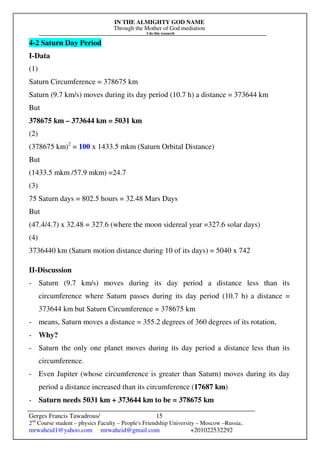
4-2 Saturn Day Period
I-Data
(1)
Saturn Circumference = 378675 km
Saturn (9.7 km/s) moves during its day period (10.7 h) a distance = 373644 km
But
378675 km – 373644 km = 5031 km
(2)
(378675 km)2
= 100 x 1433.5 mkm (Saturn Orbital Distance)
But
(1433.5 mkm /57.9 mkm) =24.7
(3)
75 Saturn days = 802.5 hours = 32.48 Mars Days
But
(47.4/4.7) x 32.48 = 327.6 (where the moon sidereal year =327.6 solar days)
(4)
3736440 km (Saturn motion distance during 10 of its days) = 5040 x 742
II-Discussion
- Saturn (9.7 km/s) moves during its day period a distance less than its
circumference where Saturn passes during its day period (10.7 h) a distance =
373644 km but Saturn Circumference = 378675 km
- means, Saturn moves a distance = 355.2 degrees of 360 degrees of its rotation,
- Why?
- Saturn the only one planet moves during its day period a distance less than its
circumference.
- Even Jupiter (whose circumference is greater than Saturn) moves during its day
period a distance increased than its circumference (17687 km)
- Saturn needs 5031 km + 373644 km to be = 378675 km
IN THE ALMIGHTY GOD NAME
Through the Mother of God mediation
I do this research
Gerges Francis Tawadrous/
2nd
Course student – physics Faculty – People's Friendship University – Moscow –Russia..
mrwaheid1@yahoo.com mrwaheid@gmail.com +201022532292
16
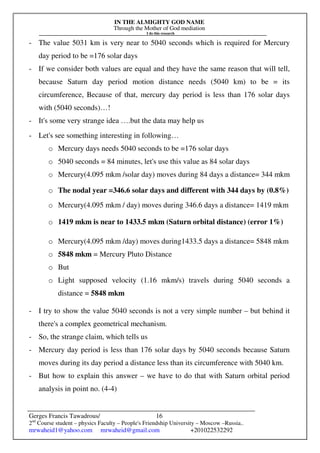
- The value 5031 km is very near to 5040 seconds which is required for Mercury
day period to be =176 solar days
- If we consider both values are equal and they have the same reason that will tell,
because Saturn day period motion distance needs (5040 km) to be = its
circumference, Because of that, mercury day period is less than 176 solar days
with (5040 seconds)…!
- It's some very strange idea ….but the data may help us
- Let's see something interesting in following…
o Mercury days needs 5040 seconds to be =176 solar days
o 5040 seconds = 84 minutes, let's use this value as 84 solar days
o Mercury(4.095 mkm /solar day) moves during 84 days a distance= 344 mkm
o The nodal year =346.6 solar days and different with 344 days by (0.8%)
o Mercury(4.095 mkm / day) moves during 346.6 days a distance= 1419 mkm
o 1419 mkm is near to 1433.5 mkm (Saturn orbital distance) (error 1%)
o Mercury(4.095 mkm /day) moves during1433.5 days a distance= 5848 mkm
o 5848 mkm = Mercury Pluto Distance
o But
o Light supposed velocity (1.16 mkm/s) travels during 5040 seconds a
distance = 5848 mkm
- I try to show the value 5040 seconds is not a very simple number – but behind it
there's a complex geometrical mechanism.
- So, the strange claim, which tells us
- Mercury day period is less than 176 solar days by 5040 seconds because Saturn
moves during its day period a distance less than its circumference with 5040 km.
- But how to explain this answer – we have to do that with Saturn orbital period
analysis in point no. (4-4)
IN THE ALMIGHTY GOD NAME
Through the Mother of God mediation
I do this research
Gerges Francis Tawadrous/
2nd
Course student – physics Faculty – People's Friendship University – Moscow –Russia..
mrwaheid1@yahoo.com mrwaheid@gmail.com +201022532292
17
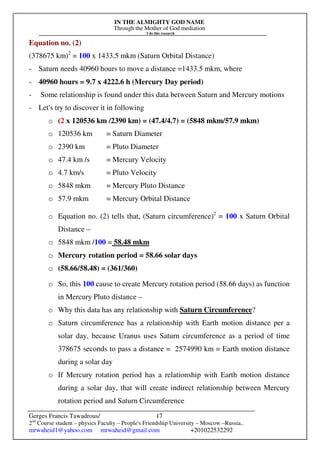
Equation no. (2)
(378675 km)2
= 100 x 1433.5 mkm (Saturn Orbital Distance)
- Saturn needs 40960 hours to move a distance =1433.5 mkm, where
- 40960 hours = 9.7 x 4222.6 h (Mercury Day period)
- Some relationship is found under this data between Saturn and Mercury motions
- Let's try to discover it in following
o (2 x 120536 km /2390 km) = (47.4/4.7) = (5848 mkm/57.9 mkm)
o 120536 km = Saturn Diameter
o 2390 km = Pluto Diameter
o 47.4 km /s = Mercury Velocity
o 4.7 km/s = Pluto Velocity
o 5848 mkm = Mercury Pluto Distance
o 57.9 mkm = Mercury Orbital Distance
o Equation no. (2) tells that, (Saturn circumference)2
= 100 x Saturn Orbital
Distance –
o 5848 mkm /100 = 58.48 mkm
o Mercury rotation period = 58.66 solar days
o (58.66/58.48) = (361/360)
o So, this 100 cause to create Mercury rotation period (58.66 days) as function
in Mercury Pluto distance –
o Why this data has any relationship with Saturn Circumference?
o Saturn circumference has a relationship with Earth motion distance per a
solar day, because Uranus uses Saturn circumference as a period of time
378675 seconds to pass a distance = 2574990 km = Earth motion distance
during a solar day
o If Mercury rotation period has a relationship with Earth motion distance
during a solar day, that will create indirect relationship between Mercury
rotation period and Saturn Circumference
IN THE ALMIGHTY GOD NAME
Through the Mother of God mediation
I do this research
Gerges Francis Tawadrous/
2nd
Course student – physics Faculty – People's Friendship University – Moscow –Russia..
mrwaheid1@yahoo.com mrwaheid@gmail.com +201022532292
18
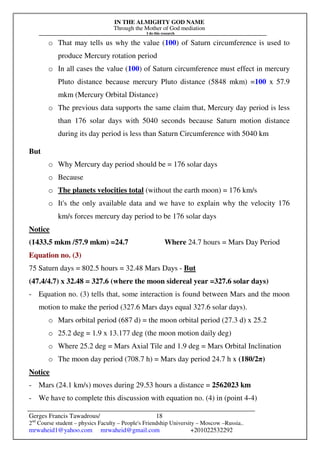
o That may tells us why the value (100) of Saturn circumference is used to
produce Mercury rotation period
o In all cases the value (100) of Saturn circumference must effect in mercury
Pluto distance because mercury Pluto distance (5848 mkm) =100 x 57.9
mkm (Mercury Orbital Distance)
o The previous data supports the same claim that, Mercury day period is less
than 176 solar days with 5040 seconds because Saturn motion distance
during its day period is less than Saturn Circumference with 5040 km
But
o Why Mercury day period should be = 176 solar days
o Because
o The planets velocities total (without the earth moon) = 176 km/s
o It's the only available data and we have to explain why the velocity 176
km/s forces mercury day period to be 176 solar days
Notice
(1433.5 mkm /57.9 mkm) =24.7 Where 24.7 hours = Mars Day Period
Equation no. (3)
75 Saturn days = 802.5 hours = 32.48 Mars Days - But
(47.4/4.7) x 32.48 = 327.6 (where the moon sidereal year =327.6 solar days)
- Equation no. (3) tells that, some interaction is found between Mars and the moon
motion to make the period (327.6 Mars days equal 327.6 solar days).
o Mars orbital period (687 d) = the moon orbital period (27.3 d) x 25.2
o 25.2 deg = 1.9 x 13.177 deg (the moon motion daily deg)
o Where 25.2 deg = Mars Axial Tile and 1.9 deg = Mars Orbital Inclination
o The moon day period (708.7 h) = Mars day period 24.7 h x (180/2π)
Notice
- Mars (24.1 km/s) moves during 29.53 hours a distance = 2562023 km
- We have to complete this discussion with equation no. (4) in (point 4-4)
IN THE ALMIGHTY GOD NAME
Through the Mother of God mediation
I do this research
Gerges Francis Tawadrous/
2nd
Course student – physics Faculty – People's Friendship University – Moscow –Russia..
mrwaheid1@yahoo.com mrwaheid@gmail.com +201022532292
19
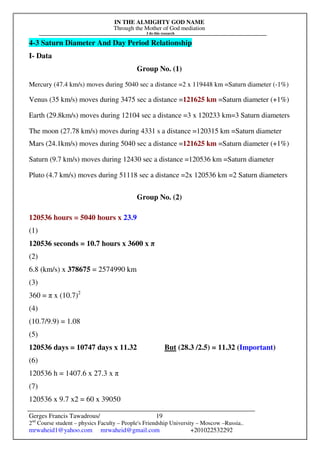
4-3 Saturn Diameter And Day Period Relationship
I- Data
Group No. (1)
Mercury (47.4 km/s) moves during 5040 sec a distance =2 x 119448 km =Saturn diameter (-1%)
Venus (35 km/s) moves during 3475 sec a distance =121625 km =Saturn diameter (+1%)
Earth (29.8km/s) moves during 12104 sec a distance =3 x 120233 km=3 Saturn diameters
The moon (27.78 km/s) moves during 4331 s a distance =120315 km =Saturn diameter
Mars (24.1km/s) moves during 5040 sec a distance =121625 km =Saturn diameter (+1%)
Saturn (9.7 km/s) moves during 12430 sec a distance =120536 km =Saturn diameter
Pluto (4.7 km/s) moves during 51118 sec a distance =2x 120536 km =2 Saturn diameters
Group No. (2)
120536 hours = 5040 hours x 23.9
(1)
120536 seconds = 10.7 hours x 3600 x π
(2)
6.8 (km/s) x 378675 = 2574990 km
(3)
360 = π x (10.7)2
(4)
(10.7/9.9) = 1.08
(5)
120536 days = 10747 days x 11.32 But (28.3 /2.5) = 11.32 (Important)
(6)
120536 h = 1407.6 x 27.3 x π
(7)
120536 x 9.7 x2 = 60 x 39050
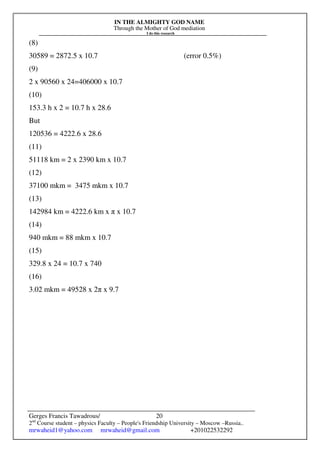
IN THE ALMIGHTY GOD NAME
Through the Mother of God mediation
I do this research
Gerges Francis Tawadrous/
2nd
Course student – physics Faculty – People's Friendship University – Moscow –Russia..
mrwaheid1@yahoo.com mrwaheid@gmail.com +201022532292
20
(8)
30589 = 2872.5 x 10.7 (error 0.5%)
(9)
2 x 90560 x 24=406000 x 10.7
(10)
153.3 h x 2 = 10.7 h x 28.6
But
120536 = 4222.6 x 28.6
(11)
51118 km = 2 x 2390 km x 10.7
(12)
37100 mkm = 3475 mkm x 10.7
(13)
142984 km = 4222.6 km x π x 10.7
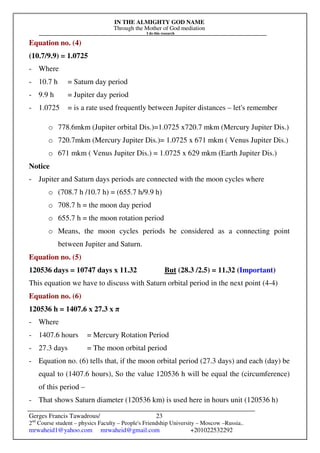
(14)
940 mkm = 88 mkm x 10.7
(15)
329.8 x 24 = 10.7 x 740
(16)
3.02 mkm = 49528 x 2π x 9.7
IN THE ALMIGHTY GOD NAME
Through the Mother of God mediation
I do this research
Gerges Francis Tawadrous/
2nd
Course student – physics Faculty – People's Friendship University – Moscow –Russia..
mrwaheid1@yahoo.com mrwaheid@gmail.com +201022532292
21
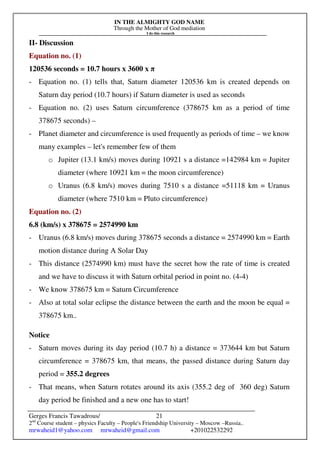
II- Discussion
Equation no. (1)
120536 seconds = 10.7 hours x 3600 x π
- Equation no. (1) tells that, Saturn diameter 120536 km is created depends on
Saturn day period (10.7 hours) if Saturn diameter is used as seconds
- Equation no. (2) uses Saturn circumference (378675 km as a period of time
378675 seconds) –
- Planet diameter and circumference is used frequently as periods of time – we know
many examples – let's remember few of them
o Jupiter (13.1 km/s) moves during 10921 s a distance =142984 km = Jupiter
diameter (where 10921 km = the moon circumference)
o Uranus (6.8 km/s) moves during 7510 s a distance =51118 km = Uranus
diameter (where 7510 km = Pluto circumference)
Equation no. (2)
6.8 (km/s) x 378675 = 2574990 km
- Uranus (6.8 km/s) moves during 378675 seconds a distance = 2574990 km = Earth
motion distance during A Solar Day
- This distance (2574990 km) must have the secret how the rate of time is created
and we have to discuss it with Saturn orbital period in point no. (4-4)
- We know 378675 km = Saturn Circumference
- Also at total solar eclipse the distance between the earth and the moon be equal =
378675 km..
Notice
- Saturn moves during its day period (10.7 h) a distance = 373644 km but Saturn
circumference = 378675 km, that means, the passed distance during Saturn day
period = 355.2 degrees
- That means, when Saturn rotates around its axis (355.2 deg of 360 deg) Saturn
day period be finished and a new one has to start!
IN THE ALMIGHTY GOD NAME
Through the Mother of God mediation
I do this research
Gerges Francis Tawadrous/
2nd
Course student – physics Faculty – People's Friendship University – Moscow –Russia..
mrwaheid1@yahoo.com mrwaheid@gmail.com +201022532292
22
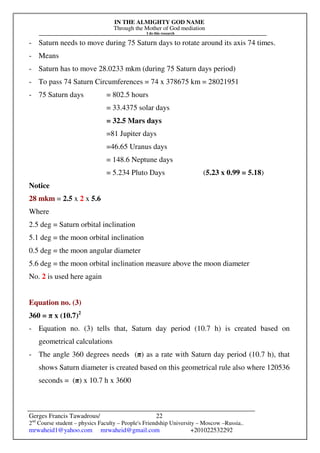
- Saturn needs to move during 75 Saturn days to rotate around its axis 74 times.
- Means
- Saturn has to move 28.0233 mkm (during 75 Saturn days period)
- To pass 74 Saturn Circumferences = 74 x 378675 km = 28021951
- 75 Saturn days = 802.5 hours
= 33.4375 solar days
= 32.5 Mars days
=81 Jupiter days
=46.65 Uranus days
= 148.6 Neptune days
= 5.234 Pluto Days (5.23 x 0.99 = 5.18)
Notice
28 mkm = 2.5 x 2 x 5.6
Where
2.5 deg = Saturn orbital inclination
5.1 deg = the moon orbital inclination
0.5 deg = the moon angular diameter
5.6 deg = the moon orbital inclination measure above the moon diameter
No. 2 is used here again
Equation no. (3)
360 = π x (10.7)2
- Equation no. (3) tells that, Saturn day period (10.7 h) is created based on
geometrical calculations
- The angle 360 degrees needs (π) as a rate with Saturn day period (10.7 h), that
shows Saturn diameter is created based on this geometrical rule also where 120536
seconds = (π) x 10.7 h x 3600
IN THE ALMIGHTY GOD NAME
Through the Mother of God mediation
I do this research
Gerges Francis Tawadrous/
2nd
Course student – physics Faculty – People's Friendship University – Moscow –Russia..
mrwaheid1@yahoo.com mrwaheid@gmail.com +201022532292
23
Equation no. (4)
(10.7/9.9) = 1.0725
- Where
- 10.7 h = Saturn day period
- 9.9 h = Jupiter day period
- 1.0725 = is a rate used frequently between Jupiter distances – let's remember
o 778.6mkm (Jupiter orbital Dis.)=1.0725 x720.7 mkm (Mercury Jupiter Dis.)
o 720.7mkm (Mercury Jupiter Dis.)= 1.0725 x 671 mkm ( Venus Jupiter Dis.)
o 671 mkm ( Venus Jupiter Dis.) = 1.0725 x 629 mkm (Earth Jupiter Dis.)
Notice
- Jupiter and Saturn days periods are connected with the moon cycles where
o (708.7 h /10.7 h) = (655.7 h/9.9 h)
o 708.7 h = the moon day period
o 655.7 h = the moon rotation period
o Means, the moon cycles periods be considered as a connecting point
between Jupiter and Saturn.
Equation no. (5)
120536 days = 10747 days x 11.32 But (28.3 /2.5) = 11.32 (Important)
This equation we have to discuss with Saturn orbital period in the next point (4-4)
Equation no. (6)
120536 h = 1407.6 x 27.3 x π
- Where
- 1407.6 hours = Mercury Rotation Period
- 27.3 days = The moon orbital period
- Equation no. (6) tells that, if the moon orbital period (27.3 days) and each (day) be
equal to (1407.6 hours), So the value 120536 h will be equal the (circumference)
of this period –
- That shows Saturn diameter (120536 km) is used here in hours unit (120536 h)
IN THE ALMIGHTY GOD NAME
Through the Mother of God mediation
I do this research
Gerges Francis Tawadrous/
2nd
Course student – physics Faculty – People's Friendship University – Moscow –Russia..
mrwaheid1@yahoo.com mrwaheid@gmail.com +201022532292
24
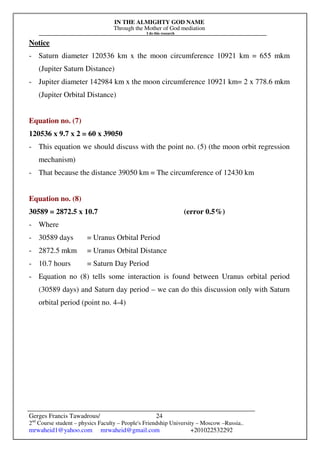
Notice
- Saturn diameter 120536 km x the moon circumference 10921 km = 655 mkm
(Jupiter Saturn Distance)
- Jupiter diameter 142984 km x the moon circumference 10921 km= 2 x 778.6 mkm
(Jupiter Orbital Distance)
Equation no. (7)
120536 x 9.7 x 2 = 60 x 39050
- This equation we should discuss with the point no. (5) (the moon orbit regression
mechanism)
- That because the distance 39050 km = The circumference of 12430 km
Equation no. (8)
30589 = 2872.5 x 10.7 (error 0.5%)
- Where
- 30589 days = Uranus Orbital Period
- 2872.5 mkm = Uranus Orbital Distance
- 10.7 hours = Saturn Day Period
- Equation no (8) tells some interaction is found between Uranus orbital period
(30589 days) and Saturn day period – we can do this discussion only with Saturn
orbital period (point no. 4-4)
IN THE ALMIGHTY GOD NAME
Through the Mother of God mediation
I do this research
Gerges Francis Tawadrous/
2nd
Course student – physics Faculty – People's Friendship University – Moscow –Russia..
mrwaheid1@yahoo.com mrwaheid@gmail.com +201022532292
25
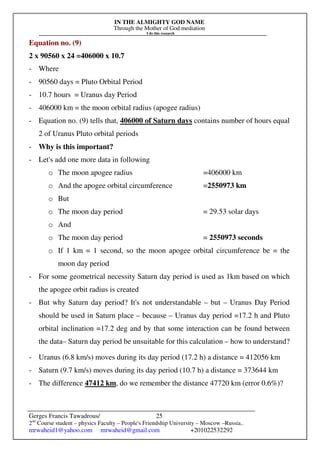
Equation no. (9)
2 x 90560 x 24 =406000 x 10.7
- Where
- 90560 days = Pluto Orbital Period
- 10.7 hours = Uranus day Period
- 406000 km = the moon orbital radius (apogee radius)
- Equation no. (9) tells that, 406000 of Saturn days contains number of hours equal
2 of Uranus Pluto orbital periods
- Why is this important?
- Let's add one more data in following
o The moon apogee radius =406000 km
o And the apogee orbital circumference =2550973 km
o But
o The moon day period = 29.53 solar days
o And
o The moon day period = 2550973 seconds
o If 1 km = 1 second, so the moon apogee orbital circumference be = the
moon day period
- For some geometrical necessity Saturn day period is used as 1km based on which
the apogee orbit radius is created
- But why Saturn day period? It's not understandable – but – Uranus Day Period
should be used in Saturn place – because – Uranus day period =17.2 h and Pluto
orbital inclination =17.2 deg and by that some interaction can be found between
the data– Saturn day period be unsuitable for this calculation – how to understand?
- Uranus (6.8 km/s) moves during its day period (17.2 h) a distance = 412056 km
- Saturn (9.7 km/s) moves during its day period (10.7 h) a distance = 373644 km
- The difference 47412 km, do we remember the distance 47720 km (error 0.6%)?
IN THE ALMIGHTY GOD NAME
Through the Mother of God mediation
I do this research
Gerges Francis Tawadrous/
2nd
Course student – physics Faculty – People's Friendship University – Moscow –Russia..
mrwaheid1@yahoo.com mrwaheid@gmail.com +201022532292
26
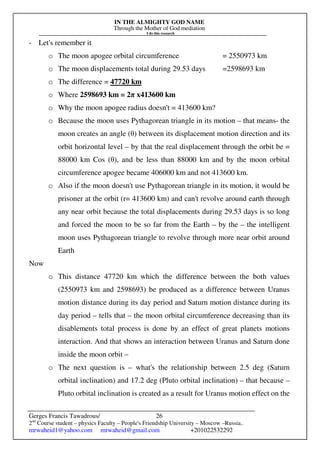
- Let's remember it
o The moon apogee orbital circumference = 2550973 km
o The moon displacements total during 29.53 days =2598693 km
o The difference = 47720 km
o Where 2598693 km = 2π x413600 km
o Why the moon apogee radius doesn't = 413600 km?
o Because the moon uses Pythagorean triangle in its motion – that means- the
moon creates an angle (θ) between its displacement motion direction and its
orbit horizontal level – by that the real displacement through the orbit be =
88000 km Cos (θ), and be less than 88000 km and by the moon orbital
circumference apogee became 406000 km and not 413600 km.
o Also if the moon doesn't use Pythagorean triangle in its motion, it would be
prisoner at the orbit (r= 413600 km) and can't revolve around earth through
any near orbit because the total displacements during 29.53 days is so long
and forced the moon to be so far from the Earth – by the – the intelligent
moon uses Pythagorean triangle to revolve through more near orbit around
Earth
Now
o This distance 47720 km which the difference between the both values
(2550973 km and 2598693) be produced as a difference between Uranus
motion distance during its day period and Saturn motion distance during its
day period – tells that – the moon orbital circumference decreasing than its
disablements total process is done by an effect of great planets motions
interaction. And that shows an interaction between Uranus and Saturn done
inside the moon orbit –
o The next question is – what's the relationship between 2.5 deg (Saturn
orbital inclination) and 17.2 deg (Pluto orbital inclination) – that because –
Pluto orbital inclination is created as a result for Uranus motion effect on the
IN THE ALMIGHTY GOD NAME
Through the Mother of God mediation
I do this research
Gerges Francis Tawadrous/
2nd
Course student – physics Faculty – People's Friendship University – Moscow –Russia..
mrwaheid1@yahoo.com mrwaheid@gmail.com +201022532292
27
Earth moon motion – an if this effect is done through interaction with Saturn
motion – that means Saturn has an effect on Pluto orbital inclination
Notice
o 7 deg x 2.5 deg =17.5 deg
o Where
o 17.4 deg = the inner planets orbital inclinations total (7+3.4+5.1+1.9)
o The data proves that, Saturn has an effect on Pluto orbital inclination but
any effect of Saturn on the inner planets or Pluto motion is done through a
relationship with Mercury – Saturn knows only Mercury – and by that –
even Saturn motion effect on the moon motion is done through Mercury
effect on the moon motion – and that supports our claim which is:
o Mercury day period is less than 176 solar days with 5040 seconds because
Saturn motion distance during its day is less than Saturn circumference with
5040 km.
Equation no. (10)
2 x 153.3 h (Pluto day period) = 10.7 h (Saturn day period)x 28.6
But
120536 km (Saturn diameter) = 4222.6 h (Mercury day period) x 28.6
- Equation no. (10) tells that, (2 x 153.3/10.7) = (120536/4222.6)
- Saturn diameter is dealt as a day period! Because
- The equation has 4 values, 3 of them are days periods and the fourth is Saturn
diameter!
- The planet diameter is used as a period of time frequently but Saturn diameter is
used as day period why?
Notice
- Saturn (9.7 km/s) moves during (128) x (120536 seconds) a distance = 149.6 mkm
= Earth Orbital Distance
- Why 128? Because
IN THE ALMIGHTY GOD NAME
Through the Mother of God mediation
I do this research
Gerges Francis Tawadrous/
2nd
Course student – physics Faculty – People's Friendship University – Moscow –Russia..
mrwaheid1@yahoo.com mrwaheid@gmail.com +201022532292
28
o 51118 km = 4.7 x 10921 km,
o The moon needs to rotate around its axis 4.7 times to move a distance =
51118 km = Uranus diameter where the moon circumference =10921 km
o The moon rotates around its axis once each 27.3 days
o 27.3 days x 4.7 = 128.8
o Some geometrical mechanism must be found behind this data
Notice
o 120536 = 365.25 x 329.8
o 329.8 days = a lunar sidereal year but its last month doesn't finish with a
sidereal month (27.3 days) but finish with a synoidic month (29.53 days)
o This data is similar to Saturn orbital period because
o 10747 days (Saturn orbital period) =365.25 days x 29.53
o We have to complete this discussion with Saturn orbital period.
Equation no. (11)
51118 km = 2 x 2390 km x 10.7
- Where
- 51118 km = Uranus Diameter
- 2390 km = Pluto Diameter
- 10.7 hours = Saturn Day Period
- The equation give us n important information – that – the planets data is created
depends on one another – because of that
- 6.8 x π = 2 x 10.7
- 6.8 km/s = Uranus velocity But 10.7 hours = Saturn day period
- Also 4.7 x π2
= (6.8)2
- We don't interest here for the units because I try to show that the values are rated
geometrically to each other. I want to say that, the values are rated geometrically
because they are crated based on geometrical rules control the interaction between
the planets motions.
IN THE ALMIGHTY GOD NAME
Through the Mother of God mediation
I do this research
Gerges Francis Tawadrous/
2nd
Course student – physics Faculty – People's Friendship University – Moscow –Russia..
mrwaheid1@yahoo.com mrwaheid@gmail.com +201022532292
29
A Question
Can Pluto orbital inclination (17.2 deg) be created based in Uranus day period
(17.2 hours)? How to prove that?
(I)
- Uranus (6.8 km/s) moves during its day period (17.2 hours) a distance = 421056
km –
- Venus (35 km/s) moves during 12104 seconds a distance = 423640 km
- Pluto (4.7 km/s) moves during 90560 seconds a distance = 425632 km
- But
o Pluto velocity (4.7 km/s) is created as a function in Uranus velocity (6.8
km/s) as we have discussed in the previous discussion
o That means,
o The distance 421056 km is defined by Uranus motion during its day period
and Pluto velocity is defined based on Uranus velocity
o Based on that
o The period 90560 seconds is created based on Uranus motion distance
during its day period
o But
o Pluto Orbital Period =90560 solar days
o That tells us, Pluto orbital period is created based on Uranus motion during
its day period
(II)
- 90560 days = 17.2 deg (Pluto orbital inclination) x 5265 days
- What's this value 5265 days? Let's remember how the rate of time (1 hour is
equivalent to 1 solar day) is created
o (Mercury + Venus + Earth) velocities total =112.2 km/s
o Pluto velocity =4.7 km /s
o 112.2 = 4.7 x 23.9
IN THE ALMIGHTY GOD NAME
Through the Mother of God mediation
I do this research
Gerges Francis Tawadrous/
2nd
Course student – physics Faculty – People's Friendship University – Moscow –Russia..
mrwaheid1@yahoo.com mrwaheid@gmail.com +201022532292
30
o That means, the distance Pluto moves during 23.9 hours is passed by the 3
planets velocities total during 1 hour
o That creates the rate (1 hour is equivalent to 23.9 or 24 hours)
o How this process is done? It's done depend on the value 5040
o Pluto during 5040 hours moves a distance = 85.5 mkm
o The 3planets velocities total during 5040 hours move a distance =2040 mkm
o Jupiter Uranus distance =2094 mkm and the difference between 2040 mkm
and 2094 mkm = 3%
o Also Pluto motion distance 85.5 mkm has no meaning but 88 mkm has a
meaning because Mercury day period =88 days (the error is also 3%)
o So, the value 5040 hours is not the required period accurately but needs to
change by 3% and will be = 5200 hours
o Let's remember the equation we examine now
o 90560 days = 17.2 deg (Pluto orbital inclination) x 5265 days
o The value 5200 hours can be uses as 5265 days or hours (error 1%) and by
that the arte 17.2 can be created
o That tells, Pluto orbital inclination is created depends on Pluto orbital period
and that's happened during the same process by which the rate of time (1
hour is equivalent to 1 24 hours ) is created…
Shortly
o Uranus motion during its day period cause Pluto orbital period to be defined
as 90560 days and based on this period of time Pluto orbital (17.2 deg)
inclination is created …
o But
When Pluto day period be =153.3 days?
o 2 x 90560 days (Pluto orbital period) x 24 h = 28255 x 153.3 h
o Means, 2 Pluto orbital periods = 28255 Pluto days periods
IN THE ALMIGHTY GOD NAME
Through the Mother of God mediation
I do this research
Gerges Francis Tawadrous/
2nd
Course student – physics Faculty – People's Friendship University – Moscow –Russia..
mrwaheid1@yahoo.com mrwaheid@gmail.com +201022532292
31
o But, what's 28255?
o Neptune orbital circumference = 28255 mkm
o Why Neptune orbital circumference is used in this data?
o Because
o 28255 days = 329.8 days x π x 27.3
o 329.8 days = a lunar sidereal year (327.6 days) , but finished with a synodic
month (29.53 days)
o 27.3 days = the moon orbital period
Notice
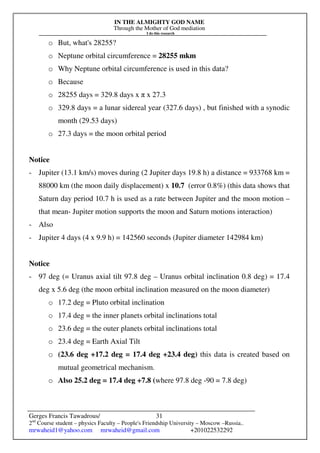
- Jupiter (13.1 km/s) moves during (2 Jupiter days 19.8 h) a distance = 933768 km =
88000 km (the moon daily displacement) x 10.7 (error 0.8%) (this data shows that
Saturn day period 10.7 h is used as a rate between Jupiter and the moon motion –
that mean- Jupiter motion supports the moon and Saturn motions interaction)
- Also
- Jupiter 4 days (4 x 9.9 h) = 142560 seconds (Jupiter diameter 142984 km)
Notice
- 97 deg (= Uranus axial tilt 97.8 deg – Uranus orbital inclination 0.8 deg) = 17.4
deg x 5.6 deg (the moon orbital inclination measured on the moon diameter)
o 17.2 deg = Pluto orbital inclination
o 17.4 deg = the inner planets orbital inclinations total
o 23.6 deg = the outer planets orbital inclinations total
o 23.4 deg = Earth Axial Tilt
o (23.6 deg +17.2 deg = 17.4 deg +23.4 deg) this data is created based on
mutual geometrical mechanism.
o Also 25.2 deg = 17.4 deg +7.8 (where 97.8 deg -90 = 7.8 deg)
IN THE ALMIGHTY GOD NAME
Through the Mother of God mediation
I do this research
Gerges Francis Tawadrous/
2nd
Course student – physics Faculty – People's Friendship University – Moscow –Russia..
mrwaheid1@yahoo.com mrwaheid@gmail.com +201022532292
32
Notice
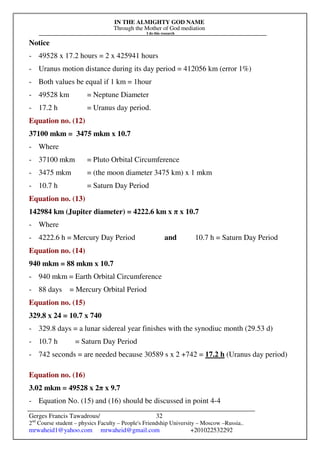
- 49528 x 17.2 hours = 2 x 425941 hours
- Uranus motion distance during its day period = 412056 km (error 1%)
- Both values be equal if 1 km = 1hour
- 49528 km = Neptune Diameter
- 17.2 h = Uranus day period.
Equation no. (12)
37100 mkm = 3475 mkm x 10.7
- Where
- 37100 mkm = Pluto Orbital Circumference
- 3475 mkm = (the moon diameter 3475 km) x 1 mkm
- 10.7 h = Saturn Day Period
Equation no. (13)
142984 km (Jupiter diameter) = 4222.6 km x π x 10.7
- Where
- 4222.6 h = Mercury Day Period and 10.7 h = Saturn Day Period
Equation no. (14)
940 mkm = 88 mkm x 10.7
- 940 mkm = Earth Orbital Circumference
- 88 days = Mercury Orbital Period
Equation no. (15)
329.8 x 24 = 10.7 x 740
- 329.8 days = a lunar sidereal year finishes with the synodiuc month (29.53 d)
- 10.7 h = Saturn Day Period
- 742 seconds = are needed because 30589 s x 2 +742 = 17.2 h (Uranus day period)
Equation no. (16)
3.02 mkm = 49528 x 2π x 9.7
- Equation No. (15) and (16) should be discussed in point 4-4
IN THE ALMIGHTY GOD NAME
Through the Mother of God mediation
I do this research
Gerges Francis Tawadrous/
2nd
Course student – physics Faculty – People's Friendship University – Moscow –Russia..
mrwaheid1@yahoo.com mrwaheid@gmail.com +201022532292
33
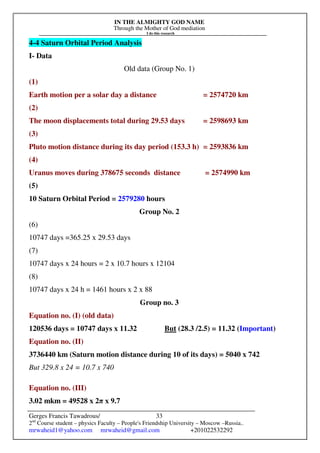
4-4 Saturn Orbital Period Analysis
I- Data
Old data (Group No. 1)
(1)
Earth motion per a solar day a distance = 2574720 km
(2)
The moon displacements total during 29.53 days = 2598693 km
(3)
Pluto motion distance during its day period (153.3 h) = 2593836 km
(4)
Uranus moves during 378675 seconds distance = 2574990 km
(5)
10 Saturn Orbital Period = 2579280 hours
Group No. 2
(6)
10747 days =365.25 x 29.53 days
(7)
10747 days x 24 hours = 2 x 10.7 hours x 12104
(8)
10747 days x 24 h = 1461 hours x 2 x 88
Group no. 3
Equation no. (I) (old data)
120536 days = 10747 days x 11.32 But (28.3 /2.5) = 11.32 (Important)
Equation no. (II)
3736440 km (Saturn motion distance during 10 of its days) = 5040 x 742
But 329.8 x 24 = 10.7 x 740
Equation no. (III)
3.02 mkm = 49528 x 2π x 9.7
IN THE ALMIGHTY GOD NAME
Through the Mother of God mediation
I do this research
Gerges Francis Tawadrous/
2nd
Course student – physics Faculty – People's Friendship University – Moscow –Russia..
mrwaheid1@yahoo.com mrwaheid@gmail.com +201022532292
34
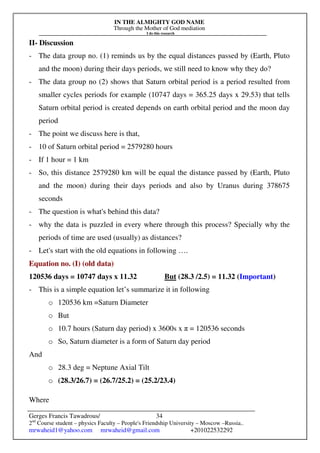
II- Discussion
- The data group no. (1) reminds us by the equal distances passed by (Earth, Pluto
and the moon) during their days periods, we still need to know why they do?
- The data group no (2) shows that Saturn orbital period is a period resulted from
smaller cycles periods for example (10747 days = 365.25 days x 29.53) that tells
Saturn orbital period is created depends on earth orbital period and the moon day
period
- The point we discuss here is that,
- 10 of Saturn orbital period = 2579280 hours
- If 1 hour = 1 km
- So, this distance 2579280 km will be equal the distance passed by (Earth, Pluto
and the moon) during their days periods and also by Uranus during 378675
seconds
- The question is what's behind this data?
- why the data is puzzled in every where through this process? Specially why the
periods of time are used (usually) as distances?
- Let's start with the old equations in following ….
Equation no. (I) (old data)
120536 days = 10747 days x 11.32 But (28.3 /2.5) = 11.32 (Important)
- This is a simple equation let’s summarize it in following
o 120536 km =Saturn Diameter
o But
o 10.7 hours (Saturn day period) x 3600s x π = 120536 seconds
o So, Saturn diameter is a form of Saturn day period
And
o 28.3 deg = Neptune Axial Tilt
o (28.3/26.7) = (26.7/25.2) = (25.2/23.4)
Where
IN THE ALMIGHTY GOD NAME
Through the Mother of God mediation
I do this research
Gerges Francis Tawadrous/
2nd
Course student – physics Faculty – People's Friendship University – Moscow –Russia..
mrwaheid1@yahoo.com mrwaheid@gmail.com +201022532292
35
o 26.7 deg = Saturn Axial Tilt
o 25.2 deg = Mars Axial Tilt
o 23.4 deg = Earth Axial Tilt
o The 4 planets axial tilts are rated to each – means- any one can be used in
place of any other – they are (all) = one effect.
o 2.5 deg = Saturn orbital inclination
o (28.3 deg /2.5 deg) =11.32
o 120536 days = 11.32 x 10747 days (Saturn Orbital Period)
o Shortly
o Saturn orbital period, diameter and day period all of them are one value in 3
different forms depends on the geometrical necessity of their using…
Notice
o 406000 km = 120536 km x 3.4 deg (Venus orb. Inclination)
o 406000 km = 10747 km x 38
o This data shows some geometrical necessity, where Saturn diameter
depends on 406000 km by Venus orb. Inclination
o But the same value (406000) defines Saturn orbital period (10747 days)
based on 38 degrees (19 degrees = the moon orbit regression per year)
o But
o The distance 406000 km uses 2 values of (19 degrees)? Why?
o 406000 km = 116.7 x 3475 km (the moon diameter), this data also uses the
double value because 406000 is the orbit radius but the value 3475 km is the
moon diameter
o It's A Part Of The Geometrical Interaction
IN THE ALMIGHTY GOD NAME
Through the Mother of God mediation
I do this research
Gerges Francis Tawadrous/
2nd
Course student – physics Faculty – People's Friendship University – Moscow –Russia..
mrwaheid1@yahoo.com mrwaheid@gmail.com +201022532292
36
Equation no. (II)
3736440 km (Saturn motion distance during 10 of its days) = 5040 x 742
- Where
- 5040 km is a different distance between Saturn motion distance during its day
period and its circumference
- 742 seconds = 17.2 h (Uranus day period) – (30589 seconds x 2)
- let's move step by step in following
o Saturn (9.7 km/s) moves during its day (10.7 h) a distance = 373644 km
o Saturn Circumference = 378675 km
o The difference = 5040 km
o During 10 days of Saturn days the total passed distance = 3736440 km
o 10 Saturn circumferences = 3786750 km
o The difference will be 50400 km (Uranus Diameter 1% error)
o Based on that,
o As the 8 Jupiter days creates a cycle for Jupiter distinguished by Jupiter
diameter (error +1%)
o Saturn 10 days Cycle is distinguished with Uranus diameter (-1%)
But
o The difference 5040 km can be covered during 75 Saturn days, so
o During 75 Saturn days, Saturn moves 28023300 km
o 74 Saturn circumferences = 28021951 km
Means
o The difference 5040 km aims to create the distance 28 mkm – why?
o 28 mkm = 51118 km (Uranus diameter) x 550.7
o 550.7 mkm = the distance between Jupiter and Mars
o Why this is important? Because
o 2.574 mkm x 550.7 days = 1433.5 mkm (Saturn orbital distance) (error 1%)
IN THE ALMIGHTY GOD NAME
Through the Mother of God mediation
I do this research
Gerges Francis Tawadrous/
2nd
Course student – physics Faculty – People's Friendship University – Moscow –Russia..
mrwaheid1@yahoo.com mrwaheid@gmail.com +201022532292
37
o Where, 2.574 mkm is the distance passed by Earth during a solar day and
equal the distances passed by Pluto and the moon during their days periods
and equal Uranus motion distance during (378675 seconds) and if 1 km = 1
hour is will be = 10 of Saturn orbital periods
o Why this is important at all?
o Because
o Saturn orbital distance =1433.5 mkm = Mats orbital circumference
o The interaction aims to define Mars orbital distance after Mars Migration
from its original orbital distance (84 mkm)
o Planet migration is done based on geometrical calculations and because of
that the process defines Mars orbital distance
Notice
o Uranus moves during 30589 hours a distance = 742 mkm
o But
o 30589 seconds x 2 + 742 seconds = 17.2 hours = Uranus Day Period
o That shows a deep interaction behind between these planets to perform the
defined task
A Conclusion
Mercury day periods is less than 176 solar days by 5040 seconds because Saturn
motion distance during its day period is less than Saturn circumference with 5040 km.
IN THE ALMIGHTY GOD NAME
Through the Mother of God mediation
I do this research
Gerges Francis Tawadrous/
2nd
Course student – physics Faculty – People's Friendship University – Moscow –Russia..
mrwaheid1@yahoo.com mrwaheid@gmail.com +201022532292
38
References
The Moon Orbital Motion Geometry (II)
https://www.academia.edu/45181646/The_Moon_Orbital_Motion_Geometry_II_
or
https://www.slideshare.net/Gergesfrancis/the-moon-orbital-motion-geometry-ii
Light Motion Features Are Discovered in Planet Motion
https://www.slideshare.net/Gergesfrancis/light-motion-features-are-discovered-in-planet-motion
or
https://www.academia.edu/44286772/Light_Motion_Features_Are_Discovered_in_Planet_Motion
The Moon Motion Trajectory Analysis (II)
https://www.academia.edu/44368860/The_Moon_Motion_Trajectory_Analysis_II_
Does Particle Data Depend on Its Motion? (Lorentz Transformations Analysis)
https://vixra.org/abs/1912.0134
Dr. Budochkina, Svetlana Aleksandrovna
Associate professor - Candidate of physico-mathematical sciences (2005)
http://www.mathnet.ru/eng/person22119
List of publications on Google Scholar
List of publications on ZentralBlatt
https://mathscinet.ams.org/mathscinet/MRAuthorID/757317
http://elibrary.ru/author_items.asp?spin=6087-3245
http://orcid.org/0000-0003-3447-0425
http://www.researcherid.com/rid/G-7453-2014
http://www.scopus.com/authid/detail.url?authorId=6507007003
https://www.researchgate.net/profile/Svetlana_Budochkina
Full list of
publications:
http://web-local.rudn.ru/web-
local/prep/rj/index.php?id=2944p=15209
Mr.Gerges Francis Tawdrous +201022532292
Physics Department- Physics  Mathematics Faculty
Curriculum Vitae http://vixra.org/abs/1902.0044
E-mail mrwaheid@gmail.com
Linkedln https://eg.linkedin.com/in/gerges-francis-86a351a1
Facebook https://www.facebook.com
Researcherid https://publons.com/researcher/3510834/gerges-tawadrous/
ORCID https://orcid.org/0000-0002-1041-7147
Quora https://www.quora.com/profile/Gerges-F-Tawdrous
Google https://scholar.google.com/citations?user=2Y4ZdTUAAAAJhl=en
Academia https://rudn.academia.edu/GergesTawadrous
List of publications http://vixra.org/author/gerges_francis_tawdrous

The Solar Group is A Clock

  • 1.
    IN THE ALMIGHTYGOD NAME Through the Mother of God mediation I do this research Gerges Francis Tawadrous/ 2nd Course student – physics Faculty – People's Friendship University – Moscow –Russia.. mrwaheid1@yahoo.com mrwaheid@gmail.com +201022532292 1 The Solar Group is A Clock The Author Authorized To Be Used By Mr. Gerges Francis Tawdrous A Student–Physics Department- Physics & Mathematics Faculty – Peoples' Friendship University of Russia (RUDN University) – Moscow – Russia Dr. Budochkina, Svetlana Aleksandrovna Associate Professor (Mathematical Analysis and Theory of Functions Department) Peoples' Friendship University of Russia (RUDN University) – Moscow – Russia Phone +201022532292 E-Mail: mrwaheid@gmail.com Curriculum Vitae http://vixra.org/abs/1902.0044 Phone +7 (495) 952-35-83 E-Mail: budochkina-sa@rudn.ru, sbudotchkina@yandex.ru Website http://web-local.rudn.ru/web-local/prep/rj/index.php?id=2944&p=19024 The Assumption Of S. Virgin Mary -Written in Cairo –Egypt –12th April 2021 1- Abstract - The solar group is a clock.. - The paper tries to develop our understanding for the solar system motion… - The classical description which tells - The solar planets are rigid bodies separated from each other in their creation and motion, revolving around the sun by the masses gravity forces – this description fails frequently to explain Planets Motions Data … - The paper vision tells – The solar planets are one trajectory of energy, or one thread (or one light beam) and each planet is a knot on this thread or a point on this trajectory of energy – - The solar group – based on the new vision – is one geometrical building and each planet is a part of this same building – and Because of that – Each plant data must be complementary to other planets data – - (A Complementary Data) is similar to an electron and a positron are produced by the double production experiment – where each particle charge is defined based on the other particle (because of charge reservation law) – similar to that – each planet creation and motion data must be complementary to the other planets to support the general motions harmony –
  • 2.
    IN THE ALMIGHTYGOD NAME Through the Mother of God mediation I do this research Gerges Francis Tawadrous/ 2nd Course student – physics Faculty – People's Friendship University – Moscow –Russia.. mrwaheid1@yahoo.com mrwaheid@gmail.com +201022532292 2 - That makes the solar group as a machine of gears, and because of the data dependency on one another, that refers to (A Motion Transportation) is found among the planets. - We still need to discover the geometrical rules based which the motion is transported from a planet to another – - Through the motion transportation, the solar system geometry creates different rates of time for planets motions – by that- The Solar Group Be A Clock - The solar group basic task is to consume a light motion for 1 second and produce a planet motion for 1 solar day – by this basic task - a rate of time – 1 second is equivalent to 1 solar day – is produced - This rate of time is divided into small parts – this paper discusses the rate of time - (1 hour of a planet motion is equivalent to 24 hours of another planet motion) – and this rate is a part of the general rate of time (1 second is equivalent to 1 solar day) - The paper discussion has 2 basic points which are (the motion transportation and the rate of time 1 hour = 24 hours) - Let's refer to the paper contents in following o Point no. 2 discusses the paper methodology o Point no. 3 discusses The Rate Of Time Creation o Point no. 4 discusses Saturn Role in The Rate of time Creation
  • 3.
    IN THE ALMIGHTYGOD NAME Through the Mother of God mediation I do this research Gerges Francis Tawadrous/ 2nd Course student – physics Faculty – People's Friendship University – Moscow –Russia.. mrwaheid1@yahoo.com mrwaheid@gmail.com +201022532292 3 2- Methodology - I use The Planets Data Analysis - This method tries to explain how planets data is created? for example why does the moon diameter =3475 km? - By this method the dependency of data among the planets be shown and proved – and many answers b provided by this method using – - Let's discuss one example in following: o The diameter 12430 km o No solar planet its diameter =12430 km, This number I have concluded… o This value is unreal, But I claim this value is a necessary value for the solar system geometry design… o This claim depends on the basic description argument – because – if the solar planets are separated rigid bodies and no planet diameter =12430 km so this value should have no effect on any planet motion – but – on the other side – if this value has an effect on any planet motion that means the planets diameters (as data) are created based on geometrical rules which contain the number (12430 km) (geometrically) but not real – and that means- Planets motions doesn't depend on their masses only (as believed now) but depend on a whole geometrical mechanism (which supports the description tells the solar system is one machine) - Let's test the value 12430 km o The value 12430 km is a middle unique rate between Venus diameter 12104 km and earth diameter 12756 km – means – no other number can do that - o Saturn (9.7 km/s) moves during 12430 seconds a distance = 120536 km = Saturn diameter o Mars (24.1 km/s) moves during 12430 seconds a distance = 300000 km = light (0.3mkm/s) motion distance during 1 second o (Earth diameter / the moon diameter) = (Jupiter diameter/(12430 π)
  • 4.
    IN THE ALMIGHTYGOD NAME Through the Mother of God mediation I do this research Gerges Francis Tawadrous/ 2nd Course student – physics Faculty – People's Friendship University – Moscow –Russia.. mrwaheid1@yahoo.com mrwaheid@gmail.com +201022532292 4 Please remember o Jupiter (13.1 km/s) moves during (10921 s) a distance = Jupiter diameter o Uranus (6.8 km/s) moves during (7510 s) a distance = Uranus diameter o Where o 10921 km = The Moon Circumference o 7510 km = Pluto Circumference - I try to show that, the value 12430 km is used as any other planet diameter in different calculations... - We have a reason to consider that the value 12430 km is a value mentioned by the geometrical design, But Why? we should know that through the paper discussion - The previous example is a method to show how the planets data analysis can direct us for some conclusions- based on the previous data – we have to consider the value 12430 km is one of the planets data spite it's a created number but the other planets depend on it in different motions features – if we consider this value 12430 km is unreal we have to explain why the other planets use it as equal any other planet diameter?! - Planets data analysis provides chances for similar conclusions – for example – Uranus orbital circumference =19 Earth orbital circumferences but the Earth moon rotates Metonic Cycle which is a cycle continues for 19 years – the data tells if Uranus motion effect on the moon motion so thenumber 19 should be found in this effect – and based on that – we conclude – Metonic Cycle is a result of Uranus motion effect on the moon motion… - The planets data analysis is a method similar to the living creature genes analysis to know how this planet creation and motion data is created.
  • 5.
    IN THE ALMIGHTYGOD NAME Through the Mother of God mediation I do this research Gerges Francis Tawadrous/ 2nd Course student – physics Faculty – People's Friendship University – Moscow –Russia.. mrwaheid1@yahoo.com mrwaheid@gmail.com +201022532292 5 3- The Rate Of Time Creation (1 hour is equivalent to 1 day) 3-1 The Distances Equality 3-2 The Motion Transportation 3-1 The Distances Equality I – Data (1) Earth motion per a solar day a distance = 2574720 km (2) The moon displacements total during 29.53 days = 2598693 km (3) Pluto motion distance during its day period (153.3 h) = 2593836 km (4) Uranus moves during 378675 seconds distance = 2574990 km (5) Mars moves during 29.53 hours a distance = 2562075 km (6) Venus moves during (5040 s x 14.61) distance = 2577204 km (7) Mercury moves during (5040 s x 10.7) distance = 2556187 km (8) Jupiter moves during (2 x 27.3 hours) a distance = 2576822.4 km (9) Saturn moves during (49528 x 10.7) distance = 2 x 2570256 km (10) Neptune moves during (5.42 x 24.7 x 3600) a distance = 2592907 km (11) 142984 km x 18 =2573712 km (where 18 = 9.9 x 1.8 error 1%) (but 1.8 = 3.1-1.3)
  • 6.
    IN THE ALMIGHTYGOD NAME Through the Mother of God mediation I do this research Gerges Francis Tawadrous/ 2nd Course student – physics Faculty – People's Friendship University – Moscow –Russia.. mrwaheid1@yahoo.com mrwaheid@gmail.com +201022532292 6 II – Discussion - The previous data shows planets motions during equal distances approximately (the difference around 1%) - We interest basically for the first 3 planets (Earth – The moon – Pluto) because they move the equal distances during Their Days Periods – - In addition to these 3 planets we interest also with Uranus motion for the equal distances because Uranus depends on the period 378675 seconds (where Saturn circumference =378675 km) and Saturn is the planet after which we make out investigation hoping that Saturn can solve the question how this rate of time is created (1 hour is equivalent to 1 solar day) - The rest planets show interesting periods they consume during their motions for the equal distances – we can take a look on these periods before to start our basic discussion o Mars uses 29.53 hours – where the moon day period =29.53 solar days – Mars uses their period in hours units – telling us that – the rate of time (1hour is equivalent to 1 solar day) is already created and be used now – we don't know yet where this rate is created but we know that Mars uses it for the distance (2562075 km) o But Earth daily motion distance (2574720 km) - (2562075 km) =12645 km o Earth diameter = 12756 km and the difference = 1% o Mercury uses its value 5040 but in different units, this value no longer be 5040 seconds but each 1 second of it = 10.7 seconds – so Mercury moves during (5040 s x 10.7) a distance = 2556187 km o The difference with Earth motion distance = 18533 km o Where mercury moves a distance = 18533 km x 2 during 782 seconds o Saturn uses Neptune Diameter (49528 km) as a period of time with Saturn day period (10.7 h) to pass double distance (Saturn data uses double value always – once we should know why?)
  • 7.
    IN THE ALMIGHTYGOD NAME Through the Mother of God mediation I do this research Gerges Francis Tawadrous/ 2nd Course student – physics Faculty – People's Friendship University – Moscow –Russia.. mrwaheid1@yahoo.com mrwaheid@gmail.com +201022532292 7 - What do we try to do in this discussion? - We try to discover how the rate of time (1 hour is equivalent to 1 solar day) is created and working? - We have these equal distances! And we have 3 planets move equal distances during Their Days Periods - Why do these 3 planets move these equal distances during their days periods? And what effect is created by these motions? - No answer yet - But - Saturn data is always distinguish – let's examine it in following may it help us
  • 8.
    IN THE ALMIGHTYGOD NAME Through the Mother of God mediation I do this research Gerges Francis Tawadrous/ 2nd Course student – physics Faculty – People's Friendship University – Moscow –Russia.. mrwaheid1@yahoo.com mrwaheid@gmail.com +201022532292 8 Saturn Orbital Period Analysis - Saturn Orbital Period = 10747 solar days - Means - Saturn Orbital Period = 257928 hours - But - Earth motion distance during a solar day = 2574720 km (1) - We need to uses (10) Saturn orbital periods to produce this number - And by that - 10 Saturn Orbital Period = 2579280 hours (2) - If - 1 hour = 1 km - So - The value no. (1) be = the value no. (2) - In this case the distance which passed by 3 planets during their days period will be related to Saturn Orbital Period - But - 10.7 hours (Saturn day period) x 3600 s x π = 120536 seconds - Means - Saturn diameter (120536 km) is created depends on Saturn day period (10.7 hours) which causes some (deep) relationship between planets motions and their orbital periods – which may cause to create different rates of time accordingly – Notice - Planet diameter using as seconds is a usual using in the solar system for example Venus diameter =12104 km but 12104 seconds = 3.4 hours where 3.4 deg = Venus orbital inclination . A Question - Why does the data use (10) Saturn Orbital Period? Based on what geometrical rule this using is don? Let's answer in the next point…
  • 9.
    IN THE ALMIGHTYGOD NAME Through the Mother of God mediation I do this research Gerges Francis Tawadrous/ 2nd Course student – physics Faculty – People's Friendship University – Moscow –Russia.. mrwaheid1@yahoo.com mrwaheid@gmail.com +201022532292 9 3-2 The Motion Transportation - Jupiter 8 days cycle we have discussed before, let's summarize it in following: (I) - Jupiter (13.1 km/s) moves during its day period (9.9 h) a distance = 466884 km - The distance 466884 km = 449197 km (Jupiter circumference) +17686 km - The 17686 km during 8 days be 141492 km (Jupiter Diameter) (error 1%) - That means - During 8 Jupiter Days (8 x 9.9 = 79.2 h), Jupiter moves a distance = 3735072 km = 8 Jupiter Circumferences + 1 Jupiter Diameter - Because the additional distance = 1 Jupiter Diameter, we conclude that, it must be a cycle of Jupiter motion and this additional distance (Jupiter diameter) is a reference for this cycle (II) - What does effect this cycle do? - The answer this question discovers that, - The distance passed by Jupiter during (8 Jupiter days) = the distance passed by Saturn during (10 of Saturn days) - Let's test that - Saturn (9.7 km/s) moves during 10 days (10.7 hours) a distance = 3736440 km - It = Jupiter motion distance during (8 days) - That tells - Jupiter has a cycle of (8 Jupiter days) and - Saturn has a cycle of (10 Saturn days) - But why the 2 distances are equal?! - Can that be a rule, where motion of the next planet b = 80% of the previous one - I have moved to Uranus for help, dreaming, Uranus motion will be 80% of Saturn - But
  • 10.
    IN THE ALMIGHTYGOD NAME Through the Mother of God mediation I do this research Gerges Francis Tawadrous/ 2nd Course student – physics Faculty – People's Friendship University – Moscow –Russia.. mrwaheid1@yahoo.com mrwaheid@gmail.com +201022532292 10 - Uranus doesn't follow this rule – Why? later we answer…. - The next planet be Neptune - Neptune uses this rule - The motion distance passed during (8 Jupiter days by Jupiter) and equal a distance passed during (10 Saturn days by Saturn) also equal a distance passed during (12 Neptune days by Neptune) let's see these distances in following - Jupiter (13.1 km/) during 8 days (79.2 h) moves a distance = 3735072 km - Saturn (9.7 km/) during 10 days (107 h) moves a distance = 3736440 km - Neptune (5.4 km/) during 12 days (193.2 h) moves a distance = 3755808 km - The distances are equal and the errors are less 1% - Why these distances are equal? - We still need to answer - But - Because the cycle (with Saturn) uses (10 days), the data in the previous point uses 10 Saturn orbital periods - Let’s remember that here o Saturn orbital period = 10747 days = 257928 hours o (10) Saturn orbital period = 107470 days = 2579280 hours o Earth moves during a solar day a distance = 2574720 km o For 1 hour of Saturn Data we compare 1 km of Earth motion o By that Saturn orbital period be the main player behind the distance 2574720 km which is passed by 3 planets during their days periods and by Uranus during 378675 seconds o Means, to examine the origin of this distance (2574720 km) we have to examine Saturn orbital period as deep as possible (and specifically we have to answer why Saturn orbital period =10747 days) A Question o Why doesn't Uranus follow this same rule with Saturn and Neptune?
  • 11.
    IN THE ALMIGHTYGOD NAME Through the Mother of God mediation I do this research Gerges Francis Tawadrous/ 2nd Course student – physics Faculty – People's Friendship University – Moscow –Russia.. mrwaheid1@yahoo.com mrwaheid@gmail.com +201022532292 11 - Uranus (6.8 km/s) moves during (153.3 hours) a distance = 3752784 km - Let's remember the other distances - Jupiter (13.1 km/) during 8 days (79.2 h) moves a distance = 3735072 km - Saturn (9.7 km/) during 10 days (107 h) moves a distance = 3736440 km - Neptune (5.4 km/) during 12 days (193.2 h) moves a distance = 3755808 km - Uranus uses (153.3 h = Pluto Day period) to pass an equal distance - Why?? for 2 reasons (1st Reason) - To create a cycle, because - Uranus motion distance during (153.3 h) – Jupiter motion distance during (79.2 h) = 3752784 km – 3735072 km = 17712 km - During 8 days this distance 17712 km will be 141696 km = Jupiter diameter (1%) - Means, Uranus moves during 8 Pluto days a distance = Jupiter motion distance during 64 Jupiter days + 1 Jupiter diameter (error 1%) - In calculations - Uranus (6.8 km/s) during (8 x153.3 h) moves = 30022272 km - Jupiter (13.1 km/s) during (64 x 9.9 h) moves = 29880576 km - Error less 1% (the real difference = 141696 km = Jupiter diameter) - That means - Jupiter 8 days cycle which is transported to Saturn as Saturn 10 days cycle and transported to Neptune as Neptune 12 days cycle is used also by Uranus but - Uranus creates a greater cycle where - Uranus (8 Pluto days periods) cycle is used by Jupiter as 64 Jupiter days cycle and by Saturn as 80 Saturn days cycle and by Neptune as 100 Neptune days cycle - So, The cycle is transported from one planet to another and this cycle be configured according to each planet motion – it's one cycle but used by all planets in different forms according to each planet velocity, day period and other data - Can that be considered as " A Motion Transportation"?
  • 12.
    IN THE ALMIGHTYGOD NAME Through the Mother of God mediation I do this research Gerges Francis Tawadrous/ 2nd Course student – physics Faculty – People's Friendship University – Moscow –Russia.. mrwaheid1@yahoo.com mrwaheid@gmail.com +201022532292 12 (2nd Reason) - Uranus uses of (153.3 hours) cause Pluto day period to be 153.3 hours - Let's ask, Why Pluto day period is so longer than any outer planet day period? - Many data shows interaction between Pluto motion with Uranus & Earth motions, and as a result of this data Pluto day period be 153.3 hours! Can we conclude this be a result of these motions interaction? - How can Uranus cause Pluto day period to be 153.3 hours? o Uranus day period =17.2 hours o Light (0.3 mkm/s) during 17.2 seconds a distance =5.16 mkm o Saturn (9.7 km/s) moves during (153.3 hours) a distance = 5.353236 mkm o The difference = 5.353236 mkm – 5.16 mkm = 193236 km o Mercury, Venus and Earth velocities total = 112.2 km/s o This total velocities (112.2 km/s) pass the distance 193236 km during a period = 1722 seconds (where the moon radius = 1737 km error 1%) o That means, Saturn motion (in comparison with) the light motion causes 2 results (1st result) to create Pluto day period be = 153.3 hours (2nd result) to create the moon diameter be = 3475 km - We should (always) keep an eye on Uranus because Uranus is the master motion - Uranus uses Saturn motion to cause Pluto day period to be =153.3 hours - In Pluto day creation process Uranus causes the moon diameter to be 3475 km - The data tells that, - Uranus causes the (deep) relationship between Saturn and Pluto - Uranus connects by itself with Jupiter to create a general harmony of motions - Based on that - Almost the basic 2 planets are Uranus and Jupiter - Although, Earth is the solar group origin.
  • 13.
    IN THE ALMIGHTYGOD NAME Through the Mother of God mediation I do this research Gerges Francis Tawadrous/ 2nd Course student – physics Faculty – People's Friendship University – Moscow –Russia.. mrwaheid1@yahoo.com mrwaheid@gmail.com +201022532292 13 4- Saturn Role in The Rate of time Creation 4-1 Preface 4-2 Saturn Day Period 4-3 Saturn Diameter And Day Period Relationship 4-3 Saturn Orbital Period Analysis 4-1 Preface - Why does Saturn effect on the rate of time creation process? From where this claim is created? - Saturn diameter is used frequently – and specially in double value –Let's remember this data in following…. - Mercury (47.4 km/s) moves during 5040 sec a distance = 2 Saturn diameters (-1%) - Pluto (4.7 km/s) moves during 51118 sec a distance = 2 Saturn diameters (-1%) - (6.8 km/s)2 x 51118 km = π x 2 Saturn diameters - ((2 x 120536 km) /2390 km) = (5848 mkm/57.9 mkm) = (47.4/4.7)2 - Mars (24.1 km/s) moves during 5040 sec a distance = Saturn diameters (+1%) - Where o 120536 km = Saturn Diameter and 51118 km = Uranus Diameter o 2390 km = Pluto Diameter o 5040 seconds = a period required for Mercury day period to be 176 days o 5848 mkm = Mercury Pluto Distance o 57.9 mkm = Mercury Orbital Distance - The previous data shows that, Saturn diameter (specially in double value) is a value mentioned geometrically… and we don't know why? - The value 5040 seconds is a period (also) mentioned geometrically because Mercury day period is less than 176 solar days by this value 5040 s - Then - 120536 hours = 23.9 x 5040 hours
  • 14.
    IN THE ALMIGHTYGOD NAME Through the Mother of God mediation I do this research Gerges Francis Tawadrous/ 2nd Course student – physics Faculty – People's Friendship University – Moscow –Russia.. mrwaheid1@yahoo.com mrwaheid@gmail.com +201022532292 14 - This data tells us, if there's a rate of time where (1 hour of a planet motion) is equivalent to (23.9 hours of another planet motion) and if 5040 is used in this rate of time, So Saturn diameter 120536 km should be used for it also. - This conclusion depends on the previous data, where some specific relationship must be found between Saturn, Pluto, Uranus and Mercury. - How to mange our discussion …? Or o How to create (a rate of time)? o We have no a theory based on which we can conclude this rate of time o Also no geometrical rules are known can create different rates of time except by light motion and we can't attribute that to light motion now because Planets data is used in the motions – so we have to use planets motions and not light motion – and because the planets move so slow low relative to light velocity – that disprove any creation of rates of time by Lorentz Transformations o We need another method depends on low -velocity motion and can perform different rates of time o We have nothing but only the planets data – it's all our treasure – o The data shows Saturn data using with Pluto and Uranus – which refers to some cooperation between Saturn motion and these planets in the rate of time creation – o Shortly o We need to analyze Saturn data to know why Saturn diameter is used frequently in these planets motions o Let's do that in the next point
  • 15.
    IN THE ALMIGHTYGOD NAME Through the Mother of God mediation I do this research Gerges Francis Tawadrous/ 2nd Course student – physics Faculty – People's Friendship University – Moscow –Russia.. mrwaheid1@yahoo.com mrwaheid@gmail.com +201022532292 15 4-2 Saturn Day Period I-Data (1) Saturn Circumference = 378675 km Saturn (9.7 km/s) moves during its day period (10.7 h) a distance = 373644 km But 378675 km – 373644 km = 5031 km (2) (378675 km)2 = 100 x 1433.5 mkm (Saturn Orbital Distance) But (1433.5 mkm /57.9 mkm) =24.7 (3) 75 Saturn days = 802.5 hours = 32.48 Mars Days But (47.4/4.7) x 32.48 = 327.6 (where the moon sidereal year =327.6 solar days) (4) 3736440 km (Saturn motion distance during 10 of its days) = 5040 x 742 II-Discussion - Saturn (9.7 km/s) moves during its day period a distance less than its circumference where Saturn passes during its day period (10.7 h) a distance = 373644 km but Saturn Circumference = 378675 km - means, Saturn moves a distance = 355.2 degrees of 360 degrees of its rotation, - Why? - Saturn the only one planet moves during its day period a distance less than its circumference. - Even Jupiter (whose circumference is greater than Saturn) moves during its day period a distance increased than its circumference (17687 km) - Saturn needs 5031 km + 373644 km to be = 378675 km
  • 16.
    IN THE ALMIGHTYGOD NAME Through the Mother of God mediation I do this research Gerges Francis Tawadrous/ 2nd Course student – physics Faculty – People's Friendship University – Moscow –Russia.. mrwaheid1@yahoo.com mrwaheid@gmail.com +201022532292 16 - The value 5031 km is very near to 5040 seconds which is required for Mercury day period to be =176 solar days - If we consider both values are equal and they have the same reason that will tell, because Saturn day period motion distance needs (5040 km) to be = its circumference, Because of that, mercury day period is less than 176 solar days with (5040 seconds)…! - It's some very strange idea ….but the data may help us - Let's see something interesting in following… o Mercury days needs 5040 seconds to be =176 solar days o 5040 seconds = 84 minutes, let's use this value as 84 solar days o Mercury(4.095 mkm /solar day) moves during 84 days a distance= 344 mkm o The nodal year =346.6 solar days and different with 344 days by (0.8%) o Mercury(4.095 mkm / day) moves during 346.6 days a distance= 1419 mkm o 1419 mkm is near to 1433.5 mkm (Saturn orbital distance) (error 1%) o Mercury(4.095 mkm /day) moves during1433.5 days a distance= 5848 mkm o 5848 mkm = Mercury Pluto Distance o But o Light supposed velocity (1.16 mkm/s) travels during 5040 seconds a distance = 5848 mkm - I try to show the value 5040 seconds is not a very simple number – but behind it there's a complex geometrical mechanism. - So, the strange claim, which tells us - Mercury day period is less than 176 solar days by 5040 seconds because Saturn moves during its day period a distance less than its circumference with 5040 km. - But how to explain this answer – we have to do that with Saturn orbital period analysis in point no. (4-4)
  • 17.
    IN THE ALMIGHTYGOD NAME Through the Mother of God mediation I do this research Gerges Francis Tawadrous/ 2nd Course student – physics Faculty – People's Friendship University – Moscow –Russia.. mrwaheid1@yahoo.com mrwaheid@gmail.com +201022532292 17 Equation no. (2) (378675 km)2 = 100 x 1433.5 mkm (Saturn Orbital Distance) - Saturn needs 40960 hours to move a distance =1433.5 mkm, where - 40960 hours = 9.7 x 4222.6 h (Mercury Day period) - Some relationship is found under this data between Saturn and Mercury motions - Let's try to discover it in following o (2 x 120536 km /2390 km) = (47.4/4.7) = (5848 mkm/57.9 mkm) o 120536 km = Saturn Diameter o 2390 km = Pluto Diameter o 47.4 km /s = Mercury Velocity o 4.7 km/s = Pluto Velocity o 5848 mkm = Mercury Pluto Distance o 57.9 mkm = Mercury Orbital Distance o Equation no. (2) tells that, (Saturn circumference)2 = 100 x Saturn Orbital Distance – o 5848 mkm /100 = 58.48 mkm o Mercury rotation period = 58.66 solar days o (58.66/58.48) = (361/360) o So, this 100 cause to create Mercury rotation period (58.66 days) as function in Mercury Pluto distance – o Why this data has any relationship with Saturn Circumference? o Saturn circumference has a relationship with Earth motion distance per a solar day, because Uranus uses Saturn circumference as a period of time 378675 seconds to pass a distance = 2574990 km = Earth motion distance during a solar day o If Mercury rotation period has a relationship with Earth motion distance during a solar day, that will create indirect relationship between Mercury rotation period and Saturn Circumference
  • 18.
    IN THE ALMIGHTYGOD NAME Through the Mother of God mediation I do this research Gerges Francis Tawadrous/ 2nd Course student – physics Faculty – People's Friendship University – Moscow –Russia.. mrwaheid1@yahoo.com mrwaheid@gmail.com +201022532292 18 o That may tells us why the value (100) of Saturn circumference is used to produce Mercury rotation period o In all cases the value (100) of Saturn circumference must effect in mercury Pluto distance because mercury Pluto distance (5848 mkm) =100 x 57.9 mkm (Mercury Orbital Distance) o The previous data supports the same claim that, Mercury day period is less than 176 solar days with 5040 seconds because Saturn motion distance during its day period is less than Saturn Circumference with 5040 km But o Why Mercury day period should be = 176 solar days o Because o The planets velocities total (without the earth moon) = 176 km/s o It's the only available data and we have to explain why the velocity 176 km/s forces mercury day period to be 176 solar days Notice (1433.5 mkm /57.9 mkm) =24.7 Where 24.7 hours = Mars Day Period Equation no. (3) 75 Saturn days = 802.5 hours = 32.48 Mars Days - But (47.4/4.7) x 32.48 = 327.6 (where the moon sidereal year =327.6 solar days) - Equation no. (3) tells that, some interaction is found between Mars and the moon motion to make the period (327.6 Mars days equal 327.6 solar days). o Mars orbital period (687 d) = the moon orbital period (27.3 d) x 25.2 o 25.2 deg = 1.9 x 13.177 deg (the moon motion daily deg) o Where 25.2 deg = Mars Axial Tile and 1.9 deg = Mars Orbital Inclination o The moon day period (708.7 h) = Mars day period 24.7 h x (180/2π) Notice - Mars (24.1 km/s) moves during 29.53 hours a distance = 2562023 km - We have to complete this discussion with equation no. (4) in (point 4-4)
  • 19.
    IN THE ALMIGHTYGOD NAME Through the Mother of God mediation I do this research Gerges Francis Tawadrous/ 2nd Course student – physics Faculty – People's Friendship University – Moscow –Russia.. mrwaheid1@yahoo.com mrwaheid@gmail.com +201022532292 19 4-3 Saturn Diameter And Day Period Relationship I- Data Group No. (1) Mercury (47.4 km/s) moves during 5040 sec a distance =2 x 119448 km =Saturn diameter (-1%) Venus (35 km/s) moves during 3475 sec a distance =121625 km =Saturn diameter (+1%) Earth (29.8km/s) moves during 12104 sec a distance =3 x 120233 km=3 Saturn diameters The moon (27.78 km/s) moves during 4331 s a distance =120315 km =Saturn diameter Mars (24.1km/s) moves during 5040 sec a distance =121625 km =Saturn diameter (+1%) Saturn (9.7 km/s) moves during 12430 sec a distance =120536 km =Saturn diameter Pluto (4.7 km/s) moves during 51118 sec a distance =2x 120536 km =2 Saturn diameters Group No. (2) 120536 hours = 5040 hours x 23.9 (1) 120536 seconds = 10.7 hours x 3600 x π (2) 6.8 (km/s) x 378675 = 2574990 km (3) 360 = π x (10.7)2 (4) (10.7/9.9) = 1.08 (5) 120536 days = 10747 days x 11.32 But (28.3 /2.5) = 11.32 (Important) (6) 120536 h = 1407.6 x 27.3 x π (7) 120536 x 9.7 x2 = 60 x 39050
  • 20.
    IN THE ALMIGHTYGOD NAME Through the Mother of God mediation I do this research Gerges Francis Tawadrous/ 2nd Course student – physics Faculty – People's Friendship University – Moscow –Russia.. mrwaheid1@yahoo.com mrwaheid@gmail.com +201022532292 20 (8) 30589 = 2872.5 x 10.7 (error 0.5%) (9) 2 x 90560 x 24=406000 x 10.7 (10) 153.3 h x 2 = 10.7 h x 28.6 But 120536 = 4222.6 x 28.6 (11) 51118 km = 2 x 2390 km x 10.7 (12) 37100 mkm = 3475 mkm x 10.7 (13) 142984 km = 4222.6 km x π x 10.7 (14) 940 mkm = 88 mkm x 10.7 (15) 329.8 x 24 = 10.7 x 740 (16) 3.02 mkm = 49528 x 2π x 9.7
  • 21.
    IN THE ALMIGHTYGOD NAME Through the Mother of God mediation I do this research Gerges Francis Tawadrous/ 2nd Course student – physics Faculty – People's Friendship University – Moscow –Russia.. mrwaheid1@yahoo.com mrwaheid@gmail.com +201022532292 21 II- Discussion Equation no. (1) 120536 seconds = 10.7 hours x 3600 x π - Equation no. (1) tells that, Saturn diameter 120536 km is created depends on Saturn day period (10.7 hours) if Saturn diameter is used as seconds - Equation no. (2) uses Saturn circumference (378675 km as a period of time 378675 seconds) – - Planet diameter and circumference is used frequently as periods of time – we know many examples – let's remember few of them o Jupiter (13.1 km/s) moves during 10921 s a distance =142984 km = Jupiter diameter (where 10921 km = the moon circumference) o Uranus (6.8 km/s) moves during 7510 s a distance =51118 km = Uranus diameter (where 7510 km = Pluto circumference) Equation no. (2) 6.8 (km/s) x 378675 = 2574990 km - Uranus (6.8 km/s) moves during 378675 seconds a distance = 2574990 km = Earth motion distance during A Solar Day - This distance (2574990 km) must have the secret how the rate of time is created and we have to discuss it with Saturn orbital period in point no. (4-4) - We know 378675 km = Saturn Circumference - Also at total solar eclipse the distance between the earth and the moon be equal = 378675 km.. Notice - Saturn moves during its day period (10.7 h) a distance = 373644 km but Saturn circumference = 378675 km, that means, the passed distance during Saturn day period = 355.2 degrees - That means, when Saturn rotates around its axis (355.2 deg of 360 deg) Saturn day period be finished and a new one has to start!
  • 22.
    IN THE ALMIGHTYGOD NAME Through the Mother of God mediation I do this research Gerges Francis Tawadrous/ 2nd Course student – physics Faculty – People's Friendship University – Moscow –Russia.. mrwaheid1@yahoo.com mrwaheid@gmail.com +201022532292 22 - Saturn needs to move during 75 Saturn days to rotate around its axis 74 times. - Means - Saturn has to move 28.0233 mkm (during 75 Saturn days period) - To pass 74 Saturn Circumferences = 74 x 378675 km = 28021951 - 75 Saturn days = 802.5 hours = 33.4375 solar days = 32.5 Mars days =81 Jupiter days =46.65 Uranus days = 148.6 Neptune days = 5.234 Pluto Days (5.23 x 0.99 = 5.18) Notice 28 mkm = 2.5 x 2 x 5.6 Where 2.5 deg = Saturn orbital inclination 5.1 deg = the moon orbital inclination 0.5 deg = the moon angular diameter 5.6 deg = the moon orbital inclination measure above the moon diameter No. 2 is used here again Equation no. (3) 360 = π x (10.7)2 - Equation no. (3) tells that, Saturn day period (10.7 h) is created based on geometrical calculations - The angle 360 degrees needs (π) as a rate with Saturn day period (10.7 h), that shows Saturn diameter is created based on this geometrical rule also where 120536 seconds = (π) x 10.7 h x 3600
  • 23.
    IN THE ALMIGHTYGOD NAME Through the Mother of God mediation I do this research Gerges Francis Tawadrous/ 2nd Course student – physics Faculty – People's Friendship University – Moscow –Russia.. mrwaheid1@yahoo.com mrwaheid@gmail.com +201022532292 23 Equation no. (4) (10.7/9.9) = 1.0725 - Where - 10.7 h = Saturn day period - 9.9 h = Jupiter day period - 1.0725 = is a rate used frequently between Jupiter distances – let's remember o 778.6mkm (Jupiter orbital Dis.)=1.0725 x720.7 mkm (Mercury Jupiter Dis.) o 720.7mkm (Mercury Jupiter Dis.)= 1.0725 x 671 mkm ( Venus Jupiter Dis.) o 671 mkm ( Venus Jupiter Dis.) = 1.0725 x 629 mkm (Earth Jupiter Dis.) Notice - Jupiter and Saturn days periods are connected with the moon cycles where o (708.7 h /10.7 h) = (655.7 h/9.9 h) o 708.7 h = the moon day period o 655.7 h = the moon rotation period o Means, the moon cycles periods be considered as a connecting point between Jupiter and Saturn. Equation no. (5) 120536 days = 10747 days x 11.32 But (28.3 /2.5) = 11.32 (Important) This equation we have to discuss with Saturn orbital period in the next point (4-4) Equation no. (6) 120536 h = 1407.6 x 27.3 x π - Where - 1407.6 hours = Mercury Rotation Period - 27.3 days = The moon orbital period - Equation no. (6) tells that, if the moon orbital period (27.3 days) and each (day) be equal to (1407.6 hours), So the value 120536 h will be equal the (circumference) of this period – - That shows Saturn diameter (120536 km) is used here in hours unit (120536 h)
  • 24.
    IN THE ALMIGHTYGOD NAME Through the Mother of God mediation I do this research Gerges Francis Tawadrous/ 2nd Course student – physics Faculty – People's Friendship University – Moscow –Russia.. mrwaheid1@yahoo.com mrwaheid@gmail.com +201022532292 24 Notice - Saturn diameter 120536 km x the moon circumference 10921 km = 655 mkm (Jupiter Saturn Distance) - Jupiter diameter 142984 km x the moon circumference 10921 km= 2 x 778.6 mkm (Jupiter Orbital Distance) Equation no. (7) 120536 x 9.7 x 2 = 60 x 39050 - This equation we should discuss with the point no. (5) (the moon orbit regression mechanism) - That because the distance 39050 km = The circumference of 12430 km Equation no. (8) 30589 = 2872.5 x 10.7 (error 0.5%) - Where - 30589 days = Uranus Orbital Period - 2872.5 mkm = Uranus Orbital Distance - 10.7 hours = Saturn Day Period - Equation no (8) tells some interaction is found between Uranus orbital period (30589 days) and Saturn day period – we can do this discussion only with Saturn orbital period (point no. 4-4)
  • 25.
    IN THE ALMIGHTYGOD NAME Through the Mother of God mediation I do this research Gerges Francis Tawadrous/ 2nd Course student – physics Faculty – People's Friendship University – Moscow –Russia.. mrwaheid1@yahoo.com mrwaheid@gmail.com +201022532292 25 Equation no. (9) 2 x 90560 x 24 =406000 x 10.7 - Where - 90560 days = Pluto Orbital Period - 10.7 hours = Uranus day Period - 406000 km = the moon orbital radius (apogee radius) - Equation no. (9) tells that, 406000 of Saturn days contains number of hours equal 2 of Uranus Pluto orbital periods - Why is this important? - Let's add one more data in following o The moon apogee radius =406000 km o And the apogee orbital circumference =2550973 km o But o The moon day period = 29.53 solar days o And o The moon day period = 2550973 seconds o If 1 km = 1 second, so the moon apogee orbital circumference be = the moon day period - For some geometrical necessity Saturn day period is used as 1km based on which the apogee orbit radius is created - But why Saturn day period? It's not understandable – but – Uranus Day Period should be used in Saturn place – because – Uranus day period =17.2 h and Pluto orbital inclination =17.2 deg and by that some interaction can be found between the data– Saturn day period be unsuitable for this calculation – how to understand? - Uranus (6.8 km/s) moves during its day period (17.2 h) a distance = 412056 km - Saturn (9.7 km/s) moves during its day period (10.7 h) a distance = 373644 km - The difference 47412 km, do we remember the distance 47720 km (error 0.6%)?
  • 26.
    IN THE ALMIGHTYGOD NAME Through the Mother of God mediation I do this research Gerges Francis Tawadrous/ 2nd Course student – physics Faculty – People's Friendship University – Moscow –Russia.. mrwaheid1@yahoo.com mrwaheid@gmail.com +201022532292 26 - Let's remember it o The moon apogee orbital circumference = 2550973 km o The moon displacements total during 29.53 days =2598693 km o The difference = 47720 km o Where 2598693 km = 2π x413600 km o Why the moon apogee radius doesn't = 413600 km? o Because the moon uses Pythagorean triangle in its motion – that means- the moon creates an angle (θ) between its displacement motion direction and its orbit horizontal level – by that the real displacement through the orbit be = 88000 km Cos (θ), and be less than 88000 km and by the moon orbital circumference apogee became 406000 km and not 413600 km. o Also if the moon doesn't use Pythagorean triangle in its motion, it would be prisoner at the orbit (r= 413600 km) and can't revolve around earth through any near orbit because the total displacements during 29.53 days is so long and forced the moon to be so far from the Earth – by the – the intelligent moon uses Pythagorean triangle to revolve through more near orbit around Earth Now o This distance 47720 km which the difference between the both values (2550973 km and 2598693) be produced as a difference between Uranus motion distance during its day period and Saturn motion distance during its day period – tells that – the moon orbital circumference decreasing than its disablements total process is done by an effect of great planets motions interaction. And that shows an interaction between Uranus and Saturn done inside the moon orbit – o The next question is – what's the relationship between 2.5 deg (Saturn orbital inclination) and 17.2 deg (Pluto orbital inclination) – that because – Pluto orbital inclination is created as a result for Uranus motion effect on the
  • 27.
    IN THE ALMIGHTYGOD NAME Through the Mother of God mediation I do this research Gerges Francis Tawadrous/ 2nd Course student – physics Faculty – People's Friendship University – Moscow –Russia.. mrwaheid1@yahoo.com mrwaheid@gmail.com +201022532292 27 Earth moon motion – an if this effect is done through interaction with Saturn motion – that means Saturn has an effect on Pluto orbital inclination Notice o 7 deg x 2.5 deg =17.5 deg o Where o 17.4 deg = the inner planets orbital inclinations total (7+3.4+5.1+1.9) o The data proves that, Saturn has an effect on Pluto orbital inclination but any effect of Saturn on the inner planets or Pluto motion is done through a relationship with Mercury – Saturn knows only Mercury – and by that – even Saturn motion effect on the moon motion is done through Mercury effect on the moon motion – and that supports our claim which is: o Mercury day period is less than 176 solar days with 5040 seconds because Saturn motion distance during its day is less than Saturn circumference with 5040 km. Equation no. (10) 2 x 153.3 h (Pluto day period) = 10.7 h (Saturn day period)x 28.6 But 120536 km (Saturn diameter) = 4222.6 h (Mercury day period) x 28.6 - Equation no. (10) tells that, (2 x 153.3/10.7) = (120536/4222.6) - Saturn diameter is dealt as a day period! Because - The equation has 4 values, 3 of them are days periods and the fourth is Saturn diameter! - The planet diameter is used as a period of time frequently but Saturn diameter is used as day period why? Notice - Saturn (9.7 km/s) moves during (128) x (120536 seconds) a distance = 149.6 mkm = Earth Orbital Distance - Why 128? Because
  • 28.
    IN THE ALMIGHTYGOD NAME Through the Mother of God mediation I do this research Gerges Francis Tawadrous/ 2nd Course student – physics Faculty – People's Friendship University – Moscow –Russia.. mrwaheid1@yahoo.com mrwaheid@gmail.com +201022532292 28 o 51118 km = 4.7 x 10921 km, o The moon needs to rotate around its axis 4.7 times to move a distance = 51118 km = Uranus diameter where the moon circumference =10921 km o The moon rotates around its axis once each 27.3 days o 27.3 days x 4.7 = 128.8 o Some geometrical mechanism must be found behind this data Notice o 120536 = 365.25 x 329.8 o 329.8 days = a lunar sidereal year but its last month doesn't finish with a sidereal month (27.3 days) but finish with a synoidic month (29.53 days) o This data is similar to Saturn orbital period because o 10747 days (Saturn orbital period) =365.25 days x 29.53 o We have to complete this discussion with Saturn orbital period. Equation no. (11) 51118 km = 2 x 2390 km x 10.7 - Where - 51118 km = Uranus Diameter - 2390 km = Pluto Diameter - 10.7 hours = Saturn Day Period - The equation give us n important information – that – the planets data is created depends on one another – because of that - 6.8 x π = 2 x 10.7 - 6.8 km/s = Uranus velocity But 10.7 hours = Saturn day period - Also 4.7 x π2 = (6.8)2 - We don't interest here for the units because I try to show that the values are rated geometrically to each other. I want to say that, the values are rated geometrically because they are crated based on geometrical rules control the interaction between the planets motions.
  • 29.
    IN THE ALMIGHTYGOD NAME Through the Mother of God mediation I do this research Gerges Francis Tawadrous/ 2nd Course student – physics Faculty – People's Friendship University – Moscow –Russia.. mrwaheid1@yahoo.com mrwaheid@gmail.com +201022532292 29 A Question Can Pluto orbital inclination (17.2 deg) be created based in Uranus day period (17.2 hours)? How to prove that? (I) - Uranus (6.8 km/s) moves during its day period (17.2 hours) a distance = 421056 km – - Venus (35 km/s) moves during 12104 seconds a distance = 423640 km - Pluto (4.7 km/s) moves during 90560 seconds a distance = 425632 km - But o Pluto velocity (4.7 km/s) is created as a function in Uranus velocity (6.8 km/s) as we have discussed in the previous discussion o That means, o The distance 421056 km is defined by Uranus motion during its day period and Pluto velocity is defined based on Uranus velocity o Based on that o The period 90560 seconds is created based on Uranus motion distance during its day period o But o Pluto Orbital Period =90560 solar days o That tells us, Pluto orbital period is created based on Uranus motion during its day period (II) - 90560 days = 17.2 deg (Pluto orbital inclination) x 5265 days - What's this value 5265 days? Let's remember how the rate of time (1 hour is equivalent to 1 solar day) is created o (Mercury + Venus + Earth) velocities total =112.2 km/s o Pluto velocity =4.7 km /s o 112.2 = 4.7 x 23.9
  • 30.
    IN THE ALMIGHTYGOD NAME Through the Mother of God mediation I do this research Gerges Francis Tawadrous/ 2nd Course student – physics Faculty – People's Friendship University – Moscow –Russia.. mrwaheid1@yahoo.com mrwaheid@gmail.com +201022532292 30 o That means, the distance Pluto moves during 23.9 hours is passed by the 3 planets velocities total during 1 hour o That creates the rate (1 hour is equivalent to 23.9 or 24 hours) o How this process is done? It's done depend on the value 5040 o Pluto during 5040 hours moves a distance = 85.5 mkm o The 3planets velocities total during 5040 hours move a distance =2040 mkm o Jupiter Uranus distance =2094 mkm and the difference between 2040 mkm and 2094 mkm = 3% o Also Pluto motion distance 85.5 mkm has no meaning but 88 mkm has a meaning because Mercury day period =88 days (the error is also 3%) o So, the value 5040 hours is not the required period accurately but needs to change by 3% and will be = 5200 hours o Let's remember the equation we examine now o 90560 days = 17.2 deg (Pluto orbital inclination) x 5265 days o The value 5200 hours can be uses as 5265 days or hours (error 1%) and by that the arte 17.2 can be created o That tells, Pluto orbital inclination is created depends on Pluto orbital period and that's happened during the same process by which the rate of time (1 hour is equivalent to 1 24 hours ) is created… Shortly o Uranus motion during its day period cause Pluto orbital period to be defined as 90560 days and based on this period of time Pluto orbital (17.2 deg) inclination is created … o But When Pluto day period be =153.3 days? o 2 x 90560 days (Pluto orbital period) x 24 h = 28255 x 153.3 h o Means, 2 Pluto orbital periods = 28255 Pluto days periods
  • 31.
    IN THE ALMIGHTYGOD NAME Through the Mother of God mediation I do this research Gerges Francis Tawadrous/ 2nd Course student – physics Faculty – People's Friendship University – Moscow –Russia.. mrwaheid1@yahoo.com mrwaheid@gmail.com +201022532292 31 o But, what's 28255? o Neptune orbital circumference = 28255 mkm o Why Neptune orbital circumference is used in this data? o Because o 28255 days = 329.8 days x π x 27.3 o 329.8 days = a lunar sidereal year (327.6 days) , but finished with a synodic month (29.53 days) o 27.3 days = the moon orbital period Notice - Jupiter (13.1 km/s) moves during (2 Jupiter days 19.8 h) a distance = 933768 km = 88000 km (the moon daily displacement) x 10.7 (error 0.8%) (this data shows that Saturn day period 10.7 h is used as a rate between Jupiter and the moon motion – that mean- Jupiter motion supports the moon and Saturn motions interaction) - Also - Jupiter 4 days (4 x 9.9 h) = 142560 seconds (Jupiter diameter 142984 km) Notice - 97 deg (= Uranus axial tilt 97.8 deg – Uranus orbital inclination 0.8 deg) = 17.4 deg x 5.6 deg (the moon orbital inclination measured on the moon diameter) o 17.2 deg = Pluto orbital inclination o 17.4 deg = the inner planets orbital inclinations total o 23.6 deg = the outer planets orbital inclinations total o 23.4 deg = Earth Axial Tilt o (23.6 deg +17.2 deg = 17.4 deg +23.4 deg) this data is created based on mutual geometrical mechanism. o Also 25.2 deg = 17.4 deg +7.8 (where 97.8 deg -90 = 7.8 deg)
  • 32.
    IN THE ALMIGHTYGOD NAME Through the Mother of God mediation I do this research Gerges Francis Tawadrous/ 2nd Course student – physics Faculty – People's Friendship University – Moscow –Russia.. mrwaheid1@yahoo.com mrwaheid@gmail.com +201022532292 32 Notice - 49528 x 17.2 hours = 2 x 425941 hours - Uranus motion distance during its day period = 412056 km (error 1%) - Both values be equal if 1 km = 1hour - 49528 km = Neptune Diameter - 17.2 h = Uranus day period. Equation no. (12) 37100 mkm = 3475 mkm x 10.7 - Where - 37100 mkm = Pluto Orbital Circumference - 3475 mkm = (the moon diameter 3475 km) x 1 mkm - 10.7 h = Saturn Day Period Equation no. (13) 142984 km (Jupiter diameter) = 4222.6 km x π x 10.7 - Where - 4222.6 h = Mercury Day Period and 10.7 h = Saturn Day Period Equation no. (14) 940 mkm = 88 mkm x 10.7 - 940 mkm = Earth Orbital Circumference - 88 days = Mercury Orbital Period Equation no. (15) 329.8 x 24 = 10.7 x 740 - 329.8 days = a lunar sidereal year finishes with the synodiuc month (29.53 d) - 10.7 h = Saturn Day Period - 742 seconds = are needed because 30589 s x 2 +742 = 17.2 h (Uranus day period) Equation no. (16) 3.02 mkm = 49528 x 2π x 9.7 - Equation No. (15) and (16) should be discussed in point 4-4
  • 33.
    IN THE ALMIGHTYGOD NAME Through the Mother of God mediation I do this research Gerges Francis Tawadrous/ 2nd Course student – physics Faculty – People's Friendship University – Moscow –Russia.. mrwaheid1@yahoo.com mrwaheid@gmail.com +201022532292 33 4-4 Saturn Orbital Period Analysis I- Data Old data (Group No. 1) (1) Earth motion per a solar day a distance = 2574720 km (2) The moon displacements total during 29.53 days = 2598693 km (3) Pluto motion distance during its day period (153.3 h) = 2593836 km (4) Uranus moves during 378675 seconds distance = 2574990 km (5) 10 Saturn Orbital Period = 2579280 hours Group No. 2 (6) 10747 days =365.25 x 29.53 days (7) 10747 days x 24 hours = 2 x 10.7 hours x 12104 (8) 10747 days x 24 h = 1461 hours x 2 x 88 Group no. 3 Equation no. (I) (old data) 120536 days = 10747 days x 11.32 But (28.3 /2.5) = 11.32 (Important) Equation no. (II) 3736440 km (Saturn motion distance during 10 of its days) = 5040 x 742 But 329.8 x 24 = 10.7 x 740 Equation no. (III) 3.02 mkm = 49528 x 2π x 9.7
  • 34.
    IN THE ALMIGHTYGOD NAME Through the Mother of God mediation I do this research Gerges Francis Tawadrous/ 2nd Course student – physics Faculty – People's Friendship University – Moscow –Russia.. mrwaheid1@yahoo.com mrwaheid@gmail.com +201022532292 34 II- Discussion - The data group no. (1) reminds us by the equal distances passed by (Earth, Pluto and the moon) during their days periods, we still need to know why they do? - The data group no (2) shows that Saturn orbital period is a period resulted from smaller cycles periods for example (10747 days = 365.25 days x 29.53) that tells Saturn orbital period is created depends on earth orbital period and the moon day period - The point we discuss here is that, - 10 of Saturn orbital period = 2579280 hours - If 1 hour = 1 km - So, this distance 2579280 km will be equal the distance passed by (Earth, Pluto and the moon) during their days periods and also by Uranus during 378675 seconds - The question is what's behind this data? - why the data is puzzled in every where through this process? Specially why the periods of time are used (usually) as distances? - Let's start with the old equations in following …. Equation no. (I) (old data) 120536 days = 10747 days x 11.32 But (28.3 /2.5) = 11.32 (Important) - This is a simple equation let’s summarize it in following o 120536 km =Saturn Diameter o But o 10.7 hours (Saturn day period) x 3600s x π = 120536 seconds o So, Saturn diameter is a form of Saturn day period And o 28.3 deg = Neptune Axial Tilt o (28.3/26.7) = (26.7/25.2) = (25.2/23.4) Where
  • 35.
    IN THE ALMIGHTYGOD NAME Through the Mother of God mediation I do this research Gerges Francis Tawadrous/ 2nd Course student – physics Faculty – People's Friendship University – Moscow –Russia.. mrwaheid1@yahoo.com mrwaheid@gmail.com +201022532292 35 o 26.7 deg = Saturn Axial Tilt o 25.2 deg = Mars Axial Tilt o 23.4 deg = Earth Axial Tilt o The 4 planets axial tilts are rated to each – means- any one can be used in place of any other – they are (all) = one effect. o 2.5 deg = Saturn orbital inclination o (28.3 deg /2.5 deg) =11.32 o 120536 days = 11.32 x 10747 days (Saturn Orbital Period) o Shortly o Saturn orbital period, diameter and day period all of them are one value in 3 different forms depends on the geometrical necessity of their using… Notice o 406000 km = 120536 km x 3.4 deg (Venus orb. Inclination) o 406000 km = 10747 km x 38 o This data shows some geometrical necessity, where Saturn diameter depends on 406000 km by Venus orb. Inclination o But the same value (406000) defines Saturn orbital period (10747 days) based on 38 degrees (19 degrees = the moon orbit regression per year) o But o The distance 406000 km uses 2 values of (19 degrees)? Why? o 406000 km = 116.7 x 3475 km (the moon diameter), this data also uses the double value because 406000 is the orbit radius but the value 3475 km is the moon diameter o It's A Part Of The Geometrical Interaction
  • 36.
    IN THE ALMIGHTYGOD NAME Through the Mother of God mediation I do this research Gerges Francis Tawadrous/ 2nd Course student – physics Faculty – People's Friendship University – Moscow –Russia.. mrwaheid1@yahoo.com mrwaheid@gmail.com +201022532292 36 Equation no. (II) 3736440 km (Saturn motion distance during 10 of its days) = 5040 x 742 - Where - 5040 km is a different distance between Saturn motion distance during its day period and its circumference - 742 seconds = 17.2 h (Uranus day period) – (30589 seconds x 2) - let's move step by step in following o Saturn (9.7 km/s) moves during its day (10.7 h) a distance = 373644 km o Saturn Circumference = 378675 km o The difference = 5040 km o During 10 days of Saturn days the total passed distance = 3736440 km o 10 Saturn circumferences = 3786750 km o The difference will be 50400 km (Uranus Diameter 1% error) o Based on that, o As the 8 Jupiter days creates a cycle for Jupiter distinguished by Jupiter diameter (error +1%) o Saturn 10 days Cycle is distinguished with Uranus diameter (-1%) But o The difference 5040 km can be covered during 75 Saturn days, so o During 75 Saturn days, Saturn moves 28023300 km o 74 Saturn circumferences = 28021951 km Means o The difference 5040 km aims to create the distance 28 mkm – why? o 28 mkm = 51118 km (Uranus diameter) x 550.7 o 550.7 mkm = the distance between Jupiter and Mars o Why this is important? Because o 2.574 mkm x 550.7 days = 1433.5 mkm (Saturn orbital distance) (error 1%)
  • 37.
    IN THE ALMIGHTYGOD NAME Through the Mother of God mediation I do this research Gerges Francis Tawadrous/ 2nd Course student – physics Faculty – People's Friendship University – Moscow –Russia.. mrwaheid1@yahoo.com mrwaheid@gmail.com +201022532292 37 o Where, 2.574 mkm is the distance passed by Earth during a solar day and equal the distances passed by Pluto and the moon during their days periods and equal Uranus motion distance during (378675 seconds) and if 1 km = 1 hour is will be = 10 of Saturn orbital periods o Why this is important at all? o Because o Saturn orbital distance =1433.5 mkm = Mats orbital circumference o The interaction aims to define Mars orbital distance after Mars Migration from its original orbital distance (84 mkm) o Planet migration is done based on geometrical calculations and because of that the process defines Mars orbital distance Notice o Uranus moves during 30589 hours a distance = 742 mkm o But o 30589 seconds x 2 + 742 seconds = 17.2 hours = Uranus Day Period o That shows a deep interaction behind between these planets to perform the defined task A Conclusion Mercury day periods is less than 176 solar days by 5040 seconds because Saturn motion distance during its day period is less than Saturn circumference with 5040 km.
  • 38.
    IN THE ALMIGHTYGOD NAME Through the Mother of God mediation I do this research Gerges Francis Tawadrous/ 2nd Course student – physics Faculty – People's Friendship University – Moscow –Russia.. mrwaheid1@yahoo.com mrwaheid@gmail.com +201022532292 38 References The Moon Orbital Motion Geometry (II) https://www.academia.edu/45181646/The_Moon_Orbital_Motion_Geometry_II_ or https://www.slideshare.net/Gergesfrancis/the-moon-orbital-motion-geometry-ii Light Motion Features Are Discovered in Planet Motion https://www.slideshare.net/Gergesfrancis/light-motion-features-are-discovered-in-planet-motion or https://www.academia.edu/44286772/Light_Motion_Features_Are_Discovered_in_Planet_Motion The Moon Motion Trajectory Analysis (II) https://www.academia.edu/44368860/The_Moon_Motion_Trajectory_Analysis_II_ Does Particle Data Depend on Its Motion? (Lorentz Transformations Analysis) https://vixra.org/abs/1912.0134 Dr. Budochkina, Svetlana Aleksandrovna Associate professor - Candidate of physico-mathematical sciences (2005) http://www.mathnet.ru/eng/person22119 List of publications on Google Scholar List of publications on ZentralBlatt https://mathscinet.ams.org/mathscinet/MRAuthorID/757317 http://elibrary.ru/author_items.asp?spin=6087-3245 http://orcid.org/0000-0003-3447-0425 http://www.researcherid.com/rid/G-7453-2014 http://www.scopus.com/authid/detail.url?authorId=6507007003 https://www.researchgate.net/profile/Svetlana_Budochkina Full list of publications: http://web-local.rudn.ru/web- local/prep/rj/index.php?id=2944p=15209 Mr.Gerges Francis Tawdrous +201022532292 Physics Department- Physics Mathematics Faculty Curriculum Vitae http://vixra.org/abs/1902.0044 E-mail mrwaheid@gmail.com Linkedln https://eg.linkedin.com/in/gerges-francis-86a351a1 Facebook https://www.facebook.com Researcherid https://publons.com/researcher/3510834/gerges-tawadrous/ ORCID https://orcid.org/0000-0002-1041-7147 Quora https://www.quora.com/profile/Gerges-F-Tawdrous Google https://scholar.google.com/citations?user=2Y4ZdTUAAAAJhl=en Academia https://rudn.academia.edu/GergesTawadrous List of publications http://vixra.org/author/gerges_francis_tawdrous