Principles of
persuasion
what is
persuasion?
Persuasion is the ability to influence other
people’s thoughts and opinions using convincing
arguments and facts.
Persuasion in business involves the strategic use
of communication and behavioral psychology to
influence others decision and actions.
It goes beyond simply convincing someone to
buy a product or invest in a service; it’s about
understanding the needs, motivations, and
desires of the target audience and tailoring the
messages to resonate with them.
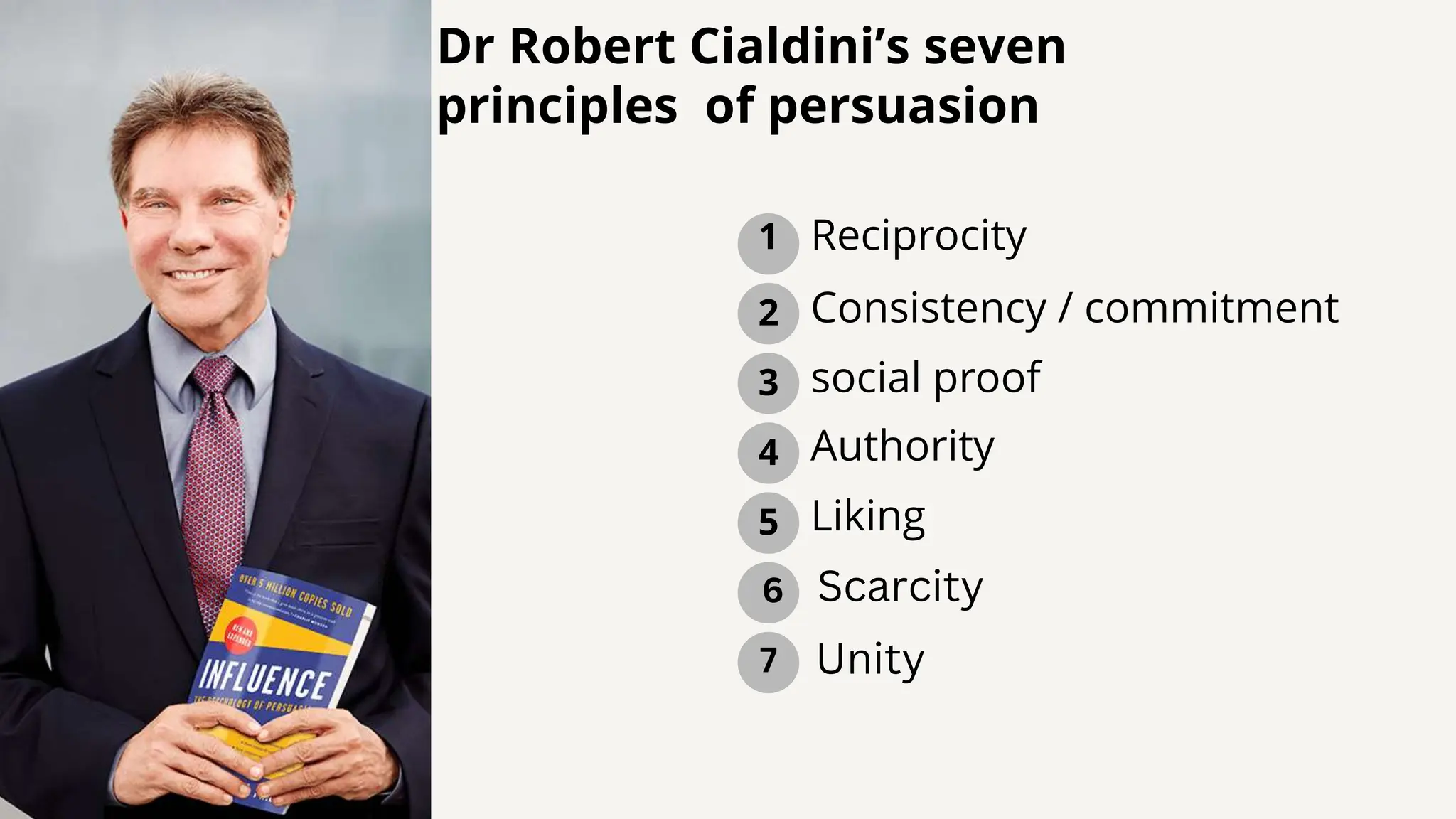
Reciprocity
Consistency / commitment
Authority
social proof
Liking
Dr Robert Cialdini’s seven
principles of persuasion
Scarcity
1
2
4
3
5
6
7 Unity
When someone gives us something, whether it is a gift, a favor or valuable
information, we feel indebted to them. This feeling of indebtedness motivates
us to reciprocate and give back in return.
By offering something of value to others, we can create a sense of obligation
and increase the likelihood of them complying with our request.
For example, providing a free sample or a small gift can trigger a reciprocity
response and make people more receptive to our message or offer.
Another example is when a company offers a discount or a special promotion
to their customers, it creates a sense of indebtedness which can lead to
increased sales.
RECIPROCITY
Consistency plays a crucial role in persuasion, ensuring that individuals align their
beliefs and behaviors. Consistency not only reinforces Credibility and Reliability but
also establishes trust in the persuader’s message.
When individuals are consistent in their words and actions, they appear more
trustworthy, thereby increasing the effectiveness of their persuasive efforts.
For instance, a company can emphasize how choosing their eco-friendly products
demonstrates an individual’s commitment to sustainability a positive image and,
thereby encouraging consistency in their environmentally conscious behavior.
CONSISTENCY
SOCIAL PROOF
When individuals perceive someone as an authoritative figure, they are more inclined
to trust and comply with their suggestions and recommendations.
People tend to view authority figures as knowledgeable and experienced in their
respective fields. Authority adds credibility and expertise to the message that are
being conveyed, increasing its persuasive impact.
A simple example would be a doctor’s recommendation carries more weight than
that of a non-medical professional when it comes to health related decisions.
AUTHORITY
The role of likeability in persuasion is crucial in influencing others to adopt a certain
belief, behavior or action.
When someone is likeable, they are more likely to gain trust, influence, and
cooperation from others.
To build likeability, it is important to authentically interact with others by showing
kindness, empathy and understanding. this genuine approach can go a long way in
gaining their favor.
LIKING
The principle of scarcity states that something becomes more valuable when it is
limited in availability.
By creating a sense of scarcity, through marketing strategy such as emphasizing
limited stock or time sensitive offers, businesses can increase the persuasiveness of
their offerings.
Examples of scarcity are limited time offers, exclusive memberships, product scarcity,
early bird discounts and event tickets etc.
SCARCITY
UNITY
Unity is the bond formed by a shared identity. This identity can come from being part
of a family or a close-knit team, but also can be based on race, ethnicity, nationality,
religion, political affiliation and other factors.
This one persuasive principle fits with the entire theme of persuasion, which is to
create a favorable state of mind just before the actual persuasion effort occurs.
remaining someone of a shared identity makes you more persuasive.
The famous example is the ikea effect. It means that some customers not only enjoy
putting furniture together themselves but also find more value in the experience
than if a company delivered pre-assembled furnitures.
The seven principles of persuasion by Dr. Robert Cialdini

The seven principles of persuasion by Dr. Robert Cialdini

  • 1.
  • 2.
    what is persuasion? Persuasion isthe ability to influence other people’s thoughts and opinions using convincing arguments and facts. Persuasion in business involves the strategic use of communication and behavioral psychology to influence others decision and actions. It goes beyond simply convincing someone to buy a product or invest in a service; it’s about understanding the needs, motivations, and desires of the target audience and tailoring the messages to resonate with them.
  • 3.
    Reciprocity Consistency / commitment Authority socialproof Liking Dr Robert Cialdini’s seven principles of persuasion Scarcity 1 2 4 3 5 6 7 Unity
  • 4.
    When someone givesus something, whether it is a gift, a favor or valuable information, we feel indebted to them. This feeling of indebtedness motivates us to reciprocate and give back in return. By offering something of value to others, we can create a sense of obligation and increase the likelihood of them complying with our request. For example, providing a free sample or a small gift can trigger a reciprocity response and make people more receptive to our message or offer. Another example is when a company offers a discount or a special promotion to their customers, it creates a sense of indebtedness which can lead to increased sales. RECIPROCITY
  • 5.
    Consistency plays acrucial role in persuasion, ensuring that individuals align their beliefs and behaviors. Consistency not only reinforces Credibility and Reliability but also establishes trust in the persuader’s message. When individuals are consistent in their words and actions, they appear more trustworthy, thereby increasing the effectiveness of their persuasive efforts. For instance, a company can emphasize how choosing their eco-friendly products demonstrates an individual’s commitment to sustainability a positive image and, thereby encouraging consistency in their environmentally conscious behavior. CONSISTENCY
  • 6.
  • 7.
    When individuals perceivesomeone as an authoritative figure, they are more inclined to trust and comply with their suggestions and recommendations. People tend to view authority figures as knowledgeable and experienced in their respective fields. Authority adds credibility and expertise to the message that are being conveyed, increasing its persuasive impact. A simple example would be a doctor’s recommendation carries more weight than that of a non-medical professional when it comes to health related decisions. AUTHORITY
  • 8.
    The role oflikeability in persuasion is crucial in influencing others to adopt a certain belief, behavior or action. When someone is likeable, they are more likely to gain trust, influence, and cooperation from others. To build likeability, it is important to authentically interact with others by showing kindness, empathy and understanding. this genuine approach can go a long way in gaining their favor. LIKING
  • 9.
    The principle ofscarcity states that something becomes more valuable when it is limited in availability. By creating a sense of scarcity, through marketing strategy such as emphasizing limited stock or time sensitive offers, businesses can increase the persuasiveness of their offerings. Examples of scarcity are limited time offers, exclusive memberships, product scarcity, early bird discounts and event tickets etc. SCARCITY
  • 10.
    UNITY Unity is thebond formed by a shared identity. This identity can come from being part of a family or a close-knit team, but also can be based on race, ethnicity, nationality, religion, political affiliation and other factors. This one persuasive principle fits with the entire theme of persuasion, which is to create a favorable state of mind just before the actual persuasion effort occurs. remaining someone of a shared identity makes you more persuasive. The famous example is the ikea effect. It means that some customers not only enjoy putting furniture together themselves but also find more value in the experience than if a company delivered pre-assembled furnitures.