THE SCIENCE BEHIND 3D LASER SCANNING: HOW
DOES IT WORK?
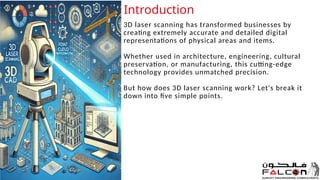
3D laser scanning has transformed businesses by
creating extremely accurate and detailed digital
representations of physical areas and items.
Whether used in architecture, engineering, cultural
preservation, or manufacturing, this cutting-edge
technology provides unmatched precision.
But how does 3D laser scanning work? Let's break it
down into five simple points.
20XX 2
Introduction
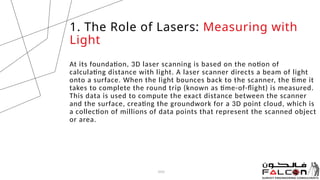
At its foundation, 3D laser scanning is based on the notion of
calculating distance with light. A laser scanner directs a beam of light
onto a surface. When the light bounces back to the scanner, the time it
takes to complete the round trip (known as time-of-flight) is measured.
This data is used to compute the exact distance between the scanner
and the surface, creating the groundwork for a 3D point cloud, which is
a collection of millions of data points that represent the scanned object
or area.
20XX
1. The Role of Lasers: Measuring with
Light
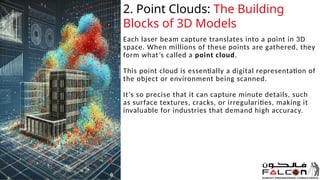
Each laser beam capture translates into a point in 3D
space. When millions of these points are gathered, they
form what’s called a point cloud.
This point cloud is essentially a digital representation of
the object or environment being scanned.
It’s so precise that it can capture minute details, such
as surface textures, cracks, or irregularities, making it
invaluable for industries that demand high accuracy.
20XX 4
2. Point Clouds: The Building
Blocks of 3D Models
Modern 3D laser scanners can rotate and pivot, allowing them to scan in
multiple directions without needing to be manually adjusted frequently.
This ability to scan in motion ensures comprehensive coverage, even for large-
scale projects like building facades, landscapes, or industrial facilities.
Some systems also use LiDAR (Light Detection and Ranging), a technology
capable of scanning vast areas efficiently, such as in mapping terrains or
cityscapes.
20XX 5
3. Scanning in Motion: Capturing the
Big Picture
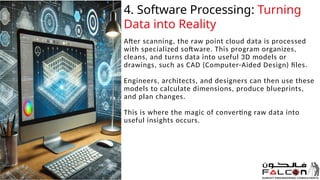
After scanning, the raw point cloud data is processed
with specialized software. This program organizes,
cleans, and turns data into useful 3D models or
drawings, such as CAD (Computer-Aided Design) files.
Engineers, architects, and designers can then use these
models to calculate dimensions, produce blueprints,
and plan changes.
This is where the magic of converting raw data into
useful insights occurs.
20XX 6
4. Software Processing: Turning
Data into Reality
• Construction and Architecture: For accurate site surveys and design
validation.
• Heritage Preservation: Documenting historical structures for restoration or
archiving.
• Manufacturing: Quality control of complex components.
• Forensics: Accident reconstruction or crime scene analysis.
The versatility of 3D laser scanning technology stems from its precision and
adaptability, making it a game-changer across industries.
20XX 7
5. Applications: Transforming Industries
3d laser scanning survey combines light and motion principles with cutting-
edge software, allowing us to observe the environment in previously
unimaginable ways. Its capacity to depict reality with microscopic accuracy has
set new norms in a variety of industries.
Whether mapping a historical monument or building the future, 3D laser
scanning demonstrates how science and technology interact to alter the world
around us.
If you've been thinking about using 3D laser scanning in your projects, now is
the time to investigate this transforming tool!
20XX 8
Conclusion
CONTACT US
Address: 209, 2nd Floor - Apricot Tower, P.O. Box : 238544, Dubai
Silicon Oasis, Dubai - United Arab Emirates.
: +97143271414
: info@falconsurveyme.com
: http://www.falconsurveyme.com/
20XX 9
20XX
T
H
A
N
K
Y
O
U

THE SCIENCE BEHIND 3D LASER SCANNING: HOW DOES IT WORK?

  • 1.
    THE SCIENCE BEHIND3D LASER SCANNING: HOW DOES IT WORK?
  • 2.
    3D laser scanninghas transformed businesses by creating extremely accurate and detailed digital representations of physical areas and items. Whether used in architecture, engineering, cultural preservation, or manufacturing, this cutting-edge technology provides unmatched precision. But how does 3D laser scanning work? Let's break it down into five simple points. 20XX 2 Introduction
  • 3.
    At its foundation,3D laser scanning is based on the notion of calculating distance with light. A laser scanner directs a beam of light onto a surface. When the light bounces back to the scanner, the time it takes to complete the round trip (known as time-of-flight) is measured. This data is used to compute the exact distance between the scanner and the surface, creating the groundwork for a 3D point cloud, which is a collection of millions of data points that represent the scanned object or area. 20XX 1. The Role of Lasers: Measuring with Light
  • 4.
    Each laser beamcapture translates into a point in 3D space. When millions of these points are gathered, they form what’s called a point cloud. This point cloud is essentially a digital representation of the object or environment being scanned. It’s so precise that it can capture minute details, such as surface textures, cracks, or irregularities, making it invaluable for industries that demand high accuracy. 20XX 4 2. Point Clouds: The Building Blocks of 3D Models
  • 5.
    Modern 3D laserscanners can rotate and pivot, allowing them to scan in multiple directions without needing to be manually adjusted frequently. This ability to scan in motion ensures comprehensive coverage, even for large- scale projects like building facades, landscapes, or industrial facilities. Some systems also use LiDAR (Light Detection and Ranging), a technology capable of scanning vast areas efficiently, such as in mapping terrains or cityscapes. 20XX 5 3. Scanning in Motion: Capturing the Big Picture
  • 6.
    After scanning, theraw point cloud data is processed with specialized software. This program organizes, cleans, and turns data into useful 3D models or drawings, such as CAD (Computer-Aided Design) files. Engineers, architects, and designers can then use these models to calculate dimensions, produce blueprints, and plan changes. This is where the magic of converting raw data into useful insights occurs. 20XX 6 4. Software Processing: Turning Data into Reality
  • 7.
    • Construction andArchitecture: For accurate site surveys and design validation. • Heritage Preservation: Documenting historical structures for restoration or archiving. • Manufacturing: Quality control of complex components. • Forensics: Accident reconstruction or crime scene analysis. The versatility of 3D laser scanning technology stems from its precision and adaptability, making it a game-changer across industries. 20XX 7 5. Applications: Transforming Industries
  • 8.
    3d laser scanningsurvey combines light and motion principles with cutting- edge software, allowing us to observe the environment in previously unimaginable ways. Its capacity to depict reality with microscopic accuracy has set new norms in a variety of industries. Whether mapping a historical monument or building the future, 3D laser scanning demonstrates how science and technology interact to alter the world around us. If you've been thinking about using 3D laser scanning in your projects, now is the time to investigate this transforming tool! 20XX 8 Conclusion
  • 9.
    CONTACT US Address: 209,2nd Floor - Apricot Tower, P.O. Box : 238544, Dubai Silicon Oasis, Dubai - United Arab Emirates. : +97143271414 : info@falconsurveyme.com : http://www.falconsurveyme.com/ 20XX 9
  • 10.