AERIAL DRONE MAPPING
FOR CONSTRUCTION
PROJECTS: ENHANCING
EFFICIENCY AND
ACCURACY
Introduction
In the ever-changing construction industry, being ahead of the curve in terms of technology and efficiency is critical.
Aerial drone mapping has emerged as one of the most innovative technologies for construction projects, offering
considerable improvements in accuracy, speed, and cost-effectiveness.
This new technology is changing the way construction businesses approach surveying, site analysis, and project
management.
What is Aerial Drone
Mapping?
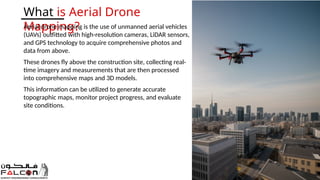
Aerial drone mapping is the use of unmanned aerial vehicles
(UAVs) outfitted with high-resolution cameras, LiDAR sensors,
and GPS technology to acquire comprehensive photos and
data from above.
These drones fly above the construction site, collecting real-
time imagery and measurements that are then processed
into comprehensive maps and 3D models.
This information can be utilized to generate accurate
topographic maps, monitor project progress, and evaluate
site conditions.
One of the most significant benefits of aerial drone mapping is the degree of accuracy it provides. Traditional
surveying methods, which frequently rely on ground-based measurements, are time-consuming and susceptible to
human error.
Drones allow you to collect a large amount of data in a shorter period of time and with more precision. Drone-
generated high-resolution photos and 3D models enable extensive site assessments, ensuring that building plans are
based on the most accurate data available.
For example, drone mapping can provide centimeter-level accuracy, which is critical for building complex structures
or planning infrastructure projects. This guarantees that measurements are accurate, reducing the possibility of
costly errors during the construction process.
1. Increased accuracy and precision
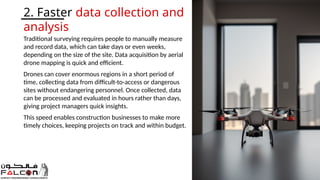
Traditional surveying requires people to manually measure
and record data, which can take days or even weeks,
depending on the size of the site. Data acquisition by aerial
drone mapping is quick and efficient.
Drones can cover enormous regions in a short period of
time, collecting data from difficult-to-access or dangerous
sites without endangering personnel. Once collected, data
can be processed and evaluated in hours rather than days,
giving project managers quick insights.
This speed enables construction businesses to make more
timely choices, keeping projects on track and within budget.
2. Faster data collection and
analysis
Throughout the lifecycle of a construction project, it is critical to track progress and ensure that everything is going
as planned. Aerial drone mapping gives construction managers a comprehensive picture of the site, allowing them
to monitor the progress of various phases of the project.
Companies can compare the present state of the site to the original designs by taking aerial photographs at regular
intervals, looking for inconsistencies and spotting potential concerns before they become major problems. This real-
time monitoring helps project management while also increasing accountability and openness with clients.
3. Improved site monitoring and progress tracking
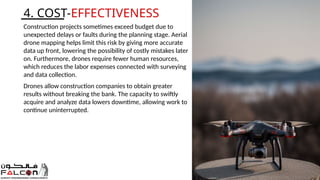
4. COST-EFFECTIVENESS
Construction projects sometimes exceed budget due to
unexpected delays or faults during the planning stage. Aerial
drone mapping helps limit this risk by giving more accurate
data up front, lowering the possibility of costly mistakes later
on. Furthermore, drones require fewer human resources,
which reduces the labor expenses connected with surveying
and data collection.
Drones allow construction companies to obtain greater
results without breaking the bank. The capacity to swiftly
acquire and analyze data lowers downtime, allowing work to
continue uninterrupted.
Aerial drone mapping enables more effective collaboration among stakeholders. Drone-generated 3D models and
maps are easily shared with architects, engineers, contractors, and clients, ensuring that everyone involved has a
clear and current picture of the project's progress. This enhances communication, keeps everyone on the same
page, and makes it easier to address difficulties quickly.
Stakeholders can access the same data and make decisions based on the same set of facts, resulting in more
efficient workflows and fewer misunderstandings.
5. Improve collaboration and communication
6. IMPROVED SAFETY FOR
CONSTRUCTION SITES
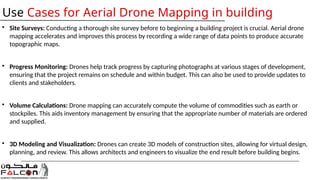
Safety is always the number one priority on construction
sites. Aerial drone mapping eliminates the need for workers
to enter dangerous regions or work at vast heights because
drones can collect data from above without endangering
human life. Drones can also be used to inspect difficult-to-
reach regions like roofs, scaffolding, and tall structures,
offering a safer and more efficient alternative to traditional
inspection methods.
By using drones for routine inspections and surveys,
construction businesses can reduce the risk of accidents and
improve site safety for all personnel.
• Site Surveys: Conducting a thorough site survey before to beginning a building project is crucial. Aerial drone
mapping accelerates and improves this process by recording a wide range of data points to produce accurate
topographic maps.
• Progress Monitoring: Drones help track progress by capturing photographs at various stages of development,
ensuring that the project remains on schedule and within budget. This can also be used to provide updates to
clients and stakeholders.
• Volume Calculations: Drone mapping can accurately compute the volume of commodities such as earth or
stockpiles. This aids inventory management by ensuring that the appropriate number of materials are ordered
and supplied.
• 3D Modeling and Visualization: Drones can create 3D models of construction sites, allowing for virtual design,
planning, and review. This allows architects and engineers to visualize the end result before building begins.
Use Cases for Aerial Drone Mapping in building
Aerial drone mapping is a major changer in the building business. Drones are changing the way construction
projects are planned and carried out by increasing accuracy, speeding up data collection, and improving safety.
Whether for site surveys, progress tracking, or real-time monitoring, aerial drone mapping provides construction
organizations with vital tools for increasing productivity, lowering costs, and ensuring project success.
As technology advances, the uses of aerial drone mapping will expand, providing even more opportunities for
construction enterprises seeking to remain ahead in an increasingly competitive industry. Investing in this
revolutionary technology today can result in faster, more accurate, and efficient construction processes tomorrow.
Final Thoughts
CONTACT US
Address: 209, 2nd Floor - Apricot Tower, P.O. Box : 238544, Dubai Silicon Oasis, Dubai -
United Arab Emirates.
: +97143271414
: info@falconsurveyme.com
: http://www.falconsurveyme.com/
Thank You

Aerial Drone Mapping for Construction Projects: Enhancing Efficiency and Accuracy

  • 1.
    AERIAL DRONE MAPPING FORCONSTRUCTION PROJECTS: ENHANCING EFFICIENCY AND ACCURACY
  • 2.
    Introduction In the ever-changingconstruction industry, being ahead of the curve in terms of technology and efficiency is critical. Aerial drone mapping has emerged as one of the most innovative technologies for construction projects, offering considerable improvements in accuracy, speed, and cost-effectiveness. This new technology is changing the way construction businesses approach surveying, site analysis, and project management.
  • 3.
    What is AerialDrone Mapping? Aerial drone mapping is the use of unmanned aerial vehicles (UAVs) outfitted with high-resolution cameras, LiDAR sensors, and GPS technology to acquire comprehensive photos and data from above. These drones fly above the construction site, collecting real- time imagery and measurements that are then processed into comprehensive maps and 3D models. This information can be utilized to generate accurate topographic maps, monitor project progress, and evaluate site conditions.
  • 4.
    One of themost significant benefits of aerial drone mapping is the degree of accuracy it provides. Traditional surveying methods, which frequently rely on ground-based measurements, are time-consuming and susceptible to human error. Drones allow you to collect a large amount of data in a shorter period of time and with more precision. Drone- generated high-resolution photos and 3D models enable extensive site assessments, ensuring that building plans are based on the most accurate data available. For example, drone mapping can provide centimeter-level accuracy, which is critical for building complex structures or planning infrastructure projects. This guarantees that measurements are accurate, reducing the possibility of costly errors during the construction process. 1. Increased accuracy and precision
  • 5.
    Traditional surveying requirespeople to manually measure and record data, which can take days or even weeks, depending on the size of the site. Data acquisition by aerial drone mapping is quick and efficient. Drones can cover enormous regions in a short period of time, collecting data from difficult-to-access or dangerous sites without endangering personnel. Once collected, data can be processed and evaluated in hours rather than days, giving project managers quick insights. This speed enables construction businesses to make more timely choices, keeping projects on track and within budget. 2. Faster data collection and analysis
  • 6.
    Throughout the lifecycleof a construction project, it is critical to track progress and ensure that everything is going as planned. Aerial drone mapping gives construction managers a comprehensive picture of the site, allowing them to monitor the progress of various phases of the project. Companies can compare the present state of the site to the original designs by taking aerial photographs at regular intervals, looking for inconsistencies and spotting potential concerns before they become major problems. This real- time monitoring helps project management while also increasing accountability and openness with clients. 3. Improved site monitoring and progress tracking
  • 7.
    4. COST-EFFECTIVENESS Construction projectssometimes exceed budget due to unexpected delays or faults during the planning stage. Aerial drone mapping helps limit this risk by giving more accurate data up front, lowering the possibility of costly mistakes later on. Furthermore, drones require fewer human resources, which reduces the labor expenses connected with surveying and data collection. Drones allow construction companies to obtain greater results without breaking the bank. The capacity to swiftly acquire and analyze data lowers downtime, allowing work to continue uninterrupted.
  • 8.
    Aerial drone mappingenables more effective collaboration among stakeholders. Drone-generated 3D models and maps are easily shared with architects, engineers, contractors, and clients, ensuring that everyone involved has a clear and current picture of the project's progress. This enhances communication, keeps everyone on the same page, and makes it easier to address difficulties quickly. Stakeholders can access the same data and make decisions based on the same set of facts, resulting in more efficient workflows and fewer misunderstandings. 5. Improve collaboration and communication
  • 9.
    6. IMPROVED SAFETYFOR CONSTRUCTION SITES Safety is always the number one priority on construction sites. Aerial drone mapping eliminates the need for workers to enter dangerous regions or work at vast heights because drones can collect data from above without endangering human life. Drones can also be used to inspect difficult-to- reach regions like roofs, scaffolding, and tall structures, offering a safer and more efficient alternative to traditional inspection methods. By using drones for routine inspections and surveys, construction businesses can reduce the risk of accidents and improve site safety for all personnel.
  • 10.
    • Site Surveys:Conducting a thorough site survey before to beginning a building project is crucial. Aerial drone mapping accelerates and improves this process by recording a wide range of data points to produce accurate topographic maps. • Progress Monitoring: Drones help track progress by capturing photographs at various stages of development, ensuring that the project remains on schedule and within budget. This can also be used to provide updates to clients and stakeholders. • Volume Calculations: Drone mapping can accurately compute the volume of commodities such as earth or stockpiles. This aids inventory management by ensuring that the appropriate number of materials are ordered and supplied. • 3D Modeling and Visualization: Drones can create 3D models of construction sites, allowing for virtual design, planning, and review. This allows architects and engineers to visualize the end result before building begins. Use Cases for Aerial Drone Mapping in building
  • 11.
    Aerial drone mappingis a major changer in the building business. Drones are changing the way construction projects are planned and carried out by increasing accuracy, speeding up data collection, and improving safety. Whether for site surveys, progress tracking, or real-time monitoring, aerial drone mapping provides construction organizations with vital tools for increasing productivity, lowering costs, and ensuring project success. As technology advances, the uses of aerial drone mapping will expand, providing even more opportunities for construction enterprises seeking to remain ahead in an increasingly competitive industry. Investing in this revolutionary technology today can result in faster, more accurate, and efficient construction processes tomorrow. Final Thoughts
  • 12.
    CONTACT US Address: 209,2nd Floor - Apricot Tower, P.O. Box : 238544, Dubai Silicon Oasis, Dubai - United Arab Emirates. : +97143271414 : info@falconsurveyme.com : http://www.falconsurveyme.com/
  • 13.