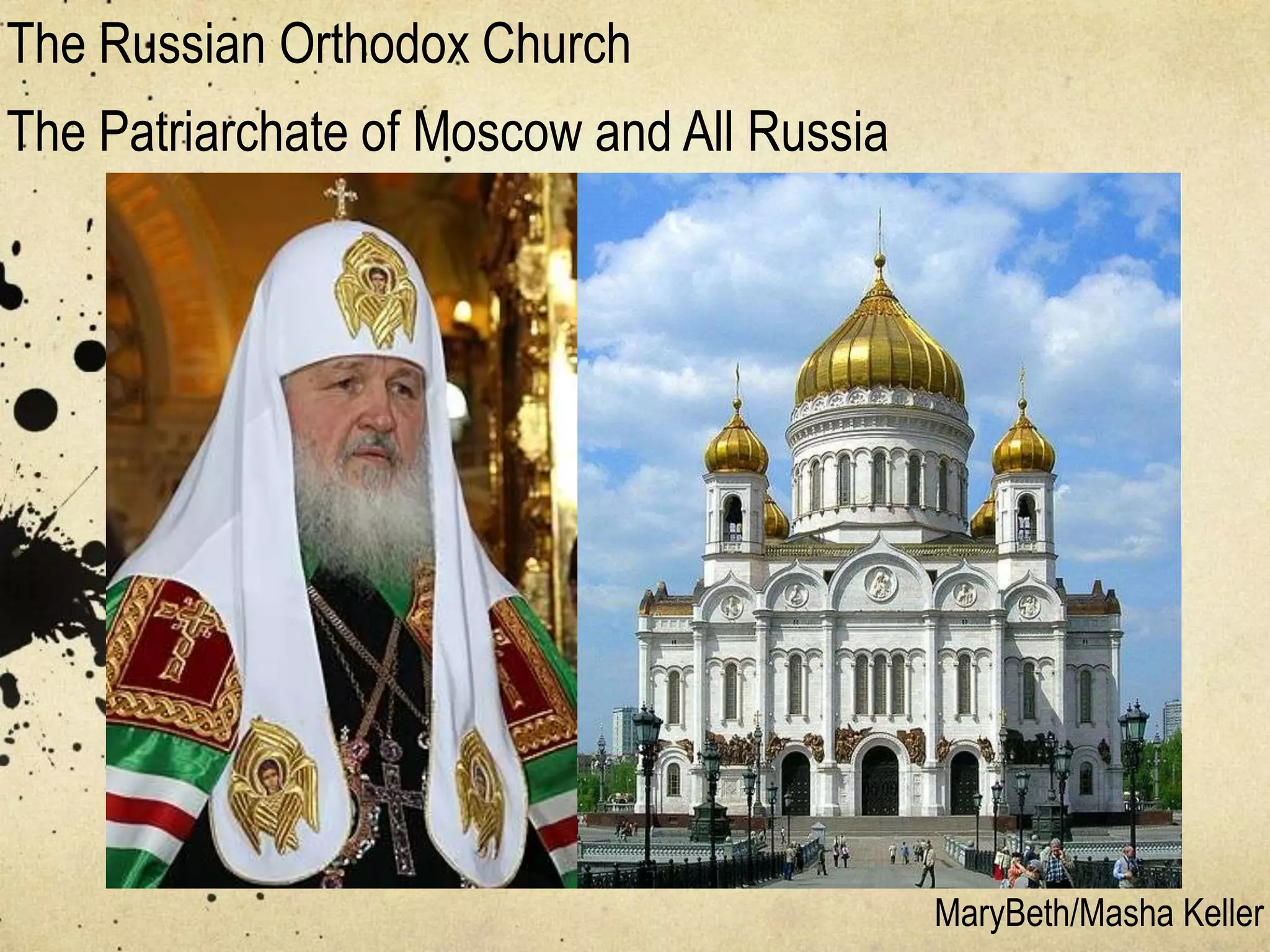
The Russian Orthodox Church
The Patriarchate of Moscow and All Russia


                                            MaryBeth/Masha Keller
The Legend of St. Andrew in Rus’


                       St. Andrew came to the
                       site of Kiev and foretold
                       the founding of a great
                       Christian City.
The rise of Christianity in Rus’
           • St. Olga, Grand     •   Paganism
             Princess of Kiev    •   Greek Missionaries
             converts in c.      •   St. Cyril and St. Methodius
             946/957             •   First Bishop of Kiev was
           • 988: St. Vladimir       sent in c. 866-867
             the Great
             chooses
             Byzantine
             Christianity
Under the Mongols
• The Church
  enjoyed a
  favored position
  & tax immunity
     •   Supported
         the
         dominance
         of Moscow
• Dramatic
  growth in
  Monasticism
During the 15th Century

The Church was the dominant aspect of life and livelihood.

Council of Florence (1439): Catholics and Orthodox meet up to discuss and
work out their differences

1448: Constantinople grants ecumenical independence to the Russian
church, now in Moscow

1453: Constantinople falls to the Muslims and Russia becomes an
ecumenical “orphan”
REFORM!!
     The Church was given the right of ownership of property; as the State’s power grew so did the that of the Church

     1589: Job is elected as Russia’s first real Patriarch

     More Monasteries!!!

     1540’s: The Tsar’s jurisdiction over the Church is nullified; Patriarchs eventually came to “out rank” the Tsar, and even ruled in his stead.


Joseph-Volokolamsk Monastery


                                                                   Kirillo-Belozersky
Solovetsky Monastery                                               Monastery
The 17th Century
The Time of Troubles
   Patriarch Germogen dies a Prisoner, calling for the Russians
   to take back their country

Schism of Old Believers against Patriarch Nikon’s Greek
Reforms
MORE REFORM!!
1700-1721: No one held the title of Patriarch; Patriarchal
duties were carried out by a “Synod”
    Synods are still in use today

1762: Peter III secularizes church property; Catherine II (the
Great) promises to return it
Fin-de-siècle religious renaissance
  Prevalent during the last 20+ years of the Empire
The ROC under Communism
 Religion was vilified and greatly discouraged; public practice of the faith
 could mean arrest, and labor camps or execution.

 1917-1941: Churches are closed/demolished, members and clergy are
 executed, land is secularized, and religion is banned, of course under
 penalty of death.

 WWII: Stalin & the “idea” of the Church

 1945-1985: (please see 1917-1941)
1985 – Present
With Glasnost and Perestroika, the church was able to
begin their ministry again without fear of arrest or
punishment

1988: Gorbachev helped the Church celebrate its
millennium anniversary and encourages participation and
inclusion

1991: USSR collapses (yay!)/Russian Federation is formed
   Church was given all its privileges back and, today, is now a
   close part of government
Beliefs and practices
•   All churches face the east

•   Iconostasis, Royal Gate, Deacons’ doors
    •      http://4.bp.blogspot.com/_VKMQjq6ujoA/TOrw90gwk_I/AAAAAAAAAfw/k1DmSHR5nZU/s1600/8%2B-
           %2BPrayers%2Bat%2Bthe%2BRoyal%2Bdoor.JPG)
    •      http://www.templestudy.com/wp-content/uploads/2008/03/iconostasis.jpg

•   An icon is always present on the Iconostasis, and is of a saint(s)/event that is commemorated on that day.
    •      Icons are to be venerated by all present at services

•   A crucifix is always to the left of the iconostasis in church, surrounded by candles
    •      http://us.123rf.com/400wm/400/400/radist/radist0811/radist081100052/3824932-decoration-of-russian-orthodox-
           church-indoor-uglich.jpg

•   More icons are scattered around the church, w/(or)w/o candles, lamps, etc.

•   Candles are always beeswax; Oil is always olive oil.

•   Incense is used for both icons and worship service.
•   Everyone is to remain standing during services, though we are free to move freely throughout the service.
    Women must cover their head, and only the elderly, expectant women, and infirm may sit.
    •      the division of men and women in church

•   Choral music only!! Musical instruments are banned.
    •      http://www.youtube.com/watch?v=SlRU7OEBpAk

•   The Orthodox cross is made with the thumb, index, and middle finger touching and is made in reverse fashion
    of the Catholic cross. (head, chest, right shoulder, left shoulder)

•   Communion wine is received from a chalice and spoon, bread is in small pieces soaked in wine. You may take
    confession before or after, and you can’t eat anything before taking communion.

•   Baptism occurs during infancy and chrismation occurs at the age of reason, however children may take
    communion regardless of having had chrismation or not.
    •      http://www.youtube.com/watch?v=WZnzO47YCMs

•   Priests may marry, but only before their ordination. They can not divorce or remarry.

•   Bishops are the highest rank in the Church, called metropolitans or Patriarchs.
The clergy
QUESTIONS?

The Russian Orthodox Church

  • 1.
    The Russian OrthodoxChurch The Patriarchate of Moscow and All Russia MaryBeth/Masha Keller
  • 2.
    The Legend ofSt. Andrew in Rus’ St. Andrew came to the site of Kiev and foretold the founding of a great Christian City.
  • 3.
    The rise ofChristianity in Rus’ • St. Olga, Grand • Paganism Princess of Kiev • Greek Missionaries converts in c. • St. Cyril and St. Methodius 946/957 • First Bishop of Kiev was • 988: St. Vladimir sent in c. 866-867 the Great chooses Byzantine Christianity
  • 4.
    Under the Mongols •The Church enjoyed a favored position & tax immunity • Supported the dominance of Moscow • Dramatic growth in Monasticism
  • 5.
    During the 15thCentury The Church was the dominant aspect of life and livelihood. Council of Florence (1439): Catholics and Orthodox meet up to discuss and work out their differences 1448: Constantinople grants ecumenical independence to the Russian church, now in Moscow 1453: Constantinople falls to the Muslims and Russia becomes an ecumenical “orphan”
  • 6.
    REFORM!! The Church was given the right of ownership of property; as the State’s power grew so did the that of the Church 1589: Job is elected as Russia’s first real Patriarch More Monasteries!!! 1540’s: The Tsar’s jurisdiction over the Church is nullified; Patriarchs eventually came to “out rank” the Tsar, and even ruled in his stead. Joseph-Volokolamsk Monastery Kirillo-Belozersky Solovetsky Monastery Monastery
  • 7.
    The 17th Century TheTime of Troubles Patriarch Germogen dies a Prisoner, calling for the Russians to take back their country Schism of Old Believers against Patriarch Nikon’s Greek Reforms
  • 8.
    MORE REFORM!! 1700-1721: Noone held the title of Patriarch; Patriarchal duties were carried out by a “Synod” Synods are still in use today 1762: Peter III secularizes church property; Catherine II (the Great) promises to return it
  • 9.
    Fin-de-siècle religious renaissance Prevalent during the last 20+ years of the Empire
  • 10.
    The ROC underCommunism Religion was vilified and greatly discouraged; public practice of the faith could mean arrest, and labor camps or execution. 1917-1941: Churches are closed/demolished, members and clergy are executed, land is secularized, and religion is banned, of course under penalty of death. WWII: Stalin & the “idea” of the Church 1945-1985: (please see 1917-1941)
  • 11.
    1985 – Present WithGlasnost and Perestroika, the church was able to begin their ministry again without fear of arrest or punishment 1988: Gorbachev helped the Church celebrate its millennium anniversary and encourages participation and inclusion 1991: USSR collapses (yay!)/Russian Federation is formed Church was given all its privileges back and, today, is now a close part of government
  • 12.
    Beliefs and practices • All churches face the east • Iconostasis, Royal Gate, Deacons’ doors • http://4.bp.blogspot.com/_VKMQjq6ujoA/TOrw90gwk_I/AAAAAAAAAfw/k1DmSHR5nZU/s1600/8%2B- %2BPrayers%2Bat%2Bthe%2BRoyal%2Bdoor.JPG) • http://www.templestudy.com/wp-content/uploads/2008/03/iconostasis.jpg • An icon is always present on the Iconostasis, and is of a saint(s)/event that is commemorated on that day. • Icons are to be venerated by all present at services • A crucifix is always to the left of the iconostasis in church, surrounded by candles • http://us.123rf.com/400wm/400/400/radist/radist0811/radist081100052/3824932-decoration-of-russian-orthodox- church-indoor-uglich.jpg • More icons are scattered around the church, w/(or)w/o candles, lamps, etc. • Candles are always beeswax; Oil is always olive oil. • Incense is used for both icons and worship service.
  • 13.
    Everyone is to remain standing during services, though we are free to move freely throughout the service. Women must cover their head, and only the elderly, expectant women, and infirm may sit. • the division of men and women in church • Choral music only!! Musical instruments are banned. • http://www.youtube.com/watch?v=SlRU7OEBpAk • The Orthodox cross is made with the thumb, index, and middle finger touching and is made in reverse fashion of the Catholic cross. (head, chest, right shoulder, left shoulder) • Communion wine is received from a chalice and spoon, bread is in small pieces soaked in wine. You may take confession before or after, and you can’t eat anything before taking communion. • Baptism occurs during infancy and chrismation occurs at the age of reason, however children may take communion regardless of having had chrismation or not. • http://www.youtube.com/watch?v=WZnzO47YCMs • Priests may marry, but only before their ordination. They can not divorce or remarry. • Bishops are the highest rank in the Church, called metropolitans or Patriarchs.
  • 14.
  • 15.