• - Theromantic period is often referred
to as
• romanticis
m.
• - Romanticism has very little to do with
things
• popularly thought as
romantic.
• - No other period in English literature displays
more
• variety in style, theme, and content
than the
• Romantic Movement.
• - Romanticism can best be described as a
large
• network of sometimes competing
philosophies,
• agendas, and points of
interest.
• - Romanticism is soul searching and truth seeking
by
• way of feeling and vision.
4.
• The RomanticMovement in
literature
began around the end of the
18th
century in Western Europe
and
flourishe
d
century
.
in the first half of the
19th
6.
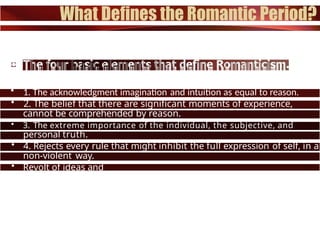
• 1. Theacknowledgment imagination and intuition as equal to reason.
• 2. The belief that there are significant moments of experience,
which
cannot be comprehended by reason.
• 3. The extreme importance of the individual, the subjective, and
one's
personal truth.
• 4. Rejects every rule that might inhibit the full expression of self, in a
non-violent way.
• Revolt of ideas and
beliefs.
7.
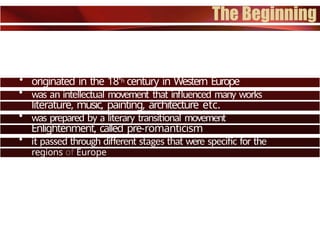
• originated inthe 18'h century in Western Europe
• was an intellectual movement that influenced many works
of
literature, music, painting, architecture etc.
• was prepared by a literary transitional movement
from
Enlightenment, called pre-romanticism
• it passed through different stages that were specific for the
diverse
regions of Europe
8.
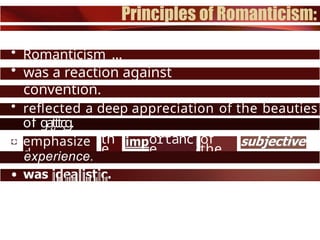
• Romanticism ...
•was a reaction against
convention.
• asserted the power of the
individual.
• reflected a deep appreciation of the beauties
of gąțttçg.
emphasize
d
th
e
ortanc
e
of
the
experience.
10.
• The RomanticMovement was partly a
rebellion against the Enli htenment
of
the revious centu and its focus
on
scientific and rational thou ht.
11.
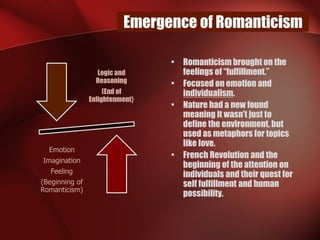
• In orderto fully address the Romantic period and its effect, it
is essential to first identify its tie with the French Revolution.
The French Revolution was all about the people vs. the
monarchy.
Again, with the introduction to knowledge — information provided
by enlightened thinkers to the civilians on their impoverished
situation (as well as the iiiel'1icient ri le o1 King Louis the ló I—')
caused æa upi tee, v hich would di iistically chan3e the face o1
EurOpC
later positioning it as a supreme power under the i ule oł
Napoleon
I3onapa1'te. a inilitiii y Iuriied Emperor).
13.
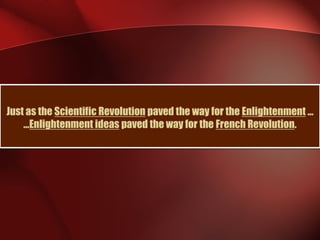
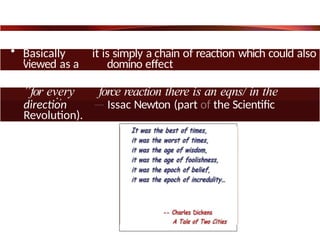
• Basically itis simply a chain of reaction which could also
be
viewed as a domino effect
”for every force reaction there is an eqns/ in the
opposite
direction — Issac Newton (part of the Scientific
Revolution).
14.
• In response,the romantic vision had taken forms other than political
—
developing apace.
• For example, in lyrca/ 6a//a‹:is, which was a watershed in literary
history
(1798 a n d 1800) — presented and illustrated a liberating aest:hetic:
and claimed that
poetry
should ewpress in genuine language experience as filtered through
y d in nature. 'Wordsworth s romanticism is probabIy most
fully
realized in his great autobiographical poem, "The Prelude" (1805—50).
15.
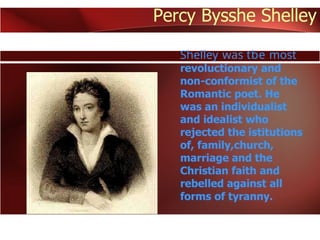
• In Prarnetheusinbound(1820), Percy Bysshe combines
soaring
lyricism with an apocalyptic political vision producing extreme
even. His
wife, I'4ary Wollstonecraft , wrote the greatest of the
Gothic
romances, i“rankenstein (1818) — which is widely mentioned even in this
day and era.
• Lord Byron designed his romantic lyric with a rationalist irony and was
also often associated with his own characters — particularly the
rebellious,
irreverent, erotically inclined Don Juan.
• Moreover
, this era also included poets such as Robert SOUthev—best-
remembered today for his story ’Goldilocks and the Three Bears"-
Leigh , Thomas , and Walter Savage .
16.
Romantic literature has
touched
areasof Europe, beginning with
man
y
German followed by ritBain the
United a
Ş
ț
_
ț ,
e
s rance as well as, parts
of Eastern Euro e; involving Russia
and Poland.
17.
• Germany iswhere some of the earliest examples of
Romantic literature emerged. In fact, the most important
literary figure of the period was Johann Wolfgang von
Goethe. Goethe used myth and local as subjects for his
poetry and helped inspire a sense of German
nationalism in the decades before a unified Germany.
The ßineriraii anal French Revelutiens in the late ì8tli centiłN agged t0the
pogiJlafiiy
oî such remar4ic iMeals as freedom, liberty, and national price.
18.
• dominated throughoutthe 19th
century and amongst these notable
Britain,
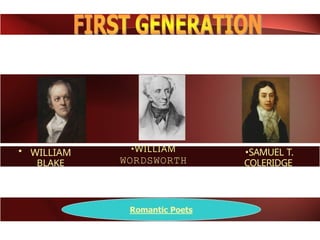
includes: William Wordsworth, Samuel Taylor Coleridge,
William
Blake, Lodryr,oBn Percy
Bysshe Shelley, and .
Some
well known Romantic novels examples popular in 19th
bentuk
Wutñering ł-łeigñts ț1847), and Charlotte Bronte's ha se
Eye (1847} — which exploited such emotions fear
and
romantic love.
19.
• Romanticism alsoinfluenced the literature of other countries,
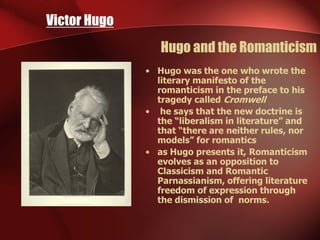
such as in France. The novels of Victor Hugo and
Stendhal
showed some Romantic influence, but they are more often
characterized as part of the .
• In Eastern Europe, Russian writes Alexander ushkin
and
among the practitioners of the Romantic Movement.
20.
• Although thereare many styles and genres
of
the Romantic Period, the ones that I found
were very prominent while researching
were
Individualism, Nature and Imagination.
The
poets of this era often used these
throughout their
writing.
21.
• individualism —the concern focused on the indd/iduaI rather
than
society. Romantics see the individual as important and unique.
• Nature — The Romantics are often called nature poets. The Romantic
praise experiences of the beauty and majesty of nature.
• Imagination — Romantic poets had their own special view of the
creative
power of the imagination and of the ways in which the human
mind is
adapted to nature. A majority of romantic novels favor imagination
over
rational, real story telling.
24.
According to sourcesthe Romantic Period was a
direct reaction to the French Revolution.
Personal O›oinion
Historically speaking, the Romantic Period (1798-1870)
actually emanated from the aRe otr i o e ni o d (a
Why7 Because, if it would not have been for the
Reformation period ... Baroque style would have never been
born. As well, Key individuals (ranging from scientists to
renown philosophers) would have never brought this
much impact in history.
• The Renaissance was an evolution (which ‘recaptured‘
the essence of Ancient Greece and Romans in order to
‘improve‘ or attempt to perfect certain concepts). Whilst, the
Reformation on the other hand, was a true Revolution ( I
exploded on ttie scene’ - Mr.Panneta Grade 12 History
leaches and created new ideals in terms of life-style.
• The industria/Revo/ution was a period of time
where the ogricufture, textife end metal
monufocture, transportation, economic poliCíes end
the socíof structure of Engfond de efoped rapídfy.
• The Industrial Re o/ution in Eng/ond woe based on
the rapid de e/opment oíscienCe
during the scientíüc re o/ution in the 18th centu ,
which /ed to new technologies such os steam
engines,• roilwoys end iron working thot beCdlTłC ÍhC
boers of the industrial resolution.
• (historica/ Context)
28.
Historical Context ofthe time period:
historical happenings in the 1700s
Romanticism
• - Newfound feelings of liberty,
expression of
oneself, and freedom
• - Escape from modern realities
29.
• How didideas of the time shape the writing? How
did
the writing influence people?
• - Romanticism was preceded by the philosophy of neo-
classicism
• - Focusing on individualism, imagination, etc..
• - Philosophical revolt against rationalism
• - Pulled away from industrialization
• - Injection of their emotions and feelings and
passions.
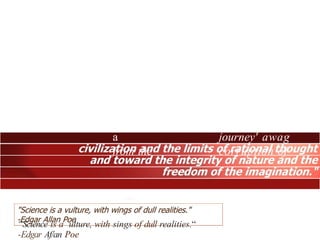
a journey' awag
fromthe corruption of
— the American Romanticism period
“Science is a ulture, with sings of dull realities.“
-Edgar Af/an Poe
34.
• Romantic literatureis characterized
by
an emphasis on emotion
assion
the natural
world.
35.
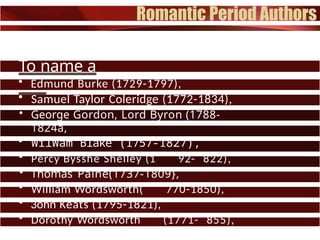
To name a
few:
•Edmund Burke (1729-1797),
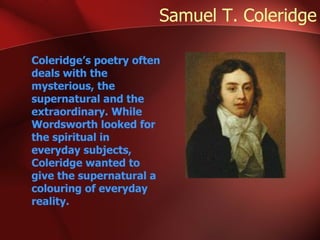
• Samuel Taylor Coleridge (1772-1834),
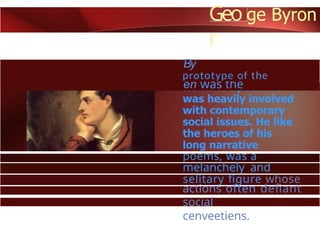
• George Gordon, Lord Byron (1788-
1824a,
• WilWam Blake (1757-1827),
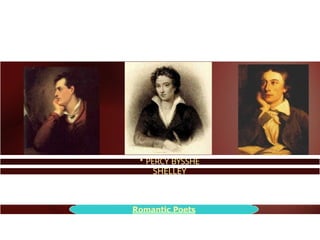
• Percy Bysshe Shelley (1 92- 822),
• Thomas Paine(1737-1809},
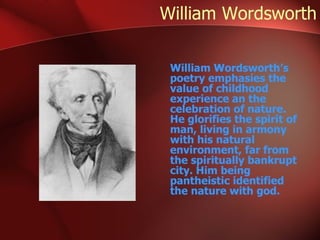
• William Wordsworth( 770-1850),
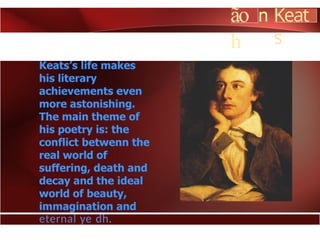
• 3ohn Keats (1795-1821),
• Dorothy Wordsworth (1771- 855),
• and Nathaniel Hawthorne.
The dominant themeof Lyrical Ztałłads was Nature,
specifically the power of Nature to create strong
impressions in the mind and imagination. The
voice in Wordsworth's poetry is observant,
meditative and aware of the connection between
living things and objects. There is the sense that
past, present, and future all mix together in the
human consciousness.
43.
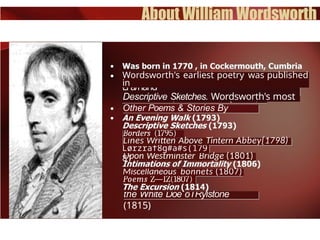
famous work, thePrelude {1850a, .
1793 in the collections in boening
Ł’F’a/hand
Descriptive Sketches. Wordsworth's most
Wordsworth's earliest poetry was published
in
Other Poems & Stories By
William
the White Doe oTRylstone
(1815)
Poems Z—IZ(1807)
Miscellaneous bonnets (1807)
Upon Westminster Bridge (1801)
Lørzraf8g#a#s(179
8)
Lines Written Above Tintern Abbey{1798)
Borders (1795)
44.
• Wordsworth isbest known as a nature Noel who
found
beauty, comfo and moral strength in the natural would. if
he
were alive today he would probably be a member of
an
organisation that campaigns to protect the evironme t.
loi
him the World où nature is free t i o n corruption and
t ,
and offers man a means of escape from industrialised society.
45.
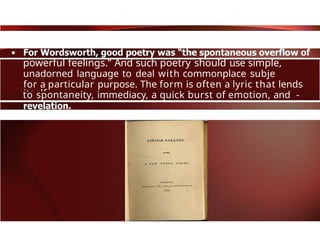
powerful feelings.” Andsuch poetry should use simple,
unadorned language to deal with commonplace subje
for a particular purpose. The form is often a lyric that lends
itself
to spontaneity, immediacy, a quick burst of emotion, and -
46.
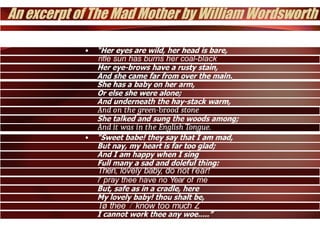
rifle sun hasburns her coal-black
hair
And on the green-brood stone
And it was in the English Tongue.
Then, lovely baby, do not ł'ear!
7 pray thee have no Year of me
Tø thee 7 know too much Z
owe•
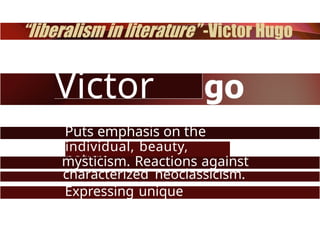
Victor
Hu
Puts emphasis onthe
individual, beauty,
nature,
mysticism. Reactions against
characterized neoclassicism.
Expressing unique
feelings.
56.
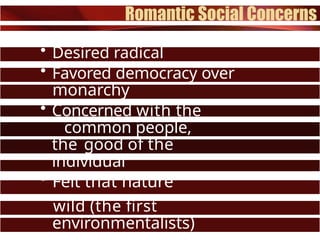
• Desired radical
change
•Favored democracy over
monarchy
• Concerned with the
common people,
the good of the
individual
• Felt that nature
should be untamed,
wild (the first
environmentalists)
57.
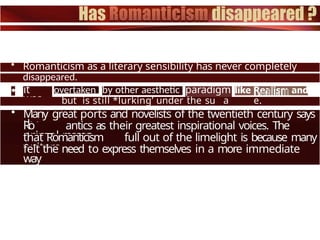
• Romanticism asa literary sensibility has never completely
disappeared.
ït
was
overtaken by other aesthetic paradigm
s
but is still *lurking’ under the su a e.
• Many great ports and novelists of the twentieth century says
the
Ro antics as their greatest inspirational voices. The
primal reason
that Romanticism full out of the limelight is because many
writers
felt the need to express themselves in a more immediate
way