S M T W T F S
December, 22nd
01
08
15
22
29
07
14
21
28
06
13
20
27
05
12
19
26
04
11
18
25
03
10
17
24
09
16
23
30
02
31
Our Team
Group 2
Lê Hữu Thắng 18128157
Đỗ Chí Thanh 18128158
Phạm Thị Hoàng Oanh 18128137
Phạm Thị Tâm 18128154
Phạm Thái Minh Thư 18128170
5
members
Table of contents
Introduction Plot
Quizz Game
Analysis
02
04
01
 Exposition
 Rising Action
 Climax
 Falling Action
 Resolution
 Characters
 Point of View
 Literary Devices
 Symbols
 Themes/Messages
03
 Review Questions
 D. H. Lawrence
 The Rocking Horse
Winner
Introduction
 D. H. Lawrence
 The Rocking Horse
Winner
01
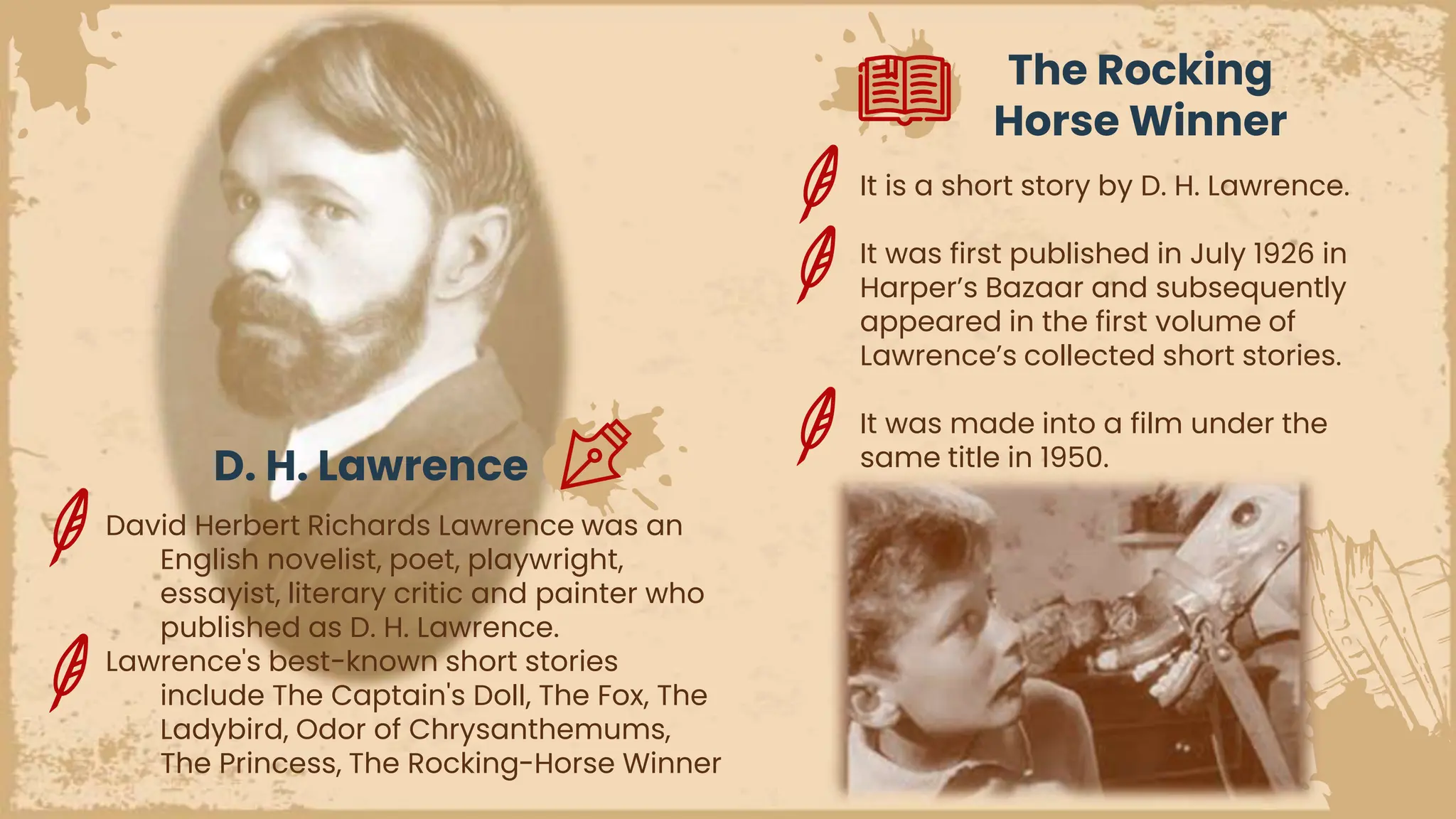
D. H. Lawrence
David Herbert Richards Lawrence was an
English novelist, poet, playwright,
essayist, literary critic and painter who
published as D. H. Lawrence.
Lawrence's best-known short stories
include The Captain's Doll, The Fox, The
Ladybird, Odor of Chrysanthemums,
The Princess, The Rocking-Horse Winner
The Rocking
Horse Winner
It is a short story by D. H. Lawrence.
It was first published in July 1926 in
Harper’s Bazaar and subsequently
appeared in the first volume of
Lawrence’s collected short stories.
It was made into a film under the
same title in 1950.
The Rocking Horse Winner short summary
 Exposition
 Rising Action
 Climax
 Falling Action
 Resolution
02
Plot
Falling Action
Resolution
Exposition
Rising
Action
Climax
Setting: England, around
the 1920's
Paul discovers the lack of
money his family has and
his mother's desires of
wanting more.
He decides to find the "luck"
his mother never had.
Although she doesn't
believe that he will find any,
he is determined to prove
her wrong whilst still
seeking her approval in
doing so.
Exposition
Paul gets a rocking horse as
a Christmas present.
From there, he begins his
"furious" rocking horse rides,
meanwhile learning the
names of the winning
horses.
He places bets on the horses
with the help of Basset and
ends up winning every time.
His Uncle finds out about the
gambling, and ends up
joining Paul and their
gardener, Basset.
Rising Action
Hester comes into Paul's
room to check up him, only
to find him furiously riding
his rocking horse.
He shouts the name of one
of the horses before falling
off the horse and
collapsing on the floor.
He then becomes afflicted
with some sort of "brain-
fever."
Climax
Before Paul collapses, he
mentions the name of one of
the horses, "Malabar."
Basset and Oscar places
their bets on the said horse
and they end up winning
eighty-thousand pounds.
Paul stays in coma-like state
due to his illness getting
progressively worse.
Falling Action
Paul dies from the severity of
his illness and effects from
his seizure.
Uncle Oscar comforts Hester
about her sons death.
He tells her that even though
Paul may be dead, at least
she's eighty-thousand
pounds richer.
Resolution
Analysis
 Characters
 Point of View
 Literary Devices
 Symbols
 Themes/Messages
03
Paul
Paul is the protagonist, he is a round and a
static character.
He is only interested in making money to
appease his mother.
Paul grew up with the idea that there is a
strong relation between luck and
money.
Hester
She is a round character, and also static
Hester is incapable of loving others. (example:
her relationship with Paul. Paul feels he
isn't loved by Hester.
Resulting in Paul being obsessed with winning
money from horse racing bets in hopes of
pleasing Hester’s obsession with money
Static, flat character
He's already rich, but
when he realizes how
accurate Paul's
predictions are for
the horse races, he
uses it to his
advantage to get
more money
Oscar uses Paul's for predictions
to gain more money
He values money above
everything else
Example, he didn't really care
about Paul's death, cared more
about the winnings.
Oscar feels pity for the death of
Paul, but is still more interested
in the money Paul won from the
Derby.
Oscar
He is a flat and a static
character
He is the gardener at Paul's
house.
Bassett is Paul's betting
partner before Oscar find
about it, and he keeps the
money from Paul's
predictions.
He had an interest in horse
racing, and would talk to
Paul about it.
Paul developed an interest,
and asked to place bets
for him
Bassett
Point of View
The short story, the Rocking-Horse
Winner, is written in third person
omniscient point of view.
Big numbers catch your
audience’s attention
Literary Devices
Irony
the 1000 pounds each year for
5 years are meant to satisfy
his mother's greed
instead of satisfaction the
mother is angry
"Her face hardened and
became more
expressionless. Then a cold,
determined look came on
her mouth."
Birthday Gift
Paul attempts to stop the
house’s cries for money by
giving it more money
but with more money the cries
simply become louder and
louder until they are
unbearable
“whispering worse than ever
lately, and even in spite of
his luck, Paul could not bear
up against it”
Cries for Money
Uncle Oscar shows a caring
attitude to Paul
yet when Paul is dying - he
takes advantage of the
boys 'gift'
Oscar's Treatment
of Paul
only in death does he consider
himself lucky
it is only when he is dying that
his mother pays attention
to her son Paul
Paul's Death
Simile
- “And then the house whispers, like people
laughing at you behind your back.”
“The child had never been to a race-
meeting before, and his eyes were
blue fire.”
Metaphor
Symbol
:
S
y
m
b
o
l 01 02 03 04
• materialism of the
parents
• represents the
greed of Paul's
mother
• the mother's lust for
more money
• son's cry for more
love
• the more money -
the worse the
voices: greed
cannot be satisfied
inability to satisfy
greed and obtain
his mothers love
The House Paul’s Death
Whispering Voice
of The House
symbolic of
Paul's innocence
chasing his
dream (to get
money to
appease his
mother)
Rocking Horse
Conflicts
Man vs. Setting/
Environment
(Paul. vs. house)
Man vs. man
→ internal conflict
(Paul vs. Hester)
Man vs. himself
(Paul vs. his luck)
Themes
Responsibility:
Children are greatly influenced by their surrounding
environment, usually created by their parents.
● “She had bonny children, yet she felt they had been thrust
upon her, and she could not love them.”
● “Over eighty thousand pounds! I call that lucky, don’t you
mother?”
Obsession & materialism:
Pursuit of money often cannot be satisfied and there
is no end to one’s materialism.
● “He went off by himself, vaguely, in a childish way, seeking
for the clue to “luck”.”
● “It’s Malabar!” he screamed, in a powerful, strange voice.
“It’s Malabar.”’
● “Although they lived in style, they felt always an anxiety in
the house. There was never enough money.”
● “And yet the voices in the house, behind the sprays of
mimosa and almond blossom, and from under the piles
of iridescent cushions, simply trilled and screamed in a
sort of ecstasy: “There must be more money! Oh-h-h,
there must be more money. Oh, now, now-w! Now-w-w –
there must be more money! – more than ever! More than
ever!”
Greed:
Excessive greed can result in fatal consequence.
● “The boy watched him with big blue eyes that had an
uncanny cold fire in them, and he said never a word.”
● “He neither slept nor regained consciousness, and his
eyes were like blue stones.”
Messages
The story alarms us to be aware
of the blind worship of
extravagance and appreciate
what we own.
The story tells us even though
money is essential, we should
not let the greed for money take
over our lives.
 Review Question
04
Quizz Game
CREDITS: This presentation template was created by
Slidesgo, including icon by Flaticon, and infographics &
images from Freepik
Thanks
!
Do you have any questions?

The Rocking Horse Winner by D.H.Lawrence.pptx

  • 1.
    S M TW T F S December, 22nd 01 08 15 22 29 07 14 21 28 06 13 20 27 05 12 19 26 04 11 18 25 03 10 17 24 09 16 23 30 02 31
  • 2.
    Our Team Group 2 LêHữu Thắng 18128157 Đỗ Chí Thanh 18128158 Phạm Thị Hoàng Oanh 18128137 Phạm Thị Tâm 18128154 Phạm Thái Minh Thư 18128170 5 members
  • 4.
    Table of contents IntroductionPlot Quizz Game Analysis 02 04 01  Exposition  Rising Action  Climax  Falling Action  Resolution  Characters  Point of View  Literary Devices  Symbols  Themes/Messages 03  Review Questions  D. H. Lawrence  The Rocking Horse Winner
  • 5.
    Introduction  D. H.Lawrence  The Rocking Horse Winner 01
  • 6.
    D. H. Lawrence DavidHerbert Richards Lawrence was an English novelist, poet, playwright, essayist, literary critic and painter who published as D. H. Lawrence. Lawrence's best-known short stories include The Captain's Doll, The Fox, The Ladybird, Odor of Chrysanthemums, The Princess, The Rocking-Horse Winner The Rocking Horse Winner It is a short story by D. H. Lawrence. It was first published in July 1926 in Harper’s Bazaar and subsequently appeared in the first volume of Lawrence’s collected short stories. It was made into a film under the same title in 1950.
  • 7.
    The Rocking HorseWinner short summary
  • 8.
     Exposition  RisingAction  Climax  Falling Action  Resolution 02 Plot
  • 9.
  • 10.
    Setting: England, around the1920's Paul discovers the lack of money his family has and his mother's desires of wanting more. He decides to find the "luck" his mother never had. Although she doesn't believe that he will find any, he is determined to prove her wrong whilst still seeking her approval in doing so. Exposition
  • 11.
    Paul gets arocking horse as a Christmas present. From there, he begins his "furious" rocking horse rides, meanwhile learning the names of the winning horses. He places bets on the horses with the help of Basset and ends up winning every time. His Uncle finds out about the gambling, and ends up joining Paul and their gardener, Basset. Rising Action
  • 12.
    Hester comes intoPaul's room to check up him, only to find him furiously riding his rocking horse. He shouts the name of one of the horses before falling off the horse and collapsing on the floor. He then becomes afflicted with some sort of "brain- fever." Climax
  • 13.
    Before Paul collapses,he mentions the name of one of the horses, "Malabar." Basset and Oscar places their bets on the said horse and they end up winning eighty-thousand pounds. Paul stays in coma-like state due to his illness getting progressively worse. Falling Action
  • 14.
    Paul dies fromthe severity of his illness and effects from his seizure. Uncle Oscar comforts Hester about her sons death. He tells her that even though Paul may be dead, at least she's eighty-thousand pounds richer. Resolution
  • 15.
    Analysis  Characters  Pointof View  Literary Devices  Symbols  Themes/Messages 03
  • 16.
    Paul Paul is theprotagonist, he is a round and a static character. He is only interested in making money to appease his mother. Paul grew up with the idea that there is a strong relation between luck and money.
  • 17.
    Hester She is around character, and also static Hester is incapable of loving others. (example: her relationship with Paul. Paul feels he isn't loved by Hester. Resulting in Paul being obsessed with winning money from horse racing bets in hopes of pleasing Hester’s obsession with money
  • 18.
    Static, flat character He'salready rich, but when he realizes how accurate Paul's predictions are for the horse races, he uses it to his advantage to get more money Oscar uses Paul's for predictions to gain more money He values money above everything else Example, he didn't really care about Paul's death, cared more about the winnings. Oscar feels pity for the death of Paul, but is still more interested in the money Paul won from the Derby. Oscar
  • 19.
    He is aflat and a static character He is the gardener at Paul's house. Bassett is Paul's betting partner before Oscar find about it, and he keeps the money from Paul's predictions. He had an interest in horse racing, and would talk to Paul about it. Paul developed an interest, and asked to place bets for him Bassett
  • 20.
    Point of View Theshort story, the Rocking-Horse Winner, is written in third person omniscient point of view.
  • 21.
    Big numbers catchyour audience’s attention Literary Devices
  • 22.
  • 23.
    the 1000 poundseach year for 5 years are meant to satisfy his mother's greed instead of satisfaction the mother is angry "Her face hardened and became more expressionless. Then a cold, determined look came on her mouth." Birthday Gift
  • 24.
    Paul attempts tostop the house’s cries for money by giving it more money but with more money the cries simply become louder and louder until they are unbearable “whispering worse than ever lately, and even in spite of his luck, Paul could not bear up against it” Cries for Money
  • 25.
    Uncle Oscar showsa caring attitude to Paul yet when Paul is dying - he takes advantage of the boys 'gift' Oscar's Treatment of Paul
  • 26.
    only in deathdoes he consider himself lucky it is only when he is dying that his mother pays attention to her son Paul Paul's Death
  • 27.
    Simile - “And thenthe house whispers, like people laughing at you behind your back.”
  • 28.
    “The child hadnever been to a race- meeting before, and his eyes were blue fire.” Metaphor
  • 29.
  • 30.
    S y m b o l 01 0203 04 • materialism of the parents • represents the greed of Paul's mother • the mother's lust for more money • son's cry for more love • the more money - the worse the voices: greed cannot be satisfied inability to satisfy greed and obtain his mothers love The House Paul’s Death Whispering Voice of The House symbolic of Paul's innocence chasing his dream (to get money to appease his mother) Rocking Horse
  • 31.
    Conflicts Man vs. Setting/ Environment (Paul.vs. house) Man vs. man → internal conflict (Paul vs. Hester) Man vs. himself (Paul vs. his luck)
  • 32.
  • 33.
    Responsibility: Children are greatlyinfluenced by their surrounding environment, usually created by their parents. ● “She had bonny children, yet she felt they had been thrust upon her, and she could not love them.” ● “Over eighty thousand pounds! I call that lucky, don’t you mother?”
  • 34.
    Obsession & materialism: Pursuitof money often cannot be satisfied and there is no end to one’s materialism. ● “He went off by himself, vaguely, in a childish way, seeking for the clue to “luck”.” ● “It’s Malabar!” he screamed, in a powerful, strange voice. “It’s Malabar.”’ ● “Although they lived in style, they felt always an anxiety in the house. There was never enough money.” ● “And yet the voices in the house, behind the sprays of mimosa and almond blossom, and from under the piles of iridescent cushions, simply trilled and screamed in a sort of ecstasy: “There must be more money! Oh-h-h, there must be more money. Oh, now, now-w! Now-w-w – there must be more money! – more than ever! More than ever!”
  • 35.
    Greed: Excessive greed canresult in fatal consequence. ● “The boy watched him with big blue eyes that had an uncanny cold fire in them, and he said never a word.” ● “He neither slept nor regained consciousness, and his eyes were like blue stones.”
  • 36.
    Messages The story alarmsus to be aware of the blind worship of extravagance and appreciate what we own. The story tells us even though money is essential, we should not let the greed for money take over our lives.
  • 37.
  • 38.
    CREDITS: This presentationtemplate was created by Slidesgo, including icon by Flaticon, and infographics & images from Freepik Thanks ! Do you have any questions?