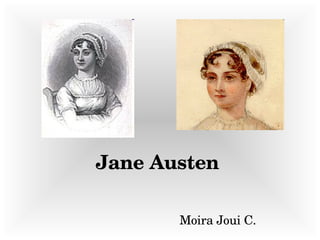
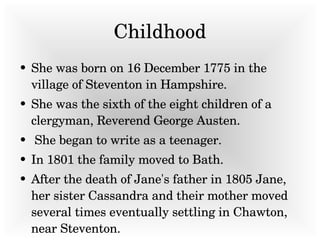
Jane Austen Moira Joui C.
Childhood She was born on 16 December 1775 in the village of Steventon in Hampshire.  She was the sixth of the eight children of a clergyman, Reverend George Austen. She began to write as a teenager.  In 1801 the family moved to Bath.  After the death of Jane's father in 1805 Jane, her sister Cassandra and their mother moved several times eventually settling in Chawton, near Steventon.
Youth As a young woman Jane enjoyed dancing (an activity which features frequently in her novels) and she attended balls in many of the great houses of the neighbourhood.  She loved the country, enjoyed long country walks, and had many Hampshire friends.  After her father's death in 1805, his widow and daughters also suffered financial difficulties and were forced to rely on the charity of the Austen sons.  It was also at this time that, Jane fell in love, and when the young man died, she was deeply upset. Later she accepted a proposal of marriage from Harris Bigg-Wither, a wealthy landowner and brother to some of her closest friends, but she changed her mind the next morning and was greatly upset by the whole episode. 
Her Books At the age of 14 she wrote her first novel,  Love and Friendship  and then  A History of England by a partial, prejudiced and ignorant Historian. In her early twenties Jane Austen wrote the novels that were later to be re-worked and published as  Sense and Sensibility ,  Pride and Prejudice  and  Northanger Abbey . She also began a novel called  The Watsons  which was never completed. 
Her times: a brief background    Britain, in Jane Austen’s lifetime, was actually at the beginning of the most far-reaching social transformation in her history to date, as industrialisation began to take hold.  For almost all of Jane Austen’s adult life, England – with only a couple of brief lulls – was at war with France: from 1793 when revolutionary France declared war on Britain, to Napoleon’s final defeat at Waterloo in 1815. Although there are no direct references to these wars in her novels
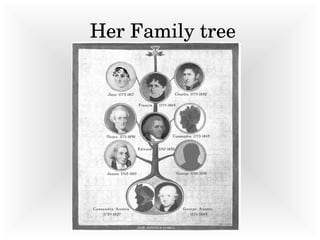
Her Family tree
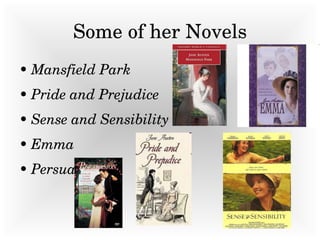
Some of her Novels Mansfield Park Pride and Prejudice   Sense and Sensibility  Emma   Persuasion
Pride and Prejudice The social milieu of Austen's Regency England was particularly stratified, and class divisions were rooted in family connections and wealth.  In her work, Austen is often critical of the assumptions and prejudices of upper-class England.  She distinguishes between internal merit (goodness of person) and external merit (rank and possessions).  Nevertheless, Austen was in many ways a realist, and the England she depicts is one in which social mobility is limited and class-consciousness is strong.
Pride and Prejudice Socially regimented ideas of appropriate behavior for each gender were extremely relevant into Austen's work as well: while social advancement for young men lay in the military, church, or law, the chief method of self-improvement for women was the acquisition of wealth.  Women could only accomplish this goal through successful marriage, which explains the importance of marriage as a goal and topic of conversation in Austen's writing.  Though young women of Austen's day had more freedom to choose their husbands than in the early eighteenth century, practical considerations continued to limit their options.
Pride and Prejudice THE PLOT:  The news that a wealthy young gentleman named Charles Bingley has rented the manor of Netherfield Park causes a great stir in the nearby village of Longbourn, especially in the Bennet household.  The Bennets have five unmarried daughters—from oldest to youngest, Jane, Elizabeth, Mary, Kitty, and Lydia—and Mrs. Bennet is desperate to see them all married. After Mr. Bennet pays a social visit to Mr. Bingley, the Bennets attend a ball at which Mr. Bingley is present.  He is attracted by Jane and spends much of the evening dancing with her. His close friend, Mr. Darcy, is less pleased with the evening and haughtily ( disdainfully proud; snobbish; scornfully arrogant )  refuses to dance with Elizabeth, which makes everyone view him as arrogant and obnoxious.
Bibliography http://www.jasa.net.au/inperspective/times.htm http://www.bbc.co.uk/history/historic_figures/austen_jane.shtml   http://www.jasa.net.au/jabiog.htm#novels   http://www.sparknotes.com/lit/pride/context.html   http://dictionary.reference.com

Jane Austen

  • 1.
  • 2.
    Childhood She wasborn on 16 December 1775 in the village of Steventon in Hampshire. She was the sixth of the eight children of a clergyman, Reverend George Austen. She began to write as a teenager. In 1801 the family moved to Bath. After the death of Jane's father in 1805 Jane, her sister Cassandra and their mother moved several times eventually settling in Chawton, near Steventon.
  • 3.
    Youth As ayoung woman Jane enjoyed dancing (an activity which features frequently in her novels) and she attended balls in many of the great houses of the neighbourhood. She loved the country, enjoyed long country walks, and had many Hampshire friends. After her father's death in 1805, his widow and daughters also suffered financial difficulties and were forced to rely on the charity of the Austen sons. It was also at this time that, Jane fell in love, and when the young man died, she was deeply upset. Later she accepted a proposal of marriage from Harris Bigg-Wither, a wealthy landowner and brother to some of her closest friends, but she changed her mind the next morning and was greatly upset by the whole episode. 
  • 4.
    Her Books Atthe age of 14 she wrote her first novel, Love and Friendship and then A History of England by a partial, prejudiced and ignorant Historian. In her early twenties Jane Austen wrote the novels that were later to be re-worked and published as Sense and Sensibility , Pride and Prejudice and Northanger Abbey . She also began a novel called The Watsons which was never completed. 
  • 5.
    Her times: abrief background  Britain, in Jane Austen’s lifetime, was actually at the beginning of the most far-reaching social transformation in her history to date, as industrialisation began to take hold. For almost all of Jane Austen’s adult life, England – with only a couple of brief lulls – was at war with France: from 1793 when revolutionary France declared war on Britain, to Napoleon’s final defeat at Waterloo in 1815. Although there are no direct references to these wars in her novels
  • 6.
  • 7.
    Some of herNovels Mansfield Park Pride and Prejudice Sense and Sensibility Emma Persuasion
  • 8.
    Pride and PrejudiceThe social milieu of Austen's Regency England was particularly stratified, and class divisions were rooted in family connections and wealth. In her work, Austen is often critical of the assumptions and prejudices of upper-class England. She distinguishes between internal merit (goodness of person) and external merit (rank and possessions). Nevertheless, Austen was in many ways a realist, and the England she depicts is one in which social mobility is limited and class-consciousness is strong.
  • 9.
    Pride and PrejudiceSocially regimented ideas of appropriate behavior for each gender were extremely relevant into Austen's work as well: while social advancement for young men lay in the military, church, or law, the chief method of self-improvement for women was the acquisition of wealth. Women could only accomplish this goal through successful marriage, which explains the importance of marriage as a goal and topic of conversation in Austen's writing. Though young women of Austen's day had more freedom to choose their husbands than in the early eighteenth century, practical considerations continued to limit their options.
  • 10.
    Pride and PrejudiceTHE PLOT: The news that a wealthy young gentleman named Charles Bingley has rented the manor of Netherfield Park causes a great stir in the nearby village of Longbourn, especially in the Bennet household. The Bennets have five unmarried daughters—from oldest to youngest, Jane, Elizabeth, Mary, Kitty, and Lydia—and Mrs. Bennet is desperate to see them all married. After Mr. Bennet pays a social visit to Mr. Bingley, the Bennets attend a ball at which Mr. Bingley is present. He is attracted by Jane and spends much of the evening dancing with her. His close friend, Mr. Darcy, is less pleased with the evening and haughtily ( disdainfully proud; snobbish; scornfully arrogant ) refuses to dance with Elizabeth, which makes everyone view him as arrogant and obnoxious.
  • 11.
    Bibliography http://www.jasa.net.au/inperspective/times.htm http://www.bbc.co.uk/history/historic_figures/austen_jane.shtml http://www.jasa.net.au/jabiog.htm#novels http://www.sparknotes.com/lit/pride/context.html http://dictionary.reference.com