The Rise of Open Adoption Software, OAS
What is Open Adoption Software (OAS)?
open · adoption · software
/ˈōpən/ noun
software that
1. is openly built by a network of developers, end users and ecosystem partners;
2. is openly and freely adopted by frontline developers who can become potential
customers;
3. is embracing of proprietary, valued-added bits to help users get the most out of their
software;
4. is now the foundation for how enterprises think about IT
a definition
what’s giving rise to OAS?
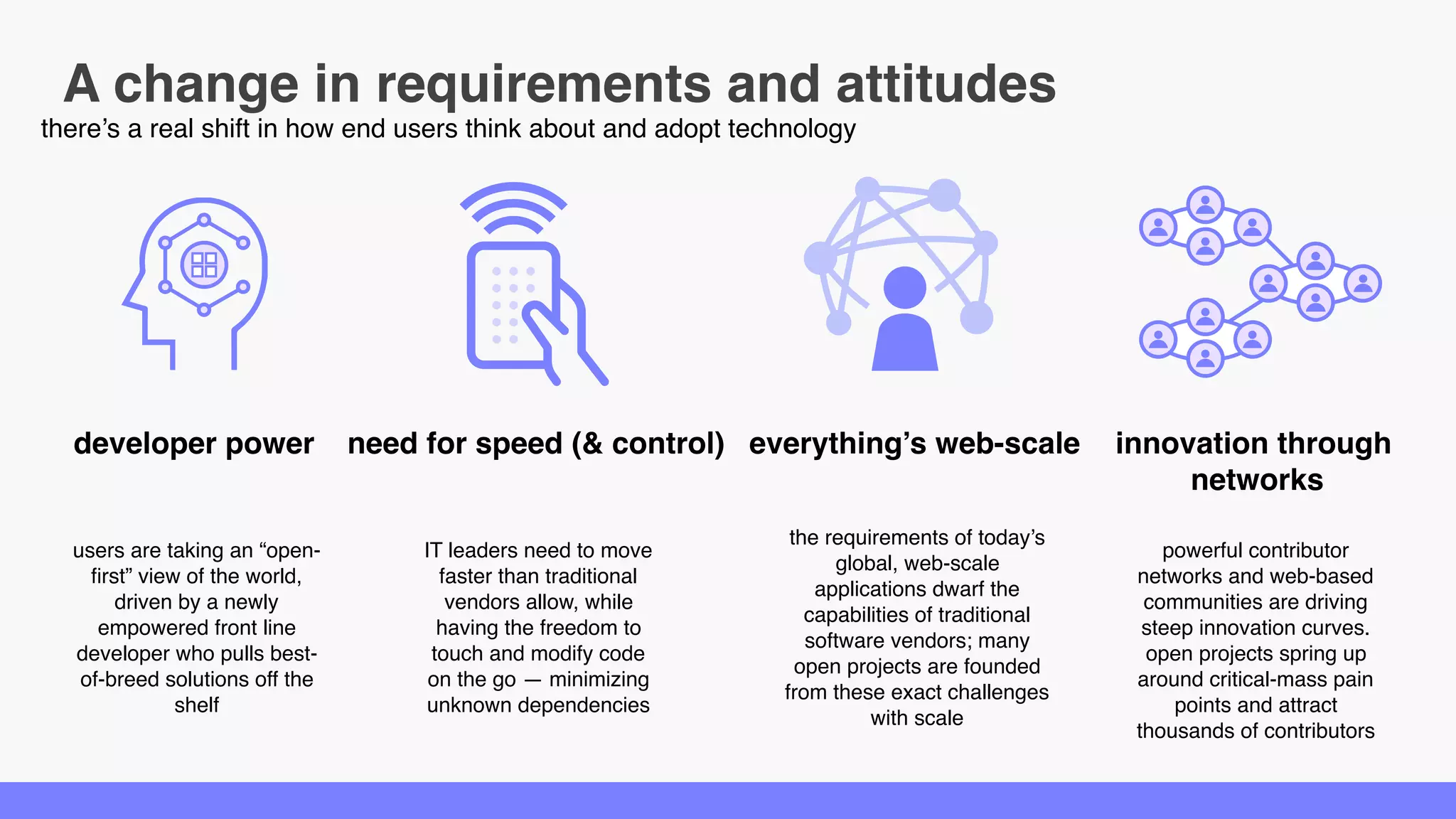
A change in requirements and attitudes
there’s a real shift in how end users think about and adopt technology
innovation through
networks
developer power everything’s web-scaleneed for speed (& control)
powerful contributor
networks and web-based
communities are driving
steep innovation curves.
open projects spring up
around critical-mass pain
points and attract
thousands of contributors
users are taking an “open-
first” view of the world,
driven by a newly
empowered front line
developer who pulls best-
of-breed solutions off the
shelf
the requirements of today’s
global, web-scale applications
dwarf the capabilities of
traditional software vendors;
many open projects are
founded from these exact
challenges with scale
IT leaders need to move
faster than traditional
vendors allow, while
having the freedom to
touch and modify code on
the go — minimizing
unknown dependencies
Mgmt,Security,Analytics
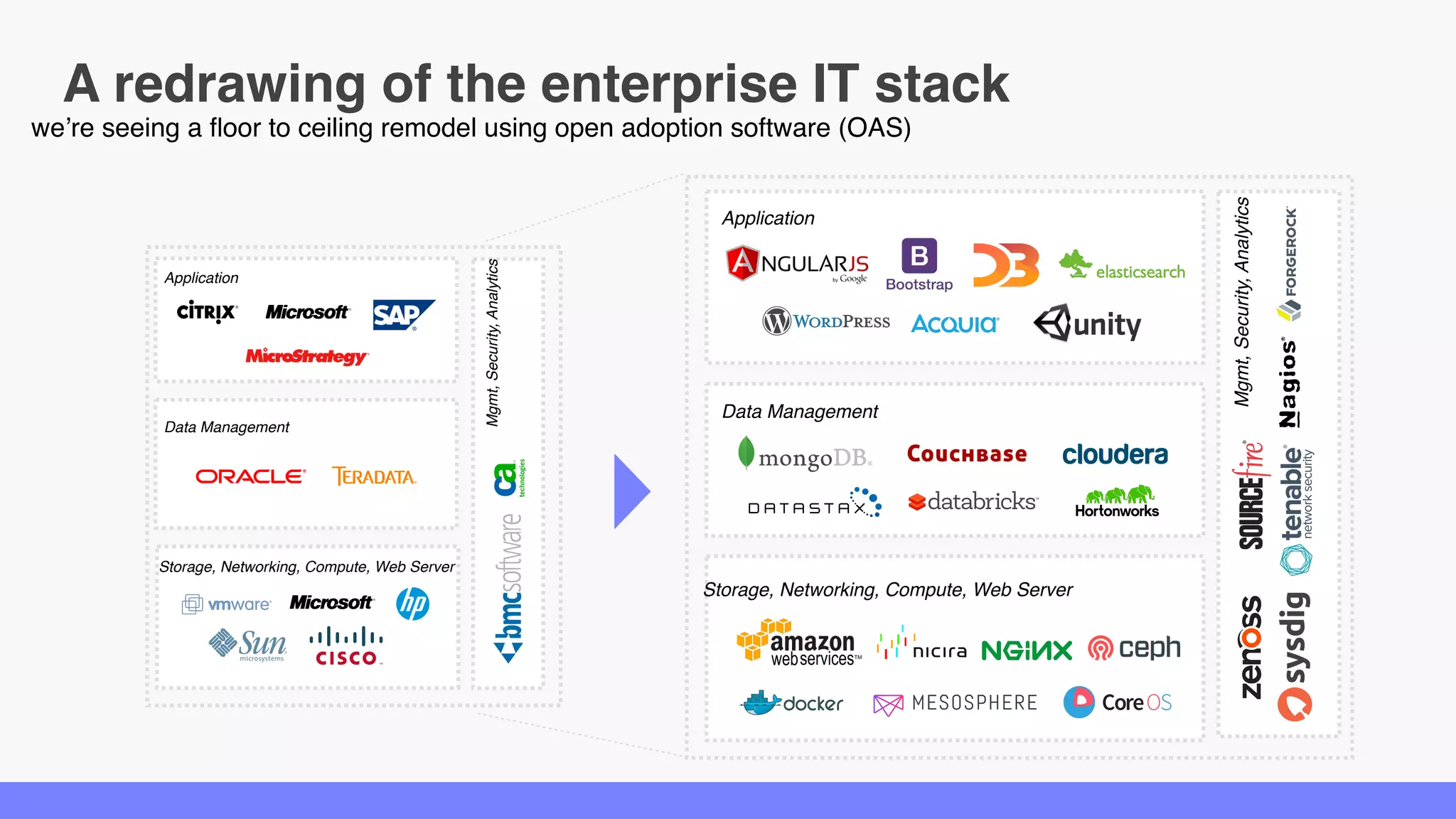
A redrawing of the enterprise IT stack
Storage, Networking, Compute, Web Server
Data Management
Application
Storage, Networking, Compute, Web Server
Data Management
Application
we’re seeing a floor to ceiling remodel using open adoption software (OAS)
Mgmt,Security,Analytics
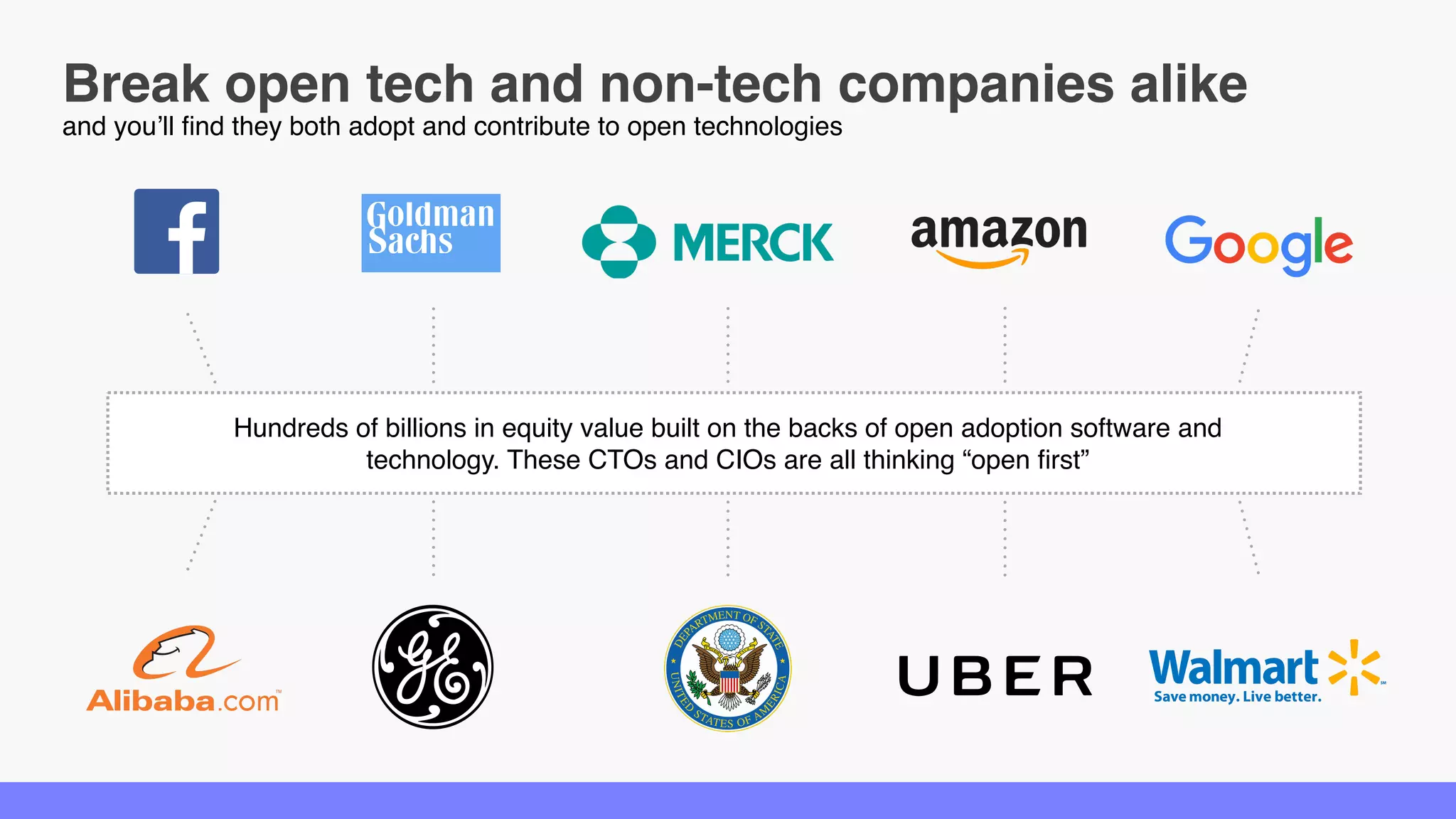
Break open tech and non-tech companies alike
and you’ll find they both adopt and contribute to open technologies
Hundreds of billions in equity value built on the backs of open adoption software and technology.
These CTOs and CIOs are all thinking “open first”
can OAS companies be real + independent?
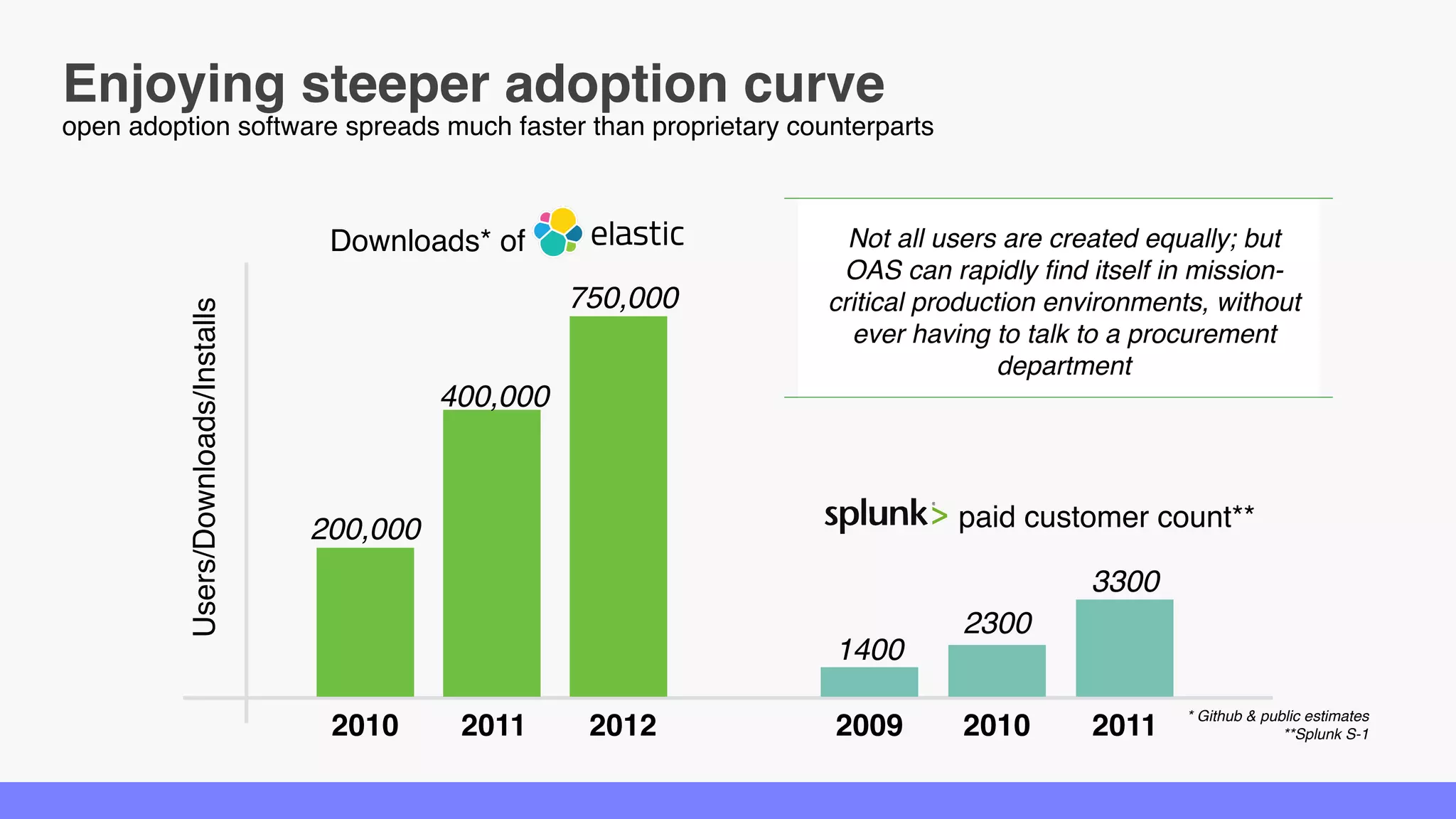
Enjoying steeper adoption curve
paid customer count**
Downloads* of
2010 2011 2012
200,000
400,000
750,000
3300
201120102009
2300
1400
* Github & public estimates
**Splunk S-1
Not all users are created equally; but OAS
can rapidly find itself in mission-critical
production environments, without ever
having to talk to a procurement department
Users/Downloads/Installs
open adoption software spreads much faster than proprietary counterparts
Mulesoft
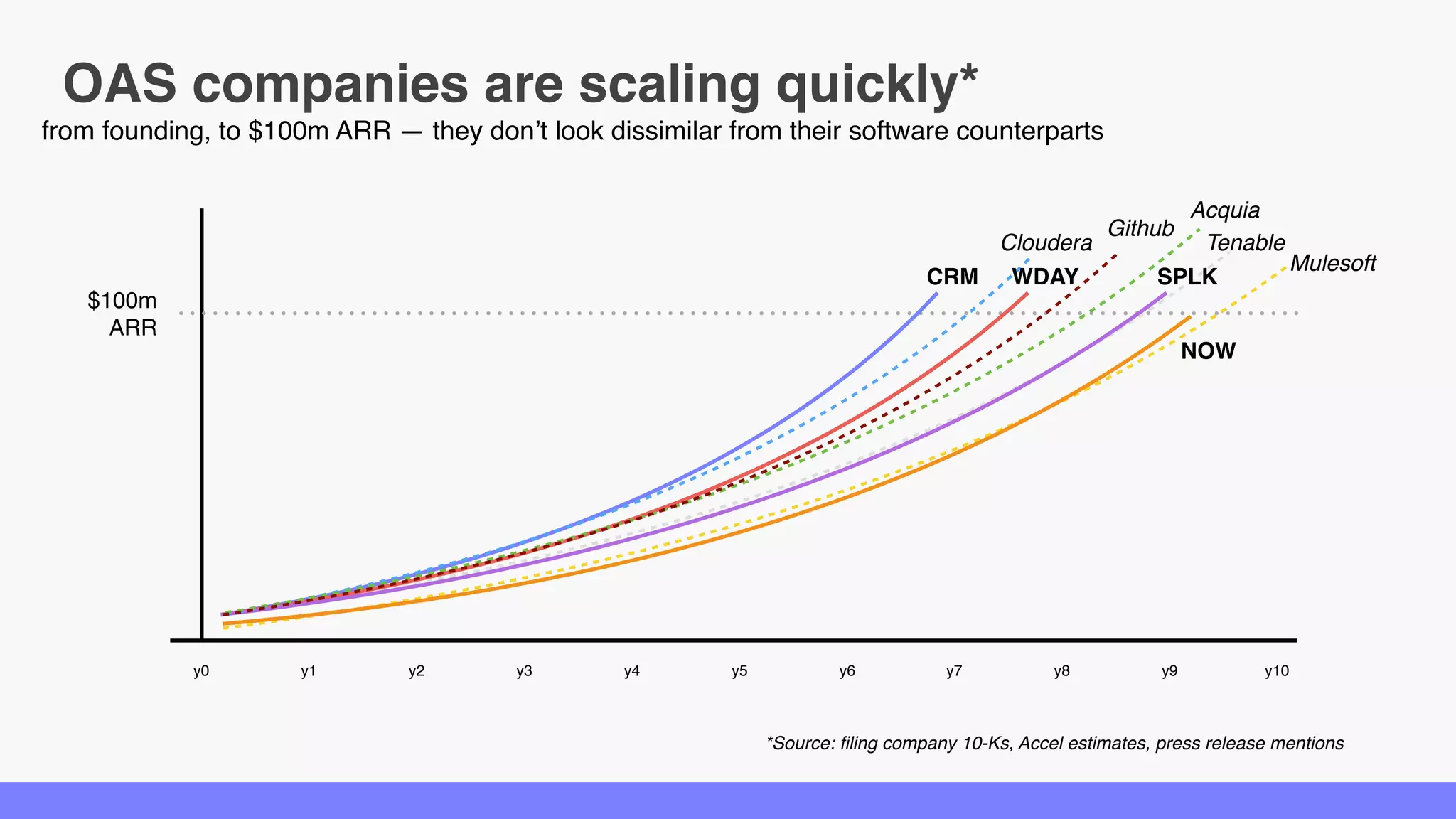
OAS companies are scaling quickly*
from founding, to $100m ARR — they don’t look dissimilar from their software counterparts
y0 y1 y2 y3 y4 y5 y6 y7 y8 y9 y10
WDAY SPLKCRM
Cloudera
$100m
ARR
Acquia
*Source: filing company 10-Ks, Accel estimates, press release mentions
Github
Tenable
NOW
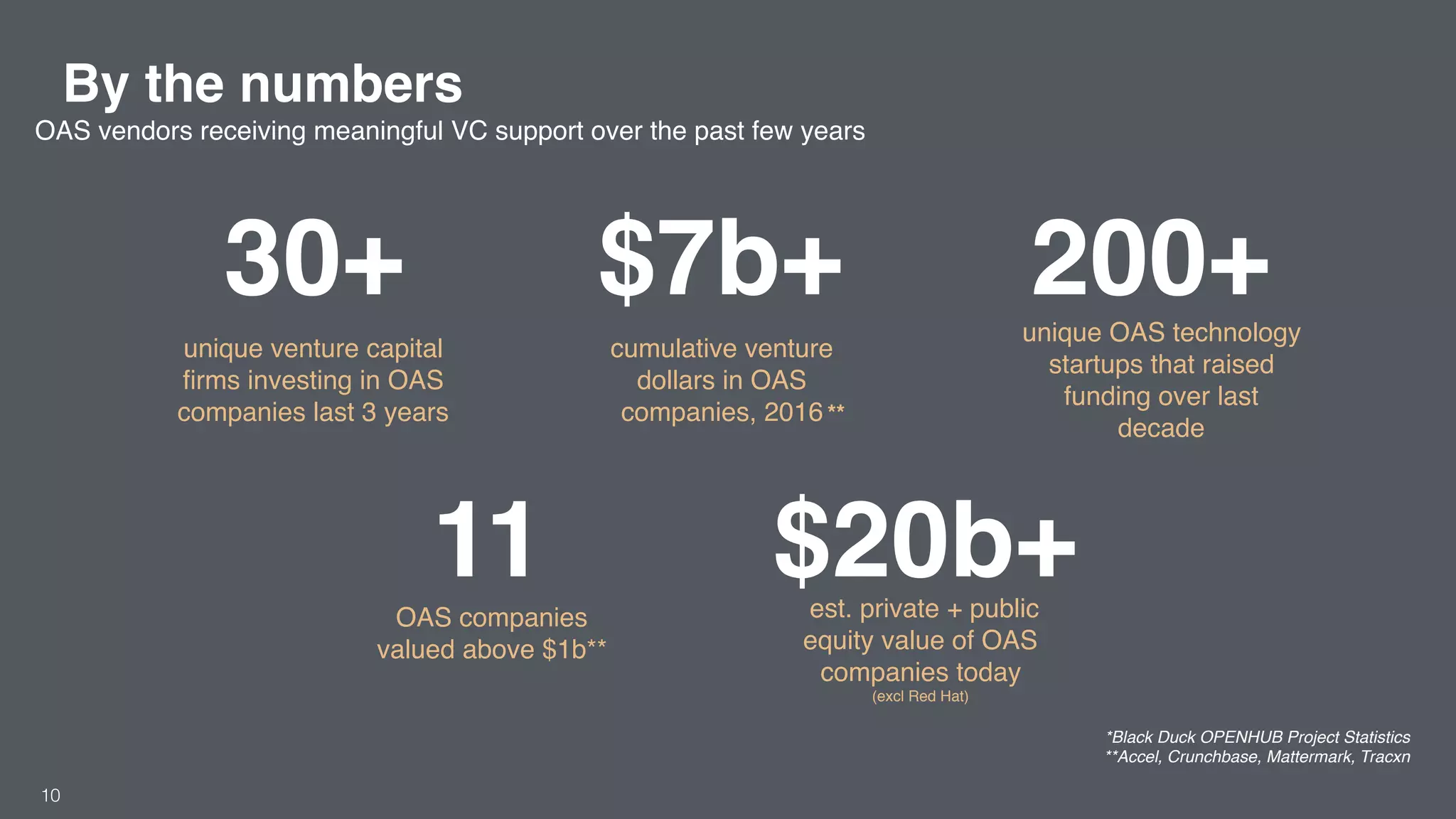
$20b+est. private + public
equity value of OAS
companies today
(excl Red Hat)
200+
11OAS companies valued
above $1b**
*Black Duck OPENHUB Project Statistics
**Accel, Crunchbase, Mattermark, Tracxn
10
**
unique OAS technology
startups that raised
funding over last decade
30+
unique venture capital
firms investing in OAS
companies last 3 years
$7b+
cumulative venture
dollars in OAS
companies, 2016
By the numbers
OAS vendors receiving meaningful VC support over the past few years
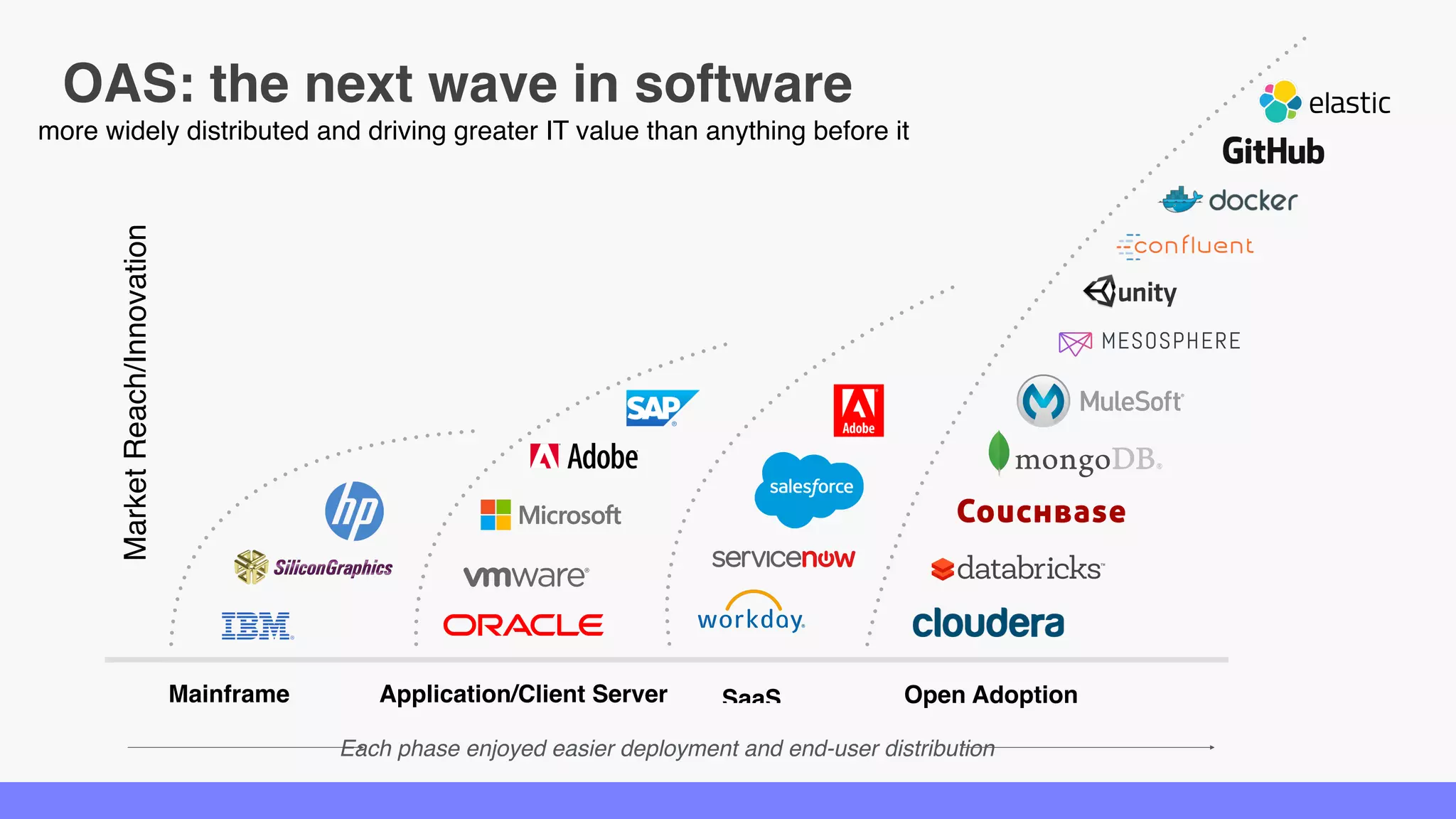
OAS: the next wave in software
Application/Client ServerMainframe SaaS Open Adoption Software
MarketReach/Innovation
Each phase enjoyed easier deployment and end-user distribution
more widely distributed and driving greater IT value than anything before it
how are OAS companies constructed?
(answer: it’s different, but luckily, there are some good frameworks emerging…)
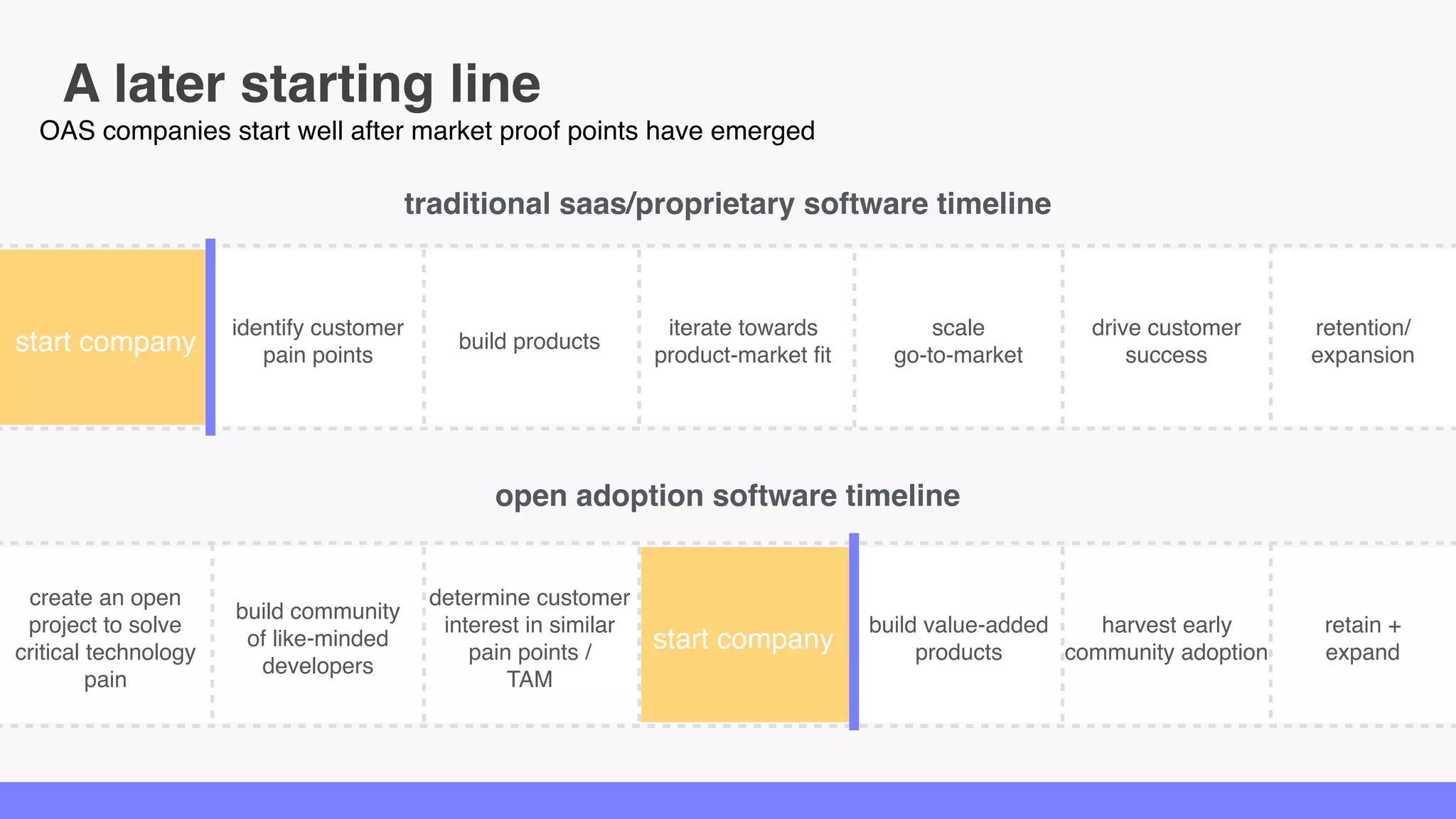
A later starting line
traditional saas/proprietary software timeline
start company
identify customer
pain points
build products
iterate towards
product-market fit
scale
go-to-market
drive customer
success
retention/
expansion
open adoption software timeline
create an open
project to solve
critical technology
pain
build community
of like-minded
developers
determine customer
interest in similar
pain points /
TAM
start company
build value-added
products
harvest early
community adoption
retain +
expand
OAS companies start well after market proof points have emerged
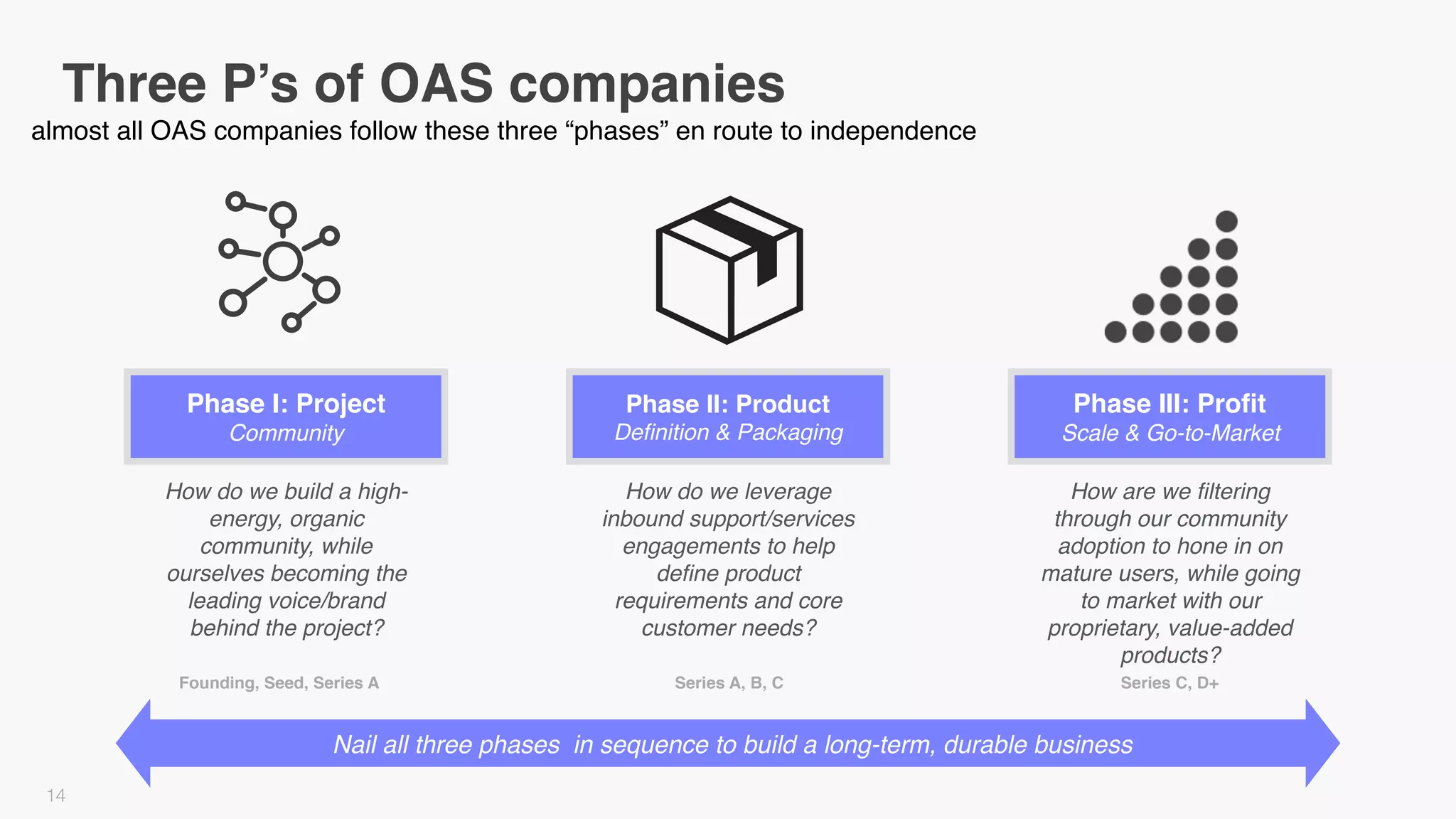
Phase II: Product
Definition & Packaging
Nail all three phases in sequence to build a long-term, durable business
Phase I: Project
Community
14
Phase III: Profit
Scale & Go-to-Market
How do we build a high-
energy, organic community,
while ourselves becoming the
leading voice/brand behind
the project?
How do we leverage inbound
support/services
engagements to help define
product requirements and
core customer needs?
How are we filtering through
our community adoption to
hone in on mature users,
while going to market with
our proprietary, value-added
products?
Three P’s of OAS companies
almost all OAS companies follow these three “phases” en route to independence
Founding, Seed, Series A Series A, B, C Series C, D+
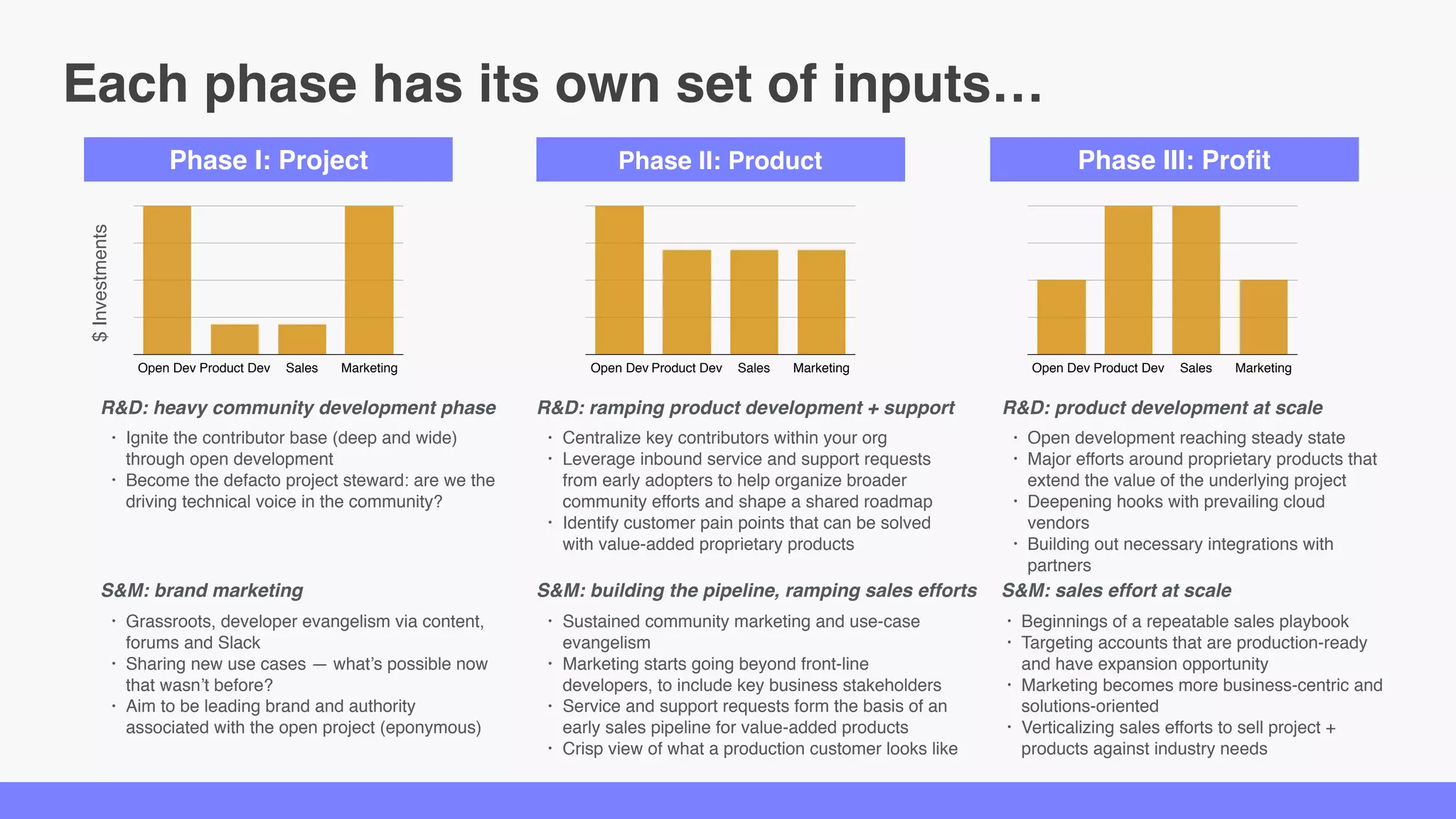
Phase II: ProductPhase I: Project Phase III: Profit
Open Dev Product Dev Sales Marketing Open Dev Product Dev Sales Marketing Open Dev Product Dev Sales Marketing
$Investments
R&D: heavy community development phase
• Ignite the contributor base (deep and wide) through open
development
• Become the defacto project steward: are we the driving
technical voice in the community?
S&M: brand marketing
• Grassroots, developer evangelism via content, forums
and Slack
• Sharing new use cases — what’s possible now that
wasn’t before?
• Aim to be leading brand and authority associated with
the open project (eponymous)
15
R&D: ramping product development + support
• Centralize key contributors within your org
• Leverage inbound service and support requests from early
adopters to help organize broader community efforts and
shape a shared roadmap
• Identify customer pain points that can be solved with
value-added proprietary products
S&M: building the pipeline, ramping sales efforts
• Sustained community marketing and use-case evangelism
• Marketing starts going beyond front-line developers, to
include key business stakeholders
• Service and support requests form the basis of an early
sales pipeline for value-added products
• Crisp view of what a production customer looks like
R&D: product development at scale
• Open development reaching steady state
• Major efforts around proprietary products that extend
the value of the underlying project
• Deepening hooks with prevailing cloud vendors
• Building out necessary integrations with partners
S&M: sales effort at scale
• Beginnings of a repeatable sales playbook
• Targeting accounts that are production-ready and have
expansion opportunity
• Marketing becomes more business-centric and
solutions-oriented
• Verticalizing sales efforts to sell project + products
against industry needs
Each phase has its own set of inputs…
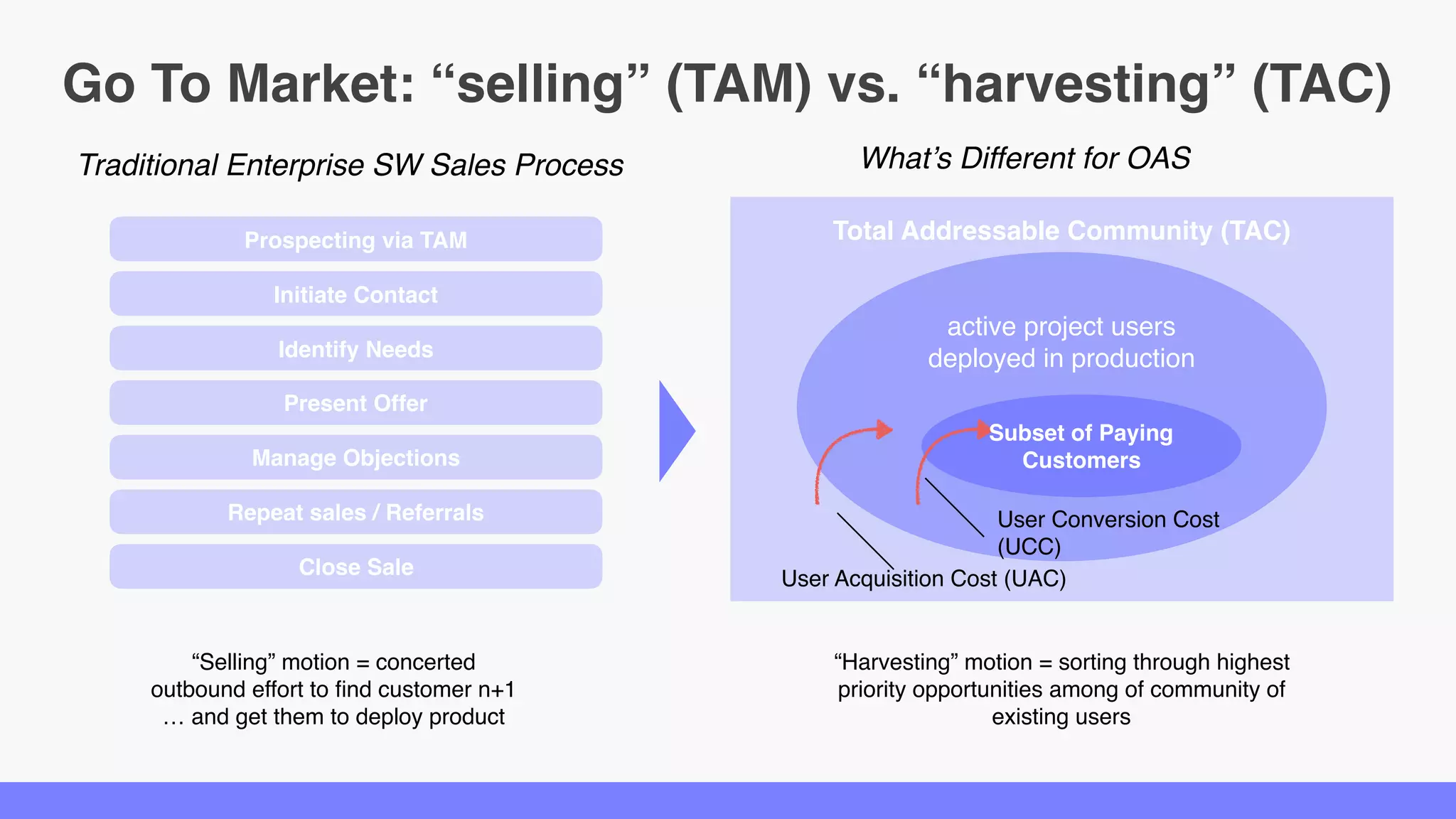
Go To Market: “selling” (TAM) vs. “harvesting” (TAC)
“Selling” motion = concerted
outbound effort to find customer n+1
… and get them to deploy product
Repeat sales / Referrals
Prospecting via TAM
Initiate Contact
Identify Needs
Present Offer
Manage Objections
Close Sale
Traditional Enterprise SW Sales Process
Total Addressable Community (TAC)
User Acquisition Cost (UAC)
User Conversion Cost (UCC)
active project users
deployed in production
Subset of Paying
Customers
What’s Different for OAS
“Harvesting” motion = sorting through highest
priority opportunities among of community of
existing users
A few things to remember…
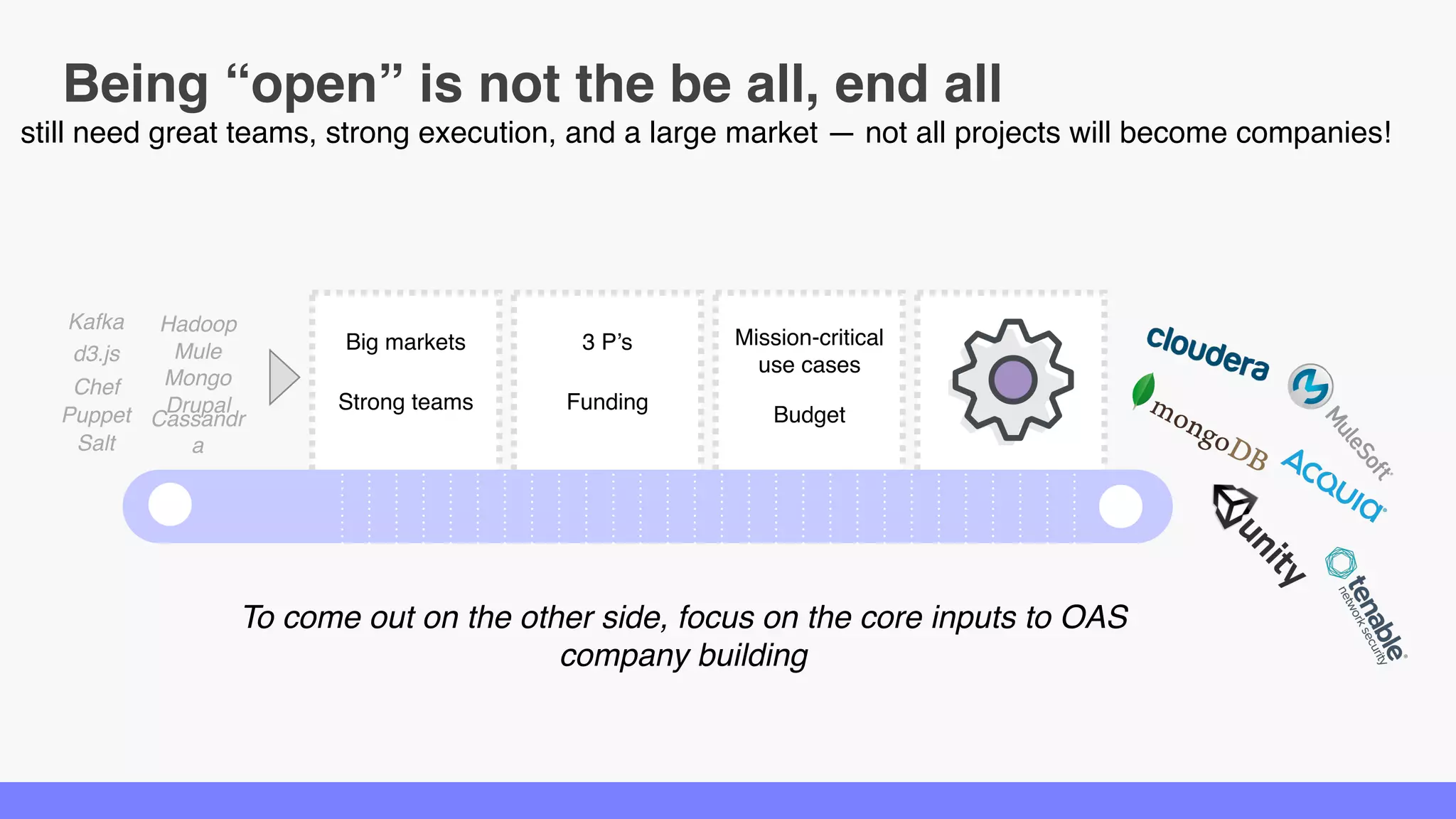
Being “open” is not the be all, end all
still need great teams, strong execution, and a large market — not all projects will become companies!
To come out on the other side, focus on the core inputs to OAS company
building
Big markets
Strong teams
3 P’s
Funding
Mission-critical
use cases
Hadoop
Mule
Mongo
Drupal
Cassandra
d3.js
Chef
Puppet
Salt
Kafka
Budget
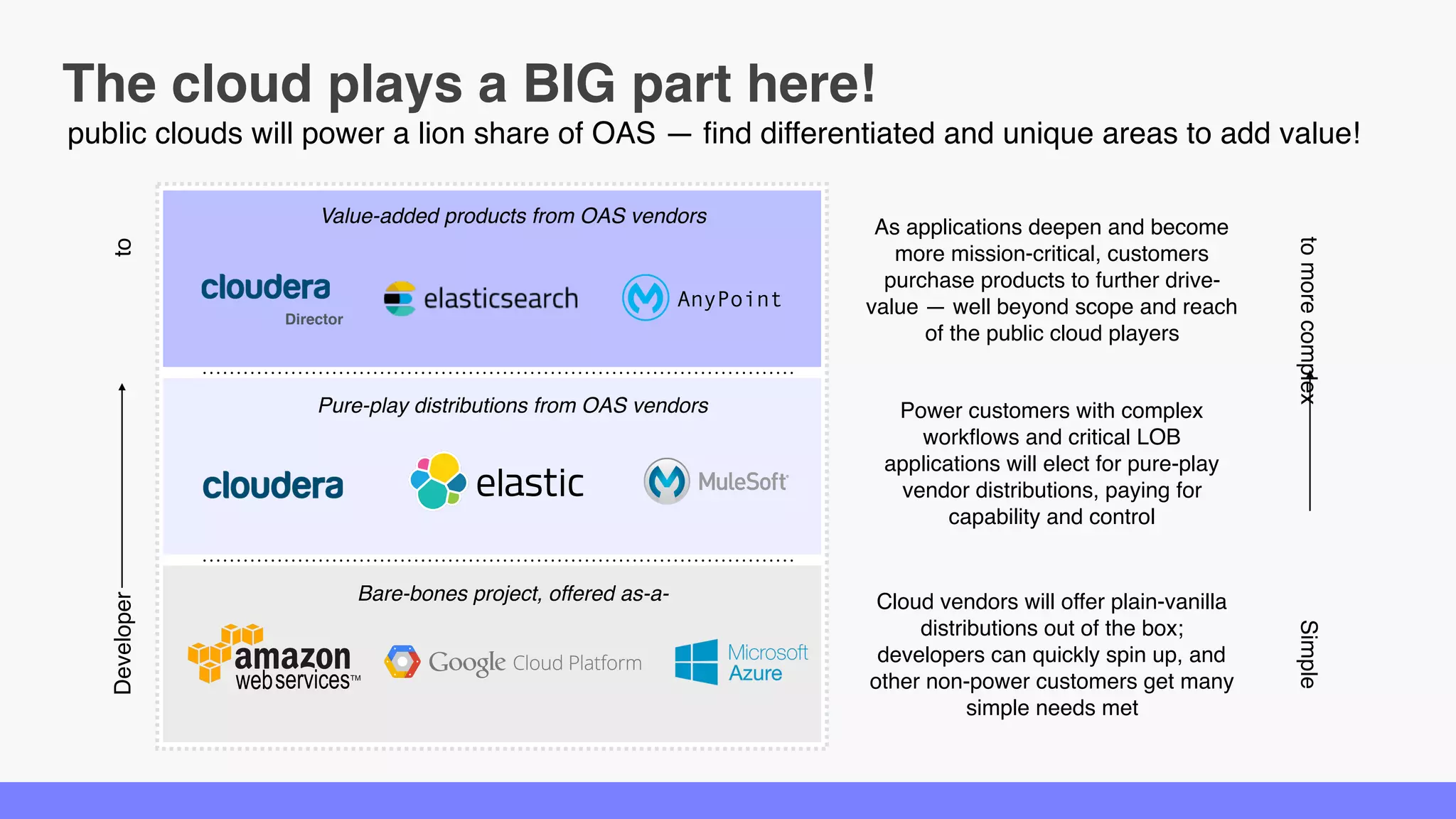
The cloud plays a BIG part here!
public clouds will power a lion share of OAS — find differentiated and unique areas to add value!
Cloud vendors will offer plain-vanilla
distributions out of the box; developers
can quickly spin up, and other non-
power customers get many simple
needs met
Power customers with complex
workflows and critical LOB applications
will elect for pure-play vendor
distributions, paying for capability and
control
As applications deepen and become
more mission-critical, customers
purchase products to further drive-value
— well beyond scope and reach of the
public cloud players
Bare-bones project, offered as-a-
Pure-play distributions from OAS vendors
Value-added products from OAS vendors
Director
AnyPoint
Developertoenterprise
tomorecomplexSimplerequirements
investors in a spectrum of software categories:
Thank you!
Ping Li ping@accel.com
Jake Flomenberg jake@accel.com
Vas Natarajan vas@accel.com

The Rise of Open Adoption Software (OAS)

  • 1.
    The Rise ofOpen Adoption Software, OAS
  • 2.
    What is OpenAdoption Software (OAS)? open · adoption · software /ˈōpən/ noun software that 1. is openly built by a network of developers, end users and ecosystem partners; 2. is openly and freely adopted by frontline developers who can become potential customers; 3. is embracing of proprietary, valued-added bits to help users get the most out of their software; 4. is now the foundation for how enterprises think about IT a definition
  • 3.
  • 4.
    A change inrequirements and attitudes there’s a real shift in how end users think about and adopt technology innovation through networks developer power everything’s web-scaleneed for speed (& control) powerful contributor networks and web-based communities are driving steep innovation curves. open projects spring up around critical-mass pain points and attract thousands of contributors users are taking an “open- first” view of the world, driven by a newly empowered front line developer who pulls best- of-breed solutions off the shelf the requirements of today’s global, web-scale applications dwarf the capabilities of traditional software vendors; many open projects are founded from these exact challenges with scale IT leaders need to move faster than traditional vendors allow, while having the freedom to touch and modify code on the go — minimizing unknown dependencies
  • 5.
    Mgmt,Security,Analytics A redrawing ofthe enterprise IT stack Storage, Networking, Compute, Web Server Data Management Application Storage, Networking, Compute, Web Server Data Management Application we’re seeing a floor to ceiling remodel using open adoption software (OAS) Mgmt,Security,Analytics
  • 6.
    Break open techand non-tech companies alike and you’ll find they both adopt and contribute to open technologies Hundreds of billions in equity value built on the backs of open adoption software and technology. These CTOs and CIOs are all thinking “open first”
  • 7.
    can OAS companiesbe real + independent?
  • 8.
    Enjoying steeper adoptioncurve paid customer count** Downloads* of 2010 2011 2012 200,000 400,000 750,000 3300 201120102009 2300 1400 * Github & public estimates **Splunk S-1 Not all users are created equally; but OAS can rapidly find itself in mission-critical production environments, without ever having to talk to a procurement department Users/Downloads/Installs open adoption software spreads much faster than proprietary counterparts
  • 9.
    Mulesoft OAS companies arescaling quickly* from founding, to $100m ARR — they don’t look dissimilar from their software counterparts y0 y1 y2 y3 y4 y5 y6 y7 y8 y9 y10 WDAY SPLKCRM Cloudera $100m ARR Acquia *Source: filing company 10-Ks, Accel estimates, press release mentions Github Tenable NOW
  • 10.
    $20b+est. private +public equity value of OAS companies today (excl Red Hat) 200+ 11OAS companies valued above $1b** *Black Duck OPENHUB Project Statistics **Accel, Crunchbase, Mattermark, Tracxn 10 ** unique OAS technology startups that raised funding over last decade 30+ unique venture capital firms investing in OAS companies last 3 years $7b+ cumulative venture dollars in OAS companies, 2016 By the numbers OAS vendors receiving meaningful VC support over the past few years
  • 11.
    OAS: the nextwave in software Application/Client ServerMainframe SaaS Open Adoption Software MarketReach/Innovation Each phase enjoyed easier deployment and end-user distribution more widely distributed and driving greater IT value than anything before it
  • 12.
    how are OAScompanies constructed? (answer: it’s different, but luckily, there are some good frameworks emerging…)
  • 13.
    A later startingline traditional saas/proprietary software timeline start company identify customer pain points build products iterate towards product-market fit scale go-to-market drive customer success retention/ expansion open adoption software timeline create an open project to solve critical technology pain build community of like-minded developers determine customer interest in similar pain points / TAM start company build value-added products harvest early community adoption retain + expand OAS companies start well after market proof points have emerged
  • 14.
    Phase II: Product Definition& Packaging Nail all three phases in sequence to build a long-term, durable business Phase I: Project Community 14 Phase III: Profit Scale & Go-to-Market How do we build a high- energy, organic community, while ourselves becoming the leading voice/brand behind the project? How do we leverage inbound support/services engagements to help define product requirements and core customer needs? How are we filtering through our community adoption to hone in on mature users, while going to market with our proprietary, value-added products? Three P’s of OAS companies almost all OAS companies follow these three “phases” en route to independence Founding, Seed, Series A Series A, B, C Series C, D+
  • 15.
    Phase II: ProductPhaseI: Project Phase III: Profit Open Dev Product Dev Sales Marketing Open Dev Product Dev Sales Marketing Open Dev Product Dev Sales Marketing $Investments R&D: heavy community development phase • Ignite the contributor base (deep and wide) through open development • Become the defacto project steward: are we the driving technical voice in the community? S&M: brand marketing • Grassroots, developer evangelism via content, forums and Slack • Sharing new use cases — what’s possible now that wasn’t before? • Aim to be leading brand and authority associated with the open project (eponymous) 15 R&D: ramping product development + support • Centralize key contributors within your org • Leverage inbound service and support requests from early adopters to help organize broader community efforts and shape a shared roadmap • Identify customer pain points that can be solved with value-added proprietary products S&M: building the pipeline, ramping sales efforts • Sustained community marketing and use-case evangelism • Marketing starts going beyond front-line developers, to include key business stakeholders • Service and support requests form the basis of an early sales pipeline for value-added products • Crisp view of what a production customer looks like R&D: product development at scale • Open development reaching steady state • Major efforts around proprietary products that extend the value of the underlying project • Deepening hooks with prevailing cloud vendors • Building out necessary integrations with partners S&M: sales effort at scale • Beginnings of a repeatable sales playbook • Targeting accounts that are production-ready and have expansion opportunity • Marketing becomes more business-centric and solutions-oriented • Verticalizing sales efforts to sell project + products against industry needs Each phase has its own set of inputs…
  • 16.
    Go To Market:“selling” (TAM) vs. “harvesting” (TAC) “Selling” motion = concerted outbound effort to find customer n+1 … and get them to deploy product Repeat sales / Referrals Prospecting via TAM Initiate Contact Identify Needs Present Offer Manage Objections Close Sale Traditional Enterprise SW Sales Process Total Addressable Community (TAC) User Acquisition Cost (UAC) User Conversion Cost (UCC) active project users deployed in production Subset of Paying Customers What’s Different for OAS “Harvesting” motion = sorting through highest priority opportunities among of community of existing users
  • 17.
    A few thingsto remember…
  • 18.
    Being “open” isnot the be all, end all still need great teams, strong execution, and a large market — not all projects will become companies! To come out on the other side, focus on the core inputs to OAS company building Big markets Strong teams 3 P’s Funding Mission-critical use cases Hadoop Mule Mongo Drupal Cassandra d3.js Chef Puppet Salt Kafka Budget
  • 19.
    The cloud playsa BIG part here! public clouds will power a lion share of OAS — find differentiated and unique areas to add value! Cloud vendors will offer plain-vanilla distributions out of the box; developers can quickly spin up, and other non- power customers get many simple needs met Power customers with complex workflows and critical LOB applications will elect for pure-play vendor distributions, paying for capability and control As applications deepen and become more mission-critical, customers purchase products to further drive-value — well beyond scope and reach of the public cloud players Bare-bones project, offered as-a- Pure-play distributions from OAS vendors Value-added products from OAS vendors Director AnyPoint Developertoenterprise tomorecomplexSimplerequirements
  • 20.
    investors in aspectrum of software categories:
  • 21.
    Thank you! Ping Liping@accel.com Jake Flomenberg jake@accel.com Vas Natarajan vas@accel.com