by Daniela FLORIS and Ettore PACETTI
Premises
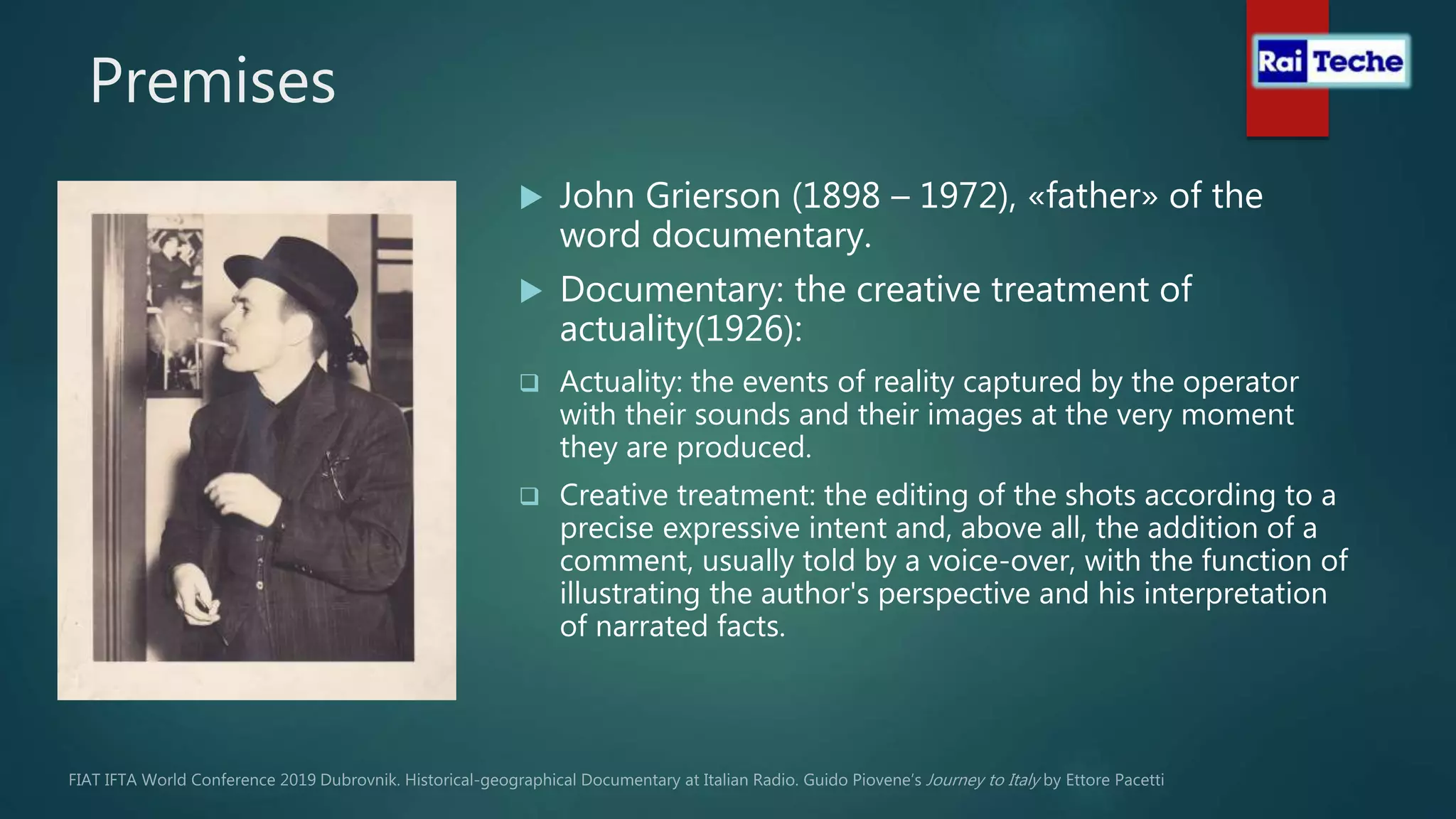
 John Grierson (1898 – 1972), «father» of the
word documentary.
 Documentary: the creative treatment of
actuality(1926):
 Actuality: the events of reality captured by the operator
with their sounds and their images at the very moment
they are produced.
 Creative treatment: the editing of the shots according to a
precise expressive intent and, above all, the addition of a
comment, usually told by a voice-over, with the function of
illustrating the author's perspective and his interpretation
of narrated facts.
The origins in Italy and the years of fascism
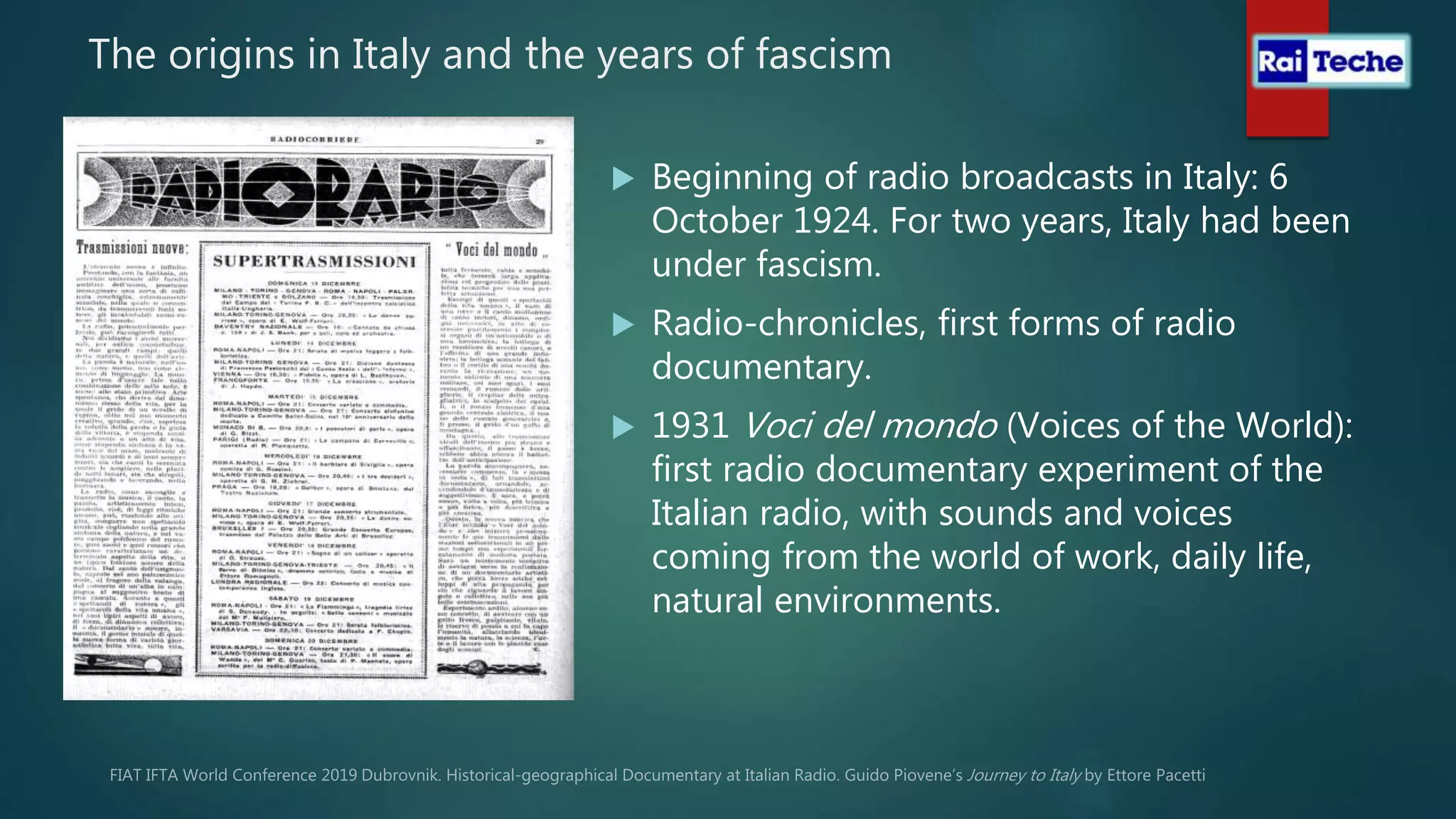
 Beginning of radio broadcasts in Italy: 6
October 1924. For two years, Italy had been
under fascism.
 Radio-chronicles, first forms of radio
documentary.
 1931 Voci del mondo (Voices of the World):
first radio documentary experiment of the
Italian radio, with sounds and voices
coming from the world of work, daily life,
natural environments.
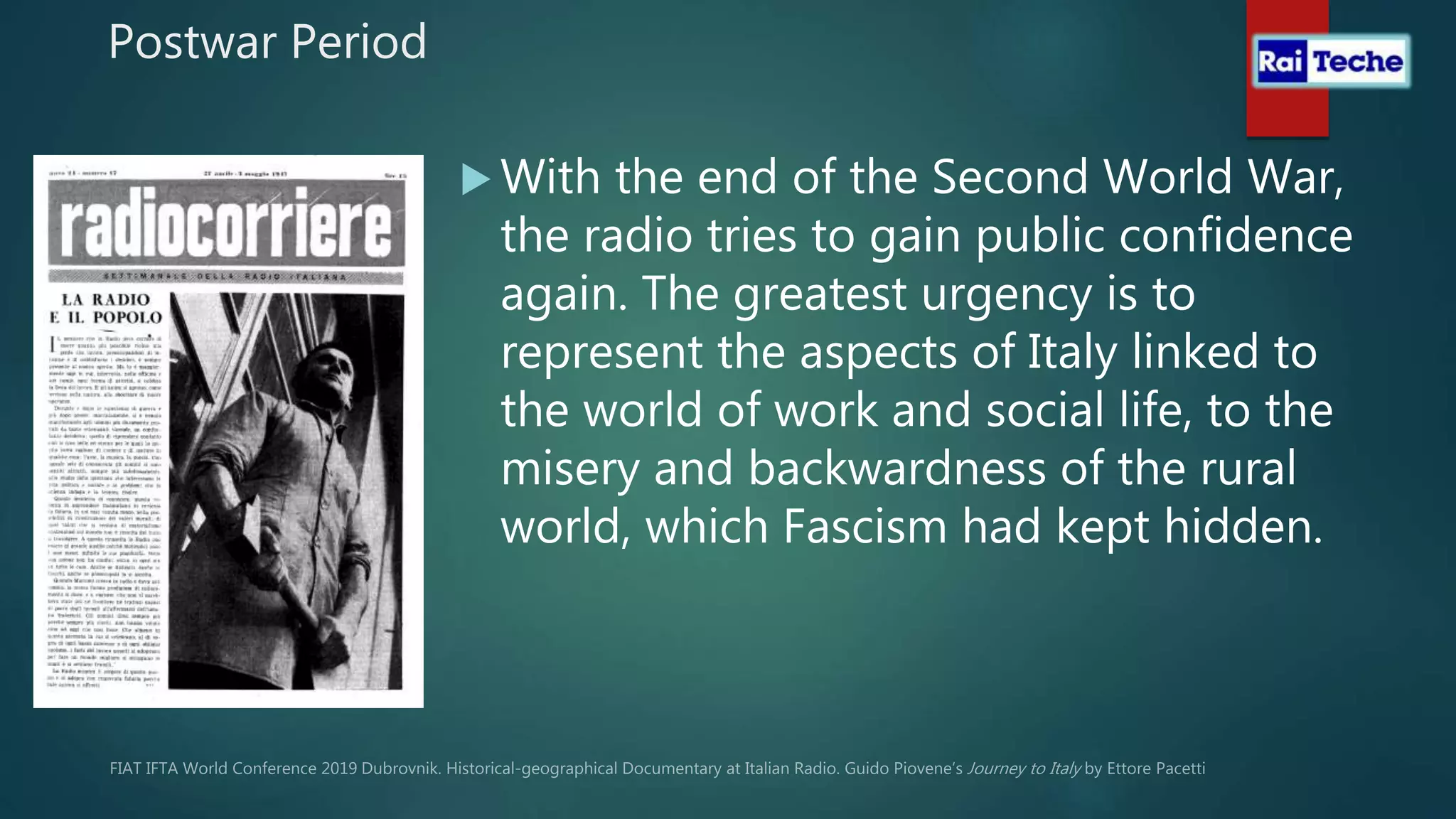
Postwar Period
 With the end of the Second World War,
the radio tries to gain public confidence
again. The greatest urgency is to
represent the aspects of Italy linked to
the world of work and social life, to the
misery and backwardness of the rural
world, which Fascism had kept hidden.
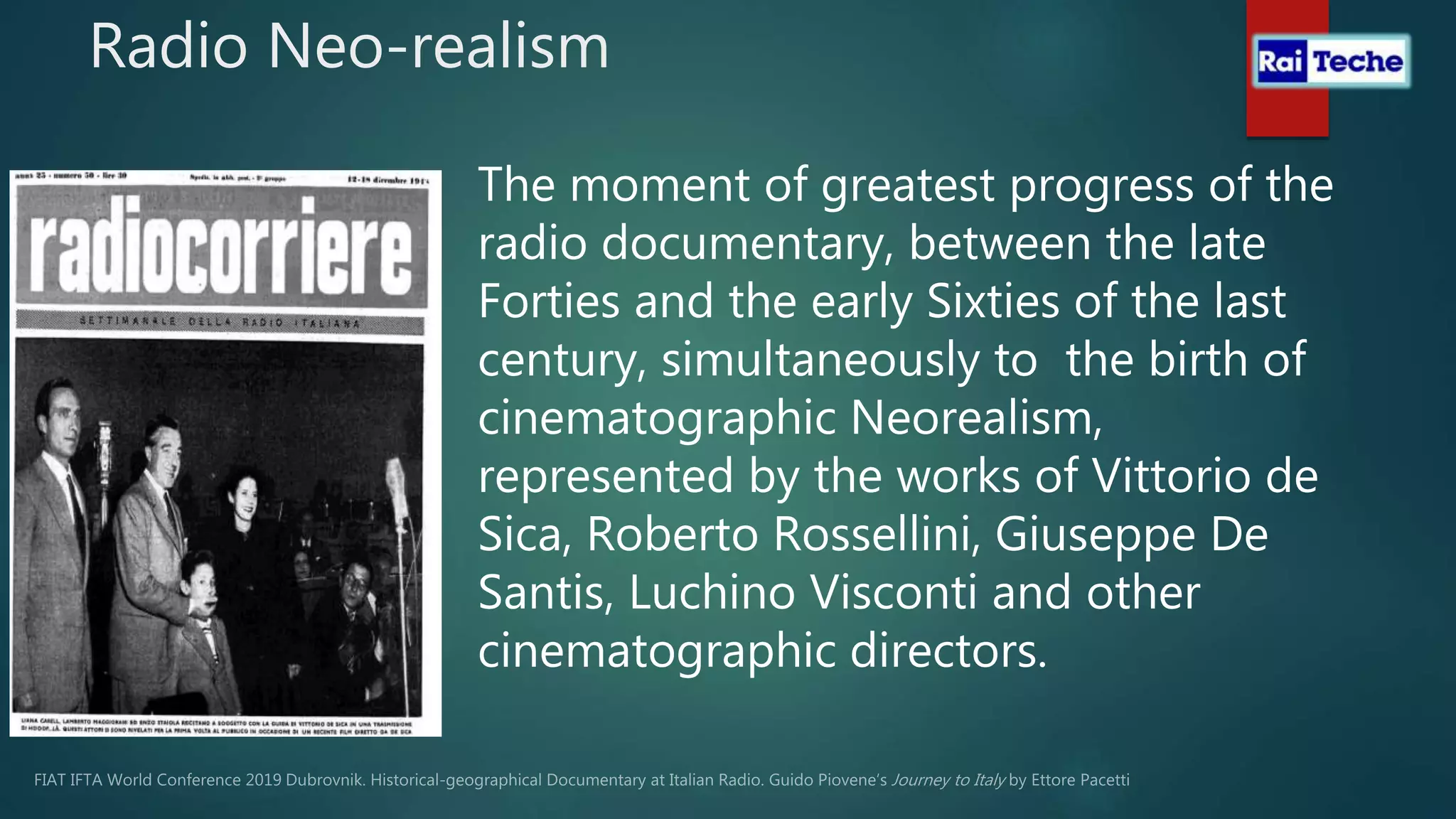
Radio Neo-realism
The moment of greatest progress of the
radio documentary, between the late
Forties and the early Sixties of the last
century, simultaneously to the birth of
cinematographic Neorealism,
represented by the works of Vittorio de
Sica, Roberto Rossellini, Giuseppe De
Santis, Luchino Visconti and other
cinematographic directors.
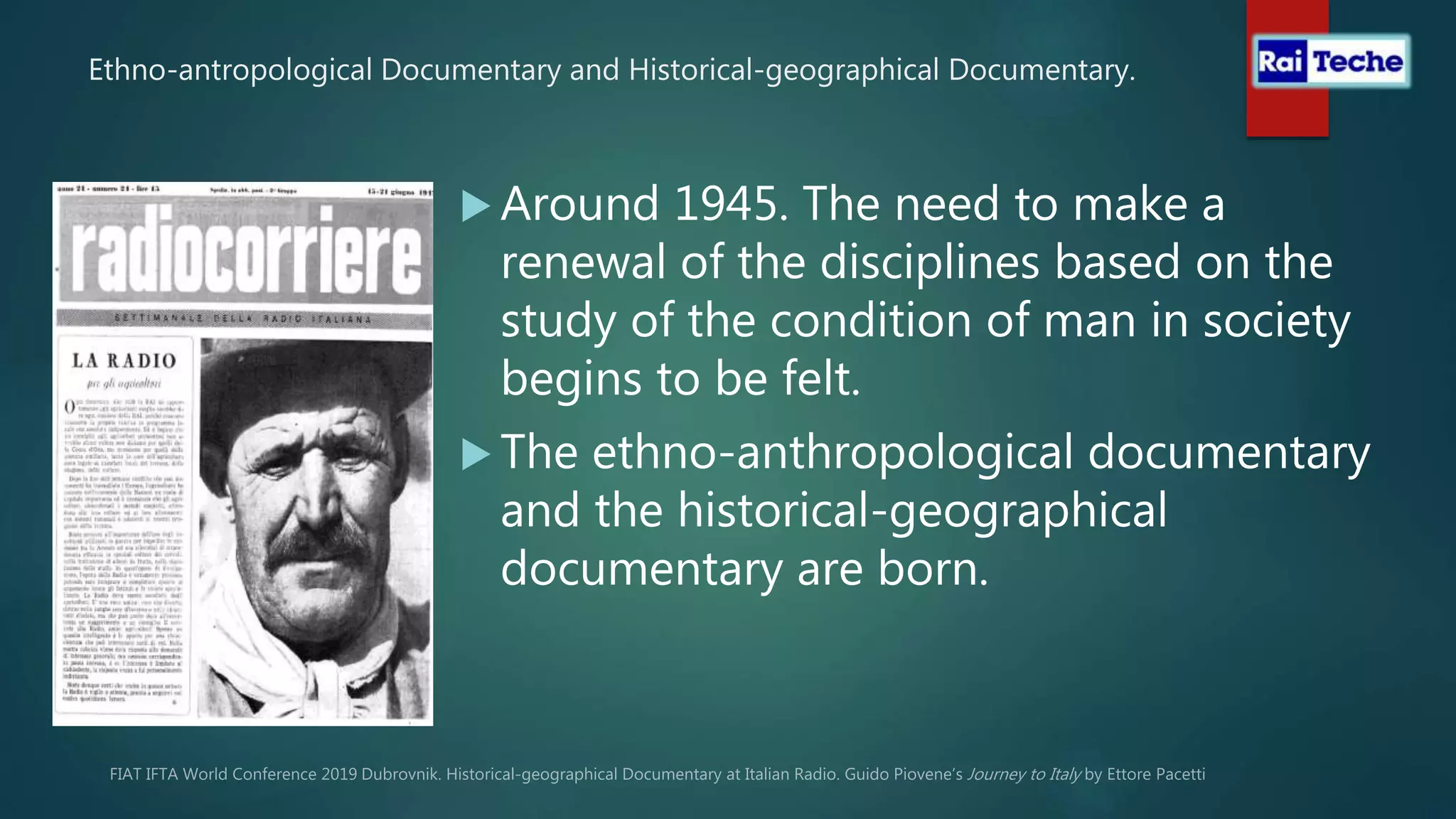
Ethno-antropological Documentary and Historical-geographical Documentary.
 Around 1945. The need to make a
renewal of the disciplines based on the
study of the condition of man in society
begins to be felt.
 The ethno-anthropological documentary
and the historical-geographical
documentary are born.
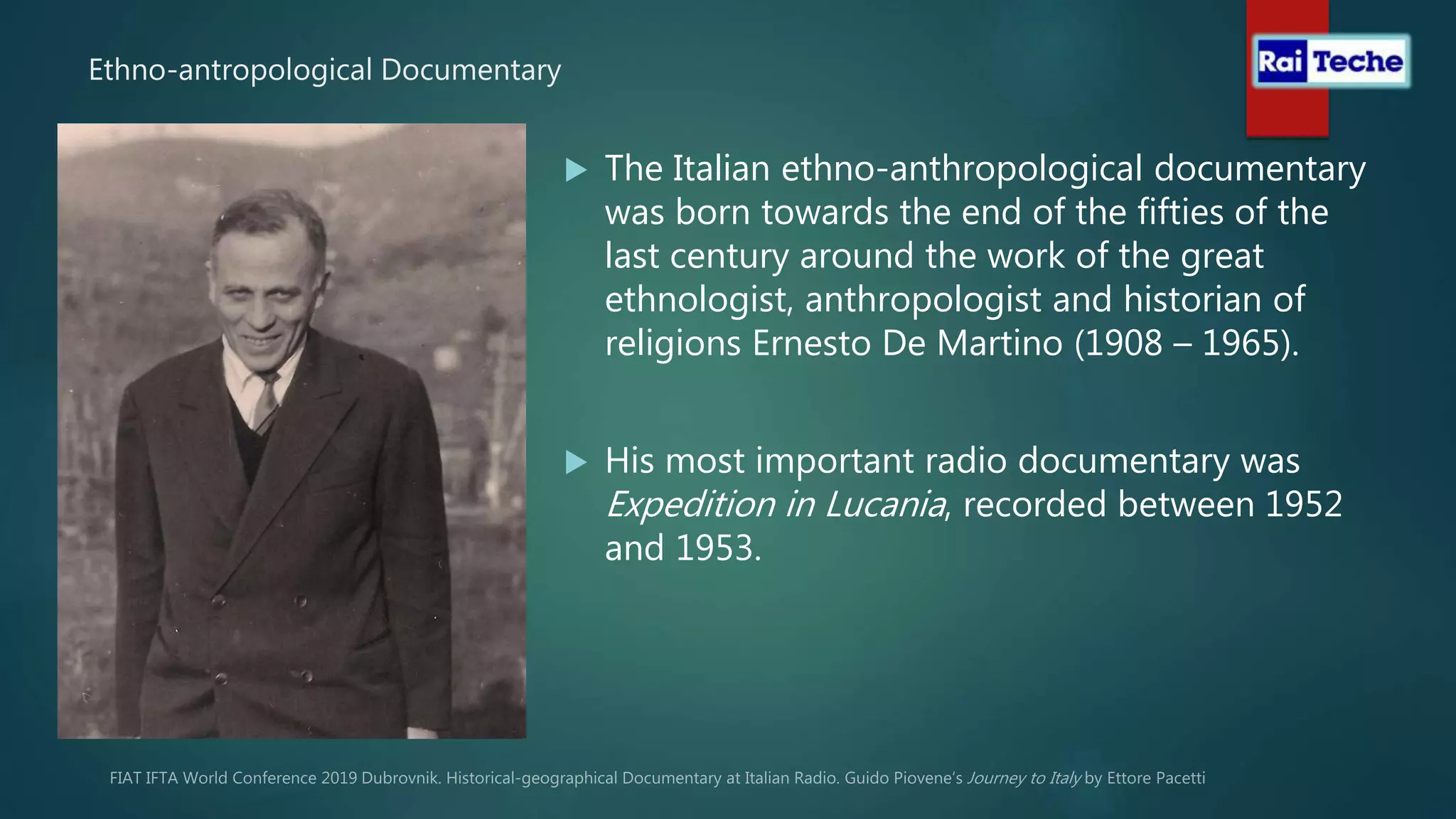
Ethno-antropological Documentary
 The Italian ethno-anthropological documentary
was born towards the end of the fifties of the
last century around the work of the great
ethnologist, anthropologist and historian of
religions Ernesto De Martino (1908 – 1965).
 His most important radio documentary was
Expedition in Lucania, recorded between 1952
and 1953.
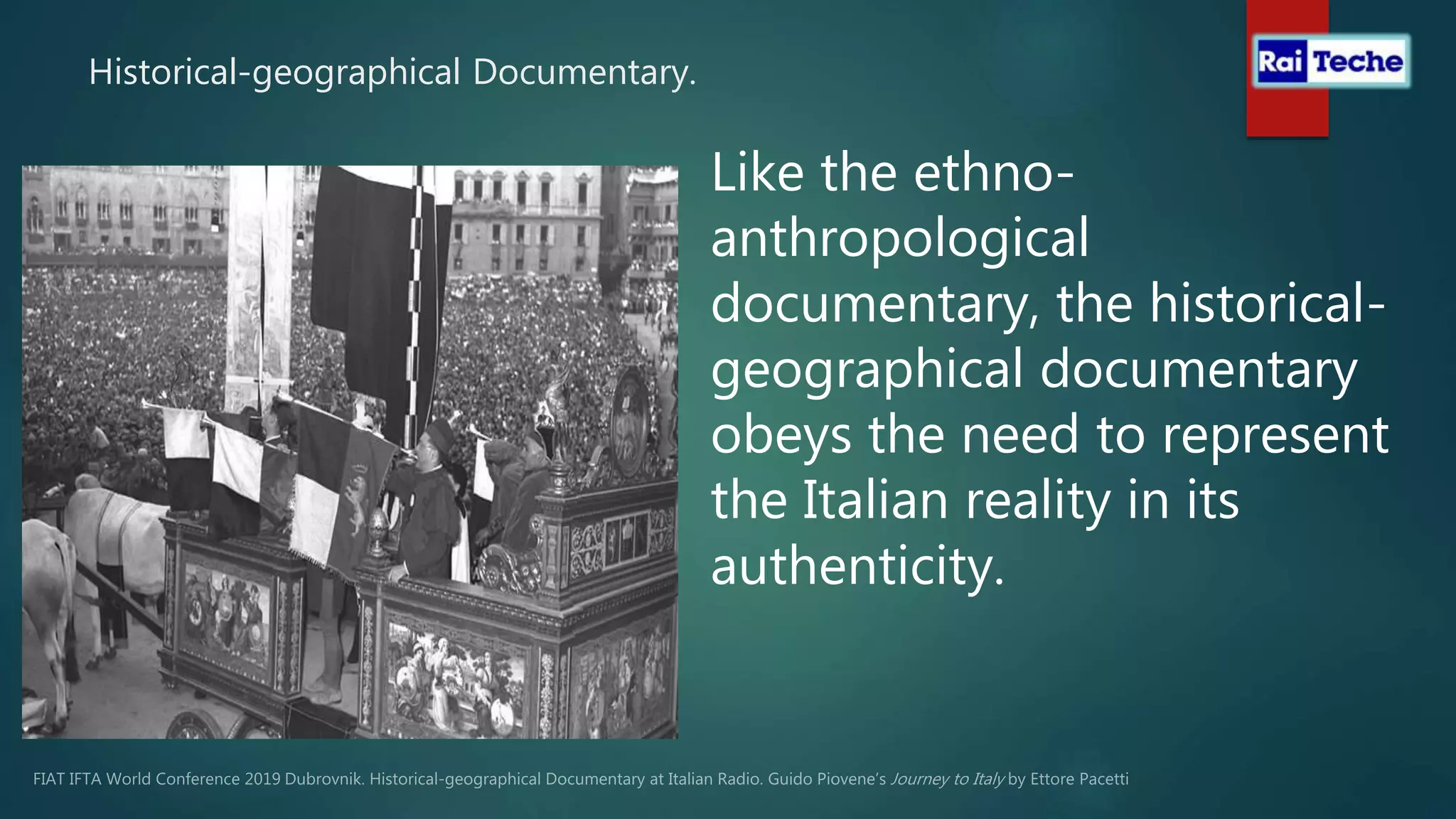
Historical-geographical Documentary.
Like the ethno-
anthropological
documentary, the historical-
geographical documentary
obeys the need to represent
the Italian reality in its
authenticity.
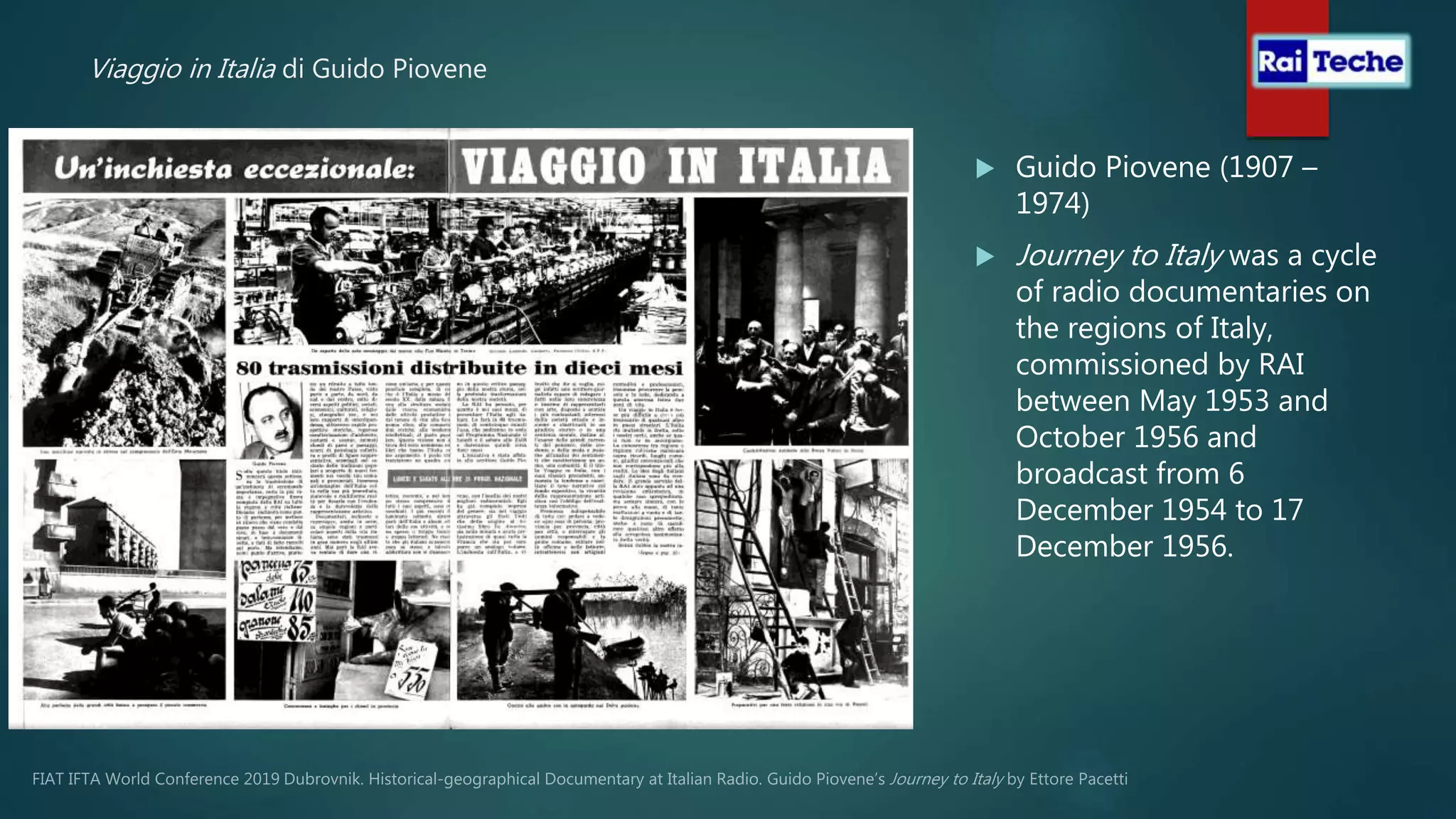
Viaggio in Italia di Guido Piovene
 Guido Piovene (1907 –
1974)
 Journey to Italy was a cycle
of radio documentaries on
the regions of Italy,
commissioned by RAI
between May 1953 and
October 1956 and
broadcast from 6
December 1954 to 17
December 1956.
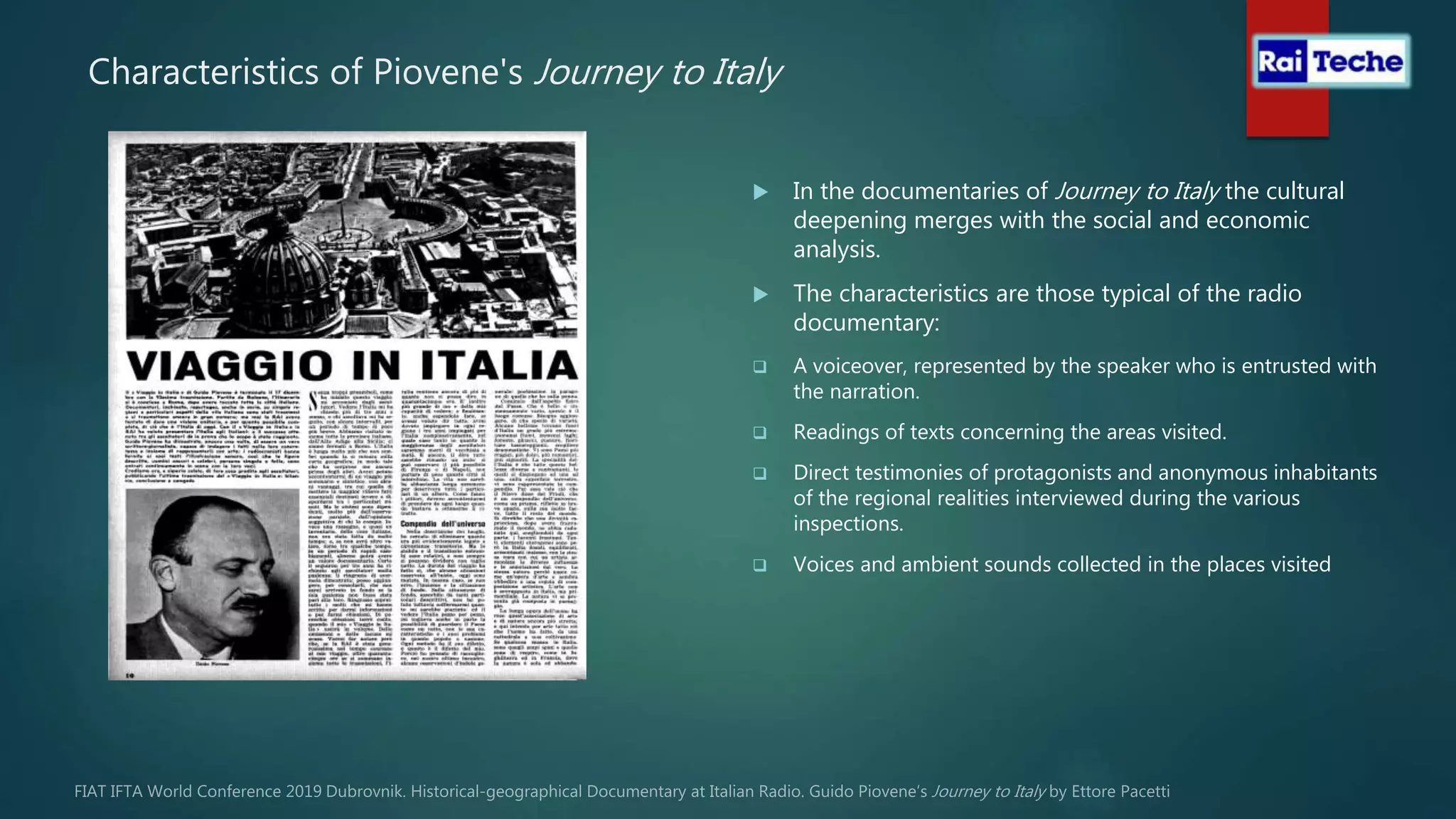
Characteristics of Piovene's Journey to Italy
 In the documentaries of Journey to Italy the cultural
deepening merges with the social and economic
analysis.
 The characteristics are those typical of the radio
documentary:
 A voiceover, represented by the speaker who is entrusted with
the narration.
 Readings of texts concerning the areas visited.
 Direct testimonies of protagonists and anonymous inhabitants
of the regional realities interviewed during the various
inspections.
 Voices and ambient sounds collected in the places visited
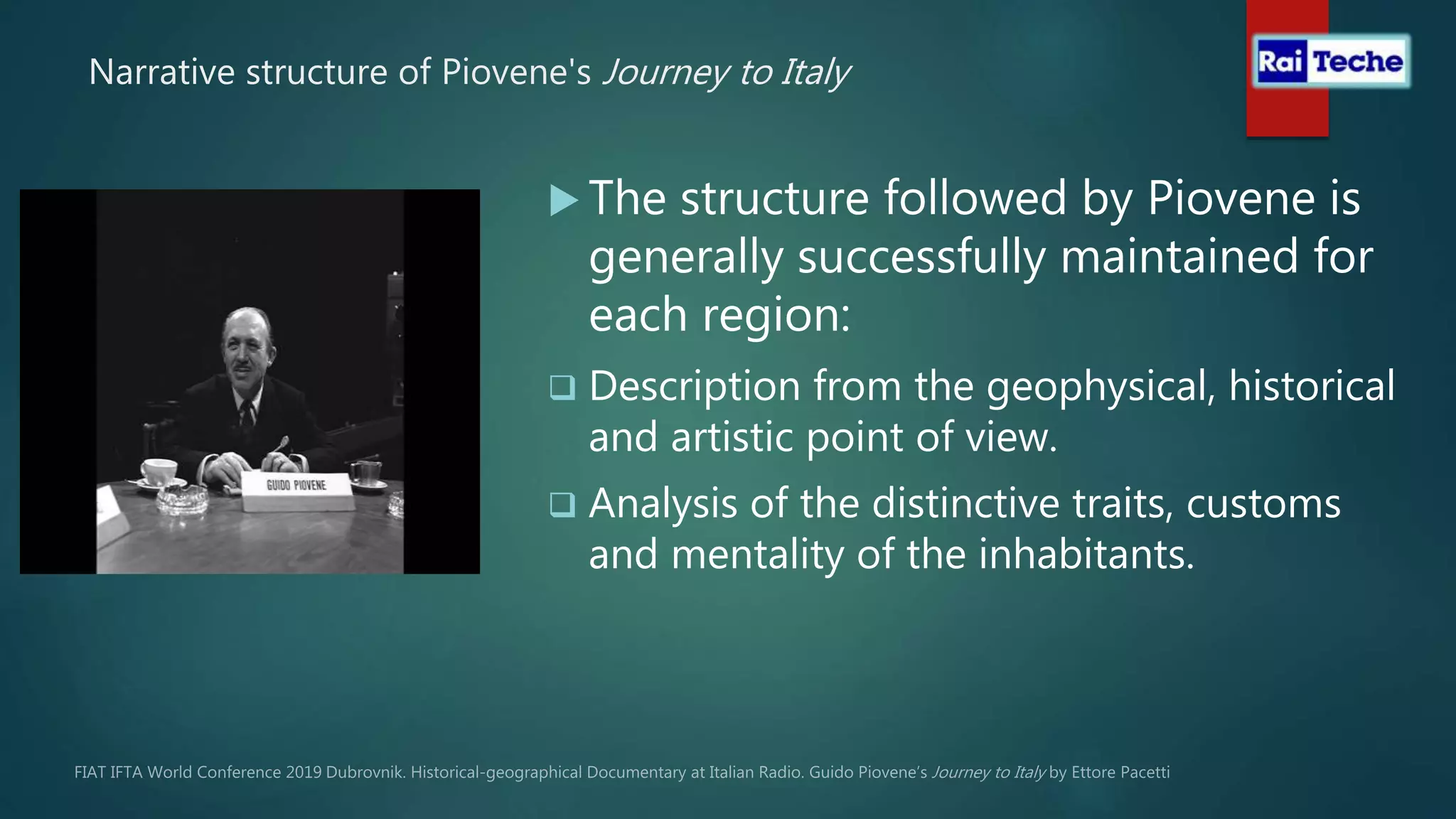
Narrative structure of Piovene's Journey to Italy
 The structure followed by Piovene is
generally successfully maintained for
each region:
 Description from the geophysical, historical
and artistic point of view.
 Analysis of the distinctive traits, customs
and mentality of the inhabitants.
The RAI Teche project
 Digitization of historical-geographical
documentaries still preserved on
analogue supports.
 Insertion of metadata for digitized
materials to ensure greater ease of
consultation and full availability of
content.
 Publication of documents filed in
research portals based on
homogeneous information criteria.
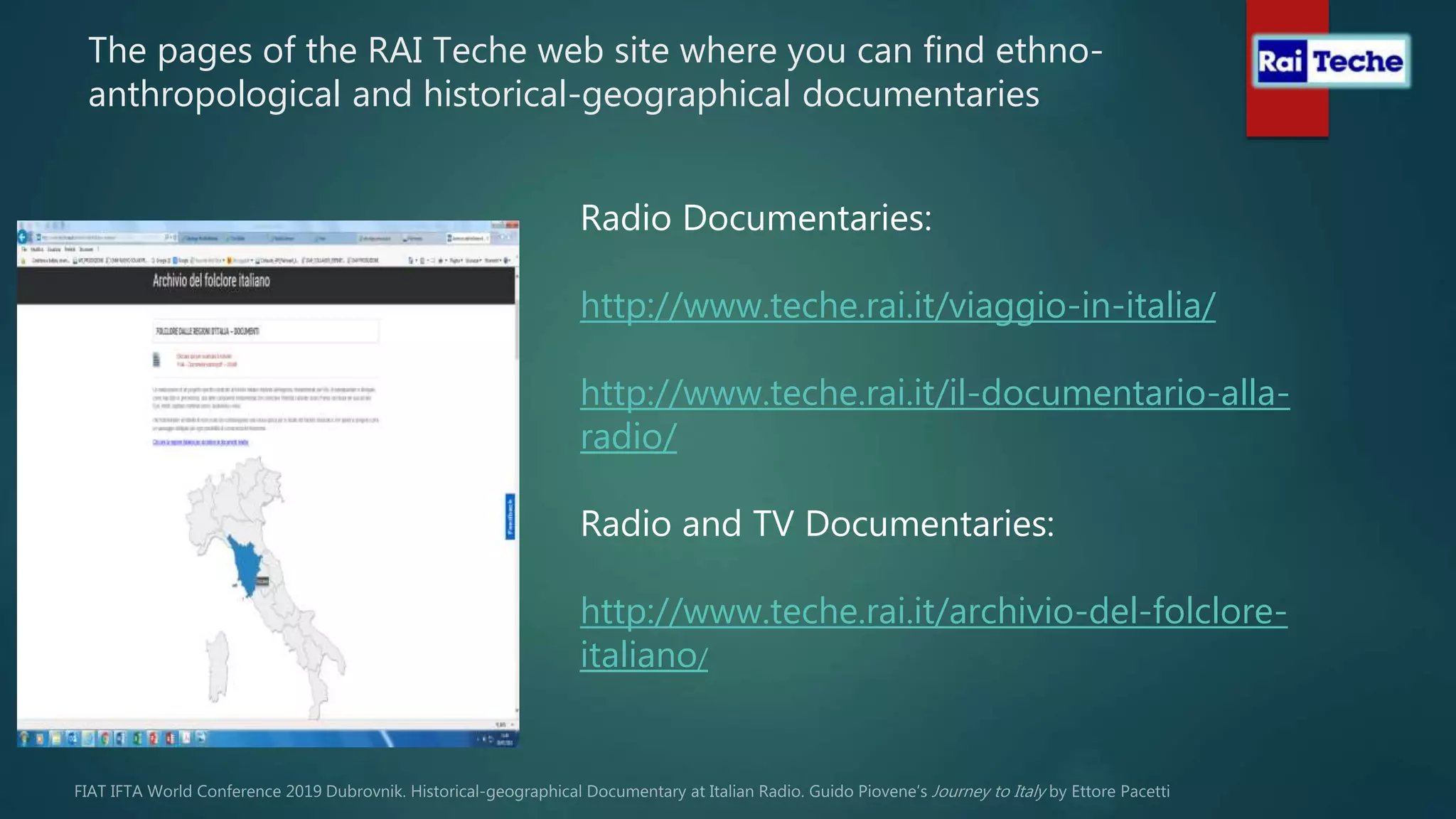
The pages of the RAI Teche web site where you can find ethno-
anthropological and historical-geographical documentaries
Radio Documentaries:
http://www.teche.rai.it/viaggio-in-italia/
http://www.teche.rai.it/il-documentario-alla-
radio/
Radio and TV Documentaries:
http://www.teche.rai.it/archivio-del-folclore-
italiano/
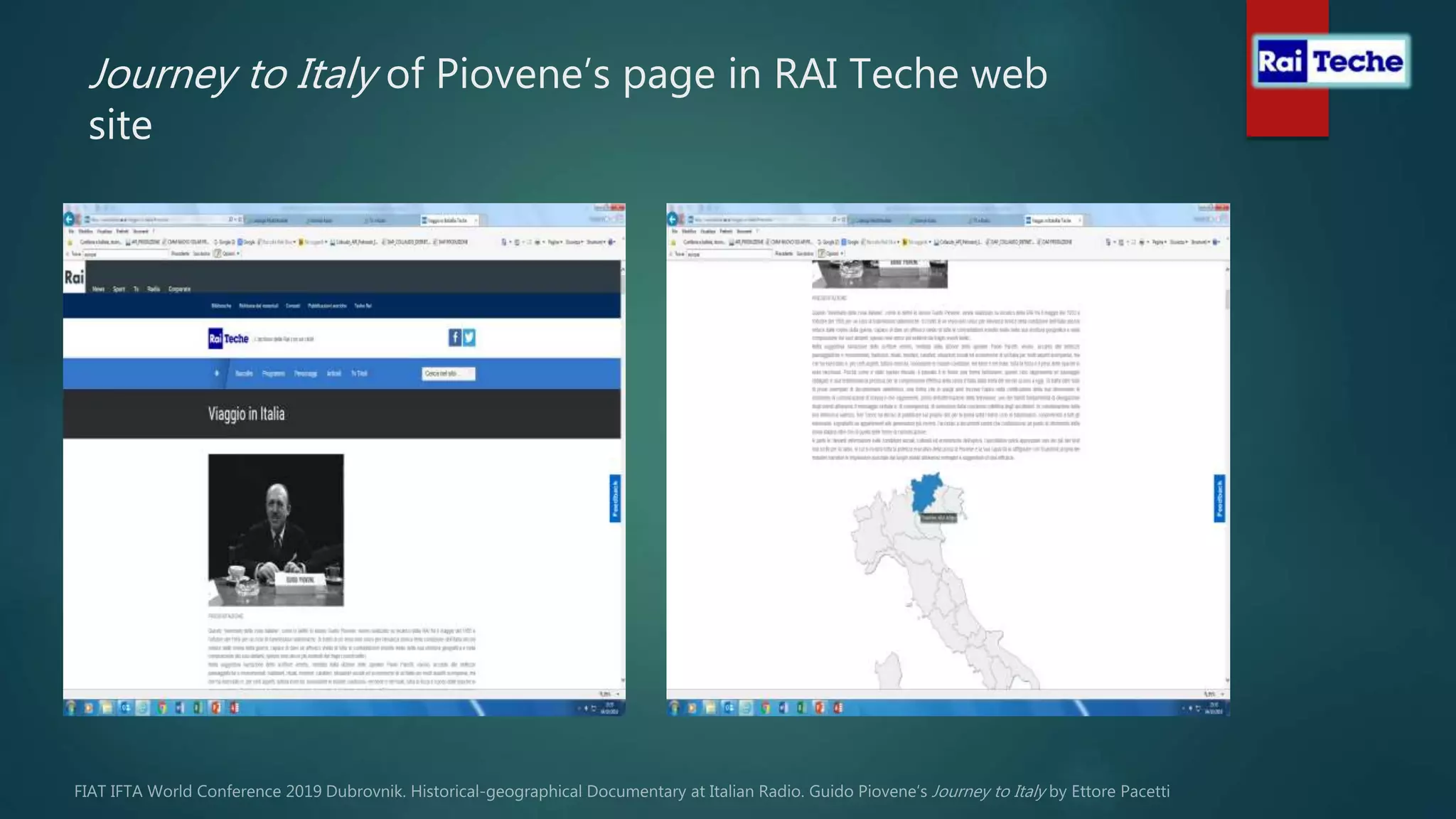
Journey to Italy of Piovene’s page in RAI Teche web
site
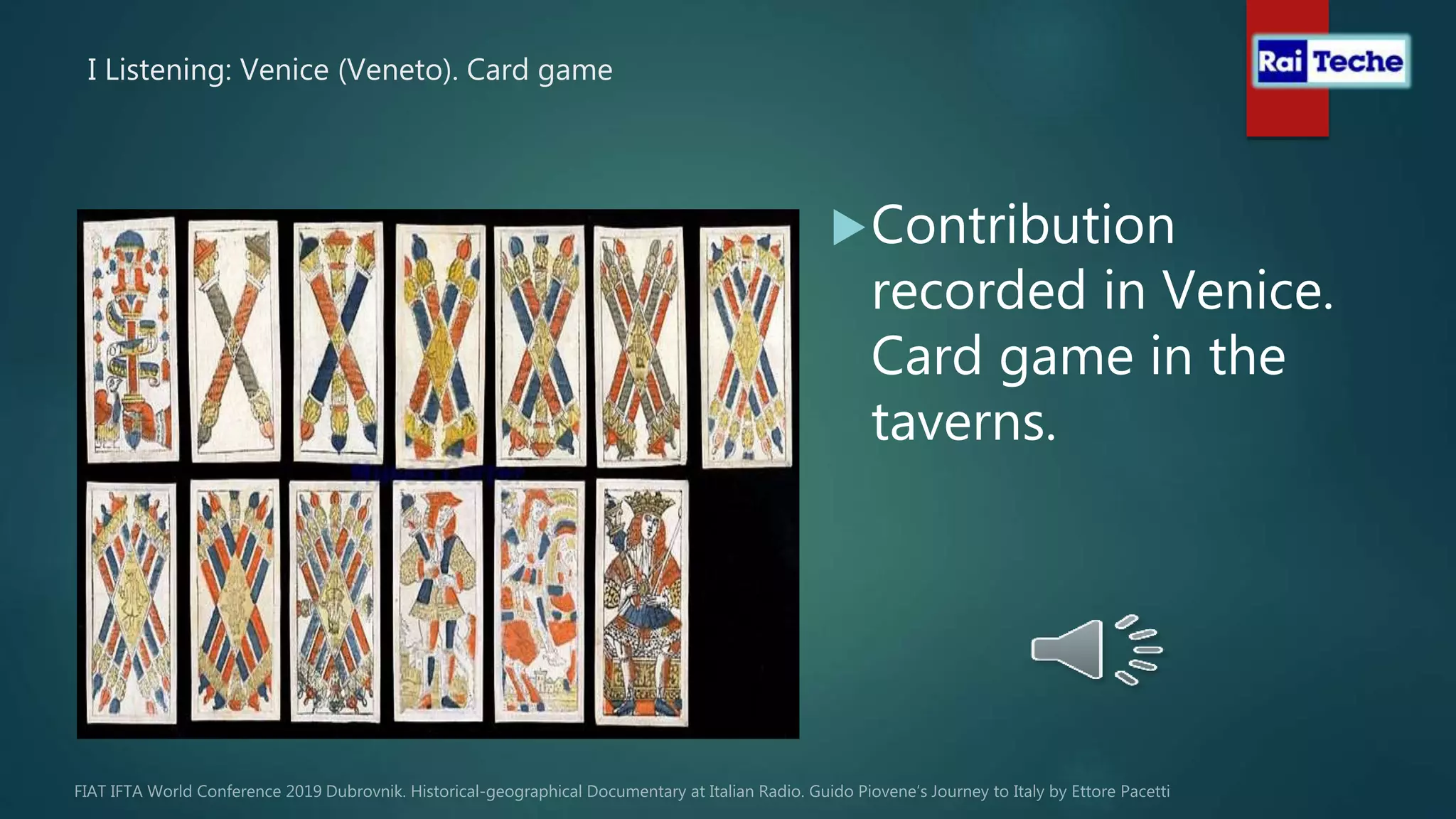
I Listening: Venice (Veneto). Card game
Contribution
recorded in Venice.
Card game in the
taverns.
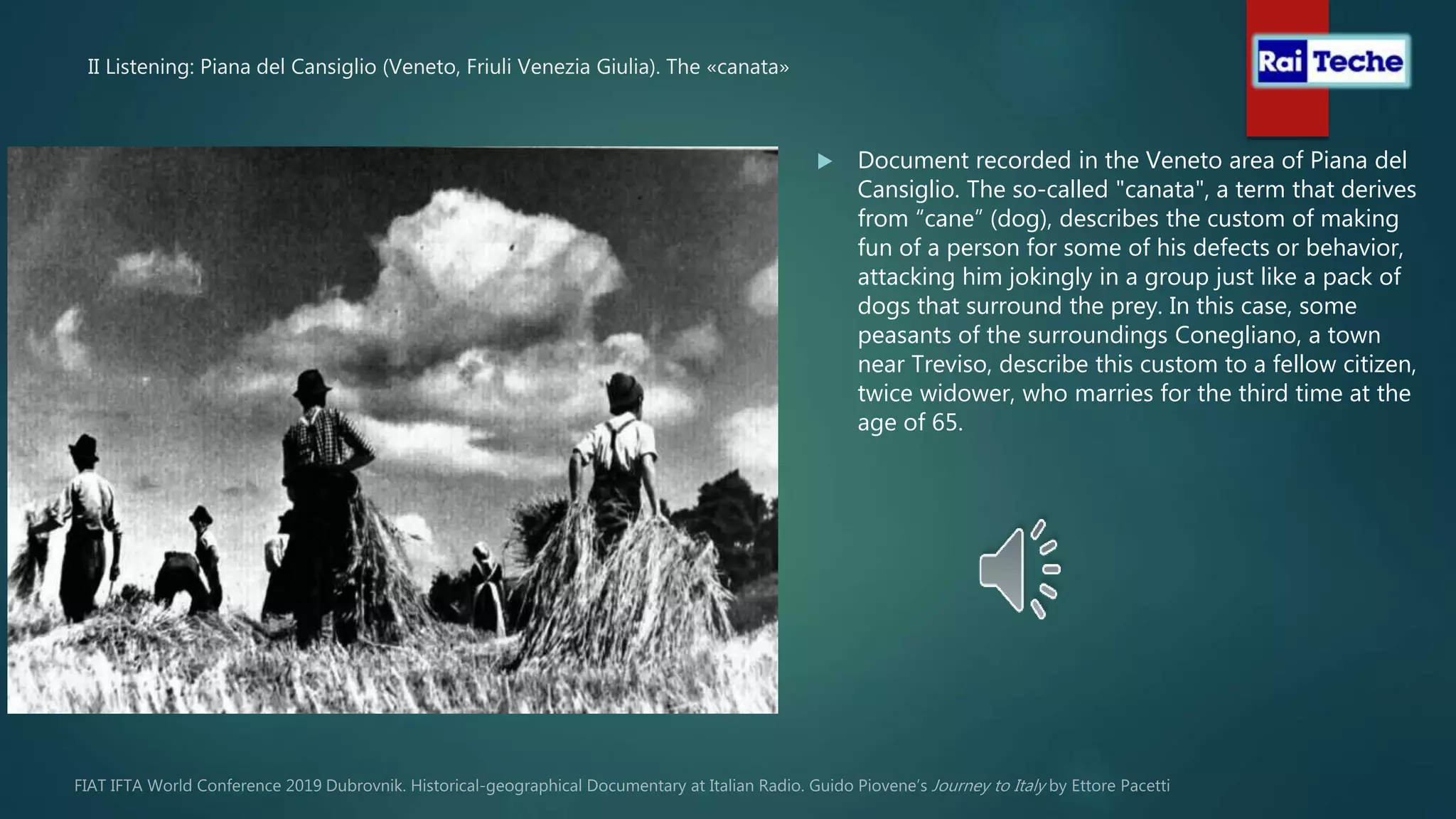
II Listening: Piana del Cansiglio (Veneto, Friuli Venezia Giulia). The «canata»
 Document recorded in the Veneto area of Piana del
Cansiglio. The so-called "canata", a term that derives
from “cane” (dog), describes the custom of making
fun of a person for some of his defects or behavior,
attacking him jokingly in a group just like a pack of
dogs that surround the prey. In this case, some
peasants of the surroundings Conegliano, a town
near Treviso, describe this custom to a fellow citizen,
twice widower, who marries for the third time at the
age of 65.
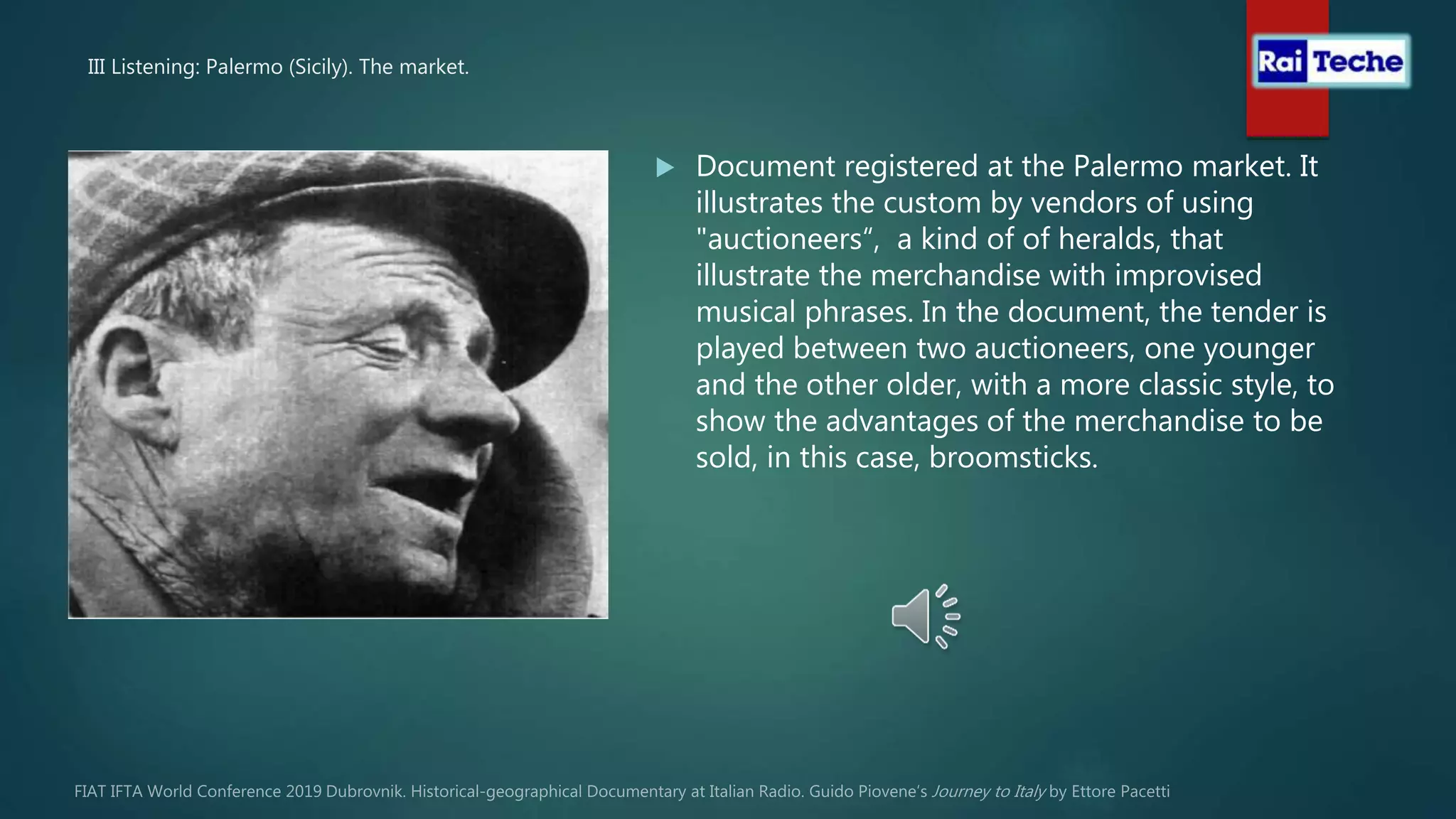
III Listening: Palermo (Sicily). The market.
 Document registered at the Palermo market. It
illustrates the custom by vendors of using
"auctioneers“, a kind of of heralds, that
illustrate the merchandise with improvised
musical phrases. In the document, the tender is
played between two auctioneers, one younger
and the other older, with a more classic style, to
show the advantages of the merchandise to be
sold, in this case, broomsticks.
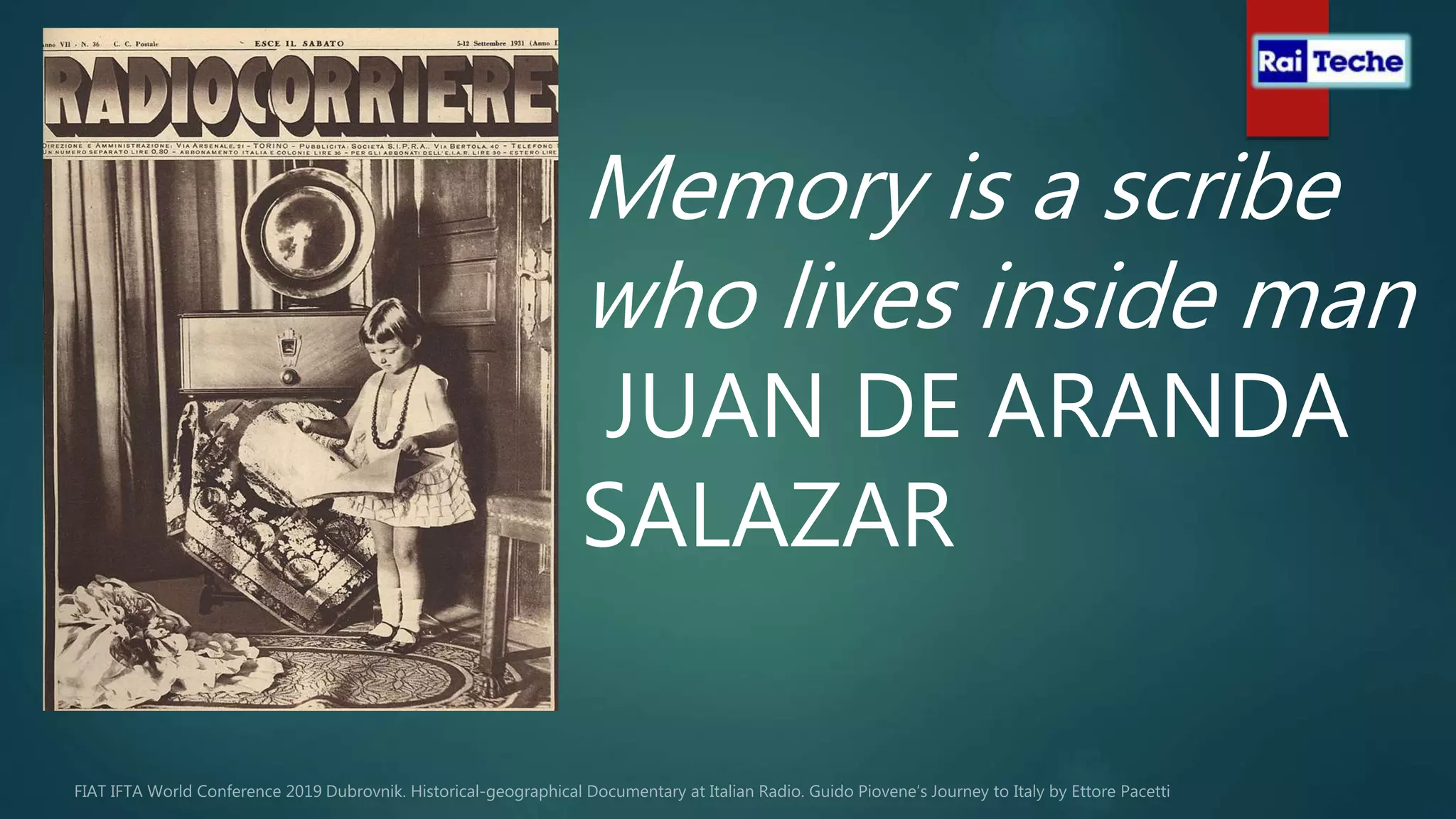
Memory is a scribe
who lives inside man
JUAN DE ARANDA
SALAZAR
Many Thanks
ettore.pacetti@rai.it

PACETTI Historical Geographical Documentary at RAI

  • 1.
    by Daniela FLORISand Ettore PACETTI
  • 3.
    Premises  John Grierson(1898 – 1972), «father» of the word documentary.  Documentary: the creative treatment of actuality(1926):  Actuality: the events of reality captured by the operator with their sounds and their images at the very moment they are produced.  Creative treatment: the editing of the shots according to a precise expressive intent and, above all, the addition of a comment, usually told by a voice-over, with the function of illustrating the author's perspective and his interpretation of narrated facts.
  • 4.
    The origins inItaly and the years of fascism  Beginning of radio broadcasts in Italy: 6 October 1924. For two years, Italy had been under fascism.  Radio-chronicles, first forms of radio documentary.  1931 Voci del mondo (Voices of the World): first radio documentary experiment of the Italian radio, with sounds and voices coming from the world of work, daily life, natural environments.
  • 5.
    Postwar Period  Withthe end of the Second World War, the radio tries to gain public confidence again. The greatest urgency is to represent the aspects of Italy linked to the world of work and social life, to the misery and backwardness of the rural world, which Fascism had kept hidden.
  • 6.
    Radio Neo-realism The momentof greatest progress of the radio documentary, between the late Forties and the early Sixties of the last century, simultaneously to the birth of cinematographic Neorealism, represented by the works of Vittorio de Sica, Roberto Rossellini, Giuseppe De Santis, Luchino Visconti and other cinematographic directors.
  • 7.
    Ethno-antropological Documentary andHistorical-geographical Documentary.  Around 1945. The need to make a renewal of the disciplines based on the study of the condition of man in society begins to be felt.  The ethno-anthropological documentary and the historical-geographical documentary are born.
  • 8.
    Ethno-antropological Documentary  TheItalian ethno-anthropological documentary was born towards the end of the fifties of the last century around the work of the great ethnologist, anthropologist and historian of religions Ernesto De Martino (1908 – 1965).  His most important radio documentary was Expedition in Lucania, recorded between 1952 and 1953.
  • 9.
    Historical-geographical Documentary. Like theethno- anthropological documentary, the historical- geographical documentary obeys the need to represent the Italian reality in its authenticity.
  • 10.
    Viaggio in Italiadi Guido Piovene  Guido Piovene (1907 – 1974)  Journey to Italy was a cycle of radio documentaries on the regions of Italy, commissioned by RAI between May 1953 and October 1956 and broadcast from 6 December 1954 to 17 December 1956.
  • 11.
    Characteristics of Piovene'sJourney to Italy  In the documentaries of Journey to Italy the cultural deepening merges with the social and economic analysis.  The characteristics are those typical of the radio documentary:  A voiceover, represented by the speaker who is entrusted with the narration.  Readings of texts concerning the areas visited.  Direct testimonies of protagonists and anonymous inhabitants of the regional realities interviewed during the various inspections.  Voices and ambient sounds collected in the places visited
  • 12.
    Narrative structure ofPiovene's Journey to Italy  The structure followed by Piovene is generally successfully maintained for each region:  Description from the geophysical, historical and artistic point of view.  Analysis of the distinctive traits, customs and mentality of the inhabitants.
  • 13.
    The RAI Techeproject  Digitization of historical-geographical documentaries still preserved on analogue supports.  Insertion of metadata for digitized materials to ensure greater ease of consultation and full availability of content.  Publication of documents filed in research portals based on homogeneous information criteria.
  • 14.
    The pages ofthe RAI Teche web site where you can find ethno- anthropological and historical-geographical documentaries Radio Documentaries: http://www.teche.rai.it/viaggio-in-italia/ http://www.teche.rai.it/il-documentario-alla- radio/ Radio and TV Documentaries: http://www.teche.rai.it/archivio-del-folclore- italiano/
  • 15.
    Journey to Italyof Piovene’s page in RAI Teche web site
  • 16.
    I Listening: Venice(Veneto). Card game Contribution recorded in Venice. Card game in the taverns.
  • 17.
    II Listening: Pianadel Cansiglio (Veneto, Friuli Venezia Giulia). The «canata»  Document recorded in the Veneto area of Piana del Cansiglio. The so-called "canata", a term that derives from “cane” (dog), describes the custom of making fun of a person for some of his defects or behavior, attacking him jokingly in a group just like a pack of dogs that surround the prey. In this case, some peasants of the surroundings Conegliano, a town near Treviso, describe this custom to a fellow citizen, twice widower, who marries for the third time at the age of 65.
  • 18.
    III Listening: Palermo(Sicily). The market.  Document registered at the Palermo market. It illustrates the custom by vendors of using "auctioneers“, a kind of of heralds, that illustrate the merchandise with improvised musical phrases. In the document, the tender is played between two auctioneers, one younger and the other older, with a more classic style, to show the advantages of the merchandise to be sold, in this case, broomsticks.
  • 19.
    Memory is ascribe who lives inside man JUAN DE ARANDA SALAZAR
  • 20.