Chapter Five: Constitution,
Democracy and Human
Rights
5.3 Constitution and Constitutionalism
5.3.1.Conceptualizing Constitution
 Constitution is figuratively defined as the fundamental or
basic law of a state which sets out the structure of the state
and also lists the rights of citizens alongside the limits on the
power exercise of a government.
 It is a blue print placed on top the hierarchy of laws on
constitutional governments.
 It is a collection of principles according to which the powers
of the government, the rights of the governed, and the
relation between the two are adjusted.
 Constitution state General Principles.
 Constitution is the mothers of all laws; all other ordinary laws
are derived from and subjected to this blue print.
 any other law contradicted with the provisions of the
constitution becomes void or invalid.
5.3.2.Peculiar Features of Constitution
 Constitution is a contract or an agreement between the ruler and
the ruled.
 The following are some of the distinctive features of a constitution.
1. Generality: it states general framework and principles. While
other laws are detail. The generality is very important because it
give the constitution a feature of elasticity through interpretation
thereby to accommodate various questions.
2. Permanency: unlike laws constitution is made for undefined
period of time. On the contrary, other laws are tentative,
occasional and in the nature of temporary existence.
3. Supremacy: it’s above all other laws. It is original because it is
directly made by the people as the direct expression of the will of
the people.
4. Codified document: Constitutions are written down; expressly
stated processes for revising or amending.
5. Allocation of powers: outline the proper relations between
institutions and offices of the state, and between government and
citizens.
5.3.3Major Purposes and Functions of Constitution
1. It serves as a framework for Government: it is a brief and a
general outline of duties and rights of governments and also
that of citizens.
2. It Limits the Powers of Government: A constitutional Government
is neither too powerful nor too weak.
3. It protects individual and collective rights of citizens:
4. It serves as the Supreme (Highest) Law of a Country: the
constitution of state is referred to as “the law behind other laws
or “the Mother of all laws” of a country.
5. It provides Government legitimacy/stability: gives governments
a legitimate/legal right to rule or govern. provide the vital
function of introducing a measure of stability, order, and
predictability of government.
6. Constitution Blue Prints for establishing Values and Goals: the
fundamental aims (objectives) and principles are described or
accomplished explicitly in preambles to constitutional
documents, which often function as statements of national
ideals and values.
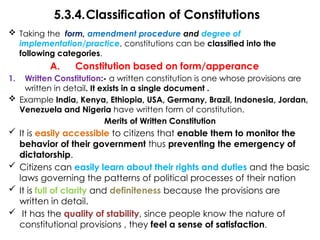
5.3.4.Classification of Constitutions
 Taking the form, amendment procedure and degree of
implementation/practice, constitutions can be classified into the
following categories.
A. Constitution based on form/apperance
1. Written Constitution:- a written constitution is one whose provisions are
written in detail. It exists in a single document .
 Example India, Kenya, Ethiopia, USA, Germany, Brazil, Indonesia, Jordan,
Venezuela and Nigeria have written form of constitution.
Merits of Written Constitution
 It is easily accessible to citizens that enable them to monitor the
behavior of their government thus preventing the emergency of
dictatorship.
 Citizens can easily learn about their rights and duties and the basic
laws governing the patterns of political processes of their nation
 It is full of clarity and definiteness because the provisions are
written in detail.
 It has the quality of stability, since people know the nature of
constitutional provisions , they feel a sense of satisfaction.
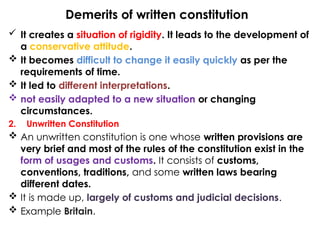
Demerits of written constitution
 It creates a situation of rigidity. It leads to the development of
a conservative attitude.
 It becomes difficult to change it easily quickly as per the
requirements of time.
 It led to different interpretations.
 not easily adapted to a new situation or changing
circumstances.
2. Unwritten Constitution
 An unwritten constitution is one whose written provisions are
very brief and most of the rules of the constitution exist in the
form of usages and customs. It consists of customs,
conventions, traditions, and some written laws bearing
different dates.
 It is made up, largely of customs and judicial decisions.
 Example Britain.
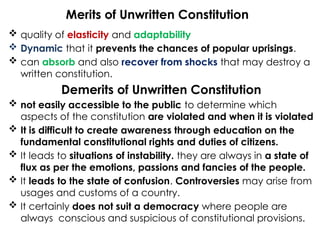
Merits of Unwritten Constitution
 quality of elasticity and adaptability
 Dynamic that it prevents the chances of popular uprisings.
 can absorb and also recover from shocks that may destroy a
written constitution.
Demerits of Unwritten Constitution
 not easily accessible to the public to determine which
aspects of the constitution are violated and when it is violated
 It is difficult to create awareness through education on the
fundamental constitutional rights and duties of citizens.
 It leads to situations of instability. they are always in a state of
flux as per the emotions, passions and fancies of the people.
 It leads to the state of confusion. Controversies may arise from
usages and customs of a country.
 It certainly does not suit a democracy where people are
always conscious and suspicious of constitutional provisions.
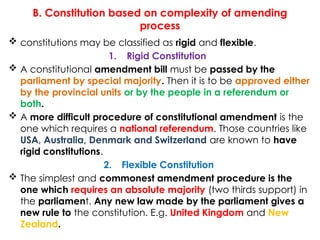
B. Constitution based on complexity of amending
process
 constitutions may be classified as rigid and flexible.
1. Rigid Constitution
 A constitutional amendment bill must be passed by the
parliament by special majority. Then it is to be approved either
by the provincial units or by the people in a referendum or
both.
 A more difficult procedure of constitutional amendment is the
one which requires a national referendum. Those countries like
USA, Australia, Denmark and Switzerland are known to have
rigid constitutions.
2. Flexible Constitution
 The simplest and commonest amendment procedure is the
one which requires an absolute majority (two thirds support) in
the parliament. Any new law made by the parliament gives a
new rule to the constitution. E.g. United Kingdom and New
Zealand.
C. Constitution based on degree of practice
1. Effective Constitution: a situation in which
government/citizens practices correspond to the provisions
of the constitution.
2. Nominal constitution: when the constitution only remains to
have paper value or when there is absence of
constitutionalism.
D. Based on the kind of state structure
 unitary and federal constitution .
1. Federal Constitution: Federal constitution is one that
distributes power among the different units of a state
administration. United States of America, Canada, Australia
and Malaysia are examples.
2. Unitary Constitution: state power is concentrated in the
hands of the central government.
5.4. Constitutionalism
 Constitutionalism is being subject to limitations and that citizens
and governments operate in accordance with the general rules
and laws rather than arbitrary.
 the essential elements for constitutionalism are constitution and
its effective implementation.
 constitutionalism does not merely require the existence of
constitution.
5.5. The Constitutional Experience of Ethiopia: Pre and Post
1931
5.5.1. Traditionnel Constitution (Pre- 1931)
 Documents like the Kebra Nagast, the Fatha Nagast and serate mengest
from the 13th Century until the early 20th Century were the precursors to the
formal written Ethiopian national constitutions of the modern era.
Fetha Negest
 (The Law of Kings) was a religious and secular legal provision. written in
Arabic by the Coptic Egyptian writer Abu-l Fada’il Ibn al-Assal (commonly
known as Ibn al-Assal) when Cyril III was the Patriarch of Alexandria (1235-
1243).
Continued…
Kibre Negest
 Literally, Kibre Negest means glory of king. This document was
written by six Tigrean clerics and completed in the early 14th
Century.
 it determine the succession of the throne in Ethiopia. It was the
principal sources of legitimacy for the kings.
Ser’ate Mengist
 provided certain administrative protocol and directives in the
19th century.
5.5.2. The 1931 First Written Constitution
 The constitution was written on July16, 1931 by Emperor Haile
Selassie.
 The constitution reinforced the traditional position of the
emperor as ‘Siyume Egziabiher, Niguse Negast Za Ethiopia’
 External factor for writing the constitution is to Became member
of League of Nations. The constitution copied from Japan.
Continued…
 Internally, the 1931 constitution was intended to provide a legal
framework for the suppression of the powerful traditional
nobilities to the emperor.
 It was designed to unify and centralize all state power in the
hands of the monarch.
5.5.3. The Revised Constitution of 1955
 The revision of the 1931 constitution was urged by both internal
and external factors.
 The Constitution spent one chapter settling the issue of
succession on the rule of male primogeniture.
 Interestingly enough it also contained an elaborate regime of
civil and political rights for the subjects. It contemplated even an
independent ministerial government responsible to the monarch
and parliament, an elected chamber and independent
judiciary.
 It was revised because of internal and external factors mainly to
cope up with the social and political dynamics of the then
period, global politics, and Ethio-Eritrean federation.
Continued…
 The federation of Eritrea with Ethiopia led to the addition of
two new documents in to the Ethiopia legal system. These
were the federal act and the Eritrean constitution.
5.5.4. The 1987 Constitution of People’s Democratic
Republic Ethiopia (PDRE)
 the time from 1974-1987 was a period of constitutional
vacuum in Ethiopia.
 The People’s Democratic Republic Ethiopia constitution
(1987) was different from the 1931 and the 1955 imperial
constitutions in that constitution:
1. State and religion were separated for the first time.
2. political power and sovereignty were given for the workers.
3. contains provisions on democratic and human rights.
4. recognized the different cultural identities and the equality
of Nation and Nationalities.
Continued…
5. a transition from a none party system to a single party system.
6. aimed at the principles of Marxist and Leninist ideology.
7. Aimed at giving power to the peoples so that they exercise
through referendum, local and national assembly.
5.5.5 The 1995 (FDRE) Constitution
 Of the total 106 articles of the constitution just about one third
(approximately 33 articles) is devoted to the discussion of rights.
 The democratic rights enshrined in the constitution tend to be
essentially group-oriented and political in nature the human
rights on the other hand are individualistic and natural.
 This constitution make federal state.
 The 2nd
chapter have five Fundamental principles, popular
sovereignty (art. 8), constitutional supremacy (art. 9), human
rights (art. 10), secularism (art. 11) and accountability and
transparency of government (Art.12).

civics constitution and democracy Chapter Five.pptx

  • 1.
    Chapter Five: Constitution, Democracyand Human Rights 5.3 Constitution and Constitutionalism
  • 2.
    5.3.1.Conceptualizing Constitution  Constitutionis figuratively defined as the fundamental or basic law of a state which sets out the structure of the state and also lists the rights of citizens alongside the limits on the power exercise of a government.  It is a blue print placed on top the hierarchy of laws on constitutional governments.  It is a collection of principles according to which the powers of the government, the rights of the governed, and the relation between the two are adjusted.  Constitution state General Principles.  Constitution is the mothers of all laws; all other ordinary laws are derived from and subjected to this blue print.  any other law contradicted with the provisions of the constitution becomes void or invalid.
  • 3.
    5.3.2.Peculiar Features ofConstitution  Constitution is a contract or an agreement between the ruler and the ruled.  The following are some of the distinctive features of a constitution. 1. Generality: it states general framework and principles. While other laws are detail. The generality is very important because it give the constitution a feature of elasticity through interpretation thereby to accommodate various questions. 2. Permanency: unlike laws constitution is made for undefined period of time. On the contrary, other laws are tentative, occasional and in the nature of temporary existence. 3. Supremacy: it’s above all other laws. It is original because it is directly made by the people as the direct expression of the will of the people. 4. Codified document: Constitutions are written down; expressly stated processes for revising or amending. 5. Allocation of powers: outline the proper relations between institutions and offices of the state, and between government and citizens.
  • 4.
    5.3.3Major Purposes andFunctions of Constitution 1. It serves as a framework for Government: it is a brief and a general outline of duties and rights of governments and also that of citizens. 2. It Limits the Powers of Government: A constitutional Government is neither too powerful nor too weak. 3. It protects individual and collective rights of citizens: 4. It serves as the Supreme (Highest) Law of a Country: the constitution of state is referred to as “the law behind other laws or “the Mother of all laws” of a country. 5. It provides Government legitimacy/stability: gives governments a legitimate/legal right to rule or govern. provide the vital function of introducing a measure of stability, order, and predictability of government. 6. Constitution Blue Prints for establishing Values and Goals: the fundamental aims (objectives) and principles are described or accomplished explicitly in preambles to constitutional documents, which often function as statements of national ideals and values.
  • 5.
    5.3.4.Classification of Constitutions Taking the form, amendment procedure and degree of implementation/practice, constitutions can be classified into the following categories. A. Constitution based on form/apperance 1. Written Constitution:- a written constitution is one whose provisions are written in detail. It exists in a single document .  Example India, Kenya, Ethiopia, USA, Germany, Brazil, Indonesia, Jordan, Venezuela and Nigeria have written form of constitution. Merits of Written Constitution  It is easily accessible to citizens that enable them to monitor the behavior of their government thus preventing the emergency of dictatorship.  Citizens can easily learn about their rights and duties and the basic laws governing the patterns of political processes of their nation  It is full of clarity and definiteness because the provisions are written in detail.  It has the quality of stability, since people know the nature of constitutional provisions , they feel a sense of satisfaction.
  • 6.
    Demerits of writtenconstitution  It creates a situation of rigidity. It leads to the development of a conservative attitude.  It becomes difficult to change it easily quickly as per the requirements of time.  It led to different interpretations.  not easily adapted to a new situation or changing circumstances. 2. Unwritten Constitution  An unwritten constitution is one whose written provisions are very brief and most of the rules of the constitution exist in the form of usages and customs. It consists of customs, conventions, traditions, and some written laws bearing different dates.  It is made up, largely of customs and judicial decisions.  Example Britain.
  • 7.
    Merits of UnwrittenConstitution  quality of elasticity and adaptability  Dynamic that it prevents the chances of popular uprisings.  can absorb and also recover from shocks that may destroy a written constitution. Demerits of Unwritten Constitution  not easily accessible to the public to determine which aspects of the constitution are violated and when it is violated  It is difficult to create awareness through education on the fundamental constitutional rights and duties of citizens.  It leads to situations of instability. they are always in a state of flux as per the emotions, passions and fancies of the people.  It leads to the state of confusion. Controversies may arise from usages and customs of a country.  It certainly does not suit a democracy where people are always conscious and suspicious of constitutional provisions.
  • 8.
    B. Constitution basedon complexity of amending process  constitutions may be classified as rigid and flexible. 1. Rigid Constitution  A constitutional amendment bill must be passed by the parliament by special majority. Then it is to be approved either by the provincial units or by the people in a referendum or both.  A more difficult procedure of constitutional amendment is the one which requires a national referendum. Those countries like USA, Australia, Denmark and Switzerland are known to have rigid constitutions. 2. Flexible Constitution  The simplest and commonest amendment procedure is the one which requires an absolute majority (two thirds support) in the parliament. Any new law made by the parliament gives a new rule to the constitution. E.g. United Kingdom and New Zealand.
  • 9.
    C. Constitution basedon degree of practice 1. Effective Constitution: a situation in which government/citizens practices correspond to the provisions of the constitution. 2. Nominal constitution: when the constitution only remains to have paper value or when there is absence of constitutionalism. D. Based on the kind of state structure  unitary and federal constitution . 1. Federal Constitution: Federal constitution is one that distributes power among the different units of a state administration. United States of America, Canada, Australia and Malaysia are examples. 2. Unitary Constitution: state power is concentrated in the hands of the central government.
  • 10.
    5.4. Constitutionalism  Constitutionalismis being subject to limitations and that citizens and governments operate in accordance with the general rules and laws rather than arbitrary.  the essential elements for constitutionalism are constitution and its effective implementation.  constitutionalism does not merely require the existence of constitution. 5.5. The Constitutional Experience of Ethiopia: Pre and Post 1931 5.5.1. Traditionnel Constitution (Pre- 1931)  Documents like the Kebra Nagast, the Fatha Nagast and serate mengest from the 13th Century until the early 20th Century were the precursors to the formal written Ethiopian national constitutions of the modern era. Fetha Negest  (The Law of Kings) was a religious and secular legal provision. written in Arabic by the Coptic Egyptian writer Abu-l Fada’il Ibn al-Assal (commonly known as Ibn al-Assal) when Cyril III was the Patriarch of Alexandria (1235- 1243).
  • 11.
    Continued… Kibre Negest  Literally,Kibre Negest means glory of king. This document was written by six Tigrean clerics and completed in the early 14th Century.  it determine the succession of the throne in Ethiopia. It was the principal sources of legitimacy for the kings. Ser’ate Mengist  provided certain administrative protocol and directives in the 19th century. 5.5.2. The 1931 First Written Constitution  The constitution was written on July16, 1931 by Emperor Haile Selassie.  The constitution reinforced the traditional position of the emperor as ‘Siyume Egziabiher, Niguse Negast Za Ethiopia’  External factor for writing the constitution is to Became member of League of Nations. The constitution copied from Japan.
  • 12.
    Continued…  Internally, the1931 constitution was intended to provide a legal framework for the suppression of the powerful traditional nobilities to the emperor.  It was designed to unify and centralize all state power in the hands of the monarch. 5.5.3. The Revised Constitution of 1955  The revision of the 1931 constitution was urged by both internal and external factors.  The Constitution spent one chapter settling the issue of succession on the rule of male primogeniture.  Interestingly enough it also contained an elaborate regime of civil and political rights for the subjects. It contemplated even an independent ministerial government responsible to the monarch and parliament, an elected chamber and independent judiciary.  It was revised because of internal and external factors mainly to cope up with the social and political dynamics of the then period, global politics, and Ethio-Eritrean federation.
  • 13.
    Continued…  The federationof Eritrea with Ethiopia led to the addition of two new documents in to the Ethiopia legal system. These were the federal act and the Eritrean constitution. 5.5.4. The 1987 Constitution of People’s Democratic Republic Ethiopia (PDRE)  the time from 1974-1987 was a period of constitutional vacuum in Ethiopia.  The People’s Democratic Republic Ethiopia constitution (1987) was different from the 1931 and the 1955 imperial constitutions in that constitution: 1. State and religion were separated for the first time. 2. political power and sovereignty were given for the workers. 3. contains provisions on democratic and human rights. 4. recognized the different cultural identities and the equality of Nation and Nationalities.
  • 14.
    Continued… 5. a transitionfrom a none party system to a single party system. 6. aimed at the principles of Marxist and Leninist ideology. 7. Aimed at giving power to the peoples so that they exercise through referendum, local and national assembly. 5.5.5 The 1995 (FDRE) Constitution  Of the total 106 articles of the constitution just about one third (approximately 33 articles) is devoted to the discussion of rights.  The democratic rights enshrined in the constitution tend to be essentially group-oriented and political in nature the human rights on the other hand are individualistic and natural.  This constitution make federal state.  The 2nd chapter have five Fundamental principles, popular sovereignty (art. 8), constitutional supremacy (art. 9), human rights (art. 10), secularism (art. 11) and accountability and transparency of government (Art.12).