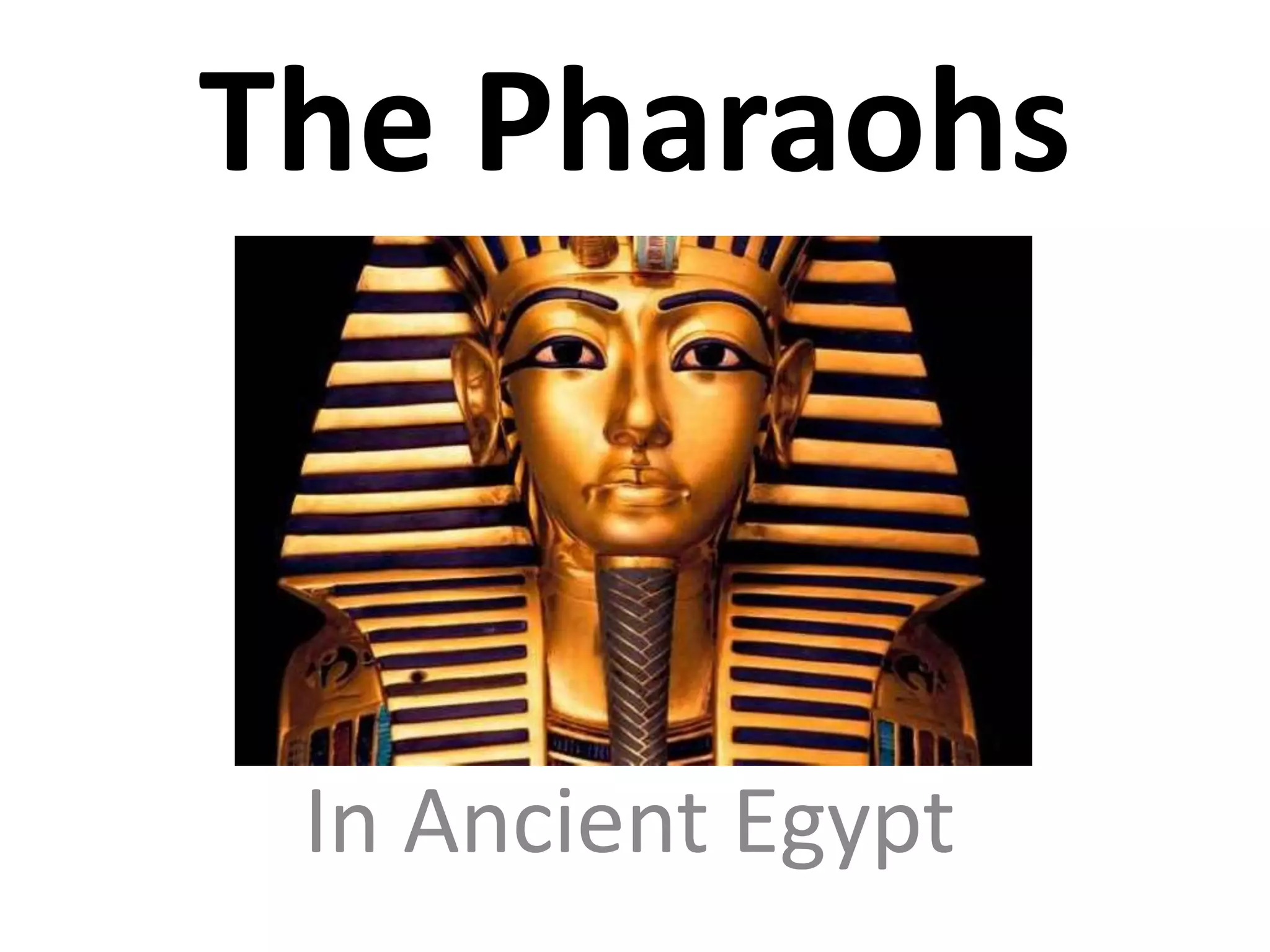
The Pharaohs 
In Ancient Egypt
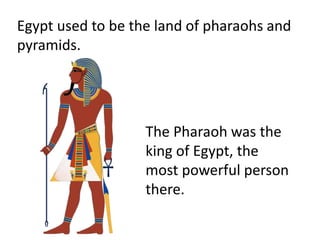
Egypt used to be the land of pharaohs and 
pyramids. 
The Pharaoh was the 
king of Egypt, the 
most powerful person 
there.
The Pharaoh 
had 2 titles 
Lord of the Two Lands 
He was the ruler of all Egypt. He owned 
all the land, made laws, collected taxes 
and defended Egypt against foreigners. 
High Priest of Every Temple 
He represented the Gods on Earth. He 
performed rituals and and built temples 
to honour the Gods.
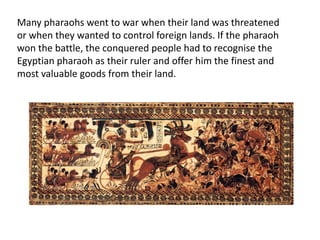
Many pharaohs went to war when their land was threatened 
or when they wanted to control foreign lands. If the pharaoh 
won the battle, the conquered people had to recognise the 
Egyptian pharaoh as their ruler and offer him the finest and 
most valuable goods from their land.
The Pharaohs 
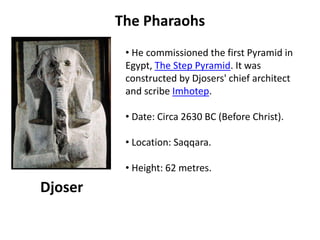
Djoser 
• He commissioned the first Pyramid in 
Egypt, The Step Pyramid. It was 
constructed by Djosers' chief architect 
and scribe Imhotep. 
• Date: Circa 2630 BC (Before Christ). 
• Location: Saqqara. 
• Height: 62 metres.
The Pharaohs 
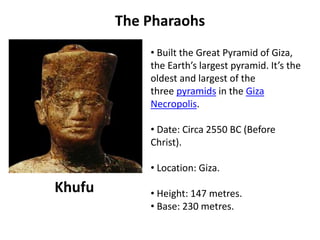
Khufu 
• Built the Great Pyramid of Giza, 
the Earth’s largest pyramid. It’s the 
oldest and largest of the 
three pyramids in the Giza 
Necropolis. 
• Date: Circa 2550 BC (Before 
Christ). 
• Location: Giza. 
• Height: 147 metres. 
• Base: 230 metres.
The Pharaohs 
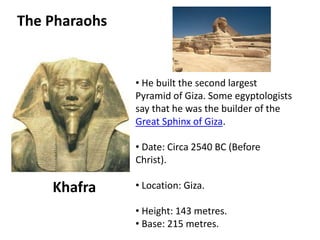
Khafra 
• He built the second largest 
Pyramid of Giza. Some egyptologists 
say that he was the builder of the 
Great Sphinx of Giza. 
• Date: Circa 2540 BC (Before 
Christ). 
• Location: Giza. 
• Height: 143 metres. 
• Base: 215 metres.
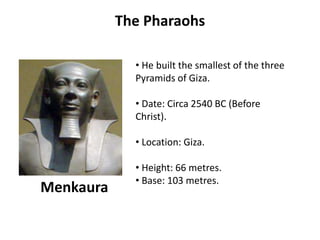
Menkaura 
The Pharaohs 
• He built the smallest of the three 
Pyramids of Giza. 
• Date: Circa 2540 BC (Before 
Christ). 
• Location: Giza. 
• Height: 66 metres. 
• Base: 103 metres.
The Pharaohs 
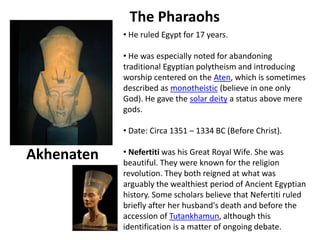
• He ruled Egypt for 17 years. 
• He was especially noted for abandoning 
traditional Egyptian polytheism and introducing 
worship centered on the Aten, which is sometimes 
described as monotheistic (believe in one only 
God). He gave the solar deity a status above mere 
gods. 
• Date: Circa 1351 – 1334 BC (Before Christ). 
• Nefertiti was his Great Royal Wife. She was 
beautiful. They were known for the religion 
revolution. They both reigned at what was 
arguably the wealthiest period of Ancient Egyptian 
history. Some scholars believe that Nefertiti ruled 
briefly after her husband's death and before the 
accession of Tutankhamun, although this 
identification is a matter of ongoing debate. 
Akhenaten
The Pharaohs 
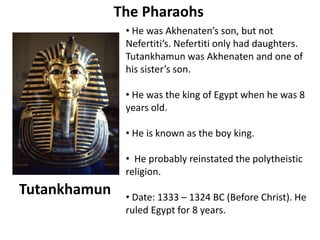
• He was Akhenaten’s son, but not 
Nefertiti’s. Nefertiti only had daughters. 
Tutankhamun was Akhenaten and one of 
his sister’s son. 
• He was the king of Egypt when he was 8 
years old. 
• He is known as the boy king. 
• He probably reinstated the polytheistic 
religion. 
• Date: 1333 – 1324 BC (Before Christ). He 
ruled Egypt for 8 years. 
Tutankhamun
The Pharaohs 
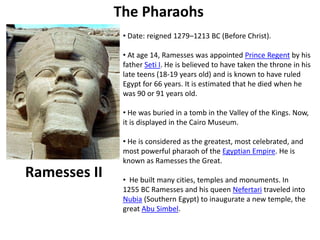
Ramesses II 
• Date: reigned 1279–1213 BC (Before Christ). 
• At age 14, Ramesses was appointed Prince Regent by his 
father Seti I. He is believed to have taken the throne in his 
late teens (18-19 years old) and is known to have ruled 
Egypt for 66 years. It is estimated that he died when he 
was 90 or 91 years old. 
• He was buried in a tomb in the Valley of the Kings. Now, 
it is displayed in the Cairo Museum. 
• He is considered as the greatest, most celebrated, and 
most powerful pharaoh of the Egyptian Empire. He is 
known as Ramesses the Great. 
• He built many cities, temples and monuments. In 
1255 BC Ramesses and his queen Nefertari traveled into 
Nubia (Southern Egypt) to inaugurate a new temple, the 
great Abu Simbel.
The Pharaohs 
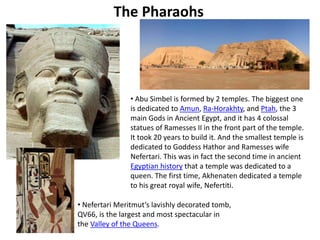
• Abu Simbel is formed by 2 temples. The biggest one 
is dedicated to Amun, Ra-Horakhty, and Ptah, the 3 
main Gods in Ancient Egypt, and it has 4 colossal 
statues of Ramesses II in the front part of the temple. 
It took 20 years to build it. And the smallest temple is 
dedicated to Goddess Hathor and Ramesses wife 
Nefertari. This was in fact the second time in ancient 
Egyptian history that a temple was dedicated to a 
queen. The first time, Akhenaten dedicated a temple 
to his great royal wife, Nefertiti. 
• Nefertari Meritmut’s lavishly decorated tomb, 
QV66, is the largest and most spectacular in 
the Valley of the Queens.
The Pharaohs 
Cleopatra VII 
• Date: 51 - 30 BC (Before Christ). 
• She was the last queen of Ancient Egypt. She became queen 
when she was 18 years old. 
•The Ptolemies spoke Greek and refused to speak Egyptian. 
But Cleopatra did learn to speak Egyptian and represented 
herself as the reincarnation of an Egyptian goddess, Isis. 
• Cleopatra originally ruled Egypt with her father, Ptolemy XII 
Auletes, and later with her brothers, Ptolemy XIII and Ptolemy 
XIV, whom she married as per Egyptian custom, but eventually 
she became sole ruler. As pharaoh, she consummated a liaison 
with Julius Caesar that solidified her grip on the throne. She 
later elevated her son with Caesar, Caesarion, to co-ruler in 
name.
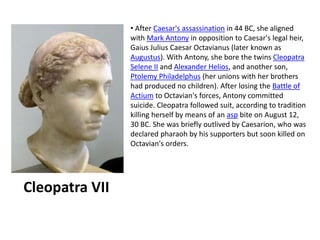
• After Caesar's assassination in 44 BC, she aligned 
with Mark Antony in opposition to Caesar's legal heir, 
Gaius Julius Caesar Octavianus (later known as 
Augustus). With Antony, she bore the twins Cleopatra 
Selene II and Alexander Helios, and another son, 
Ptolemy Philadelphus (her unions with her brothers 
had produced no children). After losing the Battle of 
Actium to Octavian's forces, Antony committed 
suicide. Cleopatra followed suit, according to tradition 
killing herself by means of an asp bite on August 12, 
30 BC. She was briefly outlived by Caesarion, who was 
declared pharaoh by his supporters but soon killed on 
Octavian's orders. 
Cleopatra VII

The pharaohs

  • 1.
    The Pharaohs InAncient Egypt
  • 2.
    Egypt used tobe the land of pharaohs and pyramids. The Pharaoh was the king of Egypt, the most powerful person there.
  • 3.
    The Pharaoh had2 titles Lord of the Two Lands He was the ruler of all Egypt. He owned all the land, made laws, collected taxes and defended Egypt against foreigners. High Priest of Every Temple He represented the Gods on Earth. He performed rituals and and built temples to honour the Gods.
  • 4.
    Many pharaohs wentto war when their land was threatened or when they wanted to control foreign lands. If the pharaoh won the battle, the conquered people had to recognise the Egyptian pharaoh as their ruler and offer him the finest and most valuable goods from their land.
  • 5.
    The Pharaohs Djoser • He commissioned the first Pyramid in Egypt, The Step Pyramid. It was constructed by Djosers' chief architect and scribe Imhotep. • Date: Circa 2630 BC (Before Christ). • Location: Saqqara. • Height: 62 metres.
  • 6.
    The Pharaohs Khufu • Built the Great Pyramid of Giza, the Earth’s largest pyramid. It’s the oldest and largest of the three pyramids in the Giza Necropolis. • Date: Circa 2550 BC (Before Christ). • Location: Giza. • Height: 147 metres. • Base: 230 metres.
  • 7.
    The Pharaohs Khafra • He built the second largest Pyramid of Giza. Some egyptologists say that he was the builder of the Great Sphinx of Giza. • Date: Circa 2540 BC (Before Christ). • Location: Giza. • Height: 143 metres. • Base: 215 metres.
  • 8.
    Menkaura The Pharaohs • He built the smallest of the three Pyramids of Giza. • Date: Circa 2540 BC (Before Christ). • Location: Giza. • Height: 66 metres. • Base: 103 metres.
  • 9.
    The Pharaohs •He ruled Egypt for 17 years. • He was especially noted for abandoning traditional Egyptian polytheism and introducing worship centered on the Aten, which is sometimes described as monotheistic (believe in one only God). He gave the solar deity a status above mere gods. • Date: Circa 1351 – 1334 BC (Before Christ). • Nefertiti was his Great Royal Wife. She was beautiful. They were known for the religion revolution. They both reigned at what was arguably the wealthiest period of Ancient Egyptian history. Some scholars believe that Nefertiti ruled briefly after her husband's death and before the accession of Tutankhamun, although this identification is a matter of ongoing debate. Akhenaten
  • 10.
    The Pharaohs •He was Akhenaten’s son, but not Nefertiti’s. Nefertiti only had daughters. Tutankhamun was Akhenaten and one of his sister’s son. • He was the king of Egypt when he was 8 years old. • He is known as the boy king. • He probably reinstated the polytheistic religion. • Date: 1333 – 1324 BC (Before Christ). He ruled Egypt for 8 years. Tutankhamun
  • 11.
    The Pharaohs RamessesII • Date: reigned 1279–1213 BC (Before Christ). • At age 14, Ramesses was appointed Prince Regent by his father Seti I. He is believed to have taken the throne in his late teens (18-19 years old) and is known to have ruled Egypt for 66 years. It is estimated that he died when he was 90 or 91 years old. • He was buried in a tomb in the Valley of the Kings. Now, it is displayed in the Cairo Museum. • He is considered as the greatest, most celebrated, and most powerful pharaoh of the Egyptian Empire. He is known as Ramesses the Great. • He built many cities, temples and monuments. In 1255 BC Ramesses and his queen Nefertari traveled into Nubia (Southern Egypt) to inaugurate a new temple, the great Abu Simbel.
  • 12.
    The Pharaohs •Abu Simbel is formed by 2 temples. The biggest one is dedicated to Amun, Ra-Horakhty, and Ptah, the 3 main Gods in Ancient Egypt, and it has 4 colossal statues of Ramesses II in the front part of the temple. It took 20 years to build it. And the smallest temple is dedicated to Goddess Hathor and Ramesses wife Nefertari. This was in fact the second time in ancient Egyptian history that a temple was dedicated to a queen. The first time, Akhenaten dedicated a temple to his great royal wife, Nefertiti. • Nefertari Meritmut’s lavishly decorated tomb, QV66, is the largest and most spectacular in the Valley of the Queens.
  • 13.
    The Pharaohs CleopatraVII • Date: 51 - 30 BC (Before Christ). • She was the last queen of Ancient Egypt. She became queen when she was 18 years old. •The Ptolemies spoke Greek and refused to speak Egyptian. But Cleopatra did learn to speak Egyptian and represented herself as the reincarnation of an Egyptian goddess, Isis. • Cleopatra originally ruled Egypt with her father, Ptolemy XII Auletes, and later with her brothers, Ptolemy XIII and Ptolemy XIV, whom she married as per Egyptian custom, but eventually she became sole ruler. As pharaoh, she consummated a liaison with Julius Caesar that solidified her grip on the throne. She later elevated her son with Caesar, Caesarion, to co-ruler in name.
  • 14.
    • After Caesar'sassassination in 44 BC, she aligned with Mark Antony in opposition to Caesar's legal heir, Gaius Julius Caesar Octavianus (later known as Augustus). With Antony, she bore the twins Cleopatra Selene II and Alexander Helios, and another son, Ptolemy Philadelphus (her unions with her brothers had produced no children). After losing the Battle of Actium to Octavian's forces, Antony committed suicide. Cleopatra followed suit, according to tradition killing herself by means of an asp bite on August 12, 30 BC. She was briefly outlived by Caesarion, who was declared pharaoh by his supporters but soon killed on Octavian's orders. Cleopatra VII