Webinar: State and Local
Government Pension Reform
Lessons from negotiated reforms
   and recent developments


         June 21, 2012
Today’s Presenters


• Keith Brainard, Research Director, National
  Association of State Retirement
  Administrators
• Joshua Franzel, Vice President, Research,
  Center for State and Local Government
  Excellence
• Alex Brown, Research & Policy Analyst,
  Center for State and Local Government
  Excellence
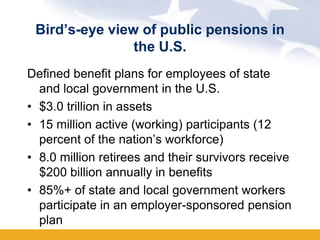
Bird’s-eye view of public pensions in
                the U.S.
Defined benefit plans for employees of state
  and local government in the U.S.
• $3.0 trillion in assets
• 15 million active (working) participants (12
  percent of the nation’s workforce)
• 8.0 million retirees and their survivors receive
  $200 billion annually in benefits
• 85%+ of state and local government workers
  participate in an employer-sponsored pension
  plan
Overarching Issues
• Pension benefits for employees of state and local
  government are in the midst of unprecedented
  change
• Public employee compensation, including
  retirement benefits, is the recipient of an
  unprecedented level of attention from the media,
  academics, and policymakers
• An unprecedented number of lawsuits challenging
  changes to pension benefits are outstanding
• State and local government employment is lower
  today by some 650,000 jobs, or 3.5%, from its
  August 2008 peak
Overarching Issues

• Pension accounting standards are on
  the verge of drastically changing the
  way public pension liabilities and costs
  are calculated
• Interest rates are at their lowest levels
  in decades and are projected to remain
  low through at least 2014
• Longevity is improving
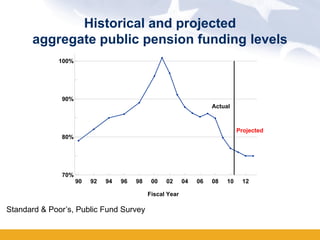
Historical and projected
      aggregate public pension funding levels
             100%


              90%
                                                                     Actual


                                                                               Projected
              80%


              70%
                    90   92   94   96   98    00   02      04   06   08   10    12

                                             Fiscal Year

Standard & Poor’s, Public Fund Survey
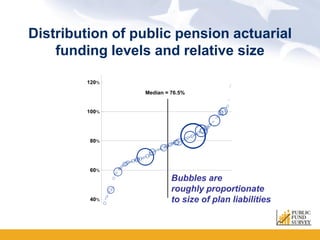
Distribution of public pension actuarial
    funding levels and relative size


                     Bubbles are
                     roughly proportionate
                     to size of plan liabilities
Changes to public pension plans in the
                U.S.

• Higher required retirement ages
• Longer vesting periods
• Higher employee contributions
• Fewer/lower cost-of-living adjustments
• Greater use of hybrid retirement plans
• Increased emphasis on employee-employer
  cost-sharing
• No shift to defined contribution plans as the
  primary retirement benefit
Retirement eligibility has become more
               stringent

• More normal (unreduced) retirement age
  requirements of 60, 65, and even 67

• Elimination of retirement eligibility at any age
  based on designated years of service

• Increased movement from five years as the
  predominant vesting period
Retirement benefits are being reduced


• COLAs
  – applied to only a portion of the benefit
  – More COLAs delayed until attainment of
    designated retirement age
  – More COLAs tied to actuarial condition of
    plan or fund’s investment performance
• Movement of final average salary period
  from three years to five and longer
Higher employee contributions


• Many states have approved higher
  employee pension contributions for
  existing plan participants
• In some states, this is held or perceived
  to be illegal
• Some higher rates are phased in over
  several years
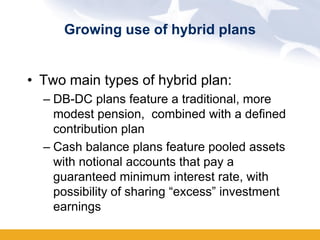
Growing use of hybrid plans


• Two main types of hybrid plan:
  – DB-DC plans feature a traditional, more
    modest pension, combined with a defined
    contribution plan
  – Cash balance plans feature pooled assets
    with notional accounts that pay a
    guaranteed minimum interest rate, with
    possibility of sharing “excess” investment
    earnings
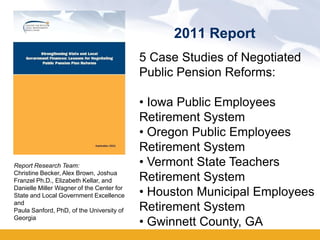
2011 Report
                                           5 Case Studies of Negotiated
                                           Public Pension Reforms:

                                           • Iowa Public Employees
                                           Retirement System
                                           • Oregon Public Employees
                                           Retirement System
Report Research Team:                      • Vermont State Teachers
Christine Becker, Alex Brown, Joshua
Franzel Ph.D., Elizabeth Kellar, and       Retirement System
Danielle Miller Wagner of the Center for
State and Local Government Excellence      • Houston Municipal Employees
and
Paula Sanford, PhD, of the University of   Retirement System
Georgia
                                           • Gwinnett County, GA
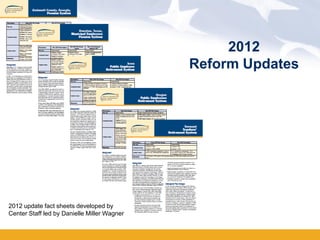
2012
                                             Reform Updates


2012 update fact sheets developed by
Center Staff led by Danielle Miller Wagner
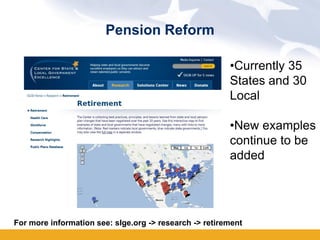
Pension Reform

                                                        •Currently 35
                                                        States and 30
                                                        Local

                                                        •New examples
                                                        continue to be
                                                        added


For more information see: slge.org -> research -> retirement
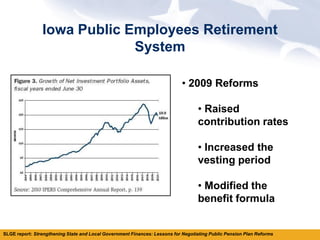
Iowa Public Employees Retirement
                             System

                                                                            • 2009 Reforms

                                                                                  • Raised
                                                                                  contribution rates

                                                                                  • Increased the
                                                                                  vesting period

                                                                                  • Modified the
                                                                                  benefit formula


SLGE report: Strengthening State and Local Government Finances: Lessons for Negotiating Public Pension Plan Reforms
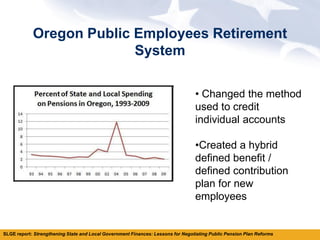
Oregon Public Employees Retirement
                          System

                                                                                 • Changed the method
                                                                                 used to credit
                                                                                 individual accounts

                                                                                 •Created a hybrid
                                                                                 defined benefit /
                                                                                 defined contribution
                                                                                 plan for new
                                                                                 employees


SLGE report: Strengthening State and Local Government Finances: Lessons for Negotiating Public Pension Plan Reforms
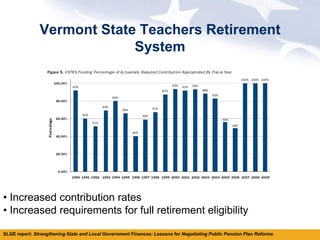
Vermont State Teachers Retirement
                            System


• Increased contribution rates
• Increased requirements for full retirement eligibility

SLGE report: Strengthening State and Local Government Finances: Lessons for Negotiating Public Pension Plan Reforms
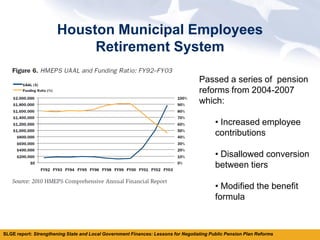
Houston Municipal Employees
                           Retirement System

                                                                                   Passed a series of pension
                                                                                   reforms from 2004-2007
                                                                                   which:

                                                                                          • Increased employee
                                                                                          contributions

                                                                                          • Disallowed conversion
                                                                                          between tiers

                                                                                          • Modified the benefit
                                                                                          formula


SLGE report: Strengthening State and Local Government Finances: Lessons for Negotiating Public Pension Plan Reforms
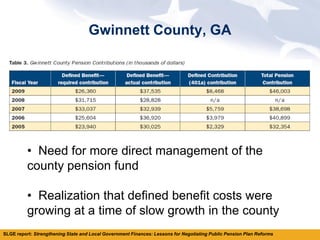
Gwinnett County, GA


          • Need for more direct management of the
          county pension fund

          • Realization that defined benefit costs were
          growing at a time of slow growth in the county
SLGE report: Strengthening State and Local Government Finances: Lessons for Negotiating Public Pension Plan Reforms
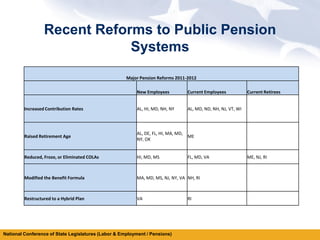
Recent Reforms to Public Pension
                              Systems
                                                     Major Pension Reforms 2011-2012

                                                         New Employees          Current Employees            Current Retirees


         Increased Contribution Rates                    AL, HI, MD, NH, NY     AL, MD, ND, NH, NJ, VT, WI


                                                         AL, DE, FL, HI, MA, MD,
         Raised Retirement Age                                                   ME
                                                         NY, OK


         Reduced, Froze, or Eliminated COLAs             HI, MD, MS             FL, MD, VA                   ME, NJ, RI


         Modified the Benefit Formula                    MA, MD, MS, NJ, NY, VA NH, RI


         Restructured to a Hybrid Plan                   VA                     RI


National Conference of State Legislatures (Labor & Employment / Pensions)
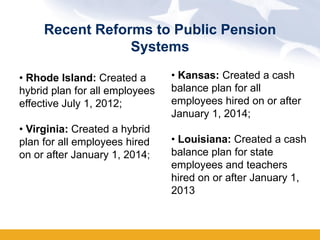
Recent Reforms to Public Pension
                 Systems

• Rhode Island: Created a       • Kansas: Created a cash
hybrid plan for all employees   balance plan for all
effective July 1, 2012;         employees hired on or after
                                January 1, 2014;
• Virginia: Created a hybrid
plan for all employees hired    • Louisiana: Created a cash
on or after January 1, 2014;    balance plan for state
                                employees and teachers
                                hired on or after January 1,
                                2013
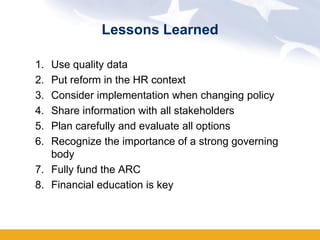
Lessons Learned

1. Use quality data
2. Put reform in the HR context
3. Consider implementation when changing policy
4. Share information with all stakeholders
5. Plan carefully and evaluate all options
6. Recognize the importance of a strong governing
   body
7. Fully fund the ARC
8. Financial education is key
Questions?


        Links to more information

Center for State and Local Government
 Excellence: www.slge.org

National Association of State Retirement
 Administrators: www.nasra.org

The Pension reform Landscape

  • 1.
    Webinar: State andLocal Government Pension Reform Lessons from negotiated reforms and recent developments June 21, 2012
  • 2.
    Today’s Presenters • KeithBrainard, Research Director, National Association of State Retirement Administrators • Joshua Franzel, Vice President, Research, Center for State and Local Government Excellence • Alex Brown, Research & Policy Analyst, Center for State and Local Government Excellence
  • 3.
    Bird’s-eye view ofpublic pensions in the U.S. Defined benefit plans for employees of state and local government in the U.S. • $3.0 trillion in assets • 15 million active (working) participants (12 percent of the nation’s workforce) • 8.0 million retirees and their survivors receive $200 billion annually in benefits • 85%+ of state and local government workers participate in an employer-sponsored pension plan
  • 4.
    Overarching Issues • Pensionbenefits for employees of state and local government are in the midst of unprecedented change • Public employee compensation, including retirement benefits, is the recipient of an unprecedented level of attention from the media, academics, and policymakers • An unprecedented number of lawsuits challenging changes to pension benefits are outstanding • State and local government employment is lower today by some 650,000 jobs, or 3.5%, from its August 2008 peak
  • 5.
    Overarching Issues • Pensionaccounting standards are on the verge of drastically changing the way public pension liabilities and costs are calculated • Interest rates are at their lowest levels in decades and are projected to remain low through at least 2014 • Longevity is improving
  • 6.
    Historical and projected aggregate public pension funding levels 100% 90% Actual Projected 80% 70% 90 92 94 96 98 00 02 04 06 08 10 12 Fiscal Year Standard & Poor’s, Public Fund Survey
  • 7.
    Distribution of publicpension actuarial funding levels and relative size Bubbles are roughly proportionate to size of plan liabilities
  • 8.
    Changes to publicpension plans in the U.S. • Higher required retirement ages • Longer vesting periods • Higher employee contributions • Fewer/lower cost-of-living adjustments • Greater use of hybrid retirement plans • Increased emphasis on employee-employer cost-sharing • No shift to defined contribution plans as the primary retirement benefit
  • 9.
    Retirement eligibility hasbecome more stringent • More normal (unreduced) retirement age requirements of 60, 65, and even 67 • Elimination of retirement eligibility at any age based on designated years of service • Increased movement from five years as the predominant vesting period
  • 10.
    Retirement benefits arebeing reduced • COLAs – applied to only a portion of the benefit – More COLAs delayed until attainment of designated retirement age – More COLAs tied to actuarial condition of plan or fund’s investment performance • Movement of final average salary period from three years to five and longer
  • 11.
    Higher employee contributions •Many states have approved higher employee pension contributions for existing plan participants • In some states, this is held or perceived to be illegal • Some higher rates are phased in over several years
  • 12.
    Growing use ofhybrid plans • Two main types of hybrid plan: – DB-DC plans feature a traditional, more modest pension, combined with a defined contribution plan – Cash balance plans feature pooled assets with notional accounts that pay a guaranteed minimum interest rate, with possibility of sharing “excess” investment earnings
  • 13.
    2011 Report 5 Case Studies of Negotiated Public Pension Reforms: • Iowa Public Employees Retirement System • Oregon Public Employees Retirement System Report Research Team: • Vermont State Teachers Christine Becker, Alex Brown, Joshua Franzel Ph.D., Elizabeth Kellar, and Retirement System Danielle Miller Wagner of the Center for State and Local Government Excellence • Houston Municipal Employees and Paula Sanford, PhD, of the University of Retirement System Georgia • Gwinnett County, GA
  • 14.
    2012 Reform Updates 2012 update fact sheets developed by Center Staff led by Danielle Miller Wagner
  • 15.
    Pension Reform •Currently 35 States and 30 Local •New examples continue to be added For more information see: slge.org -> research -> retirement
  • 16.
    Iowa Public EmployeesRetirement System • 2009 Reforms • Raised contribution rates • Increased the vesting period • Modified the benefit formula SLGE report: Strengthening State and Local Government Finances: Lessons for Negotiating Public Pension Plan Reforms
  • 17.
    Oregon Public EmployeesRetirement System • Changed the method used to credit individual accounts •Created a hybrid defined benefit / defined contribution plan for new employees SLGE report: Strengthening State and Local Government Finances: Lessons for Negotiating Public Pension Plan Reforms
  • 18.
    Vermont State TeachersRetirement System • Increased contribution rates • Increased requirements for full retirement eligibility SLGE report: Strengthening State and Local Government Finances: Lessons for Negotiating Public Pension Plan Reforms
  • 19.
    Houston Municipal Employees Retirement System Passed a series of pension reforms from 2004-2007 which: • Increased employee contributions • Disallowed conversion between tiers • Modified the benefit formula SLGE report: Strengthening State and Local Government Finances: Lessons for Negotiating Public Pension Plan Reforms
  • 20.
    Gwinnett County, GA • Need for more direct management of the county pension fund • Realization that defined benefit costs were growing at a time of slow growth in the county SLGE report: Strengthening State and Local Government Finances: Lessons for Negotiating Public Pension Plan Reforms
  • 21.
    Recent Reforms toPublic Pension Systems Major Pension Reforms 2011-2012 New Employees Current Employees Current Retirees Increased Contribution Rates AL, HI, MD, NH, NY AL, MD, ND, NH, NJ, VT, WI AL, DE, FL, HI, MA, MD, Raised Retirement Age ME NY, OK Reduced, Froze, or Eliminated COLAs HI, MD, MS FL, MD, VA ME, NJ, RI Modified the Benefit Formula MA, MD, MS, NJ, NY, VA NH, RI Restructured to a Hybrid Plan VA RI National Conference of State Legislatures (Labor & Employment / Pensions)
  • 22.
    Recent Reforms toPublic Pension Systems • Rhode Island: Created a • Kansas: Created a cash hybrid plan for all employees balance plan for all effective July 1, 2012; employees hired on or after January 1, 2014; • Virginia: Created a hybrid plan for all employees hired • Louisiana: Created a cash on or after January 1, 2014; balance plan for state employees and teachers hired on or after January 1, 2013
  • 23.
    Lessons Learned 1. Usequality data 2. Put reform in the HR context 3. Consider implementation when changing policy 4. Share information with all stakeholders 5. Plan carefully and evaluate all options 6. Recognize the importance of a strong governing body 7. Fully fund the ARC 8. Financial education is key
  • 24.
    Questions? Links to more information Center for State and Local Government Excellence: www.slge.org National Association of State Retirement Administrators: www.nasra.org