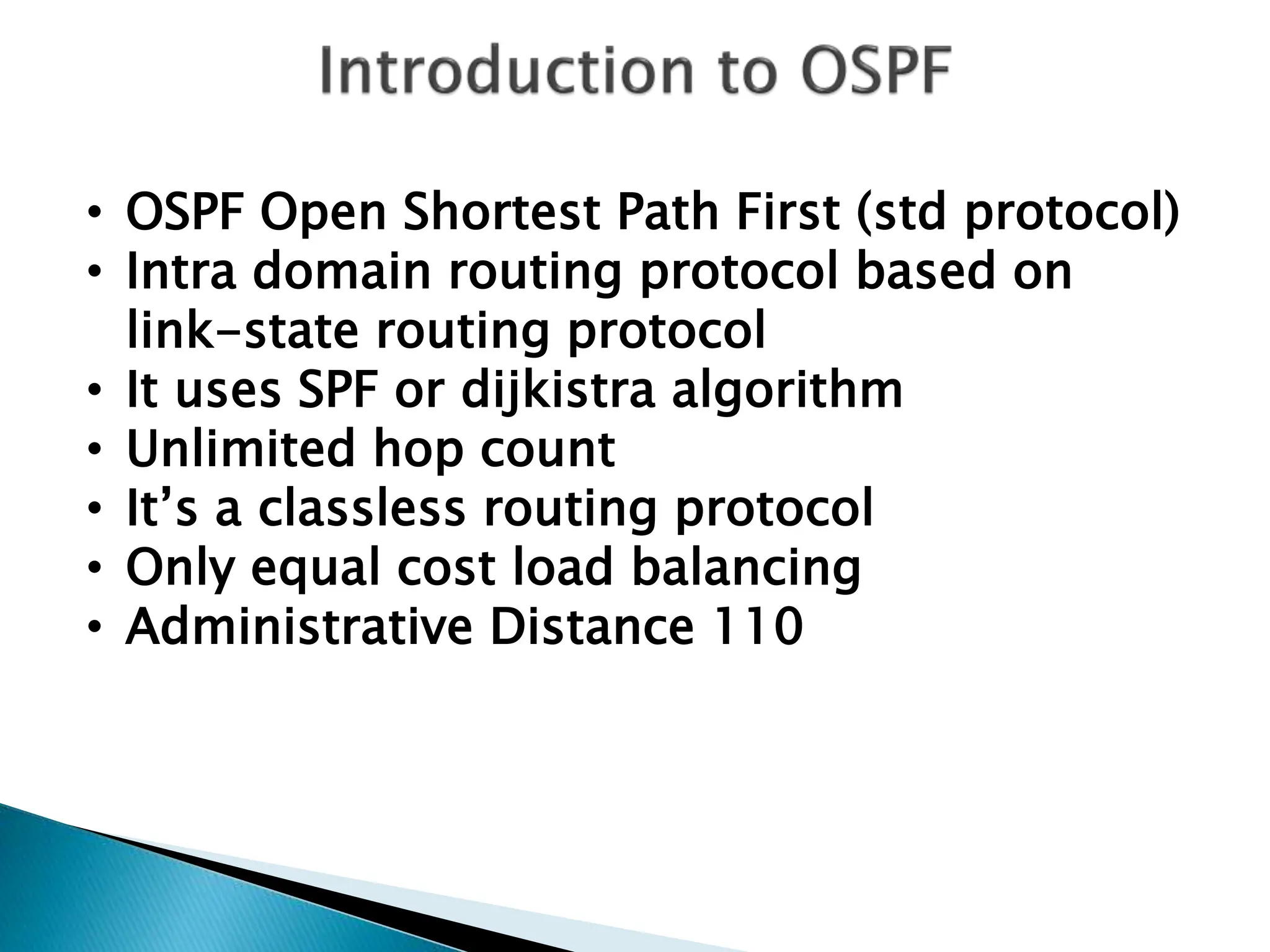
• OSPF Open Shortest Path First (std protocol)
• Intra domain routing protocol based on
link-state routing protocol
• It uses SPF or dijkistra algorithm
• Unlimited hop count
• It’s a classless routing protocol
• Only equal cost load balancing
• Administrative Distance 110
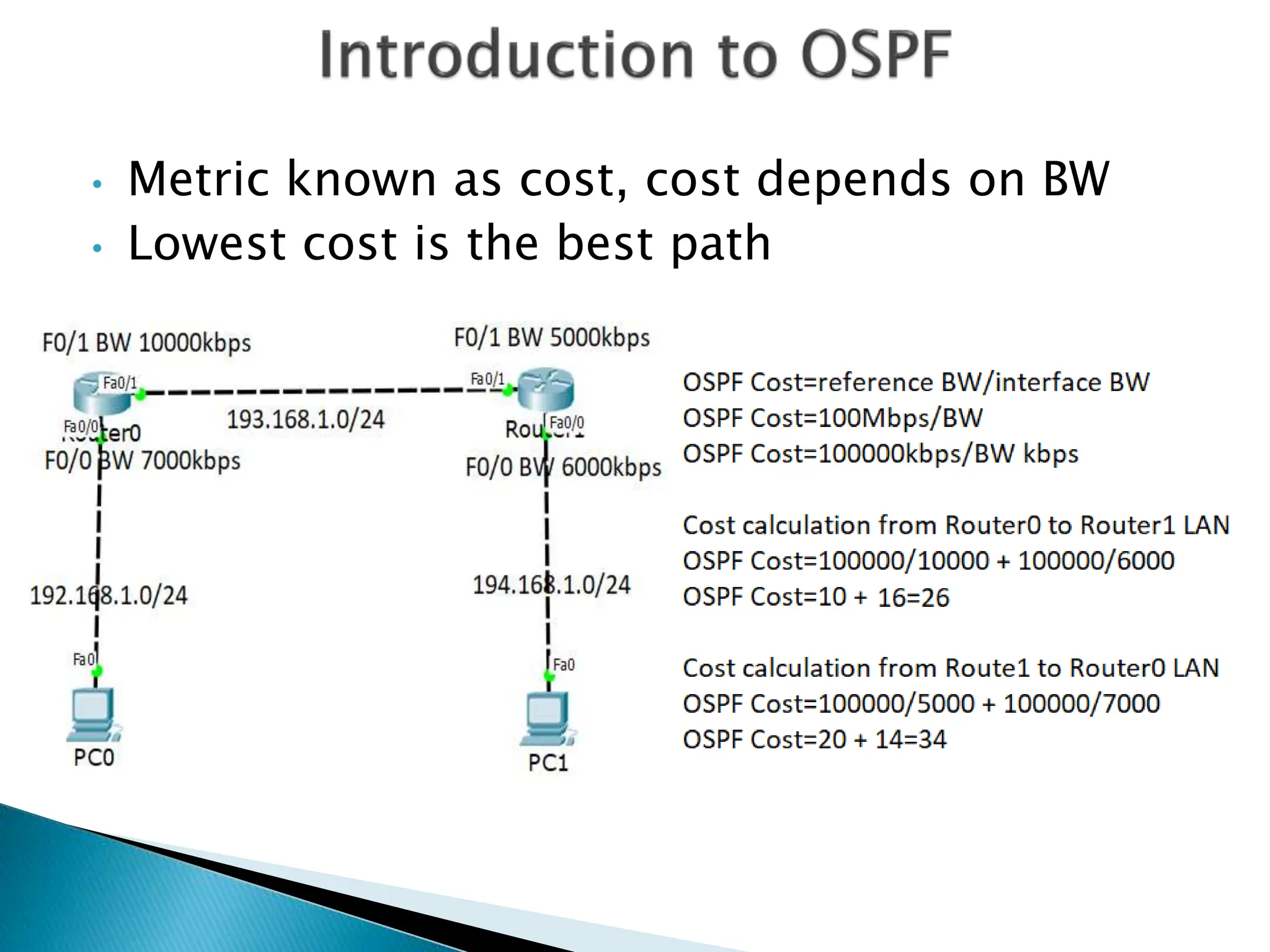
• Metric known as cost, cost depends on BW
• Lowest cost is the best path
 Loopback interfaces are logical interfaces,
which are virtual, software-only interfaces;
they are not real router interfaces
 Using loopback interfaces with your OSPF
configuration ensures that an interface is
always active for OSPF processes
 Configuring loopback interfaces when using
the OSPF routing protocol is important, and
Cisco suggests using them whenever you
configure OSPF on a router
• This is an IPv4 address used to identify a
router
• 3 Criteria for deriving the router ID
i. Administrator can manually assign Router
ID using router-id command
ii. If router-id command is not used the
router chooses the highest IP address
among the loopback address
iii. If no loopback interfaces are configured
the highest IP address of any active
interface is used as router-id
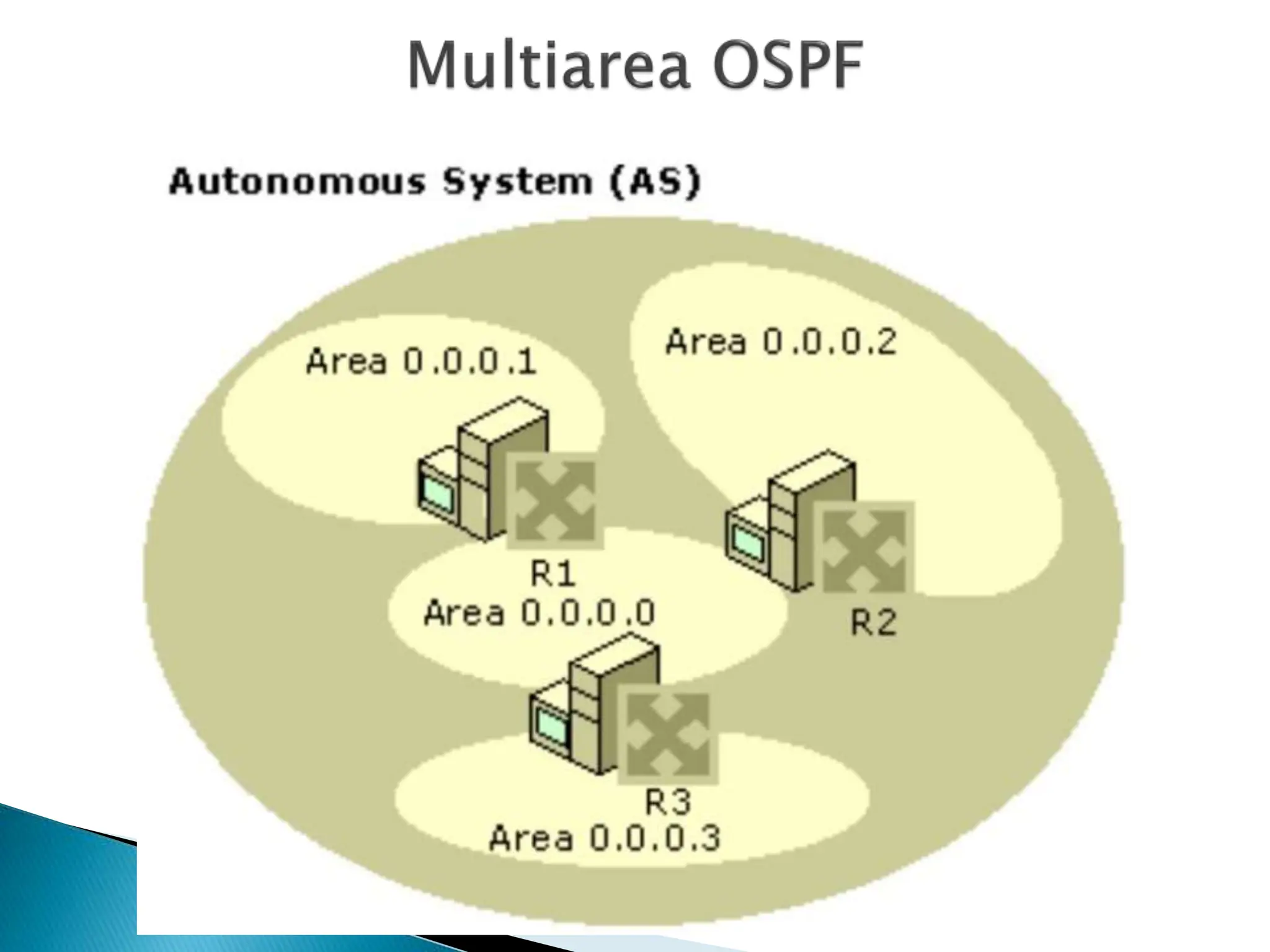
 OSPF network can be divided into groups
called areas
 Areas are identified by an area ID
 An area is a logical collection of OSPF
networks, routers and links that have the same
area ID (identification)
 Areas limit the scope of route information
distribution
 Benefit of creating areas is to reduce the
number of routes to propagate by filtering the
summarization of routes
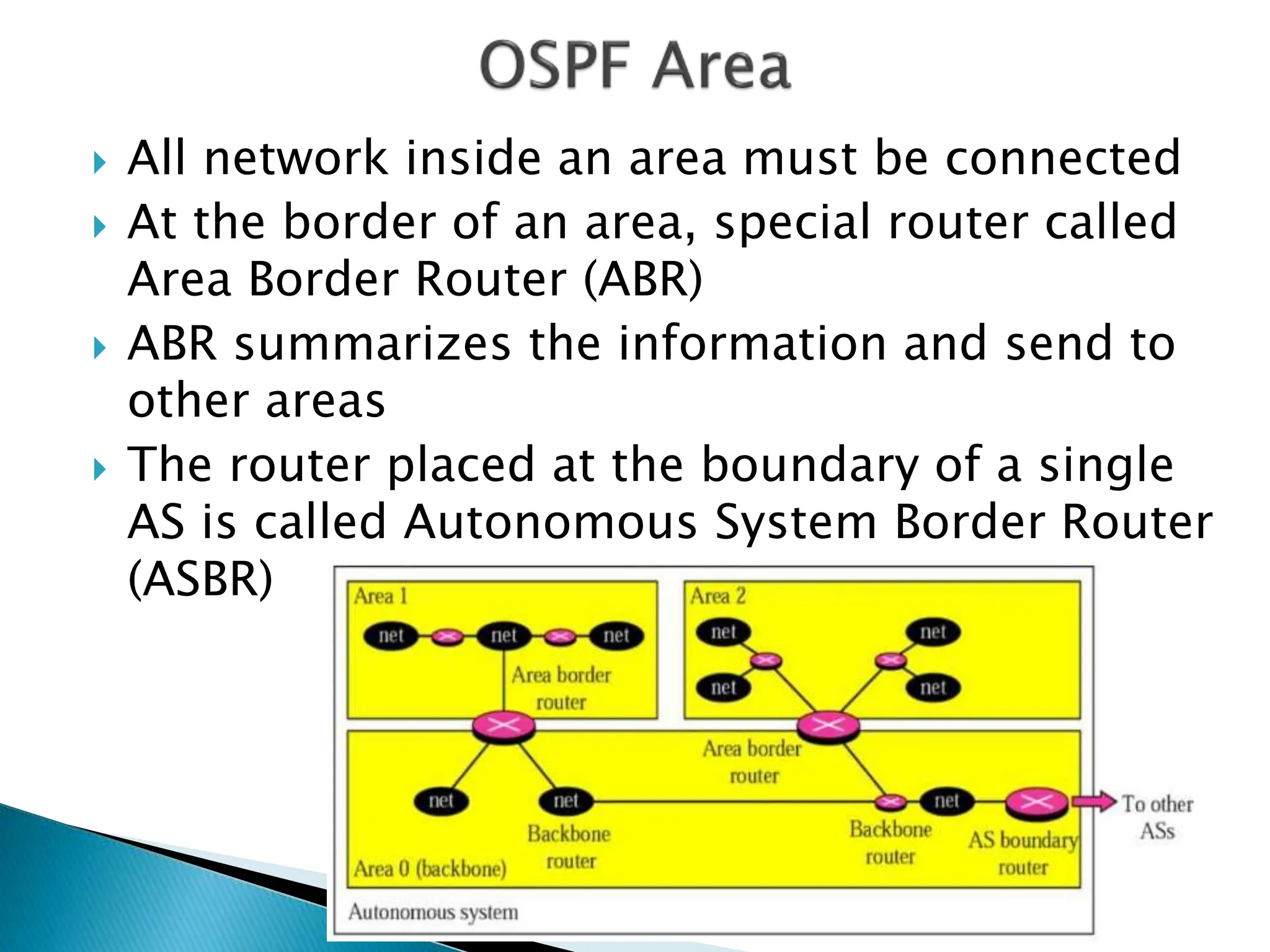
 All network inside an area must be connected
 At the border of an area, special router called
Area Border Router (ABR)
 ABR summarizes the information and send to
other areas
 The router placed at the boundary of a single
AS is called Autonomous System Border Router
(ASBR)
 A backbone area which combines a set of
independent areas into a single domain
 The backbone has reserved area ID 0.0.0.0. The
OSPF backbone area is also known as area 0
 The backbone acts as a hub for inter-area
transit traffic and the distribution of routing
information between areas
 Each non-backbone area must be directly
connected to the backbone area
 OSPF uses a DR (Designated Router) and BDR
(Backup Designated Router) on each multi-
access network
 When a router is not the DR or BDR it’s called
a DROTHER
 Network administrator can configure any
router as DR or BDR changing the priority
value
 A router with priority ‘0’ will never be
selected as DR or BDR
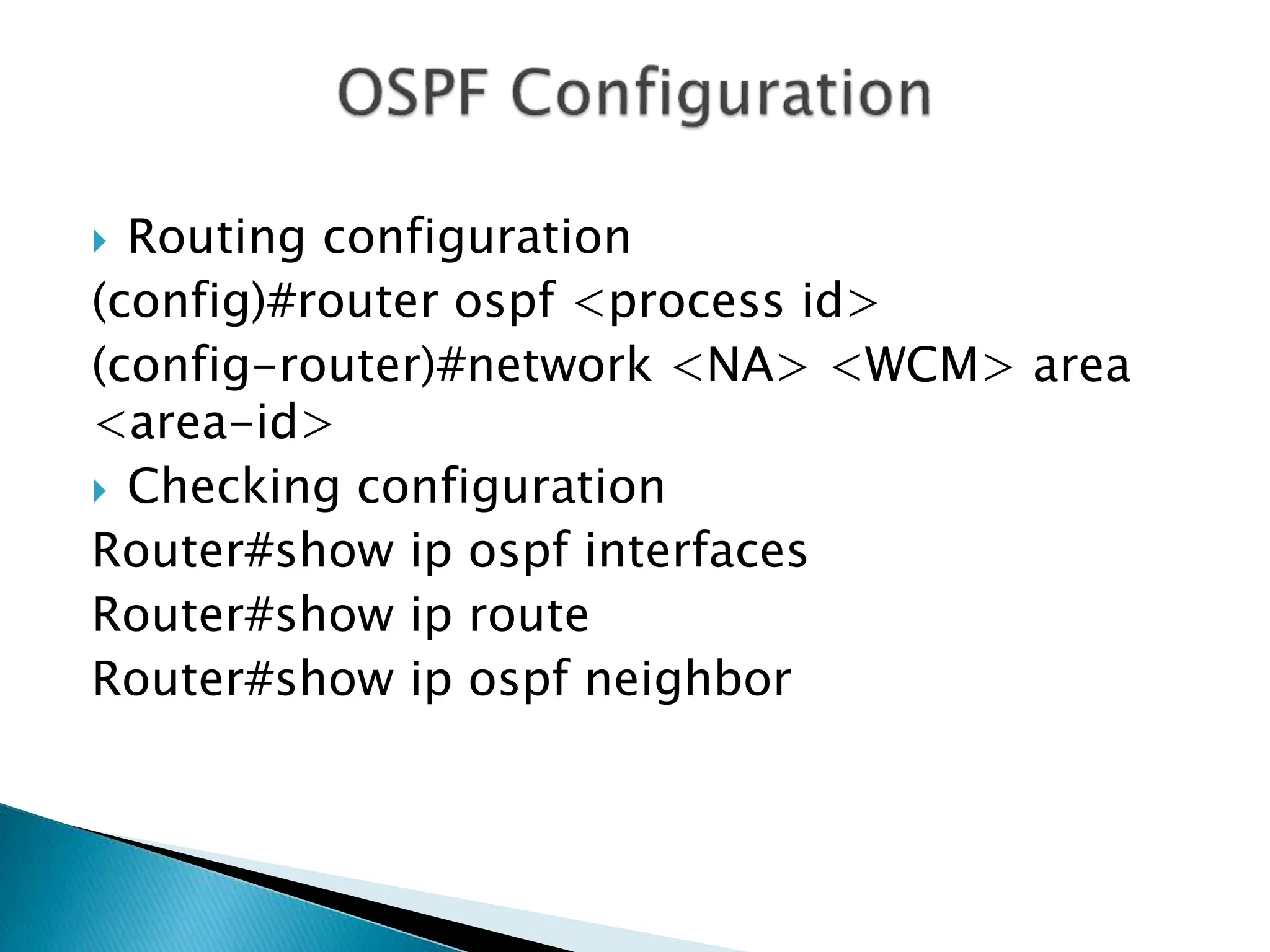
 Routing configuration
(config)#router ospf <process id>
(config-router)#network <NA> <WCM> area
<area-id>
 Checking configuration
Router#show ip ospf interfaces
Router#show ip route
Router#show ip ospf neighbor
The OSPF (Open Shortest Path First) protocol is one of a family of IP Routing protocols, and is an Interior Gateway Protocol (IGP) for the Internet OSPF Routing.pptx

The OSPF (Open Shortest Path First) protocol is one of a family of IP Routing protocols, and is an Interior Gateway Protocol (IGP) for the Internet OSPF Routing.pptx

  • 3.
    • OSPF OpenShortest Path First (std protocol) • Intra domain routing protocol based on link-state routing protocol • It uses SPF or dijkistra algorithm • Unlimited hop count • It’s a classless routing protocol • Only equal cost load balancing • Administrative Distance 110
  • 5.
    • Metric knownas cost, cost depends on BW • Lowest cost is the best path
  • 6.
     Loopback interfacesare logical interfaces, which are virtual, software-only interfaces; they are not real router interfaces  Using loopback interfaces with your OSPF configuration ensures that an interface is always active for OSPF processes  Configuring loopback interfaces when using the OSPF routing protocol is important, and Cisco suggests using them whenever you configure OSPF on a router
  • 7.
    • This isan IPv4 address used to identify a router • 3 Criteria for deriving the router ID i. Administrator can manually assign Router ID using router-id command ii. If router-id command is not used the router chooses the highest IP address among the loopback address iii. If no loopback interfaces are configured the highest IP address of any active interface is used as router-id
  • 8.
     OSPF networkcan be divided into groups called areas  Areas are identified by an area ID  An area is a logical collection of OSPF networks, routers and links that have the same area ID (identification)  Areas limit the scope of route information distribution  Benefit of creating areas is to reduce the number of routes to propagate by filtering the summarization of routes
  • 9.
     All networkinside an area must be connected  At the border of an area, special router called Area Border Router (ABR)  ABR summarizes the information and send to other areas  The router placed at the boundary of a single AS is called Autonomous System Border Router (ASBR)
  • 10.
     A backbonearea which combines a set of independent areas into a single domain  The backbone has reserved area ID 0.0.0.0. The OSPF backbone area is also known as area 0  The backbone acts as a hub for inter-area transit traffic and the distribution of routing information between areas  Each non-backbone area must be directly connected to the backbone area
  • 12.
     OSPF usesa DR (Designated Router) and BDR (Backup Designated Router) on each multi- access network  When a router is not the DR or BDR it’s called a DROTHER  Network administrator can configure any router as DR or BDR changing the priority value  A router with priority ‘0’ will never be selected as DR or BDR
  • 13.
     Routing configuration (config)#routerospf <process id> (config-router)#network <NA> <WCM> area <area-id>  Checking configuration Router#show ip ospf interfaces Router#show ip route Router#show ip ospf neighbor