@OECD_local www.linkedin.com/company/oecd-local www.oecd.org/cfe
The OECD Blue Cities Project
Building a sustainable blue economy in cities through the RISC-proof approach
Oriana Romano and Juliette Lassman
Water Governance & Circular Economy
Cities, Urban Policies and Sustainable Development Division
© OECD | Centre for Entrepreneurship, SMEs, Regions and Cities | @OECD_Local |
What is the issue?
© OECD | Centre for Entrepreneurship, SMEs, Regions and Cities | @OECD_Local |
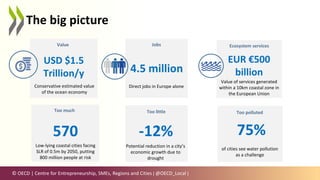
The big picture
Low-lying coastal cities facing
SLR of 0.5m by 2050, putting
800 million people at risk
570
Too much
Direct jobs in Europe alone
4.5 million
75%
of cities see water pollution
as a challenge
Too polluted
Conservative estimated value
of the ocean economy
USD $1.5
Trillion/y
Value
EUR €500
billion
Value of services generated
within a 10km coastal zone in
the European Union
Jobs Ecosystem services
-12%
Too little
Potential reduction in a city’s
economic growth due to
drought
© OECD | Centre for Entrepreneurship, SMEs, Regions and Cities | @OECD_Local |
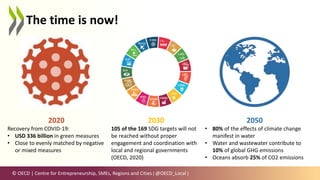
The time is now!
2020
Recovery from COVID-19:
• USD 336 billion in green measures
• Close to evenly matched by negative
or mixed measures
2030
105 of the 169 SDG targets will not
be reached without proper
engagement and coordination with
local and regional governments
(OECD, 2020)
2050
• 80% of the effects of climate change
manifest in water
• Water and wastewater contribute to
10% of global GHG emissions
• Oceans absorb 25% of CO2 emissions
© OECD | Centre for Entrepreneurship, SMEs, Regions and Cities | @OECD_Local |
The blue economy lacks a local perspective
• The traditional approach to the blue economy has been
extensively applied nationally and internationally, with little
consideration for local aspects.
• Rarely, blue economy definitions encompass all waterbodies,
going beyond the marine environment.
• Lack of a systemic and territorial approach, linking water to
economic growth and climate change.
© OECD | Centre for Entrepreneurship, SMEs, Regions and Cities | @OECD_Local |
What needs to be done?
© OECD | Centre for Entrepreneurship, SMEs, Regions and Cities | @OECD_Local |
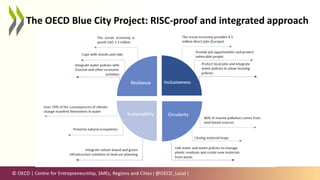
The ocean economy provides 4.5
million direct jobs (Europe)
The OECD Blue City Project: RISC-proof and integrated approach
© OECD | Centre for Entrepreneurship, SMEs, Regions and Cities | @OECD_Local |
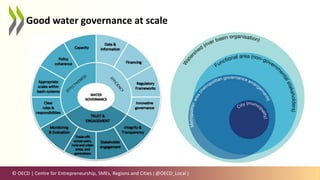
Good water governance at scale
© OECD | Centre for Entrepreneurship, SMEs, Regions and Cities | @OECD_Local |
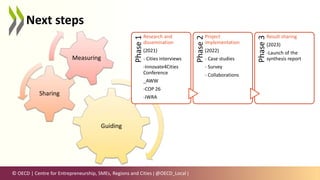
Guiding
Sharing
Measuring
Next steps
Phase
1
Research and
dissemination
(2021)
- Cities interviews
-Innovate4Cities
Conference
_AWW
-COP 26
-IWRA
Phase
2
Project
implementation
(2022)
- Case studies
- Survey
- Collaborations
Phase
3
Result sharing
(2023)
-Launch of the
synthesis report
© OECD | Centre for Entrepreneurship, SMEs, Regions and Cities | @OECD_Local |
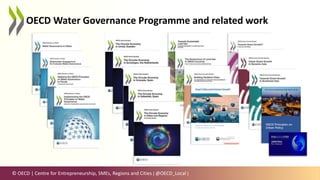
OECD Water Governance Programme and related work

Twitter: @OECD_local
LinkedIn: www.linkedin.com/company/oecd-local
Website: www.oecd.org/cfe
Thank you!
Oriana.ROMANO@oecd.org
Juliette.LASSMAN@oecd.org

The OECD Blue Cities Project

  • 1.
    @OECD_local www.linkedin.com/company/oecd-local www.oecd.org/cfe TheOECD Blue Cities Project Building a sustainable blue economy in cities through the RISC-proof approach Oriana Romano and Juliette Lassman Water Governance & Circular Economy Cities, Urban Policies and Sustainable Development Division
  • 2.
    © OECD |Centre for Entrepreneurship, SMEs, Regions and Cities | @OECD_Local | What is the issue?
  • 3.
    © OECD |Centre for Entrepreneurship, SMEs, Regions and Cities | @OECD_Local | The big picture Low-lying coastal cities facing SLR of 0.5m by 2050, putting 800 million people at risk 570 Too much Direct jobs in Europe alone 4.5 million 75% of cities see water pollution as a challenge Too polluted Conservative estimated value of the ocean economy USD $1.5 Trillion/y Value EUR €500 billion Value of services generated within a 10km coastal zone in the European Union Jobs Ecosystem services -12% Too little Potential reduction in a city’s economic growth due to drought
  • 4.
    © OECD |Centre for Entrepreneurship, SMEs, Regions and Cities | @OECD_Local | The time is now! 2020 Recovery from COVID-19: • USD 336 billion in green measures • Close to evenly matched by negative or mixed measures 2030 105 of the 169 SDG targets will not be reached without proper engagement and coordination with local and regional governments (OECD, 2020) 2050 • 80% of the effects of climate change manifest in water • Water and wastewater contribute to 10% of global GHG emissions • Oceans absorb 25% of CO2 emissions
  • 5.
    © OECD |Centre for Entrepreneurship, SMEs, Regions and Cities | @OECD_Local | The blue economy lacks a local perspective • The traditional approach to the blue economy has been extensively applied nationally and internationally, with little consideration for local aspects. • Rarely, blue economy definitions encompass all waterbodies, going beyond the marine environment. • Lack of a systemic and territorial approach, linking water to economic growth and climate change.
  • 6.
    © OECD |Centre for Entrepreneurship, SMEs, Regions and Cities | @OECD_Local | What needs to be done?
  • 7.
    © OECD |Centre for Entrepreneurship, SMEs, Regions and Cities | @OECD_Local | The ocean economy provides 4.5 million direct jobs (Europe) The OECD Blue City Project: RISC-proof and integrated approach
  • 8.
    © OECD |Centre for Entrepreneurship, SMEs, Regions and Cities | @OECD_Local | Good water governance at scale
  • 9.
    © OECD |Centre for Entrepreneurship, SMEs, Regions and Cities | @OECD_Local | Guiding Sharing Measuring Next steps Phase 1 Research and dissemination (2021) - Cities interviews -Innovate4Cities Conference _AWW -COP 26 -IWRA Phase 2 Project implementation (2022) - Case studies - Survey - Collaborations Phase 3 Result sharing (2023) -Launch of the synthesis report
  • 10.
    © OECD |Centre for Entrepreneurship, SMEs, Regions and Cities | @OECD_Local | OECD Water Governance Programme and related work
  • 11.
     Twitter: @OECD_local LinkedIn: www.linkedin.com/company/oecd-local Website:www.oecd.org/cfe Thank you! Oriana.ROMANO@oecd.org Juliette.LASSMAN@oecd.org

Editor's Notes

  • #2 Remind participants that the WGI is an international multi-stakeholder network of around 100 members from the public, private and not-for-profit sectors whom gather twice a year in a Policy Forum to share on-going reforms, projects, lessons and good practices in support of better governance in the water sector.
  • #4 The blue economy is still an emerging concept for many countries, but it has great potential for economic value and job creation as well as for ecosystem services. The worldwide ocean economy was conservatively valued at around USD 1.5 trillion per year in 2010 by the OECD (2016). According to the European Commission, if the global blue economy were a country, it would be the seventh-largest in the world, and the ocean as an economic entity would be a member of the G7 (European Commission, 2021). In Europe alone, the ocean economy provides 4.5 million direct jobs. In a business-as-usual scenario, ocean-based industries were anticipated to employ more than 40 million people globally (around 1% of the global workforce) by 2030. However, the COVID-19 pandemic had a strong impact on job growth in key blue economy sectors such as coastal tourism, transport and trade. The green recovery from COVID-19 provides a unique opportunity to rethink the role of both freshwater and the marine environment as a driver for sustainable development. Within the blue economy, water is a vector for economic growth, social well-being and ecosystem preservation. In the EU alone, almost EUR 500 billion worth of ecosystem services are generated within a 10 km coastal zone (European Commission, 2021). Cities have a key role to play in fostering a sustainable blue economy. First, a wide range of blue economic activities such as tourism, fishing and aquaculture take place and provide employment at the local level. Second, how cities build resilience to water-related risks directly impacts their ability to carry out blue economy activities: for example, nature-based solutions can restore the natural drainage capacity of cities, avoiding urban flooding. T Third, core city competences such as land use, spatial planning and waste management, among others, greatly affect the level of water security and quality which, in turn, affects the blue economy. For instance, habitat degradation from sand harvesting, mangrove deforestation, coastal development and poor land use practices, as well as litter and especially plastics, damage marine environments and the ecosystem services that they provide. However, cities and their blue economies, their population and ecosystems are increasingly vulnerable to water-related risks. Around 80% of the effects of climate change manifest themselves in water. Megacities, which will rise from 33 to 43 in 2030, are mostly located in coastal zones with higher population densities (UN DESA, 2018). By 2050, over 570 low-lying coastal cities will face projected sea level rise by at least 0.5 metres, putting over 800 million people at risk. Annual flood damage to urban property alone amounts to over USD 120 billion annually, of which around half in North America (Sadoff et al., 2015). The costs of sea-level rise could rise to trillions of dollars a year in damages by 2100 (C40 Cities, 2018). A recent study by the World Bank (2021) shows that a drought can potentially reduce a city’s economic growth by up to 12 percent. By 2050, the number of people living in severely water-stressed areas will double to 3.9 billion people, intensifying competition over water allocation across users such as city-dwellers and agricultural users in rural areas (OECD, 2012). Water pollution was identified as a challenge for 75% of 48 cities surveyed by the OECD (2016), despite progress on water quality. Polluted marine environments affect billions of people worldwide that rely on the ocean to provide jobs and food (World Bank, 2016). Cities are part of the problem, but they can also become part of the solution: 50% of solid waste comes from cities and an estimated 60% of plastic marine debris derives from urban centres.
  • #5 In response to the COVID-19 pandemic, the blue economy has significant potential to contribute to the green recovery (European Commission, 2020). Although sectors such as coastal and marine tourism, as well as fisheries and aquaculture are severely affected by the coronavirus pandemic, the green recovery can “improve resilience, boost economic activity, generate income, create jobs, and reduce inequalities” (OECD, 2020). However, water is poorly represented in recovery packages, accounting for around 8% of environmentally positive funding and measures (OECD, 2021). Governments have allocated USD 336 billion to environmentally positive recovery measures, but this amount is close to evenly matched by measures with negative or mixed environmental impacts. Cities can significantly contribute to achieving the UN Sustainable Development Goals by 2030. At least 105 of the 169 SDG targets will not be reached without proper engagement and coordination with local and regional governments (OECD, 2020). By taking action towards achieving the targets of SDGS 6, 11 and 14, calling for “clean water and sanitation for all (SDG 6), “inclusive, safe, resilient and sustainable” cities (SDG 11), and “conserving and sustainably using the oceans, seas and marine resources for sustainable development” (SDG 14), Blue Cities can also contribute to the achievement of SDGs 1 (poverty), 3 (health and well-being), 7 (energy), 8 (decent work and economic growth), 9 (industry, innovation and infrastructure), 10 (inequalities), 12 (responsible consumption and production), 13 (climate action), 15 (land) and 17 (partnerships). Water has an essential role to play in achieving Paris Agreement temperature targets at the local level. The use, storage, distribution and treatment of water and wastewater contributes to about 10% of global greenhouse gas emissions (GIZ, 2020). The world’s oceans increasingly act as a carbon sink, absorbing at least 25% of global CO2 emissions, but this negatively affects marine ecosystems via ocean acidification. By shifting to circular water systems that mitigate GHG emissions and pollution, cities can ensure that freshwater becomes a source of net-positive renewable energy and that oceans continue delivering the ecosystem services needed for climate mitigation and adaptation.
  • #6 The traditional approach to the blue economy has been extensively applied nationally and internationally, with little consideration for local aspects. Despite the relevance of a localised approach to the blue economy, little attention has been paid to the blue economy in cities. First raised at the UN Conference on Sustainable Development in Rio de Janeiro (Brazil) in 2012, the blue economy gained traction with the dedication of a Sustainable Development Goal (SDG 14) to “conserve and sustainably use the oceans, seas and marine resources”. In 2017, the UN declared a Decade of Ocean Science for Sustainable Development (2021-2030) to support the blue economy among other objectives. The new EU approach to a sustainable blue economy “Transforming the EU's Blue Economy for a Sustainable Future” (European Commission, 2021), mentions that coastal cities should be supported in the recovery from COVID-19. Recently, UN-Habitat (2018) recognised cities as being at the forefront of the blue economy. However, dedicated strategies and frameworks are lacking at the local level. Blue economy definitions usually refer to the marine environment, but more recent approaches encompass all waterbodies, highlighting the need for a functional city-basin approach to ensure both economic growth and environmental preservation. While the OECD has specifically focused on the ocean economy (OECD, 2016; OECD, 2020), the World Bank and European Commission definitions of the blue economy englobe oceans, seas and coasts. The term is generally used to describe a sustainable development approach to coastal resources. This can include a wide range of economic sectors, from the more conventional fisheries, aquaculture, maritime transport, port activities, and coastal, maritime and fluvial tourism, to emerging activities such as tidal energy, marine ecosystem services (e.g. blue carbon), seabed mining and desalination. UN-Habitat (2018) suggests to expand the concept to all waterbodies, including lakes and rivers. This approach seeks to “promote economic growth, responsible production and consumption […] through the circular economy”. As such, a functional approach is key to addressing linkages between coastal and inland urban areas, where most people live, and the surrounding environments (rural and watersheds) that sustain them. The logic of “water for water policies” hinders a holistic approach to water in relation to economic growth and climate change. At local level, water policies focus on providing access to safe drinking water and sanitation services, and managing water resources to ensure adequate quantity and quality to users. However, water policies are often developed in a silo that is disconnected from the urban economic growth and climate agendas. Water policy often lacks a proactive approach, and only gains prominence on the political agenda as response to extreme water-related events. This reactive approach fails to consider the reciprocal relationship between climate change mitigation measures and water: measures in sectors such as energy and agriculture have an impact on water resources and, conversely, water management policies can influence greenhouse gas emissions associated with different sectors (IPCC, 2018). The IPCC (2021) highlights the link between land use and the water cycle at global and local level, since land-use change is responsible for about 15% of CO2 emissions from human activities, affecting precipitation, evaporation, and plant transpiration. According to the World Bank, the blue economy is the “sustainable use of ocean resources for economic growth, improved livelihoods, and jobs while preserving the health of ocean ecosystem”. The European Commission defines the blue economy as “all economic activities related to oceans, seas and coasts”.
  • #10 The traditional approach to the blue economy has been extensively applied nationally and internationally, with little consideration for local aspects. Despite the relevance of a localised approach to the blue economy, little attention has been paid to the blue economy in cities. First raised at the UN Conference on Sustainable Development in Rio de Janeiro (Brazil) in 2012, the blue economy gained traction with the dedication of a Sustainable Development Goal (SDG 14) to “conserve and sustainably use the oceans, seas and marine resources”. In 2017, the UN declared a Decade of Ocean Science for Sustainable Development (2021-2030) to support the blue economy among other objectives. The new EU approach to a sustainable blue economy “Transforming the EU's Blue Economy for a Sustainable Future” (European Commission, 2021), mentions that coastal cities should be supported in the recovery from COVID-19. Recently, UN-Habitat (2018) recognised cities as being at the forefront of the blue economy. However, dedicated strategies and frameworks are lacking at the local level. Blue economy definitions usually refer to the marine environment, but more recent approaches encompass all waterbodies, highlighting the need for a functional city-basin approach to ensure both economic growth and environmental preservation. While the OECD has specifically focused on the ocean economy (OECD, 2016; OECD, 2020), the World Bank and European Commission definitions of the blue economy englobe oceans, seas and coasts. The term is generally used to describe a sustainable development approach to coastal resources. This can include a wide range of economic sectors, from the more conventional fisheries, aquaculture, maritime transport, port activities, and coastal, maritime and fluvial tourism, to emerging activities such as tidal energy, marine ecosystem services (e.g. blue carbon), seabed mining and desalination. UN-Habitat (2018) suggests to expand the concept to all waterbodies, including lakes and rivers. This approach seeks to “promote economic growth, responsible production and consumption […] through the circular economy”. As such, a functional approach is key to addressing linkages between coastal and inland urban areas, where most people live, and the surrounding environments (rural and watersheds) that sustain them. The logic of “water for water policies” hinders a holistic approach to water in relation to economic growth and climate change. At local level, water policies focus on providing access to safe drinking water and sanitation services, and managing water resources to ensure adequate quantity and quality to users. However, water policies are often developed in a silo that is disconnected from the urban economic growth and climate agendas. Water policy often lacks a proactive approach, and only gains prominence on the political agenda as response to extreme water-related events. This reactive approach fails to consider the reciprocal relationship between climate change mitigation measures and water: measures in sectors such as energy and agriculture have an impact on water resources and, conversely, water management policies can influence greenhouse gas emissions associated with different sectors (IPCC, 2018). The IPCC (2021) highlights the link between land use and the water cycle at global and local level, since land-use change is responsible for about 15% of CO2 emissions from human activities, affecting precipitation, evaporation, and plant transpiration. According to the World Bank, the blue economy is the “sustainable use of ocean resources for economic growth, improved livelihoods, and jobs while preserving the health of ocean ecosystem”. The European Commission defines the blue economy as “all economic activities related to oceans, seas and coasts”.