THE OECD SURVEY ON
THE CIRCULAR ECONOMY
IN CITIES AND REGIONS
Oriana Romano, Co-ordinator
Cities and Circular Economy Programme
OECD
1st OECD Roundtable on the
Circular Economy in Cities and Regions
4 July 2019 | 9h-18h
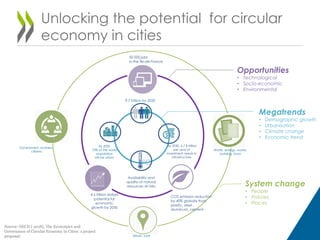
Unlocking the potential for circular
economy in cities
°C
Megatrends
• Demographic growth
• Urbanisation
• Climate change
• Economic trend
Opportunities
• Technological
• Socio-economic
• Environmental
System change
• People
• Policies
• Places
9.7 billion by 2050
By 2050
70% of the world
population
will be urban
Availability and
quality of natural
resources at risks
By 2030, 6.7 $ trillion
per year of
investment needs in
infrastructure
4.5 trillion dollars
potential for
economic
growth by 2030
50 000 jobs
in the Île-de-France
CO2 emission reduction
by 40% globally from
plastic, steel ,
aluminum, cement
Government, business,
citizens
Urban, rural
Water, energy, waste,
building, food
Source: OECD ( 2018), The Economics and
Governance of Circular Economy in Cities: a project
proposal.
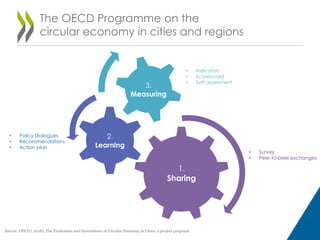
The OECD Programme on the
circular economy in cities and regions
1.
Sharing
2.
Learning
3.
Measuring
Source: OECD ( 2018), The Economics and Governance of Circular Economy in Cities: a project proposal.
• Indicators
• Scoreboard
• Self-assessment
• Policy Dialogues
• Recommendations
• Action plan
• Survey
• Peer-to-peer exchanges
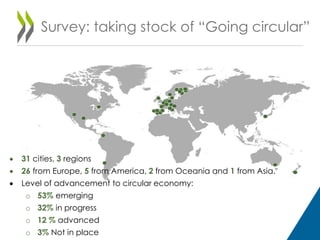
Survey: taking stock of “Going circular”
 31 cities, 3 regions
 26 from Europe, 5 from America, 2 from Oceania and 1 from Asia.
 Level of advancement to circular economy:
o 53% emerging
o 32% in progress
o 12 % advanced
o 3% Not in place
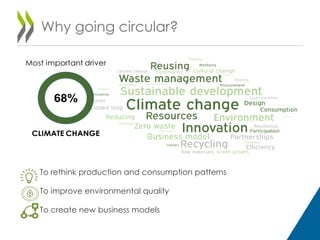
Why going circular?
To rethink production and consumption patterns
To improve environmental quality
To create new business models
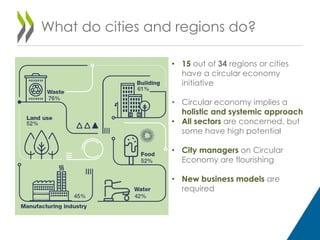
What do cities and regions do?
• 15 out of 34 regions or cities
have a circular economy
initiative
• Circular economy implies a
holistic and systemic approach
• All sectors are concerned, but
some have high potential
• City managers on Circular
Economy are flourishing
• New business models are
required
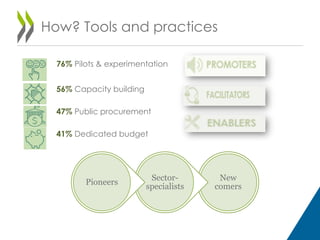
How? Tools and practices
76% Pilots & experimentation
56% Capacity building
47% Public procurement
41% Dedicated budget
New
comers
Sector-
specialists
Pioneers
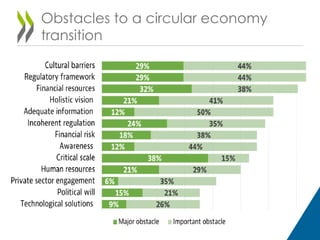
Obstacles to a circular economy
transition
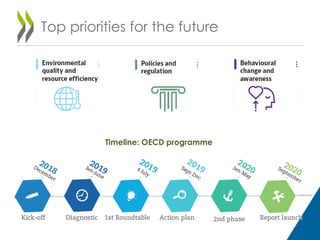
Top priorities for the future
Timeline: OECD programme
THANK YOU!
ORIANA.ROMANO@OECD.ORG
10

OECD

  • 1.
    THE OECD SURVEYON THE CIRCULAR ECONOMY IN CITIES AND REGIONS Oriana Romano, Co-ordinator Cities and Circular Economy Programme OECD 1st OECD Roundtable on the Circular Economy in Cities and Regions 4 July 2019 | 9h-18h
  • 2.
    Unlocking the potentialfor circular economy in cities °C Megatrends • Demographic growth • Urbanisation • Climate change • Economic trend Opportunities • Technological • Socio-economic • Environmental System change • People • Policies • Places 9.7 billion by 2050 By 2050 70% of the world population will be urban Availability and quality of natural resources at risks By 2030, 6.7 $ trillion per year of investment needs in infrastructure 4.5 trillion dollars potential for economic growth by 2030 50 000 jobs in the Île-de-France CO2 emission reduction by 40% globally from plastic, steel , aluminum, cement Government, business, citizens Urban, rural Water, energy, waste, building, food Source: OECD ( 2018), The Economics and Governance of Circular Economy in Cities: a project proposal.
  • 3.
    The OECD Programmeon the circular economy in cities and regions 1. Sharing 2. Learning 3. Measuring Source: OECD ( 2018), The Economics and Governance of Circular Economy in Cities: a project proposal. • Indicators • Scoreboard • Self-assessment • Policy Dialogues • Recommendations • Action plan • Survey • Peer-to-peer exchanges
  • 4.
    Survey: taking stockof “Going circular”  31 cities, 3 regions  26 from Europe, 5 from America, 2 from Oceania and 1 from Asia.  Level of advancement to circular economy: o 53% emerging o 32% in progress o 12 % advanced o 3% Not in place
  • 5.
    Why going circular? Torethink production and consumption patterns To improve environmental quality To create new business models
  • 6.
    What do citiesand regions do? • 15 out of 34 regions or cities have a circular economy initiative • Circular economy implies a holistic and systemic approach • All sectors are concerned, but some have high potential • City managers on Circular Economy are flourishing • New business models are required
  • 7.
    How? Tools andpractices 76% Pilots & experimentation 56% Capacity building 47% Public procurement 41% Dedicated budget New comers Sector- specialists Pioneers
  • 8.
    Obstacles to acircular economy transition
  • 9.
    Top priorities forthe future Timeline: OECD programme
  • 10.