Tori & Alexis
• This project was prompted by Barbara Demick’s article, ―The Good Cook‖, in
  the November 2nd, 2009 issue of The New Yorker Magazine. Demick’s article
  begins with introduction to Song Hee-suk, a ―model citizen of North Korea‖
  and a survivor of its 1900’s famine.
• She addresses the already strict rationing of food per family in North Korea,
  and Mrs. Song’s faint memory when the rations started fading away even
  more. Demick expands on North Koreas large dependency on its
  neighboring countries, at the time, and how North Korea’s lack of ability to
  repay its creditors would lead to a complete set back in their productivity as
  a country.
• This set back largely included North Korea’s drastic shortages of food, and
  thus triggered North Korea’s people –specifically Song Hee-suk—to rely on
  herself to feed her family. The article touches on the coping methods,
  business attempts and many sacrifices Mrs. Song made to feed her family
  and herself. Not only does the article talk about Mrs. Song’s hardships she
  endured, but the loses of her loved ones along the way.
• Demick ends the article on more upbeat note describing Mrs. Song liking
  and adaptation to South Korea. She also gives insight on Mrs. Song’s
  change in perspective on North Korea, and the North Korean famine she
  endured.
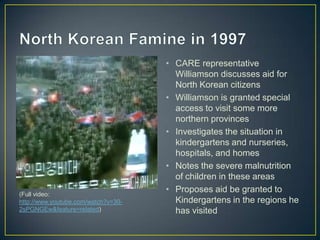
• CARE representative
                                       Williamson discusses aid for
                                       North Korean citizens
                                     • Williamson is granted special
                                       access to visit some more
                                       northern provinces
                                     • Investigates the situation in
                                       kindergartens and nurseries,
                                       hospitals, and homes
                                     • Notes the severe malnutrition
                                       of children in these areas
(Full video:
                                     • Proposes aid be granted to
http://www.youtube.com/watch?v=30-     Kindergartens in the regions he
2sPGNGEw&feature=related)              has visited
http://38north.org/2010/05/why-north-korea-could-feed-itself/
• Randall Ireson sets up his article ―Why North Korea Could
   Feed Itself‖ by explaining some of the severe agricultural
   conditions which contributed to the North Korean Famine in
   the 1990s
• Because of the previous ―Green Revolution farming
   techniques‖ that had been set into effect, when North Korea
   was cut off by its neighboring countries, it could not continue
   with such techniques
• No long had efficient way to farm
• In addition, the past three years consisted of two years of flood
   and a year of drought
• He goes on to discuss how today North Korea can solve these
   agricultural issues and become self-sufficient
http://www.cfr.org/china/china-north-korea-relationship/p11097
• ―China is North Korea’s most important ally; biggest trading
   partner; and main source of food, arms, and fuel.‖
• China has supported and ―lent political and economic backing
   to North Korea’s leaders: Kim il-Sung and his son and
   successor, Kim Jong- Il‖
• A wave in the relationship in October of 2006 when there were
   disputes over North Korea’s testing of a nuclear weapon.
• China has much investment in North Korea, and Pyongyang is
   very ―economically dependent on China‖ to provide both
   energy and food supplies.
• China’s support for North Korea not only provides a friendly
   nation and buffer zone (―between China and democratic South
   Korea‖), but China also ―gains economically‖ from this
   relationship.
• Overall China has clear ―leverage over North Korea in many
   respects.‖
Bajoria, Jayshree. "The China-North Korea Relationship." Council on
   Foreign Relations. N.p., 7 Oct. 2010. Web. 17 Sep. 2012.
   http://www.cfr.org/china/china-north-korea-relationship/p11097
Davis, Mark. ―Famine – North Korea.‖ Youtube. Lighthouse Pacific,
   1997. Web. 27 Sep. 2012. <http://www.youtube.com/watch?v=30-
   2sPGNGEw&feature=related>
Demick, Barbara. ―The Good Cook.‖ The New Yorker (2009): 58-64.
Ireson, Randall. ―Why North Korea Could Feed Itself.‖ 38 North, 2 May
   2010. Web. 17 Sep. 2012. <http://38north.org/2010/05/why-north-
   korea-could-feed-itself/>
MSLawdotedu. ―The North Korean Famine – Why Did It Happen?‖
   Youtube. Web. 17 Sep. 2012.
   <http://www.youtube.com/watch?v=fhb5Ccc3TcI>
ReutersTV. ―North Korea’s children victims of food shortage.‖ YouTube.
   Web. 17 Sep. 2012.
   <http://www.youtube.com/watch?v=Ftc_zKlz7Lo>

The North Korean Famine

  • 1.
  • 2.
    • This projectwas prompted by Barbara Demick’s article, ―The Good Cook‖, in the November 2nd, 2009 issue of The New Yorker Magazine. Demick’s article begins with introduction to Song Hee-suk, a ―model citizen of North Korea‖ and a survivor of its 1900’s famine. • She addresses the already strict rationing of food per family in North Korea, and Mrs. Song’s faint memory when the rations started fading away even more. Demick expands on North Koreas large dependency on its neighboring countries, at the time, and how North Korea’s lack of ability to repay its creditors would lead to a complete set back in their productivity as a country. • This set back largely included North Korea’s drastic shortages of food, and thus triggered North Korea’s people –specifically Song Hee-suk—to rely on herself to feed her family. The article touches on the coping methods, business attempts and many sacrifices Mrs. Song made to feed her family and herself. Not only does the article talk about Mrs. Song’s hardships she endured, but the loses of her loved ones along the way. • Demick ends the article on more upbeat note describing Mrs. Song liking and adaptation to South Korea. She also gives insight on Mrs. Song’s change in perspective on North Korea, and the North Korean famine she endured.
  • 3.
    • CARE representative Williamson discusses aid for North Korean citizens • Williamson is granted special access to visit some more northern provinces • Investigates the situation in kindergartens and nurseries, hospitals, and homes • Notes the severe malnutrition of children in these areas (Full video: • Proposes aid be granted to http://www.youtube.com/watch?v=30- Kindergartens in the regions he 2sPGNGEw&feature=related) has visited
  • 5.
    http://38north.org/2010/05/why-north-korea-could-feed-itself/ • Randall Iresonsets up his article ―Why North Korea Could Feed Itself‖ by explaining some of the severe agricultural conditions which contributed to the North Korean Famine in the 1990s • Because of the previous ―Green Revolution farming techniques‖ that had been set into effect, when North Korea was cut off by its neighboring countries, it could not continue with such techniques • No long had efficient way to farm • In addition, the past three years consisted of two years of flood and a year of drought • He goes on to discuss how today North Korea can solve these agricultural issues and become self-sufficient
  • 6.
    http://www.cfr.org/china/china-north-korea-relationship/p11097 • ―China isNorth Korea’s most important ally; biggest trading partner; and main source of food, arms, and fuel.‖ • China has supported and ―lent political and economic backing to North Korea’s leaders: Kim il-Sung and his son and successor, Kim Jong- Il‖ • A wave in the relationship in October of 2006 when there were disputes over North Korea’s testing of a nuclear weapon. • China has much investment in North Korea, and Pyongyang is very ―economically dependent on China‖ to provide both energy and food supplies. • China’s support for North Korea not only provides a friendly nation and buffer zone (―between China and democratic South Korea‖), but China also ―gains economically‖ from this relationship. • Overall China has clear ―leverage over North Korea in many respects.‖
  • 8.
    Bajoria, Jayshree. "TheChina-North Korea Relationship." Council on Foreign Relations. N.p., 7 Oct. 2010. Web. 17 Sep. 2012. http://www.cfr.org/china/china-north-korea-relationship/p11097 Davis, Mark. ―Famine – North Korea.‖ Youtube. Lighthouse Pacific, 1997. Web. 27 Sep. 2012. <http://www.youtube.com/watch?v=30- 2sPGNGEw&feature=related> Demick, Barbara. ―The Good Cook.‖ The New Yorker (2009): 58-64. Ireson, Randall. ―Why North Korea Could Feed Itself.‖ 38 North, 2 May 2010. Web. 17 Sep. 2012. <http://38north.org/2010/05/why-north- korea-could-feed-itself/> MSLawdotedu. ―The North Korean Famine – Why Did It Happen?‖ Youtube. Web. 17 Sep. 2012. <http://www.youtube.com/watch?v=fhb5Ccc3TcI> ReutersTV. ―North Korea’s children victims of food shortage.‖ YouTube. Web. 17 Sep. 2012. <http://www.youtube.com/watch?v=Ftc_zKlz7Lo>