


N° 08 OCTOBER 2015
The New Innovation Paradigm for the Digital Age:
Faster, Cheaper and Open
#DTR7
N° 08 OCTOBER 2015
The New Innovation Paradigm for the Digital Age:
Faster, Cheaper and Open
#DTR8DIGITALTRANSFORMATION
INSTITUTE
The New Innovation Paradigm for the Digital Age:
Faster, Cheaper and Open
CapgeminiConsulting’sEditorialBoard
didier.bonnet@capgemini.com,
@didiebon
@capgeminiconsul
www.linkedin.com/company/capgemini-consulting
N° 08 OCTOBER 2015
Chief Executive Officer
cyril.garcia@capgemini.com
@Cyr_Garcia
Senior Vice President
Chief Digital Officer
fernando.alvarez@capgemini.com
@Digital_Alvarez
Head of Digital
Transformation Institute
Cyril Garcia
Didier Bonnet
Fernando Alvarez
Jerome Buvat
jerome.buvat@capgemini.com,
@jeromebuvat
dti.in@capgemini.com
Institute
The Digital Transformation
www.capgemini-consulting.com
DIGITALTRANSFORMATION
INSTITUTE
#DTR8
#excitinginnovation
Contents
06
12
20
28
New Innovation Models for the Digital Age: Editorial
The Digital Innovation Radar Screen
The New Innovation Wave: Machine Learning and AI
Michael A Osborne, University of Oxford
Rise of the Machine: Forging Ahead with Robots
Jim Lawton, Rethink Robots
Digital Innovations – Our Top Picks
34
Promoting and Embedding Innovation
Frugal Innovation: Innovating More with Less
Navi Radjou
The Innovation Game: Why and How Businesses are Investing
in Innovation Centers, by Capgemini Consulting and Altimeter Group
80
52
60
66
74
The Innovation Oscars: Lessons from the Pioneers
Innovating Through Open Data
Gavin Starks, Open Data Institute
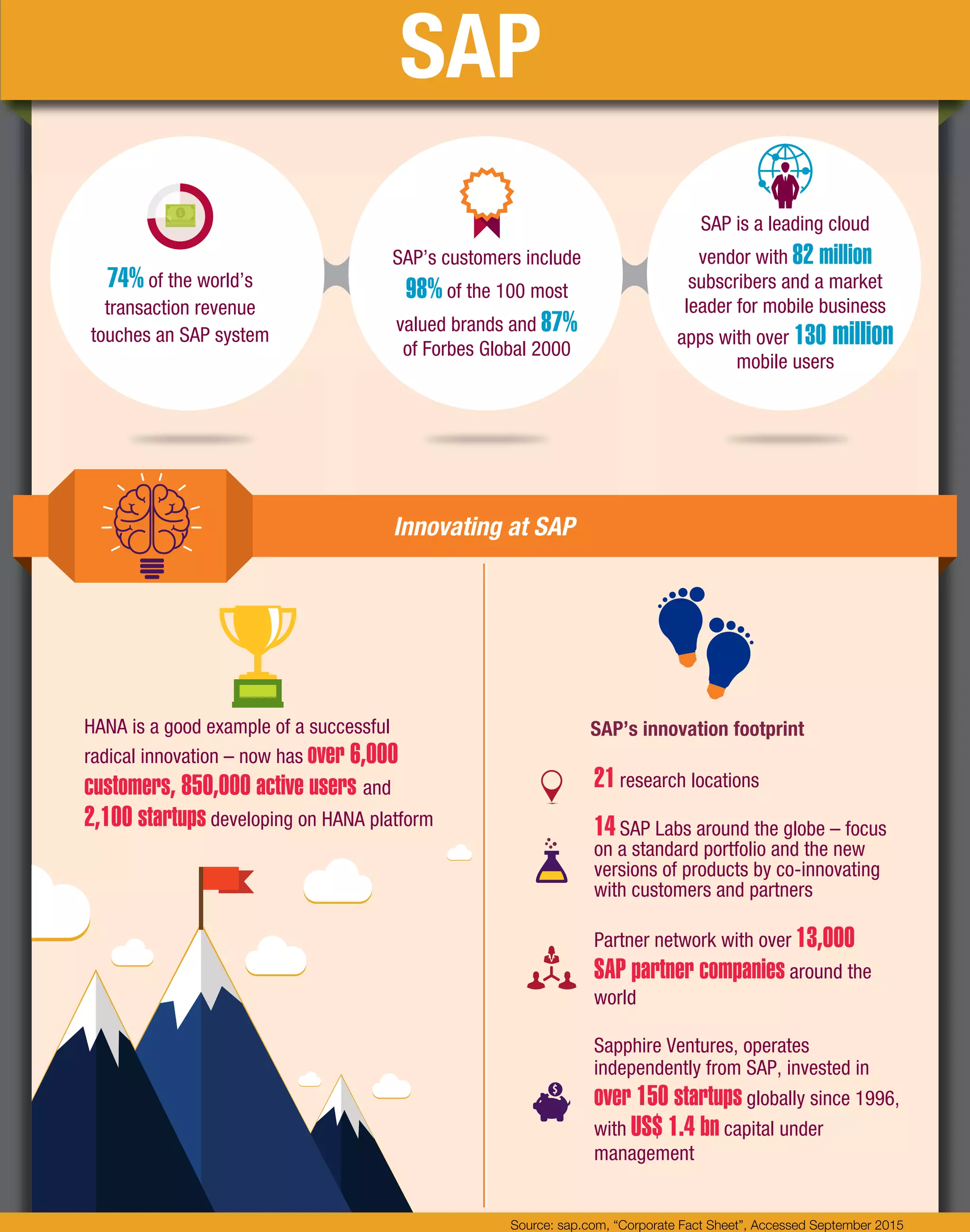
Innovating at SAP – the Delicate Balance between
Incremental and Radical Innovation
Claus von Riegen, SAP
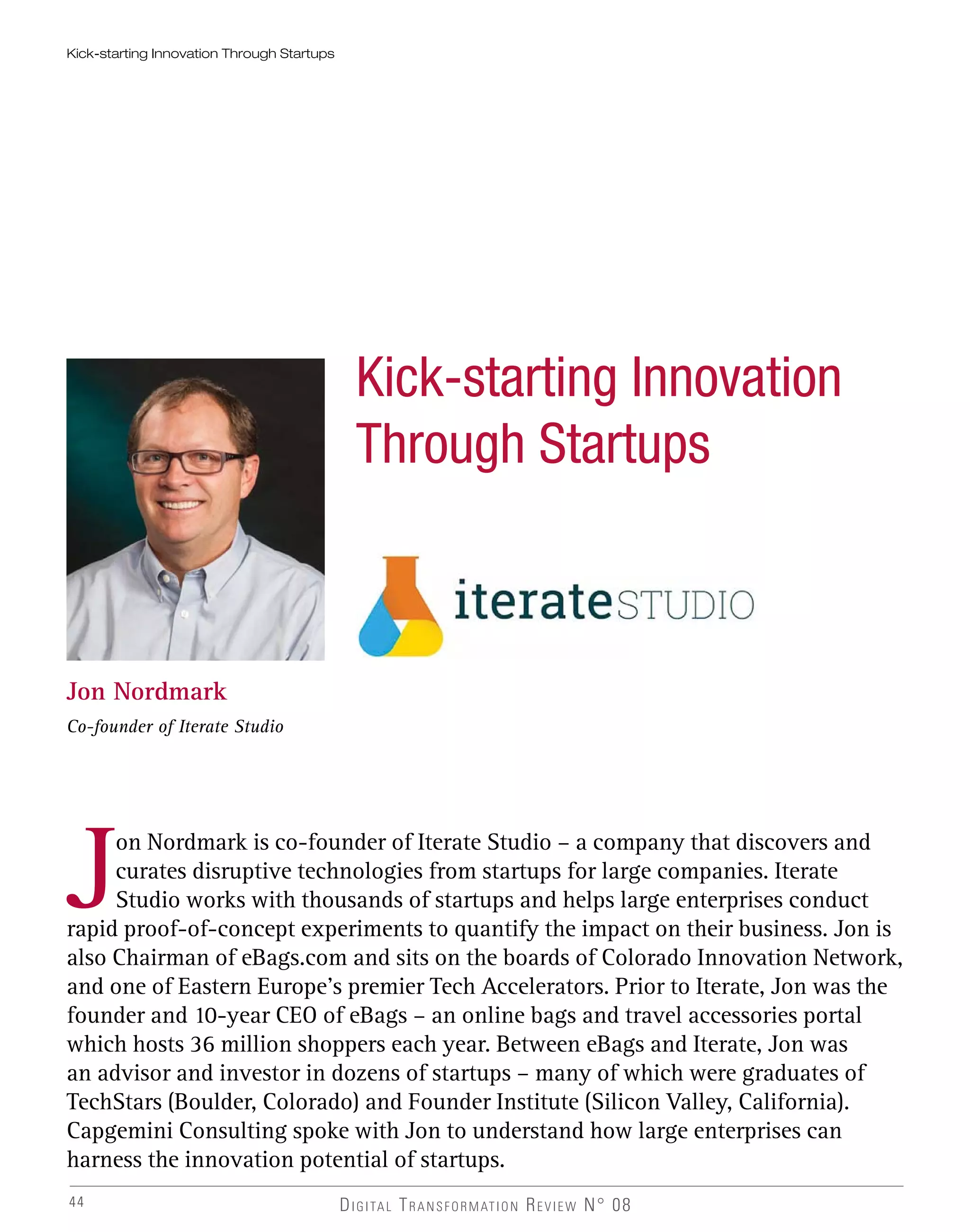
44Kick-starting Innovation Through Startups
Jon Nordmark, Iterate Studio
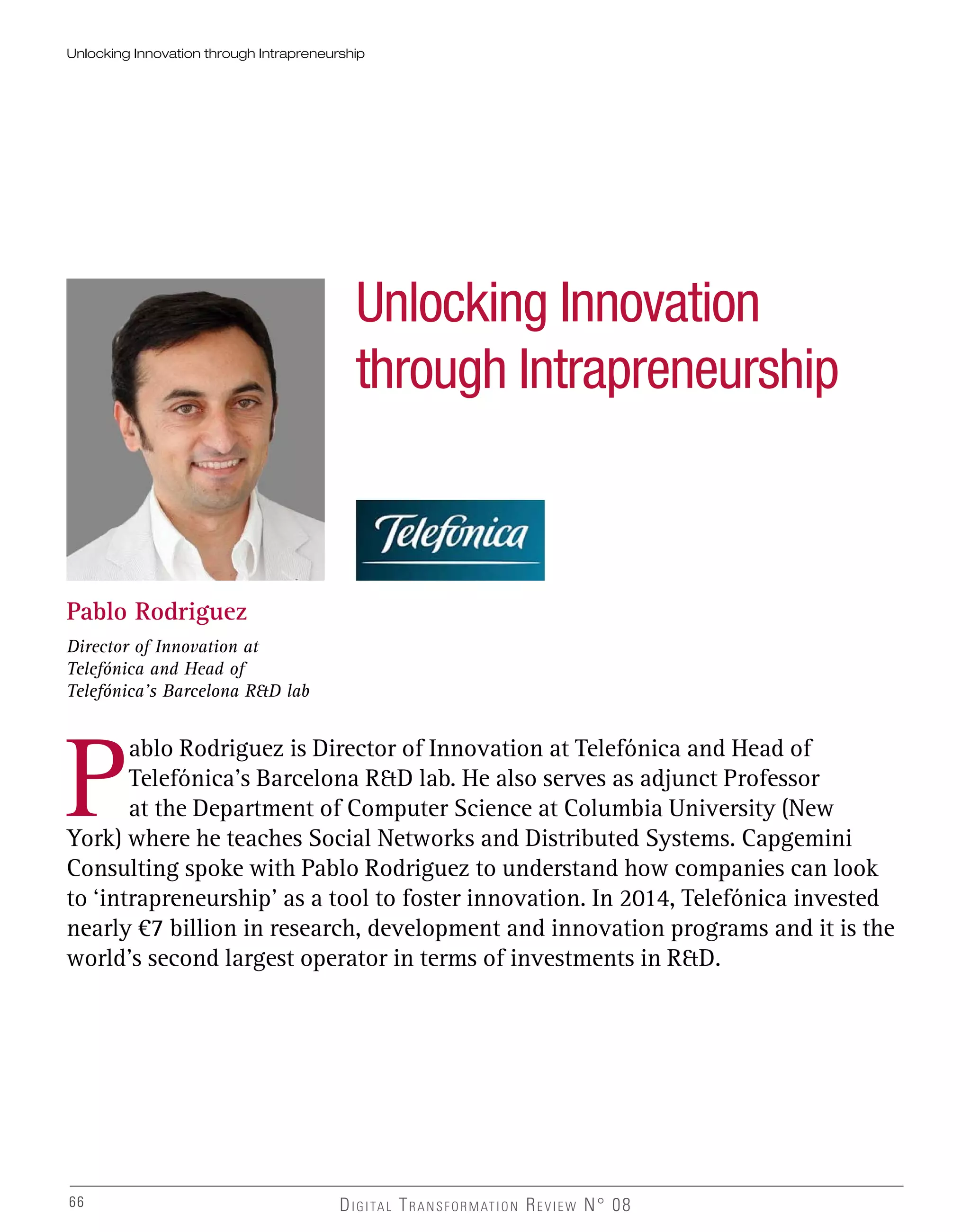
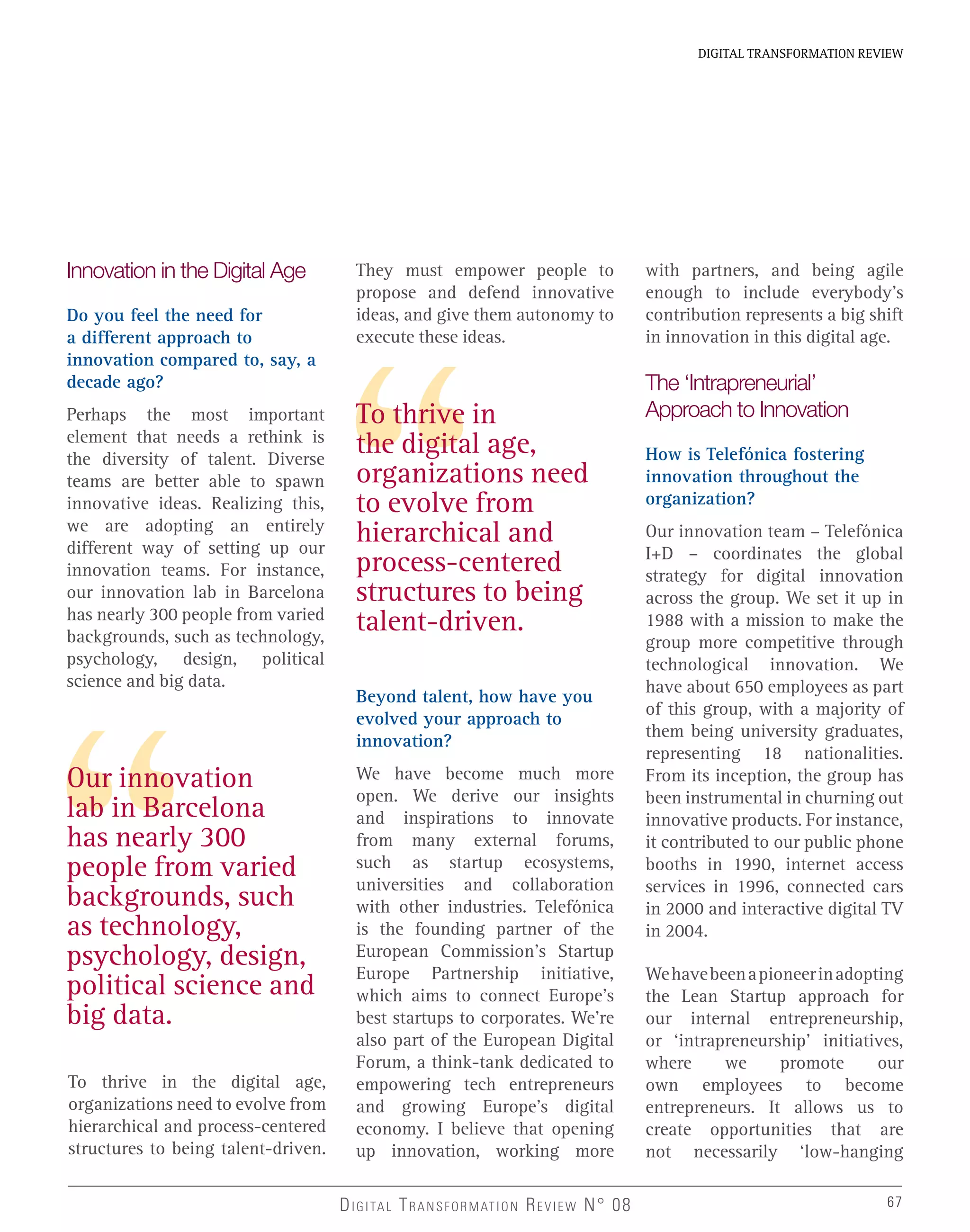
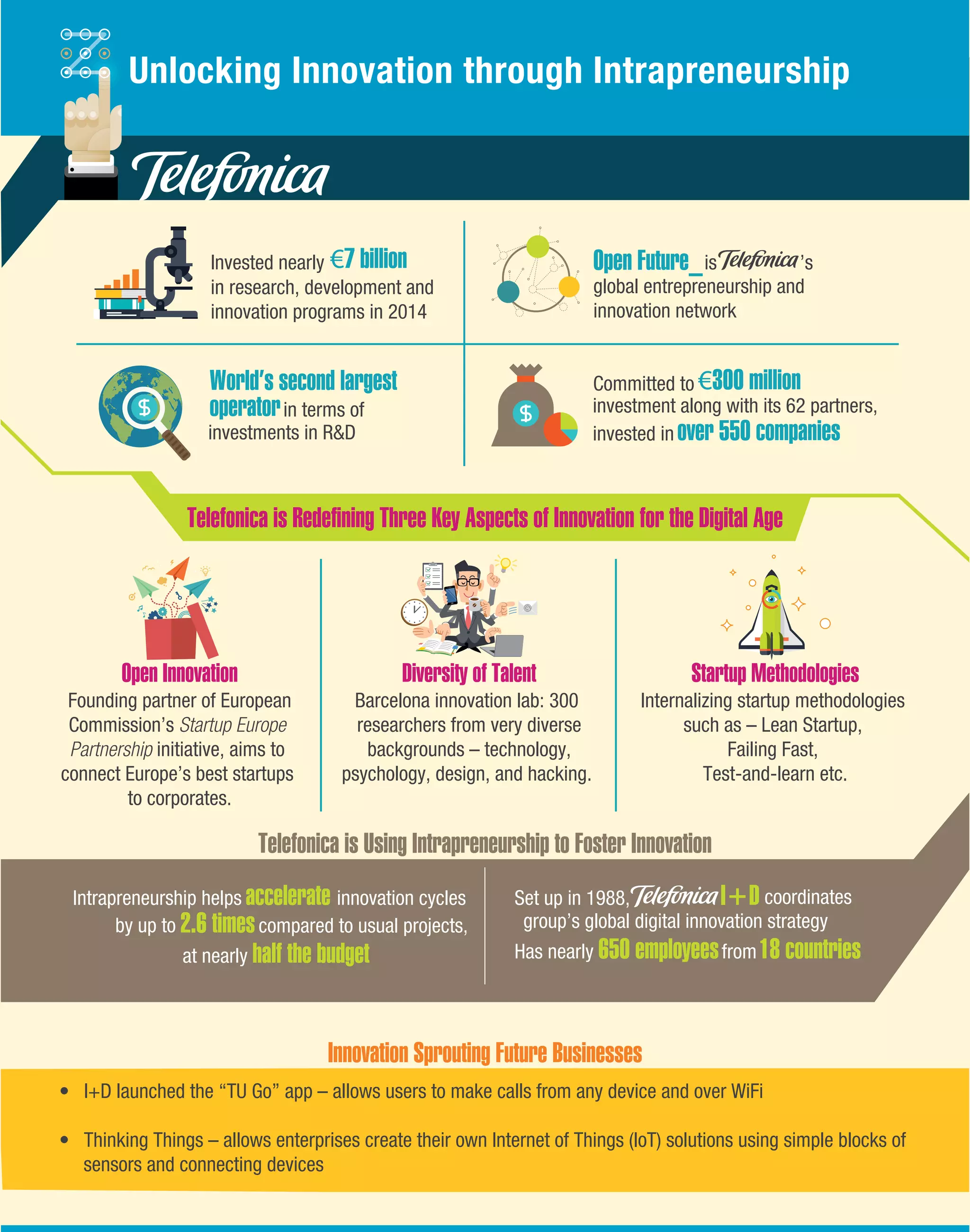
Unlocking Innovation through Intrapreneurship
Pablo Rodriguez, Telefónica
Bringing Ideas to Life – the Core Principles of
Innovation Centers
James Patterson, Capital One
6 DIGITAL TRANSFORMATION REVIEW N° 08
New Innovation Models for the Digital Age
Introduction By Capgemini Consulting’s Editorial Board
New Innovation Models for the Digital Age – Editorial
O
ne word characterizes our
digital era: innovation.
Creating a startup has never
been easier and cheaper. In our
interview with Jon Nordmark, CEO
of startup curator Iterate Studio, he
argues that “the cost of developing
a digital startup has fallen from
approximately $5 million in 2000
to $5,000 as of 2013.” And this has
led to an explosion in the number
of startups – a Cambrian age of
digital – with Jon Nordmark’s
team having identified more
than 130,000 active tech startups
across the world. And this figure is
growing every day.
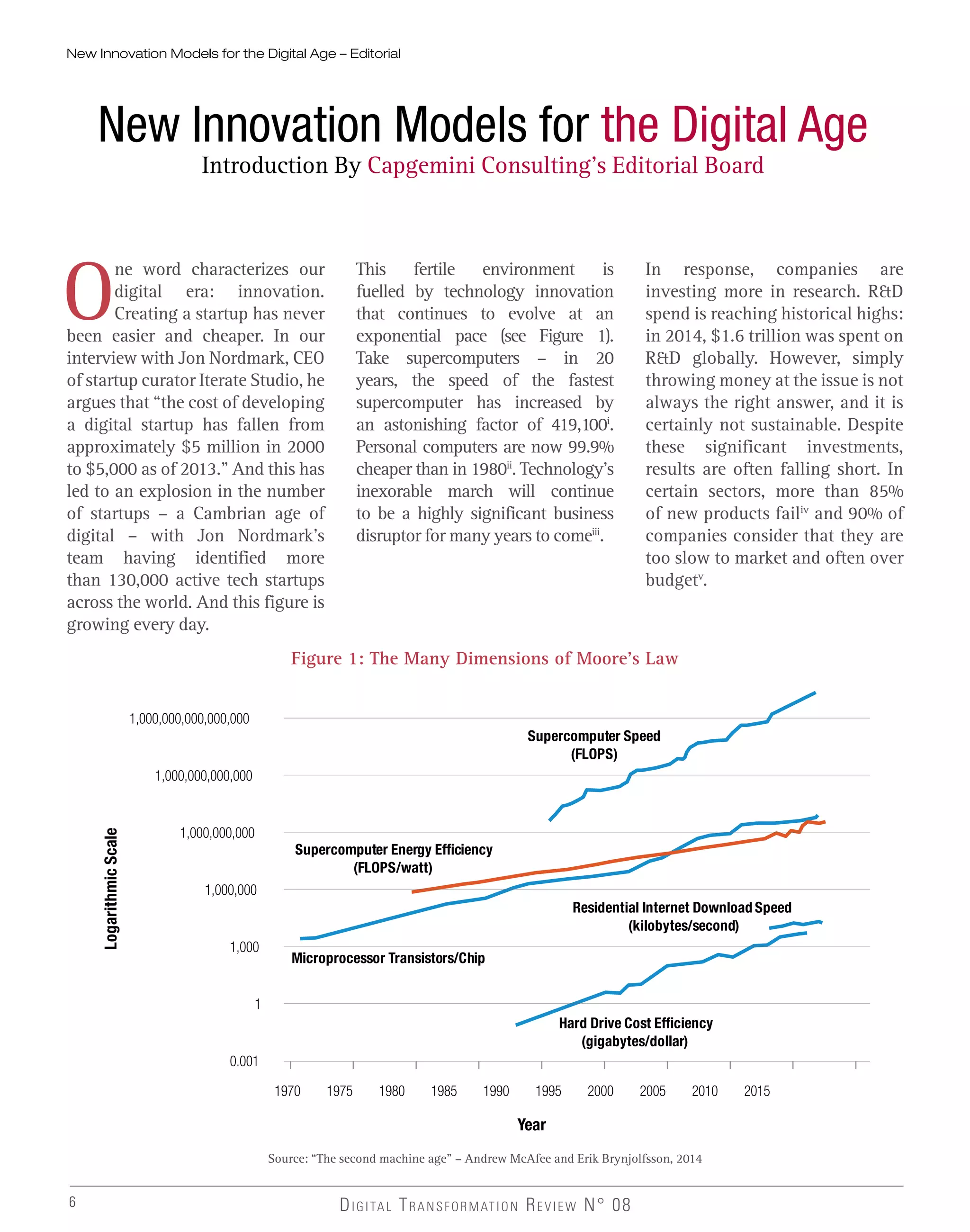
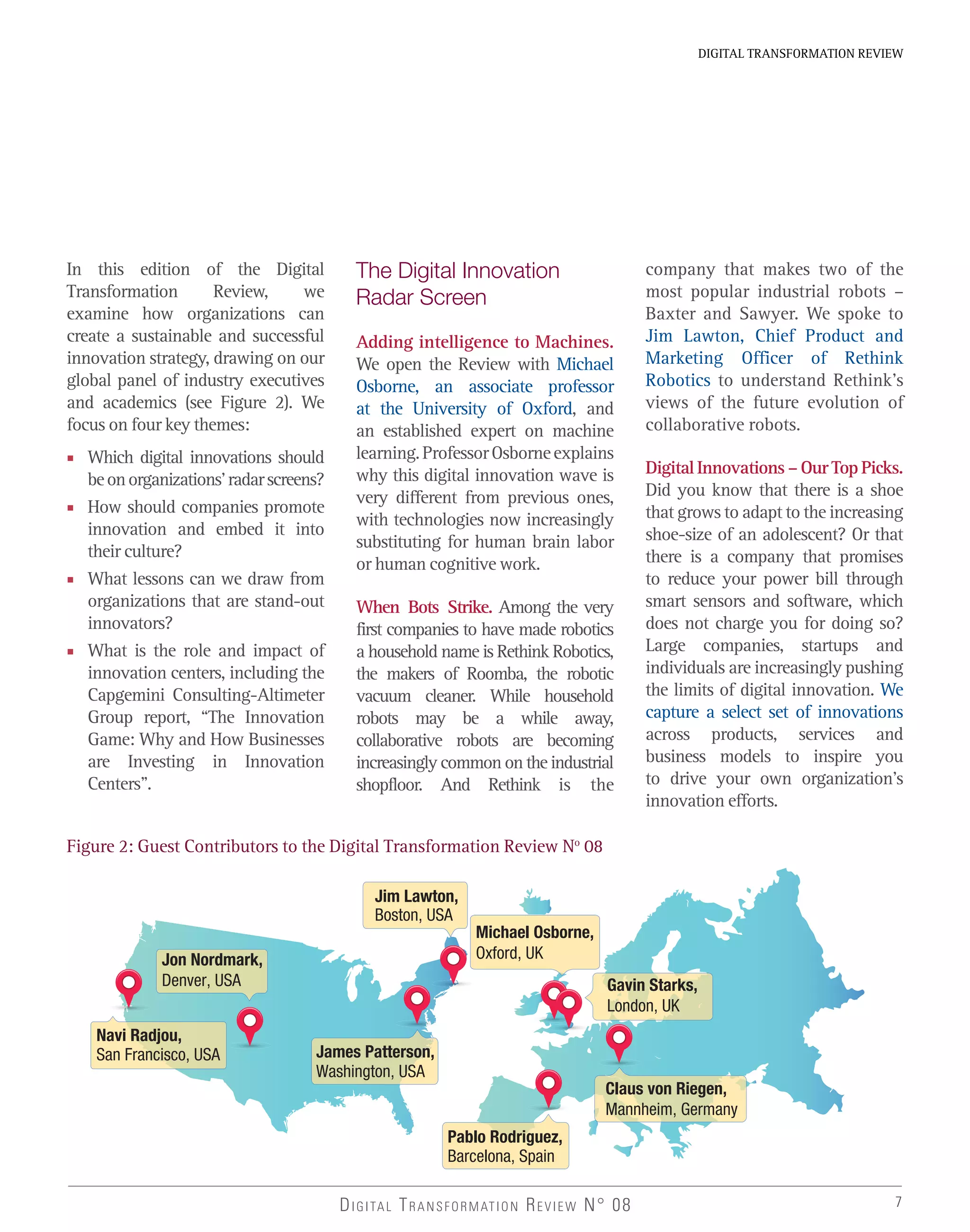
Figure 1: The Many Dimensions of Moore’s Law
Source: “The second machine age” – Andrew McAfee and Erik Brynjolfsson, 2014
This fertile environment is
fuelled by technology innovation
that continues to evolve at an
exponential pace (see Figure 1).
Take supercomputers – in 20
years, the speed of the fastest
supercomputer has increased by
an astonishing factor of 419,100i
.
Personal computers are now 99.9%
cheaper than in 1980ii
. Technology’s
inexorable march will continue
to be a highly significant business
disruptor for many years to comeiii
.
In response, companies are
investing more in research. R&D
spend is reaching historical highs:
in 2014, $1.6 trillion was spent on
R&D globally. However, simply
throwing money at the issue is not
always the right answer, and it is
certainly not sustainable. Despite
these significant investments,
results are often falling short. In
certain sectors, more than 85%
of new products failiv
and 90% of
companies consider that they are
too slow to market and often over
budgetv
.
LogarithmicScale
1,000,000,000,000,000
1,000,000,000,000
1,000,000,000
1,000,000
1,000
1
0.001
Hard Drive Cost Efficiency
(gigabytes/dollar)
Microprocessor Transistors/Chip
Residential Internet Download Speed
(kilobytes/second)
Supercomputer Speed
(FLOPS)
Supercomputer Energy Efficiency
(FLOPS/watt)
Year
1970 1975 1980 1985 1990 1995 2000 2005 2010 2015
7
DIGITAL TRANSFORMATION REVIEW
DIGITAL TRANSFORMATION REVIEW N° 08
In this edition of the Digital
Transformation Review, we
examine how organizations can
create a sustainable and successful
innovation strategy, drawing on our
global panel of industry executives
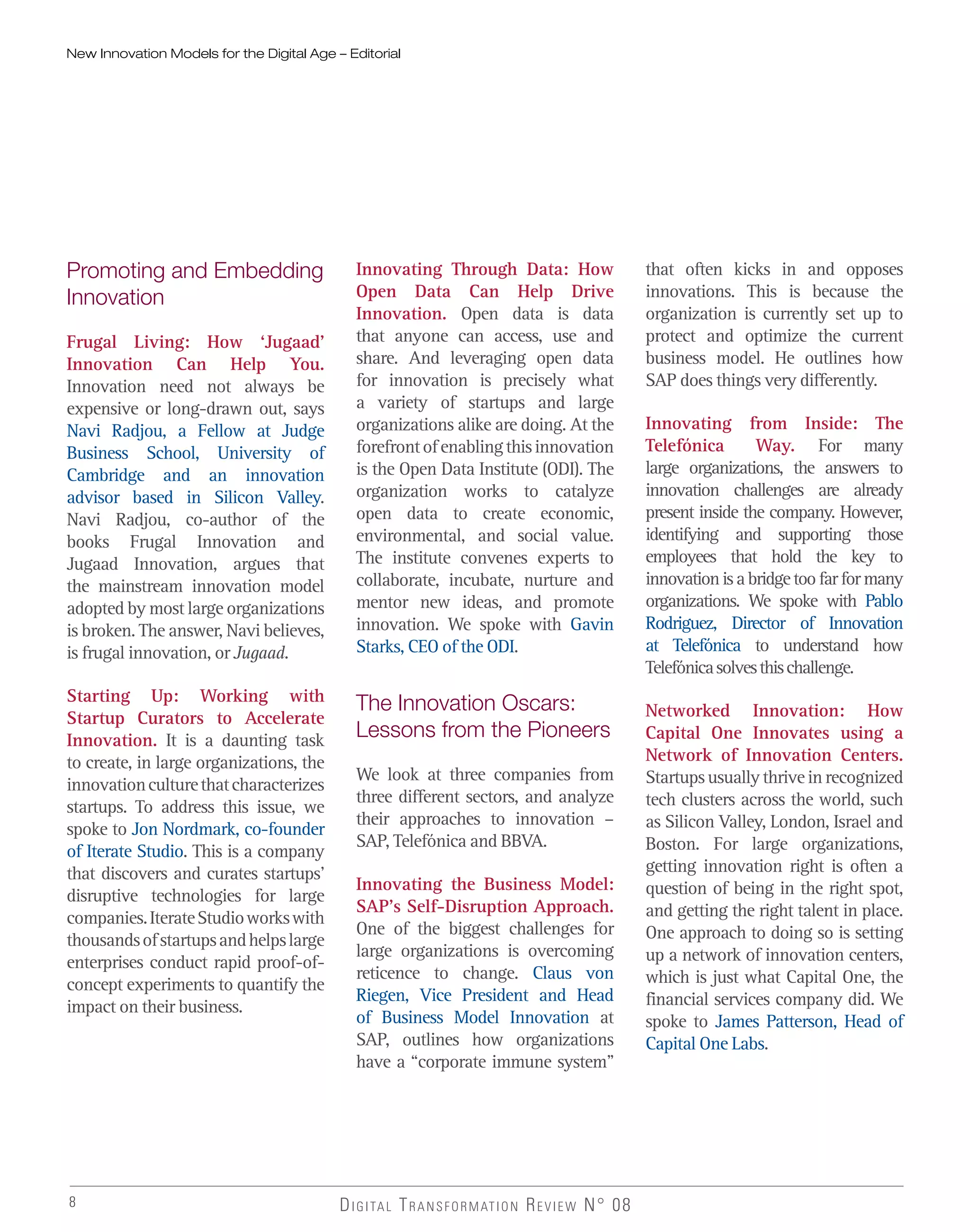
and academics (see Figure 2). We
focus on four key themes:
■ Which digital innovations should
beonorganizations’radarscreens?
■ How should companies promote
innovation and embed it into
their culture?
■ What lessons can we draw from
organizations that are stand-out
innovators?
■ What is the role and impact of
innovation centers, including the
Capgemini Consulting-Altimeter
Group report, “The Innovation
Game: Why and How Businesses
are Investing in Innovation
Centers”.
Jon Nordmark,
Denver, USA
James Patterson,
Washington, USA
Jim Lawton,
Boston, USA
Gavin Starks,
London, UK
Pablo Rodriguez,
Barcelona, Spain
Navi Radjou,
San Francisco, USA
Michael Osborne,
Oxford, UK
Claus von Riegen,
Mannheim, Germany
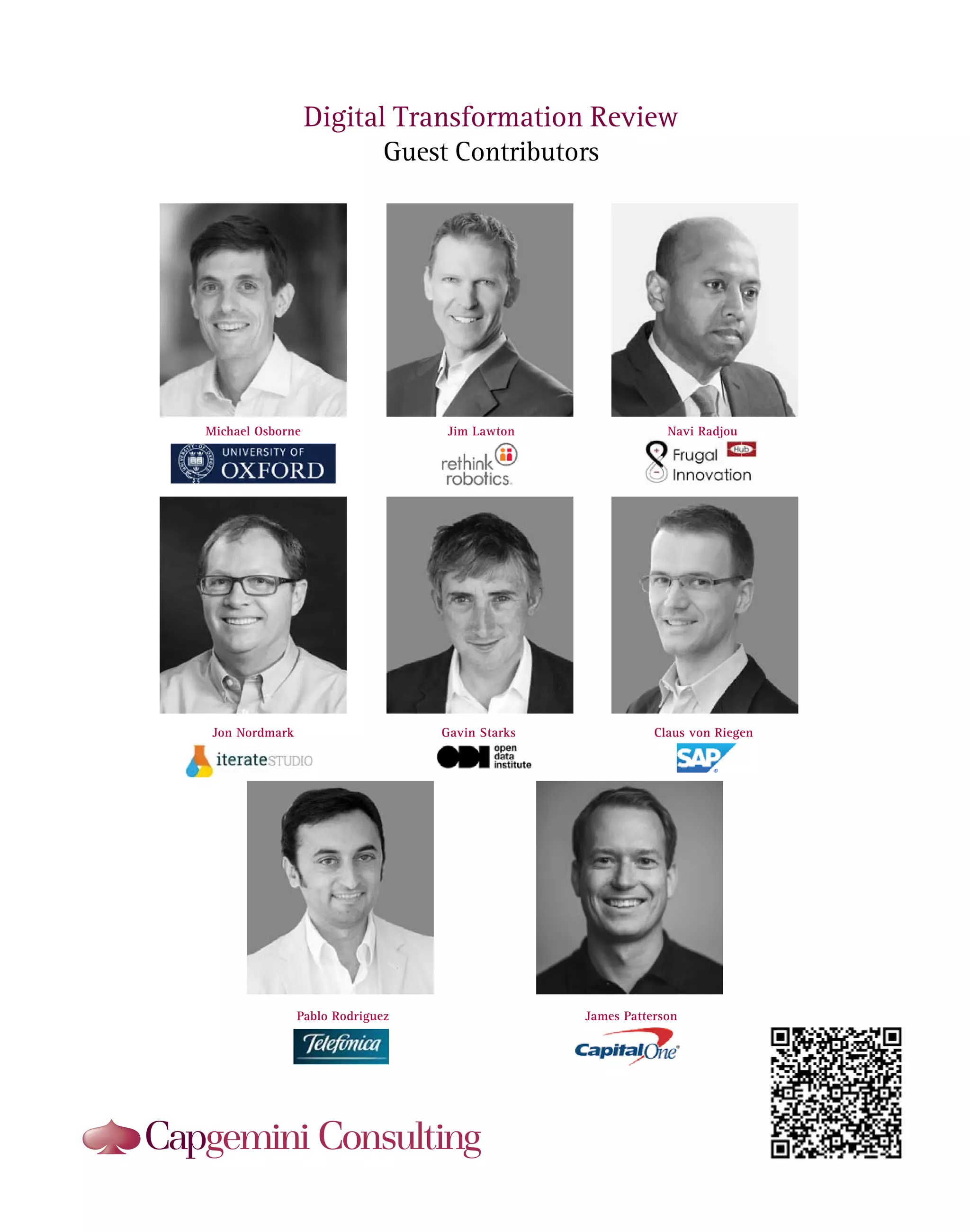
Figure 2: Guest Contributors to the Digital Transformation Review No
08
The Digital Innovation
Radar Screen
Adding intelligence to Machines.
We open the Review with Michael
Osborne, an associate professor
at the University of Oxford, and
an established expert on machine
learning.ProfessorOsborneexplains
why this digital innovation wave is
very different from previous ones,
with technologies now increasingly
substituting for human brain labor
or human cognitive work.
When Bots Strike. Among the very
first companies to have made robotics
a household name is Rethink Robotics,
the makers of Roomba, the robotic
vacuum cleaner. While household
robots may be a while away,
collaborative robots are becoming
increasingly common on the industrial
shopfloor. And Rethink is the
company that makes two of the
most popular industrial robots –
Baxter and Sawyer. We spoke to
Jim Lawton, Chief Product and
Marketing Officer of Rethink
Robotics to understand Rethink’s
views of the future evolution of
collaborative robots.
DigitalInnovations–OurTopPicks.
Did you know that there is a shoe
that grows to adapt to the increasing
shoe-size of an adolescent? Or that
there is a company that promises
to reduce your power bill through
smart sensors and software, which
does not charge you for doing so?
Large companies, startups and
individuals are increasingly pushing
the limits of digital innovation. We
capture a select set of innovations
across products, services and
business models to inspire you
to drive your own organization’s
innovation efforts.
8 DIGITAL TRANSFORMATION REVIEW N° 08
Promoting and Embedding
Innovation
Frugal Living: How ‘Jugaad’
Innovation Can Help You.
Innovation need not always be
expensive or long-drawn out, says
Navi Radjou, a Fellow at Judge
Business School, University of
Cambridge and an innovation
advisor based in Silicon Valley.
Navi Radjou, co-author of the
books Frugal Innovation and
Jugaad Innovation, argues that
the mainstream innovation model
adopted by most large organizations
is broken. The answer, Navi believes,
is frugal innovation, or Jugaad.
Starting Up: Working with
Startup Curators to Accelerate
Innovation. It is a daunting task
to create, in large organizations, the
innovationculturethatcharacterizes
startups. To address this issue, we
spoke to Jon Nordmark, co-founder
of Iterate Studio. This is a company
that discovers and curates startups’
disruptive technologies for large
companies.IterateStudioworkswith
thousandsofstartupsandhelpslarge
enterprises conduct rapid proof-of-
concept experiments to quantify the
impact on their business.
Innovating Through Data: How
Open Data Can Help Drive
Innovation. Open data is data
that anyone can access, use and
share. And leveraging open data
for innovation is precisely what
a variety of startups and large
organizations alike are doing. At the
forefrontofenablingthisinnovation
is the Open Data Institute (ODI). The
organization works to catalyze
open data to create economic,
environmental, and social value.
The institute convenes experts to
collaborate, incubate, nurture and
mentor new ideas, and promote
innovation. We spoke with Gavin
Starks, CEO of the ODI.
The Innovation Oscars:
Lessons from the Pioneers
We look at three companies from
three different sectors, and analyze
their approaches to innovation –
SAP, Telefónica and BBVA.
Innovating the Business Model:
SAP’s Self-Disruption Approach.
One of the biggest challenges for
large organizations is overcoming
reticence to change. Claus von
Riegen, Vice President and Head
of Business Model Innovation at
SAP, outlines how organizations
have a “corporate immune system”
that often kicks in and opposes
innovations. This is because the
organization is currently set up to
protect and optimize the current
business model. He outlines how
SAP does things very differently.
Innovating from Inside: The
Telefónica Way. For many
large organizations, the answers to
innovation challenges are already
present inside the company. However,
identifying and supporting those
employees that hold the key to
innovationisabridgetoofarformany
organizations. We spoke with Pablo
Rodriguez, Director of Innovation
at Telefónica to understand how
Telefónicasolvesthischallenge.
Networked Innovation: How
Capital One Innovates using a
Network of Innovation Centers.
Startupsusuallythriveinrecognized
tech clusters across the world, such
as Silicon Valley, London, Israel and
Boston. For large organizations,
getting innovation right is often a
question of being in the right spot,
and getting the right talent in place.
One approach to doing so is setting
up a network of innovation centers,
which is just what Capital One, the
financial services company did. We
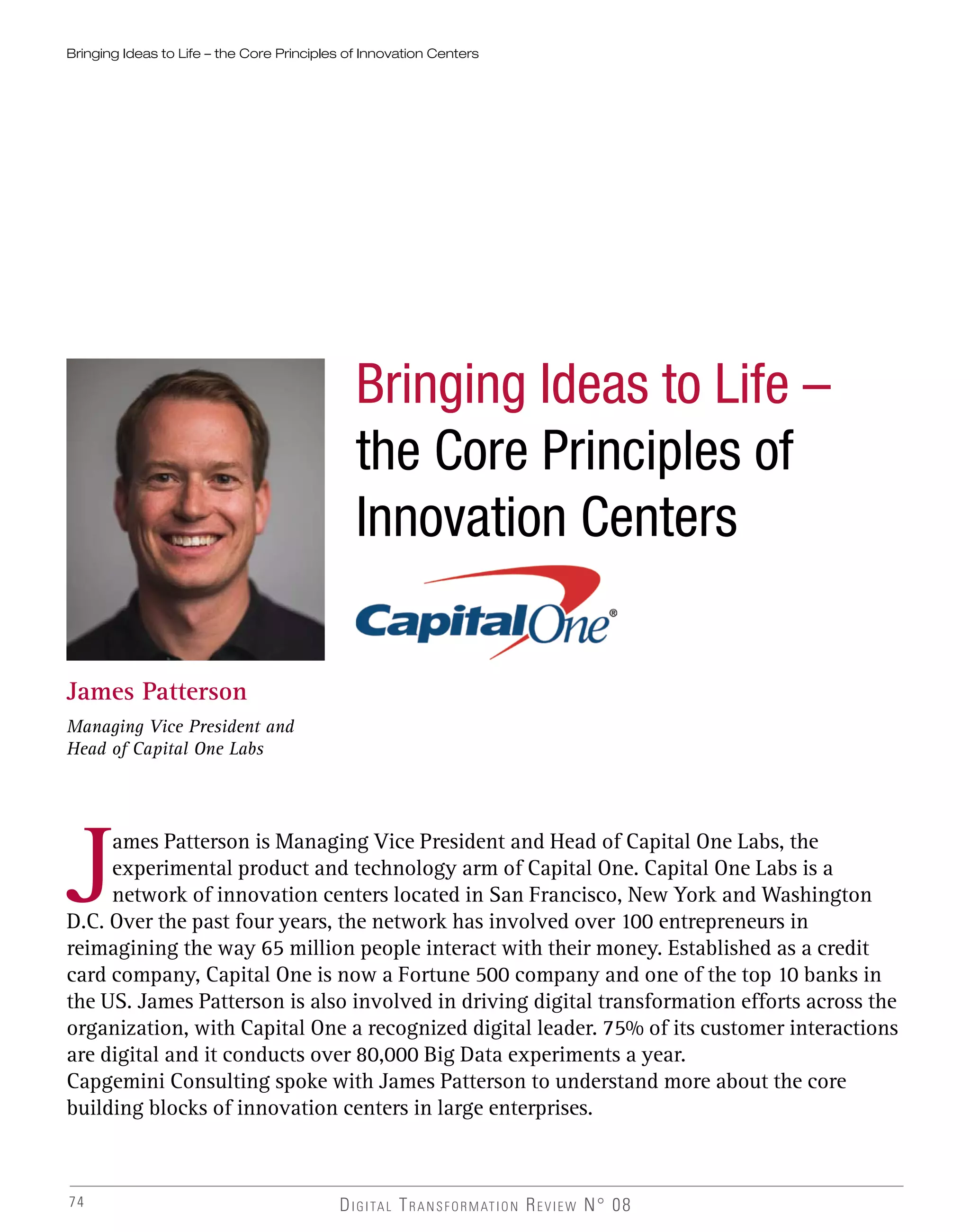
spoke to James Patterson, Head of
Capital One Labs.
New Innovation Models for the Digital Age – Editorial
9
DIGITAL TRANSFORMATION REVIEW
DIGITAL TRANSFORMATION REVIEW N° 08
The Innovation Game:
Why and How Businesses
are Investing in Innovation
Centers
We close this eighth edition of the
Digital Transformation Review
with a joint-research study from
CapgeminiConsultingandAltimeter
Group on why businesses are
investing in innovation centers and
how they are doing so. Analyzing
over 300 innovation centers across
200largeorganizationsglobally, we
found that innovation is no longer
confined to the top few tech hubs.
In fact, a number of cities across the
globe are emerging as innovation
destinations. We also draw on the
views of innovation heads at a range
of large organizations to understand
what it takes to get an innovation
center right.
As we noted at the beginning of our
introduction, massive investment in
innovation does not necessarily lead
to massive value. In fact, innovation
often remains a frustrating and
dispiriting pursuit in many large
companies. We hope this edition
of the Digital Transformation
Review is a helpful guide to making
innovation a satisfying endeavor at
your organization. Please do contact
us if you would like to discuss any of
these issues further.
i Inside HPC, How to Measure a Supercomputer’s Speed?, 7th
August 2015
ii Bloomberg, “Six things technology has made insanely cheap”, 5th February 2015
iii HBR Press, Leading Digital, October 2014
iv Nielsen, “How to flip 85% misses to 85% hits: Lessons from the Nielsen Breakthrough Innovation Project”, June 2014
v Oracle, “Understanding the Best Approaches and Tools to Manage the Complexity of Innovation”, 2013
For more information, please contact:
Fernando Alvarez (fernando.alvarez@capgemini.com, @Digital_Alvarez)
Didier Bonnet (didier.bonnet@capgemini.com, @didiebon)
Jerome Buvat (jerome.buvat@capgemini.com, @jeromebuvat)
The Digital Transformation Institute (dti.in@capgemini.com)
The Digital Innovation
Radar Screen
12
The New Innovation Wave: Machine Learning and AI
The New Innovation Wave:
Machine Learning and AI
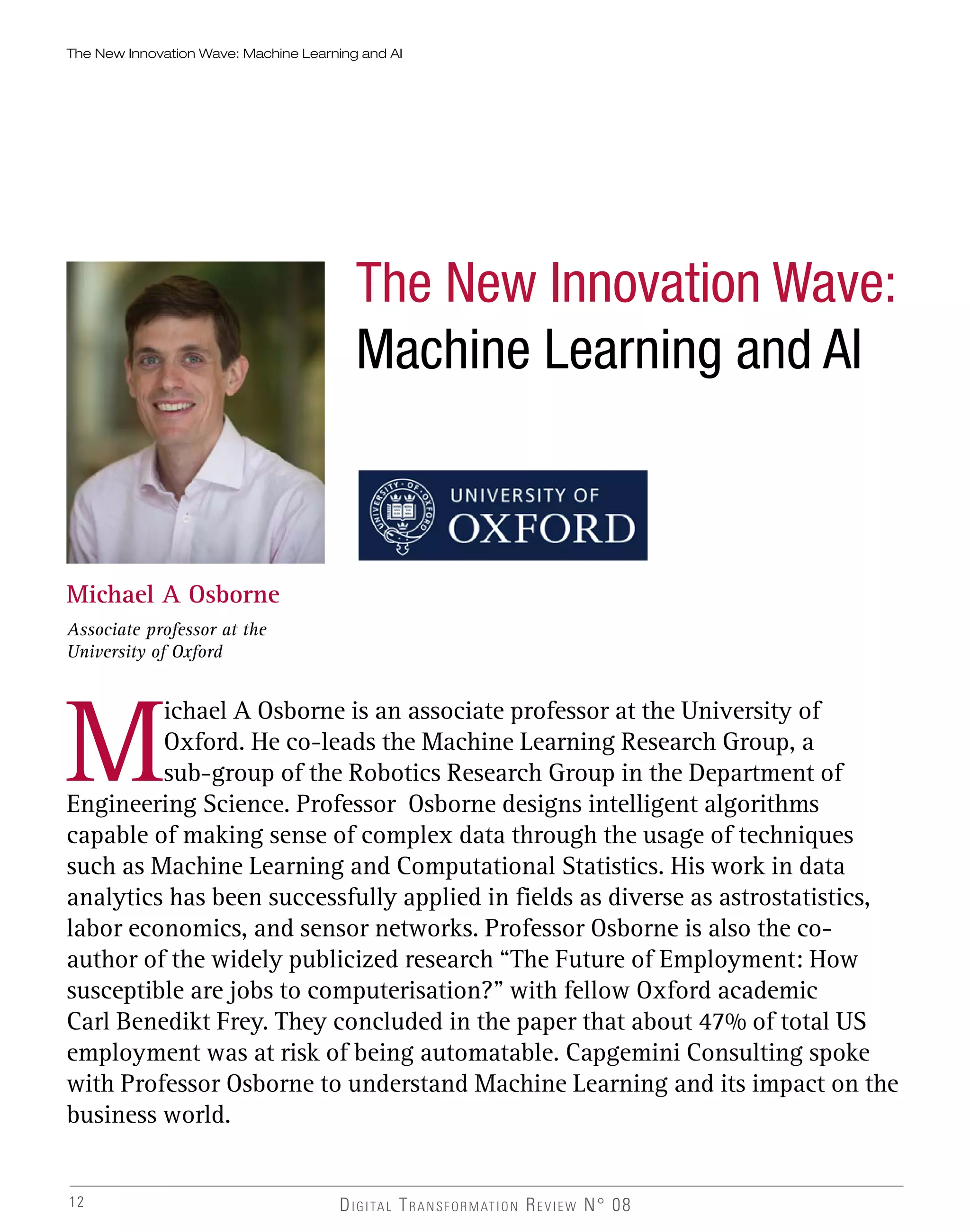
Michael A Osborne
Associate professor at the
University of Oxford
M
ichael A Osborne is an associate professor at the University of
Oxford. He co-leads the Machine Learning Research Group, a
sub-group of the Robotics Research Group in the Department of
Engineering Science. Professor Osborne designs intelligent algorithms
capable of making sense of complex data through the usage of techniques
such as Machine Learning and Computational Statistics. His work in data
analytics has been successfully applied in fields as diverse as astrostatistics,
labor economics, and sensor networks. Professor Osborne is also the co-
author of the widely publicized research “The Future of Employment: How
susceptible are jobs to computerisation?” with fellow Oxford academic
Carl Benedikt Frey. They concluded in the paper that about 47% of total US
employment was at risk of being automatable. Capgemini Consulting spoke
with Professor Osborne to understand Machine Learning and its impact on the
business world.
DIGITAL TRANSFORMATION REVIEW N° 08
Your latest research with
Professor Carl Benedikt
Frey and Citi on innovation
shows that throughout history
powerful interests have
hindered innovation. Is history
repeating itself?
History might be repeating itself.
Technological progress has always
created significant disruptions
that powerful interests tried to
combat to maintain the status
quo. In Ancient Rome, the great
author, Pliny the Elder, records
the story of an inventor who
discovered a way to manufacture
glass that was unbreakable.
Hoping to receive a reward, the
inventor presented his invention
to Roman Emperor Tiberius.
Unfortunately for the inventor,
Tiberius had him sentenced to
death, fearing the loss of jobs and
creative destruction due to the
new technology.
The various innovation waves
in history have led to dramatic
upheavals in society but we
have never seen large-scale
technological unemployment. For
example, at the beginning of the
20th century in the U.S., about
40% of our employment was
engaged in agriculture, whereas
at the end of the 20th century, it
was less than 2%. There was quite
a seismic change in the makeup of
employment due to technology.
However, none of these changes
13
DIGITAL TRANSFORMATION REVIEW
DIGITAL TRANSFORMATION REVIEW N° 08
actually affected unemployment
much; the unemployment rate
was about 5% at the beginning of
the 20th century and was still 5%
at the end of the 20th century.
Is the current digital innovation
wave different from the
previous innovation waves?
Yes, in the past technology
has largely just substituted the
human muscle, whereas now
technologies can increasingly
substitute human brain labor
or human cognitive work. If
machines can substitute for
cognitive labor, as they have done
in the past for physical labor, it’s
not very clear to what extent there
might be any demand remaining
for human labor. Another thing
that is different this time is the
accelerating rate of technological
change. It is undeniable that we
really are making quite dramatic
leaps forwards in designing
intelligent algorithms that might
be able to substitute for human
workers.
Roman Emperor
Tiberius, had [an
inventor] sentenced
to death, fearing
the loss of jobs and
creative destruction.
In the past
technology
has largely just
substituted the
human muscle,
whereas now
technologies
can increasingly
substitute human
cognitive work.
Can you give us your definition
of machine learning and
artificial intelligence?
Machine learning is a subset of
artificial intelligence (AI) and
can be defined as the study of
algorithms that can learn and act.
It’saboutthereproductionofsome
of the most quintessential human
characteristics. The boundaries
between all these different fields
are not very clear. However, you
might associate computer vision,
language processing and speech
recognition as other subsets of
artificial intelligence.
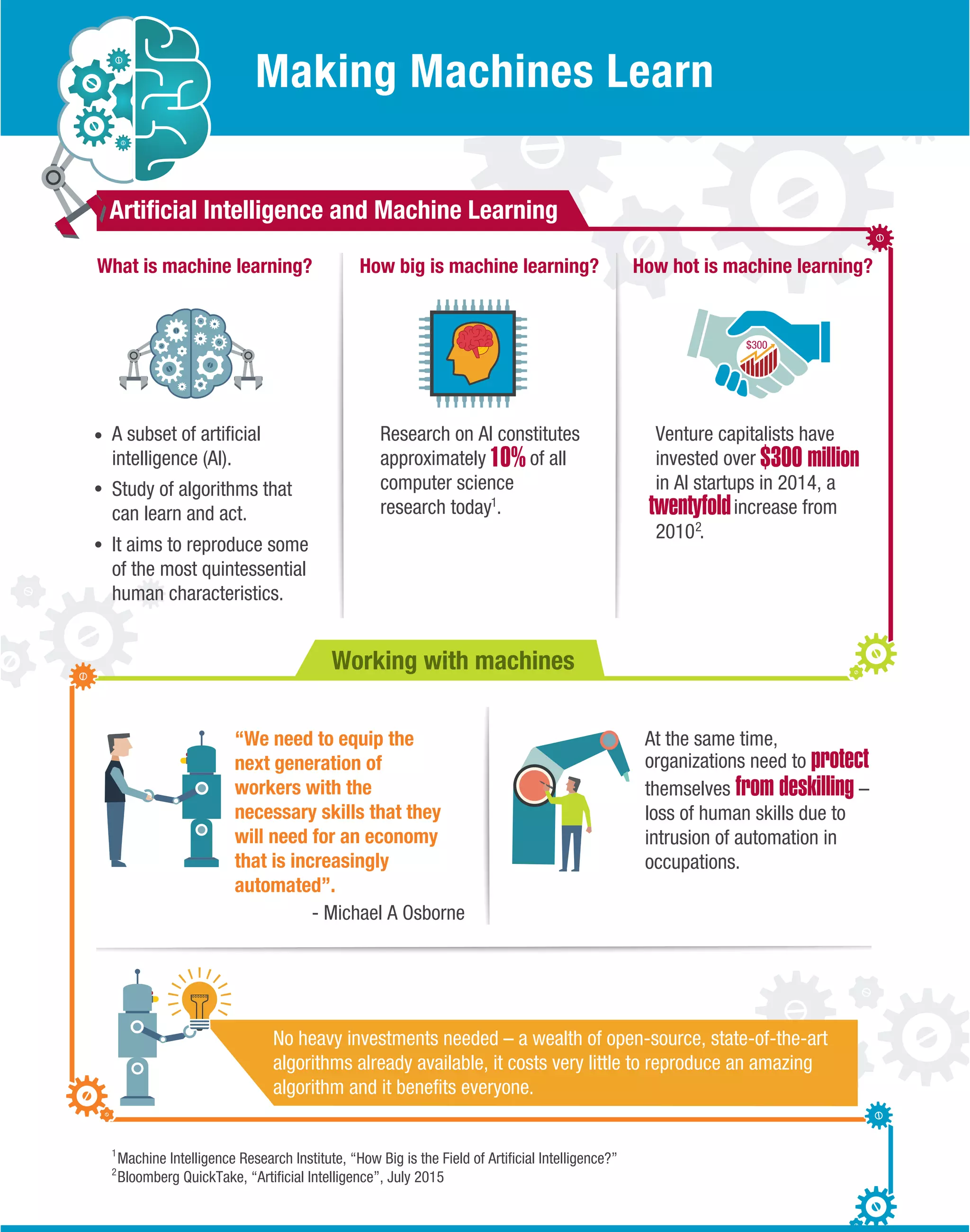
Working with machines
Making Machines Learn
“We need to equip the
next generation of
workers with the
necessary skills that they
will need for an economy
that is increasingly
automated”.
At the same time,
organizations need to protect
themselves from deskilling –
loss of human skills due to
intrusion of automation in
occupations.
No heavy investments needed – a wealth of open-source, state-of-the-art
algorithms already available, it costs very little to reproduce an amazing
algorithm and it benefits everyone.
Artificial Intelligence and Machine Learning
Machine Intelligence Research Institute, “How Big is the Field of Artificial Intelligence?”
Bloomberg QuickTake, “Artificial Intelligence”, July 20152
1
$300
1
Research on AI constitutes
approximately of all
computer science
research today .
10%
2
Venture capitalists have
invested over
in AI startups in 2014, a
increase from
2010 .
$300 million
twentyfold
- Michael A Osborne
A subset of artificial
intelligence (AI).
Study of algorithms that
can learn and act.
It aims to reproduce some
of the most quintessential
human characteristics.
What is machine learning? How big is machine learning? How hot is machine learning?
15DIGITAL TRANSFORMATION REVIEW N° 08
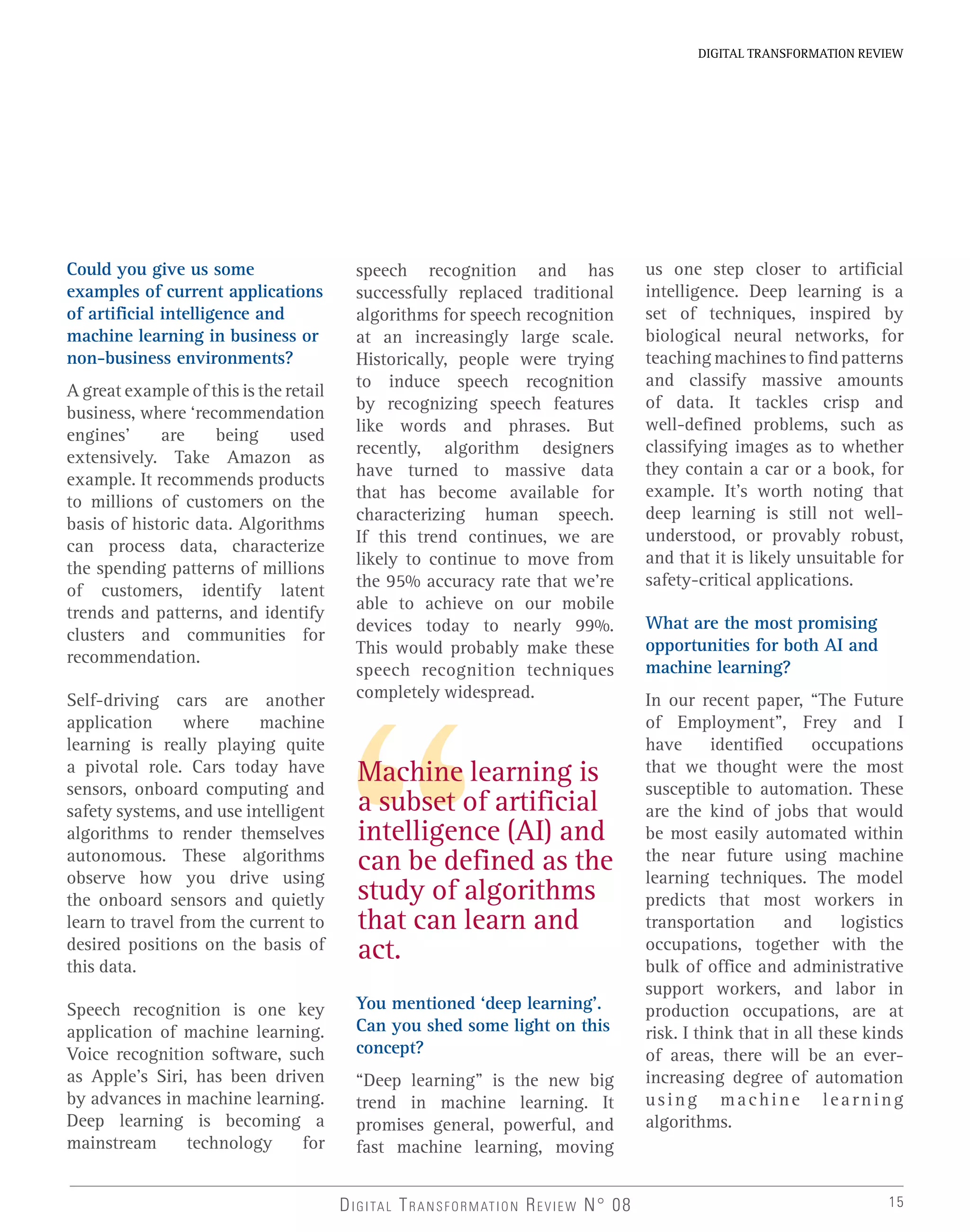
Could you give us some
examples of current applications
of artificial intelligence and
machine learning in business or
non-business environments?
A great example of this is the retail
business, where ‘recommendation
engines’ are being used
extensively. Take Amazon as
example. It recommends products
to millions of customers on the
basis of historic data. Algorithms
can process data, characterize
the spending patterns of millions
of customers, identify latent
trends and patterns, and identify
clusters and communities for
recommendation.
Self-driving cars are another
application where machine
learning is really playing quite
a pivotal role. Cars today have
sensors, onboard computing and
safety systems, and use intelligent
algorithms to render themselves
autonomous. These algorithms
observe how you drive using
the onboard sensors and quietly
learn to travel from the current to
desired positions on the basis of
this data.
Speech recognition is one key
application of machine learning.
Voice recognition software, such
as Apple’s Siri, has been driven
by advances in machine learning.
Deep learning is becoming a
mainstream technology for
speech recognition and has
successfully replaced traditional
algorithms for speech recognition
at an increasingly large scale.
Historically, people were trying
to induce speech recognition
by recognizing speech features
like words and phrases. But
recently, algorithm designers
have turned to massive data
that has become available for
characterizing human speech.
If this trend continues, we are
likely to continue to move from
the 95% accuracy rate that we’re
able to achieve on our mobile
devices today to nearly 99%.
This would probably make these
speech recognition techniques
completely widespread.
You mentioned ‘deep learning’.
Can you shed some light on this
concept?
“Deep learning” is the new big
trend in machine learning. It
promises general, powerful, and
fast machine learning, moving
Machine learning is
a subset of artificial
intelligence (AI) and
can be defined as the
study of algorithms
that can learn and
act.
us one step closer to artificial
intelligence. Deep learning is a
set of techniques, inspired by
biological neural networks, for
teaching machines to find patterns
and classify massive amounts
of data. It tackles crisp and
well-defined problems, such as
classifying images as to whether
they contain a car or a book, for
example. It’s worth noting that
deep learning is still not well-
understood, or provably robust,
and that it is likely unsuitable for
safety-critical applications.
What are the most promising
opportunities for both AI and
machine learning?
In our recent paper, “The Future
of Employment”, Frey and I
have identified occupations
that we thought were the most
susceptible to automation. These
are the kind of jobs that would
be most easily automated within
the near future using machine
learning techniques. The model
predicts that most workers in
transportation and logistics
occupations, together with the
bulk of office and administrative
support workers, and labor in
production occupations, are at
risk. I think that in all these kinds
of areas, there will be an ever-
increasing degree of automation
using machine learning
algorithms.
DIGITAL TRANSFORMATION REVIEW
16 DIGITAL TRANSFORMATION REVIEW N° 08
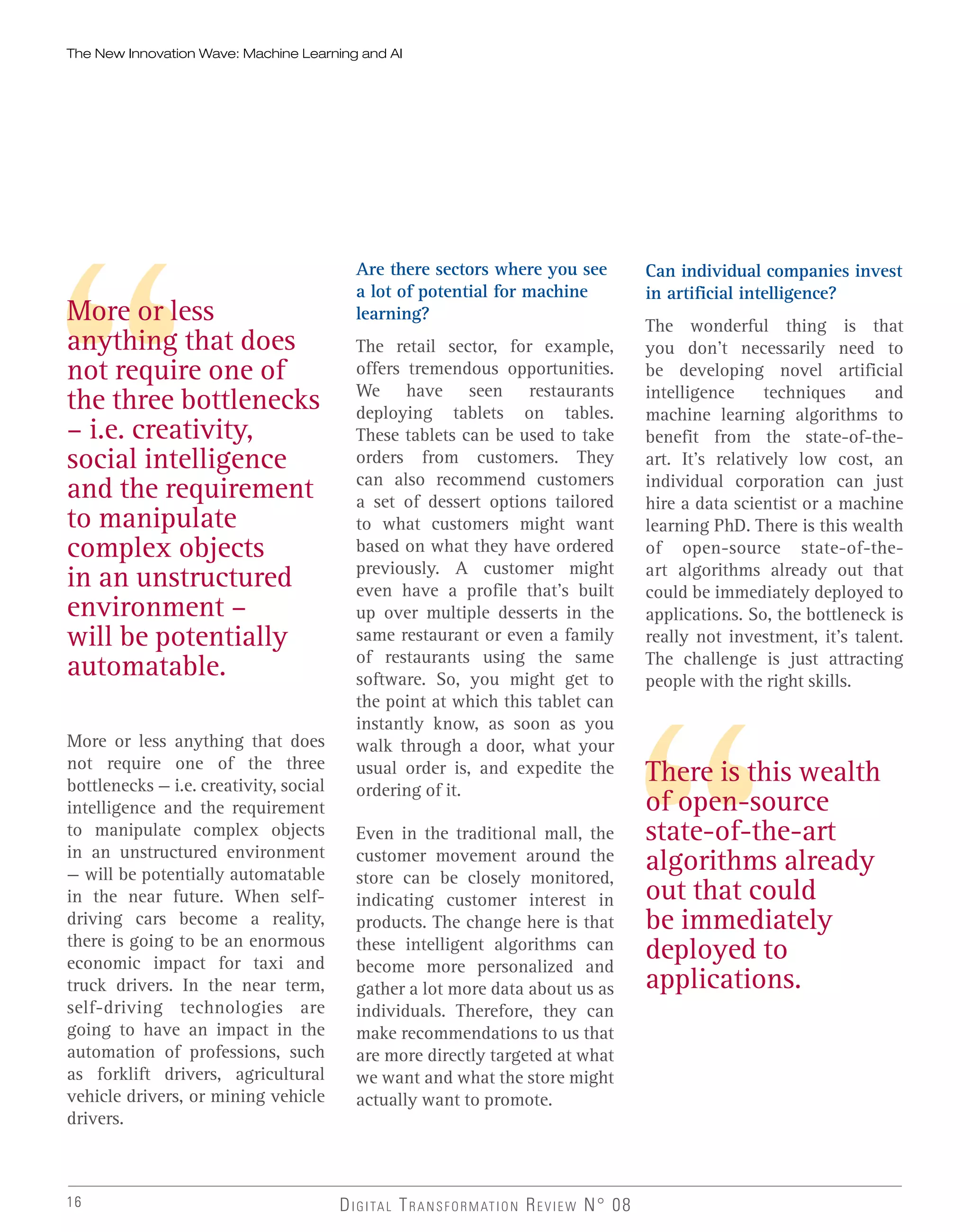
More or less anything that does
not require one of the three
bottlenecks — i.e. creativity, social
intelligence and the requirement
to manipulate complex objects
in an unstructured environment
— will be potentially automatable
in the near future. When self-
driving cars become a reality,
there is going to be an enormous
economic impact for taxi and
truck drivers. In the near term,
self-driving technologies are
going to have an impact in the
automation of professions, such
as forklift drivers, agricultural
vehicle drivers, or mining vehicle
drivers.
More or less
anything that does
not require one of
the three bottlenecks
– i.e. creativity,
social intelligence
and the requirement
to manipulate
complex objects
in an unstructured
environment –
will be potentially
automatable.
Are there sectors where you see
a lot of potential for machine
learning?
The retail sector, for example,
offers tremendous opportunities.
We have seen restaurants
deploying tablets on tables.
These tablets can be used to take
orders from customers. They
can also recommend customers
a set of dessert options tailored
to what customers might want
based on what they have ordered
previously. A customer might
even have a profile that’s built
up over multiple desserts in the
same restaurant or even a family
of restaurants using the same
software. So, you might get to
the point at which this tablet can
instantly know, as soon as you
walk through a door, what your
usual order is, and expedite the
ordering of it.
Even in the traditional mall, the
customer movement around the
store can be closely monitored,
indicating customer interest in
products. The change here is that
these intelligent algorithms can
become more personalized and
gather a lot more data about us as
individuals. Therefore, they can
make recommendations to us that
are more directly targeted at what
we want and what the store might
actually want to promote.
Can individual companies invest
in artificial intelligence?
The wonderful thing is that
you don’t necessarily need to
be developing novel artificial
intelligence techniques and
machine learning algorithms to
benefit from the state-of-the-
art. It’s relatively low cost, an
individual corporation can just
hire a data scientist or a machine
learning PhD. There is this wealth
of open-source state-of-the-
art algorithms already out that
could be immediately deployed to
applications. So, the bottleneck is
really not investment, it’s talent.
The challenge is just attracting
people with the right skills.
There is this wealth
of open-source
state-of-the-art
algorithms already
out that could
be immediately
deployed to
applications.
The New Innovation Wave: Machine Learning and AI
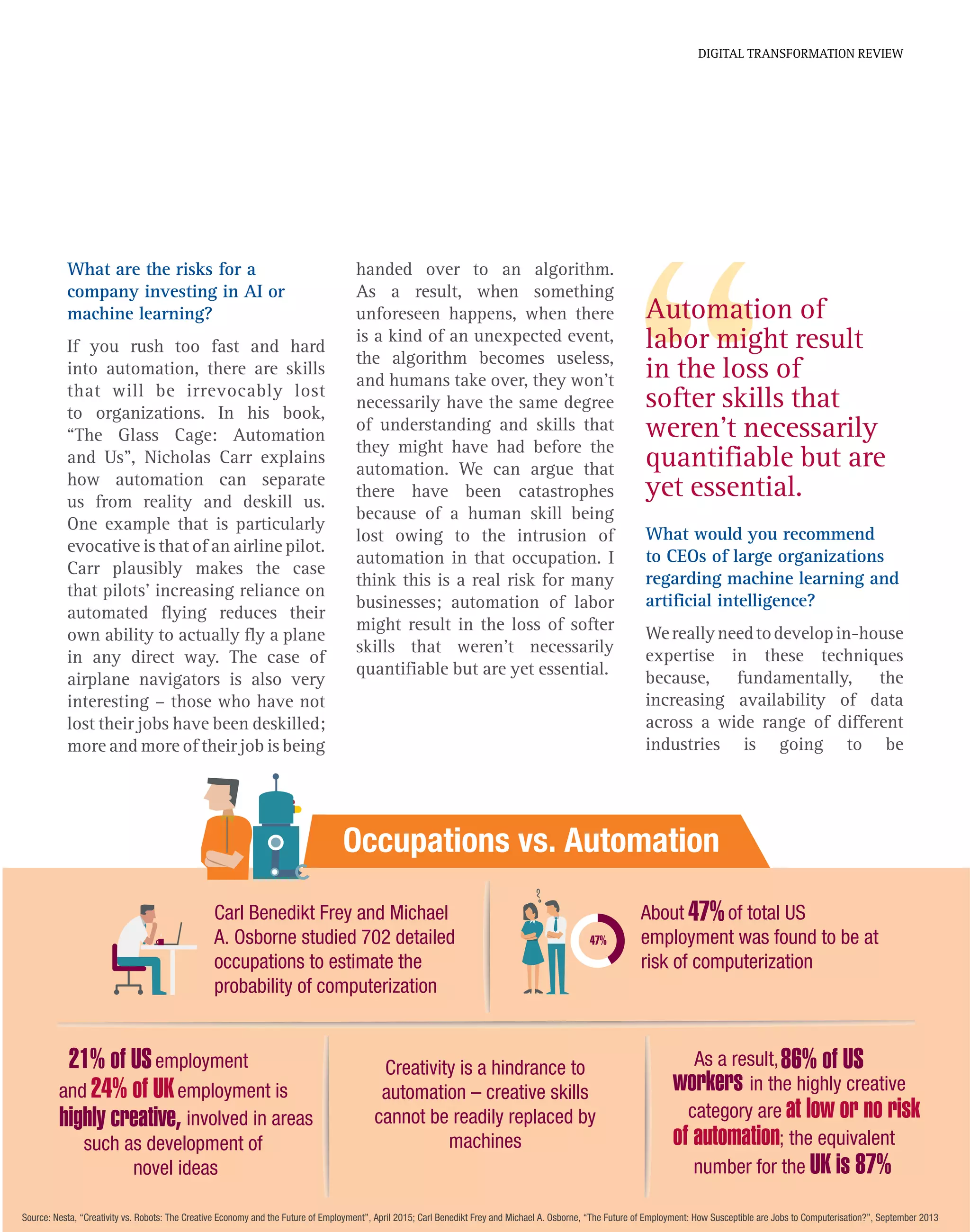
Source: Nesta, “Creativity vs. Robots: The Creative Economy and the Future of Employment”, April 2015; Carl Benedikt Frey and Michael A. Osborne, “The Future of Employment: How Susceptible are Jobs to Computerisation?”, September 2013
Carl Benedikt Frey and Michael
A. Osborne studied 702 detailed
occupations to estimate the
probability of computerization
Creativity is a hindrance to
automation – creative skills
cannot be readily replaced by
machines
About of total US
employment was found to be at
risk of computerization
47%
employment21% of US
24% of UKand employment is
involved in areashighly creative,
such as development of
novel ideas
As a result,86% of US
workers in the highly creative
category are at low or no risk
of automation; the equivalent
number for the UK is 87%
Occupations vs. Automation
47%
What are the risks for a
company investing in AI or
machine learning?
If you rush too fast and hard
into automation, there are skills
that will be irrevocably lost
to organizations. In his book,
“The Glass Cage: Automation
and Us”, Nicholas Carr explains
how automation can separate
us from reality and deskill us.
One example that is particularly
evocative is that of an airline pilot.
Carr plausibly makes the case
that pilots’ increasing reliance on
automated flying reduces their
own ability to actually fly a plane
in any direct way. The case of
airplane navigators is also very
interesting – those who have not
lost their jobs have been deskilled;
more and more of their job is being
Automation of
labor might result
in the loss of
softer skills that
weren’t necessarily
quantifiable but are
yet essential.
DIGITAL TRANSFORMATION REVIEW
handed over to an algorithm.
As a result, when something
unforeseen happens, when there
is a kind of an unexpected event,
the algorithm becomes useless,
and humans take over, they won’t
necessarily have the same degree
of understanding and skills that
they might have had before the
automation. We can argue that
there have been catastrophes
because of a human skill being
lost owing to the intrusion of
automation in that occupation. I
think this is a real risk for many
businesses; automation of labor
might result in the loss of softer
skills that weren’t necessarily
quantifiable but are yet essential.
What would you recommend
to CEOs of large organizations
regarding machine learning and
artificial intelligence?
Wereallyneedtodevelopin-house
expertise in these techniques
because, fundamentally, the
increasing availability of data
across a wide range of different
industries is going to be
Value is delivered to
us as customers or
as consumers. Let’s
make sure that all
this wealth that is
created is distributed
in a fair way
throughout society
at large.
18 DIGITAL TRANSFORMATION REVIEW N° 08
transformational. If your business
is not in the forefront of using
this data, there certainly will be
another business. The potential
value that could be realized is
going to develop into a real
competitive advantage. I think
companies need to be doing a lot
more to recruit and hold on to
talent such as data scientists and
machine learning experts.
What are some of the ethics
issues that we will face with
machine learning or AI?
The big problem here — and one that
the machine learning community is
spendingalotoftimeon—isprivacy.
Our objective is to have systems
that could be verifiably shown
to not intrude upon someone’s
private space. Ideally, you would
have an algorithm that would
process, for example, medical
health records without ever
returning to the users of that
algorithm any personal details.
These algorithms look at this
dataset and return aggregate
statistics useful to researchers
without ever returning to
those people, the details of any
individual patient. This relies
upon the robustness of the
algorithm.
How can governments and
regulators try to mitigate the
adverse effects of machine
learning?
I feel the most imminent concern
is the effect of machine learning
technologies upon employment.
People have rightly recommended
that these technological events
would necessitate the change
of education. I think we need
to equip the next generation
of workers with the necessary
skills that they will need for an
economy that is increasingly
automated. Governments do
have a role in investing in the
technological research. There
are profound challenges here in
getting governments to select
the right type of technological
development.
Is there an argument to slow
down the progress of machine
learning?
I don’t think there is. An important
thing to note is that all these
technologies will be delivering
enormous value to society. We
have seen in the last 10 years the
delivery of amazing technologies.
Even the smartphone in your
pocket, for example, has a range
of apps that would have been
unthinkable even 10 years ago. My
point is that value is delivered to
us as customers or as consumers.
Let’s make sure that all this wealth
that is created is distributed in a
fair way throughout society at
large. Moreover, the wonderful
thing about the technology is
that it has very low marginal cost
of reproduction. So, at the point
that you develop an amazing new
speech recognition algorithm,
it costs very little to deploy that
algorithm on everybody’s mobile
phone. Everybody benefits
from the introduction of those
techniques as customers and
as consumers. The problem is
that some people necessarily
will be put out of work by these
technologies. I think there is
a challenge to make sure that
there are jobs created to replace
those that are eliminated by new
technologies.
The New Innovation Wave: Machine Learning and AI
“I believe relying on one or two
programs to create an innovation
culture can only have limited results.
It has to be a combination of efforts
led from the top.”
“Financial Se
- Pablo Rodriguez
– James Patterson
el Botsman
“FFF“ inininananancicicialalal SSSFFFFFF eee
el Botsman
CREATING A CULTURE OF INNOVATION
“Innovation can’t be done in an
isolated way, on an island. The only
way innovation can take up firm
ground is when it has CEO-level
support. There needs to be a requirement
coming from the CEO that business
units must work together seamlessly.”
- Jon Nordmark
“At Capital One, innovation is
not just for one team, but for the whole
company. We have a strong culture of
long-term investments in innovation […]
our businesses and the Labs share the same
understanding of what innovation truly
means.”
“I think changing the culture of the company
is absolutely critical. Our research shows
that it takes approximately 8–10 years for a
company to make the complete transition,
which is a long journey. But, companies like
Renault have proven that if you can patiently
execute the strategy over 10 years, you can
become a leader in the space.”
– Navi Radjou
“The intrapreneurship program is the right
channel for out-of-the-box ideas: innovations
that would not be considered part of our current
product portfolio development.”
- Claus von Riegen
20
Rise of the Machine: Forging Ahead with Robots
Jim Lawton
Chief Product and Marketing
Officer, Rethink Robotics
Rethink Robotics was co-founded by Rodney Brooks, the inventor of the
popular robotic vacuum cleaner Roomba. Rethink is focused on developing
robots that provide manufacturers with the benefits of automation, but
without the need to enclose the robots in cages and tied to only one job. The
company has, to-date, launched two collaborative robots called Baxter and Sawyer.
Jim Lawton is the Chief Product and Marketing Officer of Rethink Robotics. Prior
to Rethink Robotics, he was an executive at Dun & Bradstreet. Previously, Jim
Lawton had served as Vice President of Marketing for Open Ratings (acquired by
D&B), where he transformed a 5-year-old internet company into an aggressive SaaS
provider. Capgemini Consulting spoke to Jim to understand his view of where robots
are headed and their impact.
DIGITAL TRANSFORMATION REVIEW N° 08
Rise of the Machine:
Forging Ahead with Robots
21
DIGITAL TRANSFORMATION REVIEW
Agility and
flexibility are
the two key
factors that
have been
driving the
emergence of
collaborative robots.
DIGITAL TRANSFORMATION REVIEW N° 08
What are the drivers behind the
rise of collaborative robots?
Agility and flexibility are the two
key factors that have been driving
the emergence of collaborative
robots. Manufacturers increasingly
need to maintain the flexibility
and the agility that they get with
manual labor, and robots haven’t
been up to that task so far. Today, I
may be standing in front of a sheet
metal press brake, and, tomorrow,
I will be putting circuit boards
into an in-circuit tester. This is
the kind of agility and flexibility
that manufacturers need and that
has been missing. Most industrial
robots at automotive factories, for
example, perform welding and are
typically placed in cages. These
robots take a couple of hundred
hours or more to program and are
then dismantled at the end of the
product line. Units like that are
difficult to deploy for a particular
task and lack flexibility.
What has really been at the heart
of the creation of this new kind
of collaborative robot is to think
differently about what could be
done with robots. The opportunity
is massive – we believe that 90%
of the tasks in factories today are
not automated.
Can you tell us more about
your collaborative robots –
Baxter and Sawyer – and their
unique features?
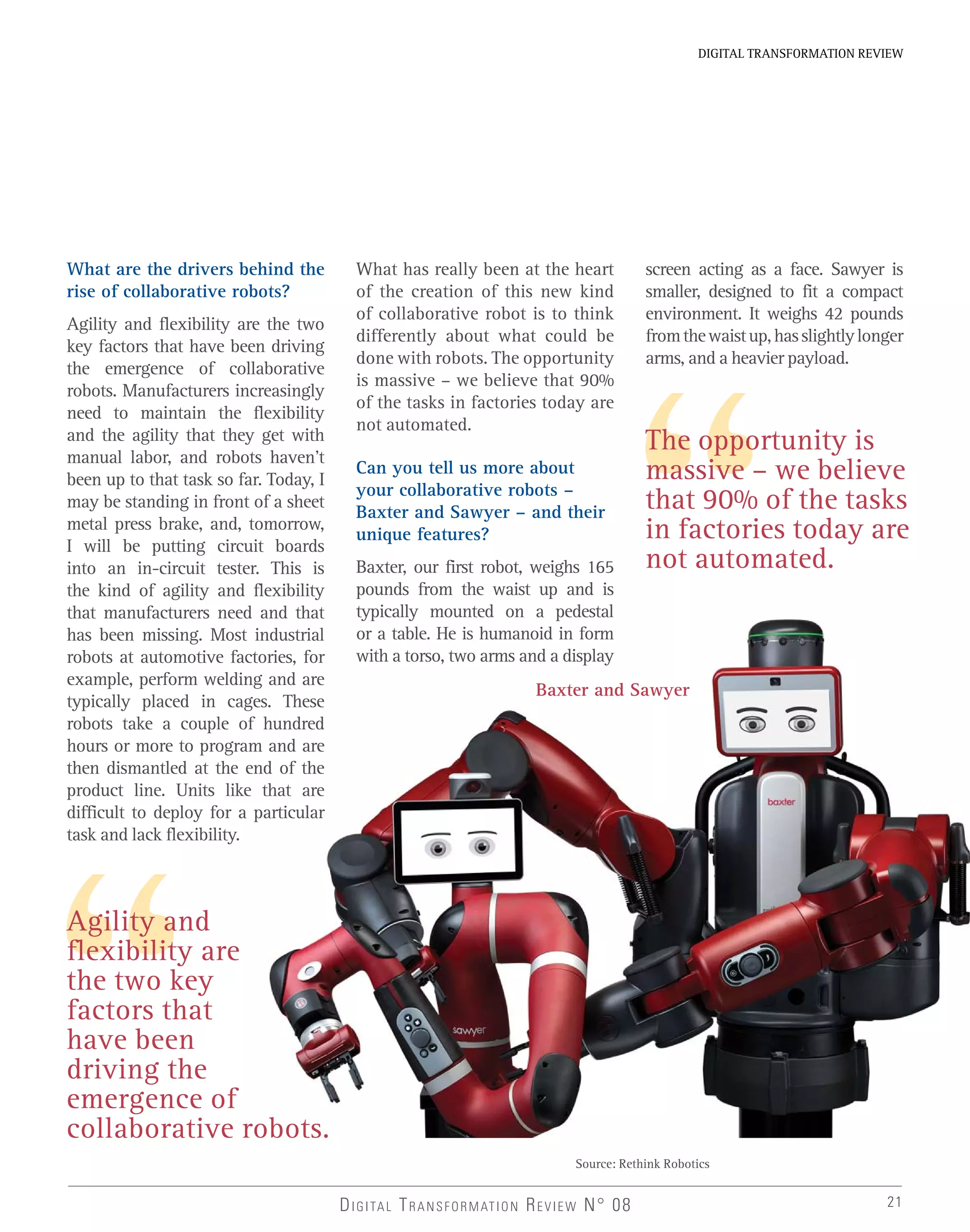
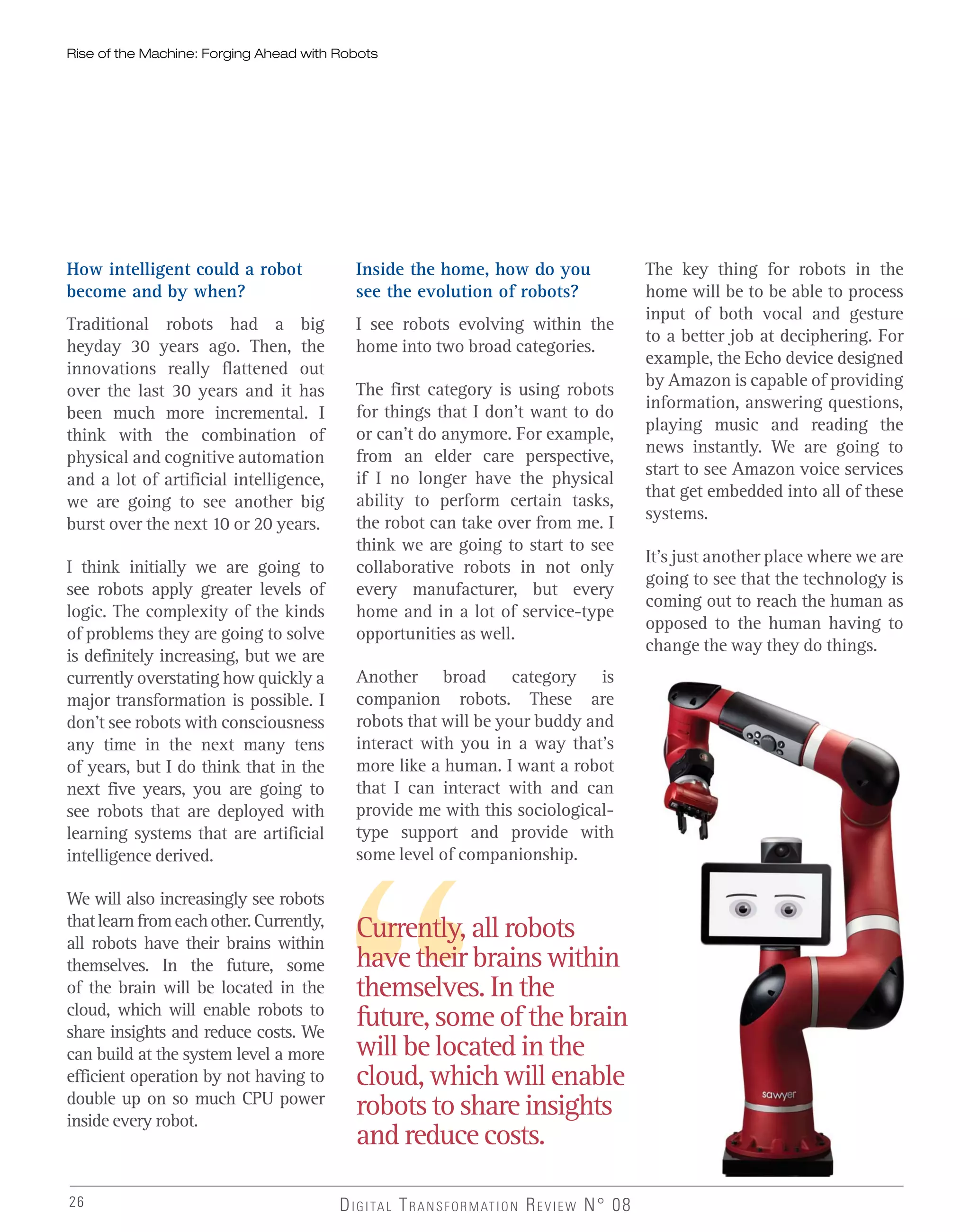
Baxter, our first robot, weighs 165
pounds from the waist up and is
typically mounted on a pedestal
or a table. He is humanoid in form
with a torso, two arms and a display
screen acting as a face. Sawyer is
smaller, designed to fit a compact
environment. It weighs 42 pounds
fromthewaistup,hasslightlylonger
arms, and a heavier payload.
Source: Rethink Robotics
The opportunity is
massive – we believe
that 90% of the tasks
in factories today are
not automated.
Baxter and Sawyer
22 DIGITAL TRANSFORMATION REVIEW N° 08
If the robot bumps
into something or
something is in a
slightly different
position, it’s able to
accommodate for that
ambiguity.
Not only will our
robots learn the job
and complete the
task, but they are
using their algorithm
to optimize the task
assigned and make
that job better.
and you are moving it in free space,
it feels as if it’s weightless. So, you
can position, orient, and move it in
any way that you want. You grab its
arm, you guide it to where the part
is, you tell it to close its hands, move
it into the CNC machine, release
its hand, pull back, close the door,
and push the button. You show the
robot exactly how to perform a task
in the same way that you would
show a human how to do so. And,
the robot thinks in the context of
the task. It’s not thinking in the
context of position and movement,
going from point to point in space.
Iftherobotbumpsintosomethingor
something is in a slightly different
position, it’s able to accommodate
for that ambiguity because it’s not
focused on executing commands.
It’s focused on performing a task.
There is increasing logic and
intelligence that’s coming into these
robots. Sawyer and Baxter automate
physical tasks, but there is also an
automation of cognitive tasks. Not
only will they learn the job and
complete the task, but they are
using their algorithm to optimize
the task assigned and make that
job better. Collaborative robots also
gain experience from those jobs,
and then change not only their
operations but also provide insights
to other robots.
What is the secret behind the
competitive pricing of Baxter
and Sawyer?
The traditional approach for
automation has been to build
robots that are extraordinarily
precise and fast. Deploying precise
components into robots at a
hardware level is very expensive.
Software,ontheotherhand–when
coupled with cheaper components
– can deliver competitive results.
We are trying to solve the problem
of precision and cost with both
hardware and software. We have
chosen components that, when
coupled with the software, get the
job done at a competitive rate from
a cost perspective – between $20K
and $30K. This enables the robot to
go after these 90% of the tasks that
are currently unautomated.
Both the robots have 7 degrees
of freedom, allowing them to get
into various kinds of fixtures in a
multitude of different ways. This
becomes very important when
you are trying to avoid obstacles.
Both Baxter and Sawyer have
learning features. For typical robots,
you write some form of script or
use a coding language within a
developing environment, and you
sit down with a computer and you
tell it where to go. With Baxter and
Sawyer, it’s much more like an on-
the-job training. They learn the
task by having somebody show
them how to do it.
When you grab the cuff of either
Baxter or Sawyer, they go into what
we call Zero-G mode. The robots’
motors are compensating for all of
the weight of the arm dynamically
as it moves through a position.
When you are holding onto the wrist
Rise of the Machine: Forging Ahead with Robots
23
DIGITAL TRANSFORMATION REVIEW
DIGITAL TRANSFORMATION REVIEW N° 08
We have chosen
components that,
when coupled with the
software, get the job
done at a competitive
rate from a cost
perspective – between
$20K and $30K.
What is the ROI of Baxter or
Sawyer?
Typically,ROItakes12to18months.
Letmegiveyouanexample.I’vegot
a tier 1 automotive manufacturer.
Traditionally they have people
standing in front of a machine,
basically tending to the machine.
So, you have four people manning
this machine, 20 out of 24 hours a
day, and they are each paid $45K
a year. This means that you are
basically spending $180K-a-year
to tend to this machine. The robot,
on the other hand, does it with
$25K. The robots can run 24 hours
a day instead of 20, it doesn’t need
vacations, it doesn’t take breaks,
and it always does the same thing
repeatedly with accurate results.
With this new generation
of robots, can we expect the
emergence of smaller local
factories closer to end users?
Most of the companies that are able
to take advantage of traditional
automation today tend to be fairly
large with high volume operations.
If you are one of the small/
medium-sized businesses, you
cannot afford to use that kind of
automation.Smallcompanieshave
been largely left along the side of
the road when it comes to getting
the benefits that automation can
provide. If we fast-forward into the
future, with an increasing number
of collaborative robots around,
smaller companies will be able to
take advantage of them.
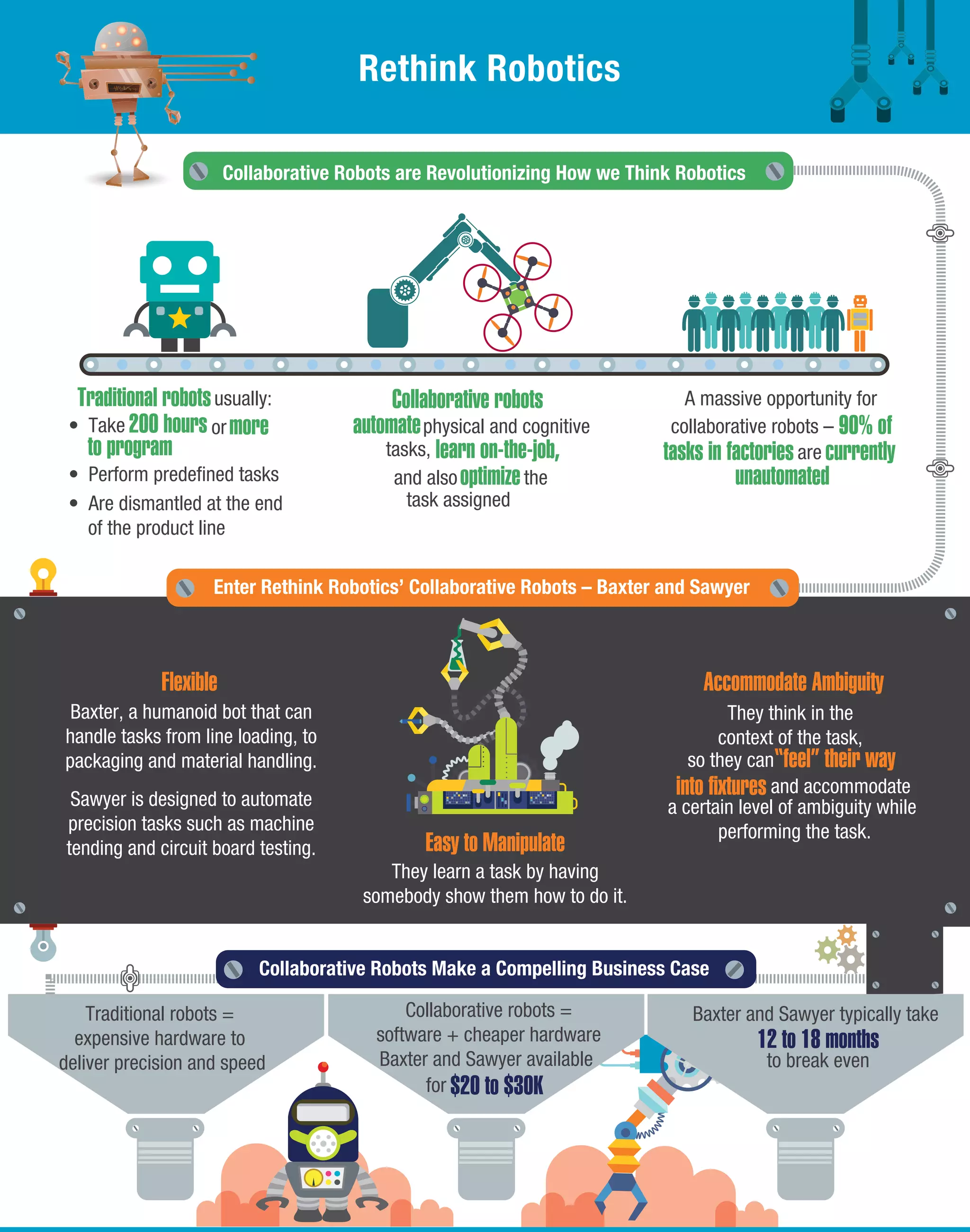
Rethink Robotics
Flexible
Easy to Manipulate
Traditional robots Collaborative robots
90% of
tasks in factories currently
unautomated
automate
learn on-the-job,
optimize
200 hours more
to program
Accommodate Ambiguity
Collaborative Robots are Revolutionizing How we Think Robotics
Enter Rethink Robotics’ Collaborative Robots – Baxter and Sawyer
Collaborative Robots Make a Compelling Business Case
Baxter, a humanoid bot that can
handle tasks from line loading, to
packaging and material handling.
Sawyer is designed to automate
precision tasks such as machine
tending and circuit board testing.
They learn a task by having
somebody show them how to do it.
usually: A massive opportunity for
are
collaborative robots –physical and cognitive
tasks,
and also the
task assigned
or• Take
• Perform predefined tasks
• Are dismantled at the end
of the product line
They think in the
context of the task,
a certain level of ambiguity while
performing the task.
“feel” their wayso they can
and accommodate
$20 to $30K
Traditional robots =
expensive hardware to
deliver precision and speed
Collaborative robots =
software + cheaper hardware
Baxter and Sawyer available
12 to 18 months
Baxter and Sawyer typically take
to break even
for
25
DIGITAL TRANSFORMATION REVIEW
DIGITAL TRANSFORMATION REVIEW N° 08
This next level of automation also
allowsmanufacturerstosetuptheir
operations in a much wider variety
of places because they don’t have
to chase low-cost labor around
the globe. If you go back 50 years,
manufacturing and design were
happening near each other. Design
could learn from manufacturing,
and manufacturing could learn
from design. Innovation was
happening much more rapidly. We
did the worst thing we could do by
movingmanufacturingofftoplaces
where labor costs were low and thus
created a big divide between the
two.Now,withcollaborativerobots,
we are able to bring innovation
and manufacturing back together
again. I think it’s going to allow
manufacturing supply chains to
operate in much different ways
than they have been operating over
the last 20–30 years.
Do we have some evidence that
the automation is helping U.S.
or European manufacturers to
bring production onshore?
There are quite a few examples
of companies that have started to
relocate some of their operations to
the United States – such as General
Electric, Ford or Caterpillar – with
the help of automation. They
can hit the ROI and they can do
it in a way that doesn’t sacrifice
flexibility.
What is clear is that we will see
much more competition between
China and developed nations.
However, the rules of the game
are changing – success will not be
driven by low-cost labor anymore,
but by technology. That’s a game
that a lot of countries can play
in. Developed countries are now
investing massive amounts of
If the next major driver
of success is having
smarter, more capable
robots, that’s not a
battle that developed
countries want to lose.
I do think that in
the next five years,
you are going to
see robots that
are deployed with
learning systems
that are artificial
intelligence derived.
money in initiatives such as
Industry 4.0. However, China has
also launched its own initiative
called “Made in China 2025”
to become the world leader in
manufacturing of all products
including high and low volume,
low and high quality. As an
example within the robotics
industry, at the end of 2014, there
were 400 robot manufacturers in
China. At the end of Q1, 90 days
later, Q1 2015, there were 700
robot manufacturers.
The key question is whether
developed countries are moving
as fast as China. If the next major
driver of success is having smarter,
more capable robots, that’s not
a battle that developed countries
want to lose.
With collaborative
robots, we are able
to bring innovation
and manufacturing
back together again.
26 DIGITAL TRANSFORMATION REVIEW N° 08
Currently, all robots
have their brains within
themselves. In the
future, some of the brain
will be located in the
cloud, which will enable
robots to share insights
and reduce costs.
How intelligent could a robot
become and by when?
Traditional robots had a big
heyday 30 years ago. Then, the
innovations really flattened out
over the last 30 years and it has
been much more incremental. I
think with the combination of
physical and cognitive automation
and a lot of artificial intelligence,
we are going to see another big
burst over the next 10 or 20 years.
I think initially we are going to
see robots apply greater levels of
logic. The complexity of the kinds
of problems they are going to solve
is definitely increasing, but we are
currently overstating how quickly a
major transformation is possible. I
don’t see robots with consciousness
any time in the next many tens
of years, but I do think that in the
next five years, you are going to
see robots that are deployed with
learning systems that are artificial
intelligence derived.
We will also increasingly see robots
thatlearnfromeachother.Currently,
all robots have their brains within
themselves. In the future, some
of the brain will be located in the
cloud, which will enable robots to
share insights and reduce costs. We
can build at the system level a more
efficient operation by not having to
double up on so much CPU power
inside every robot.
Rise of the Machine: Forging Ahead with Robots
Inside the home, how do you
see the evolution of robots?
I see robots evolving within the
home into two broad categories.
The first category is using robots
for things that I don’t want to do
or can’t do anymore. For example,
from an elder care perspective,
if I no longer have the physical
ability to perform certain tasks,
the robot can take over from me. I
think we are going to start to see
collaborative robots in not only
every manufacturer, but every
home and in a lot of service-type
opportunities as well.
Another broad category is
companion robots. These are
robots that will be your buddy and
interact with you in a way that’s
more like a human. I want a robot
that I can interact with and can
provide me with this sociological-
type support and provide with
some level of companionship.
The key thing for robots in the
home will be to be able to process
input of both vocal and gesture
to a better job at deciphering. For
example, the Echo device designed
by Amazon is capable of providing
information, answering questions,
playing music and reading the
news instantly. We are going to
start to see Amazon voice services
that get embedded into all of these
systems.
It’s just another place where we are
going to see that the technology is
coming out to reach the human as
opposed to the human having to
change the way they do things.
THE INNOVATION CHALLENGE
“Mainstream innovation is rigid
and lacks the agility to respond to big
changes in the marketplace such as new
competition. […] The innovation engine
at large incumbents has to become
more nimble and flexible.”
– Navi Radjou
– Navi Radjou
– Navi Radjou
“Technological progress has always created significant
disruptions that powerful interests tried to combat to
maintain the status quo. In Ancient Rome, the great
author, Pliny the Elder, records the story of an inventor
who discovered a way to manufacture glass that was
unbreakable. Hoping to receive a reward, the inventor
presented his invention to Roman Emperor Tiberius.
Unfortunately for the inventor, Tiberius had him
sentenced to death, fearing the loss of jobs and creative
destruction due to the new technology.”
- Michael A Osborne
“Creating excellence at small scale is
relatively straightforward. Doing so at
scale is extremely hard. And that’s where
most innovation centers struggle”
“The challenge is to convince people that
something simpler with fewer features can be
innovative. The difficulty is to shift the R&D
mindset from pushing more technology to really
understanding customer needs and focus on
delivering value to customers by creating
a simpler solution.”
“The world’s leading companies spend over
$650 billion on R&D every year. In an
economic environment that is not very
growth-oriented, it is very hard for companies
to sustain that level of investment.”
- James Patterson
28
Digital Innovations – Our Top Picks
DIGITAL TRANSFORMATION REVIEW N° 08
Digital Innovations – Our Top Picks
C
reative ideas and innovations can transform the lives of thousands of people, solve critical social
problems, and transform companies and markets. Here, we have selected a range of product and
business model innovations that offer creative solutions to a range of contemporary issues, from
social to consumer applications. This list is offered merely as a conversation starter – share your personal
innovation favorites using the hashtags #excitinginnovation and #DTR8.
Innovation in Products
Beating Iodine Deficiency
Through ‘Bindis’
Deficiency in iodine is the world’s
most predominant cause of brain
damage and can also lead to other
healthissues.InIndia,approximately
350 million people are at risk of
iodine deficiency, according to a
study from the Indian Journal of
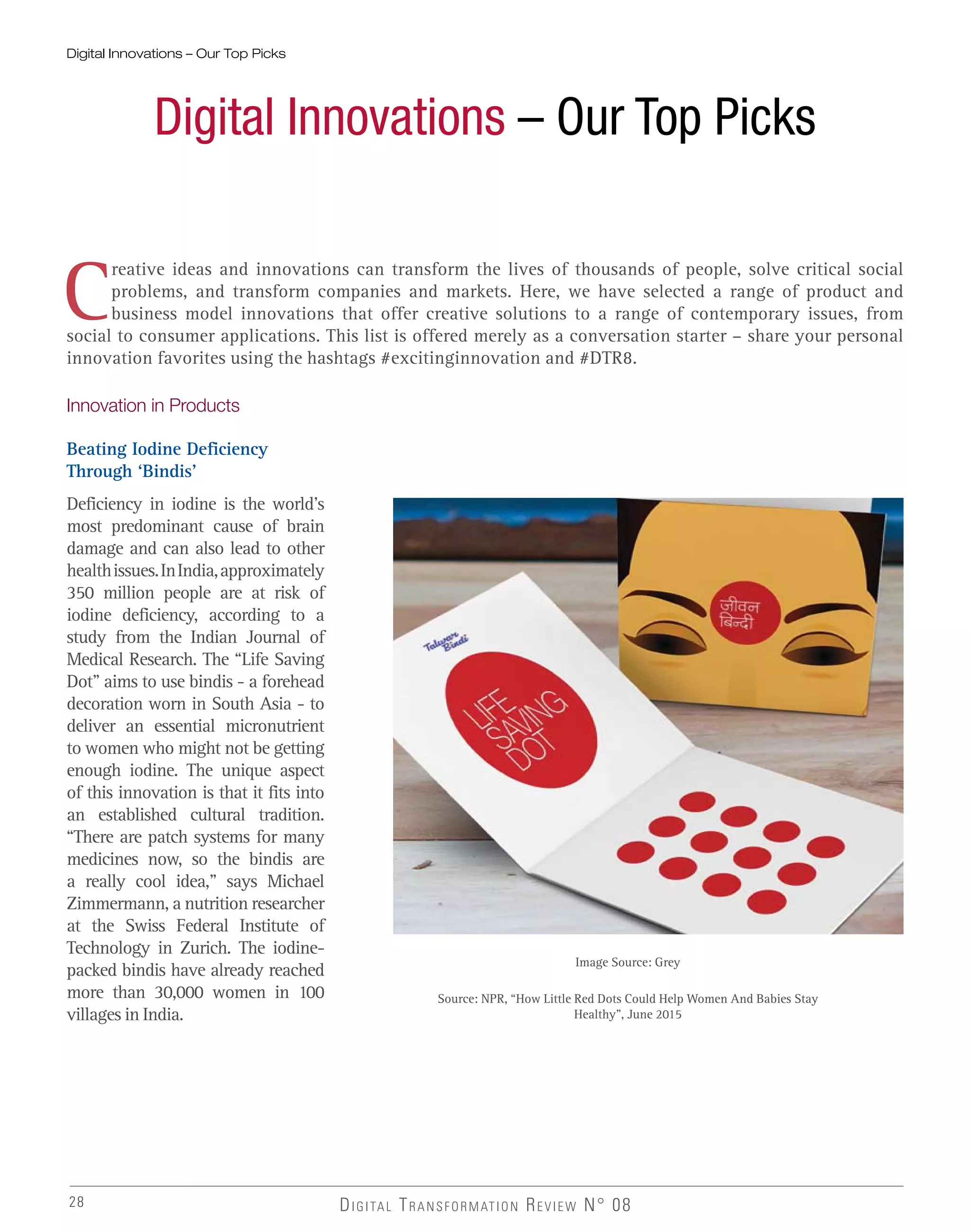
Medical Research. The “Life Saving
Dot” aims to use bindis - a forehead
decoration worn in South Asia - to
deliver an essential micronutrient
to women who might not be getting
enough iodine. The unique aspect
of this innovation is that it fits into
an established cultural tradition.
“There are patch systems for many
medicines now, so the bindis are
a really cool idea,” says Michael
Zimmermann, a nutrition researcher
at the Swiss Federal Institute of
Technology in Zurich. The iodine-
packed bindis have already reached
more than 30,000 women in 100
villages in India.
Image Source: Grey
Source: NPR, “How Little Red Dots Could Help Women And Babies Stay
Healthy”, June 2015
29
DIGITAL TRANSFORMATION REVIEW
DIGITAL TRANSFORMATION REVIEW N° 08
Source: www.theshoethatgrows.org
Source: www.liftware.com
Shoes that Magically Expand to
Fit Growing Feet
When Kenton Lee was travelling in
Kenya, he was surprised to see the
number of children either barefoot
or cramped into too-small shoes.
This drove him to come up with an
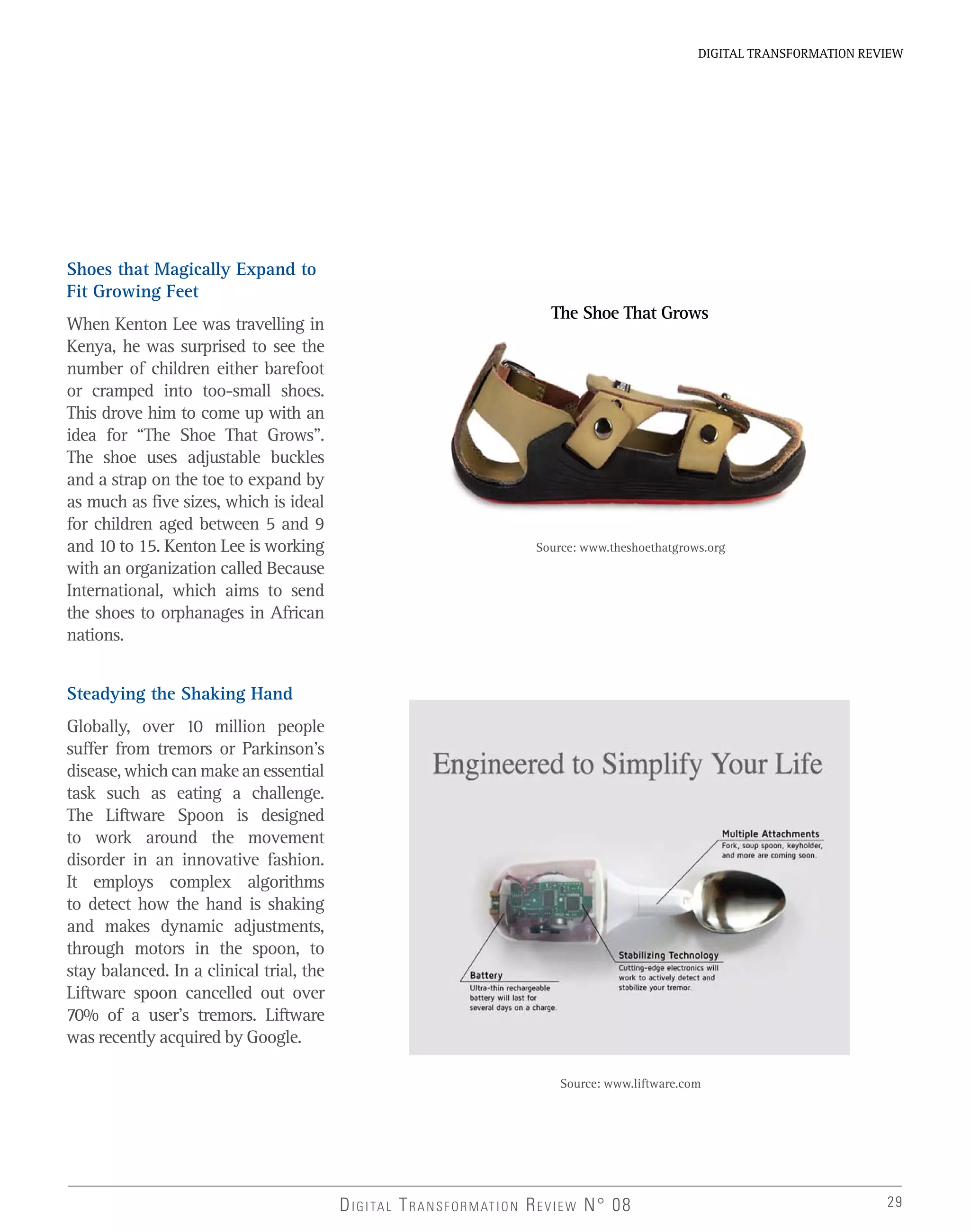
idea for “The Shoe That Grows”.
The shoe uses adjustable buckles
and a strap on the toe to expand by
as much as five sizes, which is ideal
for children aged between 5 and 9
and 10 to 15. Kenton Lee is working
with an organization called Because
International, which aims to send
the shoes to orphanages in African
nations.
Steadying the Shaking Hand
Globally, over 10 million people
suffer from tremors or Parkinson’s
disease, which can make an essential
task such as eating a challenge.
The Liftware Spoon is designed
to work around the movement
disorder in an innovative fashion.
It employs complex algorithms
to detect how the hand is shaking
and makes dynamic adjustments,
through motors in the spoon, to
stay balanced. In a clinical trial, the
Liftware spoon cancelled out over
70% of a user’s tremors. Liftware
was recently acquired by Google.
The Shoe That Grows
30 DIGITAL TRANSFORMATION REVIEW N° 08
Snap a Feature to Your
Smartphone – Project Ara
Most smartphones come with a set
of features that are usually upgraded
over a period of a year or two through
software updates. However, while the
softwarechanges,thehardwareremains
the same. Google wants to change that
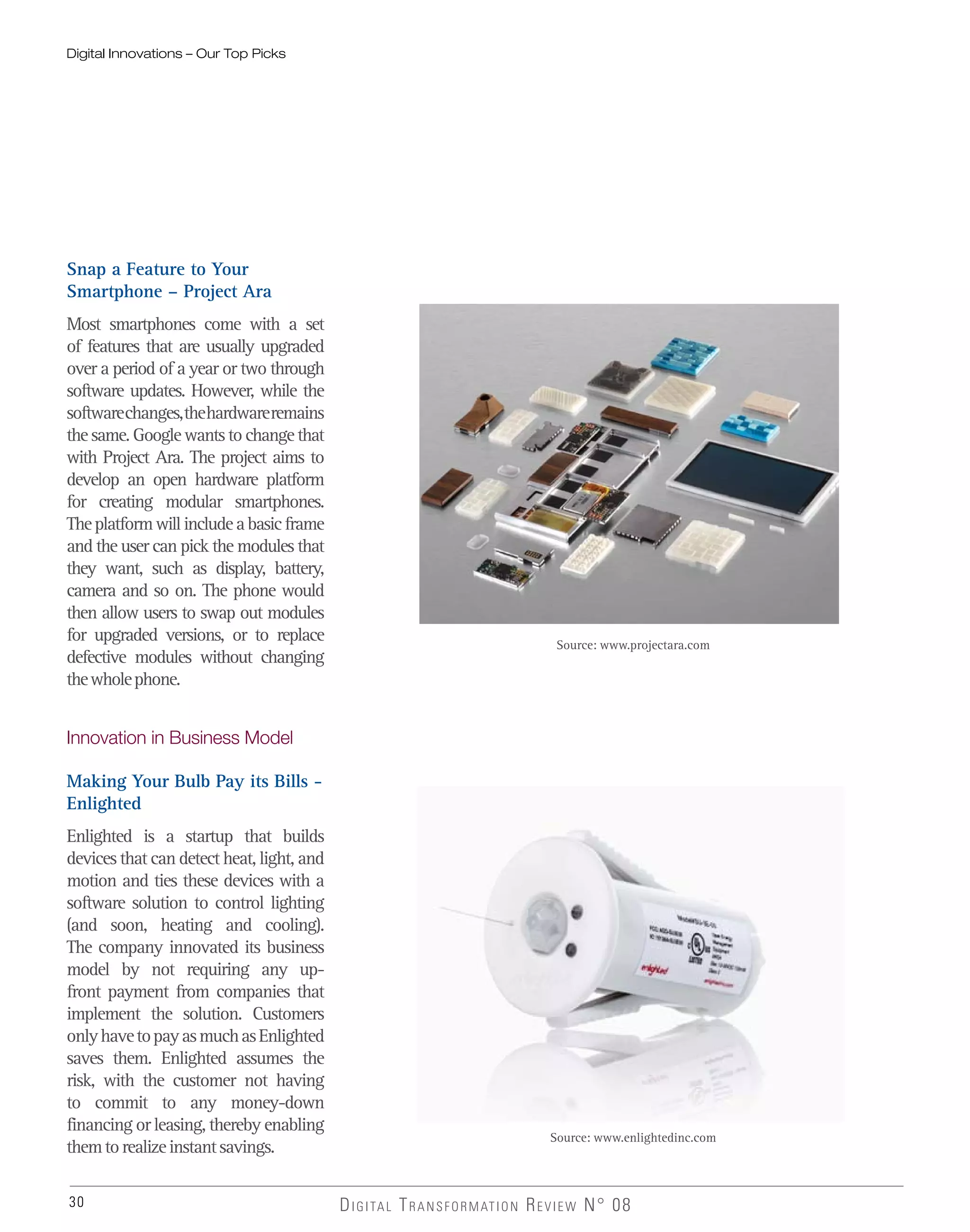
with Project Ara. The project aims to
develop an open hardware platform
for creating modular smartphones.
Theplatformwillincludeabasicframe
and the user can pick the modules that
they want, such as display, battery,
camera and so on. The phone would
then allow users to swap out modules
for upgraded versions, or to replace
defective modules without changing
thewholephone.
Innovation in Business Model
Making Your Bulb Pay its Bills -
Enlighted
Enlighted is a startup that builds
devices that can detect heat, light, and
motion and ties these devices with a
software solution to control lighting
(and soon, heating and cooling).
The company innovated its business
model by not requiring any up-
front payment from companies that
implement the solution. Customers
onlyhavetopayasmuchasEnlighted
saves them. Enlighted assumes the
risk, with the customer not having
to commit to any money-down
financing or leasing, thereby enabling
themtorealizeinstantsavings.
Digital Innovations – Our Top Picks
Source: www.projectara.com
Source: www.enlightedinc.com
31
DIGITAL TRANSFORMATION REVIEW
DIGITAL TRANSFORMATION REVIEW N° 08
Freemium for B2B - Zenefits
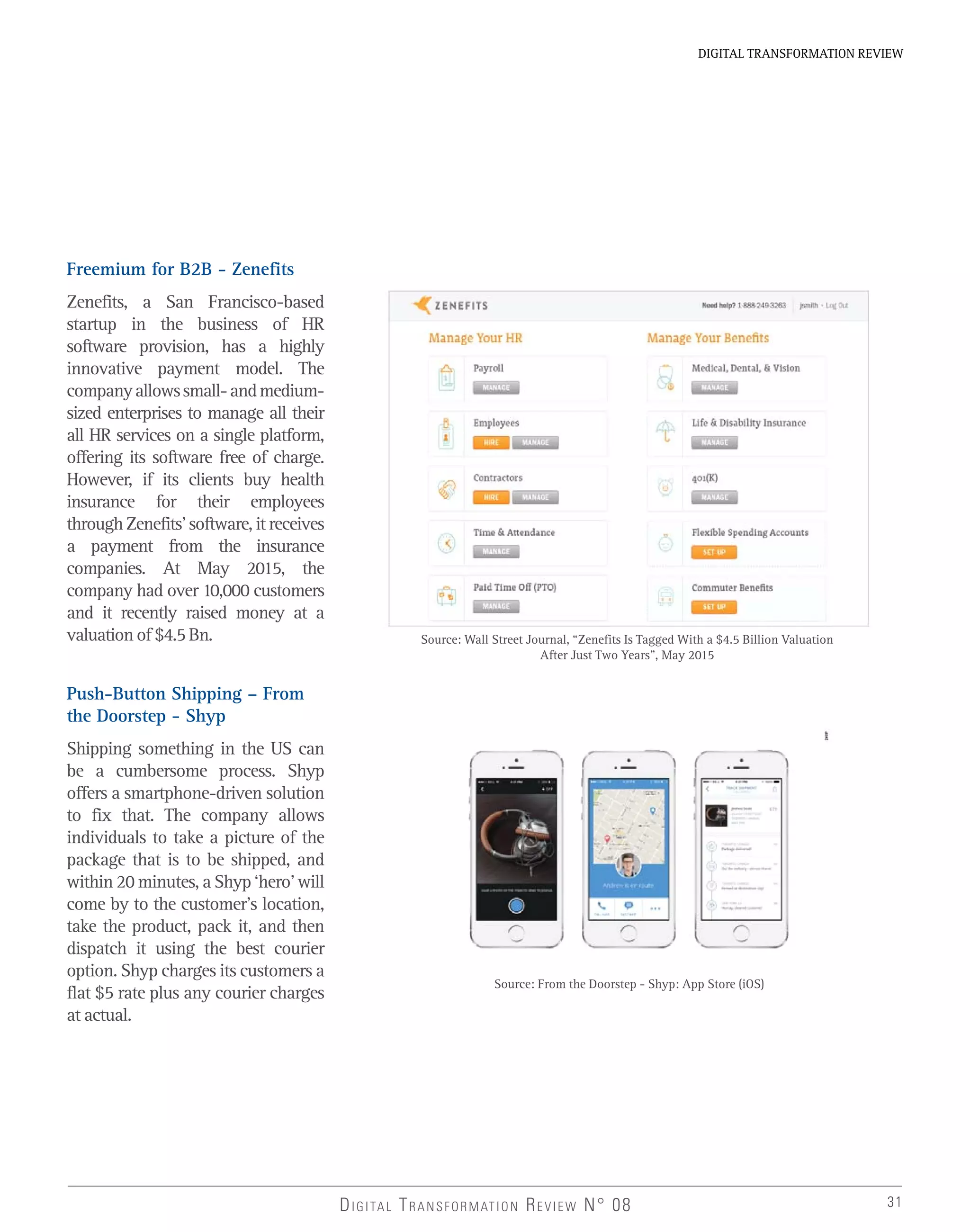
Zenefits, a San Francisco-based
startup in the business of HR
software provision, has a highly
innovative payment model. The
companyallowssmall-andmedium-
sized enterprises to manage all their
all HR services on a single platform,
offering its software free of charge.
However, if its clients buy health
insurance for their employees
through Zenefits’ software, it receives
a payment from the insurance
companies. At May 2015, the
company had over 10,000 customers
and it recently raised money at a
valuation of $4.5 Bn.
Push-Button Shipping – From
the Doorstep - Shyp
Shipping something in the US can
be a cumbersome process. Shyp
offers a smartphone-driven solution
to fix that. The company allows
individuals to take a picture of the
package that is to be shipped, and
within 20 minutes, a Shyp ‘hero’ will
come by to the customer’s location,
take the product, pack it, and then
dispatch it using the best courier
option. Shyp charges its customers a
flat $5 rate plus any courier charges
at actual.
Source: Wall Street Journal, “Zenefits Is Tagged With a $4.5 Billion Valuation
After Just Two Years”, May 2015
Source: From the Doorstep - Shyp: App Store (iOS)
Promoting and Embedding
Innovation
DIGITAL TRANSFORMATION REVIEW N° 0834
Frugal Innovation:
Innovating More
with Less
Navi Radjou
Innovation and leadership
advisor; Fellow at Judge
Business School, University of
Cambridge
N
avi Radjou is a Fellow at Judge Business School, University of
Cambridge and an innovation advisor based in Silicon Valley. He has
served as a member of the World Economic Forum’s Global Agenda
Council on Design Innovation and is a regular columnist for Harvard Business
Review. In 2013, Navi Radjou received the prestigious “Thinkers50 Innovation
Award”, which is given to a management thinker who is reshaping the way
we think about and practise innovation. Navi Radjou is the co-author of
a new book – Frugal Innovation – and co-author of the bestseller ‘Jugaad
Innovation’. Capgemini Consulting spoke with Navi Radjou to understand
how enterprises can apply principles of frugal innovation to innovate more
with fewer resources and yet deliver greater customer and social value.
‘Frugal Innovation’: Innovating More with Less
DIGITAL TRANSFORMATION REVIEW N° 08 35
DIGITAL TRANSFORMATION REVIEW
Mainstream
innovation is rigid
and lacks the agility
to respond to big
changes in the
marketplace.
Declining Returns on R&D
is Forcing Companies to
Rethink their Innovation
Strategy
You have argued that the
mainstream innovation model
adopted by most companies
is broken. Can you elaborate
why?
The traditional model is broken
because of a number of reasons.
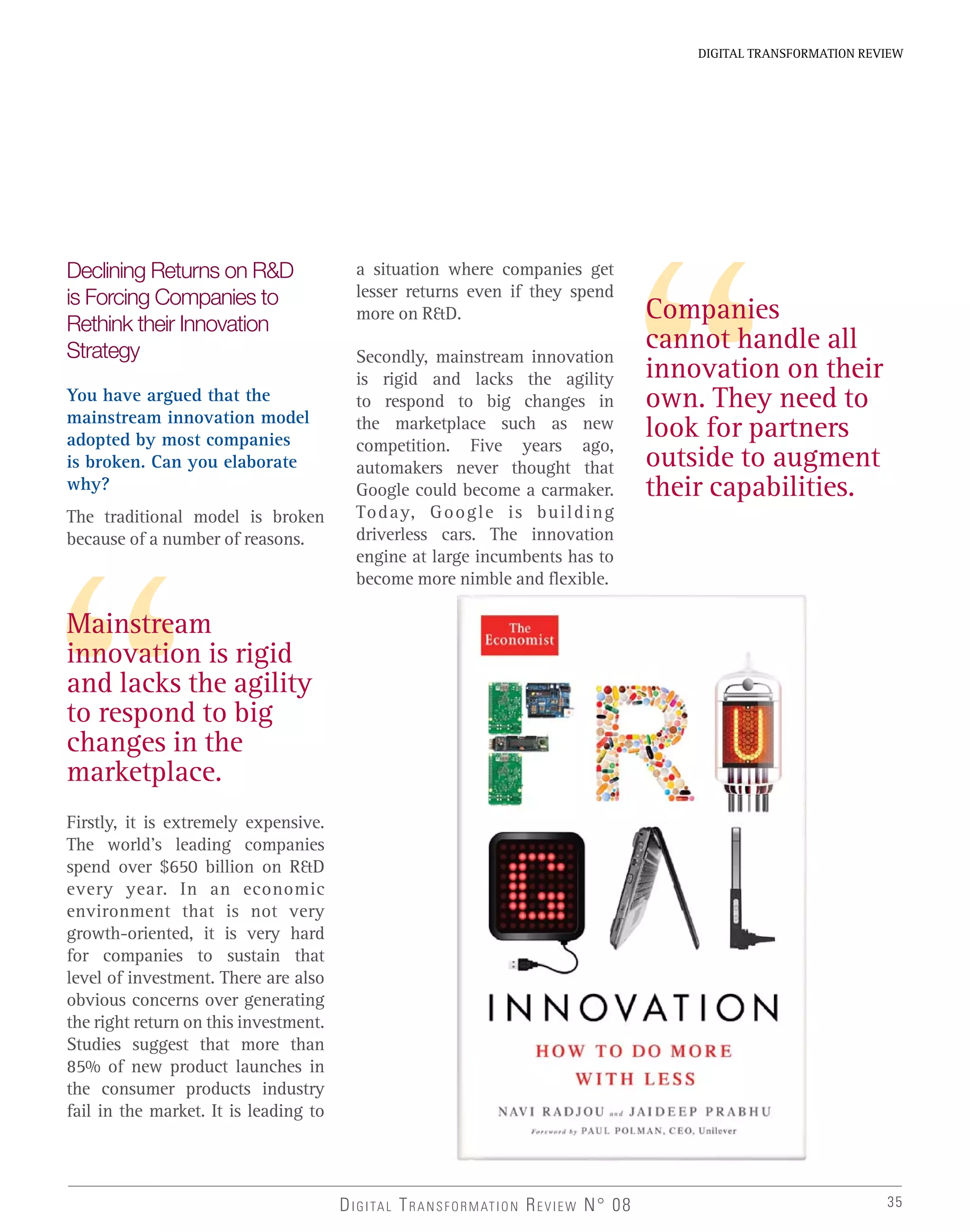
Firstly, it is extremely expensive.
The world’s leading companies
spend over $650 billion on R&D
every year. In an economic
environment that is not very
growth-oriented, it is very hard
for companies to sustain that
level of investment. There are also
obvious concerns over generating
the right return on this investment.
Studies suggest that more than
85% of new product launches in
the consumer products industry
fail in the market. It is leading to
a situation where companies get
lesser returns even if they spend
more on R&D.
Secondly, mainstream innovation
is rigid and lacks the agility
to respond to big changes in
the marketplace such as new
competition. Five years ago,
automakers never thought that
Google could become a carmaker.
Today, Google is building
driverless cars. The innovation
engine at large incumbents has to
become more nimble and flexible.
Companies
cannot handle all
innovation on their
own. They need to
look for partners
outside to augment
their capabilities.
The third kind of shortfall in the
existinginnovationpracticesisthat
they are relatively closed and not
open enough to collaborate with
external partners. Organizations
believe that they possess, in-house,
all the resources they need to deal
with demand. However, companies
cannot handle all innovation on
their own. They need to look for
partners outside to augment their
capabilities.
Frugal Innovation to Drive the
Next Wave of Growth
Can you introduce us to the
concept of frugal innovation?
Frugal innovation is about
creating high-quality solutions
that are simple, effective, and
affordable with limited resources.
It may not address all of customer
needs, may be 80-90% of them,
but it is cost effective, yet of good
quality and sustainable for the
environment.
How did you come up with the
idea of frugal innovation?
We introduced the concept in
2009. My co-authors and I, at
Cambridge University in England,
were doing research on how
Western companies could crack
the emerging markets, which
were fast becoming engines of
global growth. Emerging markets
have a lot of resource constraints.
Frugal innovation
is about creating
high-quality
solutions that are
simple, effective,
and affordable with
limited resources.
Many of them struggle with poor
infrastructure, access to capital
and natural resources. And yet
we noticed that there are many
entrepreneurs – especially in India
and Africa – who are able to use
their limited means to innovate
and create economic and social
value for the communities. They
are frugal innovators. We covered
this subject in detail in our first
book – Jugaad Innovation –
which came out in 2012. Jugaad
is a Hindi word that means
‘makeshift’ or ‘make-do’, which is
basically the ability to improvise
an effective solution in a difficult
situation.
Can you give us some examples
of these entrepreneurs in India
who came up with interesting
Jugaad innovations?
Our book offers a couple of very
interesting examples. First is
Mansukh Prajapati, a potter in
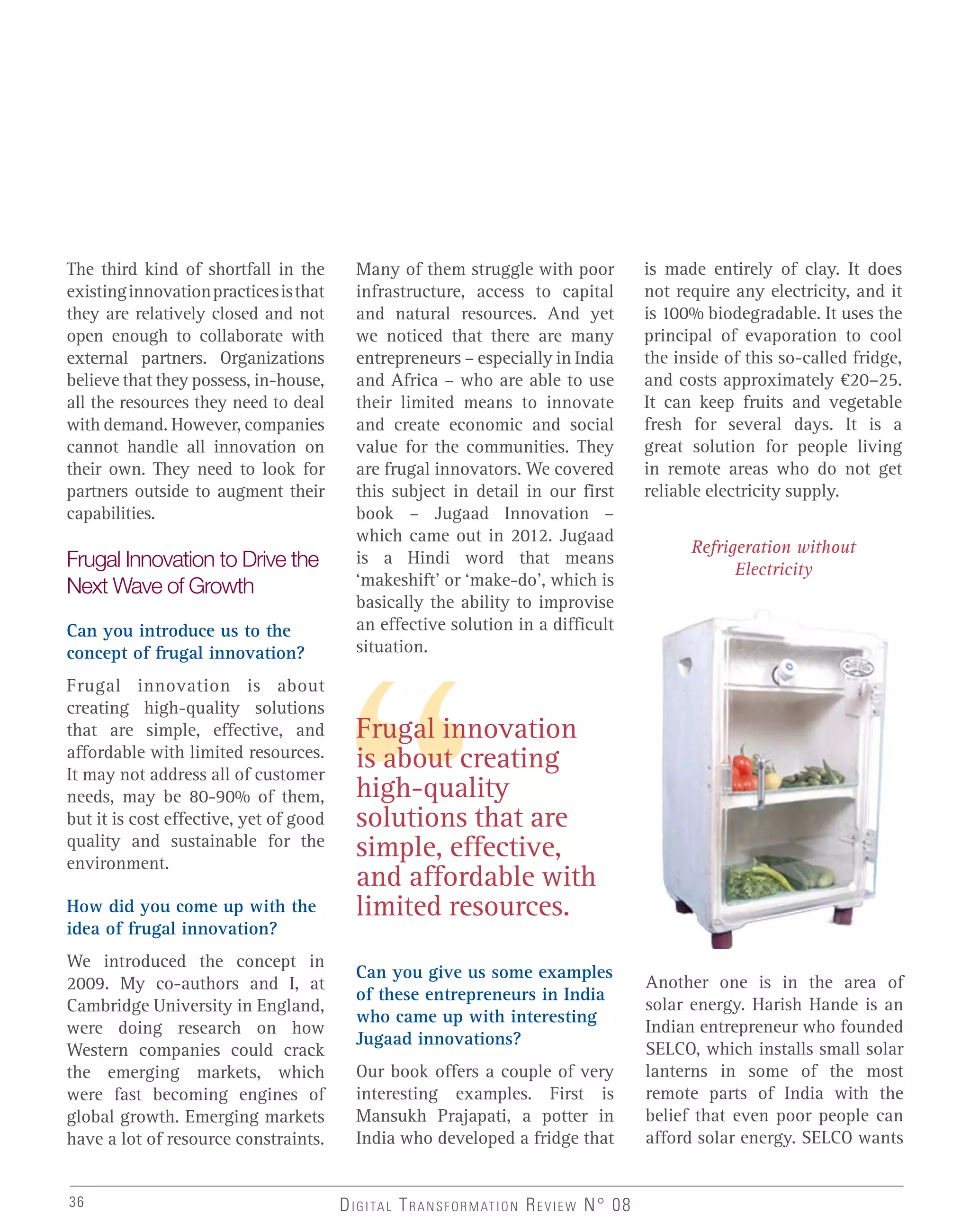
India who developed a fridge that
is made entirely of clay. It does
not require any electricity, and it
is 100% biodegradable. It uses the
principal of evaporation to cool
the inside of this so-called fridge,
and costs approximately €20–25.
It can keep fruits and vegetable
fresh for several days. It is a
great solution for people living
in remote areas who do not get
reliable electricity supply.
Refrigeration without
Electricity
Another one is in the area of
solar energy. Harish Hande is an
Indian entrepreneur who founded
SELCO, which installs small solar
lanterns in some of the most
remote parts of India with the
belief that even poor people can
afford solar energy. SELCO wants
DIGITAL TRANSFORMATION REVIEW N° 0836
I believe there is a
universal appeal to
the concept of frugal
innovation.
A recent study
showed that 55% of
global consumers
want to pay even
more for products
that are socially and
environmentally
responsible.
to democratize access to solar
lighting and he has been doing
it for 20 years. SELCO employs
young locals in the villages to
charge the solar lanterns in the
morning. They then distribute the
lanterns in the village houses and
shops in the evening, so they can
use it at night for reading and—if
you are a shopper, you can use it
to sell your goods at night. In the
morning, they collect the lamps
back along with micropayment
for the amount of light they used
the evening before. With this
inclusive approach, SELCO was
able to scale out its frugal solution
to over 200,000 households in
rural areas, in some of the most
remote villages in India, while
creating many jobs in local
communities.
Is the idea of frugal innovation
only relevant for emerging
markets or does it apply to
developed nations as well?
I believe there is a universal
appeal to the concept. Our
first book offered Western
multinationals best practices they
can learn from emerging market
entrepreneurs, and companies
who were able to innovate
more with fewer resources. We
then spent the last three years
studying frugal innovation in
the Western context. From our
findings, we published a new
book called Frugal Innovation.
This book argues that, since 2008,
there is a big shift in the Western
world – consumers have become
increasingly value conscious,
looking for products and services
that deliver more value for less.
Secondly, consumers in the West
prefertobuyproductsandservices
from companies that are socially
and environmentally responsible.
A recent study showed that 55%
of global consumers want to pay
even more for products that are
socially and environmentally
responsible. And this number has
been growing. More interestingly,
nearly 70% of future employees
want to work for companies
that have this kind of social and
environmental credentials.
Today, consumers would rather
opt for a relatively frugal solution
that addresses their basic needs
and represents more value(s) as
well. Frugality is a lifestyle that
connects the need for saving
money while doing the right thing
for the society and environment.
This need is growing especially
among young people in the
Western world. These trends have
beenforcingWesterncompaniesto
rethink their innovation approach
to serve frugal customers in their
home markets.
DIGITAL TRANSFORMATION REVIEW N° 08 37
Instead of operating
with the sense
of scarcity and
thinking only about
resources under
their sole ownership,
[companies] must
look at what’s
available in the
whole ecosystem
that they can access.
DIGITAL TRANSFORMATION REVIEW N° 08
‘Frugal Innovation’: Innovating More with Less‘Frugal Innovation’: Innovating More with Less
Principles of Frugal Innovation
– Working within Constraints
to Create More Value for
Customers and Society
What are the key principles
underpinning Jugaad or frugal
innovation?
The first principle is that you
use what is abundant to create
what is scarce. For instance,
you use clay, a widely available
and cheap material, to create
something like a fridge that does
not use electricity. You employ
local people and turn them into
your distributors instead of hiring
employees. So, the question is
‘how do you create more impact
using fewer resources’, the
answer: you don’t create new
things, you just piggy back and
leverage what you already have.
Reusing is indeed a sustainable
alternative to “reinventing the
wheel”.
What does it mean for
companies and what is
abundance for companies?
Abundance lies in the ecosystem.
Companies must take a systemic
approach – instead of operating
with the sense of scarcity and
thinking only about resources
under their sole ownership, they
must look at what’s available
in the whole ecosystem that
they can access. For example,
today if a company needs truck
capacity, it can approach the
marketplace called FLOOW2. This
is a B2B marketplace that enables
companies to share idle physical
assets, trucks, factory equipment,
medical devices etc. In most cases,
the system has more resources
than you think when you look
at it from a single person or a
company perspective.
I believe that
gradually we will see
companies sharing
their fleet, their
factories as well as
their clients. This
is the B2B version
of the sharing
economy, and it is
just taking off.
Which other principles
reinforce frugal innovation?
Using what is abundant to create
what is scarce is our first principle.
The second principle is to engage
and iterate. Instead of wasting
time and money trying to create
a perfect solution in an insular
R&D lab, companies must directly
engage customers, identify their
basic needs, quickly produce a
good enough solution, and then
iterate i.e. incrementally improve
the solution as the customers’
needs evolve. This practice is very
frugal in terms of resources as
well as time.
The third key principle is
regarding sustainability.
It’s not about Corporate Social
Responsibility (CSR) but how to
make your entire company more
sustainable. We have examples of
companies like Unilever (its CEO,
Paul Polman, wrote the foreword
for our book), which is planning
to double its revenues by 2020
while simultaneously halving the
environmental impact. This is not
just for one product or service.
They are reinventing their core
business model and entire value
chain to produce more, and better,
with less.
38
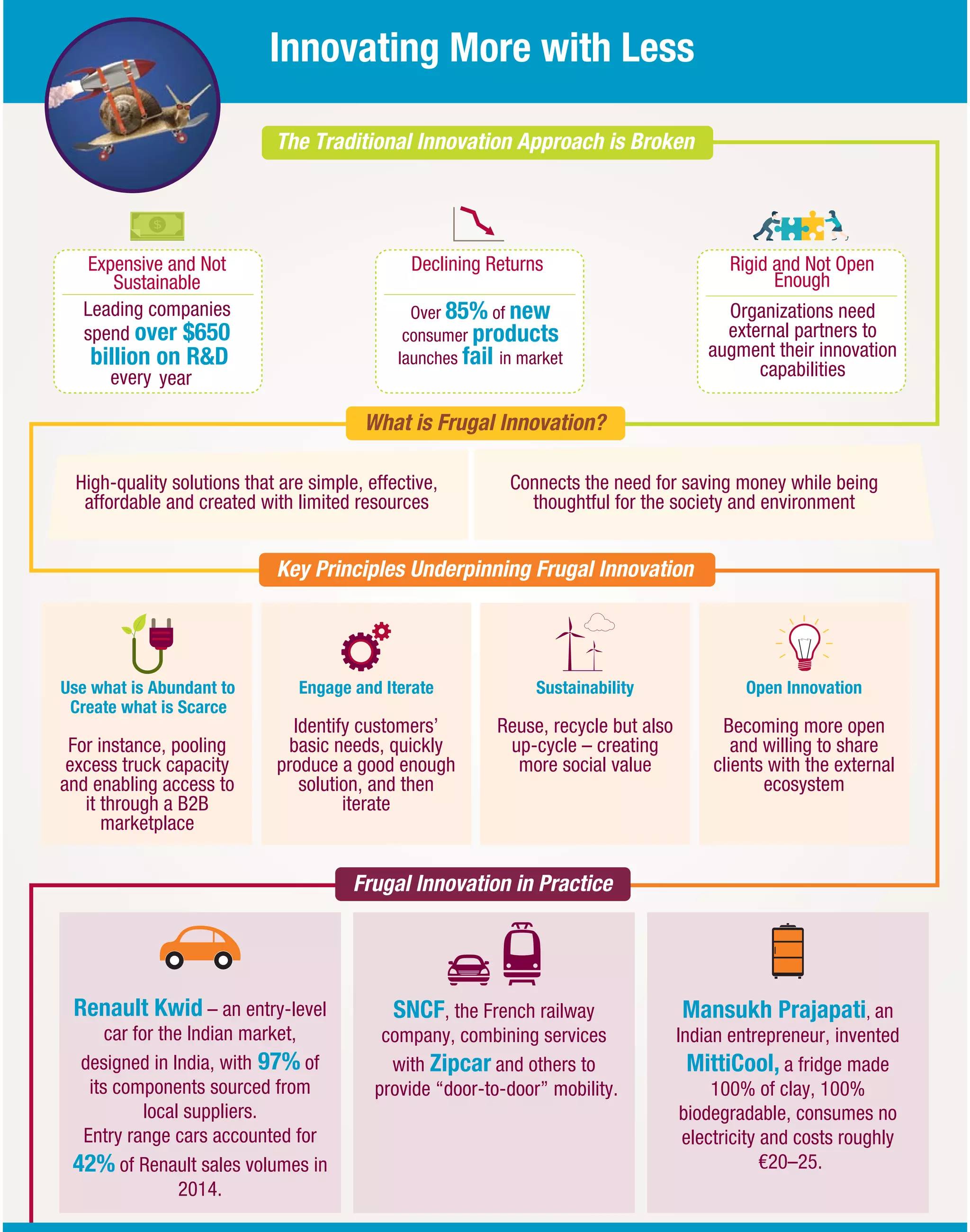
Innovating More with Less
The Traditional Innovation Approach is Broken
Key Principles Underpinning Frugal Innovation
What is Frugal Innovation?
Frugal Innovation in Practice
Expensive and Not
Sustainable
Leading companies
spend over $650
billion on R&D
every year
Renault Kwid – an entry-level
car for the Indian market,
designed in India, with 97% of
its components sourced from
local suppliers.
Entry range cars accounted for
42% of Renault sales volumes in
2014.
SNCF, the French railway
company, combining services
with Zipcar and others to
provide “door-to-door” mobility.
Mansukh Prajapati, an
Indian entrepreneur, invented
MittiCool, a fridge made
100% of clay, 100%
biodegradable, consumes no
electricity and costs roughly
€20–25.
Declining Returns
Over 85% of new
consumer products
launches fail in market
Rigid and Not Open
Enough
Organizations need
external partners to
augment their innovation
capabilities
High-quality solutions that are simple, effective,
affordable and created with limited resources
Use what is Abundant to
Create what is Scarce
For instance, pooling
excess truck capacity
and enabling access to
it through a B2B
marketplace
Engage and Iterate
Identify customers’
basic needs, quickly
produce a good enough
solution, and then
iterate
Sustainability
Reuse, recycle but also
up-cycle – creating
more social value
Open Innovation
Becoming more open
and willing to share
clients with the external
ecosystem
Connects the need for saving money while being
thoughtful for the society and environment
Renault is a very
good example of a
company that has
been at the forefront
of frugal innovation.
‘Frugal Innovation’: Innovating More with Less‘Frugal Innovation’: Innovating More with Less
In the process, companies reuse,
recycle but also up-cycle –
creating more social value as well.
That brings us to the fourth
interesting principle, which is
about collaborating extensively
with other companies – including
your rivals – the notion of open
innovation and “coopetition”.
Can you elaborate on the
concept of open innovation?
Take, for example, the French
Railway Company, SNCF. Their
focus was on offering the best
possible train services, but
customer demands have evolved.
People want an end-to-end
mobility solution that takes them
from point A to B, irrespective of
the modes of transport they may
have to use – cabs, trains and
car-sharing etc. SNCF realized
this and has just launched a
service aimed at this customer
need. They’re combining their
services with partners – such as
Zipcar and others – to provide a
“door-to-door” mobility service.
They are willing to share their
client with other brands and
companies. They understand that,
by pooling resources together,
they can serve the customer
better and more comprehensively.
Another example is Mars, the
chocolate maker. Mars is sharing
its fleet of trucks in Germany
with other companies. They asked
themselves: “if I am not using
my assets all the time, they are
sitting idle, I am basically wasting
money. So, why don’t I share them
with other people?” I believe that
gradually we will see companies
sharing their fleet, their factories
as well as their clients. This is
the B2B version of the sharing
economy, and it is just taking off.
Frugal Innovation can
Make Corporations More
Competitive
Can you explain how
large organizations have
implemented the concept of
frugal innovation?
Renault is a very good example
of a company that has been at the
forefront of frugal innovation.
In 1999, Louis Schweitzer, the
previous CEO of Renault, set an
audacious goal of building a
€6,000 car and gave his engineers
the freedom to handle the how
part. That was the first chapter in
the Renault story that led them to
launch in 2005 the Logan – a no-
frills yet spacious car that used
50% fewer parts than a typical
Renault with a minimalist design
that met high-quality and safety
standards. To capitalize on the
demand, Renault developed an
entirely new entry-level product
line under the Dacia brand. These
entry-level vehicles now represent
circa 40% of Renault’s total sales.
The second chapter, being written
in 2015, is the launch of Kwid –
an entry-level car produced for
the Indian market. The concept of
the car was developed to a large
extent by Indian designers in
Renault-Nissan’s design centers
in India and very much relies
on open innovation and local
supplier network. Ninety-seven
percent of the components in Kwid
come through local suppliers.
They involved the suppliers very
early on – right from the design
phase. So, the whole ecosystem
was involved from the beginning
until the end, and that is what
allowed Renault to pull it off.
Overall, Kwid is a very cost-
effective solution as it cost them
only half as much to take the
car from design to dealers. Most
Western carmakers cannot copy
what Renault is doing because
they try to take the existing cars
that are being sold in Europe or
US and ‘de-feature’ them for local
markets in India and China. That
approach does not work. They
must learn to build a frugal car
from scratch.
DIGITAL TRANSFORMATION REVIEW N° 0840
DIGITAL TRANSFORMATION REVIEW
DIGITAL TRANSFORMATION REVIEW N° 08 41
Do you have a view on an
approximate percentage
of companies using frugal
innovation?
If you look at the Fortune 500
companies,Iwouldsayroughly5%
have adopted frugal innovation
in a very aggressive way as
they have realized its strategic
importance. Approximately 20%
are experimenting with it and
the remaining 75%, I think, have
very little awareness. If we look
at Europe only, I would say there
is an equal split across the three
categories. While in Asia, I would
say nearly 90% of the companies
are already using frugal
innovation in some way. The US,
however, is lagging way behind
Europe and Asia in adopting
frugal innovation.
Overcoming Obstacles to
Frugal Innovation
What are the main obstacles to
frugal innovation?
There are a few obstacles of
course. The first one is mindset.
Frugal innovation is viewed as an
approach that produces only low-
cost output and not necessarily
a good quality product. The
challenge is to convince people
that something simpler with
fewer features can be innovative.
Actually, it is innovative because
it brings more value to customers.
So, the difficulty is to shift the
R&D mindset from pushing
more technology to really
understanding customer needs
and focus on delivering value to
customers by creating a simpler
solution.
The second challenge is around
marketing. How do you market a
frugal solution as aspirational?
I believe Renault is doing an
amazing job in India in terms
of marketing Kwid. They are
not talking about affordability.
They are positioning the car
as something aspirational, like
the car gives you more freedom
and comfort. It is well designed
and makes you feel good. Most
companies know how to market
an expensive product and create a
need for it but they do not know
how to create a need for frugal
solutions.
How important is it to change
the culture of a company for
ensuring success with frugal
innovation?
I think changing the culture
of the company is absolutely
critical. In Renault today, nobody
is challenging frugal innovation
because it has proven to be
successful in Europe and now
in India. So, companies need to
evolve from “doing frugal” to
“thinking frugal” and then finally
to “being frugal”. Our research
shows that it takes approximately
8–10 years for a company to make
the complete transition, which is
a long journey. But, if you look
at companies like Renault, I think
they have proven that if you can
I believe more
companies have
to realize that
frugal innovation
is not just about
low cost. It is
about combining
four attributes –
affordability, quality,
sustainability, and
simplicity.
DIGITAL TRANSFORMATION REVIEW N° 0842
The challenge is to
convince people that
something simpler
with fewer features
can be innovative.
Actually, it is
innovative because
it brings more value
to customers.
patiently execute the strategy
over 10 years, you can become a
leader in the space. I believe more
companies have to realize that
frugal innovation is not just about
low cost. It is about combining
four attributes – affordability,
quality, sustainability, and
simplicity. It is about improving
people’s quality of life while
preserving our precious planet.
44
Kick-starting Innovation Through Startups
Kick-starting Innovation
Through Startups
Jon Nordmark
Co-founder of Iterate Studio
Jon Nordmark is co-founder of Iterate Studio – a company that discovers and
curates disruptive technologies from startups for large companies. Iterate
Studio works with thousands of startups and helps large enterprises conduct
rapid proof-of-concept experiments to quantify the impact on their business. Jon is
also Chairman of eBags.com and sits on the boards of Colorado Innovation Network,
and one of Eastern Europe’s premier Tech Accelerators. Prior to Iterate, Jon was the
founder and 10-year CEO of eBags – an online bags and travel accessories portal
which hosts 36 million shoppers each year. Between eBags and Iterate, Jon was
an advisor and investor in dozens of startups – many of which were graduates of
TechStars (Boulder, Colorado) and Founder Institute (Silicon Valley, California).
Capgemini Consulting spoke with Jon to understand how large enterprises can
harness the innovation potential of startups.
DIGITAL TRANSFORMATION REVIEW N° 08
45
DIGITAL TRANSFORMATION REVIEW
We thought there
needed to be a
service that helps
large companies
discover and
validate new digital
technologies from
all over the world.
DIGITAL TRANSFORMATION REVIEW N° 08
How did you come up with the
idea of Iterate Studio?
A few years ago, I was working
in Eastern Europe with Brian
Sathianathan – one of Iterate
Studio’s other co-founders – at
a startup accelerator. We would
review about 300 business ideas
every six months and accept
approximately 10 countries into
the program.
After seeing all these really
interesting companies, we thought
there needed to be a service that
helpslargecompaniesdiscoverand
validate new digital technologies
from all over the world. At the
same time, intriguing startups
coming out of accelerators would
get a quick validation within
large-scale environments. After
proof-of-concept tests have been
run by a third party, individual
startups are valued a lot more than
when they were just an interesting
idea or theory.
What is your unique
proposition compared with
startup accelerators and
incubators?
Iterate is not a startup accelerator. We
are not interested in helping anyone
draft a business plan or giving advice
regarding how a company should
work. Unlike accelerators, we focus
on proof-of-concept tests. We find
the startups with the most potential
through a discovery process – often
they will have 10 customers already,
maybe even 100. Once we’ve found
a startup with intriguing claims or
success stories, we try to get them
tested rapidly in an environment we
trust – often in a small enterprise
where we can be sure experiments
are properly operated. Our hands-on
oversight helps us determine if the
business claims made by the startup
are valid or not. We are unbiased and
agnostic as far as how we endorse
technologies, whereas an accelerator
– like a VC – is always going to be
biased to the companies that come
through their program. We don’t care
where a startup is from, how much
money it has raised, who funded it,
who its founder is; we only care if
the technology provides a positive
business impact.
Sometimes startup solutions
can be too niche compared to
the scale of large enterprises.
How do you work around this
challenge?
Often, startups produce what we
call “point solutions,” because
each strong startup tends to be
really good at one little thing.
However, if you can combine a
few of these, you can create a
simple, powerful enterprise-level
solution that is very difficult to do
as a single startup or enterprise.
We create “digital recipes”.
Can you explain the testing
process in more detail?
Whenalargeorganizationsubscribes
to Iterate’s services, the first thing
we do is put an innovative legal
agreement in place. That legal
agreement provides the large
organization with the right to test
any startup that Iterate Studio has
decided to endorse. On the startup
side, if we decide to endorse a
We create ‘digital
recipes’ [by combining
point solutions from
different startups.]
46
startup for our large company
subscribers, we sign an agreement
with the startup that gives Iterate an
umbrella experimentation license.
We can pass that “experimentation
license” on to any large enterprise
that we are formally working with.
The beauty of these agreements is
that the large company removes
that time-consuming process of
writing and signing an individual
contract with every single startup
they work with. On the other side,
for startups, it helps them scale their
solution faster than the old way.
So, we are trying to remove all the
paperwork and make it seamless to
get a quick pilot test in place.
Oncetheadministrativestuffisoutof
the way, we get ready to test run the
startup’s solution. If it is a digital
test for the Web or mobile,
we turn on an A/B
split test platform.
Within a day to two
weeks, we usually know whether
the business impact is positive,
neutral, or negative. If the test
worked, we’ve found a great match
for the enterprise. It also gives us
great confidence in recommending
the startup technology to other
clients. If we see the test works for
one website, we know that there is
a high likelihood that it will work
in sites that are similar. We really
believe that the best
thingtodoistotestand
try things rather than
talk too much about
technology. The methodology is a
bit different for tests in physical
environments, but the philosophy
is the same.
What is the percentage of
innovations that make it from
proof-of-concept?
Our success rate is above 80%
for testing online technologies.
We also have a high success rate
on finding technologies that
will satisfy challenges presented
by enterprises – from stopping
suicides to removing standard
POS systems from retail checkouts
to creating mashups of video
technologies. We have a broad
reach across the emerging technology
ecosystem, plus spend a lot of time
trying to find the right startup
technology that could
solve a company’s
problem – hence the
highsuccessrate.
Kick-starting Innovation Through Startups
DIDIDDIGIGIG TATATAALLLLLL TRTRTRTRANANAANANSSSFORMAAAAAAAAAAAAATITITIOOOOONOOOOOOOO RREVVVVVVVVVVVVVVVVIEIEIEEWWWW N°N°N°N 0088
47
DIGITAL TRANSFORMATION REVIEW
Our success rate
is above 80% for
testing online
technologies.
Startups in the Digital Age
Do you think innovation in
today’s age is very different
from 10 or 15 years ago? Is the
nature of innovation changing?
Yes, it is vastly different. Research
has shown that the cost of
developing a digital startup has
fallen from approximately $5
million in 2000 to approximately
$5,000 as of 2013. There are a
number of factors behind this.
When I started eBags in the 90s,
we had to buy, provision, and
supervise tons of hardware. And
then, we had to write all our
software from ground up, in fairly
difficult languages. We had to hire
people with the specialized skills
to configure those servers and
write that code. We built our own
fulfillment systems, our own A/B
test platform, our own Content
Management System, our own
productreviewsystem.So,10years
ago, it was heavy commitment
to labor and hardware expenses.
Much of that has just evaporated
with the advent of the cloud.
Now those systems are readily
available through SaaS services,
off the shelf. Access to speed has
increased. Automation has also
removed a lot of technical work.
All these things in combination
have significantly brought
the cost down in the last ten
years. Lower costs combined
with explosion of angel and
crowdfunding networks has also
helped create a global baby boom
of digital startups and a potpourri
of opportunity for agile enterprise
executives.
The cost of
developing a digital
startup has fallen
from approximately
$5 million in 2000
to approximately
$5000 as of 2013.
Our new website
– Iterate.ai – has
indexed more than
130,000 startups.
How Startup Communities can
Help Large Enterprises Innovate
Often we see innovation
departments that are quite
isolated in big organizations.
How do you foster a culture
of innovation throughout the
organization?
Innovation can’t be done in an
isolated way, on an island. The
only way innovation can take up
firm ground is when it has CEO-
level support. There needs to be a
requirement coming from the CEO
that business units must work
together seamlessly. Take the case
of Jeff Bezos. He is a big supporter
of innovation and he talks about
innovation all the time. But,
he does not just talk about it –
Amazon committed $15.4 billion
to R&D in 2014, ran 1976 website
tests in 2013, and they tend to
acquire 2 to 6 startups each year.
It is outspoken and loud.
DIGITAL TRANSFORMATION REVIEW N° 08
Kick-starting Innovation through Startups
A startup identified by
Iterate helped companies
speed up their website
performance by up to
35%.
The cost of developing
a digital startup has fallen from
approximately to$5 million in 2000
approximately $5,000 as of 2013.
100,000 and
400,000 digital startups
There are somewhere between
around the world.
• Discover
• Validate
new digital technologies from
business claims made by the startups
in an unbiased and technology-agnostic way.
all over the world
Iterate’s new
website — Iterate.ai
— has indexed
more than
130,000 startups.
Google, Apple, Facebook and
Amazon together spend over
on R&D annually,
$35
79% from 2013
billion up
Large organizations can compete
with such heavy investments by
tapping into the distributed startup
community.
“We are trying to organize this
disorganized
startup
community,
so they can
be engaged
and embraced
a lot easier by large
enterprises.”
“We create
‘digital
recipes’
[by combining
point solutions from different
startups].”
Bringing Startups and Enterprises Together
How Companies can Compete with Tech Giants – by Leveraging the Combined Potential of Startups
Digital Startups are Blossoming
Iterate works closely
with 45 startups,
semi-closely with 100
and is aware of
hundreds more.
Companies need startup curators, to help them…
49
DIGITAL TRANSFORMATION REVIEW
How can companies compete
with giant companies who
spend billions of dollars in
R&D?
The most effective way is through
the startup community and I’m
saying this from my experience.
Companies should take their own
route when it comes to innovation
including the startup community.
Tap into it. On Iterate.ai, a new
innovation service our company
just launched in alpha, we have
indexed more than 130,000
digital startups around the world.
The investment going into those
startups – money, time, effort,
and knowledge – is in the billions
of dollars. Equaling or exceeding
the $10 billion R&D budgets
operated by each of the GAFA
companies (Google, Amazon,
Facebook, Apple). It is just that
the global community of startups
needs to be organized, tested,
and deployed quickly, as if they
are initially created within an
in-house lab. If you embrace this
distributed startup community,
you are embracing an R&D effort
on the level of GAFA. The startup
community can be your digital
lab or greatly enhance it. What we
are trying to do is organize this
disorganized startup community,
so they can be engaged and
embraced a lot easier by large
enterprises.
Finding Right Startup Partners for
Large Enterprises
Can you give us some examples
of great startup solutions
you’ve found for large
companies?
We are working on everything
from IoT initiatives to POS and
supply chain projects. But some
online experiments we’ve done
quickly demonstrate successes.
Take the case of
a Silicon Valley
based startup that
we work with – which
has $3 million in funding.
It is a big-data-based dynamic
couponing company that helps
retailers and travel sites deliver
offers in real-time on websites.
We have a 100% success rate
with them. Across the 14 tests
we’ve run for them, their solution
has delivered an impressive 19%
increase in conversion rate on it’s
addressed audience.
If you embrace
this distributed
startup community,
you are embracing
an R&D effort on
the level of GAFA.
DIGITAL TRANSFORMATION REVIEW N° 08
50
Iterate Studio
works closely with
approximately 45
startups, semi-closely
with another 100,
and we are aware of
hundreds more.
One of our Boston-based startups,
whichhasraisednearly$50million,
increases the speed of websites and
mobile sites by 35% on average.
This translates to about a 16%
revenue per visit increase. In May
2015, our tests helped the startup
replace its primary competitor – a
$10 billion incumbent – in three
large enterprises. Now, many more
tests are lined up based on those
results.
Another bootstrapped Indian
startup that we endorse created
a malware-removing software.
The startup blocks e-poaching,
where malware secretly takes
over a shopper’s browser, trying
to move shoppers to competitive
websites. We are finding that
6% to 11% of shoppers seem to
have malware infections, causing
almost 4% to 8% of their total
websites revenues to be lost.
Last month, we determined this
malware blocker would deliver a
$6 million revenue lift for one of
our enterprise clients. This startup
had a solution to that problem
and a technology that could be
plugged-in in minutes, and many
of our clients want to test this new
brand-protection technology.
How many entrepreneurs and
startups do you work with?
Over the years, we have been
exposed to thousands of startups,
but Iterate Studio now works
closely with approximately 45
startups. We work semi-closely
with another 100, and we are
Kick-starting Innovation Through Startups
One of our Boston-
based startups,
which has raised
nearly $50 million,
increases the speed
of websites and
mobile sites by
35% on average.
aware of hundreds more. Our new
website – Iterate.ai – has indexed
more than 130,000 startups, and
we can dive into that database
in search of digital solutions. We
are also beginning to use Iterate.
ai to automatically pair enterprise
challenges with startup solutions.
For any executive trying to work
on the cutting edge or even remain
relevant in today’s fast moving
digital ecosystem, it is critical to
be aware of the startup landscape,
to be able to connect dots on the
fly, and to do it in a scalable way.
Those are services we are trying to
provide for all the companies we
work with.
SUCCESSFUL INNOVATION APPROACHES
“I think it is important not to just think about
product innovation; you always need to rethink
your business model. Eventually it is the
business model that will determine whether
you are commercially successful.”
“To thrive in the digital age, organizations
need to evolve from hierarchical and
process-centered structures to being
talent-driven. They must empower people
to propose and defend innovative ideas,
and give them autonomy to execute these ideas.”
“Innovation ultimately is a
delicate balancing act between
improving the legacy and driving
radical innovations.”
“If you embrace the distributed startup
community, you are embracing an R&D
effort on the level of GAFA. The startup
community can be your digital lab or greatly
enhance it. What we are trying to do is
organize this disorganized startup community,
so they can be engaged and embraced a lot
easier by large enterprises.”
“Large organizations should think about releasing
their data and rely on third parties to innovate on
their behalf rather than trying to innovate
internally. Large organizations have a pivotal role
to play in the innovation ecosystem by publishing their
data as open data. Today, having an open innovation
strategy without open data makes no sense.”“The key is to bring the right people
along for the journey at the right time
– not too soon, not too late – and having
the right integrated teams that include
the business working on ideas together.”
“There are a number of parameters
[for measuring the success of innovation].
The most important one is the satisfaction
of my internal customers.”
– Claus von Riegen
- Pablo Rodriguez
- Jon Nordmark
- Claus von Riegen
- Gavin Starks
– Claus von Riegen
– James Patterson
52
Innovating Through Open Data
Gavin Starks
CEO of the Open Data
Institute (ODI)
G
avin Starks is the CEO of the Open Data Institute (ODI). Founded by
inventor of the Web Sir Tim Berners-Lee and Sir Nigel Shadbolt, the
ODI is an independent non-profit, non-partisan organization partly
funded by the UK Government working to unlock the value in open data.
The Institute supports and promotes open data in business, governments and
society, and convenes experts to collaborate and nurture innovation through
open data. Capgemini Consulting spoke with Gavin to understand the role of
open data and how it can drive innovation. Gavin is also a musician and a
Fellow of the Royal Society of Arts.
Innovating Through
Open Data
53
DIGITAL TRANSFORMATION REVIEW
DIGITAL TRANSFORMATION REVIEW N° 08
Open data is data
that anyone can
access, use,
and share.
Understanding Open Data
Can you define the concept of
‘open data’?
It is important to look at the
overall data spectrum in order
to understand what we define as
‘open data’. Open data is data that
anyone can access, use, and share.
The key difference between open
data, shared data or closed data
is the licensing conditions that
accompany them. We define open
data as data that is licensed openly.
At one end of the spectrum, you
have national security information
that is rightly closed. Then we have
shared information which refers
to data that is shared between
different organizations. Datasets in
this category could be your health
records that are shared between
doctors and health services. And
lastly you have open data which
encompasses information such as
bus schedules and prices.
Open data touches
on every part of our
lives. We now have an
increasing amount of
open data produced by
the private sector.
What kinds of open data are
available?
Open data touches on every part
of our lives. The current data
available ranges from transport
timetables and routes, weather
data, pollution levels, to geospatial
data, company and land registries
or government accounts. We now
have an increasing amount of
open data produced by the private
sector.
Open Data in Practice
What are some of the most
exciting innovations you have
seen that have been built on
open data?
Let me give three examples from
our startup community.
An interesting example is that of
TransportAPI – a startup that seeks
to create a single, comprehensive
source of UK transport information.
Transport data is scattered
across lots of different providers
Large organizations
should think about
releasing their data
and rely on third
parties to innovate
on their behalf
rather than trying to
innovate internally.
and TransportAPI consolidates
timetables, routes, live running and
performance history information
for a wide range of transport types,
including cars, buses, trains and
bicycles.Theyhavealreadygathered
70% of UK’s transport data from
open sources – for example, data on
360,000 British bus stops and 2,500
rail stations. It’s a perfect example
of an emerging supply chain, where
transport providers publish their
data,TransportAPIpicksitup,cleans
it, and turns it into a better format,
combines it with other data, and
provides it as their API. Businesses
can use TransportAPI’s transport
data for a range of commercial
purposes, from advertising to
journey planning. It has already
fostered a network of over 1,100
developers and organizations that
work with the data to create apps
and other services. Their business
model is based on the number of hits
that the app receives every month.
54 DIGITAL TRANSFORMATION REVIEW N° 08
Today, having an open
innovation strategy
without open data
makes no sense.
Innovating Through Open Data
Another interesting startup is Open
Utility. They have created a platform
for energy trading – an “ebay” for
electricity. The peer-to-peer trading
service lets renewable generators
set the price for their electricity and
makeitavailabletolocalcommercial
energy consumers to buy. This
marketplace was made possible
thanks to the availability of energy
data as open data. Their business
model is based on a transaction fee.
Finally, OpenSensors.io offers
real-time data access, data
security and storage, analytics
and machine learning via its
IoT platform. OpenSensors.io’s
real-time messaging engine can
process millions of messages
a second from any internet-
connected device, such as a sensor
or camera. Businesses can use
the platform for many purposes
– from automating networks of
car parks through license plate
recognition cameras and motion
sensors to optimizing office spaces
by configuring devices such as
thermostats, lights and locks to
respond to the preferences of the
people working in them. Anyone
using the Opensensors.io platform
to publish data can use it for free,
providing their device publishes
their work as open data. Paid plans
are offered for private users. As a
result, the platform provides access
to valuable real-time and historical
open data generated amongst
thousands of projects and their
connected devices. This enables
other individuals and businesses
to use the data to experiment,
innovate, and incorporate it into
their own products and services.
What is the role of private
organizations in open data?
Large organizations should think
about releasing their data and
rely on third parties to innovate
on their behalf rather than trying
to innovate internally. Large
organizations have a pivotal
role to play in the innovation
ecosystem by publishing their data
as open data. Today, having an
open innovation strategy without
open data makes no sense.
Can you give us some examples
of private organizations
opening up their data?
Syngenta is a good example. They
have released data collected on
3,600 farms in 41 countries across
Europe, Africa, Latin America and
Asia Pacific, representing about 200
crop-climate combinations. It is
the first time information at a crop
level, including resource efficiency,
has been made public in this way
by a commercial organization.
The data will be very valuable to
farmers, enabling them to increase
productivity sustainably. This
initiative is part of Syngenta’s Good
Growth Plan commitment to help
improve the fertility of 10 million
hectares of farmland.
Arup–anengineeringorganization
with 11,000 employees – is also a
strong advocate of open data. They
conduct large scale infrastructure
projects around the world. In the
course of such projects, they obtain
huge amounts of information
about the environment, from soil
quality, designs and plans of cities
to underground infrastructure
such as water cables. The company
releases most of this data as open
data and they are collaborating
with startups to build great insights
and innovative solutions.
Syngenta and Arup are not
isolated examples. Pharmaceutical
companies, for instance, are
starting to share information
as open data and are working
together to solve big questions,
such as the next antibiotic.
55
DIGITAL TRANSFORMATION REVIEW
DIGITAL TRANSFORMATION REVIEW N° 08
[Syngenta] have
released data
collected on 3,600
farms in 41 countries
across Europe,
Africa, Latin America
and Asia Pacific,
representing about
200 crop-climate
combinations.
In Denmark, in 2002,
the Government made
the national address
file available for
free; since then it has
calculated a 30 to 1
ratio of direct financial
benefits to cost.
At the ODI, we have worked
extensively with the World Bank on
international development in places
such as Burkina Faso, helping them
to map where schools are located
and their proximity to services,
transport and sanitation. Open
data is being used across the world
to help better target responses to
disasters and wars. In Ukraine, for
example, journalists collaborated to
crowdsource locations of shelling to
then geotag pictures of the damage.
The local government joined in and
started using the data to prioritize
and mobilize the reconstruction
process. In the aftermath of the
Haiti earthquake, OpenStreetMap
collated open mapping data and
crowdsourced data about the
physical damage caused, later
becoming the default map for rescue
organizations.
How about public
organizations?
Even if large amounts of open
data have already been published,
public organizations need to
be encouraged to release more
open data, that is most needed by
society. Geospatial data, address
data, meteorological data or land
valuations data all hold immense
potential if released as open data.
For instance, in Denmark, in 2002,
the Government made the national
address file available for free; since
then it has calculated a 30 to 1
ratio of direct financial benefits to
cost. Governments need to be more
aware of the significant social,
environmental and economic
benefits of open data.
Are more organizations aware
of open data?
We have over 250 members of
the Open Data Institute from
the commercial world. We have
trained over 2,000 people in the
last 18 months including executive
leadership teams, policymakers,
procurement officers, and lawyers.
We have reached over 900,000
people in the last two years since
we started, but it is still a drop in
the ocean from where the potential
is. Our key challenge is to make
organizations realize that open
data is core to their business, to
innovation and not peripheral. The
major barrier for organizations
to open up their data is cultural.
This is valid for big and small
organizations, universities, the
public sector, local authorities and
central government.
Our key challenge
is to make
organizations realize
that open data is
actually core to
their business, to
innovation and not
peripheral.
The web of data
will soon dwarf the
web of documents.
The UK has published
more than 15,000
government datasets
as Open Data.
TransportAPI –
seeks to create a single,
comprehensive source
of UK transport
information.
Open Utility – a
platform for energy
trading between
people.
OpenSensors.io
– offers real-time
data access, data
security and storage,
analytics and
machine learning via
its IoT platform.
Syngenta –
released crops
data from 3,600
farms in
41 countries.
Arup – an engineering
organization that conducts
large-scale infrastructure
projects around the world,
releases most of the data it
collects on environment,
design and plan of
cities.
Pharmaceutical
companies are
starting to share
information as open
data and working
together to solve big
questions, such as
the next
antibiotic.
Open Data helped
uncover £200
million per year in
potential NHS1
savings.
Open Data research
has helped tube
stations plan service
delivery and staffing.
Startups are increasingly
innovating with Open
Data in – healthcare,
property, energy and
agriculture.
Innovating through Open Data
Organizations are Warming up to Open Data’s Potential
£
Open Data is Widening its Footprint and Value
Exciting Innovation Spawned by Open Data is Augmenting Social and Customer Value
1
NHS - UK National Health Service
57
DIGITAL TRANSFORMATION REVIEW
DIGITAL TRANSFORMATION REVIEW N° 08
How do you convince large
organizations that open data
is a key building block for
innovation?
We start with data literacy; we hold
executive workshops and train
different parts of the organization,
such as the legal team or the
CTO office. We then network the
organization with startups or
other large companies, which are
generating significant benefits by
releasing or leveraging open data.
Most companies understand the
importance and value of open data
but they are overwhelmed by the
volume of data they possess and
are not sure how to start.
‘If we start sharing
our information, we
will benefit too’ – this
cultural shift is needed
to innovate in the
twenty-first century.
What kind of innovation would
you like to see emerging from
open data?
I would like open data to help solve
some of the major challenges our
society is facing. For example, in
agriculture, how do we distribute
the food we are producing more
effectively or how do we double
production and have the inputs in
farming for livestock, so that we
can meet growth and demand.
Ultimately, I would like to see a
change in company mindsets in
regard to open data. ‘If we start
sharing our information, we will
benefit too’ – this cultural shift is
needed to innovate in the twenty-
first century.
The Innovation Oscars:
Lessons from the Pioneers
DIGITAL TRANSFORMATION REVIEW N° 08
Innovating at SAP – the
Delicate Balance between
Incremental and Radical
Innovation
Claus von Riegen
Vice President and Head of
Business Model Innovation (BMI)
at SAP
C
laus von Riegen is Vice President and Head of Business Model Innovation
(BMI) at SAP. He chairs the BMI Service Center that designs and implements
new business models across the organization. Previously, Claus von Riegen
held various management positions in product development where he most
recently was responsible for SAP’s industry standards and open source strategy.
Capgemini Consulting spoke with him to understand how a large organization
such as SAP manages innovation.
Innovating at SAP – the Delicate Balance between Incremental and Radical Innovation
60
DIGITAL TRANSFORMATION REVIEW
DIGITAL TRANSFORMATION REVIEW N° 08
Many new
technologies and
products can’t really
take off without a
truly new business
model.
Innovation
ultimately is a
delicate balancing
act between
improving the
legacy and driving
radical innovations.
Can you describe SAP’s
innovation approach?
The majority of today’s economic
transactions go through an SAP
systematsomepoint,sowehavean
important responsibility to ensure
that this infrastructure runs in a
seamless and consistent manner
and is not disrupted. Therefore,
we continuously implement
incremental innovations to
improve the efficiency and value
of this infrastructure.
However, this is not sufficient
in itself, and we always have to
keep thinking of new types of
products, customers, markets
and revenue streams. Innovation
ultimately is a delicate balancing
act between improving the legacy
and driving radical innovations.
SAP HANA, which currently has
more than 6,000 customers, is
a good example of a successful,
radical technology and business
innovation we introduced a few
years ago.
What is the role of business
model innovation at SAP?
Product innovation on its own is
not sufficient, so we are placing
increasing emphasis on business
model innovation. Actually, we
have realized that many new
technologies and products can’t
really take off without a truly
new business model. Same is true
with our customers - there is, for
example, a clear trend towards a
digital transformation. Currently,
we see CIOs being challenged by
their boards. If CIOs don’t embrace
the transformation, they’ll just be
“keeping the lights on”.
Can you explain how you
govern innovation throughout
the group?
We have SAP Labs pretty much
on all continents. These labs focus
mostly on incremental innovation
– their mission is to concentrate
on the standard portfolio and the
new versions of our products by
co-innovating with our customers
and partners.
Independent from the standard
development organization, we
have our innovation center
network. It focuses on mid-
to long-term research and
innovation. These innovation
centersareveryopentotheoutside
world and tap into the ecosystem
of startups and academics.
61
Why did you decide to have
a separate innovation center
network?
We started our innovation
center network a few years
ago. Innovation was obviously
happening at SAP in the past,
but it wasn’t structured that way.
What we have seen over the
years is that it’s really important
to keep incremental and radical
innovation separate. The
investment horizon is completely
different and you need different
resources, different partners
and a different environment.
The application of SAP HANA
in healthcare, especially in
the treatment of cancer, is a
good example of a long-term
play that would have not been
considered part of our standard
portfolio in the past. People in the
innovation center network should
feel that they have a long-term
horizon to develop breakthrough
innovations and not feel like they
have to move to a different project
every six months.
If you want to be successful
in both core and disruptive
innovation, you have to keep
them separate organizationally.
Your team looks at business
model innovation specifically.
Can you give us some
background into its creation?
We created this team around 2.5
years ago. One of the reasons we
started it was because people with
great ideas ran into what you
might call corporate boundaries.
There were many challenges:
the types of legal contracts we
accept, the types of revenues we
want to generate, the types of
licensing agreements we have
in place, among others. What
we saw was that even when a
great idea emerges, the corporate
‘immune system’ tries to prevent
innovation from happening.
The reason for that is clear. The
organization is currently set up to
protect and optimize the current
business model. So that’s why we
created this team with an explicit
mandate to amend or sometimes
even disrupt our current business
model.
Is the business model
innovation service center a
fully dedicated team or do you
have people from across the
organization who dedicate part
of their time?
Ourteamismostlyvirtual–werely
extensively on local organizations
and teams and work with them
virtually on innovative business
models. When we created the
team, we thought about whether
we should create a large central
organization. It may have worked
quite well at the start, but domain
expertise is lost over time because
a lot of innovation also occurs
at the local level. Obviously, the
challenge now is to make sure
that our virtual team members
are able to dedicate enough time
to our work because they all have
their day jobs.
Innovating at SAP – the Delicate Balance between Incremental and Radical Innovation
It’s really important
to keep incremental
and radical
innovation separate.
Theorganizationis
currentlysetuptoprotect
andoptimizethecurrent
businessmodel.Sothat’s
whywecreatedthisteam
withanexplicitmandate
toamendorsometimes
evendisruptourcurrent
businessmodel.
DIGITAL TRANSFORMATION REVIEW N° 0862
74% of the world’s
transaction revenue
touches an SAP system
SAP’s customers include
98% of the 100 most
valued brands and 87%
of Forbes Global 2000
SAP is a leading cloud
vendor with 82 million
subscribers and a market
leader for mobile business
apps with over 130 million
mobile users
Innovating at SAP
HANA is a good example of a successful
radical innovation – now has over 6,000
customers, 850,000 active users and
2,100 startups developing on HANA platform
SAP’s innovation footprint
21 research locations
14 SAP Labs around the globe – focus
on a standard portfolio and the new
versions of products by co-innovating
with customers and partners
Partner network with over 13,000
SAP partner companies around the
world
Sapphire Ventures, operates
independently from SAP, invested in
over 150 startups globally since 1996,
with US$ 1.4 bn capital under
management
Source: sap.com, “Corporate Fact Sheet”, Accessed September 2015
SAP
The intrapreneurship program
is the right channel for out-of-
the-box ideas: innovations that
would not be considered part
of our current product portfolio
development. We have recently
selected five winners out of more
than 400 cases that were assessed
as part of the first wave of the
program. The people behind these
ideas can now go into a fellowship
that runs over three months, and
dedicate up to 100% of their time
to further validate their idea. We
believe it needs to be these people,
who are behind the idea and
really believe in its value, who
then also need to validate it and
demonstrate its potential in front
of customers.
How do you establish a link
between the innovation teams
and the rest of the organization?
It’s been one of my key priorities
for the past 2.5 years. After we
established my team in early
2013, we have always focused on
building bridges with the rest of
the organization. We now work
very closely with our sales teams,
our support and services units,
the development organization
and obviously our partner
organization. By creating strong
connections with the business
early on, we have realized that we
can create more value faster.
How do you measure the outcome
of your innovation initiatives?
There are a number of parameters.
The most important one is the
satisfaction of my internal
customers, that is, the teams and
their sponsors who want to drive
new business models. That’s the
first and foremost KPI. I need
satisfied customers and success
stories so that we can get more
traction with other parts of the
business.
Another key parameter is the
number of cases that we support in
the team. We need to demonstrate
that SAP overall becomes more
innovative and agile. The last
KPI that we use is the commercial
success of the innovations we
have delivered. Sometimes we
only see the revenue opportunity
materialize after a period of two
to three years. In such cases, it
can be challenging for me and my
team to be measured by such KPIs.
But still, this is something that we
track.
What would be your advice for
other large organizations?
First, I think it is important
not to just think about product
innovation; you always need
to rethink your business model.
Eventually it is the business model
that will determine whether you
are commercially successful.
Second, you need to understand
when to adapt your business
model. You need to be constantly
on the lookout for any leading
indicators or trends in the market
that could indicate that you have
to revamp your business model.
Third, disrupt yourself before
being disrupted by others. But to
make this happen, you have to
create a separate team with the
explicit mandate to disrupt the
business and make it a priority.
Otherwise, this team will be
fought against and be killed in the
corporate battlefield.
Disrupt yourself
before being
disrupted by others.
But to make this
happen, you have
to create a separate
team with the
explicit mandate to
disrupt the business
and make it a
priority.
Innovating at SAP – the Delicate Balance between Incremental and Radical Innovation
64
How can your team work around
the ‘immune system’ that tries to
thwart innovation?
Let me give you an example. A
number of teams have proposed
that SAP leverage the value
of the data that flows through
our applications and networks.
The idea is that SAP should
move into the data business and
eventually anonymize, aggregate
and analyze data. And through
such an aggregation, we can then
provide services to our customers
that weren’t possible before. For
example, as a chief procurement
officer you would then be able
to manage your spend based on
benchmarks you get across your
industry. Now, if you raise this
idea, the first thing that many
people will ask – which is part of
the corporate immune system –
is: ‘how can we comply with all
the data protection and privacy
regulations?’ Others would say,
‘good luck, but we will never
support you, and the SAP board
has no interest to move into
the data business’. And the idea
would soon be shelved.
By creating strong
connections with the
business early on,
we have realized that
we can create more
value faster.
However, with the arrival of
our team – the business model
innovation service center – we
can make a case, and try to find
a middle ground. We might
see whether we could start in
markets where we can comply
with data protection and privacy
regulations. We can then launch
some pilots and, if customers
accept and trust the security
and usefulness of our solution,
we can consider rolling it out in
other markets. The business model
innovation center effectively
provides an environment that
lets in-house entrepreneurs
experiment with new types of
business models until their market
readiness is proven.
What are the other channels of
innovation within SAP?
Innovation is not solely steered
centrally – anyone can voice new
ideas. But it creates the obvious
challenge of prioritization
as we are a large group of over
75,000 employees. We have an
environment that we created last
year called the intrapreneurship
program. The idea is to leverage
all the great ideas about new
products and value propositions
directly from our employees. We
have a set of coaches who help
employees formulate their ideas
and jury members who assess and
evaluate these ideas to eventually
pick those which we as a company
want to invest into.
DIGITAL TRANSFORMATION REVIEW N° 08
DIGITAL TRANSFORMATION REVIEW
65
66 DIGITAL TRANSFORMATION REVIEW N° 0866
Unlocking Innovation
through Intrapreneurship
Pablo Rodriguez
Director of Innovation at
Telefónica and Head of
Telefónica’s Barcelona R&D lab
P
ablo Rodriguez is Director of Innovation at Telefónica and Head of
Telefónica’s Barcelona R&D lab. He also serves as adjunct Professor
at the Department of Computer Science at Columbia University (New
York) where he teaches Social Networks and Distributed Systems. Capgemini
Consulting spoke with Pablo Rodriguez to understand how companies can look
to ‘intrapreneurship’ as a tool to foster innovation. In 2014, Telefónica invested
nearly €7 billion in research, development and innovation programs and it is the
world’s second largest operator in terms of investments in R&D.
Unlocking Innovation through Intrapreneurship
67
DIGITAL TRANSFORMATION REVIEW
DIGITAL TRANSFORMATION REVIEW N° 08 67
Our innovation
lab in Barcelona
has nearly 300
people from varied
backgrounds, such
as technology,
psychology, design,
political science and
big data.
To thrive in
the digital age,
organizations need
to evolve from
hierarchical and
process-centered
structures to being
talent-driven.
Innovation in the Digital Age
Do you feel the need for
a different approach to
innovation compared to, say, a
decade ago?
Perhaps the most important
element that needs a rethink is
the diversity of talent. Diverse
teams are better able to spawn
innovative ideas. Realizing this,
we are adopting an entirely
different way of setting up our
innovation teams. For instance,
our innovation lab in Barcelona
has nearly 300 people from varied
backgrounds, such as technology,
psychology, design, political
science and big data.
To thrive in the digital age,
organizations need to evolve from
hierarchical and process-centered
structures to being talent-driven.
They must empower people to
propose and defend innovative
ideas, and give them autonomy to
execute these ideas.
Beyond talent, how have you
evolved your approach to
innovation?
We have become much more
open. We derive our insights
and inspirations to innovate
from many external forums,
such as startup ecosystems,
universities and collaboration
with other industries. Telefónica
is the founding partner of the
European Commission’s Startup
Europe Partnership initiative,
which aims to connect Europe’s
best startups to corporates. We’re
also part of the European Digital
Forum, a think-tank dedicated to
empowering tech entrepreneurs
and growing Europe’s digital
economy. I believe that opening
up innovation, working more
with partners, and being agile
enough to include everybody’s
contribution represents a big shift
in innovation in this digital age.
The ‘Intrapreneurial’
Approach to Innovation
How is Telefónica fostering
innovation throughout the
organization?
Our innovation team – Telefónica
I+D – coordinates the global
strategy for digital innovation
across the group. We set it up in
1988 with a mission to make the
group more competitive through
technological innovation. We
have about 650 employees as part
of this group, with a majority of
them being university graduates,
representing 18 nationalities.
From its inception, the group has
been instrumental in churning out
innovative products. For instance,
it contributed to our public phone
booths in 1990, internet access
services in 1996, connected cars
in 2000 and interactive digital TV
in 2004.
Wehavebeenapioneerinadopting
the Lean Startup approach for
our internal entrepreneurship,
or ‘intrapreneurship’ initiatives,
where we promote our
own employees to become
entrepreneurs. It allows us to
create opportunities that are
not necessarily ‘low-hanging
fruit’ and grow them to become
sustainable businesses. Our
intrapreneurs have helped
us launch initiatives in some
revolutionary areas, such as
software-defined networking,
machine learning, cyber security
and privacy.
I believe that
opening up
innovation, working
more with partners,
and being agile
enough to include
everybody’s
contribution
represents a big shift
in innovation in this
digital age.
Our intrapreneurs
have helped us
launch initiatives in
some revolutionary
areas, such as
software-defined
networking, machine
learning, cyber
security and privacy.
This approach is in stark contrast
to the more conventional
approach. That demanded
elaborate business plans and
years of investment, yet often
the end result was a product or
service that didn’t meet customer
expectations.
How does your
‘intrapreneurship’ initiative
work? How does it nurture
innovation projects from
inception to reality?
We seek to promote employees
who have a start-up ‘mentality’
and a determination to create
new things. Any employee can
participate in the program by
proposing ideas at any time of
the year. We pick up the ideas
that demonstrate the potential
to create future business for
Telefónica over the next one to
five years. We also encourage
multi-disciplinary teams to come
together and form a ‘start-up’ that
can take their idea from concept
to reality. The teams then need
to mature their ideas into sound
project proposals before they can
secure resources.
How much time can they
dedicate to “intrapreneurship”
activities at the different stages
from ideation to design and
implementation?
We run the intrapreneurship
program several times per year
depending on our need to fuel
new projects into the innovation
funnel. Each time we start the
program, we select ideas from
intrapreneurs and we let them
work in their project full time
for three months. During this
time, we implement a safety
net mechanism that encourages
people to participate in the
program: once the three months’
period is finished we allow them
to return to their original position
if their idea doesn’t succeed. But
if they succeed they will continue
working full time in the project
during its whole life.
How do intrapreneurs secure
resources for their projects and
what happens to successful
ideas?
Once an innovator’s idea has
been refined to a certain level,
a venture-capital setup decides
whether to invest in it. If funded,
the project is executed by first
testing its attractiveness among
a set of customers. For this,
innovators run two to six ‘test-
68 DIGITAL TRANSFORMATION REVIEW N° 0868
Unlocking Innovation through Intrapreneurship
We have been
able to accelerate
innovation cycles
by up to two-and-
a-half times while
using only half the
budget required for
usual projects.
and-learn’ cycles. Each cycle
involves designing and building
a prototype, followed by testing
it in selected markets by working
with local sales and marketing
teams, and measuring the success.
The key output of these cycles is
the learnings from the market.
At the beginning, projects work
with minimal resources and then
investment increases as projects
validate their key hypotheses.
These projects start generating
meaningful insights in one-and-
a-half months or less. We have
been able to accelerate innovation
cycles by up to two-and-a-half
times while using only half the
budget required for usual projects.
Some of the projects go on to
become Telefónica’s operating
businesses or internal startups.
Those are the ones that are
defining new roadmaps for digital
innovation at Telefónica.
Can you give us an example of
a successful intrapreneurship
project launched in the market?
One of the intrapreneurship
projects that we launched in the
Internet-of-Things (IoT) space is
called “Thinking Things”. It is a
simple product for enterprises to
help build their own IoT solution.
The ‘Things’ in Thinking Things
are modular devices such as
sensors, actuators and a core
module that helps these sensors
connect to any telecom network.
Like Lego bricks, customers can
attach these devices to their
machines or systems to remotely
monitor their performance and
take specific actions. For example,
temperature status when it crosses
a threshold, or reacting to an SMS
for switching on irrigation in a
field.
69
DIGITAL TRANSFORMATION REVIEW
DIGITAL TRANSFORMATION REVIEW N° 08 69
Can you tell us more about
Telefónica’s external forums for
innovation, in particular – the
Open Future_ initiative?
Telefónica has been very active in
integrating with the entrepreneurial
ecosystem through accelerators,
venture capital funds and the Open
Future_ program. Open Future_
is our global entrepreneurship
and open innovation network,
involving 62 public and private
partners, entrepreneurs, startups and
investors. Our aim is to encourage
entrepreneurship in local talent,
promote the growth of that talent
with tools to accelerate their
business, and provide necessary
investmenttothoseprojectswiththe
greatest potential, thereby helping
them scale up.
Open Future_ operates in 17
countries and is very closely
connectedwiththekeytechnology
hubs and countries where we
operate. We have, along with our
partners, committed to invest
€300 million in the program.
We have, along
with our partners,
committed to invest
€300 million in
the [OpenFuture_]
program.
I believe relying on
one or two programs
to create an
innovation culture
can only have
limited results. It has
to be a combination
of efforts led from
the top.
We have been
largely focusing on
predicting human
behavior, IoT and
privacy of identity.
Creating a Culture of
Innovation
Beyond intrapreneurship,
what are the other initiatives
that you launched to create a
culture of innovation?
I believe relying on one or two
programs to create an innovation
culture can only have limited
results. It has to be a combination
of efforts led from the top. First,
we have defined our way of
working at the group level with
three key attitudes: discover,
disrupt and deliver. These
attitudes also embrace a spirit of
innovation that all employees are
encouraged to embrace. Second,
we have set up an innovation
70 DIGITAL TRANSFORMATION REVIEW N° 0870
committee composed of very
senior leaders and board members
that meet several times a year to
monitor and guide innovation
projects across the group. Third,
we organize major events, such
as TEFcon, which is an annual
conference to bring together more
than 350 engineers, developers
and designers involved in
innovation projects from most
of our group companies. Fourth,
some of our young millennial
employees are also intrapreneurs
and they actively participate in
forums, such as One Young World,
to spark a discussion on how a
young workforce can change a
corporate using intrapreneurship.
All these elements have helped us
percolate a culture of innovation
through the organization. It made
people feel that they are part of
accelerating our transformation
into a digital company.
Unlocking Innovation through Intrapreneurship
Founding partner of European
Commission’s Startup Europe
Partnership initiative, aims to
connect Europe’s best startups
to corporates.
Barcelona innovation lab: 300
researchers from very diverse
backgrounds – technology,
psychology, design, and hacking.
• I+D launched the “TU Go” app – allows users to make calls from any device and over WiFi
• Thinking Things – allows enterprises create their own Internet of Things (IoT) solutions using simple blocks of
sensors and connecting devices
Internalizing startup methodologies
such as – Lean Startup,
Failing Fast,
Test-and-learn etc.
innovation cycles
by up to
at nearly
compared to usual projects,
Set up in 1988,
group’s global digital innovation strategy
Has nearly from
coordinatesIntrapreneurship helps
Invested nearly €
in research, development and
innovation programs in 2014
global entrepreneurship and
innovation network
is ’s
Committed to €
investment along with its 62 partners,
invested in
in terms of
investments in R&D
We have reduced
our financial needs
by half which, in
the long term, will
mean to double our
success rate.
We have partnered
with MIT, and the
Open Data Institute
run by Tim Berners-
Lee and Mozilla
Foundation, to
launch the Data
Transparency Lab.
What are the key innovation
themes that you are currently
working on?
We have been largely focusing on
predicting human behavior, IoT
and privacy of identity. Predicting
human behavior is opening up
new opportunities by analyzing
massive amounts of data, such
as helping launch big societal
initiatives. We funded one of our
innovation projects in the area
of ‘Smart Tourism’. The project
analyzes mobile network data
to better distribute economic
benefits of tourism among
residents while helping tourists
enjoy a high-quality experience.
In the realm of privacy of identity,
we have partnered with MIT,
and the Open Data Institute run
by Tim Berners-Lee and Mozilla
Foundation, to launch the Data
Transparency Lab. It seeks to
advance transparency of online
personal data.
What level of success have
you seen with your innovation
initiatives?
We have had a good track record
of innovation successes during
these years. The main difference
from the past is how efficient
we have been in using our
innovations funds that has led
to a high number of successful
products launched to the market.
As I’ve mentioned before, we have
reduced our financial needs by
half which, in the long term, will
mean to double our success rate.
One example is the “over the top”
television solution of Telefónica
that has been developed internally
within the innovation program. It
started with the work of only three
engineers and ended up with a
solution that, at the end of 2014, has
been deployed in 4 countries and
has more than 400 million users.
Recently, we became the first
telco in the world to launch a
browser-based calling product
using WebRTC technology. This
product – TU Go – is the result of
our in-house innovation program.
TU Go is an app that allows people
to always stay connected and use
voice calling and texting features
throughanymobiledevice,suchas
tablets and laptops, not just their
mobile phone. We have found that
72 DIGITAL TRANSFORMATION REVIEW N° 0872
TU Go users communicate more,
have longer calls and are more
loyal to Telefónica. After its initial
success in the UK, we launched it
in Argentina last year.
Through our Open Future_
program, we have invested in
more than 550 companies and
created new digital employment
for more than 5,000 people.
We have also been a part of
successful funding rounds for
Sigfox, which raised $115 million,
and Cyanogen, which raised $80
million.
Unlocking Innovation through Intrapreneurship
73DIGITAL TRANSFORMATION REVIEW N° 08 73
74
Bringing Ideas to Life – the Core Principles of Innovation Centers
James Patterson
Managing Vice President and
Head of Capital One Labs
James Patterson is Managing Vice President and Head of Capital One Labs, the
experimental product and technology arm of Capital One. Capital One Labs is a
network of innovation centers located in San Francisco, New York and Washington
D.C. Over the past four years, the network has involved over 100 entrepreneurs in
reimagining the way 65 million people interact with their money. Established as a credit
card company, Capital One is now a Fortune 500 company and one of the top 10 banks in
the US. James Patterson is also involved in driving digital transformation efforts across the
organization, with Capital One a recognized digital leader. 75% of its customer interactions
are digital and it conducts over 80,000 Big Data experiments a year.
Capgemini Consulting spoke with James Patterson to understand more about the core
building blocks of innovation centers in large enterprises.
DIGITAL TRANSFORMATION REVIEW N° 08
Bringing Ideas to Life –
the Core Principles of
Innovation Centers
75
DIGITAL TRANSFORMATION REVIEW
DIGITAL TRANSFORMATION REVIEW N° 08
We’re a group of
just over a hundred
product managers,
designers, design
thinkers, engineers
and data scientists
across three offices.
The key is to bring
the right people along
for the journey at the
right time – not too
soon, not too late.
We concentrate on
less predictable –
yet potentially far-
reaching – returns.
Capital One Labs is a
natural extension of
who we already are
as a company.
What was the rationale behind
the creation of Capital One’s
innovation centers – Capital
One Labs?
Capital One Labs was set up nearly
four years ago. We’re a group of just
over a hundred product managers,
designers, design thinkers, engineers
anddatascientistsacrossthreeoffices.
We serve as the experimental product
and technology arm of the company
andourpriorityistoaccelerateCapital
One’s product and business agenda.
Weconductexperimentsandtestnew
products and concepts that we know
will be important for our business, but
don’t yet deliver revenues or returns
oninvestment.Wefocusonareasthat
are disruptive or radically different
from our current offerings. We take a
24-month horizon and spot potential
disruptors that will have an impact on
the areas where the business wants to
grow in that timeframe. The business
focuses on near-term improvements
with relatively predictable, short-
term results, while we concentrate on
less predictable – yet potentially far-
reaching–returns.
Many innovation centers fail to
make an impact because they are
disconnected from the rest of the
business. How are you tackling
this issue at Capital One?
Capital One Labs is a natural
extension of who we already are as
a company. There is no disconnect
between our team and the rest of
the business because we share the
same culture of entrepreneurship.
Capital One is the largest founder-
led bank in the country and is
operating at this scale – over 65
million customers. At Capital One,
innovation is not just for one team,
but for the whole company. We
have a strong culture of long-term
investments in innovation and as a
startup in the 1990s we transformed
the industry by becoming the first
bank to create mass customization
of credit cards with a personalized
APR. So our businesses and the
Labs share the same understanding
of what innovation truly means.
How do you work with the
business?
Business teams reach out to us
whenever they have an insight or
an idea that they feel we can help
them grow. And vice versa, if we
are working on something that can
be a potential breakthrough for the
business, we involve them at the
right time. The key is to bring the
right people along for the journey
at the right time – not too soon,
not too late – and having the right
integrated teams that include the
business working on ideas together.
How is Capital One Labs placed
within the broader Capital One
organization?
Weareinthetechnologyanddigital
division that falls under the Chief
Enterprise Services Officer, who
runsallofenterprisetechnologyand
operations. Being in a centralized
division versus being within any
one line of business (LOB) gives us
a unique advantage. It allows us to
take an enterprise view and focus
on holistic consumer experiences
that may not fall neatly into any
single LOB.
76
Creating excellence
at small scale
is relatively
straightforward.
Doing so at scale is
extremely hard. And
that’s where most
innovation centers
struggle.
The highest calling we
have is to demonstrate
the power of an idea
or an insight through
actually bringing that
into reality rather than
just talking about it.
We are very careful
and selective about
who we bring in.
DIGITAL TRANSFORMATION REVIEW N° 08
What is your level of
investment in Capital One
Labs?
I think the key here is more
about independence than the
absolute investment. We have the
complete, independent budget to
pay for all of the resources and
people required to run alpha and
beta tests and experiment with
technology. Even if the business is
integrated into an alpha test, we
can self-fund it, so we do not have
to ask the business for anything
that we start.
What are the key challenges
you are facing in running
Capital One Labs?
I think the biggest challenge is
to scale something that’s really
compelling. Taking something
from a prototype or market pilot
to scale is extraordinarily hard to
do. That’s primarily because you
are involving a totally different
and expanded cast of characters
to get to scale compared to just
getting to pilot. It’s not good
enough to just have an idea and
to get it in the hands of a few
hundred people. I keep myself
accountable to making sure that
the ideas that go to pilot actually
get to production. And that
involves an enormous amount of
coordination and collaboration
across the company.
Creating excellence at small scale
is relatively straightforward.
Doing so at scale is extremely
hard. And that’s where most
innovation centers struggle.
Another key challenge is
obviously talent. We are very
careful and selective about who
we bring in. We have incredibly
talented people in our Labs but it
takes a very long time to recruit
the right people.
Are Capital One Labs helping
create an innovation culture
within the company?
As you bring new ideas into the
company, you have to model what
it means by doing as opposed to
talking. The highest calling we
have is to demonstrate the power
of an idea or an insight through
actually bringing that into reality
rather than just talking about
it. I think our ‘learn by doing’
approach versus what you might
call a ‘learn by PowerPoint’
philosophy is getting a lot of
traction across our business.
Building a true ‘maker’ culture has
been our most important impact
on the organization.
Bringing Ideas to Life – the Core Principles of Innovation Centers
77
DIGITAL TRANSFORMATION REVIEW
Our success is very
much due to who we
are as a company
– an organization
obsessed with
innovation.
DIGITAL TRANSFORMATION REVIEW N° 08
However, I question whether we
would have had the same success
in a different bank, even if we
had exactly the same people and
initiatives. I think our success
is very much due to who we are
as a company – an organization
obsessed with innovation.
Could you share some success
stories?
One very good example is the
launch of the Capital One Wallet
that works with Apple Pay. This
app helps you quickly verify your
account balances and details
and keeps you connected to your
spending. The initial elements of
this product were developed in
Labs and served as the foundation
for the product that was ultimately
deliveredbytheenterprise.Another
example is Second Look, which is
a service that combs transaction
data to look for anomalies in our
customers’ spending, such as an
unusually high tips or a cable bill
that is well beyond what it has
historically been. The customer
is alerted to the charge via a text
message or email. It’s one way we
are looking out for the customer
using information we already
have available. This capability was
incubated in Labs in partnership
with our Card team.
What are the key ingredients
for making an innovation
center a success?
Great talent, great culture, great
ideas, and great relationships
across the company and with the
tech community are absolutely
essential. It is also important
to know the difference
between true innovation
and “innovation theater,”
or shiny object syndrome.
True innovation is
unglamorous, incredibly
hard to do, and requires
persistence over many
years. When we deliver
a beautiful consumer
experience, the bigger story
is the immense amount of
work that goes into building the
capability under the hood.
Is a network of innovation centers
across 3 locations: San Francisco,
New York and Washington D. C.
A team of just over 100 product
managers, designers, design thinkers,
engineers and data scientists
The experimental product and
technology arm of Capital One
Second Look, a service that helps customers
spot anomalies in their spends
Capital One Wallet, a payment app that
seamlessly works with Apple Pay
Focuses on a 24-month horizon and
spot potential disruptors with less
predictable yet far-reaching returns
Has the complete and independent
budget to pay for all resources and
people required to experiment with
technology
Fosters connections with the tech
community by selectively working
with startups to accelerate their
product agenda
Capital One is a Digital Leader, conducting more than 80,000 big data experiments
a year and processing 75% of customer transactions digitally
Capital Ones Labs…
Capital One Labs - Manifesting the Core Principles
of Innovation Centers
Getting the Basics of Innovation Centers Right
Key Success Stories
Set up nearly 4 years ago
79
DIGITAL TRANSFORMATION REVIEW
DIGITAL TRANSFORMATION REVIEW N° 08
Fostering connections with the
tech community is also a key
function of Labs. We selectively
work with startups who can
accelerate our product agenda.
There are a lot of interesting
startups out there. The important
thing is to have a sound judgment
as to which ones to spend time
with. Not all startups are created
equal. You have to strike the right
balance between the talent that
you have internally and the need
to rely on startups.
Has Capital One acquired
startups to kickstart
innovation?
We have made several acquisitions.
They have been smaller companies
–wedon’ttrytoacquirecompanies
with really high valuations. We are
particularly strong at integrating
startups into our company and
giving them the space, time, and
resources to do their best work.
Capital One is a mission-driven
company and we are careful
to engage only startups who
believe in our mission and who
complement our culture.
There are a lot of
interesting startups out
there. The important
thing is to have a sound
judgment as to which
ones to spend time with.
I think that is
actually the best
scenario when
the business units
themselves are
asking for your
capabilities and
funding it.
How have Capital One Labs
evolved since they opened?
The Capital One Labs team has
been growing fast – we have
doubled in size over the past
three years. This is due to the
pull we are getting from the
business units. I think that is
actually the best scenario when
the business units themselves
are asking for your capabilities
and funding it. Also, many of the
founding members of Labs have
moved into the business and are
driving major impact across the
company.
Great talent, great
culture, great
ideas, and great
relationships across
the company
and with the tech
community are
absolutely essential.
We partner closely with our
ventures team, Capital One
Ventures,whichisledbytheformer
CEO of a startup that we acquired.
We sit in the same offices and they
help us identify and connect with
the right companies
The Innovation Game: Why and How Businesses are Investing in Innovation Centers
80 DIGITAL TRANSFORMATION REVIEW N° 0880
The Innovation Game:
Why and How Businesses are Investing
in Innovation Centers
By Brian Solis, Altimeter, Jerome Buvat and Subrahmanyam KVJ, Capgemini Consulting
Why Should Companies Launch
Innovation Centers?
We live in an era of digital
Darwinism. As technology and
society evolves, it becomes
imperative that organizations
also evolve their business models.
Companies that don’t invest in
counter-disruptive measures
will learn that evolution doesn’t
wait. 52% of the Fortune 500
have merged, been acquired
or have gone bankrupt since
20001
. Over the last ten years,
there are myriad examples of
established corporates that have
fallen on difficult times. How can
companies avoid this fate? The
answer is innovation.
52% of the Fortune
500 have merged,
been acquired or
have gone bankrupt
since 2000.
Innovation Has Never Been
More Important...Or So Difficult
In today’s highly competitive
economy, innovation is more
criticalthanever.Arecentsurveyof
large corporations found that 65%
of senior executives face increased
pressure to innovate2
. However, the
challenges of innovation continue
to defeat many. In 2014, around
$1.6 trillion was spent on R&D
globally3
. Despite this significant
investment, the results are falling
short. In consumer goods, for
example, research shows that more
than 85% of new products fail4
.
To excel in these times requires
innovation, to protect against
external threats and create new
competitive advantage. But many
R&D teams at large and traditional
corporations seem ill-equipped to
respond. They can be constrained
by legacy organizational models,
risk-averse cultures, and a rigidity
of approach. A recent study
revealed that only 5% of R&D staff
feel highly motivated to innovate5
.
This is a worrying tendency given
the urgency to innovate.
Enter the Innovation Center
The weaknesses of traditional
innovation approaches have led a
number of ambitious organizations
to seek new inspiration. These
organizations have launched
innovation initiatives or full-
blown innovation centers in major
technology hubs with the explicit
mandate to accelerate digital
innovations. Innovation centers
achieve this by rethinking customer
experience, improving operational
efficiency and testing new business
models through the use of digital
technologies such as Big Data, the
Internet of Things, Social, Mobile,
Robotics, Augmented Reality and 3D
Printing.
Theseinnovationcenters,comprising
teams of people and often physical
sites, are established in a global
tech hub. The goal is to leverage
the ecosystem of startups, venture
capitalists, accelerators, vendors, and
academic institutions that these hubs
provide.
DIGITAL TRANSFORMATION REVIEWDIGITAL TRANSFORMATION REVIEW
81DIGITAL TRANSFORMATION REVIEW N° 08 81
Debbie Brackeen, Citi Ventures, says
that the mission of their innovation
centers is to “pioneer and test new
disruptive solutions for customers,
testing new business models and
technologies that advance our
position on the market… We’re
looking at making significant
impact to the overall business and
not just incremental changes.”
Over the last year, we interviewed
leaders of innovation centers and
also conducted extensive Web-based
researchofthe200largestcompanies
in the world by revenue. The research
probed a number of key issues:
■ What kind of companies are
investing in innovation centers?
■ Where are the preferred locations
for setting up these centers?
■ What are their mission and
purpose?
■ What are the challenges and
critical success factors?
■ How are outputs and results
measured?
The research methodology at the
end of this paper provides further
detail on our approach.
The Size of the Innovation
Center Prize
Innovation centers offer a range of
benefits. They:
■ Accelerate the speed of
innovation
■ Provide a fresh source of ideas
■ Enhance risk-taking ability
■ Attract talent
■ Drive employee engagement
■ Build a culture of innovation
Accelerate the Speed of
Innovation
An alarming 90% of companies
believe that they are too slow to
market and often over budget6
.
Innovation centers can help
resolve this issue. Walmart’s
innovation center – Walmart
Labs – helped develop an internal
search engine in just nine months,
driving a 20% increase in online
sales conversions7
. Staples’
innovation lab helped launch a
digital wallet service in nine weeks
– Staples’ fastest deployment ever8
(see Figure 1).
Walmart’s internal
search engine,
developed by
Walmart Labs in 9
months, drove a 20%
increase in online
sales conversions.
Provide a Fresh Source of Ideas
Innovation centers, by virtue of their
location and extensive engagement
with the local community, can
be a rich source of ideas. Many
innovation centers actively reach
out to startups, venture capitalists,
academics, and other industry
stakeholders for regular events. One
executive from a major European
financial services firm said: “We
have a stated goal to host over a
million external people for different
events, from big data to social media
and emerging payments or peer-to-
peer lending. We host hundreds of
people in these events every day.
The idea is that if you become sort
of the epicenter of the velocity of
ideas and innovation in the space,
you will benefit from that.”
The Innovation Game: Why and How Businesses are Investing in Innovation Centers
82 DIGITAL TRANSFORMATION REVIEW N° 0882
Our innovation
center lets us take
on risks that the rest
of the organization
may be unwilling to
take on.
– Ruth Yomtoubian,
business innovation
lead at AT&T Foundry
Enhance Risk-Taking Ability
Unlike their larger, risk-averse
parent organizations, innovation
centers are inherently “risk-
seekers”. In being so, they move
the entrepreneurial risk away
from the parent organization.
This ability to take on risks is
crucial for delivering innovation.
In the words of AT&T’s Ruth
Yomtoubian: “Our innovation
center lets us take on risks that the
rest of the organization may be
unwilling to take on.”
Attract Talent
Organizations can use their
innovation centers to showcase
their brand strength and startup
culture, and attract top talent
at universities. Also, in large
organizations, the innovations
developed by centers have the
opportunity to see mass adoption,
unlike most startups. This can
be a key proposition for the
parent company to pull skilled
individuals who are willing to
experiment their ideas at scale.
Figure 1: Innovation Centers Accelerate the Speed of Innovation
Rapid
Experimentation,
Prototyping and
Launch
Zappo Labs enabled Zappos to launch its
“Ask Zappos” digital personal assistance
service in just 12 weeks
Staples’ innovation lab helped launch a digital wallet
service in 9 weeks —
Staples’ fastest deployment ever
AT&T's Foundry innovation centers have significantly cut
the time from idea to launch. Collaboration with startups
has delivered successful solutions such as a personalized
video bill service and self-optimizing network
Walmart's search engine was developed at Walmart
Labs in 9 months with just a handful of employees —
the
tool drove a 20% increase in online sales conversions
Source: FastCompany, “How Zappos uses one-week work sprints to launch big projects fast”, July 2014 ; Adweek, “How an Office Supply Brand Stays On the
Cutting Edge of Retail”, November 2014 ; Walmart, “Welcome Adchemy to @WalmartLabs!”, May 2014 ; Capgemini Consulting and Altimeter interviews
DIGITAL TRANSFORMATION REVIEWDIGITAL TRANSFORMATION REVIEW
83DIGITAL TRANSFORMATION REVIEW N° 08 83
We went to campus
placements
right after the
announcement of
our innovation lab
and our ticket was
hotter than Twitter
and Facebook, which
was shocking.
– Innovation executive
at a leading retailer
Drive Employee Engagement
The positive impact on employee
engagement is an often-
overlooked benefit of innovation
centers. Engaging with the latest
technologiesandnewideasexcites
and motivates employees, even
those in industries that are slow to
change. An innovation executive
at a large bank says, “If we never
graduated a single concept from
the labs into production, we would
still get a ton of benefit just from
employee engagement. That gets
overlooked a lot.”
Build a Culture of Innovation
The greater positive impact of
successful innovation centers
includes the development of an
innovation culture within the
larger organization. The head of
innovation at a leading bank says:
“If your company is counting on
your innovation center to do all
your innovation, you will fail. It
should be one of the tools that
help, and it is a sort of catalyst
for serving the business.”
84 DIGITAL TRANSFORMATION REVIEW N° 0884
Asia
London (10)
Paris (9)
Berlin (5)
Munich (5)
53 centers
Silicon
Valley Chicago (4)
North America Europe
Legend
Top Ten Cities
7-10 centers
4-6 centers
1-3 centers
Top
> 50 centers
Silicon Valley 53
London 10
Paris 9
Singapore 7
Tokyo 6
Shanghai 6
Berlin 5
Munich 5
Tel Aviv 4
Chicago 4
Ten Cities
Number of Innovation
Centers
Singapore (7)
Tokyo (6)Shanghai (6)
Bangalore (4)
Seoul (4)
Tel Aviv (4)
Focus Area
% of companies
63%
51%
39%
13%
13%
5%
Mobility
Big Data / Analytics
Internet of Things
Robotics
Virtual Reality
3-D Printing
Main Mission of Innovation Centers
% of companies
35%
Gaining access and exposure
to latest technologies
Deeper understanding of
customer needs
65%
Single Center Vs Network of
Innovation Centers
% of companies
67%
33%
Companies with Single Innovation Center
Companies with a Networkof Innovation
Centers
Distribution of Innovation Centers
by Funding Model
% of companies4%
23%
73%
Internal
Partnership
Data Not Available
38% of companies have set up innovation centers
61% of companies with centers have a presence in the Silicon Valley...
...But other hubs are also emerging – top 10 locations represent
only 35% of total centers
Breakdown of Innovation Centers
by Region
29%
Asia
25%29%
The Innovation Center Heat Map
N=309
Source: Capgemini Consulting and Altimeter Analysis
N=75
Source: Capgemini Consulting and Altimeter Analysis
DIGITAL TRANSFORMATION REVIEW
85DIGITAL TRANSFORMATION REVIEW N° 08 85
How can Innovation Centers
Successfully Scale the Slippery
Slope of Digital Innovation?
It is extremely challenging to make
a success of innovation centers. A
seasoned innovation expert and
senior executive at a leading global
bank told us: “About 80 to 90% of
innovation centers fail, and end up
being a massive waste of resources.”
Such high failure rate results from
a slippery slope of challenges that
innovation centers must overcome to
succeedatdigitalinnovation.Leading
companies avert these challenges
by factoring critical success factors
into their journey.These factors
broadlyfallintothreephases–laying
down the foundation of vision and
governance, harnessing talent and
partnerships and delivering on the
core promise of innovation (see
Figure 2).
Garner CEO
Support
Ensure Business
Units’ Involvement
Harness Talent
and Partnerships
Deliver on the Core
Innovation Promise
Lay Down the
Foundation of Vision
and Governance
Create a
Cross-
Functional Team
Hire Employees that
Thrive in Both
Structured and
Unstructured
Environments
Engage with
Diverse Partners
but Use Sound
Judgment When
Selecting Them
Maintain
Focus by Culling
Unfeasible Projects
Define the Right
Purpose and Focus
Set Up a
Governance Model
Extend
Innovation
Across the
Enterprise
Prove Value with
Quick Wins and
Follow Through
Most innovation
centers commit one
of two cardinal sins.
Either they think too
far out into the future,
or they get involved in
routine projects.
– Seasoned
innovation expert
Figure 2: Critical Success Factors for Innovation Centers
Source: Capgemini Consulting and Altimeter Analysis
The Innovation Game: Why and How Businesses are Investing in Innovation Centers
86 DIGITAL TRANSFORMATION REVIEW N° 0886
It is important to
know the difference
between true
innovation and
“innovation theater,”
or shiny object
syndrome.
– James Patterson,
Managing Vice President
and Head of
Capital One Labs
About 80 to 90% of
the innovation centers
fail and end up being
a massive waste of
resources.
– Senior executive
at a leading global bank
Laying Down the Foundation of
Vision and Governance
Define the Right Purpose & Focus
Defining the purpose of the
innovation center is critical. Different
approaches will deliver different
results, with an innovation outpost
not delivering the same benefits
as an in-house innovation lab. An
innovation executive told us: “Most
innovation centers commit one
of two cardinal sins. Either they
think too far out into the future,
or they get involved in routine
projects.” Successful innovation
centers establish clear space between
themselves and everyday operations
yet ensure their breakthrough
innovations can be turned into
commercial reality.
CEO Support is a Must to Nurture
Innovation Centers
Innovation should be a top-down
approach where the CEO/leadership
team looks to entrench a culture
of innovation throughout the
organization. It is imperative that
the CEO/leadership team nurture the
innovation centers and champion
its initiatives throughout the
organization. Kevin McKenzie, Chief
Digital Officer of Westfield, says: “If
companies truly do want to innovate,
it’s got be sponsored by the CEO…
Our Co-CEO has personally gone
out and had a conversation with
the CEOs of just about every major
retailer in our category of retail about
this topic and about our mission.
Ultimately, that’s ended in a go-to
plan with the management teams.”
Set up a Governance Model with
Stakeholders from Across the
Business
A common challenge cited by many
respondents in our research is the
need to identify the ‘right’ set of
stakeholdersfromacrossthebusiness.
An innovation executive from a
global financial services firm says:
“It’s not a good answer to have one
or two champions for an innovation
center. You need a governance
body where you have a number of
stakeholders at a senior level. This
will help avoid dependence on people
and move it to a process. This way,
you also help innovation permeate
throughout the enterprise.”
Ensure Business Units’
Involvement
One risk that innovation centers face
isthat,byworkinginanautonomous
fashion, they can get disconnected
from the larger organization. It is
crucial that business units are closely
involved in the selection, scoping
and execution of innovation center
projects. In certain cases, innovation
centers are directly managed by the
business and, as a result, are in sync
with the business requirements.
DIGITAL TRANSFORMATION REVIEWDIGITAL TRANSFORMATION REVIEW
87DIGITAL TRANSFORMATION REVIEW N° 08 87
Harness Talent and Partnerships
Create a Cross-Functional Team
The composition of the innovation
center needs to be diverse. James
Patterson, Managing Vice President
and Head of Capital One Labs,
confirms this. Capital One Labs is the
experimentalproductandtechnology
armofCapitalOne.Hesays:“The key
is to bring the right people along for
the journey at the right time – not
too soon, not too late – and having
the right integrated teams that
include the business working on
ideas together.”
Hire Employees that Thrive in
both Structured and Unstructured
Environments
Shortage of digital skills is an
issue, but attitude is as important
as aptitude. The lead at a telecom
innovation center said: “The people
element cannot be underestimated.
It takes a certain kind of person
to work in any innovation center,
where half your time is spent in a
very open-ended and ambiguous
environment working with startups,
and the other half with the
traditional and risk-averse side of
the business.”
Engage with Diverse Partners
but Use Sound Judgement in
Selecting Them
Engaging with the tech ecosystem
is integral to the mission of
an innovation center, but it is
equally important to not waste too
much time. As James Patterson,
Managing Vice President and
Head of Capital One Labs puts
it: “It is important to know the
difference between true innovation
and “innovation theater,” or shiny
object syndrome. There are a lot of
interesting startups out there. The
important thing is to have a sound
judgment as to which ones to spend
time with.”
Deliver on the Core
Innovation Promise
Prove Value by Demonstrating
Early Wins and Following
Through on the Promise
Innovationcenters,byvirtueofbeing
standalone units, must constantly
prove the value that they add to
the business. Leading innovation
centers overcome this challenge by
demonstrating early wins. When
Walmart set up Walmart Labs in
2011,itmadeseveralkeyacquisitions
upfront to build momentum. One
of its early acquisitions, Kosmix,
proved instrumental in developing
a new search engine to power
its e-commerce website9
. They
accomplished the task in just nine
months and the updated website
also increased the conversion of
visitors into buyers by as much as
20%. Today, WalmartLabs continues
to be a driving force behind digital
innovation at Walmart.
We bring all sorts of
best practices and
tools and techniques
across the business
to help make people
more creative, more
engaged, more
innovative.
– Head of innovation labs
at financial services major
The Innovation Game: Why and How Businesses are Investing in Innovation Centers
88 DIGITAL TRANSFORMATION REVIEW N° 0888
The Next Innovation Wave
The digital economy offers a
solution and an inspiration for the
perennial challenge of successful
innovation. The advent of thriving
technology hubs, and the appetite of
new digital entrants to relentlessly
disrupt and innovate, has created
an innovation ecosystem that
traditional organizations can tap
into. By combining the culture and
approach of innovation centers
with the budget firepower and
access to customers that they enjoy,
traditional organizations have an
excellent opportunity to re-energize
their innovation capability.
Sunset Programs and Ideas that
are Unfeasible… But at the
Right Time
Innovation centers are all about
experimentation, and a trial-and-
error approach is one of its defining
features.Atthesametime,itiscrucial
to focus resources and energies on
the most feasible and viable projects.
Hence, projects that are unfeasible
need to be terminated, and quickly.
The VP at the innovation lab of a
leading fashion retailer said: “You
need to be honest with yourself
about what is working, regardless
of the amount of time, money, or
personal capital you have spent.”
At this retailer, ideas are tested in 1
to 2 stores and, based on feedback, a
prototype is created for a pilot in 10
to 15 stores.
Extend Innovation Across
the Enterprise
An innovation center can be said
to have reached its pinnacle when
it is able to extend the innovation
practices far beyond its walls and
deeper into business units and
functions.Onewayofdoingthisisto
ensurethatlearningfrominnovation
centers is constantly routed back to
the business. The head of innovation
labs for a financial major confirms
this by saying: “We bring all sorts of
best practices, tools and techniques
across the business to help make
people more creative, more engaged,
more innovative”.
DIGITAL TRANSFORMATION REVIEWDIGITAL TRANSFORMATION REVIEW
89DIGITAL TRANSFORMATION REVIEW N° 08 89
Research Methodology
■ Forthepurposesofthisresearch,weconsideredacompanytohaveaninnovationcenteronlyifatleastoneofitscenterswas
located in the following tech hubs:
Silicon Valley, Tel Aviv, Los Angeles, Seattle, New York City, Boston, London, Toronto, Vancouver, Chicago, Paris, Sydney,
Sao Paulo, Moscow, Berlin, Waterloo (Canada), Singapore, Melbourne, Bangalore and Santiago (list based on a study of
global tech ecosystems conducted by Telefónica and the Startup Genome in 2012- Telefónica Innovation Hub, “Startup
Ecosystem Report”, 2012)
■ We adopted a comprehensive research methodology leveraging both Primary and Secondary approaches:
o Focus interviews with executives from leading organizations, overseeing innovation related activities.
Representing diverse industry sectors, all of these are large organizations with most having revenues
greater than $5bn (see below for list of executives who agreed to be named).
o Web-based research of the largest 200 companies by revenue based on the Bloomberg list. We covered
the following sectors – Automotive, Financial Services, Consumer Products & Retail, Manufacturing and
Telecom, and picked the forty largest companies by revenue within each sector.
The research explored innovation centers along multiple dimensions:
■ Mission behind the centers (e.g. increase innovation output, form relationships with eco-system partners)
■ Focus areas for the centers (e.g. mobility, Internet of Things, Big Data)
■ Collaborative relationships forged (e.g. with large companies, startups, universities)
■ Governance models adopted (e.g. centralized, decentralized, autonomous)
■ Challenges faced
■ Results delivered
Acknowledgments
We would like to thank the numerous executives who graciously spared their time for this research. In particular, we would like to thank: Ruth
Yomtoubian, AT&T; Bridget Dolan, Sephora; Mark Brodeur, Nestlé; Kevin McKenzie, Westfield; Georges Nahon, Orange; Bao Nguyen, Walmart;
Debbie Brackeen, Citi; Karen Weining, DuPont; Ed McLaughlin, MasterCard.
You can find an unabridged version of this research on Capgemini Consulting website or on SlideShare:
https://www.capgemini-consulting.com/the-innovation-game
http://www.slideshare.net/capgemini/the-innovation-game-why-how
1. HBR, “Making Sense of Digital Disruption”, May 2015
2. Lithium, “Corporate America Under Pressure From Consumers’ Rising Expectations”, June 2015
3. Battelle, “2014 Global R&D Funding Forecast”, December 2013
4. Nielsen, “HOW TO FLIP 85% MISSES TO 85% HITS: LESSONS FROM THE NIELSEN BREAKTHROUGH INNOVATION PROJECT”, June 2014
5. Forbes, “Why U.S. Firms Are Dying: Failure To Innovate”, February 2015
6. Oracle, “Understanding the Best Approaches and Tools to Manage the Complexity of Innovation”, 2013
7. Walmart, “Welcome Adchemy to @WalmartLabs!”, May 2014
8. Adweek, “How an Office Supply Brand Stays On the Cutting Edge of Retail”, November 2014
9. Fast Company, “Walmart’s Evolution from Big Box Giant to E-Commerce Innovator”, November 2012
About Capgemini Consulting
About Capgemini
Capgemini Consulting is the global strategy and transformation
consulting organization of the Capgemini Group, specializing in
advising and supporting enterprises in significant transformation,
from innovative strategy to execution and with an unstinting focus on
results. With the new digital economy creating significant disruptions
and opportunities, our global team of over 3,600 talented individuals
work with leading companies and governments to master Digital
Transformation, drawing on our understanding of the digital economy
and our leadership in business transformation and organizational
change.
Find out more at: www.capgemini-consulting.com
Now with 180,000 people in over 40 countries, Capgemini is one of the
world's foremost providers of consulting, technology and outsourcing
services. The Group reported 2014 global revenues of EUR 10.573
billion. Together with its clients, Capgemini creates and delivers
business, technology and digital solutions that fit their needs,
enabling them to achieve innovation and competitiveness. A deeply
multicultural organization, Capgemini has developed its own way of
working, the Collaborative Business ExperienceTM, and draws on
Rightshore®, its worldwide delivery model.
Learn more about us at: www.capgemini.com
DIGITAL TRANSFORMATION REVIEW
Digital Transformation Review
Guest Contributors
Jon Nordmark
Navi RadjouJim LawtonMichael Osborne
Claus von Riegen
Pablo Rodriguez James Patterson
Gavin Starks

The New Innovation Paradigm for the Digital Age: Faster, Cheaper and Open

  • 1.
    N° 08 OCTOBER2015 The New Innovation Paradigm for the Digital Age: Faster, Cheaper and Open #DTR7 N° 08 OCTOBER 2015 The New Innovation Paradigm for the Digital Age: Faster, Cheaper and Open #DTR8DIGITALTRANSFORMATION INSTITUTE
  • 3.
    The New InnovationParadigm for the Digital Age: Faster, Cheaper and Open CapgeminiConsulting’sEditorialBoard didier.bonnet@capgemini.com, @didiebon @capgeminiconsul www.linkedin.com/company/capgemini-consulting N° 08 OCTOBER 2015 Chief Executive Officer cyril.garcia@capgemini.com @Cyr_Garcia Senior Vice President Chief Digital Officer fernando.alvarez@capgemini.com @Digital_Alvarez Head of Digital Transformation Institute Cyril Garcia Didier Bonnet Fernando Alvarez Jerome Buvat jerome.buvat@capgemini.com, @jeromebuvat dti.in@capgemini.com Institute The Digital Transformation www.capgemini-consulting.com DIGITALTRANSFORMATION INSTITUTE #DTR8 #excitinginnovation
  • 4.
    Contents 06 12 20 28 New Innovation Modelsfor the Digital Age: Editorial The Digital Innovation Radar Screen The New Innovation Wave: Machine Learning and AI Michael A Osborne, University of Oxford Rise of the Machine: Forging Ahead with Robots Jim Lawton, Rethink Robots Digital Innovations – Our Top Picks 34 Promoting and Embedding Innovation Frugal Innovation: Innovating More with Less Navi Radjou
  • 5.
    The Innovation Game:Why and How Businesses are Investing in Innovation Centers, by Capgemini Consulting and Altimeter Group 80 52 60 66 74 The Innovation Oscars: Lessons from the Pioneers Innovating Through Open Data Gavin Starks, Open Data Institute Innovating at SAP – the Delicate Balance between Incremental and Radical Innovation Claus von Riegen, SAP 44Kick-starting Innovation Through Startups Jon Nordmark, Iterate Studio Unlocking Innovation through Intrapreneurship Pablo Rodriguez, Telefónica Bringing Ideas to Life – the Core Principles of Innovation Centers James Patterson, Capital One
  • 6.
    6 DIGITAL TRANSFORMATIONREVIEW N° 08 New Innovation Models for the Digital Age Introduction By Capgemini Consulting’s Editorial Board New Innovation Models for the Digital Age – Editorial O ne word characterizes our digital era: innovation. Creating a startup has never been easier and cheaper. In our interview with Jon Nordmark, CEO of startup curator Iterate Studio, he argues that “the cost of developing a digital startup has fallen from approximately $5 million in 2000 to $5,000 as of 2013.” And this has led to an explosion in the number of startups – a Cambrian age of digital – with Jon Nordmark’s team having identified more than 130,000 active tech startups across the world. And this figure is growing every day. Figure 1: The Many Dimensions of Moore’s Law Source: “The second machine age” – Andrew McAfee and Erik Brynjolfsson, 2014 This fertile environment is fuelled by technology innovation that continues to evolve at an exponential pace (see Figure 1). Take supercomputers – in 20 years, the speed of the fastest supercomputer has increased by an astonishing factor of 419,100i . Personal computers are now 99.9% cheaper than in 1980ii . Technology’s inexorable march will continue to be a highly significant business disruptor for many years to comeiii . In response, companies are investing more in research. R&D spend is reaching historical highs: in 2014, $1.6 trillion was spent on R&D globally. However, simply throwing money at the issue is not always the right answer, and it is certainly not sustainable. Despite these significant investments, results are often falling short. In certain sectors, more than 85% of new products failiv and 90% of companies consider that they are too slow to market and often over budgetv . LogarithmicScale 1,000,000,000,000,000 1,000,000,000,000 1,000,000,000 1,000,000 1,000 1 0.001 Hard Drive Cost Efficiency (gigabytes/dollar) Microprocessor Transistors/Chip Residential Internet Download Speed (kilobytes/second) Supercomputer Speed (FLOPS) Supercomputer Energy Efficiency (FLOPS/watt) Year 1970 1975 1980 1985 1990 1995 2000 2005 2010 2015
  • 7.
    7 DIGITAL TRANSFORMATION REVIEW DIGITALTRANSFORMATION REVIEW N° 08 In this edition of the Digital Transformation Review, we examine how organizations can create a sustainable and successful innovation strategy, drawing on our global panel of industry executives and academics (see Figure 2). We focus on four key themes: ■ Which digital innovations should beonorganizations’radarscreens? ■ How should companies promote innovation and embed it into their culture? ■ What lessons can we draw from organizations that are stand-out innovators? ■ What is the role and impact of innovation centers, including the Capgemini Consulting-Altimeter Group report, “The Innovation Game: Why and How Businesses are Investing in Innovation Centers”. Jon Nordmark, Denver, USA James Patterson, Washington, USA Jim Lawton, Boston, USA Gavin Starks, London, UK Pablo Rodriguez, Barcelona, Spain Navi Radjou, San Francisco, USA Michael Osborne, Oxford, UK Claus von Riegen, Mannheim, Germany Figure 2: Guest Contributors to the Digital Transformation Review No 08 The Digital Innovation Radar Screen Adding intelligence to Machines. We open the Review with Michael Osborne, an associate professor at the University of Oxford, and an established expert on machine learning.ProfessorOsborneexplains why this digital innovation wave is very different from previous ones, with technologies now increasingly substituting for human brain labor or human cognitive work. When Bots Strike. Among the very first companies to have made robotics a household name is Rethink Robotics, the makers of Roomba, the robotic vacuum cleaner. While household robots may be a while away, collaborative robots are becoming increasingly common on the industrial shopfloor. And Rethink is the company that makes two of the most popular industrial robots – Baxter and Sawyer. We spoke to Jim Lawton, Chief Product and Marketing Officer of Rethink Robotics to understand Rethink’s views of the future evolution of collaborative robots. DigitalInnovations–OurTopPicks. Did you know that there is a shoe that grows to adapt to the increasing shoe-size of an adolescent? Or that there is a company that promises to reduce your power bill through smart sensors and software, which does not charge you for doing so? Large companies, startups and individuals are increasingly pushing the limits of digital innovation. We capture a select set of innovations across products, services and business models to inspire you to drive your own organization’s innovation efforts.
  • 8.
    8 DIGITAL TRANSFORMATIONREVIEW N° 08 Promoting and Embedding Innovation Frugal Living: How ‘Jugaad’ Innovation Can Help You. Innovation need not always be expensive or long-drawn out, says Navi Radjou, a Fellow at Judge Business School, University of Cambridge and an innovation advisor based in Silicon Valley. Navi Radjou, co-author of the books Frugal Innovation and Jugaad Innovation, argues that the mainstream innovation model adopted by most large organizations is broken. The answer, Navi believes, is frugal innovation, or Jugaad. Starting Up: Working with Startup Curators to Accelerate Innovation. It is a daunting task to create, in large organizations, the innovationculturethatcharacterizes startups. To address this issue, we spoke to Jon Nordmark, co-founder of Iterate Studio. This is a company that discovers and curates startups’ disruptive technologies for large companies.IterateStudioworkswith thousandsofstartupsandhelpslarge enterprises conduct rapid proof-of- concept experiments to quantify the impact on their business. Innovating Through Data: How Open Data Can Help Drive Innovation. Open data is data that anyone can access, use and share. And leveraging open data for innovation is precisely what a variety of startups and large organizations alike are doing. At the forefrontofenablingthisinnovation is the Open Data Institute (ODI). The organization works to catalyze open data to create economic, environmental, and social value. The institute convenes experts to collaborate, incubate, nurture and mentor new ideas, and promote innovation. We spoke with Gavin Starks, CEO of the ODI. The Innovation Oscars: Lessons from the Pioneers We look at three companies from three different sectors, and analyze their approaches to innovation – SAP, Telefónica and BBVA. Innovating the Business Model: SAP’s Self-Disruption Approach. One of the biggest challenges for large organizations is overcoming reticence to change. Claus von Riegen, Vice President and Head of Business Model Innovation at SAP, outlines how organizations have a “corporate immune system” that often kicks in and opposes innovations. This is because the organization is currently set up to protect and optimize the current business model. He outlines how SAP does things very differently. Innovating from Inside: The Telefónica Way. For many large organizations, the answers to innovation challenges are already present inside the company. However, identifying and supporting those employees that hold the key to innovationisabridgetoofarformany organizations. We spoke with Pablo Rodriguez, Director of Innovation at Telefónica to understand how Telefónicasolvesthischallenge. Networked Innovation: How Capital One Innovates using a Network of Innovation Centers. Startupsusuallythriveinrecognized tech clusters across the world, such as Silicon Valley, London, Israel and Boston. For large organizations, getting innovation right is often a question of being in the right spot, and getting the right talent in place. One approach to doing so is setting up a network of innovation centers, which is just what Capital One, the financial services company did. We spoke to James Patterson, Head of Capital One Labs. New Innovation Models for the Digital Age – Editorial
  • 9.
    9 DIGITAL TRANSFORMATION REVIEW DIGITALTRANSFORMATION REVIEW N° 08 The Innovation Game: Why and How Businesses are Investing in Innovation Centers We close this eighth edition of the Digital Transformation Review with a joint-research study from CapgeminiConsultingandAltimeter Group on why businesses are investing in innovation centers and how they are doing so. Analyzing over 300 innovation centers across 200largeorganizationsglobally, we found that innovation is no longer confined to the top few tech hubs. In fact, a number of cities across the globe are emerging as innovation destinations. We also draw on the views of innovation heads at a range of large organizations to understand what it takes to get an innovation center right. As we noted at the beginning of our introduction, massive investment in innovation does not necessarily lead to massive value. In fact, innovation often remains a frustrating and dispiriting pursuit in many large companies. We hope this edition of the Digital Transformation Review is a helpful guide to making innovation a satisfying endeavor at your organization. Please do contact us if you would like to discuss any of these issues further. i Inside HPC, How to Measure a Supercomputer’s Speed?, 7th August 2015 ii Bloomberg, “Six things technology has made insanely cheap”, 5th February 2015 iii HBR Press, Leading Digital, October 2014 iv Nielsen, “How to flip 85% misses to 85% hits: Lessons from the Nielsen Breakthrough Innovation Project”, June 2014 v Oracle, “Understanding the Best Approaches and Tools to Manage the Complexity of Innovation”, 2013 For more information, please contact: Fernando Alvarez (fernando.alvarez@capgemini.com, @Digital_Alvarez) Didier Bonnet (didier.bonnet@capgemini.com, @didiebon) Jerome Buvat (jerome.buvat@capgemini.com, @jeromebuvat) The Digital Transformation Institute (dti.in@capgemini.com)
  • 11.
  • 12.
    12 The New InnovationWave: Machine Learning and AI The New Innovation Wave: Machine Learning and AI Michael A Osborne Associate professor at the University of Oxford M ichael A Osborne is an associate professor at the University of Oxford. He co-leads the Machine Learning Research Group, a sub-group of the Robotics Research Group in the Department of Engineering Science. Professor Osborne designs intelligent algorithms capable of making sense of complex data through the usage of techniques such as Machine Learning and Computational Statistics. His work in data analytics has been successfully applied in fields as diverse as astrostatistics, labor economics, and sensor networks. Professor Osborne is also the co- author of the widely publicized research “The Future of Employment: How susceptible are jobs to computerisation?” with fellow Oxford academic Carl Benedikt Frey. They concluded in the paper that about 47% of total US employment was at risk of being automatable. Capgemini Consulting spoke with Professor Osborne to understand Machine Learning and its impact on the business world. DIGITAL TRANSFORMATION REVIEW N° 08
  • 13.
    Your latest researchwith Professor Carl Benedikt Frey and Citi on innovation shows that throughout history powerful interests have hindered innovation. Is history repeating itself? History might be repeating itself. Technological progress has always created significant disruptions that powerful interests tried to combat to maintain the status quo. In Ancient Rome, the great author, Pliny the Elder, records the story of an inventor who discovered a way to manufacture glass that was unbreakable. Hoping to receive a reward, the inventor presented his invention to Roman Emperor Tiberius. Unfortunately for the inventor, Tiberius had him sentenced to death, fearing the loss of jobs and creative destruction due to the new technology. The various innovation waves in history have led to dramatic upheavals in society but we have never seen large-scale technological unemployment. For example, at the beginning of the 20th century in the U.S., about 40% of our employment was engaged in agriculture, whereas at the end of the 20th century, it was less than 2%. There was quite a seismic change in the makeup of employment due to technology. However, none of these changes 13 DIGITAL TRANSFORMATION REVIEW DIGITAL TRANSFORMATION REVIEW N° 08 actually affected unemployment much; the unemployment rate was about 5% at the beginning of the 20th century and was still 5% at the end of the 20th century. Is the current digital innovation wave different from the previous innovation waves? Yes, in the past technology has largely just substituted the human muscle, whereas now technologies can increasingly substitute human brain labor or human cognitive work. If machines can substitute for cognitive labor, as they have done in the past for physical labor, it’s not very clear to what extent there might be any demand remaining for human labor. Another thing that is different this time is the accelerating rate of technological change. It is undeniable that we really are making quite dramatic leaps forwards in designing intelligent algorithms that might be able to substitute for human workers. Roman Emperor Tiberius, had [an inventor] sentenced to death, fearing the loss of jobs and creative destruction. In the past technology has largely just substituted the human muscle, whereas now technologies can increasingly substitute human cognitive work. Can you give us your definition of machine learning and artificial intelligence? Machine learning is a subset of artificial intelligence (AI) and can be defined as the study of algorithms that can learn and act. It’saboutthereproductionofsome of the most quintessential human characteristics. The boundaries between all these different fields are not very clear. However, you might associate computer vision, language processing and speech recognition as other subsets of artificial intelligence.
  • 14.
    Working with machines MakingMachines Learn “We need to equip the next generation of workers with the necessary skills that they will need for an economy that is increasingly automated”. At the same time, organizations need to protect themselves from deskilling – loss of human skills due to intrusion of automation in occupations. No heavy investments needed – a wealth of open-source, state-of-the-art algorithms already available, it costs very little to reproduce an amazing algorithm and it benefits everyone. Artificial Intelligence and Machine Learning Machine Intelligence Research Institute, “How Big is the Field of Artificial Intelligence?” Bloomberg QuickTake, “Artificial Intelligence”, July 20152 1 $300 1 Research on AI constitutes approximately of all computer science research today . 10% 2 Venture capitalists have invested over in AI startups in 2014, a increase from 2010 . $300 million twentyfold - Michael A Osborne A subset of artificial intelligence (AI). Study of algorithms that can learn and act. It aims to reproduce some of the most quintessential human characteristics. What is machine learning? How big is machine learning? How hot is machine learning?
  • 15.
    15DIGITAL TRANSFORMATION REVIEWN° 08 Could you give us some examples of current applications of artificial intelligence and machine learning in business or non-business environments? A great example of this is the retail business, where ‘recommendation engines’ are being used extensively. Take Amazon as example. It recommends products to millions of customers on the basis of historic data. Algorithms can process data, characterize the spending patterns of millions of customers, identify latent trends and patterns, and identify clusters and communities for recommendation. Self-driving cars are another application where machine learning is really playing quite a pivotal role. Cars today have sensors, onboard computing and safety systems, and use intelligent algorithms to render themselves autonomous. These algorithms observe how you drive using the onboard sensors and quietly learn to travel from the current to desired positions on the basis of this data. Speech recognition is one key application of machine learning. Voice recognition software, such as Apple’s Siri, has been driven by advances in machine learning. Deep learning is becoming a mainstream technology for speech recognition and has successfully replaced traditional algorithms for speech recognition at an increasingly large scale. Historically, people were trying to induce speech recognition by recognizing speech features like words and phrases. But recently, algorithm designers have turned to massive data that has become available for characterizing human speech. If this trend continues, we are likely to continue to move from the 95% accuracy rate that we’re able to achieve on our mobile devices today to nearly 99%. This would probably make these speech recognition techniques completely widespread. You mentioned ‘deep learning’. Can you shed some light on this concept? “Deep learning” is the new big trend in machine learning. It promises general, powerful, and fast machine learning, moving Machine learning is a subset of artificial intelligence (AI) and can be defined as the study of algorithms that can learn and act. us one step closer to artificial intelligence. Deep learning is a set of techniques, inspired by biological neural networks, for teaching machines to find patterns and classify massive amounts of data. It tackles crisp and well-defined problems, such as classifying images as to whether they contain a car or a book, for example. It’s worth noting that deep learning is still not well- understood, or provably robust, and that it is likely unsuitable for safety-critical applications. What are the most promising opportunities for both AI and machine learning? In our recent paper, “The Future of Employment”, Frey and I have identified occupations that we thought were the most susceptible to automation. These are the kind of jobs that would be most easily automated within the near future using machine learning techniques. The model predicts that most workers in transportation and logistics occupations, together with the bulk of office and administrative support workers, and labor in production occupations, are at risk. I think that in all these kinds of areas, there will be an ever- increasing degree of automation using machine learning algorithms. DIGITAL TRANSFORMATION REVIEW
  • 16.
    16 DIGITAL TRANSFORMATIONREVIEW N° 08 More or less anything that does not require one of the three bottlenecks — i.e. creativity, social intelligence and the requirement to manipulate complex objects in an unstructured environment — will be potentially automatable in the near future. When self- driving cars become a reality, there is going to be an enormous economic impact for taxi and truck drivers. In the near term, self-driving technologies are going to have an impact in the automation of professions, such as forklift drivers, agricultural vehicle drivers, or mining vehicle drivers. More or less anything that does not require one of the three bottlenecks – i.e. creativity, social intelligence and the requirement to manipulate complex objects in an unstructured environment – will be potentially automatable. Are there sectors where you see a lot of potential for machine learning? The retail sector, for example, offers tremendous opportunities. We have seen restaurants deploying tablets on tables. These tablets can be used to take orders from customers. They can also recommend customers a set of dessert options tailored to what customers might want based on what they have ordered previously. A customer might even have a profile that’s built up over multiple desserts in the same restaurant or even a family of restaurants using the same software. So, you might get to the point at which this tablet can instantly know, as soon as you walk through a door, what your usual order is, and expedite the ordering of it. Even in the traditional mall, the customer movement around the store can be closely monitored, indicating customer interest in products. The change here is that these intelligent algorithms can become more personalized and gather a lot more data about us as individuals. Therefore, they can make recommendations to us that are more directly targeted at what we want and what the store might actually want to promote. Can individual companies invest in artificial intelligence? The wonderful thing is that you don’t necessarily need to be developing novel artificial intelligence techniques and machine learning algorithms to benefit from the state-of-the- art. It’s relatively low cost, an individual corporation can just hire a data scientist or a machine learning PhD. There is this wealth of open-source state-of-the- art algorithms already out that could be immediately deployed to applications. So, the bottleneck is really not investment, it’s talent. The challenge is just attracting people with the right skills. There is this wealth of open-source state-of-the-art algorithms already out that could be immediately deployed to applications. The New Innovation Wave: Machine Learning and AI
  • 17.
    Source: Nesta, “Creativityvs. Robots: The Creative Economy and the Future of Employment”, April 2015; Carl Benedikt Frey and Michael A. Osborne, “The Future of Employment: How Susceptible are Jobs to Computerisation?”, September 2013 Carl Benedikt Frey and Michael A. Osborne studied 702 detailed occupations to estimate the probability of computerization Creativity is a hindrance to automation – creative skills cannot be readily replaced by machines About of total US employment was found to be at risk of computerization 47% employment21% of US 24% of UKand employment is involved in areashighly creative, such as development of novel ideas As a result,86% of US workers in the highly creative category are at low or no risk of automation; the equivalent number for the UK is 87% Occupations vs. Automation 47% What are the risks for a company investing in AI or machine learning? If you rush too fast and hard into automation, there are skills that will be irrevocably lost to organizations. In his book, “The Glass Cage: Automation and Us”, Nicholas Carr explains how automation can separate us from reality and deskill us. One example that is particularly evocative is that of an airline pilot. Carr plausibly makes the case that pilots’ increasing reliance on automated flying reduces their own ability to actually fly a plane in any direct way. The case of airplane navigators is also very interesting – those who have not lost their jobs have been deskilled; more and more of their job is being Automation of labor might result in the loss of softer skills that weren’t necessarily quantifiable but are yet essential. DIGITAL TRANSFORMATION REVIEW handed over to an algorithm. As a result, when something unforeseen happens, when there is a kind of an unexpected event, the algorithm becomes useless, and humans take over, they won’t necessarily have the same degree of understanding and skills that they might have had before the automation. We can argue that there have been catastrophes because of a human skill being lost owing to the intrusion of automation in that occupation. I think this is a real risk for many businesses; automation of labor might result in the loss of softer skills that weren’t necessarily quantifiable but are yet essential. What would you recommend to CEOs of large organizations regarding machine learning and artificial intelligence? Wereallyneedtodevelopin-house expertise in these techniques because, fundamentally, the increasing availability of data across a wide range of different industries is going to be
  • 18.
    Value is deliveredto us as customers or as consumers. Let’s make sure that all this wealth that is created is distributed in a fair way throughout society at large. 18 DIGITAL TRANSFORMATION REVIEW N° 08 transformational. If your business is not in the forefront of using this data, there certainly will be another business. The potential value that could be realized is going to develop into a real competitive advantage. I think companies need to be doing a lot more to recruit and hold on to talent such as data scientists and machine learning experts. What are some of the ethics issues that we will face with machine learning or AI? The big problem here — and one that the machine learning community is spendingalotoftimeon—isprivacy. Our objective is to have systems that could be verifiably shown to not intrude upon someone’s private space. Ideally, you would have an algorithm that would process, for example, medical health records without ever returning to the users of that algorithm any personal details. These algorithms look at this dataset and return aggregate statistics useful to researchers without ever returning to those people, the details of any individual patient. This relies upon the robustness of the algorithm. How can governments and regulators try to mitigate the adverse effects of machine learning? I feel the most imminent concern is the effect of machine learning technologies upon employment. People have rightly recommended that these technological events would necessitate the change of education. I think we need to equip the next generation of workers with the necessary skills that they will need for an economy that is increasingly automated. Governments do have a role in investing in the technological research. There are profound challenges here in getting governments to select the right type of technological development. Is there an argument to slow down the progress of machine learning? I don’t think there is. An important thing to note is that all these technologies will be delivering enormous value to society. We have seen in the last 10 years the delivery of amazing technologies. Even the smartphone in your pocket, for example, has a range of apps that would have been unthinkable even 10 years ago. My point is that value is delivered to us as customers or as consumers. Let’s make sure that all this wealth that is created is distributed in a fair way throughout society at large. Moreover, the wonderful thing about the technology is that it has very low marginal cost of reproduction. So, at the point that you develop an amazing new speech recognition algorithm, it costs very little to deploy that algorithm on everybody’s mobile phone. Everybody benefits from the introduction of those techniques as customers and as consumers. The problem is that some people necessarily will be put out of work by these technologies. I think there is a challenge to make sure that there are jobs created to replace those that are eliminated by new technologies. The New Innovation Wave: Machine Learning and AI
  • 19.
    “I believe relyingon one or two programs to create an innovation culture can only have limited results. It has to be a combination of efforts led from the top.” “Financial Se - Pablo Rodriguez – James Patterson el Botsman “FFF“ inininananancicicialalal SSSFFFFFF eee el Botsman CREATING A CULTURE OF INNOVATION “Innovation can’t be done in an isolated way, on an island. The only way innovation can take up firm ground is when it has CEO-level support. There needs to be a requirement coming from the CEO that business units must work together seamlessly.” - Jon Nordmark “At Capital One, innovation is not just for one team, but for the whole company. We have a strong culture of long-term investments in innovation […] our businesses and the Labs share the same understanding of what innovation truly means.” “I think changing the culture of the company is absolutely critical. Our research shows that it takes approximately 8–10 years for a company to make the complete transition, which is a long journey. But, companies like Renault have proven that if you can patiently execute the strategy over 10 years, you can become a leader in the space.” – Navi Radjou “The intrapreneurship program is the right channel for out-of-the-box ideas: innovations that would not be considered part of our current product portfolio development.” - Claus von Riegen
  • 20.
    20 Rise of theMachine: Forging Ahead with Robots Jim Lawton Chief Product and Marketing Officer, Rethink Robotics Rethink Robotics was co-founded by Rodney Brooks, the inventor of the popular robotic vacuum cleaner Roomba. Rethink is focused on developing robots that provide manufacturers with the benefits of automation, but without the need to enclose the robots in cages and tied to only one job. The company has, to-date, launched two collaborative robots called Baxter and Sawyer. Jim Lawton is the Chief Product and Marketing Officer of Rethink Robotics. Prior to Rethink Robotics, he was an executive at Dun & Bradstreet. Previously, Jim Lawton had served as Vice President of Marketing for Open Ratings (acquired by D&B), where he transformed a 5-year-old internet company into an aggressive SaaS provider. Capgemini Consulting spoke to Jim to understand his view of where robots are headed and their impact. DIGITAL TRANSFORMATION REVIEW N° 08 Rise of the Machine: Forging Ahead with Robots
  • 21.
    21 DIGITAL TRANSFORMATION REVIEW Agilityand flexibility are the two key factors that have been driving the emergence of collaborative robots. DIGITAL TRANSFORMATION REVIEW N° 08 What are the drivers behind the rise of collaborative robots? Agility and flexibility are the two key factors that have been driving the emergence of collaborative robots. Manufacturers increasingly need to maintain the flexibility and the agility that they get with manual labor, and robots haven’t been up to that task so far. Today, I may be standing in front of a sheet metal press brake, and, tomorrow, I will be putting circuit boards into an in-circuit tester. This is the kind of agility and flexibility that manufacturers need and that has been missing. Most industrial robots at automotive factories, for example, perform welding and are typically placed in cages. These robots take a couple of hundred hours or more to program and are then dismantled at the end of the product line. Units like that are difficult to deploy for a particular task and lack flexibility. What has really been at the heart of the creation of this new kind of collaborative robot is to think differently about what could be done with robots. The opportunity is massive – we believe that 90% of the tasks in factories today are not automated. Can you tell us more about your collaborative robots – Baxter and Sawyer – and their unique features? Baxter, our first robot, weighs 165 pounds from the waist up and is typically mounted on a pedestal or a table. He is humanoid in form with a torso, two arms and a display screen acting as a face. Sawyer is smaller, designed to fit a compact environment. It weighs 42 pounds fromthewaistup,hasslightlylonger arms, and a heavier payload. Source: Rethink Robotics The opportunity is massive – we believe that 90% of the tasks in factories today are not automated. Baxter and Sawyer
  • 22.
    22 DIGITAL TRANSFORMATIONREVIEW N° 08 If the robot bumps into something or something is in a slightly different position, it’s able to accommodate for that ambiguity. Not only will our robots learn the job and complete the task, but they are using their algorithm to optimize the task assigned and make that job better. and you are moving it in free space, it feels as if it’s weightless. So, you can position, orient, and move it in any way that you want. You grab its arm, you guide it to where the part is, you tell it to close its hands, move it into the CNC machine, release its hand, pull back, close the door, and push the button. You show the robot exactly how to perform a task in the same way that you would show a human how to do so. And, the robot thinks in the context of the task. It’s not thinking in the context of position and movement, going from point to point in space. Iftherobotbumpsintosomethingor something is in a slightly different position, it’s able to accommodate for that ambiguity because it’s not focused on executing commands. It’s focused on performing a task. There is increasing logic and intelligence that’s coming into these robots. Sawyer and Baxter automate physical tasks, but there is also an automation of cognitive tasks. Not only will they learn the job and complete the task, but they are using their algorithm to optimize the task assigned and make that job better. Collaborative robots also gain experience from those jobs, and then change not only their operations but also provide insights to other robots. What is the secret behind the competitive pricing of Baxter and Sawyer? The traditional approach for automation has been to build robots that are extraordinarily precise and fast. Deploying precise components into robots at a hardware level is very expensive. Software,ontheotherhand–when coupled with cheaper components – can deliver competitive results. We are trying to solve the problem of precision and cost with both hardware and software. We have chosen components that, when coupled with the software, get the job done at a competitive rate from a cost perspective – between $20K and $30K. This enables the robot to go after these 90% of the tasks that are currently unautomated. Both the robots have 7 degrees of freedom, allowing them to get into various kinds of fixtures in a multitude of different ways. This becomes very important when you are trying to avoid obstacles. Both Baxter and Sawyer have learning features. For typical robots, you write some form of script or use a coding language within a developing environment, and you sit down with a computer and you tell it where to go. With Baxter and Sawyer, it’s much more like an on- the-job training. They learn the task by having somebody show them how to do it. When you grab the cuff of either Baxter or Sawyer, they go into what we call Zero-G mode. The robots’ motors are compensating for all of the weight of the arm dynamically as it moves through a position. When you are holding onto the wrist Rise of the Machine: Forging Ahead with Robots
  • 23.
    23 DIGITAL TRANSFORMATION REVIEW DIGITALTRANSFORMATION REVIEW N° 08 We have chosen components that, when coupled with the software, get the job done at a competitive rate from a cost perspective – between $20K and $30K. What is the ROI of Baxter or Sawyer? Typically,ROItakes12to18months. Letmegiveyouanexample.I’vegot a tier 1 automotive manufacturer. Traditionally they have people standing in front of a machine, basically tending to the machine. So, you have four people manning this machine, 20 out of 24 hours a day, and they are each paid $45K a year. This means that you are basically spending $180K-a-year to tend to this machine. The robot, on the other hand, does it with $25K. The robots can run 24 hours a day instead of 20, it doesn’t need vacations, it doesn’t take breaks, and it always does the same thing repeatedly with accurate results. With this new generation of robots, can we expect the emergence of smaller local factories closer to end users? Most of the companies that are able to take advantage of traditional automation today tend to be fairly large with high volume operations. If you are one of the small/ medium-sized businesses, you cannot afford to use that kind of automation.Smallcompanieshave been largely left along the side of the road when it comes to getting the benefits that automation can provide. If we fast-forward into the future, with an increasing number of collaborative robots around, smaller companies will be able to take advantage of them.
  • 24.
    Rethink Robotics Flexible Easy toManipulate Traditional robots Collaborative robots 90% of tasks in factories currently unautomated automate learn on-the-job, optimize 200 hours more to program Accommodate Ambiguity Collaborative Robots are Revolutionizing How we Think Robotics Enter Rethink Robotics’ Collaborative Robots – Baxter and Sawyer Collaborative Robots Make a Compelling Business Case Baxter, a humanoid bot that can handle tasks from line loading, to packaging and material handling. Sawyer is designed to automate precision tasks such as machine tending and circuit board testing. They learn a task by having somebody show them how to do it. usually: A massive opportunity for are collaborative robots –physical and cognitive tasks, and also the task assigned or• Take • Perform predefined tasks • Are dismantled at the end of the product line They think in the context of the task, a certain level of ambiguity while performing the task. “feel” their wayso they can and accommodate $20 to $30K Traditional robots = expensive hardware to deliver precision and speed Collaborative robots = software + cheaper hardware Baxter and Sawyer available 12 to 18 months Baxter and Sawyer typically take to break even for
  • 25.
    25 DIGITAL TRANSFORMATION REVIEW DIGITALTRANSFORMATION REVIEW N° 08 This next level of automation also allowsmanufacturerstosetuptheir operations in a much wider variety of places because they don’t have to chase low-cost labor around the globe. If you go back 50 years, manufacturing and design were happening near each other. Design could learn from manufacturing, and manufacturing could learn from design. Innovation was happening much more rapidly. We did the worst thing we could do by movingmanufacturingofftoplaces where labor costs were low and thus created a big divide between the two.Now,withcollaborativerobots, we are able to bring innovation and manufacturing back together again. I think it’s going to allow manufacturing supply chains to operate in much different ways than they have been operating over the last 20–30 years. Do we have some evidence that the automation is helping U.S. or European manufacturers to bring production onshore? There are quite a few examples of companies that have started to relocate some of their operations to the United States – such as General Electric, Ford or Caterpillar – with the help of automation. They can hit the ROI and they can do it in a way that doesn’t sacrifice flexibility. What is clear is that we will see much more competition between China and developed nations. However, the rules of the game are changing – success will not be driven by low-cost labor anymore, but by technology. That’s a game that a lot of countries can play in. Developed countries are now investing massive amounts of If the next major driver of success is having smarter, more capable robots, that’s not a battle that developed countries want to lose. I do think that in the next five years, you are going to see robots that are deployed with learning systems that are artificial intelligence derived. money in initiatives such as Industry 4.0. However, China has also launched its own initiative called “Made in China 2025” to become the world leader in manufacturing of all products including high and low volume, low and high quality. As an example within the robotics industry, at the end of 2014, there were 400 robot manufacturers in China. At the end of Q1, 90 days later, Q1 2015, there were 700 robot manufacturers. The key question is whether developed countries are moving as fast as China. If the next major driver of success is having smarter, more capable robots, that’s not a battle that developed countries want to lose. With collaborative robots, we are able to bring innovation and manufacturing back together again.
  • 26.
    26 DIGITAL TRANSFORMATIONREVIEW N° 08 Currently, all robots have their brains within themselves. In the future, some of the brain will be located in the cloud, which will enable robots to share insights and reduce costs. How intelligent could a robot become and by when? Traditional robots had a big heyday 30 years ago. Then, the innovations really flattened out over the last 30 years and it has been much more incremental. I think with the combination of physical and cognitive automation and a lot of artificial intelligence, we are going to see another big burst over the next 10 or 20 years. I think initially we are going to see robots apply greater levels of logic. The complexity of the kinds of problems they are going to solve is definitely increasing, but we are currently overstating how quickly a major transformation is possible. I don’t see robots with consciousness any time in the next many tens of years, but I do think that in the next five years, you are going to see robots that are deployed with learning systems that are artificial intelligence derived. We will also increasingly see robots thatlearnfromeachother.Currently, all robots have their brains within themselves. In the future, some of the brain will be located in the cloud, which will enable robots to share insights and reduce costs. We can build at the system level a more efficient operation by not having to double up on so much CPU power inside every robot. Rise of the Machine: Forging Ahead with Robots Inside the home, how do you see the evolution of robots? I see robots evolving within the home into two broad categories. The first category is using robots for things that I don’t want to do or can’t do anymore. For example, from an elder care perspective, if I no longer have the physical ability to perform certain tasks, the robot can take over from me. I think we are going to start to see collaborative robots in not only every manufacturer, but every home and in a lot of service-type opportunities as well. Another broad category is companion robots. These are robots that will be your buddy and interact with you in a way that’s more like a human. I want a robot that I can interact with and can provide me with this sociological- type support and provide with some level of companionship. The key thing for robots in the home will be to be able to process input of both vocal and gesture to a better job at deciphering. For example, the Echo device designed by Amazon is capable of providing information, answering questions, playing music and reading the news instantly. We are going to start to see Amazon voice services that get embedded into all of these systems. It’s just another place where we are going to see that the technology is coming out to reach the human as opposed to the human having to change the way they do things.
  • 27.
    THE INNOVATION CHALLENGE “Mainstreaminnovation is rigid and lacks the agility to respond to big changes in the marketplace such as new competition. […] The innovation engine at large incumbents has to become more nimble and flexible.” – Navi Radjou – Navi Radjou – Navi Radjou “Technological progress has always created significant disruptions that powerful interests tried to combat to maintain the status quo. In Ancient Rome, the great author, Pliny the Elder, records the story of an inventor who discovered a way to manufacture glass that was unbreakable. Hoping to receive a reward, the inventor presented his invention to Roman Emperor Tiberius. Unfortunately for the inventor, Tiberius had him sentenced to death, fearing the loss of jobs and creative destruction due to the new technology.” - Michael A Osborne “Creating excellence at small scale is relatively straightforward. Doing so at scale is extremely hard. And that’s where most innovation centers struggle” “The challenge is to convince people that something simpler with fewer features can be innovative. The difficulty is to shift the R&D mindset from pushing more technology to really understanding customer needs and focus on delivering value to customers by creating a simpler solution.” “The world’s leading companies spend over $650 billion on R&D every year. In an economic environment that is not very growth-oriented, it is very hard for companies to sustain that level of investment.” - James Patterson
  • 28.
    28 Digital Innovations –Our Top Picks DIGITAL TRANSFORMATION REVIEW N° 08 Digital Innovations – Our Top Picks C reative ideas and innovations can transform the lives of thousands of people, solve critical social problems, and transform companies and markets. Here, we have selected a range of product and business model innovations that offer creative solutions to a range of contemporary issues, from social to consumer applications. This list is offered merely as a conversation starter – share your personal innovation favorites using the hashtags #excitinginnovation and #DTR8. Innovation in Products Beating Iodine Deficiency Through ‘Bindis’ Deficiency in iodine is the world’s most predominant cause of brain damage and can also lead to other healthissues.InIndia,approximately 350 million people are at risk of iodine deficiency, according to a study from the Indian Journal of Medical Research. The “Life Saving Dot” aims to use bindis - a forehead decoration worn in South Asia - to deliver an essential micronutrient to women who might not be getting enough iodine. The unique aspect of this innovation is that it fits into an established cultural tradition. “There are patch systems for many medicines now, so the bindis are a really cool idea,” says Michael Zimmermann, a nutrition researcher at the Swiss Federal Institute of Technology in Zurich. The iodine- packed bindis have already reached more than 30,000 women in 100 villages in India. Image Source: Grey Source: NPR, “How Little Red Dots Could Help Women And Babies Stay Healthy”, June 2015
  • 29.
    29 DIGITAL TRANSFORMATION REVIEW DIGITALTRANSFORMATION REVIEW N° 08 Source: www.theshoethatgrows.org Source: www.liftware.com Shoes that Magically Expand to Fit Growing Feet When Kenton Lee was travelling in Kenya, he was surprised to see the number of children either barefoot or cramped into too-small shoes. This drove him to come up with an idea for “The Shoe That Grows”. The shoe uses adjustable buckles and a strap on the toe to expand by as much as five sizes, which is ideal for children aged between 5 and 9 and 10 to 15. Kenton Lee is working with an organization called Because International, which aims to send the shoes to orphanages in African nations. Steadying the Shaking Hand Globally, over 10 million people suffer from tremors or Parkinson’s disease, which can make an essential task such as eating a challenge. The Liftware Spoon is designed to work around the movement disorder in an innovative fashion. It employs complex algorithms to detect how the hand is shaking and makes dynamic adjustments, through motors in the spoon, to stay balanced. In a clinical trial, the Liftware spoon cancelled out over 70% of a user’s tremors. Liftware was recently acquired by Google. The Shoe That Grows
  • 30.
    30 DIGITAL TRANSFORMATIONREVIEW N° 08 Snap a Feature to Your Smartphone – Project Ara Most smartphones come with a set of features that are usually upgraded over a period of a year or two through software updates. However, while the softwarechanges,thehardwareremains the same. Google wants to change that with Project Ara. The project aims to develop an open hardware platform for creating modular smartphones. Theplatformwillincludeabasicframe and the user can pick the modules that they want, such as display, battery, camera and so on. The phone would then allow users to swap out modules for upgraded versions, or to replace defective modules without changing thewholephone. Innovation in Business Model Making Your Bulb Pay its Bills - Enlighted Enlighted is a startup that builds devices that can detect heat, light, and motion and ties these devices with a software solution to control lighting (and soon, heating and cooling). The company innovated its business model by not requiring any up- front payment from companies that implement the solution. Customers onlyhavetopayasmuchasEnlighted saves them. Enlighted assumes the risk, with the customer not having to commit to any money-down financing or leasing, thereby enabling themtorealizeinstantsavings. Digital Innovations – Our Top Picks Source: www.projectara.com Source: www.enlightedinc.com
  • 31.
    31 DIGITAL TRANSFORMATION REVIEW DIGITALTRANSFORMATION REVIEW N° 08 Freemium for B2B - Zenefits Zenefits, a San Francisco-based startup in the business of HR software provision, has a highly innovative payment model. The companyallowssmall-andmedium- sized enterprises to manage all their all HR services on a single platform, offering its software free of charge. However, if its clients buy health insurance for their employees through Zenefits’ software, it receives a payment from the insurance companies. At May 2015, the company had over 10,000 customers and it recently raised money at a valuation of $4.5 Bn. Push-Button Shipping – From the Doorstep - Shyp Shipping something in the US can be a cumbersome process. Shyp offers a smartphone-driven solution to fix that. The company allows individuals to take a picture of the package that is to be shipped, and within 20 minutes, a Shyp ‘hero’ will come by to the customer’s location, take the product, pack it, and then dispatch it using the best courier option. Shyp charges its customers a flat $5 rate plus any courier charges at actual. Source: Wall Street Journal, “Zenefits Is Tagged With a $4.5 Billion Valuation After Just Two Years”, May 2015 Source: From the Doorstep - Shyp: App Store (iOS)
  • 33.
  • 34.
    DIGITAL TRANSFORMATION REVIEWN° 0834 Frugal Innovation: Innovating More with Less Navi Radjou Innovation and leadership advisor; Fellow at Judge Business School, University of Cambridge N avi Radjou is a Fellow at Judge Business School, University of Cambridge and an innovation advisor based in Silicon Valley. He has served as a member of the World Economic Forum’s Global Agenda Council on Design Innovation and is a regular columnist for Harvard Business Review. In 2013, Navi Radjou received the prestigious “Thinkers50 Innovation Award”, which is given to a management thinker who is reshaping the way we think about and practise innovation. Navi Radjou is the co-author of a new book – Frugal Innovation – and co-author of the bestseller ‘Jugaad Innovation’. Capgemini Consulting spoke with Navi Radjou to understand how enterprises can apply principles of frugal innovation to innovate more with fewer resources and yet deliver greater customer and social value. ‘Frugal Innovation’: Innovating More with Less
  • 35.
    DIGITAL TRANSFORMATION REVIEWN° 08 35 DIGITAL TRANSFORMATION REVIEW Mainstream innovation is rigid and lacks the agility to respond to big changes in the marketplace. Declining Returns on R&D is Forcing Companies to Rethink their Innovation Strategy You have argued that the mainstream innovation model adopted by most companies is broken. Can you elaborate why? The traditional model is broken because of a number of reasons. Firstly, it is extremely expensive. The world’s leading companies spend over $650 billion on R&D every year. In an economic environment that is not very growth-oriented, it is very hard for companies to sustain that level of investment. There are also obvious concerns over generating the right return on this investment. Studies suggest that more than 85% of new product launches in the consumer products industry fail in the market. It is leading to a situation where companies get lesser returns even if they spend more on R&D. Secondly, mainstream innovation is rigid and lacks the agility to respond to big changes in the marketplace such as new competition. Five years ago, automakers never thought that Google could become a carmaker. Today, Google is building driverless cars. The innovation engine at large incumbents has to become more nimble and flexible. Companies cannot handle all innovation on their own. They need to look for partners outside to augment their capabilities.
  • 36.
    The third kindof shortfall in the existinginnovationpracticesisthat they are relatively closed and not open enough to collaborate with external partners. Organizations believe that they possess, in-house, all the resources they need to deal with demand. However, companies cannot handle all innovation on their own. They need to look for partners outside to augment their capabilities. Frugal Innovation to Drive the Next Wave of Growth Can you introduce us to the concept of frugal innovation? Frugal innovation is about creating high-quality solutions that are simple, effective, and affordable with limited resources. It may not address all of customer needs, may be 80-90% of them, but it is cost effective, yet of good quality and sustainable for the environment. How did you come up with the idea of frugal innovation? We introduced the concept in 2009. My co-authors and I, at Cambridge University in England, were doing research on how Western companies could crack the emerging markets, which were fast becoming engines of global growth. Emerging markets have a lot of resource constraints. Frugal innovation is about creating high-quality solutions that are simple, effective, and affordable with limited resources. Many of them struggle with poor infrastructure, access to capital and natural resources. And yet we noticed that there are many entrepreneurs – especially in India and Africa – who are able to use their limited means to innovate and create economic and social value for the communities. They are frugal innovators. We covered this subject in detail in our first book – Jugaad Innovation – which came out in 2012. Jugaad is a Hindi word that means ‘makeshift’ or ‘make-do’, which is basically the ability to improvise an effective solution in a difficult situation. Can you give us some examples of these entrepreneurs in India who came up with interesting Jugaad innovations? Our book offers a couple of very interesting examples. First is Mansukh Prajapati, a potter in India who developed a fridge that is made entirely of clay. It does not require any electricity, and it is 100% biodegradable. It uses the principal of evaporation to cool the inside of this so-called fridge, and costs approximately €20–25. It can keep fruits and vegetable fresh for several days. It is a great solution for people living in remote areas who do not get reliable electricity supply. Refrigeration without Electricity Another one is in the area of solar energy. Harish Hande is an Indian entrepreneur who founded SELCO, which installs small solar lanterns in some of the most remote parts of India with the belief that even poor people can afford solar energy. SELCO wants DIGITAL TRANSFORMATION REVIEW N° 0836
  • 37.
    I believe thereis a universal appeal to the concept of frugal innovation. A recent study showed that 55% of global consumers want to pay even more for products that are socially and environmentally responsible. to democratize access to solar lighting and he has been doing it for 20 years. SELCO employs young locals in the villages to charge the solar lanterns in the morning. They then distribute the lanterns in the village houses and shops in the evening, so they can use it at night for reading and—if you are a shopper, you can use it to sell your goods at night. In the morning, they collect the lamps back along with micropayment for the amount of light they used the evening before. With this inclusive approach, SELCO was able to scale out its frugal solution to over 200,000 households in rural areas, in some of the most remote villages in India, while creating many jobs in local communities. Is the idea of frugal innovation only relevant for emerging markets or does it apply to developed nations as well? I believe there is a universal appeal to the concept. Our first book offered Western multinationals best practices they can learn from emerging market entrepreneurs, and companies who were able to innovate more with fewer resources. We then spent the last three years studying frugal innovation in the Western context. From our findings, we published a new book called Frugal Innovation. This book argues that, since 2008, there is a big shift in the Western world – consumers have become increasingly value conscious, looking for products and services that deliver more value for less. Secondly, consumers in the West prefertobuyproductsandservices from companies that are socially and environmentally responsible. A recent study showed that 55% of global consumers want to pay even more for products that are socially and environmentally responsible. And this number has been growing. More interestingly, nearly 70% of future employees want to work for companies that have this kind of social and environmental credentials. Today, consumers would rather opt for a relatively frugal solution that addresses their basic needs and represents more value(s) as well. Frugality is a lifestyle that connects the need for saving money while doing the right thing for the society and environment. This need is growing especially among young people in the Western world. These trends have beenforcingWesterncompaniesto rethink their innovation approach to serve frugal customers in their home markets. DIGITAL TRANSFORMATION REVIEW N° 08 37
  • 38.
    Instead of operating withthe sense of scarcity and thinking only about resources under their sole ownership, [companies] must look at what’s available in the whole ecosystem that they can access. DIGITAL TRANSFORMATION REVIEW N° 08 ‘Frugal Innovation’: Innovating More with Less‘Frugal Innovation’: Innovating More with Less Principles of Frugal Innovation – Working within Constraints to Create More Value for Customers and Society What are the key principles underpinning Jugaad or frugal innovation? The first principle is that you use what is abundant to create what is scarce. For instance, you use clay, a widely available and cheap material, to create something like a fridge that does not use electricity. You employ local people and turn them into your distributors instead of hiring employees. So, the question is ‘how do you create more impact using fewer resources’, the answer: you don’t create new things, you just piggy back and leverage what you already have. Reusing is indeed a sustainable alternative to “reinventing the wheel”. What does it mean for companies and what is abundance for companies? Abundance lies in the ecosystem. Companies must take a systemic approach – instead of operating with the sense of scarcity and thinking only about resources under their sole ownership, they must look at what’s available in the whole ecosystem that they can access. For example, today if a company needs truck capacity, it can approach the marketplace called FLOOW2. This is a B2B marketplace that enables companies to share idle physical assets, trucks, factory equipment, medical devices etc. In most cases, the system has more resources than you think when you look at it from a single person or a company perspective. I believe that gradually we will see companies sharing their fleet, their factories as well as their clients. This is the B2B version of the sharing economy, and it is just taking off. Which other principles reinforce frugal innovation? Using what is abundant to create what is scarce is our first principle. The second principle is to engage and iterate. Instead of wasting time and money trying to create a perfect solution in an insular R&D lab, companies must directly engage customers, identify their basic needs, quickly produce a good enough solution, and then iterate i.e. incrementally improve the solution as the customers’ needs evolve. This practice is very frugal in terms of resources as well as time. The third key principle is regarding sustainability. It’s not about Corporate Social Responsibility (CSR) but how to make your entire company more sustainable. We have examples of companies like Unilever (its CEO, Paul Polman, wrote the foreword for our book), which is planning to double its revenues by 2020 while simultaneously halving the environmental impact. This is not just for one product or service. They are reinventing their core business model and entire value chain to produce more, and better, with less. 38
  • 39.
    Innovating More withLess The Traditional Innovation Approach is Broken Key Principles Underpinning Frugal Innovation What is Frugal Innovation? Frugal Innovation in Practice Expensive and Not Sustainable Leading companies spend over $650 billion on R&D every year Renault Kwid – an entry-level car for the Indian market, designed in India, with 97% of its components sourced from local suppliers. Entry range cars accounted for 42% of Renault sales volumes in 2014. SNCF, the French railway company, combining services with Zipcar and others to provide “door-to-door” mobility. Mansukh Prajapati, an Indian entrepreneur, invented MittiCool, a fridge made 100% of clay, 100% biodegradable, consumes no electricity and costs roughly €20–25. Declining Returns Over 85% of new consumer products launches fail in market Rigid and Not Open Enough Organizations need external partners to augment their innovation capabilities High-quality solutions that are simple, effective, affordable and created with limited resources Use what is Abundant to Create what is Scarce For instance, pooling excess truck capacity and enabling access to it through a B2B marketplace Engage and Iterate Identify customers’ basic needs, quickly produce a good enough solution, and then iterate Sustainability Reuse, recycle but also up-cycle – creating more social value Open Innovation Becoming more open and willing to share clients with the external ecosystem Connects the need for saving money while being thoughtful for the society and environment
  • 40.
    Renault is avery good example of a company that has been at the forefront of frugal innovation. ‘Frugal Innovation’: Innovating More with Less‘Frugal Innovation’: Innovating More with Less In the process, companies reuse, recycle but also up-cycle – creating more social value as well. That brings us to the fourth interesting principle, which is about collaborating extensively with other companies – including your rivals – the notion of open innovation and “coopetition”. Can you elaborate on the concept of open innovation? Take, for example, the French Railway Company, SNCF. Their focus was on offering the best possible train services, but customer demands have evolved. People want an end-to-end mobility solution that takes them from point A to B, irrespective of the modes of transport they may have to use – cabs, trains and car-sharing etc. SNCF realized this and has just launched a service aimed at this customer need. They’re combining their services with partners – such as Zipcar and others – to provide a “door-to-door” mobility service. They are willing to share their client with other brands and companies. They understand that, by pooling resources together, they can serve the customer better and more comprehensively. Another example is Mars, the chocolate maker. Mars is sharing its fleet of trucks in Germany with other companies. They asked themselves: “if I am not using my assets all the time, they are sitting idle, I am basically wasting money. So, why don’t I share them with other people?” I believe that gradually we will see companies sharing their fleet, their factories as well as their clients. This is the B2B version of the sharing economy, and it is just taking off. Frugal Innovation can Make Corporations More Competitive Can you explain how large organizations have implemented the concept of frugal innovation? Renault is a very good example of a company that has been at the forefront of frugal innovation. In 1999, Louis Schweitzer, the previous CEO of Renault, set an audacious goal of building a €6,000 car and gave his engineers the freedom to handle the how part. That was the first chapter in the Renault story that led them to launch in 2005 the Logan – a no- frills yet spacious car that used 50% fewer parts than a typical Renault with a minimalist design that met high-quality and safety standards. To capitalize on the demand, Renault developed an entirely new entry-level product line under the Dacia brand. These entry-level vehicles now represent circa 40% of Renault’s total sales. The second chapter, being written in 2015, is the launch of Kwid – an entry-level car produced for the Indian market. The concept of the car was developed to a large extent by Indian designers in Renault-Nissan’s design centers in India and very much relies on open innovation and local supplier network. Ninety-seven percent of the components in Kwid come through local suppliers. They involved the suppliers very early on – right from the design phase. So, the whole ecosystem was involved from the beginning until the end, and that is what allowed Renault to pull it off. Overall, Kwid is a very cost- effective solution as it cost them only half as much to take the car from design to dealers. Most Western carmakers cannot copy what Renault is doing because they try to take the existing cars that are being sold in Europe or US and ‘de-feature’ them for local markets in India and China. That approach does not work. They must learn to build a frugal car from scratch. DIGITAL TRANSFORMATION REVIEW N° 0840
  • 41.
    DIGITAL TRANSFORMATION REVIEW DIGITALTRANSFORMATION REVIEW N° 08 41 Do you have a view on an approximate percentage of companies using frugal innovation? If you look at the Fortune 500 companies,Iwouldsayroughly5% have adopted frugal innovation in a very aggressive way as they have realized its strategic importance. Approximately 20% are experimenting with it and the remaining 75%, I think, have very little awareness. If we look at Europe only, I would say there is an equal split across the three categories. While in Asia, I would say nearly 90% of the companies are already using frugal innovation in some way. The US, however, is lagging way behind Europe and Asia in adopting frugal innovation. Overcoming Obstacles to Frugal Innovation What are the main obstacles to frugal innovation? There are a few obstacles of course. The first one is mindset. Frugal innovation is viewed as an approach that produces only low- cost output and not necessarily a good quality product. The challenge is to convince people that something simpler with fewer features can be innovative. Actually, it is innovative because it brings more value to customers. So, the difficulty is to shift the R&D mindset from pushing more technology to really understanding customer needs and focus on delivering value to customers by creating a simpler solution.
  • 42.
    The second challengeis around marketing. How do you market a frugal solution as aspirational? I believe Renault is doing an amazing job in India in terms of marketing Kwid. They are not talking about affordability. They are positioning the car as something aspirational, like the car gives you more freedom and comfort. It is well designed and makes you feel good. Most companies know how to market an expensive product and create a need for it but they do not know how to create a need for frugal solutions. How important is it to change the culture of a company for ensuring success with frugal innovation? I think changing the culture of the company is absolutely critical. In Renault today, nobody is challenging frugal innovation because it has proven to be successful in Europe and now in India. So, companies need to evolve from “doing frugal” to “thinking frugal” and then finally to “being frugal”. Our research shows that it takes approximately 8–10 years for a company to make the complete transition, which is a long journey. But, if you look at companies like Renault, I think they have proven that if you can I believe more companies have to realize that frugal innovation is not just about low cost. It is about combining four attributes – affordability, quality, sustainability, and simplicity. DIGITAL TRANSFORMATION REVIEW N° 0842 The challenge is to convince people that something simpler with fewer features can be innovative. Actually, it is innovative because it brings more value to customers. patiently execute the strategy over 10 years, you can become a leader in the space. I believe more companies have to realize that frugal innovation is not just about low cost. It is about combining four attributes – affordability, quality, sustainability, and simplicity. It is about improving people’s quality of life while preserving our precious planet.
  • 44.
    44 Kick-starting Innovation ThroughStartups Kick-starting Innovation Through Startups Jon Nordmark Co-founder of Iterate Studio Jon Nordmark is co-founder of Iterate Studio – a company that discovers and curates disruptive technologies from startups for large companies. Iterate Studio works with thousands of startups and helps large enterprises conduct rapid proof-of-concept experiments to quantify the impact on their business. Jon is also Chairman of eBags.com and sits on the boards of Colorado Innovation Network, and one of Eastern Europe’s premier Tech Accelerators. Prior to Iterate, Jon was the founder and 10-year CEO of eBags – an online bags and travel accessories portal which hosts 36 million shoppers each year. Between eBags and Iterate, Jon was an advisor and investor in dozens of startups – many of which were graduates of TechStars (Boulder, Colorado) and Founder Institute (Silicon Valley, California). Capgemini Consulting spoke with Jon to understand how large enterprises can harness the innovation potential of startups. DIGITAL TRANSFORMATION REVIEW N° 08
  • 45.
    45 DIGITAL TRANSFORMATION REVIEW Wethought there needed to be a service that helps large companies discover and validate new digital technologies from all over the world. DIGITAL TRANSFORMATION REVIEW N° 08 How did you come up with the idea of Iterate Studio? A few years ago, I was working in Eastern Europe with Brian Sathianathan – one of Iterate Studio’s other co-founders – at a startup accelerator. We would review about 300 business ideas every six months and accept approximately 10 countries into the program. After seeing all these really interesting companies, we thought there needed to be a service that helpslargecompaniesdiscoverand validate new digital technologies from all over the world. At the same time, intriguing startups coming out of accelerators would get a quick validation within large-scale environments. After proof-of-concept tests have been run by a third party, individual startups are valued a lot more than when they were just an interesting idea or theory. What is your unique proposition compared with startup accelerators and incubators? Iterate is not a startup accelerator. We are not interested in helping anyone draft a business plan or giving advice regarding how a company should work. Unlike accelerators, we focus on proof-of-concept tests. We find the startups with the most potential through a discovery process – often they will have 10 customers already, maybe even 100. Once we’ve found a startup with intriguing claims or success stories, we try to get them tested rapidly in an environment we trust – often in a small enterprise where we can be sure experiments are properly operated. Our hands-on oversight helps us determine if the business claims made by the startup are valid or not. We are unbiased and agnostic as far as how we endorse technologies, whereas an accelerator – like a VC – is always going to be biased to the companies that come through their program. We don’t care where a startup is from, how much money it has raised, who funded it, who its founder is; we only care if the technology provides a positive business impact. Sometimes startup solutions can be too niche compared to the scale of large enterprises. How do you work around this challenge? Often, startups produce what we call “point solutions,” because each strong startup tends to be really good at one little thing. However, if you can combine a few of these, you can create a simple, powerful enterprise-level solution that is very difficult to do as a single startup or enterprise. We create “digital recipes”. Can you explain the testing process in more detail? Whenalargeorganizationsubscribes to Iterate’s services, the first thing we do is put an innovative legal agreement in place. That legal agreement provides the large organization with the right to test any startup that Iterate Studio has decided to endorse. On the startup side, if we decide to endorse a We create ‘digital recipes’ [by combining point solutions from different startups.]
  • 46.
    46 startup for ourlarge company subscribers, we sign an agreement with the startup that gives Iterate an umbrella experimentation license. We can pass that “experimentation license” on to any large enterprise that we are formally working with. The beauty of these agreements is that the large company removes that time-consuming process of writing and signing an individual contract with every single startup they work with. On the other side, for startups, it helps them scale their solution faster than the old way. So, we are trying to remove all the paperwork and make it seamless to get a quick pilot test in place. Oncetheadministrativestuffisoutof the way, we get ready to test run the startup’s solution. If it is a digital test for the Web or mobile, we turn on an A/B split test platform. Within a day to two weeks, we usually know whether the business impact is positive, neutral, or negative. If the test worked, we’ve found a great match for the enterprise. It also gives us great confidence in recommending the startup technology to other clients. If we see the test works for one website, we know that there is a high likelihood that it will work in sites that are similar. We really believe that the best thingtodoistotestand try things rather than talk too much about technology. The methodology is a bit different for tests in physical environments, but the philosophy is the same. What is the percentage of innovations that make it from proof-of-concept? Our success rate is above 80% for testing online technologies. We also have a high success rate on finding technologies that will satisfy challenges presented by enterprises – from stopping suicides to removing standard POS systems from retail checkouts to creating mashups of video technologies. We have a broad reach across the emerging technology ecosystem, plus spend a lot of time trying to find the right startup technology that could solve a company’s problem – hence the highsuccessrate. Kick-starting Innovation Through Startups DIDIDDIGIGIG TATATAALLLLLL TRTRTRTRANANAANANSSSFORMAAAAAAAAAAAAATITITIOOOOONOOOOOOOO RREVVVVVVVVVVVVVVVVIEIEIEEWWWW N°N°N°N 0088
  • 47.
    47 DIGITAL TRANSFORMATION REVIEW Oursuccess rate is above 80% for testing online technologies. Startups in the Digital Age Do you think innovation in today’s age is very different from 10 or 15 years ago? Is the nature of innovation changing? Yes, it is vastly different. Research has shown that the cost of developing a digital startup has fallen from approximately $5 million in 2000 to approximately $5,000 as of 2013. There are a number of factors behind this. When I started eBags in the 90s, we had to buy, provision, and supervise tons of hardware. And then, we had to write all our software from ground up, in fairly difficult languages. We had to hire people with the specialized skills to configure those servers and write that code. We built our own fulfillment systems, our own A/B test platform, our own Content Management System, our own productreviewsystem.So,10years ago, it was heavy commitment to labor and hardware expenses. Much of that has just evaporated with the advent of the cloud. Now those systems are readily available through SaaS services, off the shelf. Access to speed has increased. Automation has also removed a lot of technical work. All these things in combination have significantly brought the cost down in the last ten years. Lower costs combined with explosion of angel and crowdfunding networks has also helped create a global baby boom of digital startups and a potpourri of opportunity for agile enterprise executives. The cost of developing a digital startup has fallen from approximately $5 million in 2000 to approximately $5000 as of 2013. Our new website – Iterate.ai – has indexed more than 130,000 startups. How Startup Communities can Help Large Enterprises Innovate Often we see innovation departments that are quite isolated in big organizations. How do you foster a culture of innovation throughout the organization? Innovation can’t be done in an isolated way, on an island. The only way innovation can take up firm ground is when it has CEO- level support. There needs to be a requirement coming from the CEO that business units must work together seamlessly. Take the case of Jeff Bezos. He is a big supporter of innovation and he talks about innovation all the time. But, he does not just talk about it – Amazon committed $15.4 billion to R&D in 2014, ran 1976 website tests in 2013, and they tend to acquire 2 to 6 startups each year. It is outspoken and loud. DIGITAL TRANSFORMATION REVIEW N° 08
  • 48.
    Kick-starting Innovation throughStartups A startup identified by Iterate helped companies speed up their website performance by up to 35%. The cost of developing a digital startup has fallen from approximately to$5 million in 2000 approximately $5,000 as of 2013. 100,000 and 400,000 digital startups There are somewhere between around the world. • Discover • Validate new digital technologies from business claims made by the startups in an unbiased and technology-agnostic way. all over the world Iterate’s new website — Iterate.ai — has indexed more than 130,000 startups. Google, Apple, Facebook and Amazon together spend over on R&D annually, $35 79% from 2013 billion up Large organizations can compete with such heavy investments by tapping into the distributed startup community. “We are trying to organize this disorganized startup community, so they can be engaged and embraced a lot easier by large enterprises.” “We create ‘digital recipes’ [by combining point solutions from different startups].” Bringing Startups and Enterprises Together How Companies can Compete with Tech Giants – by Leveraging the Combined Potential of Startups Digital Startups are Blossoming Iterate works closely with 45 startups, semi-closely with 100 and is aware of hundreds more. Companies need startup curators, to help them…
  • 49.
    49 DIGITAL TRANSFORMATION REVIEW Howcan companies compete with giant companies who spend billions of dollars in R&D? The most effective way is through the startup community and I’m saying this from my experience. Companies should take their own route when it comes to innovation including the startup community. Tap into it. On Iterate.ai, a new innovation service our company just launched in alpha, we have indexed more than 130,000 digital startups around the world. The investment going into those startups – money, time, effort, and knowledge – is in the billions of dollars. Equaling or exceeding the $10 billion R&D budgets operated by each of the GAFA companies (Google, Amazon, Facebook, Apple). It is just that the global community of startups needs to be organized, tested, and deployed quickly, as if they are initially created within an in-house lab. If you embrace this distributed startup community, you are embracing an R&D effort on the level of GAFA. The startup community can be your digital lab or greatly enhance it. What we are trying to do is organize this disorganized startup community, so they can be engaged and embraced a lot easier by large enterprises. Finding Right Startup Partners for Large Enterprises Can you give us some examples of great startup solutions you’ve found for large companies? We are working on everything from IoT initiatives to POS and supply chain projects. But some online experiments we’ve done quickly demonstrate successes. Take the case of a Silicon Valley based startup that we work with – which has $3 million in funding. It is a big-data-based dynamic couponing company that helps retailers and travel sites deliver offers in real-time on websites. We have a 100% success rate with them. Across the 14 tests we’ve run for them, their solution has delivered an impressive 19% increase in conversion rate on it’s addressed audience. If you embrace this distributed startup community, you are embracing an R&D effort on the level of GAFA. DIGITAL TRANSFORMATION REVIEW N° 08
  • 50.
    50 Iterate Studio works closelywith approximately 45 startups, semi-closely with another 100, and we are aware of hundreds more. One of our Boston-based startups, whichhasraisednearly$50million, increases the speed of websites and mobile sites by 35% on average. This translates to about a 16% revenue per visit increase. In May 2015, our tests helped the startup replace its primary competitor – a $10 billion incumbent – in three large enterprises. Now, many more tests are lined up based on those results. Another bootstrapped Indian startup that we endorse created a malware-removing software. The startup blocks e-poaching, where malware secretly takes over a shopper’s browser, trying to move shoppers to competitive websites. We are finding that 6% to 11% of shoppers seem to have malware infections, causing almost 4% to 8% of their total websites revenues to be lost. Last month, we determined this malware blocker would deliver a $6 million revenue lift for one of our enterprise clients. This startup had a solution to that problem and a technology that could be plugged-in in minutes, and many of our clients want to test this new brand-protection technology. How many entrepreneurs and startups do you work with? Over the years, we have been exposed to thousands of startups, but Iterate Studio now works closely with approximately 45 startups. We work semi-closely with another 100, and we are Kick-starting Innovation Through Startups One of our Boston- based startups, which has raised nearly $50 million, increases the speed of websites and mobile sites by 35% on average. aware of hundreds more. Our new website – Iterate.ai – has indexed more than 130,000 startups, and we can dive into that database in search of digital solutions. We are also beginning to use Iterate. ai to automatically pair enterprise challenges with startup solutions. For any executive trying to work on the cutting edge or even remain relevant in today’s fast moving digital ecosystem, it is critical to be aware of the startup landscape, to be able to connect dots on the fly, and to do it in a scalable way. Those are services we are trying to provide for all the companies we work with.
  • 51.
    SUCCESSFUL INNOVATION APPROACHES “Ithink it is important not to just think about product innovation; you always need to rethink your business model. Eventually it is the business model that will determine whether you are commercially successful.” “To thrive in the digital age, organizations need to evolve from hierarchical and process-centered structures to being talent-driven. They must empower people to propose and defend innovative ideas, and give them autonomy to execute these ideas.” “Innovation ultimately is a delicate balancing act between improving the legacy and driving radical innovations.” “If you embrace the distributed startup community, you are embracing an R&D effort on the level of GAFA. The startup community can be your digital lab or greatly enhance it. What we are trying to do is organize this disorganized startup community, so they can be engaged and embraced a lot easier by large enterprises.” “Large organizations should think about releasing their data and rely on third parties to innovate on their behalf rather than trying to innovate internally. Large organizations have a pivotal role to play in the innovation ecosystem by publishing their data as open data. Today, having an open innovation strategy without open data makes no sense.”“The key is to bring the right people along for the journey at the right time – not too soon, not too late – and having the right integrated teams that include the business working on ideas together.” “There are a number of parameters [for measuring the success of innovation]. The most important one is the satisfaction of my internal customers.” – Claus von Riegen - Pablo Rodriguez - Jon Nordmark - Claus von Riegen - Gavin Starks – Claus von Riegen – James Patterson
  • 52.
    52 Innovating Through OpenData Gavin Starks CEO of the Open Data Institute (ODI) G avin Starks is the CEO of the Open Data Institute (ODI). Founded by inventor of the Web Sir Tim Berners-Lee and Sir Nigel Shadbolt, the ODI is an independent non-profit, non-partisan organization partly funded by the UK Government working to unlock the value in open data. The Institute supports and promotes open data in business, governments and society, and convenes experts to collaborate and nurture innovation through open data. Capgemini Consulting spoke with Gavin to understand the role of open data and how it can drive innovation. Gavin is also a musician and a Fellow of the Royal Society of Arts. Innovating Through Open Data
  • 53.
    53 DIGITAL TRANSFORMATION REVIEW DIGITALTRANSFORMATION REVIEW N° 08 Open data is data that anyone can access, use, and share. Understanding Open Data Can you define the concept of ‘open data’? It is important to look at the overall data spectrum in order to understand what we define as ‘open data’. Open data is data that anyone can access, use, and share. The key difference between open data, shared data or closed data is the licensing conditions that accompany them. We define open data as data that is licensed openly. At one end of the spectrum, you have national security information that is rightly closed. Then we have shared information which refers to data that is shared between different organizations. Datasets in this category could be your health records that are shared between doctors and health services. And lastly you have open data which encompasses information such as bus schedules and prices. Open data touches on every part of our lives. We now have an increasing amount of open data produced by the private sector. What kinds of open data are available? Open data touches on every part of our lives. The current data available ranges from transport timetables and routes, weather data, pollution levels, to geospatial data, company and land registries or government accounts. We now have an increasing amount of open data produced by the private sector. Open Data in Practice What are some of the most exciting innovations you have seen that have been built on open data? Let me give three examples from our startup community. An interesting example is that of TransportAPI – a startup that seeks to create a single, comprehensive source of UK transport information. Transport data is scattered across lots of different providers Large organizations should think about releasing their data and rely on third parties to innovate on their behalf rather than trying to innovate internally. and TransportAPI consolidates timetables, routes, live running and performance history information for a wide range of transport types, including cars, buses, trains and bicycles.Theyhavealreadygathered 70% of UK’s transport data from open sources – for example, data on 360,000 British bus stops and 2,500 rail stations. It’s a perfect example of an emerging supply chain, where transport providers publish their data,TransportAPIpicksitup,cleans it, and turns it into a better format, combines it with other data, and provides it as their API. Businesses can use TransportAPI’s transport data for a range of commercial purposes, from advertising to journey planning. It has already fostered a network of over 1,100 developers and organizations that work with the data to create apps and other services. Their business model is based on the number of hits that the app receives every month.
  • 54.
    54 DIGITAL TRANSFORMATIONREVIEW N° 08 Today, having an open innovation strategy without open data makes no sense. Innovating Through Open Data Another interesting startup is Open Utility. They have created a platform for energy trading – an “ebay” for electricity. The peer-to-peer trading service lets renewable generators set the price for their electricity and makeitavailabletolocalcommercial energy consumers to buy. This marketplace was made possible thanks to the availability of energy data as open data. Their business model is based on a transaction fee. Finally, OpenSensors.io offers real-time data access, data security and storage, analytics and machine learning via its IoT platform. OpenSensors.io’s real-time messaging engine can process millions of messages a second from any internet- connected device, such as a sensor or camera. Businesses can use the platform for many purposes – from automating networks of car parks through license plate recognition cameras and motion sensors to optimizing office spaces by configuring devices such as thermostats, lights and locks to respond to the preferences of the people working in them. Anyone using the Opensensors.io platform to publish data can use it for free, providing their device publishes their work as open data. Paid plans are offered for private users. As a result, the platform provides access to valuable real-time and historical open data generated amongst thousands of projects and their connected devices. This enables other individuals and businesses to use the data to experiment, innovate, and incorporate it into their own products and services. What is the role of private organizations in open data? Large organizations should think about releasing their data and rely on third parties to innovate on their behalf rather than trying to innovate internally. Large organizations have a pivotal role to play in the innovation ecosystem by publishing their data as open data. Today, having an open innovation strategy without open data makes no sense. Can you give us some examples of private organizations opening up their data? Syngenta is a good example. They have released data collected on 3,600 farms in 41 countries across Europe, Africa, Latin America and Asia Pacific, representing about 200 crop-climate combinations. It is the first time information at a crop level, including resource efficiency, has been made public in this way by a commercial organization. The data will be very valuable to farmers, enabling them to increase productivity sustainably. This initiative is part of Syngenta’s Good Growth Plan commitment to help improve the fertility of 10 million hectares of farmland. Arup–anengineeringorganization with 11,000 employees – is also a strong advocate of open data. They conduct large scale infrastructure projects around the world. In the course of such projects, they obtain huge amounts of information about the environment, from soil quality, designs and plans of cities to underground infrastructure such as water cables. The company releases most of this data as open data and they are collaborating with startups to build great insights and innovative solutions. Syngenta and Arup are not isolated examples. Pharmaceutical companies, for instance, are starting to share information as open data and are working together to solve big questions, such as the next antibiotic.
  • 55.
    55 DIGITAL TRANSFORMATION REVIEW DIGITALTRANSFORMATION REVIEW N° 08 [Syngenta] have released data collected on 3,600 farms in 41 countries across Europe, Africa, Latin America and Asia Pacific, representing about 200 crop-climate combinations. In Denmark, in 2002, the Government made the national address file available for free; since then it has calculated a 30 to 1 ratio of direct financial benefits to cost. At the ODI, we have worked extensively with the World Bank on international development in places such as Burkina Faso, helping them to map where schools are located and their proximity to services, transport and sanitation. Open data is being used across the world to help better target responses to disasters and wars. In Ukraine, for example, journalists collaborated to crowdsource locations of shelling to then geotag pictures of the damage. The local government joined in and started using the data to prioritize and mobilize the reconstruction process. In the aftermath of the Haiti earthquake, OpenStreetMap collated open mapping data and crowdsourced data about the physical damage caused, later becoming the default map for rescue organizations. How about public organizations? Even if large amounts of open data have already been published, public organizations need to be encouraged to release more open data, that is most needed by society. Geospatial data, address data, meteorological data or land valuations data all hold immense potential if released as open data. For instance, in Denmark, in 2002, the Government made the national address file available for free; since then it has calculated a 30 to 1 ratio of direct financial benefits to cost. Governments need to be more aware of the significant social, environmental and economic benefits of open data. Are more organizations aware of open data? We have over 250 members of the Open Data Institute from the commercial world. We have trained over 2,000 people in the last 18 months including executive leadership teams, policymakers, procurement officers, and lawyers. We have reached over 900,000 people in the last two years since we started, but it is still a drop in the ocean from where the potential is. Our key challenge is to make organizations realize that open data is core to their business, to innovation and not peripheral. The major barrier for organizations to open up their data is cultural. This is valid for big and small organizations, universities, the public sector, local authorities and central government. Our key challenge is to make organizations realize that open data is actually core to their business, to innovation and not peripheral.
  • 56.
    The web ofdata will soon dwarf the web of documents. The UK has published more than 15,000 government datasets as Open Data. TransportAPI – seeks to create a single, comprehensive source of UK transport information. Open Utility – a platform for energy trading between people. OpenSensors.io – offers real-time data access, data security and storage, analytics and machine learning via its IoT platform. Syngenta – released crops data from 3,600 farms in 41 countries. Arup – an engineering organization that conducts large-scale infrastructure projects around the world, releases most of the data it collects on environment, design and plan of cities. Pharmaceutical companies are starting to share information as open data and working together to solve big questions, such as the next antibiotic. Open Data helped uncover £200 million per year in potential NHS1 savings. Open Data research has helped tube stations plan service delivery and staffing. Startups are increasingly innovating with Open Data in – healthcare, property, energy and agriculture. Innovating through Open Data Organizations are Warming up to Open Data’s Potential £ Open Data is Widening its Footprint and Value Exciting Innovation Spawned by Open Data is Augmenting Social and Customer Value 1 NHS - UK National Health Service
  • 57.
    57 DIGITAL TRANSFORMATION REVIEW DIGITALTRANSFORMATION REVIEW N° 08 How do you convince large organizations that open data is a key building block for innovation? We start with data literacy; we hold executive workshops and train different parts of the organization, such as the legal team or the CTO office. We then network the organization with startups or other large companies, which are generating significant benefits by releasing or leveraging open data. Most companies understand the importance and value of open data but they are overwhelmed by the volume of data they possess and are not sure how to start. ‘If we start sharing our information, we will benefit too’ – this cultural shift is needed to innovate in the twenty-first century. What kind of innovation would you like to see emerging from open data? I would like open data to help solve some of the major challenges our society is facing. For example, in agriculture, how do we distribute the food we are producing more effectively or how do we double production and have the inputs in farming for livestock, so that we can meet growth and demand. Ultimately, I would like to see a change in company mindsets in regard to open data. ‘If we start sharing our information, we will benefit too’ – this cultural shift is needed to innovate in the twenty- first century.
  • 59.
  • 60.
    DIGITAL TRANSFORMATION REVIEWN° 08 Innovating at SAP – the Delicate Balance between Incremental and Radical Innovation Claus von Riegen Vice President and Head of Business Model Innovation (BMI) at SAP C laus von Riegen is Vice President and Head of Business Model Innovation (BMI) at SAP. He chairs the BMI Service Center that designs and implements new business models across the organization. Previously, Claus von Riegen held various management positions in product development where he most recently was responsible for SAP’s industry standards and open source strategy. Capgemini Consulting spoke with him to understand how a large organization such as SAP manages innovation. Innovating at SAP – the Delicate Balance between Incremental and Radical Innovation 60
  • 61.
    DIGITAL TRANSFORMATION REVIEW DIGITALTRANSFORMATION REVIEW N° 08 Many new technologies and products can’t really take off without a truly new business model. Innovation ultimately is a delicate balancing act between improving the legacy and driving radical innovations. Can you describe SAP’s innovation approach? The majority of today’s economic transactions go through an SAP systematsomepoint,sowehavean important responsibility to ensure that this infrastructure runs in a seamless and consistent manner and is not disrupted. Therefore, we continuously implement incremental innovations to improve the efficiency and value of this infrastructure. However, this is not sufficient in itself, and we always have to keep thinking of new types of products, customers, markets and revenue streams. Innovation ultimately is a delicate balancing act between improving the legacy and driving radical innovations. SAP HANA, which currently has more than 6,000 customers, is a good example of a successful, radical technology and business innovation we introduced a few years ago. What is the role of business model innovation at SAP? Product innovation on its own is not sufficient, so we are placing increasing emphasis on business model innovation. Actually, we have realized that many new technologies and products can’t really take off without a truly new business model. Same is true with our customers - there is, for example, a clear trend towards a digital transformation. Currently, we see CIOs being challenged by their boards. If CIOs don’t embrace the transformation, they’ll just be “keeping the lights on”. Can you explain how you govern innovation throughout the group? We have SAP Labs pretty much on all continents. These labs focus mostly on incremental innovation – their mission is to concentrate on the standard portfolio and the new versions of our products by co-innovating with our customers and partners. Independent from the standard development organization, we have our innovation center network. It focuses on mid- to long-term research and innovation. These innovation centersareveryopentotheoutside world and tap into the ecosystem of startups and academics. 61
  • 62.
    Why did youdecide to have a separate innovation center network? We started our innovation center network a few years ago. Innovation was obviously happening at SAP in the past, but it wasn’t structured that way. What we have seen over the years is that it’s really important to keep incremental and radical innovation separate. The investment horizon is completely different and you need different resources, different partners and a different environment. The application of SAP HANA in healthcare, especially in the treatment of cancer, is a good example of a long-term play that would have not been considered part of our standard portfolio in the past. People in the innovation center network should feel that they have a long-term horizon to develop breakthrough innovations and not feel like they have to move to a different project every six months. If you want to be successful in both core and disruptive innovation, you have to keep them separate organizationally. Your team looks at business model innovation specifically. Can you give us some background into its creation? We created this team around 2.5 years ago. One of the reasons we started it was because people with great ideas ran into what you might call corporate boundaries. There were many challenges: the types of legal contracts we accept, the types of revenues we want to generate, the types of licensing agreements we have in place, among others. What we saw was that even when a great idea emerges, the corporate ‘immune system’ tries to prevent innovation from happening. The reason for that is clear. The organization is currently set up to protect and optimize the current business model. So that’s why we created this team with an explicit mandate to amend or sometimes even disrupt our current business model. Is the business model innovation service center a fully dedicated team or do you have people from across the organization who dedicate part of their time? Ourteamismostlyvirtual–werely extensively on local organizations and teams and work with them virtually on innovative business models. When we created the team, we thought about whether we should create a large central organization. It may have worked quite well at the start, but domain expertise is lost over time because a lot of innovation also occurs at the local level. Obviously, the challenge now is to make sure that our virtual team members are able to dedicate enough time to our work because they all have their day jobs. Innovating at SAP – the Delicate Balance between Incremental and Radical Innovation It’s really important to keep incremental and radical innovation separate. Theorganizationis currentlysetuptoprotect andoptimizethecurrent businessmodel.Sothat’s whywecreatedthisteam withanexplicitmandate toamendorsometimes evendisruptourcurrent businessmodel. DIGITAL TRANSFORMATION REVIEW N° 0862
  • 63.
    74% of theworld’s transaction revenue touches an SAP system SAP’s customers include 98% of the 100 most valued brands and 87% of Forbes Global 2000 SAP is a leading cloud vendor with 82 million subscribers and a market leader for mobile business apps with over 130 million mobile users Innovating at SAP HANA is a good example of a successful radical innovation – now has over 6,000 customers, 850,000 active users and 2,100 startups developing on HANA platform SAP’s innovation footprint 21 research locations 14 SAP Labs around the globe – focus on a standard portfolio and the new versions of products by co-innovating with customers and partners Partner network with over 13,000 SAP partner companies around the world Sapphire Ventures, operates independently from SAP, invested in over 150 startups globally since 1996, with US$ 1.4 bn capital under management Source: sap.com, “Corporate Fact Sheet”, Accessed September 2015 SAP
  • 64.
    The intrapreneurship program isthe right channel for out-of- the-box ideas: innovations that would not be considered part of our current product portfolio development. We have recently selected five winners out of more than 400 cases that were assessed as part of the first wave of the program. The people behind these ideas can now go into a fellowship that runs over three months, and dedicate up to 100% of their time to further validate their idea. We believe it needs to be these people, who are behind the idea and really believe in its value, who then also need to validate it and demonstrate its potential in front of customers. How do you establish a link between the innovation teams and the rest of the organization? It’s been one of my key priorities for the past 2.5 years. After we established my team in early 2013, we have always focused on building bridges with the rest of the organization. We now work very closely with our sales teams, our support and services units, the development organization and obviously our partner organization. By creating strong connections with the business early on, we have realized that we can create more value faster. How do you measure the outcome of your innovation initiatives? There are a number of parameters. The most important one is the satisfaction of my internal customers, that is, the teams and their sponsors who want to drive new business models. That’s the first and foremost KPI. I need satisfied customers and success stories so that we can get more traction with other parts of the business. Another key parameter is the number of cases that we support in the team. We need to demonstrate that SAP overall becomes more innovative and agile. The last KPI that we use is the commercial success of the innovations we have delivered. Sometimes we only see the revenue opportunity materialize after a period of two to three years. In such cases, it can be challenging for me and my team to be measured by such KPIs. But still, this is something that we track. What would be your advice for other large organizations? First, I think it is important not to just think about product innovation; you always need to rethink your business model. Eventually it is the business model that will determine whether you are commercially successful. Second, you need to understand when to adapt your business model. You need to be constantly on the lookout for any leading indicators or trends in the market that could indicate that you have to revamp your business model. Third, disrupt yourself before being disrupted by others. But to make this happen, you have to create a separate team with the explicit mandate to disrupt the business and make it a priority. Otherwise, this team will be fought against and be killed in the corporate battlefield. Disrupt yourself before being disrupted by others. But to make this happen, you have to create a separate team with the explicit mandate to disrupt the business and make it a priority. Innovating at SAP – the Delicate Balance between Incremental and Radical Innovation 64
  • 65.
    How can yourteam work around the ‘immune system’ that tries to thwart innovation? Let me give you an example. A number of teams have proposed that SAP leverage the value of the data that flows through our applications and networks. The idea is that SAP should move into the data business and eventually anonymize, aggregate and analyze data. And through such an aggregation, we can then provide services to our customers that weren’t possible before. For example, as a chief procurement officer you would then be able to manage your spend based on benchmarks you get across your industry. Now, if you raise this idea, the first thing that many people will ask – which is part of the corporate immune system – is: ‘how can we comply with all the data protection and privacy regulations?’ Others would say, ‘good luck, but we will never support you, and the SAP board has no interest to move into the data business’. And the idea would soon be shelved. By creating strong connections with the business early on, we have realized that we can create more value faster. However, with the arrival of our team – the business model innovation service center – we can make a case, and try to find a middle ground. We might see whether we could start in markets where we can comply with data protection and privacy regulations. We can then launch some pilots and, if customers accept and trust the security and usefulness of our solution, we can consider rolling it out in other markets. The business model innovation center effectively provides an environment that lets in-house entrepreneurs experiment with new types of business models until their market readiness is proven. What are the other channels of innovation within SAP? Innovation is not solely steered centrally – anyone can voice new ideas. But it creates the obvious challenge of prioritization as we are a large group of over 75,000 employees. We have an environment that we created last year called the intrapreneurship program. The idea is to leverage all the great ideas about new products and value propositions directly from our employees. We have a set of coaches who help employees formulate their ideas and jury members who assess and evaluate these ideas to eventually pick those which we as a company want to invest into. DIGITAL TRANSFORMATION REVIEW N° 08 DIGITAL TRANSFORMATION REVIEW 65
  • 66.
    66 DIGITAL TRANSFORMATIONREVIEW N° 0866 Unlocking Innovation through Intrapreneurship Pablo Rodriguez Director of Innovation at Telefónica and Head of Telefónica’s Barcelona R&D lab P ablo Rodriguez is Director of Innovation at Telefónica and Head of Telefónica’s Barcelona R&D lab. He also serves as adjunct Professor at the Department of Computer Science at Columbia University (New York) where he teaches Social Networks and Distributed Systems. Capgemini Consulting spoke with Pablo Rodriguez to understand how companies can look to ‘intrapreneurship’ as a tool to foster innovation. In 2014, Telefónica invested nearly €7 billion in research, development and innovation programs and it is the world’s second largest operator in terms of investments in R&D. Unlocking Innovation through Intrapreneurship
  • 67.
    67 DIGITAL TRANSFORMATION REVIEW DIGITALTRANSFORMATION REVIEW N° 08 67 Our innovation lab in Barcelona has nearly 300 people from varied backgrounds, such as technology, psychology, design, political science and big data. To thrive in the digital age, organizations need to evolve from hierarchical and process-centered structures to being talent-driven. Innovation in the Digital Age Do you feel the need for a different approach to innovation compared to, say, a decade ago? Perhaps the most important element that needs a rethink is the diversity of talent. Diverse teams are better able to spawn innovative ideas. Realizing this, we are adopting an entirely different way of setting up our innovation teams. For instance, our innovation lab in Barcelona has nearly 300 people from varied backgrounds, such as technology, psychology, design, political science and big data. To thrive in the digital age, organizations need to evolve from hierarchical and process-centered structures to being talent-driven. They must empower people to propose and defend innovative ideas, and give them autonomy to execute these ideas. Beyond talent, how have you evolved your approach to innovation? We have become much more open. We derive our insights and inspirations to innovate from many external forums, such as startup ecosystems, universities and collaboration with other industries. Telefónica is the founding partner of the European Commission’s Startup Europe Partnership initiative, which aims to connect Europe’s best startups to corporates. We’re also part of the European Digital Forum, a think-tank dedicated to empowering tech entrepreneurs and growing Europe’s digital economy. I believe that opening up innovation, working more with partners, and being agile enough to include everybody’s contribution represents a big shift in innovation in this digital age. The ‘Intrapreneurial’ Approach to Innovation How is Telefónica fostering innovation throughout the organization? Our innovation team – Telefónica I+D – coordinates the global strategy for digital innovation across the group. We set it up in 1988 with a mission to make the group more competitive through technological innovation. We have about 650 employees as part of this group, with a majority of them being university graduates, representing 18 nationalities. From its inception, the group has been instrumental in churning out innovative products. For instance, it contributed to our public phone booths in 1990, internet access services in 1996, connected cars in 2000 and interactive digital TV in 2004. Wehavebeenapioneerinadopting the Lean Startup approach for our internal entrepreneurship, or ‘intrapreneurship’ initiatives, where we promote our own employees to become entrepreneurs. It allows us to create opportunities that are not necessarily ‘low-hanging
  • 68.
    fruit’ and growthem to become sustainable businesses. Our intrapreneurs have helped us launch initiatives in some revolutionary areas, such as software-defined networking, machine learning, cyber security and privacy. I believe that opening up innovation, working more with partners, and being agile enough to include everybody’s contribution represents a big shift in innovation in this digital age. Our intrapreneurs have helped us launch initiatives in some revolutionary areas, such as software-defined networking, machine learning, cyber security and privacy. This approach is in stark contrast to the more conventional approach. That demanded elaborate business plans and years of investment, yet often the end result was a product or service that didn’t meet customer expectations. How does your ‘intrapreneurship’ initiative work? How does it nurture innovation projects from inception to reality? We seek to promote employees who have a start-up ‘mentality’ and a determination to create new things. Any employee can participate in the program by proposing ideas at any time of the year. We pick up the ideas that demonstrate the potential to create future business for Telefónica over the next one to five years. We also encourage multi-disciplinary teams to come together and form a ‘start-up’ that can take their idea from concept to reality. The teams then need to mature their ideas into sound project proposals before they can secure resources. How much time can they dedicate to “intrapreneurship” activities at the different stages from ideation to design and implementation? We run the intrapreneurship program several times per year depending on our need to fuel new projects into the innovation funnel. Each time we start the program, we select ideas from intrapreneurs and we let them work in their project full time for three months. During this time, we implement a safety net mechanism that encourages people to participate in the program: once the three months’ period is finished we allow them to return to their original position if their idea doesn’t succeed. But if they succeed they will continue working full time in the project during its whole life. How do intrapreneurs secure resources for their projects and what happens to successful ideas? Once an innovator’s idea has been refined to a certain level, a venture-capital setup decides whether to invest in it. If funded, the project is executed by first testing its attractiveness among a set of customers. For this, innovators run two to six ‘test- 68 DIGITAL TRANSFORMATION REVIEW N° 0868 Unlocking Innovation through Intrapreneurship
  • 69.
    We have been ableto accelerate innovation cycles by up to two-and- a-half times while using only half the budget required for usual projects. and-learn’ cycles. Each cycle involves designing and building a prototype, followed by testing it in selected markets by working with local sales and marketing teams, and measuring the success. The key output of these cycles is the learnings from the market. At the beginning, projects work with minimal resources and then investment increases as projects validate their key hypotheses. These projects start generating meaningful insights in one-and- a-half months or less. We have been able to accelerate innovation cycles by up to two-and-a-half times while using only half the budget required for usual projects. Some of the projects go on to become Telefónica’s operating businesses or internal startups. Those are the ones that are defining new roadmaps for digital innovation at Telefónica. Can you give us an example of a successful intrapreneurship project launched in the market? One of the intrapreneurship projects that we launched in the Internet-of-Things (IoT) space is called “Thinking Things”. It is a simple product for enterprises to help build their own IoT solution. The ‘Things’ in Thinking Things are modular devices such as sensors, actuators and a core module that helps these sensors connect to any telecom network. Like Lego bricks, customers can attach these devices to their machines or systems to remotely monitor their performance and take specific actions. For example, temperature status when it crosses a threshold, or reacting to an SMS for switching on irrigation in a field. 69 DIGITAL TRANSFORMATION REVIEW DIGITAL TRANSFORMATION REVIEW N° 08 69
  • 70.
    Can you tellus more about Telefónica’s external forums for innovation, in particular – the Open Future_ initiative? Telefónica has been very active in integrating with the entrepreneurial ecosystem through accelerators, venture capital funds and the Open Future_ program. Open Future_ is our global entrepreneurship and open innovation network, involving 62 public and private partners, entrepreneurs, startups and investors. Our aim is to encourage entrepreneurship in local talent, promote the growth of that talent with tools to accelerate their business, and provide necessary investmenttothoseprojectswiththe greatest potential, thereby helping them scale up. Open Future_ operates in 17 countries and is very closely connectedwiththekeytechnology hubs and countries where we operate. We have, along with our partners, committed to invest €300 million in the program. We have, along with our partners, committed to invest €300 million in the [OpenFuture_] program. I believe relying on one or two programs to create an innovation culture can only have limited results. It has to be a combination of efforts led from the top. We have been largely focusing on predicting human behavior, IoT and privacy of identity. Creating a Culture of Innovation Beyond intrapreneurship, what are the other initiatives that you launched to create a culture of innovation? I believe relying on one or two programs to create an innovation culture can only have limited results. It has to be a combination of efforts led from the top. First, we have defined our way of working at the group level with three key attitudes: discover, disrupt and deliver. These attitudes also embrace a spirit of innovation that all employees are encouraged to embrace. Second, we have set up an innovation 70 DIGITAL TRANSFORMATION REVIEW N° 0870 committee composed of very senior leaders and board members that meet several times a year to monitor and guide innovation projects across the group. Third, we organize major events, such as TEFcon, which is an annual conference to bring together more than 350 engineers, developers and designers involved in innovation projects from most of our group companies. Fourth, some of our young millennial employees are also intrapreneurs and they actively participate in forums, such as One Young World, to spark a discussion on how a young workforce can change a corporate using intrapreneurship. All these elements have helped us percolate a culture of innovation through the organization. It made people feel that they are part of accelerating our transformation into a digital company. Unlocking Innovation through Intrapreneurship
  • 71.
    Unlocking Innovation throughIntrapreneurship Founding partner of European Commission’s Startup Europe Partnership initiative, aims to connect Europe’s best startups to corporates. Barcelona innovation lab: 300 researchers from very diverse backgrounds – technology, psychology, design, and hacking. • I+D launched the “TU Go” app – allows users to make calls from any device and over WiFi • Thinking Things – allows enterprises create their own Internet of Things (IoT) solutions using simple blocks of sensors and connecting devices Internalizing startup methodologies such as – Lean Startup, Failing Fast, Test-and-learn etc. innovation cycles by up to at nearly compared to usual projects, Set up in 1988, group’s global digital innovation strategy Has nearly from coordinatesIntrapreneurship helps Invested nearly € in research, development and innovation programs in 2014 global entrepreneurship and innovation network is ’s Committed to € investment along with its 62 partners, invested in in terms of investments in R&D
  • 72.
    We have reduced ourfinancial needs by half which, in the long term, will mean to double our success rate. We have partnered with MIT, and the Open Data Institute run by Tim Berners- Lee and Mozilla Foundation, to launch the Data Transparency Lab. What are the key innovation themes that you are currently working on? We have been largely focusing on predicting human behavior, IoT and privacy of identity. Predicting human behavior is opening up new opportunities by analyzing massive amounts of data, such as helping launch big societal initiatives. We funded one of our innovation projects in the area of ‘Smart Tourism’. The project analyzes mobile network data to better distribute economic benefits of tourism among residents while helping tourists enjoy a high-quality experience. In the realm of privacy of identity, we have partnered with MIT, and the Open Data Institute run by Tim Berners-Lee and Mozilla Foundation, to launch the Data Transparency Lab. It seeks to advance transparency of online personal data. What level of success have you seen with your innovation initiatives? We have had a good track record of innovation successes during these years. The main difference from the past is how efficient we have been in using our innovations funds that has led to a high number of successful products launched to the market. As I’ve mentioned before, we have reduced our financial needs by half which, in the long term, will mean to double our success rate. One example is the “over the top” television solution of Telefónica that has been developed internally within the innovation program. It started with the work of only three engineers and ended up with a solution that, at the end of 2014, has been deployed in 4 countries and has more than 400 million users. Recently, we became the first telco in the world to launch a browser-based calling product using WebRTC technology. This product – TU Go – is the result of our in-house innovation program. TU Go is an app that allows people to always stay connected and use voice calling and texting features throughanymobiledevice,suchas tablets and laptops, not just their mobile phone. We have found that 72 DIGITAL TRANSFORMATION REVIEW N° 0872 TU Go users communicate more, have longer calls and are more loyal to Telefónica. After its initial success in the UK, we launched it in Argentina last year. Through our Open Future_ program, we have invested in more than 550 companies and created new digital employment for more than 5,000 people. We have also been a part of successful funding rounds for Sigfox, which raised $115 million, and Cyanogen, which raised $80 million. Unlocking Innovation through Intrapreneurship
  • 73.
  • 74.
    74 Bringing Ideas toLife – the Core Principles of Innovation Centers James Patterson Managing Vice President and Head of Capital One Labs James Patterson is Managing Vice President and Head of Capital One Labs, the experimental product and technology arm of Capital One. Capital One Labs is a network of innovation centers located in San Francisco, New York and Washington D.C. Over the past four years, the network has involved over 100 entrepreneurs in reimagining the way 65 million people interact with their money. Established as a credit card company, Capital One is now a Fortune 500 company and one of the top 10 banks in the US. James Patterson is also involved in driving digital transformation efforts across the organization, with Capital One a recognized digital leader. 75% of its customer interactions are digital and it conducts over 80,000 Big Data experiments a year. Capgemini Consulting spoke with James Patterson to understand more about the core building blocks of innovation centers in large enterprises. DIGITAL TRANSFORMATION REVIEW N° 08 Bringing Ideas to Life – the Core Principles of Innovation Centers
  • 75.
    75 DIGITAL TRANSFORMATION REVIEW DIGITALTRANSFORMATION REVIEW N° 08 We’re a group of just over a hundred product managers, designers, design thinkers, engineers and data scientists across three offices. The key is to bring the right people along for the journey at the right time – not too soon, not too late. We concentrate on less predictable – yet potentially far- reaching – returns. Capital One Labs is a natural extension of who we already are as a company. What was the rationale behind the creation of Capital One’s innovation centers – Capital One Labs? Capital One Labs was set up nearly four years ago. We’re a group of just over a hundred product managers, designers, design thinkers, engineers anddatascientistsacrossthreeoffices. We serve as the experimental product and technology arm of the company andourpriorityistoaccelerateCapital One’s product and business agenda. Weconductexperimentsandtestnew products and concepts that we know will be important for our business, but don’t yet deliver revenues or returns oninvestment.Wefocusonareasthat are disruptive or radically different from our current offerings. We take a 24-month horizon and spot potential disruptors that will have an impact on the areas where the business wants to grow in that timeframe. The business focuses on near-term improvements with relatively predictable, short- term results, while we concentrate on less predictable – yet potentially far- reaching–returns. Many innovation centers fail to make an impact because they are disconnected from the rest of the business. How are you tackling this issue at Capital One? Capital One Labs is a natural extension of who we already are as a company. There is no disconnect between our team and the rest of the business because we share the same culture of entrepreneurship. Capital One is the largest founder- led bank in the country and is operating at this scale – over 65 million customers. At Capital One, innovation is not just for one team, but for the whole company. We have a strong culture of long-term investments in innovation and as a startup in the 1990s we transformed the industry by becoming the first bank to create mass customization of credit cards with a personalized APR. So our businesses and the Labs share the same understanding of what innovation truly means. How do you work with the business? Business teams reach out to us whenever they have an insight or an idea that they feel we can help them grow. And vice versa, if we are working on something that can be a potential breakthrough for the business, we involve them at the right time. The key is to bring the right people along for the journey at the right time – not too soon, not too late – and having the right integrated teams that include the business working on ideas together. How is Capital One Labs placed within the broader Capital One organization? Weareinthetechnologyanddigital division that falls under the Chief Enterprise Services Officer, who runsallofenterprisetechnologyand operations. Being in a centralized division versus being within any one line of business (LOB) gives us a unique advantage. It allows us to take an enterprise view and focus on holistic consumer experiences that may not fall neatly into any single LOB.
  • 76.
    76 Creating excellence at smallscale is relatively straightforward. Doing so at scale is extremely hard. And that’s where most innovation centers struggle. The highest calling we have is to demonstrate the power of an idea or an insight through actually bringing that into reality rather than just talking about it. We are very careful and selective about who we bring in. DIGITAL TRANSFORMATION REVIEW N° 08 What is your level of investment in Capital One Labs? I think the key here is more about independence than the absolute investment. We have the complete, independent budget to pay for all of the resources and people required to run alpha and beta tests and experiment with technology. Even if the business is integrated into an alpha test, we can self-fund it, so we do not have to ask the business for anything that we start. What are the key challenges you are facing in running Capital One Labs? I think the biggest challenge is to scale something that’s really compelling. Taking something from a prototype or market pilot to scale is extraordinarily hard to do. That’s primarily because you are involving a totally different and expanded cast of characters to get to scale compared to just getting to pilot. It’s not good enough to just have an idea and to get it in the hands of a few hundred people. I keep myself accountable to making sure that the ideas that go to pilot actually get to production. And that involves an enormous amount of coordination and collaboration across the company. Creating excellence at small scale is relatively straightforward. Doing so at scale is extremely hard. And that’s where most innovation centers struggle. Another key challenge is obviously talent. We are very careful and selective about who we bring in. We have incredibly talented people in our Labs but it takes a very long time to recruit the right people. Are Capital One Labs helping create an innovation culture within the company? As you bring new ideas into the company, you have to model what it means by doing as opposed to talking. The highest calling we have is to demonstrate the power of an idea or an insight through actually bringing that into reality rather than just talking about it. I think our ‘learn by doing’ approach versus what you might call a ‘learn by PowerPoint’ philosophy is getting a lot of traction across our business. Building a true ‘maker’ culture has been our most important impact on the organization. Bringing Ideas to Life – the Core Principles of Innovation Centers
  • 77.
    77 DIGITAL TRANSFORMATION REVIEW Oursuccess is very much due to who we are as a company – an organization obsessed with innovation. DIGITAL TRANSFORMATION REVIEW N° 08 However, I question whether we would have had the same success in a different bank, even if we had exactly the same people and initiatives. I think our success is very much due to who we are as a company – an organization obsessed with innovation. Could you share some success stories? One very good example is the launch of the Capital One Wallet that works with Apple Pay. This app helps you quickly verify your account balances and details and keeps you connected to your spending. The initial elements of this product were developed in Labs and served as the foundation for the product that was ultimately deliveredbytheenterprise.Another example is Second Look, which is a service that combs transaction data to look for anomalies in our customers’ spending, such as an unusually high tips or a cable bill that is well beyond what it has historically been. The customer is alerted to the charge via a text message or email. It’s one way we are looking out for the customer using information we already have available. This capability was incubated in Labs in partnership with our Card team. What are the key ingredients for making an innovation center a success? Great talent, great culture, great ideas, and great relationships across the company and with the tech community are absolutely essential. It is also important to know the difference between true innovation and “innovation theater,” or shiny object syndrome. True innovation is unglamorous, incredibly hard to do, and requires persistence over many years. When we deliver a beautiful consumer experience, the bigger story is the immense amount of work that goes into building the capability under the hood.
  • 78.
    Is a networkof innovation centers across 3 locations: San Francisco, New York and Washington D. C. A team of just over 100 product managers, designers, design thinkers, engineers and data scientists The experimental product and technology arm of Capital One Second Look, a service that helps customers spot anomalies in their spends Capital One Wallet, a payment app that seamlessly works with Apple Pay Focuses on a 24-month horizon and spot potential disruptors with less predictable yet far-reaching returns Has the complete and independent budget to pay for all resources and people required to experiment with technology Fosters connections with the tech community by selectively working with startups to accelerate their product agenda Capital One is a Digital Leader, conducting more than 80,000 big data experiments a year and processing 75% of customer transactions digitally Capital Ones Labs… Capital One Labs - Manifesting the Core Principles of Innovation Centers Getting the Basics of Innovation Centers Right Key Success Stories Set up nearly 4 years ago
  • 79.
    79 DIGITAL TRANSFORMATION REVIEW DIGITALTRANSFORMATION REVIEW N° 08 Fostering connections with the tech community is also a key function of Labs. We selectively work with startups who can accelerate our product agenda. There are a lot of interesting startups out there. The important thing is to have a sound judgment as to which ones to spend time with. Not all startups are created equal. You have to strike the right balance between the talent that you have internally and the need to rely on startups. Has Capital One acquired startups to kickstart innovation? We have made several acquisitions. They have been smaller companies –wedon’ttrytoacquirecompanies with really high valuations. We are particularly strong at integrating startups into our company and giving them the space, time, and resources to do their best work. Capital One is a mission-driven company and we are careful to engage only startups who believe in our mission and who complement our culture. There are a lot of interesting startups out there. The important thing is to have a sound judgment as to which ones to spend time with. I think that is actually the best scenario when the business units themselves are asking for your capabilities and funding it. How have Capital One Labs evolved since they opened? The Capital One Labs team has been growing fast – we have doubled in size over the past three years. This is due to the pull we are getting from the business units. I think that is actually the best scenario when the business units themselves are asking for your capabilities and funding it. Also, many of the founding members of Labs have moved into the business and are driving major impact across the company. Great talent, great culture, great ideas, and great relationships across the company and with the tech community are absolutely essential. We partner closely with our ventures team, Capital One Ventures,whichisledbytheformer CEO of a startup that we acquired. We sit in the same offices and they help us identify and connect with the right companies
  • 80.
    The Innovation Game:Why and How Businesses are Investing in Innovation Centers 80 DIGITAL TRANSFORMATION REVIEW N° 0880 The Innovation Game: Why and How Businesses are Investing in Innovation Centers By Brian Solis, Altimeter, Jerome Buvat and Subrahmanyam KVJ, Capgemini Consulting Why Should Companies Launch Innovation Centers? We live in an era of digital Darwinism. As technology and society evolves, it becomes imperative that organizations also evolve their business models. Companies that don’t invest in counter-disruptive measures will learn that evolution doesn’t wait. 52% of the Fortune 500 have merged, been acquired or have gone bankrupt since 20001 . Over the last ten years, there are myriad examples of established corporates that have fallen on difficult times. How can companies avoid this fate? The answer is innovation. 52% of the Fortune 500 have merged, been acquired or have gone bankrupt since 2000. Innovation Has Never Been More Important...Or So Difficult In today’s highly competitive economy, innovation is more criticalthanever.Arecentsurveyof large corporations found that 65% of senior executives face increased pressure to innovate2 . However, the challenges of innovation continue to defeat many. In 2014, around $1.6 trillion was spent on R&D globally3 . Despite this significant investment, the results are falling short. In consumer goods, for example, research shows that more than 85% of new products fail4 . To excel in these times requires innovation, to protect against external threats and create new competitive advantage. But many R&D teams at large and traditional corporations seem ill-equipped to respond. They can be constrained by legacy organizational models, risk-averse cultures, and a rigidity of approach. A recent study revealed that only 5% of R&D staff feel highly motivated to innovate5 . This is a worrying tendency given the urgency to innovate. Enter the Innovation Center The weaknesses of traditional innovation approaches have led a number of ambitious organizations to seek new inspiration. These organizations have launched innovation initiatives or full- blown innovation centers in major technology hubs with the explicit mandate to accelerate digital innovations. Innovation centers achieve this by rethinking customer experience, improving operational efficiency and testing new business models through the use of digital technologies such as Big Data, the Internet of Things, Social, Mobile, Robotics, Augmented Reality and 3D Printing. Theseinnovationcenters,comprising teams of people and often physical sites, are established in a global tech hub. The goal is to leverage the ecosystem of startups, venture capitalists, accelerators, vendors, and academic institutions that these hubs provide.
  • 81.
    DIGITAL TRANSFORMATION REVIEWDIGITALTRANSFORMATION REVIEW 81DIGITAL TRANSFORMATION REVIEW N° 08 81 Debbie Brackeen, Citi Ventures, says that the mission of their innovation centers is to “pioneer and test new disruptive solutions for customers, testing new business models and technologies that advance our position on the market… We’re looking at making significant impact to the overall business and not just incremental changes.” Over the last year, we interviewed leaders of innovation centers and also conducted extensive Web-based researchofthe200largestcompanies in the world by revenue. The research probed a number of key issues: ■ What kind of companies are investing in innovation centers? ■ Where are the preferred locations for setting up these centers? ■ What are their mission and purpose? ■ What are the challenges and critical success factors? ■ How are outputs and results measured? The research methodology at the end of this paper provides further detail on our approach. The Size of the Innovation Center Prize Innovation centers offer a range of benefits. They: ■ Accelerate the speed of innovation ■ Provide a fresh source of ideas ■ Enhance risk-taking ability ■ Attract talent ■ Drive employee engagement ■ Build a culture of innovation Accelerate the Speed of Innovation An alarming 90% of companies believe that they are too slow to market and often over budget6 . Innovation centers can help resolve this issue. Walmart’s innovation center – Walmart Labs – helped develop an internal search engine in just nine months, driving a 20% increase in online sales conversions7 . Staples’ innovation lab helped launch a digital wallet service in nine weeks – Staples’ fastest deployment ever8 (see Figure 1). Walmart’s internal search engine, developed by Walmart Labs in 9 months, drove a 20% increase in online sales conversions. Provide a Fresh Source of Ideas Innovation centers, by virtue of their location and extensive engagement with the local community, can be a rich source of ideas. Many innovation centers actively reach out to startups, venture capitalists, academics, and other industry stakeholders for regular events. One executive from a major European financial services firm said: “We have a stated goal to host over a million external people for different events, from big data to social media and emerging payments or peer-to- peer lending. We host hundreds of people in these events every day. The idea is that if you become sort of the epicenter of the velocity of ideas and innovation in the space, you will benefit from that.”
  • 82.
    The Innovation Game:Why and How Businesses are Investing in Innovation Centers 82 DIGITAL TRANSFORMATION REVIEW N° 0882 Our innovation center lets us take on risks that the rest of the organization may be unwilling to take on. – Ruth Yomtoubian, business innovation lead at AT&T Foundry Enhance Risk-Taking Ability Unlike their larger, risk-averse parent organizations, innovation centers are inherently “risk- seekers”. In being so, they move the entrepreneurial risk away from the parent organization. This ability to take on risks is crucial for delivering innovation. In the words of AT&T’s Ruth Yomtoubian: “Our innovation center lets us take on risks that the rest of the organization may be unwilling to take on.” Attract Talent Organizations can use their innovation centers to showcase their brand strength and startup culture, and attract top talent at universities. Also, in large organizations, the innovations developed by centers have the opportunity to see mass adoption, unlike most startups. This can be a key proposition for the parent company to pull skilled individuals who are willing to experiment their ideas at scale. Figure 1: Innovation Centers Accelerate the Speed of Innovation Rapid Experimentation, Prototyping and Launch Zappo Labs enabled Zappos to launch its “Ask Zappos” digital personal assistance service in just 12 weeks Staples’ innovation lab helped launch a digital wallet service in 9 weeks — Staples’ fastest deployment ever AT&T's Foundry innovation centers have significantly cut the time from idea to launch. Collaboration with startups has delivered successful solutions such as a personalized video bill service and self-optimizing network Walmart's search engine was developed at Walmart Labs in 9 months with just a handful of employees — the tool drove a 20% increase in online sales conversions Source: FastCompany, “How Zappos uses one-week work sprints to launch big projects fast”, July 2014 ; Adweek, “How an Office Supply Brand Stays On the Cutting Edge of Retail”, November 2014 ; Walmart, “Welcome Adchemy to @WalmartLabs!”, May 2014 ; Capgemini Consulting and Altimeter interviews
  • 83.
    DIGITAL TRANSFORMATION REVIEWDIGITALTRANSFORMATION REVIEW 83DIGITAL TRANSFORMATION REVIEW N° 08 83 We went to campus placements right after the announcement of our innovation lab and our ticket was hotter than Twitter and Facebook, which was shocking. – Innovation executive at a leading retailer Drive Employee Engagement The positive impact on employee engagement is an often- overlooked benefit of innovation centers. Engaging with the latest technologiesandnewideasexcites and motivates employees, even those in industries that are slow to change. An innovation executive at a large bank says, “If we never graduated a single concept from the labs into production, we would still get a ton of benefit just from employee engagement. That gets overlooked a lot.” Build a Culture of Innovation The greater positive impact of successful innovation centers includes the development of an innovation culture within the larger organization. The head of innovation at a leading bank says: “If your company is counting on your innovation center to do all your innovation, you will fail. It should be one of the tools that help, and it is a sort of catalyst for serving the business.”
  • 84.
    84 DIGITAL TRANSFORMATIONREVIEW N° 0884 Asia London (10) Paris (9) Berlin (5) Munich (5) 53 centers Silicon Valley Chicago (4) North America Europe Legend Top Ten Cities 7-10 centers 4-6 centers 1-3 centers Top > 50 centers Silicon Valley 53 London 10 Paris 9 Singapore 7 Tokyo 6 Shanghai 6 Berlin 5 Munich 5 Tel Aviv 4 Chicago 4 Ten Cities Number of Innovation Centers Singapore (7) Tokyo (6)Shanghai (6) Bangalore (4) Seoul (4) Tel Aviv (4) Focus Area % of companies 63% 51% 39% 13% 13% 5% Mobility Big Data / Analytics Internet of Things Robotics Virtual Reality 3-D Printing Main Mission of Innovation Centers % of companies 35% Gaining access and exposure to latest technologies Deeper understanding of customer needs 65% Single Center Vs Network of Innovation Centers % of companies 67% 33% Companies with Single Innovation Center Companies with a Networkof Innovation Centers Distribution of Innovation Centers by Funding Model % of companies4% 23% 73% Internal Partnership Data Not Available 38% of companies have set up innovation centers 61% of companies with centers have a presence in the Silicon Valley... ...But other hubs are also emerging – top 10 locations represent only 35% of total centers Breakdown of Innovation Centers by Region 29% Asia 25%29% The Innovation Center Heat Map N=309 Source: Capgemini Consulting and Altimeter Analysis N=75 Source: Capgemini Consulting and Altimeter Analysis
  • 85.
    DIGITAL TRANSFORMATION REVIEW 85DIGITALTRANSFORMATION REVIEW N° 08 85 How can Innovation Centers Successfully Scale the Slippery Slope of Digital Innovation? It is extremely challenging to make a success of innovation centers. A seasoned innovation expert and senior executive at a leading global bank told us: “About 80 to 90% of innovation centers fail, and end up being a massive waste of resources.” Such high failure rate results from a slippery slope of challenges that innovation centers must overcome to succeedatdigitalinnovation.Leading companies avert these challenges by factoring critical success factors into their journey.These factors broadlyfallintothreephases–laying down the foundation of vision and governance, harnessing talent and partnerships and delivering on the core promise of innovation (see Figure 2). Garner CEO Support Ensure Business Units’ Involvement Harness Talent and Partnerships Deliver on the Core Innovation Promise Lay Down the Foundation of Vision and Governance Create a Cross- Functional Team Hire Employees that Thrive in Both Structured and Unstructured Environments Engage with Diverse Partners but Use Sound Judgment When Selecting Them Maintain Focus by Culling Unfeasible Projects Define the Right Purpose and Focus Set Up a Governance Model Extend Innovation Across the Enterprise Prove Value with Quick Wins and Follow Through Most innovation centers commit one of two cardinal sins. Either they think too far out into the future, or they get involved in routine projects. – Seasoned innovation expert Figure 2: Critical Success Factors for Innovation Centers Source: Capgemini Consulting and Altimeter Analysis
  • 86.
    The Innovation Game:Why and How Businesses are Investing in Innovation Centers 86 DIGITAL TRANSFORMATION REVIEW N° 0886 It is important to know the difference between true innovation and “innovation theater,” or shiny object syndrome. – James Patterson, Managing Vice President and Head of Capital One Labs About 80 to 90% of the innovation centers fail and end up being a massive waste of resources. – Senior executive at a leading global bank Laying Down the Foundation of Vision and Governance Define the Right Purpose & Focus Defining the purpose of the innovation center is critical. Different approaches will deliver different results, with an innovation outpost not delivering the same benefits as an in-house innovation lab. An innovation executive told us: “Most innovation centers commit one of two cardinal sins. Either they think too far out into the future, or they get involved in routine projects.” Successful innovation centers establish clear space between themselves and everyday operations yet ensure their breakthrough innovations can be turned into commercial reality. CEO Support is a Must to Nurture Innovation Centers Innovation should be a top-down approach where the CEO/leadership team looks to entrench a culture of innovation throughout the organization. It is imperative that the CEO/leadership team nurture the innovation centers and champion its initiatives throughout the organization. Kevin McKenzie, Chief Digital Officer of Westfield, says: “If companies truly do want to innovate, it’s got be sponsored by the CEO… Our Co-CEO has personally gone out and had a conversation with the CEOs of just about every major retailer in our category of retail about this topic and about our mission. Ultimately, that’s ended in a go-to plan with the management teams.” Set up a Governance Model with Stakeholders from Across the Business A common challenge cited by many respondents in our research is the need to identify the ‘right’ set of stakeholdersfromacrossthebusiness. An innovation executive from a global financial services firm says: “It’s not a good answer to have one or two champions for an innovation center. You need a governance body where you have a number of stakeholders at a senior level. This will help avoid dependence on people and move it to a process. This way, you also help innovation permeate throughout the enterprise.” Ensure Business Units’ Involvement One risk that innovation centers face isthat,byworkinginanautonomous fashion, they can get disconnected from the larger organization. It is crucial that business units are closely involved in the selection, scoping and execution of innovation center projects. In certain cases, innovation centers are directly managed by the business and, as a result, are in sync with the business requirements.
  • 87.
    DIGITAL TRANSFORMATION REVIEWDIGITALTRANSFORMATION REVIEW 87DIGITAL TRANSFORMATION REVIEW N° 08 87 Harness Talent and Partnerships Create a Cross-Functional Team The composition of the innovation center needs to be diverse. James Patterson, Managing Vice President and Head of Capital One Labs, confirms this. Capital One Labs is the experimentalproductandtechnology armofCapitalOne.Hesays:“The key is to bring the right people along for the journey at the right time – not too soon, not too late – and having the right integrated teams that include the business working on ideas together.” Hire Employees that Thrive in both Structured and Unstructured Environments Shortage of digital skills is an issue, but attitude is as important as aptitude. The lead at a telecom innovation center said: “The people element cannot be underestimated. It takes a certain kind of person to work in any innovation center, where half your time is spent in a very open-ended and ambiguous environment working with startups, and the other half with the traditional and risk-averse side of the business.” Engage with Diverse Partners but Use Sound Judgement in Selecting Them Engaging with the tech ecosystem is integral to the mission of an innovation center, but it is equally important to not waste too much time. As James Patterson, Managing Vice President and Head of Capital One Labs puts it: “It is important to know the difference between true innovation and “innovation theater,” or shiny object syndrome. There are a lot of interesting startups out there. The important thing is to have a sound judgment as to which ones to spend time with.” Deliver on the Core Innovation Promise Prove Value by Demonstrating Early Wins and Following Through on the Promise Innovationcenters,byvirtueofbeing standalone units, must constantly prove the value that they add to the business. Leading innovation centers overcome this challenge by demonstrating early wins. When Walmart set up Walmart Labs in 2011,itmadeseveralkeyacquisitions upfront to build momentum. One of its early acquisitions, Kosmix, proved instrumental in developing a new search engine to power its e-commerce website9 . They accomplished the task in just nine months and the updated website also increased the conversion of visitors into buyers by as much as 20%. Today, WalmartLabs continues to be a driving force behind digital innovation at Walmart. We bring all sorts of best practices and tools and techniques across the business to help make people more creative, more engaged, more innovative. – Head of innovation labs at financial services major
  • 88.
    The Innovation Game:Why and How Businesses are Investing in Innovation Centers 88 DIGITAL TRANSFORMATION REVIEW N° 0888 The Next Innovation Wave The digital economy offers a solution and an inspiration for the perennial challenge of successful innovation. The advent of thriving technology hubs, and the appetite of new digital entrants to relentlessly disrupt and innovate, has created an innovation ecosystem that traditional organizations can tap into. By combining the culture and approach of innovation centers with the budget firepower and access to customers that they enjoy, traditional organizations have an excellent opportunity to re-energize their innovation capability. Sunset Programs and Ideas that are Unfeasible… But at the Right Time Innovation centers are all about experimentation, and a trial-and- error approach is one of its defining features.Atthesametime,itiscrucial to focus resources and energies on the most feasible and viable projects. Hence, projects that are unfeasible need to be terminated, and quickly. The VP at the innovation lab of a leading fashion retailer said: “You need to be honest with yourself about what is working, regardless of the amount of time, money, or personal capital you have spent.” At this retailer, ideas are tested in 1 to 2 stores and, based on feedback, a prototype is created for a pilot in 10 to 15 stores. Extend Innovation Across the Enterprise An innovation center can be said to have reached its pinnacle when it is able to extend the innovation practices far beyond its walls and deeper into business units and functions.Onewayofdoingthisisto ensurethatlearningfrominnovation centers is constantly routed back to the business. The head of innovation labs for a financial major confirms this by saying: “We bring all sorts of best practices, tools and techniques across the business to help make people more creative, more engaged, more innovative”.
  • 89.
    DIGITAL TRANSFORMATION REVIEWDIGITALTRANSFORMATION REVIEW 89DIGITAL TRANSFORMATION REVIEW N° 08 89 Research Methodology ■ Forthepurposesofthisresearch,weconsideredacompanytohaveaninnovationcenteronlyifatleastoneofitscenterswas located in the following tech hubs: Silicon Valley, Tel Aviv, Los Angeles, Seattle, New York City, Boston, London, Toronto, Vancouver, Chicago, Paris, Sydney, Sao Paulo, Moscow, Berlin, Waterloo (Canada), Singapore, Melbourne, Bangalore and Santiago (list based on a study of global tech ecosystems conducted by Telefónica and the Startup Genome in 2012- Telefónica Innovation Hub, “Startup Ecosystem Report”, 2012) ■ We adopted a comprehensive research methodology leveraging both Primary and Secondary approaches: o Focus interviews with executives from leading organizations, overseeing innovation related activities. Representing diverse industry sectors, all of these are large organizations with most having revenues greater than $5bn (see below for list of executives who agreed to be named). o Web-based research of the largest 200 companies by revenue based on the Bloomberg list. We covered the following sectors – Automotive, Financial Services, Consumer Products & Retail, Manufacturing and Telecom, and picked the forty largest companies by revenue within each sector. The research explored innovation centers along multiple dimensions: ■ Mission behind the centers (e.g. increase innovation output, form relationships with eco-system partners) ■ Focus areas for the centers (e.g. mobility, Internet of Things, Big Data) ■ Collaborative relationships forged (e.g. with large companies, startups, universities) ■ Governance models adopted (e.g. centralized, decentralized, autonomous) ■ Challenges faced ■ Results delivered Acknowledgments We would like to thank the numerous executives who graciously spared their time for this research. In particular, we would like to thank: Ruth Yomtoubian, AT&T; Bridget Dolan, Sephora; Mark Brodeur, Nestlé; Kevin McKenzie, Westfield; Georges Nahon, Orange; Bao Nguyen, Walmart; Debbie Brackeen, Citi; Karen Weining, DuPont; Ed McLaughlin, MasterCard. You can find an unabridged version of this research on Capgemini Consulting website or on SlideShare: https://www.capgemini-consulting.com/the-innovation-game http://www.slideshare.net/capgemini/the-innovation-game-why-how 1. HBR, “Making Sense of Digital Disruption”, May 2015 2. Lithium, “Corporate America Under Pressure From Consumers’ Rising Expectations”, June 2015 3. Battelle, “2014 Global R&D Funding Forecast”, December 2013 4. Nielsen, “HOW TO FLIP 85% MISSES TO 85% HITS: LESSONS FROM THE NIELSEN BREAKTHROUGH INNOVATION PROJECT”, June 2014 5. Forbes, “Why U.S. Firms Are Dying: Failure To Innovate”, February 2015 6. Oracle, “Understanding the Best Approaches and Tools to Manage the Complexity of Innovation”, 2013 7. Walmart, “Welcome Adchemy to @WalmartLabs!”, May 2014 8. Adweek, “How an Office Supply Brand Stays On the Cutting Edge of Retail”, November 2014 9. Fast Company, “Walmart’s Evolution from Big Box Giant to E-Commerce Innovator”, November 2012
  • 91.
    About Capgemini Consulting AboutCapgemini Capgemini Consulting is the global strategy and transformation consulting organization of the Capgemini Group, specializing in advising and supporting enterprises in significant transformation, from innovative strategy to execution and with an unstinting focus on results. With the new digital economy creating significant disruptions and opportunities, our global team of over 3,600 talented individuals work with leading companies and governments to master Digital Transformation, drawing on our understanding of the digital economy and our leadership in business transformation and organizational change. Find out more at: www.capgemini-consulting.com Now with 180,000 people in over 40 countries, Capgemini is one of the world's foremost providers of consulting, technology and outsourcing services. The Group reported 2014 global revenues of EUR 10.573 billion. Together with its clients, Capgemini creates and delivers business, technology and digital solutions that fit their needs, enabling them to achieve innovation and competitiveness. A deeply multicultural organization, Capgemini has developed its own way of working, the Collaborative Business ExperienceTM, and draws on Rightshore®, its worldwide delivery model. Learn more about us at: www.capgemini.com DIGITAL TRANSFORMATION REVIEW
  • 92.
    Digital Transformation Review GuestContributors Jon Nordmark Navi RadjouJim LawtonMichael Osborne Claus von Riegen Pablo Rodriguez James Patterson Gavin Starks