The Need for GROWSeptember 12, 2011
A skewed and failing systemTHE AGE OF CRISIS
IntroductionPower above all determines who eats and who does not.
In 2009, the number of hungry people passed one billion for the first time (Following the collapse of the Lehman Brothers which caused oil to reach $147 a barrel)Food PricesThe Problem: Food prices are forecast to increase something in the range of 70% to 90% by 2030 before the effects of climate change.
The Reason: The food system is buckling under intense pressure from climate change, ecological degradation, population growth, rising energy prices, rising demand for meat and dairy products, and competition for land from biofuels, industry, and urbanization.Glaring InequalitiesBy 2050 an estimated 7 out of 10 people will live in Low-Income Food Deficient Countries.
In more than half of industrialized countries 50% or more of the population is overweight.
The amount of food waste by consumers in industrialized countries is possibly as much as 25%Glaring InequalitiesIn 2000 half a billion people lived in countries chronically short of water; by 2050 the number will have risen to more than 4 billion
In 2006, the value of bottled water sales in the United States was around $60 billionGlaring Inequalities
Glaring InequalitiesEstimates suggest that by providing women with the same level of access to resources as men, they could increase yields on their farms by 20-30%
In developing countries women account for only 10-20% of landowners (more likely to rely on marginal tracts not registered, which are precisely the ones currently identified by governments and investors as “available” for large scale land acquisition. Glaring Inequalities4 firms dominate over 50% of the seed industry
6 firms control 75% of agrochemicals
Research agenda of these companies focuses on their biggest customers—large industrial farms that can afford expensive input bundles—such technologies rarely meet the needs of farmers in developing countries.Bottom LinePopulation in poorer countries is growing faster than agricultural productivity. Even if the resources are available they may lack the access to acquire them.
The Resilience ProblemVolatile food prices have delivered 2 global crises in the past 3 years
The countries most vulnerable are countries with large populations living in poverty that depend on international markets for much of their food needs. The Resilience ProblemIn 2010, nearly 40% of the corn production in the United States’ corn production went into engines rather than stomachs.
Between 2005 and 2009, donors covered only about 70% of emergency assistance requested in UN appeals.

The Need for Grow

  • 1.
    The Need forGROWSeptember 12, 2011
  • 3.
    A skewed andfailing systemTHE AGE OF CRISIS
  • 4.
    IntroductionPower above alldetermines who eats and who does not.
  • 5.
    In 2009, thenumber of hungry people passed one billion for the first time (Following the collapse of the Lehman Brothers which caused oil to reach $147 a barrel)Food PricesThe Problem: Food prices are forecast to increase something in the range of 70% to 90% by 2030 before the effects of climate change.
  • 6.
    The Reason: Thefood system is buckling under intense pressure from climate change, ecological degradation, population growth, rising energy prices, rising demand for meat and dairy products, and competition for land from biofuels, industry, and urbanization.Glaring InequalitiesBy 2050 an estimated 7 out of 10 people will live in Low-Income Food Deficient Countries.
  • 7.
    In more thanhalf of industrialized countries 50% or more of the population is overweight.
  • 8.
    The amount offood waste by consumers in industrialized countries is possibly as much as 25%Glaring InequalitiesIn 2000 half a billion people lived in countries chronically short of water; by 2050 the number will have risen to more than 4 billion
  • 9.
    In 2006, thevalue of bottled water sales in the United States was around $60 billionGlaring Inequalities
  • 10.
    Glaring InequalitiesEstimates suggestthat by providing women with the same level of access to resources as men, they could increase yields on their farms by 20-30%
  • 11.
    In developing countrieswomen account for only 10-20% of landowners (more likely to rely on marginal tracts not registered, which are precisely the ones currently identified by governments and investors as “available” for large scale land acquisition. Glaring Inequalities4 firms dominate over 50% of the seed industry
  • 12.
    6 firms control75% of agrochemicals
  • 13.
    Research agenda ofthese companies focuses on their biggest customers—large industrial farms that can afford expensive input bundles—such technologies rarely meet the needs of farmers in developing countries.Bottom LinePopulation in poorer countries is growing faster than agricultural productivity. Even if the resources are available they may lack the access to acquire them.
  • 14.
    The Resilience ProblemVolatilefood prices have delivered 2 global crises in the past 3 years
  • 15.
    The countries mostvulnerable are countries with large populations living in poverty that depend on international markets for much of their food needs. The Resilience ProblemIn 2010, nearly 40% of the corn production in the United States’ corn production went into engines rather than stomachs.
  • 16.
    Between 2005 and2009, donors covered only about 70% of emergency assistance requested in UN appeals.

Editor's Notes

  • #6 The effects of climate change could roughly double the problem
  • #8 By 2030 demand for water is expected to have increased by 30 percent
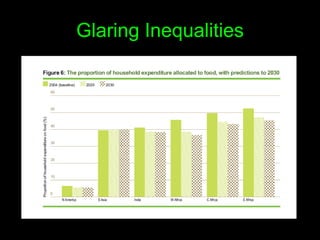
  • #9 In many of the developing regions facing the gravest challenges with malnutrition, food still accounts for around half of average household spending---and for an even greater share of spending by people living in poverty
  • #10 They may be responsible for most food production yet they face systematic discrimination in land tenure, which may be as overt as prohibitions against women being named as owners of land, as in Swaziland, or inheriting land. Women are therefore more likely to rely on marginal tracts not registered as in production, and to which titles have not been granted—precisely the ones currently identified by governments and investors as “available” for large-scale land acquisition.
  • #13 The World Bank estimated that the 2008 price spike pushed over 100 million people into poverty, 30 million of them in Africa
  • #14 Demand for food aid could conceivably double by 2020, yet the system is already buckling. Because donors’ budgets for food assistance are in monetary terms rather than tonnage, food price hikes erode their value.