VOLUME 03
ISSUE 04
MOSTINNOVATIVE
PRINTING
SOLUTION
PROVIDER
THE
APIUMADDITIVE TECHNOLOGIES
HARNESSING THE POSSIBILITIES OF 3D PRINTING
A 3-Dimensional
Future
Editor’s Desk
he Manufacturing Industry forms the backbone of an
Teconomy, serving almost every other sector. From
feeble toothbrushes and coffee mugs to high-end
computers and spacecrafts, all owe their origin to one or more
manufacturing units. And with time, the ways of
manufacturing changed and so did the materials being used in
manufacturing. From wood to metal to plastics and more.
And with everything going digital, how could the
manufacturing industry be behind. So 3D printing and
manufacturing came to the fore to give shape to our digital
ideas. 3D printing started way back in 1984 when Charles
Hull invented stereo-lithography. But all the patents
surrounding it ensured that the technology had limited
accessibility. Even after the technology came to light, it was
mostly used for industrial and niche manufacturing purposes
only. But the new century has brought the technology closer
to consumers with growing access to printing devices and 3D
printed items, especially for home decor.
Since the technology gained a world wide acceptance, it has
been absorbed in multiple industries like art and fashion,
architecture, automotive, aerospace and more. The biggest
benefit 3D printing brought with it across the industries was
prototyping. A new material, part, or an art or design, after
being visualized on paper or computer, could be realized only
after the first batch was manufactured.
Imagine manufacturing a complete concept car just to see if it
will actually work. With 3D printing, a prototype car could be
manufactured and tested at much lower costs. The medical
field is now using 3D printing to create custom organs for
those in need of transplantation. Architects are now finding it
easier to show dream homes to their potential clients.
VOLUME 03
ISSUE 04
MOSTINNOVATIVE
PRINTING
SOLUTION
PROVIDER
THE
APIUMADDITIVE TECHNOLOGIES
HARNESSING THE POSSIBILITIES OF 3D PRINTING
While 3D printing is making its own mark in the manufacturing industry, it still has a lot to achieve. The materials used are
still costly for some industries and not strong enough for others. With the entry of high-temperature polymer 3D printers and
high-performance thermoplastics, this issue is already being addressed.
The new year is expected to mark the implementation of composite material, which is lightweight and strong, more popular
across the industries. All eyes will also be on how printing software can make the designing process efficient and less of a
trouble. Also required, by the 3D industry, will be efficient and innovative minds that can take it to new heights, breaking the
current barriers.
This Edition titled “The Most Innovative 3D Printing Solution Providers” highlights the companies that are equipped with
such innovative people and buzzing with ideas. These solution providers don't just think 3D but do everything in their
potential to make 3D technology to reach out to the masses and benefit them.
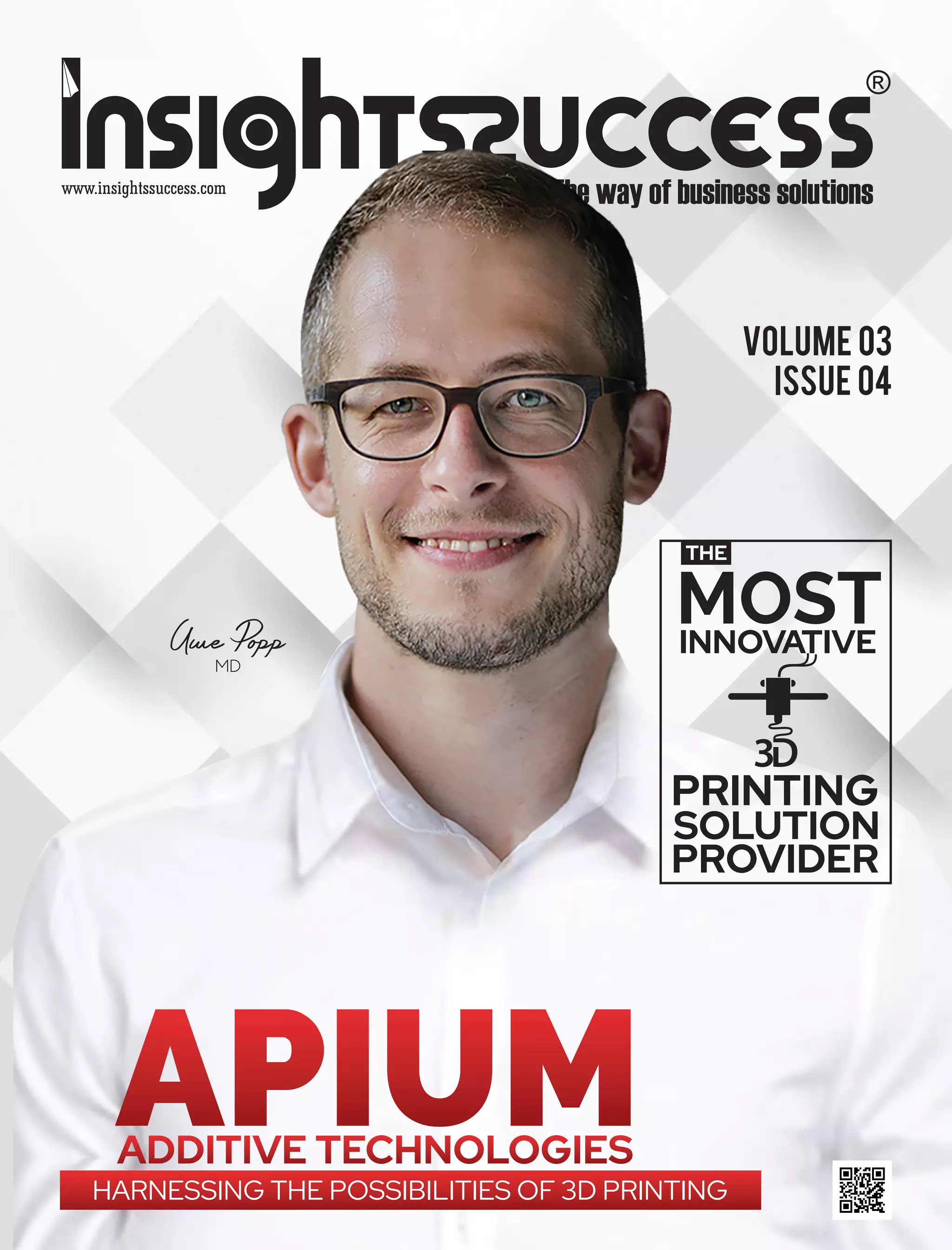
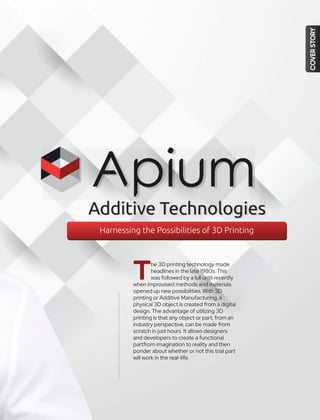
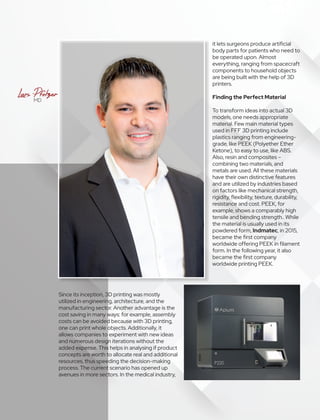
On the Cover, we have Apium Additive Technologies, a company driven by its vision to create tools where medical products
can be manufactured in a resourceful and cost-efficient fashion.
Further pages showcase the works of industry leaders like Genius Printers, a company with several patents under its belt
that looking forward to building the world’s first powder-based 3D printer that can print a layer of 1/4m² within 100
milliseconds; IMADE3D , an organization that was founded in 2016 by several folks who wanted to introduce and boost the
concept that ‘girls and boys should be able to work with their hands to build and operate a sophisticated machine’ nd;a
SelfCAD, an online CAD program that was designed for beginners in 3D Modeling, intermediate users, B2B and B2B2C.
Read through the insightful interviews of Tedd Syao, Founder of Kudo3D and Jordan Mills, CEO of MirrorMe3D.
Read a Leader’s take on The Changing Dynamics of Insurance Industry, penned by Michael Miller, CEO, Brightway
Insurance. In another article, Bryan Zheng, CEO and Founder, LIVALL explains How LIVALL is Creating the First Safe
Cycling Ecosystem.
Do go through our in-house articles Picking the Suitable 3D Material and 3D Printing: Revolutionizing the Healthcare
Industry.
We hope you enjoy reading this issue as much as we did while creating it!
Sneha Sinha
APIUMADDITIVE TECHNOLOGIES
HARNESSING THE POSSIBILITIES OF 3D PRINTING
CoverStory
Article
Industry Outlook
3D Printing:
Revolutionizing
the Healthcare
Industry
Wise Choice
Picking the Suitable
3D Material
20
42
08
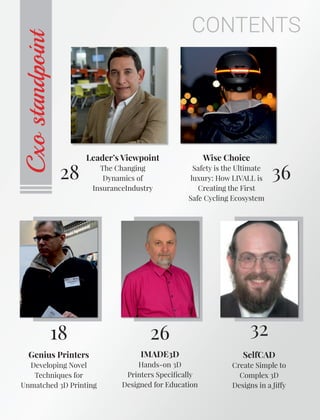
Genius Printers
Developing Novel
Techniques for
Unmatched 3D Printing
Leader’s Viewpoint
The Changing
Dynamics of
InsuranceIndustry
Wise Choice
Safety is the Ultimate
luxury: How LIVALL is
Creating the First
Safe Cycling Ecosystem
IMADE3D
Hands-on 3D
Printers Specifically
Designed for Education
SelfCAD
Create Simple to
Complex 3D
Designs in a Ji y
Cxostandpoint
28 36
18 26 32
CONTENTS
sales@insightssuccess.com
MARCH, 2020
Circulation Manager Tanaji
Research Analyst Eric Smith
Editor-in-Chief Pooja M. Bansal
Anish MillerSenior Editor
Kelly, Anna, Joseph, BhagyashriBusiness Development Executives
Sherin RodricksBusiness Development Manager
Managing Editor Sneha Sinha
Rahul, ShrutiPublishing Control Team
Art & Design Head Amol Kamble
Art & Design Assistant
Mayur Koli
Visualiser David King
Paul BelinCo-designer
Art & Picture Editor
Deepanjali Jena
Marketing Manager Marry D’souza
Technical Consultants Pratiksha, Aditya, David
Technical Head Jacob Smile
Assistant Technical Head
SME-SMO Executives Gemson, Uma, Manoj
Digital Marketing Manager Alina Sege
Assistant Digital Marketing Manager Prashant Chevale
Copyright © 2020 Insights Success Media and Technology Pvt. Ltd., All rights reserved. The content and images used in this magazine should not
be reproduced or transmitted in any form or by any means, electronic, mechanical, photocopying, recording or otherwise, without prior permission
from Insights Success. Reprint rights remain solely with Insights Success.
Follow us on : www.facebook.com/insightssuccess/ www.twitter.com/insightssuccess
Corporate Ofce
Insights Success Media Tech LLC
555 Metro Place North, Suite 100,
Dublin, OH 43017, United States
Phone - (614)-602-1754
Email: info@insightssuccess.com
For Subscription: www.insightssuccess.com
We are also available on :
RNI No.: MAHENG/2018/75953
Sales Executives Michael, Karen
Amar Sawant
Quality Assurance Team Abhishaj, Darshan
Contributing Editor Shreevarshita Gupta
18 | INSIGHTS SUCCESS VOLUME - 03, ISSUE - 04, 2020
2020, VOLUME - 03, ISSUE - 04 INSIGHTS SUCCESS | 19
20 | INSIGHTS SUCCESS VOLUME - 03, ISSUE - 04, 2020
3DPRINTINGREVOLUTIONIZING THE
HEALTHCARE INDUSTRY3D3D
Industry Outlook
2020, VOLUME - 03, ISSUE - 05 INSIGHTS SUCCESS | 21
A
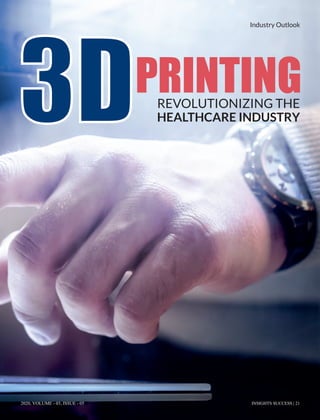
mong the numerous technological advancements, 3D printing technology is one of
them. 3D printing has been revolutionizing various industries. It has been helping to
create physical objects and it also eases the production of complex shapes as well as
materials. One of the industries that is benefitting from this technology drastically is the
healthcareindustry.Herearesomewaysinwhich3Dprintingistransformingthehealthcare
industry:
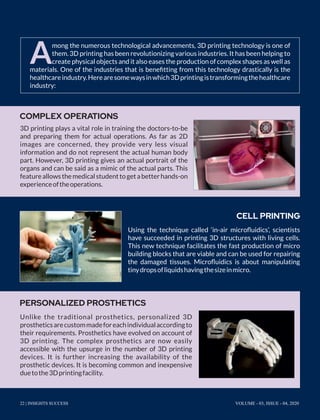
3D printing plays a vital role in training the doctors-to-be
and preparing them for actual operations. As far as 2D
images are concerned, they provide very less visual
information and do not represent the actual human body
part. However, 3D printing gives an actual portrait of the
organs and can be said as a mimic of the actual parts. This
featureallowsthemedicalstudenttogetabetterhands-on
experienceoftheoperations.
Using the technique called ‘in-air microfluidics’, scientists
have succeeded in printing 3D structures with living cells.
This new technique facilitates the fast production of micro
building blocks that are viable and can be used for repairing
the damaged tissues. Microfluidics is about manipulating
tinydropsofliquidshavingthesizeinmicro.
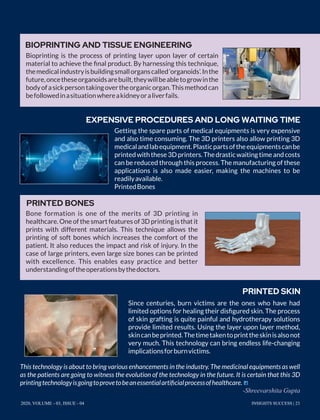
Unlike the traditional prosthetics, personalized 3D
prostheticsarecustommadeforeachindividualaccordingto
their requirements. Prosthetics have evolved on account of
3D printing. The complex prosthetics are now easily
accessible with the upsurge in the number of 3D printing
devices. It is further increasing the availability of the
prosthetic devices. It is becoming common and inexpensive
duetothe3Dprintingfacility.
COMPLEX OPERATIONS
CELL PRINTING
PERSONALIZED PROSTHETICS
22 | INSIGHTS SUCCESS VOLUME - 03, ISSUE - 04, 2020
Getting the spare parts of medical equipments is very expensive
and also time consuming. The 3D printers also allow printing 3D
medicalandlabequipment.Plasticpartsoftheequipmentscanbe
printedwiththese3Dprinters.Thedrasticwaitingtimeandcosts
can be reduced through this process. The manufacturing of these
applications is also made easier, making the machines to be
readilyavailable.
PrintedBones
Since centuries, burn victims are the ones who have had
limited options for healing their disfigured skin. The process
of skin grafting is quite painful and hydrotherapy solutions
provide limited results. Using the layer upon layer method,
skincanbeprinted.Thetimetakentoprinttheskinisalsonot
very much. This technology can bring endless life-changing
implicationsforburnvictims.
Bioprinting is the process of printing layer upon layer of certain
material to achieve the final product. By harnessing this technique,
themedicalindustryisbuildingsmallorganscalled‘organoids’.Inthe
future,oncetheseorganoidsarebuilt,theywillbeabletogrowinthe
bodyofasickpersontakingovertheorganicorgan.Thismethodcan
befollowedinasituationwhereakidneyoraliverfails.
Bone formation is one of the merits of 3D printing in
healthcare. One of the smart features of 3D printing is that it
prints with different materials. This technique allows the
printing of soft bones which increases the comfort of the
patient. It also reduces the impact and risk of injury. In the
case of large printers, even large size bones can be printed
with excellence. This enables easy practice and better
understandingoftheoperationsbythedoctors.
BIOPRINTING AND TISSUE ENGINEERING
EXPENSIVE PROCEDURES AND LONG WAITING TIME
PRINTED BONES
PRINTED SKIN
This technology is about to bring various enhancements in the industry. The medicinal equipments as well
as the patients are going to witness the evolution of the technology in the future. It is certain that this 3D
printingtechnologyisgoingtoprovetobeanessentialartificialprocessofhealthcare.
-Shreevarshita Gupta
INSIGHTS SUCCESS | 232020, VOLUME - 03, ISSUE - 04
26 | INSIGHTS SUCCESS VOLUME - 03, ISSUE - 04, 2020
INSIGHTS SUCCESS | 272020, VOLUME - 03, ISSUE - 04
28 | INSIGHTS SUCCESS VOLUME - 03, ISSUE - 04, 2020
INSIGHTS SUCCESS | 292020, VOLUME - 03, ISSUE - 04
30 | INSIGHTS SUCCESS VOLUME - 03, ISSUE - 04, 2020
32 | INSIGHTS SUCCESS VOLUME - 03, ISSUE - 04, 2020
INSIGHTS SUCCESS | 332020, VOLUME - 03, ISSUE - 04
36 | INSIGHTS SUCCESS VOLUME - 03, ISSUE - 04, 2020
INSIGHTS SUCCESS | 372020, VOLUME - 03, ISSUE - 04
38 | INSIGHTS SUCCESS VOLUME - 03, ISSUE - 04, 2020
INSIGHTS SUCCESS | 392020, VOLUME - 03, ISSUE - 04
3
D printing has been shaping its identity across
the manufacturing sector ‘layer-by-layer’. From
being used in industrial setups to being used in
DIY educational activities, 3D printing has come a long
way. What has made it useful for such diversified
industries is the wide range of material and
technologies that can be used to create 3D objects.
Technologies for the Purpose
While the core method of creating 3D objects remains
the same, i.e. adding layer-on-layer of material to form
the required shape, the technologies differ based on
the form of material used, to temperatures required,
light source and more. Here are a few popular
technologies:
SLA or Stereolithography was the first technology used to
introduce 3D printing to the world. It uses

liquid plastic as its source material. It also uses an
UltraViolet laser to trace a pattern on the liquid resin,
to cure and solidify the layers of the resin.
FDM or Fused Deposition Modeling is used to build
objects with production-grade thermoplastics. A
Thermoplastic filament is heated to its melting point
and then extruded to form the 3D object.
SLS or Selective Laser Sintering: Each layer of powdered
material is laser sintered as per a fixed pattern to build
the object. The powdered material left out of sintering
can be used to provide the support structure and can
also be removed after the object is formed for re-use.
LOM or Laminated Object Manufacturing is a rapid
prototyping system in which layers of material coated
with adhesive are fused using heat and pressure and
then cut into required shape. This process gives the
freedom of choosing the material for layers. This is also
recognized as a fast and inexpensive method.

Holding Shape
From plastic to metal, there’s no dearth of material that
can be used as the filament that finally shapes a 3D
object. The usage of the final object determines what

kind of material is to be used in the first place. As such
qualities like durability, strength, non-toxicity etc
determine which material will be used as the filament.
These qualities determine the final look, feel, colour
and usage of the final product that is being printed.
While there's a wide range of material to choose from,
they are broadly categorized as Plastics, Metals and
Composites. Plastic are the most widely used ones while
metals are mostly used for industrial products and
Composites are made of more than one material to
combine two required properties in one filament.
Here’s what one can get as options in:
Plastics
ABS or Acrylonitrile butadiene styrene is a common
thermoplastic polymer commonly used due to its low
cost and resistance to high temperature. It is light in
weight and comes in multiple colours.
Nylon or Polyamide or White Plastic as it is popularly
known as finds high application due to its flexibility and
strength. They can be easily polished to give a smooth
and clean finish to the 3D objects.
PICKING THE SUITABLE
MATERIAL3D3D
42 | INSIGHTS SUCCESS VOLUME - 03, ISSUE - 04, 2020
PEEK or Polyether Ether Ketone is a colourless organic
thermoplastic that is resistant to stress, temperature,
chemicals and can be exposed to X-ray and gamma
radiation as well. The material is apt for designing high-
performance parts, is easy to fabricate and hence
mostly utilized in automotive, chemical aerospace and
medical industries.
PET or polyethene terephthalate is a commonly used
plastic that is food-grade and hence utilized for
common consumer goods. It is strong and flexible and
gives a glossy finish to the 3D object.
Metals
Aluminum is light, versatile, and resistant to mechanical
and thermal stress. These qualities make it appropriate
for low-cost prototypes and functional models.
Stainless Steel has become a part of daily life and 3D
printing has made it all the more indispensable. It is one
of the most affordable and strong material with
amazing elasticity and magnetic properties. It can also
be mixed with other materials and also given a new
colour or look.
Precious Metals have limited usage but are nonetheless
great to work with. They mostly find their usage in
jewelry, medical and electronics industry.
Composites
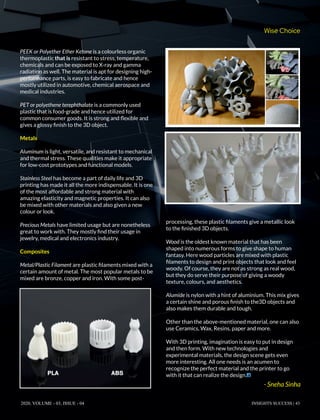
Metal/Plastic Filament are plastic filaments mixed with a
certain amount of metal. The most popular metals to be
mixed are bronze, copper and iron. With some post-
processing, these plastic filaments give a metallic look
to the finished 3D objects.
Wood is the oldest known material that has been
shaped into numerous forms to give shape to human
fantasy. Here wood particles are mixed with plastic
filaments to design and print objects that look and feel
woody. Of course, they are not as strong as real wood,
but they do serve their purpose of giving a woody
texture, colours, and aesthetics.
Alumide is nylon with a hint of aluminium. This mix gives
a certain shine and porous finish to the3D objects and
also makes them durable and tough.
Other than the above-mentioned material, one can also
use Ceramics, Wax, Resins, paper and more.
With 3D printing, imagination is easy to put in design
and then form. With new technologies and
experimental materials, the design scene gets even
more interesting. All one needs is an acumen to
recognize the perfect material and the printer to go
with it that can realize the design.
Wise Choice
2020, VOLUME - 03, ISSUE - 04 INSIGHTS SUCCESS | 43
- Sneha Sinha
The most innovative 3 d printing solution provider

The most innovative 3 d printing solution provider

  • 1.
    VOLUME 03 ISSUE 04 MOSTINNOVATIVE PRINTING SOLUTION PROVIDER THE APIUMADDITIVETECHNOLOGIES HARNESSING THE POSSIBILITIES OF 3D PRINTING
  • 4.
    A 3-Dimensional Future Editor’s Desk heManufacturing Industry forms the backbone of an Teconomy, serving almost every other sector. From feeble toothbrushes and coffee mugs to high-end computers and spacecrafts, all owe their origin to one or more manufacturing units. And with time, the ways of manufacturing changed and so did the materials being used in manufacturing. From wood to metal to plastics and more. And with everything going digital, how could the manufacturing industry be behind. So 3D printing and manufacturing came to the fore to give shape to our digital ideas. 3D printing started way back in 1984 when Charles Hull invented stereo-lithography. But all the patents surrounding it ensured that the technology had limited accessibility. Even after the technology came to light, it was mostly used for industrial and niche manufacturing purposes only. But the new century has brought the technology closer to consumers with growing access to printing devices and 3D printed items, especially for home decor. Since the technology gained a world wide acceptance, it has been absorbed in multiple industries like art and fashion, architecture, automotive, aerospace and more. The biggest benefit 3D printing brought with it across the industries was prototyping. A new material, part, or an art or design, after being visualized on paper or computer, could be realized only after the first batch was manufactured. Imagine manufacturing a complete concept car just to see if it will actually work. With 3D printing, a prototype car could be manufactured and tested at much lower costs. The medical field is now using 3D printing to create custom organs for those in need of transplantation. Architects are now finding it easier to show dream homes to their potential clients. VOLUME 03 ISSUE 04 MOSTINNOVATIVE PRINTING SOLUTION PROVIDER THE APIUMADDITIVE TECHNOLOGIES HARNESSING THE POSSIBILITIES OF 3D PRINTING
  • 5.
    While 3D printingis making its own mark in the manufacturing industry, it still has a lot to achieve. The materials used are still costly for some industries and not strong enough for others. With the entry of high-temperature polymer 3D printers and high-performance thermoplastics, this issue is already being addressed. The new year is expected to mark the implementation of composite material, which is lightweight and strong, more popular across the industries. All eyes will also be on how printing software can make the designing process efficient and less of a trouble. Also required, by the 3D industry, will be efficient and innovative minds that can take it to new heights, breaking the current barriers. This Edition titled “The Most Innovative 3D Printing Solution Providers” highlights the companies that are equipped with such innovative people and buzzing with ideas. These solution providers don't just think 3D but do everything in their potential to make 3D technology to reach out to the masses and benefit them. On the Cover, we have Apium Additive Technologies, a company driven by its vision to create tools where medical products can be manufactured in a resourceful and cost-efficient fashion. Further pages showcase the works of industry leaders like Genius Printers, a company with several patents under its belt that looking forward to building the world’s first powder-based 3D printer that can print a layer of 1/4m² within 100 milliseconds; IMADE3D , an organization that was founded in 2016 by several folks who wanted to introduce and boost the concept that ‘girls and boys should be able to work with their hands to build and operate a sophisticated machine’ nd;a SelfCAD, an online CAD program that was designed for beginners in 3D Modeling, intermediate users, B2B and B2B2C. Read through the insightful interviews of Tedd Syao, Founder of Kudo3D and Jordan Mills, CEO of MirrorMe3D. Read a Leader’s take on The Changing Dynamics of Insurance Industry, penned by Michael Miller, CEO, Brightway Insurance. In another article, Bryan Zheng, CEO and Founder, LIVALL explains How LIVALL is Creating the First Safe Cycling Ecosystem. Do go through our in-house articles Picking the Suitable 3D Material and 3D Printing: Revolutionizing the Healthcare Industry. We hope you enjoy reading this issue as much as we did while creating it! Sneha Sinha
  • 6.
    APIUMADDITIVE TECHNOLOGIES HARNESSING THEPOSSIBILITIES OF 3D PRINTING CoverStory Article Industry Outlook 3D Printing: Revolutionizing the Healthcare Industry Wise Choice Picking the Suitable 3D Material 20 42 08
  • 7.
    Genius Printers Developing Novel Techniquesfor Unmatched 3D Printing Leader’s Viewpoint The Changing Dynamics of InsuranceIndustry Wise Choice Safety is the Ultimate luxury: How LIVALL is Creating the First Safe Cycling Ecosystem IMADE3D Hands-on 3D Printers Specifically Designed for Education SelfCAD Create Simple to Complex 3D Designs in a Ji y Cxostandpoint 28 36 18 26 32 CONTENTS
  • 8.
    sales@insightssuccess.com MARCH, 2020 Circulation ManagerTanaji Research Analyst Eric Smith Editor-in-Chief Pooja M. Bansal Anish MillerSenior Editor Kelly, Anna, Joseph, BhagyashriBusiness Development Executives Sherin RodricksBusiness Development Manager Managing Editor Sneha Sinha Rahul, ShrutiPublishing Control Team Art & Design Head Amol Kamble Art & Design Assistant Mayur Koli Visualiser David King Paul BelinCo-designer Art & Picture Editor Deepanjali Jena Marketing Manager Marry D’souza Technical Consultants Pratiksha, Aditya, David Technical Head Jacob Smile Assistant Technical Head SME-SMO Executives Gemson, Uma, Manoj Digital Marketing Manager Alina Sege Assistant Digital Marketing Manager Prashant Chevale Copyright © 2020 Insights Success Media and Technology Pvt. Ltd., All rights reserved. The content and images used in this magazine should not be reproduced or transmitted in any form or by any means, electronic, mechanical, photocopying, recording or otherwise, without prior permission from Insights Success. Reprint rights remain solely with Insights Success. Follow us on : www.facebook.com/insightssuccess/ www.twitter.com/insightssuccess Corporate Ofce Insights Success Media Tech LLC 555 Metro Place North, Suite 100, Dublin, OH 43017, United States Phone - (614)-602-1754 Email: info@insightssuccess.com For Subscription: www.insightssuccess.com We are also available on : RNI No.: MAHENG/2018/75953 Sales Executives Michael, Karen Amar Sawant Quality Assurance Team Abhishaj, Darshan Contributing Editor Shreevarshita Gupta
  • 20.
    18 | INSIGHTSSUCCESS VOLUME - 03, ISSUE - 04, 2020
  • 21.
    2020, VOLUME -03, ISSUE - 04 INSIGHTS SUCCESS | 19
  • 22.
    20 | INSIGHTSSUCCESS VOLUME - 03, ISSUE - 04, 2020
  • 23.
    3DPRINTINGREVOLUTIONIZING THE HEALTHCARE INDUSTRY3D3D IndustryOutlook 2020, VOLUME - 03, ISSUE - 05 INSIGHTS SUCCESS | 21
  • 24.
    A mong the numeroustechnological advancements, 3D printing technology is one of them. 3D printing has been revolutionizing various industries. It has been helping to create physical objects and it also eases the production of complex shapes as well as materials. One of the industries that is benefitting from this technology drastically is the healthcareindustry.Herearesomewaysinwhich3Dprintingistransformingthehealthcare industry: 3D printing plays a vital role in training the doctors-to-be and preparing them for actual operations. As far as 2D images are concerned, they provide very less visual information and do not represent the actual human body part. However, 3D printing gives an actual portrait of the organs and can be said as a mimic of the actual parts. This featureallowsthemedicalstudenttogetabetterhands-on experienceoftheoperations. Using the technique called ‘in-air microfluidics’, scientists have succeeded in printing 3D structures with living cells. This new technique facilitates the fast production of micro building blocks that are viable and can be used for repairing the damaged tissues. Microfluidics is about manipulating tinydropsofliquidshavingthesizeinmicro. Unlike the traditional prosthetics, personalized 3D prostheticsarecustommadeforeachindividualaccordingto their requirements. Prosthetics have evolved on account of 3D printing. The complex prosthetics are now easily accessible with the upsurge in the number of 3D printing devices. It is further increasing the availability of the prosthetic devices. It is becoming common and inexpensive duetothe3Dprintingfacility. COMPLEX OPERATIONS CELL PRINTING PERSONALIZED PROSTHETICS 22 | INSIGHTS SUCCESS VOLUME - 03, ISSUE - 04, 2020
  • 25.
    Getting the spareparts of medical equipments is very expensive and also time consuming. The 3D printers also allow printing 3D medicalandlabequipment.Plasticpartsoftheequipmentscanbe printedwiththese3Dprinters.Thedrasticwaitingtimeandcosts can be reduced through this process. The manufacturing of these applications is also made easier, making the machines to be readilyavailable. PrintedBones Since centuries, burn victims are the ones who have had limited options for healing their disfigured skin. The process of skin grafting is quite painful and hydrotherapy solutions provide limited results. Using the layer upon layer method, skincanbeprinted.Thetimetakentoprinttheskinisalsonot very much. This technology can bring endless life-changing implicationsforburnvictims. Bioprinting is the process of printing layer upon layer of certain material to achieve the final product. By harnessing this technique, themedicalindustryisbuildingsmallorganscalled‘organoids’.Inthe future,oncetheseorganoidsarebuilt,theywillbeabletogrowinthe bodyofasickpersontakingovertheorganicorgan.Thismethodcan befollowedinasituationwhereakidneyoraliverfails. Bone formation is one of the merits of 3D printing in healthcare. One of the smart features of 3D printing is that it prints with different materials. This technique allows the printing of soft bones which increases the comfort of the patient. It also reduces the impact and risk of injury. In the case of large printers, even large size bones can be printed with excellence. This enables easy practice and better understandingoftheoperationsbythedoctors. BIOPRINTING AND TISSUE ENGINEERING EXPENSIVE PROCEDURES AND LONG WAITING TIME PRINTED BONES PRINTED SKIN This technology is about to bring various enhancements in the industry. The medicinal equipments as well as the patients are going to witness the evolution of the technology in the future. It is certain that this 3D printingtechnologyisgoingtoprovetobeanessentialartificialprocessofhealthcare. -Shreevarshita Gupta INSIGHTS SUCCESS | 232020, VOLUME - 03, ISSUE - 04
  • 28.
    26 | INSIGHTSSUCCESS VOLUME - 03, ISSUE - 04, 2020
  • 29.
    INSIGHTS SUCCESS |272020, VOLUME - 03, ISSUE - 04
  • 30.
    28 | INSIGHTSSUCCESS VOLUME - 03, ISSUE - 04, 2020
  • 31.
    INSIGHTS SUCCESS |292020, VOLUME - 03, ISSUE - 04
  • 32.
    30 | INSIGHTSSUCCESS VOLUME - 03, ISSUE - 04, 2020
  • 34.
    32 | INSIGHTSSUCCESS VOLUME - 03, ISSUE - 04, 2020
  • 35.
    INSIGHTS SUCCESS |332020, VOLUME - 03, ISSUE - 04
  • 38.
    36 | INSIGHTSSUCCESS VOLUME - 03, ISSUE - 04, 2020
  • 39.
    INSIGHTS SUCCESS |372020, VOLUME - 03, ISSUE - 04
  • 40.
    38 | INSIGHTSSUCCESS VOLUME - 03, ISSUE - 04, 2020
  • 41.
    INSIGHTS SUCCESS |392020, VOLUME - 03, ISSUE - 04
  • 44.
    3 D printing hasbeen shaping its identity across the manufacturing sector ‘layer-by-layer’. From being used in industrial setups to being used in DIY educational activities, 3D printing has come a long way. What has made it useful for such diversified industries is the wide range of material and technologies that can be used to create 3D objects. Technologies for the Purpose While the core method of creating 3D objects remains the same, i.e. adding layer-on-layer of material to form the required shape, the technologies differ based on the form of material used, to temperatures required, light source and more. Here are a few popular technologies: SLA or Stereolithography was the first technology used to introduce 3D printing to the world. It uses liquid plastic as its source material. It also uses an UltraViolet laser to trace a pattern on the liquid resin, to cure and solidify the layers of the resin. FDM or Fused Deposition Modeling is used to build objects with production-grade thermoplastics. A Thermoplastic filament is heated to its melting point and then extruded to form the 3D object. SLS or Selective Laser Sintering: Each layer of powdered material is laser sintered as per a fixed pattern to build the object. The powdered material left out of sintering can be used to provide the support structure and can also be removed after the object is formed for re-use. LOM or Laminated Object Manufacturing is a rapid prototyping system in which layers of material coated with adhesive are fused using heat and pressure and then cut into required shape. This process gives the freedom of choosing the material for layers. This is also recognized as a fast and inexpensive method. Holding Shape From plastic to metal, there’s no dearth of material that can be used as the filament that finally shapes a 3D object. The usage of the final object determines what kind of material is to be used in the first place. As such qualities like durability, strength, non-toxicity etc determine which material will be used as the filament. These qualities determine the final look, feel, colour and usage of the final product that is being printed. While there's a wide range of material to choose from, they are broadly categorized as Plastics, Metals and Composites. Plastic are the most widely used ones while metals are mostly used for industrial products and Composites are made of more than one material to combine two required properties in one filament. Here’s what one can get as options in: Plastics ABS or Acrylonitrile butadiene styrene is a common thermoplastic polymer commonly used due to its low cost and resistance to high temperature. It is light in weight and comes in multiple colours. Nylon or Polyamide or White Plastic as it is popularly known as finds high application due to its flexibility and strength. They can be easily polished to give a smooth and clean finish to the 3D objects. PICKING THE SUITABLE MATERIAL3D3D 42 | INSIGHTS SUCCESS VOLUME - 03, ISSUE - 04, 2020
  • 45.
    PEEK or PolyetherEther Ketone is a colourless organic thermoplastic that is resistant to stress, temperature, chemicals and can be exposed to X-ray and gamma radiation as well. The material is apt for designing high- performance parts, is easy to fabricate and hence mostly utilized in automotive, chemical aerospace and medical industries. PET or polyethene terephthalate is a commonly used plastic that is food-grade and hence utilized for common consumer goods. It is strong and flexible and gives a glossy finish to the 3D object. Metals Aluminum is light, versatile, and resistant to mechanical and thermal stress. These qualities make it appropriate for low-cost prototypes and functional models. Stainless Steel has become a part of daily life and 3D printing has made it all the more indispensable. It is one of the most affordable and strong material with amazing elasticity and magnetic properties. It can also be mixed with other materials and also given a new colour or look. Precious Metals have limited usage but are nonetheless great to work with. They mostly find their usage in jewelry, medical and electronics industry. Composites Metal/Plastic Filament are plastic filaments mixed with a certain amount of metal. The most popular metals to be mixed are bronze, copper and iron. With some post- processing, these plastic filaments give a metallic look to the finished 3D objects. Wood is the oldest known material that has been shaped into numerous forms to give shape to human fantasy. Here wood particles are mixed with plastic filaments to design and print objects that look and feel woody. Of course, they are not as strong as real wood, but they do serve their purpose of giving a woody texture, colours, and aesthetics. Alumide is nylon with a hint of aluminium. This mix gives a certain shine and porous finish to the3D objects and also makes them durable and tough. Other than the above-mentioned material, one can also use Ceramics, Wax, Resins, paper and more. With 3D printing, imagination is easy to put in design and then form. With new technologies and experimental materials, the design scene gets even more interesting. All one needs is an acumen to recognize the perfect material and the printer to go with it that can realize the design. Wise Choice 2020, VOLUME - 03, ISSUE - 04 INSIGHTS SUCCESS | 43 - Sneha Sinha