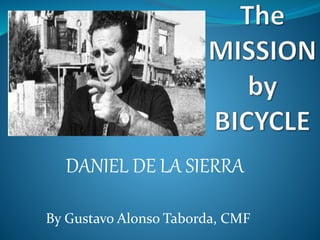
DANIEL DE LA SIERRA
By Gustavo Alonso Taborda, CMF
 There are many cases in which the stories of
mission must have a very large map. The
geography where the mission is weaved takes on
colors, experiences, distances traveled, that also
express amazing spiritual journeys.
 This story, that of Daniel de la Sierra, Claretian
Missionary, ending in the neighborhoods of
southern Buenos Aires, capital of Argentina,
begins far away: a distance vital to understanding
his journey and his finish.
Roads (From the Castilian plateau)
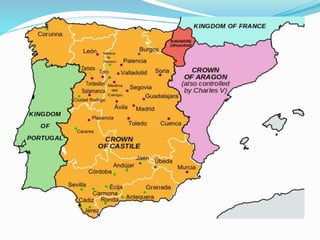
 It was during the years of the Spanish Civil
War when, in the summer of 1938, Daniel de
la Sierra saw sunlight, strong and beautiful
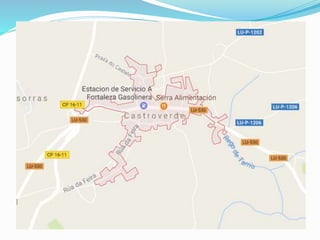
over the fertile and dry plateau of Castile. It
was August 6 of that year, in Castroverde de
Cerrato, a municipality in the province of
Valladolid, where the plateau declines gently
to the Esgueva river. It is a land rich in cattle
and crops, in vegetables and in fruits.
His father, Lucio Luis de la Sierra,
was the Secretary of the
Municipality of Castroverde, which
in those years would not have
exceed a population of one
thousand people. He established a
home with Maria Mercedes
Escudero, a teacher who was to be
blessed with several children.
 The peasant environment of work and honesty
gave Daniel a solid foundation for his growth
as a person and as a Christian, later
strengthened by the village school and the
local parish of the Assumption. In this parish,
belonging to the diocese of Palencia, he
receives baptism four days after his birth, and
within a few years, the other sacraments of
initiation, along with the usual catechism.
There, listening to the Missionaries of Medina
de Rioseco, the seeds of Claretian vocation
would be planted in his soul.
From his sister María Gloria:
My mother was preparing him for the 1st Holy
Communion and confession (six years old), and upon talking
about of the need to repair the reputation as well as the things
that were taken, Daniel said, "Listen, mother, I have taken sugar
from my grandmother. Thus, (and he showed the palm of his left
hand while with his right hand indicated the amount) give me this
much so that I can take it too her."
My father was the town clerk. Men would go to his office
and while there smoked: They would leave the ashtray full of half-
smoked cigarettes. At the end of the day, after leaving school,
Daniel went to visit his father and unbeknownst to him , he would
collect the cigarettes crumbling them hew would save them in an
envelope and give them to the beggars of the village at that time.
Towards other horizons
 While still a child, Daniel was directed towards other
horizons and begins to walk paths, that will determine
the definitive direction of his life. His first steps, in
mid 1948, are to the north, to Barquín College, a
preparatory seminary that the Claretian Missionaries
had at that time in Castro Urdiales, a charming tourist
village overlooking the Cantabrian Sea. Subsequent
steps would be the minor seminaries Valmaseda in the
Basque region, and Aranda de Duero, in the heart of
Castile. He was accompanied by formators who he
would always remember with affection and veneration:
Venancio Sanabria, Severiano Rodriguez.
 Daniel was ready to take a decisive step
on his journey towards consecration to
God in the Congregation of the
Missionary Sons of the Immaculate
Heart of Mary: that smart, handsome,
idealistic and somewhat presumptuous
young man made his profession as a
Claretian on August 15, 1954 at the
hands of his Major Superior, Fr. Toribio
Perez.
 After the novitiate came years of philosophical
studies, undertaken in the so-called College of
Infants in Sigüenza: a place full of memories
since the time of the martyrdom of the young
Fr. José M. Ruiz Cano during the dramatic on
days of 1936. Then, as was the practice then, he
went to do his maestrillo [student teaching] in
some Claretian schools (1957-59): an
experience of missionary life, of practical
transmission of the faith and of teaching to
students. In Segovia on October 24, 1959,
Daniel made his definitive consecration to the
Lord through the profession of perpetual vows.
From his co-novice Fr. Anastasio Canto:
The characteristics of sensibility and passion are
elements of his person that stood out. But all were
conditioned by other notable characteristics of austerity
and a sense of fidelity to his vocation.
He did not lack, also, a certain risk or temptation
to “presumptuousness”, due perhaps to his youth and his
distinguishing good looks. An anecdote: one day during
a conference, in front of everyone, he asked for a
penance “accusing himself of having believed that he
was the most handsome of the novitiate. Even though
this was the motive for a loud collective laughter, it did
not surprise anyone…
The Rome Experience
At twenty-one years of age, it happen
that the student Daniel, along with a
group of 41 students from nine
countries were sent to initiate the
history of the International College in
Rome, the Claretianum, which was
inaugurated that same year of 1959 to
promote greater proficiency in
theological studies.
 For five years (1959-1964) Daniel went
forward with enthusiasm and successfully
earned the Licentiate degree in theological
studies in the same Claretianum, which is
affiliated to the Theological Faculty of the
Lateran University. On the other hand, he
took advantage of this youthful period to
enrich himself in the cultural treasures of
Rome and also to cultivate his abilities in
playing musical instruments (piano and
guitar) which would become very useful in
the future.
Teacher and student
 Before crossing the Atlantic, Daniel went to Valladolid
for a well-deserved rest and to share with his family the
gift of his priesthood uniting them into his own act of
thanksgiving in the celebration of the Eucharist. And
overcoming some difficulties related to his journey, he
departs for the southern end part of the world.
 Upon reaching Buenos Aires in November of 1964, he
soon continues his journey, not towards Formosa but
to Cordova, to take charge of teaching moral theology
at the Villa Claret House of Formation. That would be
his first assignment on Argentine soil: a challenging
assignment for a young missionary of twenty-six years.
 Apparently, the most significant event that happened
to the young teacher was a kind of crisis in the
approach to pastoral work and in the transmission of
the faith from his overly critical way of thinking. That
is what Fr. Valentín Simón, who later would be his
superior as well as his friend, was able to affirm, when
upon accepting his invitation, Daniel came to
Mendoza for a few days to assist in pastoral work.
Daniel was able to see up close both the simple faith
and the poverty of people who made the pilgrimage to
the Lourdes Shrine in Challao. For the critical attitude
of the young teacher this was no more than
superstition. It is with regard to these perceptions and
attitudes that over the years and with new experiences,
these would produce a radical change in the life of
Daniel and in his way of doing ministry among simple
people.
The streets of the poor
 Since the 1940s, coupled with the promotion of
industrialization, there was given a heavy
concentration of urban growth in Argentina. Rural
residents sensed that factories and urban development
promised to provide them a better future. To this
internal migration, which came mainly from the
poorer and more remote provinces, was added the flow
of migrants arriving from neighboring countries such
as Paraguay, Bolivia and Peru. The phenomenon,
primarily with economic roots, was to last for decades
and increase continuously around the stronger urban
center, especially Buenos Aires.
Multiple factors (such as lack of job
skills, recurrent falls – sometimes
whimsical – in the job market offerings,
etc.) gave rise to the phenomenon of
precarious housing, and in general,
living conditions of the new
inhabitants of the city (in terms of
health, education, utilities, etc…),
leaving them to their own ingenuity
and their ability to fight for survival.
The conventillos or tenement
buildings were already an old
reality of Buenos Aires: a reality
that, in the middle of the twentieth
century, would have a new version,
perhaps more dramatic and global,
with the emergence of the villas de
emergencia more popularly known
as villas miseria , i.e. slums.
 The social phenomenon of these "villas" evolved, in
general, along a group dynamic manifested in three basic
moments, which did not always reach the expected results:
 The first was that of the “settlement” or the occupation of
the land, especially government-owned lands (of which
there were many in the capital), using very precarious
means.
 In a second moment, there was a certain organization of
the “villa” by an effort of all its inhabitants to obtain, for
example services of water, electricity, sewer, basic streets.
 In a second moment, there was a certain organization of
the “villa” by an effort of all its inhabitants to obtain, for
example services of water, electricity, sewer, basic streets.
 In the Buenos Aires of the 1960s (and still
today!), realities of this type could be found
in Retiro, in Flores, in Villa Lugano, in Villa
Soldati, in Chacarita, in Barracas ... And it is
clear that a very visible reality as this could
not pass unnoticed by the Church, who was
already living in Conciliar times and, since
Medellin, saw itself inspired towards a clear
option for the poor.
Soon after arriving in Buenos Aires
(1967), Fr. Daniel, not content with just
taking courses in sociology, made
contact with priests engaged in
pastoral work in the villas, “la pastoral
villera,” which was the very reason for
his university studies. His goal was to
devote his live to the most poor.
Fr. Daniel goes to the "villa"
The so-called “villa priests” who,
initially, would come in regularly to the
villas from their parishes to meet the
significant religious needs of its people
became aware of the need for a stable
presence in the midst of these new
residents, who were without a doubt in
the greatest need for pastoral
accompaniment.
Writing to his superior on
September 30, 1970,
Fr Daniel describes what they are doing
in the villa and identifies three large
areas that that inspire them, on the one
hand, in the urgency of the situation
and, secondly, the pastoral guidelines
two years earlier had been proposed in
Medellín.
 First, the specifically religious area: Sunday
Eucharistic celebration in the small hall, with
reaching out to the entire villa through loud
speakers, sacramental catechesis first
communion and confirmation, with the help
of an Opus Dei religious Sister and youth
from the university; cultivation and
purification of the traditional manifestations
of popular piety, e.g. the accompaniment of
family members when they have lost a loved
one, devotion to Mary, the participation in the
pilgrimage to Lujan from the Villas, etc.
 The second area is that of social promotion. He says
they have begun a medical clinic, supported by the
Claretian community of Constitution. They
organized a support school at the elementary level,
for children of the villa with the collaboration of
religious Sisters and laity. The priests are working
with their neighbors in improving the villa, for
example, in the placement of water pipes, paved
pathways, and so on. And together with the people
they are fighting for the safety of workers and
children from danger that they find along the Perito
Moreno Avenue that borders the villa for about ten
blocks with no traffic lights.
 Thirdly they are helping their neighbors in
the formation of their political
consciousness: an important work for them
is the promotion of a neighborhood center,
“Centro Vecinal”, a good tool for generating
and sharing the responsibility that has to do
with the neighborhood and the city itself.
The transmission of these values is made
through personal contact and
communication with other members of
neighborhood councils in addition to their
preaching of the Gospel of Jesus.
 In the letter, Daniel refers to ups and downs
that he has had as a worker. First he worked
as a metallurgist. Due to some problems
(such as twelve-hour work days, which
according to the guidelines set by the
Coadjutor Archbishop were not acceptable),
subsequently he went on to work as a mason
and a carpenter. He was interested in
learning about the tools and machinery that
would enable him to work with wood, which
was one of his aspirations.
When he had some income he would
distribute it among the group of the
villa and his religious community at the
plaza Constitution, where he also
worked for several hours on Sunday
helping with the music, the
administration of parish baptisms and
other services.
From Fr. Valentín Simon:
Fr. Daniel has told me that he had not paid a single
salary in all his projects. Everything was done through the
faith of our people. He motivated them to obtain their
collaboration ... Of course to this was added the strength of
Fr. Daniel, who insisted on compliance by those who had
made commitments so that things would not just remain in
promises.
He never received aid from abroad. His way of working
was to ask for help from local employers. He had a book
with their phone numbers. During the time of siesta for the
community in Constitution, he would spend two hours on
making and receiving phone calls. Once his beloved bicycle
betrayed him; he carried the bike basket a bag that
contained all his addresses and telephone numbers. Near
Plaza Once he lost the bag. He asked the neighbors, he put
an announcement in the newspaper, he stayed two days in a
bar looking for it and asking parishioners. And the bag
appeared.
Further on and by bicycle
 Until 1981 Daniel did everything so far reported from
the center in Barracas and his community of
Constitution, in the Federal Capital. That year would
be a time of troubles. In February, he received notice of
the death of his father, Don Lucio in Valladolid, Spain.
Moreover, his involvement and demands for the people
of Villa 21, were bringing him many
misunderstandings and restrictive measures, whether
by the military authorities who ruled Buenos Aires,
and also on the part of the primate archdiocese, which
asked for the Claretian Superior to remove Daniel far
from the capital.
The neighborhoods of the south
 Fr. Daniel was transferred to the Barrio
Santa María, in Berazategui, territory of the
Diocese of Quilmes. The move was made
possible through a collaborative pastoral
agreement between the local bishop, Bishop
Jorge Novak, and the Claretian Provincial,
Fr. Raúl Mehring. In August of 1981 Fr.
Daniel assumed the pastoral service of that
slum, living next to the Chapel of the
Assumption of Mary.
 From there he continued to attend to the
neighborhood of Caacupé, José Mármol,
which, as already indicated, at this time was
still under construction. Only in 1990, when
this neighborhood of Caacupé had been well
established and organized, the pastoral care
was passed on to other priests and Fr. Daniel
could devote himself fully to the Barrio Santa
Maria.
 There, his work would have the same
characteristics in the formation of the local
community and creation of decent living
spaces for the residents.
 Meanwhile, during those nine years, Daniel
took up the challenge without fear of the
distance that stood between one chapel and
another, between one neighborhood and
another. For the hour-long journey, he
counted on the same bicycle, which had
been tirelessly providing service for many
years and which was going to accompany
him till the end in all his comings and
goings through those neighborhoods and
among his people.
 Residing in the Chapel of the Assumption of
St. Mary parish in the jurisdiction of Our
Lady of Mercy, Ranelagh, Fr. Daniel also
took care of other chapels in the area: Saint
Thomas Aquinas and Jesus of Nazareth. To
these were soon added three other
communities. In 1987, the pastoral
development reached a point whereby
Bishop Novak created a quasi-parish and
entrusted this to Fr. Daniel.
A missionary, a style
 Daniel’s long biographical, spiritual and
missionary journey now puts him at fifty
years of age. These were years of maturity in
his interior growth and in the fruits of his
service to the Church among the most
humble. A maturity that means full
development of his remarkable human skills
and full understanding also of his vocational
identity of missionary service, as a disciple
of Jesus.
 His beliefs shaped his life. In them, his way to
being and his activities, found their purpose. His
clear intelligence had developed from early youth a
strong critical sense, that in the mirror of his
conscience was translated primarily into
responsibility with respect to those who were
under his care. His tenacity, expressed in his
behavior and the work he did, was the same force
that shaped him interiorly from the key of self-
surrender, in the manner of Jesus. It is therefore
clear that his passion had no other source than
that of the Gospel.
 Relentless in his reasoning, he was
nevertheless open to a dialogue that
also resulted in a search and an
availability when, with his superiors, it
was related to his own path of life. Seen
from today, we can say that it was this
attitude that made it possible during
several critical moments of his life; he,
not only found a positive outcome, but
fulfillment.
 And one can identify some particular issues that
were highlighted by his ministry, like popular
religiosity, the option for the poor, social peace and
harmony between peoples. He voluntarily became
a beggar for the poor.
 On his bike he went back and forth, knocking on
doors for years in search of any kind of help. And
combined with his tireless walking, was also
doggedly worked the telephone lines of
businesses, of public and private offices,
committed to expanding the network of solidarity
that beyond mitigating an emergency, he sought to
create new attitudes for social change.
Undoubtedly, this great sense of
ecclesial community was what allowed
Daniel to let go, without resentment, of
the misunderstandings and reprimands
of some prelates and continue with
tireless generosity his proclamation of
the Gospel to the poor. From this same
root came the coherency of his life in
total austerity and transparency.
From walking to being a pilgrim
 Walking with humble people and in their service, Fr. Daniel
began to understand and make his own the religious
sensibilities of his people and valuing the evangelical potential
of their traditions.
 For that reason, among many other things, since 1969, he was
involved with growing enthusiasm in the annual pilgrimage
from the villas to Luján even to becoming one of its main
promoters.
 They were moments of prayer and reflection, based on specific
themes that emerge year after year from the life situations of
the people: thanksgiving, hope, prayers for health and work,
"to participate in the construction work for one’s home" that a
great Latin American country might emerge, and so on.
 All of this was inspired by and directed towards Mary, a life-
giving presence and attraction for people in her the sanctuary
of Luján.
Last journey
 It was in October 1992 that Daniel had been
carefully preparing for the 6th Bike Ride to Luján,
scheduled for the following month. On the 25th,
the last Sunday of the month, he celebrated in the
chapels of his jurisdiction the 51 Claretian Martyrs
of Barbastro, who that same morning, Pope John
Paul II had solemnly beatified in Rome. The
exciting story of these young martyrs gave
occasion to speak of death as the giving of ones
very life as a gift.
 Fr. Simon tells what happened then: "It was about
9 pm when he got on his bicycle and headed for
Cruce Varela, where he had placed a street banner
announcing the Bike Ride to Luján. He thought
that the 3 pm storm had damaged it. He traveled a
few blocks on the Camino General Belgrano and a
bus hit him from behind, throwing him to one side
of the asphalt and onto a concrete pavement. The
blow to his head was very strong and caused
instant death. He had already said that several
times that he would not die in bed, but working,
perhaps hit by a truck or a bus. And so it
happened. "
The poor do not forget him
The memory of Fr. Daniel continues to
sustain the communities formed by
him. His name is remembered
everywhere, with gratitude and as a
great inspiration. In his weekly
message, Bishop Novak published a
letter addressed to Daniel, a vibrant
testimony about his life, his missionary
spirit, his commitment.
From the Open letter of Bishop Jorge Novak Daniel, after
his death:
... You came to our diocese eleven years to animate
the Christian life of thousands of families in the 'basin'
of Camino General Belgrano, in Berazategui. You
arrival, as mandated by the gospel with humility,
poverty and with the expansion of inexhaustible energy.
The Catholics in those neighborhoods felt that with
your presence, they had left the state of anonymity, of
being orphans. The ecclesial life, spread out into six
fraternal communities, with a strong missionary
dynamism. Everything was taking shape: catechesis,
liturgical prayer, charity. New chapels emerged and the
Bethlehem nursery project became a reality.
You were truly a "Missionary Son of the
Immaculate Heart of Mary." You also felt a holy
passion for humanity. For very sacred human causes
like human life, peace, and justice.
The people gave their verdict in Berazategui, in
Mármol, in Buenos Aires, as they crowded around your
coffin. With prayers, tears and even pious applause
they affirmed your life, they cried your death, sealed
your memory. Also and above all, the Lord received you
in heaven with open arms.
Already for the first anniversary of
his death, the communities, not
only prayed for him with the
customary novenas for the dead,
but in many other ways reflected
their appreciation for him.
 In what was the world of Daniel his
remembrance continues to bear life-giving
fruit. His name is used to describe the
dreams and struggles of the poor.
 His experience of walking among the poor
has left many signs: signs that invite us to
walk today, with the Gospel message of life
and made a sign of service, the same path of
Jesus, the light amidst the uncertainties and
challenges of changing times.
“He had already said for
several times that he
would not die in bed, but
working.”
Thank you and God Bless Always!

The mission by bicycle

  • 1.
    DANIEL DE LASIERRA By Gustavo Alonso Taborda, CMF
  • 2.
     There aremany cases in which the stories of mission must have a very large map. The geography where the mission is weaved takes on colors, experiences, distances traveled, that also express amazing spiritual journeys.  This story, that of Daniel de la Sierra, Claretian Missionary, ending in the neighborhoods of southern Buenos Aires, capital of Argentina, begins far away: a distance vital to understanding his journey and his finish.
  • 3.
    Roads (From theCastilian plateau)  It was during the years of the Spanish Civil War when, in the summer of 1938, Daniel de la Sierra saw sunlight, strong and beautiful over the fertile and dry plateau of Castile. It was August 6 of that year, in Castroverde de Cerrato, a municipality in the province of Valladolid, where the plateau declines gently to the Esgueva river. It is a land rich in cattle and crops, in vegetables and in fruits.
  • 5.
    His father, LucioLuis de la Sierra, was the Secretary of the Municipality of Castroverde, which in those years would not have exceed a population of one thousand people. He established a home with Maria Mercedes Escudero, a teacher who was to be blessed with several children.
  • 7.
     The peasantenvironment of work and honesty gave Daniel a solid foundation for his growth as a person and as a Christian, later strengthened by the village school and the local parish of the Assumption. In this parish, belonging to the diocese of Palencia, he receives baptism four days after his birth, and within a few years, the other sacraments of initiation, along with the usual catechism. There, listening to the Missionaries of Medina de Rioseco, the seeds of Claretian vocation would be planted in his soul.
  • 8.
    From his sisterMaría Gloria: My mother was preparing him for the 1st Holy Communion and confession (six years old), and upon talking about of the need to repair the reputation as well as the things that were taken, Daniel said, "Listen, mother, I have taken sugar from my grandmother. Thus, (and he showed the palm of his left hand while with his right hand indicated the amount) give me this much so that I can take it too her." My father was the town clerk. Men would go to his office and while there smoked: They would leave the ashtray full of half- smoked cigarettes. At the end of the day, after leaving school, Daniel went to visit his father and unbeknownst to him , he would collect the cigarettes crumbling them hew would save them in an envelope and give them to the beggars of the village at that time.
  • 9.
    Towards other horizons While still a child, Daniel was directed towards other horizons and begins to walk paths, that will determine the definitive direction of his life. His first steps, in mid 1948, are to the north, to Barquín College, a preparatory seminary that the Claretian Missionaries had at that time in Castro Urdiales, a charming tourist village overlooking the Cantabrian Sea. Subsequent steps would be the minor seminaries Valmaseda in the Basque region, and Aranda de Duero, in the heart of Castile. He was accompanied by formators who he would always remember with affection and veneration: Venancio Sanabria, Severiano Rodriguez.
  • 10.
     Daniel wasready to take a decisive step on his journey towards consecration to God in the Congregation of the Missionary Sons of the Immaculate Heart of Mary: that smart, handsome, idealistic and somewhat presumptuous young man made his profession as a Claretian on August 15, 1954 at the hands of his Major Superior, Fr. Toribio Perez.
  • 11.
     After thenovitiate came years of philosophical studies, undertaken in the so-called College of Infants in Sigüenza: a place full of memories since the time of the martyrdom of the young Fr. José M. Ruiz Cano during the dramatic on days of 1936. Then, as was the practice then, he went to do his maestrillo [student teaching] in some Claretian schools (1957-59): an experience of missionary life, of practical transmission of the faith and of teaching to students. In Segovia on October 24, 1959, Daniel made his definitive consecration to the Lord through the profession of perpetual vows.
  • 12.
    From his co-noviceFr. Anastasio Canto: The characteristics of sensibility and passion are elements of his person that stood out. But all were conditioned by other notable characteristics of austerity and a sense of fidelity to his vocation. He did not lack, also, a certain risk or temptation to “presumptuousness”, due perhaps to his youth and his distinguishing good looks. An anecdote: one day during a conference, in front of everyone, he asked for a penance “accusing himself of having believed that he was the most handsome of the novitiate. Even though this was the motive for a loud collective laughter, it did not surprise anyone…
  • 13.
    The Rome Experience Attwenty-one years of age, it happen that the student Daniel, along with a group of 41 students from nine countries were sent to initiate the history of the International College in Rome, the Claretianum, which was inaugurated that same year of 1959 to promote greater proficiency in theological studies.
  • 14.
     For fiveyears (1959-1964) Daniel went forward with enthusiasm and successfully earned the Licentiate degree in theological studies in the same Claretianum, which is affiliated to the Theological Faculty of the Lateran University. On the other hand, he took advantage of this youthful period to enrich himself in the cultural treasures of Rome and also to cultivate his abilities in playing musical instruments (piano and guitar) which would become very useful in the future.
  • 15.
    Teacher and student Before crossing the Atlantic, Daniel went to Valladolid for a well-deserved rest and to share with his family the gift of his priesthood uniting them into his own act of thanksgiving in the celebration of the Eucharist. And overcoming some difficulties related to his journey, he departs for the southern end part of the world.  Upon reaching Buenos Aires in November of 1964, he soon continues his journey, not towards Formosa but to Cordova, to take charge of teaching moral theology at the Villa Claret House of Formation. That would be his first assignment on Argentine soil: a challenging assignment for a young missionary of twenty-six years.
  • 16.
     Apparently, themost significant event that happened to the young teacher was a kind of crisis in the approach to pastoral work and in the transmission of the faith from his overly critical way of thinking. That is what Fr. Valentín Simón, who later would be his superior as well as his friend, was able to affirm, when upon accepting his invitation, Daniel came to Mendoza for a few days to assist in pastoral work. Daniel was able to see up close both the simple faith and the poverty of people who made the pilgrimage to the Lourdes Shrine in Challao. For the critical attitude of the young teacher this was no more than superstition. It is with regard to these perceptions and attitudes that over the years and with new experiences, these would produce a radical change in the life of Daniel and in his way of doing ministry among simple people.
  • 17.
    The streets ofthe poor  Since the 1940s, coupled with the promotion of industrialization, there was given a heavy concentration of urban growth in Argentina. Rural residents sensed that factories and urban development promised to provide them a better future. To this internal migration, which came mainly from the poorer and more remote provinces, was added the flow of migrants arriving from neighboring countries such as Paraguay, Bolivia and Peru. The phenomenon, primarily with economic roots, was to last for decades and increase continuously around the stronger urban center, especially Buenos Aires.
  • 18.
    Multiple factors (suchas lack of job skills, recurrent falls – sometimes whimsical – in the job market offerings, etc.) gave rise to the phenomenon of precarious housing, and in general, living conditions of the new inhabitants of the city (in terms of health, education, utilities, etc…), leaving them to their own ingenuity and their ability to fight for survival.
  • 19.
    The conventillos ortenement buildings were already an old reality of Buenos Aires: a reality that, in the middle of the twentieth century, would have a new version, perhaps more dramatic and global, with the emergence of the villas de emergencia more popularly known as villas miseria , i.e. slums.
  • 20.
     The socialphenomenon of these "villas" evolved, in general, along a group dynamic manifested in three basic moments, which did not always reach the expected results:  The first was that of the “settlement” or the occupation of the land, especially government-owned lands (of which there were many in the capital), using very precarious means.  In a second moment, there was a certain organization of the “villa” by an effort of all its inhabitants to obtain, for example services of water, electricity, sewer, basic streets.  In a second moment, there was a certain organization of the “villa” by an effort of all its inhabitants to obtain, for example services of water, electricity, sewer, basic streets.
  • 21.
     In theBuenos Aires of the 1960s (and still today!), realities of this type could be found in Retiro, in Flores, in Villa Lugano, in Villa Soldati, in Chacarita, in Barracas ... And it is clear that a very visible reality as this could not pass unnoticed by the Church, who was already living in Conciliar times and, since Medellin, saw itself inspired towards a clear option for the poor.
  • 22.
    Soon after arrivingin Buenos Aires (1967), Fr. Daniel, not content with just taking courses in sociology, made contact with priests engaged in pastoral work in the villas, “la pastoral villera,” which was the very reason for his university studies. His goal was to devote his live to the most poor. Fr. Daniel goes to the "villa"
  • 23.
    The so-called “villapriests” who, initially, would come in regularly to the villas from their parishes to meet the significant religious needs of its people became aware of the need for a stable presence in the midst of these new residents, who were without a doubt in the greatest need for pastoral accompaniment.
  • 24.
    Writing to hissuperior on September 30, 1970, Fr Daniel describes what they are doing in the villa and identifies three large areas that that inspire them, on the one hand, in the urgency of the situation and, secondly, the pastoral guidelines two years earlier had been proposed in Medellín.
  • 25.
     First, thespecifically religious area: Sunday Eucharistic celebration in the small hall, with reaching out to the entire villa through loud speakers, sacramental catechesis first communion and confirmation, with the help of an Opus Dei religious Sister and youth from the university; cultivation and purification of the traditional manifestations of popular piety, e.g. the accompaniment of family members when they have lost a loved one, devotion to Mary, the participation in the pilgrimage to Lujan from the Villas, etc.
  • 26.
     The secondarea is that of social promotion. He says they have begun a medical clinic, supported by the Claretian community of Constitution. They organized a support school at the elementary level, for children of the villa with the collaboration of religious Sisters and laity. The priests are working with their neighbors in improving the villa, for example, in the placement of water pipes, paved pathways, and so on. And together with the people they are fighting for the safety of workers and children from danger that they find along the Perito Moreno Avenue that borders the villa for about ten blocks with no traffic lights.
  • 27.
     Thirdly theyare helping their neighbors in the formation of their political consciousness: an important work for them is the promotion of a neighborhood center, “Centro Vecinal”, a good tool for generating and sharing the responsibility that has to do with the neighborhood and the city itself. The transmission of these values is made through personal contact and communication with other members of neighborhood councils in addition to their preaching of the Gospel of Jesus.
  • 28.
     In theletter, Daniel refers to ups and downs that he has had as a worker. First he worked as a metallurgist. Due to some problems (such as twelve-hour work days, which according to the guidelines set by the Coadjutor Archbishop were not acceptable), subsequently he went on to work as a mason and a carpenter. He was interested in learning about the tools and machinery that would enable him to work with wood, which was one of his aspirations.
  • 29.
    When he hadsome income he would distribute it among the group of the villa and his religious community at the plaza Constitution, where he also worked for several hours on Sunday helping with the music, the administration of parish baptisms and other services.
  • 30.
    From Fr. ValentínSimon: Fr. Daniel has told me that he had not paid a single salary in all his projects. Everything was done through the faith of our people. He motivated them to obtain their collaboration ... Of course to this was added the strength of Fr. Daniel, who insisted on compliance by those who had made commitments so that things would not just remain in promises. He never received aid from abroad. His way of working was to ask for help from local employers. He had a book with their phone numbers. During the time of siesta for the community in Constitution, he would spend two hours on making and receiving phone calls. Once his beloved bicycle betrayed him; he carried the bike basket a bag that contained all his addresses and telephone numbers. Near Plaza Once he lost the bag. He asked the neighbors, he put an announcement in the newspaper, he stayed two days in a bar looking for it and asking parishioners. And the bag appeared.
  • 31.
    Further on andby bicycle  Until 1981 Daniel did everything so far reported from the center in Barracas and his community of Constitution, in the Federal Capital. That year would be a time of troubles. In February, he received notice of the death of his father, Don Lucio in Valladolid, Spain. Moreover, his involvement and demands for the people of Villa 21, were bringing him many misunderstandings and restrictive measures, whether by the military authorities who ruled Buenos Aires, and also on the part of the primate archdiocese, which asked for the Claretian Superior to remove Daniel far from the capital.
  • 32.
    The neighborhoods ofthe south  Fr. Daniel was transferred to the Barrio Santa María, in Berazategui, territory of the Diocese of Quilmes. The move was made possible through a collaborative pastoral agreement between the local bishop, Bishop Jorge Novak, and the Claretian Provincial, Fr. Raúl Mehring. In August of 1981 Fr. Daniel assumed the pastoral service of that slum, living next to the Chapel of the Assumption of Mary.
  • 33.
     From therehe continued to attend to the neighborhood of Caacupé, José Mármol, which, as already indicated, at this time was still under construction. Only in 1990, when this neighborhood of Caacupé had been well established and organized, the pastoral care was passed on to other priests and Fr. Daniel could devote himself fully to the Barrio Santa Maria.  There, his work would have the same characteristics in the formation of the local community and creation of decent living spaces for the residents.
  • 34.
     Meanwhile, duringthose nine years, Daniel took up the challenge without fear of the distance that stood between one chapel and another, between one neighborhood and another. For the hour-long journey, he counted on the same bicycle, which had been tirelessly providing service for many years and which was going to accompany him till the end in all his comings and goings through those neighborhoods and among his people.
  • 35.
     Residing inthe Chapel of the Assumption of St. Mary parish in the jurisdiction of Our Lady of Mercy, Ranelagh, Fr. Daniel also took care of other chapels in the area: Saint Thomas Aquinas and Jesus of Nazareth. To these were soon added three other communities. In 1987, the pastoral development reached a point whereby Bishop Novak created a quasi-parish and entrusted this to Fr. Daniel.
  • 36.
    A missionary, astyle  Daniel’s long biographical, spiritual and missionary journey now puts him at fifty years of age. These were years of maturity in his interior growth and in the fruits of his service to the Church among the most humble. A maturity that means full development of his remarkable human skills and full understanding also of his vocational identity of missionary service, as a disciple of Jesus.
  • 37.
     His beliefsshaped his life. In them, his way to being and his activities, found their purpose. His clear intelligence had developed from early youth a strong critical sense, that in the mirror of his conscience was translated primarily into responsibility with respect to those who were under his care. His tenacity, expressed in his behavior and the work he did, was the same force that shaped him interiorly from the key of self- surrender, in the manner of Jesus. It is therefore clear that his passion had no other source than that of the Gospel.
  • 38.
     Relentless inhis reasoning, he was nevertheless open to a dialogue that also resulted in a search and an availability when, with his superiors, it was related to his own path of life. Seen from today, we can say that it was this attitude that made it possible during several critical moments of his life; he, not only found a positive outcome, but fulfillment.
  • 39.
     And onecan identify some particular issues that were highlighted by his ministry, like popular religiosity, the option for the poor, social peace and harmony between peoples. He voluntarily became a beggar for the poor.  On his bike he went back and forth, knocking on doors for years in search of any kind of help. And combined with his tireless walking, was also doggedly worked the telephone lines of businesses, of public and private offices, committed to expanding the network of solidarity that beyond mitigating an emergency, he sought to create new attitudes for social change.
  • 40.
    Undoubtedly, this greatsense of ecclesial community was what allowed Daniel to let go, without resentment, of the misunderstandings and reprimands of some prelates and continue with tireless generosity his proclamation of the Gospel to the poor. From this same root came the coherency of his life in total austerity and transparency.
  • 41.
    From walking tobeing a pilgrim  Walking with humble people and in their service, Fr. Daniel began to understand and make his own the religious sensibilities of his people and valuing the evangelical potential of their traditions.  For that reason, among many other things, since 1969, he was involved with growing enthusiasm in the annual pilgrimage from the villas to Luján even to becoming one of its main promoters.  They were moments of prayer and reflection, based on specific themes that emerge year after year from the life situations of the people: thanksgiving, hope, prayers for health and work, "to participate in the construction work for one’s home" that a great Latin American country might emerge, and so on.  All of this was inspired by and directed towards Mary, a life- giving presence and attraction for people in her the sanctuary of Luján.
  • 42.
    Last journey  Itwas in October 1992 that Daniel had been carefully preparing for the 6th Bike Ride to Luján, scheduled for the following month. On the 25th, the last Sunday of the month, he celebrated in the chapels of his jurisdiction the 51 Claretian Martyrs of Barbastro, who that same morning, Pope John Paul II had solemnly beatified in Rome. The exciting story of these young martyrs gave occasion to speak of death as the giving of ones very life as a gift.
  • 43.
     Fr. Simontells what happened then: "It was about 9 pm when he got on his bicycle and headed for Cruce Varela, where he had placed a street banner announcing the Bike Ride to Luján. He thought that the 3 pm storm had damaged it. He traveled a few blocks on the Camino General Belgrano and a bus hit him from behind, throwing him to one side of the asphalt and onto a concrete pavement. The blow to his head was very strong and caused instant death. He had already said that several times that he would not die in bed, but working, perhaps hit by a truck or a bus. And so it happened. "
  • 44.
    The poor donot forget him The memory of Fr. Daniel continues to sustain the communities formed by him. His name is remembered everywhere, with gratitude and as a great inspiration. In his weekly message, Bishop Novak published a letter addressed to Daniel, a vibrant testimony about his life, his missionary spirit, his commitment.
  • 45.
    From the Openletter of Bishop Jorge Novak Daniel, after his death: ... You came to our diocese eleven years to animate the Christian life of thousands of families in the 'basin' of Camino General Belgrano, in Berazategui. You arrival, as mandated by the gospel with humility, poverty and with the expansion of inexhaustible energy. The Catholics in those neighborhoods felt that with your presence, they had left the state of anonymity, of being orphans. The ecclesial life, spread out into six fraternal communities, with a strong missionary dynamism. Everything was taking shape: catechesis, liturgical prayer, charity. New chapels emerged and the Bethlehem nursery project became a reality.
  • 46.
    You were trulya "Missionary Son of the Immaculate Heart of Mary." You also felt a holy passion for humanity. For very sacred human causes like human life, peace, and justice. The people gave their verdict in Berazategui, in Mármol, in Buenos Aires, as they crowded around your coffin. With prayers, tears and even pious applause they affirmed your life, they cried your death, sealed your memory. Also and above all, the Lord received you in heaven with open arms.
  • 47.
    Already for thefirst anniversary of his death, the communities, not only prayed for him with the customary novenas for the dead, but in many other ways reflected their appreciation for him.
  • 48.
     In whatwas the world of Daniel his remembrance continues to bear life-giving fruit. His name is used to describe the dreams and struggles of the poor.  His experience of walking among the poor has left many signs: signs that invite us to walk today, with the Gospel message of life and made a sign of service, the same path of Jesus, the light amidst the uncertainties and challenges of changing times.
  • 49.
    “He had alreadysaid for several times that he would not die in bed, but working.” Thank you and God Bless Always!