The Lost Cause 101
Colbert Report, April 13, 2010
Main Points of the Lost Cause Interpretation
1. Slavery not a cause of the war
2. Secession was constitutional
3. North had overwhelming advantages—South never
had a chance
4. Southern nobility and chivalry, personified by
Robert E. Lee
5. South a Christian society, North a materialistic
society
6. North started the war
7. Slavery was a benign institution
Slavery not a cause of the war
 Before and during the war,
Confederates frank that this
is a war to defend slavery
 Alexander Stephens on the
Confederate government: "Its
foundations are laid, its
cornerstone rests, upon the
great truth that the negro is
not equal to the white man;
that slavery . . . is his natural
and normal condition."
Confederate Vice President
Alexander Stephens
The Confederate Constitution
 Article I, Section 9, Paragraph 4: "No bill of
attainder, ex post facto law, or law denying or
impairing the right of property in negro slaves shall
be passed."
 Article IV, Section 3, Paragraph 3: "The Confederate
States may acquire new territory . . . In all such
territory, the institution of negro slavery, as it now
exists in the Confederate States, shall be recognized
and protected by Congress and the territorial
government."
Alabama Ten Dollar Note
―Rich Man’s War and a Poor Man’s Fight‖
From the diary of James B. Lockney, 28th Wisconsin
Infantry, writing near Arkadelphia, Arkansas
(10/29/63): "Last night I talked awhile to those men
who came in day before yesterday from the S.W. part
of the state about 120 miles distant. Many of them
wish Slavery abolished & slaves out of the country as
they said it was the cause of the War, and the Curse of
our Country & the foe of the body of the people--the
poor whites. They knew the Slave masters got up the
war expressly in the interests of the institution, & with
no real cause from the Government or the North."
After the War, the Story Changes
Secession was constitutional
―Whenever any form
of government
becomes destructive of
the ends for which it
was established, it is
the right of the people
to alter or abolish it,
and to institute new
government…‖
North had overwhelming advantage…
…over the Agrarian South
Southern nobility and chivalry
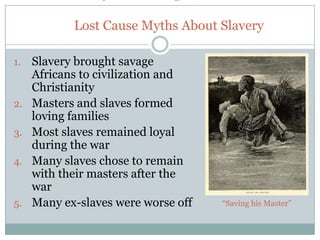
Lost Cause Myths About Slavery
1. Slavery brought savage
Africans to civilization and
Christianity
2. Masters and slaves formed
loving families
3. Most slaves remained loyal
during the war
4. Many slaves chose to remain
with their masters after the
war
5. Many ex-slaves were worse off ―Saving his Master‖
Art of the Lost Cause
The Lost Cause, Henry Mosler (1869)
Harpers Weekly, 1865
Death of General Robert E. Lee (1870)
Lee Relics
Lee Death Mask
―Americans in all regions would do
well to recommend this man's life
as a model for their sons. Lee came
as close to being perfect as a
human being can be. He was tall,
handsome and bright, and finished
second in his class at West Point
without a single demerit . . . He
never spoke ill of anyone, even his
enemies. He never took credit for
victories, but he always accepted
personal responsibility for defeats.
He was a devout Christian.‖
--Charley Reese, 2005
Monument Building—1880s to 1920s
Unveiling ceremony for Confederate
monument at Salisbury, 1909
Pensacola Confederate Memorial
Stone Mountain – 1928-1964
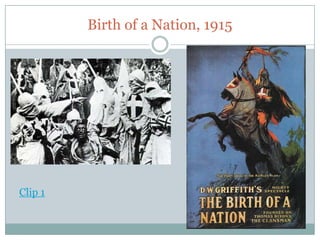
Birth of a Nation, 1915
Clip 1
Gone With the Wind, 1939
 Trailer
 Clip 1
 Clip 2
Tarzan Movies
Modern Relics of Lost Cause

The lost cause 101

  • 1.
  • 2.
  • 3.
    Main Points ofthe Lost Cause Interpretation 1. Slavery not a cause of the war 2. Secession was constitutional 3. North had overwhelming advantages—South never had a chance 4. Southern nobility and chivalry, personified by Robert E. Lee 5. South a Christian society, North a materialistic society 6. North started the war 7. Slavery was a benign institution
  • 4.
    Slavery not acause of the war  Before and during the war, Confederates frank that this is a war to defend slavery  Alexander Stephens on the Confederate government: "Its foundations are laid, its cornerstone rests, upon the great truth that the negro is not equal to the white man; that slavery . . . is his natural and normal condition." Confederate Vice President Alexander Stephens
  • 5.
    The Confederate Constitution Article I, Section 9, Paragraph 4: "No bill of attainder, ex post facto law, or law denying or impairing the right of property in negro slaves shall be passed."  Article IV, Section 3, Paragraph 3: "The Confederate States may acquire new territory . . . In all such territory, the institution of negro slavery, as it now exists in the Confederate States, shall be recognized and protected by Congress and the territorial government."
  • 6.
  • 7.
    ―Rich Man’s Warand a Poor Man’s Fight‖ From the diary of James B. Lockney, 28th Wisconsin Infantry, writing near Arkadelphia, Arkansas (10/29/63): "Last night I talked awhile to those men who came in day before yesterday from the S.W. part of the state about 120 miles distant. Many of them wish Slavery abolished & slaves out of the country as they said it was the cause of the War, and the Curse of our Country & the foe of the body of the people--the poor whites. They knew the Slave masters got up the war expressly in the interests of the institution, & with no real cause from the Government or the North."
  • 8.
    After the War,the Story Changes
  • 9.
    Secession was constitutional ―Wheneverany form of government becomes destructive of the ends for which it was established, it is the right of the people to alter or abolish it, and to institute new government…‖
  • 10.
  • 11.
  • 12.
  • 13.
    Lost Cause MythsAbout Slavery 1. Slavery brought savage Africans to civilization and Christianity 2. Masters and slaves formed loving families 3. Most slaves remained loyal during the war 4. Many slaves chose to remain with their masters after the war 5. Many ex-slaves were worse off ―Saving his Master‖
  • 14.
    Art of theLost Cause The Lost Cause, Henry Mosler (1869)
  • 15.
  • 16.
    Death of GeneralRobert E. Lee (1870)
  • 17.
  • 18.
    Lee Death Mask ―Americansin all regions would do well to recommend this man's life as a model for their sons. Lee came as close to being perfect as a human being can be. He was tall, handsome and bright, and finished second in his class at West Point without a single demerit . . . He never spoke ill of anyone, even his enemies. He never took credit for victories, but he always accepted personal responsibility for defeats. He was a devout Christian.‖ --Charley Reese, 2005
  • 19.
    Monument Building—1880s to1920s Unveiling ceremony for Confederate monument at Salisbury, 1909
  • 20.
  • 21.
  • 22.
    Birth of aNation, 1915 Clip 1
  • 23.
    Gone With theWind, 1939  Trailer  Clip 1  Clip 2
  • 24.
  • 25.
    Modern Relics ofLost Cause