March, 2024
The rise of the Kubernetes Gateway API and
its role in Cloud Native API Management
Hello!
Nuwan Dias
VP and deputy CTO - WSO2
Co-author, Microservices Security In Action
@nuwandias
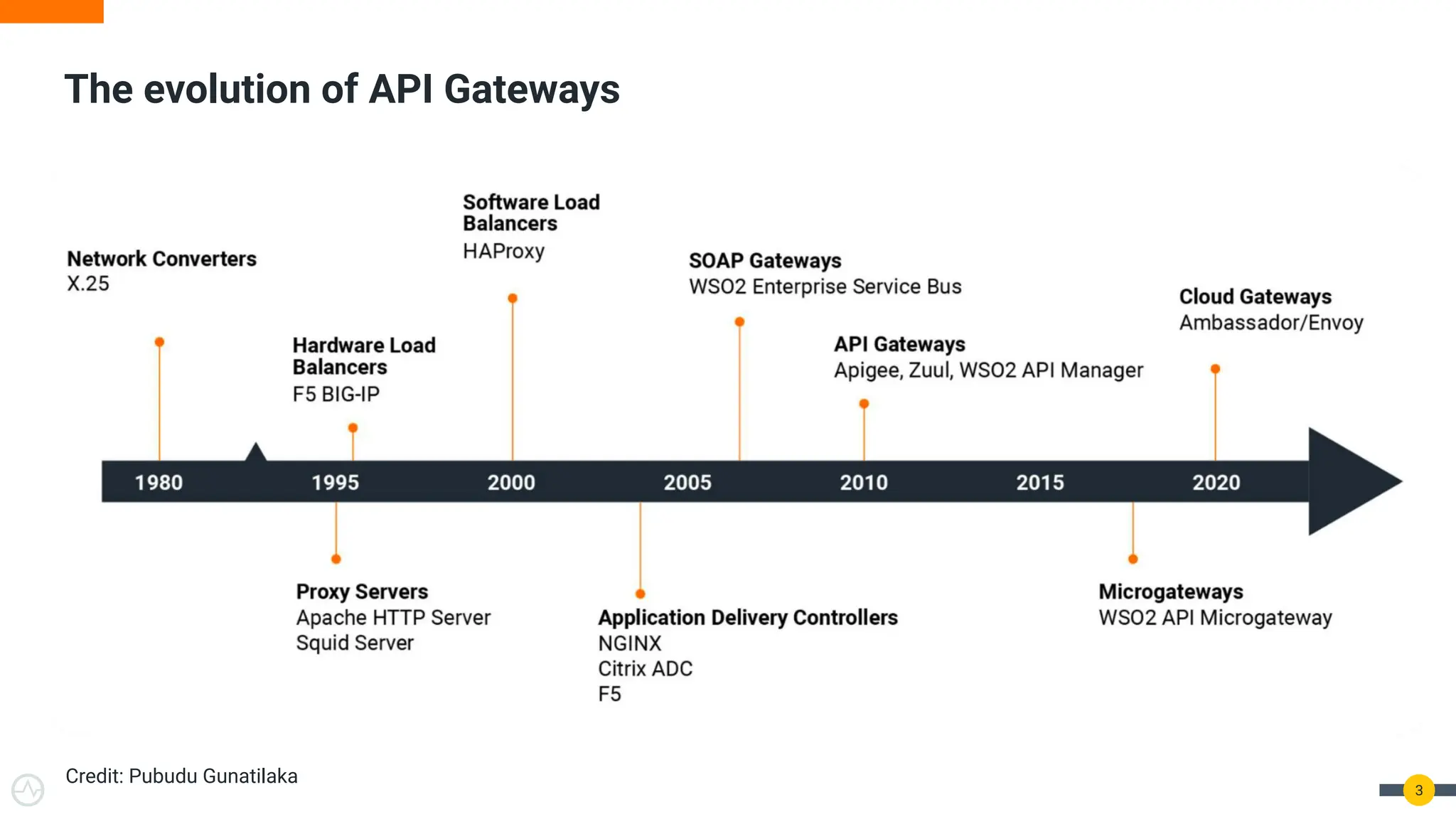
The evolution of API Gateways
3
Credit: Pubudu Gunatilaka
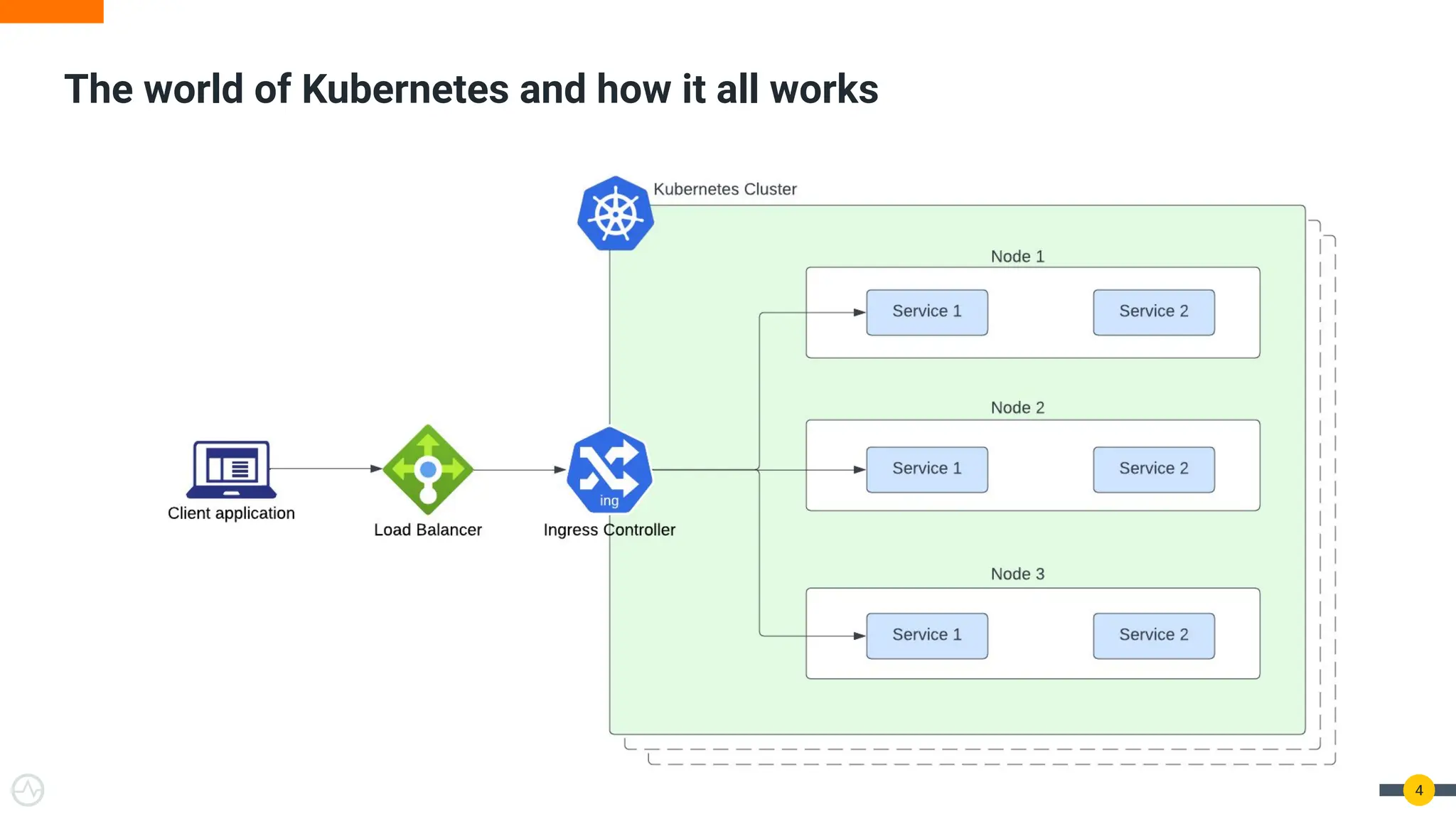
The world of Kubernetes and how it all works
4
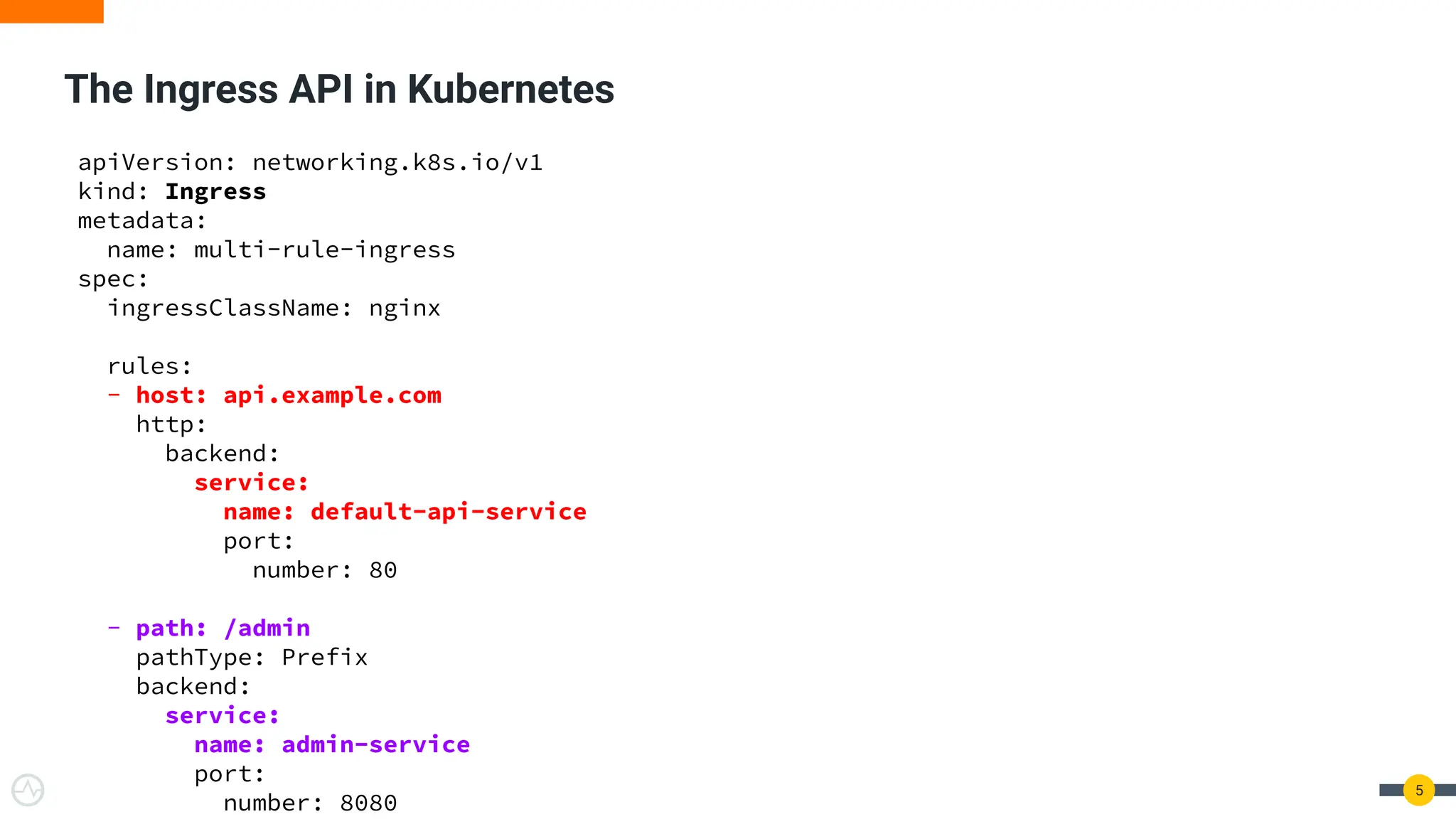
The Ingress API in Kubernetes
5
apiVersion: networking.k8s.io/v1
kind: Ingress
metadata:
name: multi-rule-ingress
spec:
ingressClassName: nginx
rules:
- host: api.example.com
http:
backend:
service:
name: default-api-service
port:
number: 80
- path: /admin
pathType: Prefix
backend:
service:
name: admin-service
port:
number: 8080
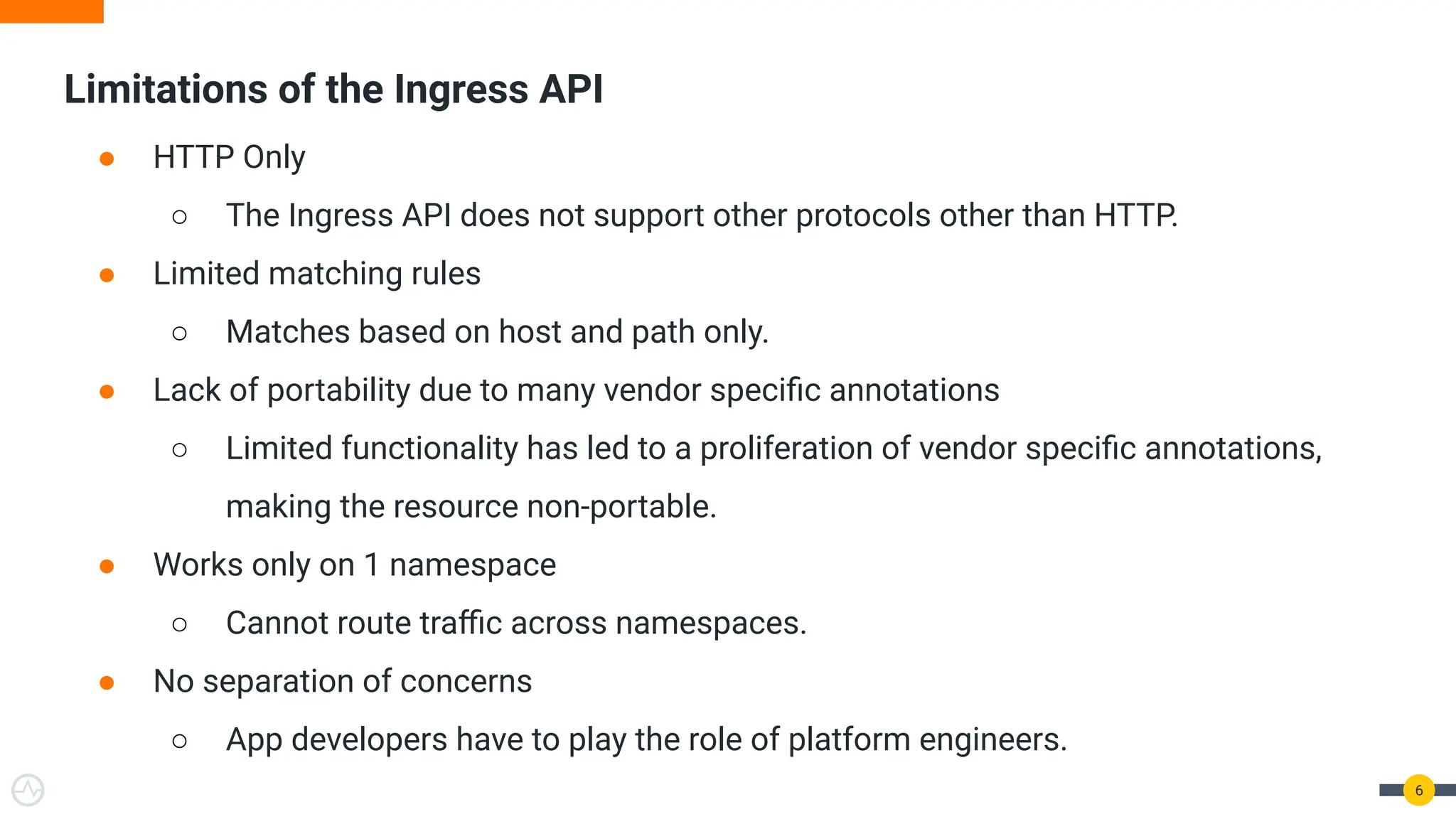
Limitations of the Ingress API
6
● HTTP Only
○ The Ingress API does not support other protocols other than HTTP.
● Limited matching rules
○ Matches based on host and path only.
● Lack of portability due to many vendor specific annotations
○ Limited functionality has led to a proliferation of vendor specific annotations,
making the resource non-portable.
● Works only on 1 namespace
○ Cannot route traffic across namespaces.
● No separation of concerns
○ App developers have to play the role of platform engineers.
The Kubernetes
Gateway API
7
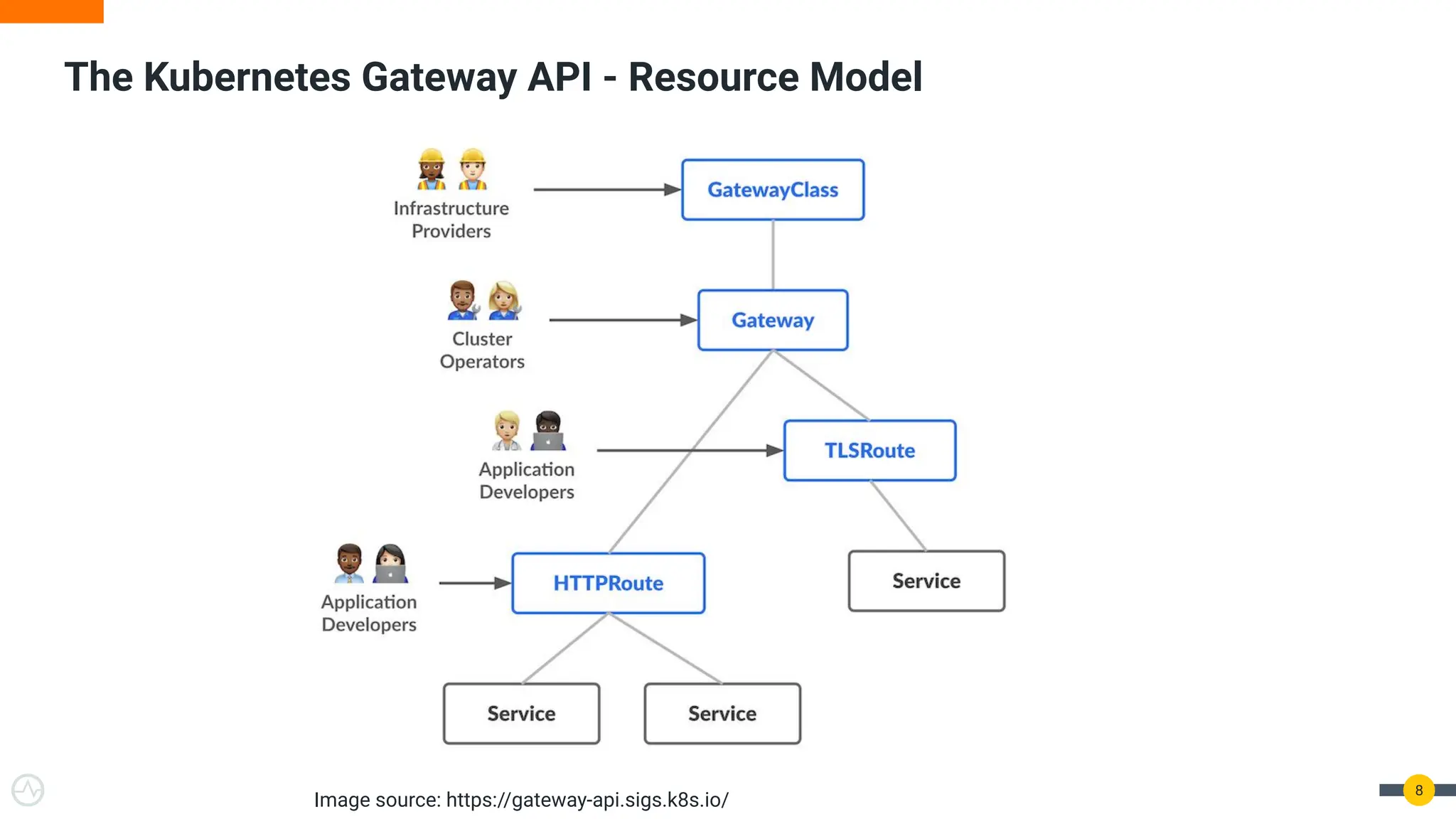
The Kubernetes Gateway API - Resource Model
8
Image source: https://gateway-api.sigs.k8s.io/
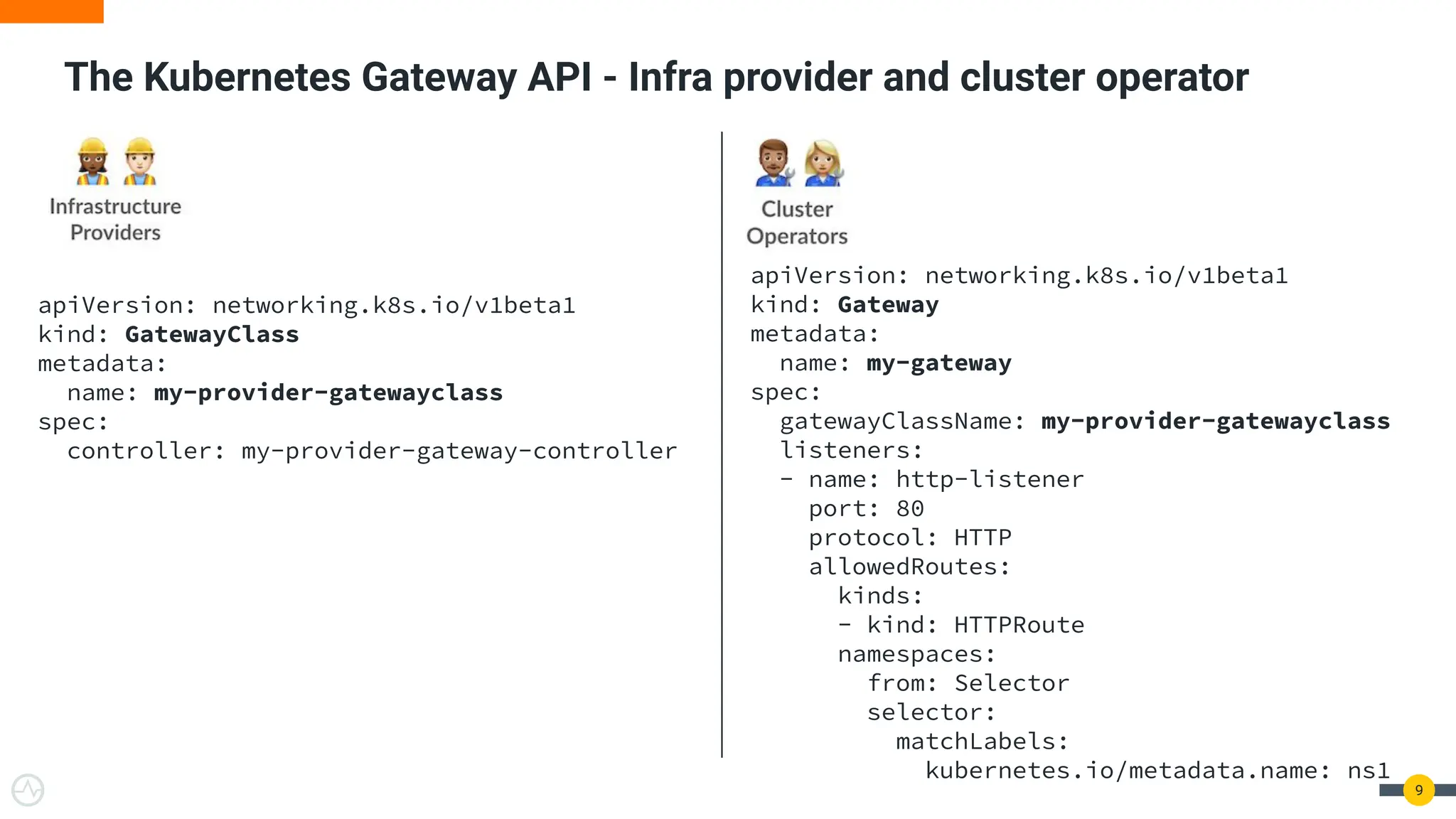
The Kubernetes Gateway API - Infra provider and cluster operator
9
apiVersion: networking.k8s.io/v1beta1
kind: GatewayClass
metadata:
name: my-provider-gatewayclass
spec:
controller: my-provider-gateway-controller
apiVersion: networking.k8s.io/v1beta1
kind: Gateway
metadata:
name: my-gateway
spec:
gatewayClassName: my-provider-gatewayclass
listeners:
- name: http-listener
port: 80
protocol: HTTP
allowedRoutes:
kinds:
- kind: HTTPRoute
namespaces:
from: Selector
selector:
matchLabels:
kubernetes.io/metadata.name: ns1
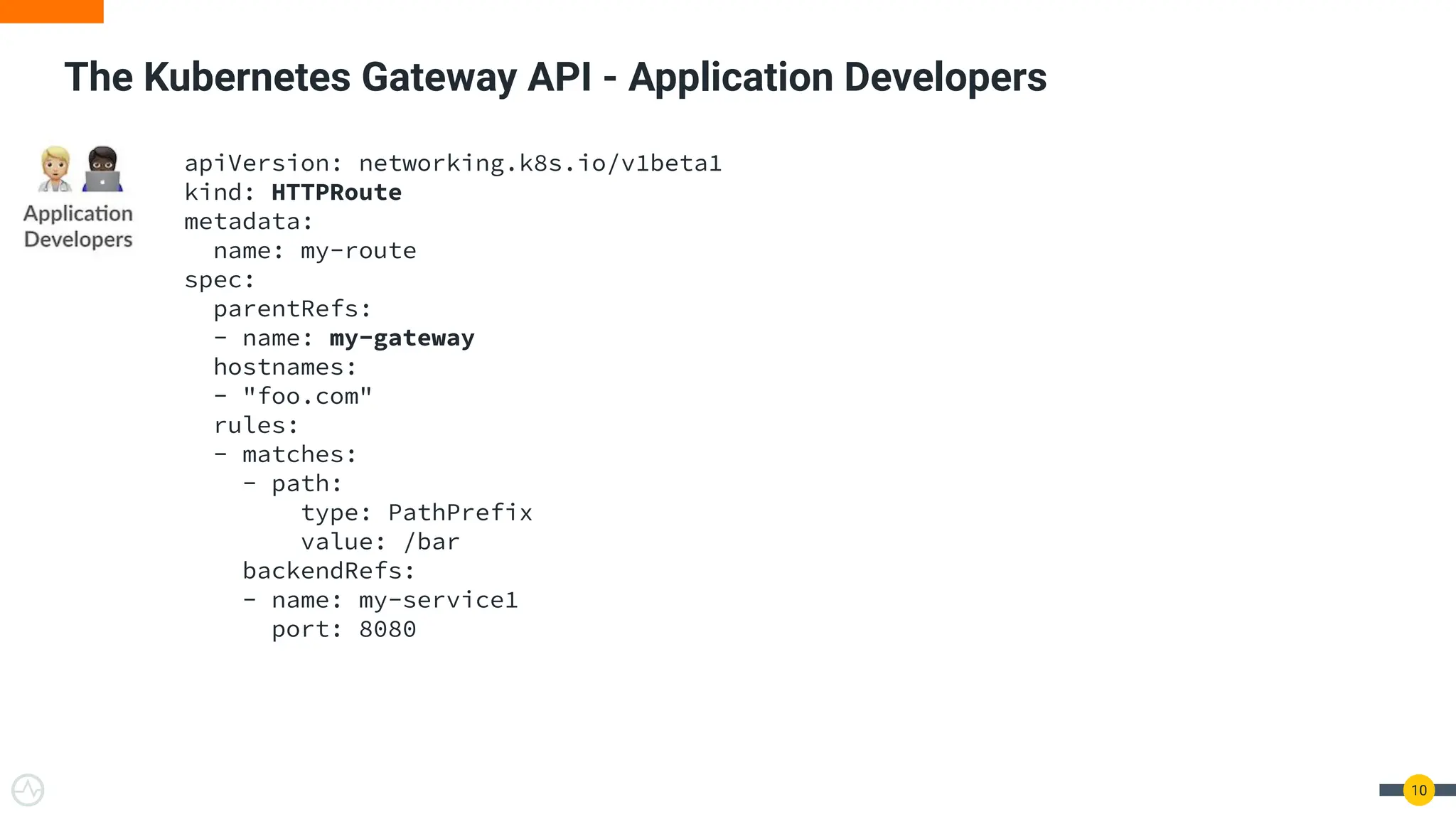
The Kubernetes Gateway API - Application Developers
10
apiVersion: networking.k8s.io/v1beta1
kind: HTTPRoute
metadata:
name: my-route
spec:
parentRefs:
- name: my-gateway
hostnames:
- "foo.com"
rules:
- matches:
- path:
type: PathPrefix
value: /bar
backendRefs:
- name: my-service1
port: 8080
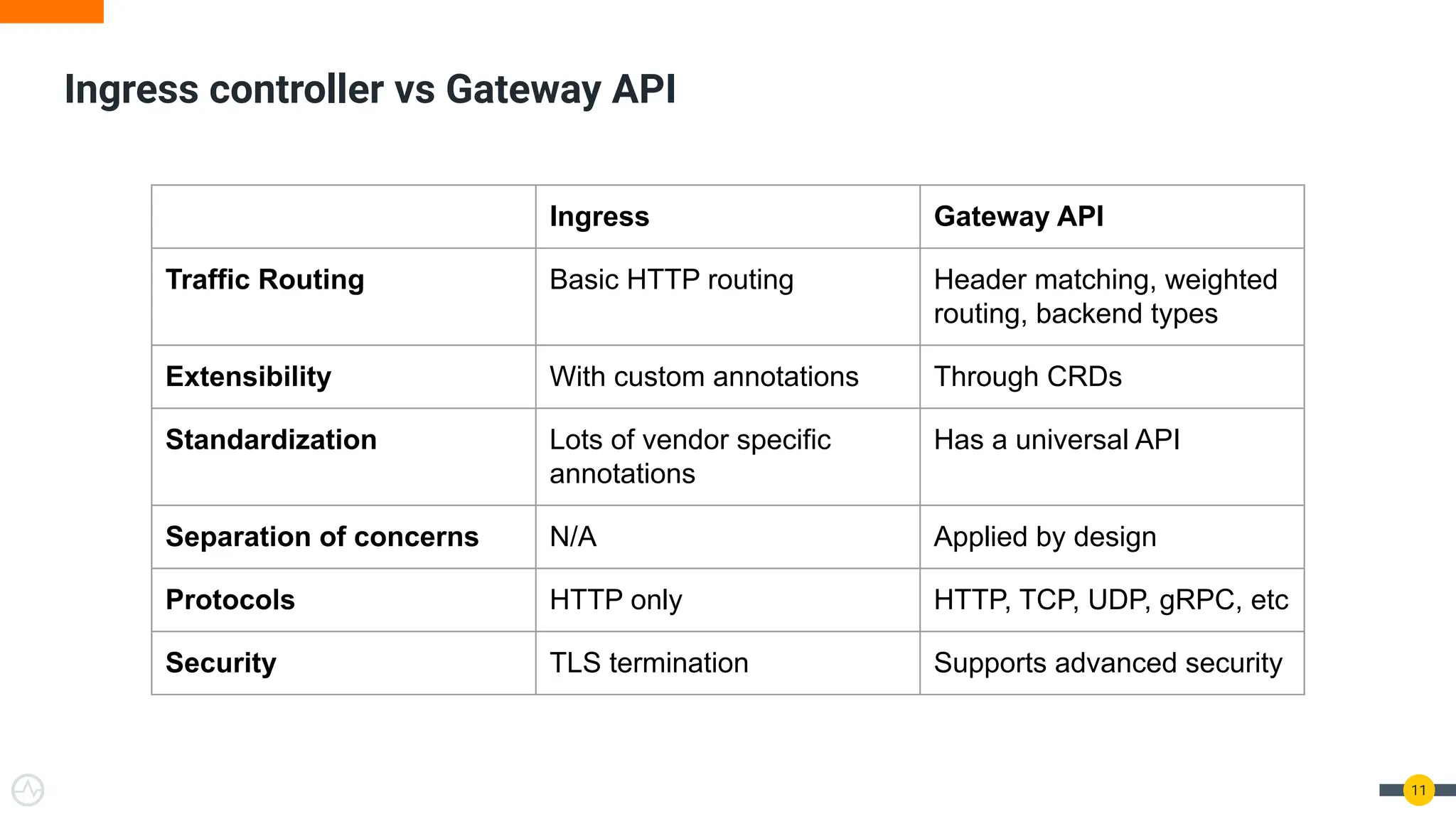
Ingress controller vs Gateway API
11
Ingress Gateway API
Traffic Routing Basic HTTP routing Header matching, weighted
routing, backend types
Extensibility With custom annotations Through CRDs
Standardization Lots of vendor specific
annotations
Has a universal API
Separation of concerns N/A Applied by design
Protocols HTTP only HTTP, TCP, UDP, gRPC, etc
Security TLS termination Supports advanced security
Gateway API != API Gateway
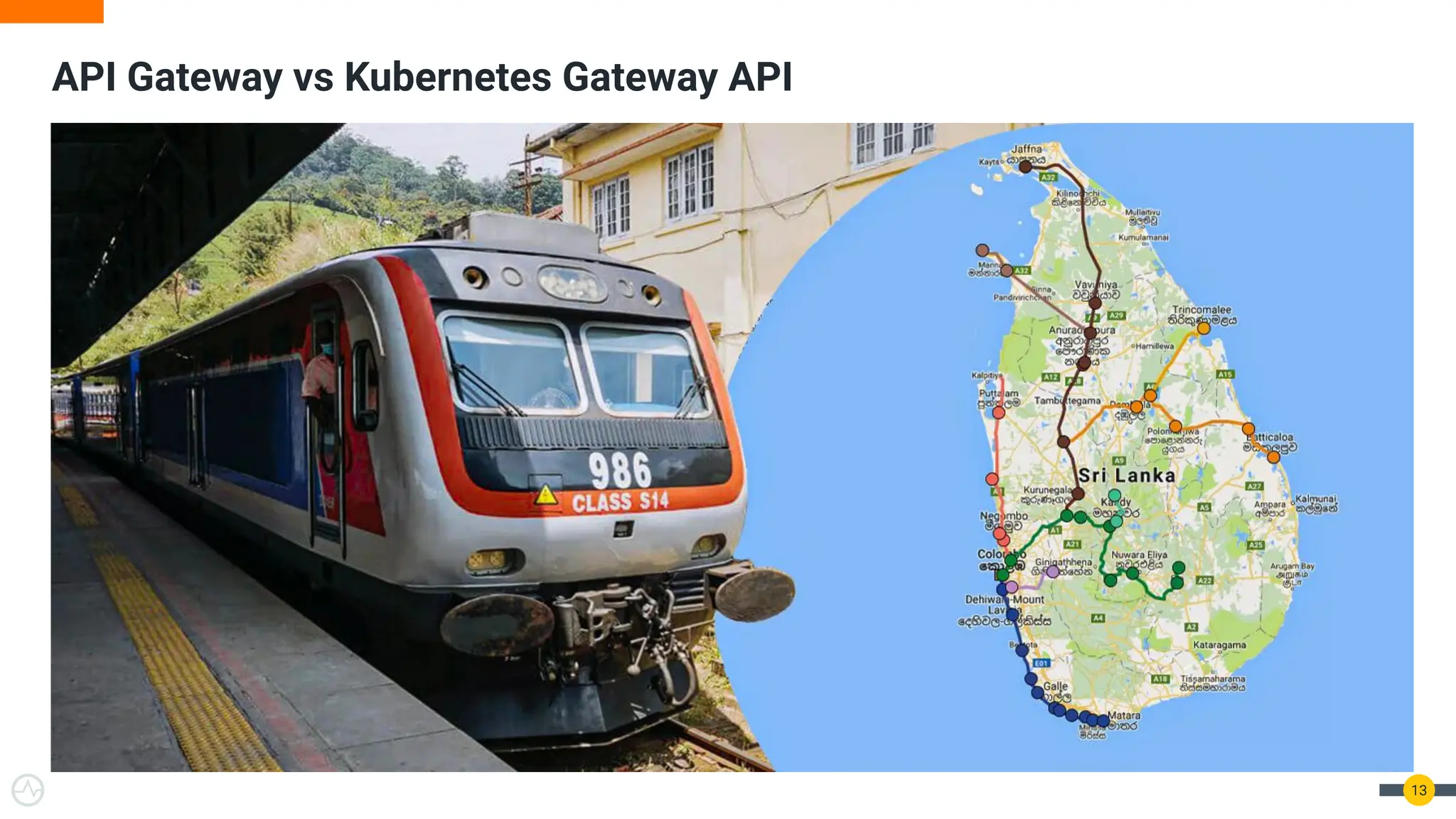
API Gateway vs Kubernetes Gateway API
13
The Envoy Gateway Project
14
● Reference: https://gateway.envoyproxy.io/
● The Kubernetes Gateway API doesn’t (yet) provide all the
features required for an API Gateway.
○ It focuses on addressing limitations of the ingress
API.
● The Envoy Gateway project provides an API that extends the
Kubernetes Gateway API.
○ This includes features required for a proper API
Gateway.
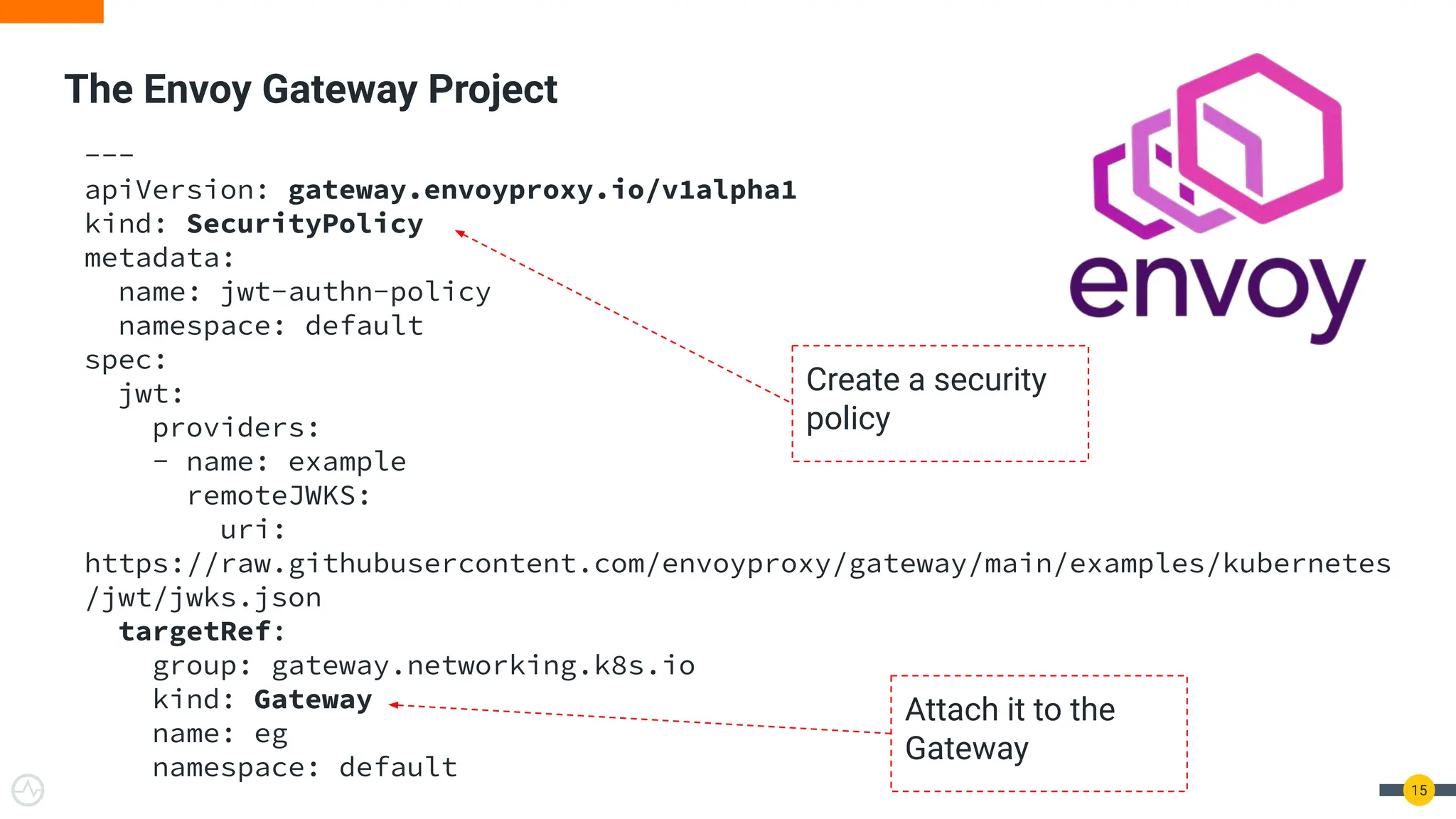
The Envoy Gateway Project
15
---
apiVersion: gateway.envoyproxy.io/v1alpha1
kind: SecurityPolicy
metadata:
name: jwt-authn-policy
namespace: default
spec:
jwt:
providers:
- name: example
remoteJWKS:
uri:
https://raw.githubusercontent.com/envoyproxy/gateway/main/examples/kubernetes
/jwt/jwks.json
targetRef:
group: gateway.networking.k8s.io
kind: Gateway
name: eg
namespace: default
Create a security
policy
Attach it to the
Gateway
Benefits of using the Gateway API configurations instead of an API
Gateway configs
16
● Standardization and Consistency
○ Abstraction - The Gateway API defines a common language and API for traffic
routing.
○ Simplicity - Separation of the “what” from the “how”.
● Better Manageability
○ Declarative approach - Developer specifies the desired routing rules. The
Gateway controller is responsible for the rest.
○ Kubernetes Integration for APIs - Makes APIs a first-class citizen in Kubernetes.
● Flexibility and Extensibility
○ Works with multiple Gateway providers - New providers can be added, old ones
can be replaced, without migrating data.
○ Future proof approach - Leaves space for new protocols and features to be
supported in the future.
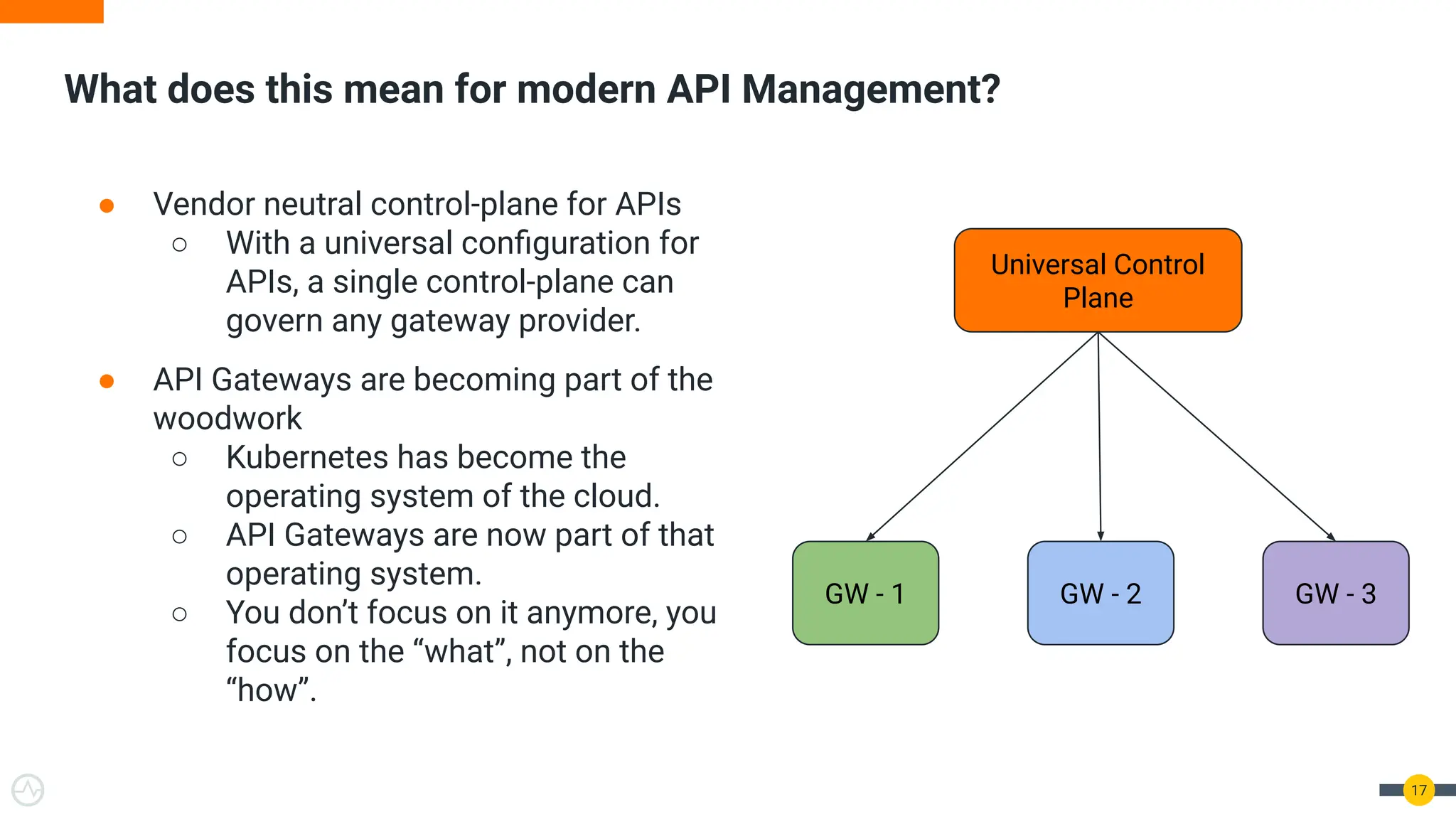
What does this mean for modern API Management?
17
● Vendor neutral control-plane for APIs
○ With a universal configuration for
APIs, a single control-plane can
govern any gateway provider.
● API Gateways are becoming part of the
woodwork
○ Kubernetes has become the
operating system of the cloud.
○ API Gateways are now part of that
operating system.
○ You don’t focus on it anymore, you
focus on the “what”, not on the
“how”.
Universal Control
Plane
GW - 1 GW - 2 GW - 3
How should you prepare?
18
● Shift to using the Gateway API spec instead of relying on vendor specific configurations.
● Have a clear separation between traffic routing rules vs business logic.
○ Don’t implement business logic on the API Gateway.
○ Use BFFs for cases which require logic outside the core API.
● Treat API publishing and API deployments as two distinct practices.
○ Have a clear separation between API control plane vs data-plane.
● Use vendor specific extensions carefully.
Internal Developer Platforms and API Management
19
● Internal developer platforms create useful abstractions that helps developers focus
away from mundane tasks.
○ They help them focus on what’s important, their business.
● API Management is one such practise that organizations cannot live without.
○ It takes away the focus on what’s important, the actual API.
● The Kubernetes Gateway API is a universal API for managing API behaviour.
● API operations will be embedded into internal developer platforms.
● Developers will finally be able to focus on what’s important, the actual API.
wso2.com
Thanks!
@nuwandias

The Kubernetes Gateway API and its role in Cloud Native API Management

  • 1.
    March, 2024 The riseof the Kubernetes Gateway API and its role in Cloud Native API Management
  • 2.
    Hello! Nuwan Dias VP anddeputy CTO - WSO2 Co-author, Microservices Security In Action @nuwandias
  • 3.
    The evolution ofAPI Gateways 3 Credit: Pubudu Gunatilaka
  • 4.
    The world ofKubernetes and how it all works 4
  • 5.
    The Ingress APIin Kubernetes 5 apiVersion: networking.k8s.io/v1 kind: Ingress metadata: name: multi-rule-ingress spec: ingressClassName: nginx rules: - host: api.example.com http: backend: service: name: default-api-service port: number: 80 - path: /admin pathType: Prefix backend: service: name: admin-service port: number: 8080
  • 6.
    Limitations of theIngress API 6 ● HTTP Only ○ The Ingress API does not support other protocols other than HTTP. ● Limited matching rules ○ Matches based on host and path only. ● Lack of portability due to many vendor specific annotations ○ Limited functionality has led to a proliferation of vendor specific annotations, making the resource non-portable. ● Works only on 1 namespace ○ Cannot route traffic across namespaces. ● No separation of concerns ○ App developers have to play the role of platform engineers.
  • 7.
  • 8.
    The Kubernetes GatewayAPI - Resource Model 8 Image source: https://gateway-api.sigs.k8s.io/
  • 9.
    The Kubernetes GatewayAPI - Infra provider and cluster operator 9 apiVersion: networking.k8s.io/v1beta1 kind: GatewayClass metadata: name: my-provider-gatewayclass spec: controller: my-provider-gateway-controller apiVersion: networking.k8s.io/v1beta1 kind: Gateway metadata: name: my-gateway spec: gatewayClassName: my-provider-gatewayclass listeners: - name: http-listener port: 80 protocol: HTTP allowedRoutes: kinds: - kind: HTTPRoute namespaces: from: Selector selector: matchLabels: kubernetes.io/metadata.name: ns1
  • 10.
    The Kubernetes GatewayAPI - Application Developers 10 apiVersion: networking.k8s.io/v1beta1 kind: HTTPRoute metadata: name: my-route spec: parentRefs: - name: my-gateway hostnames: - "foo.com" rules: - matches: - path: type: PathPrefix value: /bar backendRefs: - name: my-service1 port: 8080
  • 11.
    Ingress controller vsGateway API 11 Ingress Gateway API Traffic Routing Basic HTTP routing Header matching, weighted routing, backend types Extensibility With custom annotations Through CRDs Standardization Lots of vendor specific annotations Has a universal API Separation of concerns N/A Applied by design Protocols HTTP only HTTP, TCP, UDP, gRPC, etc Security TLS termination Supports advanced security
  • 12.
    Gateway API !=API Gateway
  • 13.
    API Gateway vsKubernetes Gateway API 13
  • 14.
    The Envoy GatewayProject 14 ● Reference: https://gateway.envoyproxy.io/ ● The Kubernetes Gateway API doesn’t (yet) provide all the features required for an API Gateway. ○ It focuses on addressing limitations of the ingress API. ● The Envoy Gateway project provides an API that extends the Kubernetes Gateway API. ○ This includes features required for a proper API Gateway.
  • 15.
    The Envoy GatewayProject 15 --- apiVersion: gateway.envoyproxy.io/v1alpha1 kind: SecurityPolicy metadata: name: jwt-authn-policy namespace: default spec: jwt: providers: - name: example remoteJWKS: uri: https://raw.githubusercontent.com/envoyproxy/gateway/main/examples/kubernetes /jwt/jwks.json targetRef: group: gateway.networking.k8s.io kind: Gateway name: eg namespace: default Create a security policy Attach it to the Gateway
  • 16.
    Benefits of usingthe Gateway API configurations instead of an API Gateway configs 16 ● Standardization and Consistency ○ Abstraction - The Gateway API defines a common language and API for traffic routing. ○ Simplicity - Separation of the “what” from the “how”. ● Better Manageability ○ Declarative approach - Developer specifies the desired routing rules. The Gateway controller is responsible for the rest. ○ Kubernetes Integration for APIs - Makes APIs a first-class citizen in Kubernetes. ● Flexibility and Extensibility ○ Works with multiple Gateway providers - New providers can be added, old ones can be replaced, without migrating data. ○ Future proof approach - Leaves space for new protocols and features to be supported in the future.
  • 17.
    What does thismean for modern API Management? 17 ● Vendor neutral control-plane for APIs ○ With a universal configuration for APIs, a single control-plane can govern any gateway provider. ● API Gateways are becoming part of the woodwork ○ Kubernetes has become the operating system of the cloud. ○ API Gateways are now part of that operating system. ○ You don’t focus on it anymore, you focus on the “what”, not on the “how”. Universal Control Plane GW - 1 GW - 2 GW - 3
  • 18.
    How should youprepare? 18 ● Shift to using the Gateway API spec instead of relying on vendor specific configurations. ● Have a clear separation between traffic routing rules vs business logic. ○ Don’t implement business logic on the API Gateway. ○ Use BFFs for cases which require logic outside the core API. ● Treat API publishing and API deployments as two distinct practices. ○ Have a clear separation between API control plane vs data-plane. ● Use vendor specific extensions carefully.
  • 19.
    Internal Developer Platformsand API Management 19 ● Internal developer platforms create useful abstractions that helps developers focus away from mundane tasks. ○ They help them focus on what’s important, their business. ● API Management is one such practise that organizations cannot live without. ○ It takes away the focus on what’s important, the actual API. ● The Kubernetes Gateway API is a universal API for managing API behaviour. ● API operations will be embedded into internal developer platforms. ● Developers will finally be able to focus on what’s important, the actual API.
  • 20.