The
Internet Of
Things
May 25
2014
The Internet
Of Every
Things
The Internet Of Things (IOT)
Introduction:
The term Internet of Things (Often abbreviated IOT) was coined more than ten
years ago by industry researchers but has emerged into mainstream public view
only more recently. Some claim the Internet of Things will completely transform
how computer networks are used for the next 10 or 100 years, while others believe
IOT is hype that won't much impact the daily lives of most people.
What Is IOT?
Internet of Things represents a general concept for the ability of network devices
to sense and collect data from the world around us, and then share that data
across the Internet where it can be processed and utilized for various interesting
purposes.
Some also use the term industrial Internet interchangeably with IOT. This refers
primarily to commercial applications of IOT technology in the world of
manufacturing. The Internet of Things is not limited to industrial applications,
however.
What the Internet of Things Can Do for Us?
Some future consumer applications envisioned for IOT sound like science fiction,
but some of the more practical and realistic sounding possibilities for the
technology include:
 Receiving warnings on your phone or wearable device when IOT networks
detect some physical danger is detected nearby.
 Self-parking automobiles.
 Automatic ordering of groceries and other home supplies.
 Automatic tracking of exercise habits and other day-to-day personal
activity including goal tracking and regular progress reports.
Issues around IOT
 Internet of Things immediately triggers questions around the privacy of
personal data. Whether real-time information about our physical location, or
updates about our weight and blood pressure that may be accessible by our
health care providers, having new kinds and more detailed data about
ourselves streaming over wireless networks and potentially around the world
is an obvious concern.
 Supplying power to this new proliferation of IOT devices and their network
connections can be expensive and logistically difficult. Portable devices
require batteries that someday must be replaced. Although many mobile
devices are optimized for lower power usage, energy costs to keep
potentially billions of them running remains high.
 Numerous corporations and start-up ventures have latched onto the
Internet of Things concept looking to take advantage of whatever business
opportunities are available. While competition in the market helps lower
prices of consumer products, in the worst case it also leads to confusing and
inflated claims about what the products do.
 IOT assumes that the underlying network equipment and related technology
can operate semi-intelligently and often automatically. Simply keeping mobile
devices connected to the Internet can be difficult enough much less trying
to make them smarter. People have diverse needs that require an IoT
system to adapt or be configurable for many different situations and
preferences. Finally, even with all those challenges overcome, if people
become too reliant on this automation and the technology is not highly
robust, any technical glitches in the system can cause serious physical
and/or financial damage.
History
 In 1997, “The Internet of Things” is the seventh in the series of ITU
Internet Reports originally launched in 1997 under the title “Challenges to
the Network”.
 1999, used by Kevin Ashton - Auto-ID Center founded in MIT.
 2003, EPC Global founded in MIT.
 2005, Four important technologies of the internet of things was proposed in
WSIS. Conference.
 2008, First international conference of internet of things: The IOT. Held
at Zurich.
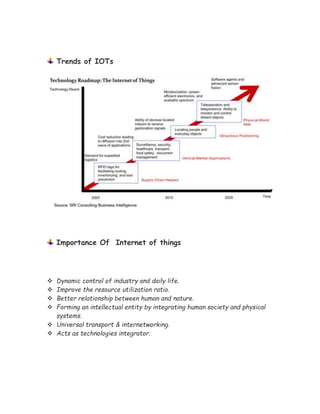
Trends of IOTs
Importance Of Internet of things
 Dynamic control of industry and daily life.
 Improve the resource utilization ratio.
 Better relationship between human and nature.
 Forming an intellectual entity by integrating human society and physical
systems.
 Universal transport & internetworking.
 Acts as technologies integrator.
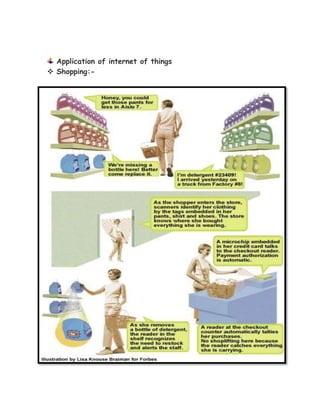
Application of internet of things
 Shopping:-
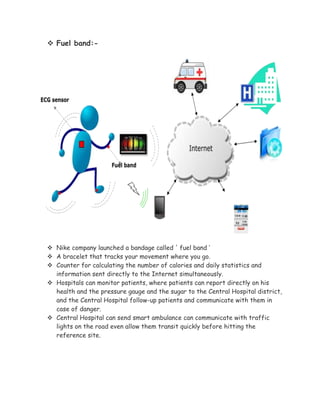
 Fuel band:-
 Nike company launched a bandage called ' fuel band ‘
 A bracelet that tracks your movement where you go.
 Counter for calculating the number of calories and daily statistics and
information sent directly to the Internet simultaneously.
 Hospitals can monitor patients, where patients can report directly on his
health and the pressure gauge and the sugar to the Central Hospital district,
and the Central Hospital follow-up patients and communicate with them in
case of danger.
 Central Hospital can send smart ambulance can communicate with traffic
lights on the road even allow them transit quickly before hitting the
reference site.
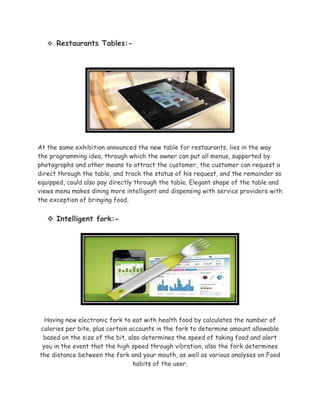
 Restaurants Tables:-
At the same exhibition announced the new table for restaurants, lies in the way
the programming idea, through which the owner can put all menus, supported by
photographs and other means to attract the customer, the customer can request a
direct through the table, and track the status of his request, and the remainder so
equipped, could also pay directly through the table. Elegant shape of the table and
views menu makes dining more intelligent and dispensing with service providers with
the exception of bringing food.
 Intelligent fork:-
Having new electronic fork to eat with health food by calculates the number of
calories per bite, plus certain accounts in the fork to determine amount allowable
based on the size of the bit, also determines the speed of taking food and alert
you in the event that the high speed through vibration, also the fork determines
the distance between the fork and your mouth, as well as various analyses on Food
habits of the user.
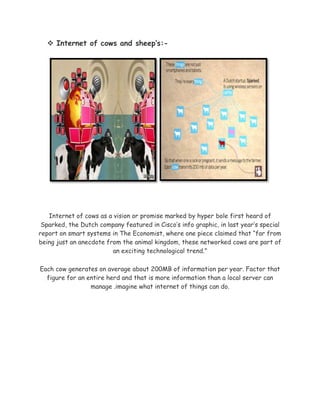
 Internet of cows and sheep’s:-
Internet of cows as a vision or promise marked by hyper bole first heard of
Sparked, the Dutch company featured in Cisco’s info graphic, in last year’s special
report on smart systems in The Economist, where one piece claimed that “far from
being just an anecdote from the animal kingdom, these networked cows are part of
an exciting technological trend.”
Each cow generates on average about 200MB of information per year. Factor that
figure for an entire herd and that is more information than a local server can
manage .imagine what internet of things can do.
 Body Guardian remote monitoring system:-
o How Body Guardian works
o System security
o Remote Monitoring
o Patient Engagement
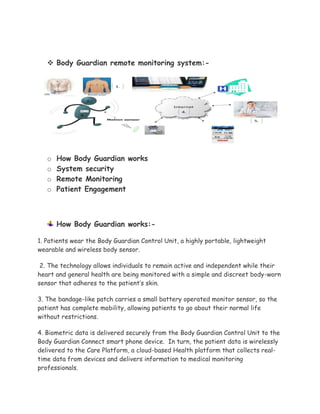
How Body Guardian works:-
1. Patients wear the Body Guardian Control Unit, a highly portable, lightweight
wearable and wireless body sensor.
2. The technology allows individuals to remain active and independent while their
heart and general health are being monitored with a simple and discreet body-worn
sensor that adheres to the patient’s skin.
3. The bandage-like patch carries a small battery operated monitor sensor, so the
patient has complete mobility, allowing patients to go about their normal life
without restrictions.
4. Biometric data is delivered securely from the Body Guardian Control Unit to the
Body Guardian Connect smart phone device. In turn, the patient data is wirelessly
delivered to the Care Platform, a cloud-based Health platform that collects real-
time data from devices and delivers information to medical monitoring
professionals.
5. Physicians and clinicians can access their patients’ data and review alerts
securely anytime, anywhere via the web or an I pad.
6. Additionally, physicians can set individualized alert thresholds for each patient
allowing for individualized tracking and care plan support.
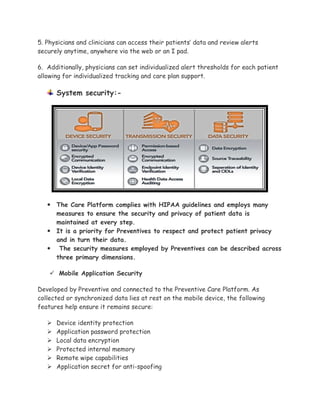
System security:-
 The Care Platform complies with HIPAA guidelines and employs many
measures to ensure the security and privacy of patient data is
maintained at every step.
 It is a priority for Preventives to respect and protect patient privacy
and in turn their data.
 The security measures employed by Preventives can be described across
three primary dimensions.
 Mobile Application Security
Developed by Preventive and connected to the Preventive Care Platform. As
collected or synchronized data lies at rest on the mobile device, the following
features help ensure it remains secure:
 Device identity protection
 Application password protection
 Local data encryption
 Protected internal memory
 Remote wipe capabilities
 Application secret for anti-spoofing
 Data Transmission Security
 The following measures help ensure data security while data is
transmitted to or from mobile devices and tablets.
 Encrypted communication via SSL
 Differential updates
 Separation of patient identification information and observation data
 Platform-Level Security
 Finally, once data reaches the Preventive Care Platform for eventual
storage or analysis, the following features help ensure optimal data
integrity and security:
 Data encryption
 User authentication
 Separation of identity
 Source traceability
Remote Patient Monitoring:-
In most healthcare settings today, nearly all insight into a patient’s health is lost
the minute they leave the clinical care setting. The visibility into their health
condition surfaces only when they return for a scheduled visit, or potentially worse
an emergency situation.
In body guardian these have been eliminated.
o Patient Engagement:-
Connecting patients to their care plan and care team in meaningful and engaging
ways using mobile web and sensor technologies.
Improving patient care and outcomes is a common goal for the health care industry.
However, the inability to influence patient behavior outside the clinical setting is a
major hurdle to achieving this goal.
By creating a continuous connection between patients and health care providers,
our solutions strengthen health care outcomes because they can help:
 Avoid hospitalizations
 Reduce re-admittance
 Increase staff efficiency
 Speed time to intervention
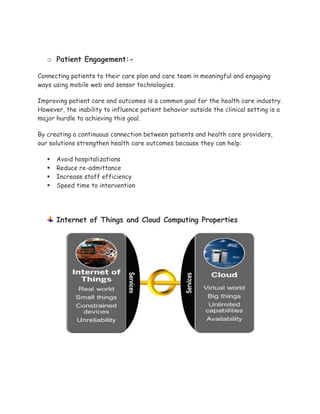
Internet of Things and Cloud Computing Properties
The Challenge of IOT
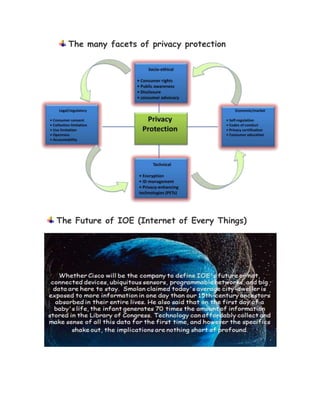
 Privacy – will be a huge issue when implementing IOT
 Identity - Online Fragmentation of Identity
 Efficiency – speed - person loses identity and is an IP address
 Decisions – do not delegate too much of our decision making and freedom of
choice to things and machines
 Absence of governance
 What is special about Identity in the Internet of Things?
1. Lifecycle
 In user identity management we have rather long living lifecycles of an
identity. In day to day service like e-mail, online shopping etc. a user
account exists for months, years or even a lifetime. In the Internet of
Things objects have very different lifetimes. This might range from
years or decades down to days or minutes.
 Example: A parcel might be shipped from one country to another. The
parcel gets an RFID tag associated with an identifier. It moves from
logistic center to another, crosses borders, it is tracked, controlled and
routed. As soon as it arrives the identity of the parcel disappears.
2. Ownership and identity relationships
 Things or objects in the IOT often have a relationship to real persons.
These could be owner(s), manufacturer(s), user(s), administrator(s) or
many other functions. A product might be owned by a manufacturer first
and subsequently by a user who bought the product. The owner, user or
administrator of an object might change over time. Ownership and
identity relationships in the IoT have an impact on other identity
related processes like e.g. authentication, authorization. The owner of a
thing might be challenged for authentication or be asked for
authorization policies.
3. Protection Mechanisms
 In the classic identity management certain protection methods have
been established over the years to protect an identity from abuse. We
have authentication methods to proof identities, secure channels to
transmit identity attributes and passwords and data are stored
encrypted.
 3.1 Security concepts like integrity, availability, authenticity, non-
repudiation are built in classic identity protocols like SAML and Open
ID. In the Internet of Things the situation is different. Here many
communication protocols are not based on internet protocol. Many
sensors or actuators have just restricted resources in terms of energy,
bandwidth, connectivity. Protocols like en Ocean[www.enocean.com] or
KNX[www.knx.org] use only few bytes to send commands or receive
values. There is no room for encryption, challenge response procedure or
other security mechanisms
 3.2 Authentication The classic authentication mechanisms
(ex.: login /password) may not directly work in the IoT.
Objects have to provide some sort of lightweight token or
certificate for an authentication where no user (providing a
password) is involved. For stronger authentication means of
individuals we usually combine two or multiple factors. These
factors are based on following proofs:
“Something that you have"
“Something that you know”
“Something that you are” (e.g. biometry)
In the IOT the last two proofs are not applicable to objects
anymore
The many facets of privacy protection
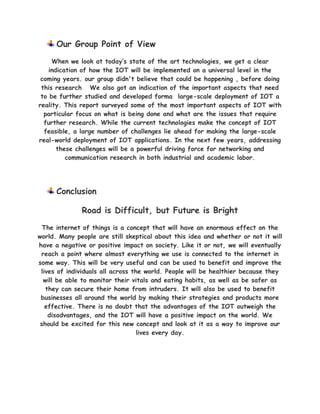
The Future of IOE (Internet of Every Things)
Our Group Point of View
When we look at today’s state of the art technologies, we get a clear
indication of how the IOT will be implemented on a universal level in the
coming years. our group didn't believe that could be happening , before doing
this research We also got an indication of the important aspects that need
to be further studied and developed forma large-scale deployment of IOT a
reality. This report surveyed some of the most important aspects of IOT with
particular focus on what is being done and what are the issues that require
further research. While the current technologies make the concept of IOT
feasible, a large number of challenges lie ahead for making the large-scale
real-world deployment of IOT applications. In the next few years, addressing
these challenges will be a powerful driving force for networking and
communication research in both industrial and academic labor.
Conclusion
Road is Difficult, but Future is Bright
The internet of things is a concept that will have an enormous effect on the
world. Many people are still skeptical about this idea and whether or not it will
have a negative or positive impact on society. Like it or not, we will eventually
reach a point where almost everything we use is connected to the internet in
some way. This will be very useful and can be used to benefit and improve the
lives of individuals all across the world. People will be healthier because they
will be able to monitor their vitals and eating habits, as well as be safer as
they can secure their home from intruders. It will also be used to benefit
businesses all around the world by making their strategies and products more
effective. There is no doubt that the advantages of the IOT outweigh the
disadvantages, and the IOT will have a positive impact on the world. We
should be excited for this new concept and look at it as a way to improve our
lives every day.
At the END
We want to thank you Dr.Abdelraouf Aishtaiwi And Dr.Ali Al-Maqousi for
all the knowledge and wisdom, it has made us richer, And For being our
guides and mentors this semester and helping us And removing all our doubts.
“THANKS SO MUCH “
References
 Thomas Frey, Empowering “Things” for Our Internet of Things, World Future
Society, September 30, 2012 http://www.wfs.org/blogs/thomas-
frey/empowering-%E2%80%9Cthings%E2%80%9D-for-our-internet-things
 Amardeo C. Sarma & João Girão, Identities in the Future Internet of Things,
May 2009,
 Pasquale Puzio, Internet of Things and its Applications, 2010 from
http://www.slideshare.net/PasqualePuzio/internet-of-things-and-its-
applications
 Internet Of Things, 21 March 2014
http://en.wikipedia.org/wiki/Internet_of_Things
 Alonso, J., Milanese, V., Oneida, E., Perez, J., Gonzalez, C., de Pedro, T.:
Cartography For Cooperative Maneuvers: A utopia’s new Cartography System
for Cooperative Maneuvers among Autonomous Vehicles. The Journal of
Navigation 64, 141–155 (2011)
::::::::::::::::::::::::::::::::::::::::::::::::::::::::::::::::::::::::::::::::::::::::::::::::::
Done By Students:-
Dana sultan / University Of Petra
Firas Al-Tal / University Of Petra
Amer AL-Baddawi / University Of Petra
Ahmad Atef Al-Shoubaki / University Of Petra
Under The Supervision Of:- Dr.Abdelraouf Aishtaiwi
The Internet Of Things UOP

The Internet Of Things UOP

  • 1.
  • 2.
    The Internet OfThings (IOT) Introduction: The term Internet of Things (Often abbreviated IOT) was coined more than ten years ago by industry researchers but has emerged into mainstream public view only more recently. Some claim the Internet of Things will completely transform how computer networks are used for the next 10 or 100 years, while others believe IOT is hype that won't much impact the daily lives of most people. What Is IOT? Internet of Things represents a general concept for the ability of network devices to sense and collect data from the world around us, and then share that data across the Internet where it can be processed and utilized for various interesting purposes.
  • 3.
    Some also usethe term industrial Internet interchangeably with IOT. This refers primarily to commercial applications of IOT technology in the world of manufacturing. The Internet of Things is not limited to industrial applications, however. What the Internet of Things Can Do for Us? Some future consumer applications envisioned for IOT sound like science fiction, but some of the more practical and realistic sounding possibilities for the technology include:  Receiving warnings on your phone or wearable device when IOT networks detect some physical danger is detected nearby.  Self-parking automobiles.  Automatic ordering of groceries and other home supplies.  Automatic tracking of exercise habits and other day-to-day personal activity including goal tracking and regular progress reports. Issues around IOT  Internet of Things immediately triggers questions around the privacy of personal data. Whether real-time information about our physical location, or updates about our weight and blood pressure that may be accessible by our health care providers, having new kinds and more detailed data about ourselves streaming over wireless networks and potentially around the world is an obvious concern.  Supplying power to this new proliferation of IOT devices and their network connections can be expensive and logistically difficult. Portable devices require batteries that someday must be replaced. Although many mobile devices are optimized for lower power usage, energy costs to keep potentially billions of them running remains high.  Numerous corporations and start-up ventures have latched onto the Internet of Things concept looking to take advantage of whatever business opportunities are available. While competition in the market helps lower
  • 4.
    prices of consumerproducts, in the worst case it also leads to confusing and inflated claims about what the products do.  IOT assumes that the underlying network equipment and related technology can operate semi-intelligently and often automatically. Simply keeping mobile devices connected to the Internet can be difficult enough much less trying to make them smarter. People have diverse needs that require an IoT system to adapt or be configurable for many different situations and preferences. Finally, even with all those challenges overcome, if people become too reliant on this automation and the technology is not highly robust, any technical glitches in the system can cause serious physical and/or financial damage. History  In 1997, “The Internet of Things” is the seventh in the series of ITU Internet Reports originally launched in 1997 under the title “Challenges to the Network”.  1999, used by Kevin Ashton - Auto-ID Center founded in MIT.  2003, EPC Global founded in MIT.  2005, Four important technologies of the internet of things was proposed in WSIS. Conference.  2008, First international conference of internet of things: The IOT. Held at Zurich.
  • 5.
    Trends of IOTs ImportanceOf Internet of things  Dynamic control of industry and daily life.  Improve the resource utilization ratio.  Better relationship between human and nature.  Forming an intellectual entity by integrating human society and physical systems.  Universal transport & internetworking.  Acts as technologies integrator.
  • 6.
    Application of internetof things  Shopping:-
  • 7.
     Fuel band:- Nike company launched a bandage called ' fuel band ‘  A bracelet that tracks your movement where you go.  Counter for calculating the number of calories and daily statistics and information sent directly to the Internet simultaneously.  Hospitals can monitor patients, where patients can report directly on his health and the pressure gauge and the sugar to the Central Hospital district, and the Central Hospital follow-up patients and communicate with them in case of danger.  Central Hospital can send smart ambulance can communicate with traffic lights on the road even allow them transit quickly before hitting the reference site.
  • 8.
     Restaurants Tables:- Atthe same exhibition announced the new table for restaurants, lies in the way the programming idea, through which the owner can put all menus, supported by photographs and other means to attract the customer, the customer can request a direct through the table, and track the status of his request, and the remainder so equipped, could also pay directly through the table. Elegant shape of the table and views menu makes dining more intelligent and dispensing with service providers with the exception of bringing food.  Intelligent fork:- Having new electronic fork to eat with health food by calculates the number of calories per bite, plus certain accounts in the fork to determine amount allowable based on the size of the bit, also determines the speed of taking food and alert you in the event that the high speed through vibration, also the fork determines the distance between the fork and your mouth, as well as various analyses on Food habits of the user.
  • 9.
     Internet ofcows and sheep’s:- Internet of cows as a vision or promise marked by hyper bole first heard of Sparked, the Dutch company featured in Cisco’s info graphic, in last year’s special report on smart systems in The Economist, where one piece claimed that “far from being just an anecdote from the animal kingdom, these networked cows are part of an exciting technological trend.” Each cow generates on average about 200MB of information per year. Factor that figure for an entire herd and that is more information than a local server can manage .imagine what internet of things can do.
  • 10.
     Body Guardianremote monitoring system:- o How Body Guardian works o System security o Remote Monitoring o Patient Engagement How Body Guardian works:- 1. Patients wear the Body Guardian Control Unit, a highly portable, lightweight wearable and wireless body sensor. 2. The technology allows individuals to remain active and independent while their heart and general health are being monitored with a simple and discreet body-worn sensor that adheres to the patient’s skin. 3. The bandage-like patch carries a small battery operated monitor sensor, so the patient has complete mobility, allowing patients to go about their normal life without restrictions. 4. Biometric data is delivered securely from the Body Guardian Control Unit to the Body Guardian Connect smart phone device. In turn, the patient data is wirelessly delivered to the Care Platform, a cloud-based Health platform that collects real- time data from devices and delivers information to medical monitoring professionals.
  • 11.
    5. Physicians andclinicians can access their patients’ data and review alerts securely anytime, anywhere via the web or an I pad. 6. Additionally, physicians can set individualized alert thresholds for each patient allowing for individualized tracking and care plan support. System security:-  The Care Platform complies with HIPAA guidelines and employs many measures to ensure the security and privacy of patient data is maintained at every step.  It is a priority for Preventives to respect and protect patient privacy and in turn their data.  The security measures employed by Preventives can be described across three primary dimensions.  Mobile Application Security Developed by Preventive and connected to the Preventive Care Platform. As collected or synchronized data lies at rest on the mobile device, the following features help ensure it remains secure:  Device identity protection  Application password protection  Local data encryption  Protected internal memory  Remote wipe capabilities  Application secret for anti-spoofing
  • 12.
     Data TransmissionSecurity  The following measures help ensure data security while data is transmitted to or from mobile devices and tablets.  Encrypted communication via SSL  Differential updates  Separation of patient identification information and observation data  Platform-Level Security  Finally, once data reaches the Preventive Care Platform for eventual storage or analysis, the following features help ensure optimal data integrity and security:  Data encryption  User authentication  Separation of identity  Source traceability Remote Patient Monitoring:- In most healthcare settings today, nearly all insight into a patient’s health is lost the minute they leave the clinical care setting. The visibility into their health condition surfaces only when they return for a scheduled visit, or potentially worse an emergency situation. In body guardian these have been eliminated.
  • 13.
    o Patient Engagement:- Connectingpatients to their care plan and care team in meaningful and engaging ways using mobile web and sensor technologies. Improving patient care and outcomes is a common goal for the health care industry. However, the inability to influence patient behavior outside the clinical setting is a major hurdle to achieving this goal. By creating a continuous connection between patients and health care providers, our solutions strengthen health care outcomes because they can help:  Avoid hospitalizations  Reduce re-admittance  Increase staff efficiency  Speed time to intervention Internet of Things and Cloud Computing Properties
  • 14.
    The Challenge ofIOT  Privacy – will be a huge issue when implementing IOT  Identity - Online Fragmentation of Identity  Efficiency – speed - person loses identity and is an IP address  Decisions – do not delegate too much of our decision making and freedom of choice to things and machines  Absence of governance  What is special about Identity in the Internet of Things? 1. Lifecycle  In user identity management we have rather long living lifecycles of an identity. In day to day service like e-mail, online shopping etc. a user account exists for months, years or even a lifetime. In the Internet of Things objects have very different lifetimes. This might range from years or decades down to days or minutes.  Example: A parcel might be shipped from one country to another. The parcel gets an RFID tag associated with an identifier. It moves from logistic center to another, crosses borders, it is tracked, controlled and routed. As soon as it arrives the identity of the parcel disappears. 2. Ownership and identity relationships  Things or objects in the IOT often have a relationship to real persons. These could be owner(s), manufacturer(s), user(s), administrator(s) or many other functions. A product might be owned by a manufacturer first and subsequently by a user who bought the product. The owner, user or administrator of an object might change over time. Ownership and identity relationships in the IoT have an impact on other identity related processes like e.g. authentication, authorization. The owner of a thing might be challenged for authentication or be asked for authorization policies.
  • 15.
    3. Protection Mechanisms In the classic identity management certain protection methods have been established over the years to protect an identity from abuse. We have authentication methods to proof identities, secure channels to transmit identity attributes and passwords and data are stored encrypted.  3.1 Security concepts like integrity, availability, authenticity, non- repudiation are built in classic identity protocols like SAML and Open ID. In the Internet of Things the situation is different. Here many communication protocols are not based on internet protocol. Many sensors or actuators have just restricted resources in terms of energy, bandwidth, connectivity. Protocols like en Ocean[www.enocean.com] or KNX[www.knx.org] use only few bytes to send commands or receive values. There is no room for encryption, challenge response procedure or other security mechanisms  3.2 Authentication The classic authentication mechanisms (ex.: login /password) may not directly work in the IoT. Objects have to provide some sort of lightweight token or certificate for an authentication where no user (providing a password) is involved. For stronger authentication means of individuals we usually combine two or multiple factors. These factors are based on following proofs: “Something that you have" “Something that you know” “Something that you are” (e.g. biometry) In the IOT the last two proofs are not applicable to objects anymore
  • 16.
    The many facetsof privacy protection The Future of IOE (Internet of Every Things)
  • 17.
    Our Group Pointof View When we look at today’s state of the art technologies, we get a clear indication of how the IOT will be implemented on a universal level in the coming years. our group didn't believe that could be happening , before doing this research We also got an indication of the important aspects that need to be further studied and developed forma large-scale deployment of IOT a reality. This report surveyed some of the most important aspects of IOT with particular focus on what is being done and what are the issues that require further research. While the current technologies make the concept of IOT feasible, a large number of challenges lie ahead for making the large-scale real-world deployment of IOT applications. In the next few years, addressing these challenges will be a powerful driving force for networking and communication research in both industrial and academic labor. Conclusion Road is Difficult, but Future is Bright The internet of things is a concept that will have an enormous effect on the world. Many people are still skeptical about this idea and whether or not it will have a negative or positive impact on society. Like it or not, we will eventually reach a point where almost everything we use is connected to the internet in some way. This will be very useful and can be used to benefit and improve the lives of individuals all across the world. People will be healthier because they will be able to monitor their vitals and eating habits, as well as be safer as they can secure their home from intruders. It will also be used to benefit businesses all around the world by making their strategies and products more effective. There is no doubt that the advantages of the IOT outweigh the disadvantages, and the IOT will have a positive impact on the world. We should be excited for this new concept and look at it as a way to improve our lives every day.
  • 18.
    At the END Wewant to thank you Dr.Abdelraouf Aishtaiwi And Dr.Ali Al-Maqousi for all the knowledge and wisdom, it has made us richer, And For being our guides and mentors this semester and helping us And removing all our doubts. “THANKS SO MUCH “ References  Thomas Frey, Empowering “Things” for Our Internet of Things, World Future Society, September 30, 2012 http://www.wfs.org/blogs/thomas- frey/empowering-%E2%80%9Cthings%E2%80%9D-for-our-internet-things  Amardeo C. Sarma & João Girão, Identities in the Future Internet of Things, May 2009,  Pasquale Puzio, Internet of Things and its Applications, 2010 from http://www.slideshare.net/PasqualePuzio/internet-of-things-and-its- applications  Internet Of Things, 21 March 2014 http://en.wikipedia.org/wiki/Internet_of_Things  Alonso, J., Milanese, V., Oneida, E., Perez, J., Gonzalez, C., de Pedro, T.: Cartography For Cooperative Maneuvers: A utopia’s new Cartography System for Cooperative Maneuvers among Autonomous Vehicles. The Journal of Navigation 64, 141–155 (2011) :::::::::::::::::::::::::::::::::::::::::::::::::::::::::::::::::::::::::::::::::::::::::::::::::: Done By Students:- Dana sultan / University Of Petra Firas Al-Tal / University Of Petra Amer AL-Baddawi / University Of Petra Ahmad Atef Al-Shoubaki / University Of Petra Under The Supervision Of:- Dr.Abdelraouf Aishtaiwi