

Qisti Prawulandari
            109014000008

Siti Nurfajri Subharani
            109014000011
THE IMPLEMENTATION OF
ENGLISH CURRICULUM IN TEFL
         AT SMPN 3
    TANGERANG SELATAN
INTRODUCTION
• Background of Study
  – The important of language
  – The status of English in Indonesia
  – English curriculum in Indonesian Education System
• Problem Formulations
  – Is English Curriculum implemented properly in
    Teaching English as a Foreign language at SMPN 3
    Tangerang?
  – How is English Curriculum implemented in Teaching
    English as Foreign Language (TEFL) at SMPN 3
    Tangerang?
RELATED LITERATURE
• According to Renandya (2000) "Indonesia, a
  former Dutch colony, used to emphasize the
  teaching of Dutch . . . . The movement
  towards English as a foreign language began at
  independence, and English is now the main
  foreign language being learned in Indonesia.
  English is taught for eight or nine years from
  primary school (from Grade 4 or 5) through high
  school.”
• English as a Foreign Language (EFL) is commonly
  related to the speaker who studies different
  native languages.  TEFL
CONT’D
• Curriculum : perspective and descriptive
• Undang-Undang No. 20 year 2003 about the National
  Education System, “Kurikum adalah seperangkat
  rencana dan pengaturan mengenai isi dan bahan
  pelajaran serta cara yang digunakan sebagai pedoman
  penyelenggaraan kegiatan pembelajaran untuk
  mencapai tujuan pendidikan tertentu.”
• Components of Curriculum
   – The objectives
     (national, institutional, curricular, instructional)
   – The materials
   – The methods
   – The evaluations (diagnostic, formative, summative)
CONT’D
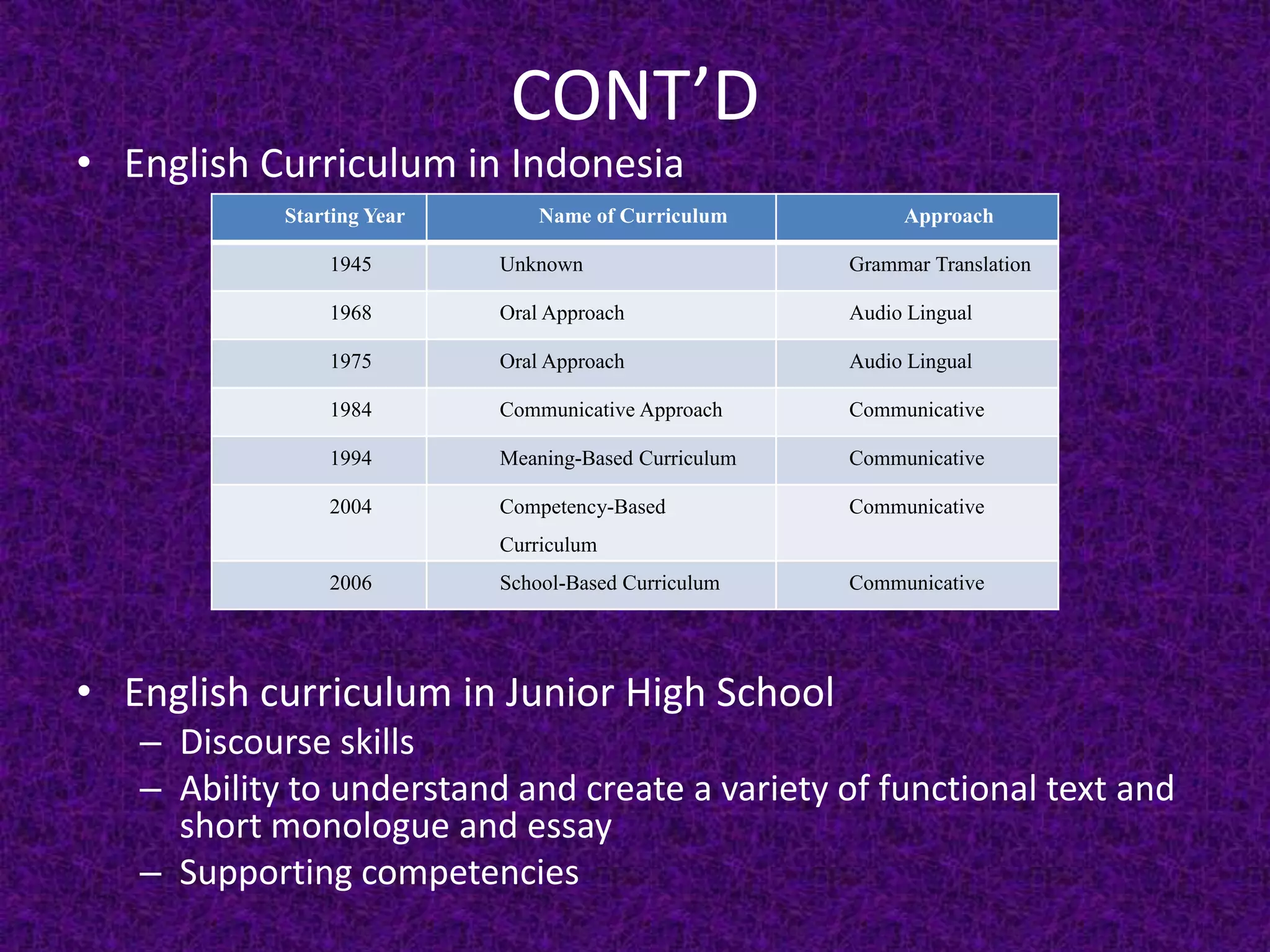
• English Curriculum in Indonesia
            Starting Year       Name of Curriculum          Approach

                1945        Unknown                    Grammar Translation

                1968        Oral Approach              Audio Lingual

                1975        Oral Approach              Audio Lingual

                1984        Communicative Approach     Communicative

                1994        Meaning-Based Curriculum   Communicative

                2004        Competency-Based           Communicative
                            Curriculum
                2006        School-Based Curriculum    Communicative


• English curriculum in Junior High School
   – Discourse skills
   – Ability to understand and create a variety of functional text and
     short monologue and essay
   – Supporting competencies
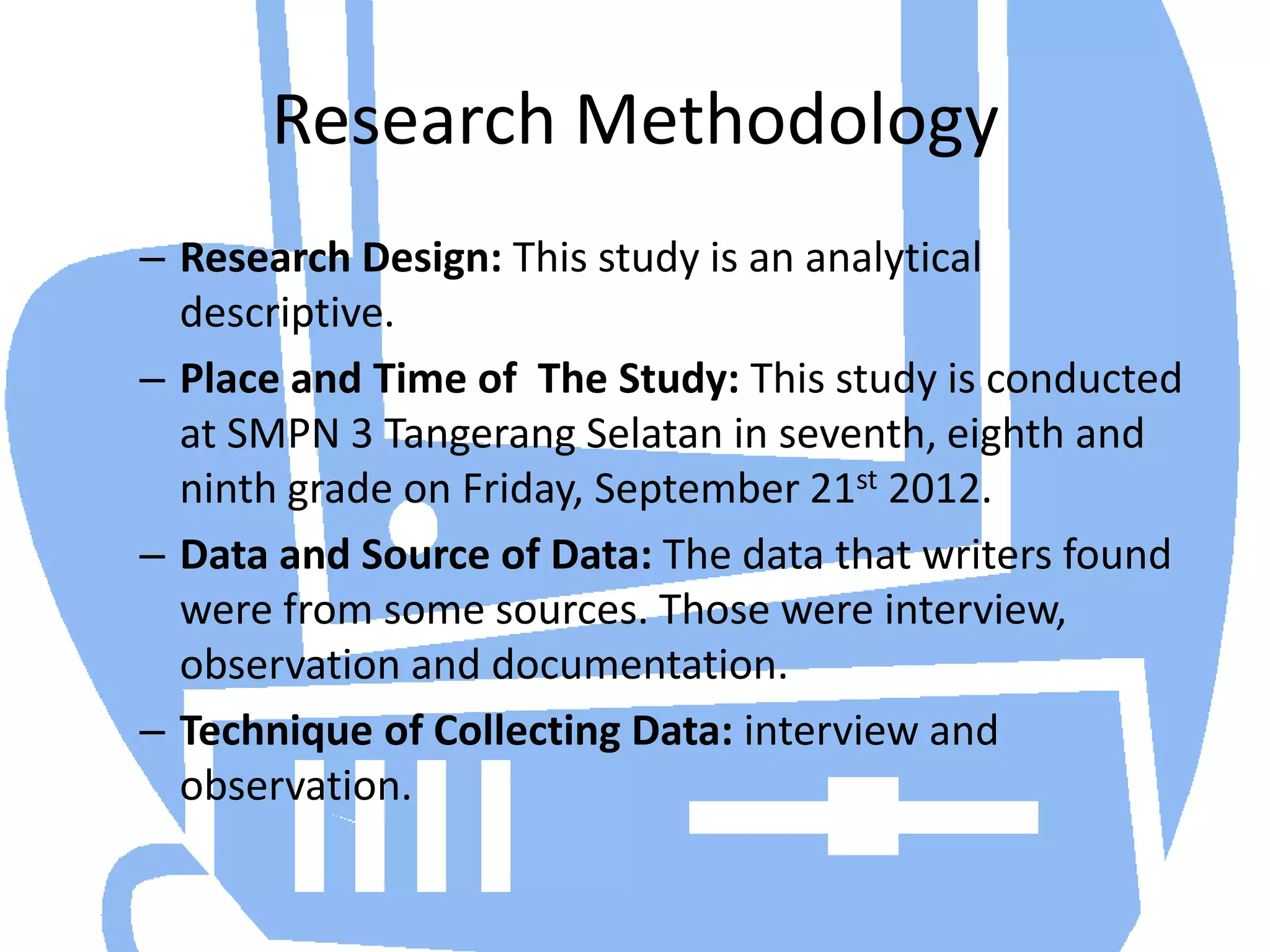
Research Methodology
– Research Design: This study is an analytical
  descriptive.
– Place and Time of The Study: This study is conducted
  at SMPN 3 Tangerang Selatan in seventh, eighth and
  ninth grade on Friday, September 21st 2012.
– Data and Source of Data: The data that writers found
  were from some sources. Those were interview,
  observation and documentation.
– Technique of Collecting Data: interview and
  observation.
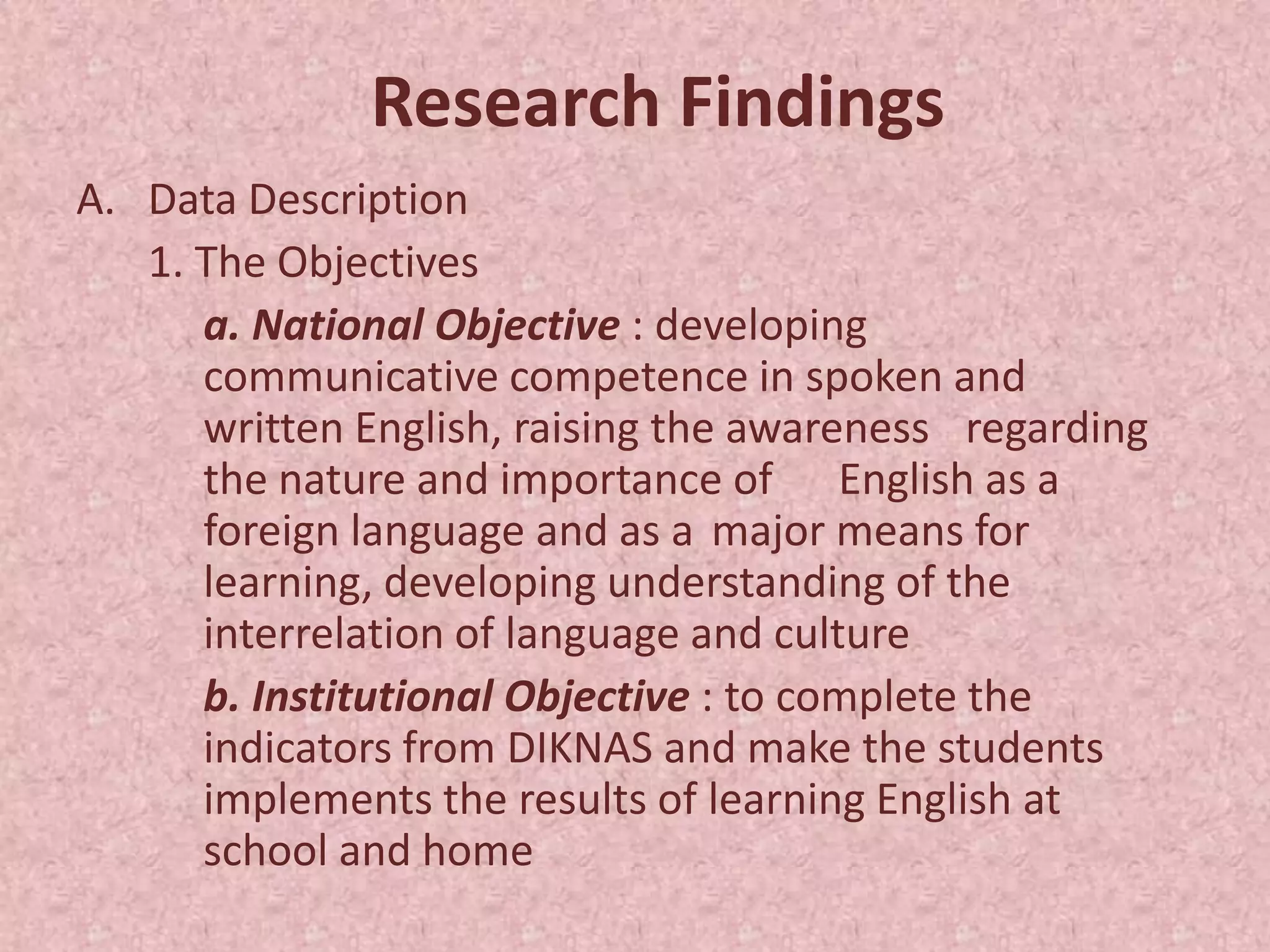
Research Findings
A. Data Description
   1. The Objectives
      a. National Objective : developing
      communicative competence in spoken and
      written English, raising the awareness regarding
      the nature and importance of English as a
      foreign language and as a major means for
      learning, developing understanding of the
      interrelation of language and culture
      b. Institutional Objective : to complete the
      indicators from DIKNAS and make the students
      implements the results of learning English at
      school and home
Cont’d
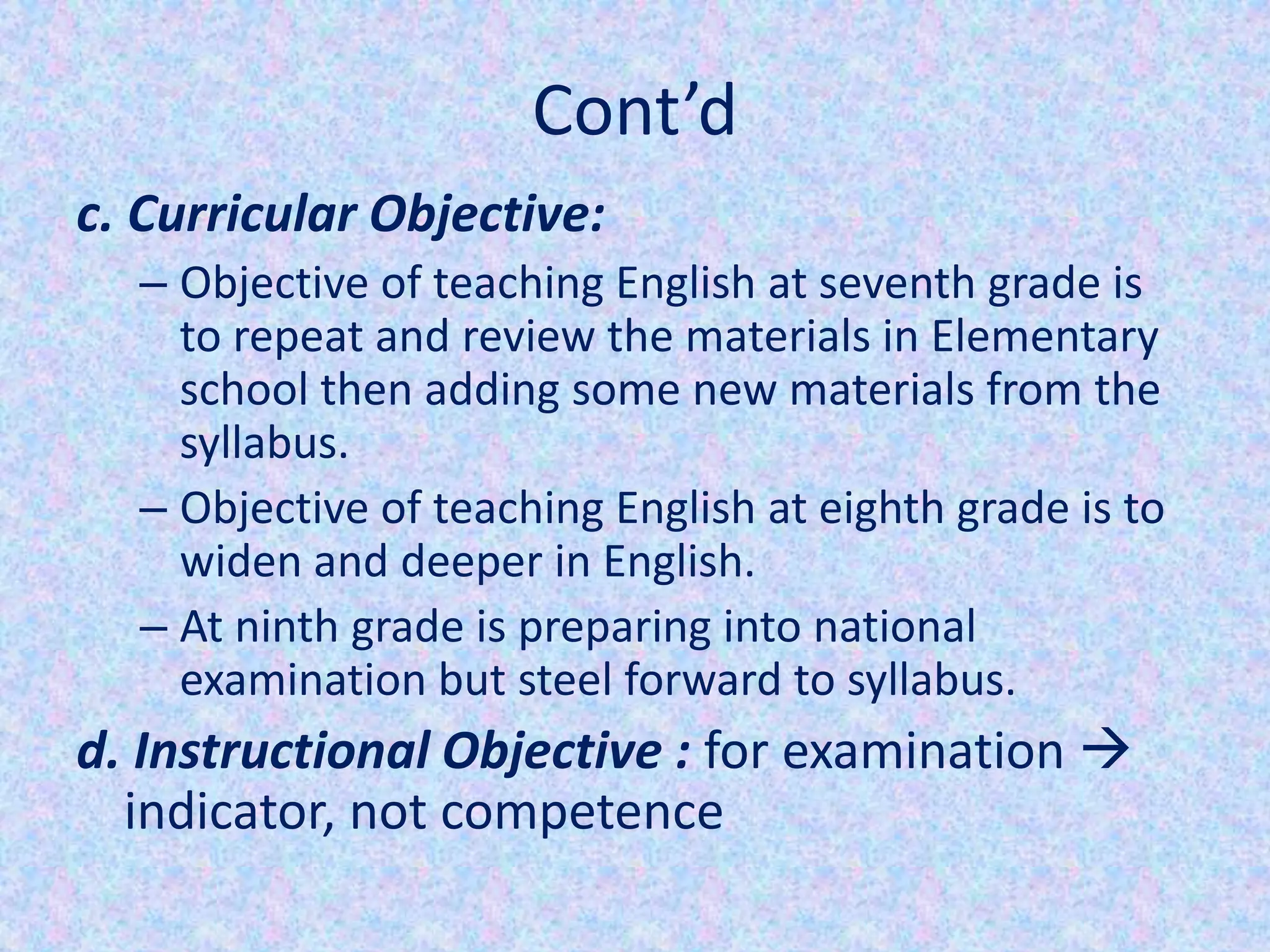
c. Curricular Objective:
  – Objective of teaching English at seventh grade is
    to repeat and review the materials in Elementary
    school then adding some new materials from the
    syllabus.
  – Objective of teaching English at eighth grade is to
    widen and deeper in English.
  – At ninth grade is preparing into national
    examination but steel forward to syllabus.
d. Instructional Objective : for examination 
  indicator, not competence
Cont’d
2. The Methods : explaining, answer-
  question, doing some exercises in student
  worksheet, with seldom discussion
3. The Materials : according to the classes
  (regular, bilingual, and acceleration).
  Authentic and non-authentic materials
4. The Evaluation: practice in class, written
  test, and oral test
Cont’d
B. Data Analysis
  1. The Objective : SMPN 3 Tangerang Selatan is
  public school which the curriculum is following
  the government’s curriculum
  2. The Method : student-centered
  (interview), teacher waits for students’ questions
  then explaining
  3. The Materials : Authentic and non-authentic
  materials
  4. The Evaluation : practice in class, written
  test, and oral test
The implementation of english curriculum in tefl

The implementation of english curriculum in tefl

  • 1.
    Qisti Prawulandari 109014000008 Siti Nurfajri Subharani 109014000011
  • 2.
    THE IMPLEMENTATION OF ENGLISHCURRICULUM IN TEFL AT SMPN 3 TANGERANG SELATAN
  • 3.
    INTRODUCTION • Background ofStudy – The important of language – The status of English in Indonesia – English curriculum in Indonesian Education System • Problem Formulations – Is English Curriculum implemented properly in Teaching English as a Foreign language at SMPN 3 Tangerang? – How is English Curriculum implemented in Teaching English as Foreign Language (TEFL) at SMPN 3 Tangerang?
  • 4.
    RELATED LITERATURE • Accordingto Renandya (2000) "Indonesia, a former Dutch colony, used to emphasize the teaching of Dutch . . . . The movement towards English as a foreign language began at independence, and English is now the main foreign language being learned in Indonesia. English is taught for eight or nine years from primary school (from Grade 4 or 5) through high school.” • English as a Foreign Language (EFL) is commonly related to the speaker who studies different native languages.  TEFL
  • 5.
    CONT’D • Curriculum :perspective and descriptive • Undang-Undang No. 20 year 2003 about the National Education System, “Kurikum adalah seperangkat rencana dan pengaturan mengenai isi dan bahan pelajaran serta cara yang digunakan sebagai pedoman penyelenggaraan kegiatan pembelajaran untuk mencapai tujuan pendidikan tertentu.” • Components of Curriculum – The objectives (national, institutional, curricular, instructional) – The materials – The methods – The evaluations (diagnostic, formative, summative)
  • 6.
    CONT’D • English Curriculumin Indonesia Starting Year Name of Curriculum Approach 1945 Unknown Grammar Translation 1968 Oral Approach Audio Lingual 1975 Oral Approach Audio Lingual 1984 Communicative Approach Communicative 1994 Meaning-Based Curriculum Communicative 2004 Competency-Based Communicative Curriculum 2006 School-Based Curriculum Communicative • English curriculum in Junior High School – Discourse skills – Ability to understand and create a variety of functional text and short monologue and essay – Supporting competencies
  • 7.
    Research Methodology – ResearchDesign: This study is an analytical descriptive. – Place and Time of The Study: This study is conducted at SMPN 3 Tangerang Selatan in seventh, eighth and ninth grade on Friday, September 21st 2012. – Data and Source of Data: The data that writers found were from some sources. Those were interview, observation and documentation. – Technique of Collecting Data: interview and observation.
  • 8.
    Research Findings A. DataDescription 1. The Objectives a. National Objective : developing communicative competence in spoken and written English, raising the awareness regarding the nature and importance of English as a foreign language and as a major means for learning, developing understanding of the interrelation of language and culture b. Institutional Objective : to complete the indicators from DIKNAS and make the students implements the results of learning English at school and home
  • 9.
    Cont’d c. Curricular Objective: – Objective of teaching English at seventh grade is to repeat and review the materials in Elementary school then adding some new materials from the syllabus. – Objective of teaching English at eighth grade is to widen and deeper in English. – At ninth grade is preparing into national examination but steel forward to syllabus. d. Instructional Objective : for examination  indicator, not competence
  • 10.
    Cont’d 2. The Methods: explaining, answer- question, doing some exercises in student worksheet, with seldom discussion 3. The Materials : according to the classes (regular, bilingual, and acceleration). Authentic and non-authentic materials 4. The Evaluation: practice in class, written test, and oral test
  • 11.
    Cont’d B. Data Analysis 1. The Objective : SMPN 3 Tangerang Selatan is public school which the curriculum is following the government’s curriculum 2. The Method : student-centered (interview), teacher waits for students’ questions then explaining 3. The Materials : Authentic and non-authentic materials 4. The Evaluation : practice in class, written test, and oral test