The HR Audit :
HR Alignment with
Business Strategy
Greater Valley Forge SHRM
April 19th, Dinner Presentation
Stephanie Kindt, Esq.
Agenda
 Understand the process of conducting a strategic HR audit.
 Discuss the difference between a strategic HR audit and a
functional/operational HR audit
 Understand & utilize the HR audit report to implement change.
 Make a strong business case to senior leadership to implement
recommendations of an HR Audit Report.
Why an HR Audit?
The purpose of the HR Audit is to conduct an in depth analysis
of the HR function to identify areas of strength and weakness.
Conducting an audit involves comprehensive look at the
services and value HR brings to an organization.
 Merger
 Recent litigation
 Recent change in strategy
 Cost reduction goals
 Organizational Restructuring
 Perception that HR is not meeting needs
 Part of a performance improvement
program
 HR’s own need to improve operational
efficiency and organizational
effectiveness
What are the Drivers?
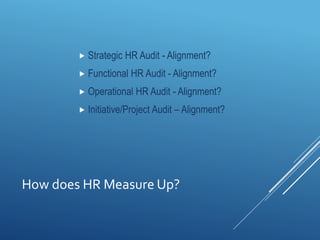
How does HR Measure Up?
 Strategic HR Audit - Alignment?
 Functional HR Audit - Alignment?
 Operational HR Audit - Alignment?
 Initiative/Project Audit – Alignment?
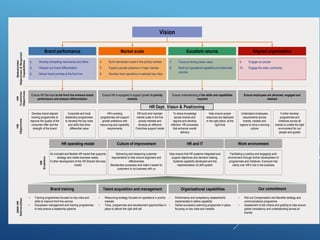
2008HR
Deliverables
 Training programmes focused on key roles and
skills to improve front line service
 Succession management and training programmes
to help ensure a leadership pipeline
Stakeholder
Objectives&Required
Capabilities
HR
Enablers
An included and flexible HR model that supports
strategy and meets business needs.
Further development of the HR Shared Services
model
Delivering and measuring customer
requirements to help ensure alignment and
effectiveness
Standardise processes and make it easier for
customers to do business with us
Help ensure that HR systems integrated and
support objectives and decision making.
Systems capability developed and the
implementation of LMS system
Facilitating a positive and engaging work
environment through further development of
programmes and initiatives. Everyone has
clarity over HR’s role in the business
HR and IT Work environmentCulture of improvementHR operating model
HR
Objectives
Brand training Organizational capabilitiesTalent acquisition and management Our commitment
 Resourcing strategy focused on operations in priority
markets
 Tools, programmes and development opportunities in
place to deliver the right skill set
 Performance and competency assessments
implemented to define capability
 Global succession planning programme in place,
focusing on key roles and markets
 Roll out Compensation and Benefits strategy and
communications programme
 Assessment of job criteria and grading to help ensure
global consistency and understanding across all
brands
Develop brand aligned
training programmes to
improve the quality of the
consumer offer and the
strength of the brand
Corporate and local
leadership programmes
to develop the key roles
and skills that drive
differential value
HR’s existing
programmes will support
growth ambitions with
resourcing and capability
requirements
Help ensure proper
resources are deployed
in the right place, at the
right time
To share knowledge
across brands and
regions and develop
effective HR processes
that enhance overall
delivery
Further develop
programmes and
initiatives across all
brands to create the right
environment for our
people and guests
Understand employees
requirements across
brands, models and
regions to drive a winning
culture
Ensure HR Services to the front line enhance brand
performance and sharpen differentiation
Ensure HR is equipped to support growth in priority
markets
Ensure understanding of the skills and capabilities
required
Ensure employees are attracted, engaged and
retained
HR build and maintain
market scale in the five
priority markets and
develop an effective
Franchise support model
Brand performance Market scale Excellent returns Aligned organization
4. Develop compelling new brands and offers
5. Sharpen our brand differentiation
6. Deliver brand promise at the front line
4. Build mainstream scale in five priority markets
5. Expand upscale presence in major markets
6. Develop more operations in selected key cities
7. Focus on driving owner value
8. Build our operational capability and share best
practice
9. Engage our people
10. Engage the wider community
Vision
HR Dept. Vision & Positioning
HR
Customer
Objectives
2008HR
Deliverables
 Training programmes focused on key roles and
skills to improve front line service
 Succession management and training programmes
to help ensure a leadership pipeline
Stakeholder
Objectives&Required
Capabilities
HR
Enablers
An included and flexible HR model that supports
strategy and meets business needs.
Further development of the HR Shared Services
model
Delivering and measuring customer
requirements to help ensure alignment and
effectiveness
Standardise processes and make it easier for
customers to do business with us
Help ensure that HR systems integrated and
support objectives and decision making.
Systems capability developed and the
implementation of LMS system
Facilitating a positive and engaging work
environment through further development of
programmes and initiatives. Everyone has
clarity over HR’s role in the business
HR and IT Work environmentCulture of improvementHR operating model
HR
Objectives
Brand training Organizational capabilitiesTalent acquisition and management Our commitment
 Resourcing strategy focused on operations in priority
markets
 Tools, programmes and development opportunities in
place to deliver the right skill set
 Performance and competency assessments
implemented to define capability
 Global succession planning programme in place,
focusing on key roles and markets
 Roll out Compensation and Benefits strategy and
communications programme
 Assessment of job criteria and grading to help ensure
global consistency and understanding across all
brands
Develop brand aligned
training programmes to
improve the quality of the
consumer offer and the
strength of the brand
Corporate and local
leadership programmes
to develop the key roles
and skills that drive
differential value
HR’s existing
programmes will support
growth ambitions with
resourcing and capability
requirements
Help ensure proper
resources are deployed
in the right place, at the
right time
To share knowledge
across brands and
regions and develop
effective HR processes
that enhance overall
delivery
Further develop
programmes and
initiatives across all
brands to create the right
environment for our
people and guests
Understand employees
requirements across
brands, models and
regions to drive a winning
culture
Ensure HR Services to the front line enhance brand
performance and sharpen differentiation
Ensure HR is equipped to support growth in priority
markets
Ensure understanding of the skills and capabilities
required
Ensure employees are attracted, engaged and
retained
HR build and maintain
market scale in the five
priority markets and
develop an effective
Franchise support model
Brand performance Market scale Excellent returns Aligned organization
4. Develop compelling new brands and offers
5. Sharpen our brand differentiation
6. Deliver brand promise at the front line
4. Build mainstream scale in five priority markets
5. Expand upscale presence in major markets
6. Develop more operations in selected key cities
7. Focus on driving owner value
8. Build our operational capability and share best
practice
9. Engage our people
10. Engage the wider community
Vision
HR Dept. Vision & Positioning
HR
Customer
Objectives
StrategicAlignment
SelfAssessment
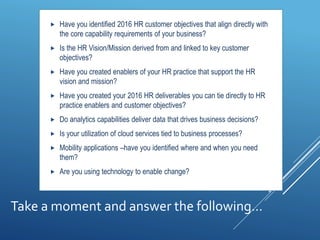
Take a moment and answer the following…
 Have you identified 2016 HR customer objectives that align directly with
the core capability requirements of your business?
 Is the HR Vision/Mission derived from and linked to key customer
objectives?
 Have you created enablers of your HR practice that support the HR
vision and mission?
 Have you created your 2016 HR deliverables you can tie directly to HR
practice enablers and customer objectives?
 Do analytics capabilities deliver data that drives business decisions?
 Is your utilization of cloud services tied to business processes?
 Mobility applications –have you identified where and when you need
them?
 Are you using technology to enable change?
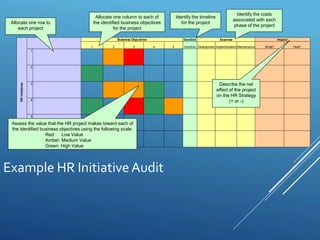
Duration
1 2 3 4 5 (months) Development Implementation Maintenance What? How?
1
2
3
4
5
6
Impact
HRInitiatives
Business Objectives Expense
Allocate one row to
each project
Allocate one column to each of
the identified business objectives
for the project
Identify the timeline
for the project
Identify the costs
associated with each
phase of the project
Describe the net
effect of the project
on the HR Strategy
(+ or -)
Assess the value that the HR project makes toward each of
the identified business objectives using the following scale:
Red: Low Value
Amber: Medium Value
Green: High Value
Example HR InitiativeAudit
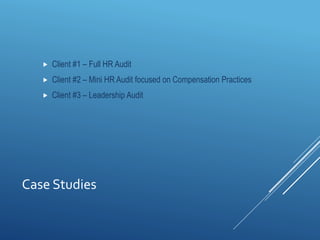
Case Studies
 Client #1 – Full HR Audit
 Client #2 – Mini HR Audit focused on Compensation Practices
 Client #3 – Leadership Audit
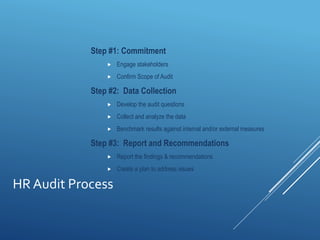
HR Audit Process
Step #1: Commitment
 Engage stakeholders
 Confirm Scope of Audit
Step #2: Data Collection
 Develop the audit questions
 Collect and analyze the data
 Benchmark results against internal and/or external measures
Step #3: Report and Recommendations
 Report the findings & recommendations
 Create a plan to address issues
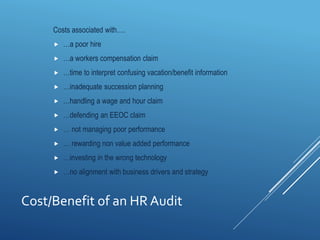
Cost/Benefit of an HR Audit
Costs associated with….
 …a poor hire
 …a workers compensation claim
 …time to interpret confusing vacation/benefit information
 …inadequate succession planning
 …handling a wage and hour claim
 …defending an EEOC claim
 … not managing poor performance
 … rewarding non value added performance
 …investing in the wrong technology
 …no alignment with business drivers and strategy
Q&A
Presentation Bonus: HR Audit Guidebook
Overview Guidebook
 Overview Conducting an HR Audit
 Leadership Audit Process Overview
 Sample Stakeholder Questions
 Sample Document Request list
 Links to Operational/Functional HR Audit
Questions assessing alignment by function
<insert link>
ThankYou

The HR Audit – GVFSHRM4.19.16

  • 1.
    The HR Audit: HR Alignment with Business Strategy Greater Valley Forge SHRM April 19th, Dinner Presentation Stephanie Kindt, Esq.
  • 2.
    Agenda  Understand theprocess of conducting a strategic HR audit.  Discuss the difference between a strategic HR audit and a functional/operational HR audit  Understand & utilize the HR audit report to implement change.  Make a strong business case to senior leadership to implement recommendations of an HR Audit Report.
  • 3.
    Why an HRAudit? The purpose of the HR Audit is to conduct an in depth analysis of the HR function to identify areas of strength and weakness. Conducting an audit involves comprehensive look at the services and value HR brings to an organization.
  • 4.
     Merger  Recentlitigation  Recent change in strategy  Cost reduction goals  Organizational Restructuring  Perception that HR is not meeting needs  Part of a performance improvement program  HR’s own need to improve operational efficiency and organizational effectiveness What are the Drivers?
  • 5.
    How does HRMeasure Up?  Strategic HR Audit - Alignment?  Functional HR Audit - Alignment?  Operational HR Audit - Alignment?  Initiative/Project Audit – Alignment?
  • 6.
    2008HR Deliverables  Training programmesfocused on key roles and skills to improve front line service  Succession management and training programmes to help ensure a leadership pipeline Stakeholder Objectives&Required Capabilities HR Enablers An included and flexible HR model that supports strategy and meets business needs. Further development of the HR Shared Services model Delivering and measuring customer requirements to help ensure alignment and effectiveness Standardise processes and make it easier for customers to do business with us Help ensure that HR systems integrated and support objectives and decision making. Systems capability developed and the implementation of LMS system Facilitating a positive and engaging work environment through further development of programmes and initiatives. Everyone has clarity over HR’s role in the business HR and IT Work environmentCulture of improvementHR operating model HR Objectives Brand training Organizational capabilitiesTalent acquisition and management Our commitment  Resourcing strategy focused on operations in priority markets  Tools, programmes and development opportunities in place to deliver the right skill set  Performance and competency assessments implemented to define capability  Global succession planning programme in place, focusing on key roles and markets  Roll out Compensation and Benefits strategy and communications programme  Assessment of job criteria and grading to help ensure global consistency and understanding across all brands Develop brand aligned training programmes to improve the quality of the consumer offer and the strength of the brand Corporate and local leadership programmes to develop the key roles and skills that drive differential value HR’s existing programmes will support growth ambitions with resourcing and capability requirements Help ensure proper resources are deployed in the right place, at the right time To share knowledge across brands and regions and develop effective HR processes that enhance overall delivery Further develop programmes and initiatives across all brands to create the right environment for our people and guests Understand employees requirements across brands, models and regions to drive a winning culture Ensure HR Services to the front line enhance brand performance and sharpen differentiation Ensure HR is equipped to support growth in priority markets Ensure understanding of the skills and capabilities required Ensure employees are attracted, engaged and retained HR build and maintain market scale in the five priority markets and develop an effective Franchise support model Brand performance Market scale Excellent returns Aligned organization 4. Develop compelling new brands and offers 5. Sharpen our brand differentiation 6. Deliver brand promise at the front line 4. Build mainstream scale in five priority markets 5. Expand upscale presence in major markets 6. Develop more operations in selected key cities 7. Focus on driving owner value 8. Build our operational capability and share best practice 9. Engage our people 10. Engage the wider community Vision HR Dept. Vision & Positioning HR Customer Objectives 2008HR Deliverables  Training programmes focused on key roles and skills to improve front line service  Succession management and training programmes to help ensure a leadership pipeline Stakeholder Objectives&Required Capabilities HR Enablers An included and flexible HR model that supports strategy and meets business needs. Further development of the HR Shared Services model Delivering and measuring customer requirements to help ensure alignment and effectiveness Standardise processes and make it easier for customers to do business with us Help ensure that HR systems integrated and support objectives and decision making. Systems capability developed and the implementation of LMS system Facilitating a positive and engaging work environment through further development of programmes and initiatives. Everyone has clarity over HR’s role in the business HR and IT Work environmentCulture of improvementHR operating model HR Objectives Brand training Organizational capabilitiesTalent acquisition and management Our commitment  Resourcing strategy focused on operations in priority markets  Tools, programmes and development opportunities in place to deliver the right skill set  Performance and competency assessments implemented to define capability  Global succession planning programme in place, focusing on key roles and markets  Roll out Compensation and Benefits strategy and communications programme  Assessment of job criteria and grading to help ensure global consistency and understanding across all brands Develop brand aligned training programmes to improve the quality of the consumer offer and the strength of the brand Corporate and local leadership programmes to develop the key roles and skills that drive differential value HR’s existing programmes will support growth ambitions with resourcing and capability requirements Help ensure proper resources are deployed in the right place, at the right time To share knowledge across brands and regions and develop effective HR processes that enhance overall delivery Further develop programmes and initiatives across all brands to create the right environment for our people and guests Understand employees requirements across brands, models and regions to drive a winning culture Ensure HR Services to the front line enhance brand performance and sharpen differentiation Ensure HR is equipped to support growth in priority markets Ensure understanding of the skills and capabilities required Ensure employees are attracted, engaged and retained HR build and maintain market scale in the five priority markets and develop an effective Franchise support model Brand performance Market scale Excellent returns Aligned organization 4. Develop compelling new brands and offers 5. Sharpen our brand differentiation 6. Deliver brand promise at the front line 4. Build mainstream scale in five priority markets 5. Expand upscale presence in major markets 6. Develop more operations in selected key cities 7. Focus on driving owner value 8. Build our operational capability and share best practice 9. Engage our people 10. Engage the wider community Vision HR Dept. Vision & Positioning HR Customer Objectives
  • 7.
  • 8.
    Take a momentand answer the following…  Have you identified 2016 HR customer objectives that align directly with the core capability requirements of your business?  Is the HR Vision/Mission derived from and linked to key customer objectives?  Have you created enablers of your HR practice that support the HR vision and mission?  Have you created your 2016 HR deliverables you can tie directly to HR practice enablers and customer objectives?  Do analytics capabilities deliver data that drives business decisions?  Is your utilization of cloud services tied to business processes?  Mobility applications –have you identified where and when you need them?  Are you using technology to enable change?
  • 9.
    Duration 1 2 34 5 (months) Development Implementation Maintenance What? How? 1 2 3 4 5 6 Impact HRInitiatives Business Objectives Expense Allocate one row to each project Allocate one column to each of the identified business objectives for the project Identify the timeline for the project Identify the costs associated with each phase of the project Describe the net effect of the project on the HR Strategy (+ or -) Assess the value that the HR project makes toward each of the identified business objectives using the following scale: Red: Low Value Amber: Medium Value Green: High Value Example HR InitiativeAudit
  • 10.
    Case Studies  Client#1 – Full HR Audit  Client #2 – Mini HR Audit focused on Compensation Practices  Client #3 – Leadership Audit
  • 11.
    HR Audit Process Step#1: Commitment  Engage stakeholders  Confirm Scope of Audit Step #2: Data Collection  Develop the audit questions  Collect and analyze the data  Benchmark results against internal and/or external measures Step #3: Report and Recommendations  Report the findings & recommendations  Create a plan to address issues
  • 12.
    Cost/Benefit of anHR Audit Costs associated with….  …a poor hire  …a workers compensation claim  …time to interpret confusing vacation/benefit information  …inadequate succession planning  …handling a wage and hour claim  …defending an EEOC claim  … not managing poor performance  … rewarding non value added performance  …investing in the wrong technology  …no alignment with business drivers and strategy
  • 13.
  • 14.
    Presentation Bonus: HRAudit Guidebook Overview Guidebook  Overview Conducting an HR Audit  Leadership Audit Process Overview  Sample Stakeholder Questions  Sample Document Request list  Links to Operational/Functional HR Audit Questions assessing alignment by function <insert link>
  • 15.

Editor's Notes

  • #2 Introduce self 1st 10 years –GSK – IO Pscyh, Law Degree 2nd 10 years – Private Practice, Founder of a charter school, Capital Campaign, Board Pres, lobbyist 3rd 10 years – KPMG – just started!
  • #4 Strategic HR Audit – an analysis of the link between HR activities and business purpose, reviewing the strategic alignment of HR with key business drivers – for the purposes of continuous improvement and growth within your industry Functional/Operational Audit – a review of the practices, policies and procedures of HR for legal/regulatory compliance. Conducting a functional/operational HR Audit is a show of good faith. Good faith means you are “evincing honesty, fairness, full communication of any hidden issues or information, and an absence of intent to harm other individuals or parties to the transaction. Good faith is an established legal principle that can limit your risk of fines and lawsuits.  There are established legal precedents for reducing and/or eliminating damages based on good faith efforts to identify and correct issues. Be clear on the business purpose behind doing an audit. Operational audits typically done by external folks, strategic audits typically done by senior HR staff with assistance. Objectives behind an HR audit should be clear at the outset.
  • #5 The reasons behind an audit should be clarified and confirmed, and should drive the audit design. Once size will not fit all
  • #6 Strategic Alignment – HR Goals created from strategic business goals Functional Alignment – HR Goals as drivers of organizational structure, HR policies, practices, procedures – the interconnected nature of HR Drivers and businesses drivers in the form of HR Processes – this is really where your 20% customized business value is delivered. Operational Alignment – HR Goals as drivers of technology, HR skills, Line manager role – are you compliant? Paperwork, IC issues, Recruiting/Hiring practices, reward & recognition systems, postings, - from a legal perspective, but also from a business driver perspective - All three are interdependent and interconnected in a mature HR organization. The HR guidebook which you will receive a link to at the close of this program includes sample questions for an HR Functional and operational audit. I have a sample for you tonight which is a mini self assessment for you to take a look at now and determine how well your own HR function is strategically aligned with your business goals. The full HR audit report would provide results on HR’s strategic, functional and operational alignment.
  • #7 Strategic, functional and operational alignment don’t always coincide. 80% of HR functions standard …20% is your business differentiation – that is where HR’s value proposition sits You can have efficient systems that are cost effective and still not be delivering value on that 20%.
  • #8 Have them take moment and answer the following 6 questions on HR alignment with strategic goals – have them rate themselves and share at there table for 5 minutes.
  • #9 If you answered no to any one of these questions – there is room for improving your HR Alignment to Business Objectives Discuss how there is a link that will be sent that has examples of operational and functional HR materials… online versions from various organizations – but again… customization of the Audit process is key… ensuring your are gathering the information to answer your audit needs/business purpose for conducting the audit.
  • #10 The template can be presented and populated or refined in a workshop setting in order to get input from several stakeholder groups. When carried out in a workshop setting, with representatives from the business present, the assessment of business value can lead to useful open discussion. The results of the assessment should be reviewed and discussed with relevant stakeholders. Initiatives or projects that are not aligned with business objectives should be identified and options for improvement developed.
  • #11 Tell the story of each client – make it funny and engaging.. Talk about Harvey, and Bob, and Rabbi Deborah – use fake names Client 1: Mid sized company looking at HR function across the organization, including organizational structure overall -commitment, interviews, documentation review, 1st draft report, 2nd draft report, senior executive commitment to recommendations and priorities, -implementation planning, implementation team, design, review, testing, implementation, ongoing commitment and maintenance. Client 2: Initial HR audit – lead to staffing changes, lead to leadership audit & all staff retreat. Leadership Audit – strategy plan /leadership competency gap analysis, Leadership interviews, personality assessment, emotional intelligence assessment and personal development goals. Report and recommendations. Client 3: mini compensation analysis – interviews, data collection, comparative reports, strategic plan review – report and recommendations to be in line with strategic goals, remain competitive and address internal inconsistencies.
  • #12 Describe each step as it relates to the case examples
  • #13 The costs of an assessment and the resulting transformation is worth it. Cost of a poor hire = 1 in 4 companies reported over 50K – an ROI of 298% (greenjobinterivew.com) Average cost of a WC claim – 50K direct, 27K indirect costs (premium hikes) cavignac.com (insurers) FSLA claim 7K per, with the largest court settlements reaching 35 million – 2013 (HR morning) EEOC claim – 75K -250K (Workforce) Cost of poor performers – 105 billion in the US – global study by Inc. – impact the work of others yielding a cost of 500K per year! (Kinesisinc 2014 study) Comparison of good vs. mediocre performance averages out to be about 50% of gross pay (Hrzone.com) Poor HR technology investment – 800K ( Top 25 management mistakes 2001) Cost of poor alignment – the difference between success/failure of business - David Ulrich
  • #14 Goal: If there is a merger in the organizations future – you want your HR Function to have the more mature processes and practices direct linked to business performance Everyday excellence at low cost – focus on higher efficiencies, harmonized processes, and low cost delivery – what is your 20% difference This version of the HR Audit aligns with KPMG’s Assessment Phase of the HR Transformation methodology. KPMG has just received Vanguard status for its depth and breadth of services offerings. The assessment phase is a first step in deploying KPMG’s Powered HR which is a fully integrated, end-to-end technology-enabled HR transformation methodology. It was designed to deliver a pre-built, lower cost, higher value next generation HR function and is awesome.